

Submitted:
09 June 2026
Posted:
10 June 2026
You are already at the latest version
Abstract
Background: Tuberculosis (TB) remains the leading cause of death among persons with advanced HIV disease (AHD) in high HIV-burden settings. Digital chest X-ray (dCXR) with computer-aided detection (CAD) is a promising tool to overcome human resource constraints and improve TB case detection. This study evaluates the real-world im-plementation and performance of dCXR/CAD for TB screening within a specialized AHD clinic in Maputo, Mozambique. Methods: We conducted a retrospective cohort analysis of 487 new AHD patients at Centro de Referência do Alto Maé (CRAM) from October 2023 to September 2024. Of these, 238 underwent dCXR with CAD interpreta-tion. All patients underwent systematic TB screening according to Ministry of Health (MoH) guidelines. Using the recorded diagnosis of TB (bacteriologically confirmed or clinically diagnosed) as the reference standard, we calculated the sensitivity, specifici-ty, positive predictive value (PPV), and negative predictive value (NPV) of the nation-ally adopted CAD threshold (≥0.5). Results: Among 238 AHD patients screened with CAD, 116 (49%) were diagnosed with TB. At the ≥0.5 threshold, sensitivity was 50% (58/116; 95% CI: 41–59), specificity 92% (112/122; 95% CI: 85–96), PPV 85% (58/68; 95% CI: 75–92), and NPV 65.9% (112/170; 95% CI: 58–73). TB diagnosis rates increased sharply with CAD score: 30% (43/143) in normal, 52% (15/27) in abnormal non-suggestive, and 85% (58/68) in suggestive cases. Bacteriological confirmation was low across all groups (19–26%), reflecting reliance on clinical diagnosis. Conclu-sion: Integrating dCXR/CAD into AHD care is feasible and identifies a high TB burden. However, at the adopted threshold of ≥0.5, CAD demonstrated high specificity but low sensitivity (50%) in this population, missing half of all TB cases. These findings suggest that CAD functions better as a confirmatory decision-support tool than a standalone screening test in AHD. Threshold optimization for this specific population warrants prospective evaluation. Implementation challenges — including fragmented systems and lack of dedicated human resources — must be addressed to realize CAD's full po-tential in TB programs.
Keywords:
tuberculosis
; HIV
; advanced HIV disease
; artificial intelligence
; digital chest x-ray
; computer-aided detection
; implementation science
; mozambique
; retrospective cohort
; programmatic data
1. Introduction
1.1. The Dual Epidemic of TB and HIV in Mozambique
Mozambique faces a severe dual epidemic of HIV and tuberculosis (TB). With an estimated population of 33 million, the country has an adult HIV prevalence of 12.5% and an estimated TB incidence of 361 per 100,000 population [1]. HIV dramatically increases the risk of developing active TB, accelerates its progression, and complicates its diagnosis and treatment. Among people living with HIV (PLHIV), those with advanced HIV disease (AHD) defined by the World Health Organization (WHO) as a CD4 cell count <200 cells/mm3 or the presence of a WHO stage 3 or 4 defining illness are at the highest risk of mortality, with TB being the leading cause of death [2,3].
Despite scale-up of antiretroviral therapy (ART), late presentation to care for HIV and recurrent disengagement from treatment continue to pose significant challenges. In Mozambique, early mortality after ART initiation is high, often driven by undiagnosed opportunistic infections (OIs), principally TB [4]. The national TB case notification rate (334/100,000) closely mirrors the estimated incidence, suggesting a strong detection effort, yet gaps persist, particularly among high-risk subgroups like patients with AHD [1]. The low proportion of bacteriologically confirmed TB (43%) indicates substantial reliance on clinical diagnosis, which can be non-specific in AHD, leading to both over- and under-treatment [1].
1.2. Challenges in TB Diagnosis Among Persons with AHD
Diagnosing TB in AHD is notoriously difficult. Classic symptoms may be absent, and the radiological presentation on chest X-ray (CXR) can be atypical, non-cavitary, and disseminated, often resembling other pulmonary conditions common in HIV— or the chest X-ray may appear entirely normal [3,5]. Sputum-based diagnostic tests, such as Xpert MTB/RIF, have lower sensitivity in this population, especially in those with low CD4 counts and extrapulmonary or paucibacillary disease [6,7]. This diagnostic complexity necessitates a high index of suspicion and a comprehensive screening approach that integrates clinical, radiological, and microbiological tools.
1.3. The Role of Digital Chest X-Ray and Computer-Aided Detection
Digital chest X-ray (dCXR) has emerged as a critical screening tool for TB. It is fast, non-invasive, and can detect abnormalities suggestive of pulmonary TB even in subclinical cases. When paired with artificial intelligence (AI) in the form of computer-aided detection (CAD) software, dCXR can automate image interpretation, providing a standardized, reproducible “score” or probability of TB. This is particularly valuable in settings with a shortage of skilled radiologists, by helping to scale and decentralize screening and prioritize individuals for further diagnostic evaluation [8].
The ideal CAD score threshold may vary by setting, depending on clinical population characteristics, the background burden of non-TB lung disease, and the intended role of CAD in the diagnostic pathway. The WHO now recommends CAD as an alternative to human reading for screening and triage [9].
However, its performance and optimal implementation in real-world, high-HIV-burden clinical settings outside of controlled study conditions require further evaluation. Key questions remain about the optimal CAD score threshold for a given setting, its performance in AHD populations where TB presentation and radiological findings are frequently atypical — or entirely absent —and the practical challenges of integrating this technology into routine clinical workflows.
1.4. The CRAM Clinic as a Natural Implementation Setting
The Centro de Referência do Alto Maé (CRAM), managed by the International Training and Education Center for Health (I-TECH) in Maputo, serves as a centre of excellence for the management of AHD in Mozambique. It provides rapid, comprehensive, same-day screening and initiation of treatment for major OIs, including Cryptococcal meningitis [10] and TB [11,12]. The clinic’s patient population consists of individuals referred with very low CD4 counts, ART treatment failure requiring HIV-1 genotyping [13], or severe comorbidities, and represents a group at extreme risk for TB and mortality [14,15,16]. In 2023, with USAID support, CRAM installed a dCXR machine and CAD software, making it the only primary-level outpatient facility in Maputo city with this capacity.
1.5. Study Rationale and Objectives
Recent studies have evaluated CAD among PLHIV in various settings. Burke et al. demonstrated that CAD combined with urine LAM improved inpatient TB diagnosis [17]. MacPherson et al. found CAD screening increased TB case detection among adults with cough in Malawi [18]. Olotu et al. reported high CAD uptake in Mozambican prisons [19]. Moodley et al. and Kagujje et al. evaluated CAD performance in primary care and among persons with prior TB, respectively [20,21]. Qin et al. and Nzimande et al. provided multi-country and regional validation data [22,23].
However, none of these studies focused specifically on persons with advanced HIV disease (CD4 <200 cells/mm3 or WHO stage 3/4), a group with atypical radiological presentations and particularly high TB burden. Moreover, while efficacy studies have demonstrated CAD’s accuracy in controlled settings, data on its real-world effectiveness within routine, resource-constrained TB/HIV programs remain scarce. Our study addresses both gaps by providing the first dedicated evaluation of CAD performance and threshold selection in an AHD cohort in a high-burden African setting, using routinely collected programmatic data. Guided by implementation science frameworks that emphasize understanding context, processes, and outcomes [24], this retrospective evaluation:
- Described the integration process of dCXR/CAD into the routine clinical workflow of a specialized AHD clinic.
- Evaluated the diagnostic yield of dCXR/CAD among patients with AHD, stratified by CAD result category.
- Assessed the performance (sensitivity and specificity) of the nationally adopted CAD threshold (≥0.5) in the AHD population.
- Listed operational challenges, facilitators, and insights from the first year of implementation.
This analysis provides critical programmatic evidence to inform national policy on CAD use, optimize clinical algorithms for TB screening in AHD, and improve implementation strategies for novel diagnostic technologies in low-resource settings.
2. Materials and Methods
2.1. Evaluation Design and Setting
This was a retrospective cohort analysis of routinely collected clinical and programmatic data. The study was conducted at the CRAM clinic, a specialized outpatient service for AHD within the Alto Maé Health Center in Maputo City, Mozambique. CRAM operates as a referral center for complex HIV cases from across the city’s primary health facilities and hospitals [11].
2.2. Evaluation Population and Cohort
The analysis focused on one cohort screened for TB over a 12-month period (October 2023 – September 2024), consisting of all new HIV+ patients admitted to CRAM during the study period (N=487). Admission criteria included CD4 count <100 cells/mm3 (or <200 if symptomatic), Kaposi’s sarcoma (KS), second-line ART failure, or complex comorbidities. To contextualize CAD performance, we used data from 2,695 patients undergoing dCXR at Alto Maé Health Centre — a primary-level facility serving both HIV-positive and HIV-negative patients — as a proxy for the general population undergoing CXR in this setting. This reference cohort includes the AHD patients described in this study, as both groups used the same machine during the same period.
2.3. The Intervention: dCXR with CAD Integration
The intervention was the integration of systematic dCXR screening with CAD interpretation into the clinic’s existing AHD care package.
A standalone digital X-ray machine was connected to qXR v4.0 (Qure.ai, India), one of six CAD software systems approved by the WHO for TB screening [25]. The CAD software analyses posterior-anterior dCXR images and assigns a score from 0 to 1, indicating the probability of TB-associated abnormalities. According to WHO TDR guidance on CAD calibration studies [25], this represents a triage threshold intended to prioritize individuals for confirmatory testing. The ≥0.5 threshold is the manufacturer’s default setting (qXR v4.0). The National TB Program (PNCT) adopted this threshold pending local calibration. We evaluated the performance of this threshold against recorded diagnosis of TB.
For AHD cohort, dCXR was part of the routine same-day admission assessment. The CAD result was available to clinicians alongside other diagnostic inputs (clinical assessment, Xpert MTB/RIF on sputum or other samples, and urine TB-LAM (performed according to national guidelines [recommended for all PLWH with CD4 <200 cells/mm3 in the outpatient setting). The final decision to initiate TB treatment was made by the clinical team based on a composite assessment.
2.4. Data Sources and variables
Data were extracted from the clinic’s electronic medical records and paper-based registers, which are part of routine national HIV and TB monitoring systems.
Independent variables: CAD result category (Invalid, Normal, Abnormal not suggestive of TB [score <0.5], Abnormal suggestive of TB [score ≥0.5]).
Primary outcome: Recorded diagnosis of TB (bacteriologically confirmed or clinically diagnosed).
Secondary outcome: bacteriological confirmation of TB (by Xpert MTB/RIF or culture).
2.5. Data Analysis
Descriptive statistics were used to characterize the cohort. Analysis was primarily focused on diagnostic yield and CAD performance metrics. For each CAD result category, we calculated: (1) Proportion of patients with recorded diagnosis of TB; and (2) Proportion of those with bacteriological confirmation. We also calculated sensitivity, specificity, PPV, and NPV for the CAD ≥0.5 threshold using the recorded diagnosis of TB as the reference standard.
Traditional sensitivity/specificity calculations against a perfect gold standard were not feasible, because most patients had a clinical diagnosis of TB and did not undergo exhaustive confirmatory testing (e.g., culture). Instead, the proportion of patients ultimately diagnosed and treated for TB was used as a pragmatic measure of CAD’s programmatic utility.
Data were managed and analysed using Microsoft Excel and Stata version 18.0.
2.6. Ethical Considerations
Ethical clearance was obtained from the Mozambican National Bioethics Committee for Health (IRB0002657 - Comité Nacional de Bioética para a Saúde, nr: 21/CNBS/2025) and the permission to perform this evaluation was also obtained from the Health Service of Maputo city (Serviço de Saúde da Cidade, N/Ref. no. 7002/2103/SSCM/2024).
3. Results
3.1. Context and Cohort Description
Between October 2023 and September 2024, 487 new patients were admitted to CRAM. The cohort comprised 53% men, with a median CD4 count at admission of 211 cells/mm3.The main reasons for admission were low CD4 count (40%), cryptococcal disease (11%), Kaposi’s sarcoma (23%), treatment failure (10%), and other medical complications (16%). The median CD4 of 211 cells/mm3 is higher than typically expected in an AHD cohort, which is partly explained by the fact that 23% of patients were admitted for Kaposi’s sarcoma — condition that defines AHD by WHO clinical stage regardless of CD4 count. Notably, 150 out of 487 (32%) of all new enrolees were ultimately diagnosed with TB and started on treatment, underscoring the high TB burden in this population. (Figure 1).
3.2. dCXR/CAD Screening Uptake
Among 487 new AHD patients, 238 (49%) underwent dCXR with CAD reading. The remaining 51% either did not receive a dCXR or their dCXR was not processed by the CAD software due to operational constraints (Figure 1).
3.3. dCXR/CAD Performance and TB Detection
3.3.1. dCXR/CAD Findings in the General Population
In the general population (both PLHIV and HIV-negative patients) screened at the nearby primary health facility (N=2,695), 90% (2,425/2,695) had valid dCXR/CAD results. Of those with a valid result, 43% (1,035/2,425) were interpreted as abnormal. Among these abnormal results, 54% (564/1,035) were flagged as suggestive of TB (CAD score ≥0.5), representing 23% (564/2,425) of all valid dCXR/CAD. This cohort provides a reference for CAD performance in the general population accessing radiography services in Maputo City. As both groups used the same machine during the same period, the AHD patients described in this study are included within this reference cohort; the comparison therefore serves only as a local reference for CAD positivity rates in the Maputo context, rather than a formal comparison between the two cohorts.
3.3.2. TB Detection by CAD Result Category in AHD Patients at CRAM
Among the 238 AHD patients screened with CAD at CRAM: 60% (143/238) had a normal CXR (score typically <0.1); 11% (27/238) had an abnormal CXR not suggestive of TB (score <0.5); 29% (68/238) had a CXR suggestive of TB (score ≥0.5).
TB diagnosis rates increased with CAD score (Table 2): 30% (43/143) among those with a normal result, 52% (15/27) among those with an abnormal non-suggestive result, and 85% (58/68) among those with a suggestive result.
Bacteriological confirmation was similarly low across all groups: 19% (8/43) in the normal group, 20% (3/15) in the non-suggestive group, and 22% (13/58) in the suggestive group. This confirms the high rate of clinical diagnosis of TB in AHD population (Table 1).
3.4. Diagnostic Performance of CAD ≥0.5 Threshold
The diagnostic performance of the manufacturer-recommended CAD threshold (≥0.5) was evaluated against the recorded diagnosis of TB. Table 2 presents the 2×2 contingency table with case and control classifications.

Table 2.
2×2 contingency table – CAD ≥0.5 threshold vs. TB diagnosis (reference standard).
|
TB Case (Recorded diagnosis of TB) |
Control (Not diagnosed with TB) |
Subtotal | |
| CAD Suggestive (≥0.5) | 58 (True Positive) | 10 (False Positive) | 68 |
| CAD Not Suggestive (<0.5) | 58 (False Negative) | 112 (True Negative) | 170 |
| Subtotal | 116 | 122 | 238 (Total) |
| Threshold ‘suggestive of TB’ = CAD score ≥0.5 | |||
From Table 2, the following performance metrics were calculated: Sensitivity;
Specificity; Positive Predictive Value (PPV); and Negative Predictive Value (NPV)
(Table 3)
3.4.1. Interpretation of Table 2 and Table 3:
At the current threshold of ≥0.5, CAD missed 58 of 116 TB cases (false negatives), resulting in a sensitivity of only 50%. However, among the 68 patients flagged as CAD-positive, 58 (85%) were true positives, highlighting a relatively high PPV (85%). The relatively low NPV (66%) indicates that a negative CAD result does not reliably rule out TB in this AHD population. The high specificity (92%) means that false positives are relatively less common (8%).
The mean CAD score across all patients varied by result category: 0.07 among those with a normal result (n=143), 0.34 among those with an abnormal but non-suggestive result (n=27), and 0.83 among those with a result suggestive of TB (n=68).
4. Discussion
This retrospective analysis of the first year of dCXR/CAD implementation at a reference AHD clinic in Mozambique provides real-world evidence on the promise and pitfalls of this technology in a high-burden, resource-constrained setting. The discussion is framed within the RE-AIM core domains of implementation science (Reach, Effectiveness, Adoption, Implementation, Maintenance) [24]
4.1. Reach and Adoption: Integrating Technology Into Routine Care
The reach of CAD screening among AHD patients was 49%, indicating that while the tool was adopted, its consistent application was limited. For AHD patients, the integration was into a complex, multi-faceted same-day assessment for high risk and sometimes critically ill individuals. Operational barriers such as the non-integrated system and lack of dedicated staff directly limited reach. This underscores a key implementation principle: even highly effective tools fail if the workflow integration is suboptimal [17]. Successful adoption requires not just technology but also process redesign and dedicated human resources to manage it.
4.2. Effectiveness: CAD Performance in Context: Confirmatory Rather than Triage Tool
The performance of CAD in this cohort reflects a pattern more consistent with a confirmatory adjunct than a triage tool. In a population where advanced HIV disease and a high background TB burden converge, the pre-test probability of TB is naturally elevated. A positive CAD result — with a PPV of 85%— adds meaningful diagnostic weight when clinical evaluation already points towards TB, supporting the decision to initiate treatment. However, the low sensitivity of 50% means that a negative result carries limited reassurance. Among AHD patients, 30% of those with a normal CAD result and 52% of those with an abnormal but non-suggestive result were ultimately diagnosed with TB. This reflects a well-recognized phenomenon: TB presentation in severely immunocompromised patients is frequently atypical — subtle, disseminated, or mimicking other opportunistic infections — and CAD algorithms trained on general population data may lack sensitivity for these patterns [5,10]. A non-suggestive CAD result should therefore not reduce clinical suspicion in a patient with advanced HIV disease.
4.3. Clinical Diagnosis Requires a Multi-Test Approach
Importantly, diagnosis in this population must rest on a constellation of findings rather than any single result. The low bacteriological confirmation rates in this cohort (19–22%) reinforce that clinicians need to integrate clinical signs, symptoms, and complementary tests — including urine TB-LAM — alongside CAD output [26].
4.4. Threshold Recalibration and Risk-Stratified Implementation in AHD
Among patients with an abnormal but non-suggestive result, the mean CAD score was 0.34 and 52% were ultimately diagnosed with TB, providing empirical grounds for reconsidering the current threshold in this population. Whether a lower threshold could reposition CAD closer to a triage role remains an important question. Lowering the threshold from 0.5 to 0.4, for example, would be expected to improve sensitivity — capturing a greater proportion of true TB cases — at the cost of reduced specificity and a likely decline in PPV. This trade-off could bring CAD’s performance profile more in line with the requirements of a triage tool, where the priority is to minimize missed cases and identify who needs confirmatory investigation, accepting a higher rate of false positives. Our data do not allow us to answer this question, but threshold optimization in this specific population deserves further investigation. Context-specific calibration of AI thresholds remains a recognised challenge in global health implementation [27]
The findings highlight the tension between fidelity to the manufacturer-recommended threshold (≥0.5) and the need for local adaptation [28]. For AHD patients, a lower CAD threshold combined with a predefined intensive workup protocol — Xpert, urine TB-LAM, ultrasound — could formalize this adaptation [29].
4.5. Challenges and Sustainability (Maintenance)
The identified challenges point to several threats to long-term sustainability. First, system fragmentation represents a critical bottleneck, as the disconnect between the X-ray machine and the CAD software necessitates manual image transfers and creates dependence on stable connectivity; therefore, investment in integrated, plug-and-play systems is important for scaling [30]. Second, a human resource gap exists because technology does not replace human input but rather reallocates it. A designated staff role for dCXR and CAD management is critical for consistent use and data quality [9]. Third, the lack of quality assurance systems poses a significant risk. For CAD to be trusted and improved, a national monitoring system and periodic recalibration against local patient outcomes are needed [22,25].
4.6. Limitations
This study has limitations inherent to retrospective programmatic data: missing data (especially for patients not receiving CAD), potential variability in clinical diagnostic criteria between clinicians, and the absence of a culture-confirmed gold standard. The sensitivity and specificity estimates we report are therefore reference-dependent and may overestimate performance if clinical diagnoses include false positives, or underestimate it if subclinical cases were missed. Patients referred for dCXR/CAD appeared to have a higher pretest probability for TB (49% TB diagnosis vs. 14% among those not screened with CAD), suggesting a selection bias. Importantly, this bias likely inflates PPV estimates, meaning that CAD’s confirmatory value may be lower in less selected populations. Whether the low sensitivity we report would improve or worsen under more systematic and less selective application of CAD remains uncertain and can only be answered through prospective evaluation with broader screening coverage. Finally, our findings apply to adults with AHD in a single urban site; generalizability to children with HIV or to more remote, lower-resource settings requires separate evaluation, though CRAM is likely representative of urban AHD cohorts in high-burden African settings [22,25].
5. Conclusions and Recommendations
The implementation of dCXR/CAD at CRAM confirms the high yield of systematic TB screening in AHD populations, while also revealing how its current application — using a general-population threshold — risks missing a significant number of TB cases among the most vulnerable patients while generating false positives in others. Based on these results and our experience implementing this technology, we recommend:
- For national programs: Conduct an urgent review of the CAD score threshold for PLHIV, particularly those with CD4 <200 cells/mm3. Consider establishing a lower, more sensitive threshold for this group.
- For clinic managers: Integrate dCXR/CAD findings into a composite clinical algorithm for AHD. A non-suggestive CAD result should not end the screening process for AHD patients. Advocate for and allocate a dedicated staff position to manage the CAD workflow.
- For implementers and donors: Prioritize funding for integrated dCXR/CAD systems over fragmented components. Support the development of national QA systems and operational research to continually evaluate and adapt CAD use in different patient populations.
- For future research: Prospective studies are needed to validate an optimized, HIV-specific CAD threshold and to evaluate the cost-effectiveness and impact on mortality of dCXR/CAD-based screening in AHD care packages.
In conclusion, dCXR/CAD shows real promise as a decision-support tool in AHD care, but its current performance in this population falls short of what is needed for either triage or confirmation. Realising its potential will require threshold optimization, careful clinical integration, and a commitment to evaluate global tools against local, high-risk realities.
Author Contributions
M.R. major contribution to the study design, data acquisition, study implementation, analysis and implementation of data, first draft writing and approved the final version. B.J., P.Z. & A.C. contributed equally to study implementation, writing, reading and approved final version. C.C., G.M. & R.B., contributed to data acquisition, and read and approved final version. A.S. and J.L. reviewed and contributed to writing the manuscript and approved the final version., F.M. & E.N. equally contributed to the analysis and interpretation of data, reviewing, writing, reading and approved the final version.
Funding
This work results from a collaborative among I-TECH and the Mozambican MoH. I-TECH was responsible for the clinical management of PLWH, including diagnosis, lab results interpretation, and clinical follow up. Data analysis and manuscript writing were conducted through an equal collaboration between I-TECH, and MoH. The I-TECH Mozambique clinical work at the facility (CRAM) was funded by the U.S. Department of Health and Human Services (HHS) – CDC (NU2GGH002374). The content and conclusions presented herein are solely the responsibility of the authors and should not be interpreted as representing official statements or policies. Consequently, no endorsement by CDC, HHS, or the U.S. Government should be inferred.
Institutional Review Board Statement
Ethical clearance was obtained from the Gaza Institutional Bioethics Committee for Health (IRB0002657 – Comité Institucional de Bioética para a Saúde de Gaza, nr: 58/CIBS-Gaza/2024) and National Bioethics Committee for Health (IRB0002657 - Comité Nacional de Bioética para a Saúde, nr: 21/CIBS/2025, and permission to perform this evaluation was also obtained from the Health Service of Maputo city (Serviço de Saúde da Cidade, N/Ref. no. 7002/2103/SSCM/2024).
Informed Consent Statement
Informed consent to participate in the routine program was waived by IRB because we performed our analysis on routine administrative data. All information obtained during the analysis was kept confidential. The analysis was performed on de-identified aggregated data. Furthermore, this analysis was conducted in accordance with the principles of the Declaration of Helsinki.
Data Availability Statement
The datasets utilized in this study are available from the corresponding author upon reasonable request; however, they are not publicly accessible due to privacy constraints.
Acknowledgments
The authors thank all the staff of the Centro de Referência de Alto-Maé (CRAM), Gaza, Mozambique for their co-operation, and their excellent technical assistance.
Conflicts of Interest
The authors declare no conflicts of interest.
AI Disclosure Statement: The authors used AI-assisted language tools (grammar and clarity suggestions) during the preparation of this manuscript. All scientific content, data analysis, interpretation, and final decisions were made solely by the authors.
Abbreviations
The following abbreviations are used in this manuscript:
| 1. Medical and Clinical Terms | |
| AHD | Advanced HIV Disease |
| ART | Antiretroviral Therapy |
| ARV | Antiretroviral |
| Bact | Bacteriologically |
| CAD | Computer-Aided Detection |
| CD4 | Cluster of Differentiation 4 (type of immune cell) |
| CrAg | Cryptococcal Antigen |
| CXR | Chest X-Ray |
| dCXR | Digital Chest X-Ray |
| Dx | Diagnosis |
| EP TB | Extrapulmonary Tuberculosis |
| FASH | Focused Assessment with Sonography for HIV/TB |
| HF | Health Facility |
| KS | Kaposi’s Sarcoma |
| LAM | Lipoarabinomannan (TB antigen test) |
| LTFU | Lost to Follow-Up |
| MDR/RR-TB | Multidrug-Resistant/Rifampicin-Resistant Tuberculosis |
| OI | Opportunistic Infection |
| PLHIV | People Living with HIV |
| TB | Tuberculosis |
| TF | Treatment Failure |
| Tx | Treatment |
| VL | Viral Load |
| Xpert | GeneXpert MTB/RIF (molecular diagnostic test) |
| 2. Organizations and Programs | |
| CDC | Centers for Disease Control and Prevention |
| C&T | Care and Treatment |
| CRAM | Centro de Referência do Alto Maé |
| EQA | External Quality Assessment |
| HRSA | Health Resources and Services Administration |
| I-TECH | International Training and Education Center for Health |
| USAID | United States Agency for International Development |
| WHO | World Health Organization |
| 3. Research and Data Terms | |
| Cohort | A defined group studied in research |
| EQA | External Quality Assessment |
| n/N | Number of cases/Total number in group |
References
- Global Programme on Tuberculosis and Lung Health (GTB), “Global tuberculosis report 2025,” World Health Organization (WHO). Available online: https://www.who.int/publications/i/item/9789240116924 (accessed on Nov. 13 2025).
- WHO, Guidelines for Managing Advanced HIV Disease and Rapid Initiation of Antiretroviral Therapy (WHO); World Health Organization (WHO): Geneva, 2017; Available online: https://www.who.int/publications/i/item/9789241550062 (accessed on Oct. 15 2023).
- Global Programme on Tuberculosis and Lung Health (GTB), WHO consolidated guidelines on tuberculosis. Module 4: treatment-drug-resistant tuberculosis treatment, 2022 update. World Health Organization (WHO), 2022. Available online: https://www.who.int/publications/i/item/9789240088542 (accessed on Jun. 08 2025).
- Aurangzeb, B.; et al. Evaluating the accuracy of artificial intelligence-powered chest X-ray diagnosis for paediatric pulmonary tuberculosis (EVAL-PAEDTBAID): Study protocol for a multi-centre diagnostic accuracy study. BMJ Open 2025, vol. 15(no. 7), e105881. [Google Scholar] [CrossRef]
- Nacarapa, E.; et al. Extrapulmonary tuberculosis mortality according to clinical and point of care ultrasound features in Mozambique. Sci. Rep. 2022, vol. 12(no. 1), 16675. [Google Scholar] [CrossRef]
- Sinshaw, W.; et al. Effect of sputum quality and role of Xpert® MTB/ RIF assay for detection of smear-negative pulmonary tuberculosis in same-day diagnosis strategy in Addis Ababa, Ethiopia. Afr. J. Lab. Med. 2022, vol. 11(no. 1), 1671. [Google Scholar] [CrossRef] [PubMed]
- Nacarapa, E.; Verdu-Jorda, M. E.; Moon, T. D.; Churchyard, G.; Valverde, E. Test and treat’ approaches to HIV care may affect the Xpert MTB/RIF testing impact in high burden TB/HIV settings: Results from a cohort frm a rural hospital in Southern Mozambique. In JOURNAL OF THE INTERNATIONAL AIDS SOCIETY; JOHN WILEY & SONS LTD THE ATRIUM, SOUTHERN GATE: CHICHESTER PO19 8SQ, W …, 2019; p. 46. [Google Scholar]
- Han, Z.-L.; et al. A systematic review and meta-analysis of artificial intelligence software for tuberculosis diagnosis using chest X-ray imaging. J. Thorac. Dis. 2025, vol. 17(no. 5), 3223–3237. [Google Scholar] [CrossRef]
- Vijayan, S.; et al. Implementing a chest X-ray artificial intelligence tool to enhance tuberculosis screening in India: Lessons learned. PLoS Digit. Health 2023, vol. 2(no. 12), e0000404. [Google Scholar] [CrossRef]
- Ruano, M.; et al. Hospitalization Free-Survival, Adverse Drug Reactions and Retention in Care Outcomes of an Outpatient Treatment Model for Cryptococcal Meningitis in Plwh in Maputo, Mozambique. 2026. [Google Scholar] [CrossRef]
- Fox, A. “I-TECH Supported Reference Center Serves as Critical Lifeline for People with Advanced HIV Disease,” I-TECH, University of Washington - Global Health department. Available online: https://www.go2itech.org/2023/02/i-tech-supported-reference-center-serves-as-critical-lifeline-for-people-with-advanced-hiv-disease/ (accessed on Feb. 24 2023).
- I- TECH, “ I-TECH International Training and Education Center for Health, Mozambique Partnerships.”. Available online: https://www.go2itech.org/2017/08/mozambique-partnerships/ (accessed on Apr. 20 2022).
- Ruano, M.; et al. Dolutegravir Resistance in Mozambique: Insights from a Programmatic HIV Resistance Testing Intervention in a Highly Antiretroviral Therapy-Experienced Cohort. Infect. Dis. Rep. 2025, vol. 17(no. 5), 123. [Google Scholar] [CrossRef]
- Nacarapa, E.; Munyangaju, I.; Osório, D.; Ramos-Rincon, J.-M. Predictors of Tuberculous Meningitis Mortality Among Persons with HIV in Mozambique. Trop. Med. Infect. Dis. 2025, vol. 10(no. 10), 276. [Google Scholar] [CrossRef]
- Nacarapa, E.; Jose, B.; Munyangaju, I.; Osório, D.; Ramos-Rincon, J.-M. Incidence and predictors of mortality among persons with rifampicin-resistant tuberculosis and HIV in Mozambique. Sci. Rep. 2025, vol. 15(no. 1), 36748. [Google Scholar] [CrossRef]
- Nacarapa, E.; et al. Predictors of attrition among adults in a rural HIV clinic in southern Mozambique: 18-year retrospective study. Sci. Rep. 2021, vol. 11(no. 1), 17897. [Google Scholar] [CrossRef]
- Burke, R. M.; et al. Enhanced Tuberculosis Diagnosis With Computer-aided Chest X-ray and Urine Lipoarabinomannan in Adults With HIV Admitted to Hospital (CASTLE Study): A Cluster Randomized Trial. Clin. Infect. Dis. 2025, vol. 80(no. 5), 1143–1151. [Google Scholar] [CrossRef]
- MacPherson, P.; et al. Computer-aided X-ray screening for tuberculosis and HIV testing among adults with cough in Malawi (the PROSPECT study): A randomised trial and cost-effectiveness analysis. PLoS Med. 2021, vol. 18(no. 9), e1003752. [Google Scholar] [CrossRef]
- Olotu, A. A.; et al. Accelerating tuberculosis diagnosis in Mozambican prisons using digital chest X-rays with computer-aided detection: a longitudinal, comprehensive health intervention. BMC Glob. Public Health 2026, vol. 4(no. 1). [Google Scholar] [CrossRef]
- Moodley, N.; Velen, K.; Saimen, A.; Zakhura, N.; Churchyard, G.; Charalambous, S. Digital Chest Radiography Enhances Screening Efficiency for Pulmonary Tuberculosis in Primary Health Clinics in South Africa. Clin. Infect. Dis. 2022, vol. 74(no. 9), 1650–1658. [Google Scholar] [CrossRef]
- Kagujje, M.; Kerkhoff, A. D.; Nteeni, M.; Dunn, I.; Mateyo, K.; Muyoyeta, M. The Performance of Computer-Aided Detection Digital Chest X-ray Reading Technologies for Triage of Active Tuberculosis Among Persons With a History of Previous Tuberculosis. Clin. Infect. Dis. 2023, vol. 76(no. 3), e894–e901. [Google Scholar] [CrossRef]
- Nzimande, N.; et al. Performance of CAD4TB artificial intelligence technology in TB screening programmes among the adult population in South Africa and Lesotho. J. Clin. Tuberc. Other Mycobact. Dis. 2025, vol. 40, 100540. [Google Scholar] [CrossRef]
- Qin, Z. Z.; et al. Comparing the accuracy of computer-aided detection (CAD) software and radiologists from multiple countries for tuberculosis detection in chest X-Rays. Sci. Rep. 2025, vol. 15(no. 1), 22540. [Google Scholar] [CrossRef] [PubMed]
- Wang, Y.; Wong, E. L.-Y.; Nilsen, P.; Chung, V. C.-H.; Tian, Y.; Yeoh, E.-K. A scoping review of implementation science theories, models, and frameworks - an appraisal of purpose, characteristics, usability, applicability, and testability. Implement. Sci. 2023, vol. 18(no. 1), 43. [Google Scholar] [CrossRef]
- WHO and UNICEF. Determining the local calibration of computer-assisted detection (CAD) thresholds and other parameters: a toolkit to support the effective use of CAD for TB screening. World Health Organization (WHO). Available online: https://iris.who.int/bitstream/handle/10665/345925/9789240028616-eng.pdf (accessed on 22 May 2026).
- Bulterys, M. A.; et al. Point-Of-Care Urine LAM Tests for Tuberculosis Diagnosis: A Status Update. J. Clin. Med. 2019, vol. 9(no. 1). [Google Scholar] [CrossRef]
- Qin, Z. Z.; et al. Computer-aided detection of tuberculosis from chest radiographs in a tuberculosis prevalence survey in South Africa: external validation and modelled impacts of commercially available artificial intelligence software. Lancet Digit. Health 2024, vol. 6(no. 9), e605–e613. [Google Scholar] [CrossRef]
- Thoele, K.; Ferren, M.; Moffat, L.; Keen, A.; Newhouse, R. Development and use of a toolkit to facilitate implementation of an evidence-based intervention: a descriptive case study. Implement. Sci. Commun. 2020, vol. 1, 86. [Google Scholar] [CrossRef]
- Odume, B.; Inumanye, O.; Best, O.; Chike, A. E. Determining Threshold for Computer-Aided Detection (CAD) in Pre-Diagnostic Pulmonary TB Screening for Targeted Community TB Case Finding Using Portable Digital X-Ray in Nigeria. J. Tuberc. Res. vol. 13(no. 04), 135–149, 2025. [CrossRef]
- Zheng, K.; Ratwani, R. M.; Adler-Milstein, J. Studying Workflow and Workarounds in Electronic Health Record-Supported Work to Improve Health System Performance. Ann. Intern. Med. 2020, vol. 172(no. 11) Suppl, S116–S122. [Google Scholar] [CrossRef] [PubMed]
Figure 1.
All TB cases – New patients admitted at CRAM (12 months).
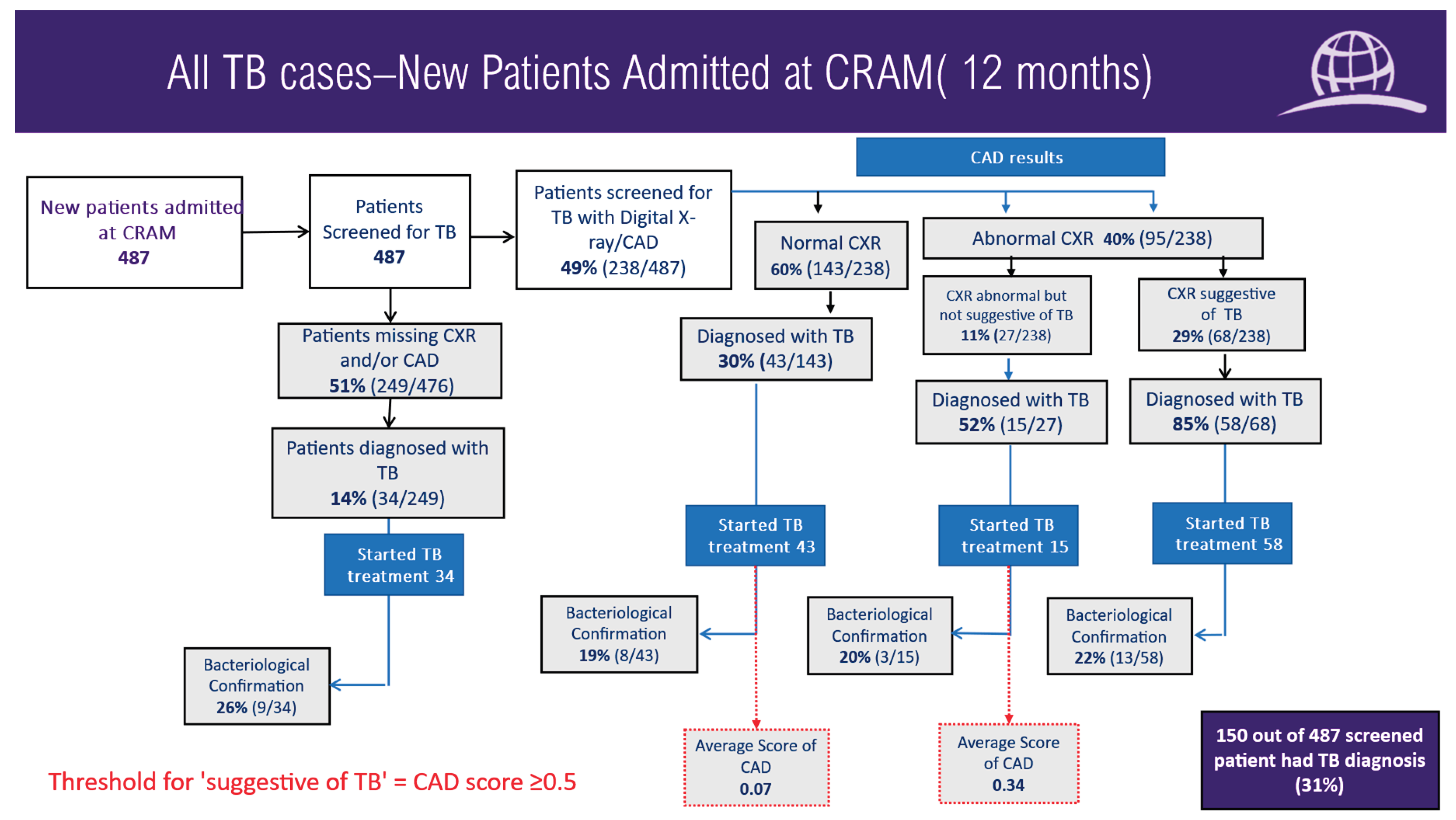
Table 1.
TB diagnosis and bacteriological confirmation by CAD result category in AHD patients.
| CAD Result Category | Patients (N) | Mean CAD Score | Recorded diagnosis of TB (n, %) | Bacteriologically Confirmed (n, %) |
| No CXR/CAD Done | 249 | __ | 34/249 (14%) | 9/34 (26%) |
| Normal | 143 | 0.07 | 43/143 (30%) | 8/43 (19%) |
| Abnormal, Not Suggestive (score <0.5) | 27 | 0.34 | 15/27 (52%) | 3/15 (20%) |
| Abnormal, Suggestive of TB (score ≥0.5) | 68 | 0.83 | 58/68 (85%) | 13/58 (22%) |
| Total (with CAD) | 238 | __ | 116/238 (49%) | 24/116 (21%) |
| COHORT TOTAL | 487 | __ | 150/487 (31%) | 33/150 (22%) |
| Notably, bacteriological confirmation rates were similarly low (19-22%) across all CAD score categories. | ||||
Table 3.
Diagnostic performance of dCXR/CAD at the ≥0.5 threshold in AHD patients (n=238).
| Metric | Calculation | Value | 95% Confidence Interval |
| Sensitivity | TP / (TP + FN) = 58 / 116 | 50% | 41 – 60 |
| Specificity | TN / (TN + FP) = 112 / 122 | 92% | 85 – 96 |
| Positive Predictive Value (PPV) | TP / (TP + FP) = 58 / 68 | 85% | 75 – 92 |
| Negative Predictive Value (NPV) | TN / (TN + FN) = 112 / 170 | 66% | 58 – 73 |
Disclaimer/Publisher’s Note: The statements, opinions and data contained in all publications are solely those of the individual author(s) and contributor(s) and not of MDPI and/or the editor(s). MDPI and/or the editor(s) disclaim responsibility for any injury to people or property resulting from any ideas, methods, instructions or products referred to in the content. |
© 2026 by the authors. Licensee MDPI, Basel, Switzerland. This article is an open access article distributed under the terms and conditions of the Creative Commons Attribution (CC BY) license (http://creativecommons.org/licenses/by/4.0/).
Copyright: This open access article is published under a Creative Commons CC BY 4.0 license, which permit the free download, distribution, and reuse, provided that the author and preprint are cited in any reuse.


