
Submitted:
09 June 2026
Posted:
16 June 2026
You are already at the latest version
Abstract
Background and Objectives: The aim of this preliminary study was to investigate the changes in upper airways space in patients undergoing bimaxillary surgery for facial dysmorphism. Orthognathic surgery alters maxillomandibular position and may influence upper airway morphology. Clarifying the direction and magnitude of these changes is clinically relevant because airway narrowing has been associated with obstructive sleep-disordered breathing, while enlargement may provide functional benefits. This preliminary study evaluated one-year changes in oropharyngeal airway volume and cross-sectional areas after bimaxillary orthognathic surgery and explored whether airway changes were associated with skeletal movements. Materials and Methods: A cohort of 17 patients was retrospectively analyzed using Cone beam computed tomography (CBCT) scans of the skull obtained preoperatively (PRE) and at 1 year follow up (POST). Skeletal landmarks were selected based on established criteria from the existing literature and the volumes of the oropharyngeal space were assessed using Newtom software (Cefla s.c. Bologna, Italy). Outcomes were airway volume (cm3), minimum cross-sectional area (mm2), and maximum cross-sectional area (mm2). Within-subject changes were computed as POST minus PRE. Paired comparisons were performed with the Wilcoxon signed-rank test (two-sided). Effect size was expressed as rank-biserial correlation, and 95% confidence intervals (CI) for the median change were estimated using non-parametric bootstrap on paired differences. Results: Median postoperative changes were positive for all outcomes: volume +2.19 cm3 (95% CI -5.17 to 5.84; p=0.332), minimum area +64.53 mm2 (95% CI -1.44 to 94.77; p=0.061), and maximum area +102.51 mm2 (95% CI -33.21 to 134.73; p=0.149). The largest effect size was observed for the minimum cross-sectional area (rank-biserial r=0.516), suggesting a more consistent improvement at the narrowest airway level. Discussion: This retrospective study evaluated changes in upper airway dimensions following bimaxillary orthognathic surgery. Oropharyngeal airway dimensions tended to increase after bimaxillary surgery at one-year follow-up; however, statistical uncertainty was attributable to small sample size and inter-individual variability. Conclusions: The findings support the importance of incorporating airway preservation into surgical planning, even in asymptomatic patients. Larger prospective studies with standardized acquisition protocols and stratification by surgical movement patterns are needed.
Keywords:
orthognathic surgery
; oropharyngeal airway
; virtual surgical planning
; facial dysmorphism
; cross-sectional area
; cone-beam computed tomography
; Wilcoxon signed-rank
1. Introduction
Patients presenting with severe malocclusion and facial dysmorphism are often candidates for orthognathic surgery, which serves both functional and aesthetic purposes. In addition to skeletal and dental changes, repositioning of the maxilla and mandible can influence the surrounding soft tissues, including the tongue, soft palate, and pharyngeal walls, which collectively contribute to upper airway patency.
Skeletal discrepancies may involve one or both jaws, as well as the chin. Depending on the specific anatomical and functional needs of the patient, various surgical approaches may be employed, including single-jaw procedures such as Le Fort I osteotomy for the maxilla or sagittal split ramus osteotomy for the mandible. In more complex cases, bimaxillary surgery is indicated, with or without adjunctive genioplasty.
In all cases, several fundamental principles are consistently considered: the restoration of a physiological and balanced occlusion, preservation of temporomandibular joint (TMJ) function, maintenance or enhancement of upper airways space, aesthetic harmony of the smile and facial profile, and prevention of premature aging.
With regard to the upper airway, many authors have investigated the impact of orthognathic surgery on the shape and volume of the nasopharynx, oropharynx and hypopharynx in patients both with and without a diagnosis of obstructive sleep apnea (OSA).
The airway response to orthognathic surgery is not purely geometric: postoperative neuromuscular adaptation, changes in head posture and variability in soft-tissue compliance can result in heterogeneous morphologic outcomes even with similar skeletal movements.
Although many studies have investigated the correlation between skeletal movement and airway space, no truly homogenous classification of comparable airway sections currently exists. Although airway changes after orthognathic surgery are well documented, this study provides standardized paired CBCT measurements with effect size reporting in a homogeneous cohort.
However, all studies reported a consistent trend in upper airway changes following skeletal movement underscoring the need for greater consideration of airway function in surgical planning to achieve optimal functional outcomes and minimizeOSA risk. In a 2011 meta-analysis, Mattos et al. [1] observed that maxillary advancement combined with mandibular setback may reduce the oropharyngeal airway space, with decreased axial sections at the level of the tongue base and vallecula, despite an increase at the level of the posterior nasal spine. Following the objectives of Mattos’ study, Christovam et al. [2] in 2016 published a systematic review and meta-analysis using CBCT to assess upper airway volume and cross-sectional area in orthognathic patients. Their findings indicated a significant increase in total airway volume following maxillomandibular advancement (MMA), whereas a significant decrease was noted in cases of maxillary advancement combined with mandibular setback, as well as in isolated mandibular setback procedures. Overall, their results suggested a greater benefit in airway dimensions associated with MMA, in contrast to the potential reduction observed in mandibular setback cases.
CBCT provides three-dimensional information and has become widely available in maxillofacial practice. Compared with two-dimensional cephalometry, CBCT allows the airway to be evaluated as a volume and through cross-sectional area profiles, including the minimum cross-sectional area, which is often considered a potential functional bottleneck. Nevertheless, CBCT-derived airway metrics are sensitive to acquisition conditions such as head posture, tongue position, and respiratory phase. Therefore, standardized protocols and transparent reporting are essential for reproducibility and interpretation.
Published studies on airway changes after orthognathic surgery report mixed results, reflecting heterogeneity in sample composition, surgical techniques, segmentation boundaries, and follow-up intervals. Moreover, statistical reporting has been inconsistent, with some studies focusing solely on p-values without effect sizes or confidence intervals. For small or preliminary cohorts, effect size estimation and uncertainty quantification can be more informative than dichotomous significance testing. Accordingly, in small or preliminary cohorts, a greater emphasis should be placed on effect size estimation and confidence intervals to better characterize the magnitude and precision of airway changes rather than relying solely on statistical significance testing.
The primary objective of this study was to evaluate one-year paired changes in oropharyngeal airway volume and cross-sectional areas in patients undergoing bimaxillary orthognathic surgery for facial dysmorphism. The secondary objective was to explore whether airway changes were associated with anteroposterior skeletal movements quantified at the cephalometric landmarks related to Maxilla basal bone (Point A) and mandibular basal bone (Point B).
2. Materials and Methods
This was a retrospective paired observational study conducted at a tertiary maxillofacial surgery unit (Unit of Oral and Maxillofacial Surgery, Ospedale Ca’ Foncello, Treviso, Italy). The study was performed in accordance with the Declaration of Helsinki. Institutional review board approval and consent procedures were obtained according to local requirements for retrospective imaging research.
A consecutive sample of patients, who underwent bimaxillary surgery in 2022, was selected. Given the retrospective design and fixed cohort size, no a priori power calculation was performed. The inclusion criteria required the availability of pre-operative CBCT (PRE) scans and a minimum follow-up period of one year after surgery (POST). Patients with a prior diagnosis of OSA; syndromic conditions or those treated with surgery-first protocols were excluded.
All patients were evaluated by an orthodontic specialist before orthodontic treatment and prior to surgery. All measurements were performed by a single experienced operator to reduce inter-observer variability. No formal inter- or intra-observer reliability analysis was performed, which represents a study limitation.
They were classified according to occlusal class (Angle classification), cephalometric analysis (Jarabak and McNamara), and surgical indication (monomaxillary vs. bimaxillary surgery). Cephalometric- performed by maxillo facial surgeon S.M.- analysis is still predominantly performed on two-dimensional radiographs, even when three-dimensional imaging is available. This is largely due to the fact that established linear and angular measurements and diagnostic classifications were originally developed for conventional radiography. The introduction of CT imaging has enabled three-dimensional assessment of skeletal morphology, particularly in patients with facial asymmetry. However, in asymmetric cases, cephalometric evaluation often relies on averaged or midline-derived parameters to allow comparison with conventional standards. The cephalometric landmarks assessed included point A for maxillary sagittal position and point B for mandibular sagittal position. These represent basal skeletal reference points and are not influenced by postoperative dental movements. All surgical procedures were performed under general anesthesia by two experienced surgeons within the same team. At the end of surgery, all patients were provided with elastic occlusal guidance to ensure stability during the initial postoperative weeks, prior to completion of orthodontic finishing aimed at achieving final occlusal stability, as limited dental adaptation may occur following repositioning of the basal bone.
One month prior to surgery, each patient underwent CBCT acquisition in Natural Head Position (NHP) to facilitate Virtual Surgical Planning (VSP). Acquisition wasperformed in orthostatic position and in usual occlusion without any spacer between the dental arches. Follow up CBCT scans were performed one year post surgery to evaluate the postoperative stability of surgical outcomes with the same protocol and machine.
All imaging was obtained at Ospedale Ca’ Foncello using the NewTom Giano HR CBCT scan (Cefla s.c. Bologna, Italy) with a standardized protocol. Upper airway analysis was performed utilizing NewTom software (Version 15.0). Skeletal landmarks selected from the literature were exclusively bony to minimize variability caused by soft tissue movements such as breathing or swallowing. (Figure 1) The posterior nasal spine (PNS) was identified as the superior boundary of the oropharyngeal space, while the most anterior point of the third cervical vertebra body served as the inferior boundary. Then two planes parallel to the Frankfurt Horizontal Plane (FHP) were marked through these two points as oropharyngeal space.
The region of interest was the oropharyngeal airway. The same anatomical boundaries and segmentation workflow were applied at PRE and POST. Airway volume was measured in cm3. Minimum and maximum cross-sectional areas were measured in mm2. Minimum cross-sectional area corresponded to the smallest axial area within the segmented oropharyngeal column, while maximum cross-sectional area corresponded to the largest axial area.
All CBCT datasets were oriented according to the FHP and superimposed using stable cranial structures including the anterior skull base and upper orbits. DDS pro software (JST Sp., z.o.o., Czestchowa, Poland) was employed for the VSP. The midsagittal plane was identified to measure linear changes in cephalometric points A and B between baseline and follow up. All data were recorded by the same author.
The primary outcomes were paired PRE-POST differences in airway volume, minimum and maximum cross-sectional area. Secondary outcomes included Point A and Point B anteroposterior movements. Exploratory analyses assessed correlations between skeletal movements and airway changes.
Continuous variables were summarized as median and interquartile range (IQR). Paired comparisons between PRE and POST were performed using the Wilcoxon signed-rank test (two-sided; alpha=0.05). Effect size was quantified as rank-biserial correlation. To quantify uncertainty in a small sample, 95% confidence intervals for the median paired change were estimated using non-parametric bootstrap resampling of paired differences (20,000 resamples). Skeletal movement variables were tested against a median of 0 using a one-sample Wilcoxon signed-rank test.
Exploratory associations between airway changes and Point A and Point B movements were assessed using Spearman rank correlation due to potential non-linearity and non-normality. These association analyses were considered hypothesis-generating and were interpreted cautiously. Analyses were performed in Python using standard scientific libraries.
3. Results
Seventeen patients completed PRE and POST airway measurements and were included in the primary analysis (Table 1). The female:male ratio was 9:8. Median age was 25 (DS 4.3 yrs) years old and malocclusions were classified as eleven Class III cases, three Class II cases and three Class I cases with major asymmetry.
Median paired changes (POST minus PRE) were positive for airway volume and for both cross-sectional area outcomes, indicating a tendency towards postoperative enlargement.
Airway volume increased by a median of 2.19 cm3 (95% CI -5.17 to 5.84). This change was not statistically significant (Wilcoxon p=0.332) and the effect size suggested a small shift towards larger postoperative values (rank-biserial r=0.268).
Minimum cross-sectional area increased by a median of 64.53 mm2 (95% CI -1.44 to 94.77), with a p-value close to the conventional significance threshold (p=0.061) and a moderate effect size (r=0.516), suggesting a comparatively more consistent increase at the narrowest level.
Maximum cross-sectional area increased by a median of 102.51 mm2 (95% CI -33.21 to 134.73; p=0.149; r=0.399).
Regarding skeletal movements, Point A displacement showed a consistent advancement (median 4.05 mm; Wilcoxon vs 0 p=0.000122). Point B displacement was heterogeneous and centered around zero (median 0.0 mm; p=0.847).
Exploratory associations: Spearman correlation was used to explore whether airway changes were associated with Point A and Point B movements.
4. Discussion
The aim of this preliminary study was to analyze our routine clinical practice and compare it with the existing literature to assess its consistency with current knowledge on orthognathic surgery.
This preliminary paired CBCT analysis suggests a general tendency towards increased oropharyngeal airway dimensions one year after bimaxillary orthognathic surgery. Across outcomes, median changes favored postoperative enlargement; however, the uncertainty around these estimates was substantial.
A common source of bias in the literature concerns the lack of uniformity in radiological reference points across different populations studied. In agreement with Hernando et al.[3], who endorsed the anatomic landmarks proposed by Swennen and Guyarro-Martinez, we chose to orientate the skull according to the FHP defining the oropharynx boundaries by the PNS superiorly and the most anterior point of the third cervical vertebral body as the limits of the airway canal. Skeletal landmarks are less susceptible to postoperative change or variability during CBCT acquisition due to factors like breathing or swallowing, as similarly reported by Gonzales et al. [4] and Gurani et al. [5]. Soft tissues and structure as epiglottis and bony structure connected to ligament and muscle as hyoid bone are more subjected to change position with swallowing during scanning. Bony landmarks can also be reliably identified by less experienced observers and are more predictable. Both skeletal and soft tissue are subject to a degree of relapse over time. Notably, Jae Hwa et al. [6] in 2019, in a six-year follow up study on patients with Class III deformities, demonstrated that beyond six months post-operatively the pharyngeal airway space (PAS) remained stable. They recorded mean skeletal relapse rates of 13.2% for the maxilla and 11,3% for the mandible. In cases involving mandibular setback, the hyoid bone exhibited a downward and backward displacement with base tongue movement against posterior pharyngeal wall, accompanied by a decreased PAS [16]; however, the airway volume stabilized six months after surgery. Hernaldo [3] suggested as mandibular set-back movement at risk of developing OSA in patients as 4-8 mm and a reported Schendel data about minimum cross-sectional area of 52 mm2 as high risk, 52-110 mm2 intermediate risk and > 110 mm2 low risk of OSA.
In our experience with Class III malocclusion and anterior open-bite with hyperdivergent profile, mandibular setback is limited by counterclockwise rotation of mandibular plane with a major setback of incisal occlusal surface and less one of the mandibular basal bone. In patients with class III malocclusion and hypodivergent profile a clockwise rotation of maxillary and mandibular place enhances mandibular set-back despite in general a major maxillary advancement is advocated.
In the present study, preoperative CBCT scans were compared to those obtained at one-year-follow up.
The minimum cross-sectional area showed the most consistent postoperative increase, with a moderate effect size and a p-value close to 0.05. This finding is clinically interesting because the minimum cross-sectional area may represent the most relevant morphologic bottleneck, potentially influencing airflow dynamics. A tendency towards improvement at the narrowest level may therefore be more functionally meaningful than changes in global volume alone. This suggests a tendency towards postoperative enlargement, although uncertainty remains due to sample size.
Bony landmarks offer a better option for follow up as compared to soft tissue reference points. In the literature, there is no clear consensus regarding the limits of airway space; for this reason, no uniform standards currently exist. The observed variability across individuals likely reflects heterogeneity in baseline craniofacial morphology, surgical movements, and soft-tissue adaptation. In particular, Point A advancement was consistent in this cohort, whereas Point B movement was heterogeneous. Because mandibular position can directly influence tongue base posture, variable mandibular displacement may contribute to the variability in airway response.
We suggest as other authors more stable reference for oropharyngeal space that is more involved in orthognathic surgery, especially retropalatal and retroglossal space.
Several studies have evaluated the effects of single-jaw and bimaxillary movements, with a general consensus that combined maxillary and mandibular advancement increases posterior airway space at all levels, including the nasopharynx, oropharynx, and hypopharynx. The only surgical movement associated with a reduction in posterior airway space is mandibular setback; however, no deterioration in respiratory function was observed. Airflow dynamics are influenced not only by airway volume but also by airway shape, as even minimal changes in cross-sectional area can significantly affect air flow, according to Poiseuille’s law [7,8]. For these reasons many authors recommend maxillary advancement to offset mandibular setback [9,10] as the increased airway near the posterior nasal spine can compensate for reductions at the oropharyngeal level. [1] Furthermore, maxillary impaction to correct a gummy smile can be performed without compromising the nasopharyngeal airway.
This study is limited by its retrospective design, absence of a control group, and heterogeneous skeletal patterns, which may introduce selection bias and limit causal inference.
Larger prospective cohorts with standardized acquisition instructions, repeated measures to assess measurement stability, and detailed recording of surgical movements in multiple planes are recommended. Combining morphologic outcomes with clinical endpoints, such as respiratory symptoms or sleep study parameters, would also improve clinical interpretability.
5. Conclusions
In this preliminary cohort, oropharyngeal airway volume and cross-sectional areas tended to increase after bimaxillary surgery, as observed at one-year follow-up. The minimum cross-sectional area exhibited the most consistent improvement. Given the limited sample size and the intrinsic variability of CBCT airway assessment, these findings should be interpreted cautiously and confirmed in larger, standardized prospective studies.
Orthognathic surgical planning should consistently aim to preserve the integrity of the upper airway column, even in asymptomatic patients, to prevent physiological aging with laxity of oropharyngeal walls . Given that the study population is from a Mediterranean country, where the prevalence of Class III malocclusion is relatively high, maxillary advancement-potentially with a degree of overcorrection-may be advisable.
VSP has increased precision and predictability of results in orthognathic surgery. A lack of prediction of face soft tissues change with surgery is the next goal but difficult to pursue because of variabilities linked to ethnicity, gender, age and surgeons. In the future 3D study of airway column shows less obstacles to develop a system of predictable results to integrate in 3D software planning.
Informed Consent Statement
Informed consent was obtained from all subjects involved in the study.
Conflicts of Interest
The authors declare no conflicts of interest.
References
- Mattos, C.T.; Vilani, G.N.; Sant'Anna, E.F.; Ruellas, A.C.; Maia, L.C. Effects of orthognathic surgery on oropharyngeal airway: a meta-analysis. Int. J. Oral Maxillofac. Surg. 2011, 40(12), 1347–56. [Google Scholar] [CrossRef] [PubMed]
- Christovam, I.O.; Lisboa, C.O.; Ferreira, D.M.; Cury-Saramago, A.A.; Mattos, C.T. Upper airway dimensions in patients undergoing orthognathic surgery: a systematic review and meta-analysis. Int. J. Oral Maxillofac. Surg. 2016, 45(4), 460–71. [Google Scholar] [CrossRef] [PubMed]
- Giralt-Hernando, M.; Valls-Ontañón, A.; Haas Junior, O.L.; Masià-Gridilla, J.; Hernández-Alfaro, F. What are the Surgical Movements in Orthognathic Surgery That Most Affect the Upper Airways? A Three-Dimensional Analysis. J. Oral Maxillofac. Surg. 2021, 79(2), 450–462. [Google Scholar] [CrossRef] [PubMed]
- Gonçales, E.S.; Duarte, M.A.; Palmieri, C., Jr.; Zakhary, G.M.; Ghali, G.E. Retrospective analysis of the effects of orthognathic surgery on the pharyngeal airway space. J. Oral Maxillofac. Surg. 2014, 72(11), 2227–40. [Google Scholar] [CrossRef] [PubMed]
- Gurani, S.F.; Di Carlo, G.; Thorn, J.J.; Ingerslev, J.; Cattaneo, P.M.; Pinholt, E.M. Two-Year Postoperative Upper Airway Cone-Beam Computed Tomographic Outcomes Based on a Verified Upper Airway Analysis Following Bimaxillary Orthognathic Surgery. J. Oral Maxillofac. Surg. 2019, 77(7), 1435–1445. [Google Scholar] [CrossRef] [PubMed]
- An, J.H.; Park, S.B.; Choi, Y.K.; Lee, S.H.; Kim, K.B.; Kim, Y.I. Cone-Beam Computed Tomography Evaluation of Pharyngeal Airway Space Changes After Bimaxillary Orthognathic Surgery in Patients With Class III Skeletal Deformities: A 6-Year Follow-Up Study. J. Oral Maxillofac. Surg. Epub. 2019, 77(12), 2534–2544. [Google Scholar] [CrossRef] [PubMed]
- Tepecik, T.; Ertaş, Ü.; Akgün, M. Effects of bimaxillary orthognathic surgery on pharyngeal airway and respiratory function at sleep in patients with class III skeletal relationship. J. Craniomaxillofac Surg. 2018, 46(4), 645–653. [Google Scholar] [CrossRef] [PubMed]
- Yamashita, A.L.; Iwaki Filho, L.; Leite, P.C.C.; Navarro, R.L.; Ramos, A.L.; Previdelli, I.T.S.; Ribeiro, M.H.D.M.; Iwaki, L.C.V. Three-dimensional analysis of the pharyngeal airway space and hyoid bone position after orthognathic surgery. J. Craniomaxillofac Surg. 2017, 45(9), 1408–1414. [Google Scholar] [CrossRef] [PubMed]
- Yang, H.J.; Jung, Y.E.; Kwon, I.J.; Lee, J.Y.; Hwang, S.J. Airway changes and prevalence of obstructive sleep apnoea after bimaxillary orthognathic surgery with large mandibular setback. Int. J. Oral Maxillofac. Surg. 2020, 49(3), 342–349. [Google Scholar] [CrossRef] [PubMed]
- He, J.; Wang, Y.; Hu, H.; Liao, Q.; Zhang, W.; Xiang, X.; Fan, X. Impact on the upper airway space of different types of orthognathic surgery for the correction of skeletal class III malocclusion: A systematic review and meta-analysis. Int. J. Surg. 2017, 38, 31–40. [Google Scholar] [CrossRef] [PubMed]
- Wiedemeyer, V.; Berger, M.; Martini, M.; Kramer, F.J.; Heim, N. Predictability of pharyngeal airway space dimension changes after orthognathic surgery in class II patients: A mathematical approach. J. Craniomaxillofac Surg. 2019, 47(10), 1504–1509. [Google Scholar] [CrossRef] [PubMed]
- AlQahtani, F.; George, J.M.; Bishawi, K.; Kuriadom, S.T. Comparison of oropharyngeal airway dimensional changes in patients with skeletal Class II and Class III malocclusions after orthognathic surgery and functional appliance treatment: A systematic review. Saudi Dent. J. 2021, 33(8), 860–868. [Google Scholar] [CrossRef] [PubMed] [PubMed Central]
- Jiang, C.; Yi, Y.; Jiang, C.; Fang, S.; Wang, J. Pharyngeal Airway Space and Hyoid Bone Positioning After Different Orthognathic Surgeries in Skeletal Class II Patients. J. Oral Maxillofac. Surg. 2017, 75(7), 1482–1490. [Google Scholar] [CrossRef] [PubMed]
- Giap, H.V.; Shin, J.W.; Chae, H.S.; Kim, Y.H.; Paeng, J.Y.; Choi, H.W. Pharyngeal Airway Morphology in Skeletal Class III With Mandibular Asymmetry is Improved After Bimaxillary Orthognathic Surgery. J. Oral Maxillofac. Surg. 2021, 79(5), 1107–1121. [Google Scholar] [CrossRef] [PubMed]
- Alcalde, L.F.A.; Faria, P.E.P.; Nogueira, R.L.M.; Chihara, L.; Sant'Ana, E. Computed tomography visualizing alterations in the upper airway after orthognathic surgery. J. Craniomaxillofac Surg. 2019, 47(7), 1041–1045. [Google Scholar] [CrossRef] [PubMed]
- Hong, J.S.; Park, Y.H.; Kim, Y.J.; Hong, S.M.; Oh, K.M. Three-dimensional changes in pharyngeal airway in skeletal class III patients undergoing orthognathic surgery. J. Oral Maxillofac. Surg. Epub. 2011, 69(11), e401-8. [Google Scholar] [CrossRef] [PubMed]
- Daluz, A.D.J.; da Silva, T.V.S.; Tôrres, B.O.; Costa, D.F.N.; Santos, L.A.M. Long-term airway evolution after orthognathic surgery: Systematic Review. J. Stomatol Oral Maxillofac. Surg. 2022, 123(2), 191–198. [Google Scholar] [CrossRef] [PubMed]
- Gottsauner-Wolf, S.; Laimer, J.; Bruckmoser, E. Posterior Airway Changes Following Orthognathic Surgery in Obstructive Sleep Apnea. J. Oral Maxillofac. Surg. 2018, 76(5), 1093.e1–1093.e21. [Google Scholar] [CrossRef] [PubMed]
- Uesugi, T.; Kobayashi, T.; Hasebe, D.; Tanaka, R.; Ike, M.; Saito, C. Effects of orthognathic surgery on pharyngeal airway and respiratory function during sleep in patients with mandibular prognathism. Int. J. Oral Maxillofac. Surg. 2014, 43(9), 1082–90. [Google Scholar] [CrossRef] [PubMed]
- Tepecik, T.; Ertaş, Ü.; Akgün, M. Effects of bimaxillary orthognathic surgery on pharyngeal airway and respiratory function at sleep in patients with class III skeletal relationship. J. Craniomaxillofac Surg. 2018, 46(4), 645–653. [Google Scholar] [CrossRef] [PubMed]
- Wiedemeyer, V.; Berger, M.; Martini, M.; Kramer, F.J.; Heim, N. Predictability of pharyngeal airway space dimension changes after orthognathic surgery in class II patients: A mathematical approach. J. Craniomaxillofac Surg. 2019, 47(10), 1504–1509. [Google Scholar] [CrossRef] [PubMed]
Figure 1.
Example of oropharyngeal airway segmentation on CBCT. Cephalometric and skeletal landmarks A, B, PNS and C3. The color map represents the airway lumen and the cross-sectional area profile along the segmented column; cooler colors indicate larger cross-sectional area and warmer colors indicate smaller cross-sectional area. The location of the minimum cross-sectional area is highlighted.
Figure 1.
Example of oropharyngeal airway segmentation on CBCT. Cephalometric and skeletal landmarks A, B, PNS and C3. The color map represents the airway lumen and the cross-sectional area profile along the segmented column; cooler colors indicate larger cross-sectional area and warmer colors indicate smaller cross-sectional area. The location of the minimum cross-sectional area is highlighted.
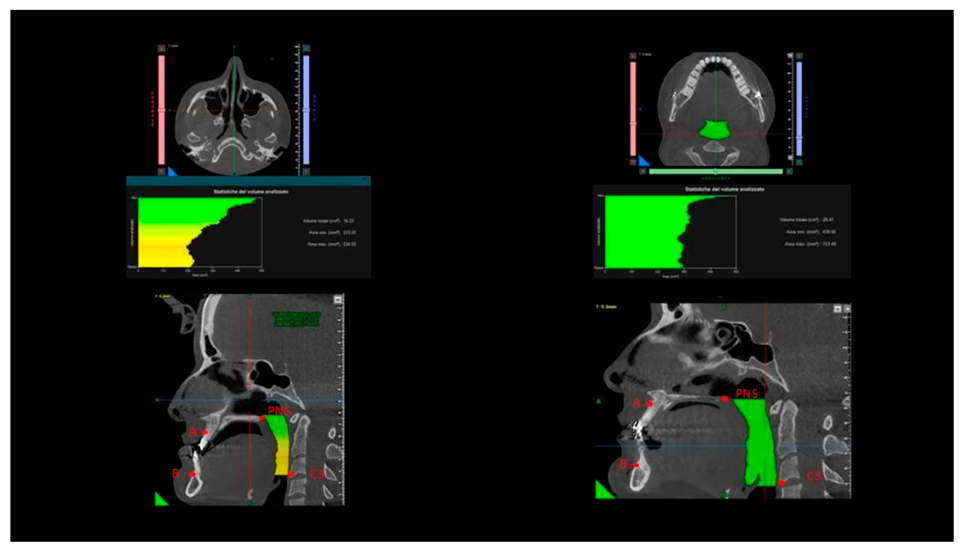

Table 1.
Results.
| Outcome | N | Median change (POST-PRE) | 95% CI (median change) | Wilcoxon p (two-sided) | Effect size (rank-biserial r) |
| Airway volume (cm3) | 17 | 2.19 | -5.17 to 5.84 | 0.332 | 0.268 |
| Minimum cross-sectional area (mm2) | 17 | 64.53 | -1.44 to 94.77 | 0.061 | 0.516 |
| Maximum cross-sectional area (mm2) | 17 | 102.51 | -33.21 to 134.73 | 0.149 | 0.399 |
Disclaimer/Publisher’s Note: The statements, opinions and data contained in all publications are solely those of the individual author(s) and contributor(s) and not of MDPI and/or the editor(s). MDPI and/or the editor(s) disclaim responsibility for any injury to people or property resulting from any ideas, methods, instructions or products referred to in the content. |
© 2026 by the authors. Licensee MDPI, Basel, Switzerland. This article is an open access article distributed under the terms and conditions of the Creative Commons Attribution (CC BY) license (http://creativecommons.org/licenses/by/4.0/).
Copyright: This open access article is published under a Creative Commons CC BY 4.0 license, which permit the free download, distribution, and reuse, provided that the author and preprint are cited in any reuse.


