

Submitted:
09 June 2026
Posted:
10 June 2026
You are already at the latest version
Abstract
Background: The way individuals perceive and interact with the food environment may influence their dietary practices and health outcomes. This study analyzed associations between social and housing conditions, food environment perception, and food security, and their effects on the nutritional status of children and mothers. Methods: A cross-sectional study conducted between 2022 and 2023 with 314 participants in Vitória de Santo Antão, Pernambuco, Brazil. Socioeconomic variables, housing conditions, perceptions of domestic and community food environments, food security, and anthropometric indicators were assessed using generalized structural equation modeling (GSEM, p < 0.05). Results: Better social and housing conditions were associated with more favorable domestic food environment perceptions and lower food insecurity. No significant associations were observed between the domestic food environment and food security, nor between the community food environment and other model variables. No significant indirect effects were identified, indicating absence of mediation through food environment perceptions. Associations were found between food security and maternal BMI, and between maternal and child BMI. Conclusions: Social and housing conditions play a central role in shaping food security and nutritional outcomes, while food environment perception showed limited relevance. These findings reinforce the need for intersectoral public policies addressing social inequalities and promoting healthy eating.
Keywords:
social determinants
; food environment
; food security
; nutritional status
; structural equation modeling
1. Introduction
The human right to adequate food (HRAF) ensures that individuals have access to sufficient, nutritious, and culturally appropriate food. Food security (FS) constitutes a practical instrument for the realization of this right, incorporating, beyond access, aspects related to food quality and stability [1,2].
Among the various factors contributing to food insecurity (FI), the globalization of the food system stands out, as it has promoted increased consumption of ultra-processed foods (UPF) and reduced intake of fresh and minimally processed foods [3]. The local food environment, in which consumers decide which foods to purchase, represents a strategic point for interventions aimed at reorienting the food system toward more sustainable diets [4,5].
Child malnutrition is influenced by multiple factors, including low parental education, inadequate sanitation and hygiene practices, and large household size. In this context, stunting constitutes a critical metric of chronic undernutrition, and is equally impacted by environmental, socioeconomic, and cultural conditions [6]. The Food and Agriculture Organization of the United Nations (FAO) identified a worsening situation in Brazil between 2012 and 2024 in the categories of inadequate growth and overweight among children under five years of age. Among adults, a similar deterioration in obesity rates was observed between 2012 and 2022 [7], reinforcing the relevance of studies that investigate the factors driving this problem.
Another important concept is that of perception, as it involves the interaction of human senses, as well as the recognition, organization, and interpretation of information, and influences the way people understand and interact with their environment [8]. Perception is subject to subjective interpretations, varying according to individual personal experience and social context. In this way, parameters such as food access, availability, diversity, nutritional adequacy, and cost directly affect this perception [9].
Despite the growing recognition of food environments as determinants of dietary practices [10,11], evidence remains limited regarding how social and housing conditions interact with food environment perceptions and food security, particularly in contexts of social vulnerability in Northeastern Brazil. Furthermore, studies that simultaneously explore these relationships through structural modeling remain scarce.
Given this context, the present study aimed to analyze the direct and indirect associations between social and housing determinants, food environment perception, food security, and nutritional outcomes of children and mothers, considering the mediating role of caregivers’ perceptions of the community and household food environment.
2. Materials and Methods
Study Design
A cross-sectional study conducted in the municipality of Vitória de Santo Antão, Pernambuco, between October 2022 and March 2023. The municipality has approximately 134,084 inhabitants and a population density of around 398.38 inhabitants per square kilometer [12], as well as a per capita GDP of approximately US$6,032.00 [13]. In recent years, the municipality has developed in various respects; however, this growth, when unplanned, can intensify vulnerability situations in certain population groups.
The sample consisted of children aged 0 to 9 years followed by Family Health Units (FHU) and/or beneficiaries of cash transfer programs (CTP). Children with neurological or motor disorders that prevented physical assessment, as well as those older than nine years, were excluded from the study.
Sample Processing
For sample sizing, the prevalence of excess weight in children aged 0 to 9 years in the municipality was used as a parameter: 27.7% among participants in CTP and 10.9% among non-participants [14]. The design considered a significance level of 95% and study power (1–β) of 80%. Additionally, a 20% margin of error was added for possible losses, resulting in a final sample of 314 children.
During the data collection period, the municipality had 36 Basic Health Units (BHU), distributed with approximately 70% in the urban area and 30% in the rural area. Based on this proportion, the study was conducted in ten units — seven located in the urban area and three in the rural area — selected by random draw, with approximately 30 interviews conducted at each FHU. Calculations were performed using Epi Info™ software for Windows.
Data Collection Instrument
Data were collected through a structured questionnaire administered to the children’s caregivers, including socioeconomic information, anthropometric assessment of children and mothers (weight and height), measurement of food insecurity using the Brazilian Food Insecurity Scale (BFIS), and assessment of food environment perception. The Household Food Environment (HFE) encompassed the availability of Fresh and Minimally Processed Foods (FMPF) and UPF in the home, while the Community Food Environment (CFE) covered aspects related to the availability, quality, variety, and accessibility of FMPF and UPF in the residential neighborhood [15,16].
Dependent Variable
Weight and height (stature or length) were measured in duplicate, following the techniques recommended by Lohman et al. [17]. These results formed the basis for calculating the nutritional status of the children, assessed through the Height-for-Age (H/A) and Body Mass Index-for-Age (BMI/A) indicators, adjusted for sex. Anthropometric indicators were expressed as Z-scores and calculated using Anthro software (version 3.2.2) for children under 5 years and Anthro Plus (version 1.0.3) for children aged 5 to 9 years.
For the H/A indicator, the following cutoff points were adopted: stunting (H/A < –2 Z-score) and adequate height (H/A ≥ –2 Z-score) [18]. Nutritional classification was carried out according to the criteria of the Food and Nutrition Surveillance System [19], considering BMI/A: underweight (BMI/A < –2 Z-score); eutrophic (–2 SD ≤ BMI/A < +1 SD); overweight risk (+1 SD ≤ BMI/A < +2 SD); overweight (+2 SD ≤ BMI/A < +3 SD); and obesity (BMI/A ≥ +3 SD).
Maternal nutritional status was assessed using BMI, calculated as the ratio of weight (kg) to the square of height (m²), classified according to World Health Organization (WHO) criteria: underweight (BMI < 18.5); eutrophic (BMI between 18.5 and 24.9); overweight (BMI between 25 and 29.9); and obesity (BMI ≥ 30) [20].
Endogenous and Exogenous Variables
Social and Housing Determinants (SHD)
The socioeconomic situation was assessed based on a poverty measurement instrument that investigated indicators such as: education (years of schooling); income (wage brackets); occupational status (formal employment, informal/self-employment, no paid work); social class [21]; and housing conditions, including type of dwelling, number of rooms and bedrooms, and floor type (cement, ceramic, or wood).
Although there is no direct scientific evidence linking housing characteristics — such as floor type, number of rooms, and number of bedrooms — to food consumption, these variables function as proxies for the socioeconomic and territorial conditions of households. In contexts of social vulnerability, housing conditions reflect material deprivations and structural inequalities that indirectly influence eating behavior and nutritional status by affecting access to resources, household stability, and conditions for acquiring, storing, and preparing food [22].
Perception of the Household Food Environment (HFE) and Community Food Environment (CFE)
Food environment perception was assessed using an instrument from the Brazilian National Survey on Child Feeding and Nutrition (ENANI) [15,16]. For the HFE, nine questions were applied regarding food availability in the home over the previous 30 days — four related to FMPF and five UPF. Responses were recorded on an ordinal frequency scale (never, rarely, sometimes, almost always, always).
For the CFE, seven questions were applied related to neighborhood perception — defined as the area accessible within 20 minutes on foot or 5 to 10 minutes by vehicle — covering availability, quality, variety, and price of FMPF (four items), as well as accessibility, variety, and price of UPF (three items), with responses on an agreement scale (strongly disagree to strongly agree).
Scores were constructed based on the methodology proposed by Castro Júnior [23]. For FMPF, responses received increasing scores (1 to 5), so that higher values indicated greater availability and better perceived quality. For UPF, the scoring was reversed, so that higher values represented lower availability or accessibility of these foods.
In the HFE, the FMPF score (S-FMPF) ranged from 4 to 20 points and the UPF score (S-UPF) from 5 to 25 points. In the CFE, the S-FMPF ranged from 4 to 20 points and the S-UPF from 3 to 15 points. To ensure comparability across scores, all were standardized on a 0 to 10 scale by dividing total values by their respective adjustment factors.
From these scores, two composite indicators were constructed: the Household Food Environment Healthfulness Perception Index (HFEHPI) and the Community Food Environment Healthfulness Perception Index (CFEHPI), calculated as the simple average of the standardized FMPF and UPF scores. In both cases, higher values indicated healthier food environments, characterized by greater availability of FMPF (fruits, vegetables, greens, and beans/other legumes) and lower presence of UPF (industrialized juice, soft drinks, cookies, packaged snacks, and sweets).
For analytical purposes, the indices were categorized into three healthfulness levels: 0–3 (poor food environment), 4–7 (moderate), and 8–10 (satisfactory).
Food Insecurity
Food security and insecurity status was assessed using the BFIS, comprising 14 questions. Each affirmative response corresponds to one point, and the total sum represents the scale score. In households with individuals under 18 years, the classification was as follows: 0 = food security; 1–5 = mild food insecurity; 6–9 = moderate food insecurity; and 10–14 = severe food insecurity [24,25].
Statistical Analysis
The analysis of Direct Effects (DE) and Indirect Effects (IE) of social and housing determinants on food security and the nutritional status of children and mothers was conducted using Generalized Structural Equation Modeling (GSEM). This approach was adopted due to the complex nature of the phenomenon under investigation and the need to integrate, in a single analytical model, latent and observable variables with different statistical natures. This approach was considered particularly appropriate for investigating simultaneous pathways between structural determinants, mediating variables, and nutritional outcomes.
Social and housing determinants were operationalized as a latent construct, referred to as Social and Housing Determinants (SHD), composed of observable indicators related to education, income, social class, occupational status, and housing conditions — including floor type, number of rooms, and number of bedrooms. These indicators were treated as complementary dimensions of a single structural construct, representing different expressions of socioeconomic vulnerability at the household level [26,27]. Measurement models were initially fitted to assess the adequacy of these indicators in composing the latent construct.
In the structural model, direct and indirect relationships were tested between social and housing determinants, perceptions of the community food environment (CFE) and household food environment (HFE), food security, and the anthropometric indicators height-for-age (H/A), BMI-for-age (BMI/A), and maternal BMI (BMI/mother). CFE and HFE perceptions were included as mediating variables, allowing exploration of the mechanisms by which structural factors are associated with nutritional outcomes along the proposed theoretical framework.
The study models were guided by the following hypotheses: (i) social and housing determinants, derived from factor analysis, are associated with perceptions of the community and household food environments, compromising food security and being associated with height deficit in children; and (ii) social and housing determinants affect perceptions of the community and household food environments, impacting food security and being associated with poor nutrition in the mother-child dyad. Both models share the same theoretical structure of relationships between variables, differing only in their final outcome — the first related to height-for-age and the second to maternal and child BMI indicators.
The conceptual organization and directionality of relationships between exogenous and endogenous variables were represented through a Directed Acyclic Graph (DAG), which guided the formulation of the structural model (Supplementary Figure S1). Although GSEM allows the representation of relationships compatible with causal hypotheses, the primary goal of the analysis was to assess patterns of association between observed and latent variables, consistent with the cross-sectional study design.
Descriptive analyses were performed in SPSS (version 26) and GSEM models were estimated in R software, using appropriate routines for generalized structural equation modeling compatible with variables of different distributions. A significance level of p < 0.05 was adopted. Results were presented using unstandardized coefficients along with their respective 95% confidence intervals (95% CI), allowing interpretation of the direction and magnitude of the associations estimated in the model.
The adequacy of the factor analysis and the latent construct structure was verified using the Kaiser-Meyer-Olkin (KMO) measure — with values above 0.5 considered adequate — and Bartlett’s test of sphericity, with p < 0.05 taken as indicative of the correlation matrix’s suitability for factor analysis [28]. Model fit was evaluated using plausibility and parsimony indicators, including Root Mean Square Error of Approximation (RMSEA) and Standardized Root Mean Square Residual (SRMSR), with values ≤ 0.08 considered acceptable [29,30]. These indices were used as complementary fit references, considering the limitations of their application in models with non-continuous outcomes.
For a more detailed understanding of the estimated relationships, unstandardized direct and indirect effects were calculated with their respective 95% confidence intervals, allowing evaluation of the intermediary pathways between constructs [31,32]. The unstandardized coefficient expresses the effect of the exogenous variable on the endogenous variable, assuming all other model variables remain constant [31,33].
Ethical Considerations
This project was approved by the Research Ethics Committee of the Health Sciences Center at the Federal University of Pernambuco (UFPE), under Ethics Submission Certificate (CAAE) No. 74287223.6.0000.5208.
3. Results
The data presented in Table 1 describe the main socioeconomic, housing, and nutritional characteristics of the sample. Most caregivers had completed only primary education (67.8%) and had no paid employment (62.7%). Approximately half of the families belonged to the lowest socioeconomic strata (48.1%) and reported a monthly household income between half and one minimum wage (48.4%). Regarding housing conditions, 53.6% of families lived in rented or borrowed dwellings, 49.7% of households had unfinished flooring, 52.5% had up to five rooms, and 79.2% had up to two bedrooms.
Concerning the nutritional profile, 44.2% of households experienced moderate to severe food insecurity, 68.8% of mothers were classified as overweight, and 36.9% of children showed impairment in the height-for-age index. Taken together, these findings highlight a context of high social, housing, and nutritional vulnerability.
The estimated coefficients indicated a negative association between the Social and Housing Conditions (SHC) construct and the food security (FS) variable. For the analyses, the variable was treated as an ordinal increasing scale, in which higher values indicate greater severity of food insecurity. This result indicates that better social and housing conditions are associated with lower levels of food insecurity.
The assessment of the latent construct SHC yielded a KMO value of 0.705 and Bartlett’s test of sphericity with p < 0.001, indicating adequacy of the factor structure for analysis [28]. The RMSEA and SRMR indices were 0.057 and 0.054 in Model 1, and 0.051 and 0.056 in Model 2, respectively, suggesting acceptable model fit [29,30].
Figure 2.
Complex structural model fitted by GSEM, representing the social and housing determinants associated with domestic and community food environments, food security, and the height-for-age index in children. Vitória de Santo Antão, Pernambuco, Brazil, 2022–2023. Values presented correspond to unstandardized coefficients. Dashed arrows indicate statistically non-significant relationships (p > 0.05).
Figure 2.
Complex structural model fitted by GSEM, representing the social and housing determinants associated with domestic and community food environments, food security, and the height-for-age index in children. Vitória de Santo Antão, Pernambuco, Brazil, 2022–2023. Values presented correspond to unstandardized coefficients. Dashed arrows indicate statistically non-significant relationships (p > 0.05).
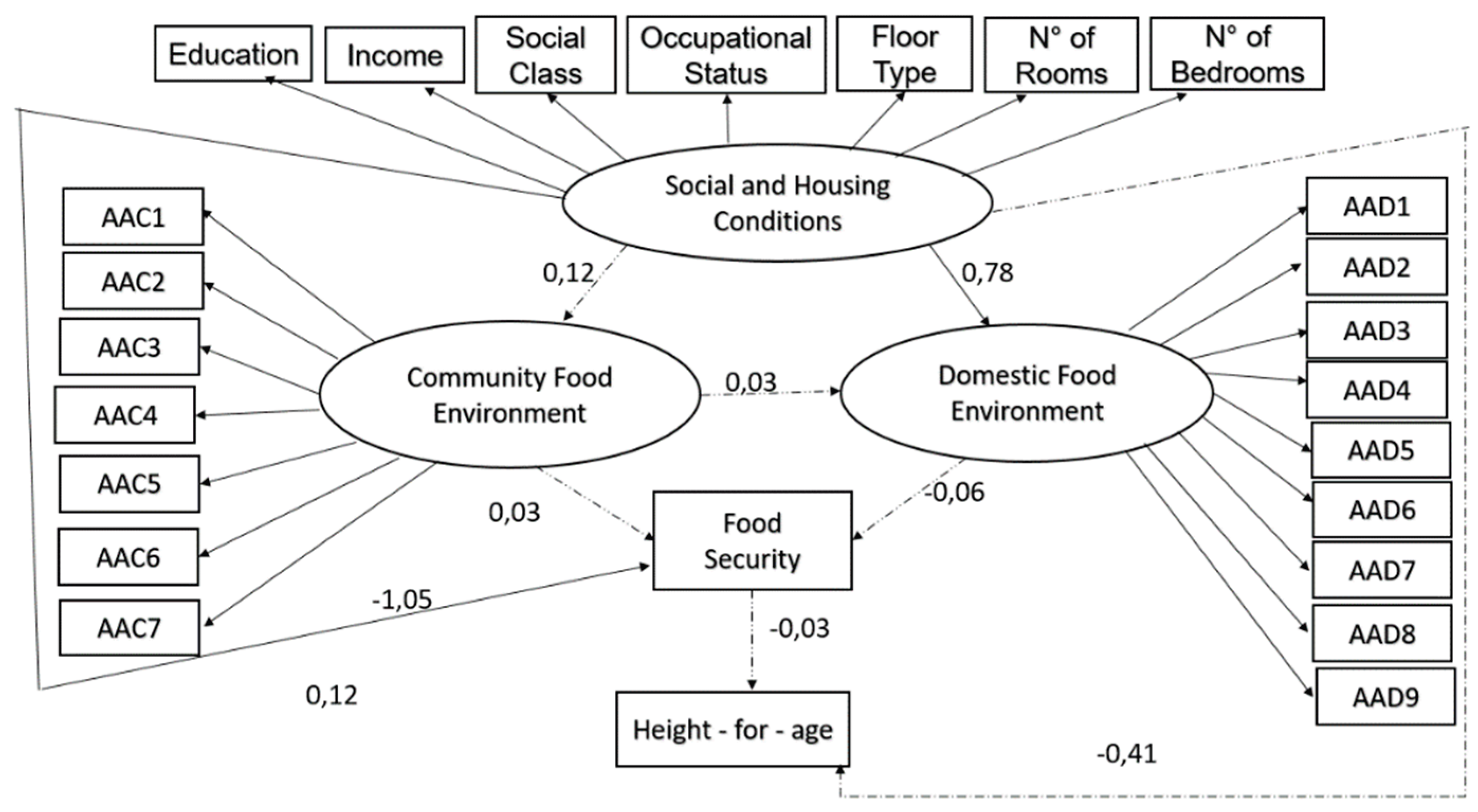
The structural models indicated that SHC was consistently associated with the domestic food environment (DFE) and with food security. Considering the coding of the food security variable, the negative coefficients observed indicate that better structural conditions are associated with lower levels of food insecurity.
Figure 3.
Complex structural model fitted by GSEM representing the social and housing determinants associated with domestic and community food environments, food security, and the indicators of maternal BMI and child BMI-for-age. Vitória de Santo Antão, Pernambuco, Brazil, 2022/2023. Values presented correspond to unstandardized coefficients Dashed arrows indicate statistically non-significant relationships (p > 0.05).
Figure 3.
Complex structural model fitted by GSEM representing the social and housing determinants associated with domestic and community food environments, food security, and the indicators of maternal BMI and child BMI-for-age. Vitória de Santo Antão, Pernambuco, Brazil, 2022/2023. Values presented correspond to unstandardized coefficients Dashed arrows indicate statistically non-significant relationships (p > 0.05).
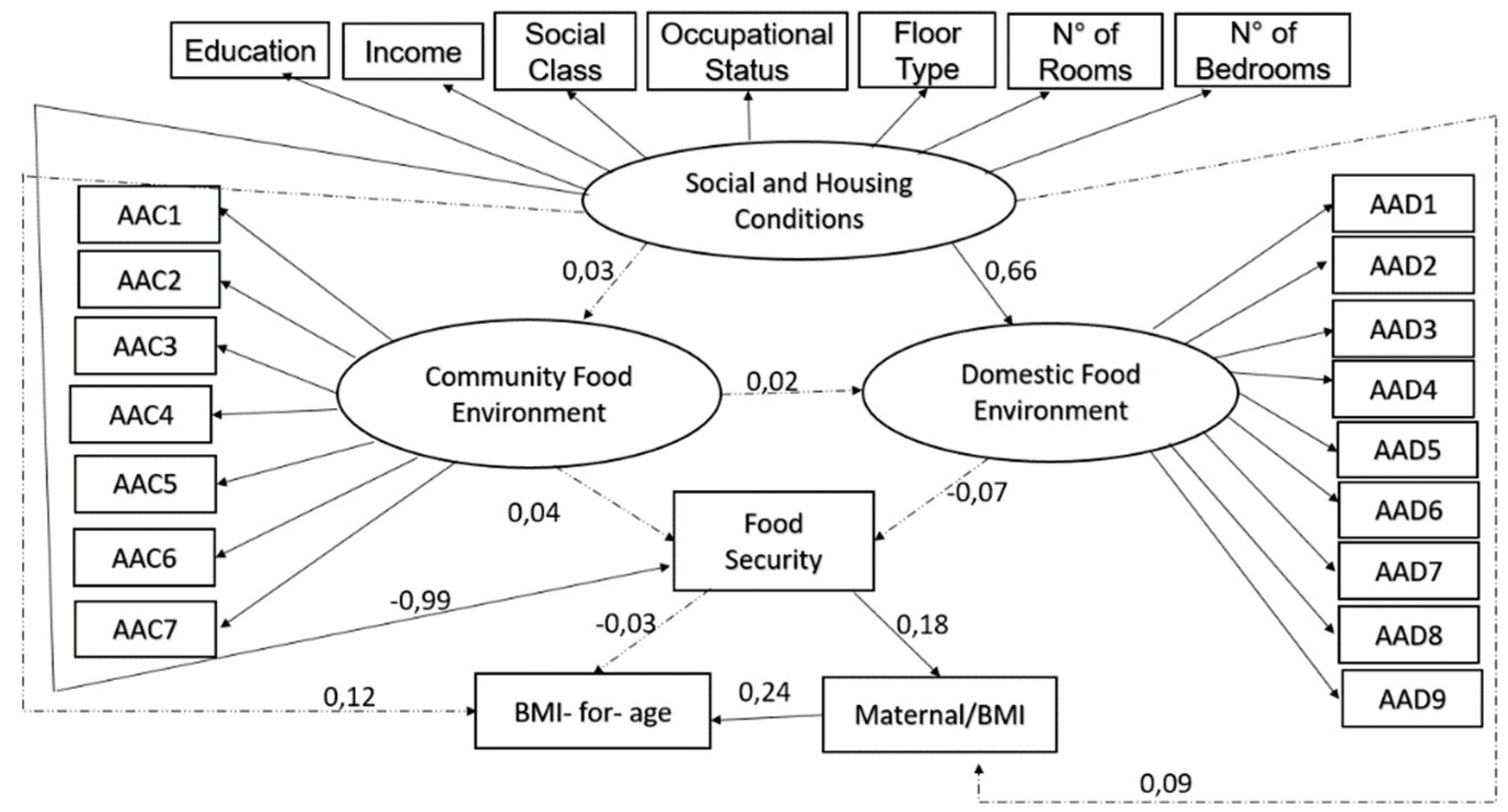
A negative and significant association was also observed between SHC and FS (Model 1: DE = −1.05; 95% CI: −1.62 to −0.48; p < 0.001; Model 2: DE = −0.99; 95% CI: −1.52 to −0.46; p < 0.001), further confirming that better structural conditions reduce the likelihood of food insecurity.
No statistically significant associations were observed between DFE and FS, nor between the community food environment (CFE) and other model variables. Additionally, no significant indirect effects (IE) were identified, indicating the absence of mediation.
In the model including anthropometric outcomes, a significant association was found between food security and maternal BMI (DE = 0.18; 95% CI: 0.002–0.37; p = 0.047), as well as between maternal BMI and child BMI-for-age (DE = 0.24; 95% CI: 0.09–0.39; p = 0.002). Given the coding of the FS variable, this result suggests that higher levels of food insecurity are associated with worse maternal nutritional outcomes, with subsequent repercussions on child nutritional status.
4. Discussion
This study examined, through generalized structural equation modeling, the associations between social and housing conditions (SHC), perceptions of the domestic and community food environments, food security, and nutritional outcomes of children and mothers in a municipality in Northeastern Brazil. The results indicate that social and housing determinants exert a direct influence on food security and on the perception of the domestic food environment, with no evidence of mediation by perceptions of either the community or domestic food environments. This finding suggests that, in the context analyzed, structural determinants play a more central role in explaining food insecurity, whereas the intermediate mechanisms initially proposed were not empirically confirmed in this context.
The observed association between SHC, the domestic food environment (DFE), and food security reinforces the role of structural conditions in shaping dietary practices and regular access to adequate food. Factors such as income, education level, employment status, and housing conditions influence the household’s food organization, affecting the availability of fresh and minimally processed foods while increasing the presence of ultra-processed foods (UPF), particularly in contexts of social vulnerability [34,35,36].
In this regard, the direct relationship between better social and housing conditions and lower food insecurity observed in this study corroborates evidence that socioeconomic inequalities, labor instability, precarious housing, and the absence of social protection are central determinants of food insecurity [37,38,39,40,41,42,43,44]. Although the DFE was associated with SHC, its perception showed no significant relationship with food security in the analyzed model, suggesting that perceptive measures of the home environment may not fully capture the deeper material constraints that determine adequate food access in socially vulnerable populations.
From a theoretical standpoint, food environments constitute a pathway connecting structural conditions and health outcomes by influencing dietary behavior. In this context, unequal social structures may promote the formation of obesogenic food environments [45,46]. However, in the present study, the community food environment showed no significant associations with other model variables, nor with food security. These results may reflect inherent limitations of relying exclusively on perceptive measures of the food environment, which do not necessarily capture actual food acquisition practices, habitual shopping locations, daily mobility, or objective territorial characteristics such as the geographic availability of food outlets, walkability, and physical accessibility to food [47]. Therefore, future studies may benefit from integrating perceptive measures, observational assessments of the food environment, and food purchasing behavior indicators, enabling a more precise characterization of the interaction between territorial context, food access, and dietary intake [48,49].
Similarly, no association was observed between the community food environment and food security. Although the literature indicates that limited availability of healthy foods and a greater concentration of UPF-dominant establishments in low-income areas are associated with food and nutritional insecurity [50,51,52,53,54], the findings of this study suggest that, in the analyzed context, these factors may not have been adequately captured by the perceptive measures employed. The systematic review conducted by Westbury et al. [55] further confirms that, in low- and middle-income countries, the structure of the urban food environment is associated with inadequate dietary patterns, although this relationship may vary according to context and measurement approach.
Consistent with these results, the absence of significant indirect effects indicates that the initially proposed mediated pathways were not confirmed. This finding suggests that the relationship between social and housing conditions and the analyzed outcomes occurs predominantly through direct pathways, rather than through the intermediate mechanisms represented by perceptions of food environments. This result may also reflect a relative homogeneity of food environment exposure among highly vulnerable populations, reducing the variability needed to discriminate associations between environmental perception and food security.
In the model that incorporated maternal and child BMI indicators, significant associations were observed between food security and maternal BMI, as well as between maternal BMI and child BMI-for-age. These findings highlight that the nutritional outcomes of the mother-child dyad share social, dietary, and household determinants. The scoping review conducted by O’Meara et al. [56] indicates that structural, ecosocial, and individual factors influence women’s dietary practices. Complementarily, a study with Iranian mothers identified food security as one of the primary determinants of maternal BMI [57].
The nutritional profile of the mother-child dyad also reveals the coexistence of food insecurity and excess weight, reflecting the multiple forms of malnutrition characteristic of contexts undergoing nutritional transition. This phenomenon has been associated with increased consumption of ultra-processed foods, driven by factors such as cost, convenience, and availability, reinforcing the need for policies that simultaneously address undernutrition and excess weight [58,59]. The coexistence of food insecurity and overweight observed in this study aligns with the contemporary overlap of multiple forms of malnutrition, in which food deprivation coexists with dietary patterns based on ultra-processed products. This phenomenon demonstrates that food insecurity is not limited to quantitative food insufficiency, but may occur simultaneously with the consumption of nutritionally poor-quality diets [10,52].
In the context of the Brazilian nutritional transition [60,61], the present study reinforces the need to advance toward more contextualized analyses of food and diet, considering not only food availability but also the degree and purpose of food processing. Recent evidence indicates that ultra-processed foods have progressively replaced dietary patterns historically based on fresh or minimally processed foods and traditional culinary preparations, a phenomenon associated with deteriorating diet quality and increasing global burden of diet-related diseases [62]. In this scenario, the expansion of UPF undermines the sustainability of food systems, intensifies inequalities in access to adequate and healthy food, and disproportionately affects socially vulnerable groups [7,62].
This study has limitations that must be considered. The cross-sectional design precludes establishing temporality between exposures and outcomes, thereby limiting causal interpretations. Furthermore, the food environment measures were based on the perceptions of caregivers and may not fully reflect objective territorial characteristics or actual food acquisition behaviors. Nevertheless, the use of a standardized instrument and prior training of interviewers aimed to reduce potential information biases. Additionally, data collection in a post-pandemic context may reflect social and dietary conditions still influenced by the prolonged effects of the COVID-19 pandemic.
By integrating social, housing, dietary, and nutritional dimensions within a single structural model, this study broadens traditional approaches centered exclusively on income or food availability, highlighting the multidimensional nature of food insecurity. However, given the cross-sectional design, these findings should be interpreted as associations compatible with the proposed theoretical model, rather than as causal relationships.
Among the strengths of this study, the use of GSEM stands out, as it allowed for the simultaneous analysis of relationships between observed and latent variables, along with the incorporation of social, housing, dietary, and nutritional dimensions within the same analytical model. The study also contributes by examining families in social vulnerability enrolled in social protection programs, providing valuable insights for the debate on social protection, food environments, and maternal and child nutrition.
5. Conclusions
The findings of this study indicate that, in this population, social and housing determinants were strongly associated with food security, with repercussions on the nutritional outcomes of the mother-child dyad. In contrast, perceptual mechanisms related to food environments did not emerge as relevant mediating pathways in the analyzed model, although this lack of association may vary depending on the social and territorial context and the measurement strategies adopted.
These results reinforce the importance of intersectoral public policies that integrate income, housing, education, and food, especially in socially vulnerable territories. Additionally, they align with recent recommendations for the transformation of food systems, including actions aimed at expanding the availability and economic accessibility of fresh and minimally processed foods, strengthening local food systems, regulating the marketing and supply of ultra-processed foods, and protecting healthier food environments, particularly for vulnerable populations [63].
Supplementary Materials
The following supporting information can be downloaded at the website of this paper posted on Preprints.org, Figure S1: Proposed conceptual model for analysis using generalized structural equation modeling (GSEM), illustrating the hypothetical relationships between latent and manifest variables before model estimation.
Author Contributions
Conceptualization, V.G.S. and J.S.O.; methodology, V.G.S., J.S.O., R.C.E.M., L.L.S. and N.B.A.; software, V.G.S.; formal analysis, V.G.S. and J.S.O.; investigation, V.G.S. and J.S.O.; data curation, V.G.S.; writing—original draft preparation, V.G.S. and J.S.O.; writing—review and editing, V.G.S., J.S.O., R.C.E.M., L.L.S., M.S.B. and N.B.A.; visualization, V.G.S.; supervision, J.S.O. All authors have read and agreed to the published version of the manuscript.
Funding
This research was funded by the Fundação de Amparo à Ciência e Tecnologia do Estado de Pernambuco (FACEPE).
Institutional Review Board Statement
The study was conducted in accordance with the Declaration of Helsinki and approved by the Research Ethics Committee of the Health Sciences Center at the Federal University of Pernambuco (UFPE), under Ethics Submission Certificate (CAAE) No. 74287223.6.0000.5208.
Informed Consent Statement
Informed consent was obtained from all subjects involved in the study.
Data Availability Statement
The data presented in this study are not publicly available due to ethical restrictions but are retained for a period of five years in accordance with institutional guidelines. Data may be made available upon reasonable request to the corresponding author.
Acknowledgments
The authors thank the Fundação de Amparo à Ciência e Tecnologia do Estado de Pernambuco (FACEPE) for supporting this research.
Conflicts of Interest
The authors declare no conflicts of interest.
Abbreviations
The following abbreviations are used in this manuscript:
| HRAF | Human Right to Adequate Food |
| FS | Food Security |
| FI | Food Insecurity |
| UPF | Ultra-Processed Foods |
| FAO | The Food and Agriculture Organization of the United Nations |
| FHU | Family Health Units |
| CTP | Cash Transfer Programs |
| BHU | Basic Health Units |
| BFIS | Brazilian Food Insecurity Scale |
| HFE | Household Food Environment |
| FMPF | Fresh and Minimally Processed Foods |
| CFE | Community Food Environment |
| H/A | Height-for-Age |
| BMIA | Body Mass Index-for-Age |
| FNSS | Food and Nutrition Surveillance System |
| WHO | World Health Organization |
| SHD | Social and Housing Determinants |
| HFEHPI | Household Food Environment Healthfulness Perception Index |
| CFEHPI | Community Food Environment Healthfulness Perception Index |
| DE | Direct Effects |
| IE | Indirect Effects |
| GSEM | Generalized Structural Equation Modeling |
| DAG | Directed Acyclic Graph |
| KMO | Kaiser-Meyer-Olkin |
| RMSEA | Root Mean Square Error of Approximation |
| SRMSR | Standardized Root Mean Square Residual |
| UFPE | University Federal of Pernambuco |
| CAAE | Ethics Submission Certificate |
| DFE | Domestic Food Environment |
References
- Brasil. Lei No 11.346, de 15 de Setembro de 2006. Available online: https://www.planalto.gov.br (accessed on 15 September 2025).
- Araujo Silva, B.D.M.; Da Cruz Silveira, V.N.; Padilha, L.L.; Araújo Frota, M.T.B. Situação de Insegurança Alimentar e Nutricional Em Famílias Quilombolas Maranhenses. DEMETRA Aliment. Nutr. Saúde 2020, 15, e43636. [Google Scholar] [CrossRef]
- Amancio, L.S.; Schemiko, L.B.; Retondario, A. Ambiente Alimentar Em Um Território de Vulnerabilidade Social Em Piraquara-PR. Saúde Em Debate 2024, 48, e8575. [Google Scholar] [CrossRef]
- Downs, S.M.; Ahmed, S.; Fanzo, J.; Herforth, A. Food Environment Typology: Advancing an Expanded Definition, Framework, and Methodological Approach for Improved Characterization of Wild, Cultivated, and Built Food Environments toward Sustainable Diets. Foods 2020, 9, 532. [Google Scholar] [CrossRef] [PubMed]
- Downs, S.M.; Ahmed, S.; Warne, T.; Fanzo, J.; Loucks, K. The Global Food Environment Transition Based on the Socio-Demographic Index. Glob. Food Secur. 2022, 33, 100632. [Google Scholar] [CrossRef]
- Islam, B.; Ibrahim, T.I.; Wang, T.; Wu, M.; Qin, J. Current Trends in Household Food Insecurity, Dietary Diversity, and Stunting among Children under Five in Asia: A Systematic Review. J. Glob. Health 2025, 15, 04049. [Google Scholar] [CrossRef] [PubMed]
- UNICEF; FAO. The State of Food Security and Nutrition in the World 2025: Addressing High Food Price Inflation for Food Security and Nutrition; FAO: Rome, Italy, 2025. [Google Scholar]
- Nisa, A.H.; Hasna, H.; Yarni, L. Persepsi. KOLONI 2023, 2, 213–226. [Google Scholar] [CrossRef]
- De Castro Junior, P.C.P.; Suéte Matos, Y.A.C.; De Oliveira, R.T.; Salles-Costa, R.; Ferreira, A.A. Perception of the Food Environment and Food Security Levels of Residents of the City of Rio de Janeiro. Int. J. Environ. Res. Public. Health 2025, 22, 642. [Google Scholar] [CrossRef]
- Monteiro, C.A.; Louzada, M.L.; Steele-Martinez, E.; Cannon, G.; Andrade, G.C.; Baker, P.; Bes-Rastrollo, M.; Bonaccio, M.; Gearhardt, A.N.; Khandpur, N.; et al. Ultra-Processed Foods and Human Health: The Main Thesis and the Evidence. Lancet 2025, 406, 2667–2684. [Google Scholar] [CrossRef]
- De Menezes, R.C.E.; Oliveira, J.S.; Almendra, R.; De Lira, P.I.C.; Costa, E.C.; Leal, V.S.; Santana, P. Influence of Food Environment on Ultra-Processed Drinks Consumption among an Economically Vulnerable Population in a Metropolitan Area in Brazil: A Multilevel Analysis. Health Place 2022, 77, 102869. [Google Scholar] [CrossRef]
- IBGE. Vitória de Santo Antão (PE). Available online: https://www.ibge.gov.br (accessed on 20 January 2026).
- IBGE. Vitória de Santo Antão (PE). Available online: https://www.ibge.gov.br (accessed on 20 January 2026).
- Barbosa, M.S.S. Segurança Alimentar e Nutricional e Estado Nutricional de Famílias Com Crianças Beneficiárias e Não Beneficiárias Do Programa Bolsa Família No Cenário Pós-Pandemia de COVID-19. Ph.D. Thesis, Universidade Federal de Pernambuco, Recife, Brazil, 2025. [Google Scholar]
- UFRJ. ENANI 2019: Aspectos Metodológicos; Universidade Federal do Rio de Janeiro: Rio de Janeiro, Brazil, 2021. [Google Scholar]
- UFRJ. Estudo Nacional de Alimentação e Nutrição Infantil; Universidade Federal do Rio de Janeiro: Rio de Janeiro, Brazil, 2024. [Google Scholar]
- Lohman, T.G.; Roche, A.F.; Martorell, R. Anthropometric Standardization Reference Manual; Human Kinetics: Champaign, IL, USA, 1988. [Google Scholar]
- World Health Organization. WHO Child Growth Standards: Length/Height-for-Age; World Health Organization: Geneva, Switzerland, 2008. [Google Scholar]
- Brasil Ministério da Saúde. SISVAN: Sistema de Vigilância Alimentar e Nutricional – Orientações Para Avaliação Do Estado Nutricional (IMC/I); Ministério da Saúde: Brasília, Brazil, 2021. [Google Scholar]
- World Health Organization. Obesity: Preventing and Managing the Global Epidemic; WHO Technical Report Series; World Health Organization: Geneva, Switzerland, 2000. [Google Scholar]
- ABEP. Critério de Classificação Econômica Brasil (CCEB); Associação Brasileira de Empresas de Pesquisa: São Paulo, Brazil, 2021. [Google Scholar]
- Mwoka, M.; Biermann, O.; Ettman, C.K.; Abdalla, S.M.; Ambuko, J.; Pearson, M.; Rashid, S.F.; Zeinali, Z.; Galea, S.; Valladares, L.M.; et al. Housing as a Social Determinant of Health: Evidence from Singapore, the UK, and Kenya: The 3-D Commission. J. Urban Health 2021, 98, 15–30. [Google Scholar] [CrossRef]
- Castro Júnior, P.C.P. Ambiente Alimentar Comunitário Medido e Percebido: Associação Com IMC de Adultos Brasileiros. Ph.D. Thesis, Fundação Oswaldo Cruz, Rio de Janeiro, Brazil, 2018. [Google Scholar]
- Brasil Ministério do Desenvolvimento Social e Combate à Fome. Escala Brasileira de Insegurança Alimentar – EBIA: Análise Psicométrica de Uma Dimensão Da Segurança Alimentar e Nutricional; Ministério do Desenvolvimento Social e Combate à Fome: Brasília, Brazil, 2014. [Google Scholar]
- Aboobacar, J.D.S.S.; Franceschini, S.D.C.C.; Morais, D.D.C.; Miguel, E.D.S.; Azevedo, F.M.; Candido, A.C.; Priore, S.E. Processo de Validação e Caraterísticas Metodológicas de Escalas de Percepção Da Insegurança Alimentar: Uma Revisão de Escopo. Ciênc. Saúde Coletiva 2025, 30, e14692023. [Google Scholar] [CrossRef]
- McCullough, M.L.; Chantaprasopsuk, S.; Islami, F.; Rees-Punia, E.; Um, C.Y.; Wang, Y.; Leach, C.R.; Sullivan, K.R.; Patel, A.V. Association of Socioeconomic and Geographic Factors With Diet Quality in US Adults. JAMA Netw. Open 2022, 5, e2216406. [Google Scholar] [CrossRef]
- Pivecka, N.; Kunz, S.; Florack, A. Social Class Differences in Dietary Intake Are Mediated by the Relationship between Health and Taste: Findings from a Cross-Sectional and Longitudinal Study. Food Qual. Prefer. 2023, 109, 104914. [Google Scholar] [CrossRef]
- Kaiser, H.F. An Index of Factorial Simplicity. Psychometrika 1974, 39, 31–36. [Google Scholar] [CrossRef]
- Hu, L.; Bentler, P.M. Cutoff Criteria for Fit Indexes in Covariance Structure Analysis: Conventional Criteria versus New Alternatives. Struct. Equ. Model. Multidiscip. J. 1999, 6, 1–55. [Google Scholar] [CrossRef]
- Groskurth, K.; Bluemke, M.; Lechner, C.M. Why We Need to Abandon Fixed Cutoffs for Goodness-of-Fit Indices: An Extensive Simulation and Possible Solutions. Behav. Res. Methods 2023, 56, 3891–3914. [Google Scholar] [CrossRef] [PubMed]
- Harris, J.E.; Gleason, P.M. Application of Path Analysis and Structural Equation Modeling in Nutrition and Dietetics. J. Acad. Nutr. Diet. 2022, 122, 2023–2035. [Google Scholar] [CrossRef]
- Hair, J.F.; Hult, G.T.M.; Ringle, C.M.; Sarstedt, M.; Danks, N.P.; Ray, S. Mediation Analysis. In Partial Least Squares Structural Equation Modeling (PLS-SEM) Using R; Classroom Companion: Business; Springer International Publishing: Cham, Switzerland, 2021; pp. 139–153. ISBN 978-3-030-80518-0. [Google Scholar]
- Pereira, A.S.; Bigóis, L.; Oliveira, J.B. Modelagem de Equação Estrutural: Uma Análise Com o SmartPLS 2.0 M3®; UPF: Passo Fundo, Brazil, 2019. [Google Scholar]
- Silva-Neto, L.G.R.; De Menezes, R.C.E.; Oliveira, J.S.; De Souza, N.P.; Dos Santos, T.L.F.; Florêncio, T.M.D.M.T. The Food Environment in Favelas Is Associated with the Presence of Arterial Hypertension and Diabetes in Socially Vulnerable Women. Public Health Nutr. 2025, 28, e44. [Google Scholar] [CrossRef]
- Almeida, N.B.; Costa, G.M.A.; Vidal, N.A.C.; Aragão, L.S.D.; Menezes, R.C.E.D.; Longo-Silva, G.; Silveira, J.A.C.D. Pântanos Alimentares e a Disponibilidade de Produtos Ultraprocessados no Ambiente Alimentar de Varejo em uma Cidade de Baixa Renda no Brasil. Hygeia Rev. Bras. Geogr. Médica Saúde 2024, 20, e2044. [Google Scholar] [CrossRef]
- Craveiro, C.; Lopes, M.; Freitas, P.; Lopes, A. Neighborhood Vulnerability and the Consumer Food Environment in an Urban Area. Int. J. Environ. Res. Public Health 2025, 22, 303. [Google Scholar] [CrossRef]
- Coletro, H.N.; Menezes-Júnior, L.A.A.D.; Mendonça, R.D.D.; Meireles, A.L.; Machado-Coelho, G.L.L.; Menezes, M.C.D. The Combined Consumption of Fresh/Minimally Processed Food and Ultra-Processed Food on Food Insecurity: COVID Inconfidentes, a Population-Based Survey. Public Health Nutr. 2023, 26, 1414–1423. [Google Scholar] [CrossRef]
- Serafim, P.; Borges, C.A.; Cabral-Miranda, W.; Jaime, P.C. Ultra-Processed Food Availability and Sociodemographic Associated Factors in a Brazilian Municipality. Front. Nutr. 2022, 9, 858089. [Google Scholar] [CrossRef]
- Ribas, S.A.; Medeiros, F.J.; Teixeira, M.T.; Andrade, P.V.; Rodrigues, M.C.C.; Ferreira, F.C.P.D.A.D.M.; Villela, L.D.; Neri, D. Household Food Insecurity and Its Association with Diet Quality in High-Risk Children. Ciênc. Saúde Coletiva 2025, 30, e10142023. [Google Scholar] [CrossRef]
- Ortiz-Marrón, H.; Ortiz-Pinto, M.A.; Urtasun Lanza, M.; Cabañas Pujadas, G.; Valero Del Pino, V.; Belmonte Cortés, S.; Gómez Gascón, T.; Ordobás Gavín, M. Household Food Insecurity and Its Association with Overweight and Obesity in Children Aged 2 to 14 Years. BMC Public Health 2022, 22, 1930. [Google Scholar] [CrossRef] [PubMed]
- Dana, L.M.; Ramos-García, C.; Kerr, D.A.; Fry, J.M.; Temple, J.; Pollard, C.M. Social Vulnerability and Child Food Insecurity in Developed Countries: A Systematic Review. Adv. Nutr. 2025, 16, 100365. [Google Scholar] [CrossRef]
- Narmcheshm, S.; Esmaillzadeh, A.; Babashahi, M.; Sharegh Farid, E.; Dorosty, A.R. Socioeconomic Determinants of Food Insecurity in Iran: A Systematic Review. J. Asian Afr. Stud. 2024, 59, 1908–1960. [Google Scholar] [CrossRef]
- Sangkla, J.; Phulkerd, S.; Sujaritpong, S.; Gray, R.S.; Chamratrithirong, A.; Pattaravanich, U. Food Access Determinants and Food Insecurity Severity in the Older Population: Evidence from a Nationally Representative, Cross-Sectional Survey in Thailand. BMC Geriatr. 2025, in press. [Google Scholar] [CrossRef]
- Phan, T.; D’Onise, K.; Nori, A.; Venugopal, K.; Joshi, S. Associations Between Food Security, Housing and Health in South Australia. Health Promot. J. Austr. 2025, 36, e950. [Google Scholar] [CrossRef]
- Autret, K.; Bekelman, T.A. Socioeconomic Status and Obesity. J. Endocr. Soc. 2024, 8, bvae176. [Google Scholar] [CrossRef]
- Gebremariam, A.D.; Charlton, K.; Visentin, D.; Andrews, K.; Kent, K. Linking Food Insecurity to Perceptions of Food Environments and Diet Quality: Implications for Health Promotion in Regional Australia. Health Promot. Int. 2025, in press. [Google Scholar] [CrossRef] [PubMed]
- Orstad, S.L.; McDonough, M.H.; Stapleton, S.; Altincekic, C.; Troped, P.J. A Systematic Review of Agreement Between Perceived and Objective Neighborhood Environment Measures and Associations With Physical Activity Outcomes. Environ. Behav. 2017, 49, 904–932. [Google Scholar] [CrossRef]
- De Castro, I.R.R.; Schincaglia, R.M.; Leite, M.A.; De Aquino Lacerda, E.M.; Normando, P.; Bertoni, N.; Kac, G. Inequalities in the Community Food Environment around Brazilian Households with Children under 5 Years from a National Survey in Brazil. Food Secur. 2025, 17, 1429–1440. [Google Scholar] [CrossRef]
- Inaç, Y.; D’Hooghe, S.; Van Dyck, D.; Dury, S.; Vandevijvere, S.; Deforche, B.; De Clercq, E.M.; Van De Weghe, N.; De Ridder, K. Associations between the Objective and Perceived Food Environment and Eating Behavior in Relation to Socioeconomic Status among Adults in Peri-Urban Settings: Results from the CIVISANO Study in Flanders, Belgium. Int. J. Health Geogr. 2024, 23, 10. [Google Scholar] [CrossRef]
- Ezekekwu, E.; Salunkhe, S.S.; Jennings, J.C.; Kelly Pryor, B.N. Community-Based and System-Level Interventions for Improving Food Security and Nutritious Food Consumption: A Systematic Review. J. Hunger Environ. Nutr. 2022, 17, 149–169. [Google Scholar] [CrossRef]
- Ziso, D.; Chun, O.K.; Puglisi, M.J. Increasing Access to Healthy Foods through Improving Food Environment: A Review of Mixed Methods Intervention Studies with Residents of Low-Income Communities. Nutrients 2022, 14, 2278. [Google Scholar] [CrossRef]
- Souza Oliveira, J.; Cristina Egito De Menezes, R.; Almendra, R.; Israel Cabral De Lira, P.; Barbosa De Aquino, N.; Paula De Souza, N.; Santana, P. Unhealthy Food Environments That Promote Overweight and Food Insecurity in a Brazilian Metropolitan Area: A Case of a Syndemic? Food Policy 2022, 112, 102375. [Google Scholar] [CrossRef]
- Zhang, Y.; Giovannucci, E.L. Ultra-Processed Foods and Health: A Comprehensive Review. Crit. Rev. Food Sci. Nutr. 2023, 63, 10836–10848. [Google Scholar] [CrossRef]
- Lane, M.M.; Gamage, E.; Du, S.; Ashtree, D.N.; McGuinness, A.J.; Gauci, S.; Baker, P.; Lawrence, M.; Rebholz, C.M.; Srour, B.; et al. Ultra-Processed Food Exposure and Adverse Health Outcomes: Umbrella Review of Epidemiological Meta-Analyses. BMJ 2024, 384, e077310. [Google Scholar] [CrossRef] [PubMed]
- Westbury, S.; Ghosh, I.; Jones, H.M.; Mensah, D.; Samuel, F.; Irache, A.; Azhar, N.; Al-Khudairy, L.; Iqbal, R.; Oyebode, O. The Influence of the Urban Food Environment on Diet, Nutrition and Health Outcomes in Low-Income and Middle-Income Countries: A Systematic Review. BMJ Glob. Health 2021, 6, e006358. [Google Scholar] [CrossRef] [PubMed]
- O’Meara, L.; De Bruyn, J.; Hope, T.; Fajó-Pascual, M.; Hodge, R.; Turner, C.; Stoynova, M.; Wellard, K.; Ferguson, E.; Dominguez-Salas, P. Conceptual Framework of Women’s Food Environments and Determinants of Food Acquisition and Dietary Intake in Low- and Middle-Income Countries: A Scoping Review. Lancet Planet. Health 2025, 9, 101280. [Google Scholar] [CrossRef]
- Rajabzadeh-Dehkordi, M.; Mohammadi-Nasrabadi, F.; Nouri, M.; Ahmadi, A.; Faghih, S. Food Insecurity, Body Mass Index, Socio-Economic Status, and Food Intake in Lactating and Non-Lactating Mothers with Children under Two Years. BMC Nutr. 2023, 9, 62. [Google Scholar] [CrossRef]
- Fahim, O.; Shahim, S.; Shams, A.N.; Muhammadi, A.F.; Djazayery, A.; Esmaillzadeh, A. Double Burden of Malnutrition in Afghanistan: Secondary Analysis of a National Survey. PLoS ONE 2023, 18, e0284952. [Google Scholar] [CrossRef]
- Kiosia, A.; Dagbasi, A.; Berkley, J.A.; Wilding, J.P.H.; Prendergast, A.J.; Li, J.V.; Swann, J.; Mathers, J.C.; Kerac, M.; Morrison, D.; et al. The Double Burden of Malnutrition in Individuals: Identifying Key Challenges and Re-thinking Research Focus. Nutr. Bull. 2024, 49, 132–145. [Google Scholar] [CrossRef]
- Monteiro, C.A.; Cannon, G.; Moubarac, J.-C.; Levy, R.B.; Louzada, M.L.C.; Jaime, P.C. The UN Decade of Nutrition, the NOVA Food Classification and the Trouble with Ultra-Processing. Public Health Nutr. 2018, 21, 5–17. [Google Scholar] [CrossRef]
- Popkin, B.M.; Reardon, T. Obesity and the Food System Transformation in Latin America. Obes. Rev. 2018, 19, 1028–1064. [Google Scholar] [CrossRef] [PubMed]
- Baker, P.; Slater, S.; White, M.; Wood, B.; Contreras, A.; Corvalán, C.; Gupta, A.; Hofman, K.; Kruger, P.; Laar, A.; et al. Towards Unified Global Action on Ultra-Processed Foods: Understanding Commercial Determinants, Countering Corporate Power, and Mobilising a Public Health Response. Lancet 2025, 406, 2703–2726. [Google Scholar] [CrossRef] [PubMed]
- Scrinis, G.; Popkin, B.M.; Corvalan, C.; Duran, A.C.; Nestle, M.; Lawrence, M.; Baker, P.; Monteiro, C.A.; Millett, C.; Moubarac, J.-C.; et al. Policies to Halt and Reverse the Rise in Ultra-Processed Food Production, Marketing, and Consumption. Lancet 2025, 406, 2685–2702. [Google Scholar] [CrossRef]

Table 1.
Characterization of socioeconomic, demographic, and nutritional factors among families of children who are beneficiaries and non-beneficiaries of the Bolsa Família Program. Vitória de Santo Antão, Pernambuco, Brazil, 2022/2023.
Table 1.
Characterization of socioeconomic, demographic, and nutritional factors among families of children who are beneficiaries and non-beneficiaries of the Bolsa Família Program. Vitória de Santo Antão, Pernambuco, Brazil, 2022/2023.
| N = 314 | % | CI | |
| Caregiver’s education level | |||
| Never attended school | 8 | 2.5 | 0.77–4.22 |
| Up to 8 years of schooling | 93 | 29.6 | 24.5–34.6 |
| > 9 years of schooling | 213 | 67.8 | 62.6–72.9 |
| Professional occupation | |||
| No paid employment | 197 | 62.7 | 57.3–68.0 |
| Informal/self-employed work | 68 | 21.7 | 17.1–26.2 |
| Formal employment | 49 | 15.6 | 11.5–19.6 |
| Socioeconomic classification (ABEP) | |||
| Up to B2 | 18 | 5.7 | 3.13–8.26 |
| C1 | 45 | 14.4 | 10.5–18.2 |
| C2 | 100 | 31.8 | 26.6–36.9 |
| D–E | 151 | 48.1 | 42.5–53.6 |
| Household income (MW) | |||
| Up to half MW | 98 | 31.2 | 26.0–36.3 |
| Half to 1 MW | 152 | 48.4 | 42.8–53.9 |
| > 1 MW | 64 | 20.4 | 15.9–24.8 |
| Housing tenure | |||
| Owned | 147 | 46.8 | 41.2–52.3 |
| Lent/donated | 49 | 15.6 | 11.5–19.6 |
| Rented | 118 | 37.6 | 32.2–42.9 |
| Type of flooring | |||
| Ceramic/concrete slab | 158 | 50.3 | 44.7–55.8 |
| Cement | 146 | 46.5 | 40.9–52.0 |
| Other | 8 | 3.2 | 1.25–5.14 |
| Number of rooms | |||
| Up to 5 | 165 | 52.5 | 46.9–58.0 |
| ≥ 6 | 149 | 47.5 | 41.9–53.0 |
| Number of bedrooms | |||
| Up to 2 | 249 | 79.2 | 74.7–83.6 |
| ≥ 3 | 65 | 20.7 | 16.2–25.1 |
| Food security and insecurity (FI) | |||
| Food security | 39 | 12.4 | 8.7–16.0 |
| Mild FI | 136 | 43.3 | 37.8–48.7 |
| Moderate FI | 100 | 31.8 | 26.6–36.9 |
| Severe FI | 39 | 12.4 | 8.7–16.0 |
| Maternal BMI * | |||
| Underweight | 8 | 2.5 | 0.90–4.8 |
| Normal weight | 90 | 28.7 | 27.5–38.6 |
| Overweight | 79 | 25.2 | 58.2–69.7 |
| Obesity | 95 | 43.6 | 38.1–49.0 |
| Height-for-age | |||
| Stunted | 116 | 36.9 | 31.5–42.2 |
| Adequate | 198 | 63.1 | 57.7–68.4 |
| BMI-for-age | |||
| Underweight | 62 | 19.7 | 15.3–24.0 |
| Normal weight | 102 | 32.5 | 27.3–37.6 |
| Overweight risk | 69 | 21.9 | 42.2–53.3 |
| Overweight | 29 | 9.2 | 6.0–12.3 |
| Obesity | 52 | 16.6 | 12.4–20.7 |
MW: Minimum wage; FI: Food insecurity; BMI: Body mass index.* Missing data: 42 cases. Source: prepared by the author (2022/2023).
Table 2.
Unstandardized direct and indirect coefficients and significance values for the structural paths of Model 1.
Table 2.
Unstandardized direct and indirect coefficients and significance values for the structural paths of Model 1.
| Relationship | Type | Effect | p-value | 95% CI Lower | 95% CI Upper |
| SHC – CFE | Direct | 0.129 | 0.633 | −0.40 | 0.66 |
| SHC – DFE | Direct | 0.789 | 0.005 | 0.23 | 1.34 |
| SHC – FS | Direct | −1.053 | 0.000 | −1.62 | −0.48 |
| SHC – H/A | Direct | −0.413 | 0.082 | −0.879 | 0.053 |
| CFE – DFE | Direct | 0.034 | 0.524 | −0.71 | 0.14 |
| DFE – FS | Direct | −0.063 | 0.149 | −0.14 | 0.02 |
| CFE – FS | Direct | 0.035 | 0.382 | −0.04 | 0.11 |
| FS – H/A | Direct | −0.032 | 0.629 | −0.16 | 0.09 |
| SHC – FAD – FS | Indirect | −0.050 | 0.162 | −0.12 | 0.02 |
| SHC – DFE – FS – H/A | Indirect | 0.002 | 0.643 | −0.00 | 0.00 |
| SHC – CFE – FS | Indirect | 0.005 | 0.698 | −0.02 | 0.03 |
| CFE – FS – H/A | Indirect | −0.001 | 0.688 | −0.00 | 0.00 |
| DFE – FS – H/A | Indirect | 0.002 | 0.641 | −0.00 | 0.00 |
SHC: Social and housing conditions; DFE: Domestic food environment; CFE: Community food environment; FS: Food security; H/A: Height-for-age.
Table 3.
Unstandardized direct and indirect coefficients and significance values for the structural paths of Model 2.
Table 3.
Unstandardized direct and indirect coefficients and significance values for the structural paths of Model 2.
| Relationship | Type | Effect | p-value | 95% CI Lower | 95% CI Upper |
| SHC– CFE | Direct | 0.034 | 0.899 | −0.49 | 0.56 |
| SHC – DFE | Direct | 0.667 | 0.013 | 0.14 | 1.19 |
| SHC – FS | Direct | −0.994 | <0.001 | −1.52 | −0.46 |
| SHC – Maternal BMI | Direct | 0.091 | 0.763 | −0.50 | 0.68 |
| SHC – Child BMI | Direct | 0.129 | 0.738 | −0.62 | 0.88 |
| CFE – CFD | Direct | 0.020 | 0.727 | −0.09 | 0.13 |
| CFD – FS | Direct | −0.079 | 0.093 | −0.17 | 0.01 |
| CFE – FS | Direct | 0.046 | 0.296 | −0.04 | 0.13 |
| FS – Maternal BMI | Direct | 0.187 | 0.047 | 0.00 | 0.37 |
| FS – Child BMI | Direct | −0.039 | 0.749 | −0.27 | 0.19 |
| Maternal BMI – Child BMI | Direct | 0.245 | 0.002 | 0.09 | 0.39 |
| SHC – CFE – FS | Indirect | 0.002 | 0.902 | −0.02 | 0.02 |
| SHC – DFE – FS | Indirect | −0.053 | 0.122 | −0.11 | 0.01 |
| SHC – FS – Child BMI | Indirect | 0.039 | 0.749 | −0.19 | 0.27 |
| SHC – FS – Maternal BMI – Child BMI | Indirect | −0.046 | 0.126 | −0.10 | 0.01 |
| SHC – FS – Maternal BMI | Indirect | −0.186 | 0.080 | −0.39 | 0.02 |
SHC: Social and housing conditions; DFE: Domestic food environment; CFE: Community food environment; FS: Food security; BMI: Body mass index.
Disclaimer/Publisher’s Note: The statements, opinions and data contained in all publications are solely those of the individual author(s) and contributor(s) and not of MDPI and/or the editor(s). MDPI and/or the editor(s) disclaim responsibility for any injury to people or property resulting from any ideas, methods, instructions or products referred to in the content. |
© 2026 by the authors. Licensee MDPI, Basel, Switzerland. This article is an open access article distributed under the terms and conditions of the Creative Commons Attribution (CC BY) license.
Copyright: This open access article is published under a Creative Commons CC BY 4.0 license, which permit the free download, distribution, and reuse, provided that the author and preprint are cited in any reuse.


