

Submitted:
09 June 2026
Posted:
10 June 2026
You are already at the latest version
Abstract
Background/Objectives: Chronic ulcers are common among older and multimorbid hospitalized patients and may reflect systemic vulnerability beyond the local wound condition. Malignancy recorded among secondary diagnoses may identify patients with reduced physiological reserve and increased inpatient risk, but its prognostic significance in hospitalized chronic ulcer populations remains insufficiently characterized. This study aimed to evaluate whether malignancy coded among secondary diagnoses was associated with in-hospital mortality among adults hospitalized with chronic ulcers. Methods: This nationwide retrospective cohort study used anonymized Romanian public-hospital discharge data for adults aged ≥18 years hospitalized with chronic ulcers between 1 January 2017 and 31 December 2022. The index-episode cohort included 69,349 patients generating 116,264 hospitalizations. Exposure was defined as at least one ICD-10 C00–C97 malignant neoplasm code recorded among secondary diagnoses in the relevant analytical hospitalization. The primary outcome was in-hospital mortality. Crude and adjusted odds ratios were estimated using logistic regression models. Results: Overall, 1,837 patients had C00–C97 codes recorded among secondary diagnoses, with 73 deaths. In-hospital mortality was 3.97% among exposed patients and 1.78% among unexposed patients, corresponding to a crude odds ratio of 2.28 (95% CI 1.79–2.90). After adjustment for age group, sex, admission type, chronic ulcer category, and hospitalization pattern, malignancy recorded among secondary diagnoses remained associated with mortality (adjusted OR 1.87, 95% CI 1.42–2.45; p < 0.001). Additional adjustment for the number of non-malignant secondary diagnoses yielded similar results (adjusted OR 1.88, 95% CI 1.42–2.47; p < 0.001). Conclusions: Malignancy coded among secondary diagnoses may serve as a pragmatic administrative marker of increased in-hospital mortality risk among patients hospitalized with chronic ulcers. However, residual confounding and the absence of cancer-stage information limit causal interpretation.
Keywords:
chronic ulcers
; malignancy
; in-hospital mortality
; administrative data
; ICD-10
; patient-level analysis
; wound healing
1. Introduction
Chronic ulcers represent a major clinical and public health problem, particularly among older and multimorbid patients. Beyond their local cutaneous expression, chronic ulcers often reflect systemic vulnerability, impaired tissue repair, vascular , metabolic dysfunction, reduced mobility, and cumulative comorbidity burden. These wounds are frequently associated with prolonged care needs, recurrent hospitalizations, infection-related complications, and substantial healthcare resource use. Large-scale epidemiological studies have emphasized that chronic wounds impose a considerable burden on patients and healthcare systems, while also remaining difficult to quantify accurately because many cases are managed across multiple care settings and may be incompletely captured in routine data sources [1,2].
In Romania, the inpatient burden of chronic wounds has recently been quantified in our previous study, which provided national estimates of the prevalence, incidence, and in-hospital mortality of hospitalized patients with chronic wounds. These estimates were generated using a large-scale data analytics approach applied to National Inpatient Database records from public hospitals between 2017 and 2022. That study demonstrated the feasibility of using administrative hospital data for population-level wound research and highlighted in-hospital mortality as an indicator of severe clinical burden in this population [3].
In-hospital mortality among patients with chronic ulcers should not be interpreted solely as the consequence of the wound itself. Rather, it may reflect the interaction between the ulcer phenotype and the patient’s broader systemic condition. Patients admitted with chronic ulcers often have advanced age, cardiovascular disease, diabetes, renal impairment, infection, immobility, malnutrition, or other conditions that may reduce physiological reserve [4,5]. Consequently, death during hospitalization may identify a subgroup with extreme clinical vulnerability, in whom chronic ulceration coexists with severe systemic disease.
Malignancy may represent one such systemic factor. Cancer can influence prognosis through multiple pathways, including systemic inflammation, cachexia, immune dysfunction, nutritional deterioration, increased susceptibility to infection, treatment-related toxicity, and reduced functional reserve. Cancer cachexia is associated with skeletal muscle wasting, metabolic disturbance, impaired tolerance to treatment, poorer quality of life, and reduced survival. These mechanisms are also biologically relevant to wound healing, because adequate tissue repair requires preserved immune function, nutritional substrates, vascular supply, and sufficient systemic resilience. Cachexia and chronic inflammatory states may therefore contribute to delayed healing, increased complication risk, and poorer outcomes in patients with chronic wounds [6,7].
Despite this plausible clinical link, the prognostic role of malignancy recorded among secondary diagnoses in patients hospitalized with chronic ulcers remains insufficiently characterized at population level. Most studies on chronic ulcers focus on diabetes, peripheral arterial disease, venous disease, infection, amputation, recurrence, or wound-care costs, while malignancy is rarely examined as a distinct secondary diagnosis associated with in-hospital death. Similarly, oncology-related studies often address wound healing in surgical or cancer-specific contexts rather than in broad populations of patients hospitalized for chronic ulcer disease.
Administrative hospital databases offer an opportunity to explore this gap at scale. Although such data cannot provide detailed information on cancer stage, disease activity, treatment, performance status, or wound severity, they allow patient-level identification of malignancy codes recorded among secondary diagnoses and their association with hard outcomes such as in-hospital death. This approach may help determine whether malignancy recorded among secondary diagnoses functions as an administrative marker of acute systemic severity among hospitalized chronic ulcer patients.
Therefore, the aim of this study was to evaluate whether malignancy recorded among secondary diagnoses, defined by ICD-10 codes C00–C97, was associated with in-hospital mortality among patients hospitalized with chronic ulcers, using a nationwide patient-level analysis [8]. The primary analysis was conducted in the overall cohort. Single-admission and recurrent patients were further examined in secondary exploratory stratified analyses, recognizing that hospitalization pattern may be influenced by survival time.
2. Materials and Methods
2.1. Study Design, Data Source, and Population
This nationwide retrospective cohort study used routinely collected administrative hospitalization data from Romania to investigate the association between malignancy recorded among secondary diagnoses and in-hospital mortality among adults hospitalized with chronic ulcers. The source dataset was obtained from the National Institute of Public Health, Bucharest, Romania, following a formal request for anonymized records of patients aged ≥18 years who were discharged from Romanian public hospitals between 1 January 2017 and 31 December 2022 with ICD-10 codes consistent with chronic ulcer disease.
The dataset included hospitalizations identified using ten predefined ICD-10 chronic ulcer codes. For each hospitalization episode, the database contained an anonymized patient identifier, age at admission, sex, area of residence, socio-professional status, admission date, length of hospital stay, type of admission, hospital department, principal diagnosis at discharge, secondary diagnoses, and discharge status. Discharge status was used to identify in-hospital death.
The final database contained 116,264 hospitalizations generated by 69,349 individual adult patients hospitalized with chronic ulcers during the study period. Of these patients, 50,493 had a single hospitalization and 18,856 had multiple hospitalizations. This national administrative data source and large-scale data analytics framework were previously used to estimate the prevalence and incidence of hospitalized chronic ulcers in Romania, as well as their associated in-hospital mortality.
The construction of the patient-level index-episode cohort, including hospitalization-pattern stratification, exposure classification, and in-hospital death counts, is summarized in Figure 1.
Chronic ulcer hospitalizations were identified using ICD-10 codes recorded as principal discharge diagnoses and grouped into six chronic ulcer categories: venous ulcers (I83.x), arterial ulcers (I70.23), diabetic ulcers (E1x.73), pressure ulcers (L89), non-classified lower-limb ulcers (L97), and chronic skin ulcers not elsewhere classified (L98.4). Age was analyzed as mean and standard deviation and using predefined categories: <45 years, 45–54 years, 55–64 years, 65–74 years, 75–84 years, and ≥85 years.
2.2. Patient-Level Index-Episode Construction
Although the source dataset contained hospitalization records, the analysis was performed at patient level to avoid over-representation of patients with repeated admissions. For patients with a single hospitalization, the analytical episode was the only available hospitalization.
For patients with multiple hospitalizations, one index hospitalization was selected for the mortality analysis. For patients who died in hospital, the index hospitalization was the admission during which death was recorded in the discharge status field. For patients who survived, the index hospitalization was the last hospitalization available in the database during the study period. Secondary diagnoses recorded during the analytical hospitalization were used to define malignancy status and index-episode covariates.
This approach allowed each patient to contribute once to the main analysis while preserving a clinically relevant episode for comparison between deceased and surviving patients.
2.3. Exposure, Outcome, and Covariates
The primary exposure was malignancy recorded among secondary diagnoses. Patients were classified as exposed if they had at least one ICD-10 C00–C97 malignant neoplasm code recorded among secondary diagnoses in the analytical hospitalization. This definition included primary malignant tumors, metastatic malignant neoplasms, and hematologic malignancies coded as secondary diagnoses. In situ neoplasms, benign neoplasms, and neoplasms of uncertain or unknown behavior (ICD-10 D00–D49) were not included in the primary exposure definition.
The primary outcome was in-hospital mortality, defined as death recorded in the discharge status field. Patients without a recorded in-hospital death were classified as survivors.
Covariates were selected according to clinical relevance and availability in the administrative database. The adjustment variables included age group, sex, type of admission, chronic ulcer category, and hospitalization pattern. Type of admission was recoded as emergency versus non-emergency/other, with all non-emergency admission categories grouped together. A sensitivity model additionally adjusted for the number of non-malignant secondary diagnoses recorded during the analytical hospitalization, used as a pragmatic administrative proxy for comorbidity burden.
2.4. Statistical and Sensitivity Analyses
Descriptive analyses compared patients with and without malignancy recorded among secondary diagnoses. Categorical variables were summarized as absolute numbers and percentages, while age was reported as mean and standard deviation and by predefined age group. Group comparisons used χ² tests [9]; Fisher’s exact test was additionally reported for 2×2 analyses with small cell counts [10]. Continuous variables were compared using the t-test or Mann–Whitney U test, depending on distributional assumptions [11].
The crude association between malignancy recorded among secondary diagnoses and in-hospital mortality was estimated using odds ratios (ORs) with 95% confidence intervals (CIs) [12]. Adjusted associations were evaluated using logistic regression models. Model 1 included age group, sex, and type of admission. Model 2 additionally included chronic ulcer category and hospitalization pattern in the overall cohort. In stratified analyses, hospitalization pattern was not included because patients were already analyzed separately as single-admission or recurrent patients. Model 3 was a sensitivity model that further adjusted for the number of non-malignant secondary diagnoses.
The primary analysis was conducted in the overall cohort of 69,349 patients. Stratified analyses among single-admission and recurrent patients were considered secondary and exploratory. Because only eight deaths occurred among recurrent patients with malignancy recorded among secondary diagnoses, Firth penalized logistic regression was fitted as a rare-event sensitivity analysis for this subgroup [13,14]. Recurrent-patient estimates were therefore interpreted cautiously.
Additional supportive analyses were performed to assess the internal consistency and clinical heterogeneity of malignancy coding. First, we examined whether patients with ICD-10 C00–C97 codes also had additional secondary diagnoses compatible with oncological burden or cancer-related care, including metastatic or unspecified malignant neoplasm codes (C77–C80), cachexia (R64), malnutrition (E43–E46), anemia in neoplastic disease (D63.0), radiotherapy or chemotherapy session codes (Z51.0–Z51.1), and personal history of malignant neoplasm (Z85.x). This analysis was supportive and did not represent clinical validation against a cancer registry.
Second, malignant codes were grouped into five non-mutually exclusive binary categories: metastatic/secondary malignant neoplasms (C77–C79), malignant neoplasm without specified site (C80), solid non-skin malignancies (C00–C76 excluding C43–C44), hematologic malignancies (C81–C96), and skin malignancies (C43–C44). Solid non-skin malignancies were further described in nine site-based subcategories in the supplementary material. Because these categories were non-mutually exclusive, patients could contribute to more than one category when multiple malignant codes were recorded during the analytical hospitalization.
Individual malignant ICD-10 codes were assessed in relation to in-hospital mortality as exploratory, hypothesis-generating analyses only. Because code-level analyses involved sparse cell counts and multiple testing, these findings were not used for the primary interpretation.
Analyses were performed using Python 3.13.5 with pandas 2.2.3, SciPy 1.17.0, and statsmodels 0.14.6. Logistic regression models used complete case analysis for the variables included in each model. Statistical significance was defined as p < 0.05. Reporting was aligned with STROBE and RECORD principles for observational studies using routinely collected administrative data [15,16]. Data quality checks, model specifications, the distribution of non-malignant secondary diagnosis count, rare-event sensitivity analyses, and exploratory code-level analyses are provided in the Supplementary Materials.
2.5. Ethical Considerations
This study used an anonymized administrative database in which all personal identifiers were encoded before delivery to the authors. Access to the data was granted under a data-sharing agreement with the National Institute of Public Health, in compliance with the EU General Data Protection Regulation (GDPR) and national legislation on the secondary use of health data. The study protocol was approved by the Scientific Research Ethics Committee of “Lucian Blaga” University of Sibiu (approval No. 11/14 March 2025).
3. Results
3.1. Study Cohort and Baseline Characteristics
The final study cohort included 69,349 adult patients hospitalized with chronic ulcers between 1 January 2017 and 31 December 2022, generating 116,264 hospitalizations. Of these patients, 50,493 had a single hospitalization and 18,856 had multiple hospitalizations during the study period.
Using the index-episode definition of exposure, 1,837 patients had at least one ICD-10 C00–C97 malignancy code recorded among secondary diagnoses in the relevant analytical hospitalization. This included 1,392 patients with a single hospitalization and 445 patients with multiple hospitalizations. In the overall cohort, 73 deaths occurred among patients with C00–C97 codes, corresponding to an in-hospital mortality of 3.97%, compared with 1.78% among patients without C00–C97 codes. These crude mortality differences are further examined in the primary association analyses below.
Baseline characteristics according to malignancy status are presented in Table 1. Patients with C00–C97 codes were older than those without such codes, both in terms of mean age and age-group distribution. Older age groups were more represented among patients with malignancy recorded among secondary diagnoses, particularly the 65–74, 75–84, and ≥85-year categories. Sex distribution was similar between groups. Patients with C00–C97 codes were more frequently from urban areas, and the distribution of chronic ulcer categories differed substantially between groups, with higher proportions of chronic skin ulcers not elsewhere classified and pressure ulcers and a lower proportion of venous ulcers. Patients with C00–C97 codes were also slightly more often single-admission patients. In-hospital death was more frequent among patients with C00–C97 codes; this crude mortality difference is analyzed further in Table 2 and Table 3.
3.2. Primary Association Between Malignancy and In-Hospital Mortality
The crude association between malignancy recorded among secondary diagnoses and in-hospital mortality is shown in Table 2. In the overall cohort, patients with C00–C97 codes had higher in-hospital mortality than those without such codes: 3.97% versus 1.78%, corresponding to a crude OR of 2.28 (95% CI 1.79–2.90; p < 0.001). A similar pattern was observed among single-admission patients, whereas the association among recurrent patients was imprecise and not statistically significant.

Table 2.
Crude association between malignancy recorded among secondary diagnoses and in-hospital mortality.
Table 2.
Crude association between malignancy recorded among secondary diagnoses and in-hospital mortality.
| Cohort | Overall | Single | Multiple (index episode) |
|---|---|---|---|
| N | 69,349 | 50,493 | 18,856 |
| C00–C97 n | 1,837 | 1,392 | 445 |
| Deaths in C00–C97 | 73 | 65 | 8 |
| Mortality C00–C97 | 3.97% | 4.67% | 1.80% |
| Mortality without C00–C97 | 1.78% | 1.98% | 1.28% |
| Crude OR | 2.28 | 2.43 | 1.42 |
| 95% CI | 1.79–2.90 | 1.88–3.14 | 0.70–2.88 |
| χ² p-value | <0.001 | <0.001 | 0.335 |
| Fisher exact p-value | <0.001 | <0.001 | 0.289 |
Note: Odds ratios compare the odds of in-hospital death among patients with at least one ICD-10 C00–C97 code recorded among secondary diagnoses versus those without such codes. χ² p-values are reported for all comparisons; Fisher’s exact p-values are additionally reported to account for sparse event counts, particularly in the recurrent/index-episode subgroup. CI: confidence interval; OR: odds ratio.
Adjusted logistic regression models are presented in Table 3. In the overall cohort, malignancy recorded among secondary diagnoses remained significantly associated with higher odds of in-hospital death after adjustment. In Model 1, adjusted for age group, sex, and type of admission, the adjusted OR was 2.42 (95% CI 1.88–3.10; p < 0.001). In Model 2, after additional adjustment for chronic ulcer category and hospitalization pattern, the association remained significant, with an adjusted OR of 1.87 (95% CI 1.42–2.45; p < 0.001), corresponding to 87% higher adjusted odds. In the sensitivity Model 3, which additionally adjusted for the number of non-malignant secondary diagnoses, the estimate remained essentially unchanged (adjusted OR 1.88, 95% CI 1.42–2.47; p < 0.001), corresponding to 88% higher adjusted odds. In stratified analyses, the association remained significant among single-admission patients in Model 2 (adjusted OR 1.93, 95% CI 1.44–2.58; p < 0.001), whereas estimates among recurrent patients were above 1 but imprecise and not statistically significant, including in the Firth penalized sensitivity model.
Table 3.
Adjusted logistic regression models for the association between malignancy recorded among secondary diagnoses and in-hospital mortality.
Table 3.
Adjusted logistic regression models for the association between malignancy recorded among secondary diagnoses and in-hospital mortality.
| Cohort | Model | Adjustment set | aOR for C00–C97 | 95% CI | p-value |
|---|---|---|---|---|---|
| Overall | M1 | Age group + sex + admission type | 2.42 | 1.88–3.10 | <0.001 |
| Overall | M2 | M1 + ulcer category + hospitalization pattern | 1.87 | 1.42–2.45 | <0.001 |
| Overall | M3 sensitivity | M2 + non-malignant diagnosis count | 1.88 | 1.42–2.47 | <0.001 |
| Single | M1 | Age group + sex + admission type | 2.50 | 1.91–3.27 | <0.001 |
| Single | M2 | M1 + ulcer category | 1.93 | 1.44–2.58 | <0.001 |
| Multiple / index | M1 | Age group + sex + admission type | 1.73 | 0.84–3.59 | 0.137 |
| Multiple / index | M2 | M1 + ulcer category | 1.51 | 0.70–3.25 | 0.293 |
| Multiple / index | Firth sensitivity | Penalized M2 | 1.58 | 0.75–3.33 | 0.226 |
Note: M1 was adjusted for age group, sex, and type of admission. M2 was additionally adjusted for chronic ulcer category and hospitalization pattern in the overall cohort. In stratified analyses, hospitalization pattern was not included because patients were already stratified as single-admission or recurrent. M3 was a sensitivity model additionally adjusted for the number of non-malignant secondary diagnoses recorded during the analytical hospitalization. Firth sensitivity refers to Firth penalized logistic regression in the recurrent subgroup because of the small number of exposed deaths.
The similarity between Model 2 and the sensitivity Model 3 suggests that the association between C00–C97 codes and in-hospital mortality was not materially explained by the overall number of coded non-malignant secondary diagnoses.
The adjusted estimates from the main and sensitivity models are summarized in Figure 2. The association remained significant in the overall cohort and among single-admission patients, while recurrent-patient estimates were imprecise and crossed the null value. Detailed sensitivity analyses, including the distribution of the non-malignant secondary diagnosis count and the Firth penalized recurrent-subgroup models, are provided in Supplementary Table 4.
Model 2 was adjusted for age group, sex, type of admission, chronic ulcer category, and hospitalization pattern in the overall cohort. In stratified analyses, hospitalization pattern was not included. Model 3 additionally adjusted for the number of non-malignant secondary diagnoses. Firth sensitivity refers to penalized logistic regression in the recurrent/index-episode subgroup.
3.3. Exploratory Stratified Analyses by Hospitalization Pattern
Stratified analyses suggested that the association differed according to hospitalization pattern. Among patients with a single hospitalization, 1,392 had C00–C97 codes and 65 deaths occurred in this group. In-hospital mortality was 4.67% among single-admission patients with malignancy codes, compared with 1.98% among those without such codes, corresponding to a crude OR of 2.43 (95% CI 1.88–3.14; p < 0.001). The association remained significant after adjustment, with an adjusted OR of 1.93 (95% CI 1.44–2.58; p < 0.001) in Model 2.
Among patients with multiple hospitalizations, 445 had C00–C97 codes in the index hospitalization and eight deaths occurred in this group. In-hospital mortality was 1.80% among recurrent patients with malignancy codes and 1.28% among those without such codes, corresponding to a crude OR of 1.42 (95% CI 0.70–2.88; p = 0.335). In adjusted analyses, the association was not statistically significant. The Model 2 adjusted OR was 1.51 (95% CI 0.70–3.25; p = 0.293), and the Firth penalized sensitivity model yielded a similar imprecise estimate (adjusted OR 1.58, 95% CI 0.75–3.33; p = 0.226). Because only eight deaths occurred among exposed recurrent patients, this subgroup analysis was considered exploratory and underpowered.
3.4. Mortality by Ulcer Category and Malignancy Category Analyses
Among patients with C00–C97 codes recorded among secondary diagnoses, in-hospital mortality varied substantially by chronic ulcer category. Pressure ulcers had the highest observed mortality in all three analytical cohorts, followed by arterial ulcers. In the overall cohort, mortality was 24.22% among patients with pressure ulcers and 7.69% among those with arterial ulcers. The same pattern was observed among single-admission patients, with mortality of 24.49% in pressure ulcers and 8.15% in arterial ulcers. Among recurrent patients with C00–C97 codes, deaths occurred mainly in the pressure ulcer group, although estimates were based on small numbers and should be interpreted descriptively.
Table 4.
In-hospital mortality among patients with malignancy recorded among secondary diagnoses by chronic ulcer category.
Table 4.
In-hospital mortality among patients with malignancy recorded among secondary diagnoses by chronic ulcer category.
| Cohort | Chronic ulcer group | C00–C97 n | Deaths | Mortality |
|---|---|---|---|---|
| Overall | Pressure ulcer (L89) | 223 | 54 | 24.22% |
| Overall | Arterial ulcer (I70.23) | 169 | 13 | 7.69% |
| Overall | Diabetic ulcer (E1x.73) | 43 | 1 | 2.33% |
| Overall | Non-classified lower-limb ulcer (L97) | 323 | 3 | 0.93% |
| Overall | Venous ulcer (I83.x) | 423 | 2 | 0.47% |
| Overall | Chronic skin ulcer NEC (L98.4) | 656 | 0 | 0.00% |
| Single | Pressure ulcer (L89) | 196 | 48 | 24.49% |
| Single | Arterial ulcer (I70.23) | 135 | 11 | 8.15% |
| Single | Diabetic ulcer (E1x.73) | 31 | 1 | 3.23% |
| Single | Non-classified lower-limb ulcer (L97) | 210 | 3 | 1.43% |
| Single | Venous ulcer (I83.x) | 268 | 2 | 0.75% |
| Single | Chronic skin ulcer NEC (L98.4) | 552 | 0 | 0.00% |
| Multiple / index episode | Pressure ulcer (L89) | 27 | 6 | 22.22% |
| Multiple / index episode | Arterial ulcer (I70.23) | 34 | 2 | 5.88% |
| Multiple / index episode | Chronic skin ulcer NEC (L98.4) | 104 | 0 | 0.00% |
| Multiple / index episode | Diabetic ulcer (E1x.73) | 12 | 0 | 0.00% |
| Multiple / index episode | Non-classified lower-limb ulcer (L97) | 113 | 0 | 0.00% |
| Multiple / index episode | Venous ulcer (I83.x) | 155 | 0 | 0.00% |
Note: This table includes only patients with at least one ICD-10 C00–C97 code recorded among secondary diagnoses. Mortality percentages were calculated within each chronic ulcer category. Categories are ordered by decreasing mortality within each analytical cohort. Zero mortality values should be interpreted descriptively, particularly in subgroups with small numbers of deaths.
3.5. Exploratory Analyses of Malignancy Categories and Individual ICD-10 Codes
To explore whether the overall C00–C97 association was driven by specific malignancy patterns, secondary analyses were performed by malignancy category and by individual malignant ICD-10 code. In non-mutually exclusive analyses of C00–C97 categories, metastatic or secondary malignant neoplasm codes (C77–C79), malignant neoplasm without specified site (C80), and solid non-skin malignancies showed the strongest crude associations with in-hospital mortality. Hematologic malignancies had a higher point estimate but did not reach statistical significance. Skin malignancy codes (C43–C44) showed low observed in-hospital mortality; however, this finding was not interpreted as protective because the category is clinically heterogeneous and includes many non-melanoma skin cancers. Among solid non-skin malignancy subcategories, most site groups showed significant crude associations with mortality, except head and neck and breast malignancies. These analyses were exploratory, non-mutually exclusive, and are reported in Supplementary Table 3.
Individual malignant ICD-10 codes were also explored in relation to in-hospital mortality. The complete list of analyzed malignant codes, together with the statistically significant code-level associations, is provided in Supplementary Table 1. Among single-admission patients, 41 malignant ICD-10 secondary diagnosis codes were associated with in-hospital death, while 7 codes were identified among recurrent patients. Three codes were common to both hospitalization patterns: C64, C34.9, and C78.0. Because code-level analyses involved sparse cell counts and multiple testing, these findings were considered exploratory and hypothesis-generating only.
3.6. Supportive Internal Consistency Analysis
In a supportive internal consistency analysis, 308 of 1,837 patients with C00–C97 codes (16.77%) had at least one strict supportive oncological pattern, including C77–C80, R64, E43–E46, D63.0, Z51.0–Z51.1, or Z85.x. Metastatic, secondary, or unspecified malignant neoplasm codes (C77–C80) were present in 202 exposed patients (11.00%). Non-C supportive codes were substantially more frequent among patients with C00–C97 than among those without C00–C97, including cachexia, malnutrition, anaemia in neoplastic disease, oncology-related care codes, and personal history of malignancy. These findings supported the internal consistency of malignancy coding in the administrative database but did not constitute clinical validation against a cancer registry. The complete results are provided in Supplementary Table 2.
4. Discussion
4.1. Main Findings
In this nationwide patient-level study of 69,349 adults hospitalized with chronic ulcers, malignancy recorded among secondary diagnoses was associated with higher odds of in-hospital mortality after adjustment for available demographic and hospitalization-level variables. This association persisted in a sensitivity model additionally adjusted for the number of non-malignant secondary diagnoses recorded during the analytical hospitalization; the near-identical estimates in Model 2 and Model 3 support the robustness of the main association after accounting for overall coded non-malignant comorbidity burden.
The association was most evident in the overall cohort and among single-admission patients. In recurrent patients, the point estimates were above 1, but confidence intervals were wide and the association did not reach statistical significance. Because only eight deaths occurred among recurrent patients with C00–C97 codes, this subgroup analysis should be interpreted as exploratory and underpowered rather than as evidence of absence of association.
Secondary analyses suggested clinical heterogeneity within the broad C00–C97 exposure. The strongest crude associations with mortality were observed for metastatic or secondary malignant neoplasm codes, malignant neoplasm without specified site, and solid non-skin malignancies. In contrast, skin malignancy codes showed low observed in-hospital mortality and were not interpreted as protective because this category is clinically heterogeneous and includes many non-melanoma skin cancers.
4.2. Clinical Interpretation: Malignancy as a Marker of Systemic Vulnerability
The association between malignancy recorded among secondary diagnoses and in-hospital mortality is clinically plausible. In hospitalized patients with chronic ulcers, death is unlikely to reflect the wound alone; rather, it may capture the interaction between ulcer phenotype, acute illness severity, and systemic vulnerability. Patients hospitalized with chronic ulcers are often older and may present with cardiovascular disease, diabetes, renal impairment, infection, immobility, malnutrition, or other conditions that reduce physiological reserve.
Malignancy may represent an additional marker of this systemic vulnerability. Cancer can influence prognosis through inflammation, immune dysfunction, cachexia, nutritional deterioration, treatment-related toxicity, increased infection risk, and reduced functional reserve. These mechanisms are also relevant to wound healing, because tissue repair requires preserved immune function, adequate nutritional substrates, vascular supply, and sufficient biological resilience. In this context, malignancy recorded among secondary diagnoses should be interpreted as an administrative marker of systemic severity and limited clinical reserve rather than as a direct causal determinant of death.
The supportive internal consistency analysis provided additional evidence for the plausibility of malignancy coding in this administrative dataset. A subset of patients with C00–C97 codes also had additional codes compatible with oncological burden or cancer-related care, including metastatic or unspecified malignant neoplasm codes, cachexia, malnutrition, anaemia in neoplastic disease, chemotherapy or radiotherapy-related care codes, and personal history of malignancy. However, because linkage with cancer registries or clinical records was not available, this analysis should be viewed as supportive internal consistency evidence, not clinical validation of cancer diagnoses.
4.3. Hospitalization Trajectory and Survivor-Related Bias
The stronger association observed among single-admission patients may reflect, at least in part, early mortality before recurrent hospitalization patterns could emerge. This interpretation is clinically plausible but methodologically sensitive, because hospitalization pattern is influenced by survival time. A patient who dies during an early hospitalization cannot later become a recurrent patient, which may create survivor-related bias in stratified analyses.
Therefore, single-admission status should not automatically be interpreted as lower chronic burden. In some patients, particularly those with advanced or poorly characterized malignancy, the first observed hospitalization for chronic ulcer disease may coincide with severe systemic decline, terminal deterioration, or an acute complication. Conversely, recurrent hospitalization may identify patients who survived long enough to accumulate repeated admissions, representing a chronic-care trajectory rather than immediate inpatient mortality risk.
For this reason, the single/recurrent analyses should be considered secondary and hypothesis-generating. They suggest that the prognostic meaning of malignancy may differ according to hospitalization trajectory, but this finding requires confirmation in datasets with longer follow-up, cancer stage, outpatient care information, and clinical wound severity measures.
4.4. Implications for Clinical Care and Health-System Planning
From a clinical perspective, malignancy recorded among secondary diagnoses may help identify hospitalized chronic ulcer patients at higher risk of in-hospital death. The finding is particularly relevant for wound-care teams because chronic ulcers can function as visible markers of systemic decline, not only as local tissue defects. In patients with both chronic ulcers and malignancy codes, clinicians should consider broader assessment of nutritional status, infection risk, functional decline, systemic inflammatory burden, and possible advanced or metastatic disease.
These findings support integrated care pathways involving dermatology, oncology, surgery, internal medicine, infectious disease specialists, nutrition support, and, when appropriate, palliative care teams. The high mortality observed among patients with pressure ulcers and arterial ulcers who also had malignancy codes suggests that the combination of tissue vulnerability, impaired perfusion or pressure-related injury, and systemic oncological burden may identify particularly fragile inpatients. However, these ulcer-category findings are descriptive and should not be interpreted as formal effect modification without additional interaction analyses.
From an administrative and public health perspective, the study illustrates the value of national hospitalization databases for identifying high-risk subgroups among patients with chronic ulcer disease. Although administrative data lack clinical granularity, they allow large-scale assessment of hard outcomes such as in-hospital death and may support risk stratification, resource planning, and the development of integrated care models for complex patients.
4.5. Strengths and Limitations
This study has several strengths. It was based on a nationwide administrative hospitalization database covering Romanian public hospitals over a six-year period and included a large cohort of 69,349 adult patients hospitalized with chronic ulcers. The analysis was performed at patient level, reducing over-representation of patients with repeated admissions, and used an objective outcome recorded in discharge data: in-hospital death. The analytical cohort was explicitly defined using an index-episode strategy, summarized in a flow diagram, and assessed through crude, adjusted, and sensitivity models. Additional analyses examined internal coding consistency, malignancy subcategories, and rare-event modeling in the recurrent subgroup.
Several limitations should also be acknowledged. First, the study relied on administrative hospitalization data, which depend on coding accuracy and completeness. Misclassification, undercoding, and variability in coding practices across hospitals may have affected both chronic ulcer and malignancy identification. Although data quality checks and RECORD/STROBE-oriented reporting improved transparency, these procedures cannot replace validation against medical records or cancer registry data.
Second, the database did not include key clinical variables such as wound size, wound duration, infection severity, microbiology, laboratory parameters, nutritional status, functional status, cancer stage, cancer treatment, performance status, or cause of death. Because cause-specific mortality was not available, we could not determine whether deaths were directly related to malignancy, ulcer complications, infection, vascular disease, or other acute conditions. As a result, residual confounding by clinical severity, acute illness, comorbidity burden, nutritional status, and functional impairment remains possible.
Third, malignancy was identified using ICD-10 C00–C97 codes recorded among secondary diagnoses. The database did not allow differentiation between active cancer, previous cancer history, cancer in remission, advanced malignancy, metastatic disease not explicitly coded, or treatment-related complications. Therefore, the exposure should be interpreted as malignancy recorded in administrative hospital data, not as clinically verified active cancer.
Fourth, the study was restricted to hospitalized patients from public hospitals and did not capture outpatient wound care, primary care, private hospital activity not included in the database, or deaths occurring after discharge. Consequently, the findings apply to the hospitalized chronic ulcer population and should not be generalized to all patients with chronic ulcers.
Fifth, stratification by single versus multiple hospitalizations is susceptible to survivor-related bias, because death during an early hospitalization prevents subsequent recurrent admissions. Recurrent-patient models were also underpowered, with only eight exposed deaths. These analyses should therefore be interpreted as exploratory and hypothesis-generating.
Finally, although the sensitivity model adjusted for the number of non-malignant secondary diagnoses as a pragmatic administrative proxy for comorbidity burden, this measure does not replace validated comorbidity indices such as Charlson or Elixhauser and cannot capture the clinical severity of individual conditions. Because of the retrospective observational design, the results demonstrate association rather than causation. Malignancy recorded among secondary diagnoses should therefore be interpreted as a marker associated with increased inpatient mortality risk, not as evidence of a direct causal effect.
4.6. Future Research
The consistently higher observed mortality among patients with pressure ulcers and arterial ulcers who also had C00–C97 codes suggests that the combination of malignancy-related systemic vulnerability with pressure-related tissue injury or impaired arterial perfusion may identify a particularly fragile inpatient phenotype. However, this finding was descriptive and should be tested in future studies using formal interaction analyses between malignancy status and chronic ulcer category.
Future studies should validate these findings using clinically enriched datasets that include wound characteristics, cancer stage, treatment status, laboratory parameters, nutritional indicators, infection severity, functional status, and post-discharge outcomes. Linkage between hospitalization databases, cancer registries, outpatient wound-care data, and mortality registries would be particularly valuable for distinguishing active malignancy from previous cancer history and for evaluating the role of cancer stage and metastatic disease.
Further research should also assess whether malignancy improves prognostic models for hospitalized chronic ulcer patients beyond age, ulcer category, admission type, and comorbidity burden. Prospective studies could clarify the mechanisms linking malignancy, impaired wound healing, systemic vulnerability, and in-hospital death, while also identifying clinical pathways for earlier risk recognition and integrated management.
5. Conclusions
Malignancy recorded among secondary diagnoses was associated with higher odds of in-hospital mortality among patients hospitalized with chronic ulcers after adjustment for demographic and hospitalization-level variables, and this association persisted in a sensitivity model accounting for the number of non-malignant secondary diagnoses. The association was most evident in the overall cohort and among single-admission patients, whereas recurrent-patient estimates were imprecise and should be interpreted cautiously. Exploratory analyses suggested that the mortality signal was mainly reflected in metastatic or secondary malignant neoplasm codes, malignant neoplasm without specified site, and solid non-skin malignancies. Overall, coded malignancy status may serve as a pragmatic administrative marker of increased inpatient risk in hospitalized chronic ulcer patients and may support broader risk stratification and integrated care approaches, while the observational design and lack of cancer-stage information preclude causal interpretation.
Supplementary Materials
The following supporting information can be downloaded at the website of this paper posted on Preprints.org: Supplementary Table 1: Individual malignant ICD-10 codes recorded among secondary diagnoses and explored in relation to in-hospital mortality, including the complete code list and statistically significant code-level associations; Supplementary Table 2: Supportive internal consistency analysis of oncological diagnostic patterns and cancer-related care codes; Supplementary Table 3: Non-mutually exclusive malignancy categories, solid non-skin malignancy subcategories, and distribution of malignant codes/categories per patient; Supplementary Table 4: Data quality checks, distribution of the non-malignant secondary diagnosis count, sensitivity models using this count as a comorbidity-burden proxy, Firth penalized recurrent-subgroup sensitivity analysis, and STROBE/RECORD reporting alignment.
Author Contributions
Conceptualization, M.T., C.D.D., S.R.F.; Methodology, M.T., C.D.D.; Software, M.T., L.V.; Validation, I.G., M.T.; Formal analysis, M.T., I.G.; Investigation, M.T., I.G.; Resources, D.F.C.M., A.G.B., C.I.M., A.N.C., H.P.D.; Data curation, M.T., I.G., L.V.; Writing—original draft preparation, M.T.; Writing—review and editing, M.T., I.G.; Visualization, M.T., I.G.; Supervision, C.D.D. and S.R.F.; Project administration, M.T., L.V. All authors have read and agreed to the published version of the manuscript.
Funding
The cost for the publication of this article will be supported by The Romanian National Society of Medical Oncology.
Institutional Review Board Statement
The study protocol was approved by the Scientific Research Ethics Committee of “Lucian Blaga” University of Sibiu (approval No. 11/14 March 2025).
Informed Consent Statement
Patient consent was waived because the study used anonymized routinely collected administrative data and did not involve direct patient contact.
Data Availability Statement
The data underlying this study were obtained from the National Institute of Public Health under a data-sharing agreement and cannot be publicly shared by the authors. Aggregated results, data quality checks, model specifications, and supplementary analyses are provided in the Supplementary Materials.
Conflicts of Interest
The authors declare no conflicts of interest.
Declaration of Generative AI and AI-Assisted Technologies in the Writing Process
During the preparation of this manuscript, the authors used ChatGPT, an AI-assisted language model developed by OpenAI, to support language editing, manuscript structuring, wording refinement, and clarity of presentation. The AI tool was not used to generate the study dataset, define the statistical results, replace statistical analysis, or make autonomous scientific interpretations. All analyses, data verification, interpretation of results, critical revisions, and final decisions regarding manuscript content were performed and approved by the authors. The authors take full responsibility for the content of the published article.
References
- Sen, C.K. Human Wound and Its Burden: Updated 2022 Compendium of Estimates. Adv. Wound Care 2023, 12, 657–670. [Google Scholar] [CrossRef] [PubMed]
- Avishai, E.; Yeghiazaryan, K.; Golubnitschaja, O. Impaired Wound Healing: Facts and Hypotheses for Multi-Professional Considerations in Predictive, Preventive and Personalised Medicine. EPMA J. 2017, 8, 23–33. [Google Scholar] [CrossRef] [PubMed]
- Taroi (Yassin Cataniciu), M.; Vecerzan (Novac), L.; Gligorea, I.; Fleacă, S.R.; Moga, D.F.C.; Boicean, A.G.; Mohor, C.I.; Cristian, A.N.; Domnariu, H.P.; Rațiu, A.; et al. Large-Scale Data Analytics of the Romanian National Inpatient Database: Prevalence, Incidence, and Mortality of Chronic Wounds, 2017–2022. Medicina 2026, 62, 468. [Google Scholar] [CrossRef] [PubMed]
- Guo, S.; Dipietro, L.A. Factors Affecting Wound Healing. J. Dent. Res. 2010, 89, 219–229. [Google Scholar] [CrossRef] [PubMed]
- Ng, M.F.Y. Cachexia - an Intrinsic Factor in Wound Healing. Int. Wound J. 2010, 7, 107–113. [Google Scholar] [CrossRef] [PubMed]
- Mariean, C.R.; Tiucă, O.M.; Mariean, A.; Cotoi, O.S. Cancer Cachexia: New Insights and Future Directions. Cancers 2023, 15, 5590. [Google Scholar] [CrossRef] [PubMed]
- Fearon, K.; Strasser, F.; Anker, S.D.; Bosaeus, I.; Bruera, E.; Fainsinger, R.L.; Jatoi, A.; Loprinzi, C.; MacDonald, N.; Mantovani, G.; et al. Definition and Classification of Cancer Cachexia: An International Consensus. Lancet Oncol. 2011, 12, 489–495. [Google Scholar] [CrossRef] [PubMed]
- ICD-10 Version:2019. Available online: https://icd.who.int/browse10/2019/en (accessed on 22 April 2026).
- Pearson, K. X. On the Criterion That a given System of Deviations from the Probable in the Case of a Correlated System of Variables Is Such That It Can Be Reasonably Supposed to Have Arisen from Random Sampling. Lond. Edinb. Dublin Philos. Mag. J. Sci. 1900, 50, 157–175. [Google Scholar] [CrossRef]
- Bolboacă, S.D.; Jäntschi, L.; Sestraş, A.F.; Sestraş, R.E.; Pamfil, D.C. Pearson-Fisher Chi-Square Statistic Revisited. Information 2011, 2, 528–545. [Google Scholar] [CrossRef]
- Mann, H.B.; Whitney, D.R. On a Test of Whether One of Two Random Variables Is Stochastically Larger than the Other. Ann. Math. Stat. 1947, 18, 50–60. [Google Scholar] [CrossRef]
- Bland, J.M.; Altman, D.G. Statistics Notes. The Odds Ratio. BMJ 2000, 320, 1468. [Google Scholar] [CrossRef] [PubMed]
- Firth, D. Bias Reduction of Maximum Likelihood Estimates. Biometrika 1993, 80, 27–38. [Google Scholar] [CrossRef]
- Heinze, G.; Schemper, M. A Solution to the Problem of Separation in Logistic Regression. Stat. Med. 2002, 21, 2409–2419. [Google Scholar] [CrossRef] [PubMed]
- von Elm, E.; Altman, D.G.; Egger, M.; Pocock, S.J.; Gøtzsche, P.C.; Vandenbroucke, J.P. STROBE Initiative The Strengthening the Reporting of Observational Studies in Epidemiology (STROBE) Statement: Guidelines for Reporting Observational Studies. J. Clin. Epidemiol. 2008, 61, 344–349. [Google Scholar] [CrossRef] [PubMed]
- Benchimol, E.I.; Smeeth, L.; Guttmann, A.; Harron, K.; Moher, D.; Petersen, I.; Sørensen, H.T.; von Elm, E.; Langan, S.M. RECORD Working Committee The REporting of Studies Conducted Using Observational Routinely-Collected Health Data (RECORD) Statement. PLoS Med. 2015, 12, e1001885. [Google Scholar] [CrossRef] [PubMed]
Figure 1.
Patient selection and index-episode analytical cohort flowchart.
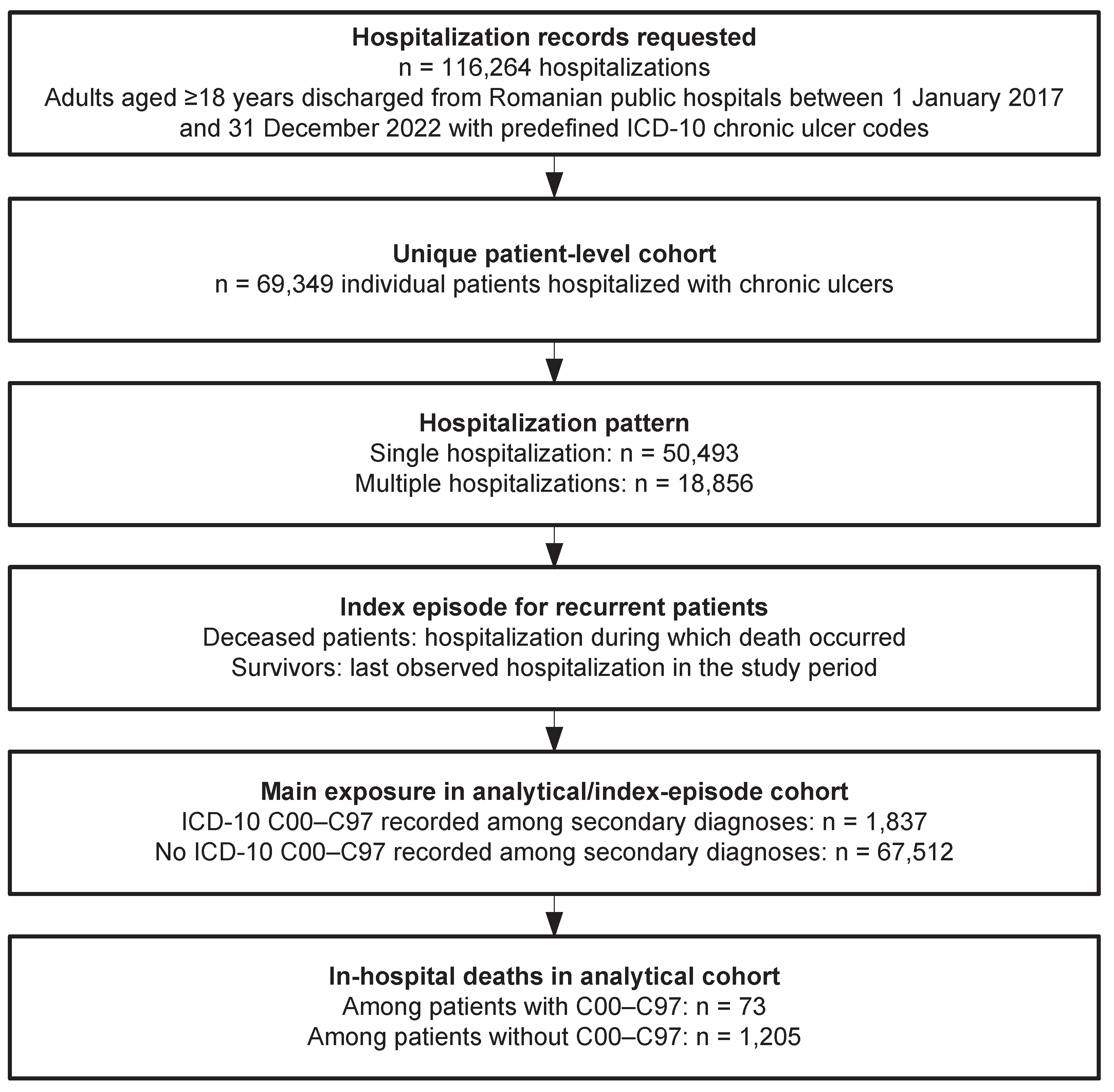
Figure 2.
Adjusted odds ratios for in-hospital mortality associated with malignancy recorded among secondary diagnoses.
Figure 2.
Adjusted odds ratios for in-hospital mortality associated with malignancy recorded among secondary diagnoses.
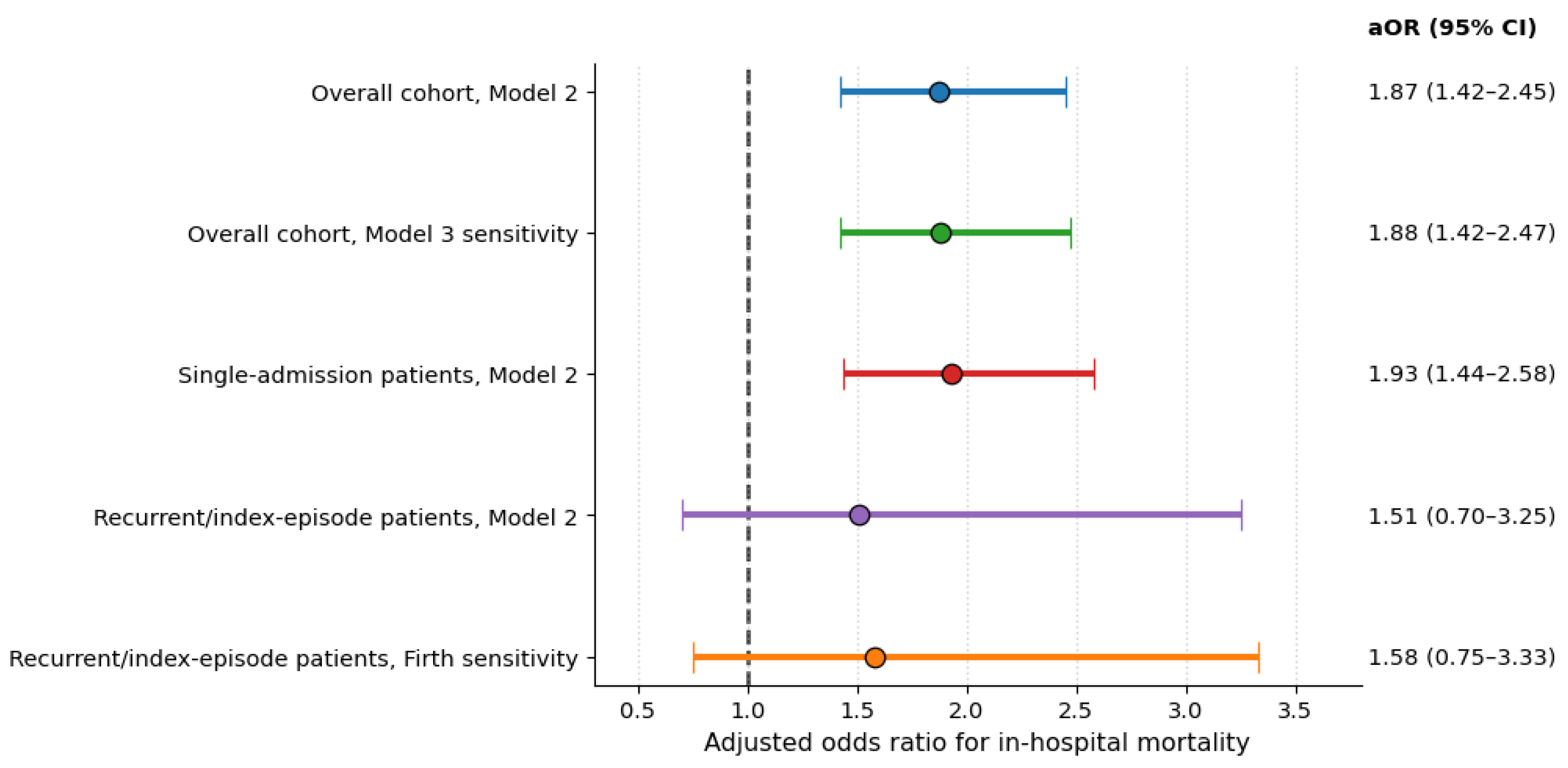
Table 1.
Baseline characteristics of patients according to malignancy recorded among secondary diagnoses in the index-episode cohort.
Table 1.
Baseline characteristics of patients according to malignancy recorded among secondary diagnoses in the index-episode cohort.
| Variable | Category | No malignancy n (%) | Malignancy C00–C97 n (%) | p-value |
|---|---|---|---|---|
| Age, years | Mean (SD) | 66.2 (13.8) | 70.7 (11.5) | <0.001 |
| Age group | <45 years | 4,810 (7.1) | 53 (2.9) | <0.001 |
| 45–54 years | 8,223 (12.2) | 112 (6.1) | ||
| 55–64 years | 14,677 (21.7) | 314 (17.1) | ||
| 65–74 years | 19,556 (29.0) | 591 (32.2) | ||
| 75–84 years | 15,589 (23.1) | 600 (32.7) | ||
| ≥85 years | 4,657 (6.9) | 167 (9.1) | ||
| Sex | Female | 32,634 (48.3) | 883 (48.1) | 0.837 |
| Male | 34,878 (51.7) | 954 (51.9) | ||
| Area of residence | Urban | 33,219 (49.2) | 1,052 (57.3) | <0.001 |
| Rural | 34,293 (50.8) | 785 (42.7) | ||
| Type of admission | Non-emergency / other | 46,869 (69.4) | 1,331 (72.5) | 0.006 |
| Emergency | 20,643 (30.6) | 506 (27.5) | ||
| Chronic ulcer category | Venous ulcer (I83.x) | 30,221 (44.8) | 423 (23.0) | <0.001 |
| Arterial ulcer (I70.23) | 8,082 (12.0) | 169 (9.2) | ||
| Diabetic ulcer (E1x.73) | 3,851 (5.7) | 43 (2.3) | ||
| Pressure ulcer (L89) | 4,554 (6.7) | 223 (12.1) | ||
| Non-classified lower-limb ulcer (L97) | 12,383 (18.3) | 323 (17.6) | ||
| Chronic skin ulcer NEC (L98.4) | 8,421 (12.5) | 656 (35.7) | ||
| Hospitalization pattern | Single | 49,101 (72.7) | 1,392 (75.8) | 0.004 |
| Multiple | 18,411 (27.3) | 445 (24.2) | ||
| In-hospital outcome | Survived | 66,307 (98.2) | 1,764 (96.0) | <0.001 |
| Died in hospital | 1,205 (1.8) | 73 (4.0) |
Note: Values are presented as n (%) unless otherwise specified. Malignancy exposure was defined as the presence of at least one ICD-10 C00–C97 code recorded among secondary diagnoses in the analytical hospitalization. For recurrent patients, this was the index hospitalization. Group comparisons were performed using the χ² test for categorical variables and the t-test or Mann–Whitney U test for continuous variables, as appropriate. P values refer to comparisons between patients with and without ICD-10 C00–C97 codes recorded among secondary diagnoses.
Disclaimer/Publisher’s Note: The statements, opinions and data contained in all publications are solely those of the individual author(s) and contributor(s) and not of MDPI and/or the editor(s). MDPI and/or the editor(s) disclaim responsibility for any injury to people or property resulting from any ideas, methods, instructions or products referred to in the content. |
© 2026 by the authors. Licensee MDPI, Basel, Switzerland. This article is an open access article distributed under the terms and conditions of the Creative Commons Attribution (CC BY) license (http://creativecommons.org/licenses/by/4.0/).
Copyright: This open access article is published under a Creative Commons CC BY 4.0 license, which permit the free download, distribution, and reuse, provided that the author and preprint are cited in any reuse.


