

Submitted:
09 June 2026
Posted:
10 June 2026
You are already at the latest version
Abstract
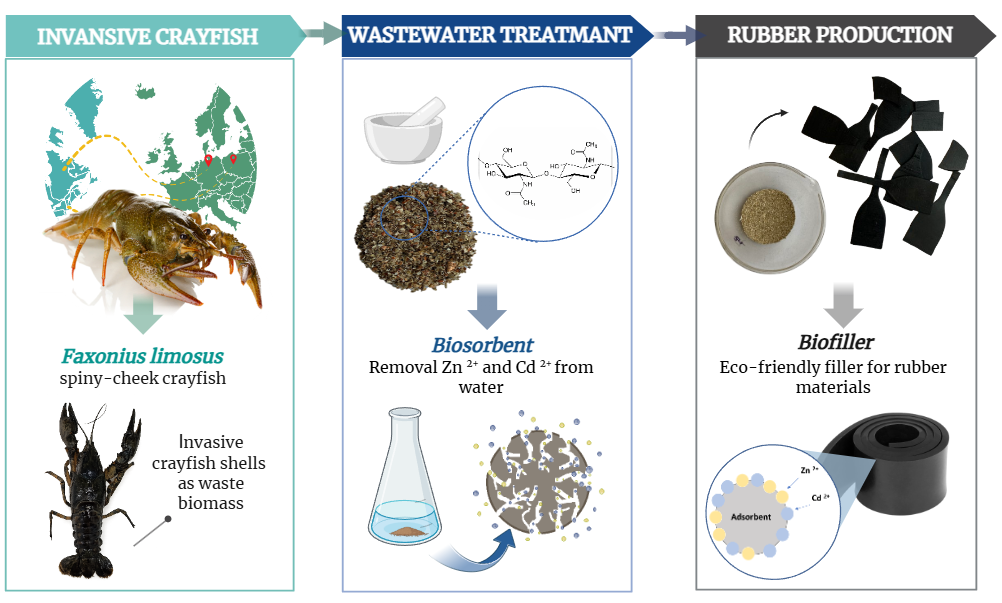
The increasing contamination of aquatic environments by heavy metals, together with the growing ecological impact of invasive aquatic species, highlights the need for sustainable remediation strategies. In this study, shells of the invasive crayfish Faxonius limosus were investigated as a low-cost biosorbent for the removal of Zn(II) and Cd(II) ions from aqueous solutions. The material was characterized using FTIR, SEM, and BET/BJH analyses, which confirmed the presence of amino, hydroxyl, amide, and carbonate functional groups and a predominantly mesoporous structure favorable for adsorption. Batch adsorption experiments showed rapid adsorption kinetics, with equilibrium reached after approximately 60 min. The pseudo-second-order kinetic model provided the best fit for both metal ions, indicating chemisorption as the dominant mechanism. Adsorption isotherms were best described by the Langmuir model, suggesting monolayer adsorption on homogeneous active sites. The maximum adsorption capacities predicted by the Langmuir model were 70.69 mg/g for Zn(II) and 302.12 mg/g for Cd(II). The study also demonstrated the potential reuse of metal-loaded shells as biofillers in natural rubber composites, contributing to sustainable waste valorization and circular economy principles.
Keywords:
biosorbents
; invasive spaces
; F. limosus
; heavy metals
; crayfish shells
1. Introduction
Heavy metal contamination of aquatic environments has become a major environmental concern as a consequence of intensified industrialization and the continuous release of metal-bearing effluents from sectors such as mining, metallurgy, electroplating, fertilizer and pesticide production, food processing, and pharmaceutical manufacturing. Unlike many organic pollutants, heavy metals are not biodegradable and can persist in aquatic systems, accumulate in sediments and biota, and subsequently enter the food chain, posing long-term ecological and human health risks [1]. Because of their persistence, toxicity, and ecological impacts, these metals are considered major contributors to ecosystem degradation and are routinely monitored as priority pollutants worldwide [2]. Particular attention has been given to Zn(II) and Cd(II), which are frequently detected in contaminated waters. Although zinc is recognized as an essential micronutrient involved in numerous biological processes, its presence at elevated concentrations may cause harmful effects, including gastrointestinal disorders, skin irritation, fever, and hematological disturbances. Cadmium is even more concerning because of its pronounced toxicity and high bioaccumulation potential, making its occurrence in aquatic systems especially problematic even at low concentrations [3]. Cadmium is introduced into surface waters through mining and metallurgical activities, battery manufacturing, electroplating, pigment production, phosphate fertilizers, and industrial wastewater discharges. Zinc, although less toxic than cadmium, may also exert harmful effects at elevated concentrations, causing toxicity to aquatic biota and disrupting ecological balance. Furthermore, the simultaneous presence of these metals in contaminated waters represents a challenge for water treatment and environmental protection. For these reasons, the development of efficient, low-cost, and sustainable materials for their removal from water remains of significant scientific and practical interest.
Conventional treatment methods for heavy-metal-contaminated water can be effective, but they are often associated with high operational costs, sludge generation, and reduced efficiency at low pollutant concentrations. For this reason, biosorption has attracted increasing attention as a low-cost and environmentally friendly alternative. Biosorption can remove metal ions through a combination of ion exchange, surface complexation, electrostatic attraction, and precipitation, while using abundant biological materials or waste-derived sorbents [1,4]. Crustacean shell waste is particularly promising in this context because it contains chitin, proteins, and calcium carbonate, all of which provide functional groups and mineral phases favorable for metal binding.
At the same time, the management of invasive aquatic species represents another important environmental challenge. The Intergovernmental Science-Policy Platform on Biodiversity and Ecosystem Services (IPBES) [5] has identified Invasive Alien Species (IAS), organisms introduced by humans into regions beyond their natural range, as one of the five primary direct drivers of global biodiversity loss. IPBES emphasizes that invasive species represent one of the most serious threats to biodiversity and human well-being in the coming decade. As stated in the EU Biodiversity Strategy for 2030 [6], Invasive alien species can severely compromise efforts to protect and restore natural ecosystems. In addition to causing extensive harm to biodiversity and the economy, many of these species also contribute to the emergence and spread of infectious diseases, endangering both humans and wildlife. Their introduction rate has risen markedly in recent years. In Europe alone, 354 of the 1,872 species currently classified as threatened are impacted by invasive alien species. Without effective prevention and control measures, the pace of invasion and the associated risks to nature and human health will continue to escalate. The implementation of the EU Invasive Alien Species Regulation [7], along with other relevant legislation and international agreements, must be further strengthened. These efforts should focus on minimizing, and where possible, preventing the introduction and establishment of alien species within the EU environment. The overarching goal is to effectively manage established invasive alien species and reduce the number of Red List species currently threatened by them by 50%.
The spiny-cheek crayfish Faxonius limosus (Rafinesque, 1817), also known as Orconectes limosus, belongs to the largest crayfish family, Cambaridae, which includes 14 genera and 441 species. Native to North and Central America, it was the first non-native crayfish species introduced into Europe. The only recorded successful introduction occurred in 1890, when 90 individuals supplied by the US Commission of Fish and Fisheries were released into a fishpond in western Poland. Since then, the species has spread widely and is now present in rivers, canals, and lakes across 23 European countries. [8]. It is an omnivorous species that feeds on aquatic plants, fish eggs, and various invertebrates, thereby negatively impacting the biodiversity. Moreover, it serves as a carrier of the crayfish plague, a disease fatal to native European crayfish. Through its extensive burrowing activity, it can also destabilize riverbanks and alter aquatic habitats. Since its introduction, F. limosus has become the most widespread non-indigenous crayfish species in Europe and is now listed among the invasive alien species (IAS) of Union concern under EU regulations 2016/1141 [9]. Faxonius limosus is adaptable to a wide variety of environmental conditions, and is an active migrator that can live and reproduce in brackish waters with salinity up to 10% [10]. Taking into account the above, there is an urgent need to monitor and prevent its further spread in the inland waters of Serbia and the Danube River Basin, in order to address the problem of its impact on biodiversity. The first record of F. limosus in Serbia dates back to 2002, when it was observed in the Danube River near Apatin. Since then, the species has expanded its distribution throughout the entire section of the Danube, the Sava, Tisa, Velika Morava, and Tamiš rivers [11].
The aim of this study was to investigate the potential use of Faxonius Limosus crayfish shells as a biosorbent for the removal of zinc and cadmium ions from water. After crayfish were collected from various locations along the course of the Danube River in Serbia, and the meat was separated, a large amount of shell waste remained and was utilized in this research. Batch adsorption experiments were conducted to investigate the removal efficiency of Zn(II) and Cd(II) from model aqueous solutions using the prepared material, whereas the adsorption behavior was further interpreted through kinetic and isotherm modeling. Given the substantial quantities of this type of waste generated worldwide, its application as a biosorbent has been the subject of increasing research interest in previous years. Several studies have demonstrated that crayfish shells can be effectively used as adsorbents in wastewater treatment [12,13]. However, a review of the available literature revealed that no data have been reported regarding the adsorption performance of the Faxonius limosus shells.
Additionally, this research proposes a solution to the problem of loaded adsorbent by utilizing it as a bio-filler in rubber production. Despite considerable advances in elucidating adsorption mechanisms and the growing number of studies addressing process modelling and optimization, the large-scale implementation of biosorption-based technologies remains limited. A key challenge lies in the fact that much of the existing research has primarily emphasized enhancing sorption efficiency and removal performance, while comparatively little attention has been devoted to the end-of-life management of spent biosorbents. In practical applications, biosorbents are typically subjected to multiple adsorption–desorption cycles; however, progressive deterioration of their sorption capacity ultimately necessitates their replacement [14,15,16]. The subsequent handling of exhausted biosorbents, often referred to as post-sorbents, is insufficiently addressed in the literature. At present, disposal in landfills or thermal treatment via incineration represent the most common management strategies. Both approaches raise serious environmental concerns, as landfilling may enable the remobilization of heavy metals through leaching and desorption processes, whereas incineration can lead to the release of hazardous gaseous emissions and the formation of metal-enriched ash residues. Consequently, the development of environmentally sound strategies for the management of metal-laden post-sorbents is essential. In recent years, increasing research efforts have been directed toward the valorization of exhausted biosorbents containing heavy metals, considering both technological feasibility and environmental sustainability. Several studies indicate that such materials can serve as secondary resources for the production of value-added products, thereby mitigating the risks associated with hazardous waste disposal while simultaneously offering potential economic benefits [17,18].
2. Materials and Methods
2.1. Preparation of the Adsorbents
Crayfish shells obtained after meat separation were washed several times with pure water to remove remaining dirt, flesh, and other impurities that may have remained on the surfaces of the shell. The shells were dried in a laboratory oven at 105℃ for 24 hours, after which they were sun-dried for a few more days. The ground crayfish shells were sieved through a mesh with an aperture size of 0.4 µm, and the fraction with particle sizes smaller than 0.4 µm was subsequently used in all further experiments.
2.2. Characterization of the Adsorbents
Comprehensive characterization of the adsorbent is essential to assess its physicochemical properties that may influence the adsorption process. In particular, the potential release of pollutants from the adsorbent into the aqueous phase may pose environmental risks, especially when organic matter is present. For this reason, the chemical oxygen demand (COD) was determined in water after 24 h of contact with the adsorbent to assess the possible release of organic compounds from the crayfish shell material into the aqueous phase during its application as a biosorbent. The analysis was performed using potassium dichromate as the oxidizing agent, following the standard dichromate reflux method [19]. Surface functional groups of the investigated crayfish shell particles were identified by Fourier Transform Infrared (FTIR) spectroscopy operated in non-contact external reflection mode. Spectra were recorded over the wavenumber range of 400–4,000 cm⁻¹ at a resolution of 4 cm⁻¹ using an Alpha FTIR spectrometer (Bruker Optics, Germany). The surface morphology of the crayfish shells was examined by scanning electron microscopy (SEM) using a JEOL JSM-6460LV scanning electron microscope and INCA X-sight software (Oxford Instruments). The point of zero charge (pHPZC) of the crayfish shell biosorbent was determined using the pH drift method according to Smičiklas et al. [20]. Briefly, 0.25 g of the adsorbent was added to 50 mL of 0.1 M KNO₃ solutions with initial pH values adjusted between 1 and 12 using 0.1 M HNO₃ or 0.1 M KOH. The suspensions were shaken for 24 h at room temperature to allow equilibration between the solid and liquid phases. Subsequently, the adsorbent was separated by filtration, and the final pH of each solution was measured. The pHPZC value was determined from the plateau region of the plot relating the initial and final pH values. The specific surface area and pore size distribution of crayfish shells were determined using a gas sorption analyzer (Anton Paar NOVAtouch LX2). The specific surface area was calculated using the Brunauer-Emmett-Teller (BET) method, while the pore size distribution was derived from the desorption branch of the nitrogen adsorption–desorption isotherm applying the Barrett-Joyner-Halenda (BJH) model.
2.3. Batch Adsorption
Aqueous solutions of Cd(II) and Zn(II) were prepared by dissolving cadmium nitrate tetrahydrate (Cd(NO₃)₂·4H₂O) and zinc sulfate heptahydrate (ZnSO₄·7H₂O) in deionized water. Batch adsorption experiments were performed at room temperature using a laboratory orbital shaker (IKA KS 260). In each experiment, 0.25 g of adsorbent was mixed with 100 mL of metal ion solution at an initial pH of 5. For kinetic studies, the contact time ranged from 5 min to 24 h at a fixed initial metal ion concentration of 50 mg/L. Isotherm experiments were carried out by varying the initial metal ion concentration from 10 to 500 mg/L for Zn ions and 700 mg/L for Cd ions, while maintaining a constant contact time of 6 h. Upon completion of the adsorption period, the solid phase was separated by filtration through MN 85/70 BF membrane filters with a pore size of 0.45 μm. The concentrations of metal ions in the aqueous phase before (C₀) and after adsorption (C) were quantified in the filtrate using inductively coupled plasma mass spectrometry (ICP-MS, Agilent 7700x). [21]. The adsorption capacity (q) and adsorption efficiency (E) of metal ions were calculated based on the following equations:
where m is the mass of added adsorbent per liter of solution.
2.4. Adsorption Kinetic Models
Adsorption kinetics provide insight into the rate and mechanism of the adsorption process, including mass transfer phenomena and the overall efficiency of the investigated adsorbent. Kinetic analysis describes the temporal evolution of solute uptake and the residence time of adsorbate species at the solid-liquid interface, thereby contributing to a better understanding of the adsorption behavior [22,23]. To elucidate the adsorption mechanism and rate-controlling steps, the experimental kinetic data were fitted using commonly applied batch kinetic models, including the pseudo-first-order (PFO), pseudo-second-order (PSO), and Elovich models:
The pseudo-first-order (PFO) kinetic model describes adsorption as a reversible process and assumes that the rate of occupation of adsorption sites is proportional to the number of unoccupied sites. The differential form of the model is expressed as follows [24]:
where qe (mg/g) and qt (mg/g) represent the adsorption capacities at equilibrium and at time , respectively, and k1 (min⁻¹) is the pseudo-first-order rate constant.
The pseudo-second-order (PSO) kinetic model assumes that adsorption proceeds via chemisorption involving both adsorption and ion-exchange mechanisms on the adsorbent surface, with chemical interaction at the active sites being the rate-limiting step [24]. The differential form of the PSO model is expressed as:
where (g/mg min) is the pseudo-second-order rate constant. Integration of the above equation under the initial condition at yields the following expression:
The Elovich kinetic model is widely applied to describe chemisorption processes on solid surfaces, particularly for systems characterized by heterogeneous adsorption sites. This empirical model assumes that the adsorption rate decreases exponentially with increasing surface coverage as a consequence of progressive occupation of energetically less favorable sites [22,24]. The Elovich equation is expressed as:
where (mg/g min) represents the initial adsorption rate and (g/mg) is a constant related to surface coverage and the activation energy of chemisorption.
2.5. Adsorption Isotherm Models
To elucidate the adsorption mechanism of Zn(II) and Cd(II) ions onto the surface of crayfish shells, the experimental equilibrium data were interpreted using widely applied adsorption isotherm models, Langmuir, Freundlich, and Temkin. These models provide insight into the adsorption behavior and surface characteristics of the adsorbent. The corresponding isotherm equations were applied in their original nonlinear form as well as in linearized form to facilitate parameter estimation and enable straightforward comparison of model performance.
The Langmuir isotherm model assumes monolayer adsorption on a homogeneous surface with a finite number of identical and energetically equivalent adsorption sites, and no interaction between adsorbed species. Once an adsorption site is occupied, no further adsorption can occur at that site [25]. The nonlinear form of the Langmuir equation is expressed as [26]:
where ql (mg/g) is the maximum monolayer adsorption capacity, and KL (l/g) is the Langmuir constant.
The Freundlich isotherm is an empirical model that does not rely on a specific theoretical assumption of adsorption and is commonly used to describe adsorption on heterogeneous surfaces [27]. The model incorporates two fitting parameters, and , which are related to the adsorption capacity and adsorption intensity, respectively, and are expressed as:
where KF is Freundlich constant ((mg/g)/(l/mg)1/n) and 1/n is constant related to the RC surface heterogeneity.
The Temkin isotherm model is a two-parameter model derived from theoretical considerations of adsorption. It describes adsorption on heterogeneous surfaces while accounting for the effects of indirect adsorbate-adsorbent interactions on the adsorption process. In this model, the heat of adsorption is assumed to decrease linearly with increasing surface coverage due to these interactions [25,28]. The Temkin isotherm equation is expressed as [26]:
where R is the ideal gas constant (8.314 J/mol K), T is the temperature (K), AT (l/mg) is Temkin isotherm constant; and bT (J/mol) is con stant related to the heat of adsorption.
2.6. Processing of Rubber Using Loaded Shells as a Biofiller
Following the batch adsorption tests (mshells=2.5g; C0(Zn,Cd)=50 mg/L; t=60 min), the saturated shells were separated by filtration and subsequently dried, first under ambient conditions and then in a laboratory oven at 50 °C until constant mass was achieved. The obtained material was stored in a dry environment in sealed polyethylene bags prior to further use.
2.7. Composition of the Natural Rubber Compound
The natural rubber (NR) compounds investigated in this study were formulated using Standard Vietnamese Rubber CV60, produced by Vietnam Rubber Group (Ho Chi Minh City, Vietnam). Four formulations, containing different content of Cd- and Zn-loaded shells, were prepared to investigate the effect of the type and content of LS on the properties of rubber samples. All additives were commercial-grade materials widely used for rubber production and were incorporated into the mixtures as received, without any additional purification. The compounding ingredients were obtained from Edos (Zrenjanin, Serbia) and included sulfur, zinc oxide (ZnO), stearic acid (stearin), N-cyclohexylbenzothiazol-2-sulfenamide (CBS) and N-isopropyl-N’-phenyl-p-phenylenediamine (IPPD). Within the vulcanization system, sulfur was used as a crosslinking agent, CBS served as the accelerator, while zinc oxide and stearic acid functioned as activators. IPPD was incorporated as an antioxidant to increase resistance to thermos-oxidative degradation. Reinforcement of the rubber matrix was achieved using carbon black (CB) grade N330, supplied by Nhumo (Altamira, Mexico) which was used as a primary filler. Except for the loaded shells, all raw materials used in this study are commercially available and commonly used in industrial rubber production. To evaluate the potential use LS as additives in rubber compounds, elastomeric formulations containing different amounts of Cd- and Zn-loaded postsorbents were prepared. In rubber compounding practice, formulation ratios are commonly expressed relative to the rubber matrix, which is assigned a reference value of 100. The quantities of all other constituents in the compound are calculated in relation to this base rubber value and expressed in parts per hundred rubber, which is denoted by phr. Zn- and- Cd-loaded shells were incorporated into natural rubber mixture at 2.5 and 5 phr, while the content of remaining compound ingredients was kept constant. The prepared samples were labelled according to the type and content of postsorbent incorporated into the rubber mixture, as summarized in Table 1.
Table 2 outlines the formulation which was used for preparation of natural rubber compound. The content of each component in the table was determined from the recipe expressed in phr (see the second column of Table 2), where it was applied chamber filling coefficient of 0.75 in order to ensure consistent and stable mixing conditions. The filling coefficient is the ratio of the volume of the compounded material and the total internal volume of the empty mixing chamber. As indicated in Table 2, the mixing ingredients are divided into inactive and active, based on their role in the mixing process. Carbon black, loaded shells, zinc oxide, stearin and IPPD are grouped as inactive, while sulphur and CBS are identified as active agents. The active and inactive components of the natural rubber compound are mixed separately into the compound, which will be explained in more details in the following section.
2.8. Mixing Procedure for Natural Rubber Samples
The natural rubber samples were prepared in the Laboratory mixer Haake Rheomix (model 600, Thermo Fisher Scientific,Waltham, MA, USA), modified with a drive unit Haake Rheocord EU-5. The applied three-stage mixing protocol followed the procedure previously described in our earlier publication [29]. The mixing procedure included (1) mixer conditioning as idle run at 90 °C, (2) rubber mastification, where raw rubber was mixed at varying rotor speeds to ensure that the compounds will be distributed equally thorough rubber matrix, and (3) final compounding which involved addition of the inactive and active components, separately, as listed in Table 2.
2.9. Preparation of Vulcanized Samples
Vulcanization is a chemical process that introduces crosslinks between polymer chains, increasing elasticity, strength and thermal stability of rubber materials [30]. In current research, the natural rubber samples were vulcanized following the ISO 37 standard, where rubber sheets of 2.2 mm thickness were pressed at 150 °C under atmospheric pressure during 15 minutes. After vulcanization, the rubber sheets were conditioned at room temperature for 24 hours to enable any remaining internal crosslinking reactions to occur, and then they cut into dumbbell-shaped samples, in accordance to ISO 37 specifications.
2.10. Rheological Characterization and Mechanical Properties
The curing behaviour for all vulcanized samples was investigated for 15 min at 150 °C using an oscillating MDR-A Rotorless Rheometer, supplied by Beijing Rade Instrument Co., Ltd. (Beijing, China). The mechanical properties of prepared composites containing different content of postsorbents were evaluated by testing their tensile strength and elongation at break. Measurements were conducted following ISO 37 standard, utilizing a dynamic Rade extensometer (RT5K-2) produces by Beijing Rade Instrument co., Ltd. (Beijing, China). Every sample was examined five times and the average value was determined for analysis.
3. Results
3.1. Characterization of the Adsorbent
To assess the potential release of organic matter from the crayfish shell biosorbent during its application, the chemical oxygen demand (COD) of water after 24 h of contact with the adsorbent was determined. The obtained value of 60.14 mg O₂/L indicates a certain release of organic compounds into the aqueous phase, which can be attributed to the presence of residual proteins, chitin-derived components, and other naturally occurring organic constituents of the shell matrix. The measured COD value remained below the limit value of 125 mg O₂/L commonly prescribed for treated municipal wastewater discharges [31]. This indicates that the release of organic matter from the crayfish shell biosorbent was relatively moderate and is unlikely to represent a major environmental concern.
Due to their chemical composition, characterized by a high content of calcium carbonate, chitin, proteins, and pigments, as well as a nanoporous structure, crustacean shell waste exhibits considerable potential as an adsorbent. This specific composition directly contributes to favorable adsorption performance, as the presence of various active sites and functional groups enhances interactions with target contaminants. FTIR spectroscopy was employed for the rapid identification of the chemical composition of the obtained shell powders. Scanning electron microscopy (SEM) was used to examine the surface morphology and microstructural features of the shell powder, and the analyses were conducted using a (Shimadzu IRAffinity-1 spectrophotometer equipped with attenuated total reflectance accessory) instrument.
3.2. Functional Groups
The FTIR spectrum recorded for the crayfish shells is given in supplementary Figure S1: FTIR spectra of F.limosus crayfish shells. Table 3 shows peaks obtained from the FTIR analysis.
The spectrum clearly shows chitin (1153, 1065, 1027, 1257 cm⁻¹) [32,33,34] interlaced with proteins (amide I/II at ~1633 and 1540–1505 cm⁻¹) [33,35]. The carbonate band near 860 cm⁻¹ confirms the presence of a mineral phase (CaCO₃) [34]; the position suggests a significant aragonite or amorphous CaCO₃ component, rather than purely calcite. The broad 3269 cm⁻¹ band [32,35,36] and the 1633 cm⁻¹ shoulder imply bound water and hydrogen bonding [33,35]. These results are consistent with previous studies on crustacean shells [32,33,35,36], which have confirmed the presence of characteristic chitin and calcium carbonate (CaCO₃) components, along with their associated functional groups. The FTIR spectra typically reveal bands corresponding to amide I and amide II groups originating from the chitin structure, as well as carbonate-related vibrations associated with CaCO₃. These functional groups play a key role in metal binding through mechanisms such as ion exchange, surface complexation, and electrostatic interactions, thereby confirming the potential of the crayfish shell material used in this study as an effective biosorbent.
3.3. Morphological Characteristics
The morphological characteristics of crayfish shells, evaluated by SEM, are presented in Figure 2. The micrographs revealed a heterogeneous and irregular surface morphology characterized by a rough and porous structure. Numerous cavities, cracks, and uneven surface features can be observed, while no uniformly distributed or regularly shaped pores were detected. The rough and fragmented surface structure may be favorable for adsorption processes, as it increases the probability of interaction between metal ions and available active sites on the biosorbent surface. In addition, the presence of cavities and irregular depressions suggests the existence of accessible mesoporous regions, which can facilitate diffusion and mass transfer of ions during adsorption.
Figure 1.
SEM image of F.limosus shells.
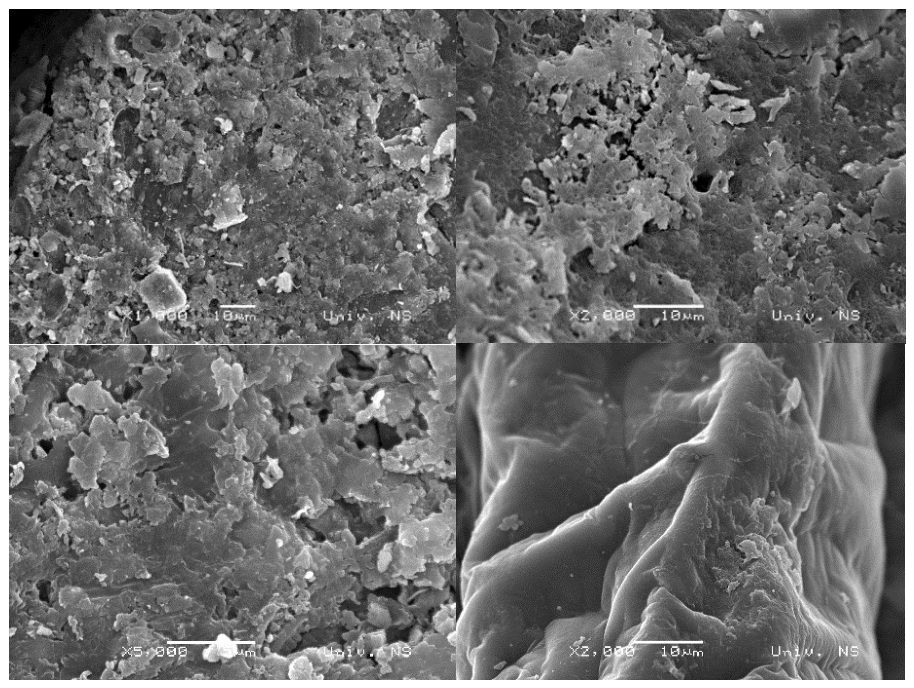
Figure 2.
a) Adsorption-desorption isotherms of crayfish shells and b) pore size distribution.
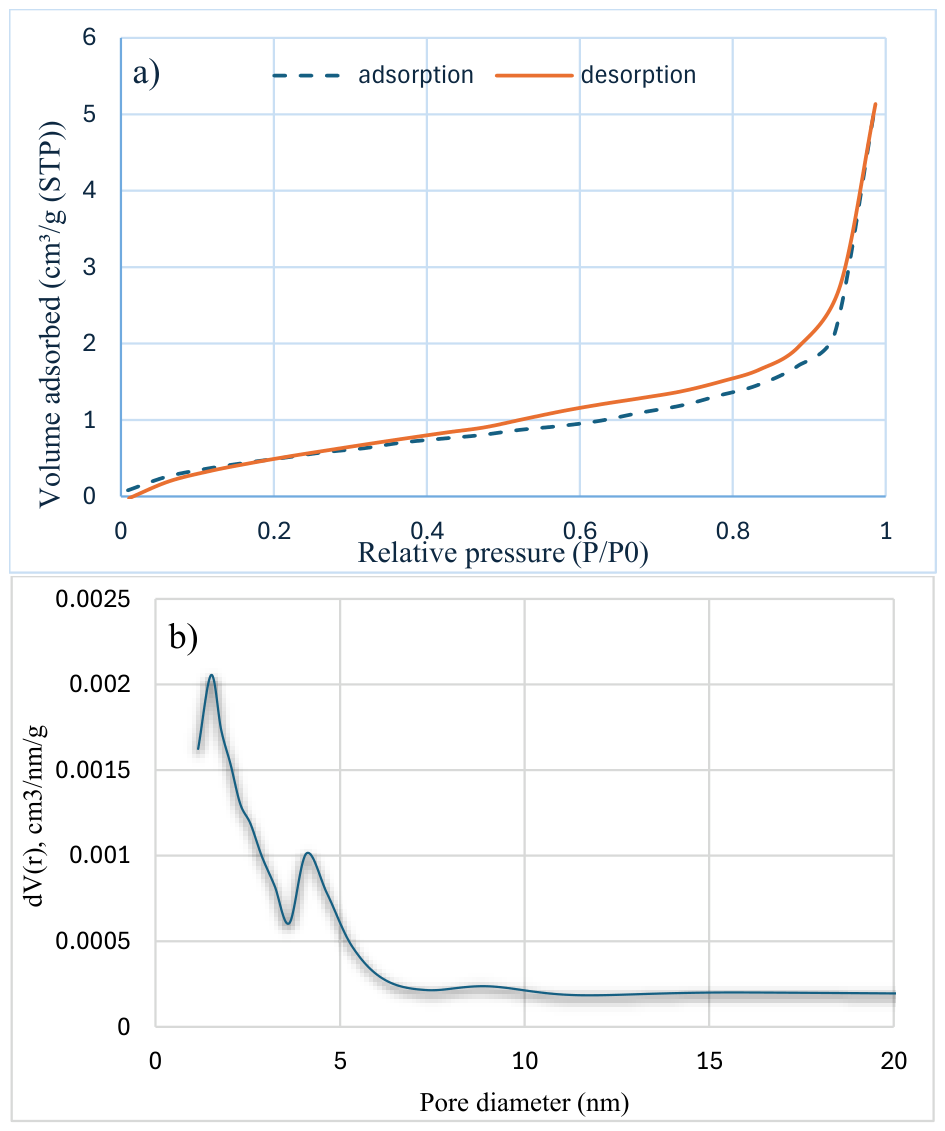
Figure 2 presents the nitrogen adsorption-desorption isotherm of the powdered river crayfish shell sample together with the pore size distribution for pores below 100 nm, calculated from the desorption branch of the isotherm using the Barrett-Joyner-Halenda (BJH) method. The specific surface area of the material was determined based on the amount of nitrogen required for monolayer adsorption, while the main textural and porosity-related properties of the biosorbent are summarized in Table 4.
According to the obtained results, the specific surface area of 2.094 m²/g can be considered relatively low, suggesting limited pore development and/or partial blockage of pores by inorganic constituents naturally present in the shell matrix, primarily calcium carbonate. BJH analysis showed a total pore volume of 3.327 × 10⁻³ cm³/g for pores smaller than 30 nm, indicating that the porosity of the material is mainly associated with the mesoporous structure. Furthermore, the average pore diameter of 3.18 nm classifies the material within the lower mesoporous range according to IUPAC classification.
Despite the relatively low specific surface area, the adsorption potential of crustacean shell-derived materials is often strongly influenced not only by textural properties, but also by the presence of functional groups such as amino, hydroxyl, and carbonate groups capable of interacting with metal ions through complexation, ion exchange, and electrostatic interactions. Therefore, the observed adsorption performance may be attributed to the combined effect of surface chemistry and mesoporous structure, which facilitates diffusion of metal ions toward the available active sites.
3.4. Adsorption Kinetics
Contact time is considered one of the key operational parameters in adsorption processes, particularly from the practical and economic perspective, since it directly influences process efficiency and treatment costs. Therefore, the effect of contact time on the adsorption of Zn(II) and Cd(II) ions onto crayfish shell biosorbent was investigated. The obtained results showed a rapid uptake of both metal ions during the initial stage of the process, with the highest adsorption rate observed within the first 30 min. Such behavior can be attributed to the large number of initially available active sites on the biosorbent surface. After this rapid phase, the adsorption rate gradually decreased, and equilibrium was reached after approximately 60 min. In addition to determining the equilibrium time, kinetic studies provide valuable insight into the adsorption mechanism, adsorption rate, and potential rate-controlling steps, all of which are important for the optimization and design of adsorption systems. In the present study, the experimental kinetic data were analyzed using pseudo-first-order, pseudo-second-order, and Elovich kinetic models. The calculated kinetic parameters are summarized in Table 5, while the corresponding kinetic plots are presented in Figure 3.
Although both Zn(II) and Cd(II) adsorption processes were best described by the pseudo-second-order kinetic model (Table 5), indicating a chemisorption-controlled mechanism, noticeable differences in adsorption capacity and kinetic behavior were observed between the two metal ions.
According the presented results (Figure 3) the higher adsorption capacity was obtained for Zn(II) (25.64 mg/g) compared to Cd(II) (14.47 mg/g). Similar trends have been reported in the literature. Bahadir et al. (2023) [37] observed higher adsorption efficiencies for Zn(II) compared to Cd(II) on chitin-based shrimp shell waste, attributing this behavior to differences in metal-ligand interactions and hydration characteristics. Jaafarzadeh et al. (2015) [38] also reported superior kinetic fitting and high adsorption affinity for Zn(II) ions relative to other metal species when using chitin-derived biosorbents. Additionally, Vijayaraghavan et al. (2011) [39] demonstrated that Zn(II) adsorption onto crab shell particles proceeds more favorably than that of other divalent metal ions. Overall, the observed distinction between Zn(II) and Cd(II) adsorption behavior underscores the importance of metal-specific properties in governing adsorption performance and confirms that crustacean shell-derived biosorbents exhibit a higher selectivity toward Zn(II) ions under the investigated conditions.
3.5. Removal Efficiency
The removal efficiencies of Cd(II) and Zn(II) by crab shell biosorbent show distinct trends as a function of initial metal concentration. As shown in Figure 4, both metals exhibited high removal efficiencies at lower initial concentrations (10-50 mg/L), with Cd(II) removal ranging from 89.90% to 92.51% and Zn(II) removal from 83.71% to 92.00%. In this concentration range, the number of available active adsorption sites was sufficient relative to the amount of metal ions present, enabling efficient adsorption of both species.
As the initial concentration increased, a clear divergence in behavior was observed. Cd(II) removal remained consistently high, increasing from 90.55% at 20 mg/L to a maximum of 98.31% at 300 mg/L, and maintaining values above 97% even at 500 mg/L. This indicates a strong affinity of Cd(II) toward the functional groups present in the crab shell matrix (-N-H, -OH, and carbonate groups from CaCO₃). In contrast, Zn(II) removal decreased significantly beyond 50 mg/L, dropping from 92.00% to 25.57% at 500 mg/L, suggesting progressive saturation of adsorption sites and weaker binding interactions.
These observations were further supported by changes detected in the FTIR spectra recorded before and after Zn(II) and Cd(II) adsorption. Noticeable variations in both band intensity and peak position confirmed the involvement of surface functional groups in the adsorption process (Figure S2 and S3 in supplementary). A broad absorption band observed in the region around 3200-3500 cm⁻¹ was attributed to overlapping O-H and N-H stretching vibrations originating from hydroxyl and amino groups. Following Zn(II) and Cd(II) adsorption, a slight decrease in intensity accompanied by peak shifting was observed, indicating the participation of hydroxyl and amino functionalities in metal binding through complexation and electrostatic interactions. Furthermore, characteristic carbonate bands associated with calcium carbonate were detected in the region around 1400 cm⁻¹ and below 900 cm⁻¹. Changes observed in these bands after adsorption suggest that carbonate groups also contributed to Zn(II) and Cd(II) removal, likely through ion exchange mechanisms involving Ca²⁺ ions naturally present within the shell matrix. Overall, the observed FTIR spectral modifications indicate that the adsorption process was governed by the combined action of amino, hydroxyl, and carbonate functional groups present in the crayfish shell-derived biosorbent.
These findings are consistent with recent studies on chitosan- and crustacean-derived biosorbents, which confirm high efficiency and strong selectivity toward divalent heavy metals. For example, a recent study [40] reported removal efficiencies of up to ~92% for Zn(II) and ~86% for Cd(II) using functionalized chitosan nanocomposites, with adsorption following pseudo-second-order kinetics, indicating chemisorption as the dominant mechanism. Similarly, recent composite biosorbents based on chitosan derived from shrimp shells have demonstrated Cd(II) removal efficiencies around 80–85%, confirming the strong affinity of cadmium toward amino-functionalized surfaces and the spontaneous nature of the adsorption process [41]. These values are comparable to the lower concentration range observed in this study, while the significantly higher Cd(II) removal (>97% at high concentrations) suggests particularly favorable interaction between Cd(II) and the crab shell matrix.
Recent study [42] further emphasize that chitosan-based materials remain among the most effective low-cost biosorbents due to the abundance of -NH₂ and -OH functional groups, which enable strong coordination with metal ions. These functional groups facilitate inner-sphere complexation, which is typically more pronounced for Cd(II) than Zn(II), explaining the higher and more stable removal efficiencies observed for cadmium in the present study. In contrast, the decline in Zn(II) removal efficiency at higher concentrations aligns with recent findings showing that Zn adsorption is more sensitive to surface saturation and diffusion limitations. Studies on modified chitosan systems have shown that Zn(II) adsorption strongly depends on pH, surface functionalization, and available binding sites, and is often governed by weaker or more reversible interactions compared to Cd(II) [43].
3.6. Adsorption Isotherm
Adsorption isotherms describe the equilibrium relationship between the adsorbent and the adsorbate under constant temperature and pH conditions, providing essential information on adsorption mechanisms and maximum uptake capacity [44]. To determine the effect of initial Zn(II) and Cd(II) concentrations on the efficiency of crayfish shells, it was varied from 10 to 500 mg/l, for Zn(II) ions, and 700 mg/l, for Cd(II) ions, while maintaining the contact time constant (60 min). As it can be seen from Table 6 and Figure 5, the Langmuir isotherm exhibited the highest R² value among the evaluated models for Zn(II) and Cd(II) adsorption, indicating that both ions are predominantly adsorbed as a monolayer on a homogeneous adsorbent surface [45]. The Temkin isotherm for the Zn ions also showed a high degree of correlation (R² = 0.9858), suggesting that adsorbate-adsorbent interactions and a uniform distribution of binding energies contribute to the adsorption process. The dimensionless separation factor (RL), derived from the Langmuir model, was used to evaluate adsorption favorability. Values of RL between 0 and 1 were obtained for all tested systems, confirming favorable adsorption of both metal ions under the studied conditions.
The maximum adsorption capacity for Zn(II) and Cd(II) predicted by the Langmuir model was 70.69 mg/g and 302.12 mg/g, respectively, which is in good agreement with the experimentally determined value of 73.4 mg/g for Zn(II) and 257.88 mg/g for Cd(II). These results are comparable with literature data reported for crustacean-based biosorbents. For instance, Zhou et al., (2016) reported adsorption capacities of 117 mg/g for zinc and 709 mg/g for lead ions using crab shell particles. In a related study [46], the same authors investigated Cd(II) adsorption onto raw crab shells, observing that the experimental data were best described by the Langmuir model, with the maximum adsorption capacity decreasing from 3.42 to 1.53 mmol/g as the biosorbent dosage increased from 0.4 to 3.2 g/L. Similarly. Jaafarzadeh et al. (2014) [47] examined Zn(II) removal using chitin derived from shrimp and crab shells, reporting maximum adsorption capacities of 270.27 mg/g and 181.18 mg/g, respectively, within the initial concentration range of 50-500 mg/L at pH 7. Rahman (2024) [48] investigated the adsorption of various heavy metals on modified shrimp-based chitosan and reported maximum adsorption capacities of 7.50 mg/g for zinc, 20.3 mg/g for copper, 15.0 mg/g for cadmium, and 76.34 mg/g for lead. In that study, high correlation coefficients (R² > 0.98) for both Langmuir and Freundlich models indicated highly efficient adsorption behavior.
Overall, the obtained isotherm parameters confirm that F. limosus shells exhibit favorable adsorption characteristics for Zn(II) and Cd(II) ions, with adsorption behavior predominantly governed by monolayer coverage on energetically uniform binding sites, consistent with findings reported for similar chitin- and calcium carbonate-based biosorbents.
3.7. Point of Zero Charge (pHPZC)
The point of zero charge (pHPZC) of F. limosus shell biosorbent is presented in Figure 6. The obtained value was 8.51, indicating that the adsorbent surface possesses a net positive charge at pH values below 8.51 and a net negative charge at pH values above this value. The relatively high pHPZC can be attributed to the chemical composition of the crayfish shells, which are rich in calcium carbonate and contain amino groups originating from chitin and residual proteins. Similar pHPZC values have been reported for crustacean shell-derived materials and chitin-based biosorbents, typically ranging between 7 and 9 depending on the degree of deproteinization, mineral content, and surface treatment [49,50,51].
At the experimental pH applied in this study (pH 5), the biosorbent surface was expected to be positively charged. Under such conditions, electrostatic attraction between the surface and positively charged Zn(II) and Cd(II) ions would not be favored. Nevertheless, high adsorption efficiencies were observed, particularly for Cd(II), indicating that electrostatic interactions were not the dominant adsorption mechanism. Instead, the adsorption process was likely governed by specific interactions between metal ions and surface functional groups, including amino, hydroxyl, amide, and carbonate groups identified by FTIR analysis. Furthermore, the presence of calcium carbonate in the shell matrix may facilitate adsorption through ion-exchange reactions involving Ca²⁺ ions, which could partially explain the high affinity observed toward Cd(II). The obtained pHPZC value therefore supports the conclusion that the adsorption process was primarily controlled by surface complexation and ion-exchange mechanisms rather than by purely electrostatic interactions.
3.7. Rheological Properties of Rubber with Incorporated Loaded Shells
The influence of incorporated loaded shells on the rheological behaviour of the natural rubber compounds was investigated using a rheometer at 150 °C during the 15 min, which corresponds to the curing conditions applied for the preparation of vulcanized samples in this study. The obtained vulcanization curves provide valuable insight into the crosslinking process and the development of the rubber network during curing. Figure 7 presents the dependence of torque on time for all investigated natural rubber formulations.
All vulcanization curves presented in Figure 7 shows the characteristic S-shaped profile typical of sulfur vulcanization systems, indicating the standard sequence of scorch period, rapid crosslinking stage, and a plateau corresponding to the formation of a stable crosslinked rubber network. As shown in Figure 7, the natural rubber sample without added loaded shells exhibits different vulcanization behavior compared to the filled samples. The samples containing 2.5 and 5 phr of Cd-loaded shells shows almost identical vulcanization curves during the 15 min test at 150 °C, indicating that increasing the amount of Cd-loaded shells at this content does not significantly affect the vulcanization process. This suggests that Cd-loaded shells influence the crosslinking reactions in a similar manner at both contents. In contrast, the samples containing Zn-loaded shells show a greater increase in torque over time compared to those with Cd-loaded shells, indicating a stronger influence on the crosslinking process and possibly a higher crosslink density. Nevertheless, the highest torque values during vulcanization are observed for the sample without added LS, suggesting that the presence of loaded shells slightly reduces the stiffness of the vulcanizing system.
The slightly lower torque values observed for samples containing LS may indicate that the particles partially interfere with the crosslinking reactions. This effect could be attributed to the adsorption of curatives (such as sulfur or accelerators) on the surface of the shells or the immobilization of rubber chains at the filler surface, which may reduce the efficiency of crosslink formation within the rubber matrix.
In addition, the metal ions present in the loaded shells (Cd(II) or Zn(II)) may also influence the vulcanization process. Metal ions are known to interact with sulfur curing systems and accelerators, potentially changing the kinetics of crosslink formation. Depending on their concentration and chemical environment, these ions may participate in or interfere with the formation of sulfur crosslinks, which could further explain the differences observed between samples containing Cd-loaded and Zn-loaded shells. Although the torque values for the samples containing LS are lower than those for the sample without LS, this does not necessarily limit their potential application. Such materials may still be suitable for various applications in the rubber industry where slightly lower crosslink density or modified mechanical properties are desirable.
The rheological properties of the studied natural rubber samples are summarized in Table 7.
The rheological parameters obtained from the vulcanization curves, including minimum torque (Mmin), maximum torque (Mmax), torque difference (ΔM), cure rate index (CRI), scorch time (ts2) and optimal curing time (t90) provide important information about the curing behaviour and crosslinking characteristics of rubber compounds. The minimum torque reflects the viscosity of the uncured rubber compound, while the maximum torque corresponds to stiffness of the fully vulcanized network and it is associated with the crosslinking density. The torque difference (ΔM = Mmax - Mmin) is commonly used as an indicator of the degree of chemical crosslinking. The cure rate index describes the rate of the vulcanization reactions. The scorch time represents the time before the onset of significant number of crosslinking reactions occur, which is important parameter for processing safety. The optimal curing time indicates the time which is required to reach approximately 90% of maximum crosslinking density.
As expected from the vulcanization curve shown in Figure 7, the highest ΔM value can be observed for the sample without added LS, indicating the highest degree of crosslinking. The rest of the samples shows similar ΔM values between them, with the exception of the sample containing 5 phr of Zn-loaded shells which is showing slightly higher torque values and different rheological behaviour. This observation is consistent with the previously discussed influence of metal ions and filler particles on the vulcanization process. The CRI values slightly increase with increasing the content of loaded shells, suggesting a slightly faster curing reactions in the presence of LS. The scorch time is slightly higher for all samples containing LS compared to the sample without LS. However, the differences in scorch time are small and do not significantly affect processing safety. Similarly, optimal curing time shows only minor variations, with slightly higher values observed at lower LS content. Overall, the differences in curing parameters are relatively small, indicating that the addition of loaded shells does not significantly disrupt the vulcanization process, which is in accordance with the similar S-shaped vulcanization curves observed in Figure 7.
3.8. Mechanical Properties
As discussed in previous section, the addition of loaded shells influences the vulcanization behaviour of the examined natural rubber composites, slightly modifying the torque development and crosslinking characteristics during curing. Since extent and structure of the crosslinked network directly affect the performance of rubber materials, it is important to further evaluate how these changes are reflected on the mechanical properties of the vulcanized samples. Mechanical properties are the key parameters that determine the stability of rubber materials for practical applications in the rubber industry. Therefore, the mechanical behaviour of the prepared samples was investigated in order to assess the influence of LS incorporation on the final properties of the rubber composites. The reference sample without added LS serve as a baseline for comparison, enabling to evaluate the effect of incorporating Cd- and Zn-loaded shells on mechanical properties.
The influence of type and content of loaded shells incorporated into the natural rubber mixture on tensile strength is presented in Figure 8, while the corresponding effect on elongation at break is shown in Figure 9. It can be observed that the addition of a small amount of LS (2,5 phr) results in a decrease in tensile strength, while higher LS contents lead to a further reduction in this property. The sample containing 5 phr of Cd-loaded shell shows a significant decrease in tensile strength. Since the incorporated postsorbent behaves primary as an inert filler, it does not provide reinforcement to the natural rubber matrix. Instead, its presence leads to discontinuation of the elastomeric phase, reducing the effective crosslinked network. Furthermore, limited interfacial adhesion between the LS particles and the continuous rubber matrix most likely results in insufficient stress transfer under tensile loading. With higher inert filler content, agglomeration of particles may occur which creates stress concentration sites that enable premature crack initiation and propagation. Even though the LS is considered inert, the presence of Zn and Cd on the shell surface may additionally influence vulcanization process to some extent, potentially affecting crosslinking density and contributing to the observed decline in mechanical performance. Consequently, this decrease in tensile strength is consistent with the non-reinforcing character of the loaded shells, suggesting that such materials may be more suitable for applications where high tensile strength is not the primary requirement.
In contrast to tensile strength, the lowest elongation at break can be observed for the sample without any loaded shells. The incorporation of LS at 2.5 phr is resulting in an increase in elongation at break, and even higher values are observed for samples containing 5 phr of LS. Observed trend in increased elongation of break at higher LS loadings indicates that the addition of LS improves the extensibility of the rubber material. Since the postsorbent behaves as an inert filler, it does not provide reinforcement but instead modifies the rubber network structure. The partial discontinuation of the elastomer phase and possible reduction in effective crosslinking density may increase chain mobility, allowing material to go through greater deformation before failure. At low LS loading, the particles most likely do not form a rigid network that would significantly restrict segmental motion, and as a result, the material becomes more flexible with increasing LS content.
Therefore, while the tensile strength decreases due to the non-reinforcing character of the LS and limited stress transfer efficiency, elongation at break increases, suggesting a shift in mechanical behaviour toward a softer and more extensible rubber material.
4. Conclusions
The results obtained in this study demonstrated that shells of the invasive crayfish Faxonius limosus can be successfully utilized as an effective low-cost biosorbent for the removal of zinc and cadmium ions from aqueous solutions. Characterization of the material confirmed the presence of functional groups and mesoporous structural features favorable for adsorption processes. The adsorption performance was strongly influenced by amino, hydroxyl, amide, and carbonate groups present in the shell matrix, as confirmed by FTIR analysis before and after adsorption. Furthermore, the determined point of zero charge (pHPZC = 8.51) indicated that the adsorbent surface was positively charged under the experimental conditions (pH 5), suggesting that electrostatic attraction was not the dominant mechanism governing metal uptake. Instead, the adsorption process was primarily controlled by surface complexation and ion-exchange interactions involving the functional groups present in the shell matrix. Batch adsorption experiments revealed rapid adsorption kinetics, with equilibrium achieved after approximately 60 min. The pseudo-second-order kinetic model provided the best fit for both investigated metal ions, indicating that chemisorption represented the dominant adsorption mechanism. Equilibrium adsorption data were best described by the Langmuir isotherm model, suggesting predominantly monolayer adsorption on relatively homogeneous active sites. Particularly high adsorption affinity was observed for Cd(II), for which removal efficiencies exceeded 97% at higher concentrations.
The study also demonstrated the possibility of valorizing spent biosorbents through their incorporation into natural rubber composites as biofillers. Although the incorporation of loaded shells reduced tensile strength due to their non-reinforcing character, the resulting composites exhibited increased elongation at break and maintained stable vulcanization behavior. These findings indicate that such materials may be suitable for applications where flexibility and deformability are prioritized over high mechanical strength. Overall, the proposed approach represents a sustainable strategy that simultaneously addresses invasive species management, heavy metal removal from water, and post-adsorbent waste utilization, thereby contributing to circular economy and environmental protection principles.
Although the obtained results confirmed the high adsorption potential of F. limosus shells and the feasibility of their reuse as biofillers in rubber composites, additional investigations are necessary before potential large-scale application. Future research should include detailed studies on the management of spent biosorbents after their service life. In particular, additional experiments should be conducted on the incorporation of ash obtained after incineration of saturated crayfish shells into rubber matrices. Furthermore, leaching tests are required in order to evaluate the possible release of heavy metals into the environment after incorporation of metal-loaded shells into rubber products and to assess their long-term environmental safety. In addition, future studies should investigate the adsorption behavior of the material toward other contaminants and different classes of pollutants, including other heavy metals and organic contaminants. Since the present study was performed using model aqueous solutions, further research should also focus on the application of the investigated biosorbent in real wastewater systems and complex environmental matrices in order to evaluate the influence of competing ions and natural organic matter on adsorption performance under realistic conditions.
Supplementary Materials
The following supporting information can be downloaded at the website of this paper posted on Preprints.org, Figure S1: FTIR spectra of F.limosus crayfish shells, Figure S2: FTIR spectra of crayfish shells loaded with Zn ions, and Figure S3: FTIR spectra of crayfish shells loaded with Cd ions.
Author Contributions
Conceptualization, V.V. and D.L.; methodology, T.S. and O.B.; software, O.B.; validation, J.L.S., and T.S.; formal analysis, T.S. and N.P.; investigation, D.L.; resources, V.V. and J.L.S.; data curation, V.V.; writing—original draft preparation, V.V.; writing—review and editing, V.V. and D.L.; visualization, D.L.; supervision, D.L.; project administration, I.Č.; funding acquisition, I.Č. All authors have read and agreed to the published version of the manuscript.
Funding
This research was funded by the Science Fund of the Republic of Serbia, #GRANT No. 7417; “Reducing the negative impact of invasive crayfish Faxonius limosus in the Danube by smart exploitation of their meat and shells” (DANUBEcare).
Data Availability Statement
The data attained during the current study are available from the cor responding author on reasonable request.
Acknowledgments
The authors are also thankful for the continuous support of the Ministry of Science, Technological Development and Innovation of the Republic of Serbia (Contract number 451-03-34/2026-03/ 200134, and 451-03-33/2026-03/ 200134).
Conflicts of Interest
The authors declare no conflicts of interest.
References
- Singh, V.; Singh, N.; Nand Rai, S.; Kumar, A.; Kumar Singh, A.; Singh, M.P.; Sahoo, A.; Shekhar, S.; Vamanu, E.; Mishra, V. Heavy Metal Contamination in the Aquatic Ecosystem: Toxicity and Its Remediation Using Eco-Friendly Approaches. Toxics 2023, 11, 147. [Google Scholar] [CrossRef]
- Mustapha, L.S.; Obayomi, O.V.; Obayomi, K.S. A comprehensive review on potential heavy metals in the environment: Persistence, bioaccumulation, ecotoxicology, and agricultural impacts. Ecol. Front. 2026, 434–449. [Google Scholar] [CrossRef]
- Ghobadifar, V.; Marandi, G.B.; Kurdtabar, M.; Bardajee, G.R. Removal of Pb(II) and Cd(II) ions by MnFe2O4@ Sio2@ VTMS nanocomposites hydrogel from aqueous solutions. J. Polym. Env. 2022, 31, 2686–704. [Google Scholar] [CrossRef]
- Karnwal, A. Unveiling the promise of biosorption for heavy metal removal from water sources, Desalin. Water Treat. 2024, 319, 100523. [Google Scholar] [CrossRef]
- Available online: //www.ipbes.net/.
- Available online: https//eur-lex.europa.eu/legal-content/EN/TXT/?uri=CELEX:52020DC0380.
- Available online: https//eur-lex.europa.eu/legal-content/EN/TXT/PDF/?uri=CELEX:32014R1143.
- Todorov, M.; Trichkova, T.; Hubenov, Z.; Jurajda, P. Faxonius limosus (Rafinesque, 1817) (Decapoda: Cambaridae), a New Invasive Alien Species of European Union Concern in Bulgaria. Acta zool. Bulg. 2020, 72, 113–121. [Google Scholar]
- Regulation (EU) No 2016/1141 of 13 July 2016 adopting a list of invasive alien species of Union concern pursuant to Regulation (EU) No 1143/2014 of the European Parliament and of the Council.
- Kaldre, K.; Paaver, T.; Hurt, M.; Gross, R. Continuing expansion of non-indigenous crayfish species in Northern Europe: first established spiny-cheek crayfish Faxonius limosus (Refinesque, 1817) population in Estonia. BioInvasions Rec. 2020, 9, 127–132. [Google Scholar] [CrossRef]
- Zorić, K.S.; Atanacković, A.D.; Ilić, M.D.; Csányi, B.; Paunović, M.M. The Spiny-cheek Crayfish Faxonius limosus (Rafinesque, 1817) (Decapoda: Cambaridae) Invades New Areas in Serbian Inland Waters. Acta Zool. Bulg. 2020, 72, 623–627. [Google Scholar]
- Vijayaraghavan, K.; Palanivelu, K.; Velan, M. Biosorption of copper(II) and cobalt(II) from aqueous solutions by crab shell particles. Bioresour. Technol. 2006, 97, 1411–1419. [Google Scholar] [CrossRef] [PubMed]
- Zhou, C.; Gong, X.; Han, J.; Guo, R. Removal of Pb(II) and Zn(II) from Aqueous Solutions by Raw Crab Shell: A Comparative Study. Water Environ. Res. 2016, 88, 374–381. [Google Scholar] [CrossRef] [PubMed]
- Castro, L.; Blázquez, M.L.; González, F.; Muñoz, J.A.; Ballester, A. Biosorption of Zn(II) from Industrial Effluents Using Sugar Beet Pulp and Fucus vesiculosus: From Laboratory Tests to a Pilot Approach. Sci. Total Environ. 2017, 598, 856–866. [Google Scholar] [CrossRef]
- Hasan, S.H.; Ranjan, D.; Talat, M. Agro-Industrial Waste “Wheat Bran” for the Biosorptive Remediation of Selenium through Continuous Up-Flow Fixed-Bed Column. J. Hazard. Mater. 2010, 181, 1134–1142. [Google Scholar] [CrossRef]
- Mohan, S.; Singh, D.K.; Kumar, V.; Hasan, S.H. Effective Removal of Fluoride Ions by rGO/ZrO₂ Nanocomposite from Aqueous Solution: Fixed-Bed Column Adsorption Modelling and Its Adsorption Mechanism. J. Fluor. Chem. 2017, 194, 40–50. [Google Scholar] [CrossRef]
- Ramrakhiani, L.; Halder, A.; Majumder, A.; Mandal, A.K.; Majumdar, S.; Ghosh, S. Industrial Waste-Derived Biosorbent for Toxic Metal Remediation: Mechanism Studies and Spent Biosorbent Management. Chem. Eng. J. 2017, 308, 1048–1064. [Google Scholar] [CrossRef]
- Bicer, A. Effect of fly ash particle size on thermal and mechanical properties of fly ash-cement composites. Therm. Sci. Eng. Prog. 2018, 8, 78–82. [Google Scholar] [CrossRef]
- Aguilar Torrejón, A.J.A.; Balderas Hernández, P.; Roa Morales, G.; Barrera Díaz, C.E.; Rodríguez Torres, I.; Torres Blancas, T. Relationship, Importance, and Development of Analytical Techniques: COD, BOD, and TOC in Water-An Overview through Time. SN Appl. Sci. 2023, 5, 118. [Google Scholar] [CrossRef]
- Smičiklas, I.D.; Milonjić, S.K.; Pfendt, P.; Raičević, S. The Point of Zero Charge and Sorption of Cadmium(II) and Strontium(II) Ions on Synthetic Hydroxyapatite. Sep. Purif. Technol. 2000, 18, 185–194. [Google Scholar] [CrossRef]
- ISO 17294-2:2023; Water quality. Application of inductively coupled plasma mass spectrometry (ICP-MS). Part 2: Determination of selected elements, including uranium isotopes.
- Musah, M.; Azeh, Y.; Mathew, J.T.; Umar, M.T.; Abdulhamid, Z.; Muhammad, A.I. Adsorption Kinetics and Isotherm Models: A Review. Caliph. J. Sci. Technol. 2022, 4, 20–26. [Google Scholar] [CrossRef]
- Wang, J.; Guo, X. Adsorption Kinetic Models: Physical Meanings, Applications, and Solving Methods. J. Hazard. Mater. 2020, 390, 122156. [Google Scholar] [CrossRef]
- Guo, X.; Wang, J. A General Kinetic Model for Adsorption: Theoretical Analysis and Modeling. J. Mol. Liq. 2019, 288, 111100. [Google Scholar] [CrossRef]
- Rajahmundry, G.K.; Garlapati, C.; Senthil Kumar, P.; Alwi, R.S.; Vo, D.N. Statistical Analysis of Adsorption Isotherm Models and Its Appropriate Selection. Chemosphere 2021, 276, 130176. [Google Scholar] [CrossRef]
- Foo, K.Y.; Hameed, B.H. Insights into the Modeling of Adsorption Isotherm Systems. Chem. Eng. J. 2010, 156, 2–10. [Google Scholar] [CrossRef]
- Nebaghe, K.C.; El Boundati, Y.; Ziat, K.; Naji, A.; Rghioui, L.; Saidi, M. Comparison of Linear and Non-Linear Method for Determination of Optimum Equilibrium Isotherm for Adsorption of Copper(II) onto Treated Martil Sand. Fluid Phase Equilib. 2016, 430, 188–194. [Google Scholar] [CrossRef]
- Ayawei, N.; Ebelegi, A.N.; Wankasi, D. Modeling and Interpretation of Adsorption Isotherms. J. Chem. 2017, 2017, 3039817. [Google Scholar] [CrossRef]
- Lubura, J.; Kojić, P.; Ikonić, B.; Pavličević, J.; Govedarica, D.; Bera, O. Influence of Biochar and Carbon Black on Natural Rubber Mixture Properties. Polym. Int. 2022, 71, 1347–1353. [Google Scholar] [CrossRef]
- Joseph, A.M.; George, B.; Madhusoodanan, K.N.; Alex, R. Current Status of Sulphur Vulcanization and Devulcanization Chemistry: Process of Vulcanization. Rubber Sci. 2015, 28, 82–121. [Google Scholar]
- Council Directive 91/271/EEC; Urban Waste Water Treatment Directive.
- Kadak, A.E.; Küçükgülmez, A.; Çelik, M. Preparation and Characterization of Crayfish (Astacus leptodactylus) Chitosan with Different Deacetylation Degrees. Iran. J. Biotechnol. 2023, 21, e3253. [Google Scholar] [CrossRef]
- Vishali, S.; Rashmi, P.; Karthikeyan, R. Evaluation of Wasted Biomaterial, Crab Shells (Portunus sanguinolentus), as a Coagulant in Paint Effluent Treatment. Desalin. Water Treat. 2016, 57, 13157–13165. [Google Scholar] [CrossRef]
- Nwaeju, C.C.; Edoziuno, F.O.; Okuma, S.O.; Tuaweri, T.J. Transforming Marine Waste into Valuable Resources: Morphological and Structural Characterization of Crab Shell Particles for Composite Applications. BMC Environ. Sci. 2025, 2, 7. [Google Scholar] [CrossRef]
- Amelia, R.; Sumiwi, S.A.; Saptarini, N.M.; Levita, J. Chitin Extracted from the Shell of Blue Swimming Crabs (Portunus pelagicus Linn.) Inhibits NF-κB p65 in Ethanol-Induced Gastric Ulcerative Wistar Rats. Mar. Drugs 2023, 21, 488. [Google Scholar] [CrossRef]
- Ogresta, L.; Nekvapil, F.; Tămaş, T.; Barbu-Tudoran, L.; Saciu, M.; Hirian, R.; Aluaş, M.; Lazar, G.; Levei, E.; Glamuzina, B.; Pinzaru, S.C. Rapid and Application-Tailored Assessment Tool for Biogenic Powders from Crustacean Shell Waste: Fourier Transform-Infrared Spectroscopy Complemented with X-ray Diffraction, Scanning Electron Microscopy, and Nuclear Magnetic Resonance Spectroscopy. ACS Omega 2021, 6, 27773–27780. [Google Scholar] [CrossRef] [PubMed]
- Bahadir, T.; Gök, G.; Çelebi, H.; Şimşek, İ.; Gök, O. Seafood Wastes as an Attractive Biosorbent: Chitin-Based Shrimp Shells. Water Air Soil Pollut. 2023, 234, 1–13. [Google Scholar] [CrossRef]
- Jaafarzadeh, N.; Mengelizadeh, N.; Takdastan, A.; Heidari Farsani, M.; Niknam, N.; Aalipour, M.R.; Hadei, M.; Bahrami, P. Biosorption of Heavy Metals from Aqueous Solutions onto Chitin. Int. J. Environ. Health Eng. 2015, 4, 1–7. [Google Scholar] [CrossRef]
- Vijayaraghavan, K.; Ni, H.Y.Y.; Balasubramanian, R. Biosorption Characteristics of Crab Shell Particles for the Removal of Manganese(II) and Zinc(II) from Aqueous Solutions. Desalination 2011, 266, 195–200. [Google Scholar] [CrossRef]
- Faizan, M.; Naz, M.Y.; Shah, S.A.S.A.; Shakir, I.; Khaliq, M.; Busharat, M.A.; Pan, D. Mesoporous Magnetic MnFe₂O₄@SiO₂-Chitosan Nanocomposite for Efficient Adsorptive Removal of Zn(II) and Cd(II) Ions from Aqueous Media. Desalin. Water Treat. 2025, 324, 101488. [Google Scholar] [CrossRef]
- Makhlouf, M.R.; Bendjaballah, M.; Boukerche, I.; Kouadri, I.; Hamidoud, S.; Benhamza, M.E.H.; Hammi, H. Eco-Friendly Synthesis of Biosorbent Based on Chitosan-Activated Carbon/Zinc Oxide Nanoparticle Beads for Efficiency Reduction of Cadmium Ions in Wastewater. Biomass Convers. Biorefin. 2025, 15, 12001–12016. [Google Scholar] [CrossRef]
- Rostami, M.S.; Khodaei, M.M. Recent Advances in Chitosan-Based Nanocomposites for Adsorption and Removal of Heavy Metal Ions. Int. J. Biol. Macromol. 2024, 270, 132386. [Google Scholar] [CrossRef]
- Abu El-Soad, A.M.; Lazzara, G.; Abd El-Magied, M.O.; Cavallaro, G.; Al-Otaibi, J.S.; Sayyed, M.I.; Kovaleva, E.G. Chitosan Functionalized with Carboxyl Groups as a Recyclable Biomaterial for the Adsorption of Cu(II) and Zn(II) Ions in Aqueous Media. Int. J. Mol. Sci. 2022, 23, 2396. [Google Scholar] [CrossRef]
- Parimal, S.; Prasad, M.; Bhaskar, U. Prediction of Equilibrium Sorption Isotherm: Comparison of Linear and Nonlinear Methods. Ind. Eng. Chem. Res. 2009, 49, 2882–2888. [Google Scholar] [CrossRef]
- Chen, X. Modeling of Experimental Adsorption Isotherm Data. Information 2015, 6, 14–22. [Google Scholar] [CrossRef]
- Zhou, C.; Gong, X.; Zhang, W.; Han, J.; Guo, R.; Zhu, A. Uptake of Cd(II) onto Raw Crab Shells: Isotherm, Kinetic, Adsorption Properties and Mechanisms. Water Environ. Res. 2017, 89, 817–826. [Google Scholar] [CrossRef]
- Jaafarzadeh, N.; Mengelizadeh, N.; Takdastan, A.; Heidari Farsani, M. Adsorption of Zn(II) from Aqueous Solution by Using Chitin Extracted from Crustacean Shells. J. Adv. Environ. Health Res. 2014, 2, 110–119. [Google Scholar] [CrossRef]
- Rahman, A. Promising and Environmentally Friendly Removal of Copper, Zinc, Cadmium, and Lead from Wastewater Using Modified Shrimp-Based Chitosan. Water 2024, 16, 184. [Google Scholar] [CrossRef]
- Nekvapil, F.; Stegarescu, A.; Lung, I.; Hirian, R.; Cosma, D.; Levei, E.; Soran, M.-L. A Novel Nanoporous Adsorbent for Pesticides Obtained from Biogenic Calcium Carbonate Derived from Waste Crab Shells. Nanomaterials 2023, 13, 3042. [Google Scholar] [CrossRef] [PubMed]
- Boudouaia, N.; Bengharez, Z.; Jellali, S. Preparation and Characterization of Chitosan Extracted from Shrimp Shells Waste and Chitosan Film: Application for Eriochrome Black T Removal from Aqueous Solutions. Appl. Water Sci. 2019, 9, 91. [Google Scholar] [CrossRef]
- Chang, J.; Shen, Z.; Hu, X.; Schulman, E.; Cui, C.; Guo, Q.; Tian, H. Adsorption of Tetracycline by Shrimp Shell Waste from Aqueous Solutions: Adsorption Isotherm, Kinetics Modeling, and Mechanism. ACS Omega 2020, 5, 3467–3477. [Google Scholar] [CrossRef] [PubMed]
Figure 3.
Effect of contact time on Cd(II) and Zn(II) biosorption by F. Limosus shells.
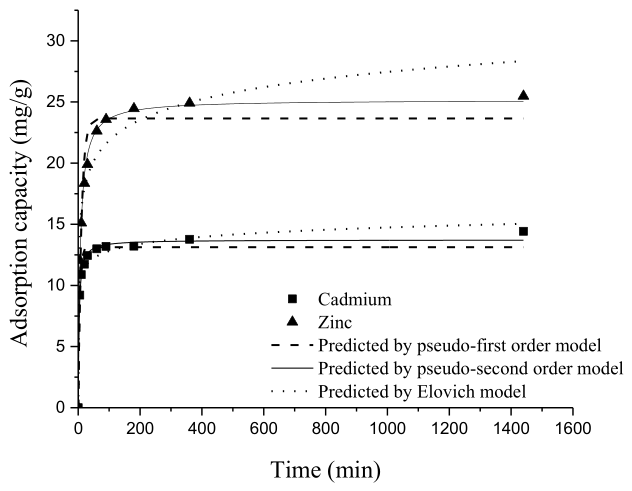
Figure 4.
Removal efficiencies of Zn(II) and Cd(II) ions by F.Limosus shells.
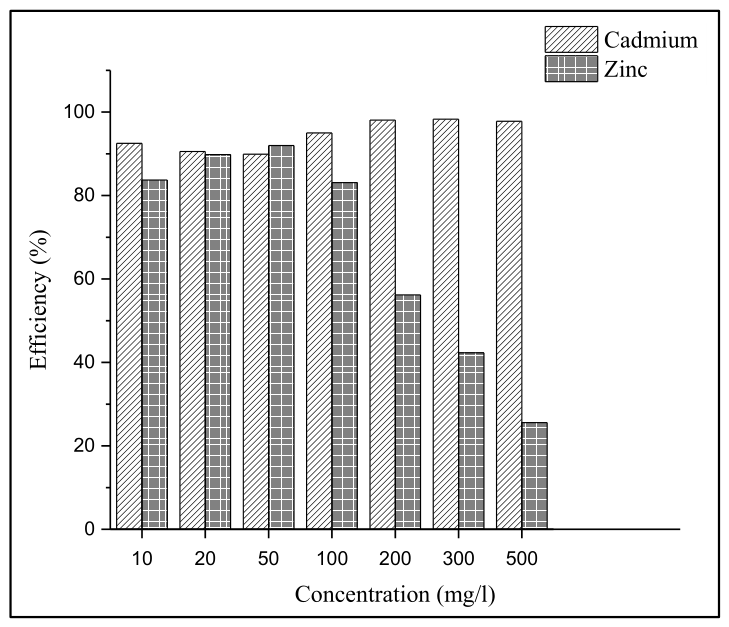
Figure 5.
Experimental data and adsorption isotherms for Zn(II) and Cd(II) adsorption onto F.limosus shells.
Figure 5.
Experimental data and adsorption isotherms for Zn(II) and Cd(II) adsorption onto F.limosus shells.
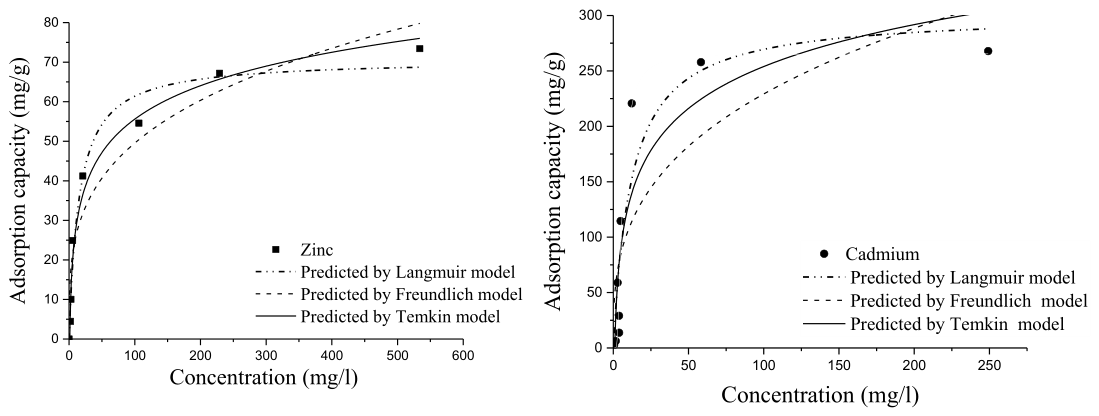
Figure 6.
pHpzc of F. limosus crayfish shells.
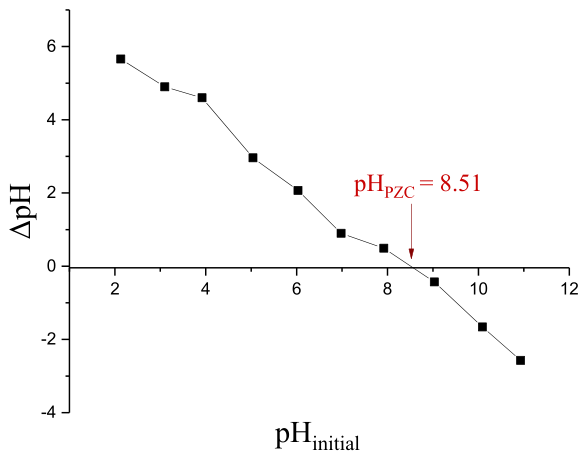
Figure 7.
Vulcanization behavior of the samples at 150 °C over a period of 15 min.
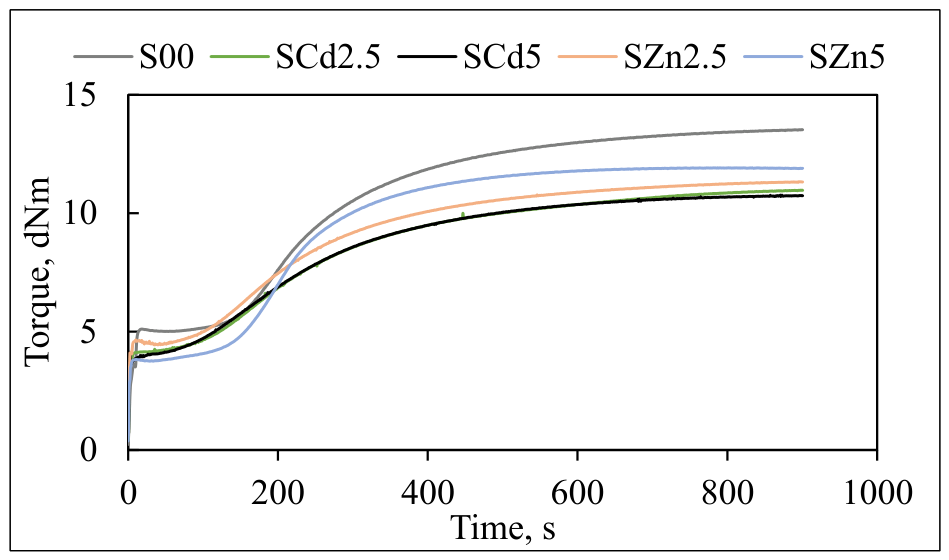
Figure 8.
Tensile strength of natural rubber samples containing loaded shells, with standard deviation.
Figure 8.
Tensile strength of natural rubber samples containing loaded shells, with standard deviation.
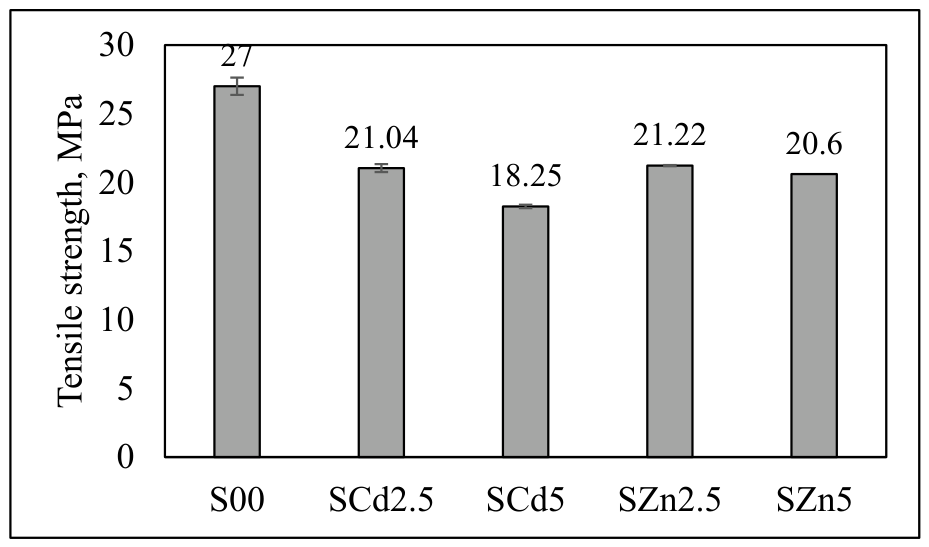
Figure 9.
Elongation of break of natural rubber samples containing loaded shells, with standard deviation.
Figure 9.
Elongation of break of natural rubber samples containing loaded shells, with standard deviation.
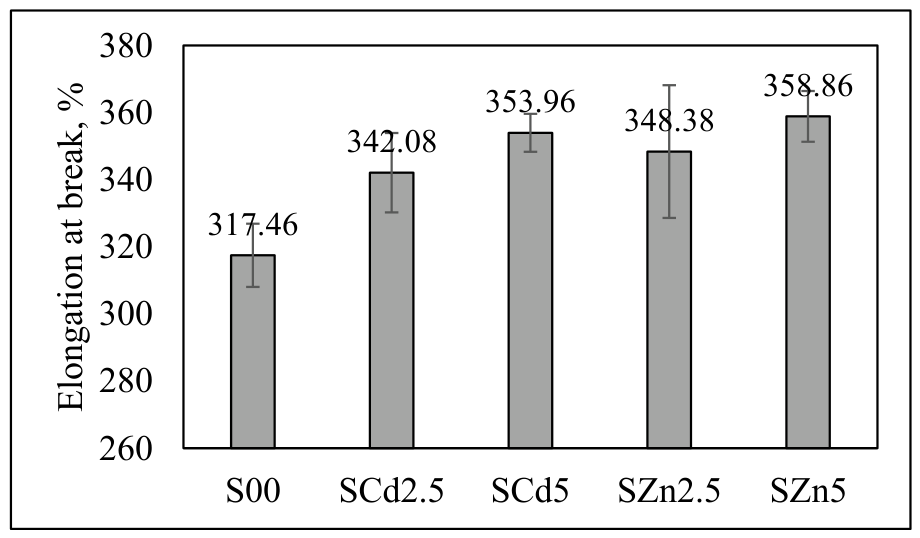

Table 1.
Labelling of the prepared samples and the content of LS.
| Sample code | Description | Content of LS, phr |
| S00 | -* | 0 |
| SCd2.5 | Sample with Cd-loaded shells | 2.5 |
| SCd5 | Sample with Cd-loaded shells | 5 |
| SZn2.5 | Sample with Zn-loaded shells | 2.5 |
| SZn5 | Sample with Zn-loaded shells | 5 |
Table 2.
Natural rubber mixing formulation.
| S00 | SCd2.5 | SCd5 | SZn2.5 | SZn5 | ||
| Components | phr | grams | ||||
| NR | 100 | 47.91 | 47.44 | 46.98 | 47.44 | 46.98 |
| CB | 50 | 23.95 | 23.72 | 23.49 | 23.72 | 23.49 |
| LS | 0, 2.5, 5* | 0.00 | 1.19 | 2.35 | 1.19 | 2.35 |
| ZnO | 4 | 1.92 | 1.90 | 1.88 | 1.90 | 1.88 |
| Stearin | 1pčl | 0.48 | 0.47 | 0.47 | 0.47 | 0.47 |
| IPPD | 1 | 0.48 | 0.47 | 0.47 | 0.47 | 0.47 |
| Sulphur | 2.5 | 1.20 | 1.19 | 1.17 | 1.19 | 1.17 |
| CBS | 0.5 | 0.24 | 0.24 | 0.23 | 0.24 | 0.23 |
* The content of loaded shells was varied according to Table 1.
Table 3.
Peaks obtained from the FTIR analysis.
| ν (cm⁻¹) | Interpretation |
| 3269.9 | O˗H / N˗H stretching (H-bonded) |
| 2920.35, 2851.08 | C˗H of CH₂/CH₃ |
| 1633.28 | Amide I (C=O stretch) |
| 1537.68, 1514.80, 1505.18 | Amide II (N˗H bend + C˗N stretch) |
| 1393.56 | CH₃ symmetric deformation and/or CO₃²⁻ |
| 1257.21 | Amide III (C˗N stretch + N˗H bend) |
| 1153.21 | (C˗O˗C) glycosidic bridge |
| 1065.41, 1027.41 | C˗O / C˗N stretching, ring vibrations |
| 860.51 | CO₃²⁻ |
Table 4.
Specific surface area of crayfish shells.
| Material | Specific surface areaSBET (m2/g) | Total pore volume for pores smaller than 30 nm (cm3/g) | Average pore diameter (nm) |
| Crayfish shell | 2,094 | 3,3272x10⁻³ | 3,1771 |
Table 5.
Kinetic parameters obtained by different kinetic models for Zn(II) and Cd(II) ions adsorption on F. Limosus shells.
Table 5.
Kinetic parameters obtained by different kinetic models for Zn(II) and Cd(II) ions adsorption on F. Limosus shells.
| Model | Parameter | Zn | Cd |
| Pseudo-first order | qe (mg/g) | 5.25 | 2.88 |
| k1 (1/min) | 0.0018 | 0.0012 | |
| R2 | 0.6015 | 0.699 | |
| Pseudo-second order | qe (mg/g) | 25.64 | 14.47 |
| k2 (g/mg min) | 0.0049 | 0.0088 | |
| R2 | 1 | 0.9998 | |
| Elovich | α | 2.44 | 0.83 |
| β | 4.45 | 5.74 | |
| R2 | 0.8533 | 0.8703 |
Table 6.
Isotherm parameters for different models for Zn(II) and Cd(II) adsorption onto F.limosus shells.
Table 6.
Isotherm parameters for different models for Zn(II) and Cd(II) adsorption onto F.limosus shells.
| Model | Parameter | Adsorbent | |
| Zn | Cd | ||
| Langmuir | qm (mg/g) | 70,69 | 302,12 |
| KL | 0,066 | 0,083 | |
| RL | 0,026-0,87 | 0,17-0,96 | |
| R2 | 0,9766 | 0,8889 | |
| Freundlich | KF | 13,37 | 49,65 |
| 1/n | 0,28 | 0,33 | |
| R2 | 0,9123 | 0,707 | |
| Temkin | b | 201,985 | 45.139 |
| AT | 0,96 | 1,052 | |
| R2 | 0,9858 | 0,8264 | |
Table 7.
Rheological properties of the studied natural rubber samples.
| Sample | Mmin(dNm) | Mmax(dNm) | ΔM | CRI | ts2(min) | t90(min) |
| S00 | 2.87 | 13.53 | 10.66 | 12.80 | 1.67 | 8.00 |
| SCd2.5 | 3.73 | 10.97 | 7.24 | 12.53 | 2.25 | 9.43 |
| SCd5 | 3.65 | 10.77 | 7.12 | 14.71 | 2.07 | 8.17 |
| SZn2.5 | 4.07 | 11.33 | 7.26 | 14.70 | 2.15 | 8.23 |
| SZn5 | 3.51 | 11.92 | 8.41 | 21.83 | 2.62 | 6.60 |
Disclaimer/Publisher’s Note: The statements, opinions and data contained in all publications are solely those of the individual author(s) and contributor(s) and not of MDPI and/or the editor(s). MDPI and/or the editor(s) disclaim responsibility for any injury to people or property resulting from any ideas, methods, instructions or products referred to in the content. |
© 2026 by the authors. Licensee MDPI, Basel, Switzerland. This article is an open access article distributed under the terms and conditions of the Creative Commons Attribution (CC BY) license (http://creativecommons.org/licenses/by/4.0/).
Copyright: This open access article is published under a Creative Commons CC BY 4.0 license, which permit the free download, distribution, and reuse, provided that the author and preprint are cited in any reuse.


