

Submitted:
09 June 2026
Posted:
10 June 2026
You are already at the latest version
Abstract
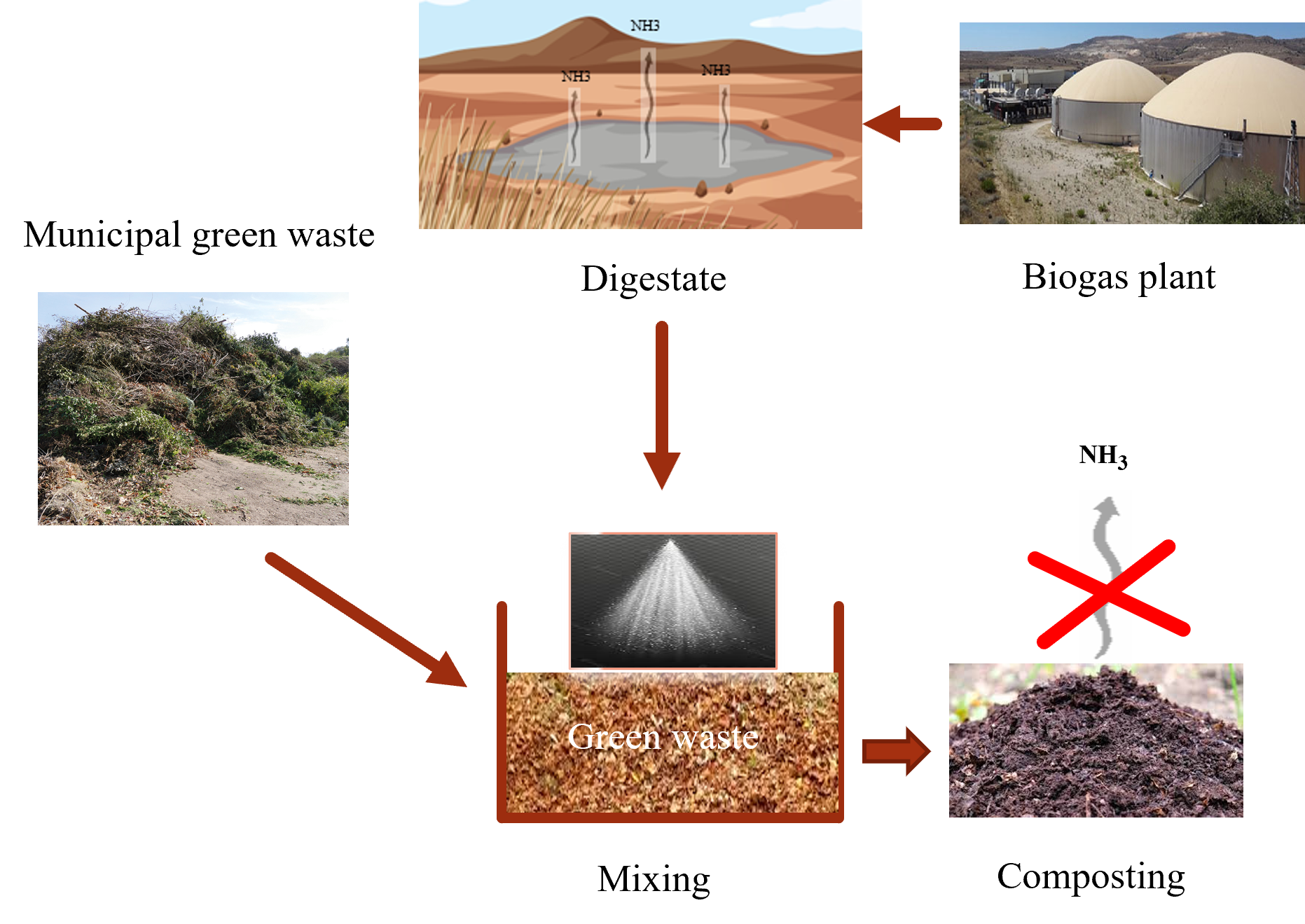
The sustainable management of biogas production digestate and lignocellulosic green waste remains a major challenge in circular bioeconomy systems. This study evaluated the feasibility and effectiveness of co-composting liquid digestate with woody pruning residues as an integrated strategy for nitrogen conservation, and enhanced composting performance. Experiments were conducted at both laboratory and intermediate scales using shredded residues from several tree species soaked in digestate or nitrogen solutions prior to aerobic incubation or open-pile composting. Nitrogen mass balance analysis based on laboratory incubations demonstrated that plant residues, which retained substantial amounts of liquid (173% of dry weight on average), enabled negligible nitrogen losses, even under high ammonium loading conditions. Temporal monitoring of inorganic nitrogen forms indicated an initial phase of microbial immobilization followed by gradual remineralization, but also strong nitrogen retention within the lignocellulosic matrix. Intermediate-scale composting trials confirmed the operational feasibility of the approach. Digestate-amended piles rapidly entered the thermophilic phase, reaching 58.8°C within five days, whereas control piles treated only with water remained slightly higher than ambient levels. The results suggested that co-composting of digestate with green waste improves moisture conditions, enhances decomposition of recalcitrant biomass and mitigates ammonia-related nitrogen losses. The proposed soaking-based co-composting strategy represents a promising and scalable solution for sustainable management of both digestate and urban green waste streams.
Keywords:
co-composting
; biogas digestate
; municipal green waste
; ammonia loss
; laboratory incubations
; optimization of composting
1. Introduction
The sustainable management of organic wastes generated from agricultural, municipal, and industrial streams represents one of the most pressing challenges in the circular bioeconomy. Among by-products of biological treatment processes, digestate, constituting the residual material from anaerobic digestion, has gained particular attention due to its large volumes and high nitrogen (N) content [1]. While anaerobic digestion valorizes organic substrates by converting them into renewable energy [2], storage and handling of digestate can lead to considerable environmental issues. Although few studies have quantified emissions from open digestate storage ponds, existing evidence highlights considerable releases of ammonia (NH₃), particularly under warm, dry conditions common in Mediterranean climates [3,4,5]. Nitrogen lost through volatilization not only contributes directly to air pollution and indirectly to greenhouse gas forcing, but also represents a significant depletion of a nutrient resource being essential for agricultural productivity, though energetically expensive to produce industrially.
The valorization of lignocellulosic green waste, such as dried pruning residues from the maintenance of urban roadside greenery and parks, remains technically problematic. These materials are characterized by a high carbon-to-nitrogen (C/N) ratio and significant recalcitrance to microbial decomposition, which translates into slow composting kinetics and difficulty at achieving the thermophilic conditions necessary for effective stabilization and sanitization. Consequently, green waste often accumulates in municipal stockpiles, or alternatively applied to agricultural fields as soil amendment, provoking substantial N immobilization due to its compositional immaturity and instability [6,7].
Co-composting of liquid digestate with green waste emerges as a promising integrated solution to both challenges. By combining a nitrogen-rich, moisture-laden digestate with a carbon-rich, structurally porous green waste, co-composting can simultaneously improve the characteristics necessary for effective composting and reduce the susceptibility of digestate nitrogen to gaseous loss pathways.
Despite these prospects, critical knowledge gaps remain. Most existing co-composting studies focus on mixtures of solid feedstocks such as food waste or animal manures [8], whereas limited work has addressed integration of a solid (e.g. green waste) and a liquid substrate (e.g. digestate), highlighting a need to explore the feasibility of such mixtures for rapid decomposition and stabilization.
The dynamics of nitrogen transformation and associated losses following the incorporation of green waste with digestate are critically important for evaluating the overall effectiveness and agronomic value of the co-composting solution. While nitrogen losses via NH₃ are well documented across a range of composting systems, the specific balance between volatilization, microbial immobilization, and ammonification-nitrification pathways remains context dependent and particularly influenced by factors such as the initial C/N ratio. Previous research on digestate composting has demonstrated that the addition of bulking agents such as wood chips can significantly enhance self-heating and nitrogen fixation, with optimal mixes fixing up to ~90% of initial ammoniacal nitrogen and thereby reducing nitrogenous emissions [9].
Several prerequisites and criteria must be fulfilled prior to the establishment of the co-composting of green waste with digestate as an effective and sustainable management strategy, with the most important being (i) the process should enhance the feasibility of composting dry, lignocellulosic materials by improving moisture content, thermal response, and microbial activity; (ii) it should mitigate NH₃ emissions compared with those associated with the open storage of digestate alone; and (iii) it should result to the production of a mature compost with clear agronomic value, characterized by improved soil physical properties and enhanced nutrient availability upon application [1]. The present study aims at systematically evaluating key aspects of the co-composting process by examining (i) the physical feasibility of incorporating digestate into pruning residues, (ii) the progression of composting dynamics, with emphasis on temperature evolution and the establishment of the thermophilic phase, and (iii) the fate of nitrogen, especially ammoniacal N, during the initial stages of co-composting, in order to quantify nitrogen retention relative to gaseous loss pathways. Through this multifaceted assessment, we seek to determine whether co-composting can serve as a scalable management strategy that simultaneously enables the recovery of valuable nutrients, mitigates environmental emissions, and produces high-quality organic amendments for agricultural application.
2. Materials and Methods
2.1. Experimental Approach
The efficiency of the proposed novel co-composting method was evaluated at two experimental scales: a laboratory scale, enabling a more precise evaluation of N dynamics and an intermediate scale designed to better simulate the real conditions of its final application .
Both experimental approaches comprised an initial mixing phase, during which the liquid and solid waste streams were brought into contact for a sufficient duration to ensure adequate soaking and absorption of the liquid fraction, followed by either a controlled incubation phase in the lab (laboratory scale) or an open composting phase (intermediate scale).
2.2. Laboratory Experiments
Weighted amounts of shredded material of trimmings (ranging from 5 to 5.96 g) of a single tree species were put in 100 ml plastic vials. Shredding was made using a homemade small four-shaft shredder equipped with two pairs of shafts (i.e., one for feeding and one with knives-disks for crushing). Feeding and crushing shafts form a working chamber of about two-liter volume with a conical shape.
The vials were subsequently filled with either digestate containing 2600 mg L-1 N or a water solution containing escalating N concentrations (200, 10000 or 20000 mg L-1 N). Woody material was left to soak for 24 h.
The digestate was collected from the upper layer of the storage tank of an anaerobic biogas production plant and was characterized by a very low solids content. It was, nevertheless, filtered using a Whatman grade 2 paper aiming to eliminate unaccounted pools of N. The concentrations of inorganic N forms in filtered digestate were subsequently determined by double steam distillation [10] as described below. The biogas plant primarily utilizes pig slurry as its main organic substrate, although additional manure streams are also incorporated aiming at enhancing methane production potential. The 200 mg L-1 N solution was prepared under laboratory conditions to simulate a hydroponic nutrient solution, comprising of 150 mg L-1 of nitrate-N and 50 mg L-1 of ammonium-N. In contrast, the higher concentration solutions (10000 and 20000 mg L-1 N) were formulated to approximate the composition of typical digestate, containing 75% ammonium-N and 25% nitrate-N.
Following the soaking phase, the material in each vial was drained by passing it through a synthetic cloth and subsequently reweighed in order to estimate the volume of liquid retained by the plant residues. Assuming the absence of preferential absorption, the weight of the retained liquid was considered indicative of the amount of N introduced into each sample.
The plant materials used consisted of shredded twigs, small branches, and sometimes, few leaves of Ficus carica, Ficus macrocarpa, Acacia saligna, Punica granatum, Olea europea and ice cream wood sticks. Each species was processed separately to avoid confounding effects associated with mixed substrates and to facilitate accurate mass balance calculations. A total of twelve digestate or N-solution mixture treatments (Table 1) were incubated over periods ranging from 53 to 82 days. In certain cases, different liquid additives were applied to plant material of the same species originating from distinct field collections.
Incubations were conducted in a controlled environment incubator (Friocell Eco line, MMM group, Germany), maintained at 25±1oC and 40% relative humidity. Vials were covered with perforated plastic caps to minimize evaporative losses while allowing adequate oxygen exchange. Each experimental run included 12 vials to accommodate multiple sampling intervals throughout the incubation period.
Inorganic N was quantified at least twice during the incubation period. After each sampling point, three replicate samples were removed from the incubator and weighed to estimate mass loss. A subsample (approximately three-fifths of the total material of each sample) was used for inorganic N determination via double steam distillation. A second fraction was dried at 30oC until constant weight for moisture content determination and subsequently used for total N measurement using an elemental CHN analyzer (EA 3000 Eurovector SpA, Milan, Italy). The last fraction of the sample was dried at 105oC to determine dry matter content (Figure 1). The two temperature drying procedure was adopted to prevent any volatilization losses of ammonia prior to CHN analysis.
The distillation procedure involved direct double distillation of plant residues or digestate in 2M KCl without prior extraction [10,11]. Distillation was first performed with NaOH only to quantify ammonium-N, and subsequently with NaOH in combination with Devarda’s alloy to reduce nitrate to ammonium. The volatilized ammonia was trapped in a boric acid (H3BO3) solution, and the ammonium borate formed was then quantified by titration with a standardized hydrochloric acid (HCl) solution.
Prior to CHN analysis, dried samples were subjected to a two-step grinding process (coffee grinder followed by pepper grinder) to ensure adequate homogenization and comminution of plant fibers.
Nitrogen balance was expressed as % N remaining for each vial separately, calculated as follows:
Final mg of N x 100 / Initial mg of N (1)
Initial and final N contents were determined according to the following formulas:
(organic N + inorganic N){ini} = (total N) {fin} =>
(GW organic N + GW inorganic N) {ini} + (LIQ inorganic N) {ini} = (total N) {fin} =>
(GW N concentration x GW dry weight + GWinorganic N) {ini} + (LIQ inorganic N) {ini} = (COM N concentration x COM dry weight{fin} (2)
Where,
GW: Green Waste, shredded pruning material of a single tree species
LIQ: Liquid component of the co-composting mixture, digestate or nitrogen water solution
COM: compost, the decomposition product of the mixture of green waste with the liquid component.
{ini}: initial, measured at the beginning of incubation period
{fin}: final, measured at the end of the incubation period
Total N was quantified by estimating the concentration of N using a CHN analyzer, whereas inorganic N fractions were quantified via double steam distillation. A one-sample t-test was applied to test whether nitrogen recovery at the end of the incubation period differed significantly from 100%.
2.3. Intermediate Scale Experiment
Mixing and composting trials conducted under outdoors conditions were performed at an intermediate scale, using conical piles of approximately 2 m3. This scale was selected to better approximate practical application conditions, although full-scale industrial implementation would typically involve larger volumes. Nevertheless, when considering greenhouse-derived organic residues, the operational scale is not expected to be significantly larger than that used in the present work.
In contrast to laboratory-scale vial assays, the establishment of a complete N mass balance in composting pile trials is inherently associated with substantial uncertainty. These uncertainties arise from approximations of key parameters, including pile volume, temporal changes in mass, bulk density, water content, and N concentration. Given the pronounced spatial heterogeneity within the compost matrix, these parameters can only be approximated through representative sampling and extrapolation to the entire pile.
Despite these limitations, intermediate-scale trials were considered essential for evaluating the technical feasibility of the co-composting approach, as well as for assessing whether the addition of N-rich liquids substrates improves the manageability and decomposition rate of green waste and promotes the initiation of the thermophilic phase during composting. A control treatment was established using the same green waste material amended with clean water only.
The green waste material used in the intermediate-scale experiments consisted predominantly of Acacia saligna, along with smaller and unquantified proportions of other plant species residues collected by municipal cleaning services. The material was shredded immediately after collection and subsequently stored outdoors in heaps for approximately six months, during which no substantial visual evidence of decomposition was observed.
Mixing of green waste with digestate or water was performed in plastic tanks with a capacity of 1 m³. Custom-designed mesh bags were placed inside the tanks prior to filling them with shredded green waste. Digestate, previously stored in a 10 m3 plastic container, was applied using a hose (Figure 2a). Preliminary trials indicated that the hydrophobic nature of the woody material may necessitate the gradual (in successive doses) application of the liquid digestate onto the top of the material for facilitating adequate infiltration. In these cases, each dose was allowed to infiltrate for several hours before additional liquid was added, until full saturation was achieved. However, this stepwise approach was not required in the present study, as the digestate used exhibited low solid content and satisfactory infiltration characteristics.
Following a soaking period of two days, the material was allowed to drain and the mesh bags were pulled out of the tanks. The wetted green waste was then unloaded to a nearby area and formed into two conical compost piles (Figure 2b and Figure 2c), hereafter referred to as the “digestate pile” (material that was soaked in digestate), and the “water pile” (control treatment; the material that was soaked in water).
Immediately after pile formation, representative samples were collected and oven-dried to estimate the amount of retained liquid. Compost pile temperatures were continuously monitored throughout the process. Additionally, samples were collected at the 25th day of composting, quite later than the day the highest temperature was recorded, for the determination of NH4+-N and NO3--N concentration using double steam distillation, and total N using the CHN analyzer.
3. Results
3.1. Laboratory Experiments
The volume of liquid retained by plant residues following soaking and drainage of the samples is shown in Table 1. In all cases, liquid retention exceeded 100% of the dry weight of the residues, reaching values as high as 267%, although substantial variability was observed. Even material derived from the same plant species exhibited differences in absorption capacity, likely reflecting variations in initial moisture content, structural properties and particle size resulting from the shredding process. The average liquid retention value across all treatments was 173%.
Dry mass loss of residues at the end of the incubation period, serving as an indicator of their decomposition rate, did not exhibit a consistent correlation with the amount of N added to samples. Treatments receiving very high concentrations of N (10000 and 20000 mg L-1) presumably appeared to induce ammonium toxicity, resulting in suppressed decomposition rates and limited mass loss, which did not exceed 12% (Table 1). In contrast, treatments amended with digestate retained between 72 and 82% of the initial dry mass. The highest decomposition rates were observed in Punica granatum and Acacia saligna residues, mixed with 200 mg N L-1 and incubated for 55 and 52 days, respectively, with mass losses accounting 30.6 and 27.3% of their initial weight.
At all but one treatment, the total N content of the material at the end of the incubation period was not significantly different from their respective initial total N, indicating negligible gaseous losses (Figure 3). Nitrogen estimates accounted not only for the added inorganic forms of ammonium and nitrate, but also for the concentration effect associated with residue mass loss during decomposition at incubation. In several cases, apparent N recovery at the end of the incubation appeared to exceed 100% of the total initial N pool (i.e., the sum of organic and inorganic N in both the residues and liquid amendments), which should most likely be attributed to experimental inaccuracies. Notably, no significant N losses were detected even under conditions of very high N loading (20 g N L-1), where a substantial fraction of nitrogen remained in the ammoniacal form, theoretically susceptible to volatilization (Figure 3).
The temporal dynamics of inorganic N (NH4+-N and NO3--N) and immobilized N during incubation compared with the initial amount of mineral N are shown in Figure 4a-h. For clarity, only eight representative treatments are shown, which, however, exemplify the principal trends observed across all treatments. The distribution of N forms evolved consistently over time, exhibiting a characteristic pattern. A phase of pronounced N immobilization was recorded at the early stages (first weeks of incubation), followed by a re-mineralization phase resulting in a progressive increase of inorganic N in the samples. Nitrification processes were not sufficiently manifested to fully deplete NH4+ concentration to zero at any stage of the incubation period.
3.2. Intermediate Scale Experiment
Compost derived from the co-processing of tree trimmings with digestate exhibited a rapid increase in temperature, reaching 58.8 oC within five days of pile formation, thereby clearly entering the thermophilic phase of the composting process. On the contrary, the control pile, consisting of green waste treated with water only, did not exceed 34.5 oC throughout the monitoring period (Figure 5). Temperature measurements were obtained from the core of the piles, as the outer layers dried rapidly under the high ambient temperatures.
The co-composting process in the digestate-amended pile showed substantial immobilization of the nitrogen (N) initially present in the digestate. The difference in inorganic N between the digestate-treated pile and water-treated piles amounted to 114 mg per 100 g of dry material. Considering that the average retention of digestate relative to the dry matter of the residues was measured to be 197% (SD =14), this value corresponds to 22.3% of the initial inorganic N (512.2 mg) applied to the residues via digestate. The observed reduction in inorganic N is attributed primarily to microbial immobilization rather than gaseous losses, as confirmed by the elemental analysis results (Table 2), which indicated complete N recovery. Specifically, the total N content measured after 25 days of composting was consistent with full retention of the N initially absorbed by the residues following their drainage.
Elemental analysis was also conducted on carefully isolated woody fractions, excluding bark, leaves, or other residual materials. This analysis revealed an N content of 0.41% in the digestate-treated pile, compared to only 0.14% N in water-treated control pile, indicating enhanced nitrogen enrichment of the lignocellulosic matrix under co-composting conditions.
4. Discussion
The present study aimed at evaluating the feasibility and effectiveness of co-composting green waste with anaerobic digestion digestate, in response to two major and interrelated challenges in organic waste management.
The first challenge concerns the handling and valorization of pruning residues and other green waste streams generated in urban environments, particularly when these materials are dry, lignocellulosic, and depleted of readily biodegradable components such as leaves and water-soluble carbohydrates [12]. The recalcitrant nature of such substrates was clearly demonstrated in this study, both through empirical observations and control experiments. The green waste used as feedstock in this study consisted of shredded plant residues that had remained exposed in open environments for several years without undergoing significant decomposition. Even after long thorough soaking, these materials exhibited limited compostability. Τhe application of immature or poorly stabilized compost can adversely affect crop performance due to nitrogen immobilization [13], while also contributing to weed proliferation. Such results constitute a significant obstacle to the development of sustainable compost markets and undermine confidence in the use of compost by producers.
The second challenge relates to the currently applied management practices of digestate derived from anaerobic digestion systems. When stored in open or semi-controlled environments such as drying lagoons, digestate emits substantial amounts of ammonia [14].
In regions applying extent anaerobic digestion treatment to organic waste streams, the volume of liquid digestate stored in drying ponds frequently exceeds the assimilative capacity of nearby agricultural soils to receive and take advantage of its nitrogen content, particularly when considering agronomic constrains related to application timing [15]. Moreover, the high ammonium content of digestate renders it particularly susceptible to nitrogen losses via volatilization when applied to alkaline soils [16]. Additional limitations include poor public acceptance due to odor emissions and potential sanitary concerns, as well as soil structural degradation issues, including compaction, reduced aeration, and impaired drainage when large volumes are applied, especially in heavy-textured soils.
The recommended co-composting strategy evaluated in this study provides a compelling pathway to address both challenges simultaneously. The incorporation of digestate into green waste streams improved the compostability by supplying moisture and adjusting the carbon-to-nitrogen (C/N) ratio, thereby facilitating rapid progression into the thermophilic phase.
A critical limitation in composting dry, woody materials under dry conditions lies in the difficulty of achieving and maintaining adequate moisture levels. Conventional watering practices are often ineffective due to hydrophobicity and preferential flow within the residue matrix, resulting in uneven wetting and significant water losses from the pile. Moreover, the application of digestate containing suspended solids may further complicate distribution due to clogging of watering systems.
Experimental trials demonstrated that the prolonged contact of co-composting feedstocks achieved by soaking green waste in digestate, is an effective approach for ensuring homogenous moisture distribution throughout the material. Optimal soaking durations ranged from 24 to 72 hours, which were sufficient to achieve full hydration without inducing anaerobic conditions. However, the implementation of this approach requires appropriate infrastructure, including tanks or ponds for soaking, as well as systems for draining and handling saturated materials. In the present study, reusable mesh bags (similar to trawl fishing nets) proved particularly effective in facilitating material handling, drainage, and subsequent pile formation.
A key finding of the present study was that combining nitrogen-rich digestate with lignocellulosic plant residues can significantly reduce ammonia volatilization and enhance nitrogen retention. Nitrogen mass balance assessments based on laboratory incubations, indicated near-complete nitrogen retention over a two-month period. It is obvious that of the total nitrogen present in a drying pond, the maximum amount that can be “saved” by the co-composting method is that which is bound in the woody matrix after soaking and draining the green waste. From this point of view, residues with a higher liquid-holding capacity are most effective.
These observations are in line with previous studies [9,17], which reported reduced ammonia emissions when solid digestate was co-composted with high C/N substrates. Additional supporting evidence is provided by earlier work [18], demonstrating that ammonia emissions are substantially lower in lignocellulosic materials (e.g., wood, bark, straw) compared to more readily degradable substrates such as kitchen waste. Similarly, the use of bulking agents such as sawdust, bark, and rice husks has been shown to mitigate ammonia losses during composting of nitrogen-rich materials, primarily through optimization of the initial C/N ratio [19,20].
Monitoring of inorganic nitrogen forms throughout the incubation period suggested that nitrogen retention occurred through a combination of biological and physicochemical mechanisms. These include microbial immobilization, within both living, active or dead, inactive biomass, and the adsorption or absorption of inorganic nitrogen species onto the organic matrix.
Elevated ammonium concentrations are known to inhibit microbial activity by altering microbial community structure and enzymatic processes. For example, [21] reported negative effects of elevated ammonia levels on methanogenic archaea and cellulose-degrading microorganisms, which is consistent with the patterns observed in the present study. Treatments receiving excessive nitrogen inputs exhibited limited mass loss, indicative of suppressed decomposition of structural components such as cellulose. Nevertheless, some degree of nitrogen turnover persisted, suggesting partial microbial processing of more labile organic fractions. Notably, these high-nitrogen treatments highlighted the importance of non-biological nitrogen retention mechanisms, particularly sorption processes within the lignocellulosic matrix, which warrant further investigation.
Although nitrification can theoretically reduce ammonia volatilization through the oxidation of ammonium (NH₄⁺) to nitrate (NO₃⁻) [22], this mechanism did not appear to have played a significant role under the conditions of the present study. High ammonium concentrations persisted till the end of the incubation period in treatments receiving nitrogen solutions of 10 or 20 g L⁻¹, despite the absence of measurable nitrogen losses.
It should be noted that the nitrogen retention results were primarily derived from controlled aerobic incubations conducted under mesophilic conditions and did not fully replicate the elevated temperatures characteristic of the thermophilic composting phase. Consequently, ammonia volatilization may be underestimated relative to field conditions. However, results from the intermediate-scale experiments suggest that this limitation may be of minor significance. Although precise nitrogen budgets were difficult to establish under open-field conditions, the nitrogen concentrations measured at the end of the thermophilic phase did not indicate significant nitrogen losses.
5. Conclusions
Overall, the results of this study demonstrate that co-composting of green waste with digestate constitutes an effective and operationally feasible strategy for simultaneously addressing the limitations associated with both materials. The addition of digestate facilitates the successful composting of otherwise recalcitrant, dry lignocellulosic residues by improving moisture conditions and optimizing the C/N balance, while also mitigating nitrogen losses typically observed during digestate storage and handling. The findings highlight that nitrogen can be efficiently retained within the composting matrix through a synergistic combination of biological immobilization and physicochemical interactions, even under conditions of high ammonium availability. Moreover, the soaking approach proved critical for achieving uniform hydration of hydrophobic materials, emphasizing the importance of appropriate process design and infrastructure. Collectively, this integrated management strategy not only enhances nutrient recovery and compost quality but also mitigates environmental impacts, suggesting strong potential for application in regions facing similar challenges with green waste and digestate management.
Author Contributions
Panagiotis Dalias: Writing – original draft, Validation, Methodology, Investigation, Formal analysis, Data curation, Conceptualization. Anastasis Christou: Validation, Writing – review & editing. Christina Constantinou: Investigation, Formal analysis, Data curation. Kalia Kaikiti: Investigation, Formal analysis, Data curation. Damianos Neocleous: Validation, Writing – review & editing, Project administration.
Funding
This work was supported by the Agricultural Research Institute of Cyprus and received funding from the European Union’s LIFE Programme, project LIFE-AgrOassis (Grant Agreement No. 101074744) and from the European Union’s Horizon Europe Innovation program, project ECONUTRI (Grant Agreement No. 101081858).
Data Availability Statement
Data is contained within the article.
Conflicts of Interest
The authors declare no conflicts of interest.
References
- Gurmessa, B., Cocco, S., Ashworth, A.J., Udawatta, R.P., Cardelli, V., Ilari, A., Serrani, D., Fornasier, F., Del Gatto, A., Foppa Pedretti, E., Corti, G., 2024. Short term effects of digestate and composted digestate on soil health and crop yield: Implications for sustainable biowaste management in the bioenergy sector. Sci. Total Environ. 906, 167208.
- Cucina, M., 2023. Integrating anaerobic digestion and composting to boost energy and material recovery from organic wastes in the Circular Economy framework in Europe: A review. Bioresour. Technol. Rep. 24, 101642.
- Maurer, C., Müller, J., 2012. Ammonia (NH₃) emissions during drying of untreated and dewatered biogas digestate in a hybrid waste-heat/solar dryer. Eng. Life Sci. 12 (3), 321–326.
- Shrestha, S., 2020. Ecological impacts of food waste digestate management in an agricultural watershed (Master’s thesis). Rochester Institute of Technology.
- Berg, W., Salamat, R., Scaar, H., Mellmann, J., 2021. Investigation of nitrogen loss during laboratory scale fixed-bed drying of digestate. Waste Manage. 129, 26–34.
- Beloso, M.C., Villar, M.C., Cabaneiro, A., Carballas, M., González-Prieto, S.J., Carballas, T., 1993. Carbon and nitrogen mineralization in an acid soil fertilized with composted urban refuses. Bioresour. Technol. 45, 123–129.
- Madrid, F., López, R., Cabrera, F., Murillo, J.M., 2011. Nitrogen mineralization of immature municipal solid waste compost. J. Plant Nutr. 34 (3), 324–336.
- Paradelo, R., Navarro-Pedreño, J., Glaser, B., Grobelak, A., Kowalska, A., Singh, B.R., 2024. Potential and Constraints of Use of Organic Amendments from Agricultural Residues for Improvement of Soil Properties. Sustainability 16, 158.
- Zeng, Y., De Guardia, A., Dabert, P., 2016. Improving composting as a post-treatment of anaerobic digestate. Bioresour. Technol. 201, 293–303.
- Keeney, D.R. and Bremner, J.M. (1966), Determination and Isotope-Ratio Analysis of Different Forms of Nitrogen in Soils: 4. Exchangeable Ammonium, Nitrate, and Nitrite by Direct-Distillation Methods. Soil Science Society of America Journal, 30: 583-587. [CrossRef]
- Akhtar, M., Hussain, F., Qureshi, T.M., Ashraf, M.Y., Akhter, J., Haq, A., 2011. Rapid and inexpensive steam distillation method for routine analysis of inorganic nitrogen in alkaline calcareous soils. Commun. Soil Sci. Plant Anal. 42 (8), 920–931.
- Reyes-Torres, M., Oviedo-Ocaña, E.R., Dominguez, I., Komilis, D., Sánchez, A., 2018. A systematic review on the composting of green waste: Feedstock quality and optimization strategies. Waste Manage. 77, 486–499.
- Fuchs, J.G., 2008. Effects of compost and digestate on environment and plant production – results of two research projects, in: Proceedings of the International Conference ORBIT, Wageningen, The Netherlands.
- Whelan, M.J., Everitt, T., Villa, R., 2010. A mass transfer model of ammonia volatilisation from anaerobic digestate. Waste Manage. 30 (10), 1808–1812.
- Twongyere, B., 2025. Anaerobic Digestate as a Soil Amendment: Impacts on Crop Production, Soil Ecology, and Environmental Quality. A Review. Preprints.org.
- Sha, Z., Ma, X., Liu, H., Wang, J., Lv, T., Goulding, K., Liu, X., 2023. Crop-specific ammonia volatilization rates and key influencing factors in the upland of China-A data synthesis. J. Environ. Manage. 336, 117676.
- Song, B., Manu, M.K., Li, D., Wang, C., Varjani, S., Ladumor, N., Xu, Y., Wong, J.W.C., 2021. Food waste digestate composting: Feedstock optimization with sawdust and mature compost. Bioresour. Technol. 341, 125759.
- Körner, I., Stegmann, R. 2002. N-Dynamics during composting – Overview and Experimental Results, In: Insam, H., Riddech, N., Klammer, S. (eds.), Microbiology of Composting, Berlin; Heidelberg, pp. 143-154.
- Morisaki, N., Phae, C.G., Nakasaki, K., Shoda, M., Kubota, H., 1989. Nitrogen transformation during thermophilic composting. J. Ferment. Bioeng. 67 (1), 57–61.
- Manu, M.K., Li, D., Liwen, L., Jun, Z., Varjani, S., Wong, J.W.C., 2021. A review on nitrogen dynamics and mitigation strategies of food waste digestate composting. Bioresour. Technol. 334, 125032.
- Fischer, M.A., Ulbricht, A., Neulinger, S.C., Refai, S., Waßmann, K., Künzel, S., Schmitz, R.A., 2019. Immediate effects of ammonia shock on transcription and composition of a biogas reactor microbiome. Front. Microbiol. 10, 2064.
- Chou, C.H., Büyüksönmez, F., 2006. Biogenic emissions from green waste and comparison to the emissions resulting from composting (part 1: ammonia). Compost Sci. Util. 14 (1), 16–22.
Figure 1.
Scheme of methodological procedure followed during laboratory incubations.
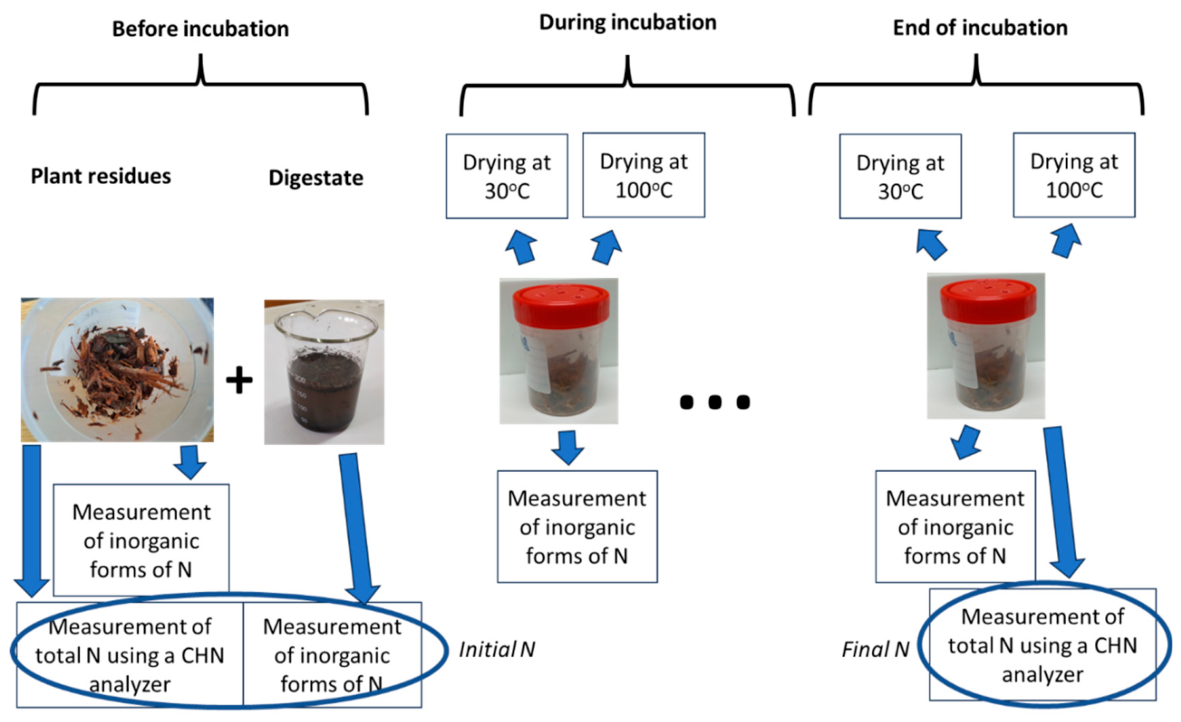
Figure 2.
a-c: Snapshots of the procedure used to create the co-composting piles: a. the soaking of the green waste with digestate was done in 1m3 plastic containers inside which special mesh bags had been placed, b. after draining, the special nets with the material were lifted, and c. opened at their bottom to release the material and create composting piles.
Figure 2.
a-c: Snapshots of the procedure used to create the co-composting piles: a. the soaking of the green waste with digestate was done in 1m3 plastic containers inside which special mesh bags had been placed, b. after draining, the special nets with the material were lifted, and c. opened at their bottom to release the material and create composting piles.
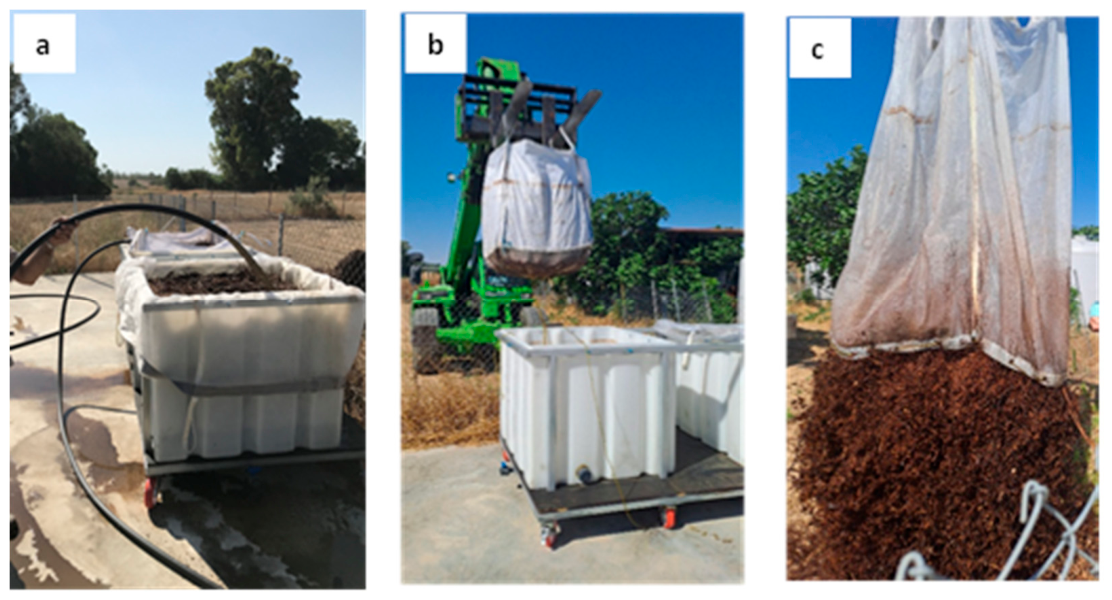
Figure 3.
Percentages of total N remaining in the vials at the end of the laboratory incubations. Trials included the addition of digestate or various N solutions in the shredded residues of a single tree species. Numbers in parentheses following the tree species indicate the kind or concentration of the solution added, e.g. 10 g abbreviates the addition of a solution containing 10000 mg L-1 of N. Error bars show standard deviation (SD).
Figure 3.
Percentages of total N remaining in the vials at the end of the laboratory incubations. Trials included the addition of digestate or various N solutions in the shredded residues of a single tree species. Numbers in parentheses following the tree species indicate the kind or concentration of the solution added, e.g. 10 g abbreviates the addition of a solution containing 10000 mg L-1 of N. Error bars show standard deviation (SD).
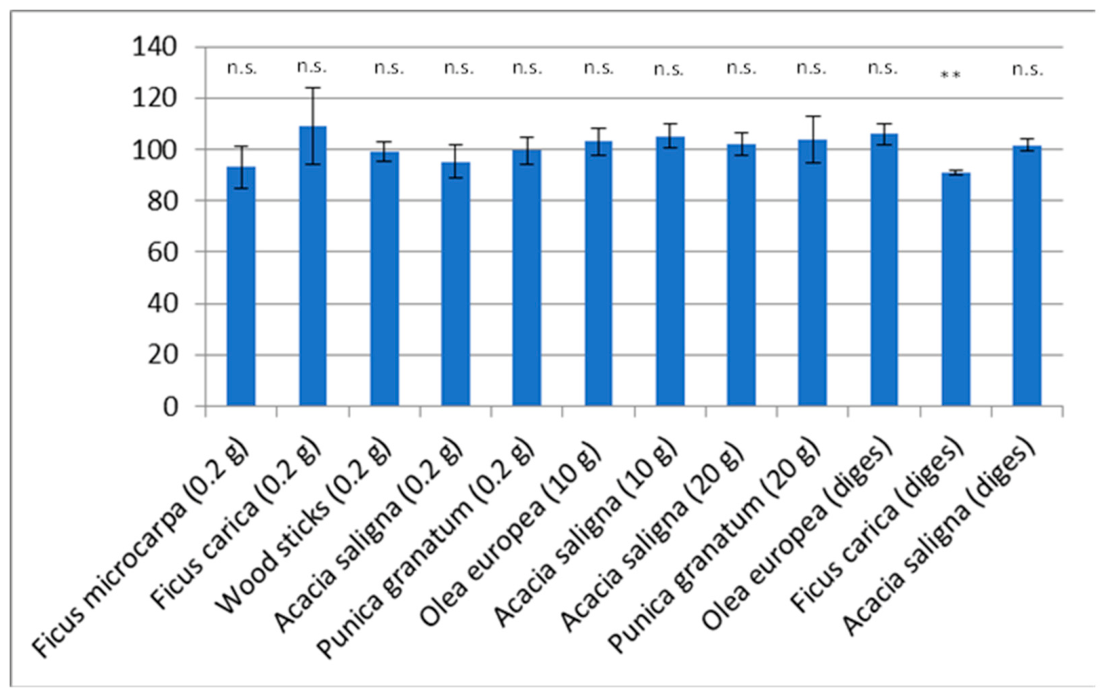
Figure 4.
a-h: Selected results from eight out the full set of 12 treatments illustrating the percentage contribution of the different forms of N in relation to the inorganic N present in the samples at the beginning of the incubations. In treatments where a great amount of N was added as nutrient solution or as digestate, the initial contribution of the inorganic forms of N carried by the residues was small and is not indicated on the bars.
Figure 4.
a-h: Selected results from eight out the full set of 12 treatments illustrating the percentage contribution of the different forms of N in relation to the inorganic N present in the samples at the beginning of the incubations. In treatments where a great amount of N was added as nutrient solution or as digestate, the initial contribution of the inorganic forms of N carried by the residues was small and is not indicated on the bars.
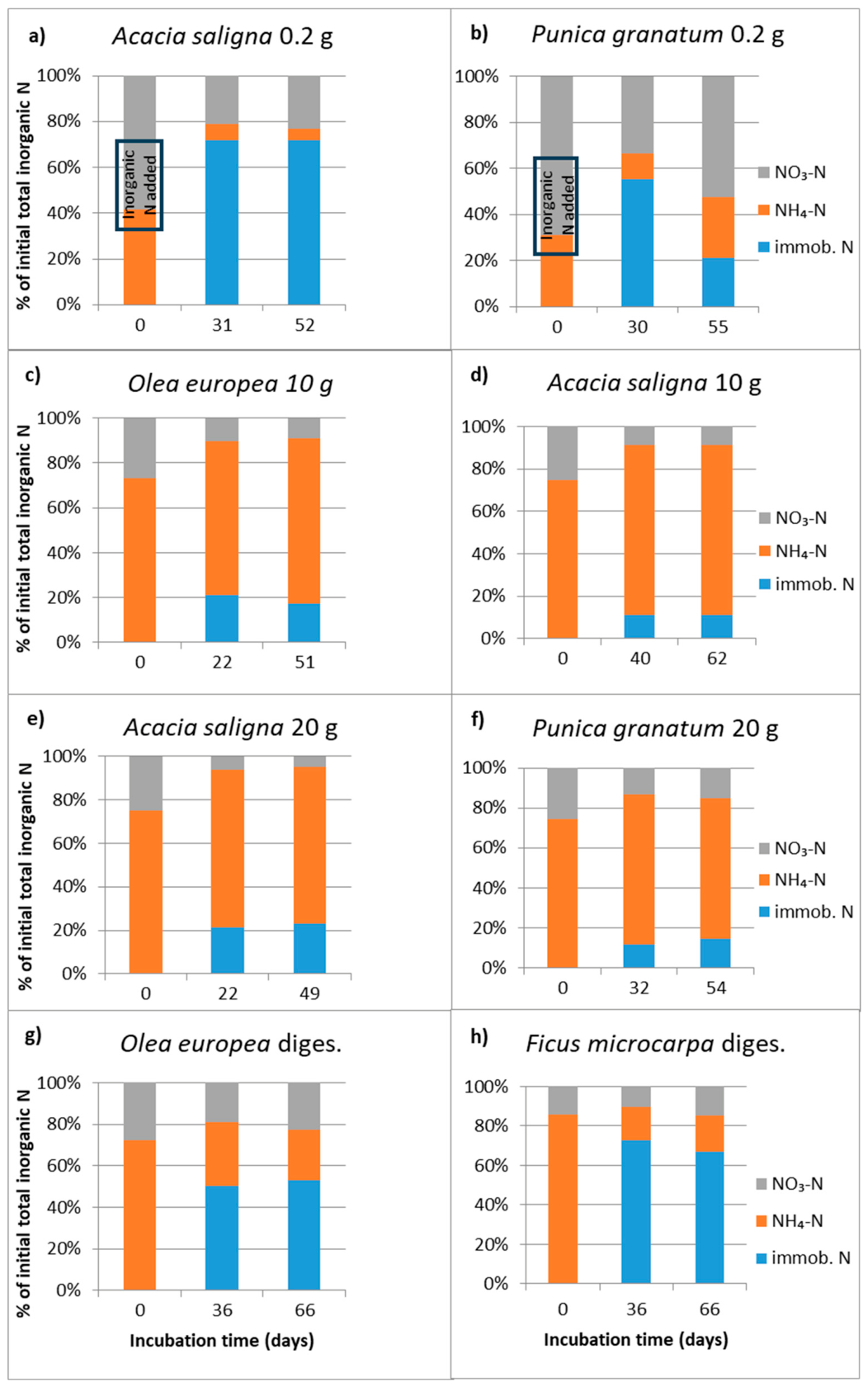
Figure 5.
Temperature profile of piles during composting of green waste created either after soaking in digestate or in water. Each point shows the average of several measurements taken at different sides inside the pile.
Figure 5.
Temperature profile of piles during composting of green waste created either after soaking in digestate or in water. Each point shows the average of several measurements taken at different sides inside the pile.
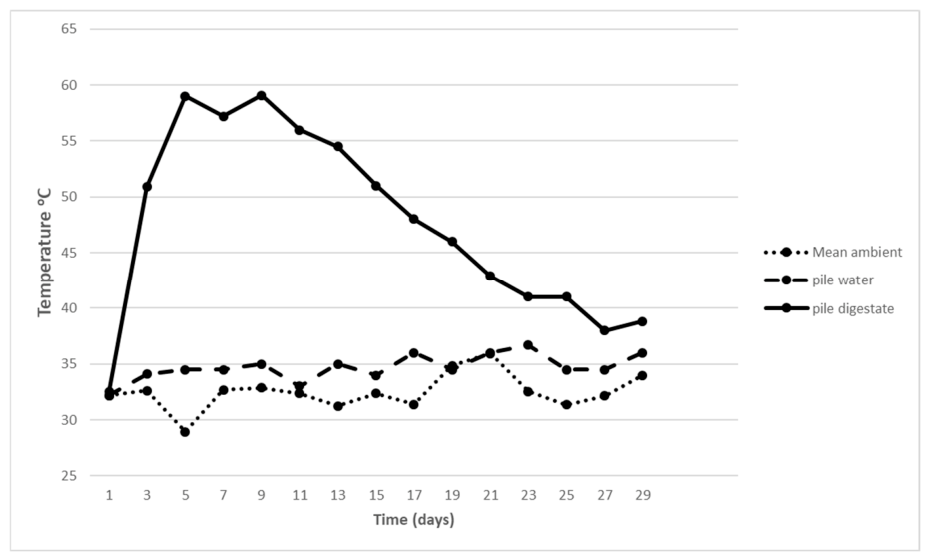

Table 1.
Results (Value ± Standard deviation - SD) of laboratory trials for 12 plant residue treatments on water retention after soaking and drainage and percentage mass remaining and inorganic N (NH4+-N + NO3--N) at the end of the incubation as a percentage of initial inorganic N.
Table 1.
Results (Value ± Standard deviation - SD) of laboratory trials for 12 plant residue treatments on water retention after soaking and drainage and percentage mass remaining and inorganic N (NH4+-N + NO3--N) at the end of the incubation as a percentage of initial inorganic N.
|
Species of residue - treatment |
Water retention in relation to residue dry matter (%) |
Days of incubation | Mass remaining (%) |
Inorganic N at the end of the incubation as a percentage of initial inorganic N (%) |
| Ficusmacrocarpa - 200 ppm | 128.1 (± 6.3) | 48 | 86.1 (± 1.3) | 14.5 (± 2.1) |
| Ficuscarica - 200 ppm | 121.8 (± 5.1) | 82 | 69.5 (± 4.2) | 51.1 (± 1.7) |
| Woodsticks - 200 ppm | 150.2 (± 4.4) | 53 | 95.0 (± 2.7) | 24.1 (± 3.2) |
| Acaciasaligna - 200 ppm | 266.7 (± 8.8) | 52 | 72.7 (± 7.5) | 27.9 (± 2.0) |
| Punicagranatum - 200 ppm | 155.7 (± 4.8) | 55 | 69.4 (±4.4) | 52.3 (± 1.3) |
| Oleaeuropea - 10000 ppm | 195.7 (± 3.4) | 64 | 88.7 (± 2.5) | 82.8 (± 1.3) |
| Acaciasaligna - 10000 ppm | 233.9 (± 4.8) | 62 | 98.4 (± 1.0) | 88.9 (± 1.4) |
| Acaciasaligna - 20000 ppm | 247.0 (± 7.3) | 56 | 99.2 (± 1.7) | 77.2 (± 1.5) |
| Punicagranatum - 20000 ppm | 152.4 (± 4.8) | 54 | 94.4 (± 3.5) | 85.4 (± 1.9) |
| Acaciasaligna - digestate | 178.5 (± 4.1) | 67 | 78.9 (±2.1) | 29.0 (± 3.3) |
| Oleaeuropea - digestate | 107.0 (± 2.2) | 67 | 72.7 (± 1.5) | 47.2 (±1.6) |
| Ficusmacrocarpa - digestate | 171.1 (± 6.4) | 67 | 82.1 (± 1.7) | 33.4 (± 5.7) |
Table 2.
Nitrogen balance data in the intermediate-scale composting experiment. The data refer to 100 grams of material. Inorganic and immobilized N coming from digestate were estimated from the difference of NH4+-N and NO3--N between “digestate” and “water” composting piles.
Table 2.
Nitrogen balance data in the intermediate-scale composting experiment. The data refer to 100 grams of material. Inorganic and immobilized N coming from digestate were estimated from the difference of NH4+-N and NO3--N between “digestate” and “water” composting piles.
| Pile digestate | Pile water | |
| N added (mg) | 512.2 | |
| Expected N concentration after digestate addition (%) | 1.58 | |
| NH4+-N (mg) | 200 (± 20) | 129 (±16) |
| NO3--N (mg) | 229 (± 22) | 186 (± 14) |
| Inorganic N from digestate (mg) | 114 | |
| Immobilized N from digestate (mg) | 398 | |
| Measured total N (%) | 1.78 (± 0.09) | 1.07 (± 0.05) |
Disclaimer/Publisher’s Note: The statements, opinions and data contained in all publications are solely those of the individual author(s) and contributor(s) and not of MDPI and/or the editor(s). MDPI and/or the editor(s) disclaim responsibility for any injury to people or property resulting from any ideas, methods, instructions or products referred to in the content. |
© 2026 by the authors. Licensee MDPI, Basel, Switzerland. This article is an open access article distributed under the terms and conditions of the Creative Commons Attribution (CC BY) license (http://creativecommons.org/licenses/by/4.0/).
Copyright: This open access article is published under a Creative Commons CC BY 4.0 license, which permit the free download, distribution, and reuse, provided that the author and preprint are cited in any reuse.


