

Submitted:
08 June 2026
Posted:
09 June 2026
You are already at the latest version
Abstract
High-volume injection mold systems used for plastic part production operate under severe coupled thermo-mechanical boundary conditions. During each molding cycle, core inserts are subjected to repeated injection pressure, transient thermal effects, and mechanical constraints imposed by the polymer and the surrounding mold assembly. These combined actions generate localized stress concentrations in critical insert regions, promoting crack initiation and eventual core insert breakage. To describe the behavior of hot-work tool steel core inserts under these operating conditions, experimental process measurements, structural analysis, and damage modelling must be linked within a service-life assessment framework. This integrated approach supports the interpretation of the observed failure case and helps identify the root cause of premature core insert breakage.
Keywords:
plastic injection molds
; high-volume production
; AISI H11 core inserts
; failure root-cause analysis
; CAE tools
; TMF-creep lifetime prediction
1. Introduction
Plastic injection molding is a high-volume manufacturing process used to produce polymer components with complex geometries and repeatable dimensional accuracy. During repeated production cycles, the mold is not only a geometric tool used to shape the polymer, it is also a mechanical and thermal system exposed to repeated loading [1].
The reliability of mold components is therefore essential, especially when production is continuous and a localized insert failure can interrupt the process, increase maintenance cost, and affect product quality [2]. Core inserts are among the most sensitive mold components because they are positioned in regions where polymer pressure, heat transfer, mechanical support, and contact constraints interact. During filling and packing, the molten polymer applies non-uniform pressure to the cavity and insert surfaces. During cooling and solidification, heat is transferred from the polymer to the mold, generating transient thermal exposure and local thermal expansion. These repeated actions create a coupled thermo-mechanical environment in which the insert response cannot be understood from global machine settings alone [3]. Previous CAE-based studies have shown that injection-molding simulation can provide non-uniform melt-pressure fields that can be transferred to core stress analysis for fatigue-life evaluation, as demonstrated by Kim and Lee [4]. This supports the use of a process-to-structure approach, where the molding process first defines pressure and temperature fields, and structural simulation then evaluates the local response of the insert. However, identifying a stress concentration is not sufficient by itself to explain premature breakage, because service life also depends on cyclic loading, thermal exposure, and damage accumulation.
AISI H11 steel is widely used for thermally and mechanically loaded tooling applications because of its hot-work performance. Under cyclic molding conditions, however, insert durability cannot be described only by classical static assessment or baseline low-cycle fatigue models [5]. The material response is affected by temperature, cyclic fatigue resistance, thermal-fatigue damage, and cumulative damage evolution [6]. This need is supported by experimental fatigue studies on AISI H11/H13 test specimens, thermal-fatigue investigations, and high-temperature damage-modelling approaches for AISI H11/X38CrMoV5/DIN 1.2343-type steels [7].
The scope of this paper is therefore limited to an industrial AISI H11 core insert failure case under high-volume injection molding conditions. The objective is not to propose a universal lifetime law for all inserts, but to establish a reproducible root-cause verification approach. The study links visual failure evidence, process measurements, process-derived pressure and temperature fields, structural finite element response, baseline LCF prediction, and coupled TMF-creep damage assessment.
Accordingly, this case study explores how an observed core insert breakage can be evaluated through a structured process-to-structure-to-damage workflow. The purpose is to determine whether the failure root cause hypthesis is consistent with results of used analysis models.
2. Materials and Methods
The investigation is conducted through a sequential verification procedure as shown in Figure 1, When a root cause is identified at a given step, the process stops and an appropriate corrective action is defined.
This sequential procedure is designed to separate empirical inspection from simulation-based verification. This new type of connections is important because numerical analysis is used only after the physical, material, geometrical, and operational evidence has been reviewed. In this way, the final root-cause conclusion is not based on simulation alone, but on a complete engineering verification chain.
The proposed methodology follows a structured root-cause analysis approach to investigate premature core insert failure in high-volume plastic injection molding. The RCA process begins with failure evidence collection, including photos, rupture location, mold and insert references, machine data, cycle counts, and production history. Then, preliminary visual and operational checks are performed, identifying possible mechanical or assembly issues. If no direct cause is found, the next step is a detailed material conformity check, assessing hardness, heat treatment, surface state, and polymer behavior. Next, geometry, tolerance, and assembly are verified by reviewing drawings and measuring critical dimensions.
Once all evidence is collected, process inputs (like injection speed, pressure and temperature) are gathered from sensors, and the injection molding simulation is conducted. Results are transferred to a structural FEA model, where local stresses are evaluated. The critical zone is identified and compared with the observed rupture location. Finally, fatigue life is estimated first by baseline LCF and then, if needed, by TMF-creep damage assessment to confirm or reject the root-cause hypothesis based on whether observed failure matches the predicted cycles.
2.1. Research Scope
This is a case study concerning broken core inserts inside high-volume production plastic injection mold.
Figure 2.
Exploded view of the injection mold assembly, highlighting the core insert’s position within the cavity.
Figure 2.
Exploded view of the injection mold assembly, highlighting the core insert’s position within the cavity.
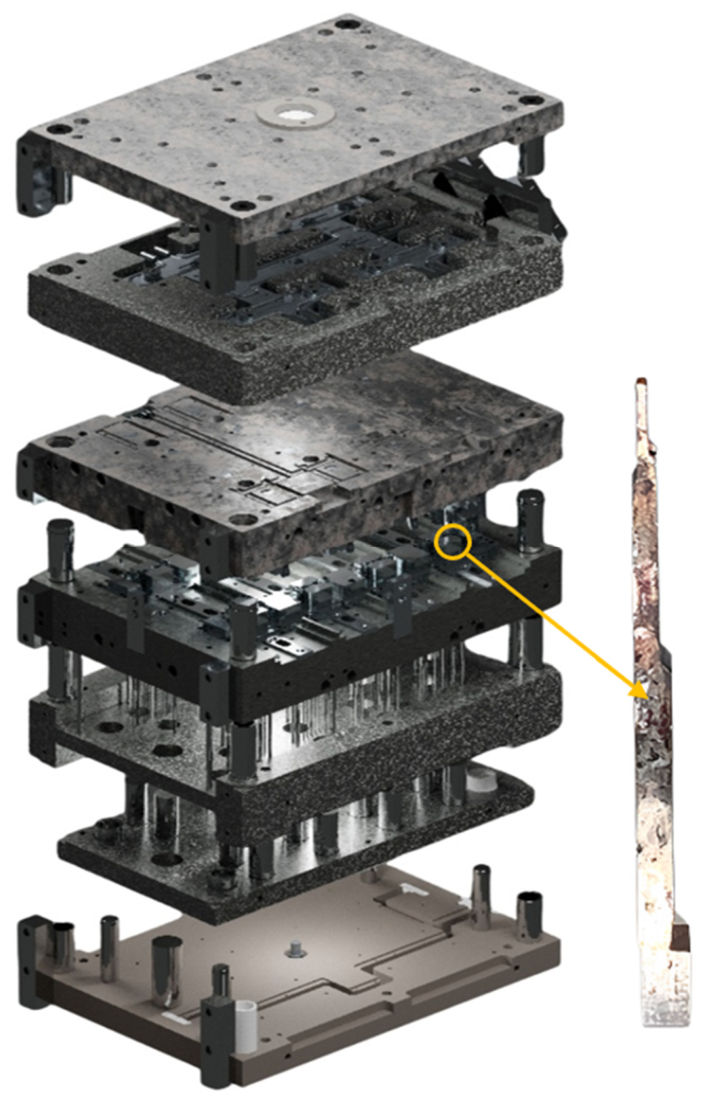
The operating envelope of the studied injection molding case was established from production records to define the mechanical, thermal, and temporal boundary conditions applied during each molding cycle.
The investigation uses: samples of broken insert, tooling and product material properties, process data, a computer aided design and technical drawings.

Table 1.
The experimental operating envelope of the studied case.
| Molding process parameter | Reference value | |
|---|---|---|
| Machine and cycle settings | Injection speed = 120 mm/s | Injection time = 0.67 s |
| switch-over = 20.00 ccm/ 1180 bar | holding pressure = 700 bar for 2.5 s | |
| cooling time = 7.00 s | cycle time = 15.2 s | |
| Global mold closure | Machine clamping force = 820 kN; minimum requirement = 660 kN. |
Locally applies 1kN of contact force insert-level |
| Temperature-control inputs | Injection unit/ nozzle 250 C | feed cooling 60 C |
| feed transition 245 C hot-runner/ feed path 240-290 C |
Slides 54-63 C Tmin = 22 C; Tmax = 297 C. |
|
Figure 3.
Core insert technical definition drawing.
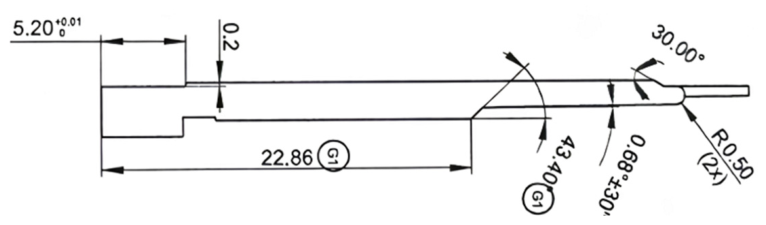
The technical drawing of the core insert provided the foundational dimensions and design intent. Based on this drawing, a 3D CAD model was created to accurately represent the geometry in three dimensions shown in Figure 4. This digital model serves as the basis for subsequent process and structural simulations.
Following the CAD geometry definition, the next step involved preparing the model for numerical analysis. The 3D geometry was meshed to ensure adequate resolution in critical regions. Refinement was focused around areas where stress concentrations were anticipated, based on the insert’s geometry and boundary conditions.
Figure 5.
Refined finite element mesh of the core insert.

The investigated insert is made of AISI H11 / DIN 1.2343, also designated as X38CrMoV5-1, an iron-based steel containing alloying element that improve hardness, strength, thermal stability, wear resistance, and fatigue resistance. For the structural finite element analysis and fatigue-damage calculations, the material is assumed to behave as homogeneous and isotropic. This assumption is adopted for numerical modelling purposes [8].
Table 2.
Chemical composition of H11/ X38CrMoV5-1.
| C | Si | Cr | Mo | V | Mn |
| 0.38 | 1.10 | 5.00 | 1.30 | 0.40 | 0.40 |
X38CrMoV5-1 is a chromium–molybdenum–vanadium hot-work tool steel, classified as a highly alloyed tool steel. These components justify its use for core inserts exposed to repeated pressure loading and transient thermal cycles in plastic injection molding. The mechanical and thermal properties of this alloy are therefore summarized in Table 3
The molding material is PA 6.6 GF >30, a glass-fiber-reinforced polyamide 6.6 in which the glass-fiber content exceeds 30%. The polyamide 6.6 matrix provides the thermoplastic base, while the glass fibers increase stiffness, dimensional stability, and mechanical strength. In the injection molding process, this reinforced polymer affects the pressure transfer, flow behavior, thermal exchange, and mechanical interaction with the mold core insert.
Figure 6.
Final injected product using the mold.
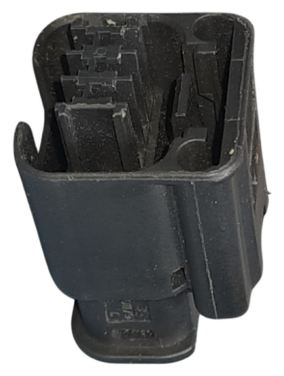
The machine used in the studied production case is the SSD Intellect 100-340 plastic injection molding machine. Assembled with this case study mold, It defines the industrial operating environment in which the AISI H11 core insert is repeatedly exposed to injection pressure, thermal loading, and mold closing constraints.
2.2. Muliphysics Analysis Requirement
A 3D CAD model of the mold is required before the process-loading simulation. The model includes the cavity, the studied core insert, the surrounding mold elements, the gate region, and the contact/support surfaces required for the numerical workflow.
Figure 7.
Mold canalisation of filling and cooling systems.
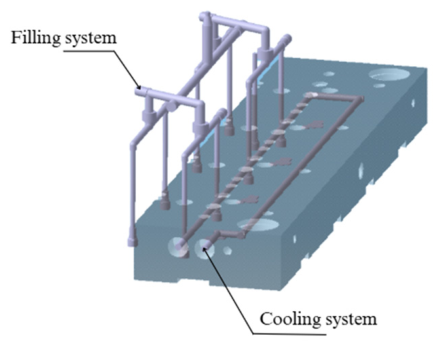
When the original CAD model is incomplete or too detailed for simulation, an optimized CAD model is prepared by preserving the geometrical features involved in the studied region and removing non-essential details.
Figure 8.
3D geometry of the insert and molded part, showing the layout and cavity components.
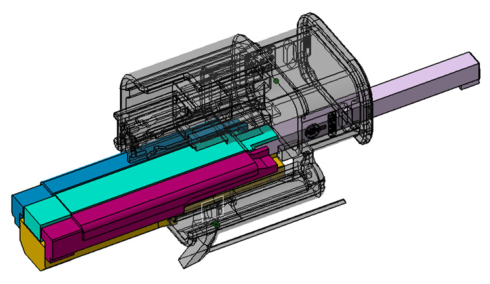
The process-loading simulation is performed using the prepared cavity and insert geometry. The computational mesh is concentrated around the cavity and the studied core insert in order to maintain local accuracy while limiting computational cost. The molded polymer is defined using its material data, including flow and thermal properties required to reproduce filling, packing, and cooling behaviour.
Contact interfaces, support regions, and local mechanical constraints are introduced according to the mold assembly configuration.
Figure 9.
CAE model showing the contact areas between the core insert and adjacent components.
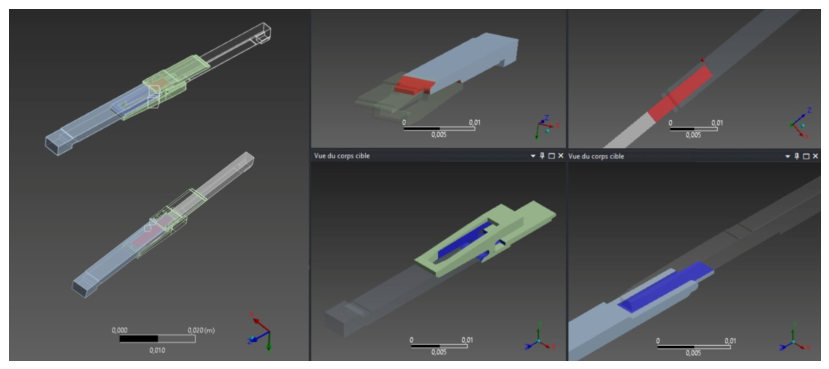
The input data used in the simulation include injection pressure, injection speed, melt temperature, packing pressure, cooling time, cycle time, and gate configuration.
When available, in-cavity pressure measurements are also introduced as reference data. Industrial operating data were translated into insert load inputs comprising pressure loading (injection/packing), mechanical constraints (seating/support and clamping boundary conditions), and cycle-dependent thermal loading (temperature field and gradients from repeated heating–cooling).
Figure 10.
CAE model showing the contact areas between the core insert and adjacent components.
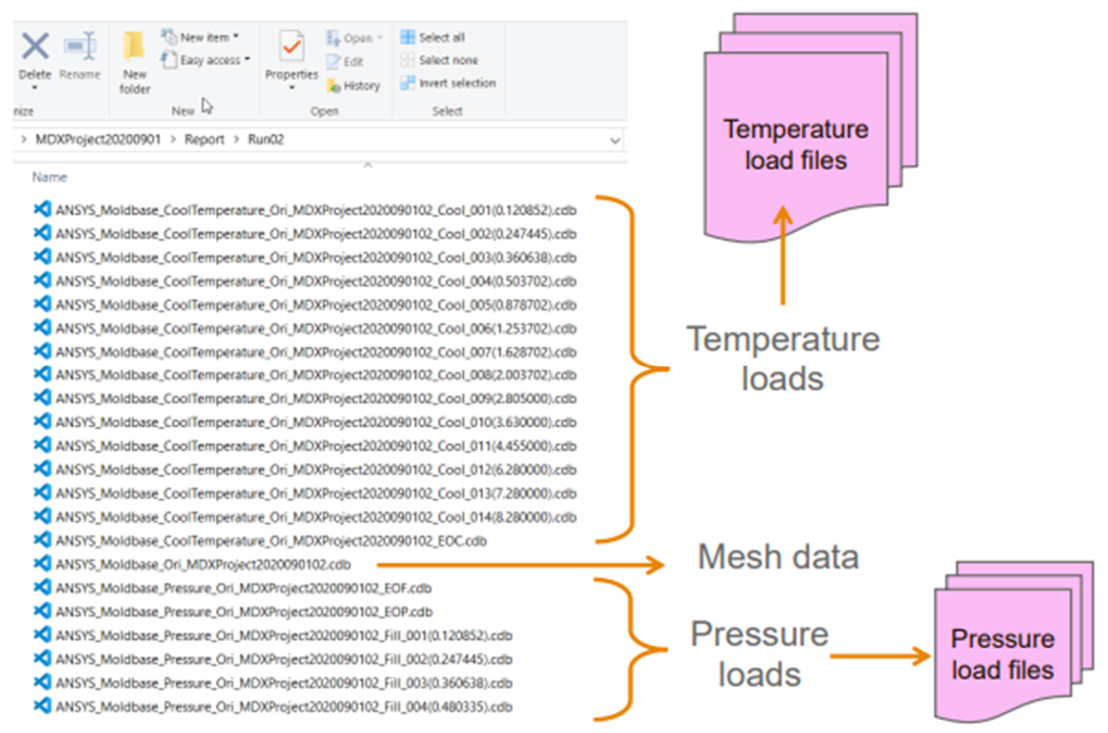
Figure 11.
CAE model showing the contact areas between the core insert and adjacent components.
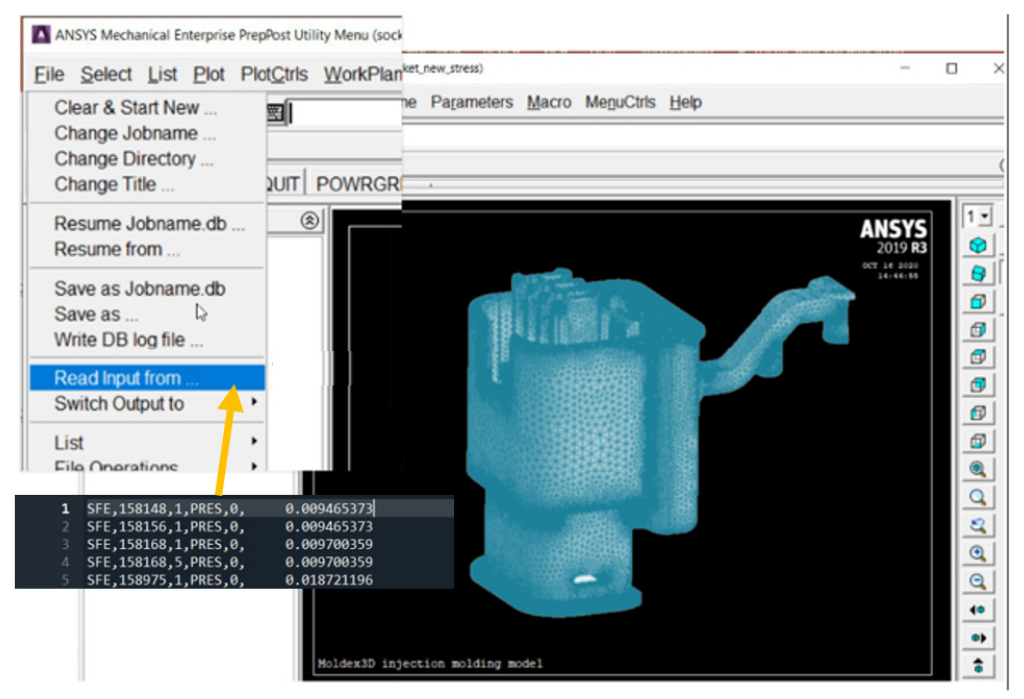
Figure 12.
CAE and Polymer pressure evolution at sensor locations.
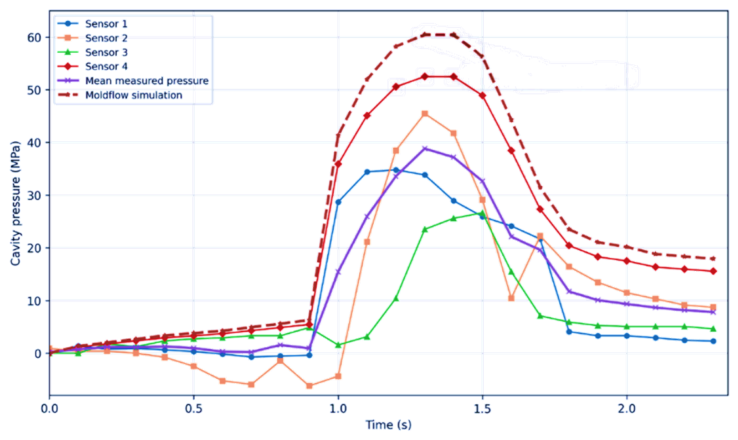
The simulated pressure at the sensor location is compared with measured cavity pressure obtained using a Kistler piezoelectric cavity pressure sensor before using the results to elaborate the structural model analysis on the insert.
2.3. Service Life Prediction
The service-life calculation converts the local structural response into fatigue-damage indicators. The insert response is assumed homogeneous and isotropic and that the calculation from the FEA-extracted stress–temperature history.
Define the local cyclic stress state. The calculation starts with the local maximum and minimum stresses extracted from the structural model [9]. The mean and alternating stresses are defined as:
The mean stress represents the constant component of the loading cycle, while the alternating stress represents the cyclic component responsible for fatigue damage. This theorem converts the structural FEA stress result into fatigue-compatible input data.
The mean-stress correction to fatigue loading using the Soderberg relation [10], is used as a conservative correction where Se is the endurance limit and Sy is the yield strength:
Convert the cyclic stress-strain response. The corrected cyclic stress state is converted into cyclic strain using the Ramberg-Osgood relation [11]:
This step links the local stress response of the insert to its cyclic strain response using the cyclic parameters K′ and n′.
Assess baseline LCF life estimation. The baseline low-cycle fatigue life is calculated using the Coffin-Manson strain–life relation [12].
This equation links the cyclic strain amplitude to the number of cycles to failure by combining elastic and plastic fatigue contributions.
Formulate the coupled fatigue-creep damage model. Introducing cumulative thermo-mechanical fatigue and creep damage model.
where: Dfatigue represents damage accumulated during repeated cyclic loading, and Dcreep represents time-dependent damage accumulated during stress exposure at elevated temperature.
The coefficients and exponents were selected from the AISI H11 damage model, based on experimental thermo-mechanical fatigue and creep data. The fatigue contribution is then concluded from the corresponding LCF life [13]:
For the time-dependent creep damage formulation during stress exposure at elevated temperature. It’s described using a Rabotnov-type damage law [14]:
The total scalar damage is then expressed as the sum of fatigue damage accumulated during repeated loading cycles and creep damage accumulated during stress exposure at elevated temperature:
This relation describes how damage increases with time under the combined effect of stress and temperature. In the studied insert, creep damage mustn’t be treated as an isolated mechanism.
Predict rupture cycles using the TMF-creep model. The final service-life prediction under coupled cyclic pressure loading, transient thermal exposure, and constrained deformation, is calculated as the inverse of the sum of the creep-damage increment and the thermo-mechanical fatigue damage increment accumulated during one representative molding:
where ∆ωc present creep damage increment per cycle and ∆ωTMF thermo-mechanical fatigue damage increment per cycle as described in the following breakdown:
where r is creep stress exponent A0 is the creep damage coefficient ∆t is the exposure time, with and are the stress values associated with the maximum and reference thermal states, respectively.
We have also:
Since the stress-severity factor is:
And temperature- and thermal-gradient-corrected TMF damage intensity:
where , , and are empirical coefficients describing the material resistance, and damage sensitivity under cyclic thermo-mechanical loading.
This is the calculation path from FEA extracted local stress and temperature history to LCF prediction and final TMF-creep rupture-cycle estimation.
3. Results and Analysis
This section presents the progressive interpretation of the studied core insert failure, starting from the observable damage evidence and moving toward process simulation, structural response, and lifetime assessment. The general inspection first defines the physical failure reference, including the damaged region and probable rupture initiation zone, before these observations are compared with the numerical results obtained from coupled process and structural analyses.
3.1. General Inspection
The fracture location, orientation and the rupture initiation region was identified for correlation with numerical response.
This damaged region was therefore retained as the reference zone for comparison with the critical stress region obtained from the structural finite element simulation. In Figure 14 The zoomed micrograph highlights the rupture initiation site under magnification. lists look like this:
Figure 13.
General inspection images of two failed core inserts: (a) partially fractured insert; (b) fully broken insert.
Figure 13.
General inspection images of two failed core inserts: (a) partially fractured insert; (b) fully broken insert.
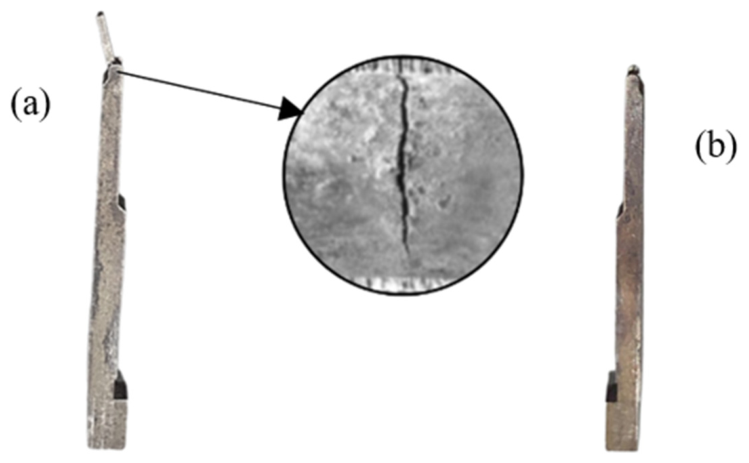
Although the damaged region can be visually retained as the reference rupture zone, the raw observation alone does not allow the crack initiation mechanism to be definitively identified. The micrograph indicates the probable rupture initiation site, but it does not by itself explain how the crack started from:
- Mechanical overload in regions of excessive local stress concentration;
- Thermal fatigue caused by repeated heating and cooling cycles;
- Contact-induced constraint generated by insert positioning, support conditions, and mold assembly interaction;
- Process-induced loading caused by repeated injection pressure, holding pressure, and transient thermal exposure;
- Progressive thermo-mechanical damage resulting from the interaction between cyclic pressure loading, thermal gradients, and constrained insert deformation.
3.2. Process Simulation Results
The injection molding process simulation provided the two main process-derived fields required for the structural analysis: the transient temperature field and the polymer pressure field. These results describe how the molded polymer thermally and mechanically loads the cavity, the core insert, and the surrounding mold structure during the molding cycle. They therefore define the multiphysics boundary conditions transferred to the structural FEA model.
3.2.1. Heat Distribution in the Mold Cavity
The simulated heat distribution shows the transient thermal exchange between the hot polymer, the cavity surface, the core insert, and the mold plate. During filling, the polymer introduces heat into the cavity, while cooling progressively extracts this heat through the metallic mold structure.
Figure 14.
Thermal field simulation results of temperature distribution in the cavity.
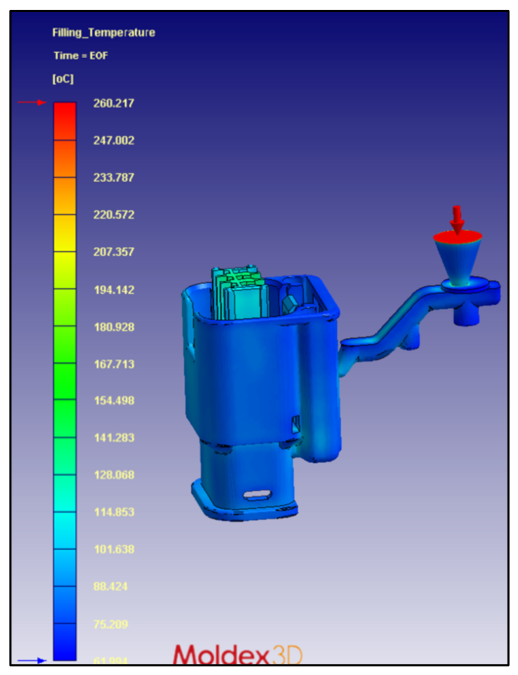
This produces a non-uniform temperature field and a thermal gradient between the polymer core, the cavity wall, and the surrounding mold components. This result is important because the resulting thermal gradient contributes to thermal strain and local thermo-mechanical loading in the insert.
3.2.2. Polymer Pressure Applied to the Cavity Surface
The simulated pressure field shows the mechanical loading applied by the polymer on the cavity and insert surfaces during filling and holding. During filling, the polymer pressure evolves according to the flow path and local cavity resistance. After filling, holding pressure is maintained to compensate for polymer shrinkage during cooling and solidification.
The selected process state corresponds to the early packing/holding stage, after cavity filling and before complete cooling. At this stage, the polymer remains highly pressurized to compensate for shrinkage, while the molded part is still hot and transfers heat toward the cavity wall, core insert, and mold plate. This stage therefore represents a critical coupled thermo-mechanical loading condition, where polymer pressure and thermal gradients act simultaneously on the insert surfaces.
This process state was retained as the critical loading condition for transferring the maximum thermal and mechanical boundary conditions to the structural FEA model.
3.3. Process Structural Response Assessment and Numerical Results
The structural analysis was performed using the maximum thermal and mechanical boundary conditions extracted from the injection molding process simulation. The transferred polymer pressure and temperature fields were applied to the AISI H11 core insert model to evaluate the local stress response under realistic operating conditions. The objective of this step was to identify the critical stress concentration region and compare it with the observed rupture initiation zone.
Figure 15.
Simulated polymer pressure distribution within the mold cavity during the packing/holding stage.
Figure 15.
Simulated polymer pressure distribution within the mold cavity during the packing/holding stage.
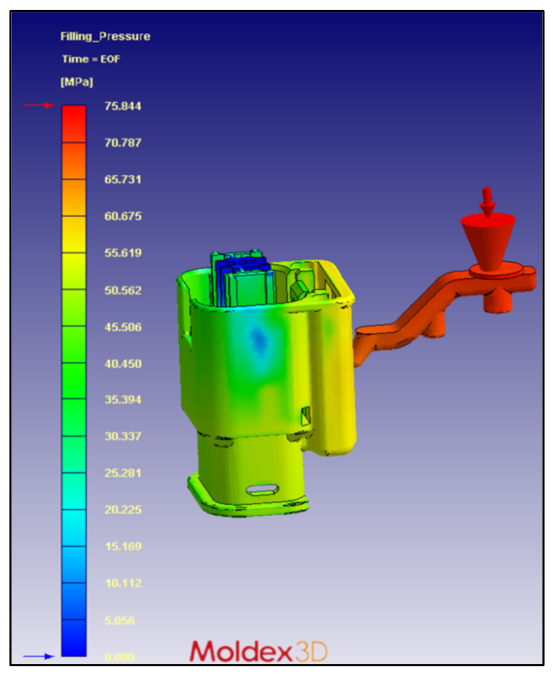
Figure 16.
Simulated Numerical results of the structural finite element analysis.
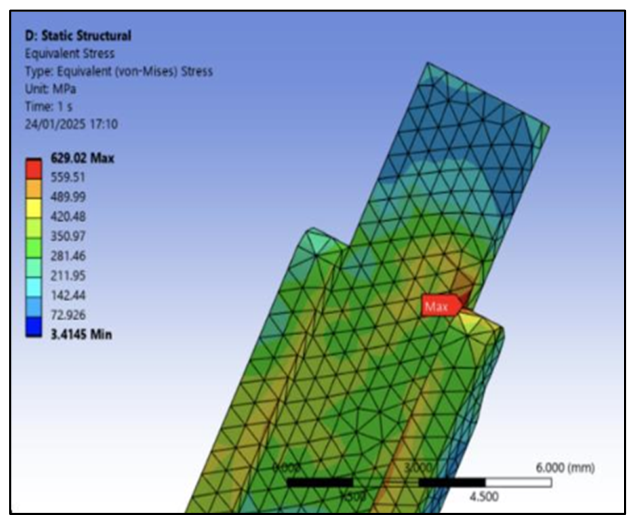
The structural finite element analysis showed a localized Von Mises stress of approximately 629 MPa at the rupture-initiation region. This value was retained as the local mechanical response of the insert and used as the stress input for the subsequent fatigue-damage calculation.
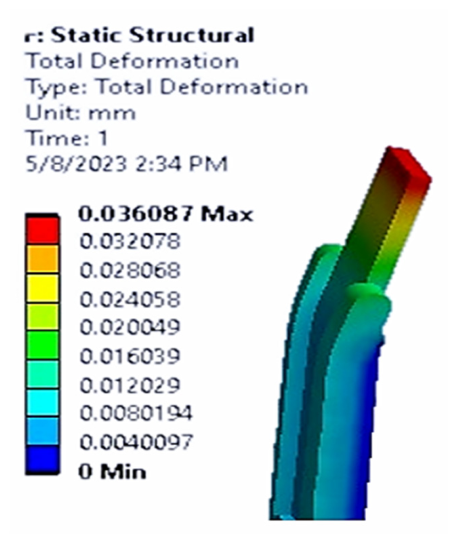
The numerical model also reported a thermally induced displacement of approximately 0.03 mm in constrained regions, indicating the local deformation response of the insert under coupled pressure and thermal loading. These values were retained for the service-life calculation. The stress, strain and temperature history extracted from this region was used as input for the baseline LCF and TMF-creep damage calculations.
The calculation under low-cycle fatigue model predicted: . The thermo-mechanical fatigue and creep model predicted: .
For our case the molding cycle time of 15.2 s, this number of life cycles is corresponding to functional production time of .
Figure 17.
Total deformation results.
3.4. Static Critical Stress Assessment
Using CAE tools structural analysis reported a localized Von Mises stress of approximately 629 MPa at the rupture-initiation region. This stress level is below the static strength level of the hardened AISI H11 condition used in the calculation. Therefore, the stress value is not retained as evidence of single-cycle static overload. Its role is to define the local stress state used for fatigue-damage assessment.
The numerical simulation model also reported a thermally induced displacement of approximately 0.03 mm in constrained regions. This displacement should be considered together with assembly dimensional tolerances and contact conditions. Although limited in magnitude, it may become relevant when the insert operates with small clearances, tight fitting surfaces, or local contact zones close to tolerance limits
The baseline LCF prediction of approximately 20,000 cycles, higher than the observed failure range around 7000 cycles, indicates that mechanical fatigue alone is insufficient and that the analysis must proceed toward the following step.
3.5. TMF-Creep Damage Verification of the Failure Root-Cause
The TMF-creep model was evaluated using the same local stress-temperature history extracted from the rupture-initiation region. This model includes cyclic stress, transient thermal exposure, and time-dependent damage during repeated molding cycles.
The observed annual breakage frequency of 321 cases corresponds to an average service life of approximately 27.3 production hours per insert under continuous manufacturing environment. This value is close to the TMF-creep predicted lifetime of 29.7 h, supporting the consistency between the model prediction and the industrial failure frequency.
4. Discussion
4.1. From Observed Failure to Evidence-Based Verification
The analysis was not limited to identifying a cracked insert or reporting a high local stress value. It followed a verification logic in which each possible explanation was checked against the available evidence. The visual inspection first defined the rupture location, crack orientation, and probable initiation region. These observations gave the physical reference needed to compare the failed part with the numerical response. The process simulation then supplied the pressure and temperature fields, while the structural model converted these fields into local stress and displacement responses. This sequence is important because the failure of a core insert cannot be evaluated only from machine settings or from the visual crack shape; it must be linked to the local response of the insert as a key element withing the mold assembly system.
4.2. Verification of Non-Retained Failure Factors
Before retaining the final damage mechanism, the first estimated failure factors were checked against the available evidence. The maximum Von Mises stress of approximately 629 MPa remains below the static strength level of the hardened AISI H11 condition used in the calculation; therefore, single-cycle static overload is not retained. The global clamping force is also not retained as the main cause because the available machine clamping force exceeds the calculated minimum requirement. Similarly, the thermally induced displacement of approximately 0.03 mm does not confirm assembly tolerance excess as a direct root cause, but it highlights improvement areas related to tolerance control, insert seating, contact-surface quality, and local support conditions.
The baseline low-cycle fatigue prediction was then used as a mechanical fatigue verification step. The model predicted approximately 20,000 cycles, while the observed failure occurred near 7000 cycles. This mismatch shows that baseline mechanical fatigue alone is not sufficient to explain the studied failure. Therefore, static overload, insufficient clamping force, assembly/tolerance effects, and LCF prediction model are treated as non-retained failure factors. Their verification supports the need to proceed toward the coupled thermo-mechanical fatigue and creep assessment.
4.3. Interpretation of Key Findings
The main value of the results lies in the progressive verification of the failure mechanism. Visual inspection alone identifies the damaged region, but it cannot explain the failure mechanism. Structural simulation adds the local mechanical response, while lifetime modelling checks whether this response can reproduce the observed failure range. This sequence transforms the analysis from simple failure observation into evidence-based root-cause verification.
The comparison between the baseline fatigue model and the coupled TMF-creep model also clarifies the limitation of isolated approaches. Static stress checking locates whether immediate overload is possible, and LCF provides a mechanical fatigue reference, but neither is sufficient alone for the studied case. The added value of the final formulation is that it introduces the missing non-isothermal and time-dependent damage components required to represent high-volume injection molding conditions.
From an industrial perspective, the findings show why insert breakage should be assessed through a connected process-to-structure-to-damage workflow. The objective is not only to calculate a lifetime after failure, but to identify which data must be monitored during production: pressure history, thermal exposure, cycle time, cooling conditions, contact constraints, maintenance events, and failure frequency. This creates the basis for automating tooling-integrity assessment and moving from corrective replacement toward predictive monitoring of mold components.
4.4. Improvement Potential and Automation for High-Volume Production Usage
For high-volume production, the main perspective is to move from post-failure investigation toward continuous tooling-integrity monitoring. This requires systematic tracking of the variables that define the molding environment, including cycle time, injection pressure, holding pressure, temperature history, cooling conditions, clamping data, maintenance operations, insert replacements, and failure records. Once recorded, these data can be connected to the CAE-based workflow to update the estimated damage state of the insert during production, instead of waiting for rupture to occur.
Future work should automate the process-to-structure-to-damage sequence. In an automated implementation, production data would feed the process-loading model, pressure and temperature fields would update the structural response, and the extracted local stress–temperature history would update the damage indicator or remaining-life estimate. With sufficient historical cases, machine-learning models could be added as a diagnostic layer to recognize abnormal loading patterns, classify probable failure mechanisms, and recommend preventive actions. This would transform the framework from a case-specific failure analysis tool into a decision-support system for predictive maintenance and tooling reliability.
The same logic can be extended beyond core inserts to other functional mold components. Mold cavity elements, sliders, and support regions can be treated as active thermo-mechanical parts exposed to polymer pressure, heat transfer, contact constraints, clearance variation, and repeated cycling. Future investigations should therefore include contact evolution, dimensional tolerance effects, local constraint changes, thermal expansion, and progressive damage accumulation across different mold components. This extension would strengthen the framework as a broader mold reliability assessment method for high-volume injection molding.
5. Conclusions
In this study we established a reproducible root-cause verification approach for an industrial AISI H11 core insert failure under high-volume injection molding conditions. The approach linked failure evidence, process-derived loading, structural finite element response, and fatigue-damage calculation in a single verification sequence.
The evidence converged toward localized cumulative damage as the retained failure mechanism. Visual inspection identified the rupture-initiation region, structural FEA located the highest local stress response in the same region, and the TMF-creep model predicted a lifetime close to the observed industrial failure range. Static overload, insufficient global clamping force, assembly tolerance effects alone, and baseline LCF alone were checked but not retained as sufficient explanations.
Our case study shows that reliable root-cause verification of AISI H11 core insert breakage requires linking visual failure evidence, process-derived loading, structural response, and cumulative damage modelling. The final TMF-creep prediction of approximately 29.7 h under the studied cycle time, was consistent with the observed failure range. Therefore, the studied insert failure is retained as a progressive thermo-mechanical fatigue and creep-related damage process localized at the critical stress region
The proposed workflow can support future tooling-integrity monitoring by connecting production data, numerical simulation, and damage indicators. This would allow high-volume injection molding systems to move from post-failure diagnosis toward predictive maintenance and preventive action planning for core inserts and other active mold system components.
Abbreviations
The following abbreviations are used in this manuscript:
| CAE | Computer-Aided Engineering |
| FEA | Finite Element Analysis |
| HRC | Rockwell hardness scale C Three letter acronym |
| PA | Polyamide |
| AISI | American Iron and Steel Institute |
| CAD | Computer-Aided Design |
| Nf | Number of cycles to failure from the LCF model |
| NRP | Predicted rupture cycles from the TMF–creep model |
| RCA | Root-cause analysis |
| tFP | Effective production service time |
References
- Durão, L. M.; Pedroso, A. F. V.; Martinho, R. P.; Brito, M. F.; Alexandre, R. J. D.; Markopoulos, A. P. Recent Advances and Future Trends in Extending the Service Life of Injection Moulding Tools: A Comprehensive Review. J. Mech. Eng. Manuf. 2026. [Google Scholar] [CrossRef]
- Mizera, A.; Krstulović-Opara, L.; Krempl, N.; Karhankova, M.; Maňas, M.; Šánek, L.; Stoklásek, P.; Grebo, A. Dynamic Behavior of Thermally Affected Injection-Molded High-Density Polyethylene Parts Modified by Accelerated Electrons. Polymers 2022, 14(22), 4970–4970. [Google Scholar] [CrossRef] [PubMed]
- Davoudinejad, A.; Bayat, M.; Pedersen, D. B.; Zhang, Y.; Hattel, J. H.; Tosello, G. Experimental Investigation and Thermo-Mechanical Modelling for Tool Life Evaluation of Photopolymer Additively Manufactured Mould Inserts in Different Injection Moulding Conditions. Int. J. Adv. Manuf. Technol. 2019, 102, 403–420. [Google Scholar] [CrossRef]
- Kim, J. K.; Lee, C. S. Fatigue Life Estimation of Injection Mold Core Using Simulation-Based Approach. Int. J. Automot. Technol. 2013, 14(5), 723–729. [Google Scholar] [CrossRef]
- Riccardo, G.; Rivolta, B.; Gorla, C.; Concli, F. Cyclic Behavior and Fatigue Resistance of AISI H11 and AISI H13 Tool Steels. Eng. Fail. Anal. 2020, 121, 105096–105096. [Google Scholar] [CrossRef]
- Oudin, A.; Penazzi, L.; Rézaï-Aria, F. Life Prediction of Hot Work Tool Steels Subjected to Thermomechanical Fatigue. Matériaux Tech. 2000, 88, 67–72. [Google Scholar] [CrossRef]
- Pellizzari, M.; Molinari, A.; Cescato, D.; Ghidini, A.; Cantini, S. Thermal Fatigue Properties of Hot-Work Tool Steels. Int. J. Microstruct. Mater. Prop. 2008, 3, 363–363. [Google Scholar] [CrossRef]
- Rovinelli, A.; Guilhem, Y.; Proudhon, H.; Lebensohn, R. A.; Ludwig, W.; Sangid, M. D. Assessing Reliability of Fatigue Indicator Parameters for Small Crack Growth via a Probabilistic Framework. Model. Simul. Mater. Sci. Eng. 2017, 25(4), 45010–45010. [Google Scholar] [CrossRef]
- Chen, Y.; Monteiro, É.; Koutiri, I.; Favier, V. Fatigue-Constrained Topology Optimization Using the Constrained Natural Element Method. Comput. Methods Appl. Mech. Eng. 2024, 422, 116821–116821. [Google Scholar] [CrossRef]
- Leonetti, D.; Maljaars, J.; Snijder, H. H. Fatigue Life Prediction of Hot-Riveted Shear Connections Using System Reliability. Eng. Struct. 2019, 186, 471–483. [Google Scholar] [CrossRef]
- Zhu, S.; Foletti, S.; Beretta, S. Probabilistic Framework for Multiaxial LCF Assessment under Material Variability. Int. J. Fatigue 2017, 103, 371–385. [Google Scholar] [CrossRef]
- Skamniotis, C.; Cocks, A. C. F. Creep-Plasticity-Fatigue Calculations in the Design of Porous Double Layers for New Transpiration Cooling Systems. Int. J. Fatigue 2021, 151, 106304–106304. [Google Scholar] [CrossRef]
- Berti, G.; Monti, M. Improvement of Life Prediction in AISI H11 Tool Steel by Integration of Thermo-mechanical Fatigue and Creep Damage Models. Fatigue Fract. Eng. Mater. Struct. 2009, 32(3), 270–283. [Google Scholar] [CrossRef]
- Velay, V.; Bernhart, G.; Delagnes, D.; Penazzi, L. A Continuum Damage Model Applied to High-temperature Fatigue Lifetime Prediction of a Martensitic Tool Steel. Fatigue Fract. Eng. Mater. Struct. 2005, 28(11), 1009–1023. [Google Scholar] [CrossRef]
Figure 1.
Sequential verification procedure from initial failure evidence into root-cause identification.
Figure 1.
Sequential verification procedure from initial failure evidence into root-cause identification.
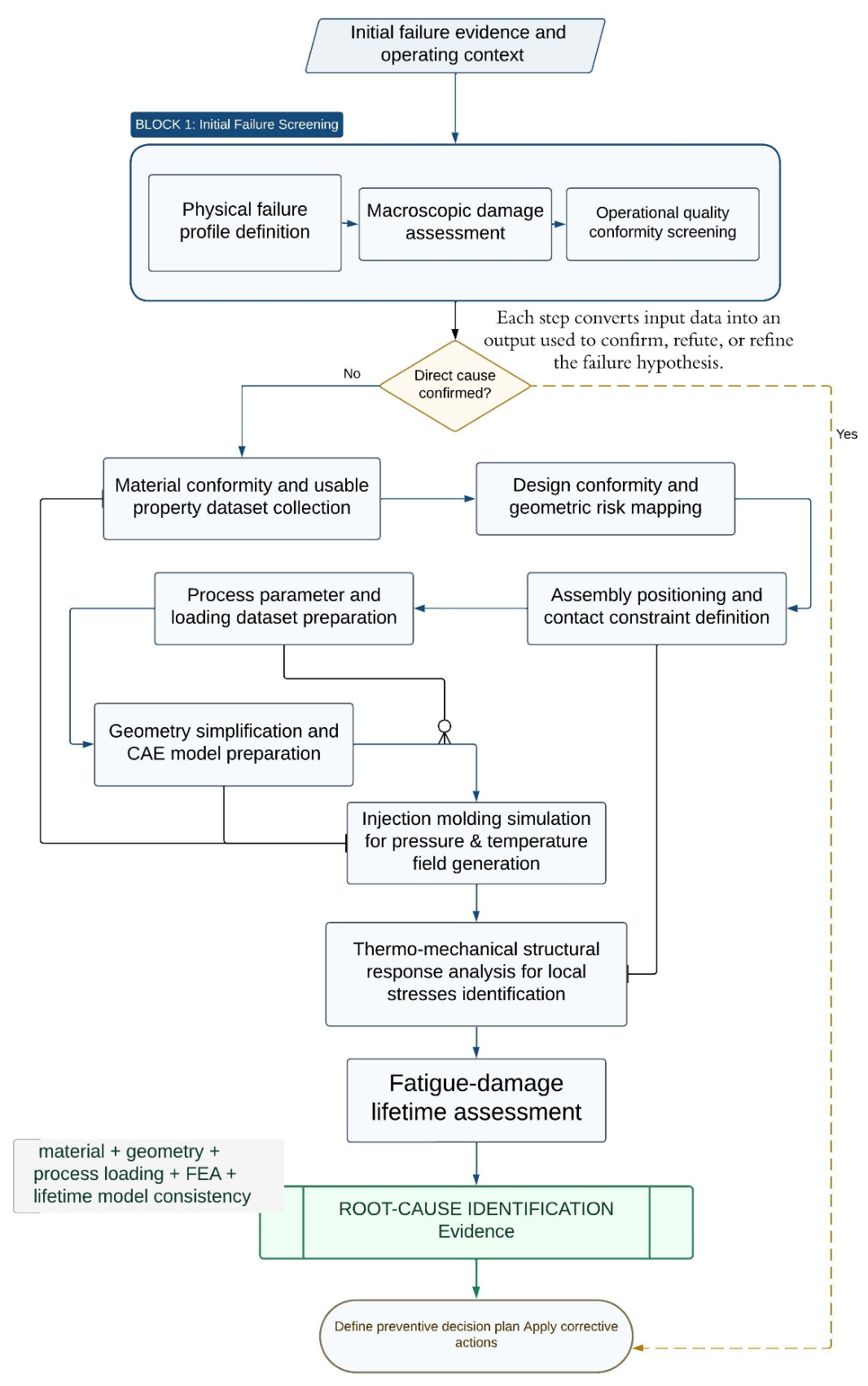
Figure 4.
3D view of used CAD model.
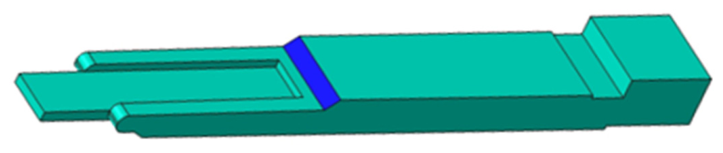
Table 3.
Mechanical and thermal material properties.
| Material property | Value (For H11) |
|---|---|
| Density | 7.80 g/cc |
| Hardness, Rockwell C | 55 |
| Tensile Strength, Ultimate | 1990 MPa |
| Tensile Strength, Yield | 1650 MPa |
| Elongation at Break | 9.0% |
| Modulus of Elasticity | 210 GPa |
| Poisson’s Ratio | 0.30 |
| Shear Modulus | 81 GPa |
| Specific Heat Capacity | 0.460 J/g-°C |
| Thermal Conductivity | 24.6 W/m-K |
Disclaimer/Publisher’s Note: The statements, opinions and data contained in all publications are solely those of the individual author(s) and contributor(s) and not of MDPI and/or the editor(s). MDPI and/or the editor(s) disclaim responsibility for any injury to people or property resulting from any ideas, methods, instructions or products referred to in the content. |
© 2026 by the authors. Licensee MDPI, Basel, Switzerland. This article is an open access article distributed under the terms and conditions of the Creative Commons Attribution (CC BY) license (http://creativecommons.org/licenses/by/4.0/).
Copyright: This open access article is published under a Creative Commons CC BY 4.0 license, which permit the free download, distribution, and reuse, provided that the author and preprint are cited in any reuse.


