

Submitted:
08 June 2026
Posted:
09 June 2026
You are already at the latest version
Abstract
Red blood cell (RBC) aggregation and viscosity-related flow resistance are important hemorheological parameters for assessing blood flow abnormalities, but their simultaneous measurement often requires multiple pumps or intermittent flow stoppage. In this study, we propose a single syringe pump microfluidic sensing method for simultaneous evaluation of RBC aggregation and transient flow response under continuous pulsatile blood delivery. The device consists of a single inlet, a main straight channel, a bifurcated test channel, and a big outlet. A programmed pulsatile-flow profile is applied by switching between high and low flow rates, and the transient velocity response is analyzed to extract the time constant (λ₁) as a viscosity-related indicator. After optimization, the selected flow profile provides stable and reproducible measurements of both λ₁ and the RBC aggregation index (AI) while reducing unnecessary blood consumption. The λ₁ shows a strong correlation with viscosity and is significantly affected by syringe air compliance. The proposed AI exhibits consistent trends when compared with conventional aggregation indices. Furthermore, it exhibits temporal stability under continuous blood flow. Finally, the method is adopted to detect time-dependent changes in blood during continuous blood infusion, which demonstrates its potential as a simple, sensitive, and practical microfluidic sensor for real-time hemorheological monitoring.
Keywords:
red blood cell aggregation
; viscosity-sensitive time constant
; microfluidic bifurcation
; continuous pulsatile flow profile
1. Introduction
Red blood cell (RBC) aggregation is regarded as a key hemorheological phenomenon that has a strong impact on blood viscosity and fluidic resistance, thereby potentially influencing tissue perfusion under low shear rates [1,2,3,4]. Because RBC aggregation modulates microvascular flow resistance and oxygen transport, its quantitative assessment is clinically important for evaluating hemorheological alterations associated with inflammation, cardiovascular and metabolic disorders, and hematological diseases [5,6,7,8]. In addition, RBC aggregation is governed by multiple hematological factors, including plasma protein concentration, hematocrit, RBC morphology [9], cellular deformability [10], and membrane viscoelastic properties [3,6,11]. Therefore, reliable RBC aggregation assessment requires quantifying aggregation while considering key modulatory blood conditions, particularly hematocrit and plasma composition, which can affect disaggregation shear-rate determination and aggregation measurements [12,13,14].
In conventional RBC aggregation assays, test blood is loaded into a measurement chamber and subjected to a high-shear field for a sufficient period to disrupt pre-existing aggregates. The external driving source, such as a vacuum pump [15], syringe pump [13], solenoid valve [16], or vibrational motor [17,18], is then abruptly turned off to stop blood flow, allowing RBC re-aggregation to occur under near-stagnant or low-shear conditions. The resulting aggregation process is subsequently monitored to determine aggregation kinetics or aggregation indices [19]. That is, several detection methods, including optical method (LED or photodiode) [18], electrical impedance [20,21], and ultrasound [14,22], and microscopic imaging [23,24] are adopted to quantify RBC aggregation. The RBC aggregation index (AI) is subsequently determined from the temporal syllectogram recorded during RBC re-aggregation. Although the previous methods can provide quantitative aggregation indices, they are often limited when the hematocrit or suspending medium changes under continuous flow or circulation conditions [13].
More recently, to resolve the critical issues raised by the previous methods, continuous flow-dependent RBC aggregation has been assessed using microfluidic bifurcation channels [13]. Herein, a single blood flow is divided into low-flow and high-flow branches, where RBC aggregation is promoted in the low-flow channel and dispersed in the high-flow channel. The aggregation index is calculated from time-lapse image intensities in both channels. Considering that hematocrit or plasma medium can be varied under continuous blood delivery [25,26,27,28], the previous method has been further improved to simultaneously measure blood viscosity and RBC aggregation [29]. However, the previous method relies on two precision pumps to introduce the reference fluid and test blood sample simultaneously. Continuous infusion of 1× PBS can gradually dilute the test blood, making it difficult to distinguish true RBC alterations from hemodilution-induced changes during continuous blood flow [30,31,32]. To overcome this limitation, direct viscosity measurement using a reference fluid should be replaced by indirect viscosity-sensitive parameters [33,34].
In this study, we propose a microfluidic sensing method for simultaneous assessment of RBC aggregation and a viscosity-sensitive time constant under continuous pulsatile blood flow. The proposed device is designed to generate two distinct flow environments: a low-flow test chamber for inducing and measuring RBC aggregation and a high-flow main channel for analyzing transient velocity responses. A single syringe pump is adopted to generate a pulsatile blood-flow profile. In particular, in the low-flow test chamber, RBC aggregation is quantified using a position-dependent aggregation index derived from image intensity along the test chamber. This approach allows spatially resolved evaluation of RBC aggregation. In the high-flow main channel, the time-dependent velocity of blood flow is measured and analyzed by regression to obtain a viscosity-sensitive time constant, which reflects changes in the state of blood delivered from the syringe.
Compared with previous methods that measure RBC aggregation alone [35], estimate viscosity using co-flow interface tracking [29,30], or perform sequential pressure or aggregation analysis, the proposed method enables simultaneous assessment of RBC aggregation and a viscosity-sensitive time constant in a single microfluidic platform under continuous pulsatile blood flow. By combining position-dependent image-based aggregation analysis in a low-flow test chamber with velocity-based regression analysis in a high-flow main channel, the method can monitor both aggregation behavior and flow-response changes without reference-fluid infusion. Therefore, it reduces hemodilution-related artifacts and provides a practical sensing strategy for detecting hemorheological alterations caused by hematocrit or medium-dependent changes in continuously delivered blood.
2. Materials and Methods
2.1. Microfluidic Chip Fabrication and Experimental Setup
A novel microfluidic platform was suggested for probing viscosity-sensitive time constant and RBC aggregation index in continuous pulsatile blood flow.
As shown in Figure 1A, the experimental setup consisted of a microfluidic chip, a single syringe pump, and a microscopic imaging system. As shown in Figure 1A-i, the microfluidic chip comprised a single inlet, a rectangular main channel (mc) (width = 1 mm, length = 14.9 mm), a bifurcation channel, and a large outlet. The main and bifurcation channels were connected to the outlet. The bifurcation channel contained a large test chamber (tc) (width = 1 mm, length = 2 mm) positioned between two narrow guide channels (width = 0.1 mm, length = 6.89 mm). The channel depth was fixed at h = 50 μm throughout the device.
The microfluidic device was fabricated by PDMS replica molding from a silicon master, which was patterned using conventional photolithography and etched by deep reactive ion etching, following standard soft-lithography and MEMS micromachining procedures [36,37]. For PDMS replica molding, Sylgard 184 elastomer base and curing agent (Dow Corning, Midland, MI, USA) were mixed at a 10:1 weight ratio. The uncured PDMS mixture was degassed in a vacuum chamber for 1 h and subsequently cured at 65 °C for 2 h. After curing, the PDMS replica was gently peeled off from the silicon master, trimmed to the required dimensions, and punched to form an inlet port with an outer diameter of 2 mm. A large outlet port was also created using a punch with an outer diameter of 3 mm. Finally, the PDMS layer was irreversibly sealed onto a glass substrate after oxygen plasma activation using a plasma treatment system (CUTE-MPR, Femto Science Co., Ltd., Hwaseong-si, Republic of Korea). The assembled chip was further heated at 120 °C for 10 min for enhancing bonding strength between the PDMS and glass surfaces.
As shown in Figure 1A-ii, a single syringe equipped with a 20-gauge needle was loaded with blood (Vb = 0.5 mL). To introduce air compliance into the blood-delivery system, an air cavity (Vair) was maintained above the blood column inside the syringe [38]. A trapped gas volume can function as a hydraulic capacitor that absorbs flow fluctuations and modifies the transient response of syringe-pump-driven microfluidic systems [39,40,41,42,43]. The needle tip was connected to one end of polyethylene tubing (inner diameter = 0.25 mm, length = 200 mm), while the other end of the tubing was inserted into the inlet port of the microfluidic device. To minimize nonspecific protein adsorption, the microchannels were pretreated with 0.2% bovine serum albumin (BSA) for 10 min. The channels were then rinsed with 1× PBS to remove residual BSA before blood infusion. The syringe was mounted on a syringe pump (neMESYS, Cetoni Gmbh, Korbussen, Germany). The pump was programmed to generate a pulsatile blood flow rate profile. The flow rate (Qsp) was set to Qsp = Qh for the high-flow interval (0 < t < th) and Qsp = Ql mL/h for the low-flow interval (th < t < T), with one cycle period defined as T = th + tl.
The microfluidic chip was mounted on an inverted microscope (IX81, Olympus, Tokyo, Japan) equipped with a 4× objective lens (NA = 0.1). Microscopic images of blood flow were acquired at 5000 frames per second (fps) using a high-speed camera (FASTCAM MINI, Photron, Tokyo, Japan). Image acquisition was triggered at 0.5 s interval using a function generator. All experiments were performed at room temperature (25 °C).
2.2. Quantification of Blood Velocity and Microscopic Image Intensity
Blood velocity was measured separately in the main channel and test chamber. The velocity response in the main channel was used to determine the viscosity-sensitive time constant, while the velocity in the test chamber was used to estimate the low-shear-rate condition for RBC aggregation. RBC aggregation was then quantified from the spatial distribution of image intensity along the test chamber.
First, as shown in Figure 1B-i, to obtain the average velocity in each channel, the region-of-interest (ROI) (1.7 mm2) was defined in the upper portion of the main channel and in the straight section of the test chamber, respectively. Velocity fields were obtained from time-lapse image sequences using PIVlab (version 3.12) [44] with an interrogation window of 129 × 129 µm2 and 50% overlap. The calculated velocity vectors were subsequently filtered using local median and standard-deviation filters. For the optical measurement system used in this study, the depth of correlation (DOC) was estimated to exceed 300 µm, which was substantially greater than the channel depth of 50 µm [45]. According to the micro-PIV depth-of-correlation theory [46,47], all RBCs located through the illuminated depth direction could contribute to the recorded correlation signals. Therefore, the measured velocity vectors were regarded as depth-averaged velocities across the channel depth. Within each channel, the velocity vectors were spatially averaged over the selected ROI. The resulting time-dependent mean velocities in the main channel and test chamber were defined as Umc and Utc, respectively.
Second, the initial background image was subtracted from each acquired image, and the resulting images were analyzed using MATLAB (version 2025b, MathWorks, Natick, MA, USA). As shown in the upper panel of Figure 2B-ii, a small ROI (0.04 mm²) was selected within the straight region of the test chamber and translated along the x-direction from the left boundary to the right boundary. The mean grayscale intensity at each position was defined as (Itc [x]). The arrow indicated blood flow direction left to right. As blood moved from the narrow guide channel into the wider test chamber, local shear rate decreased substantially. RBC aggregation was continuously induced under low-shear conditions. As shown in the lower panel of Figure 2B-ii, the Itc (x) gradually increased along the 2-mm chamber length, reflecting the progression of RBC aggregation. The spatial intensity distribution was then used to determine two parameters (Sa, Sb), following the conventional aggregation-index definition [18,21,48], and the RBC aggregation index was calculated as (AI = Sa/(Sa + Sb).
2.3. A Lumped Parameter Modeling for Estimating Time Constant and Shear Rate
As shown in Figure 1C, a simplified mathematical model was established to estimate viscosity-dependent time-constant and shear rate in test chamber, under pulsatile blood flow conditions.
As shown in Figure 1C-i, air cavity was maintained above blood volume inside the syringe. Qsp and Qm denoted flow rate of syringe pump and flow rate through tubing, respectively. From the mass conservation law [49], the temporal change in air cavity could be expressed as,
Assuming that the air cavity follows the ideal-gas law [50], the relationship between the initial and instantaneous air cavity volume was given by P0 V0 = Ps Vair, where P0 was the atmosphere pressure, V0 was initial air cavity, Ps was air pressure inside the syringe. Thus, the instantaneous air cavity was written as Vair = P0V0/Ps. Differentiating Vair with respect to time gave the Eqn (2) [43],
In Eqn (2), compliance coefficient (Cf) was defined as,
The Eqn (1) was then simplified as the Eqn (4) as,
Equation (4) indicated that the imposed syringe-pump flow rate was divided into the flow delivered through the tubing and the flow associated with compression or expansion of the air cavity [51]. Based on this relationship, the air cavity was represented as a compliance element in the equivalent fluidic circuit shown in the left panel of Figure 1C-i. In the circuit, GND (▼) denoted zero value of gauge pressure. Pj represented pressure at the junction point where the bifurcation channel was branched from the main channel. Qb denoted the flow rate through the bifurcation channel. Based on Hagen-Poiseuille law (pressure drop [ΔP] = flow rate [Q] × fluidic resistance [R]) [49], frictional loss in channel or tubing was represented as a fluidic resistance element (R). As shown in Figure 1C-ii, a lumped fluidic circuit model was established for the proposed microfluidic system. The model consisted of a syringe pump, a tubing, and a microfluidic channel. The syringe pump was represented by a flow-rate source coupled with a compliance element (Cf), whereas the tubing was modeled as a hydraulic resistance (Rt). The microfluidic channel was described using the hydraulic resistances of the main channel and bifurcation channel, which were denoted as Rm and Rb, respectively. Herein, Rb represented the equivalent hydraulic resistance of the two guide channels and the large test chamber connected in series. By applying mass conservation at junction (j), the transient flow response through the main channel could be expressed as
where Qsp was the flow rate imposed by the syringe pump and Qm was the flow rate through the main channel. The corresponding time constant was given by
Since the equivalent hydraulic resistance was directly dependent on the apparent viscosity of blood, an increase in blood viscosity led to an increase in the flow-response time constant under the same air compliance. Therefore, the flow-response time constant could provide a physically grounded and experimentally accessible index for assessing viscosity-related hemorheological variations in the proposed microfluidic system.
As shown in Figure 1C-iii, the time-dependent syringe pump flow rate (Qsp) was defined as Qsp = Qh for 0 < t < t1 and Qsp = Ql for t1 < t < T. To minimize the influence of RBC aggregation on the blood viscosity, the time constant was determined under sufficiently high shear rate conditions ( > 103 s-1). Therefore, within one period (T), the analytical solution for Qm was derived for the transient interval, when the Qsp was changed from Qh to Ql. Under this transient flow-rate condition, solving the Eqn (5) provided Qm as,
In the Eqn (7), in the main channel could be expressed as , where Umc was the time-dependent mean velocity and Amc was the cross-sectional area of the main channel. The time constant (λ1) was obtained by regression analysis of the time-lapse Umc (t) data during the flow-rate transition from Qh to Ql.
To estimate shear rate in the test chamber, the syringe flow rate was assumed as a constant value of Qsp = Q0. Based on mass conservation at the junction point (‘j’), pressure at the junction (Pj) was derived as,
Dividing Pj with Rb gave the expression of Qb as,
With regard to microfluidic channel proposed in this study, the fluidic resistance ratio (Rb/Rm) was calculated as Rb/Rm = 18.76. As shown in left panel of Figure 1C-iv, variations of flow rate in the bifurcation (Qb) were estimated by increasing Qsp ranging from 0.5 mL/h to 9.5 mL/h. As expected, the Qb was linearly proportional to Qsp. In the inset of Figure 1C-iv, the arrow (‘←’) denoted blood flow direction in the bifurcation channel. The right-side panel depicted the corresponding shear rate profiles in test chamber and guide channel, respectively. Considering that RBC aggregation was mainly promoted under low shear rate conditions () [5,25,52,53,54], RBC aggregation could be observed in the yellow region, which corresponded to Qsp < 3 mL/h. In contrast, no appreciable RBC aggregation was detected within the selected range of Qsp.
2.4. Test Blood Preparation
A packed RBC unit was provided by the Gwangju–Chonnam Blood Bank (Gwangju, Republic of Korea) and maintained at refrigerated temperature before experiments. For sample preparation, normal RBCs were collected using an established washing protocol [55,56]. After centrifugation, the supernatant containing the storage medium and washing buffer was carefully aspirated, and the buffy coat layer was subsequently removed to minimize leukocyte and platelet contamination. The RBC pellet was then resuspended in 1× PBS, and this washing procedure was repeated twice to minimize residual storage solution in the RBC suspension.
To systematically characterize the flow-response time constant and RBC aggregation, two different sets of test blood were prepared by varying hematocrit and blood medium. First, the effect of hematocrit (ϕvol) was examined using normal RBCs suspended into 1% dextran solution, where hematocrit was set from 20% to 60%. The dextran solution was prepared by dissolving dextran powder (Leuconostoc spp., MW 450–650 kDa, Sigma-Aldrich, St. Louis, MO, USA) into 1× PBS. Second, medium-dependent response was evaluated by varying the dextran concentration from 1% to 4% at a fixed hematocrit of ϕvol = 50%.
2.5. Statistical Analysis
Statistical analyses were performed using MINITAB software (version 22.4, Minitab Inc., State College, PA, USA) and Microsoft Excel 365 (Microsoft, Redmond, WA, USA). Assuming normal distribution, all measured values were presented as mean (x̅) ± standard deviation (σ). Sample size was denoted as n. 95% confidence interval (CI) was estimated calculated using x̅ − 1.96 σ/ and x̅ + 1.96 σ/ as the lower and upper limits, respectively. Difference among groups were evaluated using one-way ANOVA. Statistical significance was defined as p-value < 0.05. Linear regression analysis was performed to assess the correlation between paired variables.
3. Results and Discussion
3.1. Demonstration of the Proposed Method
To demonstrate the proposed method, viscosity-sensitive time constant and RBC aggregation index (AI) were obtained for control blood and test blood. Herein, hematocrit of both bloods (test blood, control blood) was adjusted to ϕvol = 0.5 by adding normal RBCs into dextran (Cdex = 2%) and 1× PBS, respectively. Air cavity (Vair = 0.1 mL) was maintained above blood column (Vb = 0.5 mL) inside the syringe. The syringe pump was set to generate a pulsatile flow profile (i.e., Qh = 6 mL/h for 0 < t < 2 min, Ql = 1 mL/h for 2 min < t < 6 min, and T = 6 min).
As shown in Figure 2A, time-lapse RBC aggregation index was obtained for control and test bloods. Figure 2A-i showed temporal variations of blood velocity and RBC aggregation index for control blood. The left panel represented temporal variations of blood velocity (Umc, Utc) and Qsp. The middle panel depicted temporal variations of RBC aggregation index (AI) and Qsp. The right panel showed microscopic blood-flow images in test channel captured at t = 50 s and 290 s. As control blood did not induce RBC aggregation in test chamber, microscopic image did not exhibit substantial variations. In contrast, control blood was replaced by test blood. As shown in Figure 2A-ii, temporal variations of blood velocity and RBC aggregation index were acquired for test blood. The left panel represented timelapse Umc, Utc, and Qsp. When the syringe flow rate was switched from Q = 6 mL/h to Q = 1 mL/h, test blood exhibited a longer transient response than the control blood. The middle panel depicted time-dependent AI and Qsp. The aggregation index (AI) increased substantially under the low flow condition (Q = 1 mL/h), whereas it remained relatively low at the high flow rate (Q = 6 mL/h). The right panel showed microscopic blood-flow images in test channel captured at t = 50 s and 290 s. At the high flow rate (t = 50 s), no appreciable morphological difference was observed between the test and control bloods. However, at the low flow rate (t = 290 s), pronounced RBC aggregation led to a marked increase in cell-free void regions.
As shown in Figure 2B, the time constant and RBC aggregation index (AI) of the control and test bloods were quantitatively evaluated during the first and second periods. Figure 2B-i exhibited time constant obtained from the time-lapse Umc data over two consecutive periods. The left panel showed the temporal variation in Umc for both bloods during the stepwise decrease in the syringe-pump flow rate from Qh to Ql. The results indicated that the decrease in Umc was slower for the test blood than for the control blood. Compared with the control blood, the test blood exhibited a slower decrease in Umc, indicating a longer transient response in the test blood. To accurately describe the transient behavior of Umc, the time-lapse velocity data were fitted using a two-exponential model as . Non-linear curve-fitting was performed using a curve-fitting toolbox in Matlab. The resulting fitting equations were expressed as for control blood and for test blood, respectively. Because was much smaller than , was selected as the representative time constant characterizing the dominant rapid transient response. The higher value of the test blood indicated that its transient flow response was slower than that of the control blood. The middle panel showed the λ1 values obtained for the two bloods during the first period. Each blood was tested with n = 4 ~ 8 replicates. The mean value and 95% confidence interval (CI) were superimposed on the raw data points. The λ1 value of the test blood was substantially higher than that of the control blood. One-way ANOVA confirmed a statistically significant difference between two groups (p-value = 0.003). The right panel presented the λ1 values obtained for the two bloods during the second period. One-way ANOVA revealed a statistically significant difference between the control and test bloods (p-value = 0.011). Similarly, as shown in Figure 2B-ii, the RBC aggregation index (AI) of the control and test bloods was quantitatively evaluated during two consecutive periods. The left panel showed time-dependent AI and Qsp for both bloods during the first period. Herein, the mean AI (<AI>) was calculated by averaging the AI values within the plateau regions observed at both Qh and Ql. The middle panel presented the mean AI values (<AI>) of the control and test bloods at Qh and Ql during the first period. One-way ANOVA confirmed statistically significant differences between the two bloods at both flow rates (p-value < 0.001). Notably, the difference in <AI> between two bloods was more pronounced under low flow rate (Ql). The right panel exhibited the mean AI (<AI>) values for both samples at Qh and Ql during the second period. One-way ANOVA indicated significant differences between two bloods at both flow rates (p-value < 0.001).
The preliminary results showed that the proposed a single syringe pump microfluidic method could simultaneously assess viscosity-related flow dynamics and RBC aggregation under periodically modulated flow conditions. Compared with the control blood, the test blood exhibited a significantly higher time constant (λ1) and aggregation index (AI), indicating increased flow resistance and enhanced RBC aggregation, particularly under the low-flow-rate condition (Ql).
3.2. Correlation Between Blood Viscosity and Time Constant
In this subsection, to probe the linear relationship between time constant and blood viscosity, the blood flow rate was adjusted to ensure a sufficiently high shear condition of > 103 s-1. Under these high shear regimes, blood viscosity could be reasonably treated as constant. According to Eqn (6), the time constant (λ1) was linearly proportional to blood viscosity. That is, the hydraulic resistance of a fixed microfluidic channel was linearly proportional to fluid viscosity under laminar flow, while the transient response of a compliant fluidic system was governed by a hydraulic resistance–compliance time constant [42,57,58,59,60]. When the air volume and channel geometry were maintained constant, the compliance term remained nearly unchanged and the measured time constant (λ1) was expected to vary linearly with blood viscosity. The linear relationship between the time constant and blood viscosity was experimentally validated by varying the infusion flow rate, hematocrit, and dextran concentration. Herein, air cavity inside a syringe was fixed at Vair = 0.1 mL.
As shown in Figure 3A, time constant and blood viscosity were acquired as a function of flow rate (Qsp) (Qsp = 1 ~ 6 mL/h). Herein, test blood (ϕvol = 0.5) was prepared by adding normal RBCs into dextran (Cdex = 2%). Syringe pump was abruptly stopped from the plateau value of Qsp = 1, 2, 4, and 6 mL/h. As shown in Figure 3A-i, time constant of test blood was obtained quantitatively from time-lapse blood flow rate in the main channel (Qm). The left panel exhibited time-dependent Qm with respect to plateau value of Qsp = 2, 4, and 6 mL/h. As shown in the middle panel, time-lapse Qm was redrawn from the onset of transient blood flow. Herein, the plateau value of Qsp was set to Qsp = 2 mL/h. Based on one -exponential model as ), the time-lapse Qm was best described by ). Amplitude and time constant were obtained as Q0 = 1.92 mL/h and λ1 = 27.62 s, respectively. The right panel showed variations of λ1 and Q0 with respect to plateau value of Qsp. Experiment at each flow rate was repeated five times (n = 5). The Q0 increased linearly with respect to plateau flow rate of Qsp (p-value < 0.001), while λ1 decreased gradually for up to Qsp = 4 mL/h and dropped substantially at the plateau flow rate of Qsp = 6 mL/h (p-value < 0.001). As shown in Figure 3A-ii, coflowing stream method was adopted to measure blood viscosity at plateau value of Qsp = 1 ~ 6 mL/h. The left panel showed experimental setup and microscopic image for measuring blood viscosity (μb). According to the previous study [29], viscosity formula of test fluid was given as,
where viscosity of reference fluid (1× PBS) was denoted as The formula of correction factor: Cf (αb) was obtained experimentally and derived as polynomial expression,
Herein, test blood was set to Qb = 2 mL/h. To relocate interface near the channel center, flow rate of reference fluid (1× PBS) was adjusted to Qr = 6 mL/h. Then, blood viscosity was obtained by substituting blood-filled width (αb) into the Eqn (10). The middle panel showed time-dependent blood viscosity with respect to constant flow-rate of Qb = 1, 2, 4, and 6 mL/h. Blood viscosity remained constant over time and decreased at higher flow rate of Qb. The right panel exhibited variation of μb and with respect to Qb. Herein, shear rate formula of a rectangular microfluidic channel was given as = . From the results, the μb was decreased gradually for up to Qb = 4 mL/h, where the was calculated as about 5089 s-1. Blood viscosity was remained constant at Qb = 4 ~ 6 mL/h.
As shown in Figure 3B, correlation between blood viscosity and time constant was validated by varying hematocrit (ϕvol). Herein, hematocrit of test blood was adjusted to ϕvol = 0.3 ~ 0.6 by adding normal RBCs into dextran (Cdex = 2%). To probe time constant consistently, blood flow rate was abruptly stopped from plateau value of Qb = 2 mL/h. Under transient blood flow, as shown in Figure 3B-i, time constant (λ1) was obtained as a function of ϕvol. Multiple experiments for each hematocrit were carried out (n = 3 ~5). The time constant (λ1) increased remarkedly with respect to hematocrit (p-value = 0.003). In addition, as shown in Figure 3B-ii, blood viscosity (μb) was obtained with respect to ϕvol. To examine the relationship between two parameters, time constant (λ1) and blood viscosity (μb) were plotted on y-axis and x-axis, respectively. As shown in Figure 3B-iii, λ1 tended to increase with increasing μb. Linear regression analysis yielded the following relationship: λ1 = 8.2722 μb − 2.9861 (R2 = 0.7376, p-value = 0.141). Although the correlation did not reach statistical significance, the result suggested a positive association between λ1 and μb, supporting the potential use of the time constant as a viscosity-related parameter.
As shown in Figure 3C, correlation between blood viscosity and time constant was evaluated as a function of dextran concentration (Cdex). For this analysis, test blood (ϕvol = 0.5) was prepared by suspending normal RBCs into dextran solution (Cdex = 0.5 ~ 3%). Under transient blood flow conditions, as shown in Figure 3C-i, time constant (λ1) was determined as a function of dextran concentration (Cdex). The time constant (λ1) increased remarkedly with increasing dextran concentration, showing a statistically significant dependency on dextran concentration (p-value = 0.012). Under steady blood flow conditions, as represented in Figure 3C-ii, blood viscosity (μb) was measured with respect to Cdex. Linear regression formula was obtained as μb = 0.8349 Cdex + 2.1811 (R2 = 0.9586, p-value = 0.001), indicating that the μb increased significantly with respect to Cdex. As shown in Figure 3C-iii, the λ1 was plotted against μb. According to linear analysis, linear regression analysis yielded λ1 = 4.7749 μb + 10.468 (R2 = 0.9326, p-value = 0.002).
From experimental results, including variations in infusion flow rate, hematocrit, and dextran concentration, the time constant (λ1) increased with blood viscosity (μb). Strong correlations between (λ1) and (μb), particularly under hematocrit- and dextran-dependent changes, demonstrated that (λ1) could be regarded as a reliable viscosity-related parameter.
3.3. Validation of the Proposed RBC Aggregation Index Against the Previous Methods
To validate RBC aggregation index (AI) proposed in this study, its performance was compared with those of the previously reported methods [17,21,29]. As shown in Figure 4A, the AI values obtained from the three methods were quantitatively evaluated under different blood flow conditions. Test blood with a volume fraction of ϕvol = 0.5 was prepared by suspending normal RBCs in dextran solution at Cdex = 2%. To examine the influence of blood flow rate on AI, the plateau blood flow rate (Qb) was systematically varied from 1 to 6 mL/h.
As the first previous method, RBC aggregation index (AIp1) was obtained by analyzing temporal variation in microscopic image intensity at stasis [15,17,21]. As shown in Figure 4A-i, the left panel presented time-resolved microscopic images acquired at t = 200, 230, 260, 290, 320, and 360 s. Blood flow was suddenly stopped at 200 s after reaching a plateau flow rate of Qon = 1 mL/h. After blood flow was stopped, RBCs gradually formed aggregates over time, resulting in a pronounced reduction in image intensity. The middle panel showed time-lapse image intensity (I), measured at plateau flow rates of Qon = 1, 2, 4, and 6 mL/h. According to the conventional definition of RBC aggregation index (AIp1), the two characteristic parameters (Sa, Sb) were calculated from temporal intensity profile during the first 120 s after the onset of stasis. The conventional RBC aggregation index was then computed as AIp1 = Sa/(Sa + Sb). The right panel summarized variations of AIp1 as a function of Qon. A substantial rise in AIp1 was observed as Qon increased from 1 to 2 mL/h, and this change was found to be statistically significant (p-value < 0.001). At higher flow rates (Qon > 2 mL/h), the AI p1 showed only a gradual increased, and no statistically significant difference was observed among the specific flow rate conditions.
More recently, our group suggested another RBC aggregation index (AIp2) which could be measured under continuous blood flow [13,29]. Unlike the conventional method, this approach did not require repeated stopping of blood flow. Instead, blood was continuously supplied into a microfluidic device at a constant flow rate using a syringe pump. The microfluidic device comprised a main channel and a test channel. Blood flowing through the main channel was exposed to relatively high shear conditions, under which RBC aggregates were largely dispersed. In contrast, blood entering the test channel experienced a substantially lower shear rate, promoting continuous RBC aggregation. The RBC aggregation index (AIp2) was then calculated based on the difference in image intensity between the two channels. The left panel showed microscopic image captured at t = 240 s, when blood flow rate was maintained at Qb = 1 mL/h. The red arrow (→) indicated the direction of blood flow in the channels. To quantify the image intensity in the main and test channels (i.e., Im: main channel, and It: test channel), the ROI size in each channel was set to 3.63 mm2 and 2 mm2, respectively. The AIp2 was then determined as AIp2 = (Im − It)/Im.
The second panel showed time-dependent Im, It, and AIp2 at Qb = 1 mL/h. From the results, the Im remained nearly constant throughout the measurement period. In contrast, the It decreased gradually during the initial time, and increased slowly after reaching its minimum value. The AIp2 increased progressively from the initial time, reached a maximum value, and decreased gradually over time. The third panel presented time-dependent variations of AIp2 at different flow rates of Qb = 1, 2, 4, and 6 mL/h. The results clearly indicated that the Qb had a strong influence on AIp2. In particular, the AIp2 showed a relatively high value at the low flow rate of Qb =1 mL/h, whereas it decreased markedly at the higher flow rate of Qb = 6 mL/h. This trend suggested that RBC aggregation was enhanced at the lower flow rates, whereas it was suppressed at the higher flow rates. The last panel depicted variations of AIp2 as a function of Qb. For each flow condition, the measurement was repeated about n = 4 ~ 5. The results showed that the AIp2 decreased remarkedly as Qb increased from 1 mL/h to 4 mL/h (p-value < 0.001). However, no substantial difference in AIp2 was observed between Qb = 4 and Qb = 6 mL/h.
As shown in Figure 4A-iii, the RBC aggregation index (AI) proposed in this study was obtained as a function of blood flow rate. The first panel showed blood image intensity (I) across the test chamber under a constant flow rate of Qb = 1 mL/h. The inset showed a microscopic image captured at t = 250 s, where the red arrow (←) indicated the direction of blood flow through the main and bifurcation channels. Two parameters (Sa, Sb) were obtained from the spatial variation in I and were subsequently used to calculate the RBC aggregation index as AI = Sa/ (Sa + Sb). The second panel presented time-dependent variation of AI at Qb = 1 mL/h. When compared with AIp2, the proposed AI remained relatively stable during measurement period of 250 s. The AI value was expressed as mean ± standard deviation. At Qb = 1 mL/h, AI was measured as AI = 0.123 ± 0.016 (n = 514). The third panel depicted time-lapse AI with respect to Qb = 1, 2, 4, and 6 mL/h. The corresponding AI values of each flow rate was obtained as AI = 0.103 ± 0.008 (n = 446) at Qb = 2 mL/h, AI = 0.073 ± 0.006 (n = 211) at Qb = 4 mL/h, and AI = 0.061 ± 0.008 (n = 214) at Qb = 6 mL/h. The last panel summarized variations of AI with respect to Qb. The results indicated that the constant flow rate (Qb) had a significant influence on AI over the tested flow rate range (p-value < 0.001). Compared with previous method (AIp2), the proposed AI showed lower absolute values under the same flow rate conditions. However, because its temporal variation was much smaller, the proposed AI provided more stable measurements and more consistent trends with respect to the infusion flow rate.
As the first demonstration, as shown in Figure 4B, the performance of the proposed AI was evaluated by comparing three aggregation indices (i.e., AIp1, AIp2, and AI) as a function of hematocrit (ϕvol). The hematocrit of test blood was adjusted from ϕvol = 0.3 to ϕvol = 0.6 by suspending normal RBCs into dextran solution (Cdex = 2%). The plateau flow rate was fixed at Qb = 2 mL/h. Figure 4B-i presented variation of AIp1 with respect to ϕvol. The results indicated that AIp1 decreased substantially with increasing hematocrit (p-value < 0.001). For each hematocrit condition, experiments were repeated about n = 4 ~ 6. Figure 4B-ii exhibited variation of AIp2 with respect to ϕvol. Similar to AIp1, the AIp2 decreased significantly as hematocrit increased (p-value < 0.001). When compared with AIp1, the AIp2 exhibited lower absolute values under the same hematocrit conditions. None-the-less, both indices showed a consistent decreasing trend with increasing hematocrit. Figure 4B-iii depicted the variation of the proposed AI with respect to ϕvol. The proposed AI also showed a significant dependence on hematocrit (p-value < 0.001). Importantly, it showed a similar trend to the two previous indices (AIp1, AIp2), supporting the reliability of the proposed AI for evaluating hematocrit-dependent changes in RBC aggregation.
As the second demonstration, as shown in Figure 4C, three RBC aggregation indices (i.e., AIp1, AIp2, and AI) were compared quantitatively as a function of dextran concentration (Cdex). Test blood (ϕvol = 0.5) was prepared by suspending normal RBCs into dextran solution with different concentrations (Cdex = 0.5 ~ 3%). The plateau flow rate was fixed at Qb = 2 mL/h. Figure 4C-i presented variation of AIp1 with respect to Cdex. The results indicated that the AIp1 increased significantly as the dextran concentration increased from 0.5% to 2% (p-value < 0.001). However, it remained nearly constant when Cdex was further increased between Cdex = 2% and Cdex = 3%. Figure 4C-ii depicted variation of AIp2 as a function of Cdex. Unlike AIp1, the AIP2 continued to increase significantly over the entire tested dextran concentration range from Cdex = 0.5% to Cdex = 3% (p-value < 0.001). Figure 4C-iii depicted variation of proposed AI with respect to Cdex. The proposed AI showed a statistically significant difference across the tested dextran concentration (p-value < 0.001). In particular, its increasing trend was similar to that of AIp2, indicating that the proposed AI could effectively reflect dextran-induced enhancement of RBC aggregation.
From the experimental investigation, the proposed AI provided a reliable and stable quantification of RBC aggregation when compared with the previous indices (AIp1, AIp2). The proposed AI showed consistent and statistically significant trends with respect to both hematocrit and dextran concentration. In particular, it decreased with increasing hematocrit and increased with increasing dextran concentration, in agreement with the established behavior of RBC aggregation [27,29,56,61]. These results demonstrate that the proposed AI could serve as a robust and reproducible index for quantifying RBC aggregation under continuous blood flow.
3.4. Optimization of Infusion Pulsatile Blood Flow Profile
In this subsection, a pulsatile blood flow profile was optimized to enable effective measurement of time constant and RBC aggregation index. Herein, air cavity inside the syringe was adjusted to Vair = 0.1 mL. Test blood (ϕvol = 0.5) was prepared by suspending normal RBCs into dextran solution (Cdex = 2%). The minimum infusion flow rate was fixed at Ql = 1 mL/h. Three design variables (i.e., Qh: maximum flow rate, th: delivery time for Qh, and tl: delivery time for Ql) were then determined by evaluating time constant and RBC aggregation.
First, the suggested method was employed to examine the effect of maximum flow rate (Qh) and overall period (T = th + tl) on time constant and aggregation index (AI). As presented in Figure 3A-ii, blood velocity remained nearly constant above Qb = 4 mL/h, where shear rate was estimated as = 2,667 s-1 in the main channel and = 135 s-1 in the test chamber, respectively. The maximum flow rate was selected as Qh = 4, and 6 mL/h. Period of pulsatile flow rate was set to T = 120 ~ 480 s. As shown in Figure 5A-i, time-dependent Umc and AI was measured at T = 120, 240, and 360 s under the flow rate condition (Qh = 4 mL/h, Ql = 1 mL/h). At T = 120 s, both Umc and AI did not reach plateau values during each pulsatile flow period. When period was set to 240 s or longer, the Umc reached a plateau value in each period. Additionally, the AI showed a stable plateau response. Under the conditions, the AI was obtained about 0.3 at Ql = 1 mL/h and 0.1 at Qh = 4 mL/h, respectively. Furthermore, the Umc decreased gradually from its plateau value when flow rate was changed from Qh to Ql. Analytical expression of the Eqn (7) could be subsequently used to determine time constant under a well-defined transient blood flow profile. Figure 5A-ii presented time-resolved Umc and AI as function of T under the flow-rate condition (Qh = 6 mL/h, Ql =1 mL/h). When the pulsatile flow period was set to 240 s or longer, the AI reached a stable plateau value. In particular, a longer period produced a more stable AI response, indicating that sufficient delivery time at each flow rate condition was required for reliable aggregation measurement. As shown in Figure 5A-iii, variations of time constant (λ1) and AI were summarized as a function of T under the flow rate conditions. The left panel showed variations of λ1 as a function of T under the flow rate condition (Qh = 4 mL/h, Ql = 1 mL/h). Experiment for each period was repeated about n = 2 ~ 5. The results indicated that the λ1 tended to increase substantially with respect to T (p-value = 0.05). The middle panels exhibited variations of λ1 as functions of T under the flow rate condition (Qh = 6 mL/h, Ql = 1 mL/h). For each period, experiment was repeated about n = 2 ~ 4. The results showed that the λ1 increased significantly with increasing T (p-value = 0.014). In addition, the λ1 exhibited more consistent values when compared with those obtained at Qh = 4 mL/h. The right panel depicted variations of AI as a function of T at Qmax = 4 and 6 mL/h. Herein, the AI was calculated by averaging plateau values obtained at Ql = 1 mL/h. Compared with the flow rate of Qh = 4 mL/h, the AI exhibited lower values at Qh = 6 mL/h over the tested range of T.
Second, although the condition of T = 360 s and Qh = 6 mL/h provided stable values for time constant and aggregation index, the 180 s delivery at Qh = 6 mL/h resulted in considerable blood loss because measurement was not performed during the high flow rate interval. To minimize blood loss at Qh = 6 mL/h, it was further necessary to determine the delivery duration at Qh (th). As shown in Figure 5B, the contribution of th to both time constant and AI was quantitatively examined under the flow rate condition (Qh = 6 mL/h, Ql = 1 mL/h). As shown in Figure 5B-i, the effect of delivery duration at Qh on both AI and time constant (λ1) was quantitatively examined. The delivery duration of Qh was set to th = 30, 60, 90, and 120 s. The left panel showed time-resolved Umc as a function of th, where tl denoted the delivery duration at Ql. Except for the condition of th = 30 s, the Umc reached a plateau value during the high flow rate interval. The middle panel presented time-lapse AI with respect to th. The results indicated that a longer th contributed to increasing AI. The right panel exhibited variations of λ1 as a function of th. Unlike AI, the λ1 did not show a substantial difference with respect to th (p-value = 0.45).
Based on the results, delivery duration at Qh was set to th = 60 s or longer. As show in Figure 5B-ii, variations of λ1 and AI were obtained at specific delivery condition (i.e., th = 60 s, tl = 300 s, and T = 360 s). The left panel showed time-resolved Umc and AI. As a plateau interval at Qh was short, the AI did not show a plateau value. However, the AI exhibited a plateau value at longer delivery duration at Ql.
The middle panel showed variations of λ1 during the first and second periods. For each period, measurement was repeated about n = 3. The results showed that the λ1 increased remarkedly after an elapsed period (p-value = 0.002). The right panel presented variations of AI between the first and second periods. In contrast to λ1, the AI decreased after an elapsed period, with marginal statistical significance (p-value = 0.054). Because the λ1 increased remarkedly at th = 60 s, the delivery duration at Qh was extended to th = 120 s. The delivery duration at Ql was then adjusted to tl = 240 s (i.e., T = 360 s). As shown in Figure 5B-iii, λ1 and AI were measured under this optimized delivery condition (i.e., th = 120 s, tl = 240 s). The left panel showed time-lapse Umc and AI. Both Umc and AI showed stable plateau values at Qh and Ql. The middle panel presented variations of λ1 during the first and second periods. For each period, measurement was repeated about n = 6. The results indicated that the λ1 remained nearly constant after an elapsed period (p-value = 0.598). The right panel showed variations of AI between the first and second periods. According to the results, AI showed a decreasing tendency after an elapsed period, the difference was not statistically significant (p-value = 0.328).
From the experimental investigation, the pulsatile blood flow profile was optimized to reliably measure both the time constant (λ₁) and RBC aggregation index (AI) while reducing unnecessary blood consumption. The final condition was set to Qh = 6 mL/h, Ql = 1 mL/h, th = 120 s, and tl = 240 s. Under this delivery condition, Umc and AI reached stable plateau values, and λ₁ remained reproducible across repeated periods, confirming that the optimized profile could provide a robust condition for simultaneous assessment of transient blood flow response and RBC aggregation.
3.5. Contribution of Air Compliance to Time Constant
Because the air cavity secured inside the syringe acts as a compliance element [42], it could dampen flow fluctuations while increasing the transient response time of the microfluidic system [57,62]. Consequently, the compliance-induced delay may affect the plateau value of AI by altering the time required to establish a stable low-shear condition for RBC aggregation measurement.
As shown in Figure 6A, the effect of flow rate on time constant was examined by measuring λ1 as a function of plateau flow rate. Instead of test blood, glycerin (Cgl = 30%) was used as test fluid. Air cavity above glycerin inside the syringe was set to Vair = 0.1 mL.
Fluid flow was abruptly stopped from a plateau value of Qon = 1, 2, 4, and 6 mL/h. The left panel showed time-dependent Umc as a function of Qon. In middle panel, the Umc was replotted from the onset of transient flow. The results showed that the Umc decreased more slowly at higher flow rates. Based on single exponential model, the transient velocity was fitted using for estimating the time constant (λ1). The right panel exhibited variations of λ1 with respect to Qon. The λ1 did not show substantial difference below Qon = 4 mL/h. However, when Qon increased from 4 mL/h to 6 mL/h, the λ1 increased remarkedly (p-value = 0.01). This trend for the glycerin solution was similar to that observed for control blood as shown in Figure 3A-i.
As shown in Figure 6B, time constant was evaluated as a function of glycerin concentration (Cgl) during the first and second periods. Herein, glycerin solution was infused under the optimized pulsatile flow profile, and air cavity inside a syringe was fixed at Vair = 0.1 mL. The left panel showed time-lapse Umc as a function of Cgl = 10% ~ 50%. Herein, λ1-T1 and λ1-T2 denoted time constants obtained during the first and second periods, respectively. The middle panel presented variations of λ1-T1 and λ1-T2/λ1-T1 with respect to Cgl. The λ1-T1 increased significantly with increasing Cgl (p-value = 0.001). In contrast, λ1-T2/λ1-T1 did not show significant dependence on Cgl (p-value = 0.316), indicating that the time constant remained consistent between two periods. To examine the correlation between time constant (λ1-T1) and viscosity (μgl) [63], λ1-T1 was plotted against μgl in the right panel. Linear regression analysis showed a strong proportional relationship between the time constant and viscosity, expressed as λ1-T1 = 1.7123 μgl + 5.768 (R2 = 0.9703, and p-value = 0.002). The results indicated that the time constant could be effectively used to monitor viscosity variations.
As 6. C, time constants for glycerin and control blood were measured as a function of air cavity (Vair). Both fluids were infused under the optimized flow profile. The air cavity inside the syringe was set to Vair = 0, 0.1, and 0.2 mL. Figure 6C-i depicted the time constant for glycerin (Cgl = 30%) as a function of Vair. The left panel presented time-lapse Umc with respect to Vair. By analyzing transient flow response during the first and second periods, two time constants (λ1-T1, λ1-T2) were calculated for each period.
The middle panel exhibited variations of λ1-T1 with respect to Vair. As expected, the λ1-T1 increased remarkedly with respect to Vair (p-value < 0.001), confirming the strong influence of air compliance on the transient flow response. The right panel presented variations of λ1-T2/λ1-T1 with respect to Vair. From the results, the ratio did not show significant dependence on Vair (p-value = 0.597), indicating that the time constant remained consistent between the two periods. As shown in Figure 6C-ii, the time constant for test blood (normal RBCs into 1× PBS, ϕvol = 0.5) was measured as a function of Vair. The left panel showed time-lapse Umc with respect to Vair. The middle panel exhibited variations of λ1-T1 with respect to Vair. The λ1-T1 increased significantly with increasing air cavity (p-value < 0.001). The right panel showed variations of λ1-T2/λ1-T1 with respect to Vair. The results indicated that the ratio did not show significant difference with respect to Vair (p-value = 0.157), suggesting that the time constant remained reproducible between the two periods.
From the experimental investigation, the air cavity (Vair) significantly increased the time constant (λ1-T1) in both glycerin solution and control blood, confirming that syringe air compliance strongly delayed the transient flow response. However, the λ1-T2/λ1-T1 remained nearly unchanged with respect to Vair, indicating good reproducibility between repeated periods.
3.6. Monitoring Variation in Blood During Continuous Blood Infusion
Because RBC aggregation accelerates sedimentation in syringe [27,56,61,64,65], hematocrit of delivered blood could vary continuously during blood infusion. As the final demonstration, the proposed method was applied to detect these changes in supplied blood by simultaneously monitoring two parameters, including time constant and RBC aggregation index. Herein, for consistent measurement, air cavity inside the syringe was fixed at Vair = 0.1 mL. Test blood (normal RBCs into dextran solution) was then infused into a microfluidic device under the optimized pulsatile flow profile.
First, as shown in Figure 7A, to examine the effect of hematocrit on both time constant and RBC aggregation index, time constant (λ1) and AI were measured by varying hematocrit (ϕvol). Herein, hematocrit of test blood was adjusted to ϕvol = 0.2, 0.3, 0.4, 0.5, and 0.6 by suspending normal RBCs into a dextran solution of Cdex = 1%. Figure 7A-i showed variations of time constant as a function of hematocrit during the first and second periods. The first panel presented time-lapse Umc as a function of ϕvol = 0.2 ~ 0.6. Herein, λ1-T1 and λ1-T2 were obtained by analyzing transient flow response during the first and second periods. The second panel depicted snapshots of the syringe captured at the completion of blood delivery. From the results, RBC-depleted layer increased significantly at lower hematocrit. At ϕvol = 0.6, RBC-depleted layer was not detected clearly. The third panel exhibited variations of λ1-T1 as a function of ϕvol. For each hematocrit, the measurement was repeated three times (n = 3). As expected, hematocrit contributed to significantly increasing λ1-T1 (p-value < 0.001), which was consistent with previous hemorheological studies showing that hematocrit was a major determinant of whole-blood viscosity and flow resistance [66,67,68]. Therefore, a higher hematocrit could prolong the transient flow response in a compliant microfluidic system. The last panel showed variations of λ1-T2/λ1-T1 with respect to ϕvol. The ratio did not show substantial dependence on hematocrit (p-value = 0.287), indicating that time constant remained consistent between two periods. As shown in Figure 7A-ii, RBC aggregation index (AI) was measured as a function of hematocrit during the first and second periods. The left panel showed time-dependent AI as a function of ϕvol. Herein, AI1 and AI2 were determined by averaging the plateau values at Ql during the first and second periods, respectively. The middle panel represented variations of AI1 with respect to ϕvol. The AI1 decreased remarkedly with increasing hematocrit (p-value < 0.001). The right panel depicted variations of AI2/AI1 as a function of ϕvol. The ratio increased significantly up to ϕvol = 0.4 (p-value < 0.001), whereas no substantial difference was observed from ϕvol = 0.4 to ϕvol = 0.6. From the results, RBC sedimentation occurred during blood delivery and significantly reduced AI, particularly at lower hematocrit (ϕvol = 0.2 ~ 0.4).
Second, to examine the contribution of dextran concentration to time constant and AI, as shown in Figure 7B, time constant and AI were probed as a function of dextran concentration. Herein, test blood (ϕvol = 0.5) was prepared by adding normal RBCs into dextran solution (Cdex = 1% ~ 4%). Figure 7B-i presented variations of time constant as a function of dextran concentration during the first and second periods. The first panel showed time-lapse Umc as a function of Cdex. The second panel depicted snapshots of the syringe captured at the completion of blood delivery. At Cdex = 1%, RBC-depleted layer was much smaller than those observed at higher concentration of dextran solution (Cdex = 2% ~ 4%). The third panel exhibited variations of λ1-T1 as a function of Cdex. The results indicated the dextran concentration significantly increased the time constant (p-value < 0.001). The last panel showed variations of λ1-T2/λ1-T1 with respect to Cdex. Although the ratio tended to decrease from Cdex = 2% to Cdex = 4%, the change was not statistically significant (p-value = 0.497). Figure 7B-ii exhibited variations of AI as a function of dextran concentration during the first and second periods. The left panel showed time-dependent AI as a function of Cdex. The results indicated that the AI increased remarkedly at higher concentration of dextran solution. The middle panel represented variations of AI1 with respect to Cdex. The AI1 increased significantly with increasing dextran concentration (p-value < 0.001). The right panel depicted variations of AI2/AI1 as a function of Cdex. The ratio showed a significant dependence on dextran concentration (p-value < 0.048), indicating that the AI varied substantially between the two periods.
From the experimental investigation, the proposed method enabled effective monitoring of time-dependent changes in blood properties during continuous infusion. By simultaneously measuring the time constant (λ₁) and RBC aggregation index (AI), the method detected infusion-induced variations in the delivered blood. Specifically, λ₁ reflected changes in flow resistance and viscosity-related properties, whereas AI quantified variations in RBC aggregation. These results demonstrated that the proposed approach could provide a practical and sensitive platform for real-time assessment of blood property changes during continuous delivery.
The proposed method has several limitations for practical applications. First, it was validated mainly under controlled laboratory conditions using prepared blood samples with defined hematocrit and dextran concentration. Second, the current platform still depends on external syringe-pump control, which may limit its immediate clinical translation. Further validation using fresh clinical blood samples and integration with a portable fluid-delivery system will be necessary to improve its robustness and practical applicability.
4. Conclusions
In this study, the proposed microfluidic method enabled simultaneous evaluation of viscosity-related transient flow behavior and RBC aggregation under continuous pulsatile blood delivery. The time constant (λ₁) showed a strong correlation with fluid viscosity, supporting its use as a sensitive indicator of flow resistance and viscosity-related changes. The proposed aggregation index (AI) exhibited consistent trends with hematocrit and dextran concentration when compared with two previous indices (AIp1 and AIp2), while providing improved temporal stability under continuous-flow conditions. By optimizing the pulsatile-flow profile, reliable measurements of both λ₁ and AI were achieved with reduced blood consumption. The air cavity inside the syringe acted as a compliance element and significantly influenced the time constant, confirming the importance of controlling system compliance. Finally, the method successfully detected time-dependent changes in delivered blood during continuous infusion, demonstrating its potential as a practical and sensitive platform for real-time monitoring of hemorheological variations.
Funding
This study was supported by a research fund from the Chosun University in 2026.
Institutional Review Board Statement
This study was conducted in compliance with the Declaration of Helsinki and received approval from the Ethics Committee of Chosun University (reference code: 2-1041055-AB-N-01-2022-47).
Informed Consent Statement
Not applicable.
Data Availability Statement
The original contributions presented in this study are included in the article. Further inquiries can be directed to the corresponding author.
Acknowledgments
During the preparation of this manuscript, the author used ChatGPT (Ver. 5.5) for the purposes of generating text. The author has reviewed and edited the output and takes full responsibility for the content of this publication.
Conflicts of Interest
The author declares no conflicts of interest.
References
- Mehri, R.; Mavriplis, C.; Fenech, M. Red blood cell aggregates and their effect on non-Newtonian blood viscosity at low hematocrit in a two-fluid low shear rate microfluidic system. PLoS ONE 2018, 13, e0199911. [Google Scholar] [CrossRef] [PubMed]
- Lim, B.; Bascom, P.A.J.; Cobbold, R.S.C. Simulation of red blood cell aggregation in shear flow. Biorheology 1997, 34, 423–441. [Google Scholar]
- Baskurt, O.K.; Meiselman, H.J. Hemodynamic effects of red blood cell aggregation. Indian J. Exp. Biol. 2007, 45, 25–31. [Google Scholar]
- Peshkova, A.D.; Rednikova, E.K.; Khismatullin, R.R.; Kim, O.V.; Muzykantov, V.R.; Purohit, P.K.; Litvinov, R.I.; Weisel, J.W. Red blood cell aggregation within a blood clot causes platelet-independent clot shrinkage. Blood Adv. 2025, 9, 3418–3428. [Google Scholar] [CrossRef]
- Reinhart, W.H.; Piety, N.Z.; Shevkoplyas, S.S. Influence of red blood cell aggregation on perfusion of an artificial microvascular network. Microcirculation 2017, 24, e12317. [Google Scholar] [CrossRef]
- Baskurt, O.K.; Meiselman, H.J. Erythrocyte aggregation: basic aspects and clinical importance. Clin. Hemorheol. Microcirc. 2013, 53, 23–37. [Google Scholar] [CrossRef]
- Tripette, J.; Alexy, T.; Hardy-Dessources, M.D.; Mougenel, D.; Beltan, E.; Chalabi, T.; Chout, R.; Etienne-Julan, M.; Hue, O.; Meiselman, H.J.; Connes, P. Red blood cell aggregation, aggregate strength and oxygen transport potential of blood are abnormal in both homozygous sickle cell anemia and sickle-hemoglobin C disease. Haematologica 2009, 94, 1060–1065. [Google Scholar] [CrossRef] [PubMed]
- Cheng, X.; Caruso, C.; Lam, W.A.; Graham, M.D. Marginated aberrant red blood cells induce pathologic vascular stress fluctuations in a computational model of hematologic disorders. Sci. Adv. 2023, 9, eadj6423. [Google Scholar] [CrossRef]
- Bernhardt, I.; Kaestner, L. Historical View and Some Unsolved Problems in Red Blood Cell Membrane Research. Front Biosci. (Landmark Ed) 2025, 30, 25331. [Google Scholar] [CrossRef] [PubMed]
- Stathoulopoulos, A.; Passos, A.; Kaliviotis, E.; Balabani, S. Partitioning of dense RBC suspensions in single microfluidic bifurcations: role of cell deformability and bifurcation angle. Sci. Rep. 2024, 14, 535. [Google Scholar] [CrossRef]
- Nader, E.; Nougier, C.; Boisson, C.; Poutrel, S.; Catella, J.; Martin, F.; Charvet, J.; Girard, S.; Havard-Guibert, S.; Martin, M.; Rezigue, H.; Desmurs-Clavel, H.; Renoux, C.; Joly, P.; Guillot, N.; Bertrand, Y.; Hot, A.; Dargaud, Y.; Connes, P. Increased blood viscosity and red blood cell aggregation in patients with COVID-19. Am. J. Hematol. 2022, 97, 283–292. [Google Scholar] [CrossRef]
- Chabanel, A.; Samama, M. Evaluation of a method to assess red blood cell aggregation. Biorheology 1989, 26, 785–797. [Google Scholar] [CrossRef] [PubMed]
- Kang, Y.J. Assessment of continuous flow-dependent red cell aggregation using a microfluidic chip. Appl. Sci. 2025, 15, 11481. [Google Scholar] [CrossRef]
- Bok, T.; Hysi, E.; Kolios, M.C. Quantitative ultrasound and photoacoustic assessments of red blood cell aggregation in the human radial artery. Photoacoustics 2025, 43, 100711. [Google Scholar] [CrossRef]
- Shin, S.; Nam, J.H.; Hou, J.X.; Suh, J.S. A transient, microfluidic approach to the investigation of erythrocyte aggregation: the threshold shear-stress for erythrocyte disaggregation. Clin. Hemorheol. Microcirc. 2009, 42, 117–25. [Google Scholar] [CrossRef] [PubMed]
- Isiksacan, Z.; Serhatlioglu, M.; Elbuken, C. In vitro analysis of multiple blood flow determinants using red blood cell dynamics under oscillatory flow. Analyst 2020, 145, 5996–6005. [Google Scholar] [CrossRef]
- Namgung, B.; Lee, T.; Tan, J.K.S.; Poh, D.K.H.; Park, S.; Chng, K.Z.; Agrawal, R.; Park, S.Y.; Leo, H.L.; Kim, S. Vibration motor-integrated low-cost, miniaturized system for rapid quantification of red blood cell aggregation. Lab Chip 2020, 20, 3930–3937. [Google Scholar] [CrossRef]
- Shin, S.; Yang, Y.; Suh, J.S. Measurement of erythrocyte aggregation in a microchip stirring system by light transmission. Clin. Hemorheol. Microcirc. 2009, 41, 197–207. [Google Scholar] [CrossRef]
- Charansonney, O.L.; Meseguer, E.; Goube, P.; Vicaut, E. Erythrocyte aggregation kinetics for studying the vascular phase of inflammation in patients with suspected acute coronary syndrome or acute stroke. Sci. Rep. 2025, 15, 38049. [Google Scholar] [CrossRef] [PubMed]
- Wen, J.; Wan, N.; Bao, H.; Li, J. Quantitative measurement and evaluation of red blood cell aggregation in normal blood based on a modified Hanai equation. Sensors 2019, 19, 1095. [Google Scholar] [CrossRef]
- Baskurt, O.K.; Uyuklu, M.; Meiselman, H.J. Time course of electrical impedance during red blood cell aggregation in a glass tube: comparison with light transmittance. IEEE Trans. BioMed Eng. 2010, 57, 969–78. [Google Scholar] [CrossRef] [PubMed]
- Uyuklu, M.; Canpolat, M.; Meiselman, H.J.; Baskurt, O.K. Wavelength selection in measuring red blood cell aggregation based on light transmittance. J. BioMed Opt. 2011, 16, 117006. [Google Scholar] [CrossRef]
- Antonova, N.; Khristov, K. Microrheological and microfluidic approaches for evaluation of the mechanical properties of blood cells. Appl. Sci. 2025, 15, 8291. [Google Scholar] [CrossRef]
- Alexandrova-Watanabe, A.; Abadjieva, E.; Ivanova, M.; Gartcheva, L.; Langari, A.; Guenova, M.; Tiankov, T.; Nikolova, E.V.; Krumova, S.; Todinova, S. Quantitative assessment of red blood cell disaggregation in chronic lymphocytic leukemia via software image flow analysis. Fluids 2025, 10, 167. [Google Scholar] [CrossRef]
- Wu, Y.F.; Hsu, P.S.; Tsai, C.S.; Pan, P.C.; Chen, Y.L. Significantly increased low shear rate viscosity, blood elastic modulus, and RBC aggregation in adults following cardiac surgery. Sci. Rep. 2018, 8, 7173. [Google Scholar] [CrossRef]
- Brust, M.; Aouane, O.; Thiebaud, M.; Flormann, D.; Verdier, C.; Kaestner, L.; Laschke, M.W.; Selmi, H.; Benyoussef, A.; Podgorski, T.; Coupier, G.; Misbah, C.; Wagner, C. The plasma protein fibrinogen stabilizes clusters of red blood cells in microcapillary flows. Sci. Rep. 2014, 4, 4348. [Google Scholar] [CrossRef]
- Bosek, M.; Ziomkowska, B.; Pyskir, J.; Wybranowski, T.; Pyskir, M.; Cyrankiewicz, M.; Napiorkowska, M.; Durmowicz, M.; Kruszewski, S. Relationship between red blood cell aggregation and dextran molecular mass. Sci. Rep. 2022, 12, 19751. [Google Scholar] [CrossRef]
- Chien, K.; Liu, H.; Suriany, S.; Detterich, J.A. The impact of measurement techniques and common effectors on red blood cell aggregation. Biorheology 2025, 60, 19–22. [Google Scholar] [CrossRef]
- Kang, Y.J. A microfluidic method for simultaneous assessment of blood viscosity and red blood cell aggregation during continuous syringe delivery. Sensors 2026, 26, 2845. [Google Scholar] [CrossRef] [PubMed]
- Chang, Y.N.; Yao, D.J. Development of a microfluidic viscometer for non-Newtonian blood analog fluid analysis. Bioengineering 2024, 11, 1298. [Google Scholar] [CrossRef]
- Sargent, C.R.; Perkins, I.L.; Kanamarlapudi, V.; Moriarty, C.; Ali, S. Hemodilution increases the susceptibility of red blood cells to mechanical shear stress during in vitro hemolysis testing. ASAIO J. 2021, 67, 632–641. [Google Scholar] [CrossRef]
- Kang, Y.J.; Yeom, E.; Lee, S.J. Microfluidic biosensor for monitoring temporal variations of hemorheological and hemodynamic properties using an extracorporeal rat bypass loop. Anal. Chem. 2013, 85, 10503–11. [Google Scholar] [CrossRef]
- Szafraniec, H.M.; Valdez, J.M.; Iffrig, E.; Lam, W.A.; Higgins, J.M.; Pearce, P.; Wood, D.K. Feature tracking microfluidic analysis reveals differential roles of viscosity and friction in sickle cell blood. Lab Chip 2022, 22, 1565–1575. [Google Scholar] [CrossRef]
- Ge, Y.; Huang, X.; Zhang, B.; Song, Z.; Tang, X.; Shao, S.; Guo, L.; Liang, P.; Li, B. Measurement of fluid viscosity based on pressure-driven flow digital-printed microfluidics. Analyst 2025, 150, 1326–1337. [Google Scholar] [CrossRef] [PubMed]
- Shin, S.; Park, M.S.; Ku, Y.H.; Suh, J.S. Shear-dependent aggregation characteristics of red blood cells in a pressure-driven microfluidic channel. Clin. Hemorheol. Microcirc. 2006, 34, 353–361. [Google Scholar] [PubMed]
- Liu, X.; Sun, A.; Brodsky, J.; Gablech, I.; Lednicky, T.; Voparilova, P.; Zitka, O.; Zeng, W.; Neuzil, P. Microfluidics chips fabrication techniques comparison. Sci. Rep. 2024, 14, 28793. [Google Scholar] [CrossRef]
- Gerlt, M.S.; Laubli, N.F.; Manser, M.; Nelson, B.J.; Dual, J. Reduced etch lag and high aspect ratios by deep reactive ion etching (DRIE). Micromachines 2021, 12, 542. [Google Scholar] [CrossRef]
- Kang, Y.J. Experimental investigation of air compliance effect on measurement of mechanical properties of blood sample flowing in microfluidic channels. Micromachines 2020, 11, 460. [Google Scholar] [CrossRef] [PubMed]
- Sodergren, S.; Svensson, K.; Hjort, K. Microfluidic active pressure and flow stabiliser. Sci. Rep. 2021, 11, 22504. [Google Scholar] [CrossRef]
- Kalantarifard, A.; Alizadeh Haghighi, E.; Elbuken, C. Damping hydrodynamic fluctuations in microfluidic systems. Chem. Eng. Sci. 2018, 178, 238–247. [Google Scholar] [CrossRef]
- Deng, R.; Cheng, Y.; Wang, C.-H. Experiments and simulation on a pulse dampener system for stabilizing liquid flow. Chem. Eng. J. 2012, 210, 136–142. [Google Scholar] [CrossRef]
- Zhou, Y.; Liu, J.; Yan, J.; Zhu, T.; Guo, S.; Li, S.; Li, T. Standing air bubble-based micro-hydraulic capacitors for flow stabilization in syringe pump-driven systems. Micromachines 2020, 11, 396. [Google Scholar] [CrossRef]
- Lee, J.; Rahman, F.; Laoui, T.; Karnik, R. Bubble-induced damping in displacement-driven microfluidic flows. Phys. Rev. E 2012, 86, 026301. [Google Scholar] [CrossRef]
- Thielicke, W.; Stamhuis, E.J. PIVlab—towards user-friendly, affordable and accurate digital particle image velocimetry in MATLAB. J. Open Res. Softw. 2014, 2, e30. [Google Scholar] [CrossRef]
- Kloosterman, A.; Poelma, C.; Westerweel, J. Flow rate estimation in large depth-of-field micro-PIV. Exp. Fluids 2010, 50, 1587–1599. [Google Scholar] [CrossRef]
- Wereley, S.T.; Meinhart, C.D. Recent advances in micro-particle image velocimetry. Ann. Rev. Fluid Mech. 2010, 42, 557–576. [Google Scholar] [CrossRef]
- Olsen, M.G.; Adrian, R.J. Out-of-focus effects on particle image visibility and correlation in microscopic particle image velocimetry. Exp. Fluids 2000, 29, S166–S174. [Google Scholar] [CrossRef]
- Kang, Y.J. Blood rheometer based on microflow manipulation of continuous blood flows using push-and-back mechanism. Anal. Methods 2021, 13, 4871–4883. [Google Scholar] [CrossRef] [PubMed]
- Oh, K.W.; Lee, K.; Ahn, B.; Furlani, E.P. Design of pressure-driven microfluidic networks using electric circuit analogy. Lab Chip 2012, 12, 515–45. [Google Scholar] [CrossRef] [PubMed]
- Phu Pham, L.H.; Bautista, L.; Vargas, D.C.; Luo, X. A simple capillary viscometer based on the ideal gas law. RSC Adv. 2018, 8, 30441–30447. [Google Scholar] [CrossRef]
- Kang, Y.J.; Yang, S. Fluidic low pass filter for hydrodynamic flow stabilization in microfluidic environments. Lab Chip 2012, 12, 1881–1889. [Google Scholar] [CrossRef]
- Nader, E.; Skinner, S.; Romana, M.; Fort, R.; Lemonne, N.; Guillot, N.; Gauthier, A.; Antoine-Jonville, S.; Renoux, C.; Hardy-Dessources, M.D.; Stauffer, E.; Joly, P.; Bertrand, Y.; Connes, P. Blood rheology: key parameters, impact on blood flow, role in sickle cell disease and effects of exercise. Front Physiol. 2019, 10, 1329. [Google Scholar] [CrossRef] [PubMed]
- Xu, D.; Kaliviotis, E.; Munjiza, A.; Avital, E.; Ji, C.; Williams, J. Large scale simulation of red blood cell aggregation in shear flows. J. Biomech. 2013, 46, 1810–1817. [Google Scholar] [CrossRef]
- Garcia-Duitama, J.; Chayer, B.; Garcia, D.; Goussard, Y.; Cloutier, G. Protocol for robust in vivo measurements of erythrocyte aggregation using ultrasound spectroscopy. Ultrasound Med. Biol. 2017, 43, 2871–2881. [Google Scholar] [CrossRef]
- Kim, G.; Jeong, S.; Kang, Y.J. Ultrasound standing wave-based cell-to-liquid separation for measuring viscosity and aggregation of blood sample. Sensors 2020, 20, 2284. [Google Scholar] [CrossRef]
- Neu, B.; Wenby, R.; Meiselman, H.J. Effects of dextran molecular weight on red blood cell aggregation. Biophys. J. 2008, 95, 3059–3065. [Google Scholar] [CrossRef]
- Sahin, M.A.; Shehzad, M.; Destgeer, G. Stopping microfluidic flow. Small 2024, 20, e2307956. [Google Scholar] [CrossRef]
- Kim, D.; Chesler, N.C.; Beebe, D.J. A method for dynamic system characterization using hydraulic series resistance. Lab Chip 2006, 6, 639–644. [Google Scholar] [CrossRef] [PubMed]
- Kang, Y.J. Blood viscometer using capillary blood flow under disposable compliance pump. Int. J. Mech. Sci. 2024, 277, 109456. [Google Scholar] [CrossRef]
- Bruus, H. Acoustofluidics 1: Governing equations in microfluidics. Lab Chip 2011, 11, 3742–3751. [Google Scholar] [CrossRef]
- Wagner, C.; Steffen, P.; Svetina, S. Aggregation of red blood cells: From rouleaux to clot formation. Comptes Rendus. Phys. 2013, 14, 459–469. [Google Scholar] [CrossRef]
- Haque, M.E.; Matin, A.; Wang, X.; Kersaudy-Kerhoas, M. Effects of syringe pump fluctuations on cell-free layer in hydrodynamic separation microfluidic devices. Phys. Fluids 2021, 33. [Google Scholar] [CrossRef]
- Cheng, N.-S. Formula for the viscosity of a glycerol−water mixture. Ind. Eng. Chem. Res. 2008, 47, 3285–3288. [Google Scholar] [CrossRef]
- Zhbanov, A.; Yang, S. Effects of Aggregation on Blood Sedimentation and Conductivity. PLoS ONE 2015, 10, e0129337. [Google Scholar] [CrossRef]
- Dasanna, A.K.; Darras, A.; John, T.; Gompper, G.; Kaestner, L.; Wagner, C.; Fedosov, D.A. Erythrocyte sedimentation: effect of aggregation energy on gel structure during collapse. Phys. Rev. E 2022, 105, 024610. [Google Scholar] [CrossRef]
- Trejo-Soto, C.; Hernandez-Machado, A. Normalization of blood viscosity according to the hematocrit and the shear rate. Micromachines 2022, 13, 357. [Google Scholar] [CrossRef]
- Nemeth, N.; Alexy, T.; Furka, A.; Baskurt, O.K.; Meiselman, H.J.; Furka, I.; Miko, I. Inter-species differences in hematocrit to blood viscosity ratio. Biorheology 2009, 46, 155–165. [Google Scholar] [CrossRef]
- Pries, A.R.; Neuhaus, D.; Gaehtgens, P. Blood viscosity in tube flow: dependence on diameter and hematocrit. Am. J. Physiol. 1992, 263, H1770–H1778. [Google Scholar] [CrossRef] [PubMed]
Figure 1.
A novel microfluidic platform for probing viscosity-sensitive time constant and RBC aggregation index in continuous pulsatile blood flow. (A) Experimental setup, including a microfluidic chip, single syringe pump, and microscopic imaging system. (i) The microfluidic chip consisted of an inlet, a uniform main channel (mc) (width = 1 mm, length = 14.9 mm), a bifurcation channel, and a large outlet, with all channels terminated at the outlet. The bifurcation channel included a large test chamber (tc) (width = 1 mm, length = 2 mm) positioned between two guide channels (width = 0.1 mm, length = 6.89 mm). (ii) Single syringe pump for delivering blood into the microfluidic chip. To induce air compliance, an air cavity (Vair) was maintained above blood volume (Vb) inside the syringe. Blood flow rate (Qsp) was regulated as a function of time. (iii) A microscopic imaging system comprising a microscope (4× objective, NA = 0.1), a high-speed camera (5000 frames per second [fps]), and a function generator (trigger period = 0.5 s). (B) Quantification of blood velocity (main channel: Umc, test chamber: Utc), and image intensity (Itc) inside the test chamber. (i) Variations of Umc and Utc obtained from redefined regions-of-interest (ROI) (1.7 mm2) in each channel. (ii) Spatial distributions of Itc (x) evaluated within a smaller ROI (0.04 mm2) in the test chamber. Red arrows (‘←’) indicated the direction of blood flow from right to left. Using two parameters (Sa, Sb) derived from Itc (x), the RBC aggregation index (AI) was estimated as AI = Sa/ (Sa + Sb). (C) Mathematical model of the proposed method and shear rate estimation in bifurcation channel. (i) Air compliance (Cf) model of air cavity secured inside the syringe. Based on air pressure inside the syringe (Ps), mass conservation gave the following expression: . Herein, the Qm represented flow rate flowing through syringe needle, a tubing, and inlet. The pressures at the junction and outlet were denoted as Pj and GND (‘▼’), respectively. (ii) A discrete fluidic circuit model developed for the proposed microfluidic system. Applying mass conservation law at the junction (‘j’) yielded . Here, the time constant was given by . (iii) Transient behavior of Qm under pulsatile flow of Qsp. The analytical solution for Qm was given by . (iv) Variation of shear rate in bifurcation channels with respect to constant value of Qsp. The left panel showed variations of Qb with respect to Qsp. The right-side panel depicted the corresponding shear rate profiles in test chamber and guide channel. RBC aggregation was observed in the yellow region, which corresponded to Qsp < 3 mL/h.
Figure 1.
A novel microfluidic platform for probing viscosity-sensitive time constant and RBC aggregation index in continuous pulsatile blood flow. (A) Experimental setup, including a microfluidic chip, single syringe pump, and microscopic imaging system. (i) The microfluidic chip consisted of an inlet, a uniform main channel (mc) (width = 1 mm, length = 14.9 mm), a bifurcation channel, and a large outlet, with all channels terminated at the outlet. The bifurcation channel included a large test chamber (tc) (width = 1 mm, length = 2 mm) positioned between two guide channels (width = 0.1 mm, length = 6.89 mm). (ii) Single syringe pump for delivering blood into the microfluidic chip. To induce air compliance, an air cavity (Vair) was maintained above blood volume (Vb) inside the syringe. Blood flow rate (Qsp) was regulated as a function of time. (iii) A microscopic imaging system comprising a microscope (4× objective, NA = 0.1), a high-speed camera (5000 frames per second [fps]), and a function generator (trigger period = 0.5 s). (B) Quantification of blood velocity (main channel: Umc, test chamber: Utc), and image intensity (Itc) inside the test chamber. (i) Variations of Umc and Utc obtained from redefined regions-of-interest (ROI) (1.7 mm2) in each channel. (ii) Spatial distributions of Itc (x) evaluated within a smaller ROI (0.04 mm2) in the test chamber. Red arrows (‘←’) indicated the direction of blood flow from right to left. Using two parameters (Sa, Sb) derived from Itc (x), the RBC aggregation index (AI) was estimated as AI = Sa/ (Sa + Sb). (C) Mathematical model of the proposed method and shear rate estimation in bifurcation channel. (i) Air compliance (Cf) model of air cavity secured inside the syringe. Based on air pressure inside the syringe (Ps), mass conservation gave the following expression: . Herein, the Qm represented flow rate flowing through syringe needle, a tubing, and inlet. The pressures at the junction and outlet were denoted as Pj and GND (‘▼’), respectively. (ii) A discrete fluidic circuit model developed for the proposed microfluidic system. Applying mass conservation law at the junction (‘j’) yielded . Here, the time constant was given by . (iii) Transient behavior of Qm under pulsatile flow of Qsp. The analytical solution for Qm was given by . (iv) Variation of shear rate in bifurcation channels with respect to constant value of Qsp. The left panel showed variations of Qb with respect to Qsp. The right-side panel depicted the corresponding shear rate profiles in test chamber and guide channel. RBC aggregation was observed in the yellow region, which corresponded to Qsp < 3 mL/h.
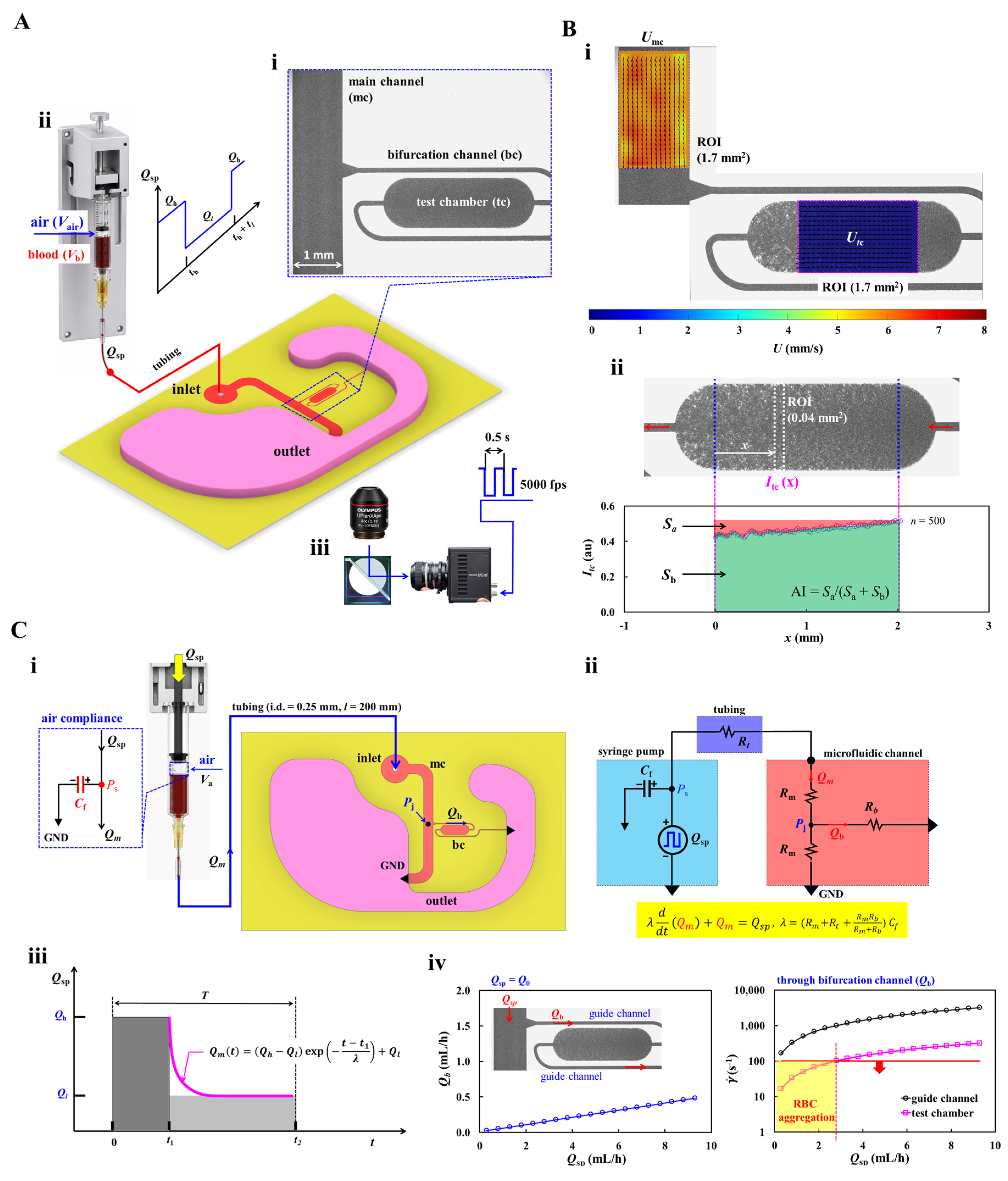
Figure 2.
Demonstration of the proposed method for detecting control and test bloods with viscosity-sensitive time constant and RBC aggregation index. Herein, hematocrit of both bloods (test blood, control blood) was adjusted to ϕvol = 0.5 by adding normal RBCs into dextran (Cdex = 2%) and 1× PBS, respectively. Syringe pump set to pulsatile blood flow (i.e., Qh = 6 mL/h for the first 2 min, Ql = 1 mL/h for the remaining 4 min). (A) Quantitative comparison of timelapse blood velocity and RBC aggregation index under pulsatile blood flow. (i) Temporal variations of blood velocity and RBC aggregation index for control blood. The left panel represented temporal variations of blood velocity (Umc, Utc) and Qsp. The middle panel depicted temporal variations of RBC aggregation index (AI) and Qsp. The right panel showed microscopic blood-flow images in test channel captured at t = 50 s and 290 s. (ii) Temporal variations of blood velocity, and RBC aggregation index for test blood. The left panel represented timelapse Umc, Utc, and Qsp. The middle panel depicted time-dependent AI and Qsp. The right panel showed microscopic blood-flow images in test channel captured at t = 50 s and 290 s. (B) Quantification of time constant and RBC aggregation over period. (i) Quantification of time constant using time-lapse Umc during two consecutive periods. The left panel showed timelapse Umc for transient blood flow, where the syringe pump was switched to Ql from Qh. Time-lapse Umc of each blood was best fitted with two exponential models as . The middle panel showed λ1 for two blood samples during the first period. The right panel exhibited λ1 for two blood samples during the second period. (ii) Quantification of AI for two blood samples during two consecutive periods. The left panel showed time-dependent AI for two blood samples. Herein, the mean AI (<AI>) was determined by averaging AI values within the plateau region observed at both Qh and Ql. The middle panel depicted <AI> for two blood samples under Qh and Ql during the first period. The right panel exhibited <AI> for both samples under Qh and Ql during the second period.
Figure 2.
Demonstration of the proposed method for detecting control and test bloods with viscosity-sensitive time constant and RBC aggregation index. Herein, hematocrit of both bloods (test blood, control blood) was adjusted to ϕvol = 0.5 by adding normal RBCs into dextran (Cdex = 2%) and 1× PBS, respectively. Syringe pump set to pulsatile blood flow (i.e., Qh = 6 mL/h for the first 2 min, Ql = 1 mL/h for the remaining 4 min). (A) Quantitative comparison of timelapse blood velocity and RBC aggregation index under pulsatile blood flow. (i) Temporal variations of blood velocity and RBC aggregation index for control blood. The left panel represented temporal variations of blood velocity (Umc, Utc) and Qsp. The middle panel depicted temporal variations of RBC aggregation index (AI) and Qsp. The right panel showed microscopic blood-flow images in test channel captured at t = 50 s and 290 s. (ii) Temporal variations of blood velocity, and RBC aggregation index for test blood. The left panel represented timelapse Umc, Utc, and Qsp. The middle panel depicted time-dependent AI and Qsp. The right panel showed microscopic blood-flow images in test channel captured at t = 50 s and 290 s. (B) Quantification of time constant and RBC aggregation over period. (i) Quantification of time constant using time-lapse Umc during two consecutive periods. The left panel showed timelapse Umc for transient blood flow, where the syringe pump was switched to Ql from Qh. Time-lapse Umc of each blood was best fitted with two exponential models as . The middle panel showed λ1 for two blood samples during the first period. The right panel exhibited λ1 for two blood samples during the second period. (ii) Quantification of AI for two blood samples during two consecutive periods. The left panel showed time-dependent AI for two blood samples. Herein, the mean AI (<AI>) was determined by averaging AI values within the plateau region observed at both Qh and Ql. The middle panel depicted <AI> for two blood samples under Qh and Ql during the first period. The right panel exhibited <AI> for both samples under Qh and Ql during the second period.
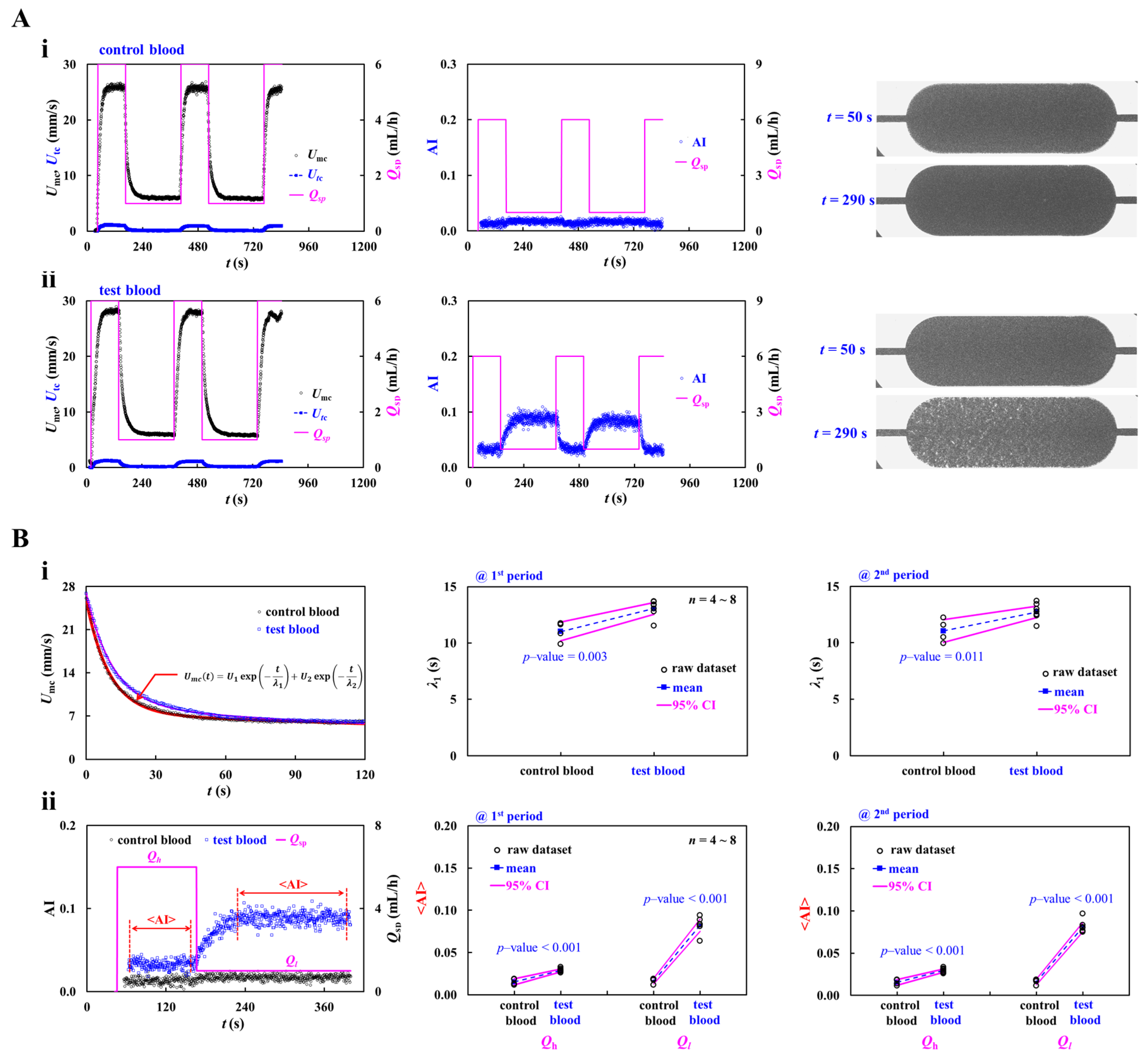
Figure 3.
Validation of correlation between blood viscosity and the time constant. (A) Quantification of time constant and blood viscosity. (i) Determination of time constant through transient blood flow analysis in the main channel (Qm). Herein, test blood (ϕvol = 0.5) was prepared by adding normal RBCs into dextran (Cdex = 2%). Syringe pump was abruptly stopped from the flow rates of Qsp = 2, 4, and 6 mL/h. The left panel exhibited time-dependent Qm with respect to plateau flow rates of Qsp = 2, 4, and 6 mL/h. The middle panel showed timelapse Qm at Qsp = 2 mL/h. The timelapse Qm was best described by ). The right panel showed variations of λ1 and Q0 with respect to plateau flow rates of Qsp. (ii) Blood viscosity measurement with coflowing method. The left panel showed experimental setup and microscopic image for measuring blood viscosity (μb). The middle panel showed time-dependent blood viscosity with respect to constant flow-rate of Qb. The right panel exhibited variation of μb and with respect to Qb. (B) Quantitative correlation between blood viscosity and time constant with respect to hematocrit (ϕvol). Hematocrit of test blood was adjusted to ϕvol = 0.3 ~ 0.6 by adding normal RBCs into dextran (Cdex = 2%). To probe time constant, blood flow was abruptly stopped from plateau value of Qb = 2 mL/h. (i) Variations of time constant (λ1) with respect to ϕvol. (ii) Variations of blood viscosity (μb) with respect to ϕvol. (iii) Linear correlation between λ1 and μb. (C) Quantitative correlation between blood viscosity and time constant with respect to dextran (Cdex). Test blood (ϕvol = 0.5) was prepared by adding normal RBCs into dextran (Cdex = 0.5 ~ 3%). (i) Variations of time constant (λ1) with respect to Cdex. (ii) Variations of blood viscosity (μb) with respect to Cdex. (iii) Linear correlation between λ1 and μb.
Figure 3.
Validation of correlation between blood viscosity and the time constant. (A) Quantification of time constant and blood viscosity. (i) Determination of time constant through transient blood flow analysis in the main channel (Qm). Herein, test blood (ϕvol = 0.5) was prepared by adding normal RBCs into dextran (Cdex = 2%). Syringe pump was abruptly stopped from the flow rates of Qsp = 2, 4, and 6 mL/h. The left panel exhibited time-dependent Qm with respect to plateau flow rates of Qsp = 2, 4, and 6 mL/h. The middle panel showed timelapse Qm at Qsp = 2 mL/h. The timelapse Qm was best described by ). The right panel showed variations of λ1 and Q0 with respect to plateau flow rates of Qsp. (ii) Blood viscosity measurement with coflowing method. The left panel showed experimental setup and microscopic image for measuring blood viscosity (μb). The middle panel showed time-dependent blood viscosity with respect to constant flow-rate of Qb. The right panel exhibited variation of μb and with respect to Qb. (B) Quantitative correlation between blood viscosity and time constant with respect to hematocrit (ϕvol). Hematocrit of test blood was adjusted to ϕvol = 0.3 ~ 0.6 by adding normal RBCs into dextran (Cdex = 2%). To probe time constant, blood flow was abruptly stopped from plateau value of Qb = 2 mL/h. (i) Variations of time constant (λ1) with respect to ϕvol. (ii) Variations of blood viscosity (μb) with respect to ϕvol. (iii) Linear correlation between λ1 and μb. (C) Quantitative correlation between blood viscosity and time constant with respect to dextran (Cdex). Test blood (ϕvol = 0.5) was prepared by adding normal RBCs into dextran (Cdex = 0.5 ~ 3%). (i) Variations of time constant (λ1) with respect to Cdex. (ii) Variations of blood viscosity (μb) with respect to Cdex. (iii) Linear correlation between λ1 and μb.
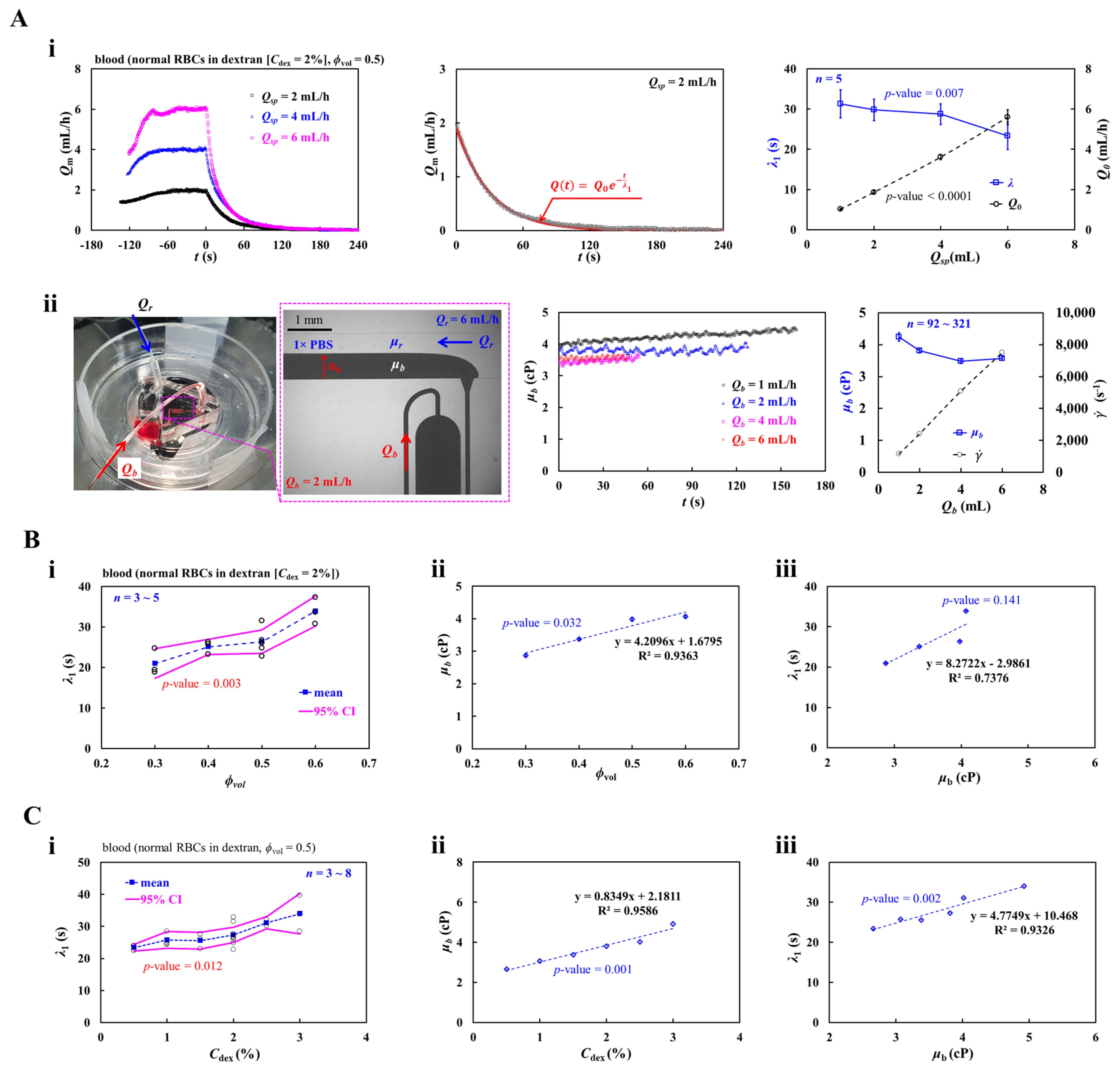
Figure 4.
Validation of the proposed RBC aggregation index against the previous methods. (A) Contribution of blood flow-rate (Qb) to three quantitative methods of RBC aggregation index. Herein, test blood (ϕvol = 0.5) was prepared by adding normal RBCs into dextran (Cdex = 2%). To investigate the effect of blood flow rate on RBC aggregation index, plateau flow rate (Qb) was varied over a range of Qb = 1 ~ 6 mL/h. (i) Quantification of RBC aggregation index (AIp1) at stasis. The left panel depicted time-resolved microscopic image captured at t = 200, 230, 260, 290, 320, and 360 s, where blood flow was suddenly stopped at 200 s from the plateau flow rate of Qon = 1 mL/h. The middle panel showed timelapse image intensity (I) with respect to plateau flow rate of Qon = 1~ 6 mL/h. The right panel showed variations of AIp1 with respect to Qon. (ii) Quantification of RBC aggregation index (AIp2) under continuous blood flow. The left panel showed microscopic image captured at t = 240 s, where blood flow rate was set to Qb = 1 mL/h. The red arrow (→) denoted blood flow direction. The second panel exhibited time-lapse Im, It, and AIp2 at Qb = 1 mL/h. The third panel showed time-lapse AIp2 with respect to Qb = 1, 2, 4, and 6 mL/h. The last panel depicted variations of AIp2 with respect to Qb. (iii) Quantification of RBC aggregation index (AI) obtained by the proposed method. The first panel showed blood image intensity (I) across the test chamber. The second panel showed time-lapse AI at Qb = 1 mL/h. The third panel depicted time-lapse AI with respect to Qb = 1, 2, 4, and 6 mL/h. The last panel showed variations of AI with respect to Qb. (B) Quantitative comparison of three RBC aggregation indices (i.e., AIp1, AIp2, and AI) with respect to hematocrit (ϕvol). Herein, hematocrit of test blood was adjusted to ϕvol = 0.3 ~ 0.6 by adding normal RBCs into dextran (Cdex = 2%). (i) Variation of AIp1 with respect to ϕvol. (ii) Variation of AIp2 with respect to ϕvol. (iii) Variation of AI with respect to ϕvol. The RBC aggregation indices showed a significant dependence on hematocrit (p-value < 0.001). (C) Quantitative comparison of three RBC aggregation indices (i.e., AIp1, AIp2, and AI) with respect to dextran concentration (Cdex). Herein, test blood (ϕvol = 0.5) was prepared by adding normal RBCs into each concentration of dextran. (i) Variation of AIp1 with respect to Cdex. (ii) Variation of AIp2 with respect to Cdex. (iii) Variation of AI with respect to Cdex. The RBC aggregation indices exhibited a statistically significant difference across dextran concentration (p-value < 0.001).
Figure 4.
Validation of the proposed RBC aggregation index against the previous methods. (A) Contribution of blood flow-rate (Qb) to three quantitative methods of RBC aggregation index. Herein, test blood (ϕvol = 0.5) was prepared by adding normal RBCs into dextran (Cdex = 2%). To investigate the effect of blood flow rate on RBC aggregation index, plateau flow rate (Qb) was varied over a range of Qb = 1 ~ 6 mL/h. (i) Quantification of RBC aggregation index (AIp1) at stasis. The left panel depicted time-resolved microscopic image captured at t = 200, 230, 260, 290, 320, and 360 s, where blood flow was suddenly stopped at 200 s from the plateau flow rate of Qon = 1 mL/h. The middle panel showed timelapse image intensity (I) with respect to plateau flow rate of Qon = 1~ 6 mL/h. The right panel showed variations of AIp1 with respect to Qon. (ii) Quantification of RBC aggregation index (AIp2) under continuous blood flow. The left panel showed microscopic image captured at t = 240 s, where blood flow rate was set to Qb = 1 mL/h. The red arrow (→) denoted blood flow direction. The second panel exhibited time-lapse Im, It, and AIp2 at Qb = 1 mL/h. The third panel showed time-lapse AIp2 with respect to Qb = 1, 2, 4, and 6 mL/h. The last panel depicted variations of AIp2 with respect to Qb. (iii) Quantification of RBC aggregation index (AI) obtained by the proposed method. The first panel showed blood image intensity (I) across the test chamber. The second panel showed time-lapse AI at Qb = 1 mL/h. The third panel depicted time-lapse AI with respect to Qb = 1, 2, 4, and 6 mL/h. The last panel showed variations of AI with respect to Qb. (B) Quantitative comparison of three RBC aggregation indices (i.e., AIp1, AIp2, and AI) with respect to hematocrit (ϕvol). Herein, hematocrit of test blood was adjusted to ϕvol = 0.3 ~ 0.6 by adding normal RBCs into dextran (Cdex = 2%). (i) Variation of AIp1 with respect to ϕvol. (ii) Variation of AIp2 with respect to ϕvol. (iii) Variation of AI with respect to ϕvol. The RBC aggregation indices showed a significant dependence on hematocrit (p-value < 0.001). (C) Quantitative comparison of three RBC aggregation indices (i.e., AIp1, AIp2, and AI) with respect to dextran concentration (Cdex). Herein, test blood (ϕvol = 0.5) was prepared by adding normal RBCs into each concentration of dextran. (i) Variation of AIp1 with respect to Cdex. (ii) Variation of AIp2 with respect to Cdex. (iii) Variation of AI with respect to Cdex. The RBC aggregation indices exhibited a statistically significant difference across dextran concentration (p-value < 0.001).
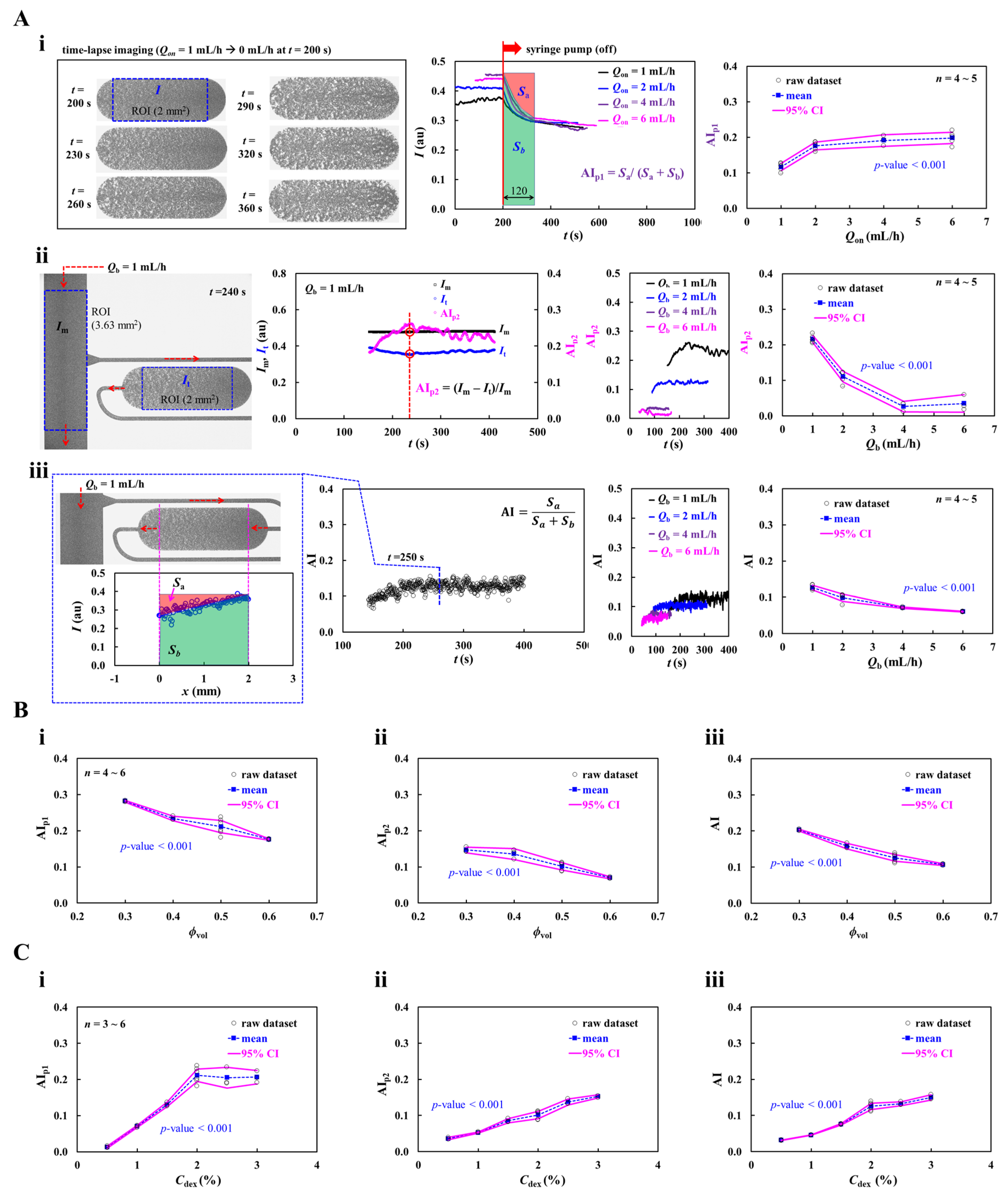
Figure 5.
Determination of pulsatile blood flow profiles for effective measurement of time constant and RBC aggregation. Herein, air cavity was adjusted to Vair = 0.1 mL inside the syringe. Test blood (ϕvol = 0.5) was prepared by adding normal RBCs into dextran (Cdex = 2%). The minimum flow rate was set to Ql = 1 mL/h. (A) Contribution of period (T) and maximum flow rate (Qh) to RBC aggregation index (AI) and time constant (λ1). Period of pulsatile blood flow was set to T = 120 ~ 480 s. (i) Time-course changes in Umc and AI with respect to T at Qh = 4 mL/h. (ii) Time-resolved Umc and AI as a function of T at Qh = 6 mL/h. (iii) Quantification of time constant (λ1) and AI with respect to T. The left panel showed variations of λ1 as functions of T under Qh = 4 mL/h. The middle panels exhibited variations of λ1 as functions of T at Qh = 6 mL/h. The right panel depicted variations of AI as a function of T at Qh = 4 and 6 mL/h. (B) Delivery duration determination of pulsatile blood flow-rate. Herein, maximum and minimum flow rates were fixed at Qh = 6 mL/h and Ql = 1 mL/h, respectively. (i) Effect of delivery duration at Qh on AI and time constant (λ1). The duration of Qh was set to th = 30, 60, 90, and 120 s. The left panel showed time-resolved Umc as a function of th, where tl denoted the duration at Ql. The middle panel depicted time-lapse AI with respect to thigh. The right panel exhibited variations of λ1 with respect to th. (ii) Variations of λ1 and AI at th = 60 s and tl = 300 s. The left panel showed time-resolved Umc and AI. The middle panel showed variations of λ1 during the first and second periods. The right panel showed variations of AI between the first and second periods. (iii) Variations of λ1 and AI at th = 120 s and tl = 240 s. The left panel showed time-lapse Umc and AI. The middle panel showed variations of λ1 during the first and second periods. The right panel showed variations of AI between the first and second periods.
Figure 5.
Determination of pulsatile blood flow profiles for effective measurement of time constant and RBC aggregation. Herein, air cavity was adjusted to Vair = 0.1 mL inside the syringe. Test blood (ϕvol = 0.5) was prepared by adding normal RBCs into dextran (Cdex = 2%). The minimum flow rate was set to Ql = 1 mL/h. (A) Contribution of period (T) and maximum flow rate (Qh) to RBC aggregation index (AI) and time constant (λ1). Period of pulsatile blood flow was set to T = 120 ~ 480 s. (i) Time-course changes in Umc and AI with respect to T at Qh = 4 mL/h. (ii) Time-resolved Umc and AI as a function of T at Qh = 6 mL/h. (iii) Quantification of time constant (λ1) and AI with respect to T. The left panel showed variations of λ1 as functions of T under Qh = 4 mL/h. The middle panels exhibited variations of λ1 as functions of T at Qh = 6 mL/h. The right panel depicted variations of AI as a function of T at Qh = 4 and 6 mL/h. (B) Delivery duration determination of pulsatile blood flow-rate. Herein, maximum and minimum flow rates were fixed at Qh = 6 mL/h and Ql = 1 mL/h, respectively. (i) Effect of delivery duration at Qh on AI and time constant (λ1). The duration of Qh was set to th = 30, 60, 90, and 120 s. The left panel showed time-resolved Umc as a function of th, where tl denoted the duration at Ql. The middle panel depicted time-lapse AI with respect to thigh. The right panel exhibited variations of λ1 with respect to th. (ii) Variations of λ1 and AI at th = 60 s and tl = 300 s. The left panel showed time-resolved Umc and AI. The middle panel showed variations of λ1 during the first and second periods. The right panel showed variations of AI between the first and second periods. (iii) Variations of λ1 and AI at th = 120 s and tl = 240 s. The left panel showed time-lapse Umc and AI. The middle panel showed variations of λ1 during the first and second periods. The right panel showed variations of AI between the first and second periods.
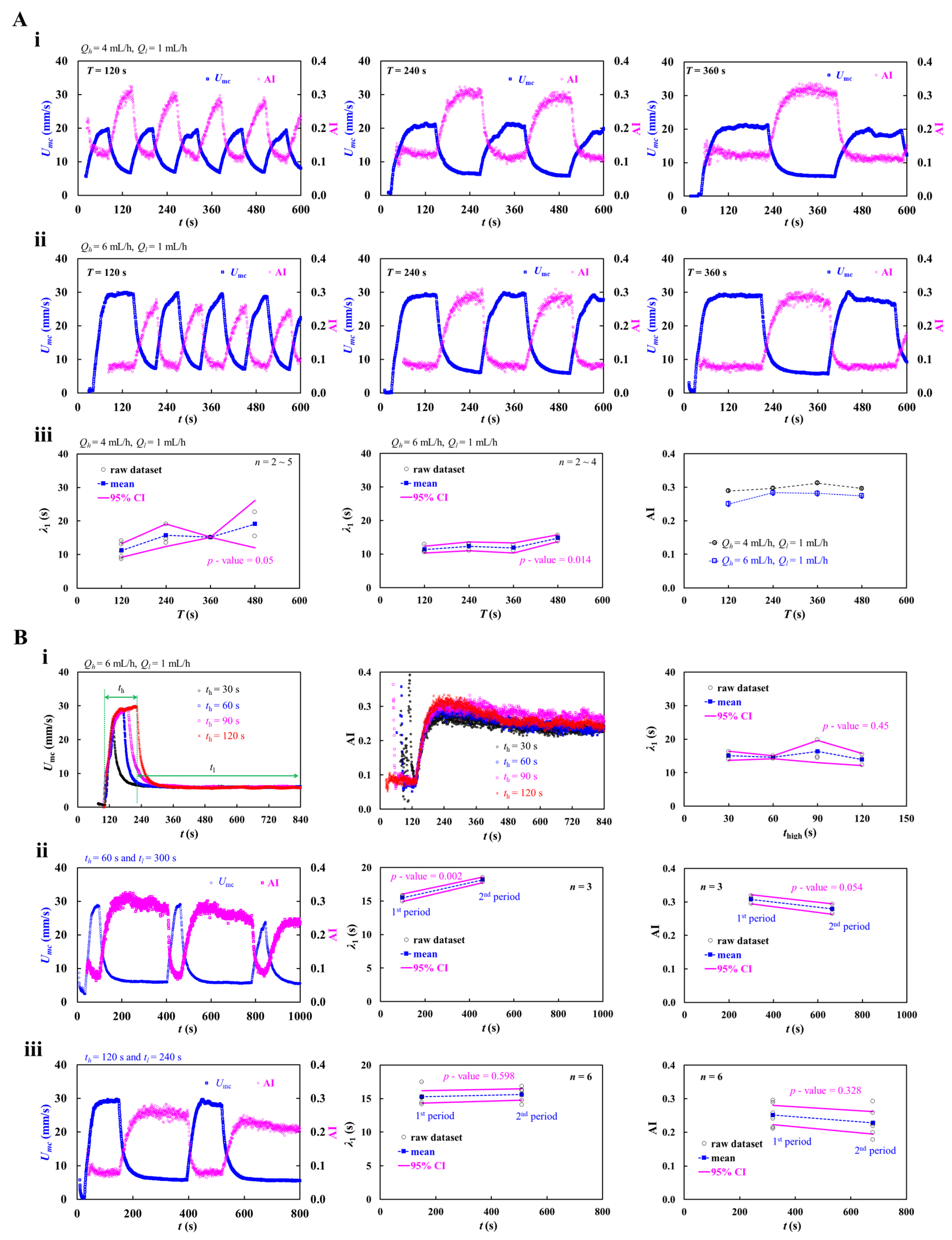
Figure 6.
Contribution of air cavity secured in syringe and flow rate to time constant and RBC aggregation index. (A) Effect of flow rate on time constant. Herein, test fluid as glycerin (30%) was abruptly stopped from plateau value of Qon = 1, 2, 4, and 6 mL/h. Air cavity above glycerin inside the syringe was set to Vair = 0.1 mL. The left panel showed time-course Umc with respect to Qon. The middle panel depicted time-resolved Umc during the transient interval. The right panel exhibited variations of λ1 with respect to Qon. (B) Variations of time constant as a function of glycerin concentration (Cgl) during the first and second periods. Glycerin solution was infused under the optimized flow profile. Air cavity above glycerin inside the syringe was set to Vair = 0.1 mL. The left panel showed time-resolved Umc as a function of Cgl = 10% ~ 50%. The middle panel exhibited variations of λ1-T1 and λ1-T2/λ1-T1 with respect to Cgl. The right panel depicted linear correlation between time constant (λ1-T1) and viscosity(μgl). (C) Contribution of air cavity (Vair) inside the syringe to time constant for glycerin and blood sample. Air cavity was set to Vair = 0 ~ 0.2 mL. (i) Variations of time constant for glycerin (Cgl = 30%) with respect to Vair. The left panel showed time-lapse Umc with respect to Vair. The middle panel exhibited variations of λ1-T1 with respect to Vair. The right panel variations of λ1-T2/λ1-T1 with respect to Vair. (ii) Variations of time constant for test blood (normal RBCs into 1× PBS, ϕvol = 0.5) with respect to Vair. The left panel showed time-lapse Umc with respect to Vair. The middle panel exhibited variations of λ1-T1 with respect to Vair. The right panel showed variations of λ1-T2/λ1-T1 with respect to Vair.
Figure 6.
Contribution of air cavity secured in syringe and flow rate to time constant and RBC aggregation index. (A) Effect of flow rate on time constant. Herein, test fluid as glycerin (30%) was abruptly stopped from plateau value of Qon = 1, 2, 4, and 6 mL/h. Air cavity above glycerin inside the syringe was set to Vair = 0.1 mL. The left panel showed time-course Umc with respect to Qon. The middle panel depicted time-resolved Umc during the transient interval. The right panel exhibited variations of λ1 with respect to Qon. (B) Variations of time constant as a function of glycerin concentration (Cgl) during the first and second periods. Glycerin solution was infused under the optimized flow profile. Air cavity above glycerin inside the syringe was set to Vair = 0.1 mL. The left panel showed time-resolved Umc as a function of Cgl = 10% ~ 50%. The middle panel exhibited variations of λ1-T1 and λ1-T2/λ1-T1 with respect to Cgl. The right panel depicted linear correlation between time constant (λ1-T1) and viscosity(μgl). (C) Contribution of air cavity (Vair) inside the syringe to time constant for glycerin and blood sample. Air cavity was set to Vair = 0 ~ 0.2 mL. (i) Variations of time constant for glycerin (Cgl = 30%) with respect to Vair. The left panel showed time-lapse Umc with respect to Vair. The middle panel exhibited variations of λ1-T1 with respect to Vair. The right panel variations of λ1-T2/λ1-T1 with respect to Vair. (ii) Variations of time constant for test blood (normal RBCs into 1× PBS, ϕvol = 0.5) with respect to Vair. The left panel showed time-lapse Umc with respect to Vair. The middle panel exhibited variations of λ1-T1 with respect to Vair. The right panel showed variations of λ1-T2/λ1-T1 with respect to Vair.
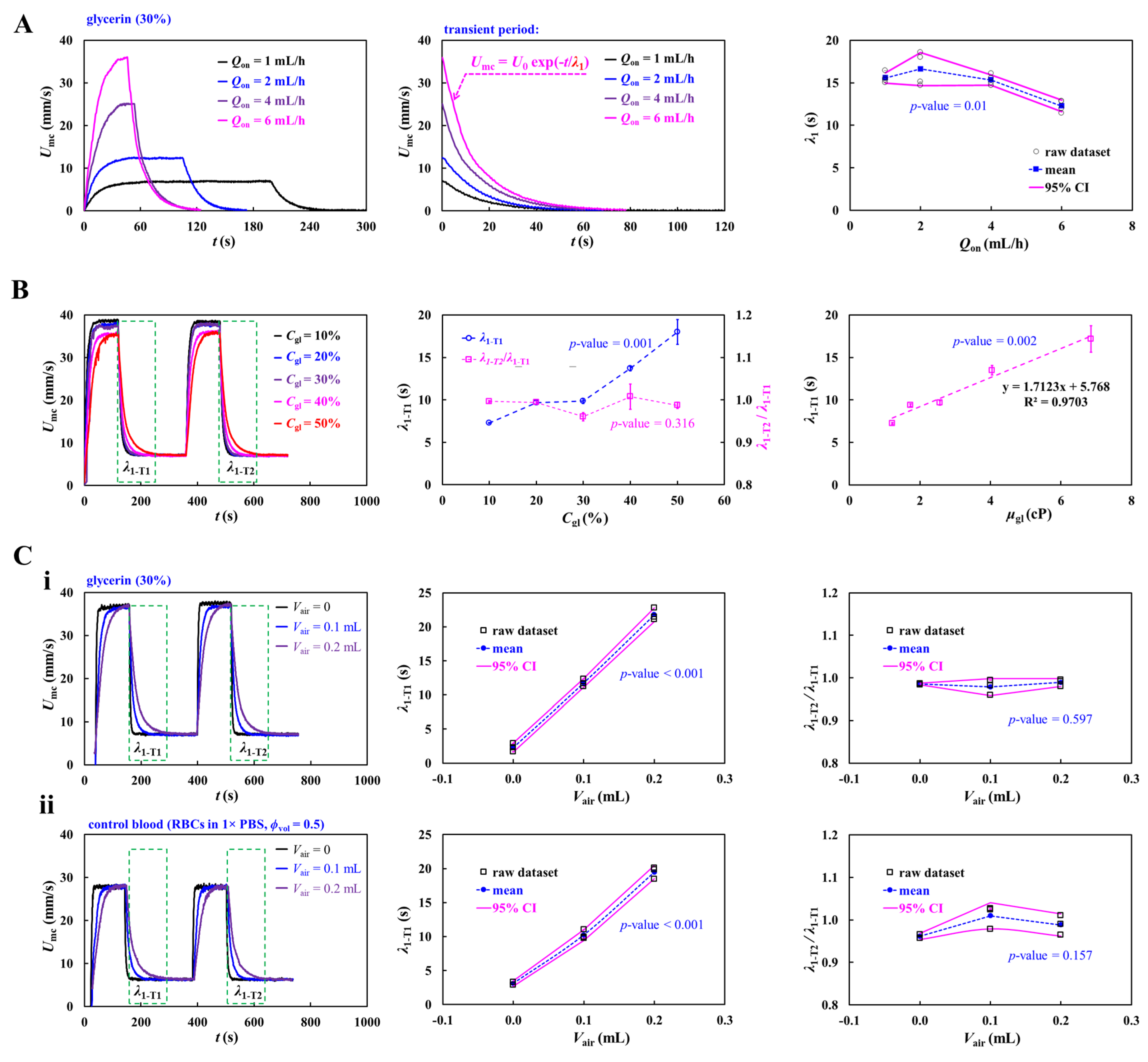
Figure 7.
Monitoring alternating blood properties during continuous infusion with a syringe pump. (A) Contribution of hematocrit to time constant and AI. Herein, hematocrit of test blood was adjusted to ϕvol = 0.2 ~ 0.6 by adding normal RBCs into dextran (Cdex = 1%). (i) Variations of time constant as a function of hematocrit during the first and second periods. The first panel showed time-lapse Umc as a function of hematocrit (ϕvol). The second panel depicted snapshots of the syringe captured at the completion of blood delivery. The third panel exhibited variations of λ1-T1 as a function of ϕvol. The last panel showed variations of λ1-T2/λ1-T1 with respect to ϕvol. (ii) Variations of RBC aggregation index as a function of hematocrit during the first and second periods. The left panel showed time-dependent AI as a function of ϕvol. The middle panel represented variations of AI1 with respect to ϕvol. The right panel depicted variations of AI2/AI1 as a function of ϕvol. (B) Contribution of dextran concentration to time constant and AI. Herein, test blood (ϕvol = 0.5) was prepared by adding normal RBCs into dextran solution (Cdex = 1% ~ 4%). (i) Variations of time constant as a function of dextran concentration during the first and second periods. The first panel showed time-lapse Umc as a function of dextran concentration (Cdex). The second panel depicted snapshots of the syringe captured at the completion of blood delivery. The third panel exhibited variations of λ1-T1 as a function of Cdex. The last panel showed variations of λ1-T2/λ1-T1 with respect to ϕvol. (ii) Variations of RBC aggregation index as a function of dextran concentration during the first and second periods. The left panel showed time-dependent AI as a function of Cdex. The middle panel represented variations of AI1 with respect to Cdex. The right panel depicted variations of AI2/AI1 as a function of Cdex.
Figure 7.
Monitoring alternating blood properties during continuous infusion with a syringe pump. (A) Contribution of hematocrit to time constant and AI. Herein, hematocrit of test blood was adjusted to ϕvol = 0.2 ~ 0.6 by adding normal RBCs into dextran (Cdex = 1%). (i) Variations of time constant as a function of hematocrit during the first and second periods. The first panel showed time-lapse Umc as a function of hematocrit (ϕvol). The second panel depicted snapshots of the syringe captured at the completion of blood delivery. The third panel exhibited variations of λ1-T1 as a function of ϕvol. The last panel showed variations of λ1-T2/λ1-T1 with respect to ϕvol. (ii) Variations of RBC aggregation index as a function of hematocrit during the first and second periods. The left panel showed time-dependent AI as a function of ϕvol. The middle panel represented variations of AI1 with respect to ϕvol. The right panel depicted variations of AI2/AI1 as a function of ϕvol. (B) Contribution of dextran concentration to time constant and AI. Herein, test blood (ϕvol = 0.5) was prepared by adding normal RBCs into dextran solution (Cdex = 1% ~ 4%). (i) Variations of time constant as a function of dextran concentration during the first and second periods. The first panel showed time-lapse Umc as a function of dextran concentration (Cdex). The second panel depicted snapshots of the syringe captured at the completion of blood delivery. The third panel exhibited variations of λ1-T1 as a function of Cdex. The last panel showed variations of λ1-T2/λ1-T1 with respect to ϕvol. (ii) Variations of RBC aggregation index as a function of dextran concentration during the first and second periods. The left panel showed time-dependent AI as a function of Cdex. The middle panel represented variations of AI1 with respect to Cdex. The right panel depicted variations of AI2/AI1 as a function of Cdex.
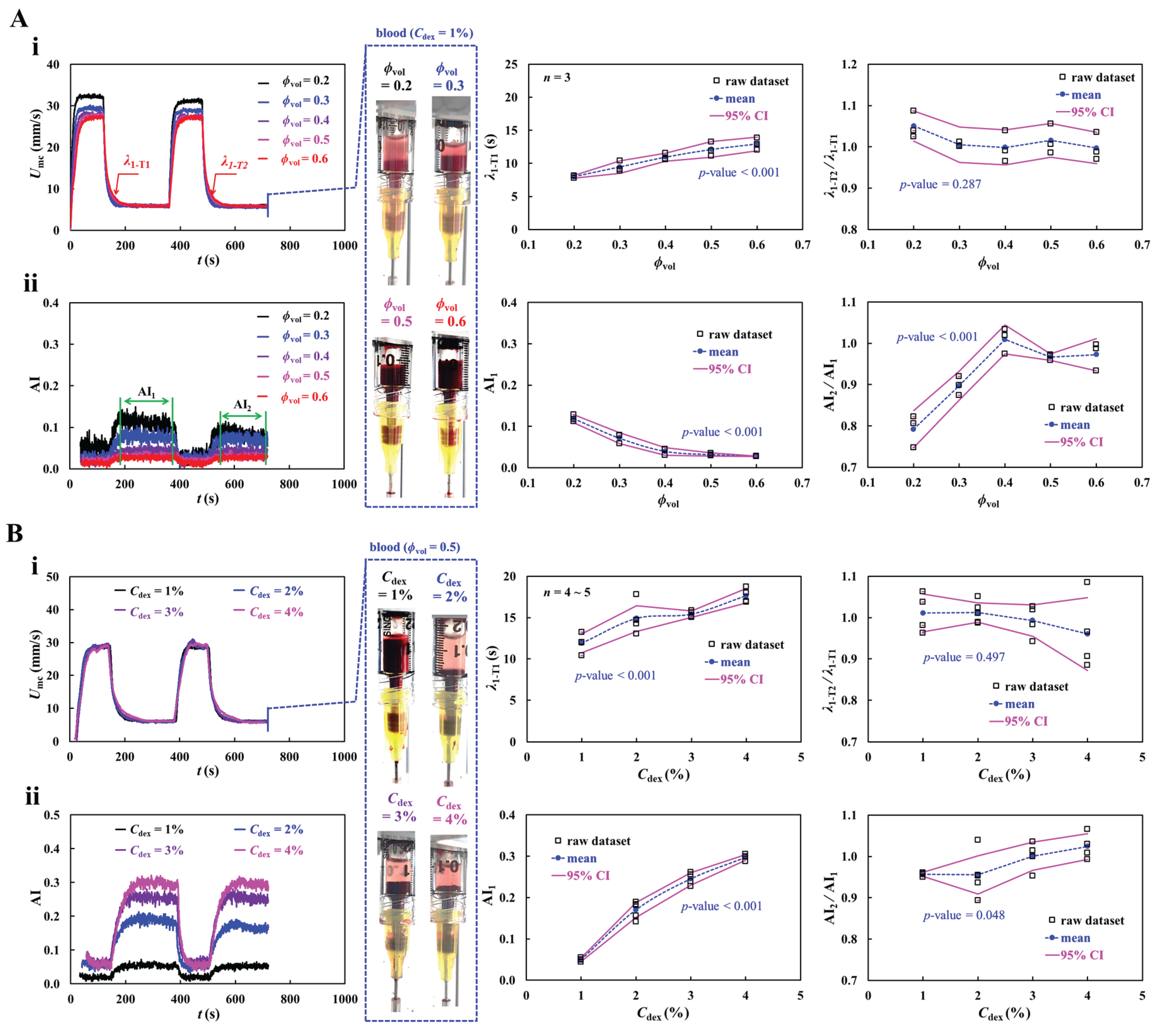
Disclaimer/Publisher’s Note: The statements, opinions and data contained in all publications are solely those of the individual author(s) and contributor(s) and not of MDPI and/or the editor(s). MDPI and/or the editor(s) disclaim responsibility for any injury to people or property resulting from any ideas, methods, instructions or products referred to in the content. |
© 2026 by the authors. Licensee MDPI, Basel, Switzerland. This article is an open access article distributed under the terms and conditions of the Creative Commons Attribution (CC BY) license (http://creativecommons.org/licenses/by/4.0/).
Copyright: This open access article is published under a Creative Commons CC BY 4.0 license, which permit the free download, distribution, and reuse, provided that the author and preprint are cited in any reuse.


