

Submitted:
07 June 2026
Posted:
09 June 2026
You are already at the latest version
Abstract
Background/Objectives: Registered nurse (RN) prescribing can improve timely access to care, but only when the education, authorization process, and workplace supports match the clinical responsibility being given to the nurse. This policy and practice analysis compares Alberta, Canada, with Aotearoa New Zealand, with particular attention to New Zealand registered nurse prescribers in primary health and specialty teams and to RN prescribing as a possible bridge to nurse practitioner (NP) readiness. Methods: We reviewed publicly available legislation, regulator standards, educational frameworks, professional guidance, and institutional information from Alberta/Canada and Aotearoa New Zealand. We also use the publicly described Cranston Ridge Medical Clinic RN Prescriber Internship as an illustrative family-medicine model. No patient, staff, trainee, or private programme data were collected. Results: Alberta permits eligible RNs, when authorized by the College of Registered Nurses of Alberta, to prescribe Schedule 1 drugs, except controlled drugs and substances, and to order common diagnostic tests within a specific practice setting and location. New Zealand uses a postgraduate, practicum-based designated-prescriber pathway for registered nurse prescribers in primary health and specialty teams, with ongoing requirements for prescribing-related professional development and prescribing practice. New Zealand also embeds registered nurse prescribing programme outcomes within NP education standards. Conclusions: Alberta appears to have an enabling legal architecture, but current implementation is site-specific and not formally linked to NP education. We propose a hybrid Alberta-New Zealand-CRMC model built around portable regulator-recognised RN-prescriber authorization, postgraduate prescribing sciences, supervised family-medicine entrustment, employer onboarding, and formal bridging into NP education. The model is presented for policy debate and future evaluation, not as an already tested outcome intervention.
Keywords:
registered nurse prescribing
; nurse practitioner education
; Alberta
; Aotearoa New Zealand
; primary care
; advanced practice nursing
; regulatory policy
; collaborative practice
; clinical practicum
; competency‐based education
1. Introduction
Access to primary care has become a practical pressure point for patients, clinics, and health systems. RN prescribing is one way to respond to that pressure while keeping professional accountability in view. In Alberta, registered nurses who meet CRNA requirements may be authorized to prescribe Schedule 1 drugs, except controlled drugs and substances, and order common diagnostic tests within a specific clinical practice setting [1]. That authority is grounded in Alberta’s Health Professions Restricted Activity Regulation, which allows prescribing by a regulated member on the registered nurse register when the member meets council-approved requirements and is authorized by the registrar [2]. CRNA standards describe RN prescribing as a means of improving access, efficiency, cost effectiveness, scope optimisation, and innovative models of care [3].
New Zealand has taken a different route. The Nursing Council of New Zealand describes registered nurse prescribers in primary health and specialty teams as nurses who use advanced knowledge and skills in collaborative teams, diagnose and treat common conditions within scope, and prescribe specified medicines as designated prescribers [4]. The role is not unrestricted independent practice: registered nurse prescribers must work in collaborative teams and must consult a doctor or mātanga tapuhi nurse practitioner when presentations are complex or outside scope [4]. Even so, the preparation is substantial. It is tied to postgraduate prescribing education, practicum, mentor assessment, and ongoing competence requirements [4,5].
This difference becomes especially important when the discussion turns to nurse practitioner education. In Canada, NPs are regulated provincially and territorially, while Canadian NP entry-level education and examination structures are being harmonised nationally through the Canadian Council of Registered Nurse Regulators (CCRNR) [9]. Alberta RN prescribing, however, remains a separate employer- and location-specific authorization rather than a portable step within NP preparation. New Zealand should be described carefully: separate RN-prescriber registration is not framed by the Nursing Council as a universal prerequisite for every NP candidate. What is directly relevant for Alberta is that New Zealand embeds registered nurse prescribing programme outcomes in mātanga tapuhi nurse practitioner master’s programme standards, and the postgraduate diploma may be credited toward the NP master’s programme [4]. That design creates a much clearer educational bridge than Alberta currently has.
The argument for a stronger bridge is both professional and practical. Reviews of nurse-led care and non-medical prescribing have generally found that nurse substitution or nurse prescribing can achieve patient outcomes and prescribing patterns comparable with physician-led care, although evidence varies by setting and study design [15,16,17]. The policy question, therefore, is not whether nurses can ever prescribe safely. It is how a jurisdiction should build the education, supervision, regulation, and continuing-competence structure that makes safe prescribing likely and makes the authority useful in real clinics.
The proposal in this article is not to transplant New Zealand’s system into Alberta wholesale. Alberta has its own legislation, regulator, employers, liability structures, diagnostic-access arrangements, and NP education pathways. A more realistic approach is a hybrid model that draws from three sources: the flexibility already present in Alberta’s legislation and CRNA standards; New Zealand’s postgraduate, practicum-based RN-prescriber pathway and its connection to NP education; and the structured family-medicine internship model publicly described by Cranston Ridge Medical Clinic (CRMC). The point is not to present one clinic as a complete answer or to report unpublished outcomes. The point is to make a regulatory and educational proposal concrete enough to be examined, challenged, improved, and eventually evaluated.
2. Materials and Methods
We used a targeted documentary policy-analysis design because the central questions are legal, regulatory, educational, and practical: what does each system authorize, how is prescribing competence built, and where do current arrangements help or hinder NP readiness? This was not a systematic review, scoping review, programme evaluation, survey, interview study, quality-improvement report, or patient-outcome study. The analysis relied on public legal, regulatory, educational, professional, and institutional documents accessed up to 5 June 2026. Alberta and Canadian sources included CRNA public guidance and standards for RN prescribing, Alberta’s Health Professions Restricted Activity Regulation, CCRNR NP materials, CASN accreditation and education-framework materials, CNA’s RN prescribing framework, and CNPS legal-risk guidance [1,2,3,4,5,6,7,8,9,10,11,12,13]. New Zealand sources included Nursing Council of New Zealand pages and notices on registered nurse prescribing and nurse practitioner scope, as well as Ministry of Health consultation materials on the designated registered nurse prescriber medicines list [4,5,6,7,8].
The CRMC RN Prescriber Internship was included as an illustrative practice model because its structure is publicly described and directly relevant to family-medicine RN prescribing in Alberta [14]. We did not collect, access, or analyse patient records, staff records, trainee performance records, interview data, survey responses, internal CRMC documents, unpublished clinical outcomes, or identifiable information. Accordingly, the article is framed as a legal, regulatory, educational, and practice-design analysis. The institutional review board/research ethics board implications are discussed in the back matter; authors should still confirm local policies and journal requirements before submission.
The analysis proceeded in four steps. First, we identified the legal basis and regulator-assigned responsibilities for RN and NP prescribing in Alberta and New Zealand. Second, we compared entry requirements, educational depth, practicum/mentorship expectations, authorization portability, and ongoing competence requirements. Third, we examined how each system does or does not connect RN prescribing with NP education and clinical readiness. Fourth, we synthesised a proposed hybrid model that could be discussed by Alberta regulators, NP educators, employers, prescribers, and government stakeholders without assuming that statutory change is the only possible route.
3. Results: Comparative Policy and Practice Findings
3.1. Alberta: Enabling Legislation with Site-Specific Implementation
Alberta’s regulatory architecture is more enabling than it may first appear. The Health Professions Restricted Activity Regulation provides that a regulated member on the registered nurse register may prescribe a Schedule 1 drug when the member meets council-approved requirements and has been authorized by the registrar [2]. This wording is important because it suggests that substantial design authority sits with the regulator rather than only with the legislature. In other words, some reforms to requirements, standards, assessment, documentation, or authorization processes may be capable of being pursued through CRNA policy and standards, although legal review would be required before assuming the exact limits of regulatory discretion.
Current implementation, however, is tightly bound to a specific practice setting and location. CRNA states that RN authorization to prescribe is for a specific practice setting and location; if the RN moves practice settings or locations, the authorization is no longer valid and the RN must reapply [1]. CRNA also requires an active permit and good standing, at least 3000 clinical practice hours as an RN, at least 750 practice hours in the practice setting/location where authorization is sought, completion of the Athabasca University RN prescribing course, and employer support, including employer policies, clinical support tools, and collaborative practice relationships [1]. The authorization process results in a prescriber ID and a practice permit that indicates the specific practice area [1].
This configuration is defensible from a public-protection perspective because it ties prescribing to local clinical support tools, employer readiness, and collaborative relationships. The trade-off is that prescriber competence becomes difficult to separate from site authorization. The Alberta RN prescriber may have developed advanced capability in one family-medicine environment, yet the authorization does not function like a portable professional condition that readily follows the nurse across comparable settings. This is a major difference from the New Zealand model discussed below.
3.2. New Zealand: Postgraduate Prescribing Preparation, Collaborative Practice, and Portability of Status
The focus of this article is the New Zealand category of registered nurse prescribers in primary health and specialty teams. Nursing Council materials state that these prescribers diagnose and treat common conditions within scope and prescribe specified medicines as designated prescribers [4]. They are required to work in collaborative teams, with access to a doctor or mātanga tapuhi nurse practitioner for complex or out-of-scope presentations [4]. The model therefore combines meaningful direct clinical function with a defined collaborative safety structure.
The required preparation is substantively different from a single short course. Registered nurses who wish to prescribe in primary health and specialty teams must have a minimum of three years of full-time practice in the area in which they intend to prescribe, complete a Council-approved postgraduate diploma in registered nurse prescribing for long-term and common conditions or equivalent, complete a practicum with an authorised prescriber, and receive a satisfactory competency assessment by an authorised prescriber [4,5]. Ministry of Health consultation materials specify that the course of study must include advanced assessment and diagnostic reasoning, pathophysiology, pharmacology science, and therapeutics [8].
Continuing competence is also explicit. The 2022 Nursing Council notice requires registered nurses who prescribe to undertake 60 hours of professional development every three years, of which 20 hours must be prescribing-related, and 40 days of prescribing practice per year; evidence of prescribing competence is provided every three years with the practising-certificate application [5]. This creates a portable prescriber status governed by education, practice, and recertification rather than by reauthorization from zero at each employer.
3.3. Nurse Practitioner Preparation and the “Bridge” Problem
The strongest New Zealand lesson for Alberta is not simply that RN prescribing exists. It is that RN prescribing can sit inside a broader advanced-practice learning pathway. The Nursing Council states that postgraduate diploma outcomes for registered nurse prescribing for long-term and common conditions are embedded in mātanga tapuhi nurse practitioner master’s programme standards and that the diploma may be credited to the NP master’s programme [4]. The Council’s NP notice describes NPs as registered nurses with advanced education, clinical training, demonstrated competence, and legal authority to practise beyond the RN level, including diagnosis, management of common and complex conditions, ordering and interpreting diagnostic and laboratory tests, and prescribing medicines within competence [7].
That connection narrows the gap between “learning to prescribe” and “learning to practise as an NP.” A registered nurse prescriber who later enters NP education is not simply observing prescribing decisions or waiting for a physician or NP preceptor to enter every order. Within the limits of the RN-prescriber authorization and the practicum arrangement, the learner can work through the clinical cycle: assessment, diagnosis, investigations, prescribing, safety-netting, follow-up, documentation, and reflection. This does not make the learner equivalent to an NP or physician. It does, however, create a form of graded responsibility that is closer to how other supervised clinicians develop in postgraduate practice.
Canada’s move toward a single entry-level national NP exam and education that prepares NPs across the lifespan and practice settings creates a timely opening for this discussion [9]. The question is whether RN prescribing should remain a separate, site-specific authorization or whether it could become part of a staged national/provincial advanced-practice pathway. Any such pathway would still have to respect provincial authority over regulated health professions, provincial drug and diagnostic-test rules, employer responsibilities, and local patient-safety requirements.

Table 1.
Comparative features of RN prescribing and NP linkage in Alberta and Aotearoa New Zealand.
| Feature | Alberta, Canada | Aotearoa New Zealand: RN prescribers in primary health and specialty teams | Policy implication |
|---|---|---|---|
| Legal/regulatory basis | HPRAR authorizes RN prescribing of Schedule 1 drugs where council-approved requirements and registrar authorization are met; CRNA standards operationalize requirements [1,2,3]. | Medicines Act/designated-prescriber framework and Nursing Council requirements authorize qualified RNs to prescribe specified medicines [4,5]. | Both systems are regulator-mediated; Alberta may have room for regulator-led refinement without assuming full statutory overhaul. |
| Scope of medicines/tests | Schedule 1 drugs except controlled drugs and substances, plus common diagnostic tests in the specific clinical practice setting [1]. | Specified medicines list for designated RN prescribers; current and proposed list changes are managed through Ministry/Gazette processes [4,8]. | Defined formularies and diagnostic limits can protect the public while enabling meaningful care. |
| Education | Completion of the Athabasca University RN prescribing course is required by CRNA [1]. | Council-approved postgraduate diploma or equivalent; study includes advanced assessment/diagnostic reasoning, pathophysiology, pharmacology science, and therapeutics [4,8]. | Educational depth is the largest design gap and the clearest target for reform. |
| Practicum/mentorship | 750 practice hours in the specific setting/location plus employer support, clinical support tools, and collaborative relationships [1]. | Practicum with an authorised prescriber, mentor assessment, and ongoing collaborative team role [4,5]. | Alberta has strong site-based practice requirements; New Zealand better connects practicum assessment with portable prescriber status. |
| Portability | Authorization is specific to practice setting/location and must be re-applied for when moving [1]. | Authorization is held as a Nursing Council-recognised prescribing status maintained through practice and CPD requirements [5]. | A portable authorization with employer-specific onboarding may be more efficient than full reauthorization. |
| NP education linkage | RN prescribing is not presented by CRNA as a formal prerequisite or credit-bearing bridge to NP education. | RN prescribing programme outcomes are embedded in NP master’s education standards and may be credited to NP master’s programmes [4]. | A bridge to NP education could increase practicum value and reduce preceptor burden. |
| Public protection | Local employer policies, clinical support tools, collaborative practice relationships, and CRNA standards [1,3]. | Postgraduate education, authorised-prescriber practicum, competency assessment, collaborative team, CPD, and prescribing-practice requirements [4,5]. | A hybrid model should combine Alberta’s local safety infrastructure with New Zealand’s education and continuing-competence structure. |
3.4. The CRMC RN Prescriber Internship as an Illustrative Alberta Practice Bridge
The CRMC internship is relevant because it addresses the gap that can remain after minimum authorization requirements are met. The public programme description states that the internship is designed for RNs who wish to become RN prescribers in family practice and to gain advanced nursing experience in that setting [14]. It is described as an 18-month, five-semester internship comprising 2940 hours, including an Athabasca University RN prescribing module, structured clinic-based practice, additional academic courses, portfolio expectations, clinical-support-tool proficiency, and objective structured clinical examination (OSCE) assessment [14]. The page also frames the internship as useful for RNs who may later apply to family/all-ages nurse practitioner programmes [14].
The model should not be presented as evidence of effectiveness, because this article reports no outcome evaluation. Its value here is more modest and more precise: it shows how an Alberta employer can build a family-medicine learning environment around RN prescribing, rather than assuming that course completion alone is enough preparation for primary-care practice. The internship also illustrates how local protocols, lab and radiology processes, clinical support tools, documentation standards, interprofessional consultation, and supervised patient exposure can be brought together in a coherent training sequence.
The limitation is that employer innovation alone cannot fully solve the policy problem. If authorization remains site-specific and disconnected from NP education, the most rigorous local internship still faces portability and recognition barriers. The policy opportunity is therefore to combine CRMC-like practice-based entrustment with New Zealand-like postgraduate prescribing education and a regulator-recognised portable authorization.
Figure 1.
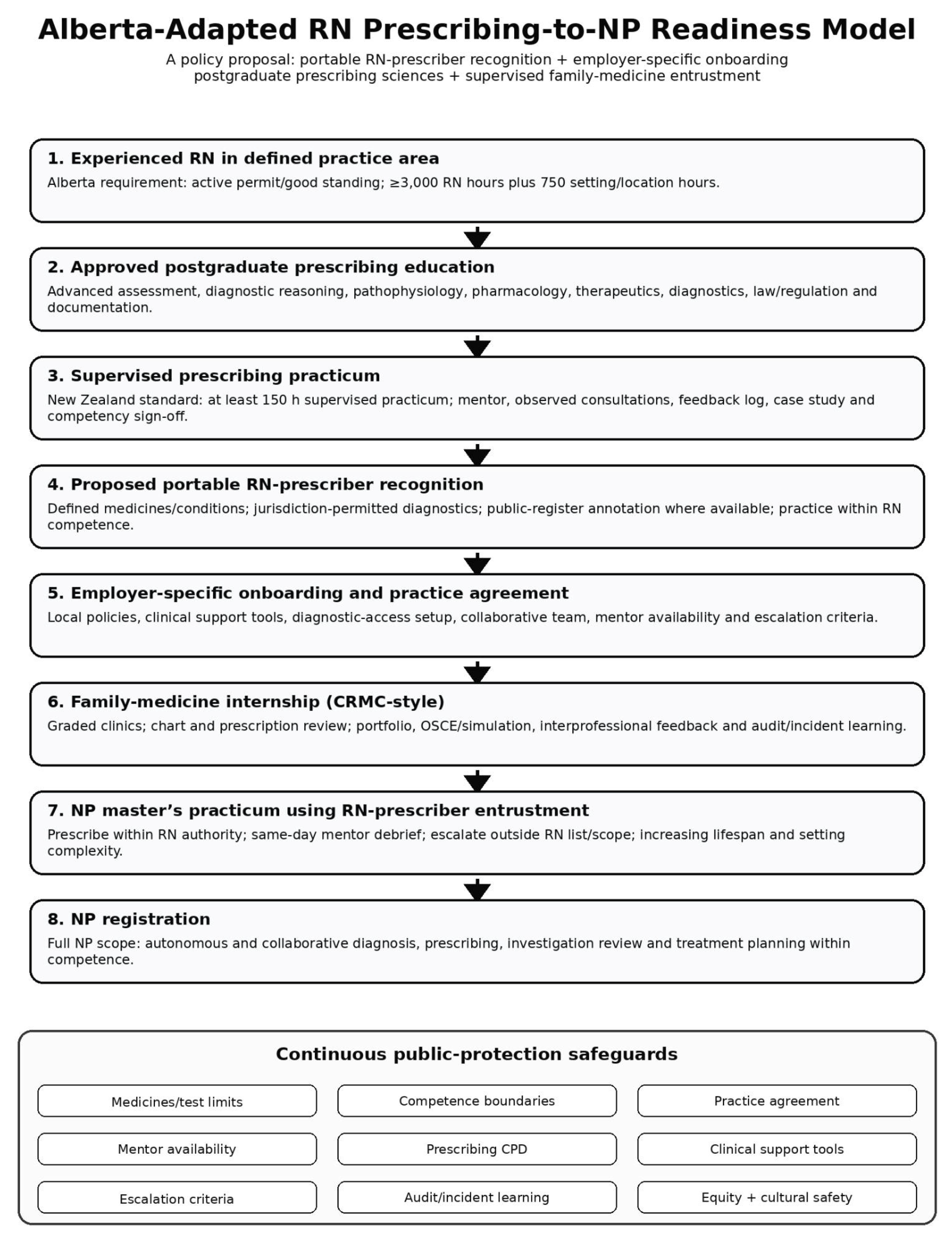
Proposed hybrid RN prescribing-to-NP readiness model. The model intentionally separates regulator-recognised prescriber status from employer-specific onboarding and clinical-support arrangements, while preserving public-protection safeguards throughout the pathway.
Figure 1.
Proposed hybrid RN prescribing-to-NP readiness model. The model intentionally separates regulator-recognised prescriber status from employer-specific onboarding and clinical-support arrangements, while preserving public-protection safeguards throughout the pathway.
4. Discussion
4.1. The Strategic Question: Is Legislative Change Always Necessary?
A central strategic issue is whether Alberta reform would require legislative amendment or whether some changes could be achieved through regulator-led standards, requirements, and authorization design. Alberta’s Health Professions Restricted Activity Regulation already states that RN prescribing is available when council-approved requirements are met and the registrar authorizes the regulated member [2]. CRNA’s requirements and standards are developed and approved under the Health Professions Act and operationalize RN prescribing in practice [3]. CNA’s national RN prescribing framework also supports broad enabling legislative and regulatory wording, with more specific requirements left to regulatory instruments [12]. Taken together, these sources support a cautious but important argument: more rigorous approved education, portfolio evidence, mentor-assessed competence, continuing competence, and criteria for practice-area portability could be discussed with the regulator before assuming that full legislative amendment is the only route.
That conclusion must be cautious. A move from location-specific authorization to portable authorization across employers may require interpretation of the regulation, CRNA bylaws, practice-permit processes, employer accountability, Alberta Health provider identifiers, laboratory/radiology access arrangements, pharmacy expectations, and liability structures. A model that permits NP students who are already RN prescribers to prescribe within their RN-prescriber authority during NP practicum may also raise questions about whether the learner is acting as an RN prescriber, as an NP student, or both. The article therefore frames reform as a staged policy proposal for legal, regulatory, and educational review rather than as a claim that the law already permits every element.
4.2. Educational Depth Should Match Clinical Responsibility
The most persuasive argument for change is educational coherence. Prescribing is not the mechanical act of choosing a medication. It depends on diagnostic reasoning, assessment, pathophysiology, pharmacology, therapeutics, medication reconciliation, interpretation of investigations, recognition of contraindications and red flags, follow-up planning, safety-netting, documentation, and consultation. CNPS legal guidance emphasises that RN prescribing is authorized within specific parameters and depends on regulatory standards, clinical support documents, professional judgment, medication reconciliation, consent, monitoring, follow-up, and careful documentation [13].
New Zealand’s requirements align closely with that responsibility because the postgraduate prescribing pathway includes advanced assessment and diagnostic reasoning, pathophysiology, pharmacology science, therapeutics, practicum, and mentor assessment [4,5,8]. Alberta’s current CRNA requirements include practice hours, a required course, employer support, clinical support tools, and collaborative relationships [1]. These requirements matter. The concern is that they may not be enough, on their own, to support RN prescribing as a serious bridge into NP readiness. A stronger Alberta model could keep CRNA’s local safety requirements while adding postgraduate prescribing sciences comparable with those expected in NP education.
4.3. Portability Should Not Mean Decontextualised Practice
Portability is sometimes misread as independence from local context. A safer interpretation is that prescriber status should follow the nurse, while each employer remains responsible for local onboarding, clinical support tools, diagnostic-access arrangements, formulary or medicines/conditions parameters, escalation pathways, and collaborative relationships. Under this model, the regulator would not need to reassess the nurse from the beginning every time the nurse moved to a comparable setting. Instead, the nurse would maintain a regulator-recognised condition or endorsement and submit employer-specific onboarding documentation before prescribing in the new environment. This approach is also consistent with CNA’s view that prescribing competencies should be transferable and portable across employers rather than tied to a single employer or another professional [12].
This distinction is important because Alberta’s current system protects the public through site specificity but may inadvertently discourage workforce mobility, limit NP-practicum flexibility, and reduce the incentive for nurses to invest in advanced prescribing preparation. New Zealand’s model suggests that portability and collaboration can coexist: the prescriber remains accountable to the Nursing Council, maintains continuing competence, and practises in a collaborative team [4,5].
4.4. Implications for NP Students and Preceptors
NP practicum is where regulatory design becomes an everyday workforce issue. When a learner can assess a patient but cannot complete the prescribing and diagnostic-management cycle within a supervised authorization, each patient encounter may require immediate preceptor intervention. In a busy primary-care clinic, that can make NP student supervision heavier than other supervised training models in which learners gradually manage patients with oversight. It may also discourage physicians and NPs from accepting NP students, even when they support the profession in principle.
A bridge model would not make NP students independent NPs. It would allow an RN who already holds RN-prescriber authorization to prescribe within that RN authority while enrolled in NP practicum, under an approved mentor and within clear escalation criteria. The learner would still be supervised. The difference is that the supervision could move toward case review, feedback, and progressive entrustment, rather than requiring the preceptor to duplicate every prescribing decision in real time. That distinction matters for confidence, preceptor workload, and clinical realism.
4.5. Safeguards for a Hybrid Model
A credible hybrid model must anticipate objections. The goal is not to dilute NP standards, create unsupervised mini-NP practice, or use RN prescribing to replace physicians or NPs. The goal is to create a structured intermediate step that protects patients and improves learner readiness. Safeguards should include an approved postgraduate curriculum; defined medicines and conditions; a supervised practicum; direct observation; prescribing logs; OSCEs or equivalent performance assessment; portfolio evidence; employer clinical support tools; mentor availability; mandatory consultation criteria; prescribing-related professional development; minimum prescribing practice; audit and incident learning; and explicit cultural-safety and equity expectations.
Systematic reviews of non-medical prescribing identify organisational support, clear governance, role clarity, confidence, access to clinical support, and continuing professional development as recurring determinants of implementation [21,22,23]. These findings support a model in which authorization alone is insufficient. Prescribing must be embedded in a service design that makes competent practice likely.
5. Proposed Alberta-New Zealand-CRMC Hybrid Model
The proposed model is deliberately staged. It combines New Zealand’s postgraduate prescribing foundation, Alberta’s regulated practice-setting supports, and CRMC’s family-medicine internship logic. It is offered as a working model for discussion by CRNA, NP programmes, CASN-accredited schools, employers, physicians, nurse practitioners, pharmacists, liability organisations, and government stakeholders.
Table 2.
Proposed hybrid model components and public-protection functions.
| Component | Core design feature | Public-protection function | Likely lead stakeholder(s) |
|---|---|---|---|
| 1. Entry criteria | Active RN registration; good standing; minimum practice hours; recent practice in intended area; employer or practicum-site readiness. | Ensures the learner has sufficient clinical foundation before prescribing preparation. | CRNA; employers; NP programmes. |
| 2. Postgraduate prescribing sciences | Approved courses in advanced assessment, diagnostic reasoning, pathophysiology, pharmacology science, therapeutics, diagnostics, law, ethics, documentation, and safety-netting. | Aligns prescribing authority with the knowledge required to diagnose, treat, monitor, and escalate safely. | CASN-accredited schools; CRNA; CCRNR partners. |
| 3. Supervised practicum | Mentored practicum with physician or NP; prescribing log; direct observation; case-based discussion; competency assessment. | Demonstrates applied prescribing competence, not only theoretical completion. | CRNA; authorised prescriber mentors; employers. |
| 4. Portable authorization | Regulator-recognised RN-prescriber endorsement valid within declared area/conditions/medicines, with employer-specific onboarding before use. | Separates prescriber competence from local protocols while preserving site safety. | CRNA; Alberta Health; employers; pharmacy/lab/radiology partners. |
| 5. Family-medicine internship | Structured graded exposure to family-medicine presentations, clinical support tools, interprofessional consultation, portfolio, and OSCE. | Builds practical confidence and reduces the gap between course completion and safe service delivery. | Employers such as CRMC; PCNs; physician and NP mentors. |
| 6. NP education bridge | RN-prescribing credits or equivalencies accepted into NP education where appropriate; RN prescribers in NP practicum prescribe within RN authority under mentor review. | Improves clinical practicum realism without granting premature NP independence. | NP programmes; CASN; CCRNR; CRNA. |
| 7. Maintenance and audit | Prescribing-related CPD; minimum prescribing practice; mentor/peer review; incident learning; periodic portfolio audit. | Maintains competence and provides early detection of practice drift or unsafe patterns. | CRNA; employers; liability/risk-management partners. |
5.1. Implementation Pathway
A feasible implementation pathway would begin with a regulator-facing discussion paper, not an immediate demand for legislative reform. The first step would be to ask CRNA for a formal interpretation of the current regulation and standards: what can be changed through standards, requirements, and authorization processes, and what would require amendment to legislation or regulation? The second step would be to convene an educator-regulator-employer working group to define a postgraduate RN-prescriber curriculum that could also be recognised within NP education. The third step would be to design a portable authorization pathway at the policy level, using only public documents and prospective administrative planning until formal evaluation is desired.
If outcomes evaluation is later pursued—for example, patient access, prescribing safety, antibiotic stewardship, preceptor workload, trainee confidence, or NP programme progression—it should be designed prospectively with appropriate research ethics board or quality-improvement review. The present article intentionally stops before that point. Its contribution is a policy model and a rationale for why such evaluation would be worth designing.
5.2. Policy Fit and Internal Coherence
The model holds together because each layer responds to a different weakness identified in the comparison. Alberta already has legal authority and CRNA standards, but the authorization is site-specific and not formally connected to NP education. New Zealand offers a postgraduate, practicum-based, continuing-competence model linked to NP programme outcomes, but its legislation and health-system context cannot simply be transplanted into Alberta. CRMC provides a concrete family-medicine training example, but a clinic-level internship cannot by itself create portable regulatory recognition. The hybrid model therefore gives each actor a distinct role: the regulator defines authorization and continuing competence; educators provide postgraduate prescribing sciences; employers provide local support tools and clinical governance; and mentors provide supervised entrustment.
This balance is what makes the proposal worth debating. It does not ask readers to accept that one jurisdiction is superior to the other, nor does it ask Alberta to abandon site-level safeguards. It instead asks whether those safeguards could be paired with a more portable and educationally meaningful prescriber status. That framing is more likely to engage regulators, educators, employers, physicians, NPs, and RN prescribers because it treats public protection and workforce development as connected goals rather than competing priorities.
6. Limitations
This article has several limitations. First, it is a targeted documentary policy analysis, not a systematic review, and it does not claim to exhaust all literature on RN prescribing, NP education, or non-medical prescribing internationally. Second, it is not legal advice. Statutory interpretation should be confirmed with CRNA, Alberta Health, legal counsel, and relevant educational and liability stakeholders. Third, New Zealand prescribing policy is evolving; Ministry of Health consultation processes may alter medicine lists and designated-prescriber parameters after the sources reviewed here. Fourth, the CRMC internship is included only as a publicly described practice model. This article reports no outcomes, trainee data, patient data, or internal programme evaluation. Fifth, Canada is not a single nursing-regulation jurisdiction; national bodies influence accreditation and harmonisation, but provincial and territorial regulators remain central to implementation.
7. Conclusions
Alberta and Aotearoa New Zealand both recognise forms of RN prescribing, but they organise education, authorization, portability, and NP linkage differently. Alberta’s current approach is legally enabled and supported by employer policies, clinical support tools, and collaborative relationships, but the authorization is tied to a specific setting and location. New Zealand’s registered nurse prescriber model for primary health and specialty teams is postgraduate, practicum-based, collaborative, and linked to NP education outcomes. That difference changes more than paperwork. It affects what a future NP student can practise, how preceptors experience supervision, and how ready the nurse may be for independent advanced practice after registration.
A hybrid Alberta-New Zealand-CRMC model could preserve Alberta’s public-protection strengths while adding a more rigorous and portable educational bridge. The central shift would be to treat RN prescribing not as a narrow site-specific add-on, but as a staged entrustment pathway: postgraduate prescribing sciences; supervised practicum; portable regulator recognition; local employer onboarding; family-medicine internship; and integration into NP education. Such a model would need regulator, educator, employer, physician, NP, pharmacy, legal, and patient-safety input. If developed carefully and evaluated appropriately, it could improve access to care, strengthen NP practicum learning, reduce preceptor burden, and produce more confident new nurse practitioners without weakening public protection.
Author Contributions
Conceptualization, D.K., T.K. and J.L.M.S.; methodology, D.K., T.K., M.M.A.P. and A.K.P.; investigation, D.K., T.K., A.K.P. and J.M.G.; writing—original draft preparation, D.K., T.K. and J.L.M.S.; writing—review and editing, D.K., T.K., J.L.M.S., M.M.A.P., A.K.P., J.M.G. and M.O.; visualization, D.K. and T.K.; supervision, J.M.G. and M.O.; project administration, D.K. All author-contribution statements should be confirmed by all authors before submission.
Funding
This research received no external funding.
Institutional Review Board Statement
Not applicable. This manuscript is a legal, regulatory, educational, and practice-policy analysis based on publicly available documents and a publicly available programme description. It did not involve human participants, patient data, staff interviews, surveys, trainee records, private documents, or identifiable information. Authors should confirm institutional and journal policies before submission.
Informed Consent Statement
Not applicable.
Data Availability Statement
No datasets were generated or analysed. All documents cited are publicly available from the sources listed in the references.
Acknowledgments
The authors acknowledge the registered nurses, nurse practitioners, physicians, educators, regulators, pharmacists, and primary care teams whose work continues to shape safe prescribing practice. This acknowledgement does not imply endorsement by any named regulator, professional association, educational institution, or government body.
Conflicts of Interest
Some authors are affiliated with Cranston Ridge Medical Clinic, which operates the RN Prescriber Internship described as an illustrative practice model in this manuscript. This affiliation is disclosed as a potential competing interest. The internship is discussed as a publicly available practice example and not as an evaluated commercial product or outcome intervention. The authors declare no other conflicts of interest. This statement should be reviewed and amended by all authors before submission.
References
- College of Registered Nurses of Alberta. RN Prescribing and Ordering Diagnostic Tests. Available online: https://www.nurses.ab.ca/nursing-in-alberta/application-support/rn-prescribing-and-ordering-diagnostic-tests/ (accessed on 5 June 2026).
- Government of Alberta. Health Professions Restricted Activity Regulation, Alta Reg 22/2023. Available online: https://www.canlii.org/en/ab/laws/regu/alta-reg-22-2023/latest/alta-reg-22-2023.html (accessed on 5 June 2026).
- College of Registered Nurses of Alberta. Registered Nurse Prescribing Schedule 1 Drugs and Ordering Diagnostic Tests: Requirements and Standards. Available online: https://nurses.ab.ca/protecting-the-public/standards-code-of-ethics/standards-for-rns-and-nps/registered-nurse-prescribing-schedule-1-drugs-and-ordering-diagnostic-tests-requirements-and-standards/ (accessed on 5 June 2026).
- Nursing Council of New Zealand. Registered Nurse Prescribing in Primary Health and Specialty Teams. Available online: https://nursingcouncil.org.nz/Public/NCNZ/nursing-section/Registered_nurse_prescribing_in_primary_health_and_specialty_teams.aspx (accessed on 5 June 2026).
- Nursing Council of New Zealand. Medicines (Designated Prescriber—Registered Nurses) Notice 2022. Available online: https://nursingcouncil.org.nz/Public/NCNZ/publications-section/Gazette_notices_folder/Medicines--Designated-Prescriber---Registered-Nurses--Notice-2022.aspx (accessed on 5 June 2026).
- Nursing Council of New Zealand. Registered Nurse Prescribing. Available online: https://nursingcouncil.org.nz/Public/NCNZ/nursing-section/Nurse_Prescribing.aspx (accessed on 5 June 2026).
- Nursing Council of New Zealand. Notice of Replacement and Revocation of Notice for Nurse Practitioners. Available online: https://nursingcouncil.org.nz/Public/NCNZ/publications-section/Gazette_notices_folder/Notice-of-Replacement-and-Revocation-of-Notice-for-Nurse-Practitioners.aspx (accessed on 5 June 2026).
- Ministry of Health—Manatū Hauora. Consultation on Amendments to the Specified Prescription Medicines List for Designated Registered Nurse Prescribers in Primary Health and Specialty Teams. Wellington: Ministry of Health, 2025. Available online: https://www.health.govt.nz/publications/consultation-amendments-specified-prescription-medicines-list-designated-registered-nurse-prescribers (accessed on 5 June 2026).
- Canadian Council of Registered Nurse Regulators. Nurse Practitioners. Available online: https://www.ccrnr.ca/nurse-practitioners (accessed on 5 June 2026).
- Canadian Association of Schools of Nursing. Accreditation—Introduction. Available online: https://www.casn.ca/accreditation/introduction (accessed on 5 June 2026).
- Canadian Association of Schools of Nursing. National Nursing Education Framework. Available online: https://www.casn.ca/eas/resources/national-education-framework (accessed on 5 June 2026).
- Canadian Nurses Association. Framework for Registered Nurse Prescribing in Canada. Ottawa: Canadian Nurses Association, 2015. Available online: https://www.cna-aiic.ca/en/nursing/regulated-nursing-in-canada/rn-prescribing-framework (accessed on 5 June 2026).
- Canadian Nurses Protective Society. InfoLAW: RN Prescribing. Available online: https://cnps.ca/article/rn-prescribing/ (accessed on 5 June 2026).
- Cranston Ridge Medical Clinic. RN Prescriber Internship. Available online: https://www.cranstonridgemedical.com/rninternship (accessed on 5 June 2026).
- Laurant, M.; van der Biezen, M.; Wijers, N.; Watananirun, K.; Kontopantelis, E.; van Vught, A.J.A.H. Nurses as substitutes for doctors in primary care. Cochrane Database Syst. Rev. 2018, 7, CD001271. [CrossRef]
- Gielen, S.C.; Dekker, J.; Francke, A.L.; Mistiaen, P.; Kroezen, M. The effects of nurse prescribing: A systematic review. Int. J. Nurs. Stud. 2014, 51, 1048–1061. [CrossRef]
- Bhanbhro, S.; Drennan, V.M.; Grant, R.; Harris, R. Assessing the contribution of prescribing in primary care by nurses and professionals allied to medicine: A systematic review of literature. BMC Health Serv. Res. 2011, 11, 330. [CrossRef]
- Raghunandan, R.; Tordoff, J.; Smith, A. Non-medical prescribing in New Zealand: An overview of prescribing rights, service delivery models and training. Ther. Adv. Drug Saf. 2017, 8, 349–360. [CrossRef]
- Poot, B.; Zonneveld, R.; Nelson, K.; Weatherall, M. Prescribing by nurse practitioners: Insights from a New Zealand study. J. Am. Assoc. Nurse Pract. 2017, 29, 581–590. [CrossRef]
- Elvidge, N.; Hobbs, M.; Fox, A.; Currie, J.; Williams, S.; Theobald, K.; Rolfe, M.; Marshall, C.; Phillips, J.L. Practice pathways, education, and regulation influencing nurse practitioners’ decision to provide primary care: A rapid scoping review. BMC Prim. Care 2024, 25, 182. [CrossRef]
- Graham-Clarke, E.; Rushton, A.; Noblet, T.; Marriott, J. Facilitators and barriers to non-medical prescribing: A systematic review and thematic synthesis. PLoS ONE 2018, 13, e0196471. [CrossRef]
- Edwards, J.; Coward, M.; Carey, N. Barriers and facilitators to implementation of non-medical independent prescribing in primary care in the UK: A qualitative systematic review. BMJ Open 2022, 12, e052227. [CrossRef]
- Xu, J.; Qi, L.; Mao, A. The barriers to nurses with prescriptive authority in exercising their prescriptive role: A systematic review and thematic synthesis of qualitative studies. Glob. Qual. Nurs. Res. 2025, 12, 23333936251356349. [CrossRef]
Disclaimer/Publisher’s Note: The statements, opinions and data contained in all publications are solely those of the individual author(s) and contributor(s) and not of MDPI and/or the editor(s). MDPI and/or the editor(s) disclaim responsibility for any injury to people or property resulting from any ideas, methods, instructions or products referred to in the content. |
© 2026 by the authors. Licensee MDPI, Basel, Switzerland. This article is an open access article distributed under the terms and conditions of the Creative Commons Attribution (CC BY) license (http://creativecommons.org/licenses/by/4.0/).
Copyright: This open access article is published under a Creative Commons CC BY 4.0 license, which permit the free download, distribution, and reuse, provided that the author and preprint are cited in any reuse.


