

Submitted:
07 June 2026
Posted:
09 June 2026
You are already at the latest version
Abstract
This paper presents Bit-Pi, a web-based asynchronous learning platform designed to support computer science students beyond the classroom at Paragon International University in Cambodia. Motivated by prior institutional findings that approximately 10% of first-year Computer Science students changed to other majors and that many faced challenges in mathematics, coding, peer pressure, and lack of external support and motivation, [2] the platform operationalizes recommendations from the “Computer Science Playbook” framework. [2] Bit-Pi integrates modular learning material authoring, block-level threaded discussion, search, notifications, and course management into a single institutionally hosted environment for mathematics and programming courses. The system was developed using Rapid Application Development and evaluated through user acceptance testing based on the Technology Acceptance Model (TAM) and basic technical performance tests. [5], [16], [17] Results from 96 students and 4 instructors indicate high perceived usefulness and ease of use, strong intention to continue using the platform, and acceptable performance under typical load. These findings show that a context-specific asynchronous platform can effectively complement existing tools and provide structured beyond-classroom support for computer science students.
Keywords:
asynchronous learning
; computer science education
; student retention
; threaded discussion
; user acceptance
; educational technology
1. Introduction
Computer science is recognized as a critical discipline in the 21st century, but programs frequently experience high attrition rates, particularly in the early years when students first encounter demanding mathematics and programming content.[1,3] Beyond academic difficulty, research has highlighted the role of affective and social factors such as low confidence, peer pressure, and limited access to support in shaping student decisions to persist or leave.[1,3]
At Paragon International University (ParagonIU) in Phnom Penh, Cambodia, internal analysis showed that about 10% of first-year Computer Science students changed to other majors.[2]. A subsequent institutional study, the “Computer Science Playbook,” identified four primary contributors to disengagement: difficulties in mathematics, difficulties in coding, peer pressure, and lack of external support and motivation.[2] The Playbook proposed a solution framework in which students receive coordinated support from three pillars: instructors, social support, and technology.[2]
While a variety of digital tools are already used at ParagonIU—including Google Classroom, Telegram, Discord, and external programming forums—these platforms do not fully meet the local need for contextual, organized, and course-specific academic support.[4,12,13,14,15] Students reported needing to ask questions about particular parts of learning materials, revisit explanations in context, and participate in clearly separated threads rather than long, mixed-topic conversation streams.[2] Instructors, meanwhile, sought mechanisms to reduce redundant questions and to make peer support more visible and reusable across cohorts.
To address these needs, we designed and deployed Bit-Pi, a web-based asynchronous learning platform tailored to the Computer Science department at ParagonIU. Bit-Pi targets mathematics and programming courses and allows instructors to create modular course materials while enabling students, teaching assistants, and instructors to engage in discussions attached to specific content blocks. The platform also provides course management, search, notifications, and institutional access control.
This paper makes three main contributions:
- It introduces a block-based, material-anchored threaded discussion model for computer science mathematics and programming courses, enabling contextual questions and answers at the level of specific content blocks rather than whole documents.
- It describes the design and institutional deployment of Bit-Pi, including its architecture and integration with existing university systems, as a concrete implementation of the Computer Science Playbook’s technology component.
The rest of this paper is organized as follows. Section II reviews related work. Section III describes the system design. Section IV presents the methodology. Section V reports the results. Section VI discusses implications and limitations. Section VII concludes.
2. Related Work
2.1. Retention and Support in Computer Science
Prior work on computer science retention has identified academic difficulty, particularly in introductory courses, as a core challenge.[1,3] At ParagonIU, the Computer Science Playbook study confirmed that students struggle with mathematics and programming and also reported strong effects of peer pressure and limited access to external support and motivation.[2] These findings are consistent with broader literature noting the interplay between content difficulty, affective factors, and access to help in determining persistence in computing programs.[1,3]
2.2. Technology Integration and Asynchronous Learning
Effective use of technology in education requires not only access but also thoughtful integration into teaching and learning processes.[4] Challenges include limited training, misalignment with pedagogy, and systems that are not designed for specific contexts.[4] In parallel, mobile and online learning research shows that flexible, anytime access to learning resources can enhance outcomes when integrated well with curricula.[5]
Asynchronous online discussions have been widely examined as a mechanism for student engagement and learning. Studies in programming courses, for example, have shown that participation in question-asking and answering in discussion forums can support understanding and problem-solving.[6] Other work emphasizes the importance of peer support systems, particularly in higher education computing contexts.[7] Research on threaded discussions has also examined how interface design and discussion structure affect student participation and perceived usefulness.[8,9]
2.3. Existing Platforms and Limitations
Existing platforms at ParagonIU and elsewhere provide partial support for these needs. Google Classroom offers a structured learning management environment for distributing materials and assignments, but it provides limited support for department-wide peer interaction and fine-grained discussion anchored to specific content segments.[12] Discord and Telegram support flexible synchronous and asynchronous communication and community building, but their message-centered designs tend to produce long, mixed-topic threads.[13] Stack Overflow provides extensive programming question-answer content but is not aligned with local curricula and institutional context.[14] Ed Discussion supports structured forum-based dialogue, yet remains external to the institution and is not tailored to the specific retention framework and local practices.[15]
Bit-Pi was conceived to address these gaps by combining a repository of course materials with block-level threaded discussion and institution-specific management and deployment.
3. System Design
3.1. Design Goals
The design of Bit-Pi was guided by three main goals drawn from the Computer Science Playbook and local needs analysis:[2]
- 1.
- Provide continuous, organized access to course materials so that students can study independently at their own pace.
- 2.
- Enable contextual and persistent discussion that accumulates explanations and keeps them attached to the exact parts of materials where students experience difficulty.
- 3.
- Lower barriers to help-seeking and peer support by enabling questions and responses from students, teaching assistants, and instructors in a shared environment.
3.2. Core Functionalities
Bit-Pi includes five key functional modules:
- Learning resource sharing: Instructors create and manage modular materials for each course using a block-based authoring format inspired by notebook environments.
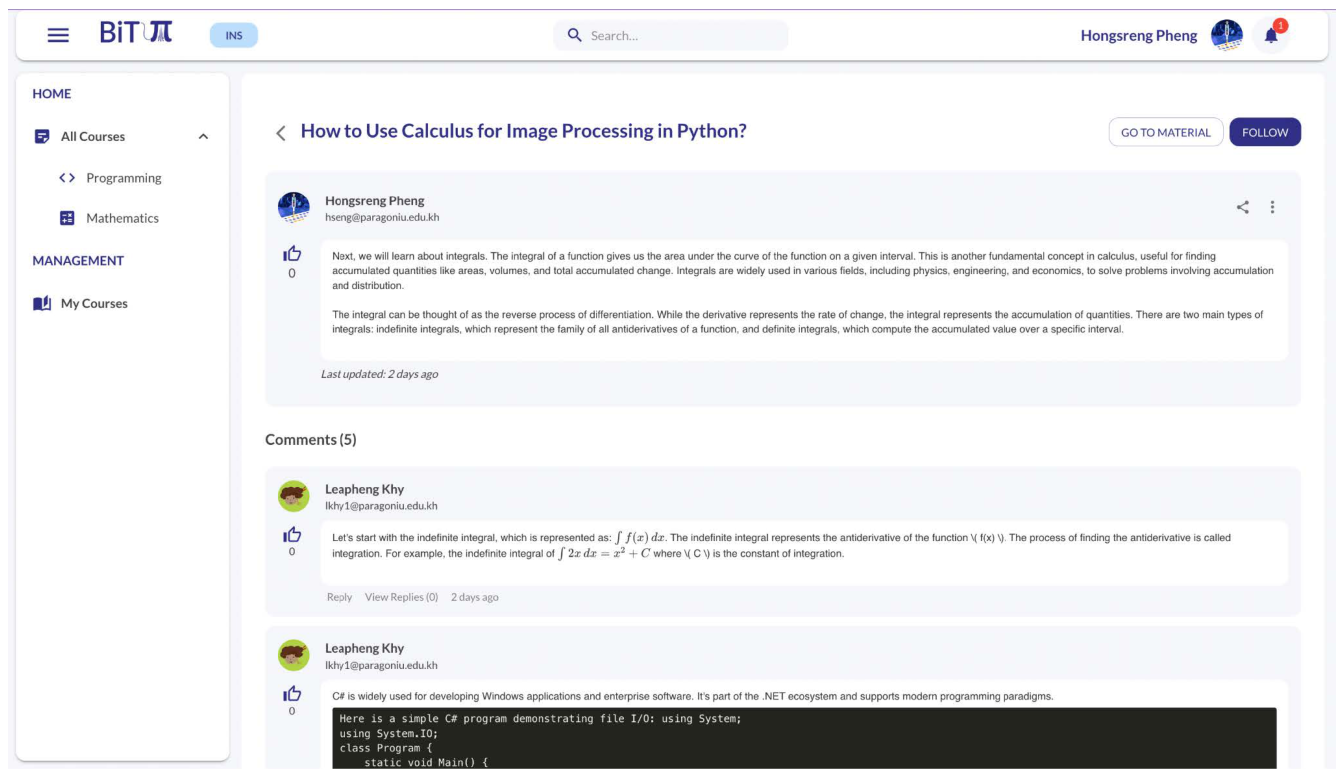
- Block-level threaded discussion: Users initiate and participate in discussions tied to specific blocks within a material, ensuring that questions and answers remain close to the relevant content.
- Search and discovery: A search function allows users to find materials and discussions based on keywords, supporting efficient retrieval of prior explanations and resources.
- Course and user management: Instructors manage course instances and teaching assistants; an administrative panel supports user, role, and permission management in alignment with university policies.
- Notifications and following: Users can follow courses or specific threads to receive notifications about new content and discussion activity.
The block-level discussion model is a particularly distinctive feature in comparison to typical LMS comment systems or general-purpose messaging applications.
3.3. Architecture and Deployment
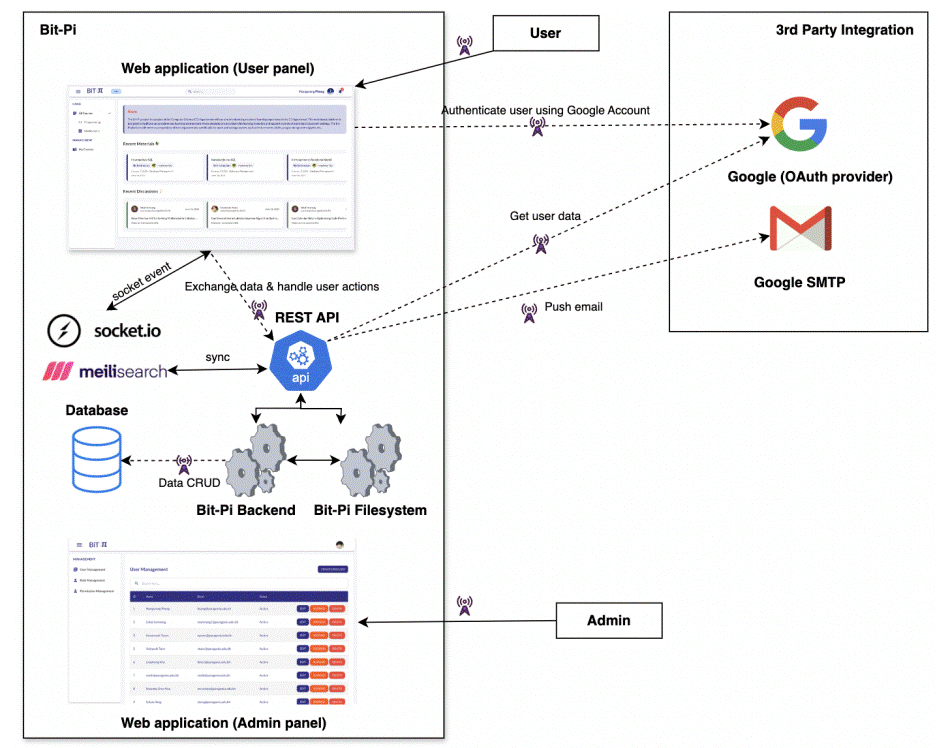
Bit-Pi is implemented as a web-based application with a Next.js (React) front end and a Laravel (PHP) back-end API using PostgreSQL for data storage. Key supporting technologies include Google OAuth for secure authentication with university Google accounts, Meilisearch as an open-source search engine for fast, typo-tolerant search, and Socket.io for real-time notifications.[10,11]
The system is deployed on ParagonIU’s on-premise cloud infrastructure, using a virtual machine proxied through Cloudflare for security and performance. This architecture enables institutional control over data, integration with existing accounts, and alignment with local IT policies.
Figure 1.
System architecture of the Bit-Pi platform, showing front-end, back-end services, database, and supporting components.
Figure 1.
System architecture of the Bit-Pi platform, showing front-end, back-end services, database, and supporting components.
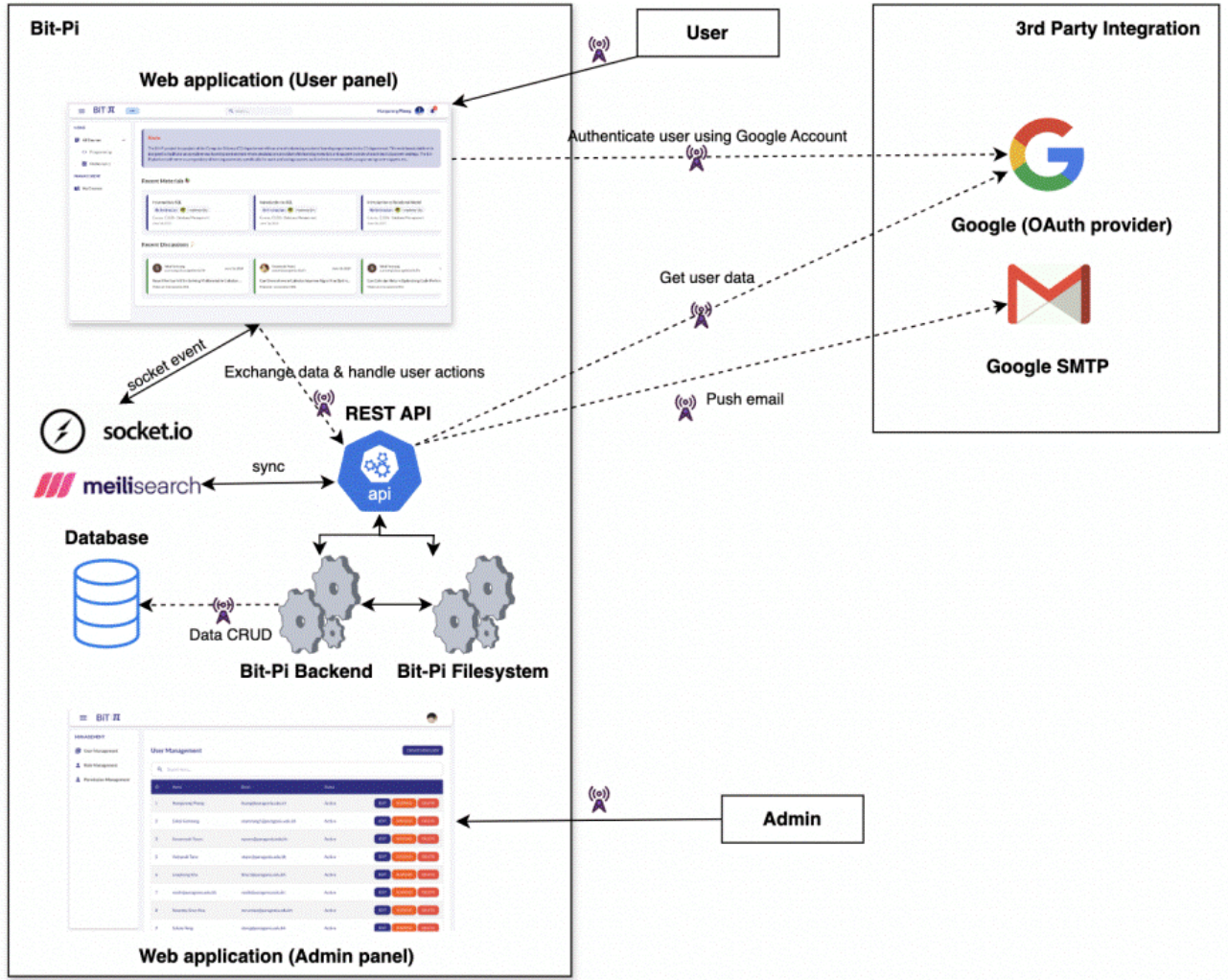
Figure 2.
Network model and deployment topology of Bit-Pi within the university infrastructure.
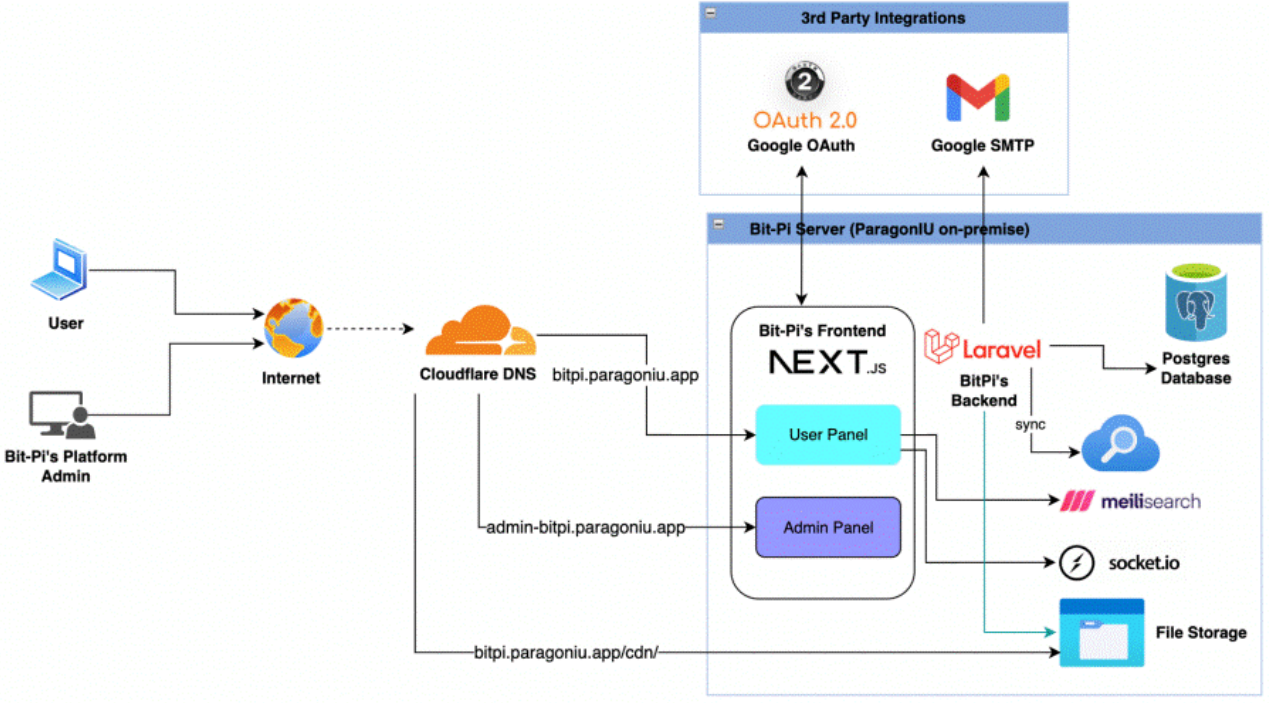
Figure 3.
Course view displaying available materials for a selected course.
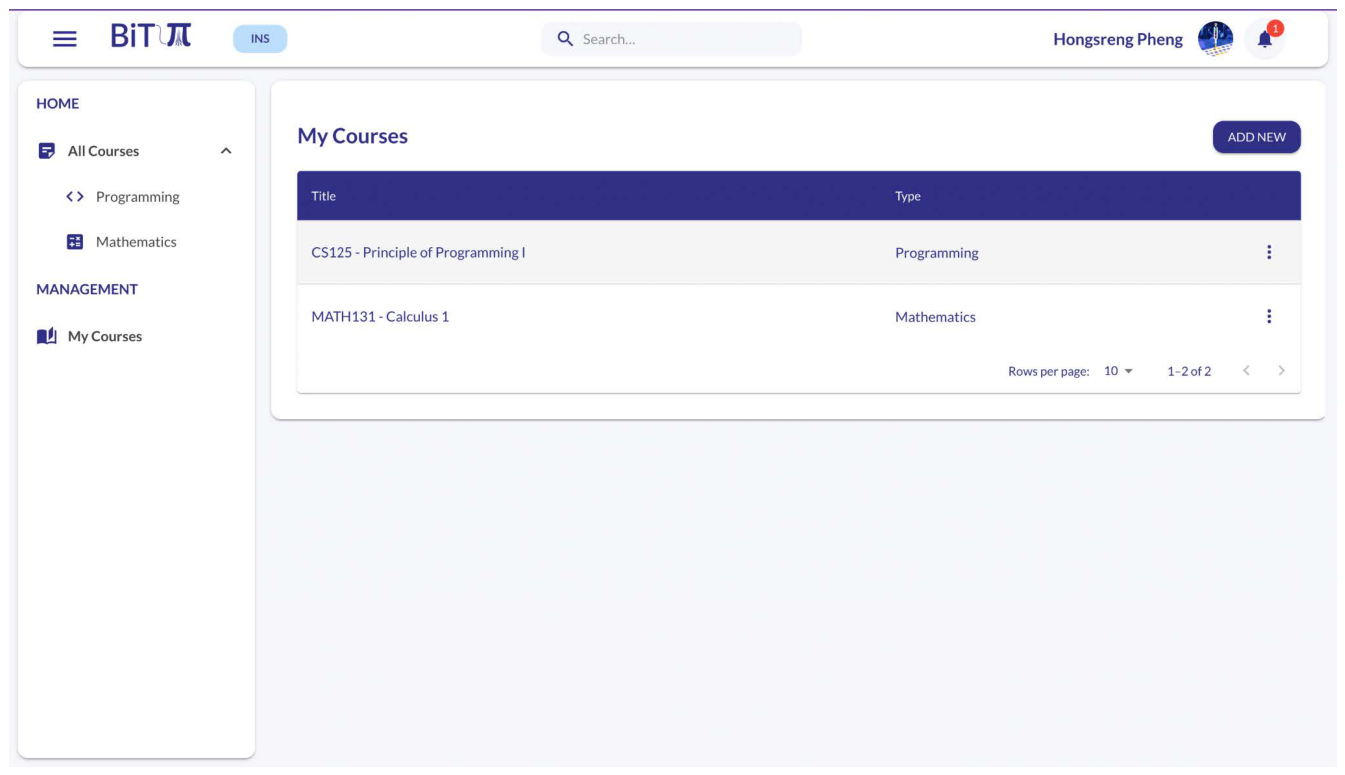
Figure 4.
Material view with segmented content blocks.
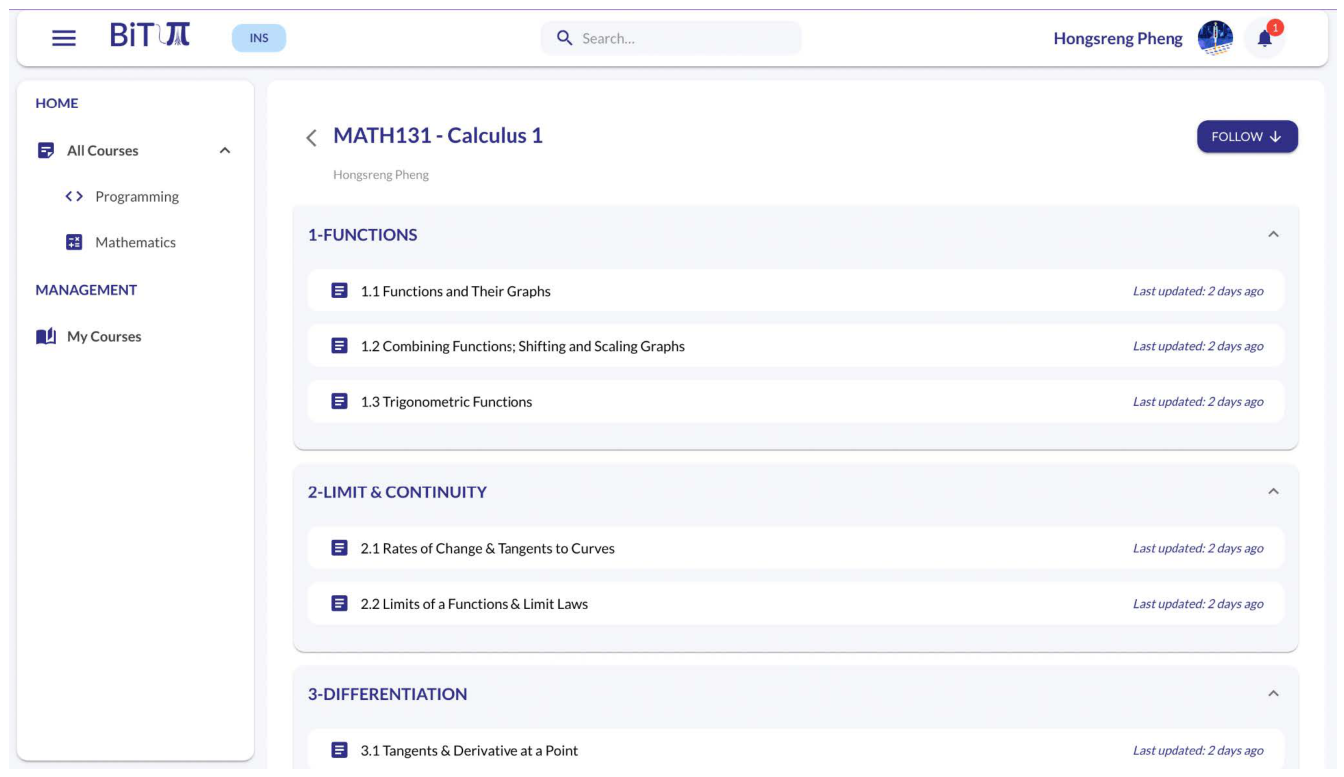
Figure 5.
Thread view with block-level comment discussion attached to a specific block.
4. Methodology
4.1. Development Process
The development followed the Rapid Application Development (RAD) model, emphasizing iterative design, prototyping, and refinement under time constraints.[16] The team first conducted an analysis and quick design phase informed by the Computer Science Playbook,[2] then implemented build cycles with stakeholder feedback, followed by testing and deployment.[16]
4.2. User Acceptance Framework
User acceptance was evaluated using the Technology Acceptance Model (TAM), which posits that perceived usefulness and perceived ease of use are key determinants of user adoption.[17] The survey instruments for both students and instructors were structured around TAM constructs such as perceived usefulness, perceived ease of use, enjoyment, output quality, self-efficacy, and intention to use.[17]
4.3. Context and Participants
The evaluation took place in the Computer Science department of ParagonIU. User acceptance testing involved 96 students from freshman to senior year and 4 instructors in mathematics and programming courses. All participants used the platform in the context of their regular courses and then completed the survey.
4.4. Instruments and Data Collection
Student and instructor surveys used five-point Likert scales from strongly disagree to strongly agree to rate statements about usefulness, usability, navigation, clarity, enjoyment, confidence, and intention to continue using the platform. Open-ended questions invited additional comments and suggestions for future improvements. The study also considered system testing results, including load and stress tests, from the project documentation to assess basic technical feasibility.[1]
4.5. Analysis
Survey results were summarized using descriptive statistics, including percentages of responses per category. Given the applied nature of the study and the institutional deployment context, the primary focus was on the overall acceptability of the platform and the distribution of positive versus negative responses. Technical performance data, including average response times under different load conditions, were interpreted in terms of whether the system could support expected departmental usage.[1]
5. Results
5.1. Student User Acceptance
The student user acceptance results were highly positive. For perceived usefulness, 94.7% of respondents indicated that the application was useful or very useful for their courses, and 93.7% reported that the threaded discussion feature was useful or very useful. For perceived ease of use, 90.6% reported that the application was easy or very easy to learn, and 92.7% felt they could use it without needing technical support.
These results suggest that Bit-Pi achieved both relevance and usability for students in mathematics and programming courses. High ratings across multiple TAM constructs, including navigation and clarity of instructions, further reinforce this interpretation.[2]
5.2. Instructor User Acceptance
Instructor responses were also positive, although the sample size was small. The survey indicated that 75% of instructors found the application useful or very useful for managing and delivering course materials, and all instructors agreed or strongly agreed that the platform enhanced teaching efficiency by reducing redundant questions. All instructors reported that the platform was easy to learn and use for course management, and all indicated that they would continue to use Bit-Pi for instructional purposes.
5.3. Intention to Use
Intention to use is a critical predictor of long-term adoption in TAM-based models.[17] The student survey showed that 67.7% of respondents would definitely continue using Bit-Pi and 27.1% would probably continue using it. This strong indication of continued use suggests that the platform is likely to be integrated into students’ regular study practices rather than remaining a short-term experiment.
5.4. Technical Performance
Technical tests reported in the project documentation evaluated the system under load and stress scenarios.[1] Under a load test with approximately 100 concurrent users, the average response time was about 5.1 s.[1] Under a stress test with 500 concurrent users, the average response time increased to around 25 s, but the system remained operational.[1]
These results indicate that Bit-Pi is technically feasible for departmental-level use on the current hardware configuration. However, further scaling, such as university-wide deployment or higher peak loads, would likely require additional computing resources or architectural optimization.[1]
6. Discussion
The evaluation indicates that Bit-Pi met its primary objectives as an asynchronous learning platform supporting mathematics and programming courses in ParagonIU’s Computer Science department. Students and instructors perceived the system as useful and easy to use, and students expressed strong intention to continue using it.
The block-level threaded discussion model appears particularly important. Students reported valuing the ability to attach questions to specific parts of course materials and to review past discussions and explanations in context.[2] This aligns with prior work on threaded discussions and contextual support, which indicates that well-structured, content-anchored discussions can enhance understanding and reduce redundant questions.[6,8,9]
The results also support the importance of peer support systems in computing education.[7] By providing a shared, persistent space for questions and answers, Bit-Pi allows explanations from peers, teaching assistants, and instructors to be reused by many students. This can reduce the burden on instructors and help address the challenge of limited external support identified in the Computer Science Playbook.[2,7]
From a systems perspective, the institutional deployment and performance results show that a context-specific platform can be both technically and organizationally feasible.[1] Compared with general-purpose tools such as Google Classroom, Discord, and external forums, Bit-Pi offers closer alignment with the local curriculum, access control, and retention-oriented design goals.[4,12,13,14,15]
However, the study has limitations. The evaluation focuses primarily on user acceptance and basic performance rather than direct measures of learning outcomes or retention over time. The instructor sample is small, limiting generalization of faculty perspectives. The research also takes place in a single institutional context, which may not generalize to all settings. Furthermore, the effectiveness of Bit-Pi depends on the quality and timeliness of contributions from instructors, teaching assistants, and students, as well as sustained moderation.[1]
Future work should therefore include longitudinal studies to investigate whether sustained use of Bit-Pi is associated with improved course performance, reduced dropout, or changes in help-seeking behavior. Additional features such as improved mobile support, bookmarking, gamification, and lightweight analytics may also be explored to enhance engagement and provide instructors with insights into student difficulties.[10,11]
7. Conclusion
This paper presented Bit-Pi, a web-based asynchronous learning platform designed to support computer science students beyond the classroom in a Cambodian university context. Grounded in the Computer Science Playbook framework, Bit-Pi integrates modular material authoring, block-level threaded discussion, search, notifications, and course management into a single institutionally hosted system targeting mathematics and programming courses.[2]
The evaluation with 96 students and 4 instructors showed high perceived usefulness and ease of use, strong intention to continue using the platform, and acceptable performance under typical load. These findings suggest that a context-specific asynchronous platform can complement existing tools and provide structured beyond-classroom support for computer science students. The work contributes a practical example of aligning educational technology design with local retention challenges and highlights directions for future research on long-term impact and feature extensions.
Author Contributions
Conceptualization: Hongsreng Pheng, Leapheng Khy, and Ratana Soth; Methodology: Leapheng Khy, and Ratana Soth; Software: Hongsreng Pheng and Leapheng Khy; Validation: Ratana Soth; Formal analysis: Hongsreng Pheng, and Ratana Soth; Investigation: Leapheng Khy; Resources: Ratana Soth; Data curation: Hongsreng Pheng and Leapheng Khy; Writing review and editing: Ratana Soth; Visualization, Hongsreng Pheng and Leapheng Khy; Supervision, Ratana Soth; Project administration, Ratana Soth.
Funding
This research received no external funding.
References
- Tech, W. “Why Do Students Drop Out of Computer Science Studies?,” Wawiwa Tech, 2020. Available online: https://wawiwa-tech.com/blog/why-do-students-drop-out-of-tech-studies/ (accessed on 30 July 2024).
- Chea, L.; Mom, S. Computer Science Playbook: Strengthening the CS experience and improving the retention rate at Paragon International University; Paragon International University, 2023. [Google Scholar]
- Barker, L. J.; McDowell, C.; Kalahar, K. Exploring factors that influence computer science introductory course students to persist in the major. ACM SIGCSE Bull. 2009, vol. 41(no. 1), 153–157. [Google Scholar] [CrossRef]
- Johnson, A. M.; Jacovina, M. E.; Russell, D. G.; Soto, C. M. Challenges and Solutions when Using Technologies in the Classroom. In Adaptive Educational Technologies for Literacy Instruction; Routledge: New York, NY, USA, 2016; pp. 13–30. [Google Scholar]
- El-Sofany, H. F.; El-Haggar, N. The Effectiveness of Using Mobile Learning Techniques to Improve Learning Outcomes in Higher Education. Int. J. Interact. Mob. Technol. 2020, vol. 14(no. 08), 4. [Google Scholar] [CrossRef]
- Vihavainen, A.; Luukkainen, M.; Kurhila, J. The use of anonymous online discussion forums in programming courses. 2014 47th Hawaii International Conference on System Sciences, 2014; pp. 128–136. [Google Scholar]
- Cheng, B. S. C. The Development of an Online Peer Support System for Higher Education. 2014 47th Hawaii International Conference on System Sciences, 2014. [Google Scholar]
- Cole, M. T.; Swartz, L. B.; Shelley, D. J. Threaded Discussion. Int. J. Inf. Commun. Technol. Educ. 2020, vol. 16(no. 1), 16–29. [Google Scholar] [CrossRef]
- Chen, L.-L. Designing Online Discussion for HyFlex Learning. Int. J. Educ. Methodol. 2022, vol. 8(no. 1), 191–198. [Google Scholar] [CrossRef]
- Chang, X. The Analysis of Open Source Search Engines. M.S. thesis, Univ. of Toronto, Toronto, Canada.
- Karwa, R. S. Finding Trending Topics and Sentiment Trends from Live Twitter Stream. unpublished.
- Google, “Google Classroom.”. Available online: https://sites.google.com/view/classroom-workspace/ (accessed on 30 July 2024).
- Discord, “About Discord.”. Available online: https://discord.com/company (accessed on 30 July 2024).
- Stack Overflow, “Tour.”. Available online: https://stackoverflow.com/tour (accessed on 30 July 2024).
- Helpdesk, “Ed Discussion for Students.”. Available online: https://sas-lps.freshdesk.com/support/solutions/articles/42000087902-ed-discussion-for-students (accessed on 30 July 2024).
- Ahmed, S. S. S. A Comparative Study of Different Software Development Life Cycle Models. Int. J. Comput. Appl. 2020, vol. 177(no. 7), 13–18. [Google Scholar]
- eBusiness@Newcastle, “Technology Acceptance Model – Theory Hub.”. Available online: https://open.ncl.ac.uk/theories/1/technology-acceptance-model/ (accessed on 30 July 2024).
Disclaimer/Publisher’s Note: The statements, opinions and data contained in all publications are solely those of the individual author(s) and contributor(s) and not of MDPI and/or the editor(s). MDPI and/or the editor(s) disclaim responsibility for any injury to people or property resulting from any ideas, methods, instructions or products referred to in the content. |
© 2026 by the authors. Licensee MDPI, Basel, Switzerland. This article is an open access article distributed under the terms and conditions of the Creative Commons Attribution (CC BY) license (http://creativecommons.org/licenses/by/4.0/).
Copyright: This open access article is published under a Creative Commons CC BY 4.0 license, which permit the free download, distribution, and reuse, provided that the author and preprint are cited in any reuse.