
Submitted:
08 June 2026
Posted:
09 June 2026
You are already at the latest version
Abstract
Background/Objectives: Gastric precancerous conditions and early gastric cancer rep-resent a heterogeneous disease spectrum with variable malignant potential and complex management pathways. Despite well-established international guidelines, discrepancies remain between recommended strategies and routine clinical practice, particularly regarding endoscopic diagnosis, risk stratification, therapeutic selection, and follow-up. This review aims to synthesize current evidence and provide practice-oriented, question-based guidance for the management of gastric precancerous lesions and early gastric cancer. Methods: A comprehensive review of the literature was conducted using PubMed and Google Scholar, focusing on endoscopic diagnosis, histological risk assessment, thera-peutic options, and surveillance strategies for gastric precancerous lesions and early gastric cancer. Key areas of clinical uncertainty and controversy were identified and translated into focused, practice-oriented clinical questions designed to reflect and possibly help to improve real-world gastroenterological practice. Results: Clinical questions were formulated to cover the entire management pathway, from endoscopic detection and characterization to therapeutic decision-making and post-treatment surveillance. Topics include high-quality endoscopic diagnosis, biopsy strategies, histological staging system, selection between endoscopic and surgical therapy, and follow-up according to individual risk profile. For each question, current evidence is summarized into concise, actionable recommendations. Conclusions: Management of gastric precancerous lesions and early gastric cancer requires a structured and individualized approach integrating high-quality endoscopy, accurate histological risk stratification, and evidence-based therapeutic and surveillance strategies. Organizing available evidence into practice-oriented clinical questions may help harmonize clinical practice, reduce unwarranted variability, and support gastroenterologists in delivering optimal patient-centered care.
Keywords:
gastric precancerous conditions
; gastric precancerous lesions
; early gastric cancer
; endoscopic mucosal resection
; endoscopic submucosal dissection
; optical diagnosis
; gastroscopy
1. Introduction
Gastric cancer remains one of the most lethal malignancies worldwide despite a global decline in incidence attributable to Helicobacter pylori eradication and improved surveillance. The transition from healthy mucosa to invasive carcinoma is not abrupt but follows a well-characterized multistep progression, the Correa cascade: chronic active gastritis, chronic atrophic gastritis (CAG), intestinal metaplasia (IM), dysplasia, and ultimately invasive adenocarcinoma. Each step represents both a clinically relevant disease stage and a potential window for intervention. Despite internationally endorsed guidelines, considerable heterogeneity persists in daily practice — in the quality of endoscopic examinations, the use of standardized biopsy protocols, the application of risk-staging systems such as OLGA and OLGIM, and the selection of therapy for early neoplastic lesions. This gap translates into delayed diagnoses, missed opportunities for organ-preserving treatment, and sometimes inappropriate escalation to surgery for lesions amenable to endoscopic cure.
Early gastric cancer (EGC) — a neoplasm confined to the mucosa or submucosa irrespective of lymph node status — is increasingly amenable to curative endoscopic resection when detected early. Endoscopic submucosal dissection (ESD) is the gold standard for en bloc, histologically complete resection, enabling accurate staging and reducing the need for radical gastrectomy. However, cure requires not only technical skill but a structured pathway of high-quality detection, reliable optical characterization, risk stratification, and well-defined post-resection surveillance. To address these challenges, we synthesize current evidence into a practical, question-based framework. By translating key controversies into focused, practice-oriented questions, this review aims to bridge guideline recommendations and daily reality, providing actionable guidance across the full spectrum of gastric precancerous conditions and early gastric cancer.
2. Materials and Methods
We conducted a comprehensive review based on an independent literature search by three authors, searching PubMed and Google Scholar up to April 2026 for studies on gastric precancerous lesions and early gastric cancer — endoscopic detection and characterization, biopsy strategies, histopathological risk staging, therapeutic decision-making, and post-treatment surveillance.
The PubMed search was conducted using a combination of MeSH terms and free-text keywords: (“Stomach Neoplasms”[MeSH] OR “Gastric Neoplasms”[MeSH] OR “early gastric cancer” OR “gastric dysplasia” OR “gastric precancerous lesions” OR “gastric intestinal metaplasia” OR “chronic atrophic gastritis”) AND (“Endoscopy, Gastrointestinal”[MeSH] OR “Endoscopic Mucosal Resection”[MeSH] OR “Endoscopic Submucosal Dissection”[MeSH] OR “endoscopic resection” OR “ESD” OR “EMR” OR “chromoendoscopy” OR “narrow band imaging”) AND (“risk stratification” OR “OLGA” OR “OLGIM” OR “surveillance” OR “optical diagnosis” OR “Helicobacter pylori” OR “curative resection”). The Google Scholar search was broader, capturing guidelines and consensus documents not indexed in MEDLINE; reference lists were screened for additional articles.
Eligible studies were systematic reviews, meta-analyses, randomized controlled trials, prospective and retrospective cohort studies, and large case series in patients with gastric precancerous conditions or early gastric cancer; only peer-reviewed full-text articles were considered. We excluded single case reports, small case series (<5 patients), narrative reviews without original data, editorials, and non-human studies. No date or language restriction was applied.
The most clinically relevant and controversial aspects of management were then identified and translated into focused, practice-oriented questions reflecting real-world decision-making. Each was addressed by appraising the evidence and integrating it with current guidelines and expert interpretation, to provide pragmatic, directly applicable answers for daily practice.
3. Results
We formulated 13 practice-oriented questions addressing the key steps in the management of gastric precancerous lesions and early gastric cancer. These questions span the comprehensive diagnostic–therapeutic pathway, including diagnostic quality and risk stratification, biopsy strategy and histological assessment, and post-treatment management. For each question, current evidence was synthesized to offer concise, evidence-based answers aimed at guiding practical endoscopic decision-making. Questions and answers are summarized in Table 1.
Diagnostic quality and risk stratification
3.1. How Should High-Quality Endoscopy Be Performed to Optimize Detection of Gastric Precancerous Lesions and Early Gastric Cancer?
Accurate detection and characterization of precancerous lesions and EGC underpin therapeutic decision-making and depend on mucosal visibility, since thick mucus, pooled fluids (saliva/bile), and air bubbles obscure the visual field [1]. Mucolytic and defoaming agents (e.g. simethicone with N-acetylcysteine) given 20–30 minutes beforehand improve mucosal cleansing [2,3]. Under the 2025 ESGE guidelines, documenting mucosal cleanliness with a validated scale (e.g., GRACE, PEACE, or Barcelona) is now a mandatory performance measure [1]. Consequently, inadequate visibility (e.g., a PEACE or GRACE ≤ 1) necessitates active intraprocedural washing to avoid suboptimal inspection. Adequate gas insufflation distends the gastric wall and eliminates blind spots where lesions could be missed [4]. Beyond visibility, the ESGE recommends a 20-minute slot per procedure, with a minimum observation time of ≥ 7 minutes for meticulous inspection [1]. Systematic photodocumentation also correlates with higher detection: ESGE advises at least 10 baseline photos [1], and 20-image training protocols increased EGC detection from 0.2% to 2.3% [5]. Finally, AI-based Computer-Aided Detection (CADe) systems act as real-time concurrent observers, highlighting subtle abnormalities, reducing perceptual errors, and standardizing EGC recognition across expertise levels [6].
3.2. How to Identify Patients at Higher Gastric Cancer Risk in Endoscopy Practice?
The Operative Link on Gastritis Assessment (OLGA) and the Operative Link on Gastric Intestinal Metaplasia (OLGIM) systems assess the severity and extent of atrophy and intestinal metaplasia to identify patients at higher gastric cancer risk. Both OLGA and OLGIM require gastric biopsies per the updated Sydney protocol: OLGA grades glandular atrophy [7], while OLGIM does the same for intestinal metaplasia [8]. Combining antral and corpus scores (none [0], mild [I], moderate [II], or severe [III] atrophy or IM), both systems classify patients into five stages (0, I, II, III, and IV) [9].
OLGA was the first staging attempt but is largely confined to research, owing to suboptimal interobserver agreement in assessing glandular loss (atrophy) [8]. It is also orientation-dependent and less reproducible [8]. OLGIM, based on intestinal metaplasia, is less orientation-dependent [10]. A newer OLGIMA system has been proposed to integrate both GA and IM severity per the Updated Sydney consensus, including all OLGIM III-IV patients and upstaging OLGIM 0-II cases with advanced atrophy [11]. Advanced stages (OLGA/OLGIM III or IV) carry a significantly increased gastric cancer risk and warrant high-quality endoscopy every three years (1-2 years with a first-degree family history of gastric cancer) [12]. For OLGA/OLGIM 0-II, periodic surveillance is not recommended unless other risk factors are present (family history of GC, incomplete IM, persistent HP infection) [13]. In practice, these systems should be integrated with the Kimura-Takemoto and EGGIM scores (see Figure 1), which endoscopically assess atrophy and metaplasia. In experienced hands this may reduce the need for extensive biopsies — particularly with previously documented advanced stages, where random biopsies may be unnecessary at surveillance if VCE shows no visible lesion [14].
3.3. When and How Should Biopsies Be Performed in Suspected Gastric Precancerous Conditions?
Before biopsy, the mucosa should be systematically assessed with VCE, as BLI and NBI enhance visibility of atrophy and IM — the latter appearing as whitish or slightly elevated areas with a villous surface pattern [15,16]. For such conditions, biopsy sampling is recommended to risk-stratify individuals, and so guide surveillance and to detect neoplasia early, when curative resection is still achievable [12]. At least two biopsies should be taken from the antrum/incisura and two from the corpus, guided by VCE and placed in separate vials so the pathologist can determine the topographical extent of atrophy or metaplasia (OLGA/OLGIM staging). Targeted biopsies (at least two) must also be taken from any macroscopically suspected neoplastic lesion [12]. Additional random biopsies may help when no visible lesions are present or for operators less familiar with the visual features of precancerous conditions [17]. The incisura angularis biopsy is optional: although IM is most severe and frequent there, the additional biopsy yields only a small absolute increase in patients staged OLGA/OLGIM III/IV [18,19]. Therefore, the additional incisura angularis biopsy should be considered if it is not possible to perform an adequate endoscopic evaluation of the mucosa using VCE [20]. Any suspicious abnormality should be biopsied separately into its own labeled jar after adequate description (size, Paris morphology, location, patterns) and photodocumentation. Early lesions warrant two biopsies, which do not compromise subsequent resection, whereas advanced lesions require six [21]. If random biopsies detect dysplasia (or indefinite for dysplasia), a high-quality endoscopy should be repeated, using VCE if not done before, given its superior diagnostic yield [22]. If still no lesion is seen, a further EGD with WLE and VCE (or dye-based chromoendoscopy) with guided biopsies is needed: at 6 months for HGD and 12 months for LGD/indefinite for dysplasia [12].
3.4. Which Endoscopic Features Raise Suspicion for High-Risk Gastric Precancerous Lesions or Early Cancer?
Identifying high-risk precancerous lesions — low-grade (LGD) and high-grade dysplasia (HGD) — requires a thorough assessment of the background mucosa. Dysplasia rarely arises in healthy mucosa, typically developing in a high-risk microenvironment altered by CAG and GIM [12]. Under white-light endoscopy (WLE), key features of dysplasia and EGC include dyschromia, focal loss of vascularity, subtle elevations or depressions, nodularity, mucosal thickening, and abnormal convergence or flattening of gastric folds [23].
Distinguishing grades is crucial: HGD carries a substantial risk of progression to intramucosal carcinoma and often shows high-risk macroscopic features [23], such as larger size (typically >2 cm), depressed morphology, marked erythema reflecting tumor neoangiogenesis, and highly irregular yet sharply demarcated margins [24,25]. Conversely, LGD usually appears as a flat or slightly elevated lesion with whitish discoloration blending into the surrounding mucosa [24,25]. The macroscopic appearance of dysplasia and EGC is standardized by the Paris Classification, which stratifies superficial (Type 0) lesions into polypoid (0-I), flat/elevated (0-IIa, 0-IIb), depressed (0-IIc), or ulcerated (0-III) subtypes [26]. The Type 0-IIc variant is particularly important, accounting for 70–80% of EGCs and strongly predicting underlying HGD or mucosal carcinoma [27]. Specific WLE markers further raise suspicion for EGC. Spontaneous bleeding or marked friability without trauma, a highly specific sign of neoangiogenesis, is seen in over half of EGC lesions [28,29]. Severe atypia produces a rough surface that distorts or fragments the normal specular light reflection under WLE—a feature suspicious for type 0-IIb or 0-IIc EGC [28,30]. Finally, EGCs show sharp chromatic boundaries: differentiated intestinal-type tumors appear as well-demarcated erythematous areas with spontaneous bleeding, whereas undifferentiated diffuse-type tumors present as flat or depressed zones of marked pallor (see Figure 2) [4].
3.5. What Is the Role of Virtual Chromoendoscopy and Magnification in Gastric Precancerous Conditions and Lesions Characterization?
WLE has historically been the standard, but its suboptimal sensitivity (33%–75%) for early gastric cancer (EGC) has driven a transition toward Image-Enhanced Endoscopy (IEE) modalities, specifically virtual chromoendoscopy (VCE) and magnifying endoscopy (ME) [31]. The MAPS III guidelines now mandate routine high-quality endoscopy incorporating VCE [12]. VCE modalities — Narrow-Band Imaging (NBI), Blue Laser Imaging (BLI), and Linked Color Imaging (LCI) — use narrowed spectral transmittance and color enhancement to heighten contrast between the mucosal surface and subepithelial microvascular networks. Meta-analyses show routine VCE improves detection and diagnostic precision for both EGCs (85% vs. 56.7%) and preneoplastic conditions (88.9% vs. 40.1%) versus WLE [32]. While VCE provides macroscopic contrast enhancement, ME uses a motorized lens for 80–100x magnification. Combining ME with VCE (e.g., ME-NBI and ME-BLI) enables an "optical biopsy" of mucosal crypts and capillary networks [33]. This identifies optical markers of gastric intestinal metaplasia (GIM) such as Light Blue Crests (LBC) and the White Opaque Substance (WOS) [34]. LBC are thin continuous or crested line of brilliant light blue color, usually arranged along the superficial margins of the foveolar glandular structure, whereas WOS is accumulated lipid droplets obscuring subepithelial capillaries [35,36]. The Vascular Surface (VS) Classification characterizes superficial lesions and differentiates neoplastic from non-neoplastic tissue using ME and VCE. It defines EGC by a clear demarcation line (DL) between cancerous and non-cancerous mucosa with an irregular microvascular (MV) and/or microsurface (MS) pattern — features present in 97% of EGCs [37]. It yields high diagnostic accuracy (79% to >95%), with sensitivity and specificity up to 95% and 96% [38,39]. However, flat, discolored, undifferentiated-type lesions remain a recognized limitation [27,38] Building on it, the Magnifying Endoscopy Simple Diagnostic Algorithm for Early Gastric Cancer (MESDA-G) provides a consensus for EGC diagnosis (Figure 3) [40,41,42]. MESDA-G first assesses the DL: its absence classifies the lesion as non-neoplastic; if present, the internal MV and MS patterns are evaluated, and an [41,43]. It achieves ~95% diagnostic accuracy and a 99% negative predictive value, though its efficacy for diffuse-type EGC remains insufficiently characterized, highlighting the need for future targeted investigations [41].
3.6. What Is the Role of Virtual Chromoendoscopy and Magnification in Gastric Precancerous Conditions and Lesions Characterization?
Surveillance monitors individuals at elevated risk of gastric adenocarcinoma without an immediate resection indication. For atrophy and intestinal metaplasia, it is indicated at advanced stages, defined by extensive antral and corpus involvement or OLGA/OLGIM III to IV [12,44]. Endoscopically, these advanced stages correlate with Kimura-Takemoto scores of C3 or higher, or EGGIM scores of 5 or higher [12,45]. Surveillance is recommended every three years, intensified to 1-2 years with aggravating factors, notably a first-degree family history of gastric cancer [12,46]. For LGD, HD-WLE with VCE is recommended strictly when no endoscopically visible lesion is present [12]. If reassessment confirms no discernible focal lesion, monitoring at 12-month intervals is advised to detect progression [12]. Surveillance is no longer appropriate once dysplasia of any grade or EGC presents as a visible lesion [12]. In such scenarios, the standard of care shifts to formal staging followed by endoscopic resection [12]. ESD — or EMR for select small non-ulcerated lesions — then provides definitive histopathological staging and potential cure, replacing observation with active intervention [12,46].
3.7. Which Lesions Are Best Managed with Endoscopic Resection Rather than Surveillance?
The choice between surveillance and resection for gastric dysplasia depends on macroscopic visibility and histological grade. Resection is indicated exclusively for visible dysplastic lesions, whether low-grade (LGD) or high-grade (HGD [12]. It both cures and provides the entire specimen for accurate staging, overcoming the sampling errors of forceps biopsies. Conversely, when dysplasia or "indefinite for dysplasia" is found on random biopsies without a visible lesion, blind prophylactic resection is contraindicated; guidelines instead mandate a stepwise protocol [12]:
- Pathological revision: the initial biopsy should be reviewed by an expert gastrointestinal pathologist to confirm the diagnosis.
- Second endoscopic evaluation: a high-quality "second-look" with HD-WLE and VCE to search for the missed lesion, map background precancerous conditions, and perform Helicobacet Pylori (HP) testing.
- Strict surveillance: if the lesion remains occult, repeat endoscopy within 6 months for invisible HGD (high risk of concurrent EGC) or 12 months for invisible LGD or indefinite findings.
Therapeutic decision-making
3.8. How Should the Choice Between EMR and ESD Be Made for Early Gastric Neoplasia?
Curative endoscopic resection for EGC relies on precise preoperative staging and LNM-risk stratification, using tools such as the eCura system [47]. High-definition endoscopy assessing size, Paris morphology, and mucosal/vascular patterns is required to estimate invasion depth and resectability [12]. Both Japanese and European guidelines now recommend ESD as the primary treatment for most superficial gastric lesions [12,48]. EMR is primarily restricted to elevated, non-ulcerated lesions ≤10 mm with a low risk of malignancy [12]. Reliable en bloc resection with EMR is difficult for lesions >15 mm, and the resulting piecemeal specimens compromise staging and increase local recurrence [49,50]. ESD achieves significantly higher en bloc (OR=4.00, p<0.00001) and R0 curative resection (OR=1.95, p<0.00001) than EMR [49]. Absolute indications include differentiated, non-ulcerated intramucosal carcinomas of any size, and ulcerated lesions ≤30 mm [12,48]. Expanded criteria allow ESD for differentiated lesions with superficial submucosal invasion (≤500 μm) measuring ≤30 mm, and non-ulcerated undifferentiated intramucosal lesions ≤20 mm [12]ESD also lowers local recurrence (OR=1.97, p<0.00001) [49,50], especially in differentiated lesions (OR=3.85, p<0.001) [49,50]. However, the safety profile dictates caution: ESD involves prolonged procedural times and a significantly higher perforation risk than EMR (OR=7.90, p<0.0001) [49]. Decisions should be multidisciplinary, balancing oncological efficacy against comorbidities, center volume, and operator expertise [12,49].
Post-treatment management
3.9. Which Endoscopic and Histological Features Define Curative Endoscopic Resection of a Gastric Superficial Neoplasm?
According to ESGE guidelines, curative endoscopic resection requires achieving en bloc excision with microscopically negative lateral (horizontal) and deep (vertical) margins, absence of lymphovascular invasion (LVI), and a histopathologically confirmed LNM risk <1%, rendering the endoscopic approach oncologically equivalent to surgical gastrectomy [12]. A "very low risk" LNM profile is met by dysplasia only, or well-differentiated pT1a lesions of any size if non-ulcerated or ≤30 mm if ulcerated; for undifferentiated histology, curability requires pT1a, size <20 mm, and absence of ulceration. Since neoplasms confined above the muscularis mucosae carry an LNM risk approaching 0%, they are the ideal candidates for curative endoscopic eradication [51]. ESGE, ASGE, and JGCA categorize these curative resections differently. The ESGE employs a four-tier system (very-low, low, local, and high risk) that restructures the traditional Japanese absolute/expanded distinction [12]. ESGE very-low risk merges the JGCA absolute criteria (eCura A) with most expanded criteria for differentiated pT1a — removing the 20 mm size limit for non-ulcerated differentiated mucosal cancers and including ulcerated differentiated pT1a ≤30 mm (JGCA eCura B) [48]. ESGE low risk is reserved for the two subtypes with higher LNM risk (~3%): differentiated pT1b SM1 (≤500 µm, ≤30 mm) and undifferentiated pT1a (≤20 mm, no ulceration) [12]. The ASGE does not adopt formal risk-tier nomenclature but endorses the Japanese absolute and expanded criteria as a unified framework, stratifying surveillance by depth of invasion (T1a vs T1b) rather than a named risk category [52]. The JGCA eCura system maintains the absolute (eCura A) vs expanded (eCura B) distinction, with eCura B covering all expanded criteria despite heterogeneous LNM risk (0.27% for differentiated pT1a >20 mm to 2.6% for pT1b SM1) [48].
3.10. When Should Surgery Be Recommended After Endoscopic Resection of Early Gastric Cancer?
Although endoscopic resection is the gold standard for EGC, about 18% of resections in Asian high-volume centers and 23-25% in Western series fail to meet curative criteria, mandating subsequent surgery. [53,54,55]. This decision balances the individual risk of occult regional LNM against the morbidity of major gastric surgery. According to ESGE guidelines, non-curative resections are stratified based on the biological risk of systemic dissemination. A resection is classified as “local risk” when curative criteria are unmet solely due to a positive horizontal margin or a piecemeal resection. Since the LNM risk in these specific scenarios remains exceptionally low (<3%), guidelines favor conservative management over radical surgery, recommending close endoscopic surveillance combined with repeat ESD or argon plasma coagulation (APC) to manage any residual or recurrent. Conversely, “high risk” resections carry a substantial risk of systemic dissemination: a positive vertical margin, lymphovascular invasion (LVI), or deep submucosal invasion (>500 μm). It also applies to poorly differentiated lesions that are ulcerated or > 20 mm, differentiated lesions with superficial submucosal invasion (≤ 500 μm) > 30 mm, or intramucosal ulcerative lesions > 30 mm. Any of these markers raises occult LNM risk beyond the 3% threshold [12]. A salvage gastrectomy with regional lymph node dissection should then be considered [12]. Meta-analyses show that salvage gastrectomy after a high-risk non-curative resection markedly improves long-term outcomes, including 5-year overall survival (OR 3.63, HR 0.40) and disease-free survival (OR 4.39) [56]. To precisely quantify LNM potential and refine surgical indications, clinicians can employ the eCura scoring system [57,58], illustrated in Figure 4. It assigns points to adverse factors, weighting lymphatic invasion (3 points) and tumor size, submucosal depth, venous invasion, and vertical margin (1 point each). Scores of 0–1 indicate low LNM risk (~2.5%) and allow observation, whereas 5–7 indicate severe risk (~22.7%) requiring radical surgery [57]. For undifferentiated histology, guidelines diverge: the ASGE prioritizes surgery [52], both European (MAPS III) and Japanese guidelines offer conditional expanded indications for undifferentiated intramucosal lesions ≤ 20 mm without ulceration, permitting strict endoscopic follow-up in highly selected patients provided en bloc resection with negative margins was achieved [12,48,54]. However, any salvage gastrectomy decision must be evaluated within a multidisciplinary team (MDT) discussion accounting for age, comorbidities, and life expectancy. For elderly patients with significant comorbidities, vigilant non-operative endoscopic follow-up should be considered, even with a high-risk pathology report [12,59].
3.11. What Is the Optimal Endoscopic Follow-Up After Resection of Gastric Superficial Neoplasms?
ESD achieves high curative resection rates for superficial gastric neoplasms, from low-grade adenomas to early gastric cancer [60]. However, the preserved gastric mucosa leaves a persistent risk of metachronous lesions [61]. Cumulative metachronous lesion incidence is 9.4% after endoscopic resection, peaking three to seven years afterward [62]. Local recurrence is very low (0.4%) after complete en bloc resection but rises significantly after piecemeal procedures [63]. Continuous surveillance is therefore mandated by European (ESGE), American (ASGE), and Japanese (JGES) guidelines to detect local recurrence and metachronous neoplasia, with follow-up frequency based on histological risk [12,48,52,54,55].
- For very-low risk/eCura A resections, all guidelines agree that no additional treatment is needed and endoscopic surveillance is sufficient.
- For low-risk resections (pT1b sm1 and undifferentiated pT1a), the ESGE mandates complete staging with CT and MDT discussion before choosing surveillance versus additional treatment — a requirement absent from the ASGE and JGCA. The ASGE recommends cross-sectional imaging (CT and/or EUS) every 6–12 months for 3–5 years for T1b sm1 lesions without mandating MDT review, while the JGCA considers all eCura B resections curative and recommends surveillance without additional treatment or MDT discussion.
- The ESGE local-risk category (piecemeal or HM1 resection with VM0, no LVI, all other criteria met) recommends endoscopic retreatment (re-ESD or ablation) over surgery at 3–6 months post-ESD, with scar biopsies at every follow-up. The ASGE likewise accepts additional endoscopic therapy within 3–6 months in lieu of surgery when a positive lateral margin is the sole non-curative criterion, with biopsy sampling for piecemeal resection or positive margins. The conceptually equivalent JGCA eCura C-1 category is less prescriptive, recommending either "additional treatment or close surveillance."
3.12. Is There a Role for H. pylori Eradication After Endoscopic Resection of Superficial Neoplasms?
HP is a Group 1 carcinogen driving the Correa cascade from chronic gastritis to atrophy, IM, dysplasia, and adenocarcinoma [64]. Although ESD effectively treats EGC and precancerous lesions, the preserved background mucosa remains susceptible to metachronous gastric cancer (MGC)[65,66]. A landmark trial by Choi et al. and recent meta-analyses demonstrate that post-ESD HP eradication reduces long-term MGC incidence by over 50% [67]. Eradication halves the risk of a second primary tumor even in stomachs with established structural damage [68,69]. It resolves chronic inflammation and promotes regression of atrophy, particularly in patients under 70 [68]. Meta-analyses confirm it lowers metachronous lesion incidence to levels comparable to naturally uninfected individuals [70,71]. Consequently, prompt H. pylori eradication offers important long-term protection and should be recommended for all patients treated for EGC or precancerous conditions [12,48].
3.13. How Should Surveillance Be Tailored After Curative Endoscopic Resection of Early Gastric Cancer?
Although annual surveillance is the baseline after endoscopic resection, long-term intervals should be tailored to the individual risk profile. Unlike traditional Japanese strategies favoring uniform annual surveillance regardless of baseline atrophy stage [63] European MAPS III guidelines advocate a risk-based approach [12]. Patients with extensive endoscopic changes (e.g. EGGIM ≥ 5) or advanced histopathological stages of GAC and IM (OLGA/OLGIM III/IV) face elevated metachronous risk and need high-quality endoscopy every three years, provided there are no additional clinical risk factors [12]. Conversely, it can be safely omitted for mild, antrum-restricted atrophy without additional risk factors [12]. The FAMISH score further refines this by stratifying patients into low (0-1), intermediate (2), and high-risk (3-9 points) tiers [61]. The score evaluates six clinical predictors: family history, age >65, male sex, corpus intestinal metaplasia, synchronous lesions, and persistent H. pylori infection [61]. Because low- and intermediate-risk patients rarely develop early metachronous lesions, their intervals may be safely prolonged [61]. This tailored approach optimizes resources and minimizes patient burden without compromising oncological safety.
To synthesize the key decision points discussed in this review, we propose a comprehensive management algorithm, illustrated in Figure 5.
4. Discussion
Gastric cancer continues to arise predominantly through the Correa cascade [64], yet most precancerous conditions and early lesions remain potentially curable when detected and managed within a structured pathway. The present question-based synthesis highlights that optimal outcomes no longer depend on any single technique, but on the ability to integrate high-quality detection, reliable optical characterization, accurate histological risk stratification, and a tailored, organ-preserving therapeutic strategy [12,55]. The most substantial change concerns the diagnostic paradigm itself. Upper endoscopy is shifting away from the historical model of untargeted random biopsies toward an optically driven examination [12]. High-definition endoscopy combined with virtual chromoendoscopy and magnification now allows the endoscopist to recognize atrophy and intestinal metaplasia in vivo — through markers such as light-blue crests and the white opaque substance [34,35,41] — and to identify neoplasia using structured criteria such as the VS classification and MESDA-G [41,42]. When coupled with endoscopic staging surrogates (Kimura–Takemoto, EGGIM) [72] and their histological counterparts (OLGA/OLGIM) [7,9], this approach enables biopsies to be guided rather than scattered, reducing reliance on extensive random sampling while improving the detection of gastric precancerous lesions [32,33]. This paradigm change has been driven by parallel advances on two fronts. Technological refinement of endoscopes has improved mucosal visibility and lesion characterization, while the progressive dissemination of ESD to Western centers — together with the cultural attention to early detection inherited from Japanese practice — has expanded the proportion of precancerous lesions and early gastric cancers amenable to endoscopic resection [51,53]. Reflecting this convergence, both Eastern and European guidelines now position ESD as the primary treatment for most superficial gastric neoplasms [48,55], owing to its superior en bloc and R0 resection rates over EMR [49,50]. Therapeutic decision-making consequently hinges on curability. Resections meeting very low risk criteria are oncologically equivalent to surgery, whereas low-risk resections may be considered as curative after adequate post-resection staging with CT scan and MDT discussion [55]. On the other hand, non-curative resections require risk-adapted management quantified by tools such as the eCura system [57]: local-risk cases favor endoscopic retreatment over surgery, while high-risk features mandate multidisciplinary discussion of salvage gastrectomy [56], weighed against the patient’s age, comorbidities, and life expectancy. The residual divergence between ESGE, ASGE, and JGCA frameworks — particularly for undifferentiated histology and submucosal invasion — underscores that these decisions remain best individualized within an expert, multidisciplinary setting[12,48,52]. Finally, management does not end at resection. Helicobacter pylori eradication roughly halves the risk of metachronous neoplasms [67,70] and should be offered to all treated patients; surveillance should be tailored to the individual risk profile — using tools such as the FAMISH score [61] and OLGA/OLGIM stage — to balance oncological safety against unnecessary procedural burden [62,63]. This review has limitations. As a narrative, question-based synthesis it provides a qualitative rather than quantitative appraisal of the evidence; much of the supporting data originates from high-volume Eastern centers and may not be fully generalizable to all Western settings, and several recommendations necessarily rely on expert interpretation where high-level evidence is still maturing.
5. Conclusions
The management of gastric precancerous lesions and early gastric cancer increasingly relies on a structured, individualized, and evidence-based pathway that integrates high-quality optically guided endoscopy, accurate histological risk stratification, and curative organ-preserving therapy [12,55]. By translating current evidence into practice-oriented questions, this review aims to bridge the gap between guideline recommendations and everyday clinical practice, harmonize management, reduce unwarranted variability, and support endoscopists across the full disease spectrum.
Author Contributions
Conceptualization, L.F. and C.C.; methodology, L.F.; validation, L.F. and M.D.M.; investigation and resources, C.C., A.G. and R.G..; writing—original draft preparation, C.C., A.G., R.G. and L.F.; writing—review and editing, C.C., L.F. and M.D.M.; visualization, all authors; supervision, L.F. and M.D.M.; project administration, C.C. and L.F. All authors have read and agreed to the published version of the manuscript.
Funding
This research received no external funding.
Institutional Review Board Statement
Not applicable.
Informed Consent Statement
Not applicable.
Data Availability Statement
No new data were created or analyzed in this study.
Conflicts of Interest
The authors declare no conflicts of interest.
Abbreviations
The following abbreviations are used in this manuscript:
| AI | Artificial Intelligence |
| APC | Argon Plasma Coagulation |
| ASGE | American Society for Gastrointestinal Endoscopy |
| BLI | Blue Laser Imaging |
| CAD | Computer-Aided Detection |
| CAG | Chronic Atrophic Gastritis |
| DL | Demarcation Line |
| eCura | Endoscopic Curability (scoring system) |
| ECG | Early Gastric Cancer |
| EGDS | Esophagogastroduodenoscopy |
| EGGIM | Endoscopic Grading of Gastric Intestinal Metaplasia |
| EMR | Endoscopic Mucosal Resection |
| ESD | Endoscopic Submucosal Dissection |
| ESGE | European Society of Gastrointestinal Endoscopy |
| FAMISH | Family history, Age >65, Male sex, corpus Intestinal metaplasia, Synchronous lesions, and persistent H. pylori (scoring system) |
| HD-WLE | High-Definition White-Light Endoscopy |
| HGD | High-Grade Dysplasia |
| HP | Helicobacter pylori |
| IEE | Image-Enhanced Endoscopy |
| IM | Intestinal Metaplasia |
| JGCA | Japanese Gastric Cancer Association |
| LBC | Light Blue Crest |
| LGD | Low-Grade Dysplasia |
| LNM | Lymph Node Metastasis |
| MDT | Multidisciplinary Team |
| ME | Magnifying Endoscopy |
| MESDA-G | Magnifying Endoscopy Simple Diagnostic Algorithm for Early Gastric Cancer |
| MGC | Metachronous Gastric Cancer |
| MGLs | Metachronous Gastric Lesions |
| MS | Microsurface |
| MV | Microvascular |
| NBI | Narrow-Band Imaging |
| OLGA | Operative Link on Gastritis Assessment |
| OLGIM | Operative Link on Gastric Intestinal Metaplasia |
| VCE | Virtual Chromoendoscopy |
| VS | Vascular Surface |
| WLE | White-Light Endoscopy |
| WOS | White Opaque Substance |
References
- Miguel Areia, A.; Esposito, G.; Leclercq, P.; Romańczyk, M.; Zessner-Spitzenberg, J.; Delgado Guillena, P.G.; Monged, A.; Honrubia López, R.; Uchima, H.; Ruiz Ballesteros, E.J.; et al. Performance Measures for Upper Gastrointestinal Endoscopy: A European Society of Gastrointestinal Endoscopy (ESGE) Quality Improvement Initiative-Update 2025. Perform. Meas. Endosc. 2025, 57, 1268–1297. [Google Scholar] [CrossRef]
- Tanadi, C.; Pajala, B.; Tri, Y.; Supranoto, N.; Tandarto, K.; Stella, M.M.; Adiwinata, R.; Simadibrata, P.; Simadibrata, M. Simethicone with or without N-Acetylcysteine as Premedication in Esophagogastroduodenoscopy: A Systematic Review and Meta-Analysis. 2024. [Google Scholar] [CrossRef] [PubMed]
- Burke, E.; Harkins, P.; Moriarty, F.; Ahmed, I. Does Premedication with Mucolytic Agents Improve Mucosal Visualization during Oesophagogastroduodenoscopy: A Systematic Review and Meta-Analysis. Surg. Res. Pract. 2021, 2021, 1–12. [Google Scholar] [CrossRef]
- Yao, K. The Endoscopic Diagnosis of Early Gastric Cancer. Ann. Gastroenterol. Q. Publ. Hell. Soc. Gastroenterol. 2013, 26, 11. [Google Scholar]
- Zhang, Q.; Chen, Z.Y.; Chen, C.Di; Liu, T.; Tang, X.W.; Ren, Y.T.; Huang, S.L.; Cui, X.B.; An, S.L.; Xiao, B.; et al. Training in Early Gastric Cancer Diagnosis Improves the Detection Rate of Early Gastric Cancer: An Observational Study in China. Medicine (United States) 2015, 94, e384. [Google Scholar] [CrossRef]
- Luo, H.; Xu, G.; Li, C.; He, L.; Luo, L.; Wang, Z.; Jing, B.; Deng, Y.; Jin, Y.; Li, Y.; et al. Real-Time Artificial Intelligence for Detection of Upper Gastrointestinal Cancer by Endoscopy: A Multicentre, Case-Control, Diagnostic Study. Lancet Oncol. 2019, 20, 1645–1654. [Google Scholar] [CrossRef]
- Rugge, M.; Meggio, A.; Pennelli, G.; Piscioli, F.; Giacomelli, L.; De Pretis, G.; Graham, D.Y. Gastritis Staging in Clinical Practice: The OLGA Staging System. Gut 2007, 56, 631–636. [Google Scholar] [CrossRef]
- Capelle, L.G.; De Vries, A.C.; Haringsma, J.; Borg, F. Ter; De Vries, R.A.; Bruno, M.J.; Van Dekken, H.; Meijer, J.; Van Grieken, N.C.T.; Kuipers, E.J. The Staging of Gastritis with the OLGA System by Using Intestinal Metaplasia as an Accurate Alternative for Atrophic Gastritis. 2010. [Google Scholar] [CrossRef]
- Yue, H.; Shan, L.; Bin, L. The Significance of OLGA and OLGIM Staging Systems in the Risk Assessment of Gastric Cancer: A Systematic Review and Meta-Analysis. Gastric Cancer 2018, 21, 579–587. [Google Scholar] [CrossRef]
- Isajevs, S.; Liepniece-Karele, I.; Janciauskas, D.; Moisejevs, G.; Putnins, V.; Funka, K.; Kikuste, I.; Vanags, A.; Tolmanis, I.; Leja, M. Gastritis Staging: Interobserver Agreement by Applying OLGA and OLGIM Systems. Virchows Arch. 2014, 464, 403–407. [Google Scholar] [CrossRef] [PubMed]
- Delgado Guillena, P.G.; Cuatrecasas, M.; Montori, S.; Felipez Varela, N.; Llach, J.; Archilla, I.; Florez-Diez, P.; Barreiro-Alonso, E.; Tejedor-Tejada, J.; Vicente, R.; et al. The OLGIMA System for Gastric Cancer Risk Assessment. A Useful Method Based on the Histological Sydney Consensus. Histopathology 2026, 88, 911–921. [Google Scholar] [CrossRef]
- Dinis-Ribeiro, M.; Libânio, D.; Uchima, H.; Spaander, M.C.W.; Bornschein, J.; Matysiak-Budnik, T.; Tziatzios, G.; Santos-Antunes, J.; Areia, M.; Chapelle, N.; et al. Management of Epithelial Precancerous Conditions and Early Neoplasia of the Stomach (MAPS III): European Society of Gastrointestinal Endoscopy (ESGE), European Helicobacter and Microbiota Study Group (EHMSG) and European Society of Pathology (ESP) Guideline Update 2025. Endoscopy 2025. [Google Scholar] [CrossRef]
- Benites-Goñi, H.; Cabrera-Hinojosa, D.; Latorre, G.; Hernandez, A. V.; Uchima, H.; Riquelme, A. OLGA and OLGIM Staging Systems on the Risk Assessment of Gastric Cancer: A Systematic Review and Meta-analysis of Prospective Cohorts. Ther. Adv. Gastroenterol. 2025, 18, 17562848251325460. [Google Scholar] [CrossRef]
- Esposito, G.; Pimentel-Nunes, P.; Angeletti, S.; Castro, R.; Libânio, D.; Galli, G.; Lahner, E.; Di Giulio, E.; Annibale, B.; Dinis-Ribeiro, M. Endoscopic Grading of Gastric Intestinal Metaplasia (EGGIM): A Multicenter Validation Study. Endoscopy 2019, 51, 515–521. [Google Scholar] [CrossRef]
- Pimentel-Nunes, P.; Dinis-Ribeiro, M.; Soares, J.B.; Marcos-Pinto, R.; Santos, C.; Rolanda, C.; Bastos, R.P.; Areia, M.; Afonso, L.; Bergman, J.; et al. A Multicenter Validation of an Endoscopic Classification with Narrow Band Imaging for Gastric Precancerous and Cancerous Lesions. Endoscopy 2012, 44, 236–246. [Google Scholar] [CrossRef]
- Capelle, L.G.; Haringsma, J.; De Vries, A.C.; Steyerberg, E.W.; Biermann, K.; Van Dekken, H.; Kuipers, E.J. Narrow Band Imaging for the Detection of Gastric Intestinal Metaplasia and Dysplasia during Surveillance Endoscopy. Dig. Dis. Sci. 2010, 55, 3442–3448. [Google Scholar] [CrossRef] [PubMed]
- Faknak, N.; Pittayanon, R.; Tiankanon, K.; Lerttanatum, N.; Sanpavat, A.; Klaikaew, N.; Rerknimitr, R. Performance Status of Targeted Biopsy Alone versus Sydney Protocol by Non-NBI Expert Gastroenterologist in Gastric Intestinal Metaplasia Diagnosis. Endosc. Int. Open 2022, 10, E273–E279. [Google Scholar] [CrossRef] [PubMed]
- Eriksson, N.K.; Färkkilä, M.A.; Voutilainen, M.E.; Arkkila, P.E.T. The Clinical Value of Taking Routine Biopsies from the Incisura Angularis during Gastroscopy. Endoscopy 2005, 37, 532–536. [Google Scholar] [CrossRef] [PubMed]
- Isajevs, S.; Liepniece-Karele, I.; Janciauskas, D.; Moisejevs, G.; Funka, K.; Kikuste, I.; Vanags, A.; Tolmanis, I.; Leja, M. The Effect of Incisura Angularis Biopsy Sampling on the Assessment of Gastritis Stage. Eur. J. Gastroenterol. Hepatol. 2014, 26, 510–513. [Google Scholar] [CrossRef]
- Varbanova, M.; Wex, T.; Jechorek, D.; Röhl, F.W.; Langner, C.; Selgrad, M.; Malfertheiner, P. Impact of the Angulus Biopsy for the Detection of Gastric Preneoplastic Conditions and Gastric Cancer Risk Assessment. J. Clin. Pathol. 2016, 69, 19–25. [Google Scholar] [CrossRef]
- Pouw, R.E.; Barret, M.; Biermann, K.; Bisschops, R.; Czakó, L.; Gecse, K.B.; De Hertogh, G.; Hucl, T.; Iacucci, M.; Jansen, M.; et al. Endoscopic Tissue Sampling - Part 1: Upper Gastrointestinal and Hepatopancreatobiliary Tracts. Eur. Soc. Gastrointest. Endosc. (ESGE) Guidel. Endoscopy 2021, 53, 1174–1188. [Google Scholar] [CrossRef]
- Yoshida, N.; Doyama, H.; Yano, T.; Horimatsu, T.; Uedo, N.; Yamamoto, Y.; Kakushima, N.; Kanzaki, H.; Hori, S.; Yao, K.; et al. Early Gastric Cancer Detection in High-Risk Patients: A Multicentre Randomised Controlled Trial on the Effect of Second-Generation Narrow Band Imaging. Gut 2021, 70, 67–75. [Google Scholar] [CrossRef]
- Banks, M.; Graham, D.; Jansen, M.; Gotoda, T.; Coda, S.; Di Pietro, M.; Uedo, N.; Bhandari, P.; Pritchard, D.M.; Kuipers, E.J.; et al. British Society of Gastroenterology Guidelines on the Diagnosis and Management of Patients at Risk of Gastric Adenocarcinoma. Gut 2019, 68, 1545–1575. [Google Scholar] [CrossRef] [PubMed]
- Kim, J.-W.; Jang, J.Y. Optimal Management of Biopsy-Proven Low-Grade Gastric Dysplasia. World J. Gastrointest. Endosc. 2015, 7, 396. [Google Scholar] [CrossRef]
- White, J.R.; Banks, M. Identifying the Pre-Malignant Stomach: From Guidelines to Practice. Transl. Gastroenterol. Hepatol. 2022, 7. [Google Scholar] [CrossRef] [PubMed]
- Axon, A.; Diebold, M.D.; Fujino, M.; Fujita, R.; Genta, R.M.; Gonvers, J.J.; Guelrud, M.; Inoue, H.; Jung, M.; Kashida, H.; et al. Update on the Paris Classification of Superficial Neoplastic Lesions in the Digestive Tract. Endoscopy 2005, 37, 570–578. [Google Scholar] [CrossRef]
- Fujiyoshi, M.R.A.; Inoue, H.; Fujiyoshi, Y.; Nishikawa, Y.; Toshimori, A.; Shimamura, Y.; Tanabe, M.; Ikeda, H.; Onimaru, M. Endoscopic Classifications of Early Gastric Cancer: A Literature Review. Cancers . 2021, 14, 100. [Google Scholar] [CrossRef] [PubMed]
- Martins, B.C.; Moura, R.N.; Kum, A.S.T.; Matsubayashi, C.O.; Marques, S.B.; Safatle-Ribeiro, A.V. Endoscopic Imaging for the Diagnosis of Neoplastic and Pre-Neoplastic Conditions of the Stomach. Cancers . 2023, 15. [Google Scholar] [CrossRef]
- Kim, G.H. Systematic Endoscopic Approach to Early Gastric Cancer in Clinical Practice. Gut Liver 2021, 15, 811–817. [Google Scholar] [CrossRef]
- Yao, K.; Uedo, N.; Muto, M.; Ishikawa, H. Development of an E-Learning System for Teaching Endoscopists How to Diagnose Early Gastric Cancer: Basic Principles for Improving Early Detection. Gastric Cancer 2016, 20, 28. [Google Scholar] [CrossRef]
- Lee, J.W.J.; Lim, L.G.; Yeoh, K.G. Advanced Endoscopic Imaging in Gastric Neoplasia and Preneoplasia. BMJ Open Gastroenterol. 2017, 4, e000105. [Google Scholar] [CrossRef] [PubMed]
- Duan, H.; Zhou, X.; Li, Q.; Liu, L.; Wang, Q.; Wu, K.; Jiang, L.; Sun, X. Diagnostic Accuracy of Linked Color Imaging and White Light Imaging for Early Gastric Cancer and Gastrointestinal Metaplasia: A Systematic Review and Meta-Analysis. Front. Oncol. 2024, 14, 1480651. [Google Scholar] [CrossRef] [PubMed]
- Rodríguez-Carrasco, M.; Esposito, G.; Libânio, D.; Pimentel-Nunes, P.; Dinis-Ribeiro, M. Image-Enhanced Endoscopy for Gastric Preneoplastic Conditions and Neoplastic Lesions: A Systematic Review and Meta-Analysis. Endoscopy 2020, 52, 1048–1065. [Google Scholar] [CrossRef]
- Kanemitsu, T.; Yao, K.; Nagahama, T.; Imamura, K.; Fujiwara, S.; Ueki, T.; Chuman, K.; Tanabe, H.; Atsuko, O.; Iwashita, A.; et al. Extending Magnifying NBI Diagnosis of Intestinal Metaplasia in the Stomach: The White Opaque Substance Marker. Endoscopy 2017, 49, 529–535. [Google Scholar] [CrossRef] [PubMed]
- An, J.K.; Song, G.A.; Kim, G.H.; Park, D.Y.; Shin, N.R.; Lee, B.E.; Woo, H.Y.; Ryu, D.Y.; Kim, D.U.; Heo, J. Marginal Turbid Band and Light Blue Crest, Signs Observed in Magnifying Narrow-Band Imaging Endoscopy, Are Indicative of Gastric Intestinal Metaplasia. BMC Gastroenterol. 2012, 12. [Google Scholar] [CrossRef]
- Yao, K.; Iwashita, A.; Nambu, M.; Tanabe, H.; Nagahama, T.; Maki, S.; Ishikawa, H.; Matsui, T.; Enjoji, M. Nature of White Opaque Substance in Gastric Epithelial Neoplasia as Visualized by Magnifying Endoscopy with Narrow-Band Imaging. Dig. Endosc. 2012, 24, 419–425. [Google Scholar] [CrossRef]
- Kang, H.M.; Kim, G.H.; Park, D.Y.; Cheong, H.R.; Baek, D.H.; Lee, B.E.; Song, G.A. Magnifying Endoscopy of Gastric Epithelial Dysplasia Based on the Morphologic Characteristics. World J. Gastroenterol. 2014, 20, 15771–15779. [Google Scholar] [CrossRef]
- Yao, K.; Doyama, H.; Gotoda, T.; Ishikawa, H.; Nagahama, T.; Yokoi, C.; Oda, I.; Machida, H.; Uchita, K.; Tabuchi, M. Diagnostic Performance and Limitations of Magnifying Narrow-Band Imaging in Screening Endoscopy of Early Gastric Cancer: A Prospective Multicenter Feasibility Study. Gastric Cancer 2014, 17, 669–679. [Google Scholar] [CrossRef]
- Ezoe, Y.; Muto, M.; Uedo, N.; Doyama, H.; Yao, K.; Oda, I.; Kaneko, K.; Kawahara, Y.; Yokoi, C.; Sugiura, Y.; et al. Magnifying Narrowband Imaging Is More Accurate than Conventional White-Light Imaging in Diagnosis of Gastric Mucosal Cancer. Gastroenterology 2011, 141. [Google Scholar] [CrossRef]
- Sumiyama, K. Past and Current Trends in Endoscopic Diagnosis for Early Stage Gastric Cancer in Japan. Gastric Cancer 2017, 20, 20–27. [Google Scholar] [CrossRef]
- Muto, M.; Yao, K.; Kaise, M.; Kato, M.; Uedo, N.; Yagi, K.; Tajiri, H. Magnifying Endoscopy Simple Diagnostic Algorithm for Early Gastric Cancer (MESDA-G). Dig. Endosc. 2016, 28, 379–393. [Google Scholar] [CrossRef]
- Yao, K.; Uedo, N.; Kamada, T.; Hirasawa, T.; Nagahama, T.; Yoshinaga, S.; Oka, M.; Inoue, K.; Mabe, K.; Yao, T.; et al. Guidelines for Endoscopic Diagnosis of Early Gastric Cancer. Dig. Endosc. 2020, 32, 663–698. [Google Scholar] [CrossRef]
- Miyaoka, M.; Yao, K.; Tanabe, H.; Kanemitsu, T.; Otsu, K.; Imamura, K.; Ono, Y.; Ishikawa, S.; Yasaka, T.; Ueki, T.; et al. Diagnosis of Early Gastric Cancer Using Image Enhanced Endoscopy: A Systematic Approach. Transl. Gastroenterol. Hepatol. 2020, 5, 50. [Google Scholar] [CrossRef] [PubMed]
- Ciechański, K.; Ciechański, E.; Kłosowska-Kapica, K.; Skrzydło-Radomańska, B. Single-Time Gastroscopy in High-Risk Patients: Screening Effectiveness for Gastric Precancerous Conditions in a Low-To Moderate-Incidence Population. J. Clin. Med. 2025, 14, 6910. [Google Scholar] [CrossRef]
- Xiao, S.; Fan, Y.; Yin, Z.; Zhou, L. Endoscopic Grading of Gastric Atrophy on Risk Assessment of Gastric Neoplasia: A Systematic Review and Meta-Analysis. J. Gastroenterol. Hepatol. 2021, 36, 55–63. [Google Scholar] [CrossRef] [PubMed]
- Attieh, P.; Al Hazzouri, A.; Al Qassab, M.; Mansour, E.; Rizk, N.; Karam, K.; Fiani, E.; Farhat, S.G. Gastric Intestinal Metaplasia: Management and Surveillance Strategies. World J. Gastrointest. Pathophysiol. 2026, 17, 118156. [Google Scholar] [CrossRef] [PubMed]
- Young, E.; Edwards, L.; Maurya, A.; Ruszkiewicz, A.; Philpott, H.; Singh, R. Lymph Node Metastases in Early Gastric Cancer: Japanese Gastric Cancer Treatment Guidelines Can Be Used for Endoscopic Resection in the West. Endosc. Int. Open 2025, 13. [Google Scholar] [CrossRef]
- Japanese Gastric Cancer Association Japanese Gastric Cancer Treatment Guidelines 2025 (7th Edition). In Gastric Cancer; 2026. [CrossRef]
- Zheng, X.; Xu, L. Endoscopic Submucosal Dissection vs. Endoscopic Mucosal Resection for Early Gastric Cancer: A Meta-Analysis. Front. Med. . 2025, 12. [Google Scholar] [CrossRef]
- Facciorusso, A.; Antonino, M.; Maso, M. Di; Muscatiello, N. Endoscopic Submucosal Dissection vs Endoscopic Mucosal Resection for Early Gastric Cancer: A Meta-Analysis. World J. Gastrointest. Endosc. 2014, 6, 555. [Google Scholar] [CrossRef]
- Ngamruengphong, S.; Ferri, L.; Aihara, H.; Draganov, P. V.; Yang, D.J.; Perbtani, Y.B.; Jue, T.L.; Munroe, C.A.; Boparai, E.S.; Mehta, N.A.; et al. Efficacy of Endoscopic Submucosal Dissection for Superficial Gastric Neoplasia in a Large Cohort in North America. Clin. Gastroenterol. Hepatol. 2021, 19, 1611–1619.e1. [Google Scholar] [CrossRef]
- Forbes, N.; Elhanafi, S.E.; Al-Haddad, M.A.; Thosani, N.C.; Draganov, P. V.; Othman, M.O.; Ceppa, E.P.; Kaul, V.; Feely, M.M.; Sahin, I.; et al. American Society for Gastrointestinal Endoscopy Guideline on Endoscopic Submucosal Dissection for the Management of Early Esophageal and Gastric Cancers: Summary and Recommendations. Gastrointest. Endosc. 2023. [Google Scholar] [CrossRef]
- Daoud, D.C.; Suter, N.; Durand, M.; Bouin, M.; Faulques, B.; Von Renteln, D. Comparing Outcomes for Endoscopic Submucosal Dissection between Eastern and Western Countries: A Systematic Review and Meta-Analysis. World J. Gastroenterol. 2018, 24, 2518–2536. [Google Scholar] [CrossRef]
- Ono, H.; Yao, K.; Fujishiro, M.; Oda, I.; Uedo, N.; Nimura, S.; Yahagi, N.; Iishi, H.; Oka, M.; Ajioka, Y.; et al. Guidelines for Endoscopic Submucosal Dissection and Endoscopic Mucosal Resection for Early Gastric Cancer (Second Edition). Dig. Endosc. 2021, 33, 4–20. [Google Scholar] [CrossRef]
- Pimentel-Nunes, P.; Libânio, D.; Bastiaansen, B.A.J.; Bhandari, P.; Bisschops, R.; Bourke, M.J.; Esposito, G.; Lemmers, A.; Maselli, R.; Messmann, H.; et al. Endoscopic Submucosal Dissection for Superficial Gastrointestinal Lesions: European Society of Gastrointestinal Endoscopy (ESGE) Guideline - Update 2022. Endoscopy 2022, 54, 591–622. [Google Scholar] [CrossRef]
- Li, S.; Tian, X.; Wei, J.; Shi, Y.; Zhang, H.; Huang, Y. Long-Term Outcomes of Additional Surgery versus Non-Gastrectomy Treatment for Early Gastric Cancer after Non-Curative Endoscopic Submucosal Dissection: A Meta-Analysis. Chin. Med. J. (Engl) . 2023, 136, 528–535. [Google Scholar] [CrossRef]
- Hatta, W.; Gotoda, T.; Oyama, T.; Kawata, N.; Takahashi, A.; Yoshifuku, Y.; Hoteya, S.; Nakagawa, M.; Hirano, M.; Esaki, M.; et al. A Scoring System to Stratify Curability after Endoscopic Submucosal Dissection for Early Gastric Cancer: “ECura System.”. Am. J. Gastroenterol. 2017, 112. [Google Scholar] [CrossRef] [PubMed]
- Lee, S.; Kim, S.G.; Cho, S.J. Decision to Perform Additional Surgery after Non-Curative Endoscopic Submucosal Dissection for Gastric Cancer Based on the Risk of Lymph Node Metastasis: A Long-Term Follow-up Study. Surg. Endosc. 2023, 37, 7738–7748. [Google Scholar] [CrossRef]
- Hatta, W.; Gotoda, T.; Koike, T.; Uno, K.; Asano, N.; Imatani, A.; Masamune, A. Is Additional Gastrectomy Required for Elderly Patients after Endoscopic Submucosal Dissection with Endoscopic Curability C-2 for Early Gastric Cancer? Digestion 2022, 103, 83–91. [Google Scholar] [CrossRef] [PubMed]
- Lee, M.W. Endoscopic Submucosal Dissection for Early Gastric Cancer: Current Standard Indication and Management. Korean J. Helicobacter Up. Gastrointest. Res. 2026, 26, 15–22. [Google Scholar] [CrossRef] [PubMed]
- Rei, A.; Ortigão, R.; Pais, M.; Afonso, L.P.; Pimentel-Nunes, P.; Dinis-Ribeiro, M.; Libânio, D. Metachronous Lesions after Gastric Endoscopic Submucosal Dissection: First Assessment of the FAMISH Prediction Score. Endoscopy 2023, 55, 909–917. [Google Scholar] [CrossRef]
- Gong, M.; Li, X.; Xin, R.; Ma, Y.; Wu, X.; Zhao, Y.; Sun, Y.; Zhu, B. A Systematic Review and Meta-Analysis of Incidence Trends and Risk Factors for Metachronous Gastric Lesions Following Endoscopic Resection. Ann. Med. 2025, 57, 2521443. [Google Scholar] [CrossRef]
- Nishida, T.; Tsujii, M.; Kato, M.; Hayashi, Y.; Akasaka, T.; Iijima, H.; Takehara, T. Endoscopic Surveillance Strategy after Endoscopic Resection for Early Gastric Cancer. World J. Gastrointest. Pathophysiol. 2014, 5, 100–106. [Google Scholar] [CrossRef] [PubMed]
- Correa, P.; Piazuelo, M.B. The Gastric Precancerous Cascade. J. Dig. Dis. 2012, 13, 2–9. [Google Scholar] [CrossRef]
- Abe, S.; Oda, I.; Minagawa, T.; Sekiguchi, M.; Nonaka, S.; Suzuki, H.; Yoshinaga, S.; Bhatt, A.; Saito, Y. Metachronous Gastric Cancer Following Curative Endoscopic Resection of Early Gastric Cancer. Clin. Endosc. 2017, 51, 253. [Google Scholar] [CrossRef] [PubMed]
- Choe, Y.; Park, J.M.; Kim, J.S.; Cho, Y.K.; Kim, B.W.; Choi, M.G. Factors Influencing Occurrence of Metachronous Gastric Cancer after Endoscopic Resection: A Systematic Review and Meta-Analysis. Korean J. Intern. Med. 2023, 38, 831–843. [Google Scholar] [CrossRef]
- Choi, I.J.; Kook, M.-C.; Kim, Y.-I.; Cho, S.-J.; Lee, J.Y.; Kim, C.G.; Park, B.; Nam, B.-H. Helicobacter Pylori Therapy for the Prevention of Metachronous Gastric Cancer. N. Engl. J. Med. 2018, 378, 1085–1095. [Google Scholar] [CrossRef]
- Han, S.J.; Kim, S.G.; Lim, J.H.; Choi, J.M.; Oh, S.; Park, J.Y.; Kim, J.; Kim, J.S.; Jung, H.C. Long-Term Effects of Helicobacter Pylori Eradication on Metachronous Gastric Cancer Development. Gut Liver 2018, 12, 133–141. [Google Scholar] [CrossRef]
- Choi, J.M.; Kim, S.G.; Choi, J.; Park, J.Y.; Oh, S.; Yang, H.J.; Lim, J.H.; Im, J.P.; Kim, J.S.; Jung, H.C. Effects of Helicobacter Pylori Eradication for Metachronous Gastric Cancer Prevention: A Randomized Controlled Trial. Gastrointest. Endosc. 2018, 88, 475–485.e2. [Google Scholar] [CrossRef]
- Xiao, S.; Li, S.; Zhou, L.; Jiang, W.; Liu, J. Helicobacter Pylori Status and Risks of Metachronous Recurrence after Endoscopic Resection of Early Gastric Cancer: A Systematic Review and Meta-Analysis. J. Gastroenterol. 2019, 54, 226–237. [Google Scholar] [CrossRef] [PubMed]
- Zhao, B.; Zhang, J.; Mei, D.; Luo, R.; Lu, H.; Xu, H.; Huang, B. Does Helicobacter Pylori Eradication Reduce the Incidence of Metachronous Gastric Cancer After Curative Endoscopic Resection of Early Gastric Cancer: A Systematic Review and Meta-Analysis. J. Clin. Gastroenterol. 2020, 54, 235–241. [Google Scholar] [CrossRef]
- Esposito, G.; Pimentel-Nunes, P.; Angeletti, S.; Castro, R.; Libânio, D.; Galli, G.; Lahner, E.; Di Giulio, E.; Annibale, B.; Dinis-Ribeiro, M. Endoscopic Grading of Gastric Intestinal Metaplasia (EGGIM): A Multicenter Validation Study. Endoscopy 2019, 51, 515–521. [Google Scholar] [CrossRef] [PubMed]
Figure 1.
a) Kimura-Takemoto staging system for gastric atrophy; (b) EGGIM scoring system for gastric intestinal metaplasia.
Figure 1.
a) Kimura-Takemoto staging system for gastric atrophy; (b) EGGIM scoring system for gastric intestinal metaplasia.
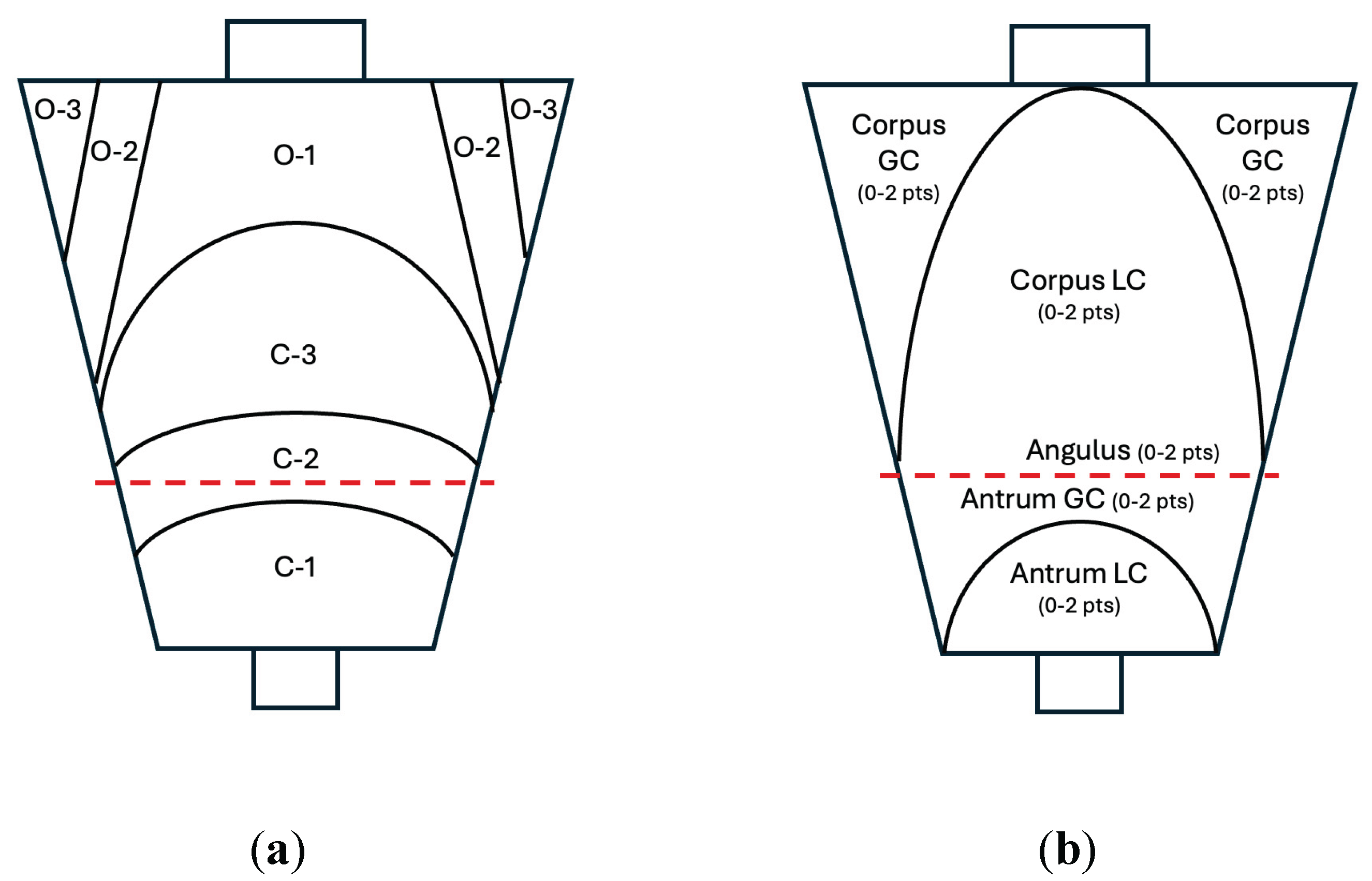
Figure 2.
(A) Gastric low-grade dysplasia; (B) Gastric high-grade dysplasia; (C) Early gastric cancer; (D) Invasive gastric cancer.
Figure 2.
(A) Gastric low-grade dysplasia; (B) Gastric high-grade dysplasia; (C) Early gastric cancer; (D) Invasive gastric cancer.
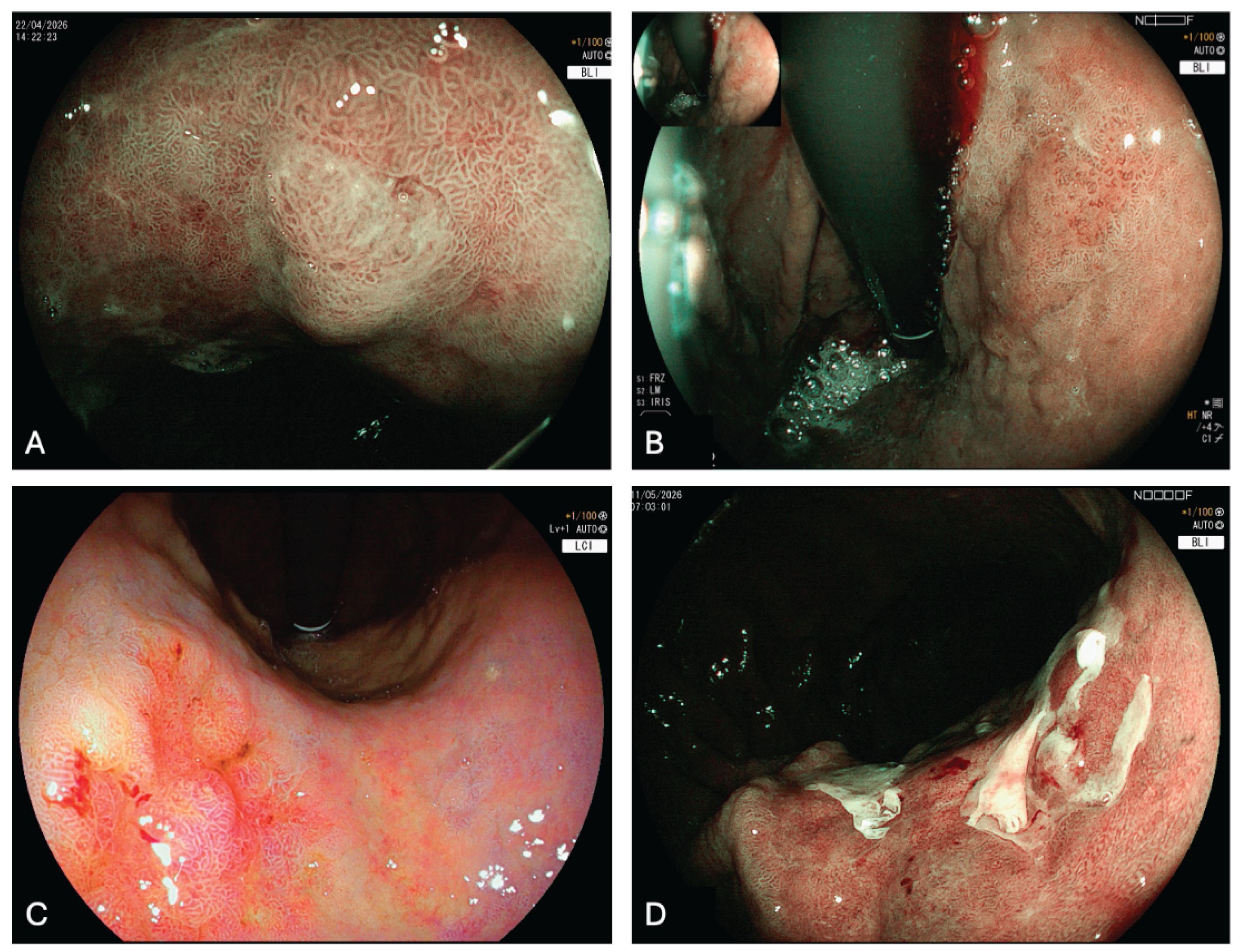
Figure 3.
MESDA-G algorithm. DL, demarcation line; IMVP, irregular microvascular pattern; IMSP, irregular microsuperficial pattern.
Figure 3.
MESDA-G algorithm. DL, demarcation line; IMVP, irregular microvascular pattern; IMSP, irregular microsuperficial pattern.
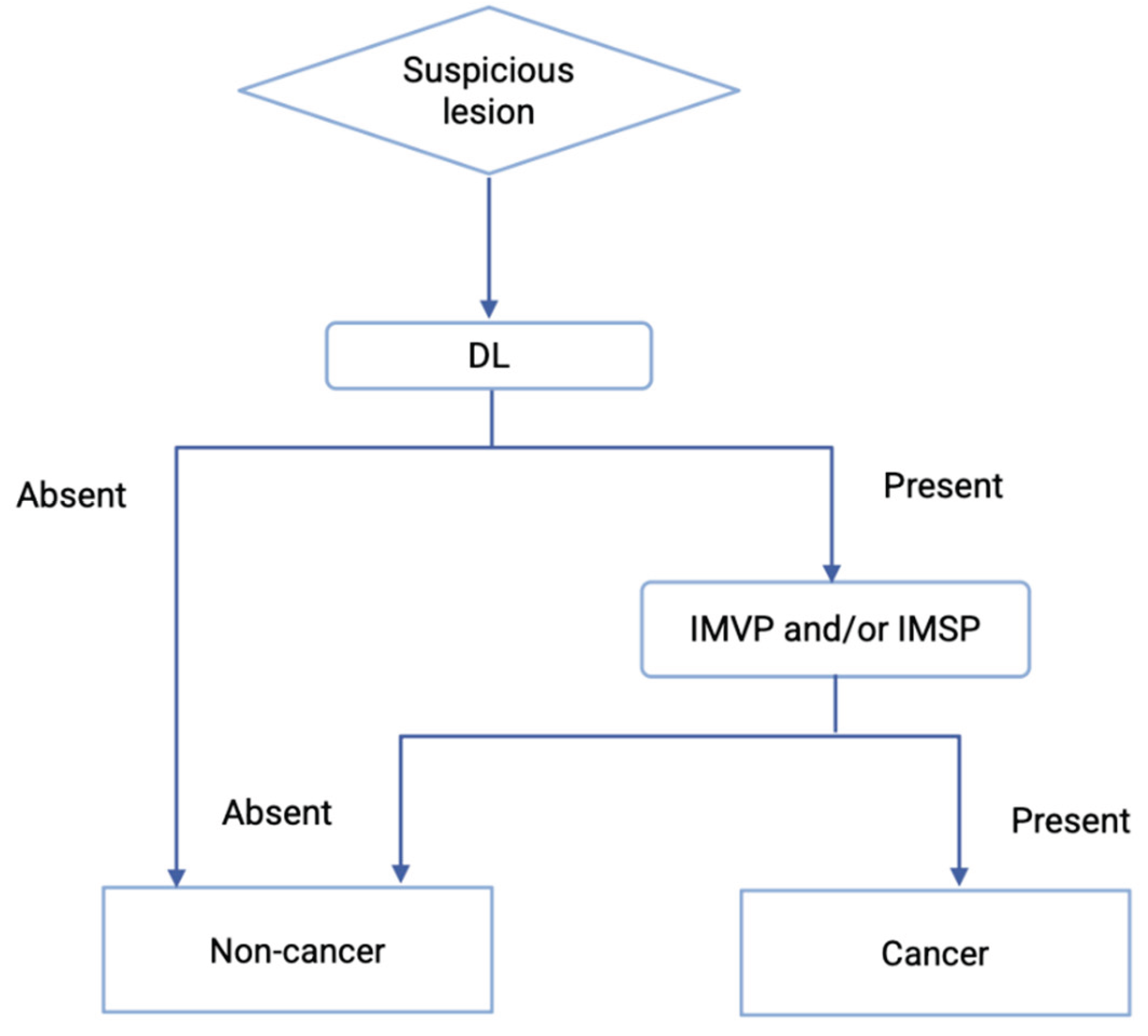
Figure 4.
eCura scoring system for quantifying lymph node metastasis potential. LNM, lymph node metastasis.
Figure 4.
eCura scoring system for quantifying lymph node metastasis potential. LNM, lymph node metastasis.
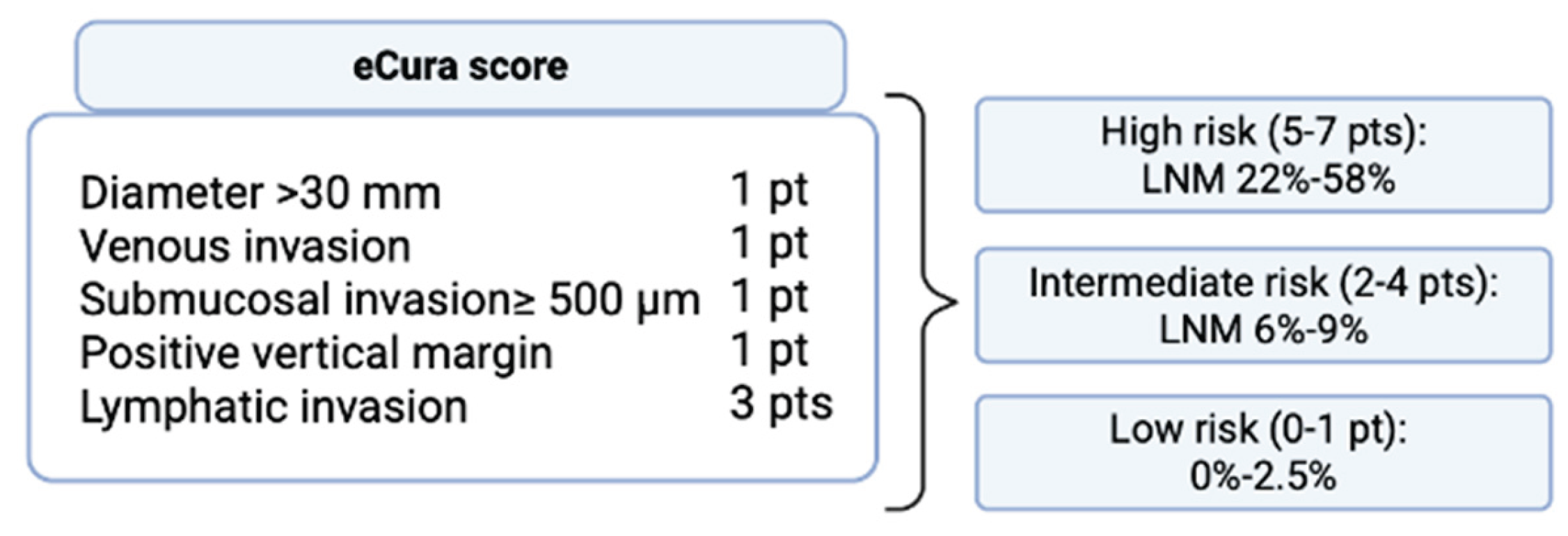
Figure 5.
Proposed diagnostic and therapeutic algorithm for the management of gastric precancerous lesions and early gastric cancer. The flowchart integrates high-quality upper gastrointestinal endoscopy standards, risk stratification of the background mucosa (atrophy and intestinal metaplasia staging), optical characterization of visible lesions, therapeutic decision-making (ESD vs. surgery), curability assessment (eCura staging), and tailored post-resection surveillance strategies. eCura, endoscopic curability scoring system; EGGIM, endoscopic grading of gastric intestinal metaplasia; ESD, endoscopic submucosal dissection; FAMISH, family history, age, male sex, corpus intestinal metaplasia, synchronous lesions, and persistent Helicobacter pylori; GI, gastrointestinal; H. pylori, Helicobacter pylori; IM, intestinal metaplasia; MDT, multidisciplinary team; ME, magnifying endoscopy; MESDA-G, magnifying endoscopy simple diagnostic algorithm for gastric cancer; mo, months; OLGA, operative link for gastritis assessment; OLGIM, operative link on gastric intestinal metaplasia assessment; VCE, virtual chromoendoscopy; WLE, white-light endoscopy.
Figure 5.
Proposed diagnostic and therapeutic algorithm for the management of gastric precancerous lesions and early gastric cancer. The flowchart integrates high-quality upper gastrointestinal endoscopy standards, risk stratification of the background mucosa (atrophy and intestinal metaplasia staging), optical characterization of visible lesions, therapeutic decision-making (ESD vs. surgery), curability assessment (eCura staging), and tailored post-resection surveillance strategies. eCura, endoscopic curability scoring system; EGGIM, endoscopic grading of gastric intestinal metaplasia; ESD, endoscopic submucosal dissection; FAMISH, family history, age, male sex, corpus intestinal metaplasia, synchronous lesions, and persistent Helicobacter pylori; GI, gastrointestinal; H. pylori, Helicobacter pylori; IM, intestinal metaplasia; MDT, multidisciplinary team; ME, magnifying endoscopy; MESDA-G, magnifying endoscopy simple diagnostic algorithm for gastric cancer; mo, months; OLGA, operative link for gastritis assessment; OLGIM, operative link on gastric intestinal metaplasia assessment; VCE, virtual chromoendoscopy; WLE, white-light endoscopy.
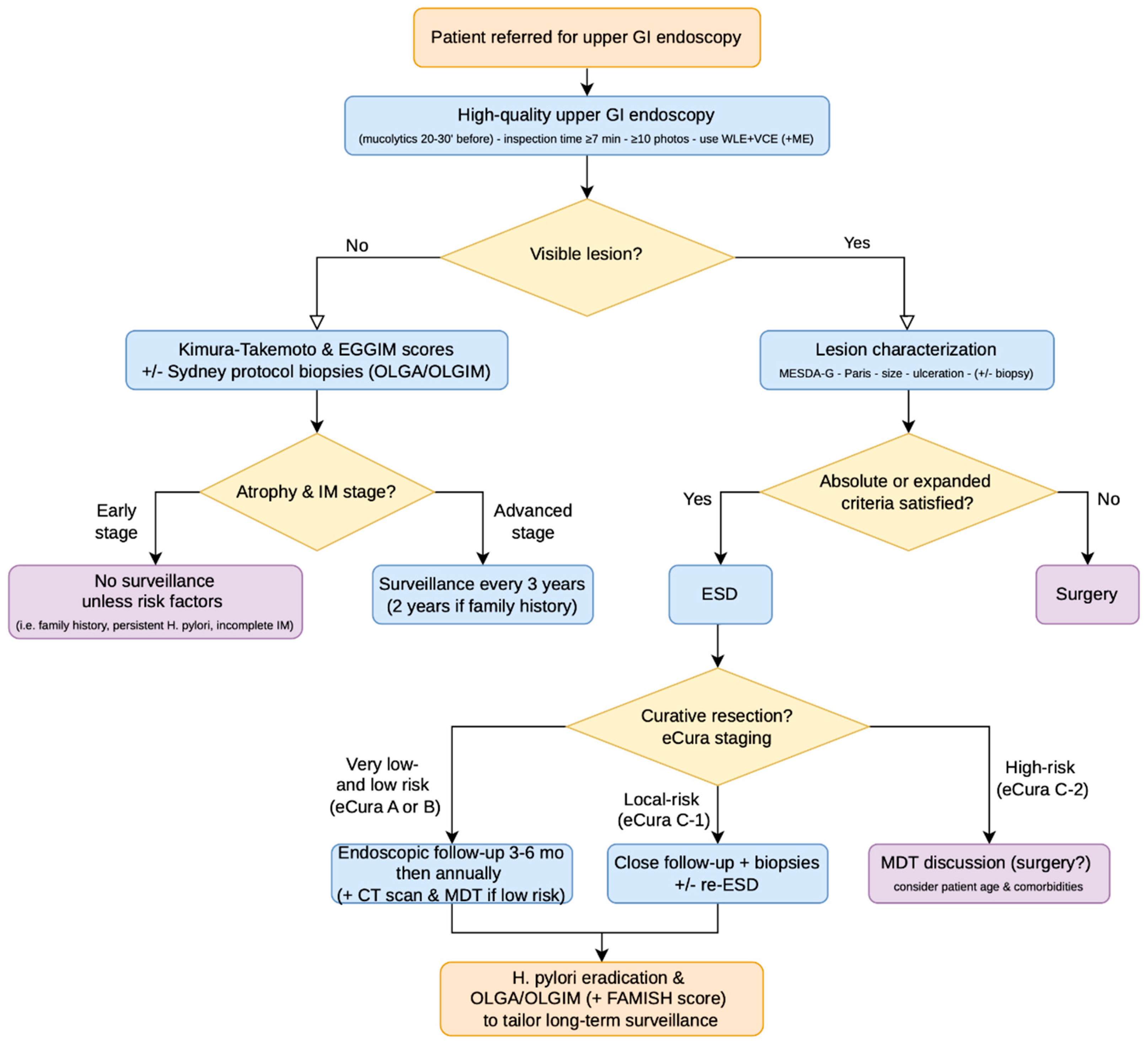

Table 1.
Management of gastric precancerous lesions and early gastric cancer: practice-oriented answer to clinical questions.
Table 1.
Management of gastric precancerous lesions and early gastric cancer: practice-oriented answer to clinical questions.
| Clinical Question | Key Recommendation |
|---|---|
| How should high-quality endoscopy be performed? | Adhere to ESGE performance measures for upper GI endoscopy (clean mucosa, observation time of ≥ 7 minutes, ≥10 photos). |
| How to identify patients at higher gastric cancer risk? |
|
| When and how should biopsies be performed in suspected gastric precancerous conditions? |
|
| Which endoscopic features are suspected for gastric precancerous lesions or EGC? |
|
| What is the role of VCE and ME in gastric precancerous conditions and lesions characterization? |
|
| When is endoscopic surveillance appropriate for precancerous conditions? | Endoscopic surveillance is appropriate for advanced stages (OLGA/OLGIM III-IV) and LGD without a visible lesion. Once a visible lesion is identified, endoscopic resection is indicated. |
| Which lesions are best managed with endoscopic resection? |
|
| Which endoscopic technique should be reserved for early gastric neoplasms? |
|
| What defines a curative endoscopic resection of a gastric superficial neoplasm? |
|
| When should surgery be recommended after endoscopic resection? |
|
| What is the optimal endoscopic follow-up after resection? |
|
| Should H. pylori be eradicated after endoscopic resection of gastric superficial neoplasms? | Yes, eradication is strongly recommended to reduce the incidence of metachronous neoplasms. |
| How should surveillance be tailored after curative EGC resection? |
|
AI, artificial intelligence; eCura, endoscopic curability; EGC, early gastric cancer; EMR, endoscopic mucosal resection; ESD, endoscopic submucosal dissection; ESGE, European Society of Gastrointestinal Endoscopy; FAMISH, family history, atrophy, metaplasia, intestinal phenotype, size, Helicobacter pylori; GI, gastrointestinal; HGD, high-grade dysplasia; HP, Helicobacter pylori; LBC, light blue crest; LGD, low-grade dysplasia; LNM, lymph node metastasis; LVI, lymphovascular invasion; MDT, multidisciplinary team; ME, magnifying endoscopy; MESDA-G, magnifying endoscopy simple diagnostic algorithm for gastric cancer; OLGA, operative link for gastritis assessment; OLGIM, operative link on gastric intestinal metaplasia assessment; SM, submucosal; VCE, virtual chromoendoscopy; WOS, white opaque substance.
Disclaimer/Publisher’s Note: The statements, opinions and data contained in all publications are solely those of the individual author(s) and contributor(s) and not of MDPI and/or the editor(s). MDPI and/or the editor(s) disclaim responsibility for any injury to people or property resulting from any ideas, methods, instructions or products referred to in the content. |
© 2026 by the authors. Licensee MDPI, Basel, Switzerland. This article is an open access article distributed under the terms and conditions of the Creative Commons Attribution (CC BY) license (http://creativecommons.org/licenses/by/4.0/).
Copyright: This open access article is published under a Creative Commons CC BY 4.0 license, which permit the free download, distribution, and reuse, provided that the author and preprint are cited in any reuse.


