

Submitted:
05 June 2026
Posted:
09 June 2026
You are already at the latest version
Abstract
Background: The clinical outcomes of lung cancer brain metastases (LCBMs) are highly variable. Traditional pathology relies on bulk cell densities. These static measures fail to capture the spatial architecture of the tumor immune microenvironment (TIME). B7-H3 (CD276) represents a key immune checkpoint in LCBMs. We investigated whether the spatial orchestration of B7-H3-expressing cell populations predicts patient prognosis. Methods: We performed multiplex immunohistochemistry (mIHC) for B7-H3 and Iba1 (a macrophage marker) in surgically resected tissues from 22 patients. We used QuPath for single-cell segmentation and classification. We performed spatial point pattern and spatial autocorrelation analyses to evaluate the relative positioning of single cells. We computed spatial interaction metrics, which included cross-Moran’s I and the cross-K function, within a 35 μm radius. We correlated these metrics with postoperative overall survival (OS) and determined prognostic thresholds via time-dependent ROC curve analysis. Results: Standard cell densities generally did not correlate with OS, although B7-H3+ tumor-associated macrophage (TAM) density showed a positive correlation. Conversely, specific spatial metrics served as significant prognostic factors. High spatial mixing and clustering of B7-H3+ and B7-H3- TAMs, as shown by high cross-Moran’s I (p = 0.011) and the cross-K functions (p = 0.033), correlated with significantly shorter OS. This pattern suggests a coordinated local immunosuppressive network. Conversely, high spatial integration between B7-H3+ and B7-H3- tumor cells correlated with prolonged OS (p = 0.016), whereas spatial segregation of B7-H3+ tumor cells predicted poor outcomes. Conclusions: Decoding the spatial architecture of B7-H3-expressing cell subpopulations provides superior prognostic stratification compared with standard density-based metrics. These localized spatial niches represent potential biomarkers and therapeutic targets for personalized LCBM management.
Keywords:
B7-H3
; lung cancer brain metastasis
; immune microenvironment
; spatial analysis
; prognosis
1. Introduction
Lung cancer remains the leading cause of brain metastases (BMs), affecting up to 40% of patients and resulting in severe neurological impairment and short overall survival (OS) [1]. Although stereotactic radiosurgery and immune checkpoint inhibitors (ICIs) have expanded the therapeutic options, patient outcomes remain highly variable. Standard clinical classification schemes, such as the Graded Prognostic Assessment (GPA) score [2] and its molecular update (Lung-molGPA), which incorporates PD-L1 expression [3], rely on bulk characteristics and systemic variables, failing to capture individual prognostic variation. This limitation highlights the critical need for novel biomarkers reflecting the complex tumor immune microenvironment (TIME) to improve patient risk stratification.
B7-H3 (CD276) represents a promising therapeutic target overexpressed on both tumor cells and tumor-associated macrophages (TAMs); its expression promotes tumor progression and immune evasion [4,5]. Although several studies have examined its prognostic impact in brain metastases, most investigations have relied on bulk metrics like overall positivity percentages [6], which fail to capture the substantial intratumoral heterogeneity and spatial organization of the brain microenvironment.
Recent advances in spatial biology demonstrate that cellular neighborhood interactions determine the functional state of the TIME far better than mere cell abundance [7,8]. The physical proximity between immunosuppressive myeloid cells and tumor cells governs anti-tumor immunity [9]. Within the specialized, myeloid-rich brain microenvironment, local cell-to-cell interactions involving B7-H3 likely exert potent immunosuppressive effects distinct from those in primary lung lesions.
In this study, we combined multiplex immunohistochemistry (mIHC) with spatial point pattern and spatial autocorrelation statistics to map B7-H3-expressing subpopulations in surgically resected lung cancer brain metastases (LCBMs). We hypothesized that the physical proximity of these subpopulations shapes the local immunosuppressive TIME and correlates with OS. By quantifying cellular neighborhoods using cross-Moran’s I and cross-K functions, we resolved localized cell-to-cell communication that conventional static density analysis cannot capture. Our findings demonstrate that while standard cell densities fail to predict OS, spatial clustering and integration of B7-H3+ and B7-H3- subpopulations, particularly within the TAM compartment, serve as robust prognostic indicators of OS.
2. Materials and Methods
2.1. Patients
This single-center retrospective cohort study was approved by the Institutional Review Board of ACC (approval number: IR071501) in accordance with the Declaration of Helsinki. The requirement for individual informed consent was waived due to the retrospective design, and an opt-out procedure was provided on the institutional website in accordance with Japanese ethical guidelines. We included 22 consecutive patients who underwent surgical resection for histologically confirmed LCBMs at ACC between April 2018 and October 2024. This cohort partially overlapped with our previous study on tertiary lymphoid structures [10] but remains strictly independent in target molecules (B7-H3/Iba1) and spatial statistical methodologies. Patients with severe perioperative complications or insufficient tissue samples were excluded.
2.2. Multiplex Immunohistochemistry (mIHC)
We performed sequential chromogenic mIHC protocols using FFPE sections [11,12]. Deparaffinized and rehydrated 4-μm-thick sections underwent heat-induced epitope retrieval (HIER) in Tris-EDTA buffer (pH 9.0) at 121 °C for 20 minutes, followed by blocking with 3% hydrogen peroxide and a protein-blocking solution. We sequentially incubated sections with rabbit monoclonal antibodies against B7-H3 (clone EPR20115; Abcam, Cambridge, UK, 1:500) and Iba1 (clone EPR16589; Abcam, Cambridge, UK, 1:1000). We visualized signals using Histofine Simple Stain MAX-PO and AP systems (Nichirei Biosciences, Tokyo, Japan), developing chromogens sequentially with HistoGreen (B7-H3; Cosmo Bio, Tokyo, Japan) and First Red II (Iba1; Nichirei Biosciences, Tokyo, Japan); dark brown signal overlap identified B7-H3+ TAMs. Between rounds, we stripped antibodies using HIER in citrate buffer (pH 6.0) at 95 °C for 10 minutes, and verified stripping efficiency by omitting the primary antibody in subsequent runs to confirm the absence of residual signal. To ensure uniformity, we processed all sections simultaneously in a single batch via an automated stainer, followed by hematoxylin counterstaining.
2.3. Digital Pathology and Cell Detection
We performed image acquisition and analysis in accordance with previous protocols [10,13]. Following mIHC, we scanned whole-slide digital images via a NanoZoomer-SQ system (Hamamatsu Photonics, Hamamatsu, Japan) at 20× magnification (0.75 NA) and performed quantitative image analysis using QuPath software (version 0.7.0) [14]. We initially identified tumor regions using a threshold-based pixel classifier on the hematoxylin channel, manually refining these regions to exclude necrosis, hemorrhage, and artifacts. For single-cell classification, we trained a supervised Random Trees classifier via a specimen-by-specimen active learning approach, progressively annotating phenotypes across all 22 specimens to generate a robust, unified model applied uniformly across the cohort. This classifier categorized single cells into four subpopulations: B7-H3+ tumor cells, B7-H3- tumor cells, B7-H3+ TAMs, and B7-H3- TAMs. Expert neuro-oncologists (S.N. and M.O.), blinded to clinical outcomes, visually verified the classification accuracy across all specimens based on morphological and phenotypic criteria. Final results were expressed as cell densities (cells/mm2 of tumor area).
2.4. Statistical Analysis of Spatial Architecture
We analyzed the TIME spatial architecture using the Python-based framework Squidpy (version 1.2.2) [15], which integrates SciPy and NetworkX for spatial graph construction. We extracted the Cartesian coordinates of classified single cells to construct spatial maps and built spatial graphs to evaluate cellular interactions. To visualize phenotypic clustering, we performed Uniform Manifold Approximation and Projection (UMAP) based on morphological and multiplex marker intensity features (mean nuclear and cytoplasmic intensities for hematoxylin, B7-H3, and Iba1) obtained from cell segmentation.
We employed three complementary metrics to capture distinct spatial dimensions: cross-Moran’s I for phenotypic spatial autocorrelation, the cross-K function for physical clustering, and co-occurrence probability for distance-dependent enrichment. We computed cross-Moran’s I and co-occurrence probability via Squidpy, while the cross-K function was calculated using the R package spatstat [16]. First, we calculated cross-Moran’s I to assess B7-H3 phenotypic alignment among neighboring cells, utilizing an inverse-distance weight matrix () and a 199-iteration permutation test. Next, we calculated the cross-K function to quantify the physical aggregation of different cell types with Ripley’s isotropic edge correction. Because edge corrections and asymmetric cell densities can cause practical asymmetry, we designated the first cell type as the reference and the second as the target, reporting results in reference-to-target notation. Finally, we computed co-occurrence probability to measure the conditional likelihood of finding a target cell type at a given distance from a reference cell type relative to complete spatial randomness.
To correlate these spatial metrics with clinical outcomes, we selected a localized spatial radius of 35 μm as the standard representative threshold. This distance provides a biologically plausible range for direct cell-to-cell neighborhood interactions or short-range paracrine signaling [17,18]. Specifically, we extracted the values of all three metrics calculated at this 35 μm radius for downstream clinical statistical analysis. To ensure robustness against threshold bias, we performed sensitivity analyses across a range of spatial radii from 10 to 50 μm in 5 μm increments.
2.5. Statistical Analysis of Clinical Data
We conducted clinical statistical analyses using EZR version 1.70 (Saitama Medical Center, Jichi Medical University, Japan) [19], a graphical user interface for R (version 4.5.0) [20], in accordance with statistical frameworks from previous studies [21,22,23]. To evaluate continuous associations between spatial metrics, clinical scores (such as the GPA score), and postoperative OS duration (months), we assessed normality using the Shapiro-Wilk test. Because the variables violated normality, we computed and reported Spearman’s rank correlation coefficients. To establish optimal prognostic thresholds, we generated time-dependent receiver operating characteristic (ROC) curves at the median postoperative OS, evaluating both directions (higher values indicating higher risk, or vice versa) to maximize the area under the curve (AUC). The optimal cutoff was determined using the Youden index, and continuous variables were dichotomized into high and low groups. Finally, we calculated hazard ratios (HRs) and 95% confidence intervals (CIs) via univariate Cox proportional hazards regression, compared survival curves using the Kaplan-Meier method with the log-rank test, and defined statistical significance as a p-value of <0.05.
3. Results
3.1. Marked Spatial Heterogeneity of B7-H3-Expressing Populations Delineates the LCBM Microenvironment
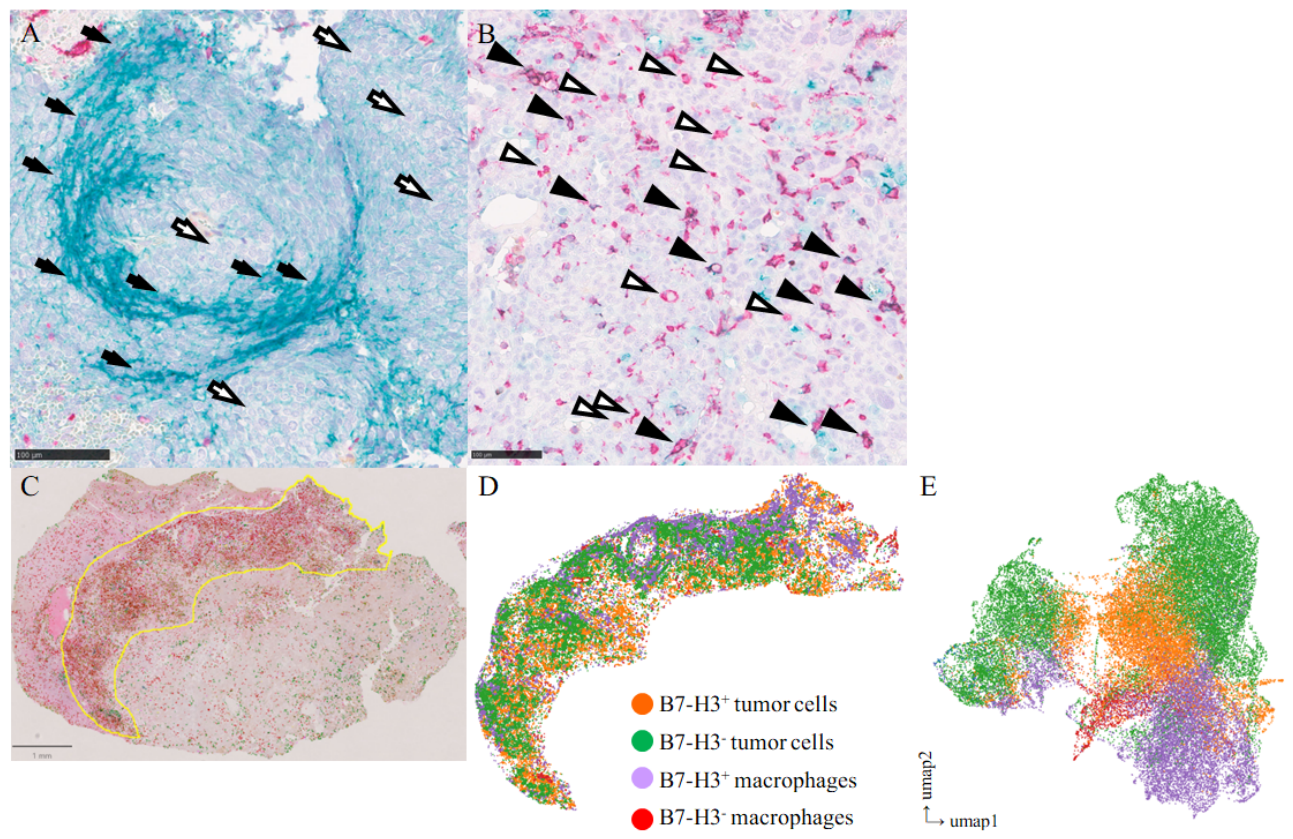
Multiplex IHC targeting B7-H3 and Iba1 revealed marked spatial heterogeneity within the TIME of LCBMs (baseline characteristics summarized in Table 1). Specifically, mIHC delineated distinct tumor parenchyma regions of B7-H3+ tumor cells (Figure 1A, black arrows) and B7-H3- tumor cells (Figure 1A, white arrows). Furthermore, we distinguished infiltrating TAM populations into B7-H3- (Figure 1B, white arrowheads) and B7-H3+ subpopulations (Figure 1B, black arrowheads) based on signal colocalization.
Following digital slide scanning and cell segmentation, Random Trees classifier performance stabilized after approximately 10 iterations, ensuring uniform cell classification. We extracted coordinates to construct spatial maps visualizing the single-cell topography (Figure 1D). Finally, UMAP analysis confirmed distinct phenotypic clustering of the identified cell populations based on multiplex marker profiles (Figure 1E).

Table 1.
Clinical characteristics of patients with lung cancer brain metastases. Summary of baseline clinical demographics, pathological diagnosis, mutational status, and treatment modalities for the 22 patients included in the study cohort. BM, brain metastasis; ECM, extracranial metastasis; EGFR, epidermal growth factor receptor; KPS, Karnofsky Performance Status; LCBM, lung cancer brain metastasis; NOS, not otherwise specified; OS, overall survival; PD-L1, programmed death-ligand 1; SRS, stereotactic radiosurgery; SRT, stereotactic radiotherapy; TPS, tumor proportion score; WBRT, whole-brain radiotherapy.
Table 1.
Clinical characteristics of patients with lung cancer brain metastases. Summary of baseline clinical demographics, pathological diagnosis, mutational status, and treatment modalities for the 22 patients included in the study cohort. BM, brain metastasis; ECM, extracranial metastasis; EGFR, epidermal growth factor receptor; KPS, Karnofsky Performance Status; LCBM, lung cancer brain metastasis; NOS, not otherwise specified; OS, overall survival; PD-L1, programmed death-ligand 1; SRS, stereotactic radiosurgery; SRT, stereotactic radiotherapy; TPS, tumor proportion score; WBRT, whole-brain radiotherapy.
| Patient Characteristics | Values |
|---|---|
| No. of patients | 22 |
| Age, years (range) | 70 (41–83) |
| Sex, No. (%) | |
| Female | 10 (45) |
| Male | 12 (55) |
| Preoperative KPS, No. (%) | |
| 90–100 | 8 (36) |
| 70–80 | 9 (41) |
| ≤60 | 5 (23) |
| KPS at BM diagnosis, No. (%) | |
| 90–100 | 13 (59) |
| 70–80 | 7 (32) |
| ≤60 | 2 (9) |
| Number of BM at diagnosis, No. (%) | |
| ≥5 | 3 (14) |
| 1–4 | 19 (86) |
| 0 | 0 (0) |
| ECM at BM diagnosis, No. (%) | |
| No | 17 (77) |
| Yes | 5 (23) |
| Pathological diagnosis, No. (%) | |
| Adenocarcinoma | 19 (86) |
| Squamous cell carcinoma | 1 (5) |
| Small cell carcinoma | 1 (5) |
| Carcinoma, NOS | 1 (5) |
| Gene mutation status, No. (%) | |
| None | 10 (45) |
| EGFR sensitizing mutation | 6 (27) |
| EGFR exon 20 insertion | 1 (5) |
| ALK rearrangement/fusion | 2 (9) |
| KRAS | 3 (14) |
| PD-L1 TPS category, No. (%) | |
| 0% | 6 (27) |
| 1–49% | 12 (55) |
| Unknown | 4 (18) |
| Preoperative radiation therapy, No. (%) | |
| None | 8 (36) |
| SRS | 5 (23) |
| SRT | 8 (36) |
| WBRT | 1 (5) |
| Postoperative radiation therapy, No. (%) | |
| None | 7 (32) |
| SRS | 1 (5) |
| SRT | 5 (23) |
| WBRT | 5 (23) |
| Unknown | 4 (18) |
| Postoperative OS, months (range) | 12 (0–48) |
Figure 1.
Representative multiplex immunostaining and spatial profiling images in lung cancer brain metastasis (LCBM). (A, B) Representative multiplex immunohistochemistry images of LCBM tissues stained for Iba1 (red) and B7-H3 (green) to visualize spatial heterogeneity. (A) Identification of B7-H3+ tumor cells indicated by black arrows and B7-H3- tumor cells indicated by white arrows. (B) Identification of B7-H3+ TAMs (black arrowheads) and B7-H3- TAMs (white arrowheads); B7-H3+ TAMs appear dark brown due to the colocalization of Iba1 and B7-H3 signals. Scale bar = 100 μm. (C) Representative digital pathology image demonstrating cell segmentation and classification using QuPath, with tumor regions defined by yellow regions of interest (ROI). (D) Spatial cell map visualizing the precise coordinates and distribution of the classified cell populations across the tissue section. (E) Uniform Manifold Approximation and Projection (UMAP) plot displaying distinct cell clusters based on their multiplex marker expression profiles.
Figure 1.
Representative multiplex immunostaining and spatial profiling images in lung cancer brain metastasis (LCBM). (A, B) Representative multiplex immunohistochemistry images of LCBM tissues stained for Iba1 (red) and B7-H3 (green) to visualize spatial heterogeneity. (A) Identification of B7-H3+ tumor cells indicated by black arrows and B7-H3- tumor cells indicated by white arrows. (B) Identification of B7-H3+ TAMs (black arrowheads) and B7-H3- TAMs (white arrowheads); B7-H3+ TAMs appear dark brown due to the colocalization of Iba1 and B7-H3 signals. Scale bar = 100 μm. (C) Representative digital pathology image demonstrating cell segmentation and classification using QuPath, with tumor regions defined by yellow regions of interest (ROI). (D) Spatial cell map visualizing the precise coordinates and distribution of the classified cell populations across the tissue section. (E) Uniform Manifold Approximation and Projection (UMAP) plot displaying distinct cell clusters based on their multiplex marker expression profiles.
3.2. Localized Spatial Interactions of Myeloid and Tumor Compartments Predict Overall Survival
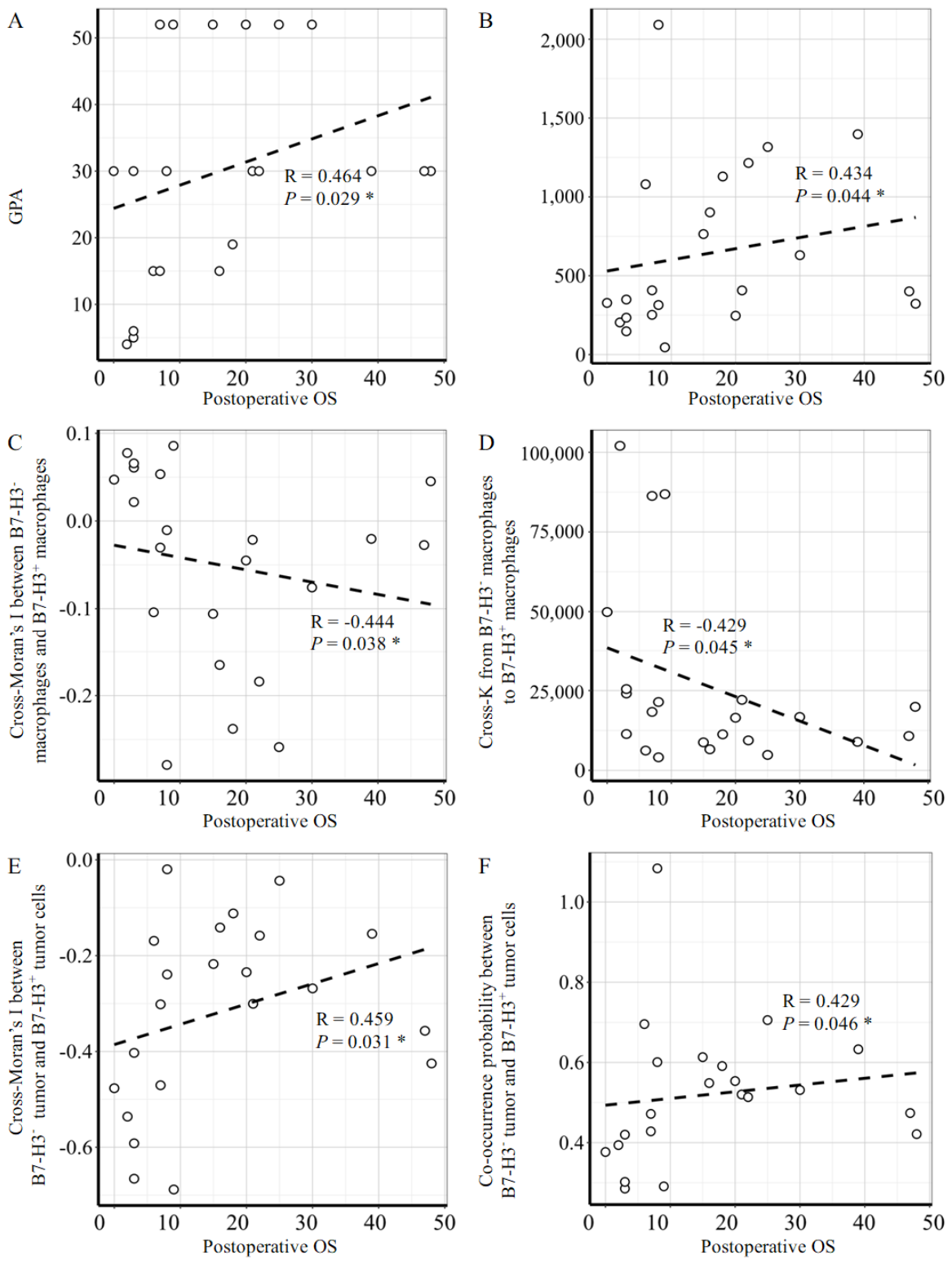
We evaluated the relationship between cellular metrics and postoperative OS (individual patient details in Table 2). Using a 35 μm spatial radius, we calculated Spearman’s rank correlation coefficients between spatial metrics and OS. As a clinical control, the GPA score correlated significantly with OS (, p = 0.029; Figure 2A). While absolute cell densities generally did not correlate with OS (Supplementary Figure S1), B7-H3+ TAM density showed a positive correlation (, p = 0.044; Figure 2B).
Beyond abundance, several spatial interaction metrics strongly associated with clinical outcomes. Within the TAM compartment, proximal interactions negatively correlated with OS, including cross-Moran’s I between B7-H3- and B7-H3+ TAMs (Figure 2C) and the cross-K function from B7-H3- to B7-H3+ TAMs (Figure 2D). Conversely, in the tumor compartment, both cross-Moran’s I (Figure 2E) and co-occurrence probability (Figure 2F) between B7-H3- and B7-H3+ tumor cells exhibited significant positive correlations with OS.
Table 2.
Pathological and spatial characteristics of the LCBM cohort. Summary of absolute cell densities and calculated spatial metrics for each patient. Densities are provided for B7-H3+ and B7-H3- tumor cells and TAMs. Spatial metrics, including cross-Moran’s I, the cross-K function, and co-occurrence probability between specific cell subpopulations, were calculated using a defined spatial radius of 35 μm.
Table 2.
Pathological and spatial characteristics of the LCBM cohort. Summary of absolute cell densities and calculated spatial metrics for each patient. Densities are provided for B7-H3+ and B7-H3- tumor cells and TAMs. Spatial metrics, including cross-Moran’s I, the cross-K function, and co-occurrence probability between specific cell subpopulations, were calculated using a defined spatial radius of 35 μm.
| sample No | Age (years) | Pathological diagnosis | GPA | Total tumor density | B7-H3+ tumor cell density | B7-H3- tumor cell density | Total macrophage density | B7-H3+ macrophage density | B7-H3- macrophage density | Cross-Moran’s I between B7-H3- tumor and B7-H3+ tumor cells |
Co-occurrence probability between B7-H3- and B7-H3+ tumor cells |
Cross-K from B7-H3- to B7-H3+ tumor cells |
Cross-Moran’s I between B7-H3- macrophages to B7-H3+ macrophages |
Cross-K from B7-H3- macrophages to B7-H3+ macrophages |
Co-occurrence probability between B7-H3- macrophages to B7-H3+ macrophages |
Cross-Moran’s I between B7-H3+ macrophages and B7-H3- tumor cells |
Cross-Moran’s I between B7-H3- macrophages and B7-H3- tumor cells |
Cross-K from B7-H3+ macrophages to B7-H3+ tumor cells |
| 1 | 73 | Adenocarcinoma | 30 | 7,596.18 | 2,276.47 | 5,319.71 | 932.23 | 322.3 | 609.93 | -0.43 | 0.42 | 4,582.94 | 0.05 | 19,904.6 | 2.71 | -0.26 | -0.38 | 1,819.49 |
| 2 | 65 | Adenocarcinoma | 52 | 1,736.65 | 429.06 | 1,307.59 | 3,763.14 | 1,316.51 | 2,446.63 | -0.04 | 0.71 | 4,347.21 | -0.26 | 4,835.19 | 0.63 | -0.17 | -0.4 | 3,314.31 |
| 3 | 75 | Adenocarcinoma | 30 | 2,156.42 | 906.98 | 1,249.44 | 817.23 | 406.96 | 410.27 | -0.3 | 0.52 | 8,791.54 | -0.02 | 22,089.5 | 1.26 | -0.36 | -0.32 | 6,144.24 |
| 4 | 76 | Adenocarcinoma | 30 | 3,340.69 | 1,227.18 | 2,113.51 | 905.61 | 314.1 | 591.51 | -0.24 | 0.6 | 8,497.39 | -0.01 | 21,413.6 | 1.23 | -0.28 | -0.56 | 5,777.81 |
| 5 | 68 | Adenocarcinoma | 52 | 2,300.68 | 932.62 | 1,368.06 | 525.19 | 246.27 | 278.92 | -0.23 | 0.55 | 4,774.19 | -0.05 | 16,476.9 | 0.99 | -0.3 | -0.63 | 5,081.5 |
| 6 | 77 | Squamous cell carcinoma | 5 | 7,398.12 | 5,695.11 | 1,703.01 | 494.87 | 147.49 | 347.38 | -0.67 | 0.29 | 2,725.52 | 0.06 | 24,075.1 | 3.38 | -0.11 | -0.2 | 1,652.84 |
| 7 | 77 | Small cell carcinoma | 4 | 10,185.43 | 4,109.91 | 6,075.52 | 983.53 | 203.56 | 779.98 | -0.54 | 0.39 | 15,470.6 | 0.08 | 102,023 | 3.65 | -0.15 | -0.33 | 9,891.62 |
| 8 | 75 | Adenocarcinoma | 30 | 3,409.41 | 2,403.41 | 1,006 | 4,230.49 | 2,091.68 | 2,138.81 | -0.02 | 1.08 | 5,102.39 | -0.28 | 4,082.25 | 0.74 | -0.16 | -0.24 | 1,447.52 |
| 9 | 69 | Adenocarcinoma | 52 | 2,686.88 | 1,412.35 | 1,274.53 | 883.01 | 407.44 | 475.57 | -0.3 | 0.43 | 6,223 | -0.03 | 18,312.3 | 1.03 | -0.29 | -0.51 | 4,366.15 |
| 10 | 73 | Adenocarcinoma | 15 | 3,239.11 | 1,131.66 | 2,107.45 | 1,764.14 | 1,080.1 | 684.03 | -0.17 | 0.7 | 4,306.19 | -0.1 | 6,199.58 | 0.9 | -0.37 | -0.35 | 2,542.73 |
| 11 | 70 | Adenocarcinoma | 6 | 5,300.81 | 2,092.08 | 3,208.73 | 1,161.91 | 348.97 | 812.95 | -0.4 | 0.42 | 2,358.89 | 0.02 | 11,379.8 | 1.63 | -0.26 | -0.57 | 1,136.22 |
| 12 | 53 | Adenocarcinoma | 30 | 5,499.58 | 3,305.76 | 2,193.82 | 492.25 | 233.8 | 258.45 | -0.59 | 0.3 | 2,397.98 | 0.07 | 25,469.4 | 1.95 | -0.21 | -0.38 | 3,492.27 |
| 13 | 51 | Adenocarcinoma | 15 | 7,047.23 | 2,937.67 | 4,109.56 | 601.02 | 251.86 | 349.17 | -0.47 | 0.47 | 18,616.7 | 0.05 | 86,292.5 | 3.15 | -0.23 | -0.31 | 9,234.88 |
| 14 | 41 | Adenocarcinoma | 30 | 4,274.04 | 2,326.06 | 1,947.98 | 1,238.18 | 400.91 | 837.27 | -0.36 | 0.47 | 4,003.7 | -0.03 | 10,760.5 | 1.13 | -0.2 | -0.36 | 2,669.77 |
| 15 | 56 | Adenocarcinoma | 52 | 6,570.38 | 5,233.94 | 1,336.44 | 274.6 | 45.59 | 229.01 | -0.69 | 0.29 | 6,116.73 | 0.09 | 86,863.3 | 3.46 | -0.07 | -0.13 | 10,513.6 |
| 16 | 42 | Carcinoma, NOS | 19 | 2,589.2 | 1,133.93 | 1,455.27 | 2,829.83 | 1,129.34 | 1,700.49 | -0.11 | 0.59 | 7,396.92 | -0.24 | 11,276.6 | 0.69 | -0.21 | -0.37 | 5,360.6 |
| 17 | 61 | Adenocarcinoma | 30 | 5,044.12 | 1,092.28 | 3,951.84 | 1,976.42 | 1,397.52 | 578.9 | -0.15 | 0.63 | 3,922.12 | -0.02 | 8,928.87 | 1.27 | -0.48 | -0.39 | 3,201.88 |
| 18 | 69 | Adenocarcinoma | 52 | 2,696.84 | 1,466.74 | 1,230.1 | 1,048.7 | 630.13 | 418.57 | -0.27 | 0.53 | 6,404.21 | -0.08 | 16,720.8 | 1.05 | -0.36 | -0.35 | 4,005.15 |
| 19 | 76 | Adenocarcinoma | 30 | 5,055.19 | 1,976.48 | 3,078.71 | 620.93 | 327.44 | 293.49 | -0.48 | 0.38 | 10,222.6 | 0.05 | 49,871.8 | 2.52 | -0.34 | -0.35 | 7,438.79 |
| 20 | 71 | Adenocarcinoma | 30 | 4,167.77 | 3,132.57 | 1,035.2 | 2,085.54 | 1,215.06 | 870.49 | -0.16 | 0.51 | 3,967.8 | -0.18 | 9,383.82 | 0.76 | -0.2 | -0.23 | 3,417.5 |
| 21 | 83 | Adenocarcinoma | 15 | 4,141.63 | 3,454.81 | 686.82 | 1,830.91 | 901.67 | 929.25 | -0.14 | 0.55 | 2,463.4 | -0.17 | 6,590.11 | 0.81 | -0.15 | -0.25 | 1,814.04 |
| 22 | 50 | Adenocarcinoma | 52 | 4,293.31 | 2,056.13 | 2,237.18 | 1,812.7 | 764.11 | 1,048.59 | -0.22 | 0.61 | 5,027.9 | -0.11 | 8,765.7 | 0.85 | -0.28 | -0.38 | 3,502.86 |
Figure 2.
Scatter plots showing associations between clinical, pathological, and spatial metrics and postoperative overall survival (OS) in lung cancer brain metastasis (LCBM). Scatter plots illustrating the Spearman’s rank correlations between postoperative OS in months and specific clinical, density-based, or spatial metrics evaluated within a 35 μm radius. (A) Graded Prognostic Assessment (GPA) score. (B) Cell density of B7-H3+ TAMs (number of cells per mm2). (C) Cross-Moran’s I between B7-H3- and B7-H3+ TAMs. (D) Cross-K function from B7-H3- TAMs to B7-H3+ TAMs. (E) Cross-Moran’s I between B7-H3- and B7-H3+ tumor cells. (F) Co-occurrence probability between B7-H3- and B7-H3+ tumor cells. Each dot represents an individual patient. Spearman’s rank correlation coefficient () and p-values are shown for significant associations (* p < 0.05).
Figure 2.
Scatter plots showing associations between clinical, pathological, and spatial metrics and postoperative overall survival (OS) in lung cancer brain metastasis (LCBM). Scatter plots illustrating the Spearman’s rank correlations between postoperative OS in months and specific clinical, density-based, or spatial metrics evaluated within a 35 μm radius. (A) Graded Prognostic Assessment (GPA) score. (B) Cell density of B7-H3+ TAMs (number of cells per mm2). (C) Cross-Moran’s I between B7-H3- and B7-H3+ TAMs. (D) Cross-K function from B7-H3- TAMs to B7-H3+ TAMs. (E) Cross-Moran’s I between B7-H3- and B7-H3+ tumor cells. (F) Co-occurrence probability between B7-H3- and B7-H3+ tumor cells. Each dot represents an individual patient. Spearman’s rank correlation coefficient () and p-values are shown for significant associations (* p < 0.05).
3.3. Spatial Neighborhood Profiling Offers Superior Prognostic Stratification over Cell Density
To evaluate the prognostic impact of these metrics, we performed a time-dependent ROC curve analysis at the median postoperative OS to determine optimal prognostic cutoff values (Table 3). Univariate Cox proportional hazards analysis confirmed that while simple cell densities failed to predict OS, specific spatial metrics served as robust prognostic factors (Figure 3), particularly spatial metrics between B7-H3+ and B7-H3- TAMs, and B7-H3+ and B7-H3- tumor cells.
Kaplan-Meier survival analysis stratified by the ROC-derived cutoffs further highlighted the prognostic relevance of spatial organization. The clinical GPA score achieved significant prognostic stratification (p = 0.002; Figure 4A). Patients with high spatial mixing and clustering of TAMs, indicated by high cross-Moran’s I (p = 0.011; Figure 4B) and cross-K function (p = 0.033; Figure 4C) between B7-H3+ and B7-H3- TAMs, experienced significantly shorter OS. Conversely, higher cross-Moran’s I (p = 0.016; Figure 4D) and co-occurrence probability (p = 0.016; Figure 4E) between B7-H3+ and B7-H3- tumor cells associated with improved OS, which reflect non-random phenotypic mixing. In contrast, spatial segregation of B7-H3+ tumor cells predicted poor outcomes.
4. Discussion
In this study, we characterized the TIME landscape in LCBMs by analyzing B7-H3 expression in tumor cells and TAMs using mIHC and spatial statistics (Figure 1). Our findings demonstrate that spatial orchestration, rather than absolute density, predicts postoperative OS (Figure 2 and Figure 3). Specifically, spatial clustering and close physical proximity of B7-H3+ and B7-H3- TAMs within 35 μm predicted shortened OS (Figure 4B, C), indicating a coordinated local immunosuppressive niche. Conversely, spatial segregation between B7-H3+ and B7-H3- tumor cells associated with poorer outcomes (Figure 4D, E). Notably, the significant correlation between the clinical GPA score and OS (Figure 2A) [2,3] serves as a vital clinical control, validating that our pilot cohort represents a standard LCBM population and strengthening the translational relevance of these spatial findings [24].
Our spatial analysis revealed marked segregation of B7-H3 expression, dividing the parenchyma into distinct positive and negative regions (Figure 1A, E). Similarly, infiltrating TAMs comprised distinct B7-H3+ and B7-H3- subpopulations with clear spatial compartmentalization (Figure 1B). Although spatial transcriptomics has demonstrated macrophage accumulation and fibrogenic niches in LCBMs [25], it did not resolve the single-cell spatial arrangement of B7-H3+ and B7-H3- subpopulations. Our single-cell mapping addresses this gap, showing that B7-H3 expression forms localized microenvironmental domains with regionalized checkpoint interactions.
We identified divergent prognostic roles for spatial interactions within different cell compartments. Although B7-H3+ TAM density positively correlated with OS (Figure 2B), their spatial proximal interactions negatively correlated with OS. These parameters included cross-Moran’s I between B7-H3+ and B7-H3- TAMs (Figure 2C) and the cross-K function from B7-H3- to B7-H3+ TAMs (Figure 2D). This discrepancy reveals a biological paradox: a higher total density of B7-H3+ TAMs may reflect active immune influx, whereas their localized mixing and clustering correlate with shorter OS. Indeed, checkpoint-expressing TAMs are not uniformly immunosuppressive; their clinical impact depends heavily on their microenvironmental context, as certain subpopulations exhibit immunostimulatory TAM phenotypes in solid tumors [26,27]. Therefore, their spatial organization, rather than mere abundance, governs their clinical significance.
Specifically, spatial clustering of TAMs serves as a functional unit to coordinate immunosuppressive states, which drives pro-tumorigenic M2-like polarization and therapy resistance in other malignancies [28,29]. Consequently, when B7-H3+ and B7-H3- TAMs aggregate in close proximity, they construct a coordinated local immunosuppressive niche. Within this neighborhood, B7-H3+ TAMs likely suppress neighboring active TAMs and other immune cells via short-range cytokine gradients or direct cell-to-cell contact, neutralizing anti-tumor TAM activity.
Conversely, within the tumor compartment, both cross-Moran’s I (Figure 2E) and co-occurrence probability (Figure 2F) between B7-H3+ and B7-H3- tumor cells exhibited significant positive correlations with OS. These results contrast with conventional cell density assessments, which ignore spatial patterns and often yield conflicting prognostic value [30]. Across other malignancies, spatial parameters, such as T-cell clustering or tumor-TAM proximity, consistently outperform simple cell counts in predicting OS [31,32]. These cross-cancer observations support our assertion that spatial architecture provides superior clinical insights over bulk density. By assessing the TIME through three complementary spatial metrics, we captured distinct dimensions of the microenvironment. The alignment of these multi-dimensional metrics strengthens the validity of our biological observations, demonstrating that the observed cellular configurations represent robust, physically and phenotypically coordinated functional units that predict OS.
Our univariate Cox proportional hazards analysis confirmed the clinical superiority of spatial metrics over conventional density-based measures (Figure 3), highlighting the limitations of bulk profiling [7,9]. Previous clinical studies utilizing simple density or percentage thresholds to evaluate B7-H3 have yielded inconsistent prognostic outcomes across solid tumors [4,5]. These discrepancies likely arise because static counts ignore tissue organization and intercellular communication requiring physical proximity. Cells must reside within close physical distance to interact via membrane-bound ligands or short-range paracrine gradients; for instance, the effective diffusion distance of inflammatory cytokines like IFN-γ is confined to approximately 30 to 40 μm in tumor tissues [18]. Spatial architecture analysis successfully resolves these microenvironmental interactions.
This spatial analysis provides novel insights into immune evasion within the brain microenvironment [33,34]. High spatial mixing of TAM subpopulations predicted significantly shorter OS (Figure 4B, C). B7-H3 suppresses T-cell activation and promotes pro-tumorigenic TAM phenotypes [35,36]. Close physical proximity allows B7-H3+ TAMs to suppress adjacent B7-H3- TAMs via paracrine factors (e.g., IL-10, TGF-β, CCL2), neutralizing anti-tumor TAM activity. Additionally, TAM-derived IL-10 can upregulate B7-H3 expression, creating a feedback loop that reinforces localized immune evasion [35] and shields tumor cells from cytotoxic T-cell infiltration [37].
Conversely, spatial patterns of tumor cells showed distinct prognostic implications: high spatial integration between B7-H3+ and B7-H3- tumor cells predicted prolonged OS (Figure 4D, E), whereas spatial segregation associated with poor outcomes. This segregation likely reflects localized clonal selection or adaptation to regional microenvironmental pressures, creating therapy-resistant niches that shield tumor cells from immune surveillance [38]. Conversely, high spatial integration dilutes the local immunosuppressive barrier, preventing a contiguous shield and allowing effector immune cells to infiltrate and eliminate tumor cells.
We also observed a distinct asymmetry in which spatial metrics reached significance in different compartments: physical clustering metrics (cross-K function) were highly predictive in the TAM compartment (Figure 4C), whereas conditional proximity metrics (co-occurrence probability) were more informative in the tumor compartment (Figure 4E). This divergence may reflect the unique spatial constraints of each cell type in our cohort. Indeed, while tumor cells formed dense, cohesive sheets occupying the majority of the parenchyma (Figure 1A), infiltrating TAMs were sparsely dispersed or localized in small clusters (Figure 1B). For highly packed point patterns like tumor cells, physical clustering metrics such as Ripley’s K-function can suffer from a ceiling or saturation effect, limiting their capacity to resolve OS differences [7,16]. In this high-density compartment, the relative probabilistic mixing and phenotypic patterns of B7-H3+ and B7-H3- subpopulations (reflected by co-occurrence probability and cross-Moran’s I) likely provide more sensitive indicators of local clonal heterogeneity and immune surveillance dynamics (Figure 4D, E) [25,39]. Conversely, for sparsely distributed immune populations, physical aggregation itself represents a major functional shift, making clustering metrics highly predictive of localized immunosuppressive networks (Figure 4C) [9,28].
From a translational perspective, these findings suggest that spatial neighborhood profiling could serve as a valuable tool for precision oncology. B7-H3 represents an attractive therapeutic target, with several monoclonal antibodies (e.g., enoblituzumab), antibody-drug conjugates (ADCs) (e.g., ifinatamab deruxtecan [DS-7300]), and CAR-T cell therapies in active clinical development [40,41]. Standard clinical stratification based on bulk B7-H3 expression may overlook the spatial organization of target cells. Our results suggest that patients with segregated, highly clustered B7-H3+ tumor niches or coordinated B7-H3+ and B7-H3- TAM networks might exhibit distinct therapeutic susceptibilities. Evaluating the spatial geometric relationships of B7-H3-expressing cell populations could therefore serve as a predictive companion biomarker to stratify patients for B7-H3-targeted therapies and combination immunotherapies.
Our study has several limitations. First, the small sample size () precluded multivariate Cox regression analysis to adjust for clinical confounders. Nevertheless, this cohort serves as a proof-of-concept. While clinical indices like the GPA score reflect systemic status, our spatial metrics offer complementary insights into localized immunosuppressive dynamics. Second, the retrospective, single-center design may introduce selection bias. Third, we did not calculate formal classifier validation metrics, such as sensitivity and specificity, on an independent cohort. However, expert visual verification ensured objective cell counting. Finally, we could not directly quantify local cytokine gradients or single-cell functional states. Further high-dimensional spatial transcriptomic, proteomic, or mechanistic studies must validate the functional consequences of these localized cellular interactions [42].
5. Conclusions
Overall, our study demonstrates that decoding the spatial architecture of B7-H3-expressing cell populations elucidates immune evasion mechanisms in LCBMs far more comprehensively than traditional density-based metrics. These specific spatial patterns, particularly the clustering of B7-H3+ TAMs and the segregation of B7-H3+ tumor cells, represent candidate biomarkers for prognostic stratification. Prospective, large-scale cohorts are required to validate these spatial signatures, which may guide personalized therapeutic strategies, including B7-H3-targeted therapies, for patients with LCBMs.
Supplementary Materials
The following supporting information can be downloaded at the website of this paper posted on Preprints.org, Figure S1. Correlations between cell densities and postoperative overall survival (OS) in lung cancer brain metastasis (LCBM). Scatter plots of Spearman’s rank correlations between postoperative OS (months) and absolute cell densities for various identified cell subpopulations, as indicated in each panel. Each dot represents an individual patient. Spearman’s rank correlation coefficient () and p-values are provided for each analysis.
Author Contributions
M.F., M.O., and S.K. conceptualized and designed the study. M.F., M.O., and S.K. acquired the funding. M.O., M.F., and R.S. supervised the project and conducted the project administration. M.O. provided resources. M.F. and M.O. developed the methodology. S.N. and M.O. acquired the raw data. S.N., M.F., and M.O. carried out formal analyses. S.N. and M.F. wrote the original draft. S.N., M.F., M.O., S.K., and R.S. edited and approved the final manuscript.
Funding
This work was supported by JSPS KAKENHI (Grant Numbers 25K12376 to M.O., 23K15677 to S.K., and 21K09167 to M.F.), the Aichi Cancer Research Foundation (to M.O.), and a research grant from Daiichi Sankyo Co., Ltd. (to S.K.).
Institutional Review Board Statement
The study was conducted in accordance with the Declaration of Helsinki and was approved by the Institutional Review Board of ACC (approval code: IR071501; approval date: 8 February 2024).
Informed Consent Statement
Patient consent was waived due to the retrospective nature of the study, and an opt-out procedure was provided in accordance with the IRB approval.
Data Availability Statement
The datasets generated and analyzed during the current study are not publicly available because of institutional policy and the risk of compromising patient privacy in this small cohort. De-identified data may be made available from the corresponding author upon reasonable request and with permission from the Institutional Review Board of ACC.
Acknowledgments
During the preparation of this manuscript, Gemini 3.1 Pro, Perplexity AI (version 2.87.0), and DeepL (version 26.21.0) were used solely for language editing and stylistic improvements in select paragraphs. The authors also thank Aichi Pathological Diagnostic Clinic (https://www.aichi-path-cl.com/) for the IHC staining, Sachi Maeda for her technical/administrative support, and Heather A. McDonald for native English proofreading.
Conflicts of Interest
The Authors declare no conflicts of interest in relation to this study.
Abbreviations
The following abbreviations are used in this manuscript:
| ACC | Aichi Cancer Center |
| AP | Alkaline phosphatase |
| AUC | Area under the curve |
| B7-H3 | B7 homolog 3 (CD276) |
| BM | Brain metastasis |
| CI | Confidence interval |
| ECM | Extracranial metastasis |
| EDTA | Ethylenediaminetetraacetic acid |
| EGFR | Epidermal growth factor receptor |
| EZR | Easy R |
| FFPE | Formalin-fixed, paraffin-embedded |
| GPA | Graded Prognostic Assessment |
| HIER | Heat-induced epitope retrieval |
| IFN-γ | Interferon-gamma |
| HR | Hazard ratio |
| Iba1 | Ionized calcium-binding adapter molecule 1 |
| ICI | Immune checkpoint inhibitor |
| IRB | Institutional Review Board |
| KPS | Karnofsky Performance Status |
| LCBM | Lung cancer brain metastasis |
| mIHC | Multiplex immunohistochemistry |
| NOS | Not otherwise specified |
| OS | Overall survival |
| PD-L1 | Programmed death-ligand 1 |
| PO | Peroxidase |
| ROC | Receiver operating characteristic |
| ROI | Region of interest |
| SRS | Stereotactic radiosurgery |
| SRT | Stereotactic radiotherapy |
| TAM | Tumor-associated macrophage |
| TIME | Tumor immune microenvironment |
| TPS | Tumor proportion score |
| UMAP | Uniform Manifold Approximation and Projection |
| WBRT | Whole-brain radiotherapy |
References
- Sacks, P.; Rahman, M. Epidemiology of Brain Metastases. Neurosurg Clin N Am 2020, 31, 481–488. [CrossRef]
- Sperduto, P.W.; Yang, T.J.; Beal, K.; Pan, H.; Brown, P.D.; Bangdiwala, A.; Shanley, R.; Yeh, N.; Gaspar, L.E.; Braunstein, S.; et al. Estimating Survival in Patients With Lung Cancer and Brain Metastases: An Update of the Graded Prognostic Assessment for Lung Cancer Using Molecular Markers (Lung-molGPA). JAMA Oncol 2017, 3, 827–831. [CrossRef]
- Sperduto, P.W.; De, B.; Li, J.; Carpenter, D.; Kirkpatrick, J.; Milligan, M.; Shih, H.A.; Kutuk, T.; Kotecha, R.; Higaki, H.; et al. Graded Prognostic Assessment (GPA) for Patients With Lung Cancer and Brain Metastases: Initial Report of the Small Cell Lung Cancer GPA and Update of the Non-Small Cell Lung Cancer GPA Including the Effect of Programmed Death Ligand 1 and Other Prognostic Factors. Int J Radiat Oncol Biol Phys 2022, 114, 60–74. [CrossRef]
- Picarda, E.; Ohaegbulam, K.C.; Zang, X. Molecular Pathways: Targeting B7-H3 (CD276) for Human Cancer Immunotherapy. Clin Cancer Res 2016, 22, 3425–3431. [CrossRef]
- Luan, S.; Zhao, Y.; Yu, Y.; Xu, J.; Xu, J.; Ren, T.; Tang, X.; Xie, L. The Relevance of B7-H3 and Tumor-Associated Macrophages in the Tumor Immune Microenvironment of Solid Tumors: Recent Advances. Am J Transl Res 2025, 17, 2835–2849. [CrossRef]
- Guo, X.; Chang, M.; Wang, Y.; Xing, B.; Ma, W. B7-H3 in Brain Malignancies: Immunology and Immunotherapy. Int J Biol Sci 2023, 19, 3762–3780. [CrossRef]
- Schürch, C.M.; Bhate, S.S.; Barlow, G.L.; Phillips, D.J.; Noti, L.; Zlobec, I.; Chu, P.; Black, S.; Demeter, J.; McIlwain, D.R.; et al. Coordinated Cellular Neighborhoods Orchestrate Antitumoral Immunity at the Colorectal Cancer Invasive Front. Cell 2020, 182, 1341–1359.e19. [CrossRef]
- Hu, B.; Sajid, M.; Lv, R.; Liu, L.; Sun, C. A Review of Spatial Profiling Technologies for Characterizing the Tumor Microenvironment in Immuno-Oncology. Front Immunol 2022, 13, 996721. [CrossRef]
- Keren, L.; Bosse, M.; Marquez, D.; Angoshtari, R.; Jain, S.; Varma, S.; Yang, S.-R.; Kurian, A.; Van Valen, D.; West, R.; et al. A Structured Tumor-Immune Microenvironment in Triple Negative Breast Cancer Revealed by Multiplexed Ion Beam Imaging. Cell 2018, 174, 1373–1387.e19. [CrossRef]
- Nohira, S.; Kuramitsu, S.; Ohno, M.; Fujita, M.; Yamashita, K.; Nagasaka, T.; Haimoto, S.; Sakakura, N.; Matsushita, H.; Saito, R. Tertiary Lymphoid Structures in Brain Metastases of Lung Cancer: Prognostic Significance and Correlation With Clinical Outcomes. Anticancer Res 2024, 44, 3615–3621. [CrossRef]
- Abe, T.; Yamashita, K.; Nagasaka, T.; Fujita, M.; Agawa, K.; Ando, M.; Mukoyama, T.; Yamada, K.; Miyake, S.; Saito, M.; et al. Deep Learning-Based Image Cytometry Using a Bit-Pattern Kernel-Filtering Algorithm to Avoid Multi-Counted Cell Determination. Anticancer Res 2023, 43, 3755–3761. [CrossRef]
- Ohno, M.; Kuramitsu, S.; Yamashita, K.; Nagasaka, T.; Haimoto, S.; Fujita, M. Tumor-Infiltrating B Cells and Tissue-Resident Memory T Cells as Prognostic Indicators in Brain Metastases Derived from Gastrointestinal Cancers. Cancers (Basel) 2024, 16, 3765. [CrossRef]
- Ito, E.; Ohno, M.; Yokota, M.; Kuramitsu, S.; Nagasaka, T.; Inomo, T.; Watanabe, T.; Fujita, M. Association of Iba1-Positive Macrophages and B7-H3-Positive Tumor Cells with Tumor Growth Kinetics in WHO Grade II Meningioma: A Pilot Watch-and-Wait Cohort Study. Cancers (Basel) 2026, 18, 1545. [CrossRef]
- Bankhead, P.; Loughrey, M.B.; Fernández, J.A.; Dombrowski, Y.; McArt, D.G.; Dunne, P.D.; McQuaid, S.; Gray, R.T.; Murray, L.J.; Coleman, H.G.; et al. QuPath: Open Source Software for Digital Pathology Image Analysis. Sci Rep 2017, 7, 16878. [CrossRef]
- Palla, G.; Spitzer, H.; Klein, M.; Fischer, D.; Schaar, A.C.; Kuemmerle, L.B.; Rybakov, S.; Ibarra, I.L.; Holmberg, O.; Virshup, I.; et al. Squidpy: A Scalable Framework for Spatial Omics Analysis. Nat Methods 2022, 19, 171–178. [CrossRef]
- Baddeley, A.; Turner, R. Spatstat: An R Package for Analyzing Spatial Point Patterns. J Stat Soft 2005, 12, 1–42. [CrossRef]
- Francis, K.; Palsson, B.O. Effective Intercellular Communication Distances Are Determined by the Relative Time Constants for Cyto/Chemokine Secretion and Diffusion. Proc Natl Acad Sci U S A 1997, 94, 12258–12262. [CrossRef]
- Centofanti, E.; Wang, C.; Iyer, S.; Krichevsky, O.; Oyler-Yaniv, A.; Oyler-Yaniv, J. The Spread of Interferon-γ in Melanomas Is Highly Spatially Confined, Driving Nongenetic Variability in Tumor Cells. Proc Natl Acad Sci U S A 2023, 120, e2304190120. [CrossRef]
- Kanda, Y. Investigation of the Freely Available Easy-to-Use Software “EZR” for Medical Statistics. Bone Marrow Transplant 2013, 48, 452–458. [CrossRef]
- R Core Team. R: A Language and Environment for Statistical Computing. R Foundation for Statistical Computing, Vienna, Austria, 2026, url: https://www.R-project.org/.
- Inomo, T.; Ohno, M.; Nagasaka, T.; Kuramitsu, S.; Ito, E.; Watanabe, T.; Fujita, M. Characterization of Tumor Immune Microenvironment in Meningiomas: Correlation of Tumor-Infiltrating Lymphocyte Aggregates With Tumor Grade. Anticancer Res 2025, 45, 3487–3496. [CrossRef]
- Matsukawa, H.; Fujita, M.; Kuramoto, Y.; Kuwahara, S.; Tsuji, S.; Takeda, Y.; Son, A.; Kato, T.; Shirakawa, M.; Yoshimura, S. Pre-Existing Gut Microbiome Dysbiosis Exacerbates Neuroinflammation and Vasospasm After Subarachnoid Hemorrhage in Mice. Neurosurgery 2026, 10.1227/neu.0000000000004035. [CrossRef]
- Mukoyama, T.; Yamashita, K.; Saito, M.; Fujita, M.; Omura, S.; Emoto, T.; Yamashita, T.; Ando, M.; Agawa, K.; Yamada, K.; et al. Short- and Long-Term Dynamics of Gut Microbiota, Highlighting Fusobacterium Nucleatum, Parvimonas Micra, and Peptostreptococcus Stomatis After Colorectal Cancer Resection: Prospective Cohort Study. BJS Open 2026, 10, zrag037. [CrossRef]
- Sperduto, P.W.; Kased, N.; Roberge, D.; Xu, Z.; Shanley, R.; Luo, X.; Sneed, P.K.; Chao, S.T.; Weil, R.J.; Suh, J.; et al. Summary Report on the Graded Prognostic Assessment: An Accurate and Facile Diagnosis-Specific Tool to Estimate Survival for Patients with Brain Metastases. J Clin Oncol 2012, 30, 419–425. [CrossRef]
- Zhang, Q.; Abdo, R.; Iosef, C.; Kaneko, T.; Cecchini, M.; Han, V.K.; Li, S.S.-C. The Spatial Transcriptomic Landscape of Non-Small Cell Lung Cancer Brain Metastasis. Nat Commun 2022, 13, 5983. [CrossRef]
- Wang, L.; Guo, W.; Guo, Z.; Yu, J.; Tan, J.; Simons, D.L.; Hu, K.; Liu, X.; Zhou, Q.; Zheng, Y.; et al. PD-L1-Expressing Tumor-Associated Macrophages Are Immunostimulatory and Associate with Good Clinical Outcome in Human Breast Cancer. Cell Rep Med 2024, 5, 101420. [CrossRef]
- Asakawa, A.; Yoshimoto, R.; Kobayashi, M.; Izumi, N.; Maejima, T.; Deguchi, T.; Kubota, K.; Takahashi, H.; Yamada, M.; Ishibashi, S.; et al. The Comprehensive Characterization of B7-H3 Expression in the Tumor Microenvironment of Lung Squamous Cell Carcinoma: A Retrospective Study. Cancers (Basel) 2024, 16, 2140. [CrossRef]
- Weng, Y.; Wang, L.; Wang, Y.; Xu, J.; Fan, X.; Luo, S.; Hua, Q.; Xu, J.; Liu, G.; Zhao, K.-B.; et al. Spatial Organization of Macrophages in CTL-Rich Hepatocellular Carcinoma Influences CTL Antitumor Activity. Cancer Immunol Res 2025, 13, 310–322. [CrossRef]
- Dooling, L.J.; Anlaş, A.A.; Tobin, M.P.; Ontko, N.M.; Marchena, T.; Wang, M.; Andrechak, J.C.; Discher, D.E. Clustered Macrophages Cooperate to Eliminate Tumors via Coordinated Intrudopodia. Proc Natl Acad Sci U S A 2025, 122, e2425452122. [CrossRef]
- Ino, Y.; Yamazaki-Itoh, R.; Shimada, K.; Iwasaki, M.; Kosuge, T.; Kanai, Y.; Hiraoka, N. Immune Cell Infiltration as an Indicator of the Immune Microenvironment of Pancreatic Cancer. Br J Cancer 2013, 108, 914–923. [CrossRef]
- Maisel, B.A.; Yi, M.; Peck, A.R.; Sun, Y.; Hooke, J.A.; Kovatich, A.J.; Shriver, C.D.; Hu, H.; Nevalainen, M.T.; Tanaka, T.; et al. Spatial Metrics of Interaction Between CD163-Positive Macrophages and Cancer Cells and Progression-Free Survival in Chemo-Treated Breast Cancer. Cancers (Basel) 2022, 14, 308. [CrossRef]
- Wilson, C.; Soupir, A.C.; Thapa, R.; Creed, J.; Nguyen, J.; Segura, C.M.; Gerke, T.; Schildkraut, J.M.; Peres, L.C.; Fridley, B.L. Tumor Immune Cell Clustering and Its Association with Survival in African American Women with Ovarian Cancer. PLoS Comput Biol 2022, 18, e1009900. [CrossRef]
- Quail, D.F.; Joyce, J.A. The Microenvironmental Landscape of Brain Tumors. Cancer Cell 2017, 31, 326–341. [CrossRef]
- Friebel, E.; Kapolou, K.; Unger, S.; Núñez, N.G.; Utz, S.; Rushing, E.J.; Regli, L.; Weller, M.; Greter, M.; Tugues, S.; et al. Single-Cell Mapping of Human Brain Cancer Reveals Tumor-Specific Instruction of Tissue-Invading Leukocytes. Cell 2020, 181, 1626–1642.e20. [CrossRef]
- Chen, C.; Shen, Y.; Qu, Q.; Chen, X.; Zhang, X.; Huang, J. Induced Expression of B7-H3 on the Lung Cancer Cells and Macrophages Suppresses T-Cell Mediating Anti-Tumor Immune Response. Exp Cell Res 2013, 319, 96–102. [CrossRef]
- Miyamoto, T.; Murakami, R.; Hamanishi, J.; Tanigaki, K.; Hosoe, Y.; Mise, N.; Takamatsu, S.; Mise, Y.; Ukita, M.; Taki, M.; et al. B7-H3 Suppresses Antitumor Immunity via the CCL2-CCR2-M2 Macrophage Axis and Contributes to Ovarian Cancer Progression. Cancer Immunol Res 2022, 10, 56–69. [CrossRef]
- Salmon, H.; Franciszkiewicz, K.; Damotte, D.; Dieu-Nosjean, M.C.; Validire, P.; Trautmann, A.; Mami-Chouaib, F.; Donnadieu, E. Matrix Architecture Defines the Preferential Localization and Migration of T Cells into the Stroma of Human Lung Tumors. J Clin Invest 2012, 122, 899–910. [CrossRef]
- Gerlinger, M.; Rowan, A.J.; Horswell, S.; Math, M.; Larkin, J.; Endesfelder, D.; Gronroos, E.; Martinez, P.; Matthews, N.; Stewart, A.; et al. Intratumor Heterogeneity and Branched Evolution Revealed by Multiregion Sequencing. N Engl J Med 2012, 366, 883–892. [CrossRef]
- Xiao, Z.; Wang, C.; Feng, J.; Zhou, M.; Wang, Y.; Li, N.; Sun, Y.; Liu, S.; Yao, X.; Li, C.; et al. Effectiveness and Safety of Chemotherapy with Cytokine-Induced Killer Cells in Non-Small Cell Lung Cancer: A Systematic Review and Meta-Analysis of 32 Randomized Controlled Trials. Cytotherapy 2019, 21, 125–147. [CrossRef]
- Kontos, F.; Michelakos, T.; Kurokawa, T.; Sadagopan, A.; Schwab, J.H.; Ferrone, C.R.; Ferrone, S. B7-H3: An Attractive Target for Antibody-Based Immunotherapy. Clin Cancer Res 2021, 27, 1227–1235. [CrossRef]
- Mielcarska, S.; Kot, A.; Dawidowicz, M.; Kula, A.; Sobków, P.; Kłaczka, D.; Waniczek, D.; Świętochowska, E. B7-H3 in Cancer Immunotherapy-Prospects and Challenges: A Review of the Literature. Cells 2025, 14, 1209. [CrossRef]
- Wakiyama, H.; Kato, T.; Furusawa, A.; Okada, R.; Inagaki, F.; Furumoto, H.; Fukushima, H.; Okuyama, S.; Choyke, P.L.; Kobayashi, H. Treg-Dominant Tumor Microenvironment Is Responsible for Hyperprogressive Disease After PD-1 Blockade Therapy. Cancer Immunol Res 2022, 10, 1386–1397. [CrossRef]
Figure 3.
Univariate Cox proportional hazards analysis for postoperative overall survival (OS). Forest plot displaying the hazard ratios (HR) and 95% confidence intervals (CI) for cell density-based pathological metrics and spatial metrics. Continuous variables were dichotomized into high and low groups based on the threshold values derived from the time-dependent receiver operating characteristic (ROC) curve analysis evaluated at the median postoperative OS. A vertical line at HR = 1 indicates no effect.
Figure 3.
Univariate Cox proportional hazards analysis for postoperative overall survival (OS). Forest plot displaying the hazard ratios (HR) and 95% confidence intervals (CI) for cell density-based pathological metrics and spatial metrics. Continuous variables were dichotomized into high and low groups based on the threshold values derived from the time-dependent receiver operating characteristic (ROC) curve analysis evaluated at the median postoperative OS. A vertical line at HR = 1 indicates no effect.
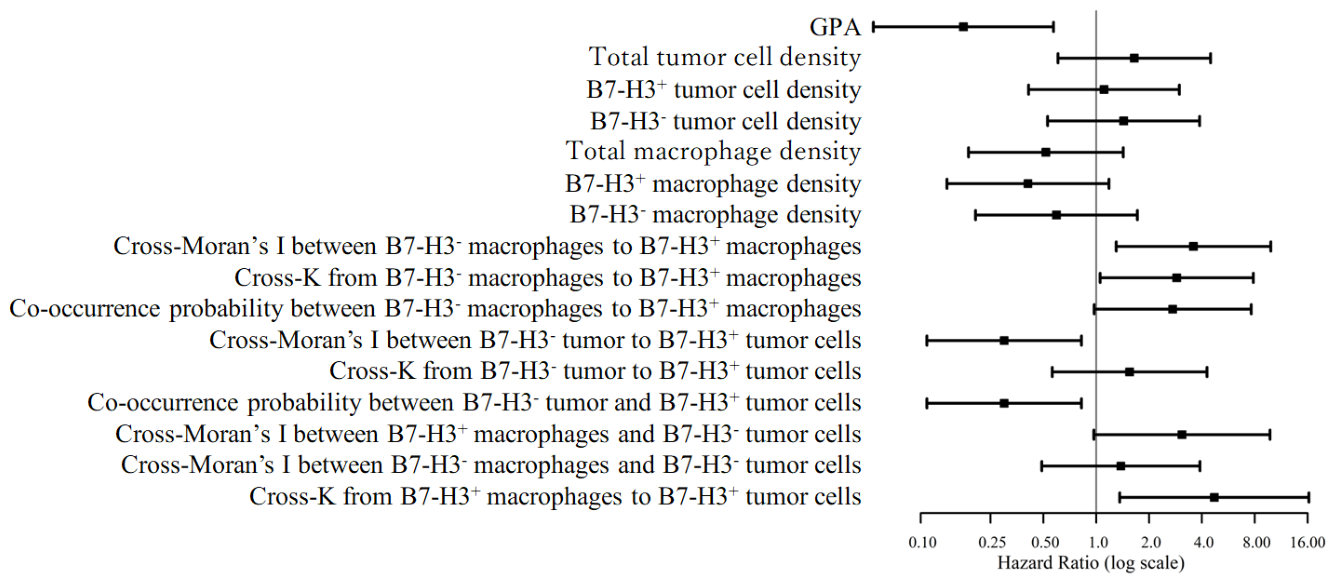
Figure 4.
Prognostic stratification of postoperative overall survival (OS) using clinical and spatial metrics. Time-dependent receiver operating characteristic (ROC) curves (left) and corresponding Kaplan-Meier survival curves (right) illustrating the prognostic stratification of the cohort. The optimal cutoff thresholds for each metric were established using ROC curve analysis evaluated at the median postoperative OS. Patient groups were subsequently dichotomized into ‘High’ and ‘Low’ group to assess differences in OS. The evaluated metrics include the clinical (A) Graded Prognostic Assessment (GPA) score, and spatial interaction parameters: (B) cross-Moran’s I between B7-H3+ and B7-H3- TAMs, (C) cross-K function from B7-H3- TAMs to B7-H3+ TAMs, (D) cross-Moran’s I between B7-H3+ and B7-H3- tumor cells and (E) co-occurrence probability between B7-H3+ and B7-H3- tumor cells. Statistical significance between stratified groups was determined using the log-rank test (* p < 0.05, ** p < 0.01).
Figure 4.
Prognostic stratification of postoperative overall survival (OS) using clinical and spatial metrics. Time-dependent receiver operating characteristic (ROC) curves (left) and corresponding Kaplan-Meier survival curves (right) illustrating the prognostic stratification of the cohort. The optimal cutoff thresholds for each metric were established using ROC curve analysis evaluated at the median postoperative OS. Patient groups were subsequently dichotomized into ‘High’ and ‘Low’ group to assess differences in OS. The evaluated metrics include the clinical (A) Graded Prognostic Assessment (GPA) score, and spatial interaction parameters: (B) cross-Moran’s I between B7-H3+ and B7-H3- TAMs, (C) cross-K function from B7-H3- TAMs to B7-H3+ TAMs, (D) cross-Moran’s I between B7-H3+ and B7-H3- tumor cells and (E) co-occurrence probability between B7-H3+ and B7-H3- tumor cells. Statistical significance between stratified groups was determined using the log-rank test (* p < 0.05, ** p < 0.01).
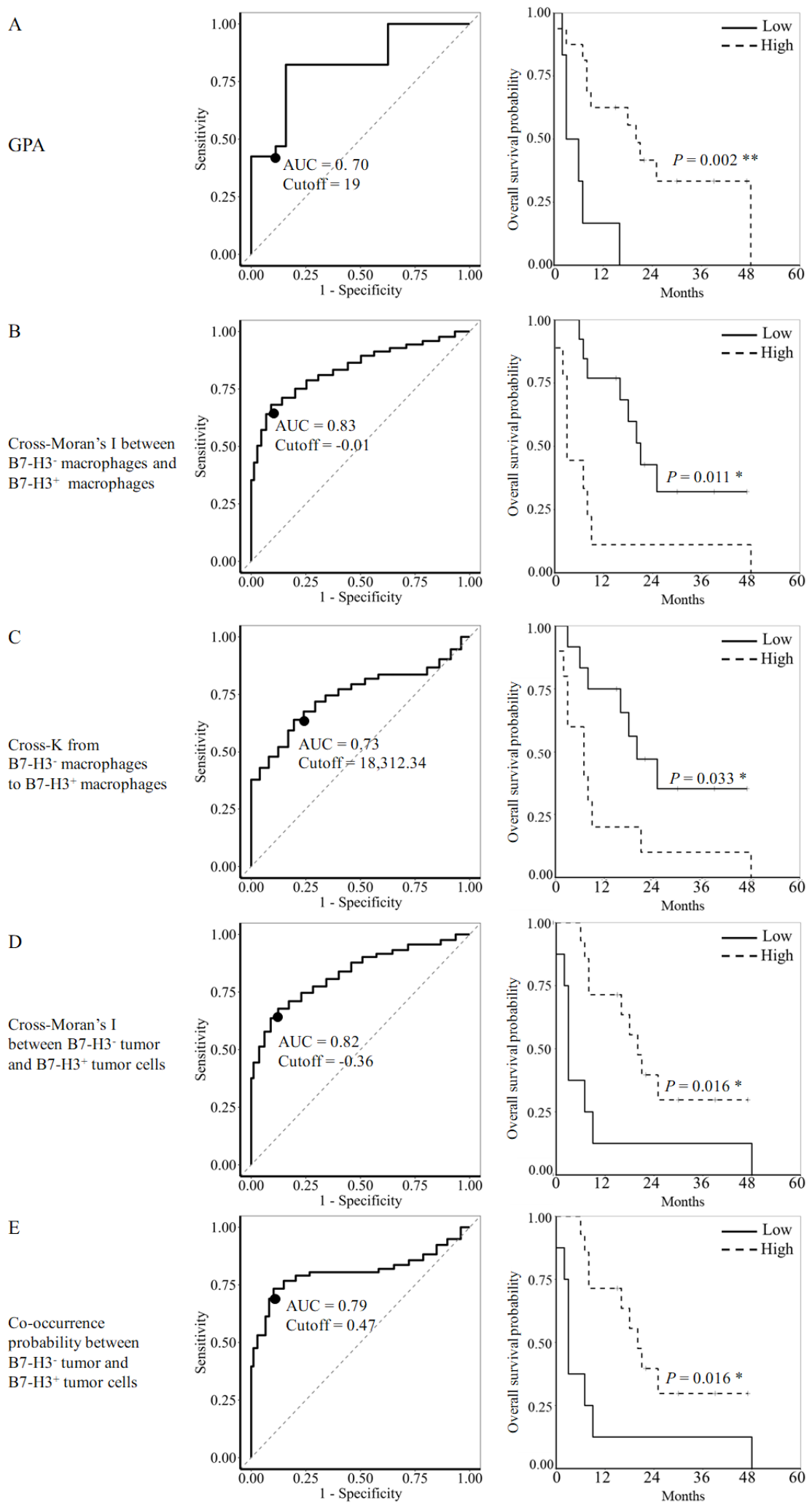
Table 3.
Time-dependent receiver operating characteristic (ROC) curve analysis of clinical, cell density, and spatial metrics for postoperative overall survival (OS). Determination of prognostic cutoff values using time-dependent ROC curve analysis evaluated at the median postoperative OS. The table presents the Area Under the Curve (AUC), optimal cutoff threshold, sensitivity, specificity, and Youden Index for the Graded Prognostic Assessment (GPA) score, simple cell density metrics, and spatial interaction metrics. Corresponding Hazard Ratios (HR) with 95% Confidence Intervals (CI) and p-values derived from univariate Cox proportional hazards analysis are also shown (* p < 0.05, ** p < 0.01). AUC, area under the curve; CI, confidence interval; GPA, graded prognostic assessment; HR, hazard ratio; ROC, receiver operating characteristic.
Table 3.
Time-dependent receiver operating characteristic (ROC) curve analysis of clinical, cell density, and spatial metrics for postoperative overall survival (OS). Determination of prognostic cutoff values using time-dependent ROC curve analysis evaluated at the median postoperative OS. The table presents the Area Under the Curve (AUC), optimal cutoff threshold, sensitivity, specificity, and Youden Index for the Graded Prognostic Assessment (GPA) score, simple cell density metrics, and spatial interaction metrics. Corresponding Hazard Ratios (HR) with 95% Confidence Intervals (CI) and p-values derived from univariate Cox proportional hazards analysis are also shown (* p < 0.05, ** p < 0.01). AUC, area under the curve; CI, confidence interval; GPA, graded prognostic assessment; HR, hazard ratio; ROC, receiver operating characteristic.
| Markers | AUC | Cutoff | Sensitivity | Specificity | Youden Index | Hazard Ratio (95% CI) | p-Value |
| GPA | 0.7 | 19 | 0.42 | 0.89 | 0.31 | 0.18 (0.05–0.57) | 0.004 ** |
| Total tumor cell density | 0.71 | 4,293.31 | 0.6 | 0.75 | 0.35 | 1.65 (0.61–4.47) | 0.329 |
| B7-H3+ tumor cell density | 0.71 | 2,056.13 | 0.64 | 0.64 | 0.28 | 1.11 (0.41–2.98) | 0.84 |
| B7-H3- tumor cell density | 0.67 | 1,455.27 | 0.69 | 0.6 | 0.29 | 1.43 (0.53–3.88) | 0.48 |
| Total macrophage density | 0.81 | 1,161.91 | 0.79 | 0.7 | 0.5 | 0.52 (0.19–1.43) | 0.202 |
| B7-H3+ macrophage density | 0.8 | 630.13 | 0.85 | 0.66 | 0.5 | 0.41 (0.14–1.18) | 0.099 * |
| B7-H3- macrophage density | 0.72 | 812.95 | 0.8 | 0.52 | 0.32 | 0.59 (0.21–1.72) | 0.336 |
| Cross-Moran’s I between B7-H3- macrophages to B7-H3+ macrophages | 0.83 | -0.01 | 0.64 | 0.91 | 0.55 | 3.58 (1.30–9.87) | 0.014 * |
| Cross-K from B7-H3- macrophages to B7-H3+ macrophages | 0.73 | 18,312.34 | 0.64 | 0.76 | 0.4 | 2.87 (1.05–7.85) | 0.039 * |
| Co-occurrence probability between B7-H3- macrophages to B7-H3+ macrophages | 0.77 | 1.95 | 0.5 | 0.95 | 0.45 | 2.72 (0.97–7.63) | 0.057 |
| Cross-Moran’s I between B7-H3- tumor to B7-H3+ tumor cells | 0.82 | -0.36 | 0.64 | 0.88 | 0.51 | 0.30 (0.11–0.82) | 0.02 * |
| Cross-K from B7-H3- tumor to B7-H3+ tumor cells | 0.61 | 6,404.21 | 0.4 | 0.83 | 0.24 | 1.55 (0.56–4.27) | 0.398 |
| Co-occurrence probability between B7-H3- tumor and B7-H3+ tumor cells | 0.79 | 0.47 | 0.69 | 0.9 | 0.59 | 0.30 (0.11–0.82) | 0.02 * |
| Cross-Moran’s I between B7-H3+ macrophages and B7-H3- tumor cells | 0.59 | -0.16 | 0.27 | 0.91 | 0.18 | 3.08 (0.97–9.78) | 0.056 |
| Cross-Moran’s I between B7-H3- macrophages and B7-H3- tumor cells | 0.6 | -0.32 | 0.39 | 0.82 | 0.2 | 1.38 (0.49–3.90) | 0.542 |
Disclaimer/Publisher’s Note: The statements, opinions and data contained in all publications are solely those of the individual author(s) and contributor(s) and not of MDPI and/or the editor(s). MDPI and/or the editor(s) disclaim responsibility for any injury to people or property resulting from any ideas, methods, instructions or products referred to in the content. |
© 2026 by the authors. Licensee MDPI, Basel, Switzerland. This article is an open access article distributed under the terms and conditions of the Creative Commons Attribution (CC BY) license (http://creativecommons.org/licenses/by/4.0/).
Copyright: This open access article is published under a Creative Commons CC BY 4.0 license, which permit the free download, distribution, and reuse, provided that the author and preprint are cited in any reuse.


