

Submitted:
06 June 2026
Posted:
09 June 2026
You are already at the latest version
Abstract
Climate change is increasingly threatening the foundations of safe healthcare delivery and challenging the effectiveness of conventional infection prevention and control (IPC) programs. Rising temperatures, floods, droughts, storms, wildfires, and other climate-related hazards can disrupt water, sanitation, and hygiene (WASH) services, damage healthcare infrastructure, compromise ventilation and sterilization systems, overwhelm healthcare facilities, and increase the risk of healthcare-associated infections (HAIs) and antimicrobial resistance (AMR). These challenges are particularly pronounced in low- and middle-income countries, where healthcare systems often have limited adaptive capacity. This commentary examines the implications of climate change for IPC and proposes a framework for climate-resilient IPC. Key elements include contingency planning for WASH services, infrastructure risk mapping, climate-integrated HAI surveillance, workforce preparedness, sustainable and green IPC technologies, and adoption of a One Health approach. Infrastructure risk mapping can help healthcare facilities identify vulnerabilities, anticipate cascading failures, and prioritize adaptation measures. Climate-informed surveillance systems can integrate environmental and meteorological indicators with epidemiological data to support early warning and proactive interventions. Sustainable IPC technologies offer opportunities to enhance resilience while reducing environmental impacts. The commentary also highlights the ethical, equity, governance, and financing dimensions of climate-resilient IPC and emphasizes the need for stronger integration of IPC into climate adaptation policies, health-system planning, and health security frameworks. Climate-resilient IPC represents a practical and necessary evolution of conventional IPC, enabling healthcare systems to anticipate, withstand, and recover from climate-related disruptions while maintaining safe care. Reframing IPC as a climate-smart, resilient, and One Health-oriented discipline is essential for protecting patients, healthcare workers, and communities in an increasingly unstable climate.
Keywords:
climate change
; infection prevention and control
; healthcare-associated infections
; antimicrobial resistance
; one health
; climate resilience
; health systems
; WASH
; surveillance
; healthcare sustainability
Introduction
Infection prevention and control (IPC) is one of the most effective and cost-efficient strategies for protecting patients, healthcare workers (HCWs), and communities from healthcare-associated infections (HAIs) and antimicrobial resistance (AMR). Over recent decades, IPC programs have achieved substantial gains through improved hand hygiene (HH), environmental cleaning, sterilization and disinfection practices, surveillance systems, and antimicrobial stewardship (AMS). However, these achievements are increasingly threatened by climate change, which is emerging as one of the greatest challenges to health systems in the twenty-first century [1,2,3,4].
IPC frameworks were largely developed under assumptions of environmental stability, reliable infrastructure, uninterrupted water and energy supplies, predictable patient flow, and functioning healthcare systems (HCSs). These assumptions are becoming increasingly invalid. Climate change is reshaping the operational environment of healthcare facilities through rising temperatures, extreme weather events, flooding, droughts, storms, wildfires, and sea-level rise which can disrupt IPC essential tools [1,2,3,4,10,11,12]. Climate-related disruptions can rapidly erode these foundations, increasing the risk of HAIs, facilitating transmission of multidrug-resistant organisms (MROs), and undermining patient safety. These risks are particularly acute in low- and middle-income countries (LMICs), where health systems often operate with limited redundancy and resources [9,10]. Climate change also influences infectious disease (ID) epidemiology through alterations in temperature, humidity, precipitation patterns, environmental contamination, and population displacement. These changes affect pathogen survival, transmission dynamics, healthcare utilization, and antimicrobial resistance AR) patterns, creating new challenges for IPC programs. [2,11,15].
This evolving reality demands a paradigm shift from conventional IPC toward climate-resilient IPC. Climate-resilient IPC extends beyond traditional infection prevention measures by integrating climate adaptation, infrastructure resilience, environmental sustainability, preparedness planning, and One Health (OH) principles. It recognizes that HAIs can no longer be separated from broader environmental, climatic, and societal determinants of health.
This commentary argues that climate-resilient IPC is no longer optional but essential. It examines how climate hazards threaten healthcare delivery and IPC systems, outlines the core elements of climate-resilient IPC, and discusses the governance, financing, ethical, and policy actions required to strengthen healthcare resilience in an era of climate instability.
Climate Crisis and Healthcare Vulnerability
Climate change acts as a systemic risk multiplier, destabilizing the environmental and infrastructural conditions required for safe healthcare delivery. [1,2,3,4,9,10,11].
Healthcare facilities (HCFs) are uniquely vulnerable because they must continue operating during emergencies. Unlike many sectors that can suspend activities during climate disasters, hospitals must remain functional precisely when demand for care increases. Climate-related emergencies often generate surges of trauma cases, ID, vulnerable populations, and displaced communities, all of which place additional pressure on already strained healthcare systems. When critical infrastructure fails, IPC rapidly becomes compromised, increasing the risk of HAIs and adverse patient outcomes [9,10].
Climate hazards are already affecting HCSs worldwide. Extreme heatwaves across Europe, the Middle East, South Asia, and North America have disrupted cooling systems, increased HCWs fatigue, and strained ventilation capacity in HCFs [2,3,4]. Flooding remains among the most disruptive hazards, damaging infrastructure, contaminating water supplies, overwhelming sanitation systems, and impairing Water, Sanitation, and Hygiene (WASH)-dependent IPC measures [5]. Drought and water scarcity increasingly threaten healthcare delivery in East Africa, the Horn of Africa, the Middle East, and parts of Latin America, directly compromising HH, environmental cleaning, sterilization services, and sanitation systems [8,12]. Cyclones, hurricanes, and severe storms disrupt HCSs through power outages, infrastructure damage, population displacement, and overcrowding [2]. Wildfires and dust storms further challenge HCSs by degrading air quality, impairing ventilation systems, and increasing respiratory disease burdens [3,8].
Importantly, climate hazards rarely occur in isolation. Compound and cascading events—such as heatwaves combined with power outages or floods followed by ID outbreaks—can amplify healthcare vulnerabilities and overwhelm existing preparedness measures. These impacts disproportionately affect LMICs, conflict-affected settings, informal settlements, and other vulnerable populations, further widening existing health inequities [16,17,18]. Climate-resilient IPC must therefore be viewed not only as a technical infection prevention strategy but also as an essential adaptation measure for protecting healthcare delivery under increasingly unstable environmental conditions.
Elements of Climate-Resilient IPC
Climate-resilient IPC requires a transition from static infection prevention measures toward adaptive systems capable of anticipating, absorbing, and responding to climate-related disruptions. Five interconnected elements are central to this transformation:
First, contingency planning for WASH services must be embedded within IPC programs. Reliable access to safe water, sanitation, hygiene facilities, and waste management systems remains the foundation of infection prevention. HCFs should establish backup water supplies, on-site purification capacity, emergency sanitation arrangements, alternative disinfection methods, and strategic stockpiles of essential IPC materials. These measures should be integrated with local disaster preparedness and municipal emergency response plans to ensure priority restoration of critical services during crises [9,10].
Second, HCFs must systematically assess climate-related risks to infrastructure and essential services. This is achieved by implementing infrastructure risk mapping [1,20].
Third, surveillance systems should evolve beyond traditional retrospective monitoring toward climate-informed surveillance approaches. So, epidemiological data should be integrated with environmental and meteorological indicators [12,15].
Fourth, workforce preparedness must become a core component of climate-resilient IPC. Healthcare workers require training not only in standard IPC practices but also in managing climate-related disruptions, adapting procedures during emergencies, maintaining safe care under resource constraints, and responding to emerging infectious disease threats associated with environmental change.
Finally, climate-resilient IPC must embrace a OH perspective. Climate change affects human, animal, and environmental health simultaneously, influencing pathogen ecology, AMR, water quality, food systems, and disease transmission pathways. Effective IPC therefore requires collaboration across sectors and alignment with broader efforts in environmental surveillance, AMR containment, water safety, and public health preparedness [15,19,22].
Climate-resilient IPC should therefore be viewed as a practical operational expression of the OH approach, translating the interconnectedness of human, animal, and environmental health into concrete actions that protect patients, HCWs, and communities.
Infrastructure Risk Mapping: From Theory to Practice
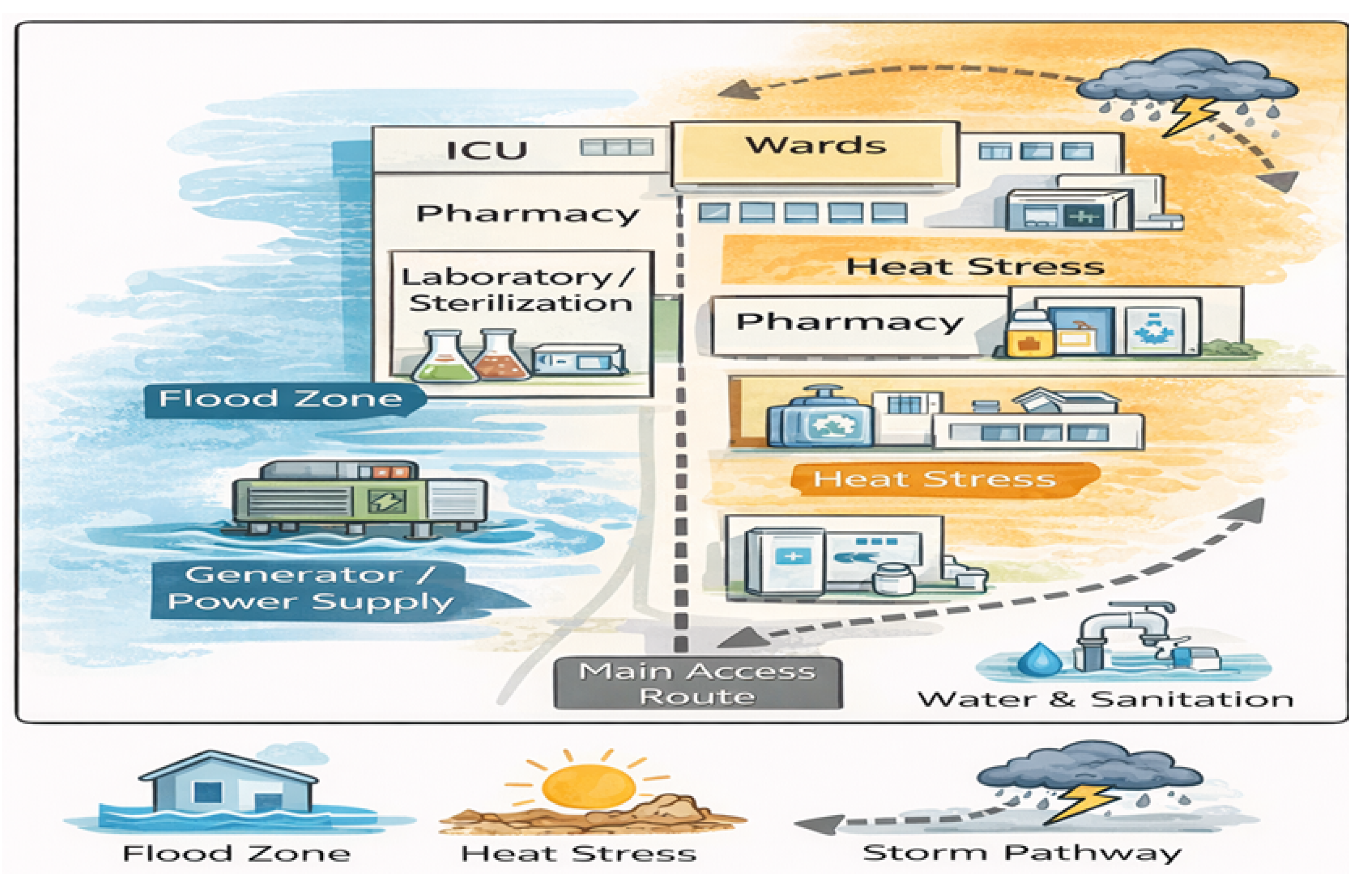
Infrastructure risk mapping helps HCFs identify vulnerabilities and anticipated cascading failures before climate-related disruptions compromise healthcare delivery and IPC performance [1,11,20]. Infrastructure risk mapping can be implemented through simple, structured, and actionable methods that are feasible even in resource-constrained settings. A practical starting point is a concise assessment tool for hospital leadership and IPC teams to identify infrastructures essential for safe care, including water and sanitation systems, power supplies, ventilation networks, laboratories, sterilization services, waste management facilities, communication systems, and transportation routes for patients, staff, and medical supplies [9,10]. The next step involves integrating locally relevant climate hazard information, such as flood-risk zones, heat-stress projections, drought exposure, storm pathways, and wildfire risk maps obtained from meteorological agencies and civil protection authorities. Overlaying these hazards onto hospital layouts allows visualization of exposure, interdependencies, and potential points of failure. Using hazard–exposure–vulnerability–criticality (HEVC) scoring, facilities can prioritize assets according to both their likelihood of disruption and the consequences of failure for healthcare delivery and IPC performance [1,19], figure.
Extending risk assessments beyond individual assets to identify cascading failure pathways provides a more comprehensive understanding of climate-related vulnerabilities and their potential consequences. For example, flooding of a backup generator may disrupt ventilation systems, operating theatres, cold-chain storage, and surveillance functions, while damaged transportation routes can delay patient access, hinder supply delivery, increase overcrowding, and compromise routine IPC practices. Understanding these interconnections supports prioritization of high-risk scenarios and targeted mitigation planning [1,12,20]. Adaptation measures could thus be proposed, e.g., including elevating backup generators above projected flood levels, installing emergency water storage and purification systems, strengthening drainage infrastructure, ensuring redundancy in critical services such as ventilation and sterilization, and identifying alternative access routes during emergencies. When integrated into routine IPC governance and periodically updated, infrastructure risk mapping transforms climate risks into actionable strategies that enhance healthcare resilience and ensure continuity of safe care [1,9,20].
Figure 1.
By linking epidemiological, environmental, and climate data, HCFs can better anticipate disruptions that increase the risk of HAIs and AMR. Climate-related hazards influence pathogen survival, transmission dynamics, healthcare utilization patterns, and environmental contamination. Flooding, for example, can damage water and sanitation infrastructure, increase patient crowding, contaminate healthcare environments, and facilitate the spread of MROs such as Acinetobacter spp. and Klebsiella spp. Similarly, heatwaves may compromise ventilation systems, increase healthcare demand, and place additional strain on IPC measures [5,12,15]. Climate-integrated surveillance supports the development of early warning systems capable of identifying high-risk periods before infection surges occur, which can guide targeted interventions, including intensified environmental cleaning, reinforcement of HH programs, optimization of ventilation systems, enhanced AMS activities, and strategic allocation of IPC resources during climate-related emergencies. [1,12,15].
Figure 1.
By linking epidemiological, environmental, and climate data, HCFs can better anticipate disruptions that increase the risk of HAIs and AMR. Climate-related hazards influence pathogen survival, transmission dynamics, healthcare utilization patterns, and environmental contamination. Flooding, for example, can damage water and sanitation infrastructure, increase patient crowding, contaminate healthcare environments, and facilitate the spread of MROs such as Acinetobacter spp. and Klebsiella spp. Similarly, heatwaves may compromise ventilation systems, increase healthcare demand, and place additional strain on IPC measures [5,12,15]. Climate-integrated surveillance supports the development of early warning systems capable of identifying high-risk periods before infection surges occur, which can guide targeted interventions, including intensified environmental cleaning, reinforcement of HH programs, optimization of ventilation systems, enhanced AMS activities, and strategic allocation of IPC resources during climate-related emergencies. [1,12,15].
Advances in digital health technologies further strengthen this approach. Integration of meteorological forecasting, electronic health records, environmental monitoring systems, geospatial analysis, artificial intelligence, and real-time reporting platforms can improve situational awareness and support timely decision-making.
Sustainable and Green IPC Technologies: Resilience with Co-Benefits
Climate-resilient IPC must not only withstand environmental shocks but also contribute to environmentally sustainable healthcare. The healthcare sector is responsible for a substantial environmental footprint, including greenhouse-gas (GHG) emissions, energy consumption, water use, and waste generation. Many HCFs, particularly in LMICs, rely on resource-intensive technologies that increase both environmental impacts and vulnerability to climate-related disruptions [9,19,21]. Climate-smart IPC offers an opportunity to enhance resilience while reducing environmental burdens through renewable energy, energy-efficient sterilization, water-saving technologies, alternative water sources, and sustainable waste management practices. Environmentally preferable IPC products, improved waste segregation, and natural or hybrid ventilation systems can further reduce ecological impacts while maintaining patient safety and essential IPC and WASH functions during climate-related emergencies [9,11,22]. Successful implementation of such approaches in several LMIC settings has demonstrated that sustainability and resilience are complementary rather than competing objectives. Investments in green IPC technologies can reduce operating costs, strengthen continuity of care during emergencies, and increase community confidence in healthcare services. To maximize these benefits, sustainability considerations should be incorporated into procurement policies, health technology assessments, infrastructure planning, and essential equipment lists, with emphasis on locally maintainable and context-appropriate solutions [9,19,21].
Ethical Imperatives and Equity Considerations
The consequences of climate-related IPC failures extend beyond operational challenges; they raise profound ethical and equity concerns. Climate change disproportionately affects populations that contribute least to global GHGs emissions while simultaneously exacerbating existing social, economic, and health inequities [16,17,18].
When climate-related disruptions compromise water supplies, sanitation systems, sterilization services, or healthcare infrastructure, the burden falls most heavily on vulnerable populations. Neonates, older adults, pregnant women, immunocompromised individuals, displaced populations, refugees, and people living in poverty are particularly susceptible to HAIs and adverse outcomes during periods of healthcare disruption. In many settings, climate hazards may further limit access to care, delay treatment, and increase exposure to infectious diseases [16,17,18]. HCWs also face increased risks. Climate-related emergencies often occur under conditions of staff shortages, resource constraints, and heightened patient demand. The inability to maintain safe standards of care may contribute to occupational exposures, psychological stress, burnout, and moral distress among healthcare personnel. Protecting HCWs is therefore an essential component of climate-resilient IPC [9,12].
From an ethical perspective, access to safe healthcare should not depend on geography, socioeconomic status, or climate vulnerability. Ensuring resilient IPC systems is therefore not only a technical necessity but also a matter of health equity, social justice, and human rights. Investments in climate-resilient IPC should prioritize populations and HCSs facing the greatest risks while promoting equitable access to safe care during both routine operations and emergencies [16,17,18].
Global Alignment and Policy Implications
Climate-resilient IPC aligns closely with existing global frameworks for health security, climate adaptation, and sustainable development. Strengthening IPC resilience directly supports the WHO Operational Framework for Climate-Resilient Health Systems and contributes to achievement of the United Nations Sustainable Development Goals, particularly SDG 3 (Good Health and Well-being), SDG 6 (Clean Water and Sanitation), and SDG 13 (Climate Action) [1,9,20]. Despite these synergies, IPC remains insufficiently represented within many climate-health policies, adaptation plans, and financing mechanisms. National climate adaptation strategies frequently focus on infrastructure, surveillance, and emergency preparedness without explicitly addressing infection prevention. Similarly, many IPC programs continue to operate independently from broader climate adaptation initiatives [1,20]. Greater policy integration is therefore needed. Climate-informed IPC indicators could be incorporated into International Health Regulations monitoring, Joint External Evaluations, national adaptation plans, AMR action plans, and healthcare accreditation standards. Such integration would help institutionalize climate-resilient IPC as a core public-health capability rather than an optional or project-based activity [1,12,20]. International organizations, professional societies, development agencies, and donors also have critical roles to play. Explicit recognition of climate-resilient IPC within global health security agendas would strengthen advocacy efforts, facilitate technical support, and promote investment in adaptation measures that protect both patients and HCWs. Particular attention should be given to LMICs and fragile settings where climate-related health risks are greatest and adaptive capacity is often limited [1,9,20].
Governance, Financing, and Operationalization of Climate-Resilient IPC
Translating climate-resilient IPC from concept to routine practice requires strong governance, sustainable financing, and clear accountability mechanisms. Although both IPC and climate adaptation are recognized public-health priorities, implementation often remains fragmented, underfunded, and poorly coordinated across sectors. National governments need to explicitly incorporate climate-resilient IPC into health-sector strategies, national adaptation plans, AMR action plans, and emergency preparedness frameworks. Dedicated budget allocations are needed to strengthen WASH infrastructure, energy security, surveillance systems, HCF resilience, and workforce capacity. At the facility level, IPC committees are to work closely with engineers, emergency preparedness teams, environmental specialists, and local authorities to ensure that climate risks are systematically incorporated into operational planning and infrastructure investments [1,9,20].
While climate adaptation funding has expanded considerably in recent years, IPC remains largely absent from many climate-health funding portfolios. Explicit inclusion of IPC indicators within climate adaptation funding criteria could unlock resources for resilient healthcare infrastructure, climate-informed surveillance systems, and sustainable IPC technologies. Locally driven innovation, context-specific solutions, and sustainable capacity building represent key investment priorities, particularly in LMICs. [1,20] Operational research represents another critical component of implementation. Evidence linking climate hazards with HAI incidence, MROs outbreaks, IPC disruptions, and healthcare system performance remains limited. Further research is needed to quantify risks, evaluate interventions, assess cost-effectiveness, and identify best practices across diverse settings. Strengthening the evidence base will support policy development, guide investments, and accelerate adoption of climate-resilient IPC strategies [12,13,14,15,20,21,22]. Professional societies, academic institutions, public-health agencies, and international organizations are key drivers of climate-resilient IPC and its integration into health security, universal health coverage, pandemic preparedness, and healthcare quality is crucial. Sustained leadership and cross-sectoral collaboration are essential to achieve measurable gains in patient safety and health-system resilience.
Conclusions
Climate change is increasingly undermining the environmental, infrastructural, and operational foundations of effective IPC, and is creating new risks for healthcare delivery, patient safety, and AMR. As climate-related hazards become more frequent and severe, conventional IPC approaches alone are no longer sufficient to ensure safe care. Climate-resilient IPC provides a practical framework for strengthening preparedness, sustainability, and health-system resilience through adaptive infrastructure, climate-informed surveillance, workforce readiness, and sustainable technologies. Issues should be investigated through a OH lens. These approaches enhance the capacity of HCFs to anticipate, withstand, and recover from climate-related disruptions while maintaining essential IPC functions. Integrating climate-resilient IPC into health policies, adaptation strategies, financing mechanisms, and routine healthcare practice is essential to safeguard continuity of safe care, particularly in climate-vulnerable and resource-constrained settings. Climate-smart IPC is no longer optional; it is a critical component of health-system resilience, health security, and sustainable healthcare in an increasingly unstable climate.
References
- World Health Organization. Operational framework for building climate-resilient health systems; WHO: Geneva, 2015. [Google Scholar]
- Romanello, M.; McGushin, A.; Di Napoli, C.; Drummond, P.; Hughes, N.; Jamart, L.; et al. The 2023 report of the Lancet Countdown on health and climate change: the imperative for a health-centred response. Lancet 2023, 402, 2346–2394. [Google Scholar] [CrossRef] [PubMed]
- McMichael, A.J. Climate change and health: impacts, vulnerability, and mitigation. Lancet 2009, 373, 1666–1669. [Google Scholar] [CrossRef]
- Watts, N.; Amann, M.; Arnell, N.; Ayeb-Karlsson, S.; Belesova, K.; Boykoff, M.; et al. The 2018 report of the Lancet Countdown on health and climate change. Lancet 2018, 392, 2479–2514. [Google Scholar] [CrossRef] [PubMed]
- Intergovernmental Panel on Climate Change. Climate Change 2023: Synthesis Report; IPCC: Geneva, 2023. [Google Scholar]
- Manzoor, A.; Adesola, R.O. Disaster in public health due to flood in Pakistan in 2022. Health Sci. Rep. 2022, 5, e903. [Google Scholar] [CrossRef] [PubMed]
- Kreienkamp, F.; Philip, S.Y.; Tradowsky, J.S.; Kew, S.F.; Lorenz, P.; Arrighi, J.; et al. Rapid attribution of heavy rainfall events in Germany. Nat. Clim. Chang 2021, 11, 1005–1010. [Google Scholar] [CrossRef]
- World Health Organization Regional Office for Africa. Drought, water scarcity and health in the African Region; WHO AFRO: Brazzaville, 2022. [Google Scholar]
- Xu, R.; Yu, P.; Abramson, M.J.; Johnston, F.H.; Samet, J.M.; Bell, M.L.; et al. Wildfires, global climate change, and human health. N Engl. J. Med. 2020, 383, 2173–2181. [Google Scholar] [CrossRef] [PubMed]
- World Health Organization. Climate-resilient and environmentally sustainable health care facilities; WHO: Geneva, 2020. [Google Scholar]
- World Health Organization; UNICEF. WASH in health care facilities: global baseline report 2019; WHO and UNICEF: Geneva, 2019. [Google Scholar]
- World Health Organization. Global report on infection prevention and control; WHO: Geneva, 2022. [Google Scholar]
- Allegranzi, B.; Nejad, S.B.; Combescure, C.; Graafmans, W.; Attar, H.; Donaldson, L.; et al. Burden of endemic healthcare-associated infection in developing countries: systematic review and meta-analysis. Lancet 2011, 377, 228–241. [Google Scholar] [CrossRef] [PubMed]
- Nejad, S.B.; Allegranzi, B.; Syed, S.B.; Ellis, B.; Pittet, D. Health-care-associated infection in Africa: a systematic review. Bull. World Health Organ. 2011, 89, 757–765. [Google Scholar] [CrossRef] [PubMed]
- Semenza, J.C.; Paz, S. Climate change and infectious disease in Europe: impact, projection and adaptation. Lancet Reg. Health Eur. 2021, 9, 100230. [Google Scholar] [CrossRef] [PubMed]
- Ebi, K.L.; Hess, J.J. Health risks due to climate change: inequity in causes and consequences. Health Aff. 2020, 39, 2056–2062. [Google Scholar] [CrossRef] [PubMed]
- Haines, A.; Ebi, K. The imperative for climate action to protect health. N Engl. J. Med. 2019, 380, 263–273. [Google Scholar] [CrossRef] [PubMed]
- Patz, J.A.; Frumkin, H.; Holloway, T.; Vimont, D.J.; Haines, A. Climate change: challenges and opportunities for global health. JAMA 2014, 312, 1565–1580. [Google Scholar] [CrossRef] [PubMed]
- United Nations Environment Programme. Frontiers 2022: Noise, Blazes and Mismatches—Emerging Issues of Environmental Concern; UNEP: Nairobi, 2022. [Google Scholar]
- World Bank. Climate and Health Vulnerability Assessment Guidance; World Bank: Washington, DC, 2021. [Google Scholar]
- Lenzen, M.; Malik, A.; Li, M.; Fry, J.; Weisz, H.; Pichler, P.P.; et al. The environmental footprint of health care: a global assessment. Lancet Planet Health 2020, 4, e271–e279. [Google Scholar] [CrossRef] [PubMed]
- World Health Organization. Global Action Plan on Antimicrobial Resistance; WHO: Geneva, 2015. [Google Scholar]
Disclaimer/Publisher’s Note: The statements, opinions and data contained in all publications are solely those of the individual author(s) and contributor(s) and not of MDPI and/or the editor(s). MDPI and/or the editor(s) disclaim responsibility for any injury to people or property resulting from any ideas, methods, instructions or products referred to in the content. |
© 2026 by the authors. Licensee MDPI, Basel, Switzerland. This article is an open access article distributed under the terms and conditions of the Creative Commons Attribution (CC BY) license (http://creativecommons.org/licenses/by/4.0/).
Copyright: This open access article is published under a Creative Commons CC BY 4.0 license, which permit the free download, distribution, and reuse, provided that the author and preprint are cited in any reuse.