

Submitted:
07 June 2026
Posted:
09 June 2026
You are already at the latest version
Abstract
Background: Nephrogenic diabetes insipidus (NDI) is a rare disorder characterized by renal resistance to arginine vasopressin, most commonly caused by pathogenic variants in the AVPR2 gene. While X-linked NDI classically affects males, heterozygous females may exhibit variable clinical expression. Certain AVPR2 variants are associated with partial NDI and milder phenotypes. Methods: We conducted a retrospective family study of a multigenerational Greek pedigree with suspected hereditary NDI. Clinical, biochemical, and pedigree data were collected through chart review and family interviews. Genetic analysis was performed using whole exome sequencing and variant interpretation followed ACMG/AMP guidelines. Results: Fourteen individuals across four generations were evaluated. Molecular analysis identified a familial AVPR2 (NM_000054.7):c.964C>T (p.Pro322Ser) missense variant in three males and three females, with heterozygous status suspected in two deceased females, segregating in an X-linked pattern. Hemizygous males exhibited a broad phenotypic spectrum, ranging from partial NDI with later onset to severe early-onset disease with urinary tract complications. Heterozygous females showed variable expression, from asymptomatic carriers to mildly symptomatic individuals. The variant co-segregated with disease and, based on ACMG criteria, it was classified as pathogenic. Conclusions: This study expands the phenotypic spectrum associated with the AVPR2 p.Pro322Ser variant and highlights marked intrafamilial variability in both hemizygous males and heterozygous females. These findings underscore the role of modifying factors in disease expression and emphasize the importance of genetic diagnosis for early management and family counseling in NDI.
Keywords:
nephrogenic diabetes insipidus
; NDI
; AVPR2
; Pro322Ser
; phenotypic variability
Introduction
Nephrogenic diabetes insipidus (NDI) is characterized by renal resistance to antidiuretic hormone (ADH; also named arginine vasopressin or AVP), leading to an inability to concentrate urine despite normal or elevated circulating ADH levels. Primary forms of NDI result from alterations in the genes that encode the key proteins AVPR2 and AQP2, whereas secondary forms have been associated with biochemical abnormalities such as hypokalemia and hypercalciuria [1,2], obstructive uropathy [3,4] or the use of certain medications, particularly lithium [5]. Most patients with congenital NDI present with failure to thrive and vomiting during the first year of life, whereas those with acquired NDI typically present later in life with polyuria and/or polydipsia. Laboratory investigations reveal the typical picture of hypernatremic dehydration with inappropriately dilute urine and dilatation of the urinary tract is a recurrently noted complication of NDI, especially for the patients with poor voiding [6].
Approximately 90% of hereditary NDI is caused by alterations in AVPR2 gene, which is located on chromosome region Xq28, while most of the remaining cases are due to AQP2 variants, which is located on chromosome 1 [7,8]. To date most than 300 different AVPR2 mutations have been described [9,10]. The AVPR2 gene encodes the vasopressin V2 receptor, which is primarily expressed in collecting duct principal cells of the kidney. Binding of vasopressin to this receptor activates cAMP-dependent signaling and promotes aquaporin-2 trafficking to the apical membrane, thereby increasing water reabsorption. Loss-of-function variants in AVPR2 impair this process and cause X-linked NDI.
Although X-linked NDI caused by AVPR2 variants classically affects males, heterozygous females may be asymptomatic or exhibit variable degrees of polyuria and polydipsia, likely due to skewed X-chromosome inactivation. In addition, certain AVPR2 changes are associated with partial NDI, when kidney tubules show partial resistance to AVP, resulting in a milder or later-onset clinical presentation [11]. The p.Pro322Ser variant has been previously linked to partial NDI phenotype with normal urinary osmolality in affected individuals [12].
Here, we describe a Greek family with X-linked NDI associated with the AVPR2 NM_000054.7:c.964C>T (p.Pro322Ser) variant, highlighting the marked intrafamilial phenotypic variability observed across generations.
Methods
This was a retrospective family study based on clinical records and genetic testing of available family members. Demographic, clinical and pedigree data were obtained through chart review and family interview. Collected variables included year of birth, age at presentation, clinical presentation, laboratory findings and any evidence of urinary tract complications. Genetic analysis was performed in the Nephrology Lab of the University of Crete, Greece. The study has been approved by the ethics committee of the University Hospital of Heraklion with a protocol number 2529/17-6-2015 (Approval date 17 June 2015) and performed in accordance with the ethical standards as laid down in the 1964 Declaration of Helsinki and its later amendments or comparable ethical standards. Written informed consent to participate was obtained from all of the adult participants and the parents or legal guardians of any participant under the age of 16.
Clinical and laboratory data were extracted anonymously and genetic investigation was performed using Whole Exome Sequencing (WES). More specifically, genomic DNA was extracted from peripheral blood specimens and submitted to Macrogen Europe (Amsterdam, The Netherlands) for whole exome sequencing. Exome capture was performed using a hybridization-based enrichment kit and sequencing was conducted on an Illumina platform with high-depth coverage. Sequencing reads were aligned to the GRCh38 human reference genome and variant calling for single nucleotide variants (SNVs) and small insertions/deletions (indels) was performed. Functional annotation of the variants was carried out by Macrogen Europe.
Bioinformatics analysis was conducted through Franklin by Genoox platform and variant interpretation was performed according to American College of Medical Genetics and Genomics (ACMG) guidelines [13], integrating phenotype, segregation, prior literature, functional data and public database information. The identified variant has been submitted to ClinVar and is publicly available under submission ID SUB16097905 and accession number SCV007539121 (University of Crete, Nephrology Department).
Results
Pedigree and Family Overview
The study cohort comprised 14 individuals from four generations, including hemizygous affected males, heterozygous females with variable phenotypic expression, and unaffected relatives who underwent clinical and/or genetic evaluation. The pedigree was consistent with X-linked inheritance [Figure 1]. Molecular analysis identified the AVPR2 (NM_000054.7): c.964C>T variant segregating within the family, predicted to result in the p.Pro322Ser substitution. Genetic findings correlated with a heterogeneous clinical presentation, ranging from asymptomatic carriers to severely affected individuals with significant polyuria, electrolyte disturbances, and lower urinary tract complications [Table 1]. The maternal grandmother (I-1) reportedly had a history of kidney disease, although no molecular data were available. Her second daughter (II-2) had longstanding polyuria and is presumed to be an obligate heterozygote based on the presence of one affected son (III-4) and two carrier daughters (III-2 and III-3). In the subsequent generation, two males (IV-3 and IV-5) were affected, one female (IV-7) was a heterozygous symptomatic carrier, and the remaining individuals were unaffected.
Individual Descriptions
I-1, a female born in 1927 and died in 1995, was reported to have a history of unclear renal disease with no molecular analysis performed.
II-1, a female born in 1952, was asymptomatic and died in 2025 with no kidney pathology. II-3, a female born in 1955 and died in 2023, has a longstanding history of mild polyuria and polydipsia since the age of 15 years, with a daily fluid intake of approximately 4 L, in the absence of electrolyte disturbances, renal impairment or treatment requirements. None of the females in generation II were genetically tested.
III-1, a male born in 1971, was asymptomatic and found to be negative for the identified variant following genetic testing prompted by the history of affected relatives. III-2 and III-3, females born in 1972 and 1975, respectively, were both asymptomatic and found to be heterozygous carriers of the variant. III-4, a male born in 1980, had a clinical diagnosis of NDI at the age of 8 years, with a daily water intake of approximetely 11 L, hypernatremia with inappropriately diluted urine, hypokalaemia and no other electrolyte disturbances, renal impairement or urinary tract complications. He was found to be hemizygous for the AVPR2 c.964C>T variant and remains stable on thiazide diuretics, potassium supplementation, and a low-salt diet.
IV-3, a male born in 1997, was diagnosed with NDI at the age of 5 years. He had a daily water intake of approximetely 12 L, hypernatremia with inappropriately diluted urine, hypokalaemia and no other electrolyte disturbances, renal impairement or urinary tract complications. Genetic analysis revealed hemizygosity for the detected variant and he remains stable on thiazide diuretics, potassium supplements and a low-salt diet. IV-5, a male born in 2007, presented with a severe NDI phenotype during the first year of life characterized by failure to thrive and recurrent episodes of dehydration. This was followed by excessive polyuria and polydipsia, recurrent hypokalemia and a daily fluid intake of approximately 13 L. He developed secondary pelvicalyceal dilatation and required a Mitrofanoff procedure, with bladder catheterization performed five times daily, while maintaining intermittent spontaneous voiding between catheterizations. Genetic test confirmed the segregated variant and he remains stable with unimpaired renal function on thiazide diuretics, potassium supplements and a low-salt diet. IV-7, a female born in 2021, underwent genetic testing due to her affected father and was identified as a heterozygous carrier. Despite this, she was reported to have mild polyuria and polydipsia from the age of 2 years, with an estimated daily fluid intake of 3 L/m², without other complications. IV-1, IV-2, IV-4 and IV-6, a female born in 1992, a female born in 1996, a male born in 1999 and a male born in 2025, respectively, were asymptomatic and found to be negative for the detected variant following genetic testing prompted by the history of affected relatives.
Genetic Findings and Variant Interpretation
Molecular analysis identified a familial AVPR2 (NM_000054.7):c.964C>T missense variant, inherited in an X-linked pattern and predicted to result in the p.Pro322Ser amino acid substitution. The variant co-segregated with disease within the family and was associated with variable phenotypic expression among both hemizygous males and heterozygous females. The detected variant is not currently listed in the ClinVar database [10]; nevertheless, the p.Pro322Ser substitution has previously been suggested as causative in a Japanese family with a mild NDI phenotype [14].
According to ACMG/AMP guidelines [13], the variant was classified as pathogenic. This classification is supported by its absence from gnomAD population databases (exomes coverage 64.1% and genomes coverage 22.9%) [15], its deleterious effect on the gene according to computational prediction tools [15], the p.Pro322Ser deleterious effect based on previous functional studies [16], the evidence of other pathogenic missense changes at the same codon [AVPR2:c.964C>A (p.Pro322Thr) and AVPR2:c.965C>T (p.Pro322Leu)] [10], the strong co-segregation with disease in all the affected family members from 2 generations and a phenotype highly specific for AVPR2-related NDI [table 2]. In line with the above, the variant fulfills 1 strong and 3 moderate ACMG criteria, consistent with classification as pathogenic.
Discussion
In this study, we describe a multigenerational Greek family with X-linked NDI associated with the AVPR2 (NM_000054.7):c.964C>T (p.Pro322Ser) variant. The variant demonstrated clear co-segregation with disease across affected family members and was associated with a wide range of disease severity, from asymptomatic heterozygous carriers to severely affected males with early-onset disease and urinary tract complications. These findings expand the clinical spectrum associated with this variant and provide further evidence supporting its pathogenic role.
Two of the three affected males (III-4 and IV-3) presented beyond infancy with normal development, consistent with partial NDI. This aligns with previous studies, in which p.Pro322Ser was associated with a milder clinical NDI phenotype [14] and partial preservation of cAMP-dependent signaling compared to other vasopressin V2 receptor mutants [16]. The third affected male (IV-5) had a severe early-onset disease complicated by urinary tract dilatation and required bladder catheterization on top of spontaneous voiding. This considerable intrafamilial phenotypic variability hasn’t been previously reported in males harbouring the p.Pro322Ser variant and suggests the potential contribution of additional genetic, epigenetic or environmental modifiers influencing disease severity.
Heterozygous females demonstrated variable clinical expression, ranging from completely asymptomatic to mildly symptomatic individuals presenting with polyuria from early childhood or adolescence. This variability is most likely explained by skewed X-chromosome inactivation, which can lead to preferential expression of the mutant allele in renal collecting duct cells. Although X-linked NDI classically affects males, symptomatic female carriers have already been reported, with some cases exhibiting a phenotype consistent with complete rather than partial NDI [17,18]. The evidence of symptomatic heterozygous females highlights the importance of careful clinical evaluation and long-term follow-up in female carriers, who are often considered unaffected.
The classification of the c.964C>T variant as pathogenic is supported by multiple lines of evidence, as shown above. The strength of segregation observed in this family represents a particularly important contribution, as large multigenerational pedigrees are relatively uncommon in rare genetic disorders and provide robust evidence for variant pathogenicity. From a clinical perspective, our findings underscore the importance of early recognition and management of NDI, particularly in preventing complications such as dehydration, electrolyte disturbances and urinary tract dilatation. The severe phenotype observed in one individual highlights the potential long-term consequences of uncontrolled polyuria and emphasizes the need for close monitoring. Furthermore, identification of the causative variant enables targeted genetic counseling, early diagnosis in at-risk individuals and appropriate management strategies.
This study has several limitations. Functional characterization of the variant was not performed, and conclusions regarding its molecular effects are based on previously published data for similar variants. In addition, the study is limited to a single family and further reports in independent cohorts would strengthen the evidence supporting pathogenicity.
Conclusion
In conclusion, we report a multigenerational family with X-linked nephrogenic diabetes insipidus associated with the AVPR2 c.964C>T (p.Pro322Ser) variant, demonstrating strong co-segregation with disease and notable intrafamilial phenotypic variability. Our findings expand the clinical spectrum associated with this substitution and highlight the importance of considering variable expression in both hemizygous males and heterozygous females. These results further support the pathogenic role of this variant and emphasize the value of detailed family-based studies in improving genotype-phenotype correlations in rare genetic disorders.
Author Contributions
Study conception and design: K.V, I.P. and K.S.; data acquisition: ED, CP, AA, DL, EKD, AA, NP; analysis and interpretation of data: K.V.; drafting of manuscript: K.V, I.P.; Revision of manuscript for important intellectual content: K.S. All authors have read and agreed to the published version of the manuscript.
Funding Statement
The genetic analysis was conducted using funds provided by the charity EMEKNNOK, KIDS-CRETE (Kidney Inherited Diseases Research in Crete), VAT 996845022, Kalessa Heraklion 71500, Greece. None of the authors received funding for the preparation and conduction of this project.
Institutional Review Board Statement
The study has been approved by the ethics committee of the University Hospital of Heraklion with a protocol number 2529/17-6-2015 (Approval date 17 June 2015) and performed in accordance with the ethical standards as laid down in the 1964 Declaration of Helsinki and its later amendments or comparable ethical standards.
Informed Consent Statement
Written informed consent to participate was obtained from all of the adult participants and the parents or legal guardians of any participant under the age of 16.
Data Availability Statement
The identified variant has been submitted to ClinVar and is publicly available under submission ID SUB16097905 and accession number SCV007539121 (University of Crete, Nephrology Department).
Conflicts of Interest Statement
The authors declare no conflict of interest.
References
- Hebert, S. C., Brown, E. M. & Harris, H. W. Role of the Ca2+-sensing receptor in divalent mineral ion homeostasis. J. Exp. Biol. 1997; 200, 295–302. [CrossRef]
- Marples, D., Frokiaer, J., Dorup, J., Knepper, M. A. & Nielsen, S. Hypokalemia induced downregulation of aquaporin-2 water channel expression in rat kidney medulla and cortex. J. Clin. Invest. 1996; 97, 1960–1968. [CrossRef]
- Frokiaer J, Marples D, Knepper MA, et al. Bilateral ureteral obstruction downregulates expression of vasopressin-sensitive AQP-2 water channel in rat kidney. Am J Physiol. 1996; 270(4 Pt 2):F657–68. [CrossRef]
- Frokiaer J, Christensen BM, Marples D, et al. Downregulation of aquaporin-2 parallels changes in renal water excretion in unilateral ureteral obstruction. Am J Physiol. 1997;273(2 Pt 2):F213–23. 12. [CrossRef]
- Rej, S., Herrmann, N. & Shulman, K. The effects of lithium on renal function in older adults— a systematic review. J. Geriatr. Psychiatry Neurol. 2012; 25, 51–61. [CrossRef]
- Bockenhauer D, Bichet DG. Pathophysiology, diagnosis and management of nephrogenic diabetes insipidus. Nat Rev Nephrol. 2015;11(10):576-88. [CrossRef]
- Sands, J. M. & Bichet, D. G. Nephrogenic diabetes insipidus. Ann. Intern. Med. 2006; 144, 186–194.
- Wesche, D., Deen, P. M. & Knoers, N. V. Congenital nephrogenic diabetes insipidus: the current state of affairs. Pediatr. Nephrol. 2012; 27, 2183–2204. [CrossRef]
- Spanakis, E., Milord, E. & Gragnoli, C. AVPR2 variants and mutations in nephrogenic diabetes insipidus: review and missense mutation significance. J. Cell Physiol. 2008; 217, 605–617. [CrossRef]
- Melissa J Landrum, Jennifer M Lee, Mark Benson, Garth R Brown, Chen Chao, Shanmuga Chitipiralla, Baoshan Gu, Jennifer Hart, Douglas Hoffman, Wonhee Jang, Karen Karapetyan, Kenneth Katz, Chunlei Liu, Zenith Maddipatla, Adriana Malheiro, Kurt McDaniel, Michael Ovetsky, George Riley, George Zhou, J Bradley Holmes, Brandi L Kattman, Donna R Maglott. ClinVar: improving access to variant interpretations and supporting evidence, Nucleic Acids Research. 2018; Volume 46, Issue D1, Pages D1062–D1067. [CrossRef]
- Bockenhauer, D. et al. Vasopressin type 2 receptor V88M mutation: molecular basis of partial and complete nephrogenic diabetes insipidus. Nephron Physiol. 2010; 114, 1–10. [CrossRef]
- Vargas-Poussou R, Forestier L, Dautzenberg MD, Niaudet P, Déchaux M, Antignac C. Mutations in the vasopressin V2 receptor and aquaporin-2 genes in 12 families with congenital nephrogenic diabetes insipidus. J Am Soc Nephrol. 1997; 8(12):1855-62. [CrossRef]
- Richards S, Aziz N, Bale S, Bick D, Das S, Gastier-Foster J, Grody WW, Hegde M, Lyon E, Spector E, Voelkerding K, Rehm HL. ACMG Laboratory Quality Assurance Committee. Standards and guidelines for the interpretation of sequence variants: a joint consensus recommendation of the American College of Medical Genetics and Genomics and the Association for Molecular Pathology. Genet Med. 2015; 17(5):405-24. [CrossRef]
- Tajima T, Nakae J, Takekoshi Y, Takahashi Y, Yuri K, Nagashima T, Fujieda K. Three novel AVPR2 mutations in three Japanese families with X-linked nephrogenic diabetes insipidus. Pediatr Res. 1996; 39(3):522-6. [CrossRef]
- Christos Kopanos, Vasilis Tsiolkas, Alexandros Kouris, Charles E Chapple, Monica Albarca Aguilera, Richard Meyer, Andreas Massouras. VarSome: the human genomic variant search engine, Bioinformatics. 2019; Volume 35, Issue 11, Pages 1978–1980. [CrossRef]
- Ala Y, Morin D, Mouillac B, Sabatier N, Vargas R, Cotte N, Déchaux M, Antignac C, Arthus MF, Lonergan M, Turner MS, Balestre MN, Alonso G, Hibert M, Barberis C, Hendy GN, Bichet DG, Jard S. Functional studies of twelve mutant V2 vasopressin receptors related to nephrogenic diabetes insipidus: molecular basis of a mild clinical phenotype. J Am Soc Nephrol. 1998; 9(10):1861-72.
- Arthus, M. F. et al. Report of 33 novel AVPR2 mutations and analysis of 117 families with X-linked nephrogenic diabetes insipidus. J. Am. Soc. Nephrol. 2000; 11, 1044–1054. [CrossRef]
- Sasaki, S., Chiga, M., Kikuchi, E., Rai, T. & Uchida, S. Hereditary nephrogenic diabetes insipidus in Japanese patients: analysis of 78 families and report of 22 new mutations in AVPR2 and AQP2. Clin. Exp. Nephrol. 2013;17, 338–344. [CrossRef]
Figure 1.
Family Pedigree.
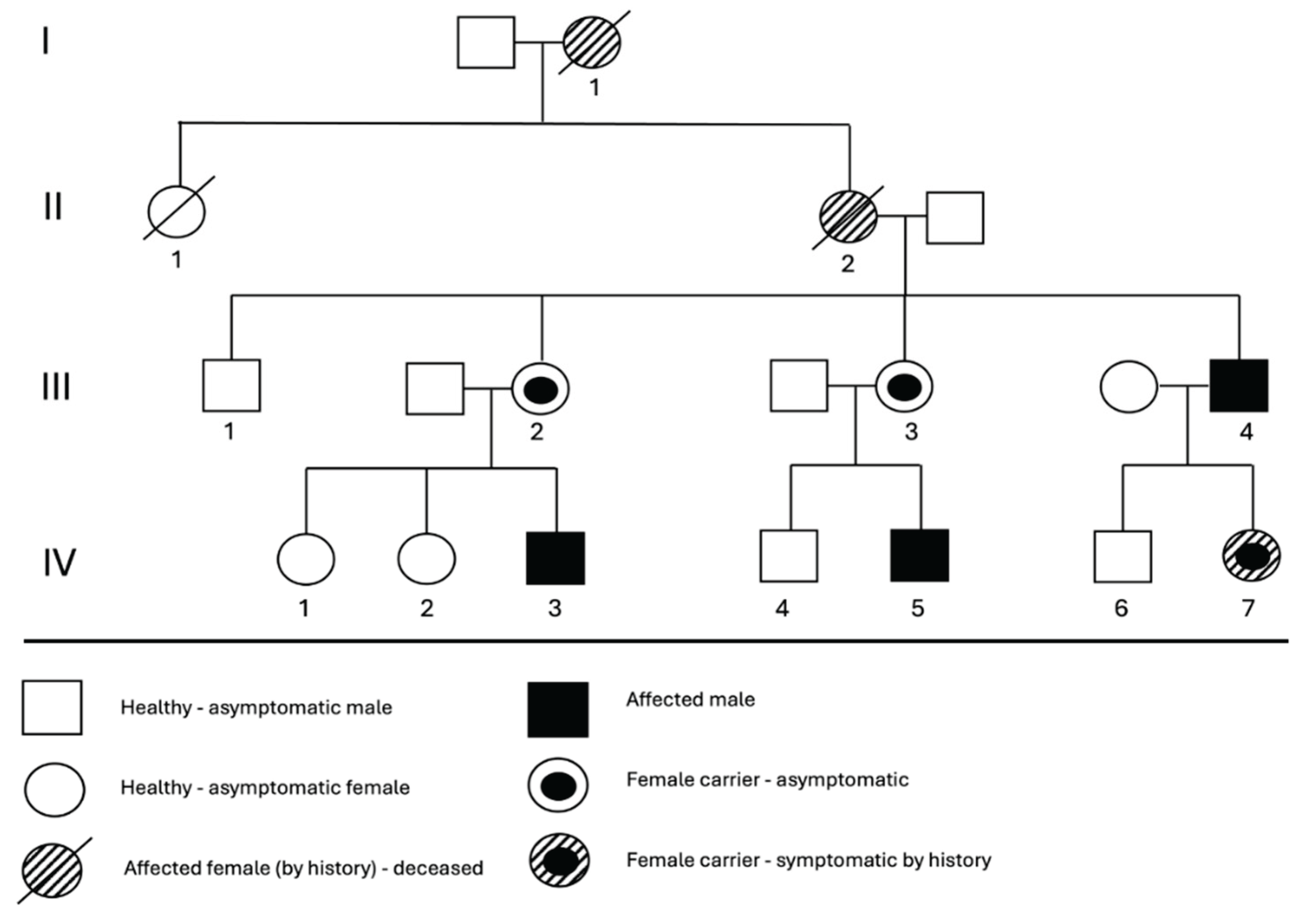

Table 1.
Participants Characteristics.
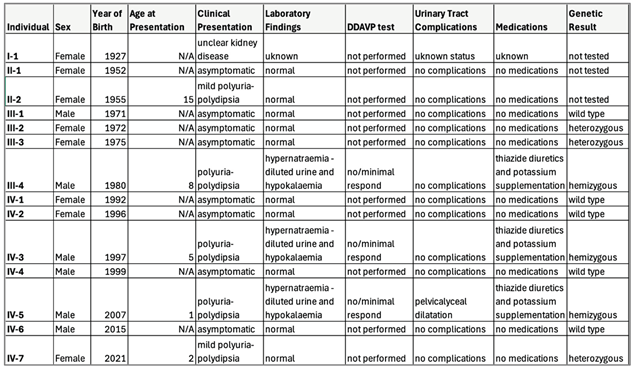 |
Table 2.
Assertion criteria for pathogenicity by the type of evidence as per ACMG/AMP guidelines.
| Evidence | Supporting | Moderate | Strong | Very Strong |
|---|---|---|---|---|
| Population Data | Absent in population database (PM2) | |||
| Computational and Predictive Data | computational prediction tools support a deleterious effect on the gene (PP3) | |||
| Functional Data | functional studies show a deleterious effect (PS3) | |||
| Effect on Protein | same residue as other pathogenic variants (PM5) | |||
| Segregation Data | co-segregation with disease in multiple affected family members (PM1) | |||
| Other Data | highly specific phenotype for AVPR2-related NDI (PP4) |
Disclaimer/Publisher’s Note: The statements, opinions and data contained in all publications are solely those of the individual author(s) and contributor(s) and not of MDPI and/or the editor(s). MDPI and/or the editor(s) disclaim responsibility for any injury to people or property resulting from any ideas, methods, instructions or products referred to in the content. |
© 2026 by the authors. Licensee MDPI, Basel, Switzerland. This article is an open access article distributed under the terms and conditions of the Creative Commons Attribution (CC BY) license.
Copyright: This open access article is published under a Creative Commons CC BY 4.0 license, which permit the free download, distribution, and reuse, provided that the author and preprint are cited in any reuse.


