

Submitted:
07 June 2026
Posted:
09 June 2026
You are already at the latest version
Abstract
Semaglutide and tirzepatide are not approved for type 1 diabetes, and their real-world associations with insulin requirements, metabolic outcomes, and safety remain uncertain. Here we analyzed de-identified federated U.S. EHR data, comparing adults with T1D initiating semaglutide (n=1,424) or tirzepatide (n=578) between Jan 1, 2018, and Dec 31, 2025, with 1:1 propensity-score matched T1D controls without GLP-1RA/tirzepatide exposure (n=2,002). At 12 months mean insulin total daily dose (TDD) percent change was −22.0% (median −9.3%) in the semaglutide subcohort and −19.7% (median −17.2%) in the tirzepatide subcohort versus +10.3% (median +0.4%) in matched controls, widening to −27.4% (median −19.4%) and −25.9% (median −31.5%) versus +10.4% (median −1.1%) in controls at 24 months (all P<0.0001). The rate of patients achieving a ≥10% TDD reduction at 6 months was 51.0% (semaglutide) and 50.3% (tirzepatide) versus 18.4% in controls (both P<0.0001). At 12 months median semaglutide dose was 0.50 mg (Q1, Q3: 0.25, 1.00), with 67.8% of patients above the 0.25 mg starter dose. Median tirzepatide dose was 5.00 mg (Q1, Q3: 2.50, 7.50), with 68.2% of patients above the 2.5 mg starter dose. Stratified analysis of 12-month TDD percent change showed significant heterogeneity by weight-loss category in the semaglutide subcohort with mean TDD reduction of −34.5% in patients losing ≥10% of body weight versus −19.6% in patients with <5% weight loss (P<0.001); semaglutide dose escalation was also associated with mean TDD reduction (1.7–2.4 mg, −31.8%; 0.25 mg, −18.2%; P=0.007) while tirzepatide dose escalation was not significantly associated with TDD reduction (ANOVA P=0.800). At 12 months mean HbA1c percent change from baseline was −4.2% (semaglutide, P<0.0001) and −3.0% (tirzepatide, P=0.007) versus −0.3% in controls and mean body weight percent change was −4.0% and −6.8% versus −0.5% (both P<0.0001). The pre-versus-post 365-day safety profile across 13 prespecified events was gastrointestinal-predominant, with nausea or vomiting increasing by 8.5 percentage points (Benjamini-Hochberg adjusted P [BH P] <0.0001) and smaller increases in hypoglycemia (+3.1 pp, BH P=0.022), constipation (+3.0 pp, BH P=0.003), diarrhea (+2.6 pp, BH P=0.016), decreased appetite (+1.1 pp, BH P=0.016), and acute kidney injury (+1.3 pp, BH P=0.022); diabetic ketoacidosis, severe hypoglycemia, pancreatitis, gallbladder disease, gastroparesis, and retinopathy progression did not change significantly. Among clinical and pharmacologic subgroups, patients with a 6-month TDD reduction of >30% had significantly higher incidence of diabetic ketoacidosis (5.42 events per 100 person-years; BH P=0.034). Across 24 prespecified cardiovascular and renal time-to-event endpoints, exposure to semaglutide or tirzepatide was associated with lower 2-year all-cause mortality (1.4% versus 5.7%; BH P<0.001) and major adverse cardiovascular events (4.2% versus 7.5%; BH P=0.002), with mortality reductions for both drugs individually and a reduction in major adverse cardiovascular events for tirzepatide; no renal endpoint remained significant after multiple-testing correction. In summary, this study demonstrates real-world reductions in daily insulin requirements, HbA1c, and weight in T1D patients after initiation of semaglutide or tirzepatide, motivating prospective evaluation of these therapies as adjunctive therapy in selected T1D adults.
Keywords:
semaglutide
; type 1 diabetes
Introduction
Type 1 diabetes (T1D) is defined by dependence on exogenous insulin, but insulin replacement alone is often not adequate to eliminate the progressive metabolic and cardiovascular burden of the disease. Contemporary care has been transformed by continuous glucose monitoring, insulin pump therapy and automated insulin delivery systems, but many adults continue to face high insulin requirements, weight gain, glycaemic variability, hypoglycaemia risk and persistent cardiovascular and kidney complications [1,2]. These challenges are increasingly salient as overweight and obesity are now common in people living with T1D, partly reflecting the intersection of population-level obesity trends, insulin-associated weight gain, insulin resistance and longer survival [3,4]. Because escalating insulin doses can improve glycaemia while also reinforcing weight gain and cardiometabolic risk, adjunctive therapies that safely reduce insulin requirements, improve weight and preserve glycemic control remain an important unmet need in adult type 1 diabetes.
Glucagon-like peptide-1 receptor agonists and dual glucose-dependent insulinotropic polypeptide and glucagon-like peptide-1 receptor agonists have reshaped the treatment of type 2 diabetes and obesity through effects on body weight, appetite, gastric emptying, glycemia and cardiometabolic risk [5,6]. However, semaglutide and tirzepatide are not approved for type 1 diabetes, so their use in this population remains off-label. This distinction is clinically important because adults with T1D differ from those with type 2 diabetes in endogenous insulin reserve, susceptibility to ketosis, dependence on precise insulin titration and risk of hypoglycemia. Any adjunctive therapy that lowers body weight, appetite or insulin requirement in T1D must therefore be evaluated not only for glycemic and metabolic benefit, but also for diabetic ketoacidosis, severe hypoglycemia, gastrointestinal intolerance, pancreatobiliary events, retinopathy progression, kidney safety and real-world feasibility of dosing and titration.
Previous adjunctive-therapy studies of incretin-based agents in T1D have suggested that this therapeutic axis can reduce body weight and insulin requirements, with more modest and variable effects on HbA1c. The ADJUNCT ONE and ADJUNCT TWO randomized trials showed that liraglutide reduced HbA1c, body weight and insulin dose in adults with T1D, but they also raised safety and tolerability concerns, including increased symptomatic hypoglycemia and hyperglycemia with ketosis at higher doses [7,8]. More recent semaglutide trials have renewed interest in this approach. In adults with T1D using automated insulin delivery, semaglutide improved glucose time in range without increasing the risk of hypoglycemia, although recurrent euglycaemic ketosis without acidosis was observed [9]. In a randomized trial studying adults with T1D and obesity, semaglutide improved a composite of glycemic and weight outcomes trials [10]. Evidence for tirzepatide in T1D is more limited, but early observational and phase 2 trial data suggest clinically meaningful weight loss and metabolic improvement in selected adults with T1D and obesity [11]. Collectively, these studies support biological plausibility but leave substantial uncertainty regarding real-world dosing, insulin adjustment, longer-term safety and cardiorenal outcomes.
Real-world evidence can complement clinical trials by describing how therapies are prescribed, titrated, tolerated and associated with clinical outcomes in routine care. This is particularly relevant for semaglutide and tirzepatide in T1D, where off-label use is occurring despite limited evidence to guide patient selection, insulin adjustment and safety monitoring. Electronic health records (EHRs) provide an opportunity to study larger and more heterogeneous populations than those enrolled in early trials, including adults treated with multiple daily injections or insulin pump therapy and patients with varying degrees of obesity, glycemic burden and cardiometabolic comorbidity. At the same time, observational analyses are vulnerable to confounding by indication, treatment-selection bias, missingness and incomplete capture of medication adherence and adverse events; therefore, their findings must be interpreted as associations that can inform, rather than replace, prospective randomized evaluation [12,13,14].
In this study, we used de-identified longitudinal EHR data from a federated U.S. clinical network to evaluate adults with T1D who initiated semaglutide or tirzepatide and propensity-score matched adults with T1D who had no GLP-1 receptor agonist or tirzepatide exposure. We examined real-world dosing and titration, insulin total daily dose trajectories, HbA1c, body weight, kidney function, prespecified safety events, insulin delivery modality subgroups and exploratory cardiovascular and renal outcomes.
Results
Cohort Eligibility, Derivation, and Baseline Characteristics
Type 1 diabetes mellitus (T1D) was ascertained by ≥2 ICD codes for T1D, a T1D-to-(T1D+T2D) ICD code ratio greater than 0.5, confirmation in clinical notes via AI augmented curation, and an encounter for long-term insulin use, yielding 29,671 adults with T1D (Figure 1). Among these, 2,960 patients had an order or administration of semaglutide or tirzepatide after T1D diagnosis occurring during the study period (January 1, 2018 to December 31, 2025) and formed the exposure cohort, and 25,985 patients had no GLP-1 receptor agonist (exenatide, lixisenatide, liraglutide, dulaglutide, semaglutide) or dual GIP/GLP-1 receptor agonist (tirzepatide) across the study period and formed the control cohort. Index date was defined as the first semaglutide or tirzepatide order or administration for the exposure cohort, and as a randomly selected clinical encounter date during the study period for the control cohort. Additional inclusion criteria included age ≥18 at index, at least 1 year of baseline EHR data, at least 30 days of post-index follow-up, and no order or administration of another antidiabetes blood glucose lowering medication (metformin, SGLT2 inhibitors, DPP-4 inhibitors, sulfonylureas, thiazolidinediones, meglitinides) in the 12 months prior to index, yielding 2,083 eligible exposed and 17,839 eligible control patients. 1:1 propensity score matching on demographics, baseline comorbidities, HbA1c, BMI, eGFR, and T1D duration produced final matched cohorts of 2,002 exposed patients (1,424 semaglutide, 578 tirzepatide) and 2,002 matched T1D controls.
Baseline characteristics of the pre-matching and post-matching cohorts are presented in Table 1. After 1:1 propensity score matching on demographics, baseline comorbidities, HbA1c, BMI, eGFR, and T1D duration, all standardized mean differences (SMDs) were less than 0.10 except for BMI, which retained a small residual imbalance (33.3 vs 32.7 kg/m², SMD 0.119). In the matched cohorts, mean age was 47.1 years in the exposed group and 46.9 years in controls, 68.0% versus 70.3% were female, mean HbA1c was 7.7% versus 7.8%, and mean eGFR was 84.4 versus 84.6 mL/min/1.73 m². Cardiometabolic comorbidity rates after matching were similar between groups, with hypertension in 46.1% versus 43.7%, hyperlipidemia in 52.7% versus 52.7%, atherosclerotic cardiovascular disease in 16.3% versus 15.9%, heart failure in 5.1% versus 5.2%, and diabetic microvascular complications in 23.8% versus 23.2%.
Semaglutide and Tirzepatide Are Associated with Sustained Reduction in Insulin TDD
Mean insulin total daily dose (TDD) declined progressively in patients exposed to semaglutide or tirzepatide over the 24-month observation period, while the matched control cohort showed modest upward drift (Figure 2A,B). At Month 6, mean TDD percent change from baseline was −17.6% (median -6.7%) for semaglutide and −17.1% (median -9.4%) for tirzepatide versus +13.5% (median +0.3%) in matched controls (both P<0.0001). At Month 12, reductions reached −22.0% (median -9.3%) for semaglutide and −19.7% (median -17.2%) for tirzepatide versus +10.3% (median +0.4%) in controls (both P<0.0001). At Month 24, reductions reached −27.4% (median -19.4%) for semaglutide and −25.9% (median -31.5%) for tirzepatide versus +10.4% (median -1.1%) in controls (both P<0.0001). The early-titration window (Index through Week 4) is magnified in Figure 2E,F and shows that divergence between exposure and control emerged within the first week, with mean reductions of −11.0% (median −2.3%) for semaglutide and −8.9% (median −3.6%) for tirzepatide by Week 1. The much smaller median reductions indicate that the typical exposed patient had little TDD change early on, with the mean likely driven by a subset of actively titrated patients. The proportion of patients achieving a ≥10% TDD reduction increased over time in both exposure groups while remaining flat in controls (Figure 2G,H; Table S1), reaching 24-month rates of 66.2% for semaglutide and 69.2% for tirzepatide versus 31.1% in controls (both P<0.0001). Median values with interquartile ranges are shown in Figure S1.
The semaglutide and tirzepatide combined exposure cohort was stratified by insulin delivery modality into multiple daily injections (MDI) and continuous subcutaneous insulin infusion (pump) subcohorts (Figure S2). The MDI subcohort began with numerically higher baseline TDD (mean 84.9 units versus 79.1 units for the pump subcohort, P=0.070) and exhibited an earlier and steeper TDD percent reduction in the first six months (Month 6 reduction −14.8% versus −9.0% for pump, P=0.049). By Month 9 the MDI advantage attenuated (−15.8% versus −10.9%, P=0.096) and by Month 24 both subcohorts had converged to a similar magnitude of TDD reduction (MDI −21.0%, pump −20.0%, P=0.80).
Real-World Semaglutide and Tirzepatide Dose Escalation in Adult T1D Patients
Median semaglutide and tirzepatide dose escalation trajectories are summarized in Figure 3 and Table S2. At Month 12, median semaglutide dose was 0.5 mg (Q1, Q3: 0.25, 1.0), with 32.2% of patients on the 0.25 mg starter dose, 25.2% on 0.5 mg, 20.2% on 1 mg, and 22.4% on 1.7 mg or higher (Figure 3B). At Month 24, median semaglutide dose remained 0.5 mg (Q1, Q3: 0.25, 1.7), with 28.7% on 0.25 mg and 22.4% on 2 mg or higher. For tirzepatide, median dose advanced from 2.5 mg at index to 5.0 mg at Month 12 (Q1, Q3: 2.5, 7.5) and remained 5.0 mg at Month 24 (Q1, Q3: 2.5, 12.5), with 16.7% of patients reaching the 15 mg dose by Month 24 (Figure 3D).
Insulin Total Daily Dose Reduction Varies by Weight Change and Semaglutide Dose
Patients were stratified by percent body weight change, absolute HbA1c change, and drug dose at 12 months (±3-month), and within-cohort mean TDD percent change was evaluated. For weight change strata (Figure 4A), the semaglutide subcohort showed significant heterogeneity in 12-month TDD reduction across categories (ANOVA P<0.001), with reductions of −34.5% in patients losing ≥10% body weight, −27.7% with 5 to 10% loss, and −19.6% with <5% loss. The heterogeneity was driven by the ≥10% loss stratum, which showed significantly greater TDD reduction than the <5% loss stratum (BH P<0.001). The tirzepatide subcohort showed a directionally similar but non-significant pattern across weight strata (ANOVA P=0.15), with reductions of −30.5% (≥10% loss), −14.7% (5 to 10% loss), and −17.5% (<5% loss). For HbA1c change strata (Figure 4B), TDD reduction did not differ significantly across categories in either subcohort (semaglutide ANOVA P=0.35; tirzepatide ANOVA P=0.15).
Dose-response analyses examined 12-month TDD percent change stratified by semaglutide or tirzepatide dose in the same window (Figure 4C,D). For semaglutide, TDD reduction was significantly associated with dose escalation (ANOVA P<0.001), with mean reductions of −18.2% at 0.25 mg, −13.5% at 0.5 mg, −27.2% at 1 mg, and −31.8% at 1.7 to 2.4 mg. The signal was concentrated at the higher dose tiers: the 1.7 to 2.4 mg tier showed significantly greater TDD reduction than both 0.5 mg (BH P<0.001) and 0.25 mg (BH P=0.007), and the 1 mg tier showed greater TDD reduction than the 0.5 mg tier (BH P=0.016), whereas the two lowest tiers did not differ from each other (0.25 versus 0.5 mg, P=0.34) and the two highest tiers did not differ (1 versus 1.7 to 2.4 mg, P=0.34). For tirzepatide (Figure 4D), TDD reduction did not differ significantly across dose categories (ANOVA P=0.800), with reductions of −22.6% at 2.5 mg, −26.0% at 5 mg, −23.3% at 7.5 to 10 mg, and −31.2% at 12.5 to 15 mg; the absence of a dose-response signal could be partially related to the limited sample size at the highest tirzepatide dose tier (n=14). When collapsed into low and high dose categories (Figure 4E,F), the semaglutide difference remained significant (≤0.5 mg versus ≥1.0 mg, P<0.001) whereas the difference for tirzepatide was still not significant (≤5 mg versus ≥7.5 mg, P=0.74). Detailed values are presented in Table S3, and the corresponding median TDD percent change with interquartile range for each stratum is shown in Figure S3.
HbA1c, Body Weight, and BMI Improved Substantially Versus Matched Controls
At Month 12, mean HbA1c percent change from baseline was −4.2% for semaglutide and −3.0% for tirzepatide (both P<0.01 versus control) (Figure 5). On the absolute scale, mean HbA1c at Month 12 was 7.4% for semaglutide and 7.3% for tirzepatide, from baseline values of 7.8% and 7.5% (Figure S4). Mean body weight percent change at Month 12 reached −4.0% for semaglutide and −6.8% for tirzepatide (both P<0.0001). Mean BMI percent change at Month 12 was −3.5% for semaglutide and −5.9% for tirzepatide (both P<0.0001). Mean body weight at Month 12 was 94.6 kg for semaglutide and 93.9 kg for tirzepatide, from 98.5 and 100.7 kg at baseline, and mean BMI was 32.1 kg/m² and 31.8 kg/m², from 33.2 and 33.8 kg/m². Tirzepatide produced larger mean weight and BMI reductions than semaglutide across all anchors, while HbA1c reductions were larger and more sustained with semaglutide than tirzepatide through Month 24.
Adverse Event Profile Is GI-Predominant and Consistent with Established GLP-1 RA Safety
Paired pre-versus-post analysis across 13 prespecified clinical events revealed a safety signal pattern consistent with established GLP-1 RA pharmacology (Figure 6; Table S4). The largest absolute increase in 365-day event risk in the combined exposure cohort was for nausea or vomiting (+8.5 pp, 95% CI +6.2 to +10.9; raw P<0.0001, BH P<0.0001), driven by semaglutide (+9.8 pp, BH P<0.0001) and present at a smaller magnitude in tirzepatide (+5.4 pp, raw P=0.019, BH P=0.123). Smaller but BH-significant increases in the combined cohort were observed for any hypoglycemia (+3.1 pp, BH P=0.022), constipation (+3.0 pp, BH P=0.003), diarrhea (+2.6 pp, BH P=0.016), decreased appetite (+1.1 pp, BH P=0.016), and acute kidney injury (+1.3 pp, BH P=0.022). In the semaglutide subgroup specifically, severe hypoglycemia showed a nominal increase (+1.7 pp, raw P=0.031) that did not retain significance after multiple-testing correction (BH P=0.058). No statistically significant increase was observed in the combined cohort for diabetic ketoacidosis (+0.8 pp, BH P=0.195), severe hypoglycemia (+1.0 pp, BH P=0.195), abdominal pain, gastroparesis, pancreatitis, gallbladder disease, or retinopathy progression. In the tirzepatide subgroup, the only adverse event reaching significance after BH adjustment was constipation (+4.8 pp, BH P=0.039).
Incidence of Diabetic Ketoacidosis and Severe Hypoglycemia by Pharmacologic Subgroup
Crude incidence rates for diabetic ketoacidosis and severe hypoglycemia after semaglutide or tirzepatide exposure were 1.91 per 100 person-years (53 events in 2,781 person-years) and 2.34 per 100 person-years (65 events in 2,781 person-years) in the combined exposure cohort, respectively (Figure 7). Across eight prespecified subgroups (baseline TDD, baseline HbA1c, baseline BMI, 6-month percent TDD reduction, 6-month HbA1c reduction, 6-month percent body weight reduction, semaglutide dose at 6 months, and tirzepatide dose at 6 months), two subgroups were significantly associated with diabetic ketoacidosis incidence: baseline HbA1c (BH P=0.034) and 6-month percent TDD reduction (BH P=0.034). Diabetic ketoacidosis incidence rose with baseline HbA1c (0.70 per 100 person-years at <7%, 1.83 per 100 person-years at 7 to 9%, 4.00 per 100 person-years at ≥9%) and was higher in patients achieving the largest 6-month TDD reductions (5.42 per 100 person-years for >30% reduction versus 1.39 per 100 person-years for <10% reduction). No subgroup was associated with severe hypoglycemia incidence.
Cardiovascular and Renal Outcomes
A total of 24 prespecified cardiovascular and renal time-to-event endpoints were evaluated over 2 years from the matched index date (Figure 8; Table S5). In the combined semaglutide/tirzepatide cohort, cumulative all-cause mortality separated early from matched T1D controls and remained lower throughout follow-up, with 2-year event rates of 1.37% versus 5.73% (P<0.001; BH p<0.001). A similar pattern was observed for MACE, with lower cumulative event probability in the exposed cohort across the 2-year follow-up period and 2-year event rates of 4.15% versus 7.55% in controls (P<0.001; BH p=0.002). Chronic kidney disease showed a directionally lower 2-year event rate in the exposed cohort, but the difference was not statistically significant (4.85% vs 6.02%, RR 0.81, P=0.259; BH p=0.765). Drug-specific results are presented in Table S5. No renal endpoint reached statistical significance after multiple-testing correction, although directionally lower rates were also observed for proteinuria/albuminuria and renal tubular/mineral metabolism disorders.
Discussion
In this propensity-score matched cohort study of adults with T1D from a federated U.S. EHR network, initiation of semaglutide or tirzepatide was associated with sustained reductions in insulin total daily dose, modest but significant HbA1c improvement and progressive body-weight reduction compared with matched adults with T1D who had no GLP-1 receptor agonist or tirzepatide exposure. These associations emerged early after treatment initiation and persisted through 24 months among patients with available follow-up. Real-world dose escalation was relatively slow and heterogeneous, with many semaglutide-treated patients remaining at low or intermediate doses and tirzepatide-treated patients showing broader titration over time. Together, these findings suggest that adjunctive semaglutide or tirzepatide use in selected adults with T1D may be associated with insulin deintensification and metabolic benefit even in routine clinical practice, where dosing is individualized and titration is often incomplete.
The insulin findings are clinically salient because adults with T1D frequently experience rising insulin requirements, weight gain and insulin resistance over time [3,4]. In this context, an intervention associated with lower insulin total daily dose, lower HbA1c and weight loss may represent a potentially useful adjunctive strategy for carefully selected patients, particularly those with obesity or high insulin requirements [7,8,9,10,11]. The observation that insulin total daily dose declined among patients with varying degrees of weight and HbA1c change suggests that the potential for insulin deintensification may not be explained solely by weight loss. However, because weight change, HbA1c change, achieved dose and insulin adjustment are post-index variables, these stratified analyses should be interpreted as descriptive and hypothesis-generating rather than causal.
Our findings extend prior incretin-based studies in type 1 diabetes in several ways. The ADJUNCT trials established that liraglutide can reduce insulin dose and body weight in T1D but highlighted the need for careful safety assessment [7,8]. More recent studies have demonstrated metabolic benefits of semaglutide and tirzepatide in selected adults with T1D, particularly those with obesity or automated insulin delivery use [9,10,11]. The present study complements clinical trials by characterizing real-world prescribing, dose escalation, insulin trajectories and clinical outcomes in a larger and more heterogeneous adult T1D population [12,13,14]. The magnitude and durability of observed insulin total daily dose reduction, together with modest HbA1c improvement and weight loss, support prospective trials of semaglutide and tirzepatide as adjunctive therapy in phenotypically selected adults with T1D.
The safety findings reinforce the need for careful clinical monitoring [7,8,9,10]. The recorded adverse-event profile was predominantly gastrointestinal, with nausea or vomiting showing the largest increase after semaglutide or tirzepatide initiation. Smaller increases were observed for hypoglycemia, constipation, diarrhea, decreased appetite, and acute kidney injury, whereas diabetic ketoacidosis, severe hypoglycemia in the combined cohort, pancreatitis, gallbladder disease, gastroparesis and retinopathy progression did not show statistically significant increases in the paired pre-versus-post analysis [7,8,9,10]. These findings are reassuring but not definitive. In T1D, any therapy that reduces appetite, food intake, body weight or insulin requirement could increase vulnerability to insulin underdosing, ketosis, dehydration or hypoglycemia if not accompanied by structured insulin-adjustment and sick-day protocols [7,8,9]. The lack of a significant diabetic ketoacidosis signal in this observational analysis should therefore be viewed as supportive of prospective evaluation, not as evidence of established safety.
Exploratory cardiovascular and renal analyses showed lower observed 2-year all-cause mortality and major adverse cardiovascular event rates among semaglutide- or tirzepatide-exposed patients, while no renal endpoint remained significant after multiple-testing correction [1,2,6]. These findings are potentially important given the high lifetime cardiovascular and kidney risk in T1D, but they require careful interpretation [1,2]. Treatment selection, obesity phenotype, clinician prescribing behavior, frailty, access to care, medication adherence and unmeasured socioeconomic or behavioral factors could all influence mortality and cardiovascular outcomes in a non-randomized EHR study [12,13,14]. Accordingly, these results are hypothesis-generating signals that motivate dedicated prospective studies rather than definitive evidence of cardioprotection in T1D.
This study has several strengths, including a large real-world adult T1D cohort, longitudinal follow-up, propensity-score matched controls, drug-specific analyses for semaglutide and tirzepatide, real-world dose-titration characterization, insulin delivery modality subgroup analyses and evaluation of prespecified metabolic, safety, cardiovascular and renal outcomes. The use of a federated EHR network enabled assessment of treatment patterns and clinical outcomes outside the constraints of highly selected trial populations, providing insight into how these agents are being used in routine care. The design also aligns with reporting priorities for observational studies using routinely collected health data, where transparency regarding cohort definition, exposure ascertainment, missingness, confounding and outcome capture is essential [13,14].
The study also has important limitations. Treatment was not randomized, and residual confounding by indication, obesity severity, cardiometabolic risk, healthcare engagement, prescribing preferences and access to medications cannot be excluded [12,13,14]. Medication orders or administrations do not confirm adherence, persistence, or patient-level dose-taking behavior. Insulin total daily dose documentation was incomplete and may reflect clinical documentation patterns rather than continuous insulin exposure. Follow-up and outcome availability declined at later timepoints, especially for tirzepatide beyond 18 months. EHR data may incompletely capture adverse events, deaths, events outside the network, continuous glucose monitoring metrics, time in range, insulin pump or automated insulin delivery settings, C-peptide, autoantibody status, nutritional intake, physical activity, and patient-reported tolerability [13,14]. Finally, misclassification of T1D, medication exposure, insulin delivery modality and safety outcomes are also possible despite the use of structured and text-derived ascertainment.
In summary, semaglutide or tirzepatide initiation in adults with T1D was associated with lower insulin requirements, modest HbA1c improvement, weight loss and a gastrointestinal-predominant adverse-event profile in routine clinical care. These findings support prospective randomized trials of GLP-1 receptor agonist and dual GIP/GLP-1 receptor agonist adjunctive therapy in selected adults with T1D, with diverse endpoints capturing insulin requirements, glycemic control, weight management, tolerability, and cardiovascular outcomes, and renal function.
Methods
Study Design
This retrospective cohort study evaluated adults with T1D who initiated semaglutide and tirzepatide and a matched non–GLP-1 RA T1D control cohort, using de-identified longitudinal electronic health record data from a federated U.S. network. The study period was from January 1, 2018, to December 31, 2025.
Cohort Definition
Adults aged 18 years or older with documented T1D who initiated semaglutide or tirzepatide between January 1, 2018 and December 31, 2025 were eligible. The index date for the exposure cohort was defined as the date of the first semaglutide or tirzepatide order or administration occurring after T1D diagnosis. T1D was ascertained at the federated network level by ≥2 ICD codes for T1D, a T1D-to-(T1D+T2D) ICD code ratio greater than 0.5 [15], confirmation of T1D diagnosis in clinical notes via AI augmented curation, and a documented encounter for long-term insulin use. Patients were required to be aged 18 years or older at index, to have at least 1 year of baseline EHR data, and to have at least 30 days of post-index follow-up. Patients with any order or administration of another blood glucose lowering medication (metformin, SGLT2 inhibitors, DPP-4 inhibitors, sulfonylureas, thiazolidinediones, meglitinides) in the 12 months prior to index were excluded.
A non–GLP-1 RA T1D control cohort was constructed using identical T1D ascertainment criteria, identical inclusion criteria (age ≥18 at index, ≥1 year of baseline EHR data, ≥30 days of post-index follow-up), and identical baseline-medication exclusion (no order or administration of another blood glucose lowering medication in the 12 months prior to index), restricted to adults with no order or administration of any GLP-1 receptor agonist (exenatide, lixisenatide, liraglutide, dulaglutide, semaglutide) or dual GIP/GLP-1 receptor agonist (tirzepatide) at any time during the study period. The index date for the control cohort was defined as a randomly selected clinical encounter date occurring during the study period and after T1D diagnosis. One-to-one propensity score matching without replacement was performed on the logit of the propensity score using a caliper of 0.1 standard deviations. The propensity score was estimated via logistic regression with baseline covariates comprising demographics (age, sex, race, ethnicity), baseline comorbidities (hypertension, hyperlipidemia, atherosclerotic cardiovascular disease, heart failure, diabetic microvascular complications, severe hypoglycemia history, DKA history, tobacco use), HbA1c, body mass index, estimated glomerular filtration rate (eGFR), and T1D duration (defined as years between first T1D diagnosis and index). Standardized mean differences (SMDs) were used to assess pre- and post-matching balance, with the conventional threshold of 0.10 used to define acceptable balance.
Insulin TDD and Drug Dose Extraction
Insulin total daily dose (TDD) and semaglutide and tirzepatide doses were extracted from clinical documents and structured medication records using AI augmented curation with a large language model (LLM). For all LLM workflows, we used gpt-oss-20b with a maximum generated-token limit of 16,384 and temperature 0.7. The prompt asked the model to extract only explicit, patient-attributed insulin TDD values and semaglutide or tirzepatide doses, together with the associated dose units, formulation, and finding date or note-date relationship, and to return valid JSON (see Supplementary Methods). After extraction, outputs were parsed and standardized to canonical units (insulin TDD in units per day; semaglutide and tirzepatide doses in mg), out-of-range or implausible values were removed, duplicate dose mentions were deduplicated, and dose dates were aligned relative to the index date. Extraction accuracy was evaluated against a manually adjudicated test set of 150 extractions, in which each extraction was labelled correct when the dose value, units, and supporting text were judged accurate and sufficiently supported by the source record. Overall extraction accuracy was 93.33% (140/150).
Insulin TDD and Drug Dose Trajectory Analyses
Insulin total daily dose (TDD) was anchored at the following time points relative to index: Week 1 (Day 7 ± 3), Week 2 (Day 14 ± 3), Week 3 (Day 21 ± 3), Week 4 (Day 28 ± 3), Day 60 (± 14), Day 90 (± 14), Month 6 (Day 180 ± 30), Month 9 (Day 270 ± 30), Month 12 (Day 365 ± 30), Month 18 (Day 547 ± 45), and Month 24 (Day 730 ± 60). Baseline TDD was defined as the documented TDD value closest to the index date within the 180-day pre-index window. TDD at each post-index anchor was defined as the documented TDD value closest to the anchor day within the anchor tolerance window. Patients with no TDD measurement at a given anchor were excluded from that anchor. Mean TDD percent change from baseline at each anchor was compared between exposure and control using two-sample Welch t-tests. The proportion of patients achieving a ≥10% TDD reduction from baseline was compared at each anchor between exposure and control using two-proportion z-tests.. Using the same anchor windows, median semaglutide and tirzepatide doses (with interquartile ranges) and the proportion of patients in each discrete dose category (semaglutide: 0.25, 0.5, 1, 1.7, 2.0, 2.4 mg; tirzepatide: 2.5, 5, 7.5, 10, 12.5, 15 mg) were summarized; drug dose at each post-index anchor was defined as the documented dose value closest to the anchor day within the anchor tolerance window.
Stratified TDD Analyses by Weight, HbA1c, and Dose
Stratified analyses of TDD percent change examined three stratifiers measured at 12 months (Day 365 ± 90 days) post-index: (1) (1) percent body weight change from baseline (≥10% loss, 5 to 10% loss, or <5% loss [gain or 0 to 5% loss]), with 12-month body weight defined as the documented value closest to Day 365 within the ±90-day window; (2) absolute HbA1c change from baseline (≥1.0% reduction, 0.5 to 1.0% reduction, or <0.5% reduction [increase or 0 to 0.5% reduction]), with 12-month HbA1c defined as the documented value closest to Day 365 within the ±90-day window; and (3) semaglutide or tirzepatide dose at 12 months (semaglutide: 0.25, 0.5, 1, and 1.7 to 2.4 mg; tirzepatide: 2.5, 5, 7.5 to 10, and 12.5 to 15 mg), with 12-month dose defined as the documented dose value closest to Day 365 within the ±90-day window. TDD percent change was evaluated within the same window, with 12-month TDD defined as the documented value closest to Day 365 within the window. Baseline TDD, body weight, and HbA1c were each defined as the documented value closest to the index date within the 180-day pre-index window. Within-cohort heterogeneity across strata was tested using a one-way ANOVA with the omnibus F statistic reported, and where the omnibus test reached α=0.05, post-hoc pairwise contrasts were performed using Fisher’s least significant difference test with Benjamini-Hochberg adjustment across the C(k,2) pairwise contrasts within each stratifier-by-cohort cell.
Laboratory and Measurement Analyses
Mean absolute change in HbA1c (in percentage points), mean percent change in body weight, mean absolute change in eGFR and systolic blood pressure from baseline were computed at the following anchor windows relative to index: Day 90 (±14 days), Month 6 (Day 180 ±30 days), Month 9 (Day 270 ±30 days), Month 12 (Day 365 ±30 days), Month 18 (Day 547 ±45 days), and Month 24 (Day 730 ±60 days). At each anchor, the value closest to the anchor day within the anchor tolerance window was selected. Baseline values were defined as the documented value closest to the index date within the 180-day pre-index window. Patients with no laboratory or measurement data at a given anchor were excluded for that anchor. Mean change at each anchor was compared between exposure and control using two-sample Welch t-tests.
Adverse Event Analysis
The paired pre-versus-post adverse event analysis examined 13 prespecified clinical events across four categories: glycemic (diabetic ketoacidosis, severe hypoglycemia, hypoglycemia), gastrointestinal (nausea/vomiting, diarrhea, abdominal pain, constipation, decreased appetite, gastroparesis), pancreatobiliary (pancreatitis, gallbladder disease), and other (retinopathy progression, acute kidney injury). Event ascertainment used AI augmented curation of clinical notes, requiring at least 2 positive instances documented within 14 days apart. For each patient, a symmetric pre-versus-post index window was defined, with window length set to the minimum of the patient’s last encounter day and 365 days. Per-patient paired 2×2 cell counts (event in both windows, pre only, post only, neither) were computed. Risk differences with 95% Wald confidence intervals on the paired-proportion difference were reported, and statistical significance was assessed using McNemar exact tests on the discordant pairs. To account for multiple comparisons across the 13 prespecified events, BH–adjusted P-values were computed within each treatment comparison (combined semaglutide or tirzepatide, semaglutide, and tirzepatide).
Stratified Incidence Rate Analyses for Diabetic Ketoacidosis and Severe Hypoglycemia
Crude incidence rates per 100 person-years were computed within the combined semaglutide and tirzepatide cohort for diabetic ketoacidosis and severe hypoglycemia, with events ascertained by AI augmented curation of clinical notes (≥2 positive instances ≥14 days apart). Cohort-wide person-time accrued from index until the first qualifying event, last documented clinical encounter, or two years post-index, whichever occurred first; 95% confidence intervals used the Garwood exact Poisson method. Subgroup-stratified rates were computed across eight prespecified stratifiers: baseline TDD, baseline HbA1c, baseline BMI, six-month percent TDD reduction, six-month HbA1c reduction, six-month percent body weight reduction, semaglutide dose at six months, and tirzepatide dose at six months. For baseline stratifiers, person-time accrued from index. For six-month stratifiers, a six-month landmark analysis was used to avoid immortal-time bias: the at-risk set was restricted to patients reaching Day 180 alive and event-free with a documented stratifier value, with person-time accruing from Day 180 forward. Baseline values were the documented value closest to index within the 180-day pre-index window; six-month values were the documented value closest to Day 180 within a ±30-day window. Heterogeneity across subgroups within each stratifier was tested using a Poisson likelihood-ratio test comparing a saturated model against a null model with a single common rate, and Benjamini-Hochberg adjusted P-values were computed across the eight stratifier tests within each outcome panel.
Insulin Delivery Modality Subgroup Analysis
A pre-specified subgroup analysis stratified patients exposed to semaglutide or tirzepatide by insulin delivery modality (multiple daily injection [MDI] versus continuous subcutaneous insulin infusion via pump). Insulin delivery modality was ascertained directly from each patient’s documented insulin TDD records, based on the structure and pattern of recorded insulin dosing entries that distinguish continuous pump-administered insulin from discrete daily injection-based dosing.
Cardiovascular and Renal Outcome Analysis
Incident cardiovascular and renal outcomes were evaluated using time-to-event analyses over 2 years from the index date. The analysis included 24 prespecified endpoints: all-cause mortality, MACE, cardiovascular diagnosis groups, and renal diagnosis groups. MACE was defined as all-cause death or first diagnosis of myocardial infarction/acute coronary syndrome or stroke. Nonfatal cardiovascular and renal outcomes were ascertained using ICD-9 and ICD-10 diagnosis-code prefixes listed in Table S7. For each endpoint, patients with the same outcome documented on or before the index date were excluded from that endpoint-specific risk set. Patients were followed from index until the first qualifying outcome event, last documented clinical activity or death record, or 2 years, whichever occurred first. Two-year Kaplan-Meier event rates were estimated for each treatment and control group, and treatment-control differences were summarized using event counts, event rates, risk ratios, risk differences, 95% confidence intervals, log-rank P values, and BH p values. BH correction was applied separately within each treatment comparison across all 24 endpoints.
Statistical Analysis
Continuous variables are reported as mean ± standard deviation (or mean ± standard error where indicated in figures), categorical variables as counts and percentages, and dose distributions as medians with interquartile ranges. The specific test applied to each analysis is described in the corresponding subsection above; in brief, between-group differences in mean change from baseline were assessed with two-sample Welch t-tests, ≥10% TDD reduction rates with two-proportion z-tests, stratified within-cohort TDD reductions with one-way ANOVA across strata followed by Fisher’s least significant difference post-hoc with Benjamini-Hochberg adjustment, paired pre-versus-post adverse event risk differences with McNemar exact tests, and time-to-event outcomes with Kaplan-Meier estimation and log-rank tests. All tests were two-sided with significance defined at α=0.05. The Benjamini-Hochberg procedure was used to control the false discovery rate across the 13 prespecified adverse events and the 24 prespecified cardiovascular and renal endpoints, applied separately within each treatment comparison; both unadjusted and Benjamini-Hochberg–adjusted values are reported, and findings significant only before adjustment are described as nominal. Anchor-based analyses used complete cases at each time point with no imputation for missing values, and covariate balance before and after propensity score matching was assessed using standardized mean differences, with values below 0.10 considered acceptable.
Data Source
This study analyzed de-identified EHR data from academic medical centers in the United States via the nference Federated Analytics Platform. Prior to analysis, all data underwent expert determination de-identification satisfying HIPAA Privacy Rule requirements (45 CFR §164.514(b)(1)), employing a multi-layered transformation approach for both structured data (cryptographic hashing of identifiers, date-shifting, geographic truncation) and unstructured clinical text (ensemble deep learning and rule-based methods with >99% recall for personally identifiable information detection) [16]. nference established secure data environments within each participating center, housing these de-identified patient data governed by expert determination. These de-identified data environments were specifically designed to enable data access and analysis without requiring Institutional Review Board oversight, approval, or exemption confirmation. Accordingly, informed consent and IRB review were not required for this study.
Data Availability
This study involves the analysis of de-identified EHR data via the nference nSights Federated Clinical Analytics Platform (nSights). Data shown and reported in this manuscript were extracted from this environment using an established protocol for data extraction, aimed at preserving patient privacy. The data has been de-identified pursuant to an expert determination in accordance with the HIPAA Privacy Rule. Any data beyond what is reported in the manuscript, including but not limited to the raw EHR data, cannot be shared, or released due to the parameters of the expert determination to maintain the data de-identification. The corresponding author should be contacted for additional details regarding nSights.
De-Identification and HIPAA Compliance Certification
Prior to analysis, all EHR data were de-identified under an expert determination consistent with the Health Insurance Portability and Accountability Act (HIPAA) Privacy Rule (45 CFR §164.514(b)(1)). The de-identification methodology employed a multi-layered transformation approach to both structured and unstructured data fields [16]. In structured data, direct identifiers including patient names and precise geographic locations were excluded entirely, while indirect identifiers underwent specific transformations: patient identifiers, medical record numbers, and accession numbers were replaced with one-way cryptographic hashes using confidential salts to preserve linkage across patient encounters; all dates were shifted backward by patient-specific random offsets (1–31 days) to preserve temporal relationships while obscuring exact event timing; the ZIP codes were truncated to two-digit state-level resolution; and continuous variables including age, height, weight, and body mass index were thresholded to prevent identification of extreme values (for example, ages ≥89 years transformed to ‘89+’ and BMI >40 transformed to ‘40+’). In unstructured clinical text, an ensemble de-identification system that combines attention-based deep learning models with rule-based methods achieved an estimated >99% recall for personally identifiable information (PII) detection, with detected identifiers replaced by plausible fictional surrogates [16].
Data Harmonization
To address heterogeneity in EHR data, we harmonized clinical variables including medications, anthropometric measurements, and diagnoses to standardized concepts. For medications, we first constructed a standardized drug concept database combining the nSights knowledge graph with RXNorm (https://www.nlm.nih.gov/research/umls/rxnorm/index.html) hierarchies to capture ingredient, brand, and dose-specific information [17]. EHR medication records were matched using a hierarchical approach prioritizing RXNorm codes when available, followed by ingredient-level matching, and finally augmented curation and pattern matching on free-text medication orders when structured codes were absent. For anthropometric measurements (height, weight, BMI), we created a unified vocabulary from SNOMED (https://www.snomed.org/, https://athena.ohdsi.org) and LOINC (https://loinc.org/) terminologies and matched EHR measurement descriptions using standardized text matching algorithms with abbreviation expansion and synonym resolution; ambiguous mappings were resolved using OpenAI GPT-4o (https://platform.openai.com/docs/models/gpt-4o) with summary statistics as context, followed by manual verification. For diagnoses, we developed a hierarchical disease concept database from the nSights knowledge graph and matched EHR diagnosis descriptions and codes by identifying the most specific common child concept in the hierarchy. This approach enabled consistent identification of clinical entities while preserving granularity where available.
Supplementary Materials
The following supporting information can be downloaded at the website of this paper posted on Preprints.org. Figure S1. Insulin total daily dose (TDD) median trajectory in patients exposed to semaglutide or tirzepatide versus matched controls. Time-series depicting longitudinal median TDD changes from Index through Month 24. The left column (panels A, C, E) compares semaglutide (navy) with the matched control cohort (gray) and the right column (panels B, D, F) compares tirzepatide (red) with the matched control cohort. (A, B) Median absolute TDD (in units) at each anchor window; error bars indicate the interquartile range (Q1, Q3). (C, D) Median TDD percent change from baseline at each anchor window; the dashed box outlines the early titration interval (Index through Week 4), shown in panels E and F. (E, F) Median TDD percent change from baseline restricted to the Index through Week 4 interval. Sample sizes above each anchor are shown as treatment/control. Figure S2. Insulin TDD trajectory stratified by insulin delivery modality within the combined semaglutide and tirzepatide exposure cohort. Three-panel figure overlaying multiple daily injections (MDI, navy) and continuous subcutaneous insulin infusion via pump (amber) subcohorts. (A) Mean absolute TDD (in units) at each anchor; error bars indicate standard error. (B) Mean TDD percent change from baseline at each anchor; error bars indicate standard error. (C) Proportion of patients achieving a ≥10% TDD reduction from baseline at each anchor; error bars indicate the standard error of the proportion. Significance markers above each panel reflect two-sample Welch t-tests (panels A, B) or two-proportion z-tests (panel C) comparing MDI to pump at that time point (* P<0.05, ** P<0.01, *** P<0.001). Figure S3. Insulin TDD percent change stratified by 12-month weight change, HbA1c change, and drug dose. (A) Stratification by 12-month percent body weight change category (<5% loss, 5–10% loss, ≥10% loss), with bars for semaglutide (navy) and tirzepatide (red). (B) Stratification by 12-month absolute HbA1c change category (<0.5% reduction, 0.5–1.0% reduction, ≥1.0% reduction). (C) Stratification by semaglutide dose at 12 months, grouped into starter (0.25 mg), low (0.5 mg), standard (1 mg), and high (1.7–2.4 mg) categories. (D) Stratification by tirzepatide dose at 12 months, grouped into starter (2.5 mg), low (5 mg), mid (7.5–10 mg), and high (12.5–15 mg) categories. (E) Semaglutide dose collapsed into low (≤0.5 mg) and high (≥1.0 mg) categories. (F) Tirzepatide dose collapsed into low (≤5 mg) and high (≥7.5 mg) categories. Bars show the median percent change in total daily insulin dose; error bars span the interquartile range (25th to 75th percentile). Figure S4. Absolute trajectories of HbA1c, body weight, and BMI versus the matched control, by exposure drug. Each panel shows the mean value at baseline and at months 3, 6, 12, and 24. Columns show the exposure drug: semaglutide (A, C, E) and tirzepatide (B, D, F). Rows from top to bottom show the endpoint: HbA1c in percent (A, B), body weight in kilograms (C, D), and BMI in kg/m² (E, F). Shaded bands are the mean ± 95% confidence interval; the light gray line is the matched control cohort. Sample sizes beneath each anchor are shown as treatment/control, with the exposed cohort on the left and the control cohort on the right. Asterisks denote the treatment-versus-control difference at each anchor from two-sample Welch t-tests (*** P < 0.001, ** P < 0.01, * P < 0.05; ns, not significant). Table S1. Insulin total daily dose (TDD) trajectory across cohorts. TDD values and percent changes are reported for the semaglutide, tirzepatide, combined semaglutide-or-tirzepatide, and matched control cohorts at each prespecified anchor from Index through Month 24. For each cohort and anchor, the table lists the number of patients contributing (N), mean absolute TDD in units (± standard error), mean TDD percent change from baseline (± standard error), the proportion of patients achieving a ≥10% TDD reduction from baseline, and two-sample P-values comparing each exposure cohort to matched controls at the same anchor (Welch t-test for mean TDD percent change; two-proportion z-test for responder rate). Table S2. Semaglutide and tirzepatide dose trajectory and dose distribution. Median dose in mg with interquartile range (Q1, Q3) and the proportion of patients in each discrete dose bin are reported for the semaglutide and tirzepatide cohorts at each prespecified anchor from Index through Month 24. Semaglutide bins are 0.25, 0.5, 1, 1.7, 2.0, and 2.4 mg; tirzepatide bins are 2.5, 5, 7.5, 10, 12.5, and 15 mg. Table S3. Insulin TDD percent change by weight change, HbA1c change, and drug-dose category. Stratified mean 12-month TDD percent change (± standard error) is reported for the semaglutide, tirzepatide, and combined semaglutide-or-tirzepatide subcohorts across three stratifiers measured at 12 months (Day 365 ± 90 days): percent body weight change from baseline (<5% loss, 5 to 10% loss, ≥10% loss), absolute HbA1c change from baseline (<0.5% reduction, 0.5 to 1.0% reduction, ≥1.0% reduction), and 12-month semaglutide or tirzepatide dose (semaglutide: 0.25, 0.5, 1, 1.7 to 2.4 mg; tirzepatide: 2.5, 5, 7.5 to 10, 12.5 to 15 mg). For each stratifier and cohort, the table lists the number of patients in each stratum (N) and the mean TDD percent change (± standard error). Table S4. Pre-versus-post adverse event risk differences. Paired risk differences in percentage points, comparing the 365 days before and after the index date, are reported for 13 prespecified clinical events across four categories (glycemic, gastrointestinal, pancreatobiliary, other) within the combined semaglutide-or-tirzepatide cohort and within each drug subcohort. For each event-cohort cell, the table lists the cohort sample size (N), pre-index event risk (%), post-index event risk (%), risk difference with 95% Wald confidence interval (RD, 95% CI, in percentage points), the McNemar exact test P-value, and the Benjamini-Hochberg adjusted P-value (BH P) computed across the 13 events within each treatment comparison. Table S5. Cardiovascular and renal time-to-event outcomes in matched T1D cohorts. This table summarizes incident cardiovascular and renal outcomes over 2 years from the matched index date across three treatment comparisons: semaglutide or tirzepatide versus matched T1D control, semaglutide versus matched T1D control, and tirzepatide versus matched T1D control. For each endpoint, patients with the same outcome documented on or before index were excluded from that endpoint-specific risk set. Event counts are shown with 2-year Kaplan-Meier event rates, along with risk ratios, log-rank P values, and Benjamini-Hochberg p values. Benjamini-Hochberg correction was applied separately within each treatment comparison across all 24 prespecified cardiovascular and renal endpoints. Outcomes with nominal P<0.05 but BH q≥0.05 should be interpreted as exploratory findings that did not remain significant after multiple-testing correction. Table S6. ICD-code definitions for cardiovascular and renal time-to-event endpoints. Endpoint definitions and ICD-9 and ICD-10 diagnosis-code prefixes used to ascertain nonfatal cardiovascular and renal outcomes. MACE was defined as all-cause death or first diagnosis of myocardial infarction/acute coronary syndrome or stroke, whereas all-cause mortality was ascertained from the recorded death date. For diagnosis-code endpoints, the first qualifying post-index code defined the incident event date. Patients with a qualifying code for the same endpoint on or before index were excluded from that endpoint-specific risk set. The valvular/rheumatic heart disease endpoint includes both rheumatic and non-rheumatic valvular disease prefixes and should therefore be interpreted as a broad valvular/rheumatic diagnosis-code category.
Author Contributions
V.S. conceived the study and designed the study with A.J.V. Data queries and statistical analyses were conducted by R.M. and K.M. All authors interpreted the data, contributed to writing the manuscript and the revisions, and approved the final version for submission.
Funding
This research received no external funding.
Acknowledgments
We thank the nference engineering team for the development of the nSights federated AI platform, and Patrick Lenehan for helpful clinical feedback.
Conflicts of Interest
The authors are employees of nference, inc., which conducts research collaborations with various biopharmaceutical companies whose therapeutic products are included in this study. None of these companies, nor any other nference collaborator, funded, supported, or had any role in the independent study design, data acquisition, analysis, interpretation, manuscript preparation, or the decision to submit this work for publication. All analyses were conducted by the authors using de-identified electronic health record data. The authors declare no additional competing interests.
References
- American Diabetes Association Professional Practice Committee for Diabetes*. 9. Pharmacologic Approaches to Glycemic Treatment: Standards of Care in Diabetes-2026. Diabetes Care 2026, 49, S183–S215. [Google Scholar] [CrossRef] [PubMed]
- Orchard, T. J. Cardiovascular disease in type 1 diabetes: a continuing challenge. Lancet Diabetes Endocrinol. 2021, 9, 548–549. [Google Scholar] [CrossRef] [PubMed]
- Van der Schueren, B.; et al. Obesity in people living with type 1 diabetes. Lancet Diabetes Endocrinol. 2021, 9, 776–785. [Google Scholar] [CrossRef] [PubMed]
- Corbin, K. D.; et al. Obesity in Type 1 Diabetes: Pathophysiology, Clinical Impact, and Mechanisms. Endocr. Rev. 2018, 39, 629–663. [Google Scholar] [CrossRef] [PubMed]
- Frías, J. P.; et al. Tirzepatide versus Semaglutide Once Weekly in Patients with Type 2 Diabetes. N. Engl. J. Med. 2021. [Google Scholar] [CrossRef] [PubMed]
- Marso, S. P.; et al. Semaglutide and Cardiovascular Outcomes in Patients with Type 2 Diabetes. N. Engl. J. Med. 2016. [Google Scholar] [CrossRef] [PubMed]
- Mathieu, C.; et al. Efficacy and Safety of Liraglutide Added to Insulin Treatment in Type 1 Diabetes: The ADJUNCT ONE Treat-To-Target Randomized Trial. Diabetes Care 2016, 39, 1702–1710. [Google Scholar] [PubMed]
- Ahrén, B.; et al. Efficacy and Safety of Liraglutide Added to Capped Insulin Treatment in Subjects With Type 1 Diabetes: The ADJUNCT TWO Randomized Trial. Diabetes Care 2016, 39, 1693–1701. [Google Scholar] [CrossRef]
- Pasqua, M.-R.; et al. Subcutaneous weekly semaglutide with automated insulin delivery in type 1 diabetes: a double-blind, randomized, crossover trial. Nat. Med. 2025, 31, 1239–1245. [Google Scholar] [CrossRef]
- Shah, V. N.; et al. Semaglutide in Adults with Type 1 Diabetes and Obesity. NEJM Evid. 2025. [Google Scholar] [CrossRef] [PubMed]
- Akturk, H. K.; Dong, F.; Snell-Bergeon, J. K.; Karakus, K. E.; Shah, V. N. Efficacy and Safety of Tirzepatide in Adults With Type 1 Diabetes: A Proof of Concept Observational Study. J. Diabetes Sci. Technol. 2025, 19, 292–296. [Google Scholar] [PubMed]
- Hernán, M. A.; Robins, J. M. Using Big Data to Emulate a Target Trial When a Randomized Trial Is Not Available. Am. J. Epidemiol. 2016, 183, 758–764. [Google Scholar] [PubMed]
- von Elm, E.; et al. Strengthening the Reporting of Observational Studies in Epidemiology (STROBE) statement: guidelines for reporting observational studies. BMJ 2007, 335, 806–808. [Google Scholar] [PubMed]
- Benchimol, E. I.; et al. The REporting of studies Conducted using Observational Routinely-collected health Data (RECORD) statement. PLoS Med. 2015, 12, e1001885. [Google Scholar] [CrossRef] [PubMed]
- Chi, G. C.; et al. Validity of ICD-10-CM codes for determination of diabetes type for persons with youth-onset type 1 and type 2 diabetes. BMJ Open Diabetes Res. Care 2019, 7, e000547. [Google Scholar] [CrossRef] [PubMed]
- Murugadoss, K.; et al. Building a best-in-class automated de-identification tool for electronic health records through ensemble learning. Patterns (N Y) 2021, 2, 100255. [Google Scholar] [PubMed]
- Venkatakrishnan, A. J.; et al. Clinical nSights: A software platform to accelerate real world oncology analyses. J. Clin. Oncol. 2024. [Google Scholar] [CrossRef]
Figure 1.
Cohort derivation flow diagram. T1D adults (N = 29,671) were identified from a federated U.S. EHR network by ≥2 ICD codes for T1D, a T1D-to-(T1D+T2D) ICD code ratio greater than 0.5, confirmation of T1D diagnosis in clinical notes via AI augmented curation, and a documented encounter for long-term insulin use during the study period (January 1, 2018 to December 31, 2025). The exposure cohort (semaglutide or tirzepatide order or administration during the study period after T1D diagnosis; N = 2,960) and the control cohort (no GLP-1 RA exposure during the study period; N = 25,985) were each filtered for age ≥18 at index, ≥1 year of baseline EHR data, ≥30 days of post-index follow-up, and absence of any other blood glucose lowering medication (metformin, SGLT2 inhibitors, DPP-4 inhibitors, sulfonylureas, thiazolidinediones, meglitinides) in the 12 months prior to index, yielding 2,083 eligible exposed and 17,839 eligible control patients. One-to-one propensity score matching on demographics, baseline comorbidities, HbA1c, BMI, eGFR, and T1D duration produced final matched cohorts of 2,002 exposed patients (1,424 semaglutide, 578 tirzepatide) and 2,002 matched controls.
Figure 1.
Cohort derivation flow diagram. T1D adults (N = 29,671) were identified from a federated U.S. EHR network by ≥2 ICD codes for T1D, a T1D-to-(T1D+T2D) ICD code ratio greater than 0.5, confirmation of T1D diagnosis in clinical notes via AI augmented curation, and a documented encounter for long-term insulin use during the study period (January 1, 2018 to December 31, 2025). The exposure cohort (semaglutide or tirzepatide order or administration during the study period after T1D diagnosis; N = 2,960) and the control cohort (no GLP-1 RA exposure during the study period; N = 25,985) were each filtered for age ≥18 at index, ≥1 year of baseline EHR data, ≥30 days of post-index follow-up, and absence of any other blood glucose lowering medication (metformin, SGLT2 inhibitors, DPP-4 inhibitors, sulfonylureas, thiazolidinediones, meglitinides) in the 12 months prior to index, yielding 2,083 eligible exposed and 17,839 eligible control patients. One-to-one propensity score matching on demographics, baseline comorbidities, HbA1c, BMI, eGFR, and T1D duration produced final matched cohorts of 2,002 exposed patients (1,424 semaglutide, 578 tirzepatide) and 2,002 matched controls.
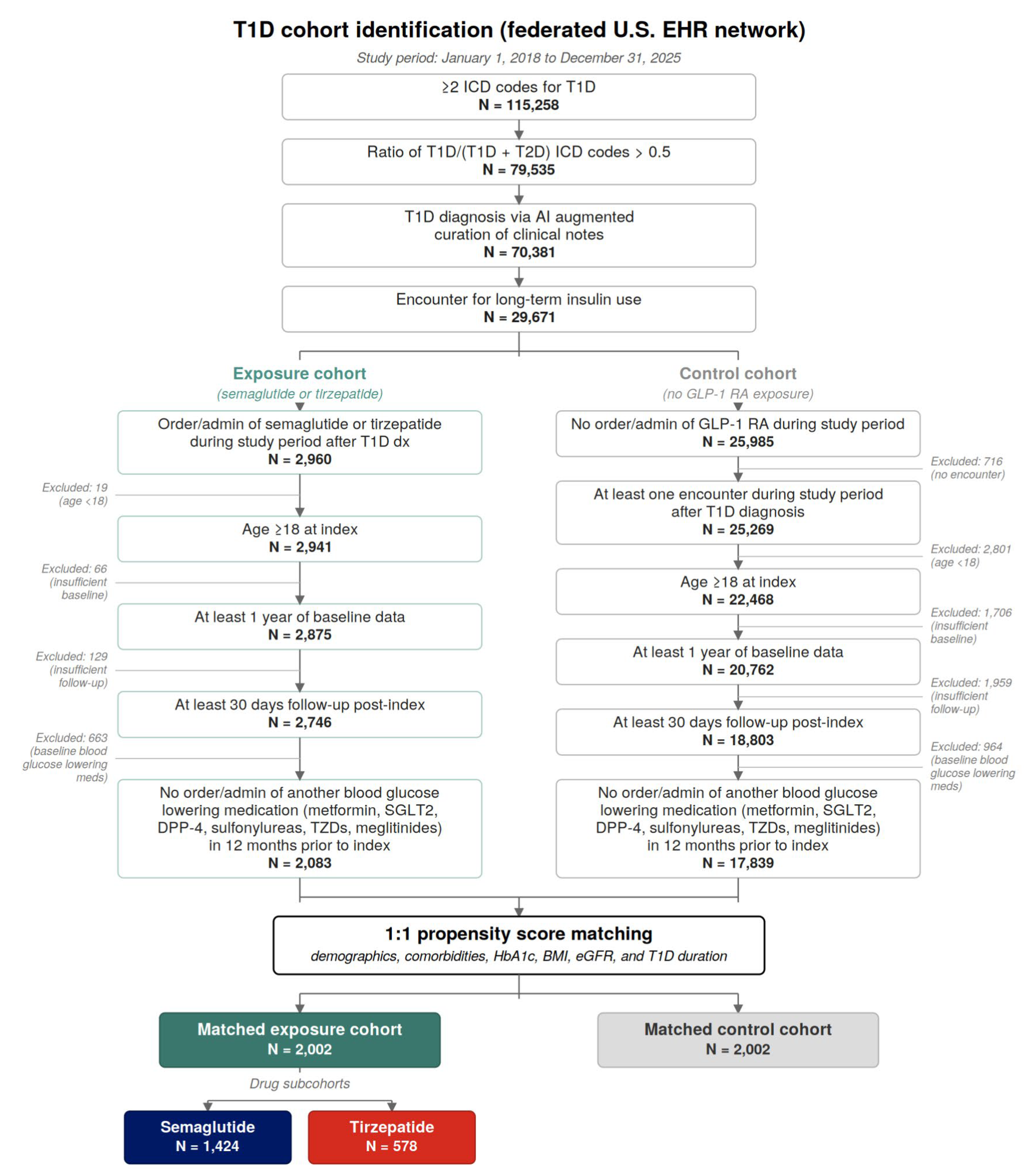
Figure 2.
Insulin total daily dose (TDD) trajectory in patients exposed to semaglutide or tirzepatide versus matched controls. Time-series depicting longitudinal TDD changes from Index through Month 24. The left column (panels A, C, E, G) compares semaglutide (navy) with the matched control cohort (gray) and the right column (panels B, D, F, H) compares tirzepatide (red) with the matched control cohort. (A, B) Mean absolute TDD (in units) at each anchor window; error bars indicate 95% confidence intervals. (C, D) Mean TDD percent change from baseline at each anchor window; the dashed box outlines the early titration interval (Index through Week 4), shown in panels E and F. (E, F) Mean TDD percent change from baseline restricted to the Index through Week 4 interval. (G, H) Proportion of patients achieving ≥10% TDD reduction from baseline at each anchor window; error bars indicate Wald 95% confidence intervals for proportions. Significance markers above each panel reflect two-sample Welch t-tests (panels A through F) or two-proportion z-tests (panels G, H) comparing the exposure cohort to the matched control at that time point (* P<0.05, ** P<0.01, *** P<0.001).
Figure 2.
Insulin total daily dose (TDD) trajectory in patients exposed to semaglutide or tirzepatide versus matched controls. Time-series depicting longitudinal TDD changes from Index through Month 24. The left column (panels A, C, E, G) compares semaglutide (navy) with the matched control cohort (gray) and the right column (panels B, D, F, H) compares tirzepatide (red) with the matched control cohort. (A, B) Mean absolute TDD (in units) at each anchor window; error bars indicate 95% confidence intervals. (C, D) Mean TDD percent change from baseline at each anchor window; the dashed box outlines the early titration interval (Index through Week 4), shown in panels E and F. (E, F) Mean TDD percent change from baseline restricted to the Index through Week 4 interval. (G, H) Proportion of patients achieving ≥10% TDD reduction from baseline at each anchor window; error bars indicate Wald 95% confidence intervals for proportions. Significance markers above each panel reflect two-sample Welch t-tests (panels A through F) or two-proportion z-tests (panels G, H) comparing the exposure cohort to the matched control at that time point (* P<0.05, ** P<0.01, *** P<0.001).
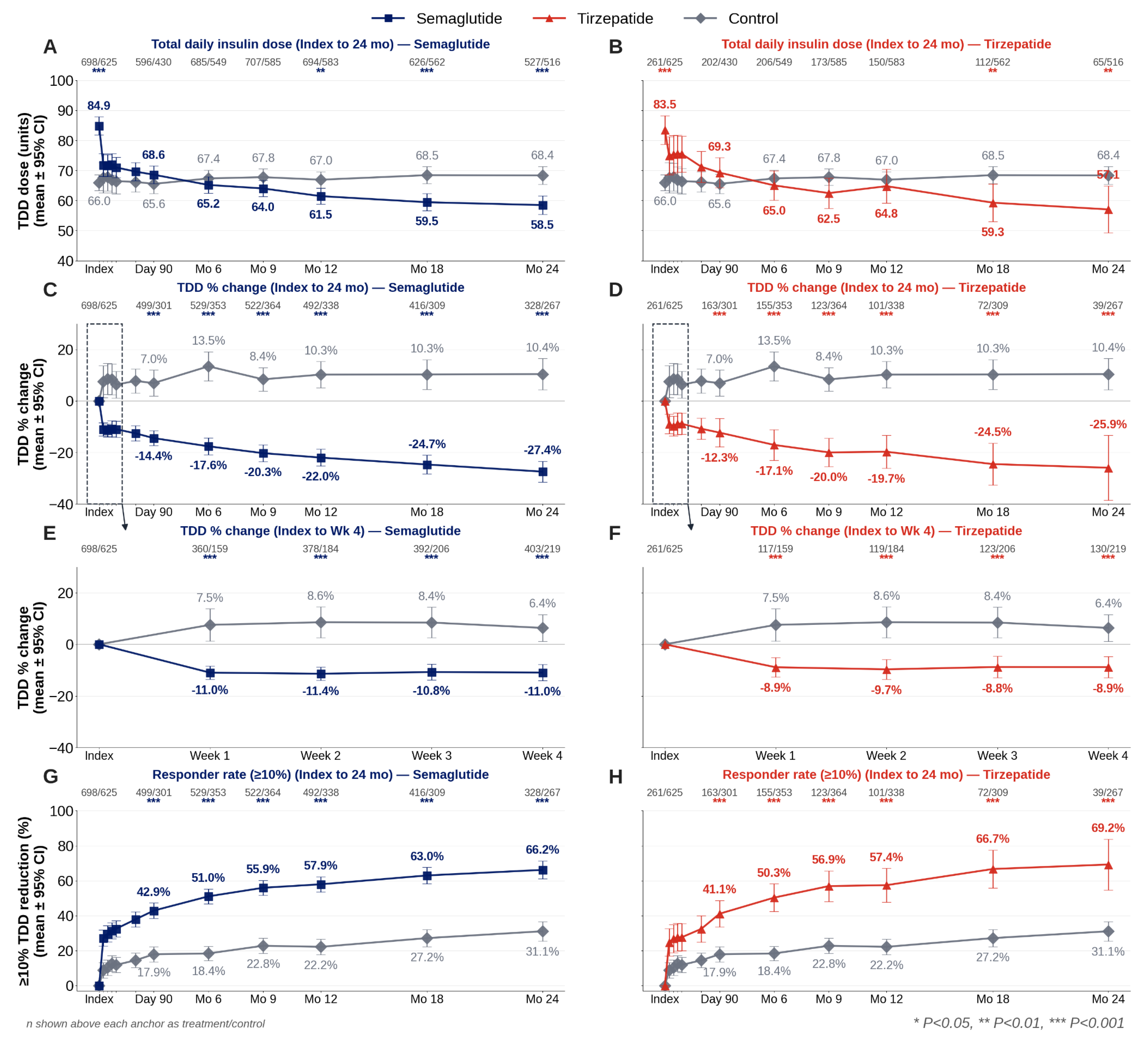
Figure 3.
Semaglutide and tirzepatide dose trajectory and dose distribution. (A) Median semaglutide dose over time with interquartile range (IQR) ribbon, from Index through Month 24. (B) Distribution of patients across semaglutide dose bins (0.25, 0.5, 1, 1.7, 2.0, 2.4 mg) at Index, Day 90, Month 6, Month 12, and Month 24 (stacked bars). (C) Median tirzepatide dose over time with IQR ribbon. (D) Distribution of patients across tirzepatide dose bins (2.5, 5, 7.5, 10, 12.5, 15 mg) at the same anchors.
Figure 3.
Semaglutide and tirzepatide dose trajectory and dose distribution. (A) Median semaglutide dose over time with interquartile range (IQR) ribbon, from Index through Month 24. (B) Distribution of patients across semaglutide dose bins (0.25, 0.5, 1, 1.7, 2.0, 2.4 mg) at Index, Day 90, Month 6, Month 12, and Month 24 (stacked bars). (C) Median tirzepatide dose over time with IQR ribbon. (D) Distribution of patients across tirzepatide dose bins (2.5, 5, 7.5, 10, 12.5, 15 mg) at the same anchors.
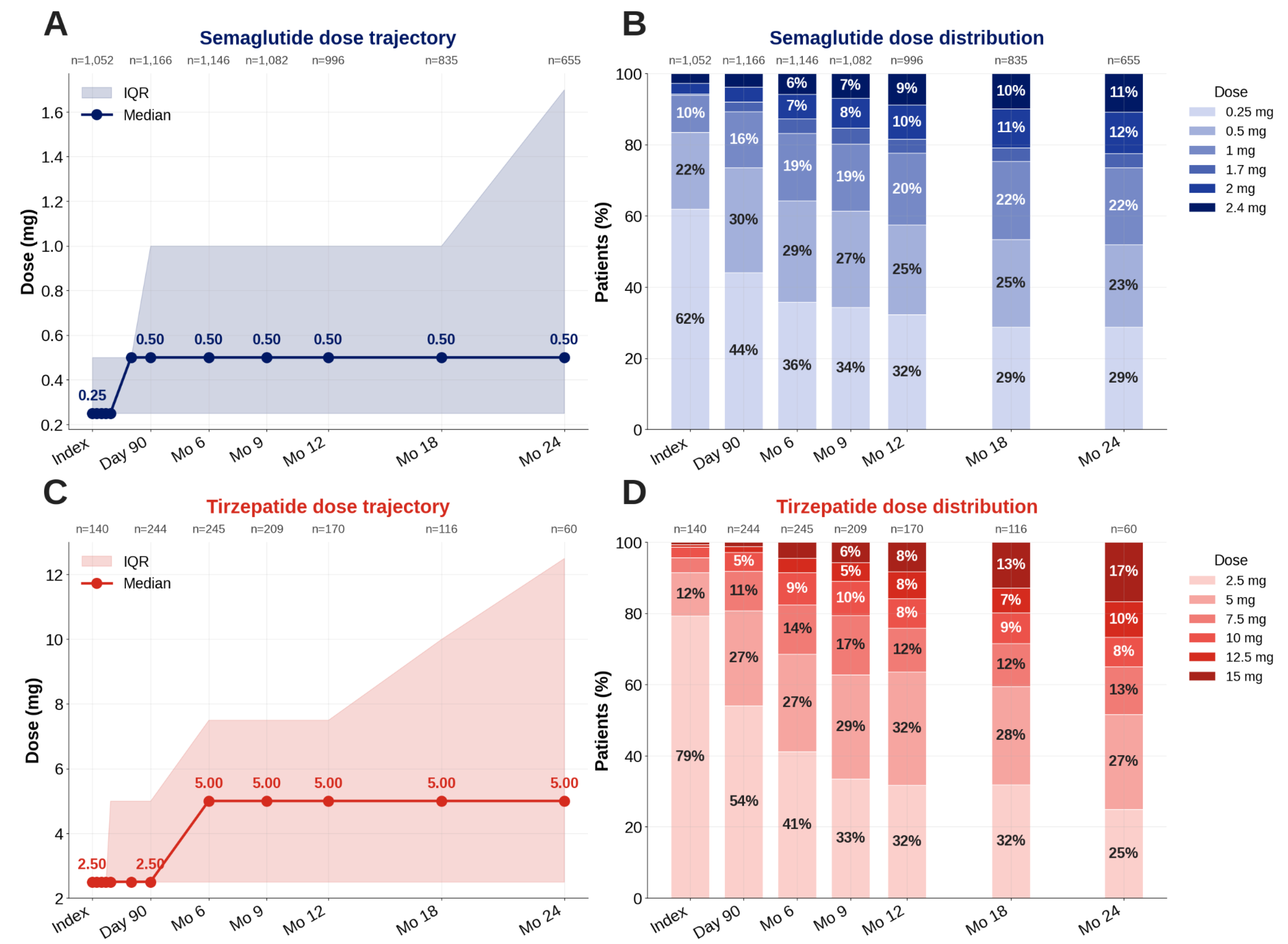
Figure 4.
Insulin TDD percent change stratified by 12-month weight change, HbA1c change, and drug dose. (A) Stratification by 12-month percent body weight change category (<5% loss, 5–10% loss, ≥10% loss), with bars for semaglutide (navy) and tirzepatide (red). (B) SStratification by 12-month absolute HbA1c change category (<0.5% reduction, 0.5–1.0% reduction, ≥1.0% reduction). (C) Stratification by semaglutide dose at 12 months, grouped into starter (0.25 mg), low (0.5 mg), standard (1 mg), and high (1.7–2.4 mg) categories. (D) Stratification by tirzepatide dose at 12 months, grouped into starter (2.5 mg), low (5 mg), mid (7.5–10 mg), and high (12.5–15 mg) categories. (E) Semaglutide dose collapsed into low (≤0.5 mg) and high (≥1.0 mg) categories. (F) Tirzepatide dose collapsed into low (≤5 mg) and high (≥7.5 mg) categories. Bars show the mean percent change in total daily insulin dose; error bars represent the standard error. Differences across categories were assessed by one-way ANOVA performed separately for each drug, with the omnibus P value shown at the upper left in the corresponding color; where the omnibus test was significant, pairwise comparisons were performed by Fisher’s least significant difference with Benjamini-Hochberg adjusted p-values.
Figure 4.
Insulin TDD percent change stratified by 12-month weight change, HbA1c change, and drug dose. (A) Stratification by 12-month percent body weight change category (<5% loss, 5–10% loss, ≥10% loss), with bars for semaglutide (navy) and tirzepatide (red). (B) SStratification by 12-month absolute HbA1c change category (<0.5% reduction, 0.5–1.0% reduction, ≥1.0% reduction). (C) Stratification by semaglutide dose at 12 months, grouped into starter (0.25 mg), low (0.5 mg), standard (1 mg), and high (1.7–2.4 mg) categories. (D) Stratification by tirzepatide dose at 12 months, grouped into starter (2.5 mg), low (5 mg), mid (7.5–10 mg), and high (12.5–15 mg) categories. (E) Semaglutide dose collapsed into low (≤0.5 mg) and high (≥1.0 mg) categories. (F) Tirzepatide dose collapsed into low (≤5 mg) and high (≥7.5 mg) categories. Bars show the mean percent change in total daily insulin dose; error bars represent the standard error. Differences across categories were assessed by one-way ANOVA performed separately for each drug, with the omnibus P value shown at the upper left in the corresponding color; where the omnibus test was significant, pairwise comparisons were performed by Fisher’s least significant difference with Benjamini-Hochberg adjusted p-values.
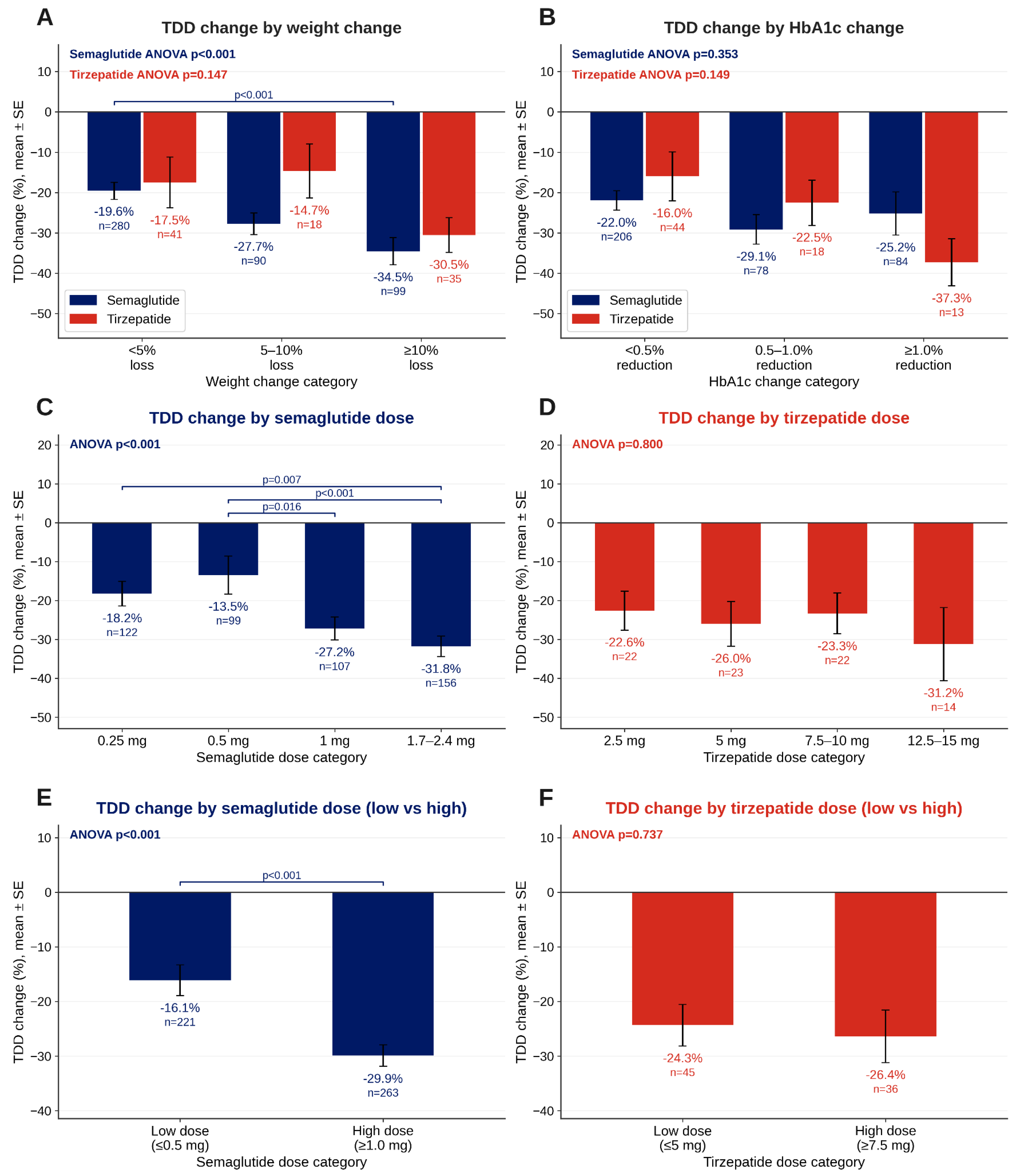
Figure 5.
Trajectories of HbA1c, body weight, and BMI versus the matched control, by exposure drug. Each panel shows the mean percent change from baseline at months 3, 6, 12, and 24. Columns show the exposure drug: semaglutide (A, C, E) and tirzepatide (B, D, F). Rows from top to bottom show the endpoint, each expressed as percent change from baseline: HbA1c (A, B), body weight (C, D), and BMI (E, F). Shaded bands are the mean ± 95% confidence interval; the light gray line is the matched control cohort. Sample sizes beneath each anchor are shown as treatment/control, with the exposed cohort on the left and the control cohort on the right. Asterisks denote the treatment-versus-control difference at each anchor from two-sample Welch t-tests (*** P < 0.001, ** P < 0.01, * P < 0.05; ns, not significant).
Figure 5.
Trajectories of HbA1c, body weight, and BMI versus the matched control, by exposure drug. Each panel shows the mean percent change from baseline at months 3, 6, 12, and 24. Columns show the exposure drug: semaglutide (A, C, E) and tirzepatide (B, D, F). Rows from top to bottom show the endpoint, each expressed as percent change from baseline: HbA1c (A, B), body weight (C, D), and BMI (E, F). Shaded bands are the mean ± 95% confidence interval; the light gray line is the matched control cohort. Sample sizes beneath each anchor are shown as treatment/control, with the exposed cohort on the left and the control cohort on the right. Asterisks denote the treatment-versus-control difference at each anchor from two-sample Welch t-tests (*** P < 0.001, ** P < 0.01, * P < 0.05; ns, not significant).
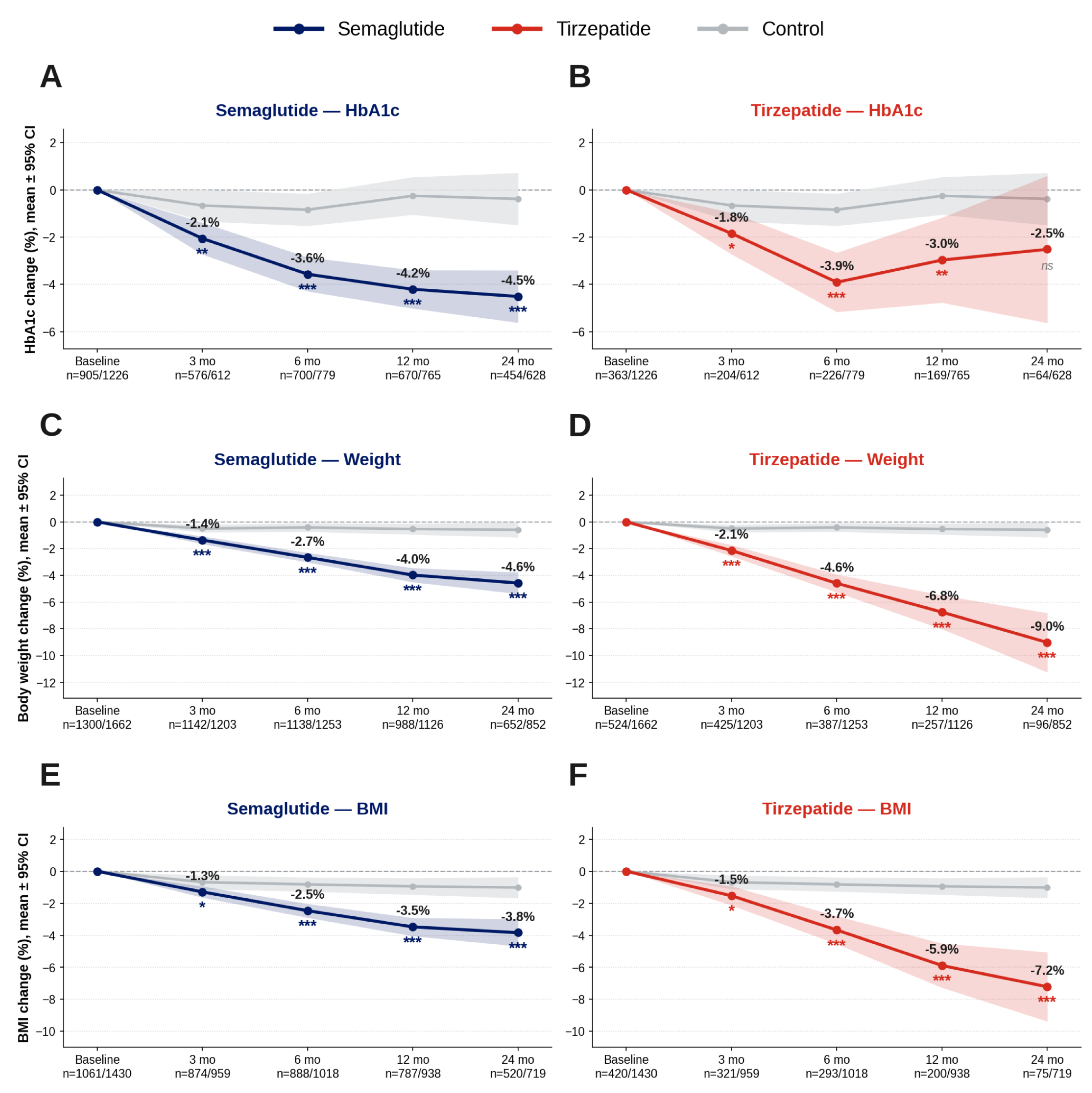
Figure 6.
Pre- versus post-exposure adverse event risk differences. Forest plot of paired risk differences, in percentage points, comparing the 365 days before and after the index date across 13 prespecified clinical events grouped by category (glycemic, gastrointestinal, pancreatobiliary, and other). Each event is plotted for three exposure groups: the combined semaglutide or tirzepatide cohort (teal; N = 2,002), semaglutide alone (navy; N = 1,424), and tirzepatide alone (red; N = 578). Markers show the point estimate and horizontal bars the 95% Wald confidence interval. The right-side columns report the risk difference with its 95% confidence interval and the corresponding two-sided McNemar exact test P-value together with the Benjamini-Hochberg adjusted P-value (P / BH P). Estimates that remain significant after Benjamini-Hochberg adjustment (BH P < 0.05) are bold and underlined, estimates reaching nominal significance before adjustment (McNemar P < 0.05) are bold. The vertical reference line at zero indicates no change in risk between periods; positive values indicate higher post-exposure risk. CI, confidence interval; RD, risk difference; BH, Benjamini-Hochberg.
Figure 6.
Pre- versus post-exposure adverse event risk differences. Forest plot of paired risk differences, in percentage points, comparing the 365 days before and after the index date across 13 prespecified clinical events grouped by category (glycemic, gastrointestinal, pancreatobiliary, and other). Each event is plotted for three exposure groups: the combined semaglutide or tirzepatide cohort (teal; N = 2,002), semaglutide alone (navy; N = 1,424), and tirzepatide alone (red; N = 578). Markers show the point estimate and horizontal bars the 95% Wald confidence interval. The right-side columns report the risk difference with its 95% confidence interval and the corresponding two-sided McNemar exact test P-value together with the Benjamini-Hochberg adjusted P-value (P / BH P). Estimates that remain significant after Benjamini-Hochberg adjustment (BH P < 0.05) are bold and underlined, estimates reaching nominal significance before adjustment (McNemar P < 0.05) are bold. The vertical reference line at zero indicates no change in risk between periods; positive values indicate higher post-exposure risk. CI, confidence interval; RD, risk difference; BH, Benjamini-Hochberg.
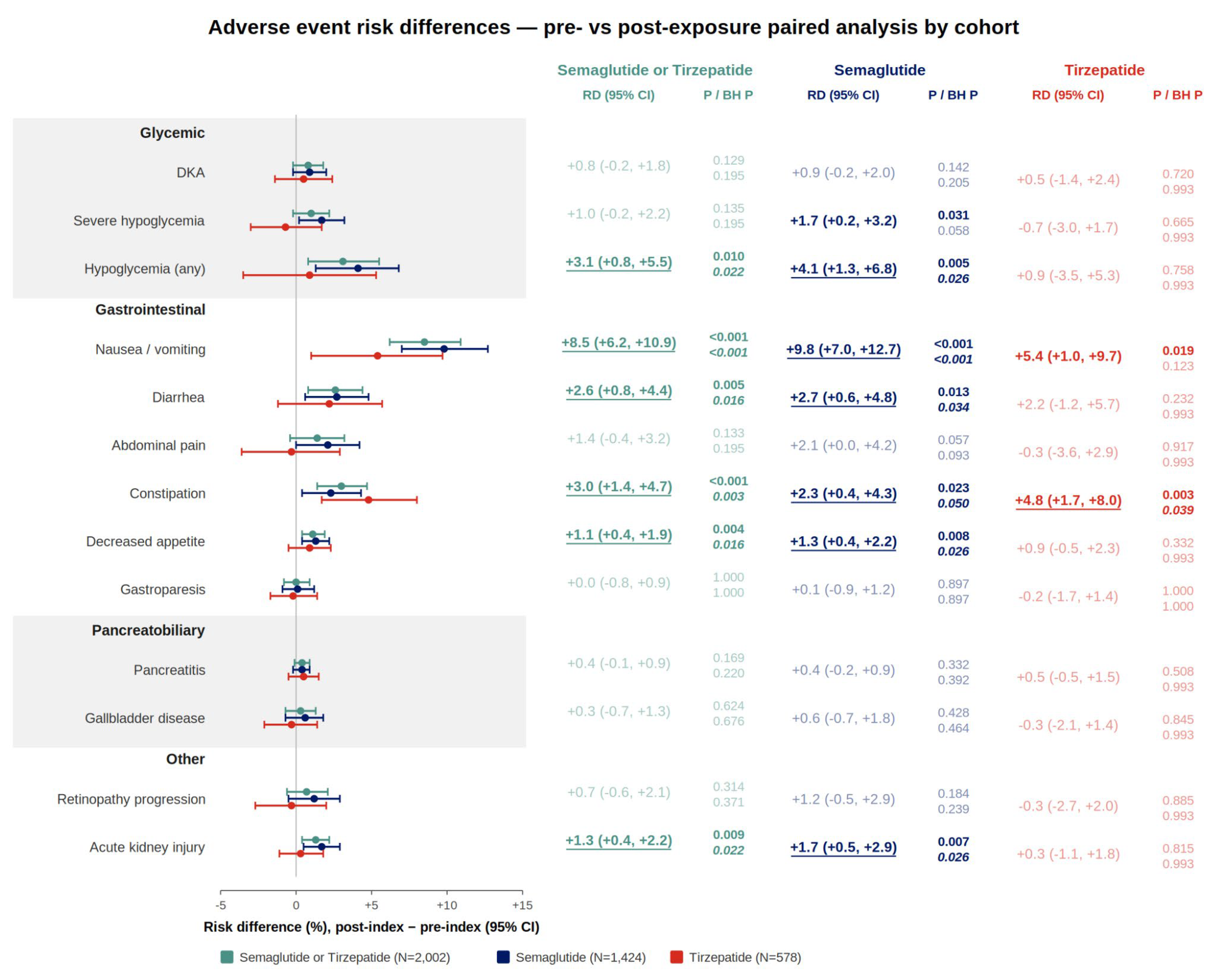
Figure 7.
Incidence rates of diabetic ketoacidosis and severe hypoglycemia following semaglutide or tirzepatide exposure, stratified by clinical and pharmacologic subgroup. Two-panel forest figure displaying crude incidence rates (per 100 person-years) for diabetic ketoacidosis (left, purple) and severe hypoglycemia (right, amber) within the combined semaglutide and tirzepatide exposure cohort. Rows are organized into eight stratifier blocks: baseline insulin total daily dose (TDD), baseline HbA1c, baseline BMI, six-month percent TDD reduction, six-month HbA1c reduction, six-month percent body weight reduction, semaglutide dose at six months, and tirzepatide dose at six months. Within each block, horizontal bars depict the subgroup incidence rate; error bars represent 95% Garwood (exact Poisson) confidence intervals. Annotations to the right of each bar report events per patients at risk, followed by the incidence rate and 95% CI. The vertical dashed line on each panel marks the cohort-wide reference incidence rate (1.91 per 100 person-years for diabetic ketoacidosis; 2.34 per 100 person-years for severe hypoglycemia). Block-level P-values reflect the Poisson likelihood-ratio test for heterogeneity across subgroups within each stratifier, paired with Benjamini-Hochberg false discovery rate adjusted P-values (BH) computed across the eight stratifier tests within each outcome panel. Raw P-values below 0.05 are displayed in bold, and BH-adjusted P-values below 0.05 are displayed in bold with underline. Tests significant after BH correction include baseline HbA1c (P=0.007, BH=0.034) and six-month TDD reduction (P=0.009, BH=0.034), both for diabetic ketoacidosis.
Figure 7.
Incidence rates of diabetic ketoacidosis and severe hypoglycemia following semaglutide or tirzepatide exposure, stratified by clinical and pharmacologic subgroup. Two-panel forest figure displaying crude incidence rates (per 100 person-years) for diabetic ketoacidosis (left, purple) and severe hypoglycemia (right, amber) within the combined semaglutide and tirzepatide exposure cohort. Rows are organized into eight stratifier blocks: baseline insulin total daily dose (TDD), baseline HbA1c, baseline BMI, six-month percent TDD reduction, six-month HbA1c reduction, six-month percent body weight reduction, semaglutide dose at six months, and tirzepatide dose at six months. Within each block, horizontal bars depict the subgroup incidence rate; error bars represent 95% Garwood (exact Poisson) confidence intervals. Annotations to the right of each bar report events per patients at risk, followed by the incidence rate and 95% CI. The vertical dashed line on each panel marks the cohort-wide reference incidence rate (1.91 per 100 person-years for diabetic ketoacidosis; 2.34 per 100 person-years for severe hypoglycemia). Block-level P-values reflect the Poisson likelihood-ratio test for heterogeneity across subgroups within each stratifier, paired with Benjamini-Hochberg false discovery rate adjusted P-values (BH) computed across the eight stratifier tests within each outcome panel. Raw P-values below 0.05 are displayed in bold, and BH-adjusted P-values below 0.05 are displayed in bold with underline. Tests significant after BH correction include baseline HbA1c (P=0.007, BH=0.034) and six-month TDD reduction (P=0.009, BH=0.034), both for diabetic ketoacidosis.
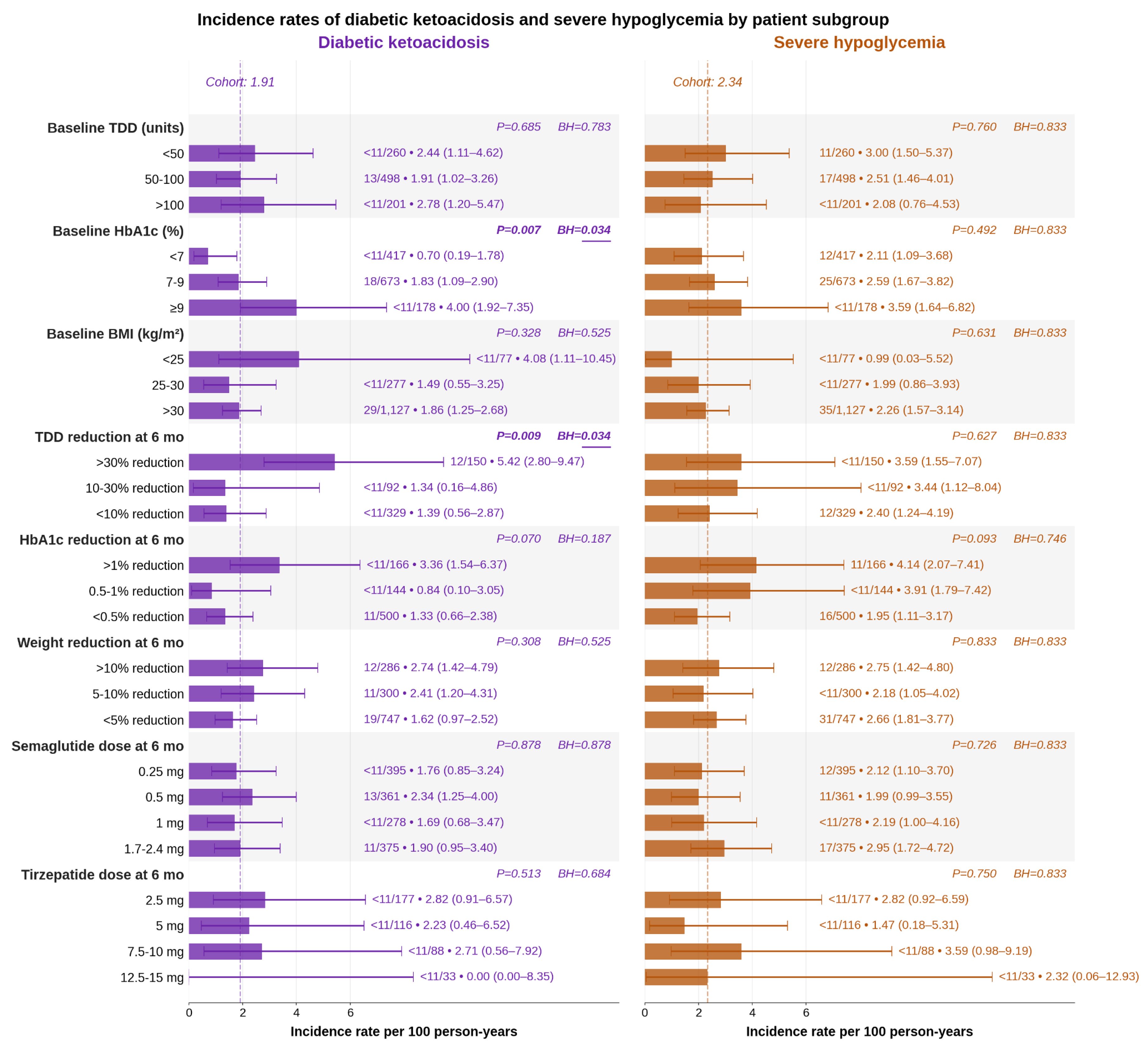
Figure 8.
Two-year time-to-event trajectories for all-cause mortality, MACE, and chronic kidney disease. Kaplan-Meier cumulative event curves are shown for the combined semaglutide or tirzepatide exposure cohort versus matched T1D controls. Panels A-C show all-cause mortality, MACE, and chronic kidney disease, respectively. Shaded bands represent 95% confidence intervals around the cumulative event curves. Log-rank P values and Benjamini-Hochberg p values are shown within each panel, with BH correction applied across the 24 prespecified cardiovascular and renal endpoints. Controls are shown in gray and semaglutide or tirzepatide exposure is shown in teal. Number-at-risk tables display the number remaining at risk and the number censored in parentheses at each time point.
Figure 8.
Two-year time-to-event trajectories for all-cause mortality, MACE, and chronic kidney disease. Kaplan-Meier cumulative event curves are shown for the combined semaglutide or tirzepatide exposure cohort versus matched T1D controls. Panels A-C show all-cause mortality, MACE, and chronic kidney disease, respectively. Shaded bands represent 95% confidence intervals around the cumulative event curves. Log-rank P values and Benjamini-Hochberg p values are shown within each panel, with BH correction applied across the 24 prespecified cardiovascular and renal endpoints. Controls are shown in gray and semaglutide or tirzepatide exposure is shown in teal. Number-at-risk tables display the number remaining at risk and the number censored in parentheses at each time point.
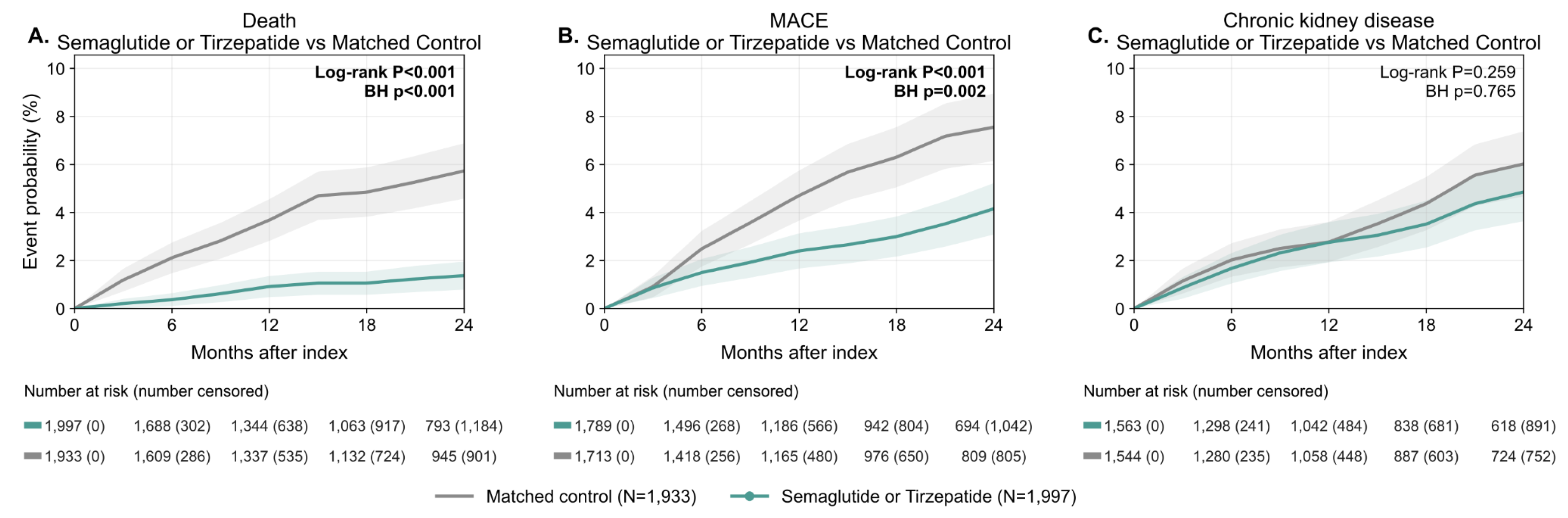

Table 1.
Baseline characteristics before and after 1:1 propensity score matching. Demographic, anthropometric, laboratory, and comorbidity characteristics of the exposure (semaglutide or tirzepatide) and control cohort before and after 1:1 propensity score matching on demographics, comorbidities, HbA1c, BMI, eGFR, and T1D duration. Standardized mean differences (SMDs) compare the exposure and control cohort within each matching state. SMDs below 0.10 indicate acceptable balance.
Table 1.
Baseline characteristics before and after 1:1 propensity score matching. Demographic, anthropometric, laboratory, and comorbidity characteristics of the exposure (semaglutide or tirzepatide) and control cohort before and after 1:1 propensity score matching on demographics, comorbidities, HbA1c, BMI, eGFR, and T1D duration. Standardized mean differences (SMDs) compare the exposure and control cohort within each matching state. SMDs below 0.10 indicate acceptable balance.
| Characteristic | Before matching | After 1:1 matching | ||||
|---|---|---|---|---|---|---|
| Semaglutide or Tirzepatide |
Control | SMD | Semaglutide or Tirzepatide |
Control | SMD | |
| n | 2,083 | 17,839 | 2,002 | 2,002 | ||
| Exposure agent, n (%) | ||||||
| Semaglutide | 1,476 (70.9) | — | 1,424 (71.1) | — | ||
| Tirzepatide | 607 (29.1) | — | 578 (28.9) | — | ||
| Age, years, mean (SD) | 47.1 (14.2) | 46.1 (18.1) | +0.057 | 47.1 (14.4) | 46.9 (14.6) | +0.013 |
| Sex, n (%) | 0.441 | 0.050 | ||||
| Female | 1,440 (69.1) | 8,830 (49.5) | 1,362 (68.0) | 1,408 (70.3) | ||
| Male | 636 (30.5) | 8,410 (47.1) | 640 (32.0) | 594 (29.7) | ||
| Unknown | <11 | 599 (3.4) | <11 | <11 | ||
| Race, n (%) | 0.125 | 0.039 | ||||
| Asian | 677 (32.5) | 6,335 (35.5) | 676 (33.8) | 680 (34.0) | ||
| Black / African American | 208 (10.0) | 2,124 (11.9) | 192 (9.6) | 196 (9.8) | ||
| White / Caucasian | 1,116 (53.6) | 8,624 (48.3) | 1,058 (52.8) | 1,063 (53.1) | ||
| Native Hawaiian / Pacific Islander | 15 (0.7) | 73 (0.4) | 15 (0.7) | 12 (0.6) | ||
| Other | 15 (0.7) | 100 (0.6) | 13 (0.6) | <11 | ||
| Unknown / not reported | 52 (2.5) | 583 (3.3) | 48 (2.4) | 42 (2.1) | ||
| Ethnicity, n (%) | 0.046 | 0.040 | ||||
| Hispanic or Latino | 73 (3.5) | 564 (3.2) | 67 (3.3) | 54 (2.7) | ||
| Not Hispanic or Latino | 1,672 (80.3) | 14,090 (79.0) | 1,608 (80.3) | 1,627 (81.3) | ||
| Unknown / not reported | 338 (16.2) | 3,185 (17.9) | 327 (16.3) | 321 (16.0) | ||
| BMI, kg/m², mean (SD) | 33.5 (5.1) | 26.6 (5.2) | +1.333 | 33.3 (5.1) | 32.7 (5.0) | +0.119 |
| HbA1c, %, mean (SD) | 7.7 (1.4) | 8.0 (1.9) | −0.164 | 7.7 (1.4) | 7.8 (1.5) | −0.039 |
| eGFR, mL/min/1.73 m², mean (SD) | 84.4 (27.5) | 84.6 (33.4) | −0.007 | 84.4 (27.8) | 84.6 (27.7) | −0.007 |
| T1D duration, years, mean (SD) | 8.6 (7.5) | 6.7 (7.1) | +0.268 | 8.6 (7.5) | 8.1 (7.6) | +0.072 |
| Hypertension, n (%) | 973 (46.7) | 6,709 (37.6) | 0.185 | 923 (46.1) | 875 (43.7) | 0.048 |
| Hyperlipidemia, n (%) | 1,102 (52.9) | 6,982 (39.1) | 0.279 | 1,056 (52.7) | 1,056 (52.7) | 0.000 |
| ASCVD, n (%) | 340 (16.3) | 3,122 (17.5) | 0.031 | 327 (16.3) | 319 (15.9) | 0.011 |
| Heart failure, n (%) | 105 (5.0) | 1,164 (6.5) | 0.064 | 102 (5.1) | 104 (5.2) | 0.005 |
| Diabetic microvascular complications, n (%) | 492 (23.6) | 3,942 (22.1) | 0.036 | 477 (23.8) | 465 (23.2) | 0.014 |
| Severe hypoglycemia history, n (%) | <11 | 103 (0.6) | 0.053 | <11 | <11 | 0.010 |
| DKA history, n (%) | <11 | 116 (0.7) | 0.071 | <11 | <11 | 0.012 |
| Tobacco use, n (%) | 71 (3.4) | 1,246 (7.0) | 0.162 | 68 (3.4) | 67 (3.3) | 0.003 |
Disclaimer/Publisher’s Note: The statements, opinions and data contained in all publications are solely those of the individual author(s) and contributor(s) and not of MDPI and/or the editor(s). MDPI and/or the editor(s) disclaim responsibility for any injury to people or property resulting from any ideas, methods, instructions or products referred to in the content. |
© 2026 by the authors. Licensee MDPI, Basel, Switzerland. This article is an open access article distributed under the terms and conditions of the Creative Commons Attribution (CC BY) license.
Copyright: This open access article is published under a Creative Commons CC BY 4.0 license, which permit the free download, distribution, and reuse, provided that the author and preprint are cited in any reuse.


