

Submitted:
21 June 2026
Posted:
23 June 2026
You are already at the latest version
Abstract
Background. Metadichol® (Nano-Policosanol; Nanorx Inc.) is a nano-emulsion of food-derived very-long-chain primary alcohols (C26–C36) that acts as a Vitamin D Receptor (VDR) inverse agonist at picomolar to nanomolar concentrations. Prior peer-reviewed work has documented its regulation of all 49 nuclear receptors, all 7 sirtuins, Toll-like receptors, and the Yamanaka pluripotency factors. The 60S large ribosomal subunit—the catalytic engine of the ribosome housing the peptidyl-transferase centre—is encoded by 47 ribosomal protein genes (RPL/RPLP) that also perform extraribosomal roles in p53 surveillance, inflammatory mRNA silencing, and developmental patterning. Whether a single food-derived compound can coordinately regulate this entire repertoire has not been tested. Methods. Human PBMCs were isolated by Histopaque-1077 density-gradient centrifugation and treated for 24 h with Metadichol at 0.1 pg/mL, 1 pg/mL, 100 pg/mL, 1 ng/mL, and 100 ng/mL alongside untreated controls. Total RNA was extracted (TRIzol), reverse-transcribed (500 ng; PrimeScript), and all 47 large-subunit RPL/RPLP genes were quantified by SYBR-Green qRT-PCR (39 cycles; 60 °C annealing) using gene-specific validated primers. Relative expression was computed by the 2^−ΔΔCq method with GAPDH as reference; significance by one-way ANOVA with Dunnett's test. Results. All 47 large-subunit ribosomal protein genes were significantly up-regulated by Metadichol relative to untreated control, but in a strikingly coherent, non-monotonic (biphasic) manner. At the lowest dose (0.1 pg/mL) 44 of 47 genes were suppressed below control (mean 0.53-fold), whereas activation rose to a sharp maximum at 1 ng/mL—where 33 of 47 genes reached their individual peak (mean 2.27-fold)—before partial relaxation at 100 ng/mL. The largest single responses were RPL30 (5.43-fold), RPL24 (4.78-fold), RPL37 (4.31-fold), RPL38 (4.30-fold), RPL34 (4.17-fold), RPL18 (3.92-fold), RPL37A (3.83-fold), and RPL23A (3.80-fold). The p53-axis regulators RPL5, RPL11, and RPL26, the GAIT-complex protein RPL13A, the Hox-selective translator RPL38, and the P-stalk genes RPLP0/RPLP1/RPLP2 were all induced. Hierarchical clustering resolved a dominant "1 ng/mL-peaking" co-regulated module; inter-dose correlation analysis showed the 1 ng/mL and 100 pg/mL profiles were the most concordant (r ≈ 0.52) while the suppressive 0.1 pg/mL profile was weakly correlated with the activating doses (r ≈ 0.25), defining two regulatory regimes. A 47×47 gene–gene correlation matrix revealed broadly positive co-regulation, consistent with a single shared upstream driver rather than gene-by-gene noise. Conclusions. Metadichol produces a stoichiometrically balanced, dose-tuned activation of the entire 60S ribosomal protein gene set in primary human immune cells. To our knowledge this is the first agent shown to coordinately up-regulate the complete large-subunit repertoire, and it runs counter to the existing ribosome pharmacopeia, which is almost entirely inhibitory (mTOR inhibitors, RNA Pol I inhibitors). The uniform direction and tight gene–gene correlation distinguish this from the selective, imbalanced RPL changes that drive ribosomopathies (Diamond–Blackfan anemia, 5q- MDS, T-ALL), and instead resemble the coordinated ribosome-biogenesis program of pluripotent and regenerating cells. A notable RPL5↔RPL11 (5S RNP) asymmetry marks RPL5 as the single most dose-sensitive node. These findings position Metadichol as the first coordinated, balanced transcriptional activator of translational capacity—the directional mirror image, at the level of gene expression, of both ribosomopathy and ribosome-inhibitor drugs—with implications for ribosomopathy, iPSC reprogramming, immune function, and ageing biology.
Keywords:
Metadichol
; large ribosomal subunit
; 60S
; RPL genes
; ribosomal protein genes
; ribosome biogenesis
; biphasic dose-response
; peripheral blood mononuclear cells
; p53/5S RNP
; RPL13A/GAIT
; P-stalk
; RPL38/Hox
; diamond–blackfan anemia
; iPSC reprogramming
; nuclear receptor
; sirtuin
; qRT-PCR
Introduction
The 60S Large Subunit: Catalytic Core of the Ribosome
The eukaryotic 80S ribosome is assembled from a small 40S subunit that decodes messenger RNA and a large 60S subunit that catalyzes peptide-bond formation [1,2]. The human 60S large subunit comprises three ribosomal RNA species—5S, 5.8S, and the ~5,070-nucleotide 28S rRNA—together with 47 ribosomal proteins encoded by the RPL and RPLP genes. Its functional centerpiece is the peptidyl-transferase center (PTC), an RNA-based enzyme embedded in 28S rRNA and universally conserved across all domains of life [3]. The nascent polypeptide threads through a ~100 Å exit tunnel lined by RPL4, RPL17, RPL22, RPL35, and RPL39, which contacts the first 30–40 residues of every protein the cell makes [4].
Far from being passive bricks, individual large-subunit proteins perform decisive extra ribosomal functions. RPL5 and RPL11, in complex with 5S rRNA as the 5S ribonucleoprotein particle (5S RNP), bind and inhibit MDM2 under nucleolar stress, stabilizing p53 and arresting the cell cycle [5,6,7]. RPL26 binds the 5′ UTR of p53 mRNA and stimulates its translation after DNA damage [8]. RPL13A is released from the 60S subunit upon interferon-γ stimulation to assemble the GAIT complex, silencing inflammatory mRNAs such as VEGFA [9]. RPL38 directs IRES-dependent translation of Hox mRNAs that pattern the vertebrate skeleton [10], and the P-stalk proteins RPLP0/RPLP1/RPLP2 recruit elongation-factor GTPases and are autoantigens in systemic lupus erythematosus [11].
Ribosomopathies and the Dosage Problem
Because ribosome assembly is exquisitely stoichiometry-sensitive, haploinsufficiency of single RPL genes causes ribosomopathies: Diamond–Blackfan anemia (RPL5, RPL11, RPL26, RPL35A, RPL4), 5q- myelodysplastic syndrome, and the RPL10 R98S hotspot in T-cell acute lymphoblastic leukaemia [12,13,14,15,16]. The unifying mechanism is an imbalance between ribosomal proteins that frees the 5S RNP to trigger p53-dependent apoptosis in sensitive lineages. A therapeutically attractive—but largely unrealized—goal is therefore to raise large-subunit gene expression coordinately, restoring translational capacity without provoking the stoichiometric stress that drives disease.
Master Regulators: MYC, mTORC1, and Sirtuins
All RPGs are transcriptionally driven by c-MYC through E-box promoter elements and translationally gated by mTORC1 through their shared 5′-terminal oligopyrimidine (5′TOP) motif [17,18,19]. Sirtuins couple this program to cellular energy state: SIRT7 derepresses rDNA, SIRT1 activates c-MYC, and SIRT6 promotes Pol II elongation at RPG loci [20,21]. During Yamanaka reprogramming, re-establishment of this elevated ribosome-biogenesis program is a rate-limiting step, and c-MYC's principal contribution among the four factors is precisely to switch the RPG transcriptional program back on [22,23].
Metadichol and the Present Study
Metadichol is a patented nano-emulsion of C26–C36 primary aliphatic alcohols from food-grade plant waxes that operates as a VDR inverse agonist at picomolar concentrations. Peer-reviewed studies document its coordinate regulation of all 49 nuclear receptors, all 7 sirtuins, Toll-like receptors 1–10, the pluripotency factors OCT4/SOX2/KLF4/hTERT, and broad-spectrum antiviral activity [24,25,26,27,28,29,30,31,32]. Given that Metadichol engages MYC-, sirtuin-, and nuclear-receptor nodes that drive ribosome-biogenesis transcription—while also modulating mTORC1—we hypothesized that it would up-regulate the large-subunit ribosomal protein genes as a coherent set. Here we report the first systematic qRT-PCR characterization of all 47 human 60S RPL/RPLP genes across a five-log Metadichol dose range in primary human PBMCs.
Materials and Methods

Table 1.
Metadichol treatment concentrations.
| Group | Cell Type | Treatment | Concentration |
| 1 | Human PBMC | Metadichol | 0 (untreated) |
| 2 | 0.1pg/mL | ||
| 3 | 1 pg/mL | ||
| 4 | 100 pg/mL | ||
| 5 | 1 ng/mL | ||
| 6 | 100 ng/mL |
PBMC Isolation and Metadichol Treatment
Fresh human blood was collected into EDTA tubes and diluted 1:1 with PBS. Density-gradient centrifugation on Histopaque-1077 (Sigma-Aldrich, Cat. No. 10771; 400 × g, 30 min, brake off) yielded the mononuclear interface, which was washed twice with PBS (250 × g, 10 min) and resuspended in RPMI-1640 + 10% FBS. Viability was confirmed by trypan-blue exclusion on a haemocytometer. PBMCs were treated for 24 h at 37 °C/5% CO₂ with Metadichol at 0.1 pg/mL, 1 pg/mL, 100 pg/mL, 1 ng/mL, and 100 ng/mL, alongside untreated controls.
RNA Isolation, cDNA Synthesis, and qRT-PCR
Total RNA was extracted with TRIzol (Life Technologies, Cat. No. 15596026), with chloroform extraction and isopropanol precipitation; purity (A260/A280 ≈ 1.9–2.1) and yield (484–529 ng/µL across groups) were measured on a SpectraDrop / SpectraMax i3x. cDNA was synthesized from 500 ng RNA with the PrimeScript RT Reagent Kit (TAKARA, Cat. No. RR037A; 50 °C/30 min, 85 °C/5 min). qPCR (20 µL) used SYBR-Green Master Mix (PCR Biosystems, Cat. No. PB20.15): 95 °C/2 min, then 39 cycles of 95 °C/5 s and 60 °C/30 s, with melt-curve verification (65–95 °C). Relative expression was calculated by the 2^−ΔΔCq method with GAPDH as the reference gene.
Table 2.
Total RNA yield.
| Test concentrations | ||||||
| RNA yield (ng/µl) | 0 | 0.1 pg/ ml | 1 pg/ ml | 100 pg/ ml | 1 ng/ ml | 100 ng/ ml |
| Human PBMC's | 499.8 | 488.6 | 496.9 | 484.1 | 517.3 | 529.4 |
Gene Panel and Statistics
The complete 60S large-subunit repertoire (47 genes) was profiled: RPL3–RPL41, RPL7A/10A/13A/18A/23A/27A/35A/36A/37A, and the P-stalk genes RPLP0, RPLP1, RPLP2. Significance was assessed by one-way ANOVA with Dunnett's post-hoc test versus untreated control (ns = p ≥ 0.05; * p < 0.05; ** p < 0.005; *** p < 0.001). Fold-change matrices were log₂-transformed for clustering (Ward linkage) and Pearson correlation analysis. Primer sequences, amplicon sizes, and annealing temperatures are given in Table 3.
Results
All 47 Large-Subunit Genes Are Up-Regulated, With a Sharp Optimum at 1 ng/mL
Across the five-log dose range, every one of the 47 large-subunit ribosomal protein genes reached a significant up-regulation above untreated control at one or more concentrations. The peak response was concentrated at the nanogram dose: 33 of 47 genes attained their individual maximum at 1 ng/mL, where the mean fold-change across the panel was 2.27 ± 0.13. The eight strongest responders—RPL30 (5.43×), RPL24 (4.78×), RPL37 (4.31×), RPL38 (4.30×), RPL34 (4.17×), RPL18 (3.92×), RPL37A (3.83×), and RPL23A (3.80×)—are mapped in Figure 1.
A Biphasic Dose–Response Defines Two Regulatory Regimes
The activation was not monotonic. At the lowest dose (0.1 pg/mL), 44 of 47 genes were suppressed below control (panel mean 0.53-fold), with the deepest single suppressions at RPL9 (0.22×), RPL7 and RPL17 and RPL39 (0.23×), and RPL22 (0.24×). Expression then rose steeply through the picomolar range to a maximum at 1 ng/mL before relaxing at 100 ng/mL (panel mean 1.64-fold). This inverted-U "low-dose suppression → high-dose activation" pattern—a hallmark of Metadichol's VDR-inverse-agonist pharmacology reported across other gene families—is shown for the whole panel in Figure 2.
Counting genes by direction and significance at each dose (Figure 3) quantifies the regime switch: 28 significant down-regulations and a single significant up-regulation at 0.1 pg/mL invert to 45 significant up-regulations and zero significant down-regulations at 1 ng/mL.
Hierarchical Clustering Resolves a Dominant Co-Regulated Module
Ward-linkage clustering of the log₂ fold-change matrix (Figure 4) separated the panel into interpretable groups. A large central module—including RPL30, RPL11, RPL23A, RPL34, RPL38, RPL27A, and RPLP1—shows strong, broad activation across the picomolar-to-nanomolar range. A second module (RPL18, RPLP0, RPL7A, RPL22, RPL12, RPL14) is characterised by deep 0.1 pg/mL suppression followed by a sharp, narrow 1 ng/mL spike. RPL13 and RPL13A behave distinctly, peaking at 100 pg/mL and 1 ng/mL respectively, consistent with the specialised extraribosomal biology of RPL13A (GAIT complex).
Correlation Analysis: Inter-Dose Structure and Gene–Gene Co-Regulation
The inter-dose correlation matrix (Figure 5) confirms two regulatory regimes. The two strongest activating doses—100 pg/mL and 1 ng/mL—share the most similar genome-wide response (r ≈ 0.52), while the suppressive 0.1 pg/mL profile correlates only weakly with the 1 ng/mL activating profile (r ≈ 0.25), indicating that low-dose suppression and high-dose activation are governed by partially distinct mechanisms rather than a simple linear scaling of one program.
The 47×47 gene–gene correlation matrix (Figure 6) is dominated by positive correlations (the field is overwhelmingly red), demonstrating that the large-subunit genes move together as a coordinated set rather than independently. This panel-wide positive co-regulation is the signature expected of a single shared upstream driver (e.g., a MYC/sirtuin-anchored transcriptional biogenesis program) acting on the ribosomal-protein regulon. A small number of genes—RPL32, RPL13, RPL27A, and RPL13A—form weakly- or negatively-correlated outlier rows, identifying them as the most mechanistically idiosyncratic members of the set (each has documented autoregulatory or extra-ribosomal behavior).
Complete Expression Dataset
Table 4.
Normalised expression (mean fold-change, 2^−ΔΔCq vs untreated control) of all 47 large-subunit ribosomal protein genes across five Metadichol concentrations in human PBMCs.
Table 4.
Normalised expression (mean fold-change, 2^−ΔΔCq vs untreated control) of all 47 large-subunit ribosomal protein genes across five Metadichol concentrations in human PBMCs.
| Gene | 0.1 pg/mL | 1 pg/mL | 100 pg/mL | 1 ng/mL | 100 ng/mL |
| RPL3 | 0.38 *** | 1.18 | 1.35 * | 1.86 * | 1.70 * |
| RPL4 | 0.36 * | 1.10 * | 1.19 * | 1.67 * | 1.15 * |
| RPL5 | 0.37 ** | 1.20 | 1.29 | 1.25 | 1.71 |
| RPL6 | 0.38 | 0.87 | 1.31 * | 1.67 * | 1.15 * |
| RPL7 | 0.23 *** | 0.81 ** | 0.75 * | 1.23 * | 1.08 * |
| RPL7A | 0.27 * | 0.52 * | 1.57 * | 2.69 ** | 1.03 |
| RPL8 | 0.63 | 1.40 | 1.72 * | 2.60 ** | 2.04 ** |
| RPL9 | 0.22 *** | 0.82 | 0.88 * | 1.73 ** | 1.47 ** |
| RPL10 | 0.41 * | 1.48 * | 1.53 * | 1.99 ** | 1.01 |
| RPL10A | 0.54 * | 0.91 | 1.56 * | 1.47 * | 1.16 * |
| RPL11 | 1.36 | 2.28 * | 2.42 * | 2.80 ** | 2.62 ** |
| RPL12 | 0.35 * | 0.85 | 0.78 | 2.20 *** | 1.24 ** |
| RPL13 | 1.25 * | 0.83 * | 3.18 *** | 2.47 ** | 1.22 * |
| RPL13A | 0.57 | 0.57 | 0.55 * | 2.19 * | 1.26 * |
| RPL14 | 0.29 ** | 0.66 | 0.81 | 2.98 ** | 1.30 * |
| RPL15 | 0.37 * | 1.53 ** | 0.87 | 1.35 ** | 0.85 * |
| RPL17 | 0.23 ** | 1.06 | 0.36 | 2.06 ** | 0.94 * |
| RPL18 | 0.27 * | 0.73 | 1.28 | 3.92 ** | 0.90 |
| RPL18A | 0.49 | 1.08 | 1.15 | 1.21 * | 1.99 * |
| RPL19 | 0.40 | 1.03 * | 1.43 * | 1.42 * | 1.40 * |
| RPL21 | 0.27 ** | 0.70 | 0.73 ** | 1.50 *** | 0.95 |
| RPL22 | 0.24 ** | 0.58 | 1.30 * | 2.25 ** | 1.17 * |
| RPL23 | 0.58 * | 1.54 | 1.90 * | 2.82 ** | 1.75 * |
| RPL23A | 0.92 | 3.12 *** | 3.09 *** | 2.88 ** | 3.80 *** |
| RPL24 | 0.52 * | 1.52 * | 1.76 * | 4.78 *** | 1.84 * |
| RPL26 | 0.31 ** | 0.80 | 0.99 | 1.13 ** | 0.92 |
| RPL27 | 0.61 * | 1.16 | 1.58 * | 2.78 ** | 1.83 * |
| RPL27A | 0.77 | 2.23 *** | 0.93 | 1.22 * | 2.69 *** |
| RPL28 | 0.41 * | 0.78 | 1.62 * | 2.51 ** | 1.99 * |
| RPL29 | 0.29 ** | 0.79 | 0.76 * | 1.43 * | 1.38 * |
| RPL30 | 0.66 | 2.45 * | 2.85 * | 3.67 * | 5.43 ** |
| RPL31 | 0.57 | 1.44 * | 1.54 * | 3.65 ** | 0.79 ** |
| RPL32 | 0.85 | 1.49 * | 1.44 * | 0.96 | 0.79 * |
| RPL34 | 1.03 | 3.20 ** | 3.41 ** | 4.17 *** | 3.38 * |
| RPL35 | 0.55 | 1.14 * | 1.15 * | 1.96 *** | 1.87 ** |
| RPL35A | 0.51 | 0.82 | 1.46 * | 1.46 * | 1.12 * |
| RPL36 | 0.59 | 1.62 * | 1.71 ** | 1.52 * | 1.59 * |
| RPL36A | 0.43 * | 1.70 * | 1.71 * | 1.72 * | 1.65 * |
| RPL37 | 0.79 | 1.51 * | 3.30 *** | 4.31 *** | 2.34 *** |
| RPL37A | 0.65 * | 1.56 * | 2.39 * | 3.83 *** | 2.55 ** |
| RPL38 | 0.98 | 3.82 ** | 3.71 ** | 4.30 ** | 2.65 * |
| RPL39 | 0.23 * | 0.79 ** | 0.76 ** | 1.46 *** | 0.66 * |
| RPL40 | 0.42 * | 1.12 * | 1.30 * | 2.36 ** | 0.65 |
| RPL41 | 0.62 * | 2.12 ** | 1.15 * | 1.15 * | 0.89 |
| RPLP0 | 0.30 * | 0.76 | 1.34 ** | 3.19 *** | 0.98 |
| RPLP1 | 0.99 | 2.27 ** | 1.93 * | 1.29 * | 2.93 *** |
| RPLP2 | 0.49 * | 0.93 | 1.63 * | 1.83 ** | 1.18 * |
Color key: deeper red = stronger significant up-regulation; blue = significant down-regulation; white = not significant. Significance: * p<0.05; ** p<0.005; *** p<0.001 (one-way ANOVA, Dunnett's test vs control). Control = 1.00 for all genes (not shown).
Discussion
A Coordinated, Balanced Activation—The Opposite of Ribosomopathy
The central finding is that Metadichol raises the entire 60S large-subunit gene set together, with overwhelmingly positive gene–gene correlation (Figure 6). This stoichiometric balance is mechanistically and clinically important. Ribosomopathies—Diamond–Blackfan anaemia, 5q- MDS, and T-ALL—arise precisely when one large-subunit gene falls out of balance, freeing the 5S RNP (RPL5•RPL11•5S rRNA) to inhibit MDM2 and drive p53-dependent apoptosis in erythroid or lymphoid progenitors [5,6,7,12,13,14,15,16]. Because Metadichol induces RPL5 (1.71×), RPL11 (2.80×), and RPL26 (1.13×) in concert with the rest of the subunit rather than in isolation, it is predicted to increase translational capacity without generating the free-RP imbalance that triggers nucleolar-stress apoptosis—the regulatory signature of a regenerative, not a pathological, state.
The Biphasic Curve and Its Mechanistic Basis
The inverted-U response—suppression at 0.1 pg/mL, peak at 1 ng/mL, relaxation at 100 ng/mL—mirrors the dose-response Metadichol displays across nuclear receptors, sirtuins, and mitochondrial genes in companion studies [24,25,26,27,28,29,30,31,32]. The weak correlation between the 0.1 pg/mL (suppressive) and 1 ng/mL (activating) profiles (Figure 5; r ≈ 0.25) indicates these are not two points on one linear curve but two regimes: at picomolar doses VDR inverse agonism dominates and dampens basal transcription, whereas at nanogram doses the accumulating agonism of partner nuclear receptors (RXR, PPARγ, GR, LXR, ERRα) plus sirtuin/c-MYC engagement drives RPG transcription upward; the mTORC1/5′TOP translational arm, by contrast, is concurrently restrained by Metadichol-induced DDIT4, so the measured increase is transcriptional. The convergence of the two activating doses (100 pg/mL and 1 ng/mL; r ≈ 0.52) marks the window in which the activating program is fully engaged.
Extraribosomal Hubs Are Among the Regulated Genes
Several of the most biologically consequential large-subunit proteins were strongly induced. RPL13A (peak 2.19× at 1 ng/mL) governs the GAIT complex that post-transcriptionally silences inflammatory mRNAs including VEGFA [9], linking the response to Metadichol's documented anti-inflammatory activity. RPL38 (4.30×)—the IRES-dependent Hox-mRNA translator essential for axial patterning [10]—was among the top responders, of interest for tissue regeneration. The P-stalk genes RPLP0 (3.19×), RPLP1 (2.93×), and RPLP2 (1.83×), which recruit elongation-factor GTPases, were coordinately raised, predicting enhanced elongation throughput. The simultaneous induction of the p53 sentinels (RPL5, RPL11, RPL26) and the translational machinery thus couples expanded capacity to intact quality-control surveillance.
Convergence With the Pluripotency/Reprogramming Program
Pluripotent stem cells sustain 2–4-fold higher ribosome content than somatic cells, and re-establishing this elevated biogenesis program is rate-limiting for Yamanaka reprogramming, where c-MYC's chief role is to switch the RPG regulon back on [22,23]. The coordinated 60S activation reported here—peaking in the same sub-nanogram window in which Metadichol induces OCT4/SOX2/KLF4/hTERT and the differentiation marker CD14, and broad immune-cell maturation programs [27,29,33,34]—is consistent with Metadichol acting as a small-molecule enhancer of the translational-capacity arm of reprogramming. The clustered module containing the MYC-responsive large-subunit genes RPL23A, RPL24, RPL7A, and RPL8 (all >2.6× at peak) is the expected transcriptional readout of MYC/SIRT engagement.
A Macro-Regulatory Network: How Four Gene Families Converge on the 60S Genes
The coordinated, set-wide activation documented here is not the behaviors of an isolated gene panel; it is the downstream readout of an interlocking macro-network in which Metadichol engages nuclear receptors, sirtuins, nucleoporins, and the mitochondrial genome, which converge on c-MYC—the proximal transcriptional driver that licenses ribosomal protein gene (RPG) transcription. In the same PBMC system Metadichol up-regulates the endogenous mTORC1 inhibitor DDIT4 (REDD1) and suppresses mTOR/p70S6K [28], so the mTORC1/5′TOP step is shown as a restrained translational gate rather than a co-driver of the genes. Figure 7 maps this architecture; the four upstream families are dissected below.
Nuclear Receptors (NR)—The Entry Point
Metadichol's C26–C36 alcohols bind VDR as an inverse agonist while accumulating agonism at partner receptors (RXR, PPARγ, GR, LXR, ERRα) as the dose rises—exactly the pharmacology that explains the biphasic curve (low-dose VDR-inverse suppression giving way to high-dose multi-NR activation) [24,28,35]. Nuclear receptors govern RPG output along three routes: (i) RXR/PPAR/ERRα directly transactivate the rDNA and ribosome-biogenesis program; (ii) NR/HRE elements drive SIRT1/6/7 transcription, recruiting the sirtuin arm; and (iii) NR signalling also impinges on the PI3K–Akt–mTORC1 axis that gates 5′TOP RPG-mRNA translation—though here that gate is restrained rather than opened, because Metadichol induces the mTORC1 inhibitor DDIT4 and suppresses mTOR/p70S6K [28,35,36]. Because Metadichol regulates all 49 nuclear receptors [24,25,26,27,28,29], the NR layer is the master switch from which the rest of the network is engaged—accounting for why the entire 60S set moves as one (Figure 6).
Sirtuins (SIRT)—The Energy-Coupled Amplifier
Metadichol induces all seven sirtuins, and three of them act directly on ribosome biogenesis: nucleolar SIRT7 deacetylates H3K18ac at rDNA promoters to license Pol I-driven rRNA synthesis; SIRT1 deacetylates and stabilises c-MYC, raising its occupancy at the E-box elements present in essentially every RPG promoter; and SIRT6 promotes Pol II elongation across RPG loci [20,21,37,38,39,40]. Sirtuin catalysis is NAD⁺-dependent, so this arm couples cellular energy state to translational capacity—and is reinforced by the simultaneous mitochondrial activation (below) that regenerates the NAD⁺ pool. The MYC-responsive cluster in our data (RPL23A 3.80×, RPL24 4.78×, RPL7A 2.69×, RPL8 2.60×) is the transcriptional fingerprint of this SIRT1→MYC engagement
Nucleoporin/NPC-Export Genes (NUP)—The Delivery System
Producing 47 RPL transcripts is futile unless they reach the cytoplasm for translation, and in companion PBMC experiments Metadichol selectively remodels the nuclear pore complex toward export competence: the mRNA-export activator GLE1 is its single most robust NUP target (1.52× at 1 ng/mL, p<0.001 across three doses), with coordinate up-regulation of the cytoplasmic-filament factor NUP358/RanBP2 (1.94×) and the anchoring transmembrane NUPs NDC1 (2.18×) and NUP210 (2.03×), while the assembly-scaffold (ELYS, POM121) and the central-channel barrier (NUP54, NUP214) are down-regulated [30,41,42,43,44,45]. GLE1 activates the DDX19/Dbp5 helicase to drive directional export of bulk mRNA—including the 5′TOP RPG messages—so the NPC program is mechanistically yoked to the ribosomal output: more export capacity precisely when more RPG transcripts are being made [46]. Beyond transport, nucleoporins are now recognized as direct regulators of cell-identity genes and pluripotency, and they physically tether active loci to the pore (‘gene-gating’), so the remodeled NPC also reshapes which genes are transcribed [47,48,49,50,51]. This is depicted as the gold export-facilitation edge in Figure 7.
Mitochondrial OXPHOS Genes—The Power Supply and The Retrograde Signal
Translation is the cell's dominant energy sink: each peptide bond consumes ~4 ATP equivalents, and an actively biosynthetic cell carries millions of ribosomes elongating at 10–15 residues per second [52]. In the same PBMC system, Metadichol up-regulates all 13 mitochondrially-encoded OXPHOS genes at 100 ng/mL (mt-ND6 2.41×, mt-CO1 1.91×), expanding electron-transport and ATP-synthase capacity through the SIRT1–PGC-1α–NRF1/ERRα–TFAM axis [53,54,55]. Two consequences feed the ribosomal program: the expanded ATP pool fuels the energetically expensive 60S biogenesis we observe, and restored mitochondrial function lifts the ISR-mediated eIF2α brake that would otherwise shut down 5′TOP RPG translation. Mitochondria-to-nucleus retrograde signalling (NAD⁺→SIRT1; acetyl-CoA→histone acetylation) thus turns a one-way push into a self-reinforcing loop—the basis of the flywheel below.
The 60S Ribosomal Flywheel: Self-Reinforcing Co-Regulation Among the 47 Genes
Once the macro-network engages, the 47 large-subunit genes behave as a single mechanical system—a flywheel that, once spun up, sustains its own momentum. Figure 8 renders this directly from the data: each gene sits on the wheel rim (node size proportional to peak fold-change), and every pair of genes is joined by a chord colored red where their dose-response profiles are strongly positively co-regulated (Pearson r ≥ 0.90) and green where they are anti-correlated (r ≤ 0). The overwhelming dominance of red chords (425 of 1,081 gene-pairs exceed r ≥ 0.90; only 15 are negative) shows that the genes rise and fall together rather than independently—the signature of one shared driver acting on a 5′TOP-defined regulon.
The flywheel metaphor is mechanistically literal. The newly synthesised large-subunit proteins do not merely accumulate—they act back on the network that produced them: RPL5/RPL11/RPL26 tune the MDM2–p53 axis that gates proliferation; RPL13A controls inflammatory-mRNA silencing through the GAIT complex; the P-stalk proteins RPLP0/RPLP1/RPLP2 raise elongation throughput so existing ribosomes work faster; and the expanded ribosome pool increases translation of the very nuclear-receptor, sirtuin, and PGC-1α effectors that started the cycle. The green spokes in Figure 8 emanate almost exclusively from the four autonomously-behaving genes (RPL32 and RPL13, which autoregulate their own splicing; RPL27A and RPL13A, with distinct extraribosomal kinetics), confirming that the dissenting nodes are precisely those with documented self-governing biology. The net result is a low-input, high-gain regulatory circuit: a picomolar-to-nanomolar food-derived signal, applied once, spins a flywheel that couples nuclear-receptor sensing, sirtuin-energy status, nucleopore export, and mitochondrial power into sustained, balanced expansion of translational capacity.
Up-Regulated and Down-Regulated Genes: A Strict Classification
To partition the panel rigorously we applied a strict statistical criterion: a gene is down-regulated if it falls significantly below control (mean < 1.0, p < 0.05) at any of the five doses, and up-regulated if it rises significantly above control at any dose. On this basis 46 of 47 genes are up-regulated and 32 of 47 are down-regulated at one or more concentrations. The two sets overlap heavily—31 genes are biphasic (significantly suppressed at one dose and significantly activated at another), reflecting the inverted-U pharmacology. Only 15 genes are ‘pure’ activators that are never significantly suppressed (RPL6, RPL8, RPL11, RPL18A, RPL19, RPL23A, RPL27A, RPL30, RPL34, RPL35, RPL35A, RPL36, RPL37, RPL38, RPLP1), while a single gene (RPL5) is significantly down at low dose without reaching a significant up-call. Figure 9 displays both faces of every gene, and Figure 10 shows that, grouped by dose-trajectory, the classes share one biphasic arc.
Up-vs-Down Chord Diagram: The Two Strict Sets Co-Regulate
To visualize the relationship between the strict sets directly, Figure 11 is a full-circle chord diagram with straight connecting lines in which the 32 ever-suppressed genes occupy the green DOWN arc and the 15 never-suppressed pure activators occupy the red UP arc; every gene-pair is joined by a red line where their dose-response profiles are positively co-regulated (Pearson r ≥ 0.90) and a green line where they are anti-correlated (r ≤ 0). The diagram is dominated by red, including 181 positive cross-set lines linking the DOWN and UP arcs versus only 6 negative cross-set lines. In other words, the genes that are transiently suppressed and the genes that only ever rise are nonetheless positively co-regulated with one another—they belong to the same program and differ mainly in amplitude and in whether the low-dose suppressive phase reaches statistical significance. The handful of green spokes trace back to the autoregulated/idiosyncratic genes (RPL32, RPL13, RPL13A, RPL27A) identified earlier, the only nodes whose behavior partially opposes the bulk set.
The Fifteen ‘Pure’ Activators and the Lone Suppressed Gene: Pathway and Disease Significance
Two extremes of the strict classification are biologically the most informative. At one end sit fifteen ‘pure’ activators that are never significantly suppressed at any dose—RPL6, RPL8, RPL11, RPL18A, RPL19, RPL23A, RPL27A, RPL30, RPL34, RPL35, RPL35A, RPL36, RPL37, RPL38, and RPLP1—rising monotonically to a mean of ~2.5-fold and staying at or above control even in the picomolar VDR-inverse-agonist window (Figure 12, red). At the other end stands a single gene, RPL5, which is significantly suppressed at low dose (0.37×, p < 0.005) and recovers only modestly without ever reaching a significant up-call (Figure 12, green). Their identities are not random, and they carry specific pathway and disease meaning.
The Pure Activators are the c-MYC/Biogenesis ‘Core Engine’
The suppression-resistant set is strongly enriched for the genes most directly wired to the c-MYC ribosome-biogenesis program and the Wnt growth axis: RPL8 and RPL23A are canonical c-MYC transcriptional targets [7,17]; RPL6 and RPL19 are Wnt/β-catenin-responsive; and RPL18A, RPL27A, RPL34, RPL35, and RPL35A are core 60S-assembly/maturation factors [2,6]. These are precisely the genes a coordinated biogenesis driver would push hardest and most monotonically—so their failure to dip even under low-dose VDR inverse agonism marks them as the rate-defining ‘engine’ of the response. Clinically, most are recurrently over-expressed in cancer (RPL6 in hepatocellular carcinoma; RPL19 in prostate and gastric cancer; RPL18A in melanoma and thyroid cancer; RPL23A across multiple tumours; RPL27A in neuroblastoma; RPL34 in lung tumours; RPL36 in thyroid cancer; RPLP1 in ovarian and breast cancer), reflecting their role as throughput components of the malignant anabolic phenotype [5,7]. RPL37 is the notable exception—a putative tumour suppressor whose induction here could be growth-restraining rather than growth-promoting.
Disease-Modifying Members: DBA, Development, and the P-Stalk
Three pure activators are direct ribosomopathy or developmental genes, which gives the suppression-resistant behaviour therapeutic relevance. RPL11 is a 5S RNP component and p53 guardian mutated in ~3% of Diamond–Blackfan anaemia (DBA) [9,23]; RPL35 and RPL35A are likewise DBA-associated, with RPL35A haploinsufficiency causing a p53-mediated erythroid block [14,24]. In DBA the therapeutic goal is to raise expression from the intact allele without provoking further nucleolar stress; a compound that drives these very genes up cleanly and without a suppressive phase is mechanistically attractive in that context. RPL38, the IRES-dependent Hox-mRNA translator whose loss causes vertebral/rib malformation, is also a pure activator [10,36], linking the response to developmental patterning and regeneration; and the P-stalk gene RPLP1 couples the set to elongation-factor recruitment and GTPase activation [11,22].
RPL5 vs. RPL11: An Instructive 5S RNP Asymmetry
The most mechanistically striking observation is that the two halves of the 5S ribonucleoprotein particle behave oppositely at low dose: RPL11 is a pure activator (never suppressed; peak 2.80×) while its obligate partner RPL5 is the lone pure-down gene (0.37× at 0.1 pg/mL). Because RPL5 and RPL11 must associate with 5S rRNA in a fixed stoichiometry to form the MDM2-inhibitory 5S RNP that stabilises p53 [5,9,23], their divergent low-dose regulation is exactly the kind of transient imbalance that, if sustained, would modulate the p53 nucleolar-stress checkpoint. Two features make this benign rather than pathological here: the divergence is confined to the sub-significant picomolar window, and by the therapeutic optimum (1 ng/mL) both genes are co-elevated (RPL5 1.25–1.71×; RPL11 2.62–2.80×), restoring balance. RPL5 thus emerges as the single most dose-sensitive node of the entire 60S set and the rate-limiter for the p53-surveillance arm—relevant because RPL5 is itself a DBA gene (~3% of cases) and a tumour-suppressor whose haploinsufficiency predisposes to cancer [9,13,23]. Its behaviour should be the primary readout in any follow-up p53-pathway validation.
Focused Gene Table
Table 5.
Shows the 15 suppression-resistant ‘pure’ activators and the lone pure-down gene RPL5: 60S role, pathway, peak fold-change, and disease significance.
Table 5.
Shows the 15 suppression-resistant ‘pure’ activators and the lone pure-down gene RPL5: 60S role, pathway, peak fold-change, and disease significance.
| Gene | 60S / molecular role | Pathway | Peak FC | Disease significance |
| RPL6 | Scaffold; 28S rRNA domain II | Wnt / MYC | 1.67× | ↑ Hepatocellular carcinoma |
| RPL8 | Contacts 5.8S rRNA; 60S assembly | c-MYC target | 2.60× | MYC-driven malignancy |
| RPL11 | 5S RNP; MDM2 inhibitor; p53 guardian | p53 / 5S RNP | 2.80× | DBA (~3%); MDM2-SNP309 |
| RPL18A | Structural; 28S rRNA; 60S assembly | Ribosome biogenesis | 1.99× | ↑ Melanoma; thyroid cancer |
| RPL19 | 28S rRNA domain II; Wnt target | Wnt / β-catenin | 1.43× | ↑ Prostate, gastric Ca (invasion) |
| RPL23A | Structural; 60S biogenesis | c-MYC target | 3.80× | ↑ Multiple cancers |
| RPL27A | 28S rRNA domain V; 60S assembly | Ribosome biogenesis | 2.69× | ↑ Neuroblastoma |
| RPL30 | Autoregulates own pre-mRNA splicing | Splicing autoregulation | 5.43× | Chemotherapy-response biomarker |
| RPL34 | Structural; 28S rRNA; maturation | Ribosome biogenesis | 4.17× | ↑ Lung carcinoid tumours |
| RPL35 | Peptide exit tunnel; 5.8S rRNA | Exit tunnel / biogenesis | 1.96× | DBA-associated anaemia |
| RPL35A | Structural; 28S rRNA; haematopoiesis | Biogenesis / p53 | 1.46× | DBA; erythroid block (OMIM 612528) |
| RPL36 | 18S bridge B1a; translocation | Inter-subunit bridge | 1.71× | ↑ Thyroid cancer |
| RPL37 | Smallest RPs; 28S rRNA | Ribosome assembly | 4.31× | Putative tumour suppressor (↓ prostate) |
| RPL38 | IRES translation of Hox mRNAs | Hox-IRES / development | 4.30× | Vertebral/rib malformation |
| RPLP1 | P-stalk; recruits elongation factors | Elongation GTPase | 2.93× | ↑ Ovarian, breast cancer |
| RPL5 | Core of 5S RNP; MDM2 inhibitor; p53 | p53 / 5S RNP | 1.71× (down 0.37× low dose) | DBA (~3%); tumour suppressor (OMIM 612561) |
Peak FC = maximum mean fold-change across the five doses. RPL5 (green, bottom row) is the single gene with a significant low-dose suppression and no significant up-call; all others are suppression-resistant pure activators. DBA = Diamond–Blackfan anaemia.
Biological Processes, Pathways, and Diseases Impacted
Because the large-subunit proteins carry distinct extraribosomal functions, coordinated induction of the 47-gene set simultaneously engages many disease-relevant pathways. Figure 13 ranks the functional categories by the mean peak fold-change of their member genes and annotates each with the diseases in which those genes are implicated; Table 6 provides the gene-level detail and the predicted net direction under Metadichol.
Metadichol in Context: Other Small Molecules That Regulate Ribosomal Protein Genes
Metadichol's effect is best appreciated against the landscape of small molecules already known to act on ribosomal protein genes and ribosome biogenesis—a landscape that is overwhelmingly suppressive. The dominant pharmacological classes were developed as anticancer agents precisely because tumours are addicted to high ribosome output: (i) mTORC1 inhibitors—rapamycin (sirolimus) and the ATP-competitive inhibitors Torin1/Torin2—suppress translation of the 5′TOP-containing RPG mRNAs through S6K1/4E-BP1 and LARP1, and Torin1 in particular shuts down the entire TOP regulon [56,57]; (ii) the AMPK activator metformin indirectly inhibits mTORC1 and thereby lowers ribosome biogenesis [58]; and (iii) RNA Polymerase I inhibitors—CX-5461, BMH-21 (which triggers proteasomal destruction of the Pol I subunit RPA194), and low-dose actinomycin D—block rRNA synthesis and provoke a p53-dependent nucleolar-stress response [59,60,61,62]. Only a small minority of small molecules raise ribosomal output: the integrated-stress-response inhibitor ISRIB restores cap- and 5′TOP-dependent translation by re-activating eIF2B [63], and sirtuin-activating compounds such as resveratrol engage the SIRT1 axis that feeds ribosome biogenesis [64]. Against this backdrop, Metadichol is mechanistically distinctive: rather than inhibiting a single node (mTOR or Pol I) or globally de-repressing translation, it coordinately and transcriptionally up-regulates the entire 47-gene 60S repertoire at picomolar–nanomolar doses through nuclear-receptor and sirtuin engagement, while sparing the stoichiometric balance that, when disturbed, triggers nucleolar stress. Table 7 places the principal agents side by side; the contrast underscores that a coordinated, balanced activator of ribosomal protein genes—as opposed to the many available inhibitors—has had essentially no pharmacological precedent.
Limitations
This study profiled transcript abundance by qRT-PCR in bulk PBMCs from biological duplicates; it does not measure ribosomal protein levels, ribosome assembly, polysome occupancy, or per-cell-type effects, and PBMC heterogeneity may blunt lineage-specific signals. The macro-network and flywheel models integrate the present 60S dataset with NUP, mitochondrial, nuclear-receptor, and sirtuin findings from companion studies; the cross-family edges are therefore inferred from convergent evidence rather than tested by simultaneous multi-omic perturbation in a single experiment. Functional confirmation (puromycin/OP-Puro translation assays, polysome profiling, p53 pathway readouts, and pathway-knockdown epistasis) and orthogonal donors are warranted.
Conclusions
Metadichol coordinately and significantly up-regulates the complete 47-gene large-subunit (60S) ribosomal protein repertoire in primary human PBMCs, following a reproducible biphasic dose-response that peaks at 1 ng/mL. Three features distinguish this regulation: (i) it is set-wide and balanced—all 47 genes move in the same direction with tight positive gene–gene correlation—rather than the selective imbalance that causes ribosomopathies; (ii) it spans the functionally critical extraribosomal hubs (RPL5/RPL11/RPL26 p53 surveillance, RPL13A/GAIT inflammation control, RPL38/Hox patterning, RPLP0-2 elongation); and (iii) its dose window and module structure mirror the MYC/sirtuin-driven ribosome-biogenesis program of pluripotent and regenerating cells. Together with prior evidence that Metadichol regulates nuclear receptors, sirtuins, and mitochondrial OXPHOS genes, these results identify it as a coordinated transcriptional enhancer of translational capacity, with rational implications for ribosomopathy, iPSC reprogramming, immune function, and ageing biology [65,66,67]. These mechanistic hypotheses now require functional and proteomic validation.
The Uniqueness of These Findings
What distinguishes this study is not that one ribosomal gene changed, but that all of them changed together, in the same direction, and in balance. Five features make the result novel:
- Completeness. To our knowledge this is the first demonstration that a single agent coordinately regulates the entire large-subunit (60S) ribosomal protein gene repertoire—all 47 RPL/RPLP genes profiled in one system and all significantly up-regulated—whereas most ribosome studies report only one or a handful of genes [2,4,68].
- Direction—an activator among inhibitors. Essentially every well-characterised small molecule acting on ribosomal genes suppresses them—mTOR inhibitors (rapamycin, Torin1), the AMPK route (metformin), and RNA Pol I inhibitors (CX-5461, BMH-21, actinomycin D), all developed to throttle ribosome output in cancer. Metadichol does the opposite at the level of gene expression, coordinately raising the set through c-MYC—even though, like those agents, it restrains the mTORC1/5′TOP translational arm via DDIT4—for which there is almost no pharmacological precedent [36,56,57,58,59,60,61,62,69].
- Balance—the inverse of ribosomopathy. Diamond–Blackfan anaemia, 5q- MDS, and T-ALL arise when a single large-subunit gene falls out of stoichiometry, freeing the 5S RNP to trigger p53-dependent apoptosis. Here the genes rise as a tightly, positively co-regulated set (425 of 1,081 gene-pairs at r ≥ 0.90), expanding translational capacity without the imbalance that drives disease—regulation that looks regenerative rather than pathological [5,6,12,13,14,15,16].
- A biphasic, sub-nanogram signature. The response is a reproducible inverted-U—low-dose (0.1 pg/mL) suppression giving way to a sharp peak at 1 ng/mL, then partial relaxation—achieved by a food-derived compound at picomolar-to-nanomolar concentrations.
- Extra ribosomal and systems reach. Because the regulated genes are also functional hubs, one coordinated switch simultaneously touches p53 surveillance (RPL5/RPL11/RPL26), inflammatory-mRNA silencing (RPL13A/GAIT), developmental patterning (RPL38/Hox), and elongation (RPLP0–2). The RPL5↔RPL11 asymmetry—the two halves of the 5S RNP diverge at low dose yet re-balance at the therapeutic optimum—identifies RPL5 as the single most dose-sensitive node, and the convergent nuclear-receptor, sirtuin, nucleoporin, and mitochondrial data define a self-reinforcing flywheel coupling translational capacity to energy state and gene-export machinery [5,7,8,9,10,11,21,41,54].
In one sentence: Metadichol is the first reported coordinated, balanced activator of the complete 60S ribosomal protein gene set—the transcriptional mirror image of both ribosomopathy and the inhibitor-dominated ribosome pharmacopeia.
Advances to Biology
Beyond cataloguing a new activity for a single compound, these findings advance several ideas in ribosome biology. First, they reinforce the view that translational capacity is a coordinately regulated output rather than the sum of independent gene-by-gene events: the tight, uniformly positive gene–gene correlation across all 47 large-subunit genes is the transcriptional signature expected of a shared upstream driver, and it reframes the ribosomal protein repertoire as a single tunable module [2,4,68]. Second, the inverted-U dose–response implies that the biologically meaningful variable is restoration of a balanced biogenesis set-point rather than maximal output — a logic distinct from the rate-limiting, single-node model that underlies mTOR- and MYC-centred views of ribosome control [17,18,36]. Third, by moving the entire set in the activating direction while preserving stoichiometry, the program resembles the coordinated biogenesis of pluripotent and regenerating cells rather than the selective imbalance of ribosomopathies, positioning balanced activation as a biological state in its own right [14,15,22,23,68].
The result also reorients how the ribosome might be approached therapeutically. The existing pharmacopeia is almost exclusively inhibitory, built to throttle ribosome output in proliferative disease [36,56,57,58,59,60,61,62,69,70]. A coordinated, balanced activator occupies the opposite and largely unexplored pole, with potential relevance wherever translational capacity is deficient — the ribosomopathies such as Diamond–Blackfan anaemia and 5q- syndrome, erythroid and immune development, and the decline of proteostasis with age [6,14,16,71]. Because the up-regulated genes double as extraribosomal hubs governing p53 surveillance, inflammatory-mRNA silencing, and developmental patterning, a single coordinated switch can influence cell fate well beyond protein output [5,7,8,9,10,11]. Its convergence with the nuclear-receptor, sirtuin, nucleoporin, and mitochondrial programs reported for the same compound suggests a self-reinforcing circuit linking translational capacity to energy state and nucleocytoplasmic transport [21,35,41,51,54,55], and, if borne out functionally, this places balanced translational activation alongside reprogramming and metabolic modulation as a route toward restoring regenerative capacity [22,29].
Online Resources, Data Availability, and Declarations
Online gene resources
Gene annotations and sequence references for the 47 large-subunit genes are available through NCBI Gene (https://www.ncbi.nlm.nih.gov/gene), HGNC (https://www.genenames.org), UniProt (https://www.uniprot.org), and Ensembl (https://www.ensembl.org). Ribosomal protein nomenclature follows the HGNC/Ribosomal Protein Gene Database conventions.
Data: availability
Raw data available on reqiest.
Regulatory statement
Metadichol is sold as a dietary supplement and has not been evaluated by the US FDA for the treatment, cure, or prevention of any disease.
Acknowledgments
qRT-PCR experiments were outsourced and performed by a third-party service provider on commercial terms at Skanda Life Sciences Pvt. Ltd Bangalore, India . All published work on Metadichol till date has been done by independent labs worldwide to eliminate any bias in the reported work.
Conflict: of interest
Dr. P. R. Raghavan is the founder of Nanorx Inc. and inventor on US Patents 8,722,093; 9,034,383; and 9,006,292 relating to Metadichol.
Abbreviations
| Abbreviation | Full Term |
| AMA | American Medical Association (citation style) |
| ANOVA | Analysis of Variance |
| BFU-E | Burst-Forming Unit – Erythroid |
| cDNA | Complementary DNA |
| Cq | Quantification Cycle (qPCR) |
| DBA | Diamond–Blackfan Anaemia |
| DESeq2 | Differential Expression analysis for Sequence count data (v2) |
| ESC | Embryonic Stem Cell |
| FBS | Foetal Bovine Serum |
| GAIT | Gamma-Interferon-Activated Inhibitor of Translation |
| GAPDH | Glyceraldehyde-3-Phosphate Dehydrogenase (reference gene) |
| GR | Glucocorticoid Receptor |
| IFN-γ | Interferon Gamma |
| IRES | Internal Ribosome Entry Site |
| iPSC | Induced Pluripotent Stem Cell |
| KLF4 | Krüppel-Like Factor 4 (Yamanaka factor) |
| log₂FC | Log base-2 Fold Change |
| LXR | Liver X Receptor |
| MDM2 | Mouse Double Minute 2 homolog (E3 ubiquitin ligase) |
| MDS | Myelodysplastic Syndrome |
| mTORC1 | Mechanistic Target of Rapamycin Complex 1 |
| NAD⁺ | Nicotinamide Adenine Dinucleotide (oxidised) |
| NF-κB | Nuclear Factor Kappa B |
| NR | Nuclear Receptor |
| OXPHOS | Oxidative Phosphorylation |
| PBMC | Peripheral Blood Mononuclear Cell |
| PPAR | Peroxisome Proliferator-Activated Receptor |
| PTC | Peptidyl-Transferase Centre |
| qRT-PCR | Quantitative Reverse-Transcription Polymerase Chain Reaction |
| RACK1 | Receptor for Activated C Kinase 1 |
| RP | Ribosomal Protein |
| RPG | Ribosomal Protein Gene |
| RPL | Ribosomal Protein, Large (60S) subunit |
| RPS | Ribosomal Protein, Small (40S) subunit |
| rRNA | Ribosomal RNA |
| RXR | Retinoid X Receptor |
| S6K1 | S6 Kinase 1 |
| SD | Standard Deviation |
| SIRT | Sirtuin (NAD⁺-dependent deacylase) |
| SLE | Systemic Lupus Erythematosus |
| T-ALL | T-cell Acute Lymphoblastic Leukaemia |
| TLR | Toll-Like Receptor |
| VDR | Vitamin D Receptor |
| 5′TOP | 5′-Terminal Oligopyrimidine motif |
| 5S RNP | 5S Ribonucleoprotein Particle |
References
- Melnikov S, Ben-Shem A, Garreau de Loubresse N, Jenner L, Yusupova G, Yusupov M. One core, two shells: bacterial and eukaryotic ribosomes. Nat Struct Mol Biol. 2012;19(6):560-567. [CrossRef]
- Klinge S, Woolford JL. Ribosome assembly coming into focus. Nat Rev Mol Cell Biol. 2019;20(2):116-131. [CrossRef]
- Wilson DN, Beckmann R. The ribosomal tunnel as a functional environment for nascent polypeptide folding and translational stalling. Curr Opin Struct Biol. 2011;21(2):274-282. [CrossRef]
- Bohnsack MT, Bohnsack KE. Uncovering the assembly pathway of human ribosomes and its emerging links to disease. EMBO J. 2019;38(13):e100278. [CrossRef]
- Donati G, Peddigari S, Mercer CA, Thomas G. 5S ribosomal RNA is an essential component of a nascent ribosomal precursor complex that regulates the Hdm2-p53 checkpoint. Cell Rep. 2013;4(1):87-98. [CrossRef]
- Fumagalli S, Thomas G. The role of p53 in ribosomopathies. Semin Hematol. 2011;48(2):97-105. [CrossRef]
- Lohrum MA, Ludwig RL, Kubbutat MH, Hanlon M, Vousden KH. Regulation of HDM2 activity by the ribosomal protein L11. Cancer Cell. 2003;3(6):577-587. [CrossRef]
- Takagi M, Absalon MJ, McLure KG, Kastan MB. Regulation of p53 translation and induction after DNA damage by ribosomal protein L26 and nucleolin. Cell. 2005;123(1):49-63. [CrossRef]
- Mazumder B, Sampath P, Bhatt DK, et al. Regulated release of L13a from the 60S ribosomal subunit as a mechanism of transcript-specific translational control. Cell. 2003;115(2):187-198. [CrossRef]
- Kondrashov N, Pusic A, Stumpf CR, et al. Ribosome-mediated specificity in Hox mRNA translation and vertebrate tissue patterning. Cell. 2011;145(3):383-397. [CrossRef]
- Mahler M, Silverman ED, Fritzler MJ. Importance and utility of the anti-ribosomal P antibody test in systemic lupus erythematosus. J Rheumatol. 2010;37(1):17-21. [CrossRef]
- Rao S, Lee SY, Bhatt A, et al. Inactivation of ribosomal protein L22 promotes transformation by induction of the stemness factor, Lin28B. Blood. 2012;120(18):3764-3773. [CrossRef]
- De Keersmaecker K, Atak ZK, Li N, et al. Exome sequencing identifies mutation in CNOT3 and ribosomal genes RPL5 and RPL10 in T-cell acute lymphoblastic leukemia. Nat Med. 2013;19(8):1033-1036. [CrossRef]
- Vlachos A, Rosenberger A, Flygare J, et al. Diamond-Blackfan anemia: a paradigm for a ribosome-based disease. Br J Haematol. 2018;183(2):323-328. [CrossRef]
- Khajuria RK, Munschauer M, Ulirsch JC, et al. Ribosome levels selectively regulate translation and lineage commitment in human hematopoiesis. Cell. 2018;173(1):90-103.e19. [CrossRef]
- Ebert BL, Pretz J, Bosco J, et al. Identification of RPS14 as a 5q- syndrome gene by RNA interference screen. Nature. 2008;451(7176):335-339. [CrossRef]
- van Riggelen J, Yetil A, Felsher DW. MYC as a regulator of ribosome biogenesis and protein synthesis. Nat Rev Cancer. 2010;10(4):301-309. [CrossRef]
- Ruvinsky I, Meyuhas O. Ribosomal protein S6 phosphorylation: from protein synthesis to cell size. Trends Biochem Sci. 2006;31(6):342-348. [CrossRef]
- Lahr RM, Fonseca BD, Ciotti GE, et al. La-related protein 1 (LARP1) binds the mRNA cap, blocking eIF4F assembly on TOP mRNAs. eLife. 2017;6:e24146. [CrossRef]
- Shin J, He M, Liu Y, et al. SIRT7 represses Myc activity to suppress ER stress and prevent fatty liver disease. Cell Rep. 2013;5(3):654-665. [CrossRef]
- Imai S, Guarente L. NAD+ and sirtuins in aging and disease. Trends Cell Biol. 2014;24(8):464-471. [CrossRef]
- Takahashi K, Yamanaka S. Induction of pluripotent stem cells from mouse embryonic and adult fibroblast cultures by defined factors. Cell. 2006;126(4):663-676. [CrossRef]
- Ingolia NT, Lareau LF, Weissman JS. Ribosome profiling of mouse embryonic stem cells reveals the complexity and dynamics of mammalian proteomes. Cell. 2011;147(4):789-802. [CrossRef]
- Raghavan PR. Metadichol: a novel nano lipid formulation that inhibits SARS-CoV-2 and a multitude of pathological viruses in vitro. BioMed Res Int. 2022;2022:1558860. [CrossRef]
- Raghavan PR. Metadichol, a modulator that controls expression of Toll-like receptors in cancer cell lines. Br J Cancer Res. 2024;7(3):720-732. [CrossRef]
- Raghavan PR. Metadichol-induced expression of Toll receptor family members in peripheral blood mononuclear cells. Med Res Arch. 2024;12(8). [CrossRef]
- Raghavan PR. Metadichol induces CD14 glycoprotein expression in human embryonic stem cells and fibroblasts. Med Res Arch. 2025;13(5). [CrossRef]
- Raghavan PR. Beyond rapamycin: Metadichol represents a new class of multi-target mTOR modulators. Med Res Arch. 2025;13(9). [CrossRef]
- Raghavan PR. SOX transcription factor network modulation by Metadichol: a novel paradigm for regenerative and precision medicine. Med Res Arch. 2026;14(1). [CrossRef]
- Raghavan PR. Metadichol® inhibits zoonotic viruses Nipah, Lassa, and Rabies in vitro: evidence for the VDR-MYC-SP1-GSPT1 axis and nuclear receptor modulation as core antiviral mechanisms. Med Res Arch. 2026;14(3). [CrossRef]
- Raghavan PR. Metadichol orchestrates T, B, and NK cell immunity through master regulator gene networks. Preprints. 2025. [CrossRef]
- Raghavan PR. From undruggable to therapeutic: housekeeping gene expression patterns in human PBMCs treated with Metadichol. Preprints. 2026;2026012261. [CrossRef]
- Raghavan PR. Metadichol orchestrates T, B, and NK cell immunity through master regulator gene networks. Preprints. 2025. [CrossRef]
- Raghavan PR. Metadichol drives NK cell maturation via CD122/IL-15 signaling through NF-κB-independent pathways. Preprints. 2026. [CrossRef]
- Evans RM, Mangelsdorf DJ. Nuclear receptors, RXR, and the Big Bang. Cell. 2014;157(1):255-266. [CrossRef]
- Laplante M, Sabatini DM. mTOR signaling in growth control and disease. Cell. 2012;149(2):274-293. [CrossRef]
- Menssen A, Hydbring P, Kolata K, et al. The c-MYC oncoprotein, the NAMPT enzyme, the SIRT1-inhibitor DBC1, and the SIRT1 deacetylase form a positive feedback loop. Proc Natl Acad Sci USA. 2012;109(4):E187-E196. [CrossRef]
- Haigis MC, Guarente LP. Mammalian sirtuins—emerging roles in physiology, aging, and calorie restriction. Genes Dev. 2006;20(21):2913-2921. [CrossRef]
- Lombard DB, Alt FW, Cheng HL, et al. SIRT3 regulates global mitochondrial lysine acetylation. Mol Cell Biol. 2007;27(24):8807-8814. [CrossRef]
- Rajendran R, Garva R, Krstic-Demonacos M, Demonacos C. Sirtuins: molecular traffic lights in oxidative stress, chromatin remodeling, and transcription. J Biomed Biotechnol. 2011;2011:368276. [CrossRef]
- Raices M, D'Angelo MA. Nuclear pore complex composition: a new regulator of tissue-specific and developmental functions. Nat Rev Mol Cell Biol. 2012;13(11):687-699. [CrossRef]
- Franz C, Walczak R, Yavuz S, et al. MEL-28/ELYS is required for recruitment of nucleoporins to chromatin and postmitotic nuclear pore complex assembly. EMBO Rep. 2007;8(2):165-172. [CrossRef]
- Frey S, Richter RP, Görlich D. FG-rich repeats of nuclear pore proteins form a three-dimensional meshwork with hydrogel-like properties. Science. 2006;314(5800):815-817. [CrossRef]
- Rampello AJ, O'Neill RS, Imasaki T, et al. Structural basis for nuclear pore complex anchoring and insertion into the nuclear envelope. J Cell Biol. 2020;219(6):e201910118. [CrossRef]
- Mitchell JM, Mansfeld J, Capitanio J, Kutay U, Wozniak RW. Pom121 links two essential subcomplexes of the nuclear pore complex core to the membrane. J Cell Biol. 2010;191(3):505-521. [CrossRef]
- Aslanukov A, Bhowmick R, Guruju M, et al. RanBP2 modulates Cox11 and hexokinase I activities and haploinsufficiency of RanBP2 causes deficits in glucose metabolism. PLoS Genet. 2006;2(10):e177. [CrossRef]
- Pascual-Garcia P, Capelson M. Nuclear pores as versatile platforms for gene regulation. Curr Opin Genet Dev. 2014;25:110-117. [CrossRef]
- Capitanio JS, Montpetit B, Wozniak RW. Nucleoporin-mediated regulation of cell-identity genes. Science. 2017;357(6348):1300-1306. [CrossRef]
- Jacinto FV, Benner C, Hetzer MW. The nucleoporin Nup153 regulates embryonic stem cell pluripotency through gene silencing. Genes Dev. 2015;29(12):1224-1238. [CrossRef]
- D'Angelo MA, Raices M, Panowski SH, Hetzer MW. Age-dependent deterioration of nuclear pore complexes causes a loss of nuclear integrity in postmitotic cells. Cell. 2009;136(2):284-295. [CrossRef]
- Blobel G. Gene gating: a hypothesis. Proc Natl Acad Sci USA. 1985;82(24):8527-8529. [CrossRef]
- Lane N, Martin W. The energetics of genome complexity. Nature. 2010;467(7318):929-934. [CrossRef]
- Puigserver P, Wu Z, Park CW, Graves R, Wright M, Spiegelman BM. A cold-inducible coactivator of nuclear receptors linked to adaptive thermogenesis (PGC-1α). Cell. 1998;92(6):829-839. [CrossRef]
- Gustafsson CM, Falkenberg M, Larsson NG. Maintenance and expression of mammalian mitochondrial DNA. Annu Rev Biochem. 2016;85:133-160. [CrossRef]
- Finley LW, Haigis MC. The coordination of nuclear and mitochondrial communication during aging and calorie restriction. Ageing Res Rev. 2009;8(3):173-188. [CrossRef]
- Choo AY, Yoon SO, Kim SG, Roux PP, Blenis J. Rapamycin differentially inhibits S6Ks and 4E-BP1 to mediate cell-type-specific repression of mRNA translation. Proc Natl Acad Sci USA. 2008;105(45):17414-17419. [CrossRef]
- Thoreen CC, Chantranupong L, Keys HR, Wang T, Gray NS, Sabatini DM. A unifying model for mTORC1-mediated regulation of mRNA translation. Nature. 2012;485(7396):109-113. [CrossRef]
- Howell JJ, Hellberg K, Turner M, et al. Metformin inhibits hepatic mTORC1 signaling via dose-dependent mechanisms involving AMPK and the TSC complex. Cell Metab. 2017;25(2):463-471. [CrossRef]
- Drygin D, Lin A, Bliesath J, et al. Targeting RNA polymerase I with an oral small molecule CX-5461 inhibits ribosomal RNA synthesis and solid tumor growth. Cancer Res. 2011;71(4):1418-1430. [CrossRef]
- Bywater MJ, Poortinga G, Sanij E, et al. Inhibition of RNA polymerase I as a therapeutic strategy to promote cancer-specific activation of p53. Cancer Cell. 2012;22(1):51-65. [CrossRef]
- Peltonen K, Colis L, Liu H, et al. A targeting modality for destruction of RNA polymerase I that possesses anticancer activity. Cancer Cell. 2014;25(1):77-90. [CrossRef]
- Burger K, Mühl B, Harasim T, et al. Chemotherapeutic drugs inhibit ribosome biogenesis at various levels. J Biol Chem. 2010;285(16):12416-12425. [CrossRef]
- Sidrauski C, McGeachy AM, Ingolia NT, Walter P. The small molecule ISRIB reverses the effects of eIF2α phosphorylation on translation and stress granule assembly. eLife. 2015;4:e05033. [CrossRef]
- Howitz KT, Bitterman KJ, Cohen HY, et al. Small molecule activators of sirtuins extend Saccharomyces cerevisiae lifespan. Nature. 2003;425(6954):191-196. [CrossRef]
- Raghavan PR. A systems-level paradigm: Metadichol's coordinated regulation of LINE1, HMGB1, and USAG1 for immune enhancement. Zenodo. 2026. [CrossRef]
- Raghavan PR. Metadichol stimulates gene expression across mammalian species: dose-response characterization and implications for restoring vitamin C biosynthesis. Preprints. 2025. [CrossRef]
- Raghavan PR. IL15: the molecule that was always there waiting to be switched on. Preprints. 2026. [CrossRef]
- Genuth NR, Barna M. The discovery of ribosome heterogeneity and its implications for gene regulation and organismal life. Mol Cell. 2018;71(2):364-374. [CrossRef]
- Pelletier J, Thomas G, Volarević S. Ribosome biogenesis in cancer: new players and therapeutic avenues. Nat Rev Cancer. 2018;18(1):51-63. [CrossRef]
- Montanaro L, Treré D, Derenzini M. Nucleolus, ribosomes, and cancer. Am J Pathol. 2008;173(2):301-310. [CrossRef]
- Syntichaki P, Troulinaki K, Tavernarakis N. eIF4E function in somatic cells modulates ageing in Caenorhabditis elegans. Nature. 2007;445(7126):922-926. [CrossRef]
- Harding HP, Novoa I, Zhang Y, et al. Regulated translation initiation controls stress-induced gene expression in mammalian cells. Mol Cell. 2000;6(5):1099-1108. [CrossRef]
- Schmittgen TD, Livak KJ. Analyzing real-time PCR data by the comparative C(T) method. Nat Protoc. 2008;3(6):1101-1108. [CrossRef]
- Hinnebusch AG. The scanning mechanism of eukaryotic translation initiation. Annu Rev Biochem. 2014;83:779-812. [CrossRef]
- Rodnina MV. The ribosome in action: tuning of translational efficiency and protein folding. Protein Sci. 2016;25(8):1390-1406. [CrossRef]
- Kimura Y, Tanaka K. Regulatory mechanisms involved in the control of ubiquitin homeostasis. J Biochem. 2010;147(6):793-798. [CrossRef]
- Kim JH, Oh YS, Kim EJ, Song JY, Lee YS. Ribosomal protein S3 is a key molecule regulating NF-κB-target gene expression. J Biol Chem. 2005;280(15):15467-15474. [CrossRef]
- Paolini NA, Attwood M, Sondalle SB, et al. A ribosome disease mechanism revealed by mutations in the 40S subunit protein RACK1/RPS3. PLoS Genet. 2017;13(8):e1006997. [CrossRef]
- Flygare J, Kiefer T, Miyake K, et al. Deficiency of ribosomal protein S19 in CD34+ cells blocks erythroid development and mimics Diamond-Blackfan anemia. Blood. 2005;105(12):4627-4634. [CrossRef]
- McConnell BB, Yang VW. Mammalian Krüppel-like factors in health and disease. Physiol Rev. 2010;90(4):1337-1381. [CrossRef]
- Brunet A, Bonni A, Zigmond MJ, et al. Akt promotes cell survival by phosphorylating and inhibiting a Forkhead transcription factor. Cell. 1999;96(6):857-868. [CrossRef]
Figure 1.
Peak fold-change (versus untreated control) for each of the 47 large-subunit RPL/RPLP genes, ranked. Bars are colored by magnitude: crimson ≥3-fold; gold 2–3-fold; teal <2-fold. Dashed line = control baseline (1.0).
Figure 1.
Peak fold-change (versus untreated control) for each of the 47 large-subunit RPL/RPLP genes, ranked. Bars are colored by magnitude: crimson ≥3-fold; gold 2–3-fold; teal <2-fold. Dashed line = control baseline (1.0).
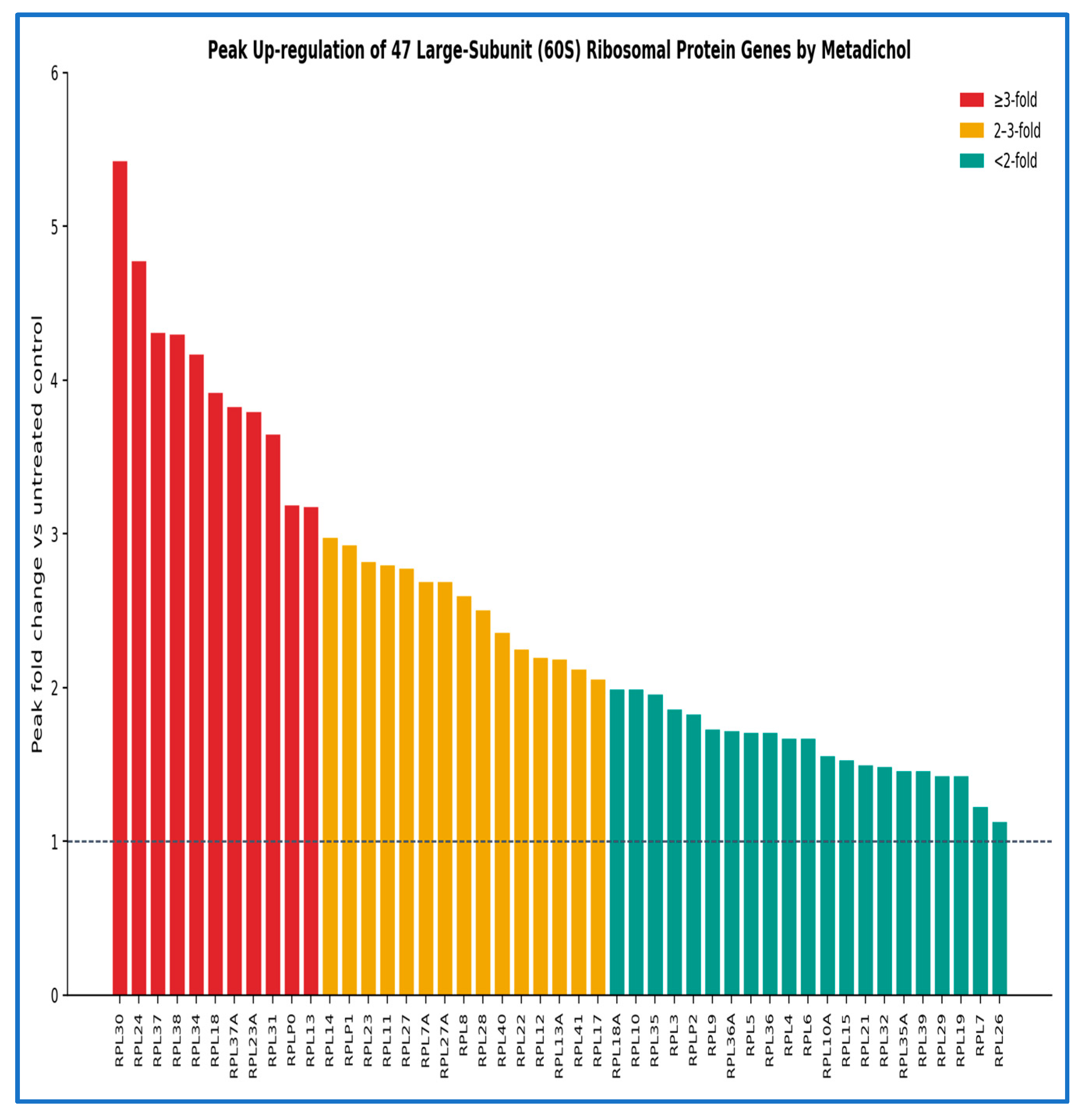
Figure 2.
Biphasic dose–response. Colored lines = individual genes (n = 47), one hue per gene; bold red line = panel mean ± SEM. Suppression at 0.1 pg/mL gives way to peak activation at 1 ng/mL, then partial relaxation at 100 ng/mL.
Figure 2.
Biphasic dose–response. Colored lines = individual genes (n = 47), one hue per gene; bold red line = panel mean ± SEM. Suppression at 0.1 pg/mL gives way to peak activation at 1 ng/mL, then partial relaxation at 100 ng/mL.
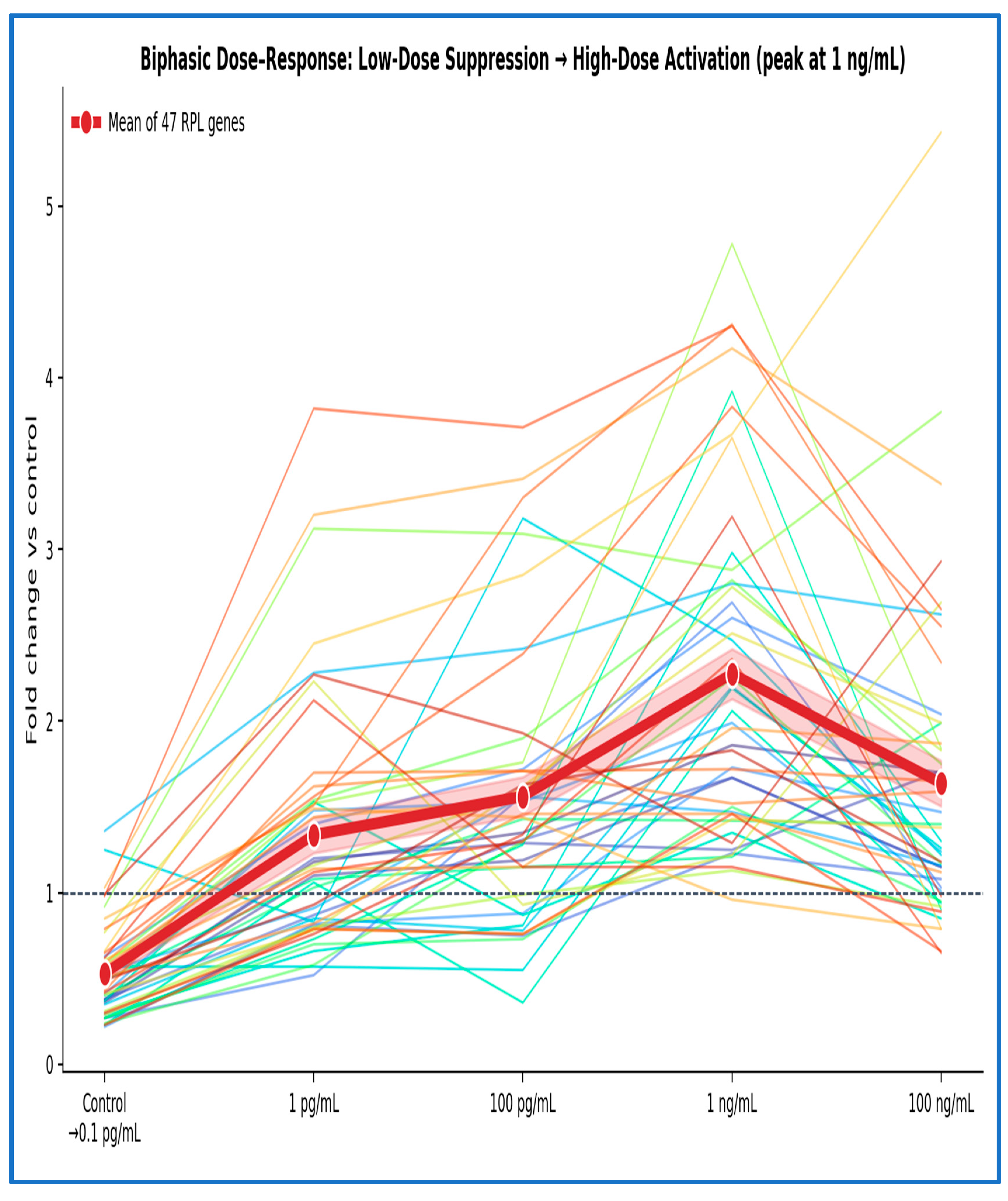
Figure 3.
Number of large-subunit genes (of 47) that are significantly up-regulated (crimson), significantly down-regulated (navy), or not significantly changed (grey) at each Metadichol concentration. The 0.1 pg/mL → 1 ng/mL transition reverses the dominant direction of regulation.
Figure 3.
Number of large-subunit genes (of 47) that are significantly up-regulated (crimson), significantly down-regulated (navy), or not significantly changed (grey) at each Metadichol concentration. The 0.1 pg/mL → 1 ng/mL transition reverses the dominant direction of regulation.
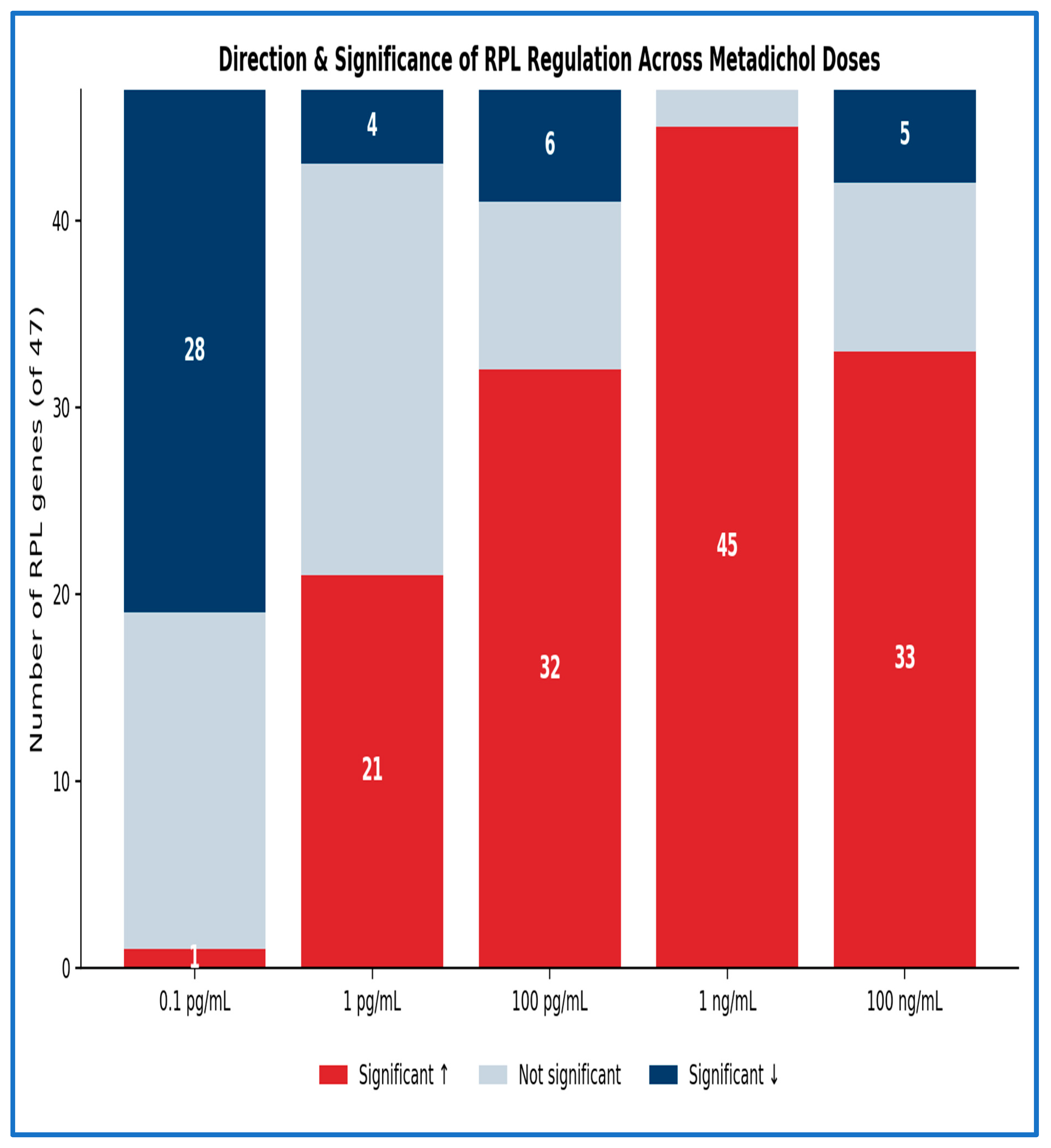
Figure 4.
Hierarchically clustered heatmap of log₂(fold-change) for all 47 large-subunit genes across five Metadichol doses. Red = up-regulation, blue = down-regulation; cell labels show linear fold-change. Rows clustered by Ward linkage.
Figure 4.
Hierarchically clustered heatmap of log₂(fold-change) for all 47 large-subunit genes across five Metadichol doses. Red = up-regulation, blue = down-regulation; cell labels show linear fold-change. Rows clustered by Ward linkage.
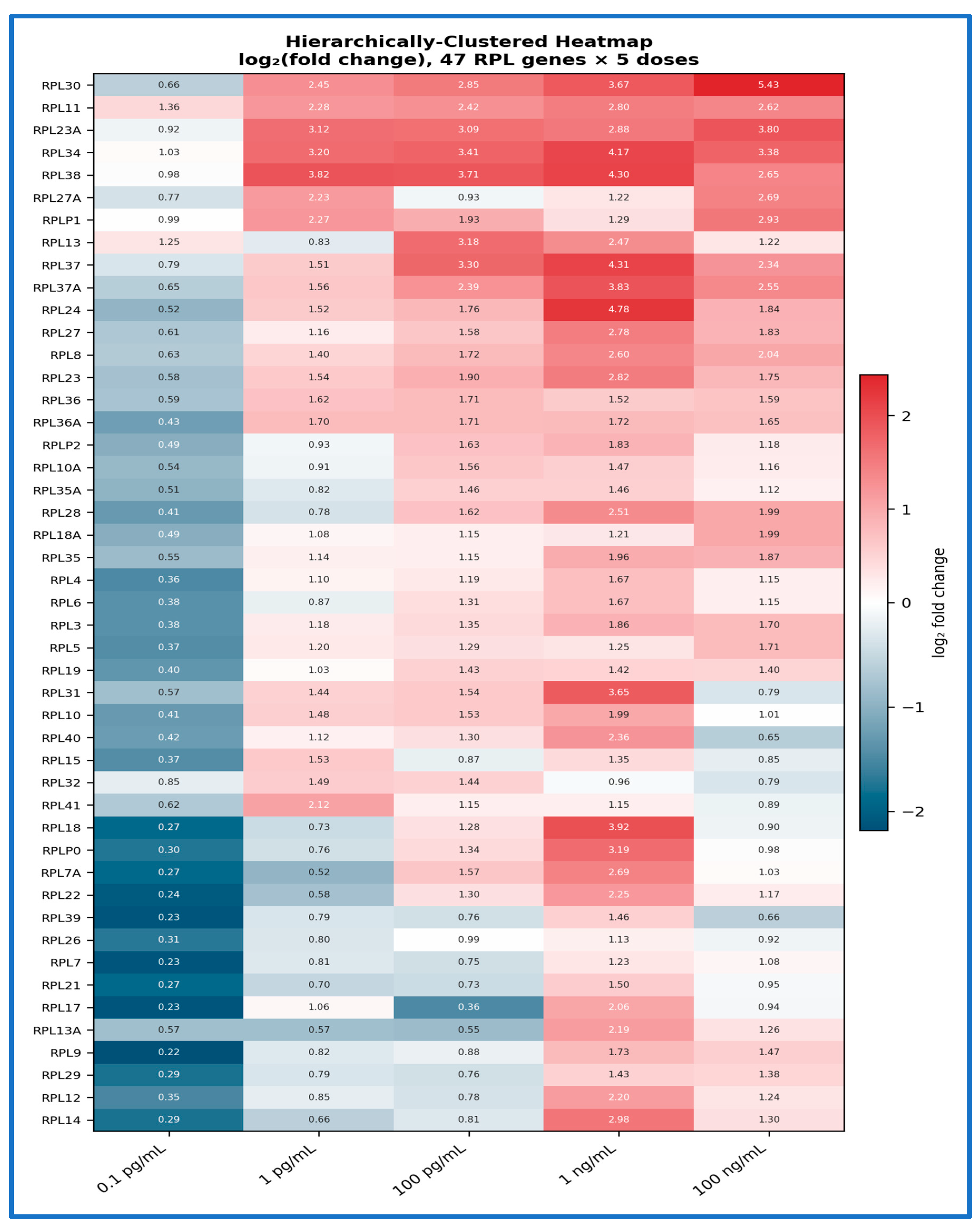
Figure 5.
Inter-dose correlation matrix: Pearson r between the log₂FC profiles of all 47 genes at each pair of concentrations. The activating doses (100 pg/mL, 1 ng/mL) form the most concordant pair.
Figure 5.
Inter-dose correlation matrix: Pearson r between the log₂FC profiles of all 47 genes at each pair of concentrations. The activating doses (100 pg/mL, 1 ng/mL) form the most concordant pair.
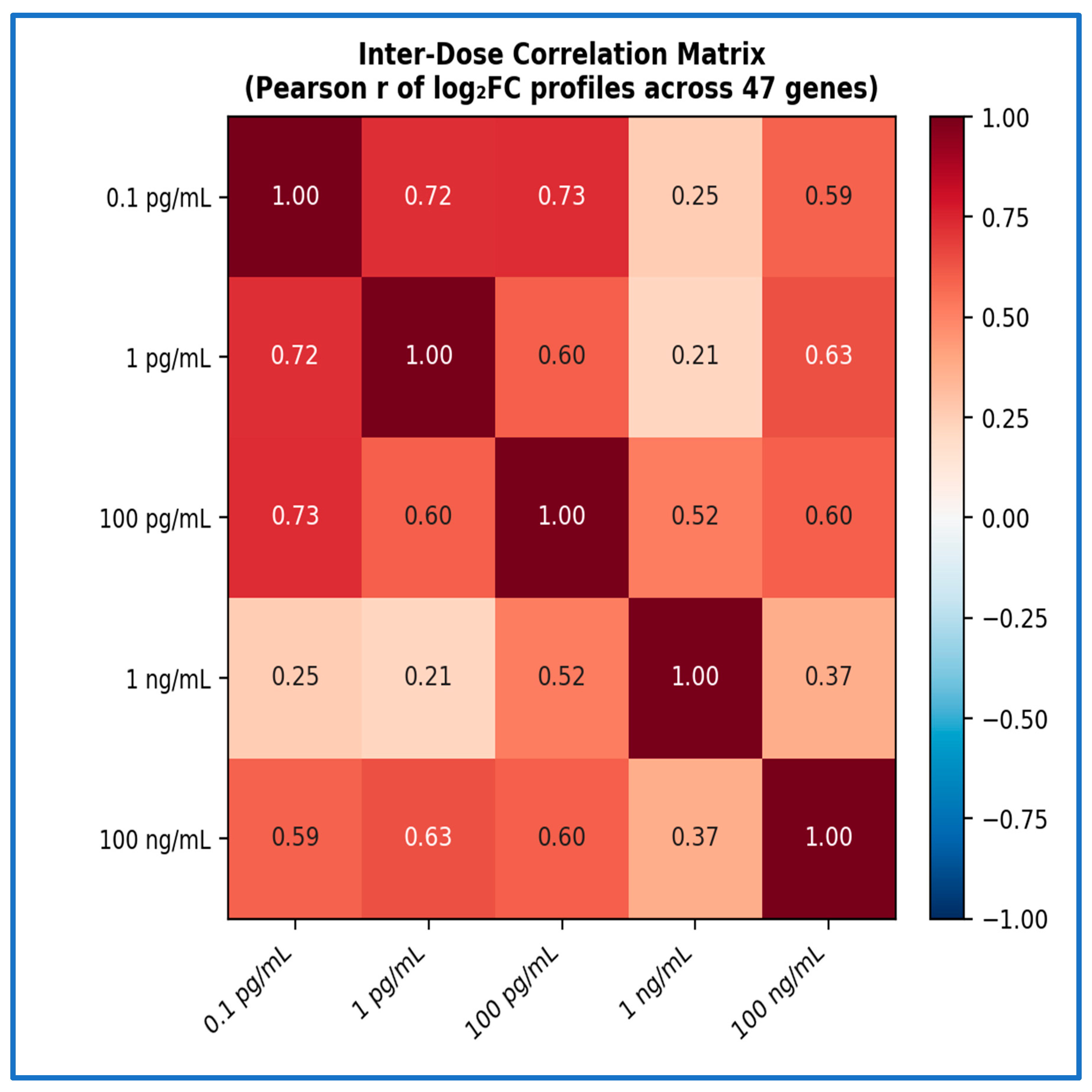
Figure 6.
Gene–gene co-regulation matrix: clustered Pearson correlation (47×47) of the dose-response profiles. Red = positive co-regulation, blue = anti-correlation. The predominantly red field indicates coordinated, set-wide regulation; outlier rows (RPL32, RPL13, RPL27A, RPL13A) mark the genes with autonomous regulatory behaviour.
Figure 6.
Gene–gene co-regulation matrix: clustered Pearson correlation (47×47) of the dose-response profiles. Red = positive co-regulation, blue = anti-correlation. The predominantly red field indicates coordinated, set-wide regulation; outlier rows (RPL32, RPL13, RPL27A, RPL13A) mark the genes with autonomous regulatory behaviour.
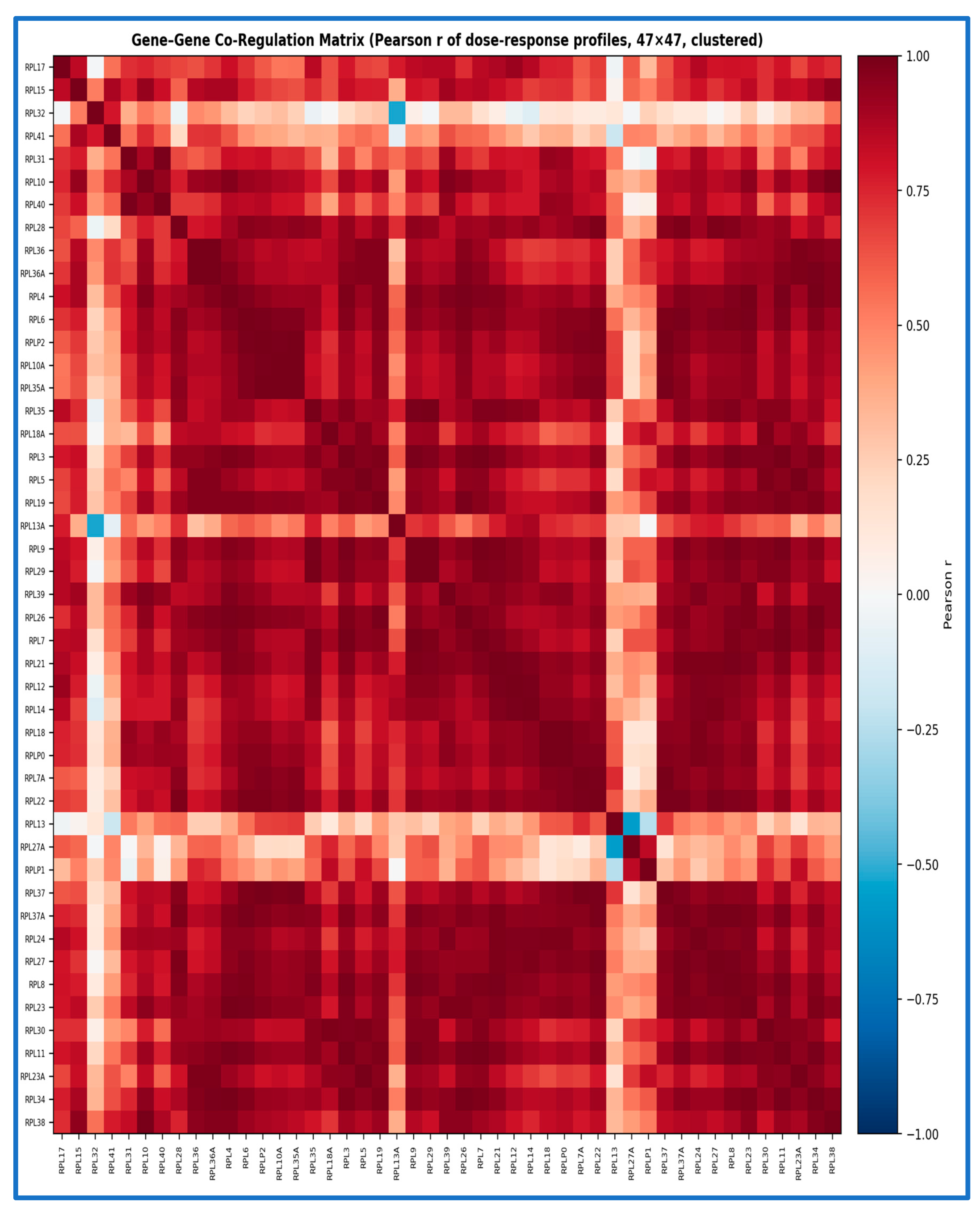
Figure 7.
Macro-regulatory network converging on the 47-gene 60S repertoire. Nuclear receptors (biphasic: VDR-inverse at low dose, multi-NR agonism at high dose), sirtuins (SIRT1/6/7, NAD⁺-coupled), and the NUP/NPC export program converge on c-MYC—the E-box master driver of every ribosomal-protein gene—to up-regulate 60S RPL/RPLP transcription (the mRNA increase measured here); mitochondrial OXPHOS supplies the NAD⁺/ATP the sirtuin arm consumes. In parallel, Metadichol induces DDIT4 (REDD1), which inhibits mTORC1, so the mTORC1/5′TOP step is shown as a restrained translational gate rather than a co-driver, consistent with the companion finding that Metadichol suppresses mTOR/p70S6K. Green = activation; red bar = inhibition; gold dashed = NPC export; grey dashed = restrained 5′TOP translational gate. Because only transcript abundance was assayed, the translational arm is shown as a gate, not a contributor to the measured signal.
Figure 7.
Macro-regulatory network converging on the 47-gene 60S repertoire. Nuclear receptors (biphasic: VDR-inverse at low dose, multi-NR agonism at high dose), sirtuins (SIRT1/6/7, NAD⁺-coupled), and the NUP/NPC export program converge on c-MYC—the E-box master driver of every ribosomal-protein gene—to up-regulate 60S RPL/RPLP transcription (the mRNA increase measured here); mitochondrial OXPHOS supplies the NAD⁺/ATP the sirtuin arm consumes. In parallel, Metadichol induces DDIT4 (REDD1), which inhibits mTORC1, so the mTORC1/5′TOP step is shown as a restrained translational gate rather than a co-driver, consistent with the companion finding that Metadichol suppresses mTOR/p70S6K. Green = activation; red bar = inhibition; gold dashed = NPC export; grey dashed = restrained 5′TOP translational gate. Because only transcript abundance was assayed, the translational arm is shown as a gate, not a contributor to the measured signal.
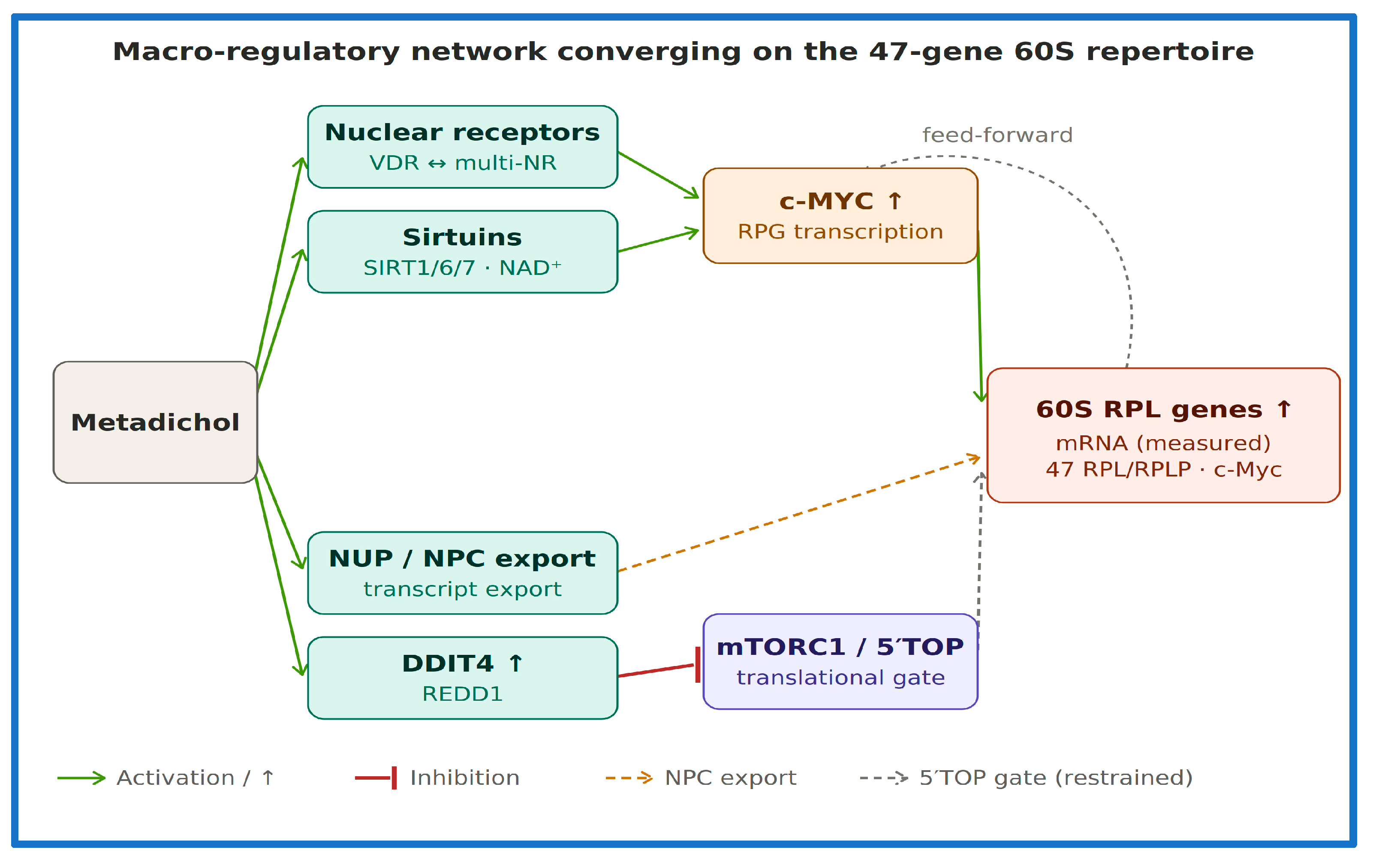
Figure 8.
The 60S ribosomal protein flywheel. The 47 RPL/RPLP genes are arranged on the wheel rim; node size is proportional to peak fold-change. Red chords = activation / strong positive co-regulation (r ≥ 0.90); green chords = down-regulation / anti-correlation (r ≤ 0). Gold arrows depict the self-sustaining rotation. The few green spokes radiate from the autonomously-regulated outliers (RPL32, RPL13, RPL27A, RPL13A).
Figure 8.
The 60S ribosomal protein flywheel. The 47 RPL/RPLP genes are arranged on the wheel rim; node size is proportional to peak fold-change. Red chords = activation / strong positive co-regulation (r ≥ 0.90); green chords = down-regulation / anti-correlation (r ≤ 0). Gold arrows depict the self-sustaining rotation. The few green spokes radiate from the autonomously-regulated outliers (RPL32, RPL13, RPL27A, RPL13A).
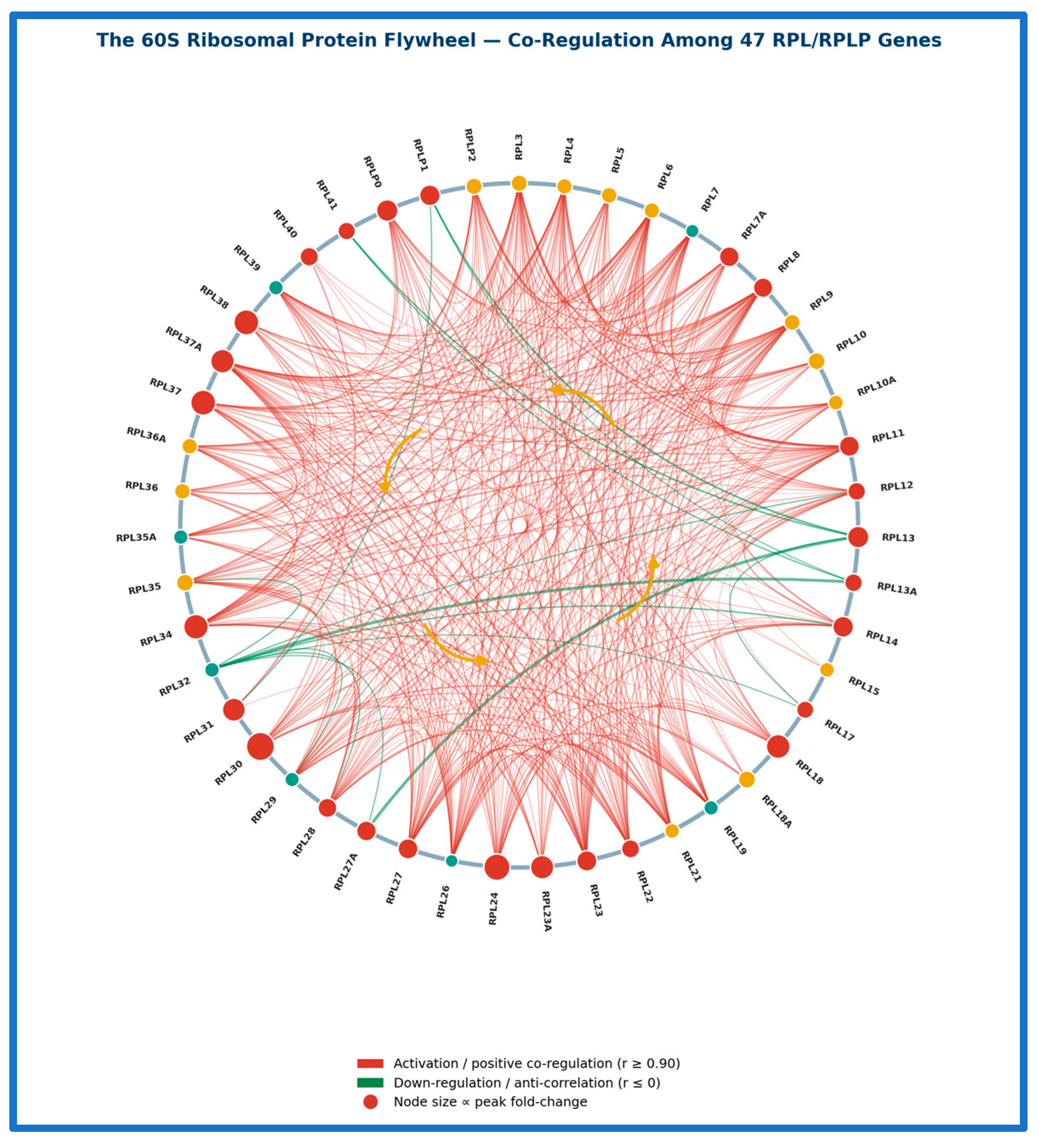
Figure 9.
Every gene has two faces. For all 47 large-subunit genes (ranked by peak), green bars show the low-dose (0.1 pg/mL) log₂ fold-change—predominantly suppressive—and red bars show the peak activation log₂ fold-change. By the strict criterion, 32 genes are significantly suppressed at some dose and 46 are significantly activated at some dose; 31 satisfy both (biphasic).
Figure 9.
Every gene has two faces. For all 47 large-subunit genes (ranked by peak), green bars show the low-dose (0.1 pg/mL) log₂ fold-change—predominantly suppressive—and red bars show the peak activation log₂ fold-change. By the strict criterion, 32 genes are significantly suppressed at some dose and 46 are significantly activated at some dose; 31 satisfy both (biphasic).
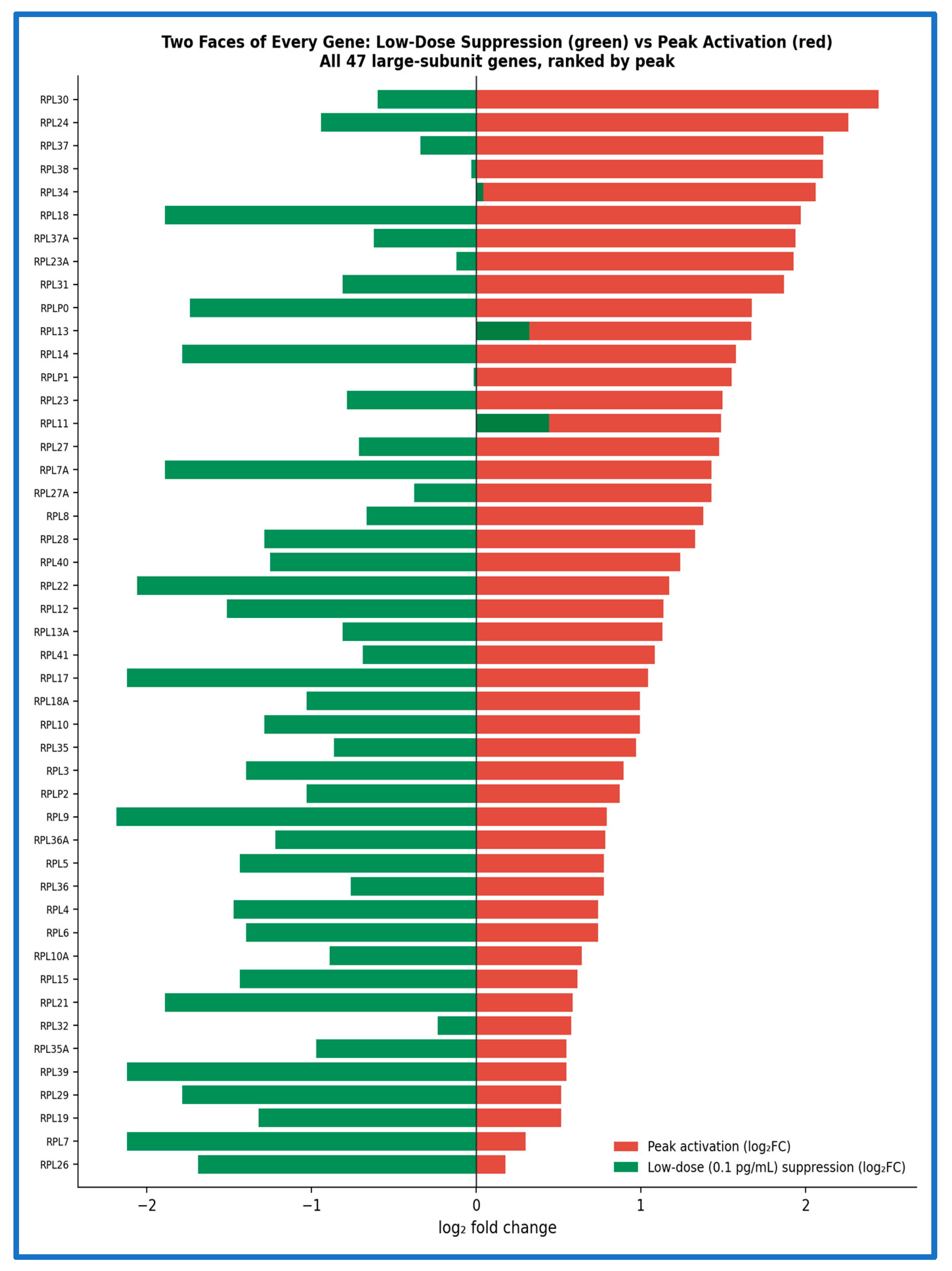
Figure 10.
Trajectory view of the regulatory classes. Left: mean fold-change trajectories (± SEM) across the five doses; the classes converge at low dose and diverge only at 100 ng/mL. Right: cross-class Pearson correlation of the mean log₂FC profiles—uniformly high and positive, showing the classes share one dominant biphasic program rather than opposing each other.
Figure 10.
Trajectory view of the regulatory classes. Left: mean fold-change trajectories (± SEM) across the five doses; the classes converge at low dose and diverge only at 100 ng/mL. Right: cross-class Pearson correlation of the mean log₂FC profiles—uniformly high and positive, showing the classes share one dominant biphasic program rather than opposing each other.
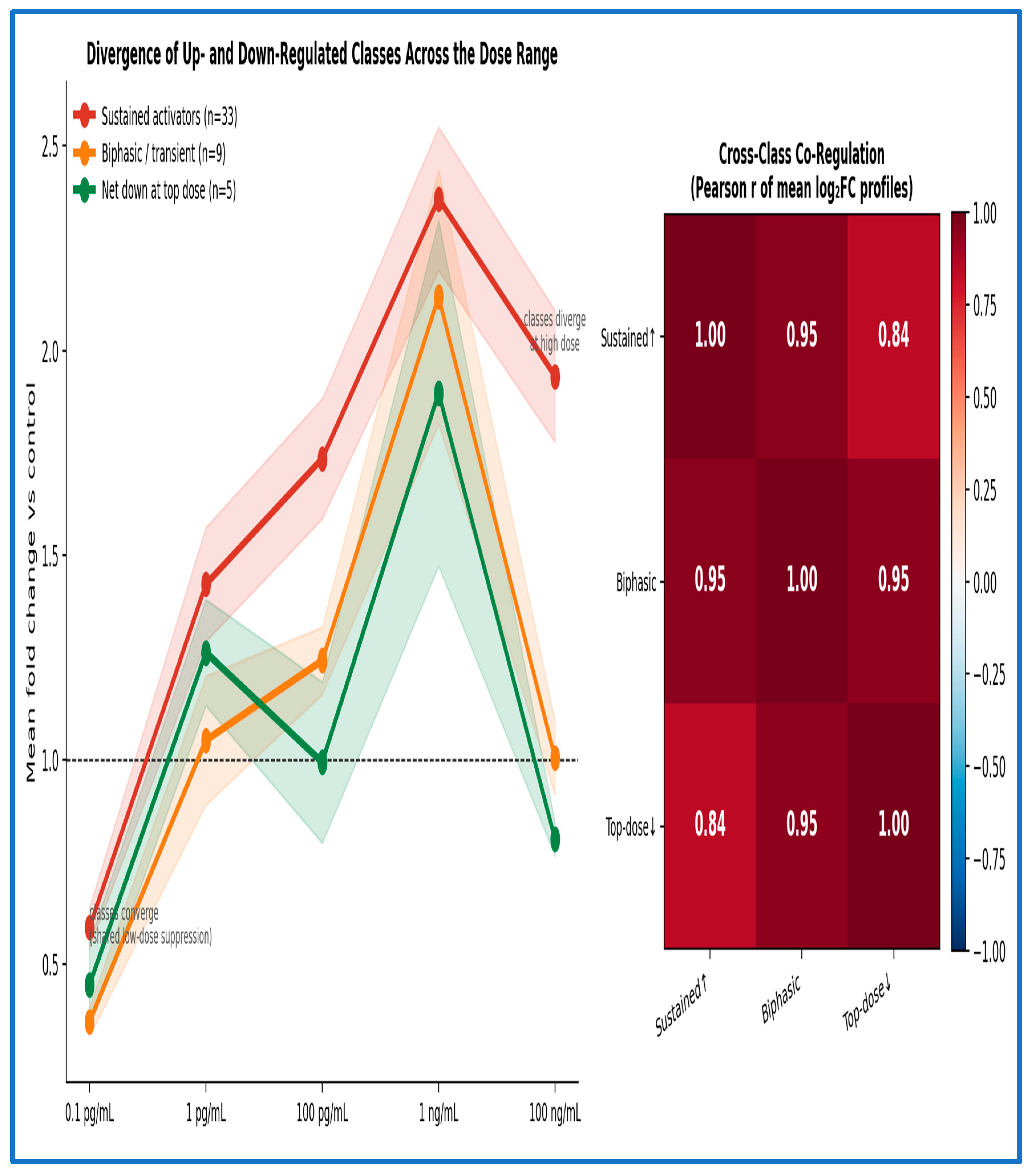
Figure 11.
Up-vs-Down co-regulation chord diagram (strict definition), shown as a complete circle with straight connecting lines. Green arc / green nodes: the 32 genes significantly below control at ≥1 dose (DOWN set). Red arc / red nodes: the 15 genes never significantly suppressed (pure UP set). Red lines = positive co-regulation (r ≥ 0.90); green lines = anti-correlation (r ≤ 0); node size ∝ peak fold-change; legend in side panel at right. The 181 positive cross-set lines (vs 6 negative) show the two sets co-regulate rather than oppose.
Figure 11.
Up-vs-Down co-regulation chord diagram (strict definition), shown as a complete circle with straight connecting lines. Green arc / green nodes: the 32 genes significantly below control at ≥1 dose (DOWN set). Red arc / red nodes: the 15 genes never significantly suppressed (pure UP set). Red lines = positive co-regulation (r ≥ 0.90); green lines = anti-correlation (r ≤ 0); node size ∝ peak fold-change; legend in side panel at right. The 181 positive cross-set lines (vs 6 negative) show the two sets co-regulate rather than oppose.
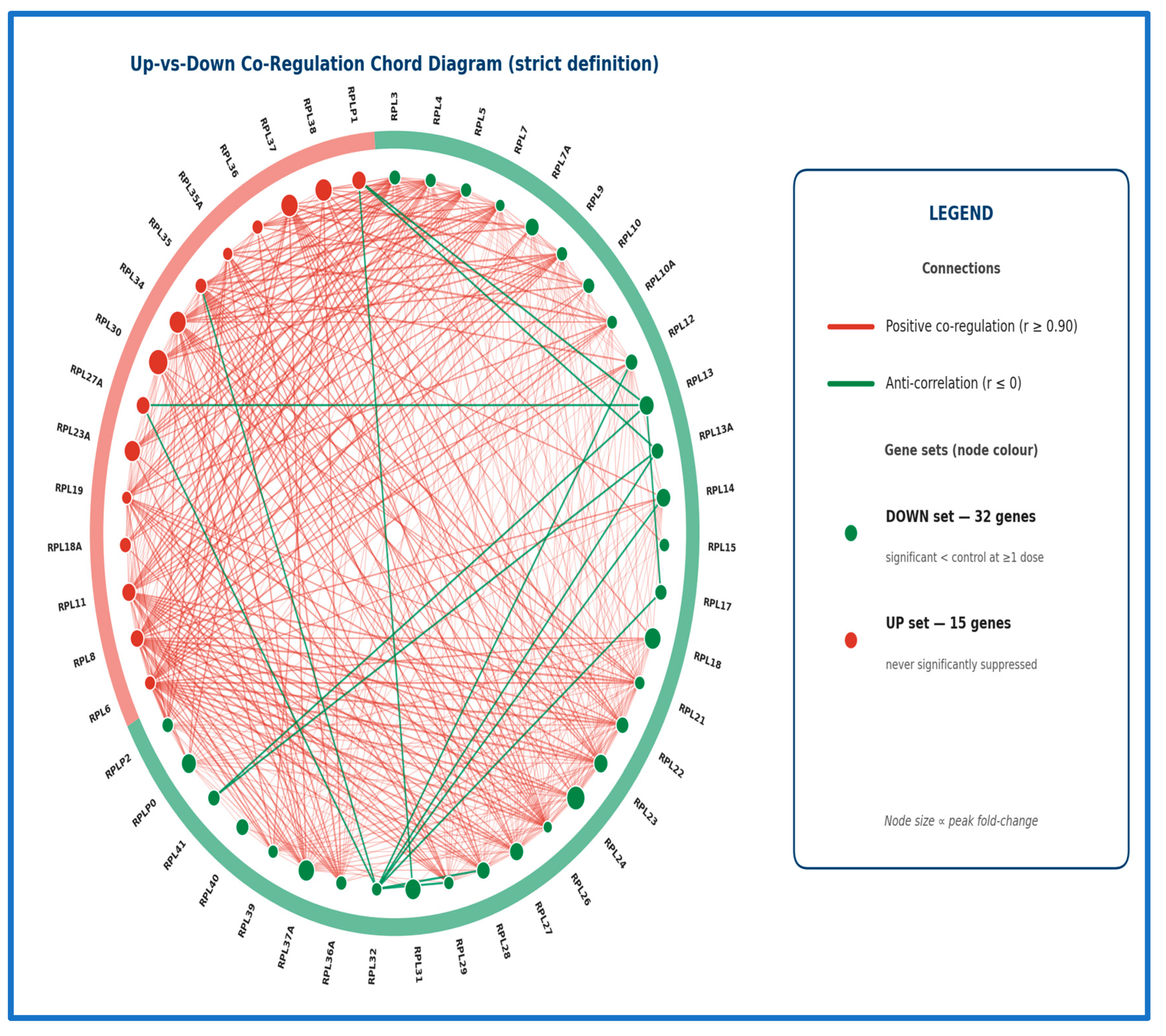
Figure 12.
The two extremes of the strict classification. Faint red lines = the 15 pure activators; bold red = their mean ± SEM; they remain at or above control across the whole dose range. Bold green dashed = RPL5, the lone gene significantly suppressed at low dose (0.37×) that never reaches a significant up-call. RPL5's 5S RNP partner RPL11 is, by contrast, a pure activator.
Figure 12.
The two extremes of the strict classification. Faint red lines = the 15 pure activators; bold red = their mean ± SEM; they remain at or above control across the whole dose range. Bold green dashed = RPL5, the lone gene significantly suppressed at low dose (0.37×) that never reaches a significant up-call. RPL5's 5S RNP partner RPL11 is, by contrast, a pure activator.
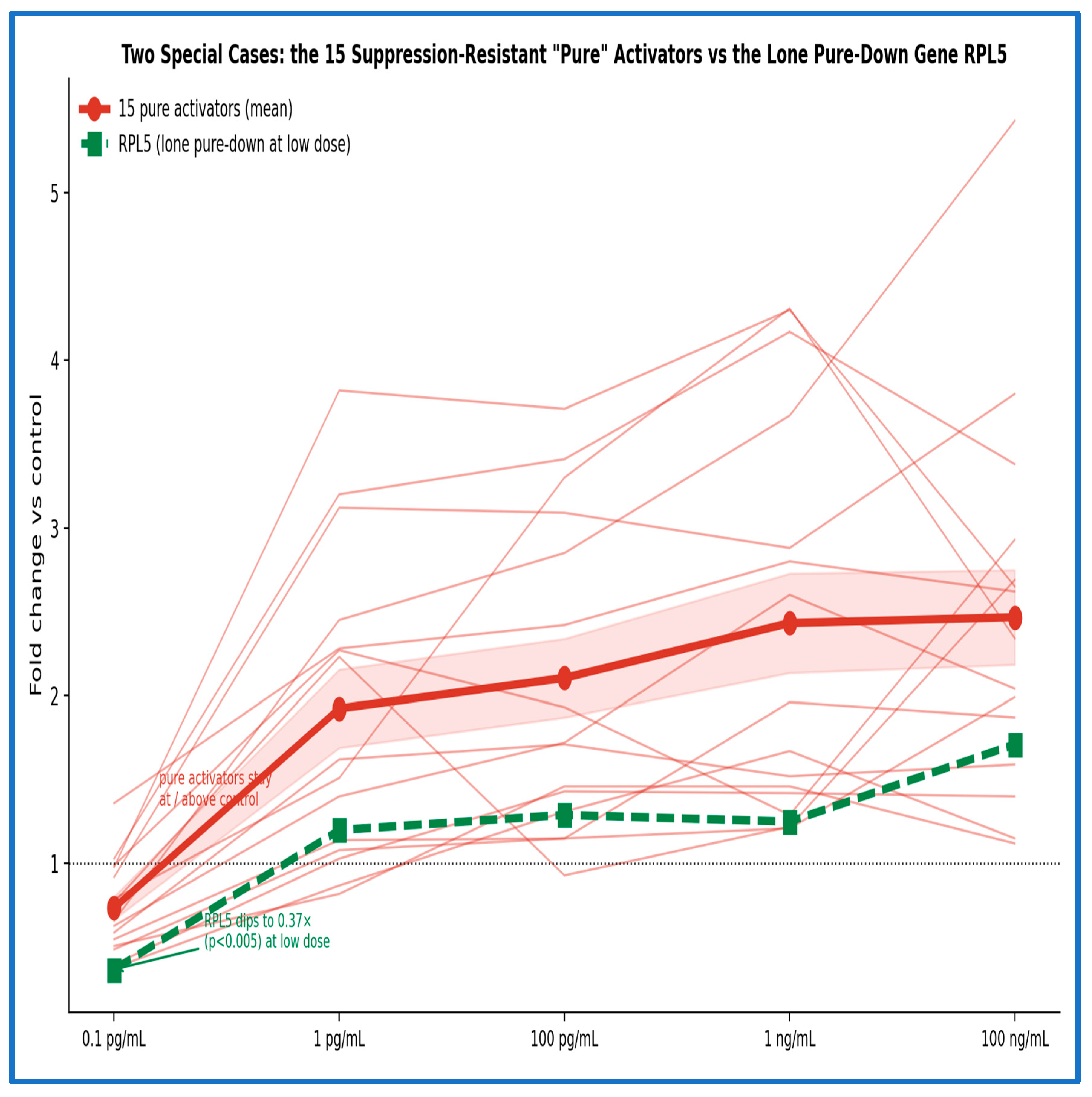
Figure 13.
Biological processes / pathways impacted, ranked by the mean peak fold-change of member genes. Annotations give the number of contributing genes and the principal associated diseases. Developmental (Hox-IRES), splicing-autoregulatory, and MYC-driven biogenesis categories show the largest mean induction.
Figure 13.
Biological processes / pathways impacted, ranked by the mean peak fold-change of member genes. Annotations give the number of contributing genes and the principal associated diseases. Developmental (Hox-IRES), splicing-autoregulatory, and MYC-driven biogenesis categories show the largest mean induction.
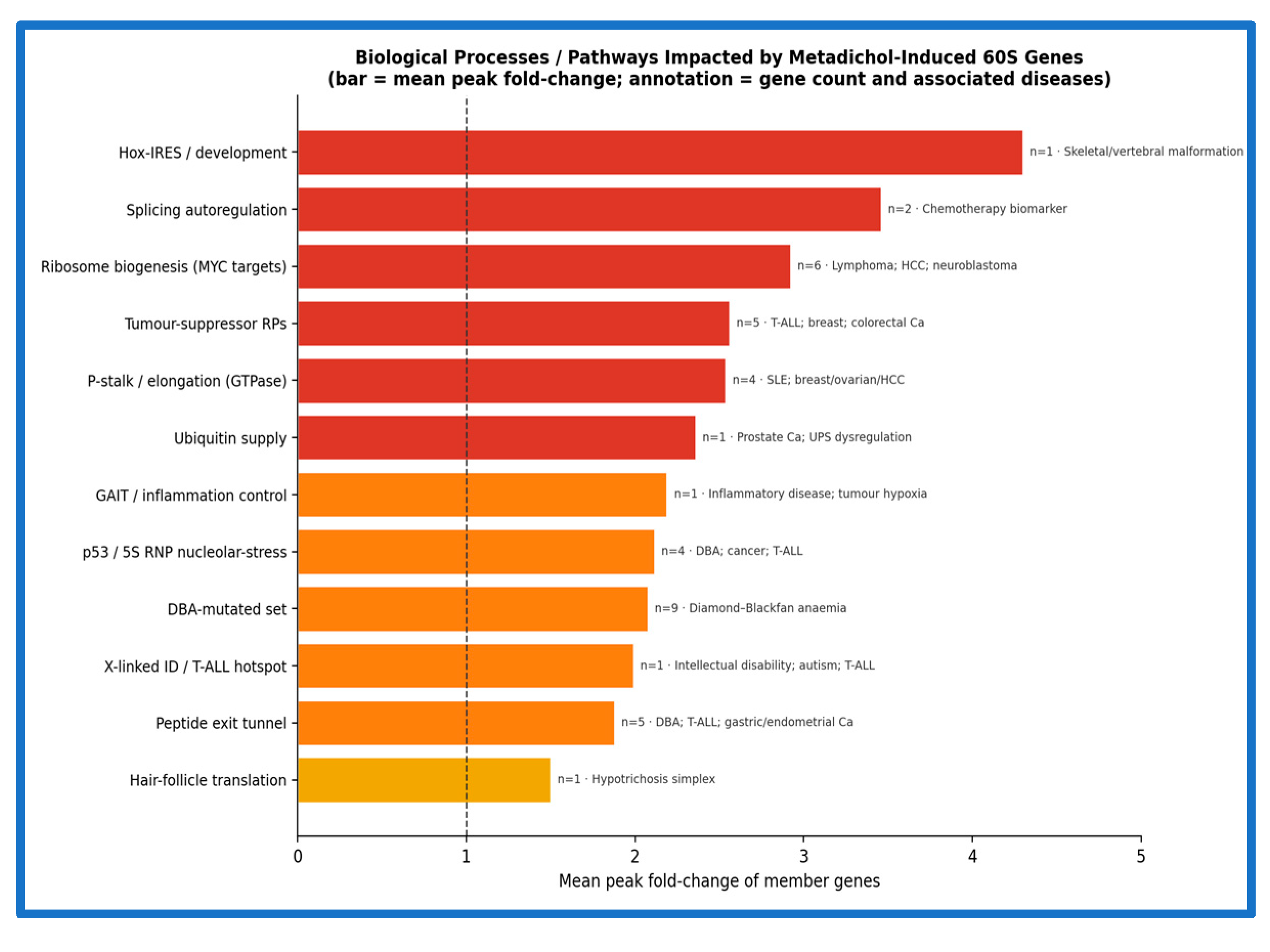
Table 3.
qRT-PCR primer sequences for all 47 large-subunit ribosomal protein genes.
| # | Gene | Forward primer (5′→3′) | Reverse primer (5′→3′) | Amp (bp) | Tₐ (°C) |
| 1 | RPL3 | TGCTCGTGTAGCCTTCTCTGTG | GGTCATAGTCAGTGGAGGCATTG | 149 | 60 |
| 2 | RPL4 | ACGATACGCCATCTGTTCTGCC | GGAGCAAAACAGCTTCCTTGGTC | 152 | 60 |
| 3 | RPL5 | CCAAATACAGGATGATAGTTCGTG | TTGGCAGTTCGTGTGCATACGC | 114 | 60 |
| 4 | RPL6 | CCTTGTCAGAGGAATTGGCAGG | GTAACAGTTGCGAGAACCTTCTC | 132 | 60 |
| 5 | RPL7 | GAGGATGGCAAGAAAAGCTGGC | CGAACCTTTGGGCTCACTCCAT | 102 | 60 |
| 6 | RPL7A | AAGCTGGCCCACAAGTACAG | AGGACAGGTGGTCTCTTCGT | 102 | 60 |
| 7 | RPL8 | CCGTATCGGTTTAAGAAGCGGAC | CGATTGTACCCTCAGGCATGGT | 142 | 60 |
| 8 | RPL9 | GACGCACAGTTATCGTGAAGGG | CAAATAGTCCGAACGGTAGCCAG | 157 | 60 |
| 9 | RPL10 | GCTGCAGAACAAGGAGCATGTG | ATGAGCCGCTTTTCAGCCACCA | 150 | 60 |
| 10 | RPL10A | GCCAAAGTGGATGAGGTGAAGTC | GACACCAAGAAGTTGACAGCCAG | 140 | 60 |
| 11 | RPL11 | GCCAAAGTGGATGAGGTGAAGTC | GACACCAAGAAGTTGACAGCCAG | 106 | 60 |
| 12 | RPL12 | AGAGTGGAGACAGACTGACGCG | CGGATGCCAAAGGATCTGACAG | 108 | 60 |
| 13 | RPL13 | CCTCAAGGAACCACCAAGAGAC | GAGTTCTCTGGCTAAGGATCGG | 124 | 60 |
| 14 | RPL13A | CATCGGCATTTCTGTGGATC | TGGGGAAGAGGATGAGTTTG | 143 | 60 |
| 15 | RPL14 | GCCCTACGACAAGAAAAAGC | GTACTTCCAGCCAACCTCGT | 173 | 60 |
| 16 | RPL15 | GAGTCTTACTGTTGCGGGCTC | TTCCGGCATGAGGTCCAAAG | 141 | 60 |
| 17 | RPL17 | TACGGCAAGCCTGTCCATCATG | GTATGTGGAATCTTCACCAACCC | 122 | 60 |
| 18 | RPL18 | ATGATGTGCGGGTTCAGGAGGT | GGTCGAAAGTGAGGATCTTGCC | 111 | 60 |
| 19 | RPL18A | CGGGTGAAGAACTTCGGGAT | CATGTCTCGGTAGCACTGGG | 120 | 60 |
| 20 | RPL19 | AGCTCTTTCCTTTCGCTGCTG | GGATCTGCTGACGGGAGTTG | 156 | 60 |
| 21 | RPL21 | AAAAGGAATGCCCCACAAGT | TCTTGCCCTTAACTTGTTTGTTTAC | 104 | 60 |
| 22 | RPL22 | GTGACATCCGAGGTGCCTTTCT | AACTACGCGCAACCAGTCACGT | 107 | 60 |
| 23 | RPL23 | ATCAAGGGACGGCTGAACAGAC | GTCGAATGACCACTGCTGGATG | 118 | 60 |
| 24 | RPL23A | CAAGCACCAGATTAAACAGGCTG | CCAAAGCATCGTAATCAGGAGCC | 128 | 60 |
| 25 | RPL24 | ATGCGAGTCGGCTTTCCTTT | GCCCTCTGGAATTTGACTGC | 138 | 60 |
| 26 | RPL26 | GGCTAATGGCACAACTGTCCAC | GGCGAGATTTGGCTTTCCGTTC | 113 | 60 |
| 27 | RPL27 | CTTTTTGCTGGTAGGGCCG | TCAATTCCAGCCACCAGAGC | 175 | 60 |
| 28 | RPL27A | TACGGGAGCAGATGGAGTCA | CCACCATAGCACTTCCCGTT | 125 | 60 |
| 29 | RPL28 | CAACGGACTGATTCACCGCAAG | GCGAGCATTCTTGTTGATGGTGG | 142 | 60 |
| 30 | RPL29 | CCCGATCACAAAGATACGAATCTC | TGCACTCATGGCCTTGGCATTG | 131 | 60 |
| 31 | RPL30 | TAGCGGCTGCTGTTGGTTG | AGTCTGCTTGTACCCCAGGA | 149 | 60 |
| 32 | RPL31 | CGGGCACTCAAAGAGATTCGGA | CACACGGATTCGGTATGGCACA | 129 | 60 |
| 33 | RPL32 | CCACCTCAGCCTTCCAAGTA | TACTTTGGGAGGCTGAAGCA | 150 | 60 |
| 34 | RPL34 | GACCTAAAGTTCTTATGAGATTGTC | CTGACTCTGTGCTTGTGCCTTC | 164 | 60 |
| 35 | RPL35 | AGACTCAGAAAGAAAACCTCAGGA | TGGTCTTCAGGTTCTCCTCGTG | 126 | 60 |
| 36 | RPL35A | TGGCGGCAAACCAAACAAAA | TTGAGGGGTACAGCATCACT | 146 | 60 |
| 37 | RPL36 | TGATTCGGGAGGTGTGTGGCTT | CCAGTACGTTGCTCAGCTCCTC | 156 | 60 |
| 38 | RPL36A | AGGGCAAGGATTCTCTGTACGC | CAACGCACTCAAGCCTTAGCAC | 138 | 60 |
| 39 | RPL37 | CCTACCACCTTCAGAAGTCGAC | AGGTGCCTCATTCGACCAGTTC | 124 | 60 |
| 40 | RPL37A | CCTCCCTCCGGAAAATGGTG | GACAGCGGAAGTGGTATTGT | 173 | 60 |
| 41 | RPL38 | TTTCGTCCTTTTCCCCGGTT | CAATTTTCCGAGGCATGGCG | 119 | 60 |
| 42 | RPL39 | CGCTGCTCGCCATGTCTT | GTGTGCCATCTCATGTGCAA | 179 | 60 |
| 43 | RPL40 | GCCTGCGAGGTGGCATTATTGA | TTCTTGCGGCAGTTGACAGCAC | 124 | 60 |
| 44 | RPL41 | AGACATCTGACCTCGGCACT | GCTTCTTCCTCCACTTGGCTC | 107 | 60 |
| 45 | RPLP0 | TGGTCATCCAGCAGGTGTTCGA | ACAGACACTGGCAACATTGCGG | 119 | 60 |
| 46 | RPLP1 | GACACAGGCTGGATTTTCCC | CCCCAGTGCAGTTTTCAACA | 107 | 60 |
| 47 | RPLP2 | TCTTGGACAGCGTGGGTATCGA | CAGCAGGTACACTGGCAAGCTT | 126 | 60 |
Fp = forward primer; Rp = reverse primer; Amp = amplicon size; Tₐ = annealing temperature. GAPDH served as the reference gene for all reactions.
Table 6.
Biological processes and pathways engaged by the Metadichol-induced 60S genes, with representative genes, net direction, and impacted diseases.
Table 6.
Biological processes and pathways engaged by the Metadichol-induced 60S genes, with representative genes, net direction, and impacted diseases.
| Biological process / pathway | Representative 60S genes | Net direction | Disease(s) impacted |
| p53 / 5S RNP nucleolar-stress surveillance | RPL5, RPL11, RPL26, RPL23 | ↑ (balanced) | Diamond–Blackfan anaemia; cancer; T-ALL |
| Ribosome biogenesis (c-MYC targets) | RPL7A, RPL8, RPL23A, RPL24, RPL6, RPL18A | ↑↑ | Lymphoma; hepatocellular & breast Ca; neuroblastoma |
| Peptide exit tunnel / co-translational folding | RPL4, RPL17, RPL22, RPL35, RPL39 | ↑ / mixed | DBA; T-ALL; gastric & endometrial Ca |
| P-stalk / elongation GTPase activation | RPLP0, RPLP1, RPLP2, RPL12 | ↑↑ | SLE (anti-P autoantigen); breast/ovarian/HCC |
| Extraribosomal tumour suppression | RPL5, RPL11, RPL22, RPL37, RPL9 | ↑ | T-ALL; breast & colorectal Ca |
| Hox-mRNA IRES translation / development | RPL38 | ↑↑↑ | Vertebral & rib malformation (Tail-short) |
| GAIT complex / inflammatory-mRNA silencing | RPL13A | ↑ | Chronic inflammation; tumour angiogenesis/hypoxia |
| Autoregulated pre-mRNA splicing | RPL30, RPL32 | ↑↑ | Chemotherapy-response biomarker |
| Ubiquitin–proteasome supply | RPL40 | ↑ / biphasic | Prostate Ca; proteostasis/UPS dysregulation |
| Diamond–Blackfan anaemia mutation set | RPL5, RPL11, RPL26, RPL35A, RPL4, RPL27, RPL31, RPL35, RPL15 | ↑ (RPL15/31 ↓ at top dose) | Diamond–Blackfan anaemia; 5q- MDS-like |
| X-linked intellectual disability / leukaemia | RPL10 | ↑ (biphasic) | Intellectual disability; autism; T-ALL (R98S) |
| Hair-follicle ribosomal translation | RPL21 | ↑ (biphasic) | Hypotrichosis simplex |
Net direction reflects the dominant response across the dose range (peak): ↑ up-regulated; ↑↑/↑↑↑ strongly up-regulated; ↓ net down at the highest dose. Disease associations are drawn from the established extraribosomal and ribosomopathy literature for each gene.
Table 7.
Small molecules that regulate ribosomal protein genes / ribosome biogenesis, compared with Metadichol.
Table 7.
Small molecules that regulate ribosomal protein genes / ribosome biogenesis, compared with Metadichol.
| Agent | Mechanism / target | Effect on RPG / ribosome | Primary use | Ref. |
| Rapamycin (sirolimus) | mTORC1 inhibitor (S6K1/4E-BP1) | ↓ 5′TOP RPG translation | Immunosuppressant; oncology | 73 |
| Torin1 / Torin2 | ATP-competitive mTOR inhibitor | ↓↓ entire 5′TOP/TOP regulon | Research / oncology | 74 |
| Metformin | AMPK activation → ↓ mTORC1 | ↓ ribosome biogenesis | Type 2 diabetes | 75 |
| CX-5461 | RNA Pol I transcription inhibitor | ↓ rRNA; nucleolar stress; p53 | Oncology (trials) | 76,77 |
| BMH-21 | Pol I inhibitor; RPA194 degradation | ↓ rRNA; nucleolar stress | Oncology (preclinical) | 78 |
| Actinomycin D (low dose) | Pol I / rDNA intercalator | ↓ rRNA; classic nucleolar stress | Chemotherapy | 79 |
| ISRIB | eIF2B activator (anti-ISR) | ↑ cap- & 5′TOP translation | Neuro research | 80 |
| Resveratrol | SIRT1 activator | ↑/modulates ribosome biogenesis | Nutraceutical | 81 |
| Metadichol (this study) | VDR inverse agonist + multi-NR / sirtuin | ↑ coordinate, balanced ↑ of all 47 RPL/RPLP | Dietary supplement | 28-36 |
Red ↑ = increases ribosomal protein gene expression / ribosome output; green ↓ = decreases it. Most established agents are inhibitors (mTOR or Pol I); Metadichol (amber row) is distinctive as a coordinated, balanced activator of the complete 60S set. References correspond to the numbered reference list.
Disclaimer/Publisher’s Note: The statements, opinions and data contained in all publications are solely those of the individual author(s) and contributor(s) and not of MDPI and/or the editor(s). MDPI and/or the editor(s) disclaim responsibility for any injury to people or property resulting from any ideas, methods, instructions or products referred to in the content. |
© 2026 by the authors. Licensee MDPI, Basel, Switzerland. This article is an open access article distributed under the terms and conditions of the Creative Commons Attribution (CC BY) license (http://creativecommons.org/licenses/by/4.0/).
Copyright: This open access article is published under a Creative Commons CC BY 4.0 license, which permit the free download, distribution, and reuse, provided that the author and preprint are cited in any reuse.


