

Submitted:
05 June 2026
Posted:
08 June 2026
You are already at the latest version
Abstract
Background: Fermented foods (FF) are widely consumed across different dietary cultures and are increasingly recognised for their nutritional and functional properties. Although fermentation can improve food preservation and safety, there are still concerns about microbiological and chemical hazards. Given the growing consumption of FF, it is essential to conduct a systematic evaluation of their safety to support evidence-based risk-benefit assessments. Objectives: This review aimed to establish the safety of FF for human consumption and to identify the main microbiological and chemical hazards associated with these foods, including their occurrence, exposure and potential risks. Design: A systematic narrative review was conducted in accordance with a predefined protocol aligned with PRISMA principles. Relevant human studies were identified through searches of the PubMed, Scopus and Cochrane Library databases. The eligibility criteria were defined using a PECO framework and included all population groups and a broad range of FF across major food categories. Alcoholic beverages with an alcohol content above 1.25% were excluded. The outcomes included the occurrence of hazards, associated exposure and risk, and reported foodborne outbreaks. Results: Microbiological hazards were predominantly associated with pathogens such as Salmonella, pathogenic Escherichia coli, Listeria monocytogenes, Campylobacter jejuni, and Clostridium botulinum, with dairy and fermented meat products most frequently implicated in outbreaks. However, these risks were largely linked to contaminated raw materials, inadequate processing conditions, or post-process contamination rather than fermentation itself. Chemical hazards included mycotoxins, heavy metals, polycyclic aromatic hydrocarbons, and acrylamide. Most available risk metrics indicated low concern under typical consumption scenarios, although certain products, such as specific cheeses and cereal-based foods, showed higher exposure levels. Importantly, several chemical hazards were associated with raw material contamination or thermal processing rather than the fermentation process. Conclusion: Overall, FF are generally safe when produced under appropriate hygienic and technological conditions. The identified risks are primarily driven by contamination upstream in the supply chain, processing practices, and environmental factors, rather than by fermentation itself. These findings emphasise the importance of targeted risk management strategies that focus on the quality of raw materials, process control and harmonised risk assessment approaches. This will support the safe integration of FF into modern diets.
Keywords:
fermented foods
; food safety
; microbiological hazards
; chemical hazards
; foodborne pathogens
; foodborne outbreaks
; risks
; risk assessment
1. Introduction
Fermented foods (FF) constitute a diverse class of foods and beverages whose production relies on the metabolic activity of microorganisms that transform raw substrates into products with distinct sensory, nutritional and functional properties. Fermented foods and beverages have been recently defined as “foods made through desired microbial growth and enzymatic conversions of food components” (Marco et al. 2021). They are ubiquitous across dietary traditions and, in many cultures, represent staples of daily diets. Historically, fermentation offered a robust strategy for preservation by lowering pH, producing antimicrobial metabolites and reducing water activity. Today, the same processes continue to contribute to safety and stability while also shaping organoleptic quality and nutritional value (Macori and Cotter 2018). In recent years, scientific and public interest in fermented foods has accelerated, driven by hypotheses about their capacity to deliver live microbes and fermentation-derived metabolites with potential benefits for human health, including modulation of the gut microbiome, enhancement of bioavailability of nutrients, and generation of bioactive compounds (Balasubramanian et al. 2024; Leeuwendaal et al. 2022; Marco et al. 2017; Künili et al. 2025). At the same time, it remains essential to systematically investigate their safety, recognising that any food, fermented or not, may present hazards if the ingredients, processes or handling are inadequate (Marco et al. 2021). Observational and intervention studies, including broader syntheses, suggest that fermented foods can impact the gut microbiome structure and function, potentially affecting immune and metabolic readouts (Mukherjee et al. 2025). However, causality and generalizability vary by product, context, and study design (Balasubramanian et al. 2024; Marco et al. 2021; Mukherjee et al. 2024; Valentino et al. 2024). The ubiquity and growing popularity of fermented foods underscore the importance of evaluating their safety through transparent, evidence-based approaches.
From a process perspective, lactic acid fermentation, ethanol production, salt addition, drying and ripening steps typically produce combinations of hurdles (low pH, organic acids, ethanol, reduced water activity, bacteriocins) that suppress many pathogens and spoilage organisms (Laranjo, Potes, and Elias 2019; Marco et al. 2017). This underlies the widespread use of fermentation as a preservation strategy across dairy, vegetable, cereals and legumes, meat and fish matrices (Macori and Cotter 2018; Marco et al. 2017). Nevertheless, safety cannot be assumed, since vulnerability can arise at several points, most notably from contaminated raw materials, inadequate process control, cross-contamination after fermentation, or due to the formation and accumulation of certain metabolites under permissive conditions (Barbieri et al. 2019; Laranjo, Potes, and Elias 2019; Marco et al. 2021; Pop et al. 2024; Tian et al. 2022). Furthermore, new risks may arise considering the development of novel FF (e. g. new strains, new matrices, etc…), particularly in light of the shift to plant-based foods as alternative protein sources (Mastrotheodoraki et al. 2026; Jin et al. 2025).
From a Food Safety perspective, microbiological hazards are central to the evaluation of fermented foods because they may enter with raw materials, persist when critical parameters are not adequately controlled, or be introduced post-process despite the protective hurdles created by fermentation (acidification, salt, reduced water activity, and microbial competition) (Laranjo, Potes, and Elias 2019; Marco et al. 2021). At the surveillance level, European foodborne outbreak data are compiled by the European Food Safety Authority (EFSA) (2025). However, the publicly available data present aggregated categories that do not always allow confirmation of the specific food product as the causal vehicle, reporting implicated food groups rather than verified outbreak sources. As such, potential raw materials for fermented foods, and in some cases fermented products themselves, may appear within these categories without permitting an easily definitive attribution, underscoring the need for a systematic appraisal of microbiological risks in this product class.
Regarding chemical risks in fermented foods, they fall into two broad groups: i) contaminants in raw materials, e.g., mycotoxins and pesticide residues in cereals and heavy metals in fish, which (in this case) fermentation may reduce, redistribute or occasionally concentrate, but does not originate or explain their initial presence (Pop et al. 2024; Tian et al. 2022); and, ii) compounds originated during fermentation, such as biogenic amines (e.g., histamine and tyramine produced by decarboxylase-positive microbes in high-protein matrices (Tsai 2005)), and acrylamide (a heat-induced, potentially carcinogenic contaminant on which fermentation can have a positive or negative effect, depending on many factors (Jensen, Hakme, and Feyissa 2025).
This narrative systematic review addresses two core questions: “Are fermented foods safe for human health?” and “Which microbiological and chemical hazards are associated with fermented foods, and what risks do they pose?”. Within PIMENTO—COST Action CA20128 “Promoting Innovation of ferMENTed fOods” Working Group 3, our specific aims were to: i) characterise the occurrence of food hazards in fermented foods when linked to human consumption and reported illness; ii) synthesise the reported risk of exposure to these hazards, considering product type and context of production; and, iii) collate reported foodborne outbreaks attributed to fermented foods, including the extent of resulting disease (Todorovic et al. 2024).
Together, these objectives provide an evidence-based foundation to distinguish hazards arising from contaminated inputs or process deviations from those attributable to fermentation itself, and to inform proportionate risk management and surveillance priorities, particularly in the context of risk-benefit of fermented foods.
2. Methodology
This systematic narrative review was conducted according to a predefined protocol developed within the PIMENTO COST Action CA20128, Working Group 3 (WG3). This protocol followed the guidance of Muka et al. (2020)and the PRISMA (Preferred Reporting Items for Systematic Reviews and Meta-Analyses) guidelines (Page et al. 2021) and it was registered on the Open Science Framework: https://osf.io/hsakz/.
2.1. Research Question
A systematic narrative review of the scientific literature on the safety of fermented foods aimed to answer two specific questions: 1) “Are fermented foods safe for human health?”; and 2) “Which microbiological and chemical hazards are associated with fermented foods, and what risks do they pose?”
2.2. Eligibility Criteria
The eligibility criteria were established based on the PECO framework (Schardt et al. 2007; Mintzker, Blum, and Adler 2023). The population corresponded to the general population, including vulnerable groups (e.g., elderly, children, without any limitation on age, gender, health and physiological conditions (i.e., pregnant women, breastfeeding women, etc). The exposure consisted of the ingestion of any of the fermented foods contained in the PIMENTO search string for fermented foods across the following food groups: dairy, meat and fish, fruits and vegetables, beverages, legumes, cereals and grains. Alcoholic beverages with an alcohol content of more than 1.25% were excluded. Unless specified otherwise, no limits were set for duration or dosage of the ingested fermented food(s). Unless specified otherwise, studies investigating application of fermented foods other than for nutritional purpose (e.g., nasal or topical) were excluded. In addition, studies investigating probiotics were excluded unless the probiotic(s) were added at the beginning of the fermentation process and that there were indications from the literature that the probiotic strain(s) contribute(s) to the fermentation of the food matrix. Exposure, including any possible confounders such as prebiotic fibres or added bioactive compounds, were not included. The outcomes included reporting of (i) the occurrence (levels/magnitude; frequency) of food hazards in the defined fermented foods, when associated with human consumption and reported illness; (ii) the reported associated risk of exposure, taking into account the probability and severity; and (iii) the reported outbreaks that may occur and the extent of the diseases that occur. The comparison (i.e., absence of consumption of the fermented foods), was not considered.
2.3. Literature Search Strategy
Literature search for English written studies was conducted using PubMed, Scopus and Cochrane Library (Cochrane Reviews and Cochrane Trials) databases from 01/01/1970 until 31/12/2024.
A generic search string was developed by the Library of the University of Zurich in the context of PIMENTO project, which considered terms for the search of a broad scope of fermented foods across all food groups, of all types of human studies, as well as of dietary intake (Supplementary Table S1). Specific terms were considered, such as food safety, safety, contaminant, toxic, infection, outbreak.
2.4. Study Selection
Study selection was carried out using CADIMA-Central Access Database for Impact Monitoring and Assessment (https://www.cadima.info).
After deletion of duplicates, a consistency test training was performed in CADIMA before the study selection.
Then, study selection was conducted in two phases: i) title and abstract screening; ii) full text screening, both independently assessed by two reviewers. The inconsistencies found in both phases were solved by simple consensus between the two reviewers and mediated by the project leaders (R.A. and M.L.), whenever necessary.
2.5. Data Extraction
Data were extracted independently by two reviewers and compiled by the project leaders. Standardised forms were used for microbiological and chemical hazards data extraction (Supplementary Table S2).
3. Results
3.1. Scoping Results
Following literature search, papers were retrieved from three databases using the search string presented in Supplementary Table S1. After removal of duplicates, 2828 papers were screened for eligibility based on their title and abstract. A total of 2285 papers were excluded based on the title and abstract screening, while 543 papers were retained for full-text screening. The final selection included 123 studies that were kept for data extraction (Figure 1).
3.2. Microbiological Hazards
The analysis of fermented foods safety incidents or outbreaks reveals several fermented foods associated with serious health risks due to microbiological contamination (Table 1).
Bacteria were the most commonly identified microbiological hazards, with Salmonella, Escherichia coli and other enterobacteria, as well as Campylobacter jejuni and Clostridium botulinum being the most frequently reported (highest number of reported cases), while Listeria monocytogenes shows up as the most lethal.
Concerning toxin-producing pathogens, three B. cereus strains (cereulide and enterotoxins) (Zhou et al. 2014), different Clostridium botulinum strains (toxins types A, B and E) (Bacha et al. 2021; Ganapathiraju et al. 2019; Mehramiri 2017; Pourshafie et al. 1998; Tseng et al. 2009), and one STEC strain (Shiga toxin) have been reported (Ethelberg et al. 2009).
Regarding viruses, only hepatitis E virus and noroviruses have been reported associated to outbreaks (Cho et al. 2016; Guo et al. 2014; Li et al. 2021; Park et al. 2015; Smith et al. 2021). Toxoplasma gondii and Trichinella britovi were the two parasites-that have been reported to be involved in foodborne outbreaks (Cortés-Blanco et al. 2002; da Costa et al. 2020).
Cheese and yogurt are the fermented foods most frequently associated to foodborne outbreaks of microbiological origin, thus being the FF that pose greatest concerns in terms of food safety. Fermented dairy products are also the FF type that have shown the highest prevalence of consumption (Syrpas et al. 2025).
Several epidemiological investigations have highlighted that certain fermented foods have been implicated in severe foodborne outbreaks resulting in a notable number of hospitalizations and, in some cases, fatalities. Among these, fermented dairy products appear most frequently associated with significant public health concerns.
In particular, within the dairy sector, yogurt has been linked to 74 hospitalizations, primarily associated with Salmonella Typhi contamination. However, cheese products have been recurrently implicated in outbreaks involving different pathogenic species. For example, cheese contaminated with C. jejuni caused 44 hospitalizations, while unpasteurized Mexican-style aged cheese (Cotija) was responsible for 36 hospitalizations associated with multidrug-resistant Salmonella Newport. Another serious outbreak was linked to a salad containing cheese, tuna fish and chicken, which resulted in 23 hospitalizations due to L. monocytogenes serotype 4b.
Among the food categories, fermented meat products, such as salami, accounted for 52 and 21 hospitalizations related to Salmonella Montevideo and Salmonella enterica Typhimurium, respectively.
Deaths have also been reported following the consumption of cheese-based products. Both cheese with tuna fish and chicken salad and Mexican-style cheese were responsible for five deaths each, in both cases due to L. monocytogenes infections. Soft cheese made from raw cow’s milk was linked to two deaths caused by Salmonella Montevideo, while isolated fatal cases involved C. botulinum type A in a generic cheese product and L. monocytogenes serotype 1/2b in Gorgonzola cheese.
However, even though the above identified microbiological risks appear in several FF, from the analysis of the retrieved studies, these risks do not emerge from the fermentation process itself, but they mostly come from the raw materials.
These findings highlight the importance of rigorous hygiene, pasteurization, and monitoring of pathogens such as Listeria monocytogenes, Salmonella spp., and Clostridium botulinum in fermented food production.
3.3. Chemical Hazards
The analysis of fermented food safety incidents or outbreaks suggests various fermented foods associated with relevant health problems caused by chemical hazards, such as mycotoxins, heavy metals, polycyclic aromatic hydrocarbons (PAHs), and acrylamide.
3.3.1. Mycotoxins
Across the extracted records (Table 2), mycotoxin exposure associated with fermented foods clustered around cereal-based products (bread and bakery items) and fermented dairy (yoghurt, kefir, fermented milk, cheese), with additional contributions from coffee. Table 2 summarises, for each food type and toxin, the reported intake and risk metrics used for risk characterisation.
Across cereal-based fermented foods, mycotoxin intakes and, when available, associated risks were described. For bread and bakery, aflatoxin B1 (AFB1) intakes of 0.002–0.02 ng/kg bw/day corresponded to a maximum HQ of 0.0011, a minimum MOE of 21,193, and a maximum LCR of 0.0016 (Hoteit et al. 2024); additional aflatoxins (AFB2, AFG1, AFG2) were each reported at 0.080 ng/kg bw/day without risk characterisation (Sirot, Fremy, and Leblanc 2013; Coppa et al. 2020). Ochratoxin A (OTA) ranged from 0.01–1.18 ng/kg bw/day (max HQ 0.0653; min MOE 12,331) (Hoteit et al. 2024; Sirot, Fremy, and Leblanc 2013). For deoxynivalenol (DON), a worst-case intake of 332.18 ng/kg bw/day yielded HQ 0.0415 (Hoteit et al. 2024; Sirot, Fremy, and Leblanc 2013). Reported intakes for nivalenol (13.29 ng/kg bw/day), zearalenone (0.706 and 8.03 ng/kg bw/day) and fumonisins (FB1 13.49; FB2 3.47 ng/kg bw/day) lacked risk metrics, limiting formal appraisal beyond risk magnitude (Sirot, Fremy, and Leblanc 2013; Coppa et al. 2020).
In dairy, all the available data concerned aflatoxin M1 (AFM1). For cheese, intakes from 0.003–0.06 ng/kg bw/day produced maximum HQs of 0.174–0.33, minimum MOEs of 14,561–127,389, and maximum LCRs up to 0.00038 (Hoteit et al. 2024; Heidari et al. 2024; Farkas et al. 2022) (Behtarin and Movassaghghazani 2024). One study reported at 0.06–0.09 ng/kg bw/day and a minimum MOE of 6482 and a maximum LCR of 0.0005, indicating potential health concern (Massahi et al. 2023). For yoghurt/kefir and fermented milk, AFM1 ranged 0.06–0.07 ng/kg bw/day (max HQ 0.3496) and 0.00026–0.29 ng/kg bw/day (max HQ 0.022; min MOE 40,000), consistent with low concern (Hoteit et al. 2024; Heidari et al. 2024). Coffee contributed very low OTA (0.00037 ng/kg bw/day) with no risk metrics reported in that study (Sirot, Fremy, and Leblanc 2013).
Overall, wherever risk metrics were available, HQs were <1 and MOEs were generally ≥10,000, except for cheese/cream cases, generally suggesting low concern of mycotoxins for most fermented foods assessed. However, the absence of risk metrics particularly for zearalenone, fumonisin and nivalenol constrains definitive risk interpretation (Hoteit et al. 2024; Farkas et al. 2022; Heidari et al. 2024; Sirot, Fremy, and Leblanc 2013; Behtarin and Movassaghghazani 2024; Massahi et al. 2023) (Coppa et al. 2020; Massahi et al. 2024).
3.3.2. Heavy Metals
Table 3 summarises the concentrations in products (µg/kg or mg/kg), estimated dietary intakes (µg/kg bw/day), and risk metrics (THQ/HI/MOE), complemented in a few cases by biomonitoring data. The results are organised by product group (cereal-based breads/bakery; fermented dairy including cheese/cream, yoghurt/kefir/fermented milk; and coffee/chocolate).
In multigrain, wholemeal (or whole wheat), rye, and white breads, several metallic elements are present, including manganese (Mn), copper (Cu), nickel (Ni), lead (Pb), arsenic (As), chromium (Cr), cobalt (Co), cadmium (Cd), and mercury (Hg). The average daily intake of these metals is primarily dominated by manganese at 44.0 µg/kg body weight and copper at 6.62 µg/kg body weight, while other metals contribute at lower levels, such as nickel at 0.69 µg/kg, lead at 0.15 µg/kg, and arsenic at 0.06 µg/kg. Concentrations of these metals in bakery products can vary significantly; for example, manganese levels range from 19,084 to 28.151 µg/kg, copper from 3.139 to 4.377 µg/kg, nickel from 260 to 710 µg/kg, and lead from 20.1 to 56.3 µg/kg. While individual Target Hazard Quotients (THQs) are less than 1, the cumulative Hazard Index (HI) reaches between 1.37 and 1.71. This suggests a potential cumulative effect, even though single-metal assessments seem acceptable. Additional analyses of bread products indicate lead and nickel contributions with a reported Margin of Exposure (MOE) of 18.7. Furthermore, methylmercury is being investigated in separate datasets. Together, these findings highlight the importance of product formulation (such as whole grain or bran inclusions), and the specific types of metals present in determining the risk outcomes associated with these bakery products.
In Neisi, Farhadi, Cheraghian, et al. (2024), Generalized Additive Models (GAM) were employed for advanced exposure assessment in healthy and patient groups, providing probabilistic insights into the exposure-risk relationships between heavy metals in food and cardiovascular diseases by statistically comparing the mean concentrations of heavy metals in urine between the patient group and the healthy group. GAM analysis revealed that the levels of Sr and Cd in bread exceeded Iran’s standard limit (Neisi, Farhadi, Cheraghian, et al. 2024). There was a significant correlation (p-value < 0.05) between urinary heavy metal levels in individuals with heart disease and those in the healthy group, excluding Ni.
A detailed profile of sheep cheese reveals several concerning elements, with Target Hazard Quotients (THQs) calculated for both preschool children and adults. The most notable finding is arsenic (As), with THQ values of 11.06 for preschool children and 3.48 for adults, reflecting a mean product level of 0.73 ± 0.29 mg/kg. Antimony (Sb) also presented significant values, with a THQ of 2.5 for preschool children and 0.79 for adults, and a mean level of 0.22 ± 0.15 mg/kg. Other elements such as barium (Ba), chromium (Cr), copper (Cu), iron (Fe), lead (Pb), lithium (Li), molybdenum (Mo), nickel (Ni), and strontium (Sr) showed THQs well below 1 across all groups. These findings highlight that cheese type and origin are crucial factors, with exposure in young children being the most critical concern (Almášiová et al. 2024).
In processed dairy products, titanium (Ti) was detected at 0.12 ± 0.17 mg/kg, although risk levels were not reported (Rompelberg et al. 2016). Specific entries indicate lead and nickel in sour cream (Pb 1.98 µg/kg, Ni 48 µg/kg), which have a relatively high MOE of 1111.6, suggesting low concern. Conversely, cheese had lead levels of 52.24 µg/kg and nickel at 48 µg/kg, with an MOE of 57.4. Cheese curd had even higher lead levels at 183.28 µg/kg and nickel at 135 µg/kg, yielding an MOE of 2.15, indicating the narrowest margin of safety among dairy products concerning lead exposure (Pipoyan et al. 2023). Most cheese and cream varieties pose low concern, but certain products, like sheep cheese and specific curds, exhibit elevated lead and arsenic levels that necessitate targeted sourcing controls and verification testing, particularly for items marketed to children.
In the realm of fermented milk, a wide array of metals (including mercury (Hg), lead (Pb), cadmium (Cd), chromium (Cr), arsenic (As), zinc (Zn), copper (Cu), iron (Fe), manganese (Mn), and nickel (Ni)) showed ranges such as Pb from 0 to 35.01 µg/kg, Cd from 0 to 305 µg/kg, Cr from 0 to 433 µg/kg, and As from 0 to 17 µg/kg. All assessed metals had a THQ of less than 1, and the Hazard Index (HI) was below 1 overall, indicating a low risk under typical intake scenarios [Ref 1755]. For the traditional Armenian fermented milk Matsun, the estimated intakes of lead (0.84 µg/kg) and nickel (19 µg/kg) resulted in a high MOE value of 1513.8, indicating low concern (Pipoyan et al. 2023).
Yoghurt showed titanium levels of 0.47 ± 0.46 mg/kg, but risk characterization was not provided (Bolliger, van Zijl, and Louw 1992).
For coffee, various surveys report cadmium levels ranging from 0.002 to 0.100 mg/kg, copper from 0.507 to 10.527 mg/kg, lead from 0.033 to 0.695 mg/kg, nickel from 0.952 to 1.511 mg/kg, and zinc from 4.472 to 26.109 mg/kg (Rahimi et al. 2024). A separate dataset estimates lead intake at 0.1398 µg/kg body weight per day (with nickel at 0.1031 µg/kg body weight per day), which presents a relatively tighter margin of exposure compared to dairy products (Pipoyan et al. 2023). In individual case reports, chocolate was identified as a potential source of arsenic. In one report, arsenic biomonitoring in exposed individuals detected concentrations of 0.3–0.4 mL/L in blood and 5.3–5.8 mL/L in urine, and high maternal exposure was linked to foetal mortality (Konstantinidis et al. 2023).
While direct comparisons across studies are limited due to context and unit variations, these findings suggest that coffee (for lead exposure) and certain cocoa/chocolate products (for arsenic exposure) can be significant contributors to specific consumption patterns.
The heterogeneity in sampling frames, origins, and analytical methods (and occasional non-reported risk fields) restricts strict cross-study comparability. Furthermore, biomonitoring entries (e.g., arsenic levels in chocolate consumers) reflect specific contexts that may not be generalized. Future studies should aim to harmonize consumption scenarios, incorporate distributional intake reporting, and prioritize the investigation of speciation (e.g., inorganic arsenic) where feasible.
3.3.3. Polycyclic Aromatic Hydrocarbons (PAH)s
Across cereal-based fermented foods, PAH intakes and, when available, risks were described exclusively for bread (Table 4). Benzo[a]pyrene (BaP) represented the main quantified compound, with reported mean daily intakes ranging from 48.1 ± 20.4 ng/day to 4 × 10⁻⁵–1.02 µg/kg bw/day. Carcinogenic risk values indicated that bread consumers were exposed to moderate or high carcinogenic risk levels through the intake of PAHs (Asadi Touranlou et al. 2024). Grouped PAH fractions (PAH4, PAH8, PAH16) were also reported but lacked quantitative intake or risk data. Overall, available results suggest that, although bread constitutes a relevant contributor to PAH dietary exposure, the limited number of studies and incomplete reporting of risk metrics prevent a comprehensive risk assessment.
3.3.4. Acrylamide
Acrylamide, which has recently been the subject of intense research due to its association with increased carcinogenic, neurotoxic and genotoxic risks from exposure to heat-treated foods, contributes to the risk of fermented foods from the consumption of bread, coffee, and tea. Table 5 summarizes the reported acrylamide intake from fermented foods (bread, brewed coffee, tea).
Bellicha et al. (2022) reported that the main contributors to acrylamide intake were coffee (mean ± SD: 10.4 ± 13.6 μg/d), potato fries and chips (mean ± SD: 10.1 ± 16.3 μg/d), pastries and cakes (mean ± SD: 3.1 ± 3.3 μg/d), and bread (mean ± SD: 2.1 ± 1.6 μg/d). Overall, food groups that can be considered fermented foods (coffee, bread, pastries, and cakes) contributed approximately 56% of total intake. A borderline significant positive association was observed between dietary acrylamide exposure and breast cancer risk overall. The association was observed more specifically in premenopausal females. However, data on the association between acrylamide intake from fermented foods (bread, pastries, coffee) and breast cancer are not specifically available in this study. Similar findings were observed in a Polish study (Mojska et al. 2010): the main sources of dietary acrylamide are bread (45%), French fries and potato crisps (23%), and roasted coffee (19%). Acrylamide exposure from bread varies between 0.16 and 0.25 µg/kg body weight/day, and from coffee approximately 0.08 µg/kg body weight/day for total age group. The observations are similar to other European countries. The risk characterisation of acrylamide intake from fermented foods could not be extracted from these data.
Data from a Japanese study (Kawahara et al. 2018) revealed that coffee, along with potato and vegetable cooked at high temperature, contribute significantly to long term dietary acrylamide exposure. The calculated MOE values for the median and 95th percentile of probable long-term average dietary acrylamide exposure using the non-carcinogenic endpoint were 2792 and 1648, which indicates that neoplastic risk cannot be excluded. Separate data for fermented foods cannot be extracted from this study.
According to the study by McCullough et al. (2019), based on the nutrition cohort of 151,337 participants, dietary acrylamide is not associated with renal cell cancer (RCC) risk. As the main contributors of acrylamide in American populations were identified French fries (23% of intake), coffee (15%) and bread (10%). Acrylamide intake was not associated with RCC among men, women, or both combined after adjusting for age and sex or in multivariable analyses.
3.3.5. Other Chemical Hazards
The analysed studies of various hazardous organic and inorganic compounds identified in fermented foods reported the presence of multiple contaminants, including dioxins, bisphenol A, bromates, nitrosamines, alkaloids, ultraviolet filters, furan, and trace elements such as arsenic, among others. Table 6 summarises, for each food type and hazardous organic and inorganic compounds, the reported intake and risk metrics used for risk characterisation.
In dairy products, including cheese, yogurt, and dairy desserts, several dioxin-like compounds were detected, with estimated average daily intakes ranging from 7.7 to 233 g/day. Although some authors have suggested that fermentation processes may contribute to the degradation of dioxins, Loutfy et al. (2006) observed that, in the case of cheese, concentrations of dioxins and dioxin-like contaminants exceeded the acceptable limits. Risk characterization indicated a potential health concern, as exposures remained above the tolerable daily intake (TDI) established for these compounds. Similarly, bisphenol A (BPA) was detected in cheese and yogurt at concentrations ranging from 521 to 640 ng/mL. Although the calculated hazard quotient (HQ) suggested a need for consideration of non-carcinogenic risks. Among other hazardous organic compounds detected in dairy products are antimicrobial residues. In the study by Alenezi et al. (2024), residues of ampicillin, tetracycline, oxytetracycline, and amoxicillin were found at concentrations ranging from 2.44 to 220.3 µg/L. However, the overall risk associated with these antibiotic residues in dairy products was considered low.
In bread and bakery products, potassium bromate (KBrO3) was frequently identified as the main contaminant. Concentrations ranged from 0.0000282 to 49.19 mg/kg/day depending on the product type, with the highest values observed in wheat bread. The corresponding hazard ratios (HRs) varied widely, ranging from 0.166 to over 295,000. A significantly higher risk was observed for consumption of bread from Cameroon (Ncheuveu Nkwatoh, Fon, and Navti 2023) than for the studied products from Ghana (Ayembilla et al. 2024).
In fermented meat products, notable contaminants included N-nitrosodimethylamine (NDMA) in salt-fermented pollock, with estimated exposures of 0.002–0.090 g/kg bw/day. Monte Carlo-based cancer risk simulations (mean = 1.0 × 10⁻⁵; 95th percentile = 3.73 × 10⁻⁵) indicated a low but measurable carcinogenic potential associated with frequent consumption (Sun et al. 2023). Additionally, elevated urinary iodine concentrations (530–2124 mg/L) were observed in consumers of chorizo, suggesting a possible association with thyroid hormone dysregulation due to iodide or thyroid-active compounds (AOR = 1.88) (Conrey et al. 2008).
In several studies (Chen, Huang, and Wu 2024; De Mul et al. 2008; Fanaike et al. 2019; Scholl, Huybrechts, et al. 2012; Scholl, Humblet, et al. 2012), different types of foods, including fermented products, were analysed collectively, rather than as separate categories. Consequently, the detected contaminants reflected the combined diversity of the sampled products rather than the specific composition of fermented foods. Reported substances included benzophenone-type ultraviolet filters (BP, BP-3, PBZ, 4-MBP), furan, and pyrrolizidine alkaloids, all occurring at levels generally below toxicological concern for adults. However, for children, some MOE values for furan exposure approached the 100–10,000 range, suggesting a potential concern for sensitive groups (Scholl, Huybrechts, et al. 2012).
Coffee was mentioned in a single study as a source of trigonelline, a natural alkaloid with an estimated daily intake of approximately 13.8 g/day, which was not associated with any toxic or adverse health effects (Konstantinidis et al. 2023).
Two additional studies included products that could potentially be categorized as fermented, although this could not be confirmed based on the available descriptions. The study by Han et al. (2024) investigated homemade sausages and reported the presence of sodium nitrite, with a very low MOE. The reported dose of 3.5 g/kg was extremely high compared with intake standards (maximum 125 mg/kg in the final product). Similarly, in the study of Cvetković et al. (2019) on millet-based products, atropine and scopolamine were detected at concentrations of 0.23 ng/kg bw/day.
For several other studies no quantitative data on intake or risk characterization were provided. Nevertheless, the analysed fermented products can be considered in the context of their possible contamination with various compounds, such as verotoxin in yogurt (Morgan et al. 1993), caffeine in coffee (Adeleye et al. 2023), or phthalates in bread (Adeleye et al. 2023).
4. Discussion
This narrative systematic analysis was designed to answer two complementary questions: “Are fermented foods safe for humans?” and “What are the main microbiological and chemical hazards posed by fermented foods and the associated risks?”.
Fermentation is widely recognised as a food-processing strategy that can enhance safety and stability through technological approaches such as acidification, salt addition, reduced water activity, production of antimicrobial metabolites, and microbial competition. These properties can inhibit or suppress many pathogenic and spoilage organisms, contributing to safer foods and extended shelf-life (Chai and Chen 2025). Fermented foods are considered an established diet component with a generally favourable safety profile, despite safety depending on ingredient quality and manufacturing conditions rather than on fermentation alone, as empirically evidenced by the collected data: the microbiological hazards and outbreaks identified were rarely interpretable as being caused by fermentation itself; instead, they aligned with entry via the substrate (e.g., contaminated milk, meat, cereals, vegetables, fish) or with manufacturing practices and post-processing contamination. This perspective is particularly important for food products for which there is no final step to decrease the associated risk (e.g., many cheeses and cured meats), as the microbiological quality of the production environment and raw materials becomes a decisive factor in determining risk.
Across the retrieved literature, bacteria were the most frequently reported microbiological hazards, with recurrent reporting of Salmonella spp., pathogenic Escherichia coli and other Enterobacteriaceae, Campylobacter jejuni, and Clostridium botulinum. Listeria monocytogenes appeared less frequently but was associated with the most severe outcomes, consistent with its high case fatality in vulnerable groups. The product group most often implicated was fermented dairy, especially cheeses and yoghurt, followed by selected fermented meats, with sporadic entries in vegetable, cereal-based, fish, and mixed dishes containing fermented ingredients. Despite considerable heterogeneity in the context, a pattern was identified: hazards tend to enter early (raw milk or insufficiently controlled ingredients), persist when fermentation parameters are insufficient to suppress them, or be introduced after fermentation (e.g., slicing/handling, mixed dishes). This pattern is also consistent with the role of starter cultures as a safety tool, considering that the well-selected cultures can reduce opportunities for pathogen growth, but they cannot compensate for heavily contaminated substrates or poor hygienic conditions (Skowron et al. 2022). A key implication is the heightened relevance of production contexts. This is especially true in traditional or household fermentations. In these contexts, sanitation and temperature control are more variable (Cocolin et al. 2016). In such contexts, safety margins can narrow substantially, increasing the likelihood that pathogens or toxin-producing organisms present in the substrate will survive or proliferate. However, insufficient evidence was found to establish a clear picture of the relationship between production contexts and the associated risk of fermented foods.
Across the studies retrieved in our systematic analysis, chemical hazards were also reported across diverse fermented foods, namely mycotoxins, especially in cereal-based foods and dairy products, heavy metals, with product- and geography-specific drivers, process-related contaminants, e.g., PAHs and acrylamide in baked/smoked matrices, and a smaller set of other compounds, such as furan, UV filters and nitrosamines in specific contexts. The chemical hazards reported in fermented foods can be classified within two broad, policy-relevant categories: i) hazards primarily driven by the food matrix and upstream contamination and ii) hazards that may be influenced by processing choices, including fermentation-related pathways. This distinction is critical for understanding whether fermented foods are “safe”: the data indicate that most chemical hazards are not inherently created by fermentation but rather reflect contamination present in raw materials and primary production environments, with fermentation sometimes modifying, rather than initiating, exposure. In fact, fermentation and downstream processing can change concentrations by degradation, binding, redistribution, or concentration via moisture loss, so a matrix-based hazard can still be relevant at the consumption level (Assohoun et al. 2013).
Mycotoxins represent one of the clearest examples of hazards primarily driven by upstream contamination rather than fermentation biology. In the broader literature, mycotoxins in fermented products are largely attributable to fungal contamination of ingredients before processing, including during storage, and can persist because many mycotoxins are relatively heat-stable and may survive standard processing conditions (Tian et al. 2022). This framing aligns with the pattern observed in the obtained results, in which mycotoxin-related findings were concentrated in cereal-based products (where grain quality and storage are decisive) and in dairy, where aflatoxin M1 reflects carry-over from contaminated animal feed into milk and derived products (Pop et al. 2024). It is also important to mention that the fermentation can sometimes reduce mycotoxin concentrations through microbial binding or biotransformation, but these effects are variable and depend on strain, matrix, and process parameters, and, therefore, fermentation should not be assumed to be uniformly protective (Tian et al. 2022). From a risk management perspective, it is clear that the most effective strategy is to ensure the safety of raw materials (through good agricultural practices, storage control, supplier verification and targeted monitoring), rather than relying on fermentation to remediate contaminated ingredients (Loi et al. 2023). This supports that many chemical hazards associated with fermented foods reflect the food system upstream rather than an inherent hazard generated by fermentation.
The literature indicates that metal concentrations in dairy and other fermented matrices are primarily determined by upstream and processing-chain factors, particularly environmental contamination of raw materials and potential contributions from contact materials, rather than by microbial fermentation processes (Boudebbouz et al. 2021; Yan et al. 2022). Metals emerged in the obtained results as a highly context-dependent hazard class, with risk characterisation varying substantially by product type, geographic origin, and population subgroup (e.g., differences driven by consumption patterns and body weight assumptions in children and adults). This variability is consistent with broader evidence indicating that metal occurrence in milk and dairy products is shaped primarily by upstream environmental determinants, including contamination of soil, water, and feed, together with potential concentration effects during processing and differences in local production systems, thereby motivating structured monitoring and risk assessment across supply chains (Boudebbouz et al. 2021; Yan et al. 2022).
For the substances considered process-derived contaminants, the fermentation of the food is secondary to the contribution of high-temperature processing and/or smoking within the overall manufacturing chain. PAHs exemplify this distinction since they arise primarily from incomplete combustion and smoke deposition, and their occurrence in foods is therefore governed mainly by smoking-related variables (e.g., wood type, smoke-generation temperature and airflow, smoking duration, distance to the heat source, fat content and casing, and equipment design and maintenance), rather than by microbial fermentation pathways (Cheng et al. 2023; Ledesma, Rendueles, and Díaz 2016). Thus, PAHs reported in fermented products (e.g., smoked fermented meat products) should be interpreted as reflecting the smoking unit operation and its exposure conditions, not as hazards generated by fermentation. This is consistent with the previous published evidence showing that PAH profiles and loads in thermally processed meat products are largely driven by processing parameters and smoking technology (Onopiuk et al. 2021).
Acrylamide provides a parallel example of a contaminant determined primarily by thermal processing rather than fermentation. Acrylamide formation is dominated by Maillard chemistry during baking or roasting, shaped by precursor availability (particularly free asparagine and reducing sugars), temperature and time profiles and moisture conditions. Accordingly, it is best conceptualised as a thermal-processing hazard (Seyedzadeh-Hashemi et al. 2026). Nonetheless, fermentation can modulate acrylamide formation indirectly, most notably in sourdough systems, by altering precursor pools and dough pH, thus serving as a potential mitigation strategy within an otherwise heat-driven pathway (Ameur et al. 2024; Seyedzadeh-Hashemi et al. 2026). Thus, the evidence indicates that when PAHs and acrylamide are reported in products classified as fermented, their occurrence should be interpreted primarily as a function of co-occurring unit operations in the manufacturing chain (e.g., smoking, baking, roasting) and their associated process conditions, rather than being attributed to microbial fermentation as the causal determinant.
Another example is Furan, a recognised heat-induced processing contaminant, reported especially in coffee and heat-treated foods. While coffee may be consumed in fermented-product contexts (e.g., fermented coffee processing), furan formation is primarily driven by roasting and thermal degradation of precursors rather than fermentation (Batool et al. 2023). As reflected in the obtained results, this again supports the broader conclusion that several hazards associated with fermented foods are, in practice, indicators of thermal processing and product-specific manufacturing chains. Nitrosamines are relevant to specific product categories, most notably cured meats, where nitrite and/or nitrate use, processing, and storage conditions influence formation pathways. Regulatory and scientific bodies have highlighted nitrosamines as genotoxic carcinogens of concern in foods, supporting the need for continued mitigation and surveillance in relevant processed meat chains (Chain et al. 2023). Recent literature has also summarised formation mechanisms and control strategies, framing nitrosamines as a hazard shaped by formulation and processing conditions rather than by fermentation as a microbial transformation alone (Rot et al. 2025).
A small number of studies addressed compounds such as UV filters in specific contexts. These are best interpreted as emerging contaminants potentially linked to packaging materials, environmental contamination, or complex supply-chain exposures rather than fermentation itself. Evidence highlights that migration and contamination depend on packaging composition, food properties (fat content, acidity), time-temperature, and regulatory compliance, underscoring the importance of considering packaging as part of the overall risk system (Rot et al. 2025; González-López et al. 2023). Given the emerging nature of these hazards and the fragmented reporting landscape, a lack of retrieved findings should not be interpreted as the absence of risk, but rather as potentially reflecting limited data availability and under-investigation at present.
Among the chemical hazards identified, biogenic amines (BAs) represent the clearest example of a hazard that can be linked directly to the fermentation ecosystem, namely, the presence and predominance of decarboxylase-positive microorganisms, the availability of free amino acid precursors, and process conditions that permit microbial growth and enzymatic activity (Hazards 2011; Gardini et al. 2016). BAs such as histamine, tyramine, putrescine and cadaverine are formed through microbial amino acid decarboxylation, and their accumulation is therefore highly matrix-dependent, being most relevant in protein-rich foods (e.g., cheeses, fermented meats, fish sauces) where precursor amino acids are abundant and where ripening and storage can provide time for amine production (Gardini et al. 2016; Barbieri et al. 2019). Importantly, the BA hazard is not an inherent or inevitable consequence of fermentation, but rather a function of controllable ecological and technological factors. Hygienic quality of the raw materials and processing environment (which influences the initial load and diversity of BA-producing microorganisms), the choice of starter cultures (including avoidance of decarboxylase-positive strains and, where appropriate, use of strains with amine-degrading capacity), and the management of critical parameters such as temperature, salt concentration, pH and acidification kinetics and oxygen availability, which collectively determine whether BA-formers can proliferate and express decarboxylase activity (Gardini et al. 2016; Hazards 2011). Accordingly, BA formation is best framed as a predictable and manageable chemical risk within fermented foods, for which risk reduction can be achieved through validated processing design and verification, reinforcing that hazards attributed to fermented foods frequently reflect upstream or process-control determinants rather than fermentation as an intrinsically hazardous step (Barbieri et al. 2019; Hazards 2011).
Taken together, the evidence gathered in the present systematic review supports a coherent and practically useful interpretation of safety in fermented foods. The hazard landscape is largely structured by where hazards enter the chain and which unit operations dominate exposure, rather than by fermentation as an intrinsically hazardous technology. Across food categories, the most frequently reported chemical risks are consistent with i) upstream contaminants that originate in primary production and raw materials (e.g., mycotoxins and metals), and ii) process-derived contaminants associated with smoking or high-temperature steps that may co-occur with fermentation (e.g., PAHs, acrylamide, furan). In contrast, the subset of hazards most plausibly linked to fermentation is comparatively narrow, with BAs representing the most emblematic example, driven by the presence of decarboxylase-positive microorganisms, precursor availability and permissive processing conditions. This aligns with recent evidence emphasising both the long history of safe consumption and the need to interpret hazards through a product- and process-specific lens, rather than attributing risk generically to fermentation (Marco et al. 2021; Pop et al. 2024). Additionally, production context is a major determinant of both microbiological and chemical hazard profiles, yet it is insufficiently captured in the published literature in a way that supports structured comparison. The current evidence is most often reported by food category, while information on whether the product was produced in a household, artisanal, or industrial setting is either absent, inconsistently described, or not operationalised in risk characterisation. This matters because the same fermented food category can embody markedly different safety envelopes depending on context. Household fermentation may involve higher variability in hygiene, temperature control, salt application, and fermentation kinetics, artisanal production can be highly heterogeneous, sometimes combining traditional practices with variable degrees of standardisation and industrial processes typically rely on defined starters, validated time, temperature, salt and pH targets, and environmental monitoring schemes. These contextual differences plausibly influence not only pathogen entry and persistence (i.e., through raw-material handling, sanitation, cross-contamination, and post-process exposure), but also the formation and accumulation of certain fermentation-linked metabolites such as BAs, which are strongly shaped by microbial ecology and process conditions (Barbieri et al. 2019; Gardini et al. 2016; Laranjo, Potes, and Elias 2019). Consequently, future research would benefit from moving beyond categorisation by food type alone and adopting a standardised reporting framework that systematically captures production setting, critical control parameters, starter culture use (including strain-level characterisation where relevant), and post-fermentation handling conditions. Such harmonisation would improve comparability across studies and enable a more rigorous differentiation between hazards attributable to contaminated inputs, process deviations, and fermentation ecology. The same approach would also strengthen the interpretability of risk metrics by anchoring them to transparent intake scenarios and population subgroups and by clarifying whether reported values reflect typical manufacturing practices or exceptional conditions. This is particularly relevant for hazards that are demonstrably upstream-driven, such as metals and mycotoxins, where supply-chain context and environmental determinants dominate concentrations in the finished product, and where relying on downstream processing to offset contaminated inputs is unlikely to be a robust safety strategy. Finally, the increasing uptake of genomic and high-resolution analytical methods offers a timely opportunity to improve attribution and verification in complex fermentation environments, supporting more precise identification of hazards, routes of contamination, and the effectiveness of controls (Hazards et al. 2019).
Overall, these considerations reinforce the rationale that fermented foods are best viewed as generally safe when produced under appropriate controls, with risk concentrated in identifiable scenarios, such as contaminated raw materials, inadequate management of critical parameters, and variable hygiene and temperature control in less standardised settings.
5. Conclusions
These results illustrate the complex balance required to assess dietary exposure to heavy metals in fermented foods. While levels of some metals approach the thresholds of concern, the overall risk indices, supported by biomonitoring evidence, indicate risks that can be managed with sensible dietary choices. This analysis highlights the importance of continued monitoring, refining risk assessments, and considering vulnerable populations in food safety and regulatory frameworks.
Supplementary Materials
The following supporting information can be downloaded at the website of this paper posted on Preprints.org, Supplementary Table S1. PIMENTO S7 Search string, Supplementary Table S2. Data Extraction Form.
Author Contributions
RA: Conceptualization, Data curation, Formal analysis, Investigation, Methodology, Writing—original draft, Writing—review & editing. LA: Formal analysis, Investigation, Writing—original draft, Writing—review & editing. ZC: Formal analysis, Investigation, Writing—original draft, Writing—review & editing. PR: Formal analysis, Investigation, Writing—original draft, Writing—review & editing. ES: Formal analysis, Investigation, Writing—original draft, Writing—review & editing. IS: Formal analysis, Investigation, Writing—original draft, Writing—review & editing. BNS: Formal analysis, Investigation, Writing—original draft, Writing—review & editing. AT: Formal analysis, Investigation, Writing—original draft, Writing—review & editing. AZ: Formal analysis, Investigation, Writing—original draft, Writing—review & editing. MBK: Writing—review & editing. MG: Writing—review & editing. AI: Writing—review & editing. CC: Conceptualization, Funding acquisition. SP: Conceptualization, Methodology, Supervision, Writing—review & editing. GV: Conceptualization, Methodology, Supervision, Writing—review & editing. ML: Conceptualization, Data curation, Formal analysis, Investigation, Methodology, Writing—original draft, Writing—review & editing.
Funding
This publication is based upon work from COST Action PIMENTO CA20128, supported by COST (European Cooperation in Science and Technology; www.cost.eu).
Data Availability Statement
The original contributions presented in the study are included in the manuscript/Supplementary Material. Further inquiries can be directed to the corresponding author.
Acknowledgments
The authors thank the administrative team of PIMENTO for their support. The authors acknowledge the R&D unit MED—Mediterranean Institute for Agriculture, Environment and Development (https://doi.org/10.54499/UID/05183/2025) and the Associate Laboratory CHANGE—Global Change and Sustainability Institute (https://doi.org/10.54499/LA/P/0121/2020). The authors acknowledge The Slovak Research and Development Agency within the framework of project No APVV 23-0169.
Conflicts of Interest
The authors declare that the research was conducted in the absence of any commercial or financial relationships that could be construed as a potential conflict of interest.
References
- Adeleye, Q.A.; Attama, C.M.; Egbeobauwaye, O.; Angela, O. Psychosis following caffeine consumption in a young adolescent: Review of case and literature. Ann. Afr. Med. 2023, 22, 392–394. [Google Scholar] [CrossRef]
- Al Dahouk, S.; Nöckler, K.; Hensel, A.; Tomaso, H.; Scholz, H.C.; Hagen, R.M.; Neubauer, H. Human brucellosis in a nonendemic country: A report from Germany, 2002 and 2003. Eur. J. Clin. Microbiol. Infect. Dis. 2005, 24, 450–456. [Google Scholar] [CrossRef]
- Alenezi, M.S.; Tartor, Y.H.; El-Sherbini, M.; Pet, E.; Ahmadi, M.; Abdelkhalek, A. Antibiotic Residues in Milk and Milk-Based Products Served in Kuwait Hospitals: Multi-Hazard Risk Assessment. Antibiotics 2024, 13, 1073. [Google Scholar] [CrossRef] [PubMed]
- Almášiová, S.; Toman, R.; Pšenková, M.; Tančin, V.; Jančo, I. Toxic Elements in Sheep Milk, Whey, and Cheese from the Environmentally Burdened Area in Eastern Slovakia and Health Risk Assessment with Different Scenarios of Their Consumption. Toxics 2024, 12, 467. [Google Scholar] [CrossRef]
- Ameur, H.; Zein Alabiden Tlais, A.; Paganoni, C.; Cozzi, S.; Suman, M.; Di Cagno, R.; Gobbetti, M.; Polo, A. Tailor-made fermentation of sourdough reduces the acrylamide content in rye crispbread and improves its sensory and nutritional characteristics. Int. J. Food Microbiol. 2024, 410, 110513. [Google Scholar] [CrossRef] [PubMed]
- Amin-zaki, L.; Majeed, M.A.; Clarkson, T.W.; Greenwood, M.R. Methylmercury poisoning in Iraqi children: Clinical observations over two years. Br. Med. J. 1978, 1, 613–616. [Google Scholar] [CrossRef] [PubMed]
- Arnedo-Pena, A.; Sabater-Vidal, S.; Herrera-León, S.; Bellido-Blasco, J.B.; Silvestre-Silvestre, E.; Meseguer-Ferrer, N.; Yague-Muñoz, A.; Gil-Fortuño, M.; Romeu-García, A.; Moreno-Muñoz, R. An outbreak of monophasic and biphasic Salmonella Typhimurium, and Salmonella Derby associated with the consumption of dried pork sausage in Castellon (Spain). Enferm. Infecc. Microbiol. Clin. 2016, 34, 544–550. [Google Scholar] [CrossRef]
- Asadi Touranlou, F.; Hashemi, M.; Ghavami, V.; Tavakoly Sany, S.B. Concentration of polycyclic aromatic hydrocarbons (PAHs) in bread and health risk assessment across the globe: A systematic review and meta-analysis. Compr. Rev. Food Sci. Food Saf. 2024, 23, e13411. [Google Scholar] [CrossRef]
- Assohoun, M.C.N.; Djeni, T.N.; Koussémon-Camara, M.; Brou, K. Effect of Fermentation Process on Nutritional Composition and Aflatoxins Concentration of <i>Doklu</i>, a Fermented Maize Based Food. Food Nutr. Sci. 2013, 4, 1120–1127. [Google Scholar]
- EFSA (European Food Safety Authority). Dashboard on Foodborne Outbreaks. 2025. Available online: https://www.efsa.europa.eu/en/microstrategy/FBO-dashboard.
- Ayembilla, J.A.; Quarcoo, A.; Whyte, B.K.; Gordon, A.; Otu, P.N.Y.; Bonah, D.A.; Gedza, W.E.; Gmakame, J.; Andorful, I.A.; Owusu-Ansah, L. Health risk assessment of potassium bromate in bread in Ghana. Heliyon 2024, 10, e24519. [Google Scholar] [CrossRef]
- Bacha, T.; Abebaw, E.; Moges, A.; Bekele, A.; Tamiru, A.; Shemsedin, I.; Siraj, D.S.; Jima, D.; Amogne, W. Botulism outbreak in a rural Ethiopia: A case series. BMC Infect. Dis. 2021, 21, 1270. [Google Scholar] [CrossRef] [PubMed]
- Balasubramanian, R.; Schneider, E.; Gunnigle, E.; Cotter, P.D.; Cryan, J.F. Fermented foods: Harnessing their potential to modulate the microbiota-gut-brain axis for mental health. Neurosci. Biobehav Rev. 2024, 158, 105562. [Google Scholar] [CrossRef]
- Balter, S.; Benin, A.; Pinto, S.W.; Teixeira, L.M.; Alvim, G.G.; Luna, E.; Jackson, D.; LaClaire, L.; Elliott, J.; Facklam, R.; et al. Epidemic nephritis in Nova Serrana, Brazil. Lancet 2000, 355, 1776–1780. [Google Scholar] [CrossRef]
- Bar-Dayan, Y.; Bar-Dayan, Y.; Klainbaum, Y.; Shemer, J. Food-borne outbreak of streptococcal pharyngitis in an Israeli Airforce Base. Scand. J. Infect. Dis. 1996, 28, 563–566. [Google Scholar] [CrossRef]
- Barbieri, F.; Montanari, C.; Gardini, F.; Tabanelli, G. Biogenic Amine Production by Lactic Acid Bacteria: A Review. Foods 2019, 8, 17. [Google Scholar] [CrossRef] [PubMed]
- Batool, Z.; Chen, J.-H.; Liu, B.; Chen, F.; Wang, M. Review on Furan as a Food Processing Contaminant: Identifying Research Progress and Technical Challenges for Future Research. J. Agric. Food Chem. 2023, 71, 5093–5106. [Google Scholar] [CrossRef]
- Behtarin, P.; Movassaghghazani, M. Aflatoxin M(1) level and risk assessment in milk, yogurt, and cheese in Tabriz, Iran. Toxicon 2024, 250, 108119. [Google Scholar] [CrossRef]
- Bellicha, A.; Wendeu-Foyet, G.; Coumoul, X.; Koual, M.; Pierre, F.; Guéraud, F.; Zelek, L.; Debras, C.; Srour, B.; Sellem, L.; et al. Dietary exposure to acrylamide and breast cancer risk: Results from the NutriNet-Santé cohort. Am. J. Clin. Nutr. 2022, 116, 911–919. [Google Scholar] [CrossRef] [PubMed]
- Bhattacharya, A.; Shantikumar, S.; Beaufoy, D.; Allman, A.; Fenelon, D.; Reynolds, K.; Normington, A.; Afza, M.; Todkill, D. Outbreak of Clostridium perfringens food poisoning linked to leeks in cheese sauce: An unusual source. Epidemiol. Infect. 2020, 148, e43. [Google Scholar] [CrossRef]
- Bilau, M.; Matthys, C.; Baeyens, W.; Bruckers, L.; De Backer, G.; Den Hond, E.; Keune, H.; Koppen, G.; Nelen, V.; Schoeters, G.; et al. Dietary exposure to dioxin-like compounds in three age groups: Results from the Flemish environment and health study. Chemosphere 2008, 70, 584–592. [Google Scholar] [CrossRef]
- Boada, L.D.; Sangil, M.; Álvarez-León, E.E.; Hernández-Rodríguez, G.; Henríquez-Hernández, L.A.; Camacho, M.; Zumbado, M.; Serra-Majem, L.; Luzardo, O.P. Consumption of foods of animal origin as determinant of contamination by organochlorine pesticides and polychlorobiphenyls: Results from a population-based study in Spain. Chemosphere 2014, 114, 121–128. [Google Scholar] [CrossRef]
- Bolliger, C.T.; van Zijl, P.; Louw, J.A. Multiple organ failure with the adult respiratory distress syndrome in homicidal arsenic poisoning. Respiration 1992, 59, 57–61. [Google Scholar] [CrossRef]
- Boudebbouz, A.; Boudalia, S.; Bousbia, A.; Habila, S.; Imen Boussadia, M.; Gueroui, Y. Heavy metals levels in raw cow milk and health risk assessment across the globe: A systematic review. Sci. Total Environ. 2021, 751, 141830. [Google Scholar] [CrossRef]
- Bremer, V.; Leitmeyer, K.; Jensen, E.; Metzel, U.; Meczulat, H.; Weise, E.; Werber, D.; Tschaepe, H.; Kreienbrock, L.; Glaser, S.; et al. Outbreak of Salmonella Goldcoast infections linked to consumption of fermented sausage, Germany 2001. Epidemiol. Infect. 2004, 132, 881–887. [Google Scholar] [CrossRef] [PubMed]
- CDC; Centers for Disease Control and Prevention. Outbreak of multidrug-resistant Salmonella enterica serotype Newport infections associated with consumption of unpasteurized Mexican-style aged cheese--Illinois, March 2006-April 2007. MMWR Morb. Mortal. Wkly. Rep. 2008, 57, 432–435. [Google Scholar]
- Salmonella montevideo infections associated with salami products made with contaminated imported black and red pepper—United States, July 2009–April 2010. MMWR Morb. Mortal. Wkly. Rep. 2010, 59, 1647–1650.
- Chai, K.F.; Chen, W.N. Microbes in Fermentation: Guardians or Threats to Food Safety? J. Agric. Food Chem. 2025, 73, 20643–20652. [Google Scholar] [CrossRef]
- EFSA Panel on Contaminants in the Food Chain; Schrenk, D.; Bignami, M.; Bodin, L.; Chipman, J.K.; del Mazo, J.; Hogstrand, C.; Hoogenboom, L.; Leblanc, J.-C.; Nebbia, C.S.; et al. Risk assessment of N-nitrosamines in food. EFSA J. 2023, 21, e07884. [Google Scholar]
- Chen, H.C.; Huang, Y.F.; Wu, C.T. Concentrations, compositional profiles, and health risks of benzophenones among the Taiwanese population based on analysis of 23 daily consumed foods. J. Hazard Mater. 2024, 470, 134077. [Google Scholar] [CrossRef]
- Cheng, Y.-Q.; Leible, M.; Weiss, J.; Gibis, M. The impact of temperature-controlled smoldering smoking on polycyclic aromatic hydrocarbons and heterocyclic amines contents in Frankfurter-type sausages. Food Chem. 2023, 423, 136258. [Google Scholar] [PubMed]
- Cho, H.G.; Lee, S.G.; Lee, M.Y.; Hur, E.S.; Lee, J.S.; Park, P.H.; Park, Y.B.; Yoon, M.H.; Paik, S.Y. An outbreak of norovirus infection associated with fermented oyster consumption in South Korea, 2013. Epidemiol. Infect. 2016, 144, 2759–2764. [Google Scholar] [CrossRef]
- Cho, S.H.; Kim, J.; Oh, K.H.; Hu, J.K.; Seo, J.; Oh, S.S.; Hur, M.J.; Choi, Y.H.; Youn, S.K.; Chung, G.T.; et al. Outbreak of enterotoxigenic Escherichia coli O169 enteritis in schoolchildren associated with consumption of kimchi, Republic of Korea, 2012. Epidemiol. Infect. 2014, 142, 616–623. [Google Scholar] [CrossRef]
- Cocolin, L.; Gobbetti, M.; Neviani, E.; Daffonchio, D. Ensuring safety in artisanal food microbiology. Nat. Microbiol. 2016, 1, 16171. [Google Scholar] [CrossRef]
- Cody, S.H.; Abbott, S.L.; Marfin, A.A.; Schulz, B.; Wagner, P.; Robbins, K.; Mohle-Boetani, J.C.; Vugia, D.J. Two outbreaks of multidrug-resistant Salmonella serotype typhimurium DT104 infections linked to raw-milk cheese in Northern California. JAMA 1999, 281, 1805–1810. [Google Scholar] [CrossRef]
- Conedera, G.; Mattiazzi, E.; Russo, F.; Chiesa, E.; Scorzato, I.; Grandesso, S.; Bessegato, A.; Fioravanti, A.; Caprioli, A. A family outbreak of Escherichia coli O157 haemorrhagic colitis caused by pork meat salami. Epidemiol. Infect. 2007, 135, 311–314. [Google Scholar] [CrossRef]
- Conrey, E.J.; Lindner, C.; Estivariz, C.; Pereira, M.; Welsh, J.; Vignolo, J.; Fishbein, D.; Kettel Khan, L.; Grummer-Strawn, L. Thyrotoxicosis outbreak linked to consumption of minced beef and chorizo: Minas, Uruguay, 2003–2004. Public Health 2008, 122, 1264–1274. [Google Scholar] [CrossRef] [PubMed]
- Coppa, C.F.S.C.; Cirelli, A.C.; Gonçalves, B.L.; Barnabé, E.M.B.; Khaneghah, A.M.; Corassin, C.H.; Oliveira, C.A.F. Dietary exposure assessment and risk characterization of mycotoxins in lactating women: Case study of São Paulo state, Brazil. Food Res. Int. 2020, 134, 109272. [Google Scholar] [CrossRef] [PubMed]
- Cortés-Blanco, M.; García-Cabañas, A.; Guerra-Peguero, F.; Ramos-Aceitero, J.M.; Herrera-Guibert, D.; Martínez-Navarro, J.F. Outbreak of trichinellosis in Cáceres, Spain, December 2001–February 2002. Euro Surveill. 2002, 7, 136–138. [Google Scholar] [CrossRef]
- Cvetković, D.; Živković, V.; Lukić, V.; Nikolić, S. Sodium nitrite food poisoning in one family. Forensic Sci. Med. Pathol. 2019, 15, 102–105. [Google Scholar] [CrossRef]
- da Costa, M.A.; Pinto-Ferreira, F.; de Almeida, R.P.A.; Martins, F.D.C.; Pires, A.L.; Mareze, M.; Mitsuka-Bregano, R.; Freire, R.L.; da Rocha Moreira, R.V.; Borges, J.M.; et al. Artisan fresh cheese from raw cow’s milk as a possible route of transmission in a toxoplasmosis outbreak, in Brazil. Zoonoses Public Health 2020, 67, 122–129. [Google Scholar] [CrossRef] [PubMed]
- de Castro, V.; Escudero, J.; Rodriguez, J.; Muniozguren, N.; Uribarri, J.; Saez, D.; Vazquez, J. Listeriosis outbreak caused by Latin-style fresh cheese, Bizkaia, Spain, August 2012. Euro Surveill. 2012, 17. [Google Scholar] [CrossRef]
- De Mul, A.; Bakker, M.I.; Zeilmaker, M.J.; Traag, W.A.; Leeuwen, S.P.; Hoogenboom, R.L.; Boon, P.E.; Klaveren, J.D. Dietary exposure to dioxins and dioxin-like PCBs in The Netherlands anno 2004. Regul. Toxicol. Pharmacol. 2008, 51, 278–287. [Google Scholar] [CrossRef]
- Deschênes, G.; Casenave, C.; Grimont, F.; Desenclos, J.C.; Benoit, S.; Collin, M.; Baron, S.; Mariani, P.; Grimont, P.A.; Nivet, H. Cluster of cases of haemolytic uraemic syndrome due to unpasteurised cheese. Pediatr. Nephrol. 1996, 10, 203–205. [Google Scholar] [CrossRef]
- Desenclos, J.C.; Bouvet, P.; Benz-Lemoine, E.; Grimont, F.; Desqueyroux, H.; Rebière, I.; Grimont, P.A. Large outbreak of Salmonella enterica serotype paratyphi B infection caused by a goats’ milk cheese, France, 1993, a case finding and epidemiological study. BMJ 1996, 312, 91–94. [Google Scholar] [CrossRef]
- Dominguez, M.; Jourdan-Da Silva, N.; Vaillant, V.; Pihier, N.; Kermin, C.; Weill, F.X.; Delmas, G.; Kerouanton, A.; Brisabois, A.; de Valk, H. Outbreak of Salmonella enterica serotype Montevideo infections in France linked to consumption of cheese made from raw milk. Foodborne Pathog. Dis. 2009, 6, 121–128. [Google Scholar] [CrossRef]
- Draper, A.D.; Morton, C.N.; Heath, J.N.; Lim, J.A.; Schiek, A.I.; Davis, S.; Krause, V.L.; Markey, P.G. An outbreak of salmonellosis associated with duck prosciutto at a Northern Territory restaurant. Commun. Dis. Intell. Q. Rep. 2017, 41, E16–E20. [Google Scholar] [CrossRef] [PubMed]
- Ethelberg, S.; Smith, B.; Torpdahl, M.; Lisby, M.; Boel, J.; Jensen, T.; Nielsen, E.M.; Mølbak, K. Outbreak of non-O157 Shiga toxin-producing Escherichia coli infection from consumption of beef sausage. Clin. Infect. Dis. 2009, 48, e78–e81. [Google Scholar] [CrossRef] [PubMed]
- Evans, M.R.; Salmon, R.L.; Nehaul, L.; Mably, S.; Wafford, L.; Nolan-Farrell, M.Z.; Gardner, D.; Ribeiro, C.D. An outbreak of Salmonella typhimurium DT170 associated with kebab meat and yogurt relish. Epidemiol. Infect. 1999, 122, 377–383. [Google Scholar] [CrossRef]
- Fanaike, R.; Andarwulan, N.; Prangdimurti, E.; Indrotristanto, N.; Puspitasari, R. Dietary exposure to sulfites in Indonesians. Asia Pac. J. Clin. Nutr. 2019, 28, 122–130. [Google Scholar]
- Farkas, Z.; Kerekes, K.; Ambrus, Á.; Süth, M.; Peles, F.; Pusztahelyi, T.; Pócsi, I.; Nagy, A.; Sipos, P.; Miklós, G.; et al. Probabilistic modeling and risk characterization of the chronic aflatoxin M1 exposure of Hungarian consumers. Front. Microbiol. 2022, 13. [Google Scholar] [CrossRef]
- Fontaine, R.E.; Cohen, M.L.; Martin, W.T.; Vernon, T.M. Epidemic salmonellosis from cheddar cheese: Surveillance and prevention. Am. J. Epidemiol. 1980, 111, 247–253. [Google Scholar] [CrossRef]
- Ganapathiraju, P.V.; Gharpure, R.; Thomas, D.; Millet, N.; Gurrieri, D.; Chatham-Stephens, K.; Dykes, J.; Luquez, C.; Dinavahi, P.; Ganapathiraju, S.; et al. Notes from the Field: Botulism Type E After Consumption of Salt-Cured Fish—New Jersey, 2018. MMWR Morb. Mortal. Wkly. Rep. 2019, 68, 1008–1009. [Google Scholar] [CrossRef]
- Garcia-Fulgueiras, A.; Sánchez, S.; Guillén, J.J.; Marsilla, B.; Aladueña, A.; Navarro, C. A large outbreak of Shigella sonnei gastroenteritis associated with consumption of fresh pasteurised milk cheese. Eur. J. Epidemiol. 2001, 17, 533–538. [Google Scholar] [CrossRef] [PubMed]
- Gardini, F.; Özogul, Y.; Suzzi, G.; Tabanelli, G.; Özogul, F. Technological Factors Affecting Biogenic Amine Content in Foods: A Review. Front. Microbiol. 2016, 7. [Google Scholar] [CrossRef]
- Gaulin, C.; Levac, E.; Ramsay, D.; Dion, R.; Ismail, J.; Gingras, S.; Lacroix, C. Escherichia coli O157,H7 outbreak linked to raw milk cheese in Quebec, Canada: Use of exact probability calculation and casecase study approaches to foodborne outbreak investigation. J. Food Prot. 2012, 75, 812–818. [Google Scholar] [PubMed]
- Ghahremani, M.H.; Ghazi-Khansari, M.; Farsi, Z.; Yazdanfar, N.; Jahanbakhsh, M.; Sadighara, P. Bisphenol A in dairy products, amount, potential risks, and the various analytical methods, a systematic review. Food Chem. X 2024, 21, 101142. [Google Scholar] [CrossRef]
- Gianfranceschi, M.; D’Ottavio, M.C.; Gattuso, A.; Pourshaban, M.; Bertoletti, I.; Bignazzi, R.; Manzoni, P.; Marchetti, M.; Aureli, P. Listeriosis associated with gorgonzola (Italian blue-veined cheese). Foodborne Pathog. Dis. 2006, 3, 190–195. [Google Scholar] [CrossRef]
- Gieraltowski, L.; Julian, E.; Pringle, J.; Macdonald, K.; Quilliam, D.; Marsden-Haug, N.; Saathoff-Huber, L.; Von Stein, D.; Kissler, B.; Parish, M.; et al. Nationwide outbreak of Salmonella Montevideo infections associated with contaminated imported black and red pepper: Warehouse membership cards provide critical clues to identify the source. Epidemiol. Infect. 2013, 141, 1244–1252. [Google Scholar] [PubMed]
- Gilot, P.; Hermans, C.; Yde, M.; Gigi, J.; Janssens, M.; Genicot, A.; André, P.; Wauters, G. Sporadic case of listeriosis associated with the consumption of a Listeria monocytogenes-contaminated ‘Camembert’ cheese. J. Infect. 1997, 35, 195–197. [Google Scholar] [CrossRef]
- González-López, M.E.; de Jesús Calva-Estrada, S.; Gradilla-Hernández, M.S.; Barajas-Álvarez, P. Current trends in biopolymers for food packaging: A review. Front. Sustain. Food Syst. 2023, 7. [Google Scholar] [CrossRef]
- Guo, Z.; Huang, J.; Shi, G.; Su, C.; Niu, J.J. A food-borne outbreak of gastroenteritis caused by norovirus GII in a university located in Xiamen City, China. Int. J. Infect. Dis. 2014, 28, 101–106. [Google Scholar] [CrossRef]
- Haeghebaert, S.; Sulem, P.; Deroudille, L.; Vanneroy-Adenot, E.; Bagnis, O.; Bouvet, P.; Grimont, F.; Brisabois, A.; Le Querrec, F.; Hervy, C.; et al. Two outbreaks of Salmonella enteritidis phage type 8 linked to the consumption of Cantal cheese made with raw milk, France, 2001. Euro Surveill. 2003, 8, 151–156. [Google Scholar] [CrossRef]
- Hakami, R.; Mohtadinia, J.; Etemadi, A.; Kamangar, F.; Nemati, M.; Pourshams, A.; Islami, F.; Nasrollahzadeh, D.; Saberi-Firoozi, M.; Birkett, N.; et al. Dietary intake of benzo(a)pyrene and risk of esophageal cancer in north of Iran. Nutr. Cancer 2008, 60, 216–221. [Google Scholar] [CrossRef]
- Han, S.; Jang, S.; Oh, S.; Lee, J.; Lee, H.J.; Koo, Y.E.; Kim, B.H. Occurrence and health risk assessment of tropane alkaloids in cereal foods consumed in Korea. Food Chem. Toxicol. 2024, 186, 114589. [Google Scholar] [CrossRef]
- Hashimoto, T.; Yahiro, T.; Khan, S.; Kimitsuki, K.; Hiramatsu, K.; Nishizono, A. Bacillus subtilis Bacteremia from Gastrointestinal Perforation after Natto Ingestion, Japan. Emerg. Infect. Dis. 2023, 29, 2171–2172. [Google Scholar] [CrossRef] [PubMed]
- Efsa Panel on Biological Hazards. Scientific Opinion on risk based control of biogenic amine formation in fermented foods. EFSA J. 2011, 9, 2393. [Google Scholar] [CrossRef]
- Efsa Panel on Biological Hazards; Koutsoumanis, K.; Allende, A.; Alvarez-Ordóñez, A.; Bolton, D.; Bover-Cid, S.; Chemaly, M.; Davies, R.; De Cesare, A.; Hilbert, F.; et al. Whole genome sequencing and metagenomics for outbreak investigation, source attribution and risk assessment of food-borne microorganisms. EFSA J. 2019, 17, e05898. [Google Scholar]
- Hedberg, C.W.; Korlath, J.A.; D’Aoust, J.Y.; White, K.E.; Schell, W.L.; Miller, M.R.; Cameron, D.N.; MacDonald, K.L.; Osterholm, M.T. A multistate outbreak of Salmonella javiana and Salmonella oranienburg infections due to consumption of contaminated cheese. JAMA 1992, 268, 3203–3207. [Google Scholar] [CrossRef]
- Heidari, E.; Nejati, R.; Sayadi, M.; Loghmani, A.; Dehghan, A.; Nematollahi, A. Health risk assessment of aflatoxin M1 exposure through traditional dairy products in Fasa, Iran. Environ. Monit. Assess. 2024, 197, 69. [Google Scholar] [CrossRef]
- Ho, J.L.; Shands, K.N.; Friedland, G.; Eckind, P.; Fraser, D.W. An outbreak of type 4b Listeria monocytogenes infection involving patients from eight Boston hospitals. Arch. Intern. Med. 1986, 146, 520–524. [Google Scholar] [CrossRef]
- Horsburgh, C.R., Jr.; Chin, D.P.; Yajko, D.M.; Hopewell, P.C.; Nassos, P.S.; Elkin, E.P.; Hadley, W.K.; Stone, E.N.; Simon, E.M.; Gonzalez, P.; et al. Environmental risk factors for acquisition of Mycobacterium avium complex in persons with human immunodeficiency virus infection. J. Infect. Dis. 1994, 170, 362–367. [Google Scholar] [CrossRef] [PubMed]
- Hoteit, M.; Abbass, Z.; Daou, R.; Tzenios, N.; Chmeis, L.; Haddad, J.; Chahine, M.; Al Manasfi, E.; Chahine, A.; Poh, O.B.J.; et al. Dietary Exposure and Risk Assessment of Multi-Mycotoxins (AFB1, AFM1, OTA, OTB, DON, T-2 and HT-2) in the Lebanese Food Basket Consumed by Adults: Findings from the Updated Lebanese National Consumption Survey through a Total Diet Study Approach. Toxins 2024, 16, 158. [Google Scholar] [CrossRef]
- Ishikawa, K.; Hasegawa, R.; Furukawa, K.; Kawai, F.; Uehara, Y.; Ohkusu, K.; Mori, N. Recurrent Bacillus subtilis Var. Natto Bacteremia and Review of the Literature on Bacillus subtilis: The First Case Report. Am. J. Case Rep. 2024, 25, e942553. [Google Scholar] [CrossRef] [PubMed]
- Jensen, S.N.; Hakme, E.; Feyissa, A.H. Kinetic modeling of acrylamide formation during seaweed bread baking. LWT 2025, 215. [Google Scholar] [CrossRef]
- Jin, J.; den Besten, H.M.W.; Rietjens, I.; Widjaja-van den Ende, F. Chemical and Microbiological Hazards Arising from New Plant-Based Foods, Including Precision Fermentation-Produced Food Ingredients. Annu. Rev. Food Sci. Technol. 2025, 16, 171–194. [Google Scholar] [CrossRef]
- Kabwama, S.N.; Bulage, L.; Nsubuga, F.; Pande, G.; Oguttu, D.W.; Mafigiri, R.; Kihembo, C.; Kwesiga, B.; Masiira, B.; Okullo, A.E.; et al. A large and persistent outbreak of typhoid fever caused by consuming contaminated water and street-vended beverages: Kampala, Uganda, January–June 2015. BMC Public Health 2017, 17, 23. [Google Scholar]
- Kakar, F.; Akbarian, Z.; Leslie, T.; Mustafa, M.L.; Watson, J.; van Egmond, H.P.; Omar, M.F.; Mofleh, J. An outbreak of hepatic veno-occlusive disease in Western afghanistan associated with exposure to wheat flour contaminated with pyrrolizidine alkaloids. J. Toxicol. 2010, 2010, 313280. [Google Scholar] [CrossRef] [PubMed]
- Karagiannis, I.; Mellou, K.; Gkolfinopoulou, K.; Dougas, G.; Theocharopoulos, G.; Vourvidis, D.; Ellinas, D.; Sotolidou, M.; Papadimitriou, T.; Vorou, R. Outbreak investigation of brucellosis in Thassos, Greece, 2008. Euro Surveill. 2012, 17. [Google Scholar] [CrossRef]
- Kawahara, J.; Imaizumi, Y.; Kuroda, K.; Aoki, Y.; Suzuki, N. Estimation of long-term dietary exposure to acrylamide of the Japanese people. Food Addit. Contam. Part A Chem. Anal. Control Expo. Risk Assess. 2018, 35, 1689–1702. [Google Scholar] [CrossRef]
- Kimura, A.C.; Palumbo, M.S.; Meyers, H.; Abbott, S.; Rodriguez, R.; Werner, S.B. A multi-state outbreak of Salmonella serotype Thompson infection from commercially distributed bread contaminated by an ill food handler. Epidemiol. Infect. 2005, 133, 823–828. [Google Scholar] [CrossRef]
- Konstantinidis, N.; Franke, H.; Schwarz, S.; Lachenmeier, D.W. Risk Assessment of Trigonelline in Coffee and Coffee By-Products. Molecules 2023, 28, 3460. [Google Scholar] [CrossRef] [PubMed]
- Köse; Genç, B.; Pekmezci, H.; Basaran, B. Bread Consumption-Induced Heavy Metal Exposures and Health Risk Assessment of Pregnant Women: Turkey. Biol. Trace Elem. Res. 2024, 202, 473–480. [Google Scholar] [CrossRef]
- Künili, İ.E.; Akdeniz, V.; Akpınar, A.; Öztürkoğlu Budak, Ş.; Curiel, J.A.; Guzel, M.; Karagözlü, C.; Kasikci, M.B.; Perry, G.; Caruana, M.; et al. Bioactive compounds in fermented foods: A systematic narrative review. Front. Nutr. 2025, 12. [Google Scholar] [CrossRef] [PubMed]
- Laranjo, M.; Potes, M.E.; Elias, M. Role of Starter Cultures on the Safety of Fermented Meat Products. Front. Microbiol. 2019, 10, 853. [Google Scholar] [CrossRef]
- Ledesma, E.; Rendueles, M.; Díaz, M. Contamination of meat products during smoking by polycyclic aromatic hydrocarbons: Processes and prevention. Food Control 2016, 60, 64–87. [Google Scholar] [CrossRef]
- Leeuwendaal, N.K.; Stanton, C.; O’Toole, P.W.; Beresford, T.P. Fermented Foods, Health and the Gut Microbiome. Nutrients 2022, 14, 1527. [Google Scholar] [CrossRef]
- Li, Y.; Fan, X.; Yu, G.; Wei, P.; Wang, Y.; Guo, H. An acute gastroenteritis outbreak associated with breakfast contaminated with norovirus by asymptotic food handler at a kindergarten in Shenzhen, China. BMC Infect. Dis. 2021, 21, 54. [Google Scholar] [CrossRef]
- Linnan, M.J.; Mascola, L.; Lou, X.D.; Goulet, V.; May, S.; Salminen, C.; Hird, D.W.; Yonekura, M.L.; Hayes, P.; Weaver, R.; et al. Epidemic listeriosis associated with Mexican-style cheese. N. Engl. J. Med. 1988, 319, 823–828. [Google Scholar]
- Loi, M.; Logrieco, A.F.; Pusztahelyi, T.; Leiter, É.; Hornok, L.; Pócsi, I. Advanced mycotoxin control and decontamination techniques in view of an increased aflatoxin risk in Europe due to climate change. Front. Microbiol. 2023, 13. [Google Scholar] [CrossRef] [PubMed]
- Loutfy, N.; Fuerhacker, M.; Tundo, P.; Raccanelli, S.; El Dien, A.G.; Ahmed, M.T. Dietary intake of dioxins and dioxin-like PCBs, due to the consumption of dairy products, fish/seafood and meat from Ismailia city, Egypt. Sci. Total Env. 2006, 370, 1–8. [Google Scholar] [CrossRef]
- Luzzi, I.; Galetta, P.; Massari, M.; Rizzo, C.; Dionisi, A.M.; Filetici, E.; Cawthorne, A.; Tozzi, A.; Argentieri, M.; Bilei, S.; et al. An Easter outbreak of Salmonella Typhimurium DT 104A associated with traditional pork salami in Italy. Euro Surveill. 2007, 12, E11–E12. [Google Scholar] [CrossRef]
- MacDonald, D.M.; Fyfe, M.; Paccagnella, A.; Trinidad, A.; Louie, K.; Patrick, D. Escherichia coli O157,H7 outbreak linked to salami, British Columbia, Canada, 1999. Epidemiol. Infect. 2004, 132, 283–289. [Google Scholar] [CrossRef]
- MacDonald, P.D.; Whitwam, R.E.; Boggs, J.D.; MacCormack, J.N.; Anderson, K.L.; Reardon, J.W.; Saah, J.R.; Graves, L.M.; Hunter, S.B.; Sobel, J. Outbreak of listeriosis among Mexican immigrants as a result of consumption of illicitly produced Mexican-style cheese. Clin. Infect. Dis. 2005, 40, 677–682. [Google Scholar] [CrossRef]
- Macori, G.; Cotter, P.D. Novel insights into the microbiology of fermented dairy foods. Curr. Opin. Biotechnol. 2018, 49, 172–178. [Google Scholar] [CrossRef]
- Maguire, H.; Cowden, J.; Jacob, M.; Rowe, B.; Roberts, D.; Bruce, J.; Mitchell, E. An outbreak of Salmonella dublin infection in England and Wales associated with a soft unpasteurized cows’ milk cheese. Epidemiol. Infect. 1992, 109, 389–396. [Google Scholar] [CrossRef] [PubMed]
- Marco, M.L.; Heeney, D.; Binda, S.; Cifelli, C.J.; Cotter, P.D.; Foligne, B.; Ganzle, M.; Kort, R.; Pasin, G.; Pihlanto, A.; et al. Health benefits of fermented foods: Microbiota and beyond. Curr. Opin. Biotechnol. 2017, 44, 94–102. [Google Scholar] [CrossRef]
- Marco, M.L.; Sanders, M.E.; Ganzle, M.; Arrieta, M.C.; Cotter, P.D.; De Vuyst, L.; Hill, C.; Holzapfel, W.; Lebeer, S.; Merenstein, D.; et al. The International Scientific Association for Probiotics and Prebiotics (ISAPP) consensus statement on fermented foods. Nat. Rev. Gastroenterol. Hepatol. 2021, 18, 196–208. [Google Scholar] [CrossRef] [PubMed]
- Massahi, T.; Kiani, A.; Moradi, M.; Soleimani, H.; Omer, A.K.; Habibollahi, M.H.; Mansouri, B.; Sharafi, K. A worldwide systematic review of ochratoxin A in various coffee products—Human exposure and health risk assessment. Food Addit. Contam. Part A Chem. Anal. Control Expo. Risk Assess. 2024, 41, 1594–1610. [Google Scholar] [CrossRef]
- Massahi, T.; Kiani, A.; Sharafi, K.; Omer, A.K.; Ebrahimzadeh, G.; Jaafari, J.; Fattahi, N.; Parnoon, K. A national systematic literature review for aflatoxin M1 in commonly consumed cheese brands in Iran: Human health risk assessment by Monte Carlo simulation. Heliyon 2023, 9, e19679. [Google Scholar] [CrossRef]
- Mastrotheodoraki, A.; Kollia, E.; Roumani, F.; Dasenaki, M.; Valdramidis, V. Mycotoxins in Plant-Based fermented products: Challenges and perspectives. Curr. Opin. Food Sci. 2026, 101408. [Google Scholar] [CrossRef]
- McCullough, Marjorie L.; Hodge, Rebecca A.; Um, Caroline Y.; Gapstur, Susan M. Dietary Acrylamide Is Not Associated with Renal Cell Cancer Risk in the CPS-II Nutrition Cohort. Cancer Epidemiol. Biomark. Prev. 2019, 28, 616–619. [Google Scholar]
- Mehramiri, A. Botulism Outbreak in a Family after Ingestion of Locally Produced Cheese. MOJ Clin. Med. Case Rep. 2017, 6. [Google Scholar]
- Mintzker, Y.; Blum, D.; Adler, L. Replacing PICO in non-interventional studies. BMJ Evid.-Based Med. 2023, 28, 284. [Google Scholar] [CrossRef] [PubMed]
- Mitakakis, T.Z.; Wolfe, R.; Sinclair, M.I.; Fairley, C.K.; Leder, K.; Hellard, M.E. Dietary intake and domestic food preparation and handling as risk factors for gastroenteritis: A case-control study. Epidemiol. Infect. 2004, 132, 601–606. [Google Scholar] [PubMed]
- Mojska, H.; Gielecińska, I.; Szponar, L.; Ołtarzewski, M. Estimation of the dietary acrylamide exposure of the Polish population. Food Chem. Toxicol. 2010, 48, 2090–2096. [Google Scholar] [CrossRef]
- Morgan, D.; Newman, C.P.; Hutchinson, D.N.; Walker, A.M.; Rowe, B.; Majid, F. Verotoxin producing Escherichia coli O 157 infections associated with the consumption of yoghurt. Epidemiol. Infect. 1993, 111, 181–188. [Google Scholar] [CrossRef]
- Muka, T.; Glisic, M.; Milic, J.; Verhoog, S.; Bohlius, J.; Bramer, W.; Chowdhury, R.; Franco, O.H. A 24-step guide on how to design, conduct, and successfully publish a systematic review and meta-analysis in medical research. Eur. J. Epidemiol. 2020, 35, 49–60. [Google Scholar] [CrossRef]
- Mukherjee, A.; Breselge, S.; Dimidi, E.; Marco, M.L.; Cotter, P.D. Fermented foods and gastrointestinal health: Underlying mechanisms. Nat. Rev. Gastroenterol. Hepatol. 2024, 21, 248–266. [Google Scholar] [CrossRef]
- Mukherjee, A.; Farsi, D.N.; Garcia-Gutierrez, E.; Akan, E.; Millan, J.A.S.; Angelovski, L.; Bintsis, T.; Gerard, A.; Guley, Z.; Kabakci, S.; et al. Impact of fermented foods consumption on gastrointestinal wellbeing in healthy adults: A systematic review and meta-analysis. Front. Nutr. 2025, 12, 1668889. [Google Scholar] [CrossRef]
- Ncheuveu Nkwatoh, T.; Fon, T.P.; Navti, L.K. Potassium bromate in bread, health risks to bread consumers and toxicity symptoms amongst bakers in Bamenda, North West Region of Cameroon. Heliyon 2023, 9, e13146. [Google Scholar] [CrossRef] [PubMed]
- Neisi, A.; Farhadi, M.; Ahmadi Angali, K.; Sepahvand, A. Health risk assessment for consuming rice, bread, and vegetables in Hoveyzeh city. Toxicol. Rep. 2024, 12, 260–265. [Google Scholar] [CrossRef]
- Neisi, A.; Farhadi, M.; Cheraghian, B.; Dargahi, A.; Ahmadi, M.; Takdastan, A.; Ahmadi Angali, K. Consumption of foods contaminated with heavy metals and their association with cardiovascular disease (CVD) using GAM software (cohort study). Heliyon 2024, 10, e24517. [Google Scholar] [CrossRef]
- Onopiuk, A.; Kołodziejczak, K.; Szpicer, A.; Wojtasik-Kalinowska, I.; Wierzbicka, A.; Półtorak, A. Analysis of factors that influence the PAH profile and amount in meat products subjected to thermal processing. Trends Food Sci. Technol. 2021, 115, 366–379. [Google Scholar] [CrossRef]
- Page, M.J.; McKenzie, J.E.; Bossuyt, P.M.; Boutron, I.; Hoffmann, T.C.; Mulrow, C.D.; Shamseer, L.; Tetzlaff, J.M.; Akl, E.A.; Brennan, S.E.; et al. The PRISMA 2020 statement: An updated guideline for reporting systematic reviews. BMJ 2021, 372, n71. [Google Scholar] [CrossRef]
- Park, J.H.; Jung, S.; Shin, J.; Lee, J.S.; Joo, I.S.; Lee, D.Y. Three gastroenteritis outbreaks in South Korea caused by the consumption of kimchi tainted by norovirus GI.4. Foodborne Pathog. Dis. 2015, 12, 221–227. [Google Scholar] [CrossRef] [PubMed]
- Patà, Z.; Fare, P.B.; Lava, S.A.G.; Milani, G.P.; Bianchetti, M.G.; Janett, S.; Hunjan, I.; Kottanattu, L. Nontyphoidal Salmonella Outbreaks Associated With Chocolate Consumption: A Systematic Review. Pediatr. Infect. Dis. J. 2024, 43, 420–424. [Google Scholar] [CrossRef]
- Pipoyan, D.; Beglaryan, M.; Davtyan, L.; Stepanyan, S.; Mantovani, A. Risk assessment of dietary exposure to trace elements that are reproductive toxicants: Lead, molybdenum and nickel. The case study of Armenia. Reprod. Toxicol. 2023, 118, 108382. [Google Scholar] [CrossRef]
- Pontello, M.; Sodano, L.; Nastasi, A.; Mammina, C.; Astuti, M.; Domenichini, M.; Belluzzi, G.; Soccini, E.; Silvestri, M.G.; Gatti, M.; et al. A community-based outbreak of Salmonella enterica serotype Typhimurium associated with salami consumption in Northern Italy. Epidemiol. Infect. 1998, 120, 209–214. [Google Scholar] [CrossRef]
- Pop, O.L.; Ciont Nagy, C.; Gabianelli, R.; Coldea, T.E.; Pop, C.R.; Mudura, E.; Min, T.; Rangnoi, K.; Yamabhai, M.; Vlaic, R.; et al. Deciphering contaminants and toxins in fermented food for enhanced human health safeguarding. Compr. Rev. Food Sci. Food Saf. 2024, 23, e13428. [Google Scholar] [CrossRef]
- Pourshafie, M.R.; Saifie, M.; Shafiee, A.; Vahdani, P.; Aslani, M.; Salemian, J. An outbreak of food-borne botulism associated with contaminated locally made cheese in Iran. Scand. J. Infect. Dis. 1998, 30, 92–94. [Google Scholar] [CrossRef] [PubMed]
- Rahimi, A.; Talebi-Ghane, E.; Heshmati, A.; Ranjbar, A.; Mehri, F. Content of potentially toxic elements (PTEs) in coffee and coffee-based products: A meta-analysis study, Systematic review, and health risk assessment. Drug Chem. Toxicol. 2024, 47, 356–364. [Google Scholar] [CrossRef] [PubMed]
- Rompelberg, C.; Heringa, M.B.; van Donkersgoed, G.; Drijvers, J.; Roos, A.; Westenbrink, S.; Peters, R.; van Bemmel, G.; Brand, W.; Oomen, A.G. Oral intake of added titanium dioxide and its nanofraction from food products, food supplements and toothpaste by the Dutch population. Nanotoxicology 2016, 10, 1404–1414. [Google Scholar] [CrossRef]
- Rot, T.; Kovačević, D.; Habschied, K.; Mastanjević, K. N-Nitrosamines in Meat Products: Formation, Detection and Regulatory Challenges. Processes 2025, 13, 1555. [Google Scholar] [CrossRef]
- Salari, M.H.; Khalili, M.B.; Hassanpour, G.R. Selected epidemiological features of human brucellosis in Yazd, Islamic Republic of Iran: 1993–1998. East Mediterr. Health J. 2003, 9, 1054–1060. [Google Scholar] [CrossRef]
- Sartz, L.; De Jong, B.; Hjertqvist, M.; Plym-Forshell, L.; Alsterlund, R.; Löfdahl, S.; Osterman, B.; Ståhl, A.; Eriksson, E.; Hansson, H.B.; et al. An outbreak of Escherichia coli O157,H7 infection in southern Sweden associated with consumption of fermented sausage; aspects of sausage production that increase the risk of contamination. Epidemiol. Infect. 2008, 136, 370–380. [Google Scholar] [CrossRef]
- Scavia, G.; Staffolani, M.; Fisichella, S.; Striano, G.; Colletta, S.; Ferri, G.; Escher, M.; Minelli, F.; Caprioli, A. Enteroaggregative Escherichia coli associated with a foodborne outbreak of gastroenteritis. J. Med. Microbiol. 2008, 57, 1141–1146. [Google Scholar] [CrossRef]
- Schardt, C.; Adams, M.B.; Owens, T.; Keitz, S.; Fontelo, P. Utilization of the PICO framework to improve searching PubMed for clinical questions. BMC Med. Inf. Decis. Mak. 2007, 7, 16. [Google Scholar] [CrossRef]
- Schecter, A.; Cramer, P.; Boggess, K.; Stanley, J.; Päpke, O.; Olson, J.; Silver, A.; Schmitz, M. Intake of dioxins and related compounds from food in the U.S. population. J. Toxicol. Env. Health A 2001, 63, 1–18. [Google Scholar] [CrossRef]
- Schimmer, B.; Nygard, K.; Eriksen, H.M.; Lassen, J.; Lindstedt, B.A.; Brandal, L.T.; Kapperud, G.; Aavitsland, P. Outbreak of haemolytic uraemic syndrome in Norway caused by stx2-positive Escherichia coli O103,H25 traced to cured mutton sausages. BMC Infect. Dis. 2008, 8, 41. [Google Scholar] [CrossRef] [PubMed]
- Scholl, G.; Humblet, M.F.; Scippo, M.L.; De Pauw, E.; Eppe, G.; Saegerman, C. Risk assessment of Belgian adults for furan contamination through the food chain. Food Addit. Contam. Part A Chem. Anal. Control Expo. Risk Assess. 2012, 29, 345–353. [Google Scholar] [CrossRef] [PubMed]
- Scholl, G.; Huybrechts, I.; Humblet, M.F.; Scippo, M.L.; De Pauw, E.; Eppe, G.; Saegerman, C. Risk assessment for furan contamination through the food chain in Belgian children. Food Addit. Contam. Part A Chem. Anal. Control Expo. Risk Assess. 2012, 29, 1219–1229. [Google Scholar] [CrossRef]
- Schwartz, B.; Hexter, D.; Broome, C.V.; Hightower, A.W.; Hirschhorn, R.B.; Porter, J.D.; Hayes, P.S.; Bibb, W.F.; Lorber, B.; Faris, D.G. Investigation of an outbreak of listeriosis: New hypotheses for the etiology of epidemic Listeria monocytogenes infections. J. Infect. Dis. 1989, 159, 680–685. [Google Scholar] [CrossRef]
- Seyedzadeh-Hashemi, S.; Khanniri, E.; Khorshidian, N.; Mohammadi, M. Mitigation of acrylamide in bread: Insights into formulation and technological approaches. Food Chem. 2026, 498, 147164. [Google Scholar] [CrossRef] [PubMed]
- Sharma, P.K.; Ramakrishnan, R.; Hutin, Y.; Manickam, P.; Gupte, M.D. Risk factors for typhoid in Darjeeling, West Bengal, India: Evidence for practical action. Trop. Med. Int. Health 2009, 14, 696–702. [Google Scholar] [CrossRef] [PubMed]
- Shin, J.; Yoon, K.B.; Jeon, D.Y.; Oh, S.S.; Oh, K.H.; Chung, G.T.; Kim, S.W.; Cho, S.H. Consecutive Outbreaks of Enterotoxigenic Escherichia coli O6 in Schools in South Korea Caused by Contamination of Fermented Vegetable Kimchi. Foodborne Pathog. Dis. 2016, 13, 535–543. [Google Scholar] [CrossRef]
- Sirot, V.; Fremy, J.M.; Leblanc, J.C. Dietary exposure to mycotoxins and health risk assessment in the second French total diet study. Food Chem. Toxicol. 2013, 52, 1–11. [Google Scholar] [CrossRef] [PubMed]
- Skowron, K.; Budzyńska, A.; Grudlewska-Buda, K.; Wiktorczyk-Kapischke, N.; Andrzejewska, M.; Wałecka-Zacharska, E.; Gospodarek-Komkowska, E. Two Faces of Fermented Foods—The Benefits and Threats of Its Consumption. Front. Microbiol. 2022, 13. [Google Scholar] [CrossRef]
- Smith, I.; Said, B.; Vaughan, A.; Haywood, B.; Ijaz, S.; Reynolds, C.; Brailsford, S.; Russell, K.; Morgan, D. Case-Control Study of Risk Factors for Acquired Hepatitis E Virus Infections in Blood Donors, United Kingdom, 2018–2019. Emerg. Infect. Dis. 2021, 27, 1654–1661. [Google Scholar] [CrossRef]
- Sorgentone, S.; Busani, L.; Calistri, P.; Robuffo, G.; Bellino, S.; Acciari, V.; Ferri, M.; Graziani, C.; Antoci, S.; Lodi, F.; et al. A large food-borne outbreak of campylobacteriosis in kindergartens and primary schools in Pescara, Italy, May-June 2018. J. Med. Microbiol. 2021, 70. [Google Scholar] [CrossRef]
- Sun, Y.; Jiang, B.; Wang, X.; Liu, N.; Yang, M.; Wang, S.; Guo, Y.; Zhou, D. Occurrence of N-nitrosodimethylamine in roasted Alaska pollock fillets during processing and storage and preliminary cancer risk assessment. J. Sci. Food Agric. 2023, 103, 6940–6946. [Google Scholar] [CrossRef]
- Syrpas, M.; Smiliotopoulos, T.; Adamberg, S.; Adamberg, K.; Ağagündüz, D.; Brouwer-Brolsma, E.M.; Burtscher, J.; Perry, M.C.G.; Cerjak, M.; Chandolias, K.; et al. Mapping Fermented Food Prevalence and Intake Across European Regions: Results from the PIMENTO Study. In Preprints; 2025. [Google Scholar]
- Tian, F.; Woo, S.Y.; Lee, S.Y.; Park, S.B.; Im, J.H.; Chun, H.S. Mycotoxins in soybean-based foods fermented with filamentous fungi: Occurrence and preventive strategies. Compr. Rev. Food Sci. Food Saf. 2022, 21, 5131–5152. [Google Scholar] [CrossRef]
- Todorovic, S.; Akpinar, A.; Assuncao, R.; Bar, C.; Bavaro, S.L.; Berkel Kasikci, M.; Dominguez-Soberanes, J.; Capozzi, V.; Cotter, P.D.; Doo, E.H.; et al. Health benefits and risks of fermented foods-the PIMENTO initiative. Front Nutr. 2024, 11, 1458536. [Google Scholar] [CrossRef] [PubMed]
- Tsai, Y. Occurrence of histamine and histamine-forming bacteria in kimchi products in Taiwan. Food Chem. 2005, 90, 635–641. [Google Scholar] [CrossRef]
- Tseng, C.K.; Tsai, C.H.; Tseng, C.H.; Tseng, Y.C.; Lee, F.Y.; Huang, W.S. An outbreak of foodborne botulism in Taiwan. Int. J. Hyg. Env. Health 2009, 212, 82–86. [Google Scholar] [CrossRef]
- Ung, A.; Baidjoe, A.Y.; Van Cauteren, D.; Fawal, N.; Fabre, L.; Guerrisi, C.; Danis, K.; Morand, A.; Donguy, M.P.; Lucas, E.; et al. Disentangling a complex nationwide Salmonella Dublin outbreak associated with raw-milk cheese consumption, France, 2015 to 2016. Euro Surveill. 2019, 24. [Google Scholar] [CrossRef]
- Valentino, V.; Magliulo, R.; Farsi, D.; Cotter, P.D.; O’Sullivan, O.; Ercolini, D.; De Filippis, F. Fermented foods, their microbiome and its potential in boosting human health. Microb. Biotechnol. 2024, 17, e14428. [Google Scholar] [CrossRef] [PubMed]
- Weiss, B.; Clarkson, T.W.; Simon, W. Silent latency periods in methylmercury poisoning and in neurodegenerative disease. Env. Health Perspect. 2002, 110, 851–854. [Google Scholar] [CrossRef]
- Werber, D.; Dreesman, J.; Feil, F.; van Treeck, U.; Fell, G.; Ethelberg, S.; Hauri, A.M.; Roggentin, P.; Prager, R.; Fisher, I.S.; et al. International outbreak of Salmonella Oranienburg due to German chocolate. BMC Infect. Dis. 2005, 5, 7. [Google Scholar] [CrossRef] [PubMed]
- Williams, R.C.; Isaacs, S.; Decou, M.L.; Richardson, E.A.; Buffett, M.C.; Slinger, R.W.; Brodsky, M.H.; Ciebin, B.W.; Ellis, A.; Hockin, J. Illness outbreak associated with Escherichia coli O157,H7 in Genoa salami E. coli O157,H7 Working Group. CMAJ 2000, 162, 1409–1413. [Google Scholar]
- Yan, M.; Niu, C.; Li, X.; Wang, F.; Jiang, S.; Li, K.; Yao, Z. Heavy metal levels in milk and dairy products and health risk assessment: A systematic review of studies in China. Sci. Total Environ. 2022, 851, 158161. [Google Scholar] [CrossRef]
- Zhou, G.; Bester, K.; Liao, B.; Yang, Z.; Jiang, R.; Hendriksen, N.B. Characterization of three Bacillus cereus strains involved in a major outbreak of food poisoning after consumption of fermented black beans (Douchi) in Yunan, China. Foodborne Pathog. Dis. 2014, 11, 769–774. [Google Scholar] [CrossRef]
Figure 1.
PRISMA chart illustrating the flowchart of studies to be included. Source: Page MJ, et al. BMJ 2021;372,n71. doi: 10.1136/bmj.n71. * Full-text not available or text not in English.
Figure 1.
PRISMA chart illustrating the flowchart of studies to be included. Source: Page MJ, et al. BMJ 2021;372,n71. doi: 10.1136/bmj.n71. * Full-text not available or text not in English.
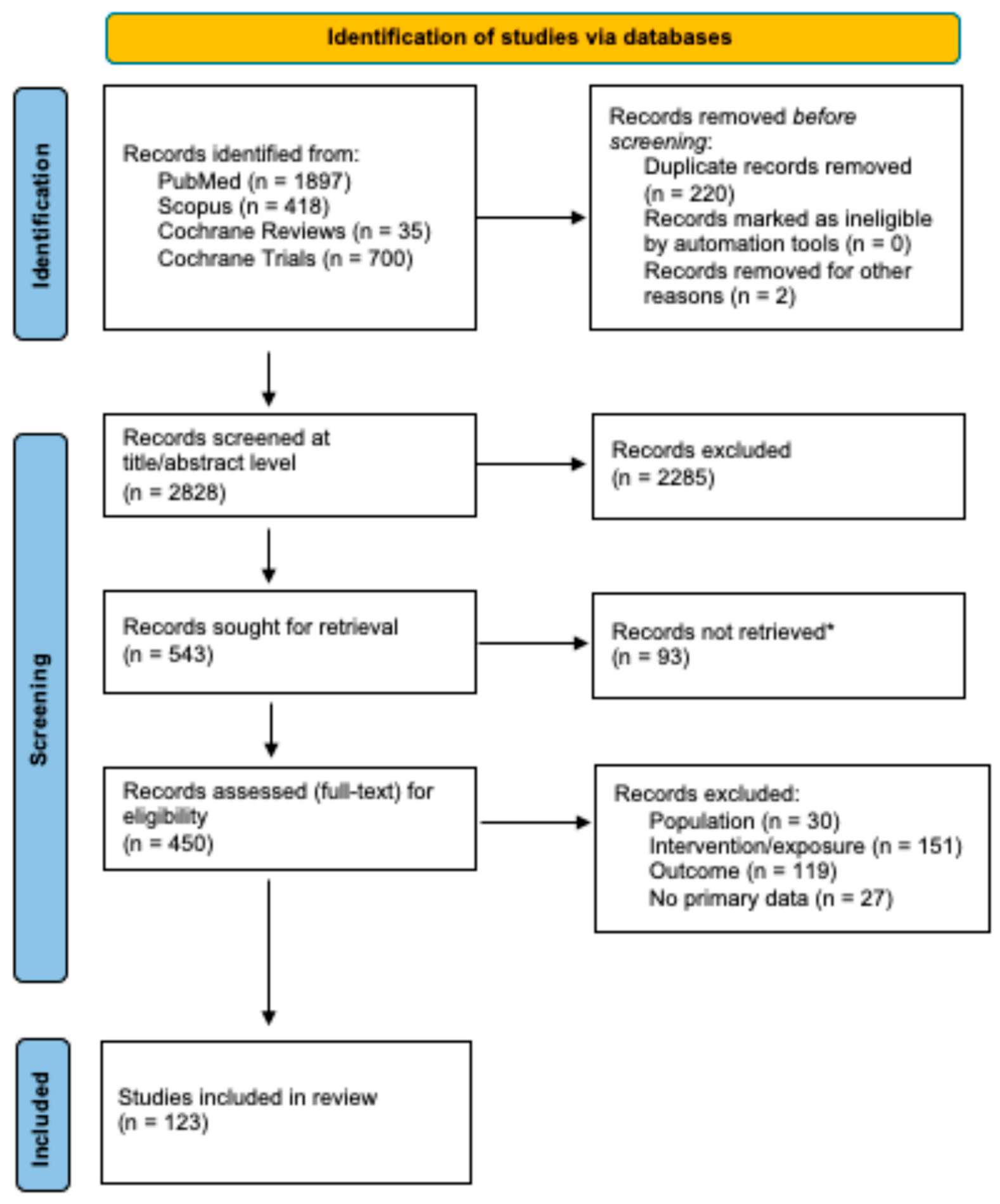

Table 1.
Summary of microbiological hazards from fermented foods.
| Type of Fermented Foods | Fermented Foods | Associated Pathogens | # Hospitalizations/ # Deaths |
References |
|---|---|---|---|---|
| Chocolate | Chocolate | nontyphoidal Salmonella | -/0 | (Patà et al. 2024) |
| Chocolate | Salmonella Oranienburg | 14/0 | (Werber et al. 2005) | |
| Dairy products | artisan fresh cheese from raw cow’s milk | Toxoplasma gondii | -/- | (da Costa et al. 2020) |
| locally made cheese | Clostridium botulinum | 4/- | (Mehramiri 2017) | |
| cheese with “KochiKocha,” which was made from chili and butter | Clostridium botulinum | -/- | (Bacha et al. 2021) | |
| Unpasteurised cheese | Verotoxin producing Escherichia coli (VTEC) | 4/- | (Deschênes et al. 1996) | |
| raw-milk cheese | Salmonella Dublin | -/0 | (Ung et al. 2019) | |
| a pecorino cheese made with unpasteurized sheep milk | enteroaggregative Escherichia coli (EAEC) serotype O92, H33 | 0/0 | (Scavia et al. 2008) | |
| hard cheeses | Mycobacterium avium complex (MAC) | -/- | (Horsburgh et al. 1994) | |
| mexican-style soft cheese | Listeria monocytogenes | -/- | (Linnan et al. 1988) | |
| unpasteurised bovine milk cheese | Streptococcus equi zooepidemicus | -/- | (Balter et al. 2000) | |
| cheddar cheese | Salmonella Heidelberg | -/- | (Fontaine et al. 1980) | |
| raw milk cheese | Escherichia coli O157,H7 | -/0 | (Gaulin et al. 2012) | |
| processed white cheese | Streptococcus T type 8/25/Imp19 | -/0 | (Bar-Dayan et al. 1996) | |
| unpasteurized goats and sheep milk or cheese |
Brucella melitensis Brucella suis bv 1 |
-/0 | (Al Dahouk et al. 2005) | |
| Brie cheese | Listeria monocytogenes | -/- | (Schwartz et al. 1989) | |
| cheese | Campylobacter jejuni | 44/- | (Sorgentone et al. 2021) | |
| unpasteurized Goat cheese | Salmonella Paratyphi B | -/1 | (Desenclos et al. 1996) | |
| Fresh pasteurized milk cheese | Shigella sonnei | -/- | (Garcia-Fulgueiras et al. 2001) | |
| Gorgonzola cheese |
Listeria monocytogenes serotype 1/2b |
1/1 | (Gianfranceschi et al. 2006) | |
| Latin-style fresh cheese | Listeria monocytogenes | 2/0 | (de Castro et al. 2012) | |
| Mozzarella cheese |
Salmonella Javiana Salmonella Oranienburg |
-/- | (Hedberg et al. 1992) | |
| raw cheese | Brucella melitensis | -/- | (Karagiannis et al. 2012) | |
| leeks in cheese sauce | Clostridium perfringens | 1/- | (Bhattacharya et al. 2020) | |
| Cheese | Clostridium botulinum Type A | 23/1 | (Pourshafie et al. 1998) | |
| Mexican-style cheese | Listeria monocytogenes | 13/5 | (MacDonald et al. 2005) | |
| Unpasteurized Mexican-style aged cheese (Cotija cheese) | Multidrug-Resistant Salmonella Newport | 36/0 | (CDC 2008) | |
| Soft unpasteurized cow’s milk cheese (imported Irish cheese) | Salmonella Dublin | 3/0 | (Maguire et al. 1992) | |
| Soft cheese made from raw cow’s milk | Salmonella Montevideo | 5/2 | (Dominguez et al. 2009) | |
| Yoghurt-based relish used in kebabs |
Salmonella Typhimurium DT170 |
6/0 | (Evans et al. 1999) | |
| Cheese (along with tuna fish and chicken salad, suspected as potential vehicles of infection) |
Listeria monocytogenes serotype 4b |
23/5 | (Ho et al. 1986) | |
| yogurt | Salmonella Typhi | 74/- | (Sharma et al. 2009) | |
| cheese | Brucella spp. | -/- | (Salari, Khalili, and Hassanpour 2003) | |
| camembert cheese | Listeria monocytogenes | 0/0 | (Gilot et al. 1997) | |
| fresh Mexican style cheese | Salmonella Typhimurium | 14/- | (Cody et al. 1999) | |
| Cantal cheese | Salmonella enterica | -/- | (Haeghebaert et al. 2003) | |
| Cereal products | Bread | Norovirus GII | 0/0 | (Guo et al. 2014) |
| Hamburguer bun | Salmonella Thompson | 9/0 | (Kimura et al. 2005) | |
| bread | norovirus | -/- | (Li et al. 2021) | |
| Non-alcoholic beverages | Bushera | Salmonella Typhi | -/- | (Kabwama et al. 2017) |
| Vegetable products | kimchi cabbage | Enterotoxigenic Escherichia coli (ETEC) O6 | 0/- | (Shin et al. 2016) |
| Kimchi | Escherichia coli O169 | 0/0 | (Cho et al. 2014) | |
| kimchi | Norovirus GI.4 | 0/0 | (Park et al. 2015) | |
| fermented black beans (douchi) | Bacillus cereus | -/- | (Zhou et al. 2014) | |
| natto | Bacillus subtilis | 1/0 | (Hashimoto et al. 2023) | |
| natto | Bacillus subtilis var. natto | 1/0 | (Ishikawa et al. 2024) | |
| Meat and/or fish products | cold sliced salami | not identified | -/- | (Mitakakis et al. 2004) |
| Meat and/or fish products | Salt-Cured Fish | Clostridium botulinum type E | 2/0 | (Ganapathiraju et al. 2019) |
| Meat and/or fish products | Fermented oysters (“eorigul-jeot”) | Norovirus (NoV) Genogroups GII.4, GII.11, GII.14 |
-/0 | (Cho et al. 2016) |
| Meat and/or fish products | cured pork meat | Hepatitis E virus | -/- | (Smith et al. 2021) |
| Meat and/or fish products | pork salami | Salmonella Typhimurium DT104A | -/0 | (Luzzi et al. 2007) |
| Meat and/or fish products | dry fermented salami, raw beef, raw beef suet, and raw pork were combined | Escherichia coli O157,H7 | -/0 | (MacDonald et al. 2004) |
| Meat and/or fish products | Genoa Salami | Escherichia coli O157,H7 | 14/0 | (Williams et al. 2000) |
| Meat and/or fish products | salami | Listeria monocytogenes | -/- | (Schwartz et al. 1989) |
| Meat and/or fish products | salami | Salmonella Montevideo | 52/0 | (Gieraltowski et al. 2013) |
| Meat and/or fish products | fermented sausage | Escherichia coli O157,H7 | 13/0 | (Sartz et al. 2008) |
| Meat and/or fish products | Cinkrugan (fermented goat meat) | Clostridium botulinum Type B | 3/0 | (Tseng et al. 2009) |
| Meat and/or fish products | Dried pork sausage (“longaniza de Pascua”) |
Salmonella Typhimurium (monophasic and biphasic) Salmonella Derby |
-/0 | (Arnedo-Pena et al. 2016) |
| Meat and/or fish products | Organic fermented beef sausage | Shiga toxin-producing Escherichia coli (STEC) O26,H11 | 0/0 | (Ethelberg et al. 2009) |
| Meat and/or fish products | Fermented raw pork sausage (spreadable “frische Mettwurst”) | Salmonella Goldcoast | -/0 | (Bremer et al. 2004) |
| Meat and/or fish products | Duck prosciutto (cured duck meat) | Salmonella Typhimurium PT9 | 7/0 | (Draper et al. 2017) |
| Meat and/or fish products | Salami-type sausage and highly seasoned pork sausage | Trichinella britovi | -/0 | (Cortés-Blanco et al. 2002) |
| Meat and/or fish products | salami | Salmonella Senftenberg | -/- | (CDC 2010) |
| Meat and/or fish products | pork dry-fermented salami | Escherichia coli 0157 | 2/0 | (Conedera et al. 2007) |
| Meat and/or fish products | cured mutton sausages | Escherichia coli O103,H25 | 12/- | (Schimmer et al. 2008) |
| Meat and/or fish products | salami | Salmonella Typhimurium | 21/- | (Pontello et al. 1998) |
- not reported.
Table 2.
Summary of dietary exposure and risk characterisation of mycotoxins from fermented foods. For each food category and mycotoxin, the table reports intake (median and range by unit) and risk metrics.
Table 2.
Summary of dietary exposure and risk characterisation of mycotoxins from fermented foods. For each food category and mycotoxin, the table reports intake (median and range by unit) and risk metrics.
| Type of Fermented Foods | Mycotoxins | Mean Estimated Intake (ng/kg Bodyweight/Day) |
Risk Characterisation | References |
|---|---|---|---|---|
| Cereal products | Aflatoxin B1 | 0.002–0.02 | max HQ 0.0011 min MOE 21,193.14 max LCR 0.0016 |
(Hoteit et al. 2024) |
| Aflatoxin B2 | 0.080 | NR | (Sirot, Fremy, and Leblanc 2013) | |
| Aflatoxin G1 | 0.080 | NR | (Sirot, Fremy, and Leblanc 2013) | |
| Aflatoxin G2 | 0.080 | NR | (Sirot, Fremy, and Leblanc 2013) | |
| Aflatoxins (total) | 0.119 | NR | (Coppa et al. 2020) | |
| Ochratoxin A | 0.172 | NR | (Sirot, Fremy, and Leblanc 2013) | |
| 0.01–1.18 | max HQ 0.0653 min MOE 12,331.48 |
(Hoteit et al. 2024) | ||
| Deoxynivalenol (DON) | 332.18 | max HQ 0.0415 | (Hoteit et al. 2024) | |
| Deoxynivalenol (DON) and metabolites (3-Ac-DON, 15-Ac-DON) | DON: 226.3 3-Ac-DON: 5.45 15-Ac-DON: 4.82 |
NR | (Sirot, Fremy, and Leblanc 2013) | |
| Nivalenol | 13.29 | NR | (Sirot, Fremy, and Leblanc 2013) | |
| Zearalenone | 0.706 | NR | (Coppa et al. 2020) | |
| 8.03 | NR | (Sirot, Fremy, and Leblanc 2013) | ||
| Fumonisins B1 (FB1) and B2 (FB2) | FB1, 13.49; FB2, 3.47 | NR | (Sirot, Fremy, and Leblanc 2013) | |
| 2.936 | NR | (Coppa et al. 2020) | ||
| Dairy products | Aflatoxin M1 | 0.06 | max HQ 0.33 min MOE 14,561 max LCR 0.00038 |
(Heidari et al. 2024) |
| 0.003 | max HQ 0.174 | (Hoteit et al. 2024) | ||
| 0.031 | max HQ 0.12 min MOE 127,389 |
(Farkas et al. 2022) | ||
| 0.04 | max HQ 0.19 | (Behtarin and Movassaghghazani 2024) | ||
| Range 0.06–0.09 | min MOE 6482 max LCR 0.0005 |
(Massahi et al. 2023) | ||
| Dairy products | Aflatoxin M1 | Range 0.06–0.07 | max HQ 0.3496 | (Hoteit et al. 2024) |
| Range 0.00026–0.29 | max HQ 0.022 min MOE 40,000 |
(Heidari et al. 2024) | ||
| Coffee | Ochratoxin A | 0.00037 | NR | (Massahi et al. 2024) |
HQ-hazard quotient; MOE-margin of exposure; LCR-lifetime cancer risk). HQ > 1 indicates potential non-cancer concern; for genotoxic carcinogens (e.g., aflatoxins, OTA), an MOE ≥ 10,000 is generally considered of low concern, whereas MOE < 10,000 indicates potential concern; typical population-level LCR screening bands are within the 10−6–10−5 range. NR = not reported.
Table 3.
Summary of dietary exposure and risk characterisation of heavy metals from fermented foods.
Table 3.
Summary of dietary exposure and risk characterisation of heavy metals from fermented foods.
| Type of Fermented Foods | Fermented Foods | Heavy Metals | Mean Estimated Intake | Product Concentration | Risk Characterisation—RC/Hazard Index—HI/Target Hazard Quotient—THQ/Generalized Additive Model GAM | References |
|---|---|---|---|---|---|---|
| Cereal products | Multi-grain bread, whole meal bread, whole wheat bread, rye bread, and white bread: | Mn, Cu, Ni, Pb, As, Cr, Co, Cd, and Hg | Mn: 44.0, Cu: 6.62, Ni: 0.69, Pb: 0.15, As: 0.06, Cr: 0.04, Co: 0.03, Cd: 0.03, and Hg: < 0.00 μg/kg bw/day | Mn: 19,084–28,151; Cu: 3139–4377; Ni: 260–710; Pb: 20.1–56.3; As: 13.4–22.0; Cr: 49.0–127; Co: 7.20–25.3; Cd: 11.0–23.6; and Hg: 0.13–0.41 µg/kg | THQ < 1; HI (1.37–1.71) | (Köse, Pekmezci, and Basaran 2024) |
| Bread | Methylmercury | / | / | (Amin-zaki et al. 1978) | ||
| Bread | Pb, Ni | Pb: 0.0267 μg/kg/day; Ni: 0.3802 μg/kg/day | Pb: 13.64 μg/kg; Ni: 194 μg/kg | MOE 18.7 | (Pipoyan et al. 2023) | |
| Bread | Methylmercury | / | / | (Weiss, Clarkson, and Simon 2002) | ||
| As, Cd, Cr, Ni, Pb | / | As 0.11–1.31; Cd 0.13–0.2; Cr 0.056–1.44; Ni 0.61–1.2; Pb 0.054–0.36 mg/kg | HI < 1 and HQ < 1 (adults and children) | (Neisi, Farhadi, Angali, et al. 2024) | ||
| Bread | Fe, Zn, Cr, Cd, Pb, As, Ni and Sr | / | Fe: 129–316; Zn: 18.14–36.14; Cr: 0.049–1.39; Cd: 0.13–0.19; Pb: 0.054–0.41; As: 0.11–1.29; Ni: 0.61–1.2; Sr: 1.64–9.89 ppm | GAM: Pb: 0.69 (SE: 0.015–43.92); As: 3.58 (SE: 0.28–12.36); Sr: 11.88681 (0.285–41.70) Cd: 0.04190 (0.017–2.338) |
(Neisi, Farhadi, Cheraghian, et al. 2024) | |
| GAM: Pb: 0.14 (SE: 0.008–16.01); As: 0.24 (SE: 0.03–7.8); Sr:2.6582 (0.166–16.01) Cd: 0.03310 (0.015–2.103) | ||||||
| Dairy products | Processed dairy products | Ti | / | 0.12 (±0.17) mg/kg | NR | (Rompelberg et al. 2016) |
| Sour cream | Pb | Pb: 0.0004 μg/kg/day; Ni: 0.0109 μg/kg/day | Pb: 1.98 μg/kg; Ni: 48 μg/kg | MOE 1111.6 | (Pipoyan et al. 2023) | |
| Cheese | Pb: 0.0087 μg/kg/day; Ni: 0.0214 μg/kg/day | Pb: 52.24 μg/kg; Ni: 48 μg/kg | MOE 57.4 | |||
| Cheese curd | Pb: 0.2327 μg/kg/day; Ni: 0.1714 μg/kg/day | Pb: 183.28 μg/kg Ni: 135 μg/kg | MOE 2.15 | |||
| Sheep cheese | Sb | 0.0003/0.0001 mg/day/100 g | 0.22 ±0.15 mg/kg | THQ preschool children: 2.5; adults: 0.79 | (Almášiová et al. 2024) | |
| As | 0.0010/0.0033 mg/day/100 g | 0.73 ± 0.29 mg/kg | THQ preschool children: 11.06; adults: 3.48 | |||
| Ba | 0.0018/0.0057 mg/day/100 g | 1.26 ± 0.58 mg/kg | THQ preschool children: 0.03; adults: 0.01 | |||
| Cr | 0.0001/0.0001 mg/day/100 g | 0.04 ± 0.01 mg/kg | THQ preschool children: 0.06; adults: 0.02 | |||
| Cu | / | 0.26 ± 0.08 mg/kg | THQ preschool children: 0.0; adults: 0.01 | |||
| Fe | / | 6.57 ± 0.84 mg/kg | THQ preschool children: 0.0; adults: 0.01 | |||
| Pb | 0.0002/0.0006 mg/day/100 g | 0.13 ± 0.09 mg/kg | THQ preschool children: 0.17; adults: 0.05 | |||
| Li | 0.0001/0.0003 mg/day/100 g | 0.07 ± 0.03 mg/kg | THQ preschool children: 0.09; adults: 0.03 | |||
| Mo | 0.0001/0.0003 mg/day/100 g | 0.06 ± 0.05 mg/kg | THQ preschool children: 0.05; adults: 0.02 | |||
| Ni | 0.0010/0.0032 mg/day/100 g | 0.70 ± 0.52 mg/kg | THQ preschool children: 0.16; adults: 0.05 | |||
| Sr | 0.0071/0.0226 mg/day/100 g | 4.96 ± 0.74 mg/kg | THQ preschool children: 0.04; adults: 0.01 | |||
| Dairy products | Fermented milk | Hg, Pb, Cd, Cr, As, Zn, Cu, Fe, Mn, Ni | / | Hg: 0–26; Pb: 0–35.01; Cd: 0–305; Cr: 0–433; As: 0–17; Zn: 2893–28,980; Cu: 31.09–1133; Fe: 341.83–8320; Mn: 22.67–793; Ni: 0–81.9 μg/kg | THQ < 1; HI < 1 THQ < 1; HI < 1 |
(Yan et al. 2022) |
| Matsun | Pb, Ni | Pb: 0.0003 μg/kg/day; Ni: 0.0075 μg/kg/day | Pb: 0.84 μg/kg; Ni: 19 μg/kg | MOE 1513.8 | (Pipoyan et al. 2023) | |
| Yoghurt | Ti | / | 0.47 (±0.46) mg/kg | NR | (Rompelberg et al. 2016) | |
| Coffee & Chocolate | Chocolate | As | / | / | NR | (Bolliger, van Zijl, and Louw 1992) |
| Coffee | Pb | Pb: 0.1398 μg/kg/day; Ni: 0.1031 μg/kg/day | Pb: 192.56 μg/kg; Ni: 142 μg/kg | MOE 3.6 | (Pipoyan et al. 2023) | |
| Coffee | Cd | / | Range: 0.002–0.100 mg/kg | THQ < 1 | (Rahimi et al. 2024) | |
| Cu | / | Range: 0.507–10.527 mg/kg | ||||
| Pb | / | Range: 0.033–0.695 mg/kg | ||||
| Ni | / | Range: 0.952–1.511 mg/kg | ||||
| Zn | / | Range: 4.472–26.109 mg/kg |
THQ—Target hazard quotient; HI—hazard index; MOE—margin of exposure.
Table 4.
Summary of dietary exposure and risk characterisation of PAHs from fermented foods. For each food category and PAH, the table reports intake (median and range by unit) and risk metrics (max HQ, min MOE, max LCR). HQ > 1 indicates potential non-cancer concern; for genotoxic carcinogens (e.g., benzo[a]pyrene), an MOE ≥ 10,000 is generally considered of low concern, whereas MOE < 10,000 indicates potential concern; typical population-level lifetime cancer risk (LCR) screening bands are 10−6–10−5. NR = not reported.
Table 4.
Summary of dietary exposure and risk characterisation of PAHs from fermented foods. For each food category and PAH, the table reports intake (median and range by unit) and risk metrics (max HQ, min MOE, max LCR). HQ > 1 indicates potential non-cancer concern; for genotoxic carcinogens (e.g., benzo[a]pyrene), an MOE ≥ 10,000 is generally considered of low concern, whereas MOE < 10,000 indicates potential concern; typical population-level lifetime cancer risk (LCR) screening bands are 10−6–10−5. NR = not reported.
| Type of Fermented Foods | PAHs | Mean Estimated Intake (ng/kg bw/Day) | Risk Characterisation | References |
|---|---|---|---|---|
| Bread | benzo(a)pyrene (BaP) | 48.1 ± 20.4 ng/day | NR | (Hakami et al. 2008) |
| Benzo(a)pyrene (BaP) | 4 × 10⁻⁵ to 1.02 µg/kg/day | moderate or high carcinogenic risks (CR > 10−6) | (Asadi Touranlou et al. 2024) | |
| PAH 4, the combined levels of benzo[a]pyrene (BaP), chrysene (CHR), benz[a]anthracene (BaA), and benzo[b]fluoranthene (BbF) |
NR The study only reports that the mean concentration of PAH4 in bread samples from various countries worldwide varied between not detected to 3.45 μg/kg |
NR | (Asadi Touranlou et al. 2024) | |
| PAH 8, benz[a]anthracene, benzo[b]fluoranthene, benzo[k]fluoranthene, benzo[ghi]perylene, benzo[a]pyrene, chrysene, dibenz[a,h]anthracene, and indeno [1,2,3-cd]pyrene | NR The study only reports that the mean concentration of PAH8 in bread samples from various countries worldwide varied between not detected to 14 μg/kg |
NR | (Asadi Touranlou et al. 2024) | |
| PAH16, acenaphthene, acenaphthylene, anthracene, fluoranthene, fluorene, naphthalene, phenanthrene, pyrene, benz[a]anthracene, benzo[b]fluoranthene, benzo[k]fluoranthene, benzo[ghi]perylene, benzo[a]pyrene, chrysene, dibenz[a,h]anthracene, and indeno [1,2,3-cd]pyrene | NR (mean concentration of PAH16 in bread samples from various countries worldwide varied between 1.06 and 374.8 μg/kg) |
NR | (Asadi Touranlou et al. 2024) |
Table 5.
Summary of dietary exposure and risk characterisation of acrylamide from fermented foods.
| Type of Fermented Foods | Fermented Foods | Mean Estimated Intake (µg/kg bw/Day) |
References |
|---|---|---|---|
| Bread & Bakery (cereal-based) | White bread | 0.0340 | (Bellicha et al. 2022) |
| Bread (age 1–6) | 0.2325 | (Mojska et al. 2010) | |
| Bread (age 7–19) | 0.2480 | (Mojska et al. 2010) | |
| Bread (age 19–96) | 0.1617 | (Mojska et al. 2010) | |
| Bread (age 1–96) | 0.1935 | (Mojska et al. 2010) | |
| Coffee | Coffee | 0.1700 | (Bellicha et al. 2022) |
| Brewed coffee | 0.0110 | (Kawahara et al. 2018) | |
| Coffee beverage | 0.0016 | (Kawahara et al. 2018) | |
| Coffee (age 7–19) | 0.0062 | (Mojska et al. 2010) | |
| Coffee (age 19–96) | 0.0891 | (Mojska et al. 2010) | |
| Coffee (age 1–96) | 0.0817 | (Mojska et al. 2010) | |
| Tea | Green tea and oolong tea | 0.0042 | (Kawahara et al. 2018) |
| Barley tea, bottled | 0.0018 | (Kawahara et al. 2018) | |
| Barley tea, home prepared | 0.0018 | (Kawahara et al. 2018) | |
| Rosted green tea | 0.0018 | (Kawahara et al. 2018) |
NR = not reported.
Table 6.
Summary of dietary exposure and risk characterisation of other hazardous organic and inorganic compounds from fermented foods.
Table 6.
Summary of dietary exposure and risk characterisation of other hazardous organic and inorganic compounds from fermented foods.
| Type of Fermented Food | Hazardous Compounds | Mean Estimated Intake/Mean Concentration | Risk Characterisation | References | ||
|---|---|---|---|---|---|---|
| Dairy | not specified | Residues of antibiotics: | ampicillin | Range 2.44 to 3.89 µg/L | NR | (Alenezi et al. 2024) |
| not specified | tetracycline | Range 54.13 to 220.3 µg/L | NR | (Alenezi et al. 2024) | ||
| not specified | oxytetracycline | Range 41.55 to 160.7 µg/L | NR | (Alenezi et al. 2024) | ||
| not specified | amoxicillin | Range 3.11 to 5.5 µg/L, | NR | (Alenezi et al. 2024) | ||
| cheese and yogurt | Dioxin-like contaminants | Range 204–233 g/day | NR | (Bilau et al. 2008) | ||
| yoghurt | 53.7 g/day | NR | (Boada et al. 2014) | |||
| dairy dessert | 7.7 g/day | NR | (Boada et al. 2014) | |||
| cheese | 37 g/day | NR | (Boada et al. 2014) | |||
| cheese | PCDD, PCDF, and PCB Dioxin | 4.88 pg WHO-TEQ/kg bw/day | the maximum WHO TDI of 4 pg TEQ/kg bw/day | (Loutfy et al. 2006) | ||
| not specified | 36.9–252 pg/day | NR | (Schecter et al. 2001) | |||
| cheese and yogurt | bisphenol A (BPA) | 521.0 ng/mL–640 ng/mL | NR | (Ghahremani et al. 2024) | ||
| bread & bakery (cereal-based) | french bread: | potassium bromate | 31.83 mg/kg/day | cHQ: 1591.50/aHQ: 2,387,125/HR: 190,980.00 | (Ncheuveu Nkwatoh, Fon, and Navti 2023) | |
| milk bread: | 36.89 mg/kg/day | cHQ: 31,844.89/aHQ: 2,537,125/HR: 221,387.10 | (Ncheuveu Nkwatoh, Fon, and Navti 2023) | |||
| simple bread: | 49.19 mg/kg/day | cHQ: 2459.36/aHQ: 2,287,125/HR: 295,122.90 | (Ncheuveu Nkwatoh, Fon, and Navti 2023) | |||
| wheat bread: | 11.56 mg/kg/day | cHQ: 577.93/aHQ: 774,625/HR: 69,351.43 | (Ncheuveu Nkwatoh, Fon, and Navti 2023) | |||
| local bread: | 5.56 mg/kg/day | cHQ: 277.93/aHQ: 174,625/HR: 33,351.43 | (Ncheuveu Nkwatoh, Fon, and Navti 2023) | |||
| not specified | 0.0000525 mg/kg/day | HR: 0.309 | (Ayembilla et al. 2024) | |||
| tea bread | 0.0000739 mg/kg/day | HR: 0.435 | (Ayembilla et al. 2024) | |||
| sugar bread | 0.0000629 mg/kg/day | HR: 0.370 | (Ayembilla et al. 2024) | |||
| butter bread | 0.0000282 mg/kg/day | HR: 0.166 | (Ayembilla et al. 2024) | |||
| not specified | 0.0000525 mg/kg/day | HR: 0.309 | (Ayembilla et al. 2024) | |||
| tea bread | 0.0000739 mg/kg/day | HR: 0.435 | (Ayembilla et al. 2024) | |||
| sugar bread | 0.0000629 mg/kg/day | HR: 0.370 | (Ayembilla et al. 2024) | |||
| butter bread | 0.0000282 mg/kg/day | HR: 0.166 | (Ayembilla et al. 2024) | |||
| not specified | Heliotrine | 0.16 mg/kg | NR | (Kakar et al. 2010) | ||
| not specified | heliotrine-N-oxide | 5.4 mg/kg | NR | (Kakar et al. 2010) | ||
| not specified | lasiocarpine | 0.045 mg/kg | NR | (Kakar et al. 2010) | ||
| not specified | total pyrrolizidine alkaloids | 5.6 mg/kg | NR | (Kakar et al. 2010) | ||
| coffee | Trigonelline | 13.8 g/day | NR | (Konstantinidis et al. 2023) | ||
| fermented meat | salt-fermented pollock | N-nitrosodimethylamine | Range 0.002 to 0.090 g/kg bw/day | CR; 95th percentile: 3.73 × 10⁻⁵, mean: 1.0 × 10⁻⁵, av: 1.71 × 10⁻⁶ | (Sun et al. 2023) | |
| chorizo | thyroid hormones or iodide compounds | Urinary iodine concentrations 530–2124 mg/L | AOR 1.88 | (Conrey et al. 2008) | ||
| various food including fermented products | benzophenone-type ultraviolet filters: BP, 4-MBP, BP-3, PBZ, 2- OHBP, M2BB, 4-OHBP |
20–51 ng/kg/day | NR | (Chen, Huang, and Wu 2024) | ||
| Furan (adults) | 380/494 ng/kg bw/ day | MOE > 10,000 for more than 10% of the population and no result < 100 | (Scholl, Humblet, et al. 2012) | |||
| Furan (children) | 417–421 ng/ kg bw/ day | MOE: 100–10,000 | (Scholl, Huybrechts, et al. 2012) | |||
| polychlorinated dibenzo-p-dioxins (PCDDs)1, polychlorinated dibenzofurans (PCDFs) and dioxin-like PCBs (polychlorinated mono-ortho (mo-PCBs), and non-ortho biphenyls (no-PCBs) |
0.8 pg WHOTEQ/kg bw/d | NR | (De Mul et al. 2008) | |||
| sulfite | 8.6 to 50 mg/kg | below the maximum permitted level for each food category (max 0.19 mg/kg BW/day) |
(Fanaike et al. 2019) | |||
NR = not reported; TEQ/WHO-TEQ =Toxic Equivalent/World Health Organization Toxic Equivalent; TDI = Tolerable Daily Intake; bw = body weight; HQ = Hazard Quotient; HR = Hazard Ratio; MOE = Margin of Exposure; CR = Cancer Risk.
Disclaimer/Publisher’s Note: The statements, opinions and data contained in all publications are solely those of the individual author(s) and contributor(s) and not of MDPI and/or the editor(s). MDPI and/or the editor(s) disclaim responsibility for any injury to people or property resulting from any ideas, methods, instructions or products referred to in the content. |
© 2026 by the authors. Licensee MDPI, Basel, Switzerland. This article is an open access article distributed under the terms and conditions of the Creative Commons Attribution (CC BY) license (http://creativecommons.org/licenses/by/4.0/).
Copyright: This open access article is published under a Creative Commons CC BY 4.0 license, which permit the free download, distribution, and reuse, provided that the author and preprint are cited in any reuse.


