
Submitted:
05 June 2026
Posted:
09 June 2026
You are already at the latest version
Abstract
In previously published papers, we derived the appropriate partial differential equations of the fractional order, with appropriate boundary and initial conditions, of the oscilla-tion dynamics of the rheological Kelvin-Voight model of fractional-type materials, and studied the longitudinal natural and forced oscillations of rods of variable cross-section and determined the natural and forced rheological modes of the fractional type. In this paper, we present new scientific results from the study of the flow dynamics of the rheological Maxwell model of fractional-type materials, viscoelastic fluids with the property of normal stress relaxational of the material in a pipe of variable cross-section. These properties lead to the appearance of longitudinal rheological flows (creeps) of the fractional type. We described this flow motion of the material only by a partial differen-tial equation of fractional order in terms of normal flow stresses and determined its ap-proximate analytical solutions and the corresponding approximate analytical expressions of the eigen and forced modes of normal flow stress (creep) in terms of eigen time func-tions in the corresponding eigen amplitude forms. We considered various possible boundary conditions for normal flow stresses and for different cross-sections of pipes of variable cross-section. We derived an ordinary differential equation of fractional order in terms of eigentime functions in each eigen amplitude form of the normal creep stress of the fractional type and gave its approximate analytical solutions, with accompanying approximate analyt-ical expressions of the rheological eigenmodes and forced modes of the normal creep stress of the fractional type. We have derived an ordinary differential equation of fractional order by its eigentime functions in each eigen amplitude mode of the normal creep stress of the solution. We have given graphical representations of the surfaces of the eigen and forced rheological creep modes of the solution as a function of the exponent of differentiation of the frac-tional order and time. We have given comparisons of these eigen and forced modes of rheological Maxwell model of material fractional type with the corresponding eigen and forced rheological modes of dynamics when the material is elastoviscous of the Kel-vin-Voigt model of an elastoviscous material, fractional type. We have shown compara-tive graphs of the surfaces of eigen and forced modes of fractional type for the oscillation dynamics of the rheological Kelvin-Voigt model of an elastopiscoustic material, fractional type and the flow dynamics of the rheological Maxwell model of a viscoelastic material, fractional type.
Keywords:
Maxwell model of fractional-type
; longitudinal flow dynamics
; a pipe of variable cross-section
; partial differential equation of fractional order
; ordinary differential equation of fractional order in terms of eigentime functions
1. Introduction
The author learned his first scientific knowledge about the longitudinal and transverse dynamics of deformable ideally elastic media from Professor Dr. and mathematician Danilo P. Raškpvić at exceptional lectures and from his exellant university monographs (see References [1,23]). In particular, the author emphasizes the analogies he spoke about and emphasized the analogous dynamics, which are described by the same mathematical descriptions, and among them the analogies of the dynamics of torsional and longitudinal oscillations of rods (see Reference [4], as well as the basic original and previously published References [5,6,7], of Mihail Petrović, the founder of the Serbian school of mathematics, who completed his studies as the most successful student of generation of mathematics and physics at the University of the Sorbonne and was one of the three doctoral students of Julius Henri Poincaré, also see Reference [8]).
The author later, as a professor of elastodynamics for mechanical engineering students, published References [9,10,11], and one of them contains a chapter on classical models of rheological materials, see Reference [9], as well as on the analytical mechanics of discrete hereditary systems, see Reference [121.
In the 1980s, the Electronic Industry of Niš had in its production program the production of ultrasonic piezoelectric transducers for various purposes. Two magisters of science in the field of electronics, Miodrag Prokić and Dragan Šarković, worked on the construction and testing of piezoelectric transducers, at whose suggestion the author of this paper was engaged as an external consultant at EI Niš, and in the field of mechanical engineering and the theory of oscillations and the theory of elasticity. From this collaboration, a number of References were published [13, 14, 15,1, and among them is the first published Reference [13] on the construction and testing of ultrasonic piezoelectric transducers. The structure of ultrasonic piezoelectric transducers contains a circular piezoelectric plate that is connected to an electrical source and polarized and represents an exciter of ultrasonic longitudinal oscillations in a rod of variable cross-section, which we call a concentrator or amplifier of the amplitude of ultrasonic longitudinal oscillations at the tip of the smallest cross-section of that rod of variable cross-section. On the other hand, there is a so-called metal counterweight of the structure.
Many years later, we published Reference [16], on the properties of fluid sprayers based on excitation of longitudinal oscillations and the operation of ultrasonic piezoelectric transducers, and Dragan Šarković, M.Sc., completed his doctoral dissertation under the mentorship of Vukota Babović and successfully defended it at the Physics Group at the Faculty of Natural Sciences and Mathematics in Kragujevac. From this collaboration, Perić Ljubiša, under the mentorship of the author of this paper, completed and wrote both his magister's science thesis and his doctorate on coupled mechanical and piezoelectric state tensors and defended it at the Faculty of Mechanical Engineering in Niš. Dragan Mančić, under the mentorship of Milan Radmanović, completed and defended his doctoral dissertation at the Faculty of Electronics in Niš.
The very construction of ultrasonic piezoelectric transducers was the inspiration for the study of longitudinal oscillations of rods, by the author of this paper and Aleksandar Filipovski, who later published the following References on these scientific results [17,18,19]. Under the mentorship of the author of this paper, in 1995, Aleksandar Filipovski completed and defended his magister's science thesis, entitled ''Energy analysis of longitudinal oscillations of rods of variable cross-section'', Reference [20], at the Faculty of Mechanical Engineering in Niš, and one of the members of the Masgiter's science thesis defense committee was academician Božidar Vujanović. Much later, in 2002, at the initiative of the author of this paper, they published a co-authored paper Reference [21].
At the invitation of one of the editors, Bilen Emek Abali, the author of this paper, wrote and published in 2020, Reference [22], on Forced Longitudinal Fractional Type Vibrations of a Rod with Variable Cross Section, in the Springer Nature book Developments and Novel Approaches in Nonlinear Solid Body Mechanics.
Four years later, in 2024, the author of this paper, driven by strong scientific inspiration, returned to research in the field of applications of fractional calculus in mechanics, with a sudden and spontaneous scientific inspiration, based on previously acquired knowledge of classical rheological models and carrying in his mind the ideas of applying fractional calculus, and in a very short time achieved new scientific results, which he formulated in References [23,24,25], published in a specialized journal called ''Fracral and Fractional'', and with the exceptional support of the Journal's Editorial Board and especially one of the associate editors. This series of new papers also includes the published Reference [26], as well as Rerenne [27,28].
It is also useful to see the overview References [29,30] for insight into other results related to the content of this manuscript.
In the published References [22,23], new scientific results of theoretical-analytical research of the dynamics of rheological models of fractional type of elasto-viscous material in a rod of variable cross-section are presented. This is a material of fractional type, properties of subsequent elasticity (post-elasticity). The material is a rheological Kelvin-Voigt model of a material of fractional type with properties of elasto-viscosity and subsequent elasticity (post-elasticity), which are described in detail in Reference [26]. These properties lead to the appearance of rheological longitudinal oscillations of fractional type in the rod. We described this motion only by a partial differential equation of fractional order and determined its approximate analytical solutions and corresponding approximate expressions for describing the eigen and forced rheological modes of the elastoviscous rheological fractional type. We considered different boundary conditions and for different cross-sections of a rod of variable cross-section. We derived an ordinary differential equation of fractional order in terms of time functions in each amplitude form of oscillation and gave its approximate analytical solutions, with the accompanying approximate analytical expressions of the eigen and forced modes. We determined the amplitude functions. We graphically displayed the surfaces of the eigen and forced modes as a function of the exponent of the differentiation of the fractional order and time. References [20,22,23,26] contain differential equations of the amplitude functions of longitudinal rheological oscillations of a rod of ideally elastic material, as well as tables of eigenvalues for different cross-sections and different boundary conditions. Detailed descriptions of the amplitude functions of longitudinal oscillations of a rod of ideally elastic material for different cross-sections and different boundary conditions are also given.
In this paper, unlike the previous one, we will present new scientific results of studying the flow (creep) dynamics of the rheological Maxwell model of materials, fractional type, viscoelastic fluids with the property of relaxation of the normal stress of the material, in a pipe of variable cross-section. These properties lead to the appearance of longitudinal flows (creeping) of the rheological Maxwell model of materials of fractional type. We described this flow (creeping) motion only by a partial differential equation of fractional order in terms of normal stresses and determined its approximate analytical solutions and the corresponding approximate analytical expressions for the eigen and forced modes of the normal stress flow (creeping) in terms of the eigen time functions for the corresponding eigen amplitude modes. We considered different possible boundary conditions for the normal yield (creeping) stresses of the rheological Maxwell model of fractional-type materials and for different cross-sections of pipes of variable cross-section.
2. Constitutive Differential Relation of the Fractional Order of the Rheological Maxwell Model of Materials, Fractional Type
In the Maxwell rheological model of materials, fractional type, the following rheological elements are sequentially related:
* The ideally elastic solid Hooke element of the constitutive relation between the normal stress and axial dilatation , in a state of axial strain, has the form:
* an ideally viscous fluid generalized Newtonian element, of fractional type, constitutive differential relations of fractional order of normal stress and fractional type of axial dilatation , in the state of axial flow, (creeping) is of the form:
where is the fractional order differential operator, the exponent of the fractional order of differentiation, on the interval .
In this paper, we will use the following differential operator of non-integer (fractional) order , which we define with the following derivative and integral:
where is the special Gamma function, which is defined in integral form (see Reference [31]):
or in general form as a function of a variable , in the form:

The constitutive differential relation of the rheological Maxwell model of the fractional type of viscoelastic material is composed using the sum of the fractional type dilation velocities, and , in the longitudinal direction and is equal to: is:
That is, how: follows and it follows that heaven is a sum (see Figure 1.a) axial dilatation analysis): .
Finally, the constitutive differential relation of the rheological Maxwell model of fractional-type material is in the form:
when the fractional-type rate of change of normal stress approaches to zero , the material described by the modified fractional Maxwell model behaves like a viscoelastic fluid. This is because the deformation, i.e. axial dilation of the body: , increases indefinitely without any additional load. Upon unloading, the deformation in the ideally elastic (Hookean) element fully recovers, while the deformation resulting from the flow (creeping) in the fractional-type viscous (modified Newtonian fluid fractional type) element , connected in series, remains unrecovered.
If this material, a the fractional-type modified Maxwell model ,, fractional type, is suddenly loaded to some value of normal stress, , the corresponding elastic deformation occurs instantaneously in Hooke's ideal elastic element . This occurs due to the sudden application of load at the very beginning of the observation period, the flow (creeping) behavior of the serially connected fractional-type viscous element (modified Newtonian fluid, fractional type) in the rheological fractional type Maxwell model does not immediately manifest. If the development of deformation (dilatation) is constrained—i.e., if the fractional-type rate of dilatation tends to zero —then the normal stress becomes a time-dependent function that must be determined.
When the rate of change of the normal stress of the fractional-type modified rheological Maxwell complex assembly tends to zero , then the normal mechanical stress tends to a value proportional to the rate of dilation of the fractional type :
In order to determine the dependence of normal stress on time, when we keep the material model of the modified rheological Maxwell complex model, fractional type , at some constant rate of dilatation, fractional type , we write that:
By applying the previous condition (9), we obtain a differential equation of fractional order, which can be solved using the Laplace transform. We then apply the Laplace transform to the functional relationship defined by equation (26)—the fractional-order differential equation. As a result of this transformation, we obtain the following expression: .
The approximate analytical solution of the constitutive differential equation (9) of fractional order is in the form (for details of solving the fractional type differential equation (9), see References [23,26]):
Fig. 1 presents generalized complex rheological Maxwell models of fractional type for ideal materials, incorporating a generalized Newton viscous element of fractional type. In particular, Fig. 1.a illustrates the generalized fractional Maxwell model of a viscoelastic fluid, along with the decomposition and analysis of axial dilatation and normal stress states.
The normal stress relaxation surface is shown, based on the approximate analytical expression (10), representing the time-dependent normal stress response of the rheological Maxwell model, fractional type, in a three-dimensional coordinate system: normal stress time t and exponent α of fractional derivative in interval from zero to one, 0<α≤1.
From the previous solution (10), as well as from the surface plot shown in Fig. 1.b, it is evident that the normal stress decreases asymptotically over time and tends toward zero, as illustrated in Fig. 1.b. This gradual reduction in normal stress under constant dilatation is known as normal stress relaxation of fractional type. The constitutive differential relation of the fractional order, viscoelastic rheological material - Maxwell's fractional type model is a fractional order differential equation fractional type in the form:
by the normal stress along the entire longitudinal direction of the rheological Maxwell model of the fractional type of material. The solution is easily obtained using the Laplace transform and the convolution theorem (for details of solving equation (11) see References [23,26]).
3. Partial Differential Equation of Longitudinal Flow Dynamics of the Rheological Maxwell Model of a Material, Fractional Type, in a Pipe of Variable Cross-Section
Normal force to the cross section of the rheological Maxwell model of material, fractional type, with variable cross section at coordinate is , whail it’s value in cross section on coordinate is (ssee Fig. 2): Normal force to the cross section of the rheological Maxwell model of material, fractional type, with variable cross section at coordinate is , while it's value in cross section on coordinate is (see Figure 2):
Let’s denote with longitudinal displacement of the cross section of the rheologic Maxwell material fractional tyoe at longitudinal coordinate . According to the D’Alambert’s Principles of dynamical equilibrium of all acting forces to the system, following differential equation could be written for dynamical equilibrium of the forces of one elementary part of rheologic Maxwell material fractional type material is in form (for details see References [17,21,22]):
where is visco-elastic rheologic Maxwell model fractional type material’s density, is area of cross section of material flowand is distributed volume force. Substituting equation (12) into equation (13) leads to:
We can, now, write two basic relations that describe the dynamics flow (creeping) of the rheological Maxwell model of a fractional-type material flowing (creeping) in a pipe of constant or variable cross-section: the first is the constitutive differential relation of the fractional order, and the second is the dynamic equilibrium equation of an element of the Maxwell model of a fractional-type material (14):
From these equations (15) and (16) we eliminate the longitudinal displacement , to obtain a partial differential equation of fractional order in terms of the nodal stress of rheological flow (creeping) of dynamics flow of the rheological Maxwell model of material, fractional type.
We differentiate the first fractional order differential equation (15) twice with respect to time, and we differentiate the second partial differential equation (16) with respect to fractional order time and with respect to the coordinate , so that we obtain:
Then, we substitute the first obtained equation (17) into the second (18) and we obtain a partial differential equation of fractional order in terms of the normal stress in the form:
This fractional order partial differential equation (19) in terms of normal stress describes the longitudinal dynamics flow (creeping) of the rheological Maxwell model of a fractional type material, in a pipe of constant or variable cross-section as a function of the longitudinal coordinate .
4. Decomposition of the Partial Differential Equation of Longitudinal Flow Dynamics of the Rheological Maxwell Model of a Material, Fractional Type, in a Pipe of Variable Cross-Section
Let us assume the solution of the partial differential equation (19) of fractional order of the longitudinal dynamics-flow of the rheological Maxwell model of the material, of fractional type, in a pipe of variable cross-section under normal stress in the form of the product of two functions, one that depends on time , and the other that depends on the longitudinal coordinate in the form:
Let's also assume that we can also assume the load in the form .
Then, the resulting equation is in the following form:
Then, we separate the resulting equation (21) into two separate ordinary differential equations, one in terms of a function in terms of coordinates , and the other of fractional order in terms of a function in terms of time . For that reason we, dividing the differential equation (21) by and separate the left and right sides into terms that depend only on time, i.e., only on the coordinate , and it follows:
We have separated the partial differential equation (21) of fractional order, in the form of two separate ones, (22) in (23), one ordinary differential equation in terms of the function in terms of the coordinate , and the other of fractional order in terms of the function in terms of time , where we have introduced one unknown constant , which we determine from the condition that the function in terms of the coordinate as well as the solution for the flows normal stress of floe (creeping) of rheological Maxwell's material satisfy the boundary conditions. Now we can write the previous system of equations (22)-(23) in the following convenient form:
In the previous system of ordinary differential equations (24) –(25), the first of which is of fractional order, we have introduced the eigen characteristic number , which we determine from the boundary conditions, which will be explained in the following sections of the article.
The previous first ordinary differential equation (24) in terms of the eigen time function is an ordinary differential equation of fractional order and from it we determine the eigentime functions . The second equation (25) is an ordinary differential equation in terms of functions that depend on the longitudinal coordinate and from it we determine the eigen amplitude functions, which must satisfy the boundary conditions. The sign in front of the constant is determined from the condition that the solution for the eigen amplitude function that depends on the longitudinal coordinate , satisfies the conditions of physical reality of the task of mathematical solution of the ordinary differential equation (25).
In the paper, we assumed that it is possible to differentiate over whole derivatives and derivatives of fractional order by changing the order of differentiation.
5. Eigen Amplitude Functions of Some Possible Cross-Sections of a Pipe for the Realization of Flow Dynamics and Possible Boundary Conditions, Flow of a Rheological Maxwell Material Model, Fractional Type, in a Pipe of Variable Cross-Section
And now it is necessary to solve this ordinary differential equation (25) by its own amplitude function for each selected cross-sectional shape , which we express in function of the longitudinal coordinate , as well as for the corresponding boundary conditions by normal stress, for flows of the rheological Maxwell model of material, of fractional type, in a pipe of variable cross-section :
In this section, we will analyze the solutions to these differential equations (26) for some selected cross-sections and some of the boundary conditions for the normal stresses for the flow of the rheological Maxwell material model, fractional type.
5.1* As the simplest case of flow of the rheological Maxwell model of the material, of fractional type, we choose a constant cross section along the longitudinal coordinate . Then this differential equation (26) in terms of its own amplitude function becomes:
The mathematical solutions of the previous ordinary differential equation (27) in terms of its own amplitude function are:
and
The first mathematical solution (28) for corresponds to the physical properties of the problem of the flow of the rheological Maxwell model of material, fractional type in a pipe, so we write the eigen characteristic constant with a plus sign.
* if the pipe is free at both ends and means that the normal stresses in the cross-sections at both ends, in the corresponding cross- sections for and for , are zero, for the flow of the rheological Maxwell model of material, fractional type, so the amplitude functions of the eigenvalues at the ends of the pipe are equal to zero: and . From these conditions it follows:
Thus, we have determined the eigen characteristic numbers, , , of which there are infinitely many, for the observed flow (creeping) of the rheological Maxwell model of a material, of fractional type, in a pipe of constant cross-section. For each characteristic number, the eigen amplitude function for the flow of the rheological Maxwell model of a material, of fractional type, is of the form:
This means that there are infinitely many proper amplitude forms and that they are of the form (31), , , and that they correspond to each proper characteristic number from the set ,
The sets of eigenvalue functions (31), , and , , for the flow (creeping) of the rheological Maxwell model of a material, of fractional type, in a pipe of constant cross-section, satisfy the orthogonality conditions:
These orthogonality conditions (32), in the general case for the flow of the rheological Maxwell model of a material, of fractional type, in a pipe of variable cross-section, can be obtained from the differential equation (27) itself by the eigenamplitude functions , ]. It is sufficient to multiply the differential equation (27) twice by two different indices and , then multiply the first by , , and the second by , , and subtract them, for example the first from the second, and then integrate them along the longitudinal coordinate in the limits from zero to along the longitudinal coordinate to the next end of the pipe, from and to . In the obtained result, through multiple repeated partial integrations and entering different values of the eigenamplitude functions, , and , , at the boundaries of the intervals, for and for , we obtain the conditions of orthogonality of the eigenamplitude functions. Based on this description, we write the following:
The result of the subtraction is:
Then follows partial integration in several stages, with the introduction of general possible boundary conditions of the considered problem, we obtain:
These, as a final result, follow the orthogonality conditions of the eigenamplitude functions in the general form (32).
For this case, for the flow (creeping) of the rheological Maxwell model of a material, of fractional type, in a pipe of constant cross-section, when we have determined the eigenamplitude functions , in the form (31) we can check the orthogonality conditions by direct calculation, and we obtain:
5.2* If for a variable cross-section of a pipe for the flow of a rheological Maxwell's material model, of fractional type, in a pipe of variable cross-section we adopt a circular cross-section with a diameter, which changes along the longitudinal coordinate as:
so the cross-sectional area is: , and relation us:
The differential equation (26) in terms of the eigenamplitude functions for the flow of the rheological Maxwell model of the material, fractional type, for this case of changing the circular cross-section (38) of the pipe is:
5.3* If for the variable cross-section of a pipe for the flow of a rheological Maxwell material model, of fractional type, in a pipe of variable cross-section we adopt a circular cross-section with a diameter that varies along the longitudinal coordinate as:
so the cross-sectional area is: , and relation us:
The differential equation (26) in terms of the eigenamplitude functions for the flow of the rheological Maxwell model of the material, fractional type, for this case of changing the circular cross-section (41) of the pipe is:
To solve this previous differential equation (43), we introduce a shift in the form:
Then we differentiate the previously introduced solution with respect to the longitudinal coordinate, so that we obtain:
We multiply the assumed solution (44) by , and the first derivative (45) by , and then add them with the second derivative (46) to obtain the following classical differential equation with constant coefficients, and we obtain:
When we divide by we get an unknown differential equation in the form:
The mathematical solutions of the previous differential equation (48) are in the form:
And
For the eigenamplitude functions , for the flow (creeping) of the rheological Maxwell material model, fractional type, for this case of changing the circular cross-section of a pipe of diameter (41), the corresponding solution is
what are the solutions of the differential equation (45).
The eigen characteristic number, that is , is in the following form:
Now we consider the boundary conditions that both ends of the tube are free. Then the normal stresses in the sections at both ends, for and for , in the corresponding cross sections, are simply zero, and it follows that the eigenvalue functions and , are equal to zero:
and, these condition (53) are the boundary conditions, which follow from the conditions for normal stresses at the ends of the pipe for the flow (creeping) of the rheological Maxwell model of the material, fractional type, are equal to zero.
Since the eigenamplitude functions of the form (51) are , by applying the boundary conditions (53) we write:
that is,
The eogrn characteristic flow numbers of the rheological Maxwell model of a material, of fractional type, through a pipe of variable circular cross-section of diameter (41) are:
while the eigenamplitude functions of the form,
and there are infinitely many of them.
From the form (57) of the eigenamplitude forms , , , and that each corresponds to one of the set of many eigencharacteristic numbers, , , or , or , , for the flow (creeping) of the rheological Maxwell model of a material, of fractional type, through a pipe of variable cross-section diameter (41) and that they grow exponentially with the longitudinal coordinate .
The eigen amplitude functions, , and , , of the flow (creeping) of the rheological Maxwell model of a material, of fractional type, through a pipe of variable cross-section of diameter (41) satisfy the orthogonality conditions (32), which in this case can also be proved from the differential equation of the eigen eigen amplitude functions , , or by direct integration. For this case we obtain:
We have shown in several examples that both the differential equation in terms of its own amplitude function and in terms of the longitudinal coordinate can be separated and can be immediately solved independently of the ordinary differential equation of fractional order in terms of its own time function that depends on time . We have previously shown the solution of the second ordinary differential equation (25) or (26) in examples, taking into account that the solution is performed for each case of a change in the cross-section of the pipe individually and for each case individually selected boundary conditions according to the normal flow stresses of the rheological Maxwell model of the material, fractional type.
5.4* Overview of possible boundary conditions for the longitudinal flow dynamics of a rheological Maxwell material model, fractional type, in a pipe of variable cross-section
In this section, we will list some more possible boundary conditions for the longitudinal flow dynamics of a rheological Maxwell model of a material, of fractional type, in a pipe of constant or variable cross-section.
The solutions for the eigen amplitude functions , which we have shown in previous three examples, for selected pipe cross-sections, must satisfy the boundary conditions.
We determine the boundary conditions for each specific case of the choice of changes in pipe cross-sections along the longitudinal coordinate, as well as at each end of the pipe for and for .
* a tube fixed at the left end and free at the right end for . The normal flpw stress for is equal to the axial force divided by the cross-sectional area: . The normal stress at the free end for is equal to
to the axial force divided by the cross-sectional area: .
The normal stress at the free end for is equal to
zero, and it follows that the eigen amplitude function at
that end is equal to zero.
These boundary conditions are:
* the pipe is fixed at both ends, which means that the normal stresses in the sections at both ends, for and are equal to the corresponding axial forces divided by the corresponding cross sections area. The boundary conditions are of the form:
* the pipe is free at both ends and means that the normal stresses in the cross sections at both ends, for and , in the corresponding cross sections for and for are zero. It follows that the eigenamplitude functions in the cross sections at the ends of the pipe are equal to zero, and the boundary conditions are in the form:
* A pipe fixed at the left end and carrying a material point at the right end for . For normal stress , it is equal to the axial force divided by the cross-sectional area , . For normal stress at the right end , it is equal to the inertia force divided by the cross-sectional area . In this case, the boundary conditions are as follows:
* the tube carries one material point at both ends, the left and right ends , masses and , the normal stresses at the ends are equal to the corresponding inertia force divided by the corresponding cross-section , i.e. the inertia force divided by the cross-section of the right ed , and boundary conditions in this case are in the following fform :
6. Differential Equations of Fractional Order in Terms of Eigentime Functions and Approximate Analytical Solutions of the Flow Dynamics of the Rheological Maxwell Model of a Material, Fractional Type, in a Pipe of Variable Cross-Section
The previously derived fractional order ordinary differential equation, (25) or (26), for describing the flow (creeping) of a rheological Maxwell model of a material, of fractional type, in terms of time function in a pipe of constant or variable cross-section is an ordinary differential equation of fractional order in terms of its own time function , which depends on time .
Considering that each eigenamplitude function and for the corresponding cross section of pipe and corresponding boundary conditions, corresponds to one eigen characteristic number from the set containing an infinite number of characteristic numbers , , this means that there is also an infinite number of eigentime functions with the corresponding eigen characteristic number , , and a corresponding eigenamplitude function and a corresponding expression for the normal stress .
The previously derived, first ordinary differential equation of fractional order (24) can be solved in terms of the eigen time function by applying the Laplace transform, while the second ordinary differential equation, (25) or (26), is of second order in terms of the eigen amplitude function and the space longitudinal coordinate , the solutions of which we showed in the previous section for the appropriate cross sections and appropriate boundary conditions.
And so, it is easy, by separating the fractional order partial differential equation (19), or (20) into two independent differential equations (21) and (22), or (24) and (25), to solve each one individually and derive the derivative of the fractional order partial differential equation (19).
This means that one particular solution of the fractional order partial differential equation (19) corresponds to one eigenamplitude function and one eigentime function from the following sets of eigenamplitude functions, eigentime functions and with the corresponding eigencharacteristic numbers :
The fractional order differential equation (24) in terms of the eigentime functions of the eigenflow (creeping) of the rheological Maxwell model of the material, of fractional type, in a pipe of constant or variable cross-section, is connected only by a eigen characteristic constant , a eigen characteristic number, with the differential equation in terms of the eigenamplitude functions , where it is necessary to choose a plus or minus sign in the derived constant depending on which mathematical solution corresponds to the real problem. We have chosen the ''plus'' sign.
We did this for three examples, shown in the previous part 5. We also worked out the relations of the derivatives of the cross-sectional area and the cross-sectional area of the pipe for special examples, and for those three examples, in an ordinary differential equation, of fractional order, in terms of eigen time functions and time , for forced flows (creeping) of the rheological Maxwell model of materials, of fractional type, in a pipe of constant or variable cross-section, this relation , which depends on the longitudinal coordinate , can be considered constant in solving this ordinary differential equation of fractional order in terms of its own time functions .
Since, we have determined the eigen characteristic numbers , and showed that there are a large number of them, this means that there will be just as many eigen time functions , in each of the eigen amplitude functions , form, for each of the eigen characteristic numbers , for rheological flows (creeping), of the flow cross-sections and for one case of boundary conditions, and shown that are a large number, this means that there will be the same number of time functions , , in each of the amplitude functions , , for each of the characteristic numbers , , for flows (creepings) of the rheological Maxwell material model, fractional type, in a pipe of constant or variable cross-section.
Now, we concentrate our attention on solving the ordinary differential equation of fractional order (24) in terms of eigen time functions , of the flow of the rheological Maxwell model of a material, of fractional type, in a pipe of constant or variable cross-section, omitting the indices , which does not affect the generality of the solution and solving of such an equation. This differential equation of fractional order (24) can be solved by applying the Laplace transform, which we denote by the symbol, and it follows:
That is, we solve the previous algebra equation (65) using the Laplace transform of the eigen time function in the form:
If we assume that the external coercive force is periodic and sinusoidal in shape:
and since its Laplace transform is the previous Laplace transform (66) of the eigentime function takes the form:
If we assume that the external coercive force is periodic and of cosine form:
and since its Laplace transform is the previous Laplace transform (66) of the eigentime function takes the form:
In order to determine the eigentime function in function of time , from the differential equation (24), of fractional order, in terms of eigen time functions and time , for the eigen and forced flows (creeping) of the rheological Maxwell model of material, of fractional type, in a pipe of constant or variable cross-section, from the previous expressions of Laplace transforms (66), (67) and (68) it is necessary to determine the inverse Laplace transformations of the same. In order to determine the inverse Laplace transformations of the previous expressions of Laplace transforms from Laplace transforms (66), (68) and (70), we will first convert certain of their terms, which are repeated, into approximate series using expressions from References [31,32,33]: We show the following transformations:
We transform the previous expression (77) into the following order by the complex parameter of the Laplace transform in the form (see References References [31,32,33]):
and it follows that
Now, we can extract the Laplace transform of the eigenmode of the time function of the type ''likesin'' - similar to the sine in the form:
where is initial value of the eigen time fubction derivative along time.
How is it (see table from Reference [1]):
it follows that:
and that the inverse Laplace transform of the previous expression (76) can be written in the form:
Now, based on the previous Laplace transform expressions (75), (76) and (77), we can determine their inverse Laplace transform in the form:
Thus, we have translated the previous expressions (75), (76) and (77) into the time domain. Given that for the Gamma function :
Now, based on the previous Laplace transform of the previous expression (75), (76) and (77), we can determine their inverse Laplace transform in the form:
Now, based on expression (74) and the previous transformations (77), (78), (79) and (89), we can extract the inverse Laplace transform of the eigenmode of the time function of the type ''likesin'' - similar to sine, with the previous transformations:
and finally we obtain in the time domain an approximate analytical expression of the eigenmode of the time function of the type ''likesin'' – similar to a sine, for the dynamics of the eigenflow of the rheological Maxwell model of a material, of fractional type, in a pipe of constant or variable cross-section, which corresponds to the eigenamplitude function , in the form:
In a similar way as in the previous procedure, we finally obtain in the time domain an approximate analytical expression of the eigenmode of the time function of the type ''likecos'' - similar to cosine, for the flow dynamics of the rheological Maxwell model of a material, of fractional type, in a pipe of constant or variable cross-section, which corresponds to the eigenamplitude function , in the form:
For the initial value of the corresponding self-contained mode of the time function .
In a similar way as in the previous procedure, using appropriate initial conditions, for initial velocities and initial values of the eigentime function , we finally obtain in the time domain an approximate analytical expression of the eigentime function of the eigenflow , for the dynamics of the eigenflow of the rheological Maxwell model of a material, of fractional type, in a pipe of constant or variable cross-section, which corresponds to the eigenamplitude function , in the form:
In a similar way, as in the previous procedure, using the appropriate expressions and the convolution theorem (see Reference [1]), we finally obtain in the time domain an approximate analytical expression of the time function of the forced mode for forced flow (creeping), for the forced flow dynamics of the rheological Maxwell model of a material, of fractional type, in a pipe of constant or variable cross-section, which corresponds to the eigenamplitude function , in the form:
Now, we use the previously obtained approximate analytical expressions for time functions and the calculations for the eigenamplitude functions , which correspond to the selected cross-sections and the appropriate boundary conditions, using appropriate initial conditions, for the initial velocities and initial values of the eigentime function , it is finally possible, in the time domain, to write approximate analytical expressions for the eigen and forced mods of the normal stress of the eigen and forced flow, for the dynamics of the eigenflow of the rheological Maxwell model of the material, of the fractional type, in a pipe of constant or variable cross-section, in the form:
That is, now, the approximate analytical solution of the partial equation of fractional order, (19), or (20), for the n-th eigenmode of the rheological normal stress of the eigenflow in the longitudinal direction for the eigenflow of the rheological Maxwell model of the material, fractional type, in a pipe of constant or variable cross-section, is in the form:
The approximate analytical solution of the partial equation of fractional order, (19), or (20), for the rheological normal stress of self-flow in the longitudinal direction for the self-flow of the rheological Maxwell model of a material, of fractional type, in a pipe of constant or variable cross-section, is in the form:
Also, the approximate analytical solution of the partial differential equation of fractional order, (19), or (20), for the rheological eigenmode of normal stress , of the “likesin” type, of the eigenflow in the longitudinal direction for the eigenflow of the rheological Maxwell model of the material, of the fractional type, in a pipe of constant or variable cross-section, is in the form:
Now, the approximate analytical solution of the partial equation of fractional order, (19), or (20), for the rheological eigenmode of normal stress, of the “likecos” type, of the eigenflow in the longitudinal direction for the eigenflow of the rheological Maxwell model of the material, of the fractional type, in a pipe of constant or variable cross-section, is in the form:
The approximate analytical solution of the forced mode of the partial equation of the fractional order, (19), or (20), for the rheological forced mode of normal stress , of the “likesin” type, of forced flow in the longitudinal direction for the forced flow of the rheological Maxwell material model, of the fractional type, in a pipe of constant or variable cross-section, is in the form:
Also, based on the previous results, we can easily construct an approximate analytical solution of the forced mode of the partial equation of the fractional order, (19), or (20), for the rheological forced mode of normal stress, of the “likecos” type, of forced flow in the longitudinal direction for the forced flow of the rheological Maxwell model of the material, of the fractional type, in a pipe of constant or variable cross-section, is in the form:
and based on the previous results, we can easily construct a general approximate analytical solution of the resulting forced mode of the fractional order partial equation, (19), or (20), for the rheological resulting forced mode of normal stress, of the type of sum of two series of modes “likesin” and “likecos” , of forced flow in the longitudinal direction for the forced flow of the rheological Maxwell material model, of the fractional type, in a pipe of constant or variable cross-section, is in the form:
and finally, based on the previous results, we can easily construct a general approximate analytical solution of the partial equation of fractional order, (19), or (20), for the approximate analytical-mathematical description of the dynamics flow (creeping) of rheological normal stress, flow, in the longitudinal direction for the rheological Maxwell model of material, fractional type, in a pipe of constant or variable cross-section, is in the form:
With this series of analytical approximations and solutions, for the eigenmodes and forced modes of time functions and descriptions of the modes of normal stress flow, we have also given a general solution to the partial differential equation of fractional order, (19), or (20), for the approximate analytical-mathematical description of the dynamics of rheological normal stress, flow, in the longitudinal direction for the flow of the rheological Maxwell model of material, of fractional type, in a pipe of constant or variable cross-section. We assumed that the material is of biscoelastic properties and that it is a rheological creeper type material with normal stress relaxation property.
7. Graphical Representation of Eigentime Functions According to Approximate Analytical Solutions of Flow Dynamics of the Rheological Maxwell Model of Material, Fractional Type, in a Pipe of Variable Cross-Section
In this chapter, we will present graphs of the eigenmodes and forced modes ''likesin'' and ''likecos'' of the eigentime functions, as well as graphs of the eigenmodes and forced modes ''likesin'' and ''likecos'' of the eigennormal stresses of the flow (creeping) dynamics of the rheological Maxwell material model, fractional type, in a pipe of variable cross-section.
The following figures show the surfaces of the previously listed modes in the coordinate systems: mode amplitude, time and fractional order differentiation exponent.
Figure 3, Figure 4 and Figure 5 show the surfaces of the eigenmode of the time fundtions “like cos”, longitudinal flow of the rheological visoelastic Maxwell model of a fractional type material with property od normal stress relaxation, in a pipe, represented in the coordinate system of the amplitude of the eigen time mode modes , time and exponent of the fractional order derivative, on the interval . These surfaces are drawn using an approximate analytical expression.
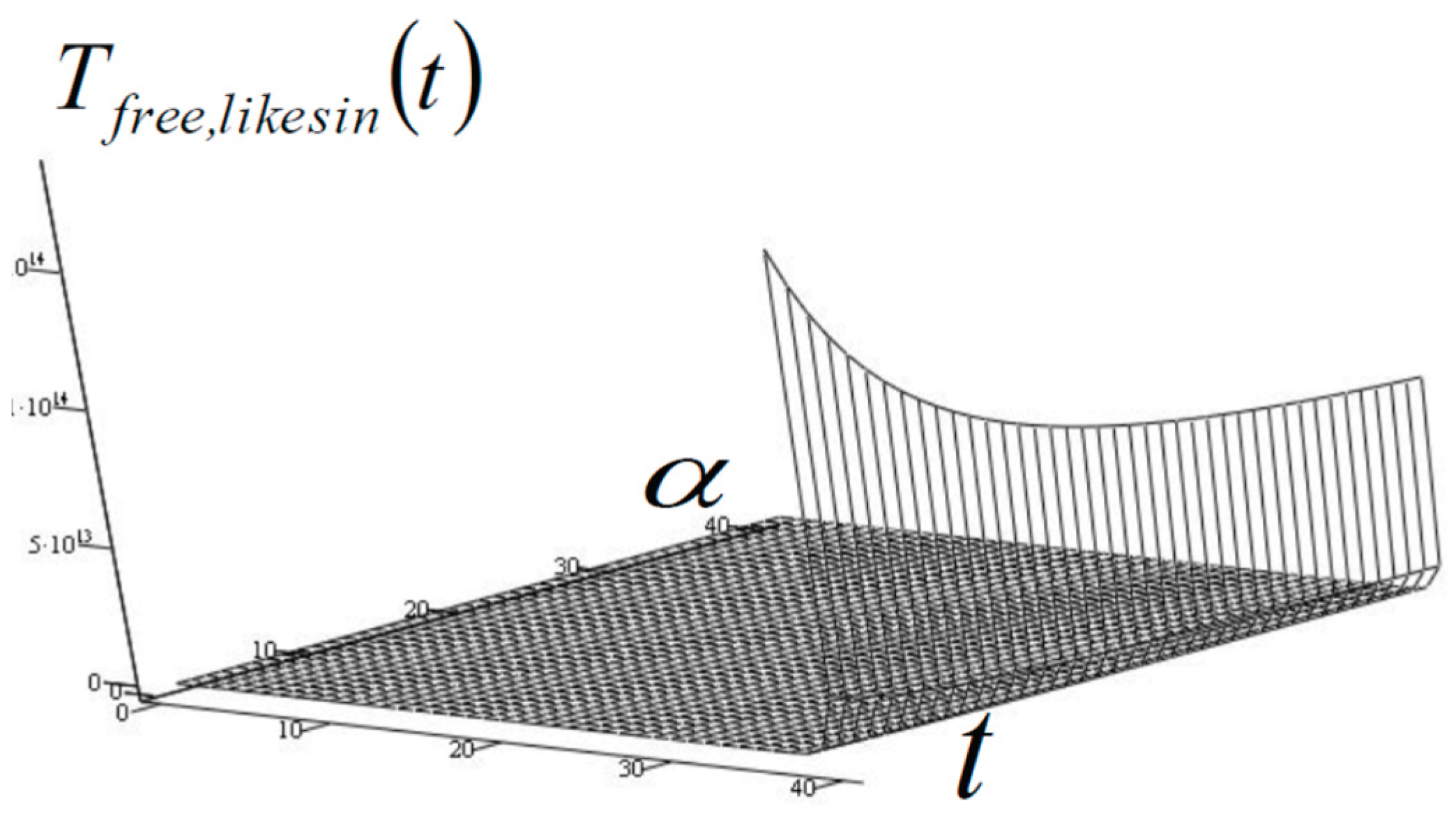
Figure 6 and Figure 7 show the surfaces of the eigenmode of the time fundtions “likesin”, longitudinal flow of the rheological visoelastic Maxwell model of a fractional type material with property od normal stress relaxation, in a pipe, represented in the coordinate system of the amplitude of the eigen time mode mode , time and exponent of the fractional order derivative, on the interval . These surfaces are drawn using an approximate analytical expression .
8. Concluding Considerations on the Flow Dynamics of the Rheological Maxwell Model of a Material, Fractional Type, in a Pipe of Variable Cross-Section
We have presented new scientific analytical results of the theoretical study of the flow (creeping) dynamics of the rheological Maxwell model of a viscoelastic material, fractional type, in a pipe of variable cross-section. Here we emphasize that in the study we neglected the influence of the formation of a boundary layer during flow in the region at the boundary layer of the pipe of the rheological Maxwell model of a viscoelastic material, fractional type. In particular, we neglected the occurrence of friction forces at the boundary of the boundary layer in contact with the pipe surface, assuming that this boundary layer is of negligible thickness in relation to the cross-section of the flow stream of the rheological Maxwell model of a viscoelastic material, fractional type, i.e. the cross-section of the pipe, and that these friction forces are negligible in relation to the flow force - the product of the normal stress and the cross-sectional area of the flow stream in each of its cross-sectio
We have presented comparative plots of the surfaces of eigen and forced forces of fractional type for the dynamics of oscillation of the rheological Kelvin-Voigt model of an elastophisto-viscous material, fractional type, and the dynamics of flow of the rheological Maxwell model of a viscoelastic material, fractional type. In the structural formula of these two rheological models of materials of Kelvin-Voigt and Maxwell fractional type, they contain the same basic rheological elements, Hooke's ideally elastic and Newton's ideally viscous of fractional type, the first in their parallel connection, and the second in the order connection. It is connected with the property of subsequent elasticity (post-elasticity), and the second with the property of normal stress relaxation.
Acknowledgments
Author would like to thank the Editorial Board of the Јournal ''Fractal and Fractional'', and especially the Associate Editor for their permanent support and assistance in publishing this article.
References
- Rašković D. P., Teorija oscilacija (Theory of oscillatins). Book. Naučna knjiga, First Edition 1952., Second Edition, 1965. http://elibrary.matf.bg.ac.rs/search; http://elibrary.matf.bg.ac.rs/handle/123456789/3778.
- Rašković D. P., (1985), Teorija elasti?nosti (Theory of elasticity), Nau?na Knjiga, Beograd, 1985, Preface and Index notation: Hedrih (Stevanovi?) K.R. http://elibrary.matf.bg.ac.rs/ http://elibrary.matf.bg.ac.rs/handle/123456789/376.5.
- Rašković D. P., (1974), Analitička mehanika (Analytical Mechanics), Mašinski fakultet Kragujevac, 1974. http://elibrary.matf.bg.ac.rs/.
- Hedrih (Stevanović) K., Filipovski A., (1995), Models Analogy of the Longitudinal and Torsional Vibrations of Rods with Variable Cross Section (in Serbian), Naučno-tehniški pregled, Vol. XLV, br. 8, pp. 13- 20.
- Petrović, M., (1911), Elementi matematičke fenomenologije (Elements of mathematical phenomenology), Srpska kraljevska akademija, Beograd, 1911. str. 789. ttp://elibrary.matf.bg.ac.rs/handle/123456789/476?locale-attribute=sr.
- Petrović M.: Fenomenološko preslikavanje (Phenomenological mapping), Srpska kraljevska akademija, Beograd, 1933, pp. 33. (In Serbian).
- Petrović M.: Mecanismes communs aux phenomenes disparates, Paris 1921. Special Issue of International Journal Non-Linear Mechanics, Vol. 73, Pages 1-128, July 2015.
- Dedicated to Petrovi?'s theory: Elements of mathematical phenomenology and Phenomenological Mappings. Edited by Katica R. (Stevanović) Hedrih, Ivan Kosenko, Pavel Krasilnikov and Pol D. Spanos. https://www.sciencedirect.com/journal/international-journal-of-non-linear-mechanics/vol/73/suppl/C.
- Hedrih (Stevanović), R. K, Izabrana poglavlja Teorije elasti?nosti (Selected chapters of Theory of Elasticity), Prvo iydanje 1973 - prošireno i dopunjeno, Mašinski fakultet u Nišu, 1988, p. 425. http://elibrary.matf.bg.ac.rs/handle/123456789/3766.
- Hedrih (Stevanović), Katica, IZABRANA POGLAVLJA TEORIJE NELINEARNIH OSCILACIJA, Univerzitet u Nišu, (Niš , 1975) ; http://elibrary.matf.bg.ac.rs/ http://elibrary.matf.bg.ac.rs/handle/123456789/3767.
- Hedrih (Stevanović) , Katica, OSNOVI TEORIJE NELINEARNIH OSCILACIJA, Preprint 20 primeraka, Niš, 1973. sada dostupno u PDF-u, na linkovima http://elibrary.matf.bg.ac.rs/ http://elibrary.matf.bg.ac.rs/handle/123456789/3768.
- Goroško O.A., Hedrih (Stevanović), K.R., Analilitička dinamika (mehanika) diskretnih naslednih sistema, (Analytical Dynamics (Mechanics) of Discrete Hereditary Systems), University of Niš, 2001, Monograph, p. 426 (in Serbian), YU ISBN 86-7181-054-2. UDC 531.011:531.391.
- Šarković, D., Hedrih (Stevanović) K., R. Prokić, M., Konstrukcije i ispitivanja impedansno-frekventnih karakteristika ultrazvučnih raspršivača, Zbornik radova ''25 godina mašinstva-Niš'' Tom 1. Mašinski fakultet Niš, 1985, pp. 71-85.
- Hedrih (Stevanović) K.R., Perić Lj., Mančić D., Radmanović M., Cross Polarized and Electrode Coated Rectangular Piezoceramic Plate Strain Problem, Journal of Electrotechnics and Mathematics, Faculty of Technical Sciences, Vol. 8, No. 1, pp. 39 - 54, Kosovska Mitrovica, 2003.
- Hedrih (Stevanović) K.R., Perić Lj., Mančić D., Radmanović M., Problem naprezanja pravougaone piezokeramičke ploče sa poprečnom polarizacijom bez elektroda, Savetovanje elektroničara - ETRAN, (4 - strane), Bukovička Banja, 2001.
- Hedrih (Stevanović) K., (2006), Vukota Babović, Dragan Šarković (2006), An auxiliary size distribution model for the ultrasonically produced water droplets, Experimental Thermal and Fluid Science - ETF, Elsevier, Volume 30, Issue 6, June 2006, Pages 559-564. http://www.elsevier.com/locate/etfs.
- Hedrih (Stevanović), K.R., Filipovski A., Longitudinal vibrations of rheological rod with variable cross section, Communications in Nonlinear Science and Numerical Simulation, Volume 4, Issue 3, September 1999, pps 193-199, https://www.sciencedirect.com/science/article/abs/pii/S1007570499900059. [CrossRef]
- Hedrih (Stevanovi?) K., Filipovski A., (1994), Longitudinal Vibrations of Rods with Variable Cross Section (in Serbian), IX Seminar primenjene matematike, Apstrakt, YU CRAM Budva199.
- Hedrih (Stevanović) K., Filipovski A., (1995), Models Analogy of the Longitudinal and Torsional Vibrations of Rods with Variable Cross Section (in Serbian), Naučno-tehnički pregled, Vol. XLV, br. 8, pp. 13- 20.
- Filipovski A., Energijska analiza longitudinalnih oscilacija štapova promenljivog preseka (Energy analysis longitudinal oscillations of rods with changeable cross sections), [in Serbian], Magistar of Sciences Degree Thesis, Faculty of Mechanical Engineering in Niš, 1995. Supervisor K. Hedrih (Stevanović).
- Hedrih (Stevanović) K., Filipovski A., (2002), LONGITUDINAL CREEP VIBRATIONS OF A FRACTIONAL DERIVATIVE ORDER RHEOLOGICAL ROD WITH VARIABLE CROSS SECTION, FACTA UNIVERSITATIS, Series: Mechanics, Automatic Control and Robotics Vol.3, No 12, 2002, pp. 327 - 349.
- Katica R. (Stevanović) Hedrih, (2020), Forced Longitudinal Fractional Type Vibrations of a Rod with Variable Cross Section, in Developments and Novel Approaches in Nonlinear Solid Body Mechanics, Editors: Bilen Emek Abali and Ivan Giorgio, Chapter 18, pp. 325-344. ISSN 1869-8433 ISSN 1869-8441 (electronic) Advanced Structured Materials, ISBN 978-3-030-50459-5 ISBN 978-3-030-50460-1 (eBook). © Springer Nature Switzerland AG 2020. [CrossRef]
- Hedrih (Stevanović), K.R, (2025), An Overview: New Class of Complex Models of Materials Piezoelectric Properties with Differential Constitutive Relation of Fractional Order, Fractal Fract. 9(3) (2025), 170. [CrossRef]
- Hedrih (Stevanović), K.R., Rheologic Fractional Oscillators or Creepers, Fractal Fract. 2025, 9(8), 552. [CrossRef]
- Hedrih (Stevanović), K.R.; Hedrih, A.N. Rheological Burgers-Faraday Models and Rheological Dynamical Systems with Fractional Derivatives and Their Application in Biomechanics. Fractal Fract.2024, 8(12), 742, Special Issue Complexity, Fractality and Fractional Dynamics Applied to Science and Engineering. [CrossRef]
- Hedrih (Stevanović), R. K,, New rheologic models of the fractional type, INNOVATIVE MECHANICAL ENGINEERING, University of Niš, Faculty of Mechanical Engineering, VOL. 4, NO 2, 2025, PP. 76-114, http://ime.masfak.ni.ac.rs/Dokumenta/papers/v4n2/v4_n2_Hedrih.pdf.
- Hedrih (Stevanović), R. K, G.V. Milovanović: Elements of mathematical phenomenology and analogies of electrical and mechanical oscillators of the fractional type with finite number of degrees of freedom of oscillations: linear and nonlinear modes, Commun. Anal. Mech. 16(4) (2024), 738 - 785; [CrossRef]
- Hedrih (Stevanović), R. K, [0000-0002-2930-5946], TWO NEW RHEOLOGICAL MODELS AND TWO RHEOLOGICAL DYNAMICAL SYSTEMS FRACTIONAL TYPE, Chapter 14, Vol. 507, in Mathematical Approaches to Challenges in Biology and Biomedicine: ICMASC 2024, Porto, Portugal, June 22-24, 2024, Editors: Martin Golubitsky, Stefano Boccaletti and Carla M.A. Pinto, Springer Nature Switzerland AG, A Springer Book: Springer Proceedings in Mathematics & Statistics, pp. 239-266, 2024. ISSN 2194-1009, ISSN 2194-1017 (electronic) ISBN 978-3-031-97949-1, ISBN 978-3-031-97950-7 (eBook). https://doi.ord/10.1007/978-3-031-97950-7. https://books.google.rs/books/about/Mathematical_Approaches_to_Challenges_in.html?id=En6lEQAAQBAJ&redir_esc=y.
- Hedrih (Stevanović), K.R., Dynamics of hybrid systems of complex structures, Special Issue, Guest Editor: Katica R. (Stevanovi?) Hedrih, Mathematical Institute SASA, Belgrade, NON-PERIODICAL ISSUES - PROCEEDINGS of Mathematical Institute SASA, Belgrade [Collection of Papers], Zbornik radova 19 (27), 2022, pp. 1- 455, Series of thematic collection of papers that is published occasionally, Belgrade, http://elib.mi.sanu.ac.rs/pages/browse_publication.php?db=zr; http://elib.mi.sanu.ac.rs/pages/browse_issue.php?db=zr&rbr=27; Impresum http://elib.mi.sanu.ac.rs/files/journals/zr/27/i.pdf.
- Hedrih (Stevanović), K.R., Advances in classical and analytical mechanics: A review of author's results, Theoretical and Applied Mechanics Publisher: Serbian Society of Mechanics and Mathematical Institute of the Serbian Academy of Sciences and Arts, Beograd, 40-2, pp: 203-303, 2013 ISSN: 1450-5584. http://elib.mi.sanu.ac.rs/pages/browse_issue.php?db=tam&rbr=67. [CrossRef]
- Mitrinovi? D. S., Djokovi? D.Ž.: Special functions (Specijalne funkcije), Gradjevinska knjiga, Beograd, 1964, p. 267.
- Rašković D. P., Tablice iz Otpornosti materijala (Tables of Straight of materials), Građevinska Knjiga, Beograd 1979, 11 izdanje (11th edition).
- Bronstein I.N, Semendjajew K.A. , 176 page in Taschenbuch der Mathenmatik von I.N.Bronstein und K.A. Semendjajew, Mit 427 Abbildungen, B.G. Teubner Verlag sgesellschaft-Leipzig, 1958.
Figure 1.
a) Structure of the rheological Maxwell basic complex material model, fractional type, which contains in its structure, serially connected basic model of Hooke's ideally elastic element and basic model of Newton's ideally viscous element of fractional type and b) and c) surface of normal stress-surface of normal stress relaxation in the coordinate system: elongation of normal stress relaxation, time and exponent of differentiation of fractional order.
Figure 1.
a) Structure of the rheological Maxwell basic complex material model, fractional type, which contains in its structure, serially connected basic model of Hooke's ideally elastic element and basic model of Newton's ideally viscous element of fractional type and b) and c) surface of normal stress-surface of normal stress relaxation in the coordinate system: elongation of normal stress relaxation, time and exponent of differentiation of fractional order.
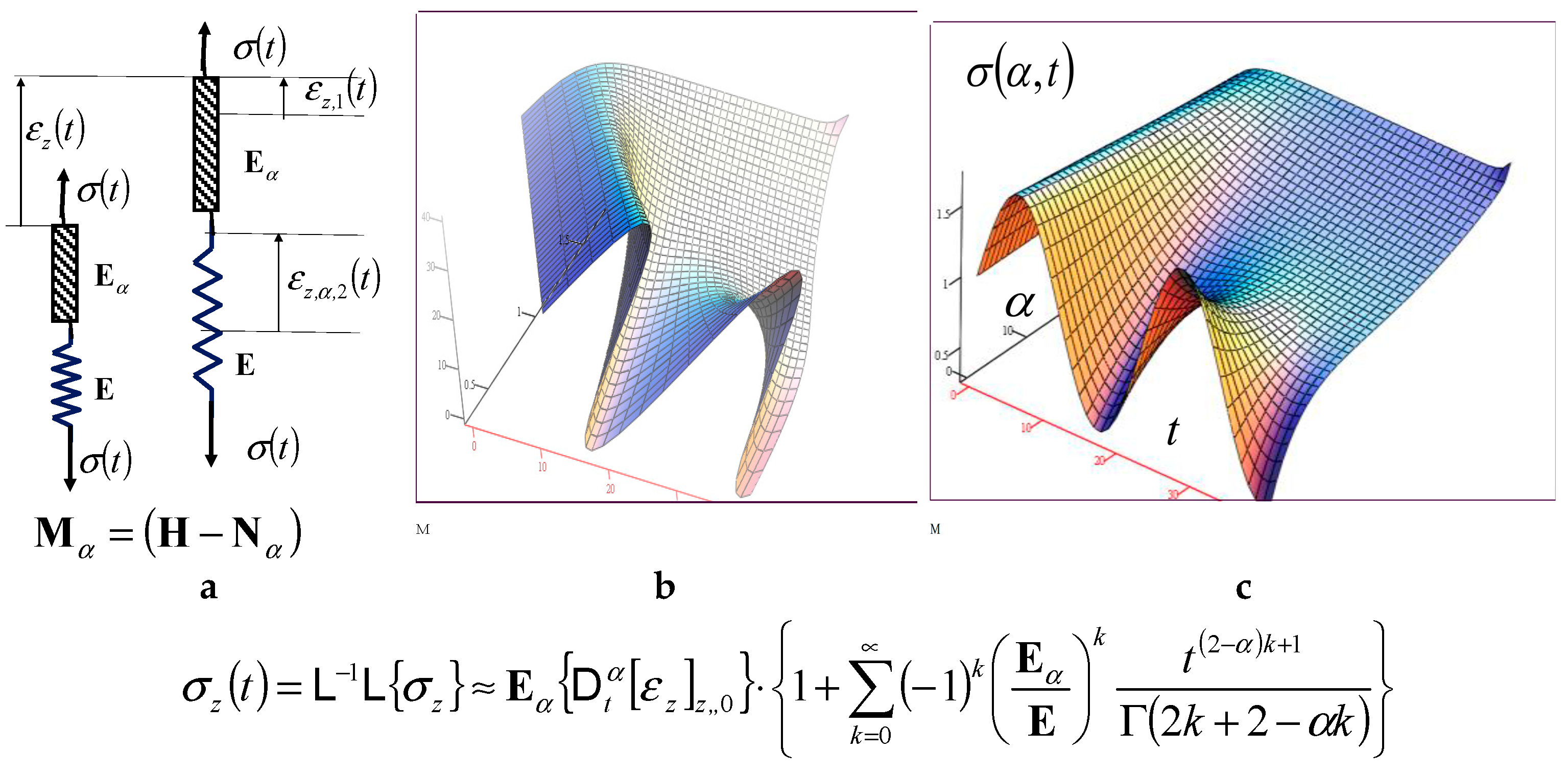
Figure 2.
Element of the rheological Maxwell model of material, fractional type, between two cross-sections in longitudinal coordinates and a representation of the axial forces and in those cross-sections.
Figure 2.
Element of the rheological Maxwell model of material, fractional type, between two cross-sections in longitudinal coordinates and a representation of the axial forces and in those cross-sections.
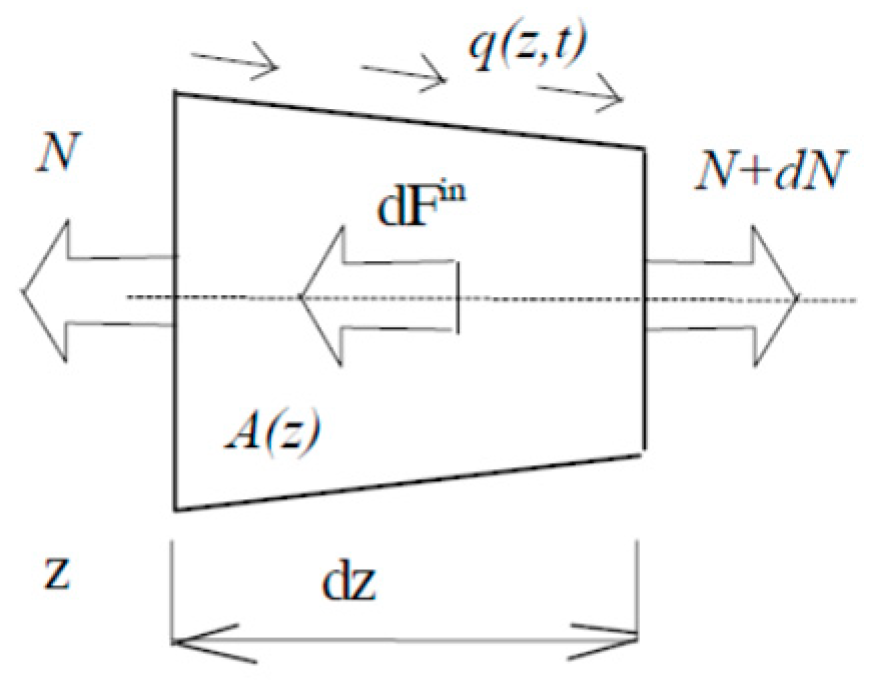
Figure 3.
Surface of the self-eifweb time mode ''like cos'', longitudinal flow of the rheological visco-elastic Maxwell model of a fractional type material in a pipe, presented in the coordinate system of the amplitude of the self-eigen mode , time and exponent of the fractional order derivative, on the interval .
Figure 3.
Surface of the self-eifweb time mode ''like cos'', longitudinal flow of the rheological visco-elastic Maxwell model of a fractional type material in a pipe, presented in the coordinate system of the amplitude of the self-eigen mode , time and exponent of the fractional order derivative, on the interval .
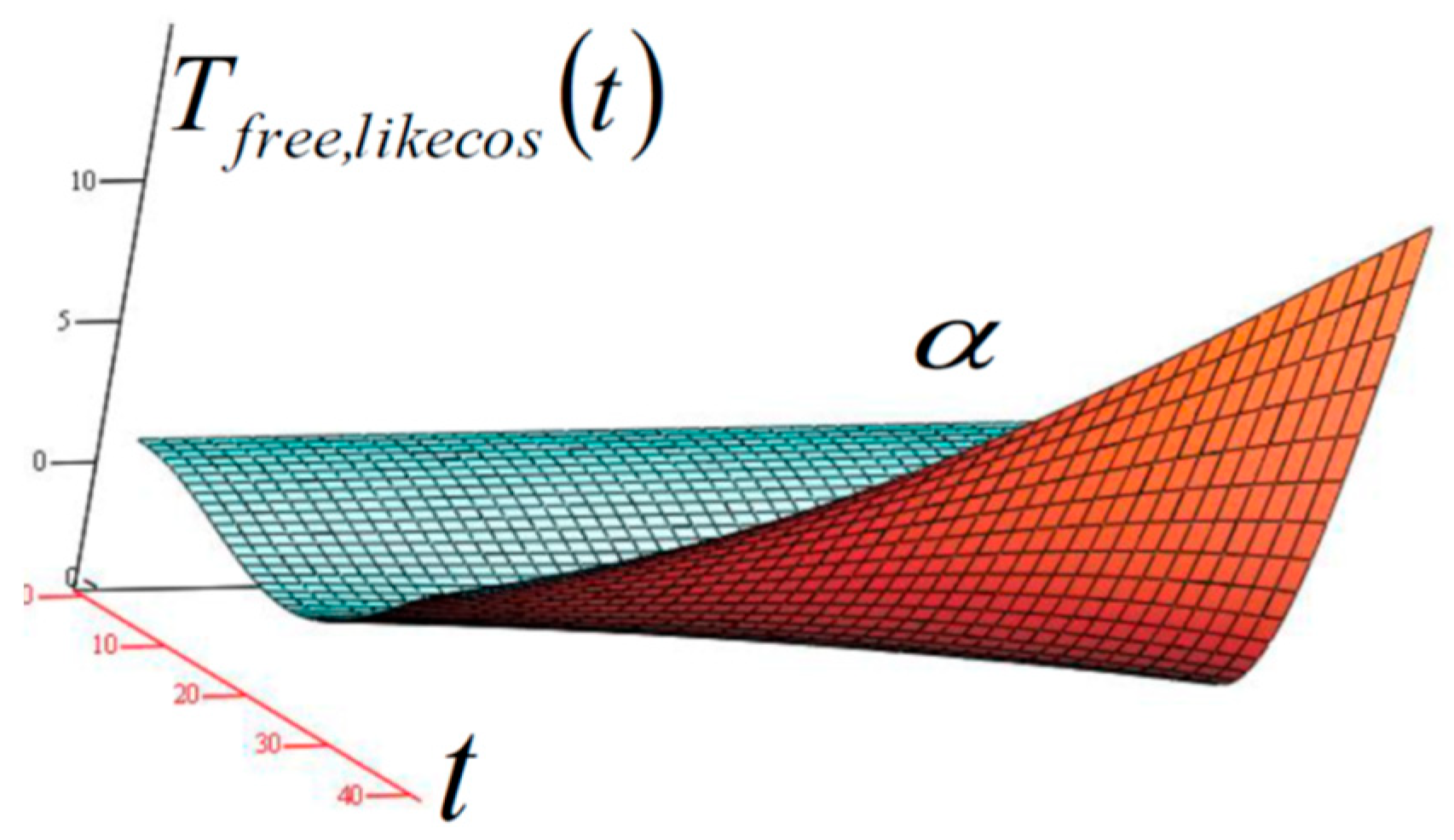
Figure 4.
Surface of the self-eifweb time mode ''like cos'', longitudinal flow of the rheological visco-elastic Maxwell model of a fractional type material in a pipe, presented in the coordinate system of the amplitude of the self-eigeb mode, time and exponent of the fractional order derivative, on the interval , drawings from another direction of visibility.
Figure 4.
Surface of the self-eifweb time mode ''like cos'', longitudinal flow of the rheological visco-elastic Maxwell model of a fractional type material in a pipe, presented in the coordinate system of the amplitude of the self-eigeb mode, time and exponent of the fractional order derivative, on the interval , drawings from another direction of visibility.
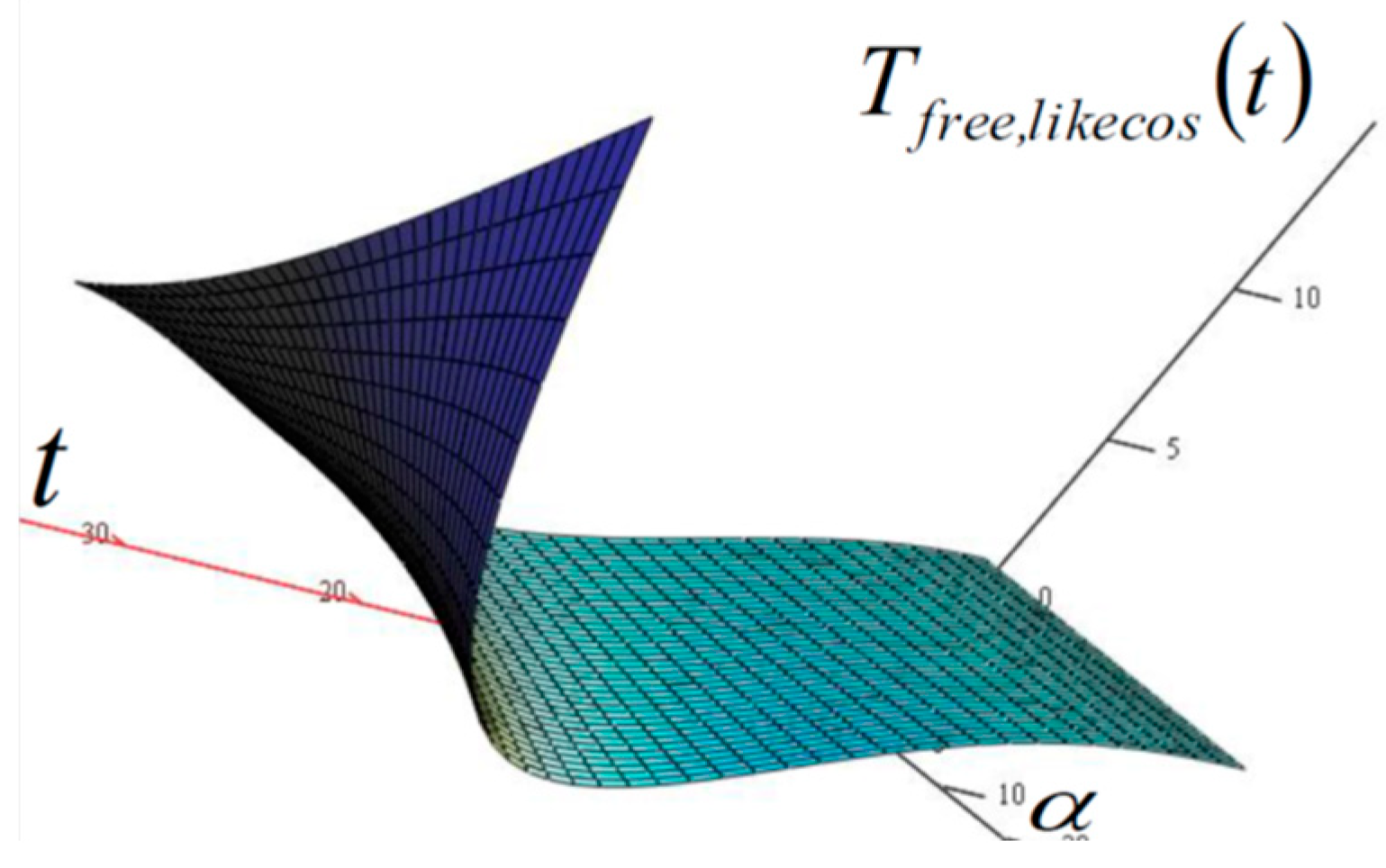
Figure 5.
Surface of the self-eifweb time mode ''like cos'', longitudinal flow of the rheological visco-elastic Maxwell model of a fractional type material in a pipe, presented in the coordinate system of the amplitude of the self-eigeb mode , time and exponent of the fractional order derivative, on the interval , drawings from another direction of visibility and in black and white.
Figure 5.
Surface of the self-eifweb time mode ''like cos'', longitudinal flow of the rheological visco-elastic Maxwell model of a fractional type material in a pipe, presented in the coordinate system of the amplitude of the self-eigeb mode , time and exponent of the fractional order derivative, on the interval , drawings from another direction of visibility and in black and white.
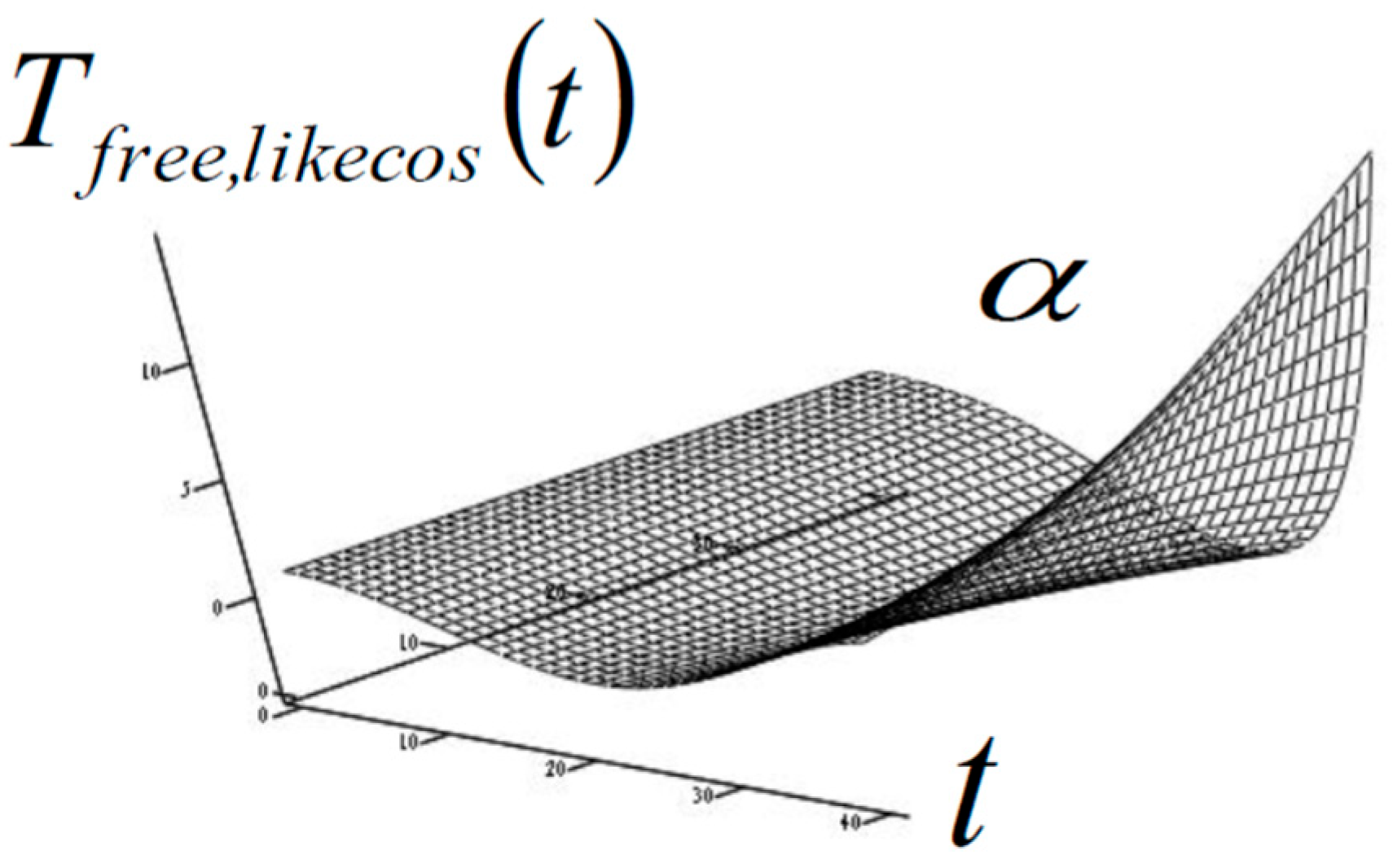
Figure 6.
Surface of the self-eifweb time mode ''like sin'', longitudinal flow of the rheological visco-elastic Maxwell model of a fractional type material in a pipe, presented in the coordinate system of the amplitude of the self-eigen mode of, time and exponent of the fractional order derivative, on the interval ., drawings from another direction of visibility.
Figure 6.
Surface of the self-eifweb time mode ''like sin'', longitudinal flow of the rheological visco-elastic Maxwell model of a fractional type material in a pipe, presented in the coordinate system of the amplitude of the self-eigen mode of, time and exponent of the fractional order derivative, on the interval ., drawings from another direction of visibility.
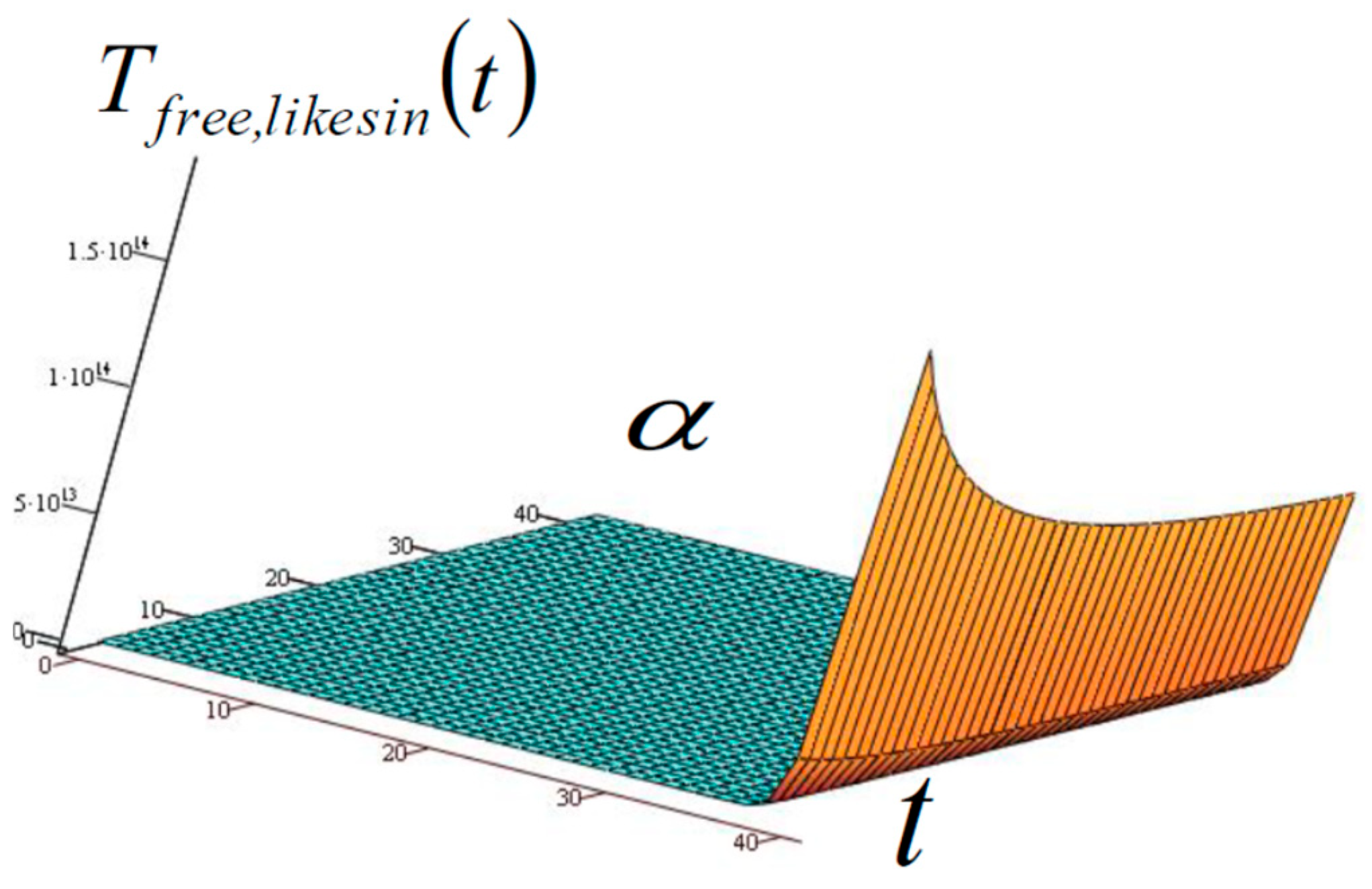
Figure 7.
Surface of the self-eifweb time mode ''like cos'', longitudinal flow of the rheological visco-elastic Maxwell model of a fractional type material in a pipe, presented in the coordinate system of the amplitude of the self-eigeb mode of time and exponent of the fractional order derivative, on the interval ., drawings from another direction of visibility and in black and white.
Figure 7.
Surface of the self-eifweb time mode ''like cos'', longitudinal flow of the rheological visco-elastic Maxwell model of a fractional type material in a pipe, presented in the coordinate system of the amplitude of the self-eigeb mode of time and exponent of the fractional order derivative, on the interval ., drawings from another direction of visibility and in black and white.
Disclaimer/Publisher’s Note: The statements, opinions and data contained in all publications are solely those of the individual author(s) and contributor(s) and not of MDPI and/or the editor(s). MDPI and/or the editor(s) disclaim responsibility for any injury to people or property resulting from any ideas, methods, instructions or products referred to in the content. |
© 2026 by the authors. Licensee MDPI, Basel, Switzerland. This article is an open access article distributed under the terms and conditions of the Creative Commons Attribution (CC BY) license (http://creativecommons.org/licenses/by/4.0/).
Copyright: This open access article is published under a Creative Commons CC BY 4.0 license, which permit the free download, distribution, and reuse, provided that the author and preprint are cited in any reuse.


