
Submitted:
02 June 2026
Posted:
09 June 2026
You are already at the latest version
Abstract
Peripheral neuropathy, a widespread neurological disorder, is characterized by debilitating symptoms arising from damage to peripheral nerves. Retinoids, derivatives of vitamin A, are known for their critical roles in neural development and cellular processes, mediating their effects through nuclear receptors, retinoic acid receptors (RARs) and retinoid X receptors (RXRs). However, the therapeutic application of retinoids is often limited by their propensity to induce side effects, such as skin irritation. This study introduces MH21 (NVG1003), a novel CNS-sparing synthetic RAR modulator found to mitigate dermatological toxicity while preserving beneficial neural and immunomodulatory properties. In vivo analysis in rat striatum showed that MH21 exerts its action peripherally without engaging CNS RAR pathways. We evaluated the in vitro efficacy and safety of MH21, focusing on its impact on neuronal cell viability, inflammation and neuroprotection. Our findings demonstrate that MH21 significantly reduced oxidative stress and cell death in neuronal cell models, showed anti-inflammatory properties, upregulation of cellular autophagy and cytoprotective effects in vitro. In human skin cell models, MH21 did not induce significant cytotoxicity or inflammatory responses, indicating a favorable skin safety profile. These results collectively suggest that MH21 is a promising drug candidate for the treatment of peripheral neuropathies, offering a potentially safer and more effective retinoid-based therapeutic strategy.
Keywords:
MH21
; NVG1003
; retinoid
; peripheral neuropathy
; mitochondrial dysfunction
; neuroinflammation
; neurodegeneration
; autophagy
; neuroprotective effects
1. Introduction
The peripheral nervous system (PNS) represents the extensive network of nerves located outside the central nervous system (CNS) including the brain and spinal cord. These peripheral nerves are categorized into sensory, motor, and autonomic types, each playing a vital role in maintaining physiological functions [1]. Damage in peripheral nervous system induced by traumatic, genetic, metabolic, nutritional, autoimmune and infection-, drug-, or environmental toxicity-induced reasons, can lead to debilitating symptoms such as pain, tingling and loss of function in the extremities [2]. Peripheral neuropathy affects 1% to 7% of the general population and is more common in people over the age of 50. Common identifiable causes include diabetes, nerve compression or injury, alcohol use, exposure to toxins, genetic disorders and poor nutrition [3].
Retinoids (e.g. all-trans-retinoic acid, ATRA), metabolites of vitamin A, are specific regulators of neural differentiation, motor neuron growth and immunology in vertebrates [4,5,6,7]. Retinoic acids have attracted much attention due to their ability to act as potent modulators of cellular differentiation, immune regulation and neuronal development [8]. Their biological effects are mediated through activation of retinoic acid receptors (RARs) and retinoid X receptors (RXRs), each of which has three isoforms (α, β, and γ) [9]. ATRA translocates across the nuclear membrane via RARs, interacts with the retinoic acid response element (RARE) and participates in gene regulatory mechanisms [10]. Although ATRA and its derivatives are used in the treatment of other skin diseases, such as acne, in addition to the protection of the nervous system, they can cause severe local irritation, manifested as mild erythema and peeling of the skin stratum corneum [11].
To address this limitation, many approaches to reduce retinoid skin irritation are being tried, most of which are pharmaceutical approaches for topical retinoids, such as encapsulating retinoids, converting retinoids into nanoparticles, forming complexes (e.g. with cyclodextrins), and conjugating retinoids to carriers (e.g. polymers, NLCs, SLNs)[12,13]. New topical retinoids with reduced skin irritation are also being developed [14,15].
MH21 (Ref: UK Patent Application No. 2402264.2, 2024) is a novel, CNS-sparing synthetic RAR modulator designed to retain beneficial neural and immunomodulatory properties while minimizing dermatological toxicity. In this study, we evaluate the safety and efficacy of MH21, focusing on its impact on skin cell viability and inflammation, its neuroprotective potential in neuronal cell models and its CNS-sparing characteristics in vivo. We aimed to identify a suitable candidate for the treatment of peripheral neuropathy that would simultaneously avoid central issues and skin irritation, thereby facilitating the development of targeted and well-tolerated therapies.
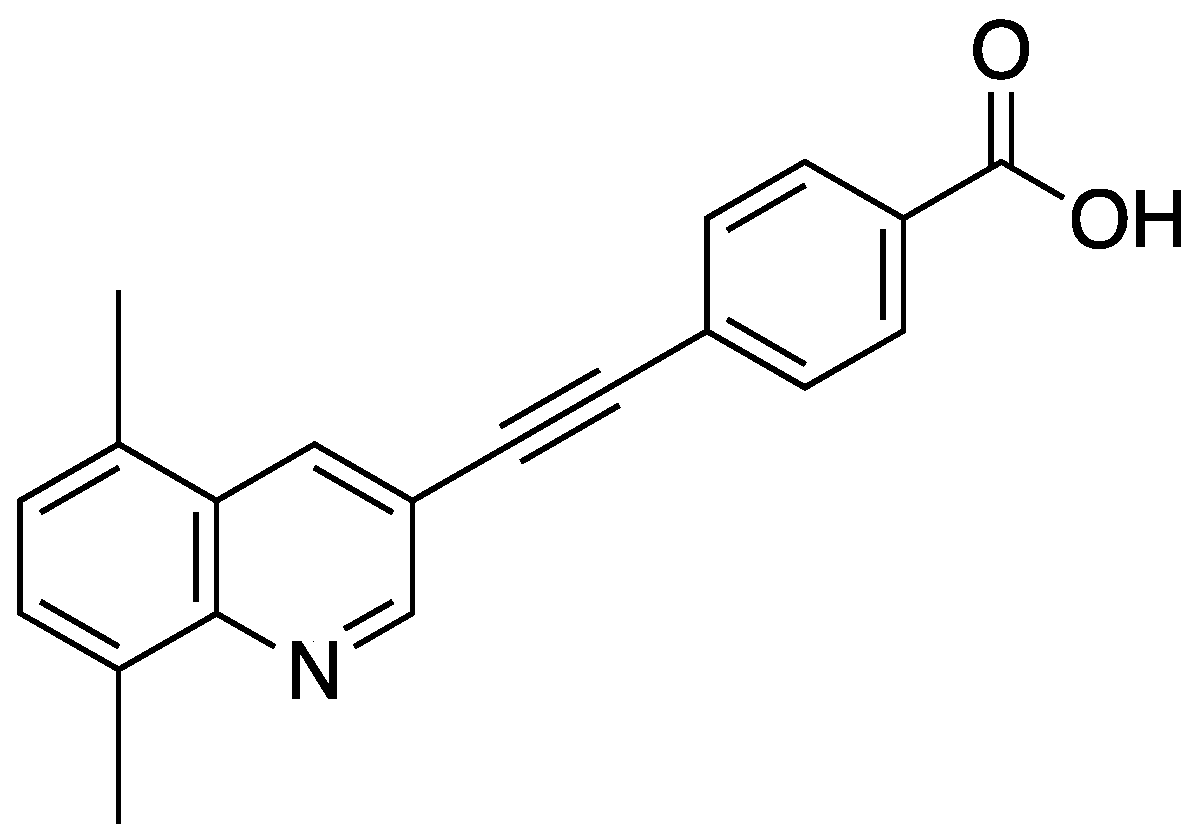
Structure of MH21 (NVG1003) (Ref: UK Patent Application No. 2402264.2, 2024)
2. Results
2.1. MH21 Shows CNS-Sparing Properties In Vivo
To investigate the regulation of RAR expression in vitro by MH21, quantitative immunofluorescence was used to detect the expression of Cyp26b1 and RARs. To establish whether the RAR modulator MH21 produces biological activity in the brain, qPCR was used to quantify the expression of Cyp26b1 and RARs.
Results in vivo (Figure 1 A) shows MH21 treatment of mixed sex groups of rats revealed no significant changes in either Cyp26b1 or RARβ gene expression at any dose tested (0.03,0.1 and 0.3 mg/kg i.p.) when compared to vehicle. Further investigation revealed a similar lack of effect of MH21 on the expression of two other genes associated with RAR signalling, RARα and RARγ. In all cases, the average fold change in gene expression when normalised to vehicle remained between 0.88 and 1.15. This is in contrast Ellorarxine, a CNS-permeable RAR-M (Supplementary Figure 1), which increased both Cyp26b1 or RARβ gene expression throughout the brain.
Results in vitro (Figure 1 B) showed that MH21 significantly upregulated the protein expression of Cyp26b1 by 19.4% (t=3.724, df=8, P=0.0058) and RARβ by 14.3% (t=2.518, df=10, P=0.0305) , but not RARα (t=0.5851, df=10, P=0.5715) or RARγ (t=0.3294, df=10, P=0.7486). These results, combined with the in vivo data, suggest that MH21 is unable to pass the blood-brain barrier, but could activate peripheral RARβ receptors.
2.2. Neuroprotective Effects of MH21
To investigate the protective effects of MH21 on neuronal cells, we used a range of assays. We used the MTT assay to test its effect on oxidative stress, the LDH assay to measure its influence on the percentage of cell death, and ELISA to establish the release of cytokines to assess the level of inflammation and LC3B and p62 staining for autophagy. All assays were evaluated with or without a 4 h MH21 (10 nM) pretreatment. 10 μM hydrogen peroxide was used to induce cytokine release, 50 μM hydrogen peroxide was used to induce oxidative stress, 100 μM hydrogen peroxide was used to induce cell death, 0.001% DMSO was used as vehicle control.
2-way-ANOVA showed that MH21 had significant positive effects of 19% and 10% on mitochondrial viability of SH-SY5Y cells (Row Factor: F (1, 12) = 59.32, P<0.0001; Column Factor: F (1, 12) = 24.95, P=0.0003)(Figure 2 A), and modestly reduced 3.3% and 4.2% of cell death of SH-SY5Y cells (Row Factor: F (1, 12) = 164.7, P<0.0001; Column Factor: F (1, 12) = 7.526, P=0.0178). Furthermore, MH21 showed a significant decrease in cell death (8.5%) in the presence of 100 μM H2O2 of C6 cells (Row Factor: F (1, 12) = 82.65, P<0.0001; Column Factor: F (1, 12) = 24.39, P=0.0003) (Figure 2 C). The neuroinflammatory protective effect of MH21 may also be achieved by reducing the release of cytokines, which we observed to be reduced in HMC3 cells under oxidative stress, though not significantly among all conditions (Figure 2D). A trend of a cytokine reduction was observed for both IL-6 (Row Factor: F (1, 12) = 73.35, P<0.0001; Column Factor: F (1, 12) = 2.756, P=0.1228) and TNFα (Row Factor: F (1, 12) = 36.02, P<0.0001; Column Factor: F (1, 12) = 3.965, P=0.0697). The expression of autophagy marker, LC3B both in normal media (51.2%) and in serum-free media (26.3%) was increased (Figure 2E) by MH21 (Row Factor: F (1, 12) = 121.6, P<0.0001; Column Factor: F (1, 12) = 39.07, P<0.0001). There is no significant change in p62 expression (Row Factor: F (1, 70) = 20.67, P<0.0001; Column Factor: F (1, 70) = 0.8586, P=0.3573).
2.3. Skin Safety Profile of MH21
To investigate the potential side effects of MH21 on skin cells, we used various assays. We used the MTT assay to test its effect on oxidative stress, the LDH assay to measure its influence on the percentage of cell death, and ELISA to establish the release of cytokines to assess the level of inflammation. All assays were evaluated with or without a 4 h MH21 (10 nM) pretreatment. 100 μM hydrogen peroxide was used to induce oxidative stress, 0.01% DMSO was used as vehicle control.
Results in skin cells and 2-way-ANOVA showed that MH21 modestly increased the mitochondrial activity of HDF by 10.1% under oxidative stress (Row Factor: F (1, 12) = 92.90, P<0.0001; Column Factor: F (1, 12) = 5.270, P=0.0405)(Figure 3A). MH21 showed no significant effect on cell death (Figure 3B). MH21 showed significant effect on reducing the release of IL-6 under oxidative stress (Row Factor: F (1, 12) = 79.72, P<0.0001; Column Factor: F (1, 12) = 5.579, P=0.0359).
3. Discussion
This study investigated the neuroprotective potential and safety profile of MH21, a novel CNS-sparing RAR-modulator, with a particular focus on minimizing on-target skin toxicity while retaining therapeutic effects on peripheral neurons. The findings provide promising evidence that MH21 may serve as a safer and more effective retinoid for treating peripheral neuropathies.
Our results show that MH21 demonstrated beneficial effects in brain cell models. Neuronal mitochondrial dysfunction caused by oxidative stress has been widely reported in many neurodegenerative diseases, and the function of RARβ has been shown to be closely related to it [16,17,18]. In SH-SY5Y and C6 cells subjected to oxidative stress, MH21 significantly improves mitochondrial viability (Figure 2A) and reduced cell death (Figure 2B-C). Cardoso et al. suggests that the ATRA signaling pathway is involved in regulating enzymes such as PDK4, shifting energy utilization toward fatty acid oxidation [19]. The ATRA signaling pathway is also thought to promote the transcription of genes encoding endogenous antioxidant enzymes, such as SOD or enzymes involved in glutathione metabolism, thereby increasing the intrinsic capacity of cells, including mitochondria, to neutralize ROS [20,21], thus improves mitochondrial viability, which is consistent with our findings.
Neuroinflammation in the CNS may lead to synaptic dysfunction and neurological and psychiatric diseases [22,23], while in peripheral, low-grade inflammation caused by chronic diseases such as type II diabetes is also closely related to peripheral neuropathy [24,25,26]. Our results (Figure 2D) show that MH21 significantly suppressed the release of TNF-α and IL-6 under stress condition (t-test), which suggests that MH21 can reduce neuroinflammation and provide neuroprotection. These findings suggest that MH21 retains neurotrophic and anti-inflammatory functions, likely through selective activation of RAR pathways in neuronal environments. The RARs mediate ATRA and its analogues to suppress the NF−κB signaling pathway. NF−κB cannot enter the nucleus because of this inhibition which stops the transcriptional machinery needed for TNF−α and IL−6 production by activated glial cells [27]. And ATRA has been shown to downregulate the Toll-Like Receptor 4 (TLR4) signaling pathway. The TLR4 pattern recognition receptor on glial cells identifies PAMPs/DAMPs following CNS injury to start the NF−κB cascade which produces TNF−α and IL−6 release [28]. These reports are consistent with our findings and may explain the anti-inflammatory effects of MH21. The dual observation of reduced oxidative and inflammatory stress and lowered cytotoxicity supports the therapeutic potential of MH21 in peripheral nervous system pathologies.
Normally, damaged organelles and protein aggregates are transported through endosomes and autophagosomes to lysosomes, where they are digested and recycled by cellular autophagy [29]. In a variety of neurodegenerative diseases, defects occur at different stages of the autophagic pathway, leading to neuronal degeneration due to the accumulation of ubiquitinated protein aggregates [30]. We chose to use LC3B, the mammalian homolog of Atg8, and detected it with phosphatidylethanolamine as a marker [31]. SQSTM1/p62 is a multifunctional ubiquitination-binding adaptor protein encoded by the SQSTM1 gene, which participates in the protein degradation process of the ubiquitin proteasome system and the autophagy-lysosome system [32]. In the early stages of central and peripheral neurodegenerative diseases, when autophagic activity is weakened, p62 protein accumulates in the cytoplasm. p62 can form a complex with ubiquitinated proteins and LC3II proteins on the autophagosome membrane to complete the degradation process in the autophagolysosome. We observed that the upregulation of LC3BII with no significant change in p62 under MH21 treatment (Figure 2E-H), indicating that MH21 may upregulate the level of cellular autophagy. Retinoic acid can activate autophagy by inhibiting the PI3K-Akt-mTOR signaling pathway, a major negative regulator of autophagy [33]. Reduced mTOR activity promotes autophagosome formation. In studies of liver ischemia-reperfusion injury, RA binds to RARα and also promotes autophagy by reducing p-Akt expression [34]. The treatment can also boost the production of vital autophagy proteins Beclin 1 and LC3-II which play a crucial role in the first stages of autophagosome development [35]. This suggests a non-genomic explanation for the enhancement of autophagy from MH21 treatment.
MH21 shows CNS-sparing activity in vivo. Changes in the expression levels of RARβ and Cyp26b1 in the mouse brain were used as a basis for whether the drug can enter the CNS. In vivo qPCR analysis of Cyp26b1 and RARα/β/γ in the striatum of MH21-treated rats revealed no significant changes compared to vehicle controls, even at escalating doses. In contrast, for in vitro experiments, as in previous studies with Ellorarxine, MH21 significantly increased the expression of RARβ and Cyp26b1 in neuronal cells, which suggests that MH21 acts as RARβ agonist. RAR-β plays a crucial role in numerous important biological processes that protect the nervous system and promote its recovery. Existing RARβ agonists have demonstrated promising effects on CNS regeneration [36]. E.g. The oral RARβ agonist C286 promotes oligodendrocyte precursor cell (OPC) differentiation and remyelination through an interaction between neuronal RARβ and RARα in NG2+ cells [37]. RARβ activation is a key intrinsic signal that enables neurons to overcome the inhibitory environment following CNS injury. The RARβ2 isoform is particularly implicated in this process [38]. Although it has not yet been determined which RARβ subtype MH21 targets, the observed activation of RARβ is one of the potential pieces of evidence for its potential role as a neuroprotective drug. The data confirms that MH-21 exerts its action peripherally without engaging CNS RAR pathways, supporting its use in peripheral neuropathic conditions (Figure 1).
One of the critical limitations of retinoid-based therapies is their propensity to induce dermatological irritation and inflammation due to their high activity in skin cells, however, the relationship between its effect on the proliferation of epidermal cells and skin irritation is still unclear [39,40]. Drugs that induce epidermal and dermal thickening but are non-irritating when applied topically to the skin have been reported before [41], and our results suggest that MH21 would possibly be one of these drugs. Our in vitro experiments demonstrated that MH21 does not elicit significant cytotoxicity or inflammatory responses in either human dermal fibroblasts (HDFs) or keratinocytes (HaCaTs) (Figure 3A-B). Specifically, MH21 did not increase the release of pro-inflammatory cytokines such as IL-6 under both basal and inflammatory stress conditions (Figure 3C). Moreover, the compound either preserved or modestly enhanced mitochondrial viability in HDFs under mild oxidative stress, while showing no detrimental effects under higher stress levels. This indicates that MH21 possesses a favorable skin safety profile, addressing a major challenge in retinoid drug development. Future studies should also explore pharmacokinetics, long-term safety, and dosing strategies to explore the possibility of its application.
4. Materials and Methods
4.1. In Vivo Experiments
4.1.1. Animals
All animal procedures adhered to the ARRIVE guidelines, were in accordance with the UK Animals (Scientific Procedures) Act, 1986 and were approved by King’s College London Animal Welfare and Ethical Review Body.
A total of 58 adult rats were used for these studies. All animals were maintained on a 12:12 hour light:dark cycle with food and water available ad libitum. Rats underwent a 7-day habituation period prior to receiving drug treatments.
4.1.2. Drug Preparation
MH21 was dissolved in N-methyl-2-pyrollidone (BioServ) followed by Kolliphor HS-15, PEG-400 and PBS (final volume ratio of 5%, 5%, 30% and 60%, respectively) to give a stock solution of 1 mg/ml. This was diluted further in the same vehicle for dosing.
4.1.3. Dosing and Tissue Preparation
Dosing was conducted with the experimenter blinded to the treatment, and animals randomly assigned to groups.
Adult Wistar rats (250-300 g) were given a single intra-peritoneal injection of MH21 (0.03, 0.1 or 0.3 mg/kg) or equivalent vehicle (5% N-methyl-2-pyrollidone, 5% Kolliphor HS-15, 30% PEG-400, 60% PBS) (N = 12 rats per treatment; 6 male/6 female).
Animals were euthanised using sodium pentobarbital (600 mg/kg) 4h post treatment. The brains were removed, the striata micro-dissected on an ice-cold platform then snap-frozen in liquid nitrogen and stored at -80 ℃.
4.1.4. Quantitative Polymerise Chain Reaction (qPCR)
Striata from one hemisphere per rat were weighed and homogenised with TRIzol reagent (Invitrogen) as per the manufacturer guidelines. The RNA pellet was resuspended in nuclease-free water and the absorbances at 230, 260 and 280 nm measured using a nanodrop spectrophotometer, ND-1000. All samples had 260/280 rations between 1.8-2.1, confirming purity. Samples were then treated with DNase I followed by cDNA synthesis using 1µg RNA (iSCRIPT, Bio-Rad). Samples were diluted 1:10 in Qiagen’s QuantiNova Template Buffer (achieving 5 ng per 10 µl reaction) and qPCR was run on a Roche Lightcycler 480, using the same kit as per the manufacturer’s recommendations (Denaturation at 95 °C for 2 mins then 40 two-step cycles of 5 s denaturation at 95 °C then 10 s annealing at 60 °C). A melt curve was run at the end of the cycle and checked to ensure only one product was produced in each reaction, while no reverse transcriptase controls were run to ensure amplification of cDNA only. All genes of interest were normalised to the housekeeping gene Actin beta (Actinb).
The primers used were:
Cyp26b1 F: GTCCCCACAGTTTATTATGGAAG, R: GTGTGTCATGGCTGTCGT, product length – 77, efficiency 105.08 (PrimerBlast)
Rarb F: CAGCTGGGTAAATACACCACGAA, R: GGGGTATACCTGGTACAAATTCTGA, product length – 227, efficiency – 94.https://doi.org/10.1079/BJN2003877
Actinb F: AAGTCCCTCACCCTCCCAAAAG, R: AAGCAATGCTGTCACCTTCCC, Product length – 97, efficiency – 97.https://doi.org/10.1186/1471-2172-5-3
Rara F: TGGGCAAGTACACTACGAACAA, R: ATCTGGTCGGCAATGGTGAG, product length – 160, Efficiency – 95.43 (Primer Blast, spans exon-junctions; targets transcript variants 1-7)
Rarg – P1: CCCCTTACAGACCTCGTCTTTG, P2: CCACAGATGAGGCAGATAGCACTA, product length - 101 Efficiency – 99. https://doi.org/10.1016/j.nut.2009.08.011
4.2. In Vitro Experiments
4.2.1. Cell Lines and Culture
Human Dermal Fibroblasts (HDF), Human Keratinocytes (HaCaTs), C6 (rat glioma), HMC3 (human microglial clone 3) and SH-SY5Y (human neuroblastoma) cells were obtained from Durham University Biosciences stock and cultured in Dulbecco’s modified Eagle’s medium (DMEM, Gibco, London, UK) supplemented with 10% fetal bovine serum (FBS, Gibco, London, UK) and 1% Penicillin–Streptomycin Solution (Pen-Strep, Lonza, Slough, UK) at 37 °C in a humidified 5% incubator (Table 1). The growth medium was changed every 2 days. When the culture reached 80% confluence, trypsin–EDTA was added and incubated for 3–5 min to make adherent cells detach. Triturated cells were seeded in a ratio of 1:2 into 24-well plates or T75 flasks for further growth. Passage number 1-30 were routinely used in these experiments
4.2.2. Drug Preparation
MH21 (1 mM in DMSO) was synthesized following Nevrargenics’ patent of MH21 [53] and was stored at −20 °C. The drug was prepared to a 1 μM stock solution using dH2O and was stored at 4 °C. Drugs were used at the concentration of 10 nM, determined based on previous pilot studies (Escudier et al., 2024).
4.2.3. Pretreatments
After trypsinization, cells were plated (40,000 cells/mL) in 24-well plate chambers and left to grow for 24 h at 37 °C and 5% CO2 before being treated with 10% DMSO (Sham treatment) or 10 nM MH21 for 4 h before being stressed.
Oxidative stress was induced in the cells using H2O2, with a concentration determined in our preliminary experiments to result in approximately 50% mitochondrial viability. Inflammation stress was induced in the cells using LPS, with a concentration determined in our preliminary experiments to result in substantial cytokine release. These procedures were carried out following the methodology described in our previous research [42,43].
Autophagy was induced by culturing cells with DMEM/F12 without serum for 24 h (starvation stress) before the MH21 treatment.
4.2.4. Pre-Experiments
After trypsinization, cells were plated (40,000 cells/mL) in 24-well plate chambers and left to grow for 24 h at 37 °C and 5% CO2 before being stressed with 10% DMSO (Sham treatment) or 10 nM MH21 for 4 h before being stressed with 10μM, 20μM, 50μM, 100μM, 200μM H2O2. MTT assay and LDH assay were carried to determine cell viability, in order to establish the appropriate H₂O₂ concentration for subsequent assays.
4.2.5. Methyl Thiazolyl Diphenyl Tetrazolium Bromide (MTT) Assay [17]
A total of 50 μL of 5 mg/mL MTT (M2128, Merck Life Science UK Limited, Gillingham, Dorset, UK) (Table 1) was added to each well and left to incubate for 4 h at 37 °C and 5% CO2. Subsequently, the medium was removed and 200 μL DMSO was added to each well to dissolve the formazan crystals. Finally, 100 μL from each well was transferred to a 96-well tissue culture plate, and the absorbance was measured at 595 nm using a microplate reader.
4.2.6. Lactate Dehydrogenase (LDH) Release Assay [44]
The LDH release was measured using a CytoTox 96 kit (ADG1781, Promega, Southampton, UK) (Table 1). A total of 100 μL of the supernatant was extracted from each well and transferred to a 96-well tissue culture plate. A total of 100 μL of the cytotoxicity detection kit LDH solution was added to each well and incubated for 30 min in the dark at room temperature. The reaction was stopped by adding 50 μL of the stop solution. Subsequently, the optical density was measured at 490 nm. This assay was normalized by freezing the leftover plate, later thawing it, then pipetting the contents of each well into Eppendorf tubes, centrifuging those for 10 min for the cells to settle down, and then extracting 100 μL of the supernatant from each Eppendorf tube and following the same procedure as described above. This gave an indication of the total amount of LDH and allowed for normalization.
4.2.7. Enzyme-Linked Immunosorbent Assay (ELISA) [18]
After 24 h since stressing the cells, 100 μL of the supernatant was collected from each well and an ELISA was carried out using the Human IL-6 ELISA kit (ab178013, Abcam, Cambridge, UK) and Human TNF-α ELISA kit (ab46087) according to the manufacturer’s protocol (Table 1). The standard curve generated was used to calculate concentrations from the absorbance measurements.
4.2.8. Immunocytochemistry Staining [45]
Cells were plated at a density of 8000/mL in 6-well (35 mm) chambers onto 15 mm × 15 mm coverslips. After 24 h since stressing the cells, immunocytochemistry staining was carried out using the VECTASTAIN Elite ABC Universal Kit (PK-6200), 2BScientific, Kirtlington, UK and ImmPACT DAB Substrate Kit, Peroxidase (SK-4105), 2BScientific, Kirtlington, UK, according to the manufacturer’s protocol. The primary antibodies for LC3B were diluted in a ratio of 1:200 (Invitrogen, PA146286, 5781 Van Allen Way, Carlsbad, CA, USA).
4.2.9. Immunofluorescence Staining
Cells were plated at a density of 8000/mL in 6-well (35 mm) chambers onto 15 mm × 15 mm coverslips. After 24 h since treatment, the cells were fixed in 4% paraformaldehyde (PFA) for 10 min at room temperature. Cells were washed three times for 5 min with PBS and then blocked in PBS containing 1% bovine serum albumin, 1% fish skin gelatin and 0.3% Triton X-100 at room temperature for 1 h. Then, the cells were incubated with the primary antibodies for 1 h at room temperature. The primary antibodies were diluted for RARα in a ratio of 1:100 (Abcam, Cambridge, UK, ab275745), for RARβ in a ratio of 1:100 (Abcam, ab5792), for RARγ in a ratio of 1:100 (Abcam, Cambridge, UK, ab97569), for Cyp26B1 in a ratio of 1:200 (Abcam, Cambridge, UK, ab113236) and for Anti-SQSTM1/p62 in a ratio of 1:200 (Abcam, Cambridge, UK, ab240635) (Table 1). Cells were then washed three times for 5 min in PBS and incubated with secondary antibodies (Goat Anti-Mouse IgG H&L Alexa Fluor® 488, 1:1000, Abcam, Cambridge, UK, ab150113) for 1.5 h at room temperature. Cells were then washed three times for 5 min with PBS and incubated with DAPI (1 μg/mL) for 5 min at room temperature to stain the DNA for nuclear localization. Fluorescent images were captured by using a Zeiss fluorescent microscope (Zeiss ApoTome, Cambridge, UK) [46]
4.3. Quantification and Statistical Analysis
In vivo statistical analysis was carried out in GraphPad Prism 10. The geometric mean of the vehicle group was used to obtain ∆∆Cq values. Normality testing was done on ∆Cq values indicating some qPCR data were non-normally distributed. For consistency, all analyses were therefore performed using non-parametric tests. Analysis was done on ∆Cq values and presented as the inverse of the ∆∆Cq. These were averaged per group and 2-∆∆Cq values were then computed, as per the Livak method and normalised fold changes in gene expression then determined. Vehicle and NVG0645 (0.03 mg/kg) were compared using Mann-Whitney test, whereas the different doses of MH21 and vehicle were compared using Kruskal-Wallis test. P<0.05 was taken as the minimum significance level.
The semi-quantitative analysis of immunofluorescence images and immunocytochemistry images was conducted using ImageJ.
The in vitro data were obtained from at least three independent experiments for each experimental condition. The data were expressed as the means ± the SD. t-tests and two-way ANOVA tests were used to analyze the differences between the two groups. p values < 0.05 were considered significant. All these analyses were performed using Graphpad Prism 8. Key statistical results for each panel in the figures are shown in the figure legends.
Supplementary Materials
The following supporting information can be downloaded at the website of this paper posted on Preprints.org.
Author Contributions
Yunxi Zhang: Writing – review & editing, Writing – original draft, Methodology, Investigation, Formal analysis, Validation, Data curation. Joseph Allison: Writing – original draft, Methodology, Formal analysis, Validation, Data curation. Emily Hassard: Formal analysis, Validation, Data curation. Mia Harris: Validation. Andrew Whiting: Supervision, Investigation, Conceptualization, Writing – review & editing. Susan Duty: Supervision, Investigation, Conceptualization, Writing – review & editing. Paul Chazot: Supervision, Investigation, Conceptualization, Writing – review & editing.
References
- Murtazina, A.; Adameyko, I. The Peripheral Nervous System. Development 2023, 150. [Google Scholar] [CrossRef] [PubMed]
- Salih, M.A.M.; Azzedine, H. Peripheral Nerve Disorders. In Clinical Child Neurology; 2020. [Google Scholar]
- Castelli, G.; Desai, K.M.; Cantone, R.E. Peripheral Neuropathy: Evaluation and Differential Diagnosis. Am. Fam. Physician 2020, 102. [Google Scholar]
- Lane, M.A.; Bailey, S.J. Role of Retinoid Signalling in the Adult Brain. Prog. Neurobiol. 2005, 75. [Google Scholar] [CrossRef] [PubMed]
- Janesick, A.; Wu, S.C.; Blumberg, B. Retinoic Acid Signaling and Neuronal Differentiation. Cell. Mol. Life Sci. 2015, 72. [Google Scholar] [CrossRef]
- Riancho, J.; Berciano, M.T.; Ruiz-Soto, M.; Berciano, J.; Landreth, G.; Lafarga, M. Retinoids and Motor Neuron Disease: Potential Role in Amyotrophic Lateral Sclerosis. J. Neurol. Sci. 2016, 360. [Google Scholar] [CrossRef]
- Gürbüz, M.; Aktaç, Ş. Understanding the Role of Vitamin A and Its Precursors in the Immune System. Nutr. Clin. Et. Metab. 2022, 36. [Google Scholar] [CrossRef]
- McCaffery, P.J.; Adams, J.; Maden, M.; Rosa-Molinar, E. Too Much of a Good Thing: Retinoic Acid as an Endogenous Regulator of Neural Differentiation and Exogenous Teratogen. Eur. J. Neurosci. 2003, 18. [Google Scholar] [CrossRef]
- Giguère, V. Retinoic Acid Receptors and Cellular Retinoid Binding Proteins: Complex Interplay in Retinoid Signaling. Endocr. Rev. 1994, 15. [Google Scholar] [CrossRef]
- Lavudi, K.; Nuguri, S.M.; Olverson, Z.; Dhanabalan, A.K.; Patnaik, S.; Kokkanti, R.R. Targeting the Retinoic Acid Signaling Pathway as a Modern Precision Therapy against Cancers. Front. Cell Dev. Biol. 2023, 11. [Google Scholar] [CrossRef]
- Kim, B.H.; Lee, Y.S.; Kang, K.S. The Mechanism of Retinol-Induced Irritation and Its Application to Anti-Irritant Development. Toxicol. Lett. 2003, 146. [Google Scholar] [CrossRef]
- Czajkowska-Kośnik, A.; Szekalska, M.; Winnicka, K. Nanostructured Lipid Carriers: A Potential Use for Skin Drug Delivery Systems. Pharmacol. Rep. 2019, 71. [Google Scholar] [CrossRef] [PubMed]
- Milosheska, D.; Roškar, R. Use of Retinoids in Topical Antiaging Treatments: A Focused Review of Clinical Evidence for Conventional and Nanoformulations. Adv. Ther. 2022, 39. [Google Scholar] [CrossRef] [PubMed]
- Kim, H.; Kim, B.; Kim, H.; Um, S.; Lee, J.; Ryoo, H.; Jung, H. Synthesis and in Vitro Biological Activity of Retinyl Retinoate, a Novel Hybrid Retinoid Derivative. Bioorg. Med. Chem. 2008, 16. [Google Scholar] [CrossRef]
- Kambayashi, H.; Odake, Y.; Takada, K.; Funasaka, Y.; Ichihashi, M.; Kato, S. N-Retinoyl-D-Glucosamine, a New Retinoic Acid Agonist, Mediates Topical Retinoid Efficacy with No Irritation on Photoaged Skin. Proc. Br. J. Dermatol. Suppl. 2005, Vol. 153. [Google Scholar] [CrossRef]
- Angelova, P.R.; Abramov, A.Y. Role of Mitochondrial ROS in the Brain: From Physiology to Neurodegeneration. FEBS Lett. 2018, 592. [Google Scholar] [CrossRef]
- Marie, A.; Darricau, M.; Touyarot, K.; Parr-Brownlie, L.C.; Bosch-Bouju, C. Role and Mechanism of Vitamin A Metabolism in the Pathophysiology of Parkinson’s Disease. J. Park. Dis. 2021, 11. [Google Scholar] [CrossRef] [PubMed]
- Almaguer, J.; Hindle, A.; Lawrence, J.J. The Contribution of Hippocampal All-Trans Retinoic Acid (ATRA) Deficiency to Alzheimer’s Disease: A Narrative Overview of ATRA-Dependent Gene Expression in Post-Mortem Hippocampal Tissue. Antioxidants 2023, 12. [Google Scholar] [CrossRef]
- Cardoso, A.C.; Lam, N.T.; Savla, J.J.; Nakada, Y.; Pereira, A.H.M.; Elnwasany, A.; Menendez-Montes, I.; Ensley, E.L.; Bezan Petric, U.; Sharma, G.; et al. Mitochondrial Substrate Utilization Regulates Cardiomyocyte Cell-Cycle Progression. Nat. Metab. 2020, 2. [Google Scholar] [CrossRef]
- Ahlemeyer, B.; Bauerbach, E.; Plath, M.; Steuber, M.; Heers, C.; Tegtmeier, F.; Krieglstein, J. Retinoic Acid Reduces Apoptosis and Oxidative Stress by Preservation of SOD Protein Level. Free Radic. Biol. Med. 2001, 30. [Google Scholar] [CrossRef]
- Teixeira, C.C.; Shapiro, I.M.; Hatori, M.; Rajpurohit, R.; Koch, C. Retinoic Acid Modulation of Glutathione and Cysteine Metabolism in Chondrocytes. Biochem. J. 1996, 314. [Google Scholar] [CrossRef]
- Chen, W.W.; Zhang, X.; Huang, W.J. Role of Neuroinflammation in Neurodegenerative Diseases (Review). Mol. Med. Rep. 2016, 13. [Google Scholar] [CrossRef] [PubMed]
- Du, L.; Zhang, Y.; Chen, Y.; Zhu, J.; Yang, Y.; Zhang, H.L. Role of Microglia in Neurological Disorders and Their Potentials as a Therapeutic Target. Mol. Neurobiol. 2017, 54. [Google Scholar] [CrossRef]
- Martini, R.; Willison, H. Neuroinflammation in the Peripheral Nerve: Cause, Modulator, or Bystander in Peripheral Neuropathies? Glia 2016, 64. [Google Scholar] [CrossRef]
- Kang, S.; Kim, E.; Cho, H.; Kim, D.J.; Kim, H.C.; Jung, S.J. Associations between Non-Alcoholic Fatty Liver Disease and Cognitive Impairment and the Effect Modification of Inflammation. Sci. Rep. 2022, 12. [Google Scholar] [CrossRef]
- Guarner, V.; Rubio-Ruiz, M.E. Low-Grade Systemic Inflammation Connects Aging, Metabolic Syndrome and Cardiovascular Disease. Interdiscip. Top. Gerontol. 2014, 40. [Google Scholar] [CrossRef]
- Rao, J.; Qian, X.; Wang, P.; Pu, L.; Zhai, Y.; Wang, X.; Zhang, F.; Lu, L. All-Trans Retinoic Acid Preconditioning Protects against Liver Ischemia/Reperfusion Injury by Inhibiting the Nuclear Factor Kappa B Signaling Pathway. J. Surg. Res. 2013, 180. [Google Scholar] [CrossRef]
- Li, S.; Lei, Y.; Lei, J.; Li, H. All-Trans Retinoic Acid Promotes Macrophage Phagocytosis and Decreases Inflammation via Inhibiting CD14/TLR4 in Acute Lung Injury. Mol. Med. Rep. 2021, 24. [Google Scholar] [CrossRef]
- Nixon, R.A. The Role of Autophagy in Neurodegenerative Disease. Nat. Med. 2013, 19. [Google Scholar] [CrossRef]
- Takalo, M.; Salminen, A.; Soininen, H.; Hiltunen, M.; Haapasalo, A. Protein Aggregation and Degradation Mechanisms in Neurodegenerative Diseases. Am. J. Neurodegener. Dis. 2013, 2. [Google Scholar]
- Hwang, H.J.; Kim, Y.K. The Role of LC3B in Autophagy as an RNA-Binding Protein. Autophagy 2023, 19. [Google Scholar] [CrossRef] [PubMed]
- Ichimura, Y.; Komatsu, M. Selective Degradation of P62 by Autophagy. Semin. Immunopathol. 2010, 32. [Google Scholar] [CrossRef]
- Minkina, A.; Lindeman, R.E.; Gearhart, M.D.; Chassot, A.A.; Chaboissier, M.C.; Ghyselinck, N.B.; Bardwell, V.J.; Zarkower, D. Retinoic Acid Signaling Is Dispensable for Somatic Development and Function in the Mammalian Ovary. Dev. Biol. 2017, 424. [Google Scholar] [CrossRef]
- Zhong, C.; Pu, L.Y.; Fang, M.M.; Gu, Z.; Rao, J.H.; Wang, X.H. Retinoic Acid Receptor α Promotes Autophagy to Alleviate Liver Ischemia and Reperfusion Injury. World J. Gastroenterol. 2015, 21. [Google Scholar] [CrossRef]
- Long, C.; Zhou, Y.; Shen, L.; Yu, Y.; Hu, D.; Liu, X.; Lin, T.; He, D.; Xu, T.; Zhang, D.; et al. Retinoic Acid Can Improve Autophagy through Depression of the PI3K-Akt-MTOR Signaling Pathway via RARα to Restore Spermatogenesis in Cryptorchid Infertile Rats. Genes Dis. 2022, 9. [Google Scholar] [CrossRef]
- Koshy, A.; Mathieux, E.; Stüder, F.; Bramoulle, A.; Lieb, M.; Colombo, B.M.; Gronemeyer, H.; Mendoza-Parra, M.A. Synergistic Activation of RARβ and RARγ Nuclear Receptors Restores Cell Specialization during Stem Cell Differentiation by Hijacking RARα-Controlled Programs. Life Sci. Alliance 2023, 6. [Google Scholar] [CrossRef]
- Goncalves, M.B.; Wu, Y.; Clarke, E.; Grist, J.; Hobbs, C.; Trigo, D.; Jack, J.; Corcoran, J.P.T. Regulation of Myelination by Exosome Associated Retinoic Acid Release from NG2-Positive Cells. J. Neurosci. 2019, 39. [Google Scholar] [CrossRef]
- Goncalves, M.B.; Wu, Y.; Clarke, E.; Grist, J.; Moehlin, J.; Mendoza-Parra, M.A.; Hobbs, C.; Kalindjian, B.; Fok, H.; Mander, A.P. C286, an Orally Available Retinoic Acid Receptor β Agonist Drug, Regulates Multiple Pathways to Achieve Spinal Cord Injury Repair. Front. Mol. Neurosci. 2024, 17, 1411384. [Google Scholar] [CrossRef] [PubMed]
- Wood, L.C.; Elias, P.M.; Calhoun, C.; Tsai, J.C.; Grunfeld, C.; Feingold, K.R. Barrier Disruption Stimulates Interleukin-1α Expression and Release from a Pre-Formed Pool in Murine Epidermis. J. Investig. Dermatol. 1996, 106. [Google Scholar] [CrossRef] [PubMed]
- Narsa, A.C.; Suhandi, C.; Afidika, J.; Ghaliya, S.; Elamin, K.M.; Wathoni, N. A Comprehensive Review of the Strategies to Reduce Retinoid-Induced Skin Irritation in Topical Formulation. Dermatol. Res. Pract. 2024, 2024, 5551774. [Google Scholar] [CrossRef] [PubMed]
- Varani, J.; Fligiel, H.; Zhang, J.; Aslam, M.N.; Lu, Y.; Dehne, L.A.; Keller, E.T. Separation of Retinoid-Induced Epidermal and Dermal Thickening from Skin Irritation. Arch. Dermatol. Res. 2003, 295. [Google Scholar] [CrossRef]
- Zhang, Y.; Gailloud, L.; Shin, A.; Fewkes, J.; Pinckney, R.; Whiting, A.; Chazot, P. A Comparative Study of a Potent CNS-Permeable RARβ-Modulator, Ellorarxine, in Neurons, Glia and Microglia Cells In Vitro. Int. J. Mol. Sci. 2025, 26. [Google Scholar] [CrossRef]
- Escudier, O.; Zhang, Y.; Whiting, A.; Chazot, P. Evaluation of a Synthetic Retinoid, Ellorarxine, in the NSC-34 Cell Model of Motor Neuron Disease. Int. J. Mol. Sci. 2024, 25. [Google Scholar] [CrossRef]
- Dheen, S.T.; Jun, Y.; Yan, Z.; Tay, S.S.W.; Ling, E.A. Retinoic Acid Inhibits Expression of TNF-α and INOS in Activated Rat Microglia. Glia 2005, 50. [Google Scholar] [CrossRef] [PubMed]
- Kolarcik, C.L.; Bowser, R. Retinoid Signaling Alterations in Amyotrophic Lateral Sclerosis. Am. J. Neurodegener. Dis. 2012, 1. [Google Scholar] [CrossRef]
- Niewiadomska-Cimicka, A.; Krzyżosiak, A.; Ye, T.; Podleśny-Drabiniok, A.; Dembélé, D.; Dollé, P.; Krężel, W. Genome-Wide Analysis of RARβ Transcriptional Targets in Mouse Striatum Links Retinoic Acid Signaling with Huntington’s Disease and Other Neurodegenerative Disorders. Mol. Neurobiol. 2017, 54. [Google Scholar] [CrossRef] [PubMed]
Figure 1.
MH21 on gene expression in adult rat striatum in vivo (A), and neuronal cells in vitro (B), scale bar: 50 μm, data are presented as mean ± SD. (A, n=12) (B, n=5), **p<0.01.
Figure 1.
MH21 on gene expression in adult rat striatum in vivo (A), and neuronal cells in vitro (B), scale bar: 50 μm, data are presented as mean ± SD. (A, n=12) (B, n=5), **p<0.01.
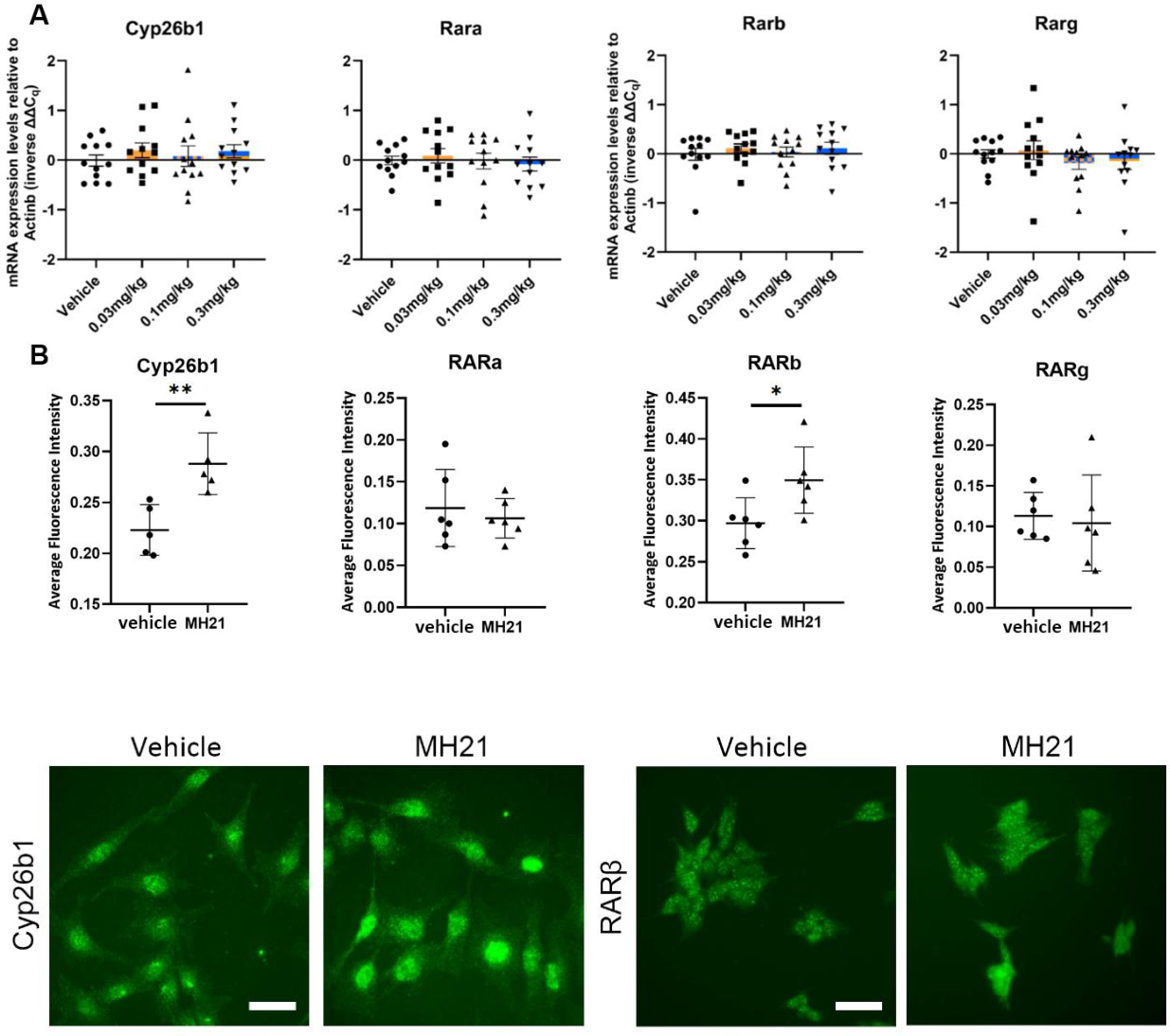
Figure 2.
Effect of MH21 on neuronal cells. (A) MTT results of SH-SY5Ys under oxidative stress treated with MH21. (B) LDH results of SH-SY5Ys under oxidative stress treated with MH21. (C) LDH results of C6s under oxidative stress treat with MH21. (D) Cytokines release of HMC3s under oxidative stress treated with MH21. (E,G) Average Optical Density of LC3B of HMC3 in normal media and serum-free media. Scale bar: 50 μm. (F,H) Average Fluorescence Intensity of p62 of HMC3 in normal media and serum-free media. Data are presented as mean ± SD. (A-F, n=4) (G-H, n=16), *p<0.05, ***p<0.001, ###p<0.001.
Figure 2.
Effect of MH21 on neuronal cells. (A) MTT results of SH-SY5Ys under oxidative stress treated with MH21. (B) LDH results of SH-SY5Ys under oxidative stress treated with MH21. (C) LDH results of C6s under oxidative stress treat with MH21. (D) Cytokines release of HMC3s under oxidative stress treated with MH21. (E,G) Average Optical Density of LC3B of HMC3 in normal media and serum-free media. Scale bar: 50 μm. (F,H) Average Fluorescence Intensity of p62 of HMC3 in normal media and serum-free media. Data are presented as mean ± SD. (A-F, n=4) (G-H, n=16), *p<0.05, ***p<0.001, ###p<0.001.
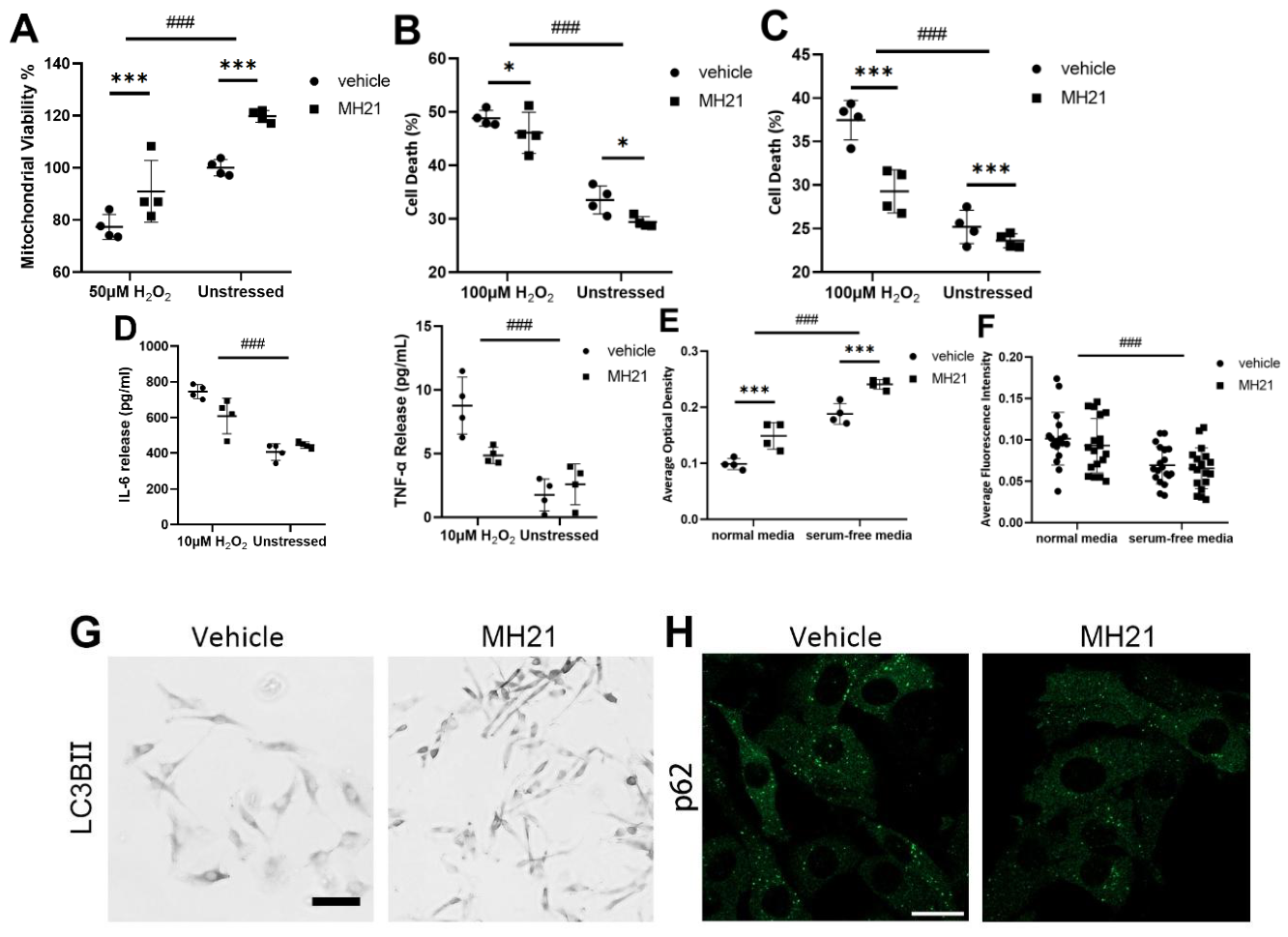
Figure 3.
Effect of MH21 on skin cells. (A) MTT results of HDF with MH21. (B) LDH results of HDF and HaCaT with MH21. (C) IL-6 release of HDF under oxidative stress treated with MH21. (n=4). *p<0.05, ###p<0.001.
Figure 3.
Effect of MH21 on skin cells. (A) MTT results of HDF with MH21. (B) LDH results of HDF and HaCaT with MH21. (C) IL-6 release of HDF under oxidative stress treated with MH21. (n=4). *p<0.05, ###p<0.001.
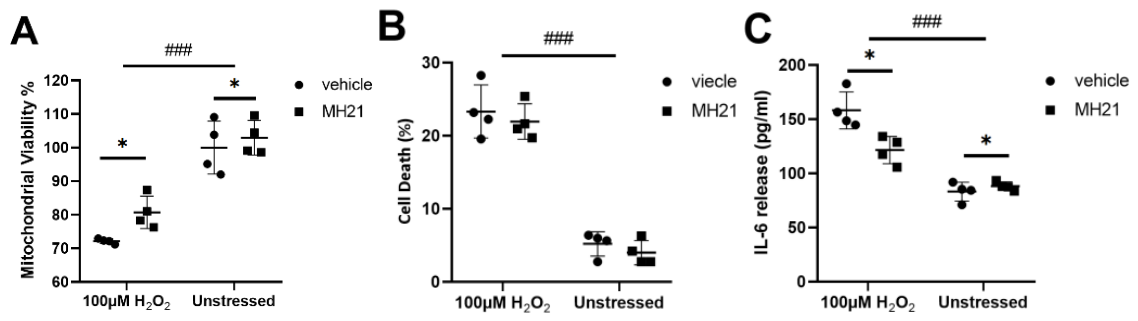

Table 1.
MH21 failed to affect striatal gene expression in rats. Gene expression was assessed by qPCR in the striatum of mixed sex groups of Wistar rats treated with increasing doses of MH21 (0.03-0.3 mg/kg). Data are averaged from n=12 animals (6 male, 6 female) per group and the striata were removed 4 h post dosing. Cyp26b1, Cytochrome P450 26B1; Rara, Retinoic Acid Receptor Alpha; Rarb, Retinoic Acid Receptor Beta; Rarg, Retinoic Acid Receptor Gamma.
Table 1.
MH21 failed to affect striatal gene expression in rats. Gene expression was assessed by qPCR in the striatum of mixed sex groups of Wistar rats treated with increasing doses of MH21 (0.03-0.3 mg/kg). Data are averaged from n=12 animals (6 male, 6 female) per group and the striata were removed 4 h post dosing. Cyp26b1, Cytochrome P450 26B1; Rara, Retinoic Acid Receptor Alpha; Rarb, Retinoic Acid Receptor Beta; Rarg, Retinoic Acid Receptor Gamma.
| Gene | MH21 concentration (mg/kg) | Normalised Fold Change (compared to vehicle) |
| Cyp26b1 | 0.03 | 1.15 |
| 0.1 | 1.06 | |
| 0.3 | 1.14 | |
| Rara | 0.03 | 1.07 |
| 0.1 | 0.99 | |
| 0.3 | 0.95 | |
| Rarb | 0.03 | 1.08 |
| 0.1 | 1.03 | |
| 0.3 | 1.09 | |
| Rarg | 0.03 | 1.05 |
| 0.1 | 0.88 | |
| 0.3 | 0.90 |
Disclaimer/Publisher’s Note: The statements, opinions and data contained in all publications are solely those of the individual author(s) and contributor(s) and not of MDPI and/or the editor(s). MDPI and/or the editor(s) disclaim responsibility for any injury to people or property resulting from any ideas, methods, instructions or products referred to in the content. |
© 2026 by the authors. Licensee MDPI, Basel, Switzerland. This article is an open access article distributed under the terms and conditions of the Creative Commons Attribution (CC BY) license (http://creativecommons.org/licenses/by/4.0/).
Copyright: This open access article is published under a Creative Commons CC BY 4.0 license, which permit the free download, distribution, and reuse, provided that the author and preprint are cited in any reuse.


