

Submitted:
07 June 2026
Posted:
09 June 2026
You are already at the latest version
Abstract
Alternating marine inflow and continental outflow make southern Sweden a suitable region for investigating natural and anthropogenic contributions to background particulate matter (PM). However, the interpretation of dust and marine aerosol sources remains challenging because their source signatures often overlap during atmospheric transport. This study investigates aerosol sources at the Vavihill and Hyltemossa background stations using source apportionment, elemental analysis, transport modelling, reanalysis data, and particle resolved microscopy. At Vavihill, size segregated filter samples were used to determine PM10 and PM2.5 mass concentrations and elemental composition, followed by Positive Matrix Factorization (PMF). At Hyltemossa, online XACT elemental measurements were combined with FIDAS coarse PM observations to evaluate coarse mode source contributions. HYSPLIT backward trajectories, CAMS diagnostics, and SEM/EDX analysis supported the interpretation of selected dust related episodes and particle mixing state. The results show that background PM in southern Sweden is influenced by mineral and marine related aerosols, local pollution, and mixed combustion particles. Observations from Vavihill estimated that mineral related aerosols increased significantly during spring and contributed up to approximately 38% of total PM10. Studies combining source apportionment with trajectory analysis, CAMS diagnostics, and SEM/EDX can strengthen the interpretation of background aerosol sources and particle mixing conditions in areas affected by marine and continental air masses.
Keywords:
source apportionment
; ESAT-PMF
; mineral dust
; sea spray
; PIXE
; HYSPLIT
; SEM/EDX
; background aerosol sites
1. Introduction
Particulate matter (PM) at regional background sites comprises a mixture of anthropogenic particles, including combustion-related and industrial aerosols, and natural particles, such as sea spray and mineral dust. In northern Europe, the relative contributions of these components vary substantially with circulation patterns, season, and the extent of atmospheric ageing [30]. Southern Sweden is particularly well suited for investigating these source influences because it is regularly affected by both marine air masses from the North Sea and the Kattegat and continental outflow from mainland Europe. This atmospheric contrast provides favorable conditions for separating marine and crustal contributions using elemental tracers and receptor modelling [2,11,32].
Source-apportionment studies based on elemental concentration have shown that sea salt or road salt, crustal material, traffic-related aerosol, and secondary anthropogenic aerosol are among the main contributors to ambient PM [32,34]. Receptor modelling methods such as Positive Matrix Factorization (PMF) are used widely to resolve major source factors from ambient aerosol measurements [2,11,21]. To support the interpretation of source origins, trajectory analysis can be conducted using transport models such as HYSPLIT [28].
Temporal changes in elemental and mass concentrations can be used to identify when dust episodes occur and how aerosol composition and particle loading change [17]. Regional atmospheric aerosol products such as CAMS reanalysis [13] can further support the interpretation of these episodes by providing large-scale information on aerosol loading and transport patterns.
However, interpretation of these source factors remains challenging when source profiles overlap or when particles are chemically modified during transport [3,26]. This difficulty is especially relevant for soil-derived and marine-related factors. Soil-derived particles may originate from natural mineral dust, local or regional re-suspended soil and road dust, and agricultural activities, whereas sea-salt particles can undergo chloride depletion and internal mixing with nitrate, sulfate, and carbonaceous material [7,10,25]. To reduce these interpretative difficulties, receptor modelling benefits from complementary methods that can directly constrain particle morphology and mixing state. Electron microscopy combined with energy-dispersive X-ray spectroscopy (EDX) provides particle-resolved information on shape, elemental composition, and internal mixing. Scanning electron microscopy (SEM) is particularly useful for atmospheric particles because it enables analysis of individual particles with minimal preparation and directly links morphology to composition [5,35,38]. Recent studies on mineral dust have further demonstrated the value of electron microscopy for identifying particle mixing state, surface ageing, and compositional heterogeneity that are not evident from bulk aerosol chemistry alone [23,37].
Hyltemossa and Vavihill are important regional background sites in southern Sweden with long-term PM measurements. PM measurements have been carried out at Vavihill since the 1980s and at Hyltemossa since 2015. However, the lack of systematic measurements of elemental concentration, particle mixing state, and atmospheric ageing limits the physical interpretation of PM sources at these sites, making it difficult to distinguish between source types, identify atmospheric processing, and constrain source contributions. At the same time, For rural background environments in northern Europe, relatively few studies have combined receptor model source apportionment with air mass transport, event scale aerosol variability, and particle level composition [9]. As a result, the interpretation of dust related and marine influenced factors often remains uncertain when based on receptor modelling alone. A combined framework is therefore needed to better link statistically resolved PMF factors with transport history, temporal variability, and particle level properties.
This study addresses this need by combining the Environmental Source Apportionment Toolkit (ESAT-PMF) [27] with HYSPLIT trajectory analysis, SEM-based particle characterization, and CAMS regional dust diagnostics. The framework integrates offline size-segregated particle-induced X-ray emission (PIXE) elemental data collected at Vavihill and online XACT-FIDAS measurements [8,31] collected at Hyltemossa. In addition, a limited number of samples collected at Hyltemossa using the newly developed TU Darmstadt Integrated Aerosol Sampling System (TuDa-IASS) were analysed by SEM/EDX to provide illustrative particle-level evidence and to demonstrate the field performance of the sampler.
Because Vavihill and Hyltemossa are located only about 19 km apart, the two sites are generally expected to be influenced by similar regional air masses. However, the datasets used here were collected during different time periods and using different measurement techniques. They are therefore treated as complementary observations from nearby background environments rather than as directly paired event by event measurements. Together, they support the interpretation of source factors and aerosol composition.
The study aims to: (i) estimate the major source factors contributing to PM in southern Sweden; (ii) examine the temporal behaviour of the major source factors and their relative contributions to the fine and coarse particle fractions; (iii) assess air-mass transport patterns associated with selected dust-related episodes using backward trajectories; and (iv) demonstrate the use of TuDa-IASS for qualitative particle-level characterization
Overall, this study demonstrates how an integrated framework combining modelling, reanalysis data, and instrumentation can be used to build a more comprehensive interpretation of PM sources and atmospheric processes at regional background sites with limited and discrete observations.
2. Materials and Methods
As stated above, this study uses measurements from Vavihill and Hyltemossa collected during different periods and with different techniques, and interprets them as complementary observations from two nearby regional background sites. The ESAT-PMF Toolkit, a Python package designed to reproduce and extend EPA-PMF-style workflows, was applied to the Vavihill PIXE, and Hyltemossa XACT-FIDAS datasets for resolving source factor profiles and estimating their contributions. The information is then interpreted using particle level elemental signatures, backward trajectory analysis and CAMS aerosol reanalysis to infer likely source types, source regions, transport pathways and particle loading. TuDa-IASS samples were analysed by SEM/EDX to provide particle-level evidence for representative particle classes, including information on particle morphology, elemental composition, and internal mixing.
2.1. Study Areas
The Vavihill station (56∘01′ N, 13∘09′ E; 172 m above sea level) is an EMEP (European Monitoring and Evaluation Programme) rural background site located in Skåne, southern Sweden. The site has no major local pollution sources in its immediate vicinity, but it lies relatively close to big cities like Helsingborg, Malmö, and Copenhagen, which are approximately 25, 45, and 40 km away, respectively (Figure 1a) [16,29]. Vavihill is also located about 20 km inland from the coast and can therefore be influenced by both relatively clean marine or northerly air masses and more polluted continental air masses arriving from the south and southwest [16].
The Hyltemossa station (56∘05′52′′ N, 13∘25′08′′ E; 115 m a.s.l.) is an ICOS (Integrated Carbon Observation System) and ACTRIS (Aerosols, Clouds, and Trace Gases Research Infrastructure) regional background site in southern Sweden. The site was established in 2014 in a managed coniferous forest. The station is located approximately 19 km northeast of Vavihill (Figure 1a) and is influenced by nearly the same air masses as Vavihill. The positions of these sites in southern Sweden make them suitable for observing background aerosol under both marine and continental air-mass influences [1,12].
2.2. Measurements and Sampling
At Vavihill, aerosol samples were collected at 24 h resolution between 14 January and 15 May 2000 using a Gent-type PM10 inlet coupled to a stacked filter unit (SFU). The SFU contains Nuclepore polycarbonate membrane filters with pore sizes of 8 µm and 0.4 µm arranged in series, allowing separation of the fine (PM2.5) and coarse (PM10–PM2.5) PM fractions. Polycarbonate filters were selected because they consist mainly of light elements, generally show low background during the PIXE analysis, and produce relatively low bremsstrahlung background during analysis. During the same period, PM concentrations were continuously monitored using a TEOM (Tapered Element Oscillating Microbalance) equipped with alternating inlets for PM10 and PM2.5. To minimize contamination, sample-handling procedures were standardized throughout the campaign, including batch preparation of filters prior to sampling and consistent handling before and after exposure.
At Hyltemossa, hourly aerosol measurements were carried out during October 2022 to January 2024 using an XACT 625i ambient metals monitor and a Palas FIDAS optical aerosol spectrometer, together called XACT-FIDAS in this study. The online measurement approach provided continuous, high-time-resolution data that are difficult to obtain from offline filter-based sample processing [8,15]. The XACT provided elemental concentrations based on online X-ray fluorescence. The XACT instrument sampled behind a PM10 inlet, and the reported elemental concentrations therefore represent the PM10 aerosol fraction. The FIDAS determined particle-size distributions using optical light scattering, from which PM mass concentrations and coarse-particle mass in the – size range were derived [8,33].
A short campaign was conducted at Hyltemossa from 7 to 11 May 2025 using the TuDa-IASS to obtain samples for SEM/EDX analysis. TuDa-IASS was originally developed for aircraft-based aerosol sampling [4]. However, this study indirectly evaluates its ground-based performance through deployment alongside standard aerosol instrumentation and qualitative particle sampling. The sampler consists of three individual air samplers: MultiMINI8, NanoPS, and SPAFiS. MultiMINI8 (Multi Micro Inertial Impactor) is a miniaturized cascade impactor sampler that can collect up to eight samples per sampling sequence. NanoPS (Nano Particle Sampler) is a thermophoretic particle sampler that can collect up to six samples per sampling sequence. SPAFiS (Single Particle Filter Sampler) can collect up to six samples per sampling sequence. MultiMINI8 and NanoPS collect particles on TEM grid substrates, whereas SPAFiS collects particles on Isopore membrane filters. Samples were collected at table height (approx. 110 cm) with a 15-minute sampling duration per sample. In addition, a short exposure blank sample was collected as a quality-control measure by operating the pump for only 3 s. A full evaluation of the TuDa-IASS is outside the scope of this paper, and only selected single-particle results are presented here.
2.3. Analytical Techniques and Interpretation
2.3.1. PIXE Analysis
Polycarbonate filters from Vavihill were analysed by PIXE at the ion beam analytical facility, at Lund University. PIXE is a non-destructive multielement technique well suited to low-mass aerosol deposits collected at high time and size resolution. PIXE spectra were processed to derive elemental areal densities and associated analytical uncertainties, which were then converted to atmospheric concentrations based on the sampled air volume. The field blank filters showed inconsistencies and evidence of contamination, hence blank correction was performed using a surrogate blank approach. For each element, the surrogate blank was defined as the lowest observed concentration above twice the detection limit. The corresponding blank uncertainty was conservatively assigned as 60 percent of this value and propagated into the total analytical uncertainty using standard error propagation. Measurements close to or below the detection limit were retained rather than substituted or removed in order to preserve the statistical structure of the dataset. As a result, some blank-corrected concentrations became negative; these values were not truncated to zero in order to avoid bias in the subsequent statistical analysis. Species with consistently low signal-to-noise ratios or frequent non-detects were treated cautiously and, where necessary, excluded from receptor modelling or from factor interpretation (See section: Section 2.3.2). These treatments were applied in accordance with ESAT-PMF recommendations.
Elemental concentrations were derived from the characteristic X-ray yields, with reported detection limits of approximately 0.05 ng m−3 for elements from Al and heavier in the periodic table. The PIXE dataset includes elemental concentrations of Si, S, K, Ca, Ti, Cr, Mn, Fe, Co, Ni, Cu, Zn, Se, Br, and Pb in both fine and coarse PM fractions, together with Cl and Sr only in the coarse fraction and V only in the fine fraction. These measurements were used to construct the ESAT-PMF input matrix and to support interpretation of source-related factors.
2.3.2. ESAT-PMF Analysis
The elemental and mass concentrations were used as input to ESAT-PMF for source apportionment study. Concentrations of the measured pollutants can be adequately explained by a linear combination of contributions from various relevant sources with fixed composition. The analysis was performed separately for the fine and coarse PM fractions. In this way, size-fraction information was preserved, helping to resolve factor profiles and their contributions separately. Factor interpretation was conducted using elemental tracers characteristic of the four selected source categories: mineral dust, marine aerosol, mixed combustion, and general pollution.
The resolved factors were interpreted based on their dominant or enriched elemental tracers. Mineral dust was associated with high contributions of crustal elements such as Si, Ca, Ti, Fe, Sr, and Mn; marine aerosol with coarse Cl, and Br; mixed combustion, including metal-related sources, with Zn, Pb, K, Cu, V, and Ni; and general pollution with S, Zn, Pb, and partly Cu and Br.
Presence of S was considered an indicator of secondary or mixed transported aerosol, and V and Ni were considered indication of oil-combustion influence. Because the concentration measurements did not include all major aerosol constituents, particularly , , and organic matter, the missing measured mass was treated as part of the unaccounted fraction.
For Hyltemossa, ESAT–PMF was applied to the combined XACT–FIDAS dataset. XACT provided PM10 elemental concentrations, while FIDAS provided the particle mass variables. In the present analysis, FIDAS PM10–PM2.5 was used as the coarse PM mass metric. The Hyltemossa factors should therefore be interpreted as source-related contributions to coarse PM variability, constrained by PM10 elemental composition, rather than as strictly size-resolved elemental source profiles.
After the initial ESAT–PMF runs, the modelled-to-measured ratio was calculated for each species. Species with ratios below 40% were not used as primary tracers for factor interpretation.
2.3.3. Backward Trajectory Analysis
Interpretation of the ESAT-PMF factors was further supported by backward trajectory analysis to assess source regions and transport pathways. The Lagrangian trajectory model HYSPLIT was used, driven by meteorological input fields derived from the ECMWF atmospheric reanalysis ERA5. Four-day backward trajectories were calculated for selected Vavihill cases on 30-March, 19-April, 23-April, and 3-May-2000. An arrival time of 12:00 UTC was used, with an arrival height of approximately 500 m above sea level. In addition, a selected event at Hyltemossa on 8 April 2023 was examined to compare transport patterns and dust intrusion signatures at both sites (see Section 2.3.3 and Section 3.3.1).
2.3.4. Event Scale Analysis Using CAMS Dust Diagnostics
To evaluate selected mineral dust episodes resolved by the ESAT-PMF model, aerosol products from the Copernicus Atmosphere Monitoring Service (CAMS) were used as independent regional support. The CAMS data were not used as input to the PMF model. Instead, they were used to check whether periods with enhanced coarse PM and mineral dust contributions were also reflected in regional dust indicators.
Three CAMS variables were considered in this analysis: CAMS Europe PM10, CAMS Europe surface dust in PM10, and CAMS EAC4 dust aerosol optical depth at 550 nm (dust AOD550). CAMS Europe PM10 was used to describe the broader regional aerosol mass situation. The two dust specific variables, CAMS surface dust in PM10 and dust AOD550, were used as the main CAMS dust indicators. Surface dust in PM10 gives information on near surface dust, while dust AOD550 gives information on the total dust load in the atmospheric column, including transported dust that may not appear clearly in surface concentrations.
The CAMS dust indicators were compared with FIDAS coarse PM, XACT elemental concentrations, and the ESAT–PMF mineral dust factor during selected Hyltemossa events. The coarse PM fraction, PM10 minus PM2.5, was used as the main observed mass variable because mineral dust and other mechanically generated particles are expected to contribute mainly to the coarse aerosol fraction. To evaluate changes in elemental composition during the events, robust z scores were calculated for the XACT elemental concentrations relative to the full XACT matched period:
where x is the elemental concentration and MAD is the median absolute deviation. Positive robust z values indicate concentrations above the long term median for each element. Elements such as Ca, Fe, and K were interpreted as mineral associated tracers, while Ni, Zn, and Pb were used to indicate possible mixing with pollution related or combustion associated aerosol during the same event windows.
An episode was considered consistent with dust influence when enhanced coarse PM concentrations occurred together with elevated CAMS dust indicators and elevated XACT concentrations of mineral-associated elements such as Ca, Fe, and K. The ESAT-PMF mineral dust contribution was then used as an additional check to see whether the receptor model reproduced the timing of these independently identified mineral related coarse particle enhancements. This approach allowed the interpretation of selected dust related episodes to be supported by observed coarse PM, chemical composition, source apportionment results, and regional CAMS aerosol diagnostics. See Section 3.3.1 and Table A3 in the Appendix.
2.3.5. SEM/EDX Analysis and Particle Classification
TuDa-IASS samples were analysed using a Quanta 200 FEG environmental scanning electron microscope (ESEM; FEI, Eindhoven, the Netherlands) coupled to an energy-dispersive X-ray detector (EDX; EDAX, AMETEK, Tilburg, the Netherlands). Secondary-electron images from the Everhart–Thornley detector were used to assess particle morphology and surface topology, while back-scattered electron images from the solid-state detector were used to examine internal elemental distribution and inclusions. EDX spectra provided elemental composition for individual particles, which was used to classify particles into compositional groups and to infer likely source-related particle classes. Because all analyses were performed under high vacuum ( mbar), the instrument is referred as SEM. The instrument was operated at an acceleration voltage of 12.5–15 kV and a working distance of 10 mm. Particle classification was based on combined evaluation of morphology, contrast in SEM images, and EDX-derived elemental composition. Classification criteria focused on identifying mineral-dust-like particles, sea-salt or marine-derived particles, carbonaceous or secondary-coated particles, metal-rich particles, and internally mixed particles. The SEM/EDX results were interpreted qualitatively as a particle-resolved evidence layer rather than as an independent source-apportionment dataset.
3. Results
3.1. PM Levels and Source Apportionment at Vavihill
At Vavihill, the mean PM10 concentration was 12.6 g m−3, about 25% higher than the mean PM2.5 concentration of 10.1 g m−3. A zero-offset regression between PM10 and PM2.5 gave the relationship PM10 = 1.22 PM2.5, indicating that PM10 closely tracked PM2.5 during the study period (Figure 2a). The statistical source–receptor model ESAT-PMF produced non-negative source profiles and source contributions for the selected four-factor solution using the characteristic elements of the relevant source types.
Fifty ESAT-PMF model runs were evaluated, and the successful runs gave very similar factor profiles and source contributions. Therefore, one representative four factor solution was used for further interpretation. Model performance, evaluated against the measured PM fractions, yielded RMSE values of 2.48 g m−3 for fine and 1.10 g m−3 for coarse PM. The corresponding values were 0.74 and 0.53, respectively, showing that the fine fraction was reproduced more robustly than the coarse fraction (Figure 2 b&c).
The selected four-factor ESAT solution resolved source profiles interpreted as general pollution, mineral dust, marine aerosol, and mixed combustion. Mineral dust was identified mainly from cSi, cCa, cMn, cFe, fTi, and fFe; marine influence from cCl and cBr; general pollution from fine-fraction anthropogenic species such as fS, fZn, fSe, and fPb; and mixed combustion from transition and heavy-metal tracers including cCo, cNi, cCu, cPb, and fCu. S was treated as an indicator of secondary or mixed transported aerosol rather than as a uniquely source-specific tracer. The coarse- and fine-fraction profiles resolved distinct source signatures, and the model accounted for 94.4% of the fine PM mass and 80.7% of the coarse PM mass, leaving 5.6% and 19.3% unaccounted mass, respectively.
Figure 3 shows the factor fingerprints expressed as percentage contributions for each species in the selected four-factor solution. In the coarse fraction, cSi was apportioned almost entirely to the mineral-dust factor, which also accounted for dominant fractions of cMn and cFe and a substantial fraction of cCa. The marine factor was characterized mainly by cCl and cBr, with additional contributions to cS, cK, and cSe, indicating a coarse marine aerosol signature but also some source mixing. The mixed-combustion factor was identified mainly by cCo, cNi, cCu, and cPb, while cS was shared between the marine and mixed-combustion factors, suggesting that coarse sulfur was not uniquely associated with a single source. In the coarse fraction, the general-pollution factor made smaller contributions to cK, cCa, and cS, but it was less clearly defined by unique coarse-fraction tracers.
In the fine fraction, general pollution was characterized mainly by fS, fK, fZn, fSe, and fPb, with additional contributions to several fine-fraction metals. Mineral dust was identified most clearly by fTi and also accounted for fractions of fCa, fMn, and fFe, consistent with the coarse mineral-dust signature. The marine factor accounted for fractions of fCa and fBr, although the fine-fraction marine signal was less distinct than in the coarse fraction. Mixed combustion was expressed most clearly in fCu, with additional contributions to fMn, fZn, fSe, fBr, and fPb, indicating greater source mixing among the fine-fraction anthropogenic tracers. Overall, the coarse fraction showed clearer separation between mineral dust, marine aerosol, and combustion-related metals, whereas the fine fraction showed stronger mixing between general pollution, marine influence, and mixed combustion.
The estimated source contributions differed clearly between the two PM fractions. For the coarse PM, the largest contribution relative to the measured coarse mass was from the marine factor (31.2%, 0.77 g m−3), followed by mineral dust (25.3%, 0.63 g m−3), general pollution (14.1%, 0.35 g m−3), mixed combustion (10.1%, 0.25 g m−3), and unaccounted mass (19.3%, 0.48 g m−3). For PM2.5, general pollution was the largest contributor relative to the measured fine mass (41.6%, 4.21 g m−3), followed by mixed combustion (19.2%, 1.94 g m−3), marine aerosol (17.2%, 1.74 g m−3), mineral dust (16.4%, 1.65 g m−3), and unaccounted mass (5.6%, 0.57 g m−3). Thus, the coarse fraction was dominated by marine and mineral sources together with a larger unaccounted fraction, whereas the fine fraction was dominated mainly by anthropogenic sources (see Figure A1 and Table A1 in Appendix).
Figure 4 shows the time series of source contributions to the fine and coarse PM fractions. The fine and coarse fractions varied episodically and were driven mainly by alternating contributions from the resolved source factors. For the coarse fraction, marine contributions were more prominent during several earlier episodes, whereas mineral dust became more important toward late April and May. Mixed combustion and general pollution contributed less to the coarse mass but were present during specific events. Similarly, in the fine fraction, general pollution provided a stronger sustained background, while mixed combustion and marine contributions were more episodic. Mineral dust also became more important during the later part of the record, particularly from April to May. Compared with the coarse fraction, the fine fraction showed larger absolute variability and a stronger sustained background. The figure also shows that the modelled fine fraction captured the observational variability better than the coarse fraction, although some coarse-particle peaks remained underestimated. The observed mean concentration of PM2.5 was 10.098 g m−3, of which the model reproduced 9.528 g m−3, corresponding to a difference of 0.570 g m−3 or 5.6%. For PM10–PM2.5, the observed mean concentration was 2.475 g m−3, while the model reproduced 1.996 g m−3, corresponding to a difference of 0.478 g m−3 or 19.3%. (See Table A1 in Appendix)
3.2. Back-Trajectory Analysis for the Selected Episodes
To place the mineral-dust-related episodes in a synoptic transport context, four-day HYSPLIT backward trajectories were analysed for four selected Vavihill events: 30 March, 19 April, 23 April, and 3 May 2000. These dates were selected from the period in which the time-series analysis indicated an increased contribution from the mineral-dust factor, particularly during late March, April, and early May. The corresponding trajectory pathways are shown in Figure 5.
The selected episodes showed clearly different transport regimes. Among them, the 19 April 2000 event exhibited the strongest long-range southerly transport signature. The air mass arriving at Vavihill could be traced from southern Sweden across central Europe towards the western Mediterranean sector, indicating a markedly different pathway compared with the more regional episodes. In contrast, the 23 April 2000 case was spatially more compact and remained closer to central Europe, without the pronounced long-range southerly transport observed on 19 April. The 30 March 2000 trajectory was characterised mainly by easterly to continental transport, whereas the 3 May 2000 case showed a more northerly to northeasterly pathway. These results indicate that the mineral-dust-related episodes identified by the ESAT–PMF analysis were not associated with a single, uniform transport pattern.
Taken together, the trajectory analysis suggests that the springtime increase in the mineral-dust contribution reflected a combination of different synoptic situations rather than one recurring air-mass origin. Nevertheless, the 19 April 2000 event stands out as the clearest long-range southerly case among the selected episodes and therefore represents the strongest dust-relevant transport pattern within the analysed period.
3.3. PM Levels and Source Apportionment at Hyltemossa
At Hyltemossa, the mean PM10 concentration was 9.1 g m−3, which was approximately 52% higher than the mean PM2.5 concentration of 6.0 g m−3. A zero-offset regression between PM10 and PM2.5 gave the relationship PM PM2.5, and the two size fractions showed a strong linear relationship during the XACT-matched measurement period (). PM10 was consistently higher than PM2.5, and the regression line remained above the 1:1 line over most of the concentration range, confirming the presence of a variable coarse PM fraction (Figure 6a).
Compared with the Vavihill measurements from 2000, the mean concentrations at Hyltemossa were lower by about 28% for PM10 and about 41% for PM2.5. This difference is likely mainly related to the long term decrease in regional background particle concentrations in southern Sweden since the early 2000s, as reported by Naturvårdsverket [19]. A smaller contribution may also come from site location, as Hyltemossa is further from major local pollution sources and from the larger urban areas of Helsingborg, Malmö, and Copenhagen.
ESAT source apportionment was then performed using the combined XACT elemental composition and FIDAS coarse PM dataset. The selected four-factor solution reproduced the temporal variability of coarse PM moderately, with between measured and modelled coarse PM. The modelled concentrations followed the general measured variability, although several high-concentration coarse PM episodes were underestimated. The regression slope was lower than the 1:1 line, indicating that the reconstructed source contributions captured the main temporal structure but did not fully explain the highest coarse PM events (Figure 6b).
The source profile plot shows clear chemical separation among the four factors. Cl was apportioned mainly to the marine factor, which also accounted for substantial fractions of Sr and Br. Ca and Fe were apportioned mainly to the mineral-dust factor, which also accounted for part of Cu and Sr, consistent with a crustal aerosol source. S was apportioned mainly to the general-pollution factor, which also accounted for fractions of Ni, Pb, Br, Zn, and K, indicating a regional pollution signature. Zn, K, and Cu were apportioned mainly to the mixed-combustion factor, which also accounted for fractions of Fe and Pb, supporting its interpretation as a mixed combustion and metal-rich aerosol source (Figure 7).
The temporal source contribution plot showed strong variability in coarse PM source contributions over the full XACT-FIDAS sampled period. Marine and mixed-combustion contributions were frequently important, while mineral dust contributed substantially during several elevated coarse PM episodes. General pollution was present throughout the record but was usually a smaller contributor to coarse PM compared with marine aerosol, mineral dust, and mixed combustion. The measured coarse PM line was generally higher than the modelled sum during some peak events, consistent with the residual or unaccounted mass shown in the mass-balance analysis (Figure 8 also see the Table A2 in appendix). The largest differences occurred during spring, especially in April. This may partly reflect aerosol components that are not well represented by the metal tracers used in the PMF analysis. Examples include secondary organic aerosol and primary biological particles, which have been shown to contribute substantially to carbonaceous aerosol at Nordic rural background sites during summer [36].
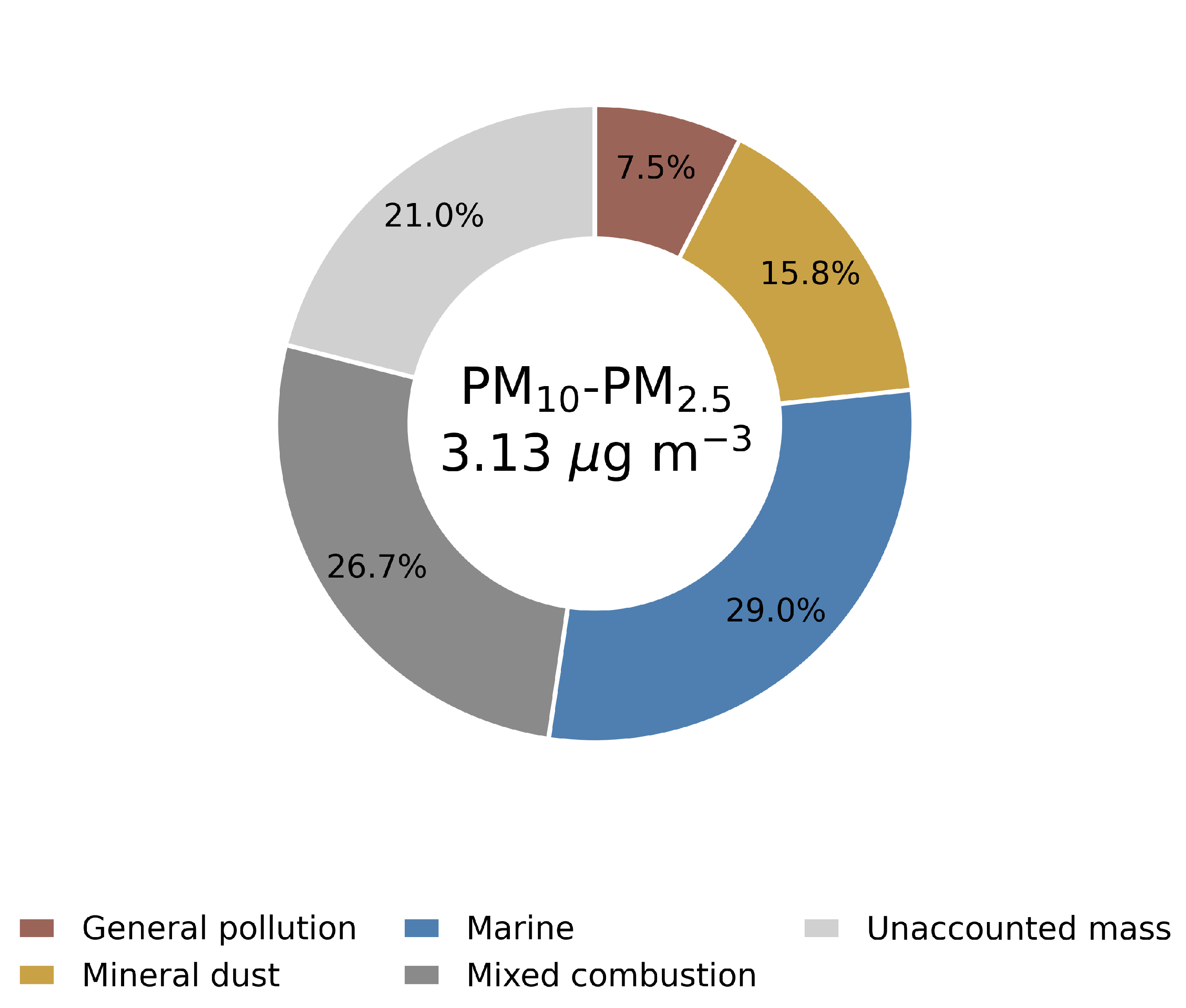
The average coarse PM concentration was 3.13 g m−3. The reconstructed source contributions accounted for 78.9% of the measured coarse PM mass, leaving 21.1% as unaccounted. Therefore, the Hyltemossa coarse PM results explain part of the measured coarse PM mass, but not all of it. The largest average contribution was from marine aerosol, accounting for 29.0% of coarse PM. Mixed combustion contributed 26.4%, mineral dust contributed 16.2%, and general pollution contributed 7.3% (see Figure A2 in appendix).
3.3.1. Elemental Signatures Observed During CAMS Dust Events
Two coarse-particle events at Hyltemossa were examined in detail using CAMS dust variables, FIDAS coarse PM, ESAT-PMF model reconstructed coarse PM, and XACT elemental concentrations. The selected events occurred on 8 April 2023 and during 24–28 October 2022.
The 8 April 2023 event is shown in Figure 9. During this event, the observed FIDAS coarse concentration increased clearly. Concurrently, CAMS surface dust concentration and dust AOD550 also increased during the same event window. The ESAT-PMF reconstructed coarse PM followed the timing of the observed coarse-particle increase, although the reconstructed values were lower than the highest observed coarse PM values. Generally, the reconstruction successfully captured the primary increasing and decreasing trends of the observed coarse PM concentrations.
From the XACT elemental concentration heatmap, 8 April 2023 showed elevated Ca and Fe concentrations during the period with enhanced coarse PM. Other elements showed weaker or less persistent increases during the event window. Ni concentrations increased later in the episode, reflecting a shift in the elemental pattern.
The 24–28 October 2022 dust episode is shown in Figure 10. In this case, the observed FIDAS coarse PM concentration remained elevated over several days and showed repeated peaks. CAMS surface dust concentration and dust AOD550 increased during parts of the selected period, especially toward the later part of the event window. The ESAT-PMF reconstructed coarse PM reproduced the main timing of the coarse-particle enhancement, but it did not reproduce the sharpest observed peaks.
During this episode, the XACT elemental concentration heatmap for 24–28 October 2022 showed sustained elevated Fe concentrations. Elevated Ca and K concentrations were also observed during parts of the event. In addition, Pb, Zn, and Ni were elevated during the same multi-day period. The October episode therefore had a broader elemental signature than the April episode, with both mineral-associated elements and metal-rich elements elevated during the event window.
The selected two episodes showed different elemental patterns. The 8 April 2023 event was mainly characterized by enhanced coarse PM together with elevated Ca and Fe concentrations. The 24–28 October 2022 event showed repeated coarse PM enhancements together with elevated Fe, Ca, and K concentrations, as well as elevated Pb, Zn, and Ni concentrations. Thus, the April event showed a clearer mineral-associated elemental pattern, whereas the October event showed a more chemically mixed elemental pattern.(see the Table A3 in appendix).
3.4. Particle-Resolved Observations at Hyltemossa
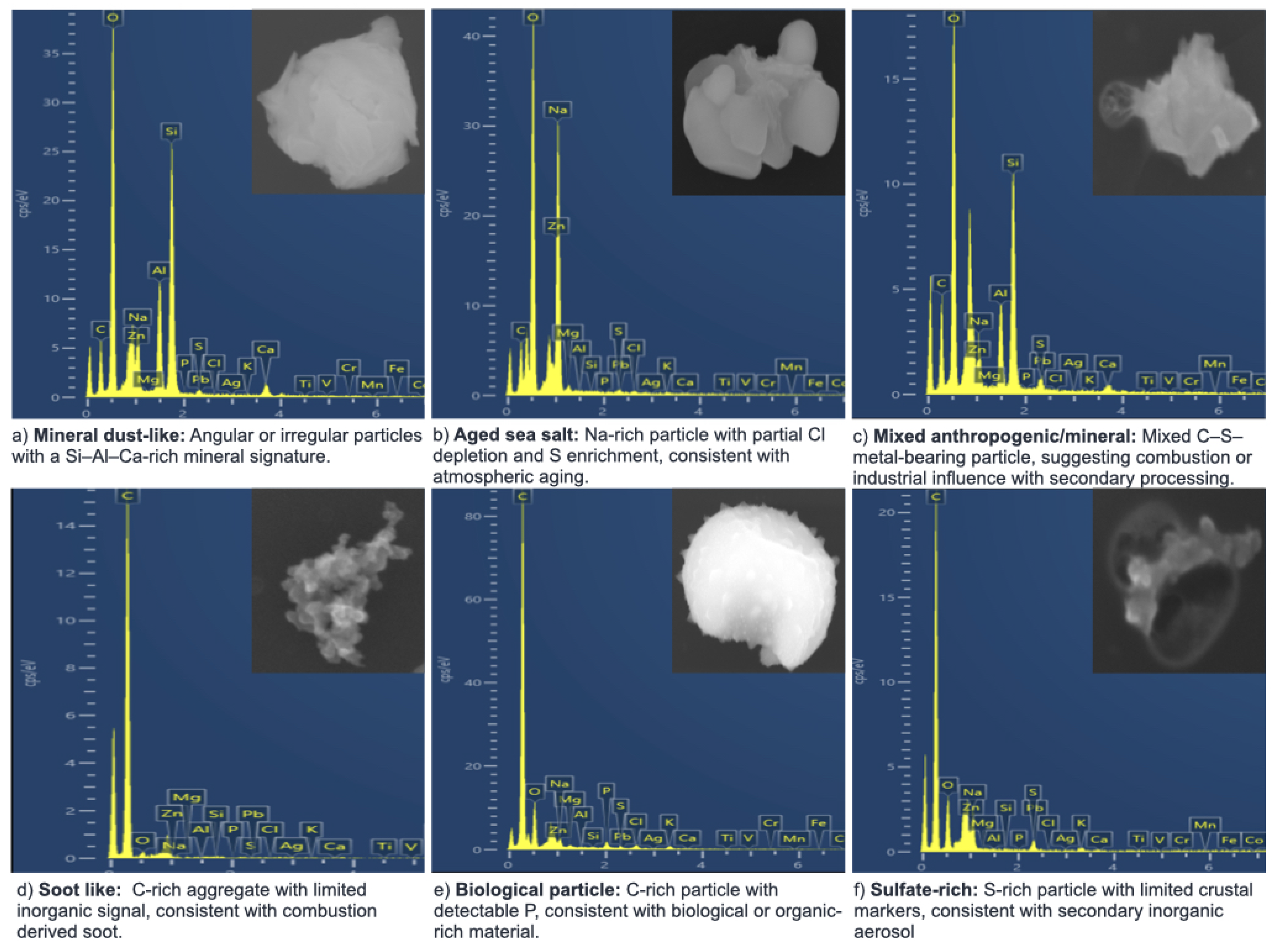
Particle-resolved SEM/EDX analysis at Hyltemossa identified a diverse aerosol population, including mineral-dust-like particles, aged sea-salt particles, mixed anthropogenic particles, soot-like particles, biological particles, and secondary sulfate-rich particles. These particle classes are broadly consistent with the aerosol classes inferred from the source-apportionment analyses and provide single-particle evidence for the physical presence of the major aerosol types represented in the bulk chemical dataset.
Mineral-dust-like particles were typically observed as angular or irregular aluminosilicate particles, often with Ca and Fe-bearing signatures, indicating crustal or resuspended mineral material. Aged sea-salt particles were characterized by Na-rich composition with partial Cl depletion and S enrichment, consistent with chloride loss and atmospheric processing. Mixed anthropogenic particles showed heterogeneous morphologies and elemental combinations involving mineral elements together with S or trace metals, suggesting internal mixing between natural and anthropogenic aerosol components. Soot-like carbonaceous aggregates and biological particles were also observed, indicating additional contributions from combustion-related and natural primary aerosol sources.(Table 1)
The SEM/EDX observations are not used here as a quantitative source-apportionment method. Instead, they provide particle-level support for the interpretation of the ESAT-PMF factors and demonstrate that atmospheric ageing and internal mixing can influence the chemical signatures observed in bulk aerosol measurements.
Figure 11.
Representative SEM/EDX particle classes observed at Hyltemossa. The figure shows examples of the main particle types identified in the particle-resolved analysis, including mineral-dust-like particles, aged sea-salt particles, mixed anthropogenic particles, soot-like particles, biological particles, and secondary sulfate-rich particles. The corresponding AZtec EDX spectra are plotted as X-ray energy (keV) on the x-axis and count rate per energy interval (cps/eV) on the y-axis. The SEM morphology and elemental signatures were used to support the classification of individual particles.
Figure 11.
Representative SEM/EDX particle classes observed at Hyltemossa. The figure shows examples of the main particle types identified in the particle-resolved analysis, including mineral-dust-like particles, aged sea-salt particles, mixed anthropogenic particles, soot-like particles, biological particles, and secondary sulfate-rich particles. The corresponding AZtec EDX spectra are plotted as X-ray energy (keV) on the x-axis and count rate per energy interval (cps/eV) on the y-axis. The SEM morphology and elemental signatures were used to support the classification of individual particles.
4. Discussion
4.1. Source Characterisation and Size Dependence of Background Aerosol in Southern Sweden
The results from the two background sites show that background PM in southern Sweden is influenced by a combination of marine aerosol, mineral-associated aerosol, general pollution, and mixed combustion aerosols. These source categories were resolved from the Vavihill size-segregated PIXE dataset and the Hyltemossa XACT–FIDAS dataset. Because the measurement instruments and sampling periods differed, the datasets are not comparable on an event-by-event basis. Nevertheless, the combined analysis helps characterise the main source types contributing to background aerosol in southern Sweden and shows that both natural and anthropogenic components are important for PM in this region.
At the Vavihill site, the source contributions showed a clear size dependence. The coarse fraction was apportioned mainly to marine aerosol and mineral-associated particles, while the fine fraction was more strongly dominated by general pollution and mixed combustion. This behaviour is physically consistent with the expected size distribution of the different aerosol types. Sea-salt particles and mechanically generated mineral particles are mainly found in the coarse mode, whereas transported pollution, secondary aerosols, and combustion-related particles are more strongly represented in the fine mode. In the coarse PM fraction at this site, marine aerosol was the largest average contributor, followed by mineral-associated aerosol. Together, these two natural source categories accounted for a large part of the measured coarse PM mass. General pollution and mixed combustion made smaller contributions to the coarse fraction, while a remaining part of the coarse mass was not reconstructed by the model.
At the Hyltemossa site, among the four sources identified by ESAT–PMF, marine aerosol was the dominant resolved contributor to coarse PM. Mixed combustion and mineral-associated aerosol provided the next largest contributions, while general pollution contributed less to the coarse fraction but was still present throughout the record. The analysis therefore supports the interpretation that coarse PM at southern Swedish background sites is not controlled by one single source type. Instead, it reflects a variable mixture of marine particles, mineral-rich particles, and combustion- or pollution-related aerosols.
Both datasets agree more clearly on source types than on exact numerical values. Direct numerical comparison is limited by differences in sampling periods, instrumentation, time resolution, and chemical inputs. However, both datasets identify the same broad aerosol classes, including natural sources such as marine and mineral-associated particles, and anthropogenic sources such as general pollution and mixed combustion. This supports the interpretation that these source types are recurring components of the southern Swedish background aerosol.
4.2. Mineral Associated Aerosols: Composition, Variability, and Transport
The mineral associated factors were characterised mainly by crustal elements such as Si, Ca, Fe, Ti, Mn, K, and Sr, although the specific chemical fingerprint varied by site and particle size. At Vavihill, the mineral associated signature was particularly pronounced in the coarse fraction, where Si, Ca, Mn, and Fe made strong contributions to the component. At Hyltemossa, the mineral associated signature was mainly associated with Ca, Fe, and Sr. These tracers are consistent with mineral rich aerosol, but they do not point to a unique dust source. For this reason, the term mineral associated aerosol is more appropriate than interpreting the component as only desert dust or only local soil dust.
The resolved component represents particles with a crustal chemical signature. Such particles may originate from long range transport of mineral particles, soil dust, road dust, or other resuspended materials. PMF alone cannot distinguish these sources, since they may produce similar elemental signatures at the receptor site. Therefore, the mineral associated factor should be understood as a broader dust-related aerosol class rather than as a specific source region component.
The temporal behaviour of the mineral associated contribution also supports this interpretation. At Vavihill, the mineral associated factor increased during parts of the spring, but the selected trajectory cases did not show one recurring air mass transport pathway. The case of 19 April 2000 showed the most pronounced long range southerly transport pattern, while the other selected cases were associated with more local, easterly, northerly, or northeasterly transport. This suggests that similar mineral rich aerosol signatures can occur under different synoptic conditions. Therefore, the spring increase in mineral associated aerosol is probably not caused by a single source pattern or a single transport mechanism.
The Hyltemossa event analysis provides further insight into the characteristics of dust-related coarse aerosol. The event on 8 April 2023 showed a relatively clear mineral-associated pattern. During this event, FIDAS coarse PM increased, CAMS surface dust and dust AOD550 increased, and XACT elemental concentrations showed elevated Ca and Fe. The ESAT–PMF reconstructed coarse PM followed the time course of the observed coarse-particle increase, although the highest observed values were underestimated. Taken together, these observations support the interpretation of the April event as mineral-influenced.
In contrast, the event from 24–28 October 2022 had a different character. Coarse PM remained elevated for several days, and elevated Fe, Ca, and K concentrations were observed during parts of the event. However, Pb, Zn, and Ni also increased during the same period. This means that the October event was not a pure mineral dust episode. Instead, it appears to represent a chemically mixed coarse particle event, where mineral-associated aerosol occurred together with metal-rich or pollution-related aerosol. This distinction is important because elevated coarse PM alone is not sufficient evidence for a dust event. Biogenic coarse particles, such as pollen fragments or other primary biological material, are also not explicitly resolved by the metal-based PMF analysis. Such particles may therefore contribute to the unexplained coarse PM mass, especially during spring. The interpretation becomes stronger when coarse particle mass, mineral tracers, PMF source contributions, transport information, and CAMS dust diagnostics are considered together.
Generally, the results suggest that mineral-associated aerosol is an important contributor to coarse PM during spring at these southern Swedish background sites. However, the exact sources of this coarse mineral fraction remain uncertain. This is an important knowledge gap. Future research should aim to separate these contributions more clearly using longer chemical time series, transport analysis, size-resolved composition, and particle-level observations.
4.3. Marine Aerosol and Atmospheric Processing
As expected for these background stations, marine aerosol was a major source category at both locations, reflecting transport from the surrounding North Sea, Kattegat, and Baltic coastal areas. At Vavihill, the marine factor was mainly associated with coarse Cl and Br, together with contributions from other elements. At Hyltemossa, Cl was the clearest marine tracer, with additional contributions from Br and Sr.
The marine factor should not be interpreted as representing only fresh sea spray. During atmospheric transport, sea-salt particles can undergo chemical ageing and atmospheric processing. Chloride may be depleted through reactions with acidic gases, while particles can become enriched in sulfate, nitrate, or other secondary material. This processing modifies the original sea-salt signature and can cause the marine factor to overlap with secondary or mixed transported aerosol. Therefore, sulfur-enriched marine contributions may partly represent aged sea salt influenced by secondary formation, rather than fresh sea spray alone. However, identifying aged sea salt from bulk chemical composition alone is challenging, especially because the sulfur signature is distributed across several source factors.
The individual particle analysis using SEM/EDX supports this interpretation. Aged sea-salt particles were observed as Na-rich particles with partial Cl depletion and S enrichment. This particle-level evidence shows that marine particles arriving at the site were not always fresh sea salt. Instead, some particles had already undergone atmospheric ageing during transport. For a more reliable interpretation of marine aerosol, bulk chemistry should therefore be interpreted cautiously, since aged sea-salt components can appear in more than one source factor. Combining bulk source apportionment with single-particle analysis helps to improve the interpretation of marine aerosol sources.
4.4. Anthropogenic Influence and Chemically Mixed Coarse Aerosol
Although the main focus of this study is on dust-related and marine-related aerosol, the results show that anthropogenic particles also contribute substantially to background PM. The general pollution component was mainly associated with S, K, Zn, Se, and Pb, suggesting local or transported pollution influence, including secondary aerosol components. The mixed combustion component was associated with elements such as Cu, Ni, Pb, Zn, Fe, and K.
These tracers indicate anthropogenic influence, but they do not point to a single source. Instead, they likely represent a mixture of emission sources, may include combustion processes, non-exhaust traffic emissions, industrial activity, shipping, and biomass burning. The presence of metal-rich material in the coarse fraction suggests that anthropogenic influences are not limited to fine PM. Some coarse-particle episodes also contained mineral-associated elements such as Ca, Fe, and K together with pollution-related metals such as Pb, Zn, and Ni. This indicates that dust-related and anthropogenic aerosols can occur together during the same events.
This mixing is important for interpreting background aerosols. Coarse PM enhancements should therefore not automatically be interpreted as pure mineral dust or sea salt. By the time particles reach a background location, mineral, marine, and anthropogenic particles may already have undergone ageing, mixing, and atmospheric chemical processing.
4.5. Particle-Level Characteristics from SEM/EDX
The SEM/EDX observations provide information that cannot be obtained from the bulk ESAT-PMF analysis alone. While PMF resolves factors from time-resolved chemical covariation, SEM/EDX shows the morphology, composition, and mixing state of individual particles. The TuDa-IASS sampling followed by microscopic analysis showed a chemically and morphologically diverse background aerosol population at Hyltemossa.
The mineral-dust-like particles were characterised by angular or irregular shapes and showed aluminosilicate or Ca- and Fe-bearing compositions. These particles are consistent with crustal or resuspended mineral material. Single-particle analysis of mineral dust is important because bulk elemental data alone cannot show particle shape, surface structure, or mixing state. SEM/EDX confirms that diverse mineral-rich particles were physically present at this background station.
A variety of marine-origin particles were also observed. Sea-salt particles with Na-rich composition, partial Cl depletion, and S enrichment indicate atmospheric processing during transport. This supports the interpretation that the marine aerosol at the site includes not only freshly emitted sea spray but also aged sea-salt particles. The presence of mixed anthropogenic particles and sulfate-rich particles further shows that internal mixing was common. Some particles contained a combination of mineral elements, sulfur, and trace metals, suggesting interactions between natural and anthropogenic aerosol components.
Carbonaceous particles such as soot-like and organic particles were also observed using the sampling system. This particle class was not the primary focus of the ESAT–PMF analysis, but it shows that the background aerosol includes additional primary particle types. This is particularly relevant because the PMF datasets do not include all major aerosol components, such as organic matter, elemental carbon, nitrate, and ammonium.
The SEM/EDX results are therefore used here as qualitative support, not as a separate quantitative source-apportionment method. The number of samples was limited, and the analysed particles are not intended to represent the full seasonal aerosol population. Their main value is that they show particle morphology, ageing, and internal mixing, which helps explain why some PMF factors are chemically mixed and why source interpretation from bulk chemistry alone remains uncertain.
4.6. Implications and Limitations for Interpreting Dust Related Aerosol at Background Sites
The study results show that dust related aerosol at background sites cannot be interpreted reliably from one method alone. ESAT–PMF identifies chemically resolved source factors, HYSPLIT provides transport context, CAMS gives regional dust information, and SEM/EDX adds particle level evidence. Each method has limitations, but together they give a clearer interpretation of aerosol sources and mixing state.
This is especially important for the mineral related factor. Its composition indicates mineral rich aerosol, but possible sources include agricultural dust, road dust, surface dust, and long range transported particles. The event analysis shows that mineral enhanced periods were not all the same: some were consistent with dust transport, while others were chemically mixed with pollution related metals. SEM/EDX also showed that mineral like particles occurred together with aged sea salt, sulfate rich particles, soot like particles, organic material, and mixed anthropogenic particles.
Several limitations remain. The Vavihill and Hyltemossa datasets were collected during different periods and with different instruments, so they are used as complementary rather than directly comparable observations. The PMF input data did not include all major aerosol components, such as nitrate, ammonium, organic matter, and elemental carbon, which limits the interpretation of secondary and carbonaceous aerosol. In addition, the PMF models did not explain all coarse PM variability during some high concentration episodes.
CAMS and HYSPLIT also provide indirect evidence. CAMS may miss local or short lived coarse particle processes, and trajectory uncertainty increases with time. SEM/EDX provides useful particle level information, but the sample number is limited and not statistically representative to understand seasonality.
5. Conclusions
This study shows that background PM in southern Sweden is shaped by both marine and continental influences. Coarse particles were mainly linked to marine aerosol and mineral related material, while fine particles were more affected by pollution and combustion sources.
The dust contribution was not constant. It appeared mainly episodic and was influenced by different air mass pathways, including both long range transport and more regional sources. This means that the dust factor should not be treated as one simple one source alone, but as a mineral related aerosol group that can be mixed and aged during transport.
The Hyltemossa events also showed that coarse particle episodes can have different chemical character. Some were mainly mineral influenced, while others contained both crustal elements and pollution related metals. SEM/EDX observations supported this interpretation by showing mineral like particles, aged sea salt, soot like particles, biological particles, sulfate rich particles, and mixed anthropogenic particles.
In summary, dust related aerosol at southern Swedish background sites is best understood as a mixed and processed particle group. Future work should include seasonally resolved single particle analysis to better connect source apportionment results with changes in particle composition and mixing state. This would improve the interpretation of aerosol sources in regions where marine air, continental transport, and local or regional pollution interact.
Author Contributions
AK and SI conceived the manuscript framework, organized the Vavihill and Hyltemossa datasets, and drafted the manuscript. ES, AK, and SI contributed to the scientific framing of the source-apportionment analysis and to the trajectory interpretation for southern Sweden. ME, SI, and KK contributed to microscopy interpretation, particle classification, and sampler-related methodology. JT organized the CAMS reanalysis datasets, AE and EA provided and organised XACT-FIDAS datasets. All authors contributed to the discussion of the results and to the revision of the manuscript.
Funding
This work was supported by TPChange (TRR 301 – Project-ID 428312742: “The tropopause region in a changing atmosphere”), funded by the Deutsche Forschungsgemeinschaft (DFG). Additional funding was provided by the Royal Physiographic Society of Lund, the Swedish Foundation for Strategic Environmental Research (MISTRA) through the ASTA program, and the Swedish Environmental Protection Agency. The acquiring of the Xact 625i XRF monitor was supported by Lund University, through the engineering faculty infrastructure funds. The authors also acknowledge ACTRIS Sweden, a national research infrastructure funded by the Swedish Research Council (Grant 2021-00177) and its six participating Swedish research-performing organizations.
Institutional Review Board Statement
Not applicable
Informed Consent Statement
Not applicable
Data Availability Statement
The datasets supporting the results of this study are publicly available in Zenodo at https://doi.org/10.5281/zenodo.20376884. The repository includes the data used for the source apportionment analysis, including XACT–FIDAS, PIXE, and particulate-mass datasets. The repository also includes the original uncropped SEM/EDX particle analysis images.
Acknowledgments
Conflicts of Interest
Declare conflicts of interest or state “The authors declare no conflicts of interest.” Authors must identify and declare any personal circumstances or interest that may be perceived as inappropriately influencing the representation or interpretation of reported research results. Any role of the funders in the design of the study; in the collection, analyses or interpretation of data; in the writing of the manuscript; or in the decision to publish the results must be declared in this section. If there is no role, please state “The funders had no role in the design of the study; in the collection, analyses, or interpretation of data; in the writing of the manuscript; or in the decision to publish the results”.
Abbreviations
The following abbreviations are used in this manuscript:
| ACTRIS | Aerosols, Clouds, and Trace Gases Research Infrastructure |
| AOD | Aerosol optical depth |
| AOD550 | Aerosol optical depth at 550 nm |
| CAMS | Copernicus Atmosphere Monitoring Service |
| EAC4 | ECMWF Atmospheric Composition Reanalysis 4 |
| ECMWF | European Centre for Medium-Range Weather Forecasts |
| EDX | Energy-dispersive X-ray spectroscopy |
| EMEP | European Monitoring and Evaluation Programme |
| ERA5 | ECMWF Reanalysis version 5 |
| ESAT | Environmental Source Apportionment Toolkit |
| ESAT–PMF | Environmental Source Apportionment Toolkit–Positive Matrix Factorization |
| FIDAS | Fine dust aerosol spectrometer |
| HYSPLIT | Hybrid Single-Particle Lagrangian Integrated Trajectory model |
| ICOS | Integrated Carbon Observation System |
| MAD | Median absolute deviation |
| PIXE | Particle-induced X-ray emission |
| PM | Particulate matter |
| PM2.5 | Particulate matter with aerodynamic diameter below 2.5 |
| PM10 | Particulate matter with aerodynamic diameter below 10 |
| PM10–PM2.5 | Coarse particulate matter fraction |
| PMF | Positive Matrix Factorization |
| RMSE | Root mean square error |
| SEM | Scanning electron microscopy |
| SEM/EDX | Scanning electron microscopy with energy-dispersive X-ray spectroscopy |
| SFU | Stacked filter unit |
| TEM | Transmission electron microscopy |
| TEOM | Tapered Element Oscillating Microbalance |
| TuDa-IASS | TU Darmstadt Integrated Aerosol Sampling System |
| UTC | Coordinated Universal Time |
| XACT | Xact 625i ambient metals monitor |
| XRF | X-ray fluorescence |
Appendix A.
Appendix A.1

Table A1.
Mean measured and modelled concentrations and source contributions for the selected four-factor ESAT-PMF solution at Vavihill after excluding species with modelled/measured ratios below 40%. The selected solution is filtered Model 4. Residual is calculated as modelled minus measured concentration.
Table A1.
Mean measured and modelled concentrations and source contributions for the selected four-factor ESAT-PMF solution at Vavihill after excluding species with modelled/measured ratios below 40%. The selected solution is filtered Model 4. Residual is calculated as modelled minus measured concentration.
| Species | Unit | General pollution | Mineral dust | Marine | Mixed combustion | Model sum | Measured average | Residual | Model/Measured |
|---|---|---|---|---|---|---|---|---|---|
| Coarse-fraction species | |||||||||
| cSi | ng m−3 | 0.000 | 67.052 | 0.014 | 0.000 | 67.066 | 80.381 | -13.314 | 83.4% |
| cS | ng m−3 | 2.708 | 3.719 | 33.996 | 28.751 | 69.175 | 95.475 | -26.301 | 72.5% |
| cCl | ng m−3 | 0.000 | 0.001 | 468.884 | 0.000 | 468.885 | 511.817 | -42.932 | 91.6% |
| cK | ng m−3 | 3.843 | 13.131 | 14.131 | 6.123 | 37.228 | 39.728 | -2.501 | 93.7% |
| cCa | ng m−3 | 5.153 | 21.870 | 14.516 | 7.123 | 48.663 | 51.606 | -2.943 | 94.3% |
| cMn | ng m−3 | 0.000 | 0.863 | 0.003 | 0.402 | 1.268 | 1.430 | -0.162 | 88.7% |
| cFe | ng m−3 | 1.066 | 24.994 | 1.220 | 6.686 | 33.966 | 37.108 | -3.142 | 91.5% |
| cCo | ng m−3 | 0.000 | 0.012 | 0.000 | 0.116 | 0.128 | 0.298 | -0.170 | 43.0% |
| cNi | ng m−3 | 0.001 | 0.008 | 0.001 | 0.106 | 0.116 | 0.209 | -0.094 | 55.3% |
| cCu | ng m−3 | 0.003 | 0.042 | 0.004 | 0.175 | 0.224 | 0.400 | -0.176 | 56.1% |
| cSe | ng m−3 | 0.000 | 0.000 | 0.079 | 0.000 | 0.079 | 0.167 | -0.088 | 47.3% |
| cBr | ng m−3 | 0.000 | 0.003 | 0.998 | 0.342 | 1.343 | 1.666 | -0.322 | 80.6% |
| cPb | ng m−3 | 0.000 | 0.000 | 0.003 | 0.693 | 0.696 | 1.093 | -0.397 | 63.7% |
| Fine-fraction species | |||||||||
| fS | ng m−3 | 195.674 | 29.244 | 14.153 | 66.622 | 305.694 | 368.869 | -63.176 | 82.9% |
| fK | ng m−3 | 20.359 | 7.268 | 6.887 | 4.586 | 39.100 | 42.600 | -3.500 | 91.8% |
| fCa | ng m−3 | 2.433 | 6.324 | 4.851 | 0.587 | 14.196 | 17.552 | -3.356 | 80.9% |
| fTi | ng m−3 | 0.009 | 0.672 | 0.003 | 0.006 | 0.690 | 1.184 | -0.494 | 58.3% |
| fMn | ng m−3 | 0.017 | 0.366 | 0.000 | 0.345 | 0.729 | 0.978 | -0.249 | 74.5% |
| fFe | ng m−3 | 4.565 | 8.734 | 0.289 | 3.124 | 16.712 | 19.356 | -2.644 | 86.3% |
| fCo | ng m−3 | 0.097 | 0.056 | 0.016 | 0.038 | 0.206 | 0.291 | -0.085 | 70.8% |
| fNi | ng m−3 | 0.319 | 0.088 | 0.049 | 0.183 | 0.639 | 0.774 | -0.135 | 82.6% |
| fCu | ng m−3 | 0.001 | 0.090 | 0.000 | 0.235 | 0.326 | 0.674 | -0.348 | 48.4% |
| fZn | ng m−3 | 2.908 | 0.453 | 0.072 | 1.258 | 4.692 | 6.076 | -1.384 | 77.2% |
| fSe | ng m−3 | 0.143 | 0.000 | 0.011 | 0.104 | 0.258 | 0.336 | -0.078 | 76.7% |
| fBr | ng m−3 | 1.064 | 0.197 | 1.075 | 0.750 | 3.086 | 3.516 | -0.430 | 87.8% |
| fPb | ng m−3 | 1.206 | 0.113 | 0.063 | 0.711 | 2.093 | 2.889 | -0.796 | 72.4% |
| Particulate matter mass | |||||||||
| PM2.5 | g m−3 | 4.205 | 1.653 | 1.735 | 1.935 | 9.528 | 10.098 | -0.570 | 94.4% |
| PM10–PM2.5 | g m−3 | 0.349 | 0.626 | 0.772 | 0.250 | 1.996 | 2.475 | -0.478 | 80.7% |
Table A2.
Mean measured and modelled concentrations and source contributions for the selected four-factor ESAT-PMF solution at Hyltemossa using the XACT-FIDAS matched dataset. In the selected solution Vanadium was excluded because it was very weakly reconstructed and did not contribute to a stable source interpretation. Residual is calculated as modelled minus measured concentration.
Table A2.
Mean measured and modelled concentrations and source contributions for the selected four-factor ESAT-PMF solution at Hyltemossa using the XACT-FIDAS matched dataset. In the selected solution Vanadium was excluded because it was very weakly reconstructed and did not contribute to a stable source interpretation. Residual is calculated as modelled minus measured concentration.
| Species | Unit | General pollution | Mineral dust | Marine | Mixed combustion | Model sum | Measured average | Residual | Model/Measured |
|---|---|---|---|---|---|---|---|---|---|
| XACT elemental species | |||||||||
| S | ng m−3 | 198.775 | 0.000 | 32.791 | 9.888 | 241.455 | 247.982 | -6.528 | 97.4% |
| Cl | ng m−3 | 0.000 | 0.000 | 640.007 | 0.000 | 640.007 | 696.044 | -56.037 | 91.9% |
| K | ng m−3 | 5.807 | 6.982 | 11.531 | 28.498 | 52.818 | 57.006 | -4.188 | 92.7% |
| Ca | ng m−3 | 0.000 | 16.604 | 14.999 | 2.107 | 33.710 | 36.026 | -2.316 | 93.6% |
| Fe | ng m−3 | 0.000 | 18.533 | 0.000 | 11.713 | 30.246 | 37.959 | -7.714 | 79.7% |
| Ni | ng m−3 | 0.036 | 0.000 | 0.005 | 0.041 | 0.082 | 0.323 | -0.241 | 25.4% |
| Cu | ng m−3 | 0.097 | 0.229 | 0.027 | 0.431 | 0.784 | 1.069 | -0.286 | 73.3% |
| Zn | ng m−3 | 0.648 | 0.458 | 0.051 | 3.547 | 4.704 | 5.882 | -1.178 | 80.0% |
| Br | ng m−3 | 0.376 | 0.259 | 0.943 | 0.169 | 1.746 | 2.140 | -0.394 | 81.6% |
| Sr | ng m−3 | 0.000 | 0.173 | 0.289 | 0.000 | 0.462 | 0.527 | -0.065 | 87.6% |
| Pb | ng m−3 | 0.595 | 0.015 | 0.000 | 0.453 | 1.063 | 3.751 | -2.688 | 28.3% |
| Particulate matter mass | |||||||||
| PM10–PM2.5 | g m−3 | 0.230 | 0.507 | 0.909 | 0.828 | 2.474 | 3.135 | -0.660 | 78.9% |
Table A3.
Summary of ESAT-PMF mineral-dust contributions during the selected event windows. PMF mineral-dust contributions are calculated for reconstructed PM10–PM2.5 using the selected four-factor solution.
Table A3.
Summary of ESAT-PMF mineral-dust contributions during the selected event windows. PMF mineral-dust contributions are calculated for reconstructed PM10–PM2.5 using the selected four-factor solution.
| Event | Period | Mean observed – (g m−3) |
Max observed PM10–PM2.5 (g m−3) |
Mean mineral-dust contribution (g m−3) |
Max mineral-dust contribution (g m−3) |
Mean mineral-dust fraction (%) |
Max mineral-dust fraction (%) |
|---|---|---|---|---|---|---|---|
| Main event | 8 Apr 2023 | 3.70 | 6.25 | 2.11 | 4.01 | 63.9 | 88.7 |
| Main event window | 7–10 Apr 2023 | 3.21 | 6.25 | 1.50 | 4.01 | 55.8 | 88.7 |
| Selected multi-day event | 24–28 Oct 2022 | 5.47 | 8.41 | 1.51 | 3.53 | 33.1 | 63.7 |
Figure A1.
Estimated source contributions to coarse and fine particulate matter for the selected four-factor ESAT-PMF solution at Vavihill. (a)Fine PM (b)Coarse PM. The donut charts show the relative contributions of general pollution, mineral dust, marine aerosol, and mixed combustion to the modelled PM mass, with the total modelled concentration given at the centre of each chart.
Figure A1.
Estimated source contributions to coarse and fine particulate matter for the selected four-factor ESAT-PMF solution at Vavihill. (a)Fine PM (b)Coarse PM. The donut charts show the relative contributions of general pollution, mineral dust, marine aerosol, and mixed combustion to the modelled PM mass, with the total modelled concentration given at the centre of each chart.
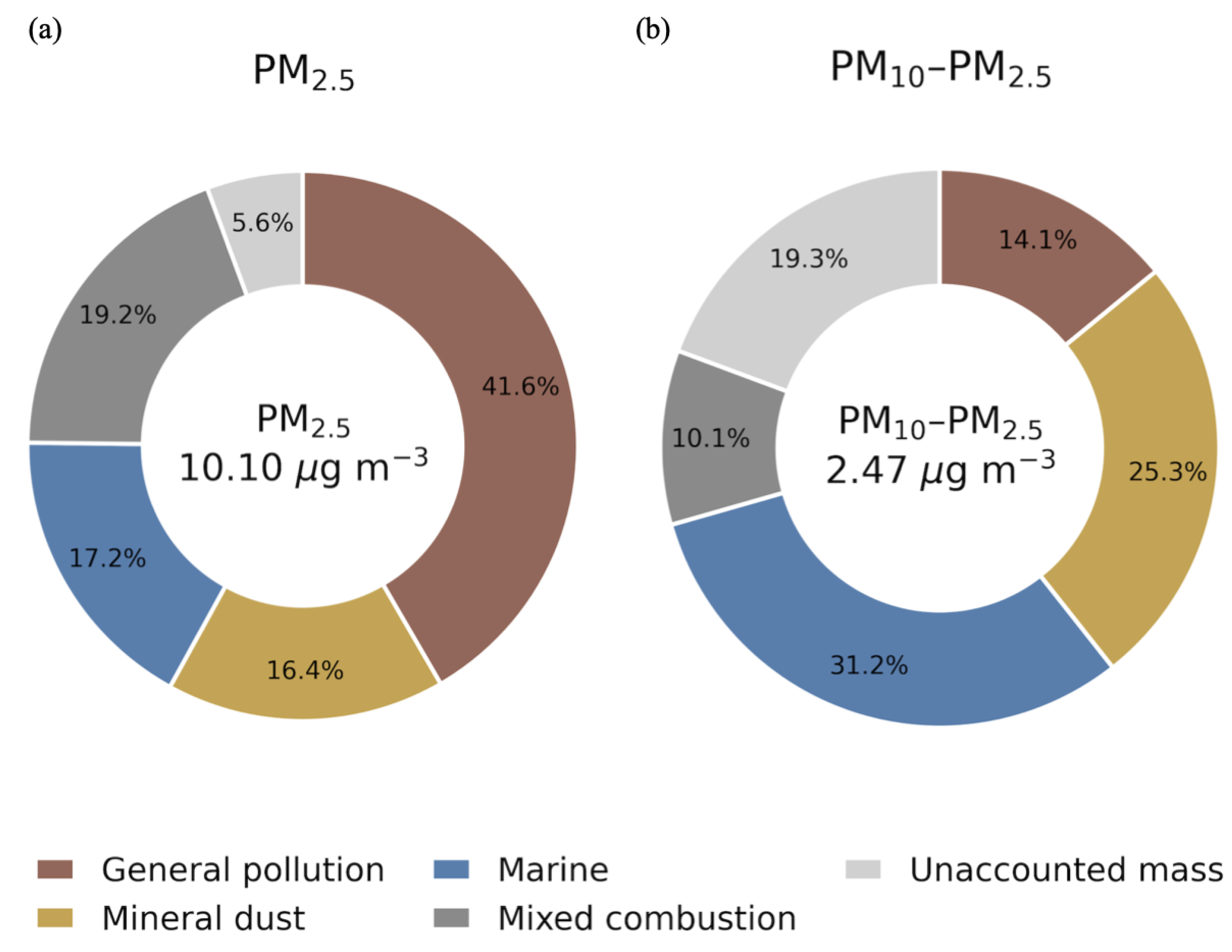
Figure A2.
Estimated source contributions to coarse particulate matter for the selected four-factor ESAT-PMF solution at Hyltemossa. The donut charts show the relative contributions of general pollution, mineral dust, marine aerosol, and mixed combustion to the modelled PM mass, with the total modelled concentration given at the centre of the chart.
Figure A2.
Estimated source contributions to coarse particulate matter for the selected four-factor ESAT-PMF solution at Hyltemossa. The donut charts show the relative contributions of general pollution, mineral dust, marine aerosol, and mixed combustion to the modelled PM mass, with the total modelled concentration given at the centre of the chart.
References
- ACTRIS Sweden. Hyltemossa station. Available online: https://www.actris.se/node/9 (accessed on 4 May 2026).
- Belis, C.A.; Karagulian, F.; Larsen, B.R.; Hopke, P.K. Critical review and meta-analysis of ambient particulate matter source apportionment using receptor models in Europe. Atmos. Environ. 2013, 69, 94–108. [Google Scholar] [CrossRef]
- Belis, C.A.; Larsen, B.R.; Amato, F.; El Haddad, I.; Favez, O.; Harrison, R.M.; Hopke, P.K.; Nava, S.; Paatero, P.; Prévôt, A.S.H.; et al. European Guide on Air Pollution Source Apportionment with Receptor Models; European Commission, Joint Research Centre: Luxembourg, 2014; p. EUR 26080 EN. [Google Scholar] [CrossRef]
- Bozem, H.; Joppe, P.; Li, Y.; Emig, N.; Afchine, A.; Breuninger, A.; Curtius, J.; Hofmann, S.; Ismayil, S.; Kandler, K.; Kunkel, D.; Kutschka, A.; Lachnitt, H.-C.; Petzold, A.; Richter, S.; Röschenthaler, T.; Rolf, C.; Schneider, L.; Schneider, J.; Vogel, A.; Hoor, P. The TropoPause Composition TOwed Sensor Shuttle (TPC-TOSS): A New Airborne Dual Platform Approach for Atmospheric Composition Measurements at the Tropopause. Atmos. Meas. Tech. 2025, 18, 6545–6568. [Google Scholar] [CrossRef]
- Ebert, M.; Inerle-Hof, M.; Weinbruch, S. Environmental scanning electron microscopy as a new technique to determine the hygroscopic behaviour of individual aerosol particles. Atmos. Environ. 2002, 36, 5909–5916. [Google Scholar] [CrossRef]
- Eskes, H.; Tsikerdekis, A.; Ades, M.; Alexe, M.; Benedictow, A.C.; Bennouna, Y.; Blake, L.; Bouarar, I.; Chabrillat, S.; Engelen, R.; et al. Evaluation of the Copernicus Atmosphere Monitoring Service CY48R1 upgrade of June 2023. Atmos. Chem. Phys. 2024, 24, 9475–9514. [Google Scholar] [CrossRef]
- Finlayson-Pitts, B.J. The tropospheric chemistry of sea salt: A molecular-level view of the chemistry of NaCl and NaBr. Chem. Rev. 2003, 103, 4801–4822. [Google Scholar] [CrossRef] [PubMed]
- Furger, M.; Minguillón, M.C.; Yadav, V.; Slowik, J.G.; Hüglin, C.; Fröhlich, R.; Petterson, K.; Baltensperger, U.; Prévôt, A.S.H. Elemental composition of ambient aerosols measured with high temporal resolution using an online XRF spectrometer. Atmos. Meas. Tech. 2017, 10, 2061–2076. [Google Scholar] [CrossRef]
- Glasius, M.; Hansen, A.M.K.; Claeys, M.; Henzing, J.S.; Jedynska, A.D.; Kasper-Giebl, A.; Kistler, M.; Kristensen, K.; Martinsson, J.; Maenhaut, W.; et al. Composition and Sources of Carbonaceous Aerosols in Northern Europe during Winter. Atmos. Environ. 2018, 173, 127–141. [Google Scholar] [CrossRef]
- Hoffman, R.C.; Laskin, A.; Finlayson-Pitts, B.J. Sodium nitrate particles: Physical and chemical properties during hydration and dehydration, and implications for aged sea salt aerosols. J. Aerosol Sci. 2004, 35, 869–887. [Google Scholar] [CrossRef]
- Hopke, P.K. Review of receptor modelling methods for source apportionment. J. Air Waste Manag. Assoc. 2016, 66, 237–259. [Google Scholar] [CrossRef]
- ICOS Sweden. Hyltemossa Research Station. Available online: https://www.icos-sweden.se/hyltemossa (accessed on 4 May 2026).
- Inness, A.; Ades, M.; Agustí-Panareda, A.; Barré, J.; Benedictow, A.; Blechschmidt, A.-M.; Dominguez, J.J.; Engelen, R.; Eskes, H.; Flemming, J.; et al. The CAMS reanalysis of atmospheric composition. Atmos. Chem. Phys. 2019, 19, 3515–3556. [Google Scholar] [CrossRef]
- Ismayil, S.; Kristensson, A.; Eriksson, A.; Ahlberg, E. Data for: Source Apportionment and Single-Particle Characterisation of Background Aerosol in Southern Sweden. Zenodo 2026. [Google Scholar] [CrossRef]
- Jandacka, D.; Durcanska, D.; Cibula, R. Concentration and inorganic elemental analysis of particulate matter in a road tunnel environment (Žilina, Slovakia): Contribution of non-exhaust sources. Front. Environ. Sci. 2022, 10, 952577. [Google Scholar] [CrossRef]
- Kristensson, A.; Dal Maso, M.; Swietlicki, E.; Hussein, T.; Zhou, J.; Kerminen, V.-M.; Kulmala, M. Characterization of new particle formation events at a background site in Southern Sweden: Relation to air mass history. Tellus B Chem. Phys. Meteorol. 2008, 60, 330–344. [Google Scholar] [CrossRef]
- Manousakas, M.I.; Daellenbach, K.R.; Canonaco, F.; Bozzetti, C.; Vlachou, A.; Furger, M.; Haddad, I.E.; Hueglin, C.; Jaffrezo, J.-L.; Prévôt, A.S.H.; et al. Source identification of the elemental fraction of particulate matter using size-segregated, highly time-resolved data and an optimized source apportionment approach. Environ. Int. 2022, 160, 107055. [Google Scholar] [CrossRef]
- Manousakas, M.; Rausch, J.; Jaramillo-Vogel, D.; Schneider-Beltran, K.S.; Alastuey, A.; Jaffrezo, J.-L.; Uzu, G.; Perseguers, S.; Schnidrig, N.; Prévôt, A.S.H.; et al. Comparison of PM source profiles identified by different techniques and the potential of utilizing single-particle analysis data in source apportionment. Atmos. Environ. X 2025, 27, 100363. [Google Scholar] [CrossRef]
- Naturvårdsverket. Partiklar (PM2,5) i regional bakgrund (årsmedelvärden). Reviewed. 1 September 2025. Available online: https://www.naturvardsverket.se/data-och-statistik/luft/partiklar-pm25-halter-i-luft-regional-bakgrund-arsmedelvarden/ (accessed on 1 June 2026).
- Norris, G.; Duvall, R.; Brown, S.; Bai, S. EPA 600/R-14/108; EPA Positive Matrix Factorization (PMF) 5.0 Fundamentals and User Guide. U.S. Environmental Protection Agency: Washington, DC, USA, 2014.
- Paatero, P.; Tapper, U. Positive matrix factorization: A non-negative factor model with optimal utilization of error estimates of data values. Environmetrics 1994, 5, 111–126. [Google Scholar] [CrossRef]
- Panta, A.; Kandler, K.; Alastuey, A.; et al. Insights into the single-particle composition, size, mixing state, and aspect ratio of freshly emitted mineral dust from field measurements in the Moroccan Sahara using electron microscopy. Atmos. Chem. Phys. 2023, 23, 3861–3885. [Google Scholar] [CrossRef]
- Panta, A.; Kandler, K.; Schepanski, K.; Alastuey, A.; Dagsson Waldhauserova, P.; Dupont, S.; Eknayan, M.; González-Flórez, C.; González-Romero, A.; Klose, M.; et al. Unveiling single-particle composition, size, shape, and mixing state of freshly emitted Icelandic dust via electron microscopy analysis. Atmos. Chem. Phys. 2025, 25, 10457–10478. [Google Scholar] [CrossRef]
- Petersson Sjögren, M.; Decesari, S.; Paglione, M.; Deng, J.; Krejci, R.; Swietlicki, E.; Kristensson, A.; et al. Atmospheric fluorescent bioaerosol concentrations measured during 18 months in a coniferous forest in southern Sweden. Atmos. Chem. Phys. 2023, 23, 4977–4994. [Google Scholar] [CrossRef]
- Querol, X.; Tobías, A.; Pérez, N.; et al. Monitoring the impact of desert dust outbreaks for air quality for health studies. Environ. Int. 2019, 130, 104867. [Google Scholar] [CrossRef]
- Reizer, M.; Calzolai, G.; Maciejewska, K.; et al. Measurement report: Receptor modelling for source identification of urban fine and coarse particulate matter using hourly elemental composition. Atmos. Chem. Phys. 2021, 21, 14471–14492. [Google Scholar] [CrossRef]
- Smith, D.; Duvall, R.; Boylan, J.; Brown, S.; Bai, S. ESAT: Environmental Source Apportionment Toolkit Python package. J. Open Source Softw. 2024, 9, 7316. [Google Scholar] [CrossRef]
- Stein, A.F.; Draxler, R.R.; Rolph, G.D.; Stunder, B.J.B.; Cohen, M.D.; Ngan, F. NOAA’s HYSPLIT Atmospheric Transport and Dispersion Modelling System. Bull. Am. Meteorol. Soc. 2015, 96, 2059–2077. [Google Scholar] [CrossRef]
- Tørseth, K.; Aas, W.; Breivik, K.; Fjæraa, A.M.; Fiebig, M.; Hjellbrekke, A.G.; Lund Myhre, C.; Solberg, S.; Yttri, K.E. Introduction to the European Monitoring and Evaluation Programme (EMEP) and observed atmospheric composition change during 1972–2009. Atmos. Chem. Phys. 2012, 12, 5447–5481. [Google Scholar] [CrossRef]
- Tunved, P.; Ström, J. On the seasonal variation in observed size distributions in northern Europe and their changes with decreasing anthropogenic emissions in Europe: Climatology and trend analysis based on 17 years of data from Aspvreten, Sweden. Atmos. Chem. Phys. 2019, 19, 14849–14873. [Google Scholar] [CrossRef]
- TÜV Rheinland Energie und Umwelt GmbH. Report on Supplementary Testing of the Fidas® 200 S Respectively Fidas® 200 Measuring System Manufactured by Palas GmbH for the Components Suspended Particulate Matter PM10 and PM2.5. Report No. 936/21227195/A, 2015. [Google Scholar]
- Viana, M.; Kuhlbusch, T.A.J.; Querol, X.; Alastuey, A.; Harrison, R.M.; Hopke, P.K.; Winiwarter, W.; Vallius, M.; Szidat, S.; Prévôt, A.S.H.; et al. Source apportionment of particulate matter in Europe: A review of methods and results. J. Aerosol Sci. 2008, 39, 827–849. [Google Scholar] [CrossRef]
- Vogt, M.; Schneider, P.; Castell, N.; Hamer, P. Assessment of Low-Cost Particulate Matter Sensor Systems against Optical and Gravimetric Methods in a Field Co-Location in Norway. Atmosphere 2021, 12, 961. [Google Scholar] [CrossRef]
- Waked, A.; Favez, O.; Alleman, L.Y.; Piot, C.; Petit, J.-E.; Delaunay, T.; Verlinden, E.; Golly, B.; Besombes, J.-L.; Jaffrezo, J.-L.; et al. Source apportionment of PM10 in a north-western Europe regional urban background site (Lens, France) using positive matrix factorization and including primary biogenic emissions. Atmos. Chem. Phys. 2014, 14, 3325–3346. [Google Scholar] [CrossRef]
- Worringen, A.; Kandler, K.; Benker, N.; et al. Single-particle characterization of ice-nucleating particles and ice particle residuals sampled by three different techniques. Atmos. Chem. Phys. 2015, 15, 4161–4178. [Google Scholar] [CrossRef]
- Yttri, K. E.; Simpson, D.; Nøjgaard, J. K.; Kristensen, K.; Genberg, J.; Stenström, K.; Swietlicki, E.; Hillamo, R.; Aurela, M.; Bauer, H.; Offenberg, J. H.; Jaoui, M.; Dye, C.; Eckhardt, S.; Burkhart, J. F.; Stohl, A.; Glasius, M. Source apportionment of the summer time carbonaceous aerosol at Nordic rural background sites. Atmos. Chem. Phys. 2011, 11, 13339–13357. [Google Scholar] [CrossRef]
- Zhang, L.; Wang, Y.; Xie, W.; Li, W.; Kojima, T.; Zhang, D. High heterogeneity and ageing state of mineral particles in a slowly-moving dust plume on the southwestern coast of Japan. Sci. Total Environ. 2024, 921, 170318. [Google Scholar] [CrossRef]
- Zimmermann, F.; Ebert, M.; Worringen, A.; Schütz, L.; Weinbruch, S. Environmental scanning electron microscopy (ESEM) as a new technique to determine the ice nucleation capability of individual atmospheric aerosol particles. Atmos. Environ. 2007, 41, 8219–8227. [Google Scholar] [CrossRef]
Figure 1.
Study area and study design. (a) Location of the Vavihill and Hyltemossa regional background stations in southern Sweden. (b) Flow chart summarizing the non-synchronous but complementary datasets, analytical steps, and interpretative framework used in the study. ESAT PMF and HYSPLIT backward trajectory analyses were applied at both Vavihill and Hyltemossa. CAMS reanalysis was used for the Hyltemossa event-scale assessment of dust loading. TuDa-IASS single-particle analysis was used as supporting particle-scale evidence based on samples collected at Hyltemossa.
Figure 1.
Study area and study design. (a) Location of the Vavihill and Hyltemossa regional background stations in southern Sweden. (b) Flow chart summarizing the non-synchronous but complementary datasets, analytical steps, and interpretative framework used in the study. ESAT PMF and HYSPLIT backward trajectory analyses were applied at both Vavihill and Hyltemossa. CAMS reanalysis was used for the Hyltemossa event-scale assessment of dust loading. TuDa-IASS single-particle analysis was used as supporting particle-scale evidence based on samples collected at Hyltemossa.
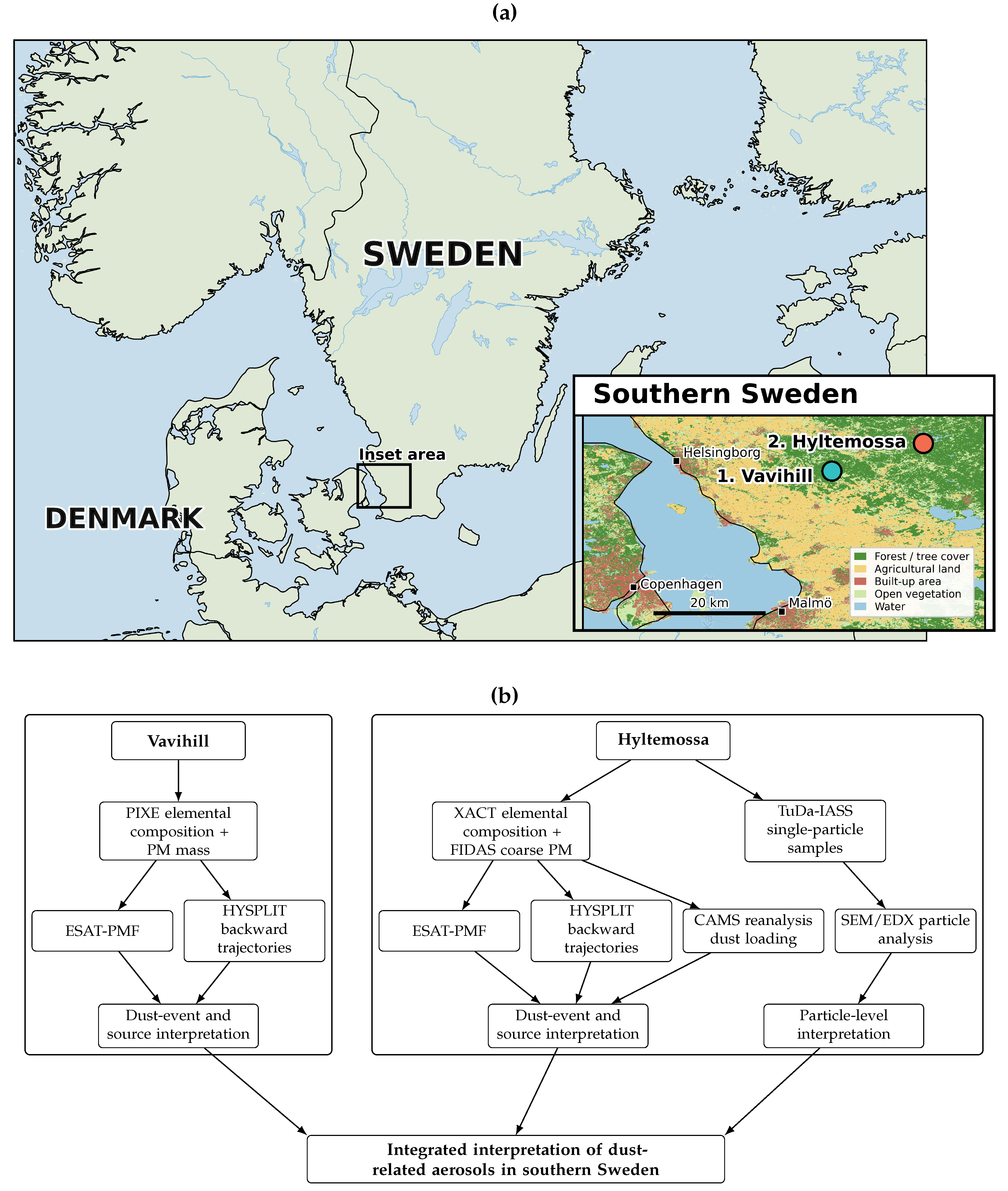
Figure 2.
Relationship between measured PM fractions and performance of the selected four-factor ESAT-PMF solution at Vavihill. (a) PM10 versus PM2.5, showing the fitted no-offset regression (solid line) and the 1:1 relationship (dashed line). (b) Modelled versus measured PM2.5. (c) Modelled versus measured PM10–PM2.5. In panels (b,c), the dashed line indicates the 1:1 relationship and the solid line indicates the fitted regression. The corresponding R2 values are given in each panel.
Figure 2.
Relationship between measured PM fractions and performance of the selected four-factor ESAT-PMF solution at Vavihill. (a) PM10 versus PM2.5, showing the fitted no-offset regression (solid line) and the 1:1 relationship (dashed line). (b) Modelled versus measured PM2.5. (c) Modelled versus measured PM10–PM2.5. In panels (b,c), the dashed line indicates the 1:1 relationship and the solid line indicates the fitted regression. The corresponding R2 values are given in each panel.
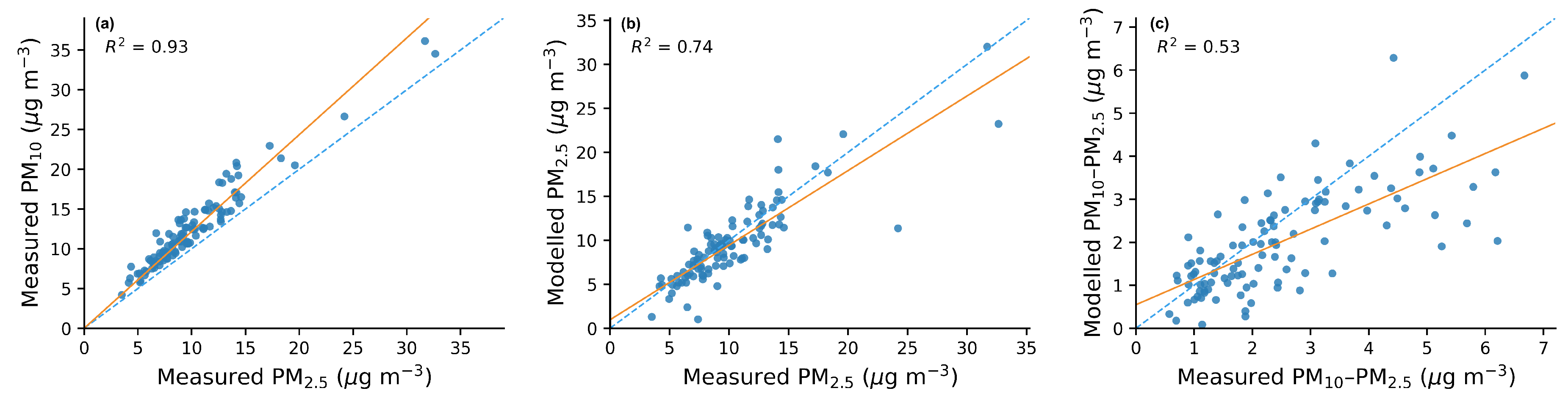
Figure 3.
Factor fingerprints for the selected four-factor ESAT-PMF solution (filtered Model 4) at Vavihill. (a) Coarse-fraction species together with PM10–PM2.5. (b) Fine-fraction species together with PM2.5. Bars show the relative contribution of the four resolved factors to each species: general pollution, mineral dust, marine aerosol, and mixed combustion. The prefixes c and f denote coarse and fine fraction species, respectively.
Figure 3.
Factor fingerprints for the selected four-factor ESAT-PMF solution (filtered Model 4) at Vavihill. (a) Coarse-fraction species together with PM10–PM2.5. (b) Fine-fraction species together with PM2.5. Bars show the relative contribution of the four resolved factors to each species: general pollution, mineral dust, marine aerosol, and mixed combustion. The prefixes c and f denote coarse and fine fraction species, respectively.
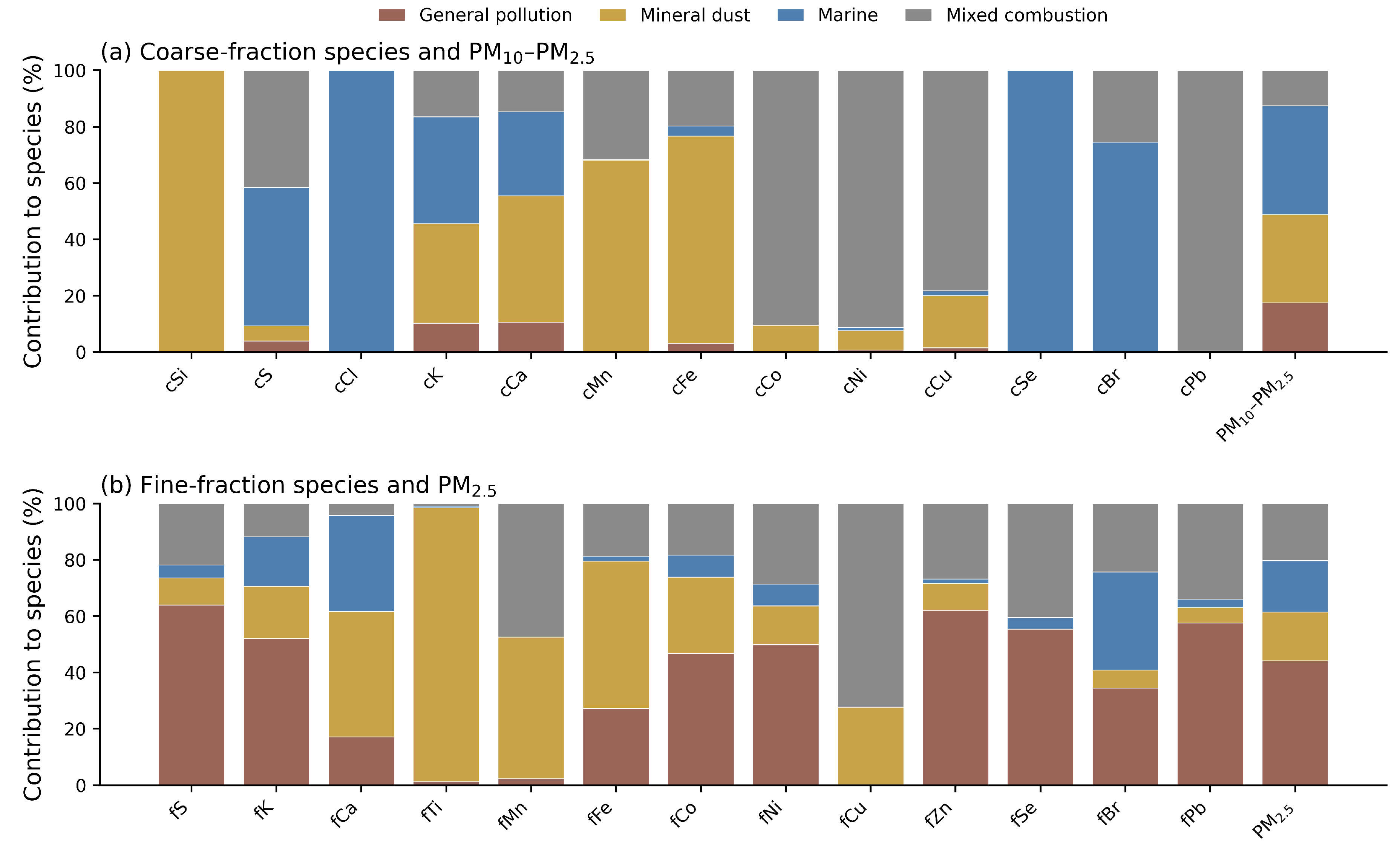
Figure 4.
Temporal evolution of source contributions to coarse and fine PM at Vavihill for the selected four-factor ESAT–PMF solution. (a) PM10–PM2.5. (b) PM2.5. The stacked coloured areas represent the contributions from the four resolved factors, the solid black line shows the measured concentration, and the dashed black line shows the modelled sum. Species with weak model reconstruction were treated cautiously in the factor interpretation, as described in Section 2.3.2.
Figure 4.
Temporal evolution of source contributions to coarse and fine PM at Vavihill for the selected four-factor ESAT–PMF solution. (a) PM10–PM2.5. (b) PM2.5. The stacked coloured areas represent the contributions from the four resolved factors, the solid black line shows the measured concentration, and the dashed black line shows the modelled sum. Species with weak model reconstruction were treated cautiously in the factor interpretation, as described in Section 2.3.2.
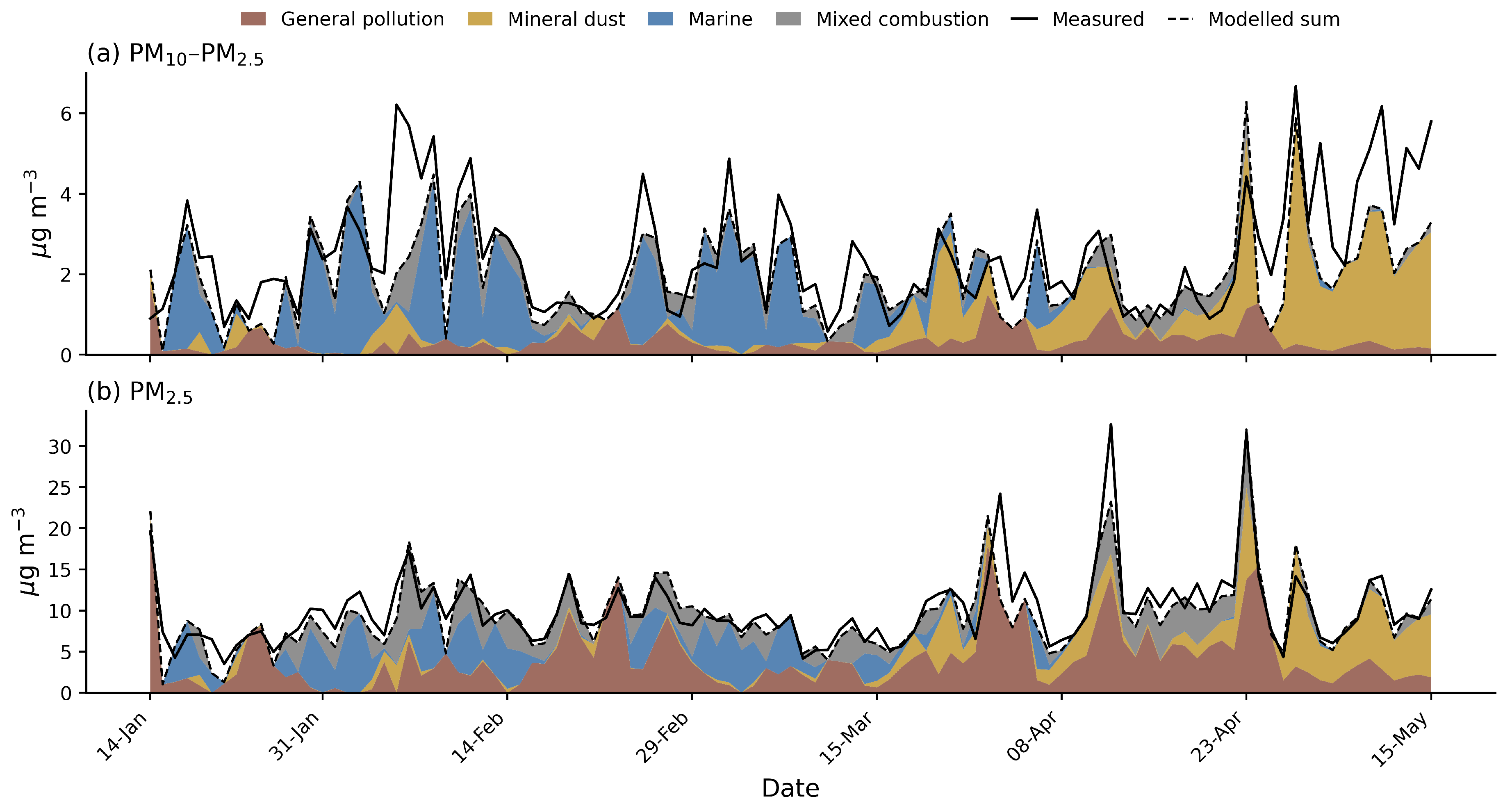
Figure 5.
Four-day (96 h) HYSPLIT backward trajectories for selected episodes. The Vavihill trajectories show candidate mineral-associated aerosol episodes arriving at 12:00 UTC on 30 March, 19 April, 23 April, and 3 May 2000. The Hyltemossa trajectory shows the selected coarse-particle episode arriving at 12:00 UTC on 8 April 2023. The Hyltemossa trajectory is included as a separate case study and is not temporally linked to the Vavihill events.
Figure 5.
Four-day (96 h) HYSPLIT backward trajectories for selected episodes. The Vavihill trajectories show candidate mineral-associated aerosol episodes arriving at 12:00 UTC on 30 March, 19 April, 23 April, and 3 May 2000. The Hyltemossa trajectory shows the selected coarse-particle episode arriving at 12:00 UTC on 8 April 2023. The Hyltemossa trajectory is included as a separate case study and is not temporally linked to the Vavihill events.
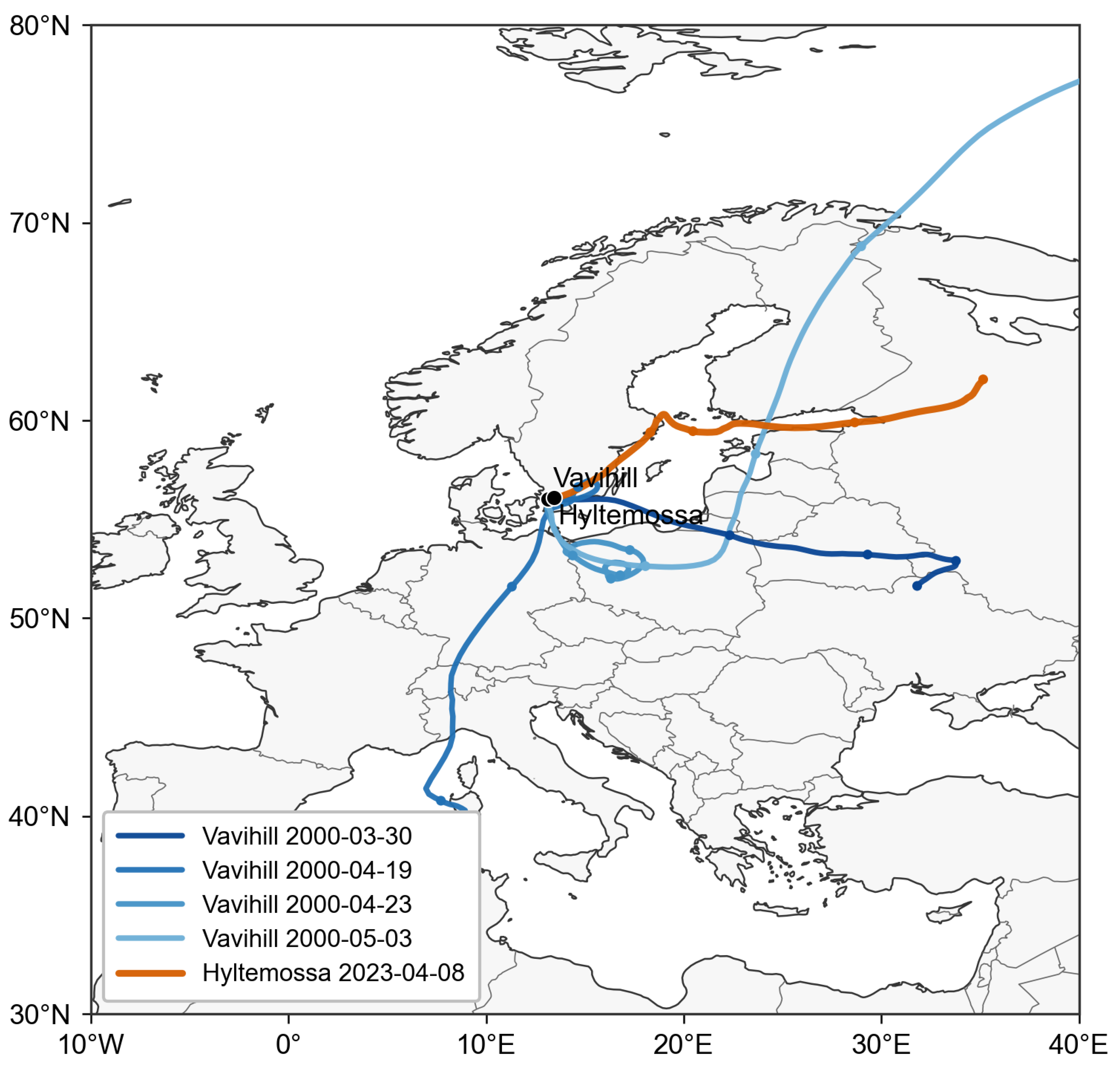
Figure 6.
Relationship between measured PM fractions and performance of the selected four-factor ESAT-PMF solution at Hyltemossa. (a) PM10 versus PM2.5, showing the fitted no-offset regression (solid line) and the 1:1 relationship (dashed line). (b) Modelled versus measured PM10–PM2.5. The corresponding R2 values are given in each panel.
Figure 6.
Relationship between measured PM fractions and performance of the selected four-factor ESAT-PMF solution at Hyltemossa. (a) PM10 versus PM2.5, showing the fitted no-offset regression (solid line) and the 1:1 relationship (dashed line). (b) Modelled versus measured PM10–PM2.5. The corresponding R2 values are given in each panel.
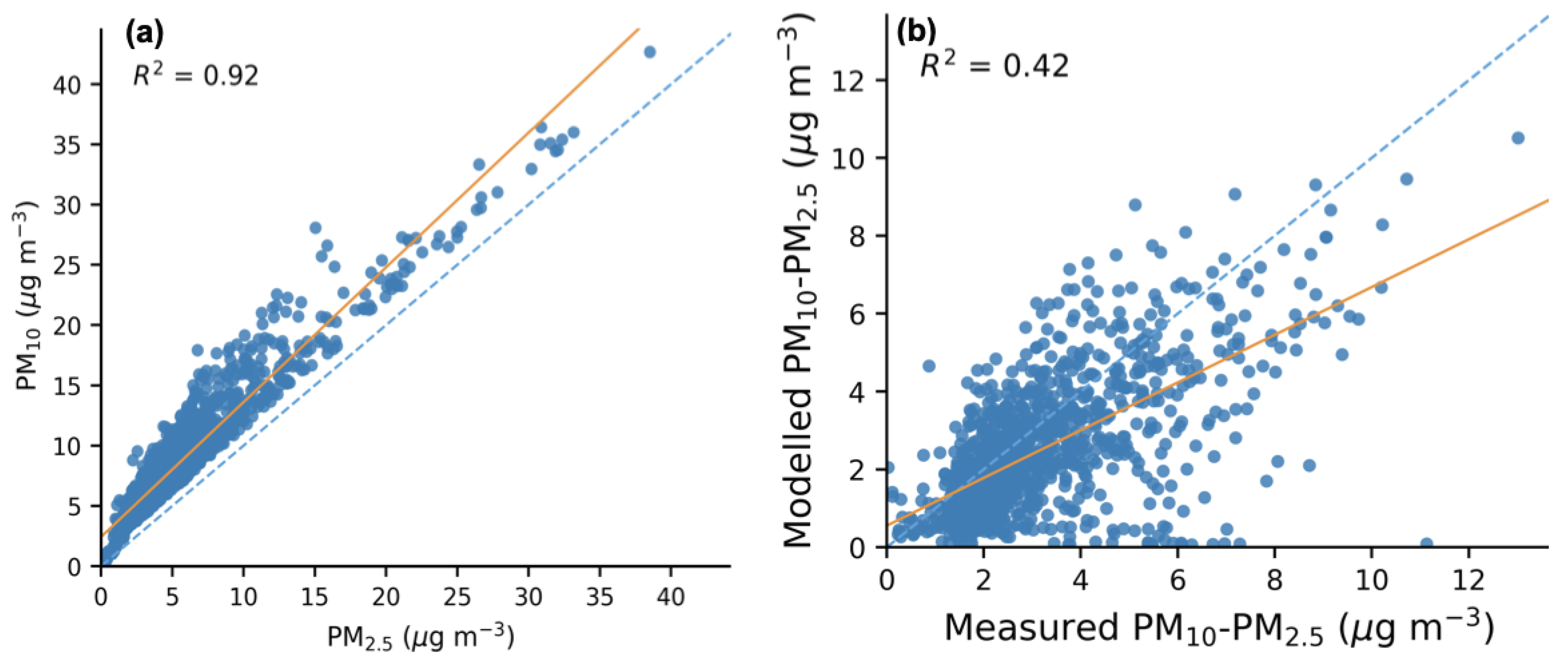
Figure 7.
Resolved source profiles for the selected four-factor ESAT-PMF solution at Hyltemossa. Bars show the percentage contribution of each factor to the resolved mass of each chemical species and to PM10–PM2.5. The four factors are interpreted as general pollution, mineral dust, marine aerosol, and mixed combustion.
Figure 7.
Resolved source profiles for the selected four-factor ESAT-PMF solution at Hyltemossa. Bars show the percentage contribution of each factor to the resolved mass of each chemical species and to PM10–PM2.5. The four factors are interpreted as general pollution, mineral dust, marine aerosol, and mixed combustion.
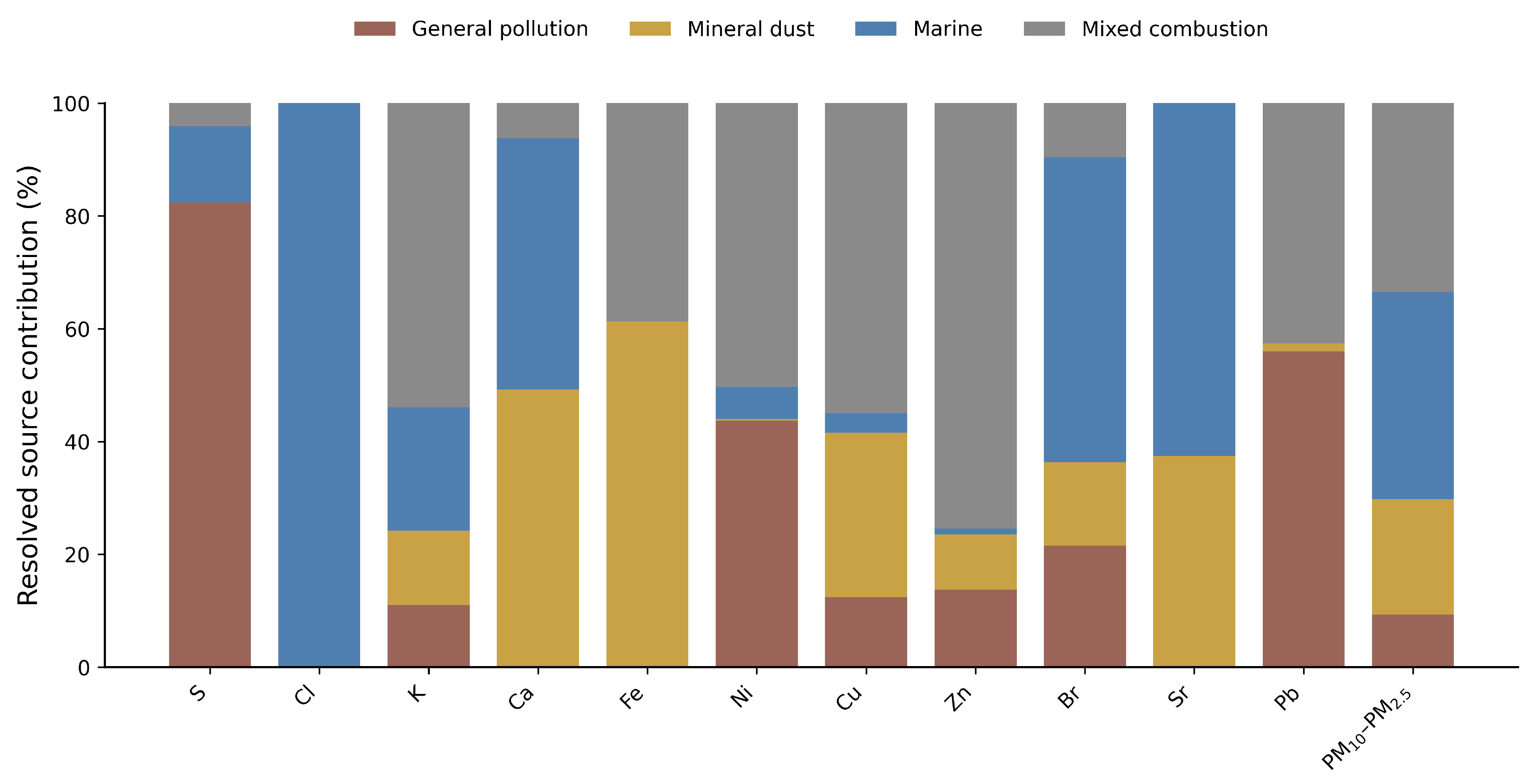
Figure 8.
Temporal variation in measured and modelled PM10–PM concentrations at Hyltemossa, together with the resolved source contributions from the selected four factor ESAT-PMF solution. Coloured stacked areas represent the contributions from general pollution, mineral dust, marine aerosol, and mixed combustion. The solid black line shows measured PM10–PM, and the dashed black line shows the modelled PM10–PM concentration. The grey vertical band marks the main data gap in the XACT FIDAS record.
Figure 8.
Temporal variation in measured and modelled PM10–PM concentrations at Hyltemossa, together with the resolved source contributions from the selected four factor ESAT-PMF solution. Coloured stacked areas represent the contributions from general pollution, mineral dust, marine aerosol, and mixed combustion. The solid black line shows measured PM10–PM, and the dashed black line shows the modelled PM10–PM concentration. The grey vertical band marks the main data gap in the XACT FIDAS record.
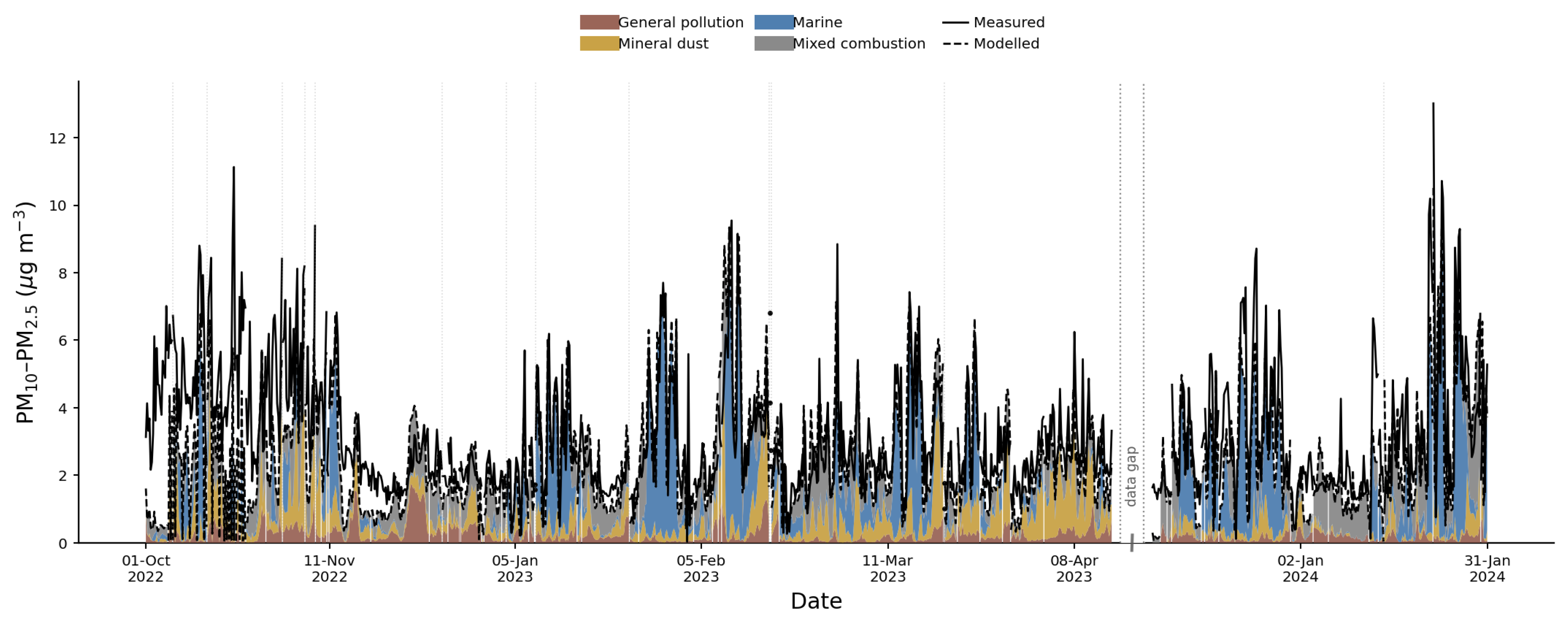
Figure 9.
Event-scale diagnostics for the 8 April 2023 coarse-particle episode at Hyltemossa. (a) CAMS PM10, surface dust concentration, and dust AOD550 during the full analysis period, with the selected event window shaded in grey. (b) Observed FIDAS PM10–PM2.5, ESAT-PMF reconstructed PM10–PM2.5, CAMS surface dust, and CAMS dust AOD550 during the event window. (c) XACT elemental concentrations expressed as robust z scores relative to the full XACT matched period. The event shows enhanced coarse PM together with elevated Ca and Fe concentrations and elevated CAMS dust indicators.
Figure 9.
Event-scale diagnostics for the 8 April 2023 coarse-particle episode at Hyltemossa. (a) CAMS PM10, surface dust concentration, and dust AOD550 during the full analysis period, with the selected event window shaded in grey. (b) Observed FIDAS PM10–PM2.5, ESAT-PMF reconstructed PM10–PM2.5, CAMS surface dust, and CAMS dust AOD550 during the event window. (c) XACT elemental concentrations expressed as robust z scores relative to the full XACT matched period. The event shows enhanced coarse PM together with elevated Ca and Fe concentrations and elevated CAMS dust indicators.
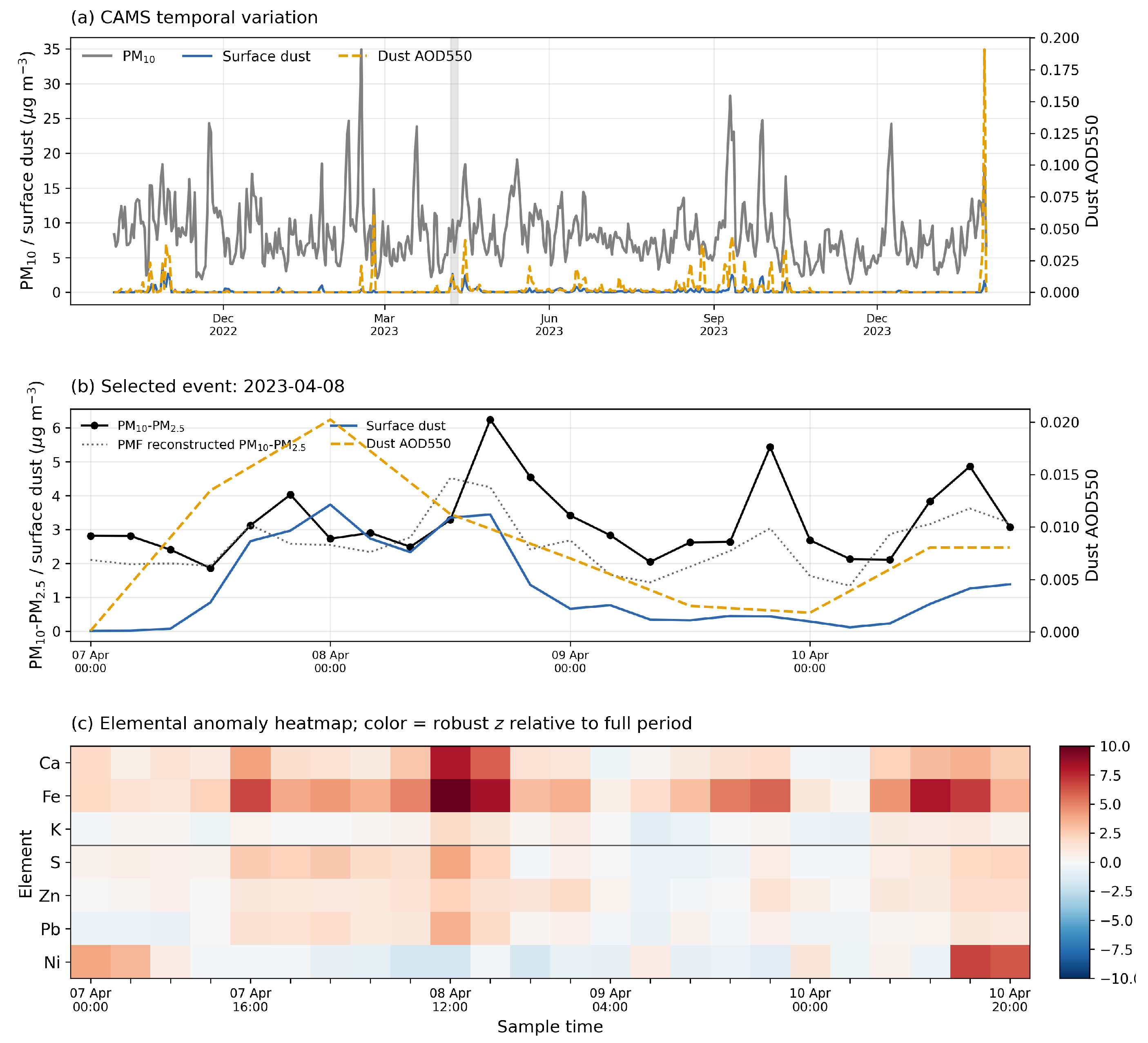
Figure 10.
Event-scale diagnostics for the 24–28 October 2022 coarse-particle episode at Hyltemossa. (a) CAMS PM10, surface dust concentration, and dust AOD550 during the full analysis period, with the selected event window shaded in grey. (b) Observed FIDAS PM10–PM2.5, PMF-reconstructed PM10–PM2.5, CAMS surface dust, and CAMS dust AOD550 during the event window. (c) XACT elemental concentrations expressed as robust z scores relative to the full XACT matched period. The episode shows repeated coarse PM enhancements together with elevated Fe, Ca, and K concentrations, as well as elevated Pb, Zn, and Ni concentrations.
Figure 10.
Event-scale diagnostics for the 24–28 October 2022 coarse-particle episode at Hyltemossa. (a) CAMS PM10, surface dust concentration, and dust AOD550 during the full analysis period, with the selected event window shaded in grey. (b) Observed FIDAS PM10–PM2.5, PMF-reconstructed PM10–PM2.5, CAMS surface dust, and CAMS dust AOD550 during the event window. (c) XACT elemental concentrations expressed as robust z scores relative to the full XACT matched period. The episode shows repeated coarse PM enhancements together with elevated Fe, Ca, and K concentrations, as well as elevated Pb, Zn, and Ni concentrations.
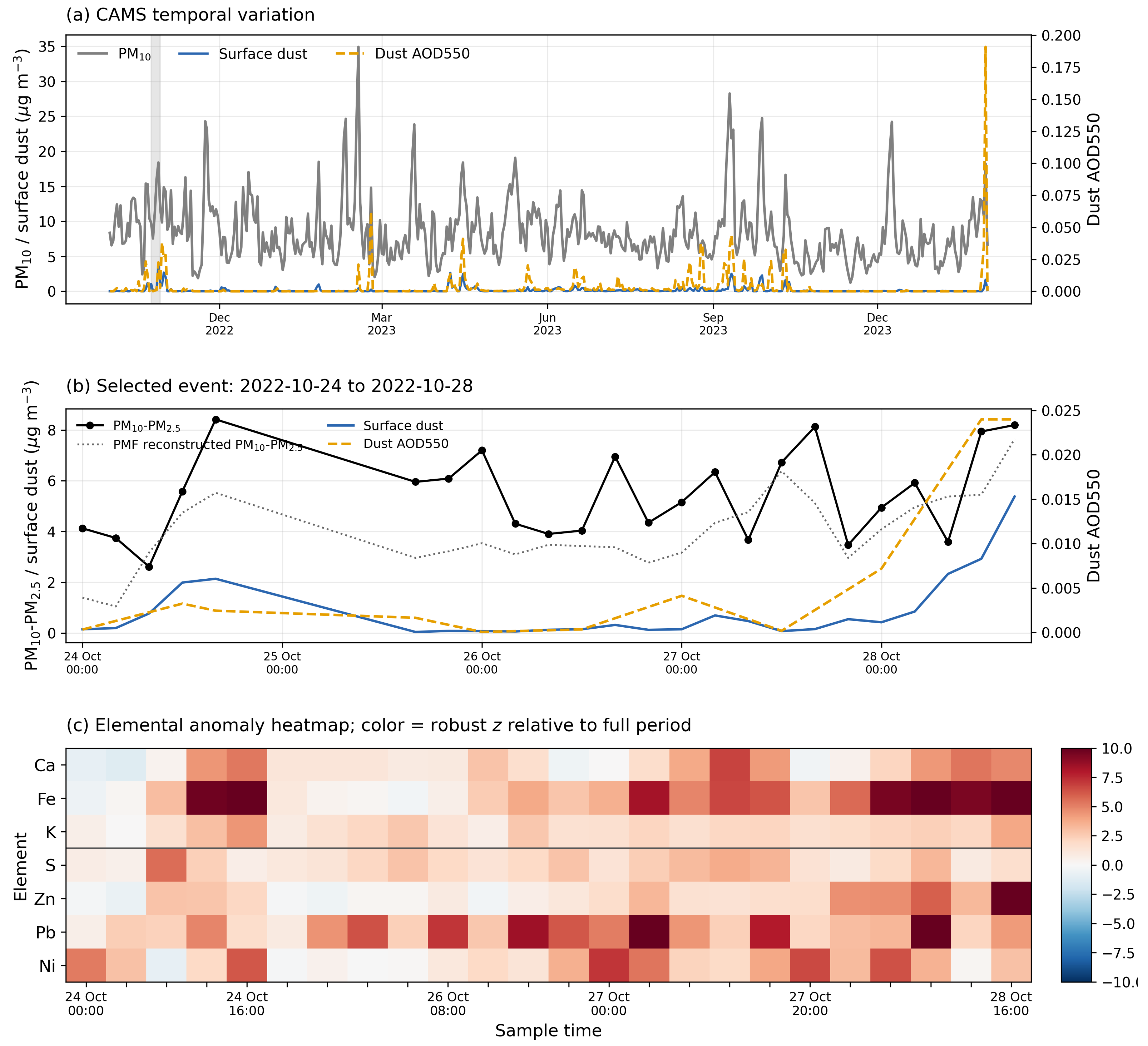
Table 1.
Representative particle classes observed by SEM/EDX at Hyltemossa.
| Particle class | Main morphological characteristics | Indicative EDX features | Interpretation |
|---|---|---|---|
| Mineral-dust-like | Angular or irregular particles; silicate-rich grains; occasional Ca- and Fe-bearing particles | Al, Si, Ca, Fe, K, Mg | Consistent with crustal or resuspended mineral material |
| Aged sea salt | Rounded or partially restructured particles; possible reaction rims | Na-rich particles with partial Cl depletion and S enrichment | Consistent with atmospheric ageing and chloride depletion |
| Mixed anthropogenic | Internally mixed particles with heterogeneous morphology | Combinations of Si, Ca, Fe, S, Zn, Pb, or other trace metals | Indicates mixing between natural and anthropogenic aerosol components |
| Soot-like | Chain-like or aggregated carbonaceous particles, where resolvable | Strong C signal with limited inorganic contribution | Supports the presence of combustion-related carbonaceous particles |
| Biological | Irregular or rounded carbon-rich particles, sometimes with textured surfaces | C-rich composition with P and/or minor inorganic constituents | Suggests a contribution from natural biological aerosol particles |
| Secondary sulfate-rich | Rounded or internally mixed particles; sometimes associated with aged sea salt or mineral particles | S-rich composition, with minor Na, Ca, or other elements where present | Consistent with secondary aerosol formation and atmospheric processing |
Disclaimer/Publisher’s Note: The statements, opinions and data contained in all publications are solely those of the individual author(s) and contributor(s) and not of MDPI and/or the editor(s). MDPI and/or the editor(s) disclaim responsibility for any injury to people or property resulting from any ideas, methods, instructions or products referred to in the content. |
© 2026 by the authors. Licensee MDPI, Basel, Switzerland. This article is an open access article distributed under the terms and conditions of the Creative Commons Attribution (CC BY) license (http://creativecommons.org/licenses/by/4.0/).
Copyright: This open access article is published under a Creative Commons CC BY 4.0 license, which permit the free download, distribution, and reuse, provided that the author and preprint are cited in any reuse.


