

Submitted:
16 June 2026
Posted:
17 June 2026
You are already at the latest version
Abstract
We study synchronization transitions in financial markets via persistent homology applied to time-varying correlation networks. Vietoris–Rips filtrations on rolling Mantegna distance matrices (49 Fama–French industry portfolios, 1976–2026) capture one-dimensional homological cycles (H1) that reflect intransitive sectoral triples—configurations where two pairwise correlations are strong but the third is weak. Exact analytical null distributions for the persistence and count of such intransitive precursors in random metric spaces are derived. The data reveal a two-scale topological response: stress amplifies intransitivity among the most strongly correlated industries while dissolving it among weakly and moderately correlated ones. Because static topological summaries are highly collinear with average correlation, we assess the predictive ability of the momentum of topological reorganization for market stress onset. At short horizons (5–20 days) the momentum of average pairwise correlation dominates, but at 80–100 day horizons the standardized rate of change of the persistence-weighted mean cycle birth (dAvgBirth) significantly outperforms both a correlation-only control and the momentum of average correlation itself. Decomposing cycles into sectoral triples maps abstract topology onto interpretable linkages. The findings show that higher-order topological momentum captures a slow, structural component of stress build-up complementary to fast-moving correlation dynamics.
Keywords:
persistent homology
; correlation networks
; market stress
; topological data analysis
1. Introduction
Financial markets display higher correlations during systemic stress. In calm periods returns cluster around sectoral factors, yielding moderate average correlations and identifiable community structure. As risk builds, a dominant market factor drives synchronization: cross-sectional dispersion compresses and correlations converge [1,2,3]. Standard diagnostics—average pairwise correlation, the first principal component’s variance share, or random-matrix spectral thresholds [4,5,6]—capture aggregate alignment but ignore higher-order structural configurations. In particular, they cannot detect correlation intransitivity: situations where A correlates strongly with B, and B with C, yet A and C remain weakly linked. Such triples represent local failures of transitive closure in the correlation network.
Persistent homology provides a framework for quantifying these higher-order structures [7,8]. While it has been applied to financial time series via delay embeddings of single indices [9,10], its use for correlation-network dynamics has received limited attention. Prior network-based work relies on minimum spanning trees, planar filters, or hard thresholding [2,3,11], which remove cycles and discard multi-scale topological information. Recent applications have used topological filtering to study the temporal persistence of simplicial motifs, demonstrating long memory in market structures [20]. The Vietoris–Rips filtration preserves the full simplicial hierarchy as the distance threshold varies, enabling scale-specific signal isolation with stability guarantees [12].
We apply this framework to daily returns of the 49 Fama–French industry portfolios (1976–2026), constructing rolling Mantegna distance matrices and computing persistence diagrams to track -cycle dynamics. Exact analytical null distributions for the persistence and count of intransitive precursors in random metric spaces are derived, providing geometric benchmarks. The empirical analysis shows that stress induces a scale-dependent topological reorganization: intransitive configurations amplify among highly correlated sectors while dissolving elsewhere. Static topological summaries are collinear with average correlation, but momentum-transformed indicators capture incremental predictive information for stress onset. The framework further maps abstract homological cycles to interpretable sectoral triples.
2. Materials and Methods
2.1. Correlation Metric Space and Rolling Construction
Let denote the daily logarithmic return of the i-th Fama–French industry portfolio (, ). For a rolling window of W trading days we compute the Pearson correlation matrix over . The Mantegna transformation [1] embeds these correlations into a Euclidean metric:
where for perfect positive correlation and for perfect negative correlation. A window of W days balances estimation stability for pairwise distances with responsiveness to structural shifts [2,3]. The sequence forms a dynamic metric space suitable for topological filtration.
2.2. Persistent Homology and Vietoris–Rips Filtration
For each t we construct a family of Vietoris–Rips simplicial complexes : a k-simplex belongs to if for all . As grows,
generates a sequence of homology groups . We focus on , which captures one-dimensional topological holes. In a Vietoris–Rips complex, non-trivial cycles correspond to closed loops of length that lack interior 2-simplices. Each cycle is described by a birth parameter b (the filtration value at which the loop closes) and a death parameter d (the value at which it is trivialised). The collection of birth–death pairs forms the persistence diagram [16]. The persistence stability theorem [12] guarantees bounded sensitivity to metric perturbations.
A non-trivial cycle is mechanically sustained by missing internal chords; therefore every such cycle contains intransitive sectoral triples along its support: two pairwise correlations are strong while the third is weak. These triples serve as interpretable proxies for higher-order topological stress.
2.3. Topological Indicators
A simple aggregate such as total persistence may conflate opposite signals at different correlation scales. To isolate scale-specific information we extract the following summaries from each daily diagram.
- Scale-specific total persistence. Let and be fixed birth windows for high- and low-correlation regimes. The summed persistence for cycles born in the high window isand is defined analogously.
- Scale-specific cycle counts. and count cycles with strictly positive persistence () born in the respective windows:and similarly for .
- Global average cycle birth. A persistence-weighted centre of the diagram iswhere and are the birth and persistence of the i-th cycle on day t.
- First Betti number at a given scale. For a fixed filtration value , the first Betti numbercounts -cycles alive at that . We use only for scale calibration (Section 3.2), not for prediction.
The indicators form the basis of our topological predictors.
2.4. Statistical Framework for Stress Forecasting
Topological invariants capture qualitative order-parameter behaviour rather than volatility amplitude; linear forecasting of volatility levels is therefore not the objective. We cast the problem as binary regime detection.
Day t is stressed if the realised volatility of the Fama–French Market Factor exceeds the 90th percentile of its rolling 252-day historical distribution:
where is the standard deviation of logarithmic market returns over a 20-day window. The lagged quantile computation avoids look-ahead bias. For each horizon days we define a binary onset target:
where is the indicator that stress begins within h days.
The model is estimated only on calm days (). For indicator and horizon h we estimate
with the logistic link and the average pairwise correlation. Because is defined via realised volatility, we exclude volatility and its lags from the controls to avoid mechanical dependence; is the sole control.
Temporal splits and hyper-parameter tuning.
The sample is split into Training (1976-02-27 to 2006-02-26), Validation (2006-02-27 to 2016-02-26), and Test (2016-02-27 to 2026-02-27) periods. For each momentum indicator we select a single pair of parameters that maximises the validation AUC for the onset target at horizon days. The chosen parameters are then fixed and applied to all horizons. No Test-period information enters indicator construction or model specification.
Bootstrap inference.
We use a moving-block bootstrap on the Test set (block length 120 days, 1000 replications) with predictive models held fixed. The block length matches the characteristic horizon of the predictive signal (60–100 trading days) and yields conservative inference by preserving the serial dependence induced by overlapping rolling windows. We report 95% percentile confidence intervals for AUC and Brier scores. One-sided pairwise tests compare the best indicator against competitors: the bootstrap p-value is the fraction of replications where the competitor’s AUC equals or exceeds that of the best indicator.
3. Results
3.1. Descriptive Statistics
We use daily logarithmic returns of the Kenneth French 49 Industry Portfolios [13]1 from 27 February 1976 to 27 February 2026 (12,605 trading days). The portfolios are value-weighted, reconstructed annually from CRSP/Compustat with four-digit SIC codes, and include delistings and corporate actions, eliminating survivorship bias by construction. A rolling window of trading days yields observation windows.
We benchmark Mantegna distance against average pairwise correlation and the variance share of the first principal component .

Table 1.
Descriptive statistics of correlation space (, , 1976–2026).
| Metric | Full sample | Calm periods | Stress periods | p-value |
|---|---|---|---|---|
| 0.248 | 0.239 | 0.315 | ||
| 0.558 | 0.540 | 0.681 | ||
| Mean Mantegna distance | 0.466 | 0.477 | 0.387 |
Notes:p-values from Mann–Whitney test. Stress defined as 20-day realised volatility of the Fama–French Market Factor exceeding the 90th percentile over the preceding year.
Average pairwise correlation is in the full sample, consistent with a multi-factor market with pronounced sectoral structure. During stress periods rises to and to (), the synchronisation effect documented in prior literature [3]. The mean Mantegna distance falls from to (), reflecting compression of the correlation metric space under elevated systemic risk.
3.2. Descriptive Topology: Two-Scale Structure
Persistent homology detects -cycles across the study period; at least one cycle appears in every one of the rolling windows (mean , maximum 50; Table 2).
Figure 1.
Topological changes during financial stress (, ). (a) Distribution of -cycle counts by regime. (b) Marginal density of birth filtration values. (c) Mean Betti number profile ; points significant at (Mann–Whitney) are marked. (d) Corresponding p-value profile (log scale). Shaded regions indicate the HIGH-correlation (red) and LOW-correlation (blue) scales identified on the calibration sample, with median boundaries and 95% bootstrap confidence intervals.
Figure 1.
Topological changes during financial stress (, ). (a) Distribution of -cycle counts by regime. (b) Marginal density of birth filtration values. (c) Mean Betti number profile ; points significant at (Mann–Whitney) are marked. (d) Corresponding p-value profile (log scale). Shaded regions indicate the HIGH-correlation (red) and LOW-correlation (blue) scales identified on the calibration sample, with median boundaries and 95% bootstrap confidence intervals.
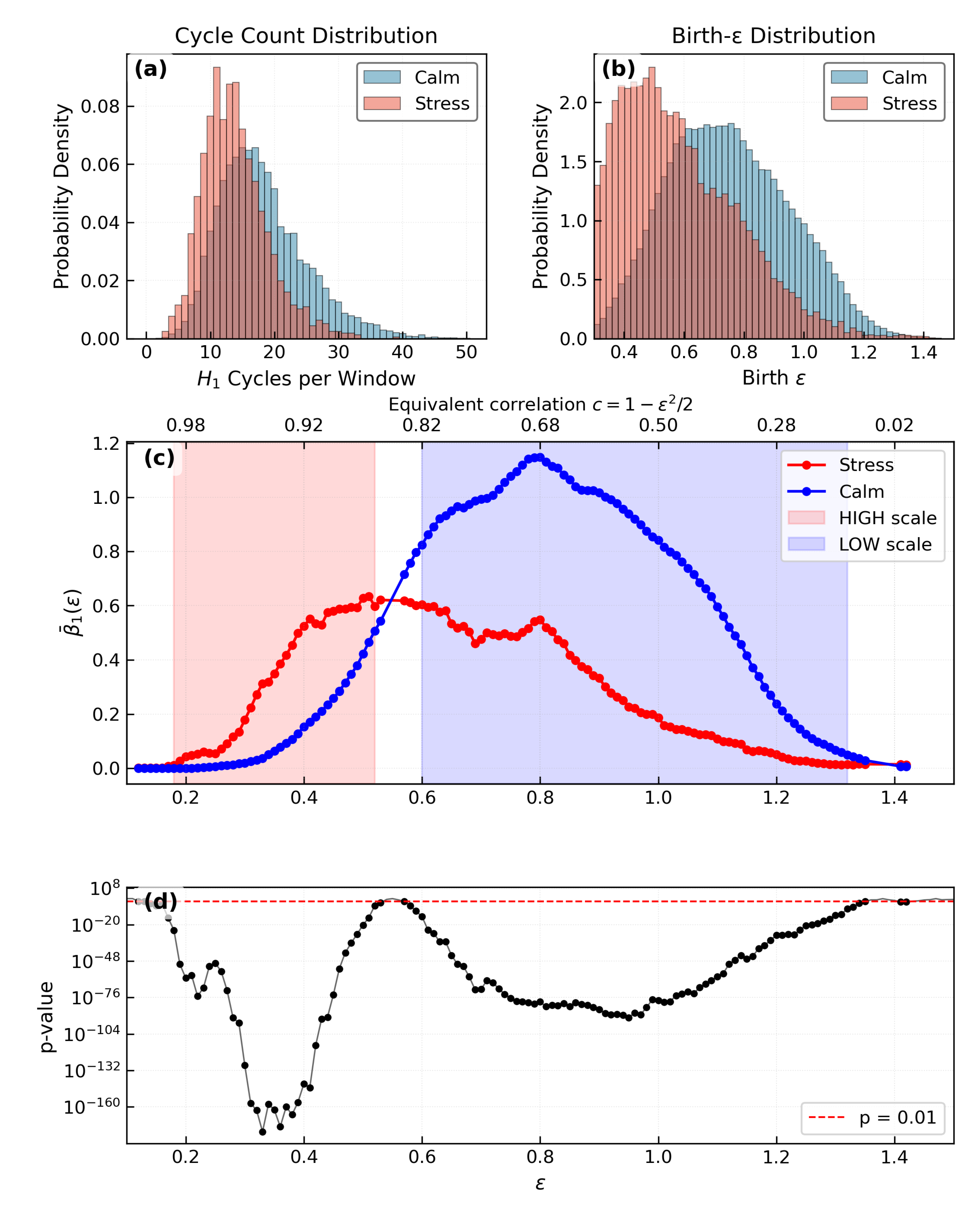
We identify filtration scales where market topology differs systematically between stress and calm regimes using a two-stage procedure. First, a dense grid (step ) is pre-filtered by requiring that be significant (, two-sided Mann–Whitney U test) in both temporal halves of the original sample. Second, boundary uncertainty is quantified via a moving-block bootstrap ( replications, block length trading days): significant -ranges with consistent sign are aggregated, and final scales are reported as median boundaries with 95% empirical confidence intervals. This yields two intervals:
- 1.
- HIGH-correlation scale (, equivalent ): is higher during stress.
- 2.
- LOW-correlation scale (, equivalent ): is higher during calm periods.
Thus, stress induces opposite topological responses at different correlation strengths. In calm periods, sectoral differentiation generates intransitive configurations across a broad range of moderate and weak correlations. As systemic risk rises, a dominant market factor synchronises most pairs, dissolving low-scale cycles; however, incomplete synchronisation among the strongest correlates () creates new persistent high-scale cycles. The bootstrap-robust intervals suggest that the two scales reflect stable structural properties, not sample-specific artefacts.
3.3. Robustness to Window Selection and Timescale Alignment
The two-scale pattern is broadly insensitive to the choice of correlation window W and volatility horizon L. Mean Betti profiles computed across and (Figure 2) display clear separation in seven of the nine configurations; only the misaligned pairs and show attenuated significance. Aligning ensures that regime labels reflect the contemporaneous correlation structure [2,17,18]. We therefore fix for the main analysis; this matches the characteristic correlation decay of the FF-49 universe and standard practice for daily returns [1].
3.4. Sectoral Decomposition of Intransitive Configurations
A one-dimensional homological cycle () at the high-correlation scale implies an intransitive triple of sectors where two pairwise correlations exceed a filtration threshold while the third remains below it. Extracting these triples provides a sector-level interpretation of the topological signal: the framework identifies configurations where synchronization fails to close transitive triangles.
The pipeline executes in minutes on standard hardware [15], allowing for daily recomputation. Figure 3 and Figure 4 illustrate the sectoral topology at selected thresholds during a calm trading day (2026-02-27) and a stressed trading day (2020-03-10).
During calm regimes, intransitive configurations in the high-correlation band are sparse and topologically disconnected. At (), the network contains 22 triples distributed across isolated clusters, reflecting localized structural frictions. Tightening the threshold to () reduces the triple count to 2. The Containers sector appears in intransitive links across both thresholds, indicating a persistent structural friction (e.g., supply-chain or inventory cycle constraints). This alignment is retrospective and illustrative: the configuration identified in late February 2026 coincided with conditions preceding the March 2026 global logistics disruption. While not predictive, this example shows how localized intransitive configurations can serve as diagnostic markers for structural frictions.
During stress periods, intransitive structures persist even at extreme correlation thresholds. At (), where calm markets show no triples, the stress network contains 73 triples that form a connected component. The sectoral aggregation graph shows contributions from Wholesale, Banks, Business Services, Chemicals, and Communication. These sectors link otherwise disconnected parts of the economy.
Figure 5 shows the temporal evolution of intransitive triple counts across the LOW- and HIGH-correlation bands over 2006–2026. For this illustration, stress is defined exogenously rather than via volatility. The upper panel tracks the LOW-correlation range; the lower panel tracks the HIGH-correlation range. During systemic stress episodes (marked by vertical dashed lines), LOW-correlation triple counts decline while HIGH-correlation counts increase. This pattern is consistent with the two-scale structure identified in the persistence analysis.
The distinction between structural and cyclical intransitivity has implications for risk management. Persistent, threshold-robust triples in isolated sectors (e.g., Containers) may reflect supply-chain or operational bottlenecks. Monitoring HIGH-scale triple accumulation provides a sector-level diagnostic that complements aggregate volatility or correlation metrics.
3.5. Exact Analytical Nulls and Topological Geometry
We derive analytical benchmarks for random metric spaces and compare the empirical market against these baselines.
3.5.1. Intransitive Triangles and Exact Null Distributions
In a Vietoris–Rips filtration, a 1-cycle requires at least four vertices. The intermediate 3-point motif—intransitive triangle—is structurally relevant. For a triangle with edge lengths ordered as , the open 2-path exists at scales , with persistence .
Let be the order statistics of three i.i.d. variables conditioned on the triangle inequality . The conditional joint density on the constrained metric simplex is . Marginalising over and changing variables to yields the exact persistence density
The expected persistence is . In contrast, a perfect ultrametric space (hierarchical tree) has identically.
The probability that a single intransitive triangle is alive at scale follows from integrating the same density over the region :
For Mantegna distances in , scale before applying the formulas.
If all triples share this marginal distribution, the expected number of intransitive triangles alive at scale is .
3.5.2. Deterministic Link and Geometric Amplification
Topological observables are deterministic functions of the correlation matrix via the Mantegna metric . For example, the intransitive triangle count . Consequently, topological metrics cannot serve as independent predictors—they move with the correlations. However, the filtration acts as a geometric amplifier: small correlation changes near critical thresholds can shift thousands of triangles at once, making cycle decompositions more sensitive to an approaching structural shift than pairwise metrics alone.
3.5.3. Empirical Findings: Excess Complexity and Hypo-Frustration
We compare the Fama–French 49 industry portfolio data against two nulls: (1) the exact theoretical null derived above, and (2) a parameter-free Gaussian factor null generated from , where is the Ledoit–Wolf shrinkage covariance matrix [19].
Figure 6 shows three structural observations. (1) At intermediate correlation scales, the empirical triangle count exceeds the theoretical null by about 50%, indicating more topological frustration than a random metric space. (2) Across the same intermediate range, the empirical count is substantially lower than the Gaussian factor null; the market’s geometry is sparser and more hierarchical than a linear factor model. (3) During stress, the count rises sharply at tight scales (small ), surpassing both null benchmarks and the calm-period curve. This localised excess, where sector pairs are most strongly coupled, reflects intransitive triples among tightly correlated industries that neither null reproduces. Away from these tight scales, the stress curve falls below the calm curve, consistent with the dissolution of low-correlation frustration.
The curves diverge in the negative-correlation tail. An intransitive triangle is alive only if its longest edge . Because financial correlations are overwhelmingly positive, Mantegna distances rarely exceed , and the empirical count drops to zero once passes that threshold. The theoretical null admits distances up to (perfect negative correlation) and thus predicts a long tail; this stems from the null’s assumption that negative correlations are as likely as positive ones—a premise that does not hold for equity markets. The theoretical null is therefore a loose outer bound, not a realistic baseline.
Figure 7 shows the conditional mean persistence . Both calm and stress curves lie strictly below the theoretical random-metric benchmark at all scales—a pattern we term hypo-frustration: open 2-paths resolve faster than in a random metric space. During stress, persistence nearly vanishes at the tightest scales, consistent with an approach to an ultrametric, tree-like geometry. Taken together, the tight-scale surge in intransitive triangles and the consistently shortened persistence relative to both nulls constitute a geometric signature of market stress.
3.6. Predictive Performance
We evaluate whether topological indicators improve forecasts of near-term stress beyond average correlation . Models are logistic regressions trained on the combined Training (1976–2006) and Validation (2006–2016) periods and applied without re-estimation to the hold-out Test set (2016–2026). The high and low correlation scales are defined on the Training period (1976–2006). The evaluation is strictly chronological: no Test-period data inform indicator construction, hyper-parameter selection, or model fitting.
Indicator Suite and Hyper-Parameters
From each daily persistence diagram we extract five level indicators (Section 2.3):
Momentum signals are built as
where and is the rolling standard deviation of differences, computed over days and shifted by one day to prevent look-ahead bias. We also include the momentum of average pairwise correlation, , as an additional competitor. The lag and window are selected by grid search on the Validation set, maximizing AUC for the onset target at days, and then held fixed for all horizons (Table 3).
Out-of-Sample Performance
Table 4 reports AUC and Brier scores for all momentum indicators and the control-only model ( only) across horizons days. Figure 8 displays the AUC curves.
At short horizons (5–20 days) the momentum of average correlation, , yields the highest AUC, though its advantage over the control model is modest and not statistically significant at conventional levels ( at ). No topological indicator consistently outperforms in this range.
At longer horizons, topological indicators take the lead. For –100 days, achieves the highest AUC among all predictors. It significantly outperforms the control at , 80, and 100 days (bootstrap , , and , respectively) and also surpasses significantly at days (). No other indicator matches this consistent long-horizon edge.
Bootstrap Confidence Intervals and Pairwise Tests
Moving-block bootstrap on the Test set (block length 120 days, 1000 replications) confirms the pattern. Table 5 reports 95% confidence intervals for ; the lower bounds remain above 0.5 at all horizons. Pairwise superiority tests (Table 6) further show that ’s advantage over the control and over at long horizons is robust.
A clear horizon-dependent pattern emerges. At short horizons, the momentum of average correlation captures the bulk of the predictive signal, and topological momentum adds no significant incremental information. At 60–100 day horizons, the momentum of the persistence-weighted mean cycle birth, , is the strongest predictor, outperforming both the control model and . This is consistent with a slow, structural build-up of topological frustration that materialises into volatility only over several months.
4. Discussion
The two-scale topological response clarifies why synchronisation during stress is not uniform. A dominant market factor compresses most pairwise distances, dissolving low-correlation cycles, but incomplete synchronisation among the most tightly coupled sectors sustains or creates high-correlation intransitivities. Stress therefore reorganises the network hierarchically rather than simply compressing it.
Static topological summaries contribute little beyond average correlation because the level of frustration at any instant recapitulates first-moment co-movement. The predictive information resides in the rate and direction of topological change. Momentum transformation (differencing and volatility normalisation) isolates this slow, directional drift from the fast-moving correlation background. The horizon-dependent pattern supports this interpretation: is silent at short horizons where correlation momentum dominates, and becomes informative only at 60–100 days, consistent with a gradual accumulation of higher-order fragility that precedes volatility spikes [4,20].
Decomposing -cycles into sectoral triples translates abstract homological features into interpretable inter-industry linkages. Calm-period triples are sparse and disconnected; under stress they consolidate into connected components that bridge otherwise segregated sectors. Monitoring these configurations can highlight persistent structural frictions that are invisible in pairwise correlation matrices, offering a diagnostic complement to aggregate risk measures.
The study has several limitations. Industry-level portfolios mask firm-level heterogeneity. The correlation scales were calibrated on U.S. equity markets and may differ across asset classes or macroeconomic regimes. The moving-block bootstrap accounts for serial dependence but effective degrees of freedom remain limited, which could affect the precision of out-of-sample uncertainty estimates. Finally, the Vietoris–Rips construction assumes that Mantegna distances adequately represent the dependency structure; alternative metrics (e.g., partial correlations or tail-dependence measures) could yield different topological signatures.
Within these constraints, momentum-transformed topological indicators may complement existing regime-detection systems. Sectoral triple diagnostics could help identify structural linkages not apparent in correlation matrices. The central methodological point is that the slow, structural component of stress build-up is captured not by the topological state but by its momentum.
5. Conclusions
Persistent homology applied to time-varying correlation networks reveals a two-scale topological response to market stress: high-correlation intransitivities amplify while low-correlation ones dissolve. Exact analytical null distributions for random metric spaces provide a geometric baseline for these patterns.
The predictive content lies in the momentum of topological reorganisation, not in static summaries. Static diagrams largely recapitulate average correlation; momentum-based transformations isolate the slow, directional drift of the topology. The scale-independent indicator significantly improves out-of-sample forecasts of stress onset at 60–100 day horizons over both a correlation-only control and the momentum of average correlation, while correlation momentum dominates at short horizons.
These findings suggest that higher-order topological dynamics capture a structural component of stress build-up that is complementary to fast-moving correlation measures. The horizon-dependent result underscores the importance of matching the predictor’s timescale to the phenomenon.
Future work should examine whether the long-horizon signal generalises to cross-asset networks and whether regime-switching calibration of the scale boundaries [14] improves robustness. Higher-dimensional homological features (, ) may further characterise multi-sector synchronisation. The pipeline is transferable to other domains with time-varying dependency structures where a compatible distance metric can be defined.
Author Contributions
Conceptualization, R.Y.; methodology, R.Y.; software, R.Y.; validation, R.Y.; formal analysis, R.Y.; investigation, R.Y.; resources, R.Y.; data curation, R.Y.; writing—original draft preparation, R.Y.; writing—review and editing, R.Y.; visualization, R.Y. All authors have read and agreed to the published version of the manuscript.
Funding
This research received no external funding.
Institutional Review Board Statement
Not applicable.
Informed Consent Statement
Not applicable.
Data Availability Statement
The data and code supporting this study are available in the Zenodo repository at https://doi.org/10.5281/zenodo.20476047.
Acknowledgments
The author thanks the open-source community for maintaining the software tools used in this research and gratefully acknowledges the availability of the Fama–French data library.
Conflicts of Interest
The author declares no conflicts of interest.
Abbreviations
The following abbreviations are used in this manuscript:
| TDA | Topological Data Analysis |
| FF | Fama–French |
| AUC | Area Under the Curve |
| CI | Confidence Interval |
References
- Mantegna, R.N. Hierarchical structure in financial markets. Eur. Phys. J. B 1999, 11, 193–197. [Google Scholar] [CrossRef]
- Tumminello, M.; Lillo, F.; Mantegna, R.N. Correlation, hierarchies, and networks in financial markets. J. Econ. Behav. Organ. 2010, 75, 40–58. [Google Scholar] [CrossRef]
- Yen, P.T.W.; Cheong, S.A. Understanding changes in the topology and geometry of financial market correlations during a market crash. Entropy 2021, 23, 1211. [Google Scholar] [CrossRef] [PubMed]
- Billio, M.; Getmansky, M.; Lo, A.W.; Pelizzon, L. Econometric measures of connectedness and systemic risk in the finance and insurance sectors. J. Financ. Econ. 2012, 104, 535–559. [Google Scholar] [CrossRef]
- Kritzman, M.; Li, Y.; Page, S.; Rigobon, R. Principal components as a measure of systemic risk. J. Portf. Manag. 2011, 37, 112–126. [Google Scholar] [CrossRef]
- Laloux, L.; Cizeau, P.; Bouchaud, J.-P.; Potters, M. Noise dressing of financial correlation matrices. Phys. Rev. Lett. 1999, 83, 1467–1470. [Google Scholar] [CrossRef]
- Edelsbrunner, H.; Harer, J.L. Computational Topology: An Introduction; American Mathematical Society: Providence, RI, USA, 2010. [Google Scholar]
- Carlsson, G. Topology and data. Bull. Am. Math. Soc. 2009, 46, 255–308. [Google Scholar] [CrossRef]
- Gidea, M.; Katz, Y. Topological data analysis of financial time series: Landscapes of crashes. Phys. A 2018, 491, 820–834. [Google Scholar] [CrossRef]
- Gidea, M. Topological data analysis of critical transitions in financial networks. In 3rd International Winter School and Conference on Network Science (NetSci X 2017) Springer Proceedings in Complexity; Shmueli, E., et al., Eds.; Springer: Cham, Switzerland, 2017; pp. 47–59. [Google Scholar] [CrossRef]
- Kenett, D.Y.; Tumminello, M.; Madi, A.; Gur-Gershgoren, G.; Mantegna, R.N.; Ben-Jacob, E. Dominating clasp of the financial sector revealed by partial correlation analysis of the stock market. PLoS ONE 2010, 5, e15032. [Google Scholar] [CrossRef] [PubMed]
- Cohen-Steiner, D.; Edelsbrunner, H.; Harer, J. Stability of persistence diagrams. Discret. Comput. Geom. 2007, 37, 103–120. [Google Scholar] [CrossRef]
- Fama, E.F.; French, K.R. Industry costs of equity. J. Financ. Econ. 1997, 43, 153–193. [Google Scholar] [CrossRef]
- Hamilton, J.D. A new approach to the economic analysis of nonstationary time series and the business cycle. Econometrica 1989, 57, 357–384. [Google Scholar] [CrossRef]
- Maria, C.; Boissonnat, J.-D.; Glisse, M.; Yvinec, M. The GUDHI library: Simplicial complexes and persistent homology. In Mathematical Software – ICMS 2014; Hong, H., Yap, C., Eds.; Springer: Berlin/Heidelberg, Germany, 2014; pp. 167–174. [Google Scholar] [CrossRef]
- Otter, N.; Porter, M.A.; Tillmann, U.; Grindrod, P.; Harrington, H.A. A roadmap for the computation of persistent homology. EPJ Data Sci. 2017, 6, 17. [Google Scholar] [CrossRef] [PubMed]
- Marti, G.; Nielsen, F.; Bińkowski, M.; Donnat, P. A review of two decades of correlations, hierarchies, networks and clustering in financial markets. In Progress in Information Geometry: Theory and Applications; Nielsen, F., Ed.; Springer: Cham, Switzerland, 2021; pp. 245–274. [Google Scholar] [CrossRef]
- Tumminello, M.; Di Matteo, T.; Aste, T.; Mantegna, R.N. Correlation based networks of equity returns sampled at different time horizons. Eur. Phys. J. B 2007, 55, 209–217. [Google Scholar] [CrossRef]
- Ledoit, O.; Wolf, M. A well-conditioned estimator for large-dimensional covariance matrices. J. Multivar. Anal. 2004, 88, 365–411. [Google Scholar] [CrossRef]
- Turiel, J.; Barucca, P.; Aste, T. Simplicial persistence of financial markets: Filtering, generative processes and structural risk. Entropy 2022, 24, 1482. [Google Scholar] [CrossRef] [PubMed]
| 1 | Data source: https://mba.tuck.dartmouth.edu/pages/faculty/ken.french/datalibrary.html, downloaded 2026-04-15. |
Figure 2.
Mean Betti number profiles across correlation window (W) and volatility horizon (L) combinations. Red lines: stress; blue lines: calm. Shaded regions indicate (Mann–Whitney): red where , blue where the reverse.
Figure 2.
Mean Betti number profiles across correlation window (W) and volatility horizon (L) combinations. Red lines: stress; blue lines: calm. Shaded regions indicate (Mann–Whitney): red where , blue where the reverse.
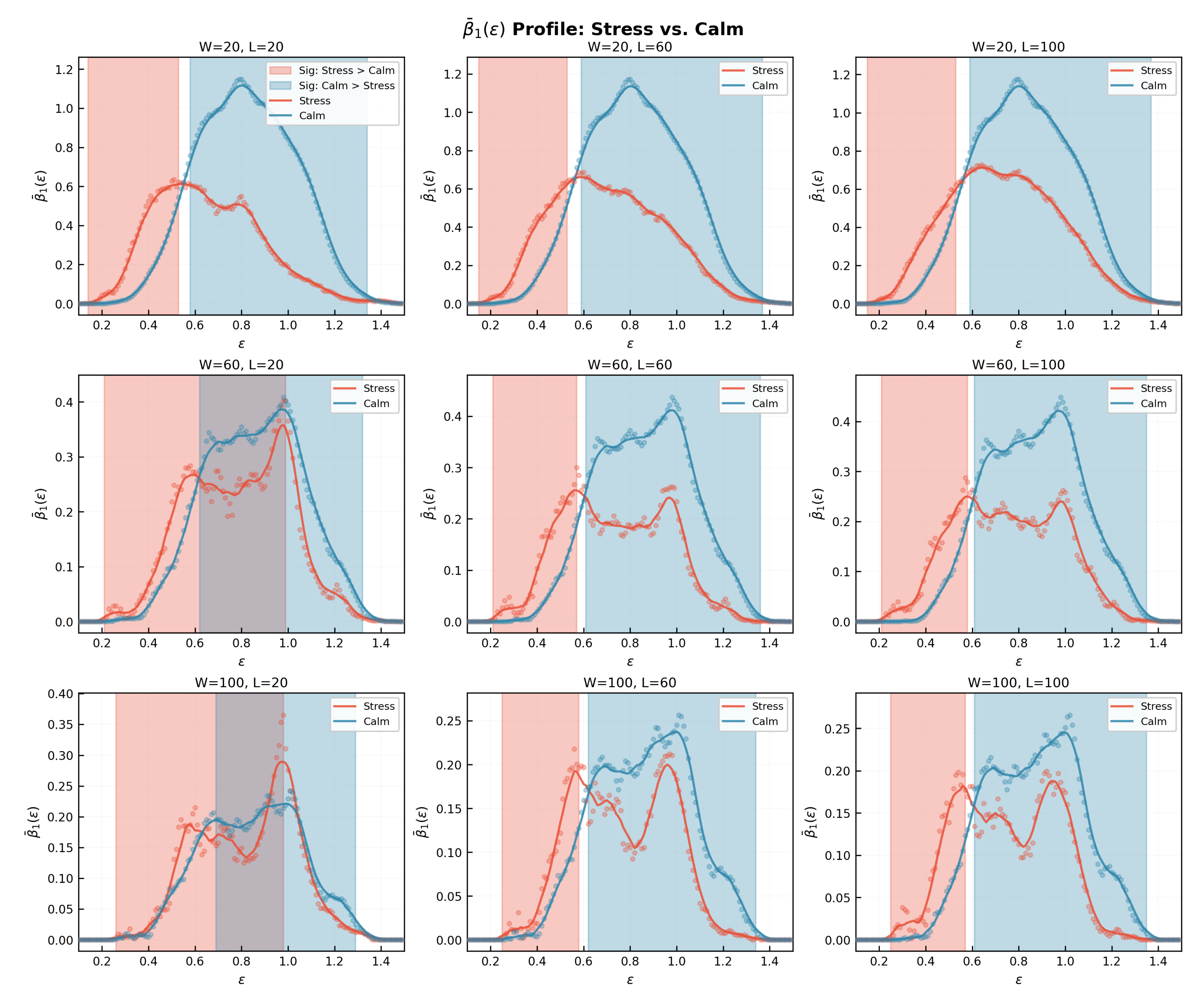
Figure 3.
Intransitive triples at HIGH scale during a calm regime (2026-02-27). Left panels show the correlation network restricted to edges participating in open triangles (solid red) and missing edges (dashed red). Right panels show sector-level aggregation with edge thickness scaling with triple count.
Figure 3.
Intransitive triples at HIGH scale during a calm regime (2026-02-27). Left panels show the correlation network restricted to edges participating in open triangles (solid red) and missing edges (dashed red). Right panels show sector-level aggregation with edge thickness scaling with triple count.
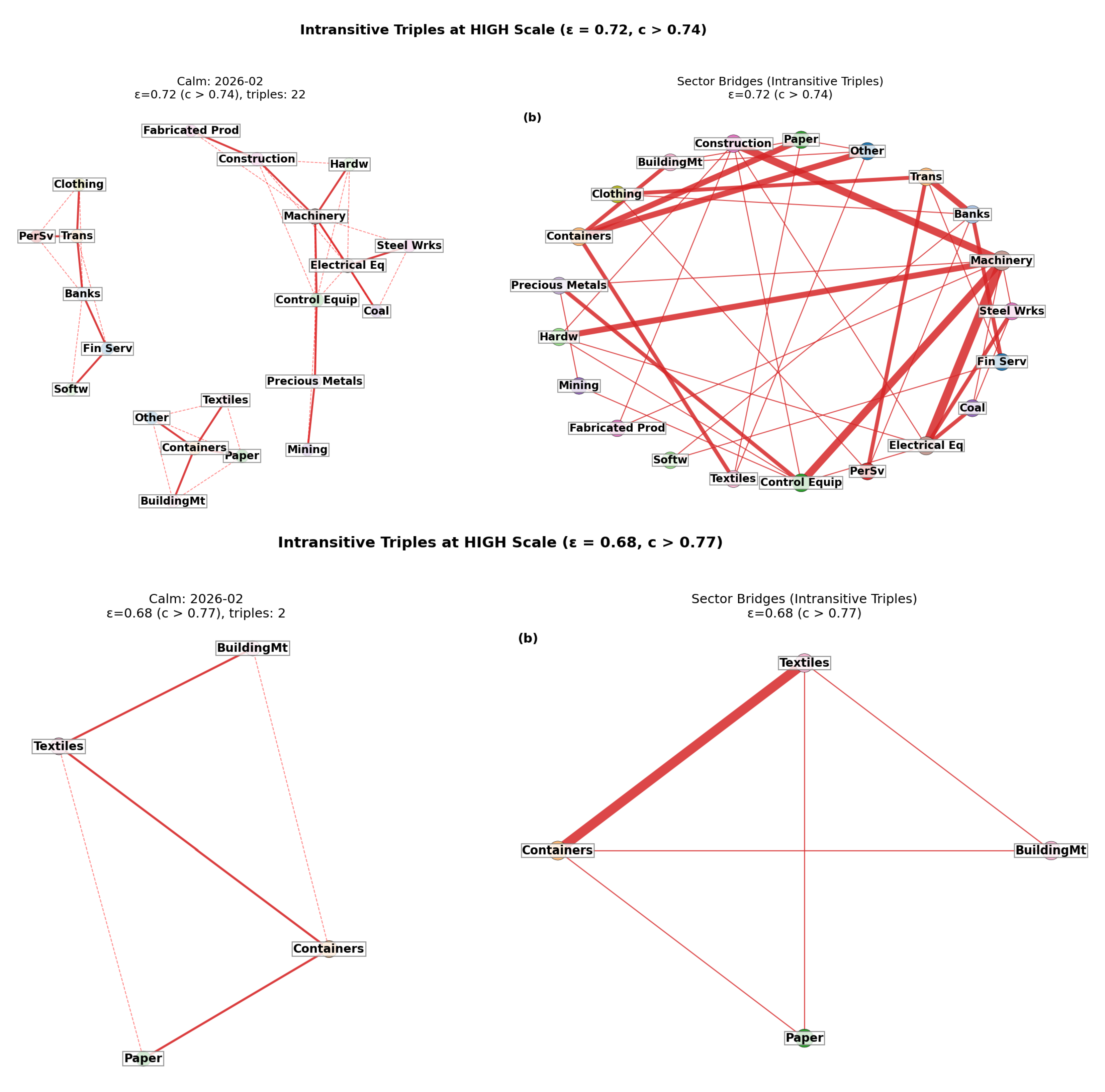
Figure 4.
Intransitive triples at HIGH scale during a stress regime (2020-03-10). At (), the stress period sustains 73 triples forming a connected component.
Figure 4.
Intransitive triples at HIGH scale during a stress regime (2020-03-10). At (), the stress period sustains 73 triples forming a connected component.
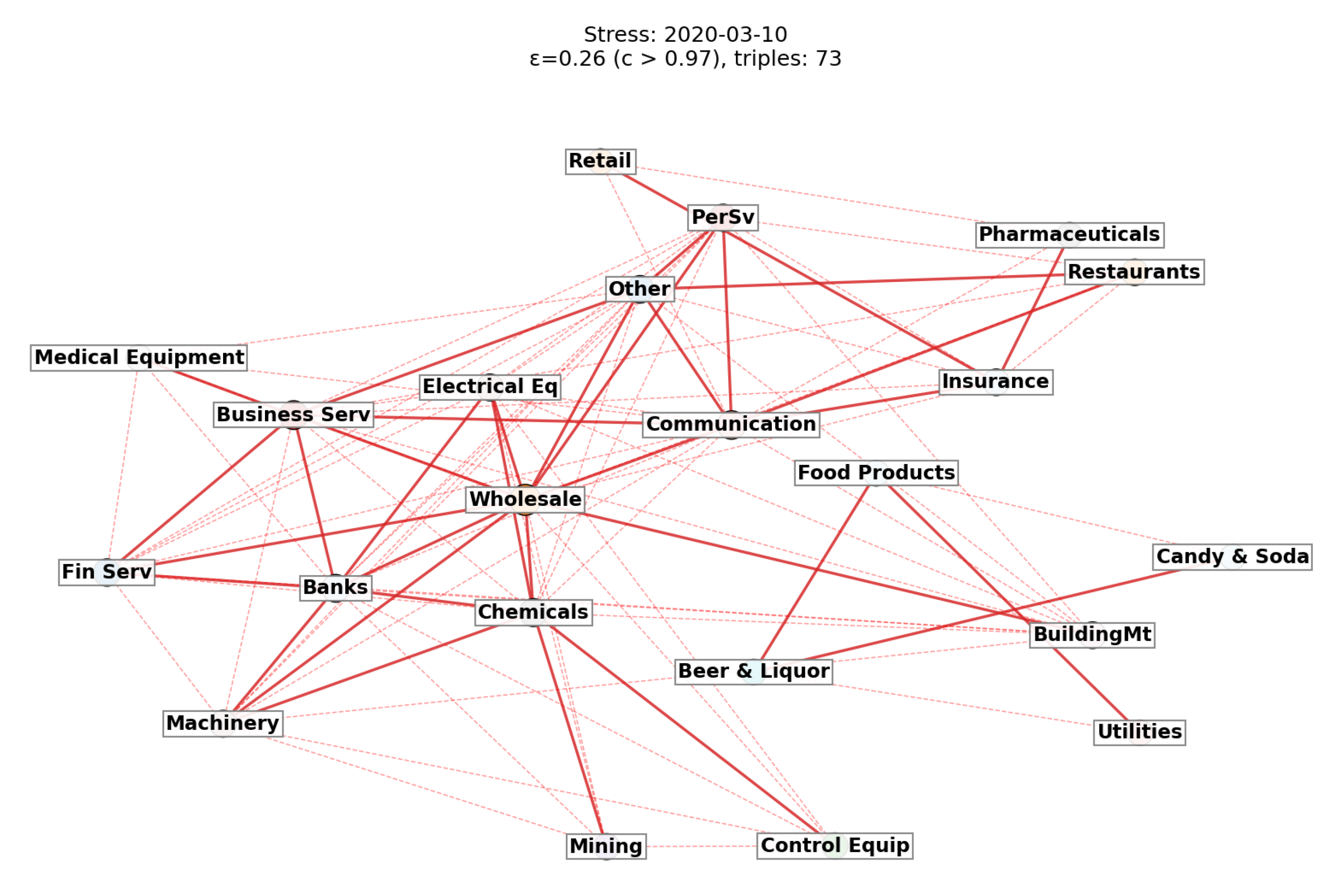
Figure 5.
Temporal dynamics of intransitive triples across LOW- and HIGH-correlation ranges (2006–2026). Vertical dashed lines mark major stress episodes, defined exogenously.
Figure 5.
Temporal dynamics of intransitive triples across LOW- and HIGH-correlation ranges (2006–2026). Vertical dashed lines mark major stress episodes, defined exogenously.
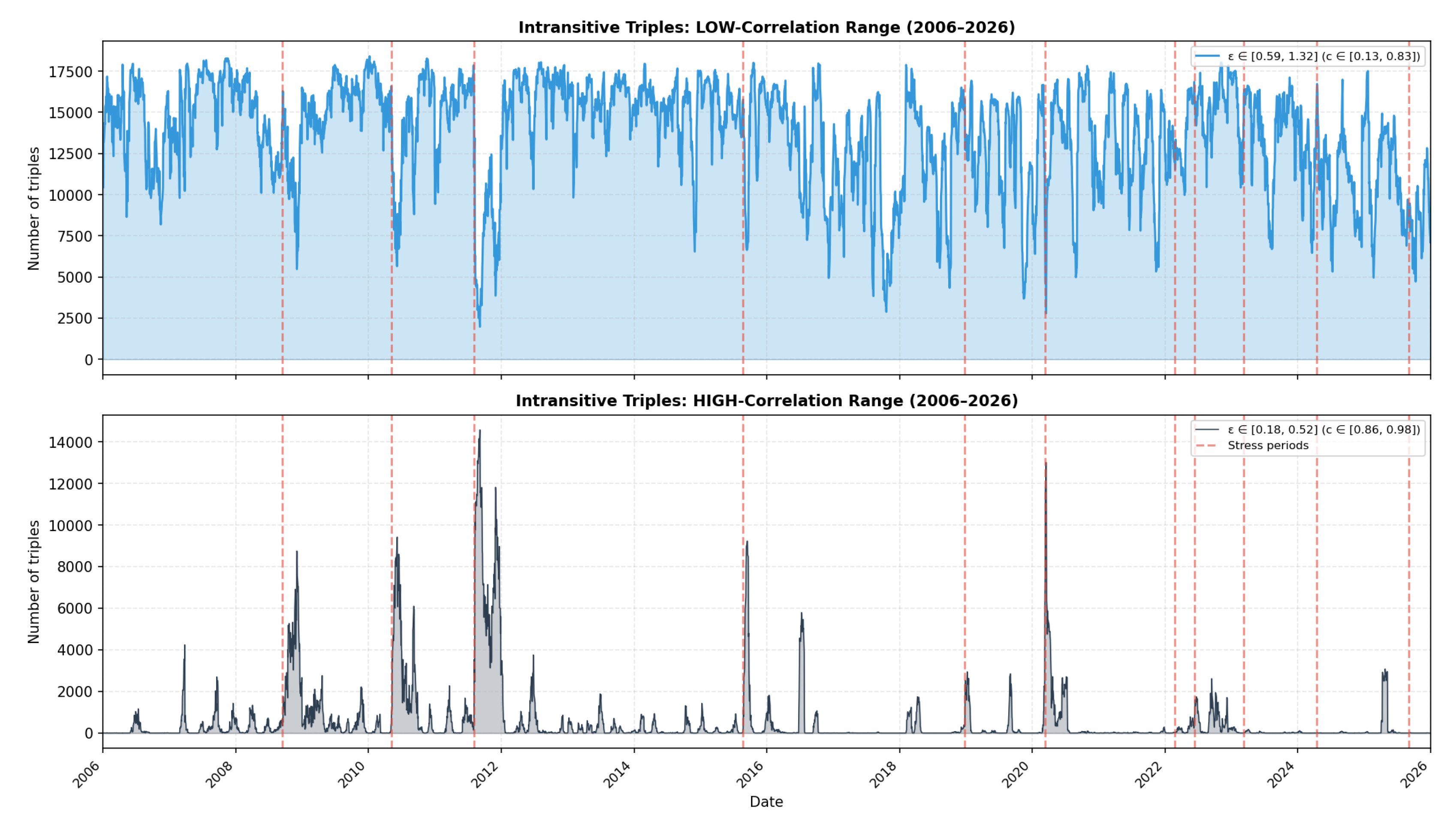
Figure 6.
Number of intransitive triangles versus filtration scale. The empirical market (calm: green; stress: red) lies above the theoretical random-metric null (black) at intermediate scales, but below the Gaussian factor null (blue) over most of the range. During stress, the peak shifts toward tighter scales (higher correlations), where the count surpasses both null benchmarks and the calm-period curve.
Figure 6.
Number of intransitive triangles versus filtration scale. The empirical market (calm: green; stress: red) lies above the theoretical random-metric null (black) at intermediate scales, but below the Gaussian factor null (blue) over most of the range. During stress, the peak shifts toward tighter scales (higher correlations), where the count surpasses both null benchmarks and the calm-period curve.
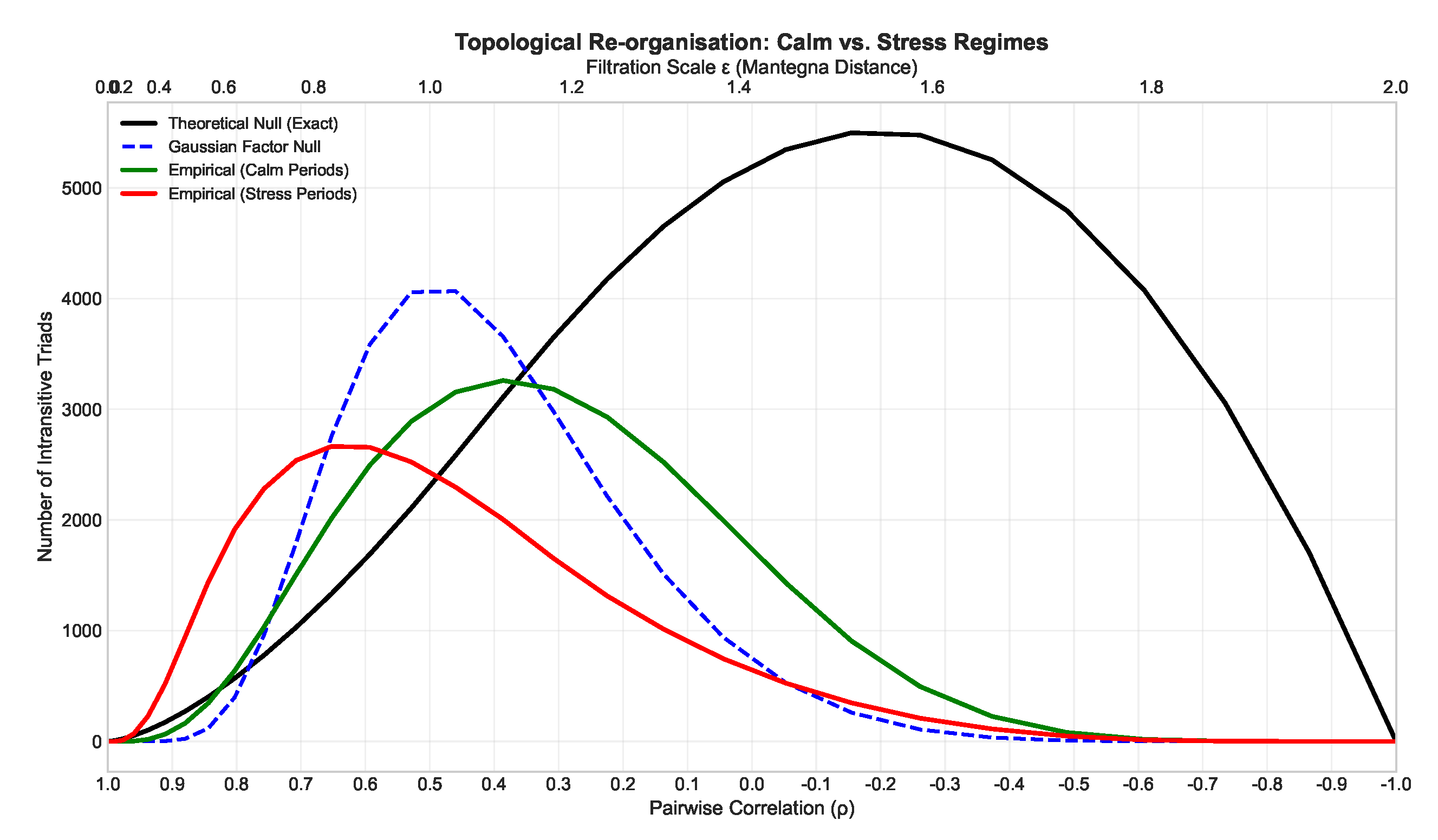
Figure 7.
Mean topological persistence conditional on the middle edge . Theoretical expectation (black dashed): for and for . Both calm (green) and stress (red) curves lie consistently below the theoretical line (hypo-frustration). At small y, the stress curve approaches zero, indicating a near-ultrametric structure during crashes.
Figure 7.
Mean topological persistence conditional on the middle edge . Theoretical expectation (black dashed): for and for . Both calm (green) and stress (red) curves lie consistently below the theoretical line (hypo-frustration). At small y, the stress curve approaches zero, indicating a near-ultrametric structure during crashes.
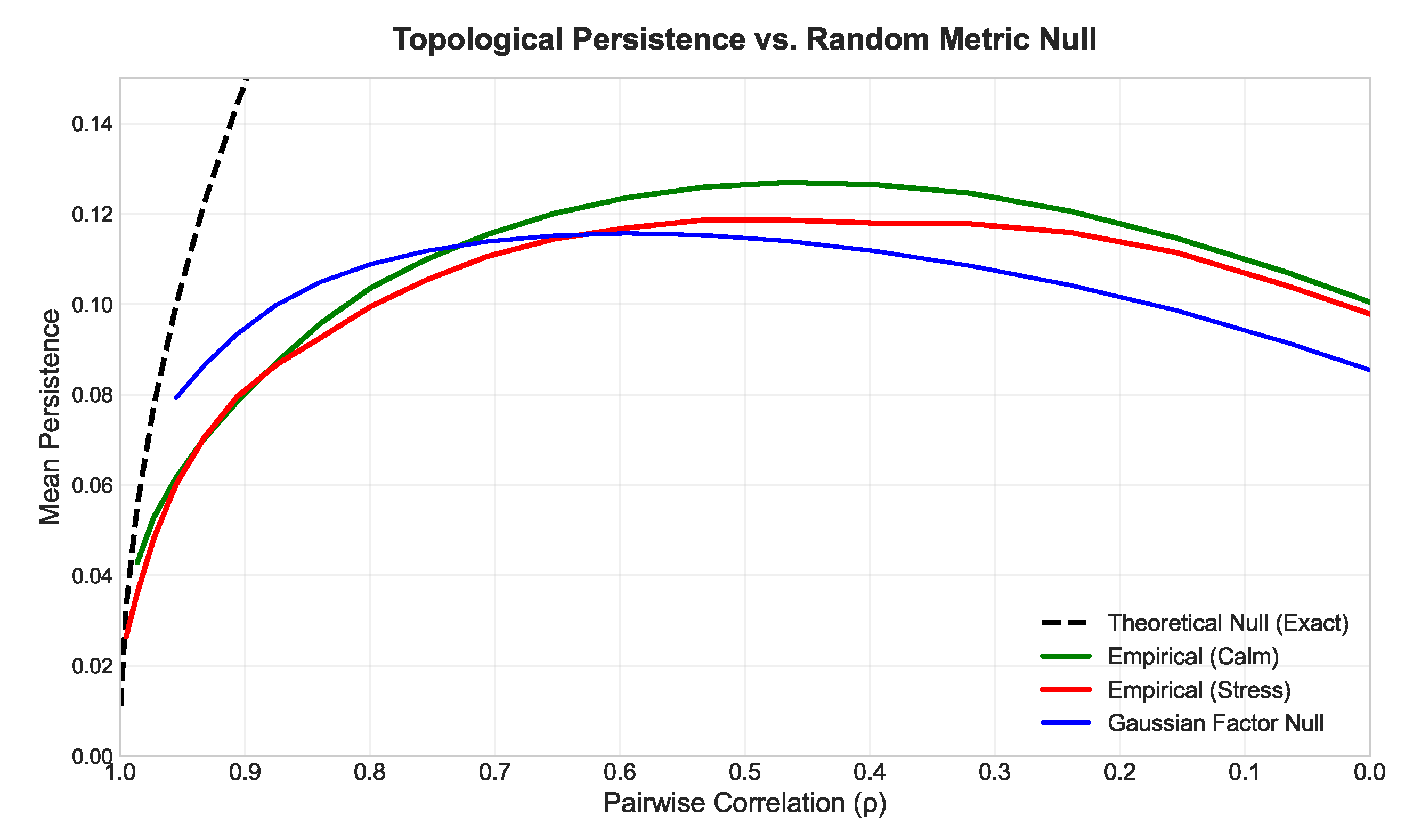
Figure 8.
Out-of-sample AUC for onset target. Models trained on Training+Validation, evaluated on Test set (2016–2026).
Figure 8.
Out-of-sample AUC for onset target. Models trained on Training+Validation, evaluated on Test set (2016–2026).
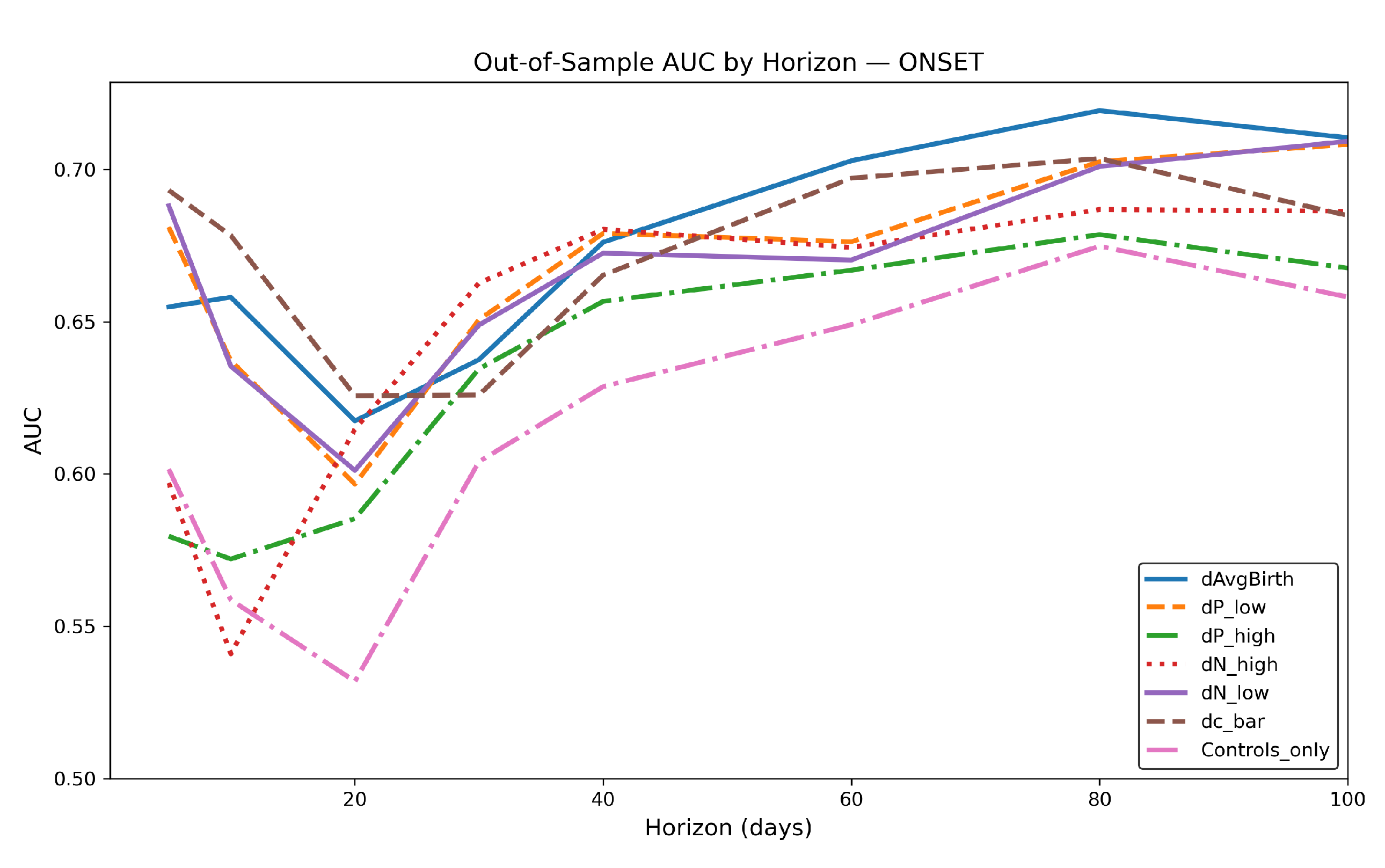
Table 2.
Statistics of -cycles by stress regime (, ).
| Characteristic | Full sample | Calm periods | Stress periods |
|---|---|---|---|
| Total cycles | 221,757 | 200,222 | 21,535 |
| Cycles per window (mean) | 17.62 | 18.15 | 13.87 |
| Birth (median) | 0.72 | 0.74 | 0.54 |
| Death (median) | 0.75 | 0.77 | 0.56 |
| Persistence (%) | 23.5 | 24.5 | 13.9 |
Notes: Cycles from Vietoris–Rips filtrations on Mantegna distances. Stress defined as in Section 2.4.
Table 3.
Fixed hyper-parameters (tuned on onset target, ).
| Indicator | (days) | (days) | Val. AUC () |
|---|---|---|---|
| 25 | 60 | 0.656 | |
| 30 | 60 | 0.658 | |
| 20 | 40 | 0.625 | |
| 30 | 40 | 0.636 | |
| 30 | 60 | 0.663 | |
| 20 | 120 | 0.651 |
Table 4.
Out-of-sample point estimates for the onset target (fixed hyper-parameters).
| Indicator | ||||||||
|---|---|---|---|---|---|---|---|---|
| 0.655 | 0.658 | 0.617 | 0.638 | 0.676 | 0.703 | 0.719 | 0.710 | |
| 0.681 | 0.637 | 0.597 | 0.651 | 0.679 | 0.676 | 0.703 | 0.708 | |
| 0.580 | 0.572 | 0.585 | 0.635 | 0.657 | 0.667 | 0.679 | 0.668 | |
| 0.597 | 0.541 | 0.615 | 0.663 | 0.680 | 0.674 | 0.687 | 0.686 | |
| 0.688 | 0.635 | 0.601 | 0.649 | 0.673 | 0.670 | 0.701 | 0.709 | |
| 0.693 | 0.678 | 0.626 | 0.626 | 0.665 | 0.697 | 0.704 | 0.685 | |
| Controls ( only) | 0.602 | 0.559 | 0.532 | 0.604 | 0.629 | 0.649 | 0.675 | 0.658 |
Notes: Test set contains 2,225 calm days. Event rates range from 3.0% () to 38.3% (). Bold entries indicate the highest AUC at each horizon.
Table 5.
Bootstrap 95% CIs for (selected horizons).
| Horizon | AUC | 95% CI | Brier | 95% CI |
|---|---|---|---|---|
| 0.655 | [0.510, 0.789] | 0.031 | [0.016, 0.050] | |
| 0.676 | [0.571, 0.786] | 0.163 | [0.128, 0.209] | |
| 0.703 | [0.604, 0.812] | 0.205 | [0.181, 0.228] | |
| 0.719 | [0.613, 0.840] | 0.237 | [0.211, 0.259] | |
| 0.710 | [0.593, 0.835] | 0.264 | [0.206, 0.310] |
Table 6.
Pairwise bootstrap p-values: vs. competitors (selected horizons).
| Compared Indicator | |||
|---|---|---|---|
| 0.114 | 0.167 | 0.455 | |
| 0.046 | 0.005 | 0.003 | |
| 0.050 | 0.006 | 0.021 | |
| 0.066 | 0.162 | 0.488 | |
| 0.351 | 0.090 | 0.009 | |
| Controls only | 0.036 | 0.031 | 0.005 |
Notes: One-sided bootstrap p-values. : competitor’s AUC ≥’s AUC.
Disclaimer/Publisher’s Note: The statements, opinions and data contained in all publications are solely those of the individual author(s) and contributor(s) and not of MDPI and/or the editor(s). MDPI and/or the editor(s) disclaim responsibility for any injury to people or property resulting from any ideas, methods, instructions or products referred to in the content. |
© 2026 by the author. Licensee MDPI, Basel, Switzerland. This article is an open access article distributed under the terms and conditions of the Creative Commons Attribution (CC BY) license.
Copyright: This open access article is published under a Creative Commons CC BY 4.0 license, which permit the free download, distribution, and reuse, provided that the author and preprint are cited in any reuse.