

Submitted:
05 June 2026
Posted:
09 June 2026
You are already at the latest version
Abstract
We develop a transfer-matrix framework for the asymptotic analysis of chromatic polynomials of recursively constructed prism-derived graph families. For each family {Gn}, the chromatic polynomial admits a finite spectral expansion P(Gn, z) = ∑j αj(z)λj(z)n, and the Beraha–Kahane–Weiss theorem identifies the limiting chromatic-root set through competition among dominant spectral branches. For the antiprism family An, the reduced transfer operator has discriminant ∆(z) = 9 − 4z. After the substitution w2 = 9 − 4z, the unit-modulus conditions for the spectral branches λ± pull back to the irreducible quartic curve x4 − 8x3 + 2x2y2 + 21x2 − 8xy2 − 18x + y4 + 5y2 = 0. The same quartic arises independently for the circulant family Cn({1, 2}) through an identical reduced spectral normal form. In contrast, the chord family Cn({1, 3}) satisfies λ+(z)λ−(z) = −1, forcing collapse of the reduced equimodular locus to the vertical segment ℜ(z) = 2, |ℑ(z)| ≤ 2. We further prove that the antiprism family possesses a nonfixed isolated accumulation point at the fifth Beraha number B5 = (3 + √5)/2, arising from residual amplitude cancellation under unique dominant spectral behavior. The generalized Petersen family G(n, 2) exhibits an irreducible cubic spectral equation, demonstrating an obstruction to the quadratic pullback mechanism. These examples reveal a structural relationship between reduced transfer-matrix spectra and the algebraic geometry of limiting chromatic- root loci, showing that distinct recursive graph families may share identical asymptotic geometry through common reduced spectral normal forms.
Keywords:
chromatic polynomial
; transfer matrix
; equimodular curve
; Beraha–Kahane–Weiss theorem
; antiprism
; Beraha numbers
MSC: 05C15; 05C31; 82B20; 14P05
1. Introduction
The chromatic polynomial counts the proper colorings of a finite graph G as a polynomial in the number of colors. Introduced by Birkhoff [5] and systematically developed by Whitney [15], it occupies a central position in algebraic graph theory, combinatorics, and statistical mechanics. Through the Fortuin–Kasteleyn representation [7,14], the chromatic polynomial appears as the zero-temperature antiferromagnetic specialization of the Potts partition function [10]; like the all-terminal reliability polynomial [6], it is a one-variable specialization of the Tutte polynomial [14]. Extending the variable from positive integers to the complex plane transforms the problem from combinatorial enumeration to the study of algebraic and geometric root distributions.
For recursively constructed graph families , the chromatic roots often accumulate on structured subsets of as . Understanding the geometry of these limiting sets has become a central theme in chromatic-root theory. The transfer-matrix method expresses the chromatic polynomial in the form , where the are spectral branches of a finite transfer operator and the amplitudes encode the invariant-sector structure. The theorem of Beraha, Kahane, and Weiss [3] then identifies two accumulation mechanisms: roots accumulate where two dominant branches have equal modulus, producing continuous accumulation curves, and at zeros of the amplitude of a uniquely dominant branch, producing isolated accumulation points.
Transfer-matrix methods for Potts-model partition functions and chromatic polynomials were developed extensively in [11,12]. Structural results on zero-free intervals appear in [8,13]. Explicit equimodular geometry for the prism family was obtained in [2], and finite-n Cassini-type bounds were established in [1]. Related spectral behavior for circulant graph families was investigated in [9].
The present article extends this program to several recursively layered families amenable to the same sector-decomposition analysis. We use the term prism-derived to mean any such family whose transfer operator admits a two-vertex interface reduction via the decomposition of Section 2; this encompasses families whose local transition rule or cyclic-closure condition differs from the standard prism, including and , provided the same spectral analysis applies. The families studied are: the antiprism family , the Möbius ladder , the circulants and , the open-boundary ladder , and the generalized Petersen family .
Although these families differ substantially at the graph-theoretic level, they share a common spectral mechanism governed by low-dimensional transfer reductions.
The antiprism family provides the central example. Its reduced transfer matrix has discriminant , and the conditions — representing competition between the row–column branches and the constant residual — pull back under to circle equations in the w-plane whose preimages form the irreducible quartic of (4). In addition, the family has a nonfixed isolated accumulation point at the fifth Beraha number , arising from amplitude cancellation within a region where the constant residual is uniquely dominant.
The circulant family independently reproduces the same quartic through the identical discriminant , showing that the limiting curve is spectrally rather than combinatorially determined. By contrast, the chord family satisfies , which forces both reduced branches onto the unit circle simultaneously and collapses the equimodular locus of the reduced spectral pair to the vertical segment , . At the opposite extreme, the ladder family has a single spectral branch ; its chromatic polynomial factors as , no branch competition arises, and the only accumulation points are the fixed zeros .
The generalized Petersen family marks the transition to higher-order spectral behavior: its reduced transfer operator has an irreducible cubic characteristic polynomial over , and the corresponding accumulation geometry lies beyond the quadratic circle-pullback method.
These examples lead to a structural observation, stated as Remark 2, relating the dimension and splitting structure of the reduced characteristic polynomial to the topology of the equimodular set. The main structural results are established in Theorems 3–9.
2. Transfer-Matrix Framework and Equimodular Geometry
A family is recursively layered if each graph is obtained by iterating a fixed layer construction along a prescribed interface, with the admissibility of each new layer determined entirely by the current and next interface colorings. In the closed case the terminal interface is identified with the initial one.
Definition 1
(State space and transfer operator). Let be an integer. For a two-vertex interface, set and let denote the set of proper q-colorings of that interface; in particular . Thetransfer operator is the matrix whose -entry equals 1 if the transition satisfies all layer constraints and equals 0 otherwise.
The transfer operator recasts the proper-coloring problem as counting walks in a directed state graph.
Proposition 1
(Trace formula). Let be a recursively layered graph family with transfer matrix . If the family is closed cyclically after n layers, then for every integer . If the family has open boundary conditions, then , where and are the indicator vectors of admissible initial and terminal interface states, respectively.
Proof.
In the closed case a proper q-coloring of determines a sequence of interface states in which each transition is admissible; the transfer rule records exactly the coloring constraints between consecutive layers, so the correspondence is bijective. The number of such closed state sequences is . In the open-boundary case the closing condition is removed: selects admissible initial states, selects admissible terminal states, and counts admissible state paths from the initial boundary to the terminal boundary. □
For fixed n, an identity established for all integers extends to all as soon as both sides are polynomial in q, since two polynomials that agree on an infinite set of integers are identical.
Equip with the standard inner product . The symmetric group acts on by relabeling colors; the transfer operators considered below commute with this action, and the inner product is -invariant, so the orthogonal complement of any invariant subspace is again invariant. Set . For any one has so . For the map from zero-sum pairs to is injective: if for all then, fixing b and varying a, g must be constant; then forces , and hence . Thus . Define as the orthogonal complement of in . The dimension count yields the -invariant decomposition .
Remark 1
(Characterization of ). An element belongs to if and only if every row sum and every column sum vanishes. The q row-sum conditions and q column-sum conditions share exactly one linear dependency (total row sum equals total column sum), so their joint rank is and the common zero-set has dimension . To confirm this zero-set equals , write with and , and suppose all row and column sums of f vanish. The row sum at a of is (using to evaluate ); summing over a gives , hence . The row equation then reads for each a, and the column equation gives . Since for , one has and therefore .
Let J denote the transposition involution . Since every orbit of J on has size two (as prevents fixed points), the J-symmetric and J-antisymmetric subspaces of each have dimension . The subspace is J-symmetric. For , the J-symmetric part is where satisfies , and the J-antisymmetric part is where satisfies ; each is parameterized by a zero-sum function on , so both symmetric and antisymmetric parts of have dimension . Writing and for the J-symmetric and J-antisymmetric parts of , dimension subtraction gives and Note that at , consistent with .
Among the families studied in Section 4 and Section 5, the residual action for every holds for the circulant ; we call this the J-reversal residual condition. The prism and the Möbius ladder instead satisfy (the residual eigenvalue of [2]), as does the antiprism (Proposition 4). The residual action must in every case be verified directly from the transition rule.
Proposition 2
(J-reversal residual eigenvalues). If a recursively layered family satisfies for every , then has eigenvalue with multiplicity and eigenvalue with multiplicity .
Proof.
For , so ; for , so . The multiplicities are and . □
The antiprism does not satisfy the J-reversal condition; its residual sector is computed separately in Section 3. Whenever the residual sector contributes only the eigenvalues with multiplicities polynomial in q — as holds for every family treated below — the sector decomposition yields the following expansion.
Theorem 1
(Branch expansion). Let be a closed recursively layered graph family with two-vertex interface. Assume preserves ; that the induced action on , where , takes the form for a matrix with entries polynomial in q; and that the residual sector contributes only the eigenvalues with multiplicities polynomial in q. Then
where are the eigenvalues of and the are polynomials in z. If the residual sector contributes only eigenvalue , the term is absent.
Proof.
For integer , Proposition 1 gives . The constant sector contributes . Since the row–column action is , one has and the row–column trace is which accounts for the amplitude in (1). The residual sector contributes by hypothesis. The power sum is polynomial in q via the Newton recurrence , with and , both polynomial in q. Hence the right side of (1) is polynomial in q and agrees with for every integer ; two polynomials agreeing on infinitely many values are identical, so the formula holds for all . □
The asymptotic geometry of chromatic-root accumulation is governed by the dominant branches in (1). The equimodular locus and its role in limiting root geometry are made precise by the following theorem.
Theorem 2
(Beraha–Kahane–Weiss [3]). Let on a domain , where each and is analytic and no two distinct branches differ by a unimodular constant on any open subset of D. A point is a limit point of zeros of if and only if either at least two branches achieve the maximum modulus at and the ratio of any two such dominant branches is not locally constant, or a unique branch is dominant at and .
The first condition produces accumulation along curves of equal dominant-branch modulus; the second produces isolated accumulation points through amplitude cancellation. In the quadratic cases below, the branches take the form with linear in z. The branch is analytic on any simply-connected domain avoiding the ray ; BKW applies to each such analytic branch on its domain of definition, and the equimodular locus is independent of branch-cut choice since it is defined by modulus conditions , which are symmetric between the two determinations of . The accumulation set of is a subset of : it consists precisely of those equimodular points where the dominant branches are not related by a unimodular constant, together with isolated points from amplitude cancellation. Accordingly, in each family we identify the candidate equimodular locus first, then verify dominant-branch conditions to determine which components support the actual accumulation. Setting and writing , the conditions , equivalently , become circle equations in the w-plane. Their pullbacks under the quadratic map are real quartic curves in .
Proposition 3
(Isolated accumulation criterion). Let satisfy the hypotheses of Theorem 2. Suppose is uniquely dominant throughout a neighborhood U of , that , and that is not identically zero near . Then is an isolated limit point of zeros of .
Proof.
Shrink U to obtain with for all and . Write where satisfies on compact subsets of U for some constant C, so uniformly on compact subsets of U. Since is analytic and not identically zero, its zero at is isolated; choose with and on . For all sufficiently large n, on , so Rouché’s theorem gives and the same number of zeros inside . Applying this to every sufficiently small shows that zeros of accumulate at . After shrinking U, throughout, so does not contribute zeros and the zeros of in U coincide with those of . Since is uniquely dominant throughout U, no equimodular curve intersects U, so the accumulation at is isolated. □
3. The Antiprism Family
For , the antiprism has vertex set and edges , , , and , with all indices read modulo n; see Figure 1. A transfer state is a pair , where and . A transition is admissible precisely when , , , and . To count admissible successors: must avoid , giving choices; for each such (with already enforced), must avoid , giving another choices. Hence every state has exactly admissible successors, and the constant-sector eigenvalue is .
The induced action on the row–column sector is given by
To verify this, let with . Summing over admissible successors, and using to evaluate the resulting partial sums, one obtains . The coefficient pair is therefore mapped to , which is the action of on the two-dimensional coefficient factor. The characteristic polynomial is , the discriminant is , and the spectral branches are .
Because does not satisfy the J-reversal condition on , its residual sector requires a direct computation from the transition rule.
Proposition 4
(Antiprism residual action). For every and every , one has . Consequently , and the residual sector contributes eigenvalue with multiplicity .
Proof.
Fix . The admissible successors are those satisfying , , and . Apply inclusion-exclusion to these three forbidden conditions starting from . Since , every row sum and every column sum of f vanishes by Remark 1; in particular the full sum, the row sum at , and the column sums at and all equal zero. Among the pairwise intersections: contributes the single term (valid since ); is empty in because it forces ; and is empty because it forces . The triple intersection is empty. Inclusion-exclusion therefore gives . Since was arbitrary, fixes pointwise. The multiplicity is . □
Together, the preceding computation and the row–column reduction give , from which the branch expansion follows immediately.
Theorem 3
(Branch expansion of ). For all and all ,
where .
Proof.
For integers , Proposition 1 gives . The constant sector contributes . The row–column sector contributes . Proposition 4 gives the residual contribution . Summing yields (3) for all integers . The power sum satisfies the Newton recurrence with and , both polynomial in z, so is polynomial in z for each fixed n. Both sides of (3) are therefore polynomial in z and agree for infinitely many integer values, hence they are identical for all . □
Verification at . One has , so . Substituting into (3) gives . The graph is the octahedral graph, equivalently the complete tripartite graph [4]. Its proper 3-colorings assign one color class to each antipodal pair, and hence there are such colorings. This confirms .
Setting , so that and , the spectral branches factor as . The product formula simplifies via to . Writing and , the four branch moduli are ; ; ; residual: 1. Their pairwise equimodular boundaries are , , , and . The boundary , i.e., , is a circle in the z-plane; the boundary reduces to , a half-line on the real axis . The candidate equimodular locus governed by the Beraha–Kahane–Weiss theorem is therefore contained in the union of the quartic arising from and (competition between the row–column branches and the constant residual branch of modulus 1) together with this circle and half-line; the actual accumulation set is the subset on which the relevant pair of branches is dominant, as illustrated in Figure 2.
Theorem 4
(Quartic equimodular curve). The loci and coincide and are given by the real quartic curve , where and
Moreover, Q is irreducible over .
Proof.
Let and choose a square root satisfying . Replacing w by interchanges the labels and , so the resulting equimodular loci are independent of the chosen branch. Equating real and imaginary parts of gives and .
Since , the condition is equivalent to . Expanding yields , or equivalently . Combining this relation with gives and .
Squaring the identity yields . Substituting and gives . After expansion and a second substitution of , the equation simplifies to , and hence .
Substituting this expression for u into and simplifying yields precisely the quartic equation . Therefore every point satisfying lies on the quartic .
For the branch , the condition is equivalent to , or . The resulting system differs from the preceding one only by replacing u with . The same elimination therefore produces the identical quartic polynomial . Consequently every point satisfying also lies on .
It remains to prove the converse and verify that the elimination process introduces no extraneous points. Assume that and define . Direct substitution into Q shows that . Now define . Then .
Moreover, . Using gives , and therefore .
To show that v is real, first suppose that . Then . If , the identity forces . Substituting into gives , and consequently . Hence in all cases, so a real value of v exists. Choose its sign so that .
Setting , we obtain . Thus w is indeed a square root of .
Next, . Using and yields . Hence , and therefore . This proves that every point on the quartic satisfies .
Replacing u by yields the reconstruction corresponding to , and therefore every point on the quartic also satisfies .
We conclude that
For irreducibility, write , where and .
Since Q is primitive as a polynomial in y, Gauss’s lemma reduces the problem to irreducibility over the field . The polynomial is not a square in F because the factors x and occur with odd multiplicity. Furthermore, , which is not a square in F since it has a simple zero at .
Assume, for contradiction, that Q is reducible over F. If Q possessed a linear factor, then it would have a root . Consequently would be a root of , forcing . This would imply , contrary to the preceding observation. Therefore Q has no linear factor over F.
Any nontrivial factorization must therefore be quadratic. Since the coefficient of vanishes, such a factorization has the form with . Comparing coefficients gives , , and .
If , then r and s are roots of . Its discriminant is , which is not a square in F, a contradiction.
If , then , which would make a square in F, again a contradiction.
Both possibilities are impossible. Hence no quadratic factorization exists, and Q is irreducible over . Gauss’s lemma then implies that Q is irreducible over . □
Setting gives , so the quartic meets the real axis at , , and ; the double factor at marks a singular point of the curve. Indeed , while , , give Hessian determinant , so is a node at which two real branches cross, not a smooth tangency. In Beraha notation , these real intersections are , , and .
Theorem 5
(Isolated accumulation point). The antiprism family has an isolated accumulation point at . This is the unique zero of the residual amplitude lying in the open region where the constant residual branch is uniquely dominant.
Proof.
Set . Then , so with , and . Substituting gives , hence . Also . Since all three non-residual branches have modulus less than 1 at and the constant residual has modulus 1, the residual is uniquely dominant at and remains so throughout a neighborhood U of .
The residual amplitude is . Its roots are , so and . Proposition 3 therefore implies that is an isolated limit point of chromatic roots of .
The other root satisfies , so is dominant at and the residual branch is not. Hence is the only zero of in the region where the residual is uniquely dominant. □
Proposition 5.
.
Proof.
The identity gives . Since , one has . Hence . □
4. Spectral Deformations: Möbius, Circulant, and Chord
The antiprism’s accumulation geometry is driven by the discriminant of its reduced transfer matrix and the flat residual eigenvalue . The three families studied here each arise from a closely related construction and deviate from the antiprism in one precisely controlled way: the Möbius ladder preserves the prism spectrum but alters the amplitudes through a twisted closure; the circulant (see for eg., Figure 3(a)) independently reproduces the discriminant ; and the chord family (see for eg., Figure 3(b)) satisfies a product identity on its reduced branches that forces the quartic geometry to degenerate to a segment. The contrast among these cases shows that the equimodular geometry is determined by the discriminant and determinant of the reduced transfer matrix, not by the graph structure alone.
4.1. The Möbius ladder
The Möbius ladder , shown in Figure 1(c), is obtained from the prism by a twisted cyclic closure: the terminal interface is identified with rather than . A proper q-coloring of corresponds to a state sequence in which each transition is admissible and the closing condition is rather than , where J is the transposition involution . The number of such twisted closed walks is , giving the twisted trace formula .
Since the local transition rule for is identical to that of the prism , the transfer matrix and its eigenvalues are unchanged. By [2], the prism transfer operator has four spectral branches , , , and , with corresponding eigenspaces: the constant space for ; the J-symmetric subspace of for ; the J-antisymmetric subspace of for ; and for . The computation of proceeds sector by sector. Writing for the spectral projector onto the eigenspace of :
The constant sector: , so , contributing .
The row–column sector: on the J-symmetric eigenspace of , J acts as the identity, so , contributing . On the J-antisymmetric eigenspace of , J acts as , so , contributing .
The residual sector: since J has no fixed point on (a fixed point would require ), . The four sector contributions must sum to zero: contributing .
Summing gives
Both sides are polynomial in z and agree for all integers , so the identity holds for all . Since the twisted closure modifies amplitudes but not eigenvalues, shares its pairwise equimodular loci with the prism family.
4.2. The Circulant and the Shared Discriminant
For , let have vertex set with edges and . The bound ensures the graph is simple: when , the vertex collapses two distance-2 neighbors to one, giving , while for all adjacencies are distinct and .
The transfer construction records two consecutive colors as a state . A transition is admissible when , enforcing both the distance-1 constraint and the distance-2 constraint . For fixed , there are exactly admissible choices for c, giving constant-sector eigenvalue .
To derive the row–column action, let with . Then Since and , one has , and thus The coefficient pair maps to , so the reduced action on the row–column sector is with characteristic polynomial and discriminant . The reduced spectral branches are therefore .
For the residual sector, let . Then and by the zero row-sum condition of Remark 1. Hence , so . Proposition 2 therefore applies, and the residual sector contributes eigenvalue with multiplicity and eigenvalue with multiplicity . The two residual branches and differ by the unimodular constant ; the hypothesis of Theorem 2 therefore excludes this pair from producing an accumulation curve, consistent with their common modulus being constant.
Theorem 6
(Branch expansion of ). For all and all ,
where . For , this reduces to .
Proof.
For integer , the trace formula gives . The constant sector contributes . Since the row–column action is , the row–column sector contributes . By Proposition 2, the residual sector contributes . Summing yields (6) for all integers . The power sum is polynomial in q by the Newton recurrence with initial values and and step ; all other terms in (6) are visibly polynomial. Hence both sides are polynomial in q, and polynomial identity extends the formula to all .
For , . Evaluating the right side of (6) at gives 0 in each case (verified from the recurrence with ), so the formula yields a monic degree-five polynomial with roots , confirming . □
Setting , the circulant branches are . The equimodular conditions become , i.e., , which are exactly the same two circles in the w-plane that arise in the antiprism analysis (Theorem 4), with branch labels interchanged. Their pullback under is again the quartic from (4). The shared discriminant is thus the precise spectral reason for the identical limiting geometry, even though the two families differ substantially as graphs.
Corollary 1
(Shared w-plane modulus locus implies shared equimodular geometry). Let and be closed recursively layered graph families whose reduced transfer matrices have spectral branches , and a common linear discriminant . Fix , so , and suppose that under this substitution the conditions , and the conditions , determine the same unordered pair of curves in the w-plane. Then the reduced unit-modulus loci coincide,
and equal the preimage of under the covering .
In particular, for the antiprism and the circulant the common discriminant is and the common w-plane locus is the pair of circles , ; its pullback under is the irreducible quartic of Theorem 4. This holds even though the trace and determinant of the two reduced matrices differ.
Proof.
Because is linear with nonzero leading coefficient, defines a single-valued map . For a reduced operator each condition pulls back under to a condition on w alone; by hypothesis the union of the two conditions is, for both families, the same curve set . Hence
For the two named families, gives and , while gives and . Both produce the unordered pair , whose pullback under was computed in Theorem 4 to be . □
The circulant family admits no nonfixed isolated accumulation point from residual amplitude cancellation. The residual amplitudes and have zeros at and . At each, the constant residual branch is not uniquely dominant: at , ; at , has modulus ; at , has , so lies on the equimodular boundary; at , each have modulus 1, so also lies on the equimodular boundary. In each case, Proposition 3 does not apply, and no nonfixed isolated accumulation point arises. The resulting root distributions for and are shown in Figure 4.
4.3. The Chord Graph and a Degenerate Equimodular Locus
For , let have vertex set and edges and . The bound ensures the two distance-3 neighbours are distinct: for one has , so the jump-3 edges form a perfect matching and the local transition counts below change; the analysis assumes the generic case . The distance-3 edges couple vertices three steps apart, so the transfer construction must retain three consecutive colors. A transfer state has the form with and , representing the color triple . Appending requires (the distance-1 edge ) and (the distance-3 edge ); no distance-2 constraint arises since and are not adjacent in .
Under the -orbit decomposition, the state space has two orbit types: Type I, where (count ), and Type II, where (count ). For an -invariant function f that takes value x on Type I and y on Type II:
On a Type I state : d avoids only , giving successors. Exactly one has (type Type I successor ) and have (Type II successors). Hence
On a Type II state with : d avoids , giving successors. Exactly one has (the Type I successor ) and have (Type II successors). Hence
The reduced action on the two-dimensional orbit-type sector is therefore represented by , with characteristic polynomial , giving the reduced spectral branches and the product (Vieta).
Theorem 7
(Equimodular locus of the reduced spectral pair for ). The reduced branches satisfy , and the equimodular locus of the pair is exactly .
Proof.
The product identity is immediate from Vieta’s formulas. If , then taking moduli gives , so both branches have modulus 1. Choose with . Substituting into and dividing by gives , i.e., , hence . Thus and .
Conversely, let with and choose with . Then , and substituting into the characteristic equation gives So is a root. The second root is (since the product of the two roots equals ), which also has modulus 1. Hence , completing the characterization. □
We stress that Theorem 7 describes only the reduced orbit-type sector ; the full transfer decomposition and the dominance of over the residual sectors are not established here, so the segment is the reduced-pair equimodular locus rather than a proven limiting root set. The product identity is the spectral mechanism that collapses the quartic geometry. Whereas the antiprism and circulant families have and defining distinct circles in the w-plane whose pullbacks produce a quartic, the chord family has simultaneously, and the parametrization traces out a segment rather than a curve of positive area. This transition from quartic to segment is the geometric content of level two in the spectral hierarchy of Section 6.
5. The Ladder Graph and the Generalized Petersen Family
The two families studied here occupy opposite ends of the spectral hierarchy. The ladder graph (Figure 5(a)) has a single dominant spectral branch, so the Beraha–Kahane–Weiss mechanism produces no equimodular accumulation curve whatsoever. The generalized Petersen graph (Figure 5(b)) has an irreducible cubic spectral equation, placing its accumulation geometry beyond the quadratic analysis of the preceding sections. Together they delimit the range of behavior stated in Remark 2.
5.1. The Ladder Graph
The ladder is the Cartesian product of a path on n vertices with a single edge; it has vertices arranged as two parallel paths connected by n rungs. Because the family has open boundary conditions, the transfer formula of Proposition 1 applies in its vector form. A transfer state is a pair . A transition is admissible when , , and . For a fixed state , there are initially ordered pairs with ; exactly have , exactly have , and exactly one pair satisfies both conditions (namely itself). Inclusion-exclusion gives admissible successors for every state, so .
Theorem 8
(Chromatic polynomial of ). For all and all , . The two roots of are fixed zeros of unbounded multiplicity (hence the only nontrivial limit points of the root set), and no equimodular accumulation curve occurs.
Proof.
The first rung of is an edge and contributes colorings. Since , the open-boundary transfer formula with gives for every integer . Both sides are polynomial in q, so the identity holds for all .
The factorization shows that every zero of is either 0, 1, or a root of . The roots of are , and each appears with multiplicity for all ; they are therefore fixed zeros of the family of unbounded multiplicity, and trivially its only nontrivial limit points. Since the chromatic polynomial involves only the single spectral branch , no two branches can compete in modulus, and the first condition of Theorem 2 never applies. The sole accumulation mechanism is that of fixed zeros, and no equimodular accumulation curve arises. □
Figure 6 compares the isolated-point behavior of the ladder with the vertical segment arising for .
5.2. The Generalized Petersen Family
For , the generalized Petersen graph has vertex set with outer cycle edges , spokes , and inner edges . Unlike the prism and antiprism families, the inner edges couple vertices separated by two layers, so the transfer process must retain one previous inner color. Accordingly, a transfer state is represented by a triple where the spoke constraint forces .
A transition is admissible precisely when the new layer satisfies all adjacency constraints: (from the outer edge ), (from the spoke ), and (from the inner edge ). The colour-relabelling group acts on the state set , and an -invariant function depends only on the equality pattern of . Since is fixed, there are exactly three patterns, so the invariant sector is 3-dimensional, spanned by the indicators of
Write an invariant f as the triple of its values on . The reduced action sends f to the function whose value at a state is over the admissible successors , those with , , and ; a successor lies in when , in when , and in otherwise. Counting the successors of each pattern gives the following.
From (so ): the successors () require , giving ; the successors () require , giving ; the successors require then , giving .
From (so ): the successors () require , giving ; no successor exists, since violates ; the successors require and , giving .
From ( distinct): the successors () require , giving ; the successors () require , giving ; the successors require and , which yields choices of when and otherwise, hence .
Collecting the counts as the matrix whose -entry is the number of type- successors of a type- state gives
The remaining -isotypic sectors contribute lower-dimensional residual blocks that we do not record here.
We can check with the case when . Direct enumeration of the admissible single-layer extensions yields the integer matrix , whose characteristic polynomial is , in agreement with Theorem 9. We emphasize that Theorem 9 establishes the cubic as the spectral equation of this dominant three-dimensional sector; a complete branch expansion of , including the residual amplitudes, is not derived here and is left open.
Theorem 9
(Cubic spectral equation). The characteristic polynomial of is and is irreducible over .
Proof.
Setting , a direct expansion of gives . Substituting back: ; ; and . This gives the stated polynomial. One can verify that at , we have with a direct expansion from to confirm the result.
For irreducibility over : since f is monic in with coefficients in and is integrally closed, any root of f in must lie in . A cubic over a field is reducible if and only if it has a root in that field, so it suffices to show f has no root . The constant term forces to divide in , so for some .
If : the leading power of z in is with coefficient , forcing , a contradiction.
If : the coefficient of in is , so . Then ; since has no real roots and is not identically zero, .
If : the coefficient is again , giving . Then .
If : the coefficient of in is , giving . Then .
In every case , so f has no root in and is therefore irreducible over . □
The three spectral branches of are thus algebraic of degree three over . Their equimodular geometry is not governed by a single quadratic discriminant, and the pairwise modulus-competition locus is a higher-degree real algebraic set whose structure lies beyond the methods of the preceding sections. The numerical root distributions in Figure 7 are consistent with multibranch cubic competition but do not constitute a proof of a specific algebraic degree for the accumulation set.
6. Spectral Hierarchy and Consequences
The families studied in the preceding sections are governed by a common spectral mechanism: the limiting chromatic-root geometry is determined not by the graph structure directly, but by the dimension and algebraic properties of the reduced transfer operator—specifically its discriminant, its determinant, and the moduli of its branches relative to the constant residual eigenvalue. The following remark summarizes the four qualitatively distinct outcomes exhibited by the families of this paper.
Remark 2
(Spectral hierarchy). The preceding examples exhibit a structural relationship between the reduced transfer spectrum and the geometry of the limiting chromatic-root locus.
- 1.
- For reduced transfer operators with linear discriminant, the unit-modulus conditions reduce under to circle equations in the w-plane. Their quadratic pullbacks produce quartic equimodular curves, as in the antiprism and circulant families ; see Theorem 4 and Corollary 1.
- 2.
- When identically, the equimodular condition forces both branches onto the unit circle, collapsing the geometry to a real line segment rather than a quartic curve; see Theorem 7.
- 3.
- For reduced transfer operators of degree at least three with irreducible characteristic polynomial over , the equimodular geometry arises from higher-degree algebraic branch competition and is not governed by the quadratic pullback mechanism; see Theorem 9.
- 4.
- If the boundary conditions project onto a single dominant spectral branch, then no dominant branch competition occurs and no equimodular accumulation curve arises; see Theorem 8.
These examples suggest that the algebraic complexity of the reduced transfer spectrum strongly constrains the topology and geometry of the limiting chromatic-root set.
Each level of this hierarchy is realized by one or more families studied above. The antiprism and the circulant both fall under item 1: they share the discriminant , so the conditions produce the same two circles in the w-plane and, upon pullback, the same irreducible quartic from (4). Despite this common limiting geometry, the families differ in their residual amplitudes: the antiprism has the isolated accumulation point from amplitude cancellation within a uniquely dominant residual region, while the circulant has no such point because every residual amplitude zero lies on or outside the equimodular boundary. The prism also realizes item 1, but through a different quadratic mechanism: its reduced row–column matrix has the constant discriminant 4, so the relevant quadratic branch is the constant-sector eigenvalue , whose unit-modulus competition produces a quartic equimodular curve distinct from . The Möbius ladder shares the full prism spectrum and hence shares that same prism quartic — again not . Thus the shared quartic Q of (4) is specific to the pair , which alone realize the linear-discriminant pullback .
The chord family falls under item 2. Its reduced branches satisfy (Theorem 7), and the unit-circle parametrization forces , collapsing the equimodular locus to the segment . The determinant condition is specific to this family; a general unit-determinant condition would yield a one-dimensional equimodular locus, but not necessarily a vertical segment.
The ladder realizes item 4: the open boundary conditions project entirely onto the single branch , so no branch competition arises and the zeros are fixed for all . The generalized Petersen family realizes item 3: its characteristic polynomial is irreducible of degree three over (Theorem 9), placing its accumulation geometry beyond the quadratic circle-pullback method.
The chromatic polynomial arises as the zero-temperature antiferromagnetic specialization of the Potts partition function [7,10], and in the thermodynamic limit the dominant transfer branch determines the free energy while the equimodular set marks the complex phase boundary [11,14]. Under this correspondence, the quartic (4) is the complex phase boundary for both the antiprism and circulant families; the segment constitutes the equimodular locus of the reduced spectral pair and is therefore the component of the phase boundary of the chord family arising from reduced-sector competition; contributions from the full transfer operator, including any residual sector, are not characterized here.
Several problems remain open. A structural classification of circulant families whose reduced discriminant equals would clarify the combinatorial origin of the shared quartic geometry. Whether higher Beraha numbers arise as isolated accumulation points in other prism-derived families through amplitude cancellation within a uniquely dominant residual region remains unresolved. The irreducibility of the cubic spectral equation for suggests the existence of higher-degree equimodular sets, but the algebraic structure of the corresponding accumulation set is not yet understood. More broadly, a general theory relating the degree and splitting field of the reduced characteristic polynomial to the topology of the limiting root set would unify the hierarchy of the present paper.
Acknowledgments
This research was funded by the United States Department of Education, grant number P382G240006.
References
- Allagan, J.; Voloshin, V.; Gao, W.; Deriglazov, V. Chromatic roots of prism graphs: Cassini geometry and a uniform finite-n bound. J. Comb. Math. Comb. Comput. (To appear). 2026. [Google Scholar]
- Allagan, J.; Voloshin, V.; Deriglazov, V.; Lopez-Bonilla, R. N. Explicit equimodular curves for prism-graph chromatic polynomials and the Beraha–Kahane–Weiss limit set. Amer. J. Comput. Math. 2026, vol. 16(no. 1), 14–26. [Google Scholar] [CrossRef]
- Beraha, S.; Kahane, J.; Weiss, N. J. Limits of zeros of recursively defined families of polynomials. In Studies in Foundations and Combinatorics, Adv. Math. Suppl. Stud.; Academic Press, 1978; vol. 1, pp. 213–232. [Google Scholar]
- Biggs, N. Algebraic Graph Theory, 2nd ed.; Cambridge University Press, 1993. [Google Scholar]
- Birkhoff, G. D. A determinant formula for the number of ways of coloring a map. Ann. Math. vol. 14, 42–46, 1912. [CrossRef]
- Colbourn, C. J. The Combinatorics of Network Reliability; Oxford University Press, 1987. [Google Scholar]
- Fortuin, C. M.; Kasteleyn, P. W. On the random-cluster model I. Physica 1972, vol. 57(no. 4), 536–564. [Google Scholar] [CrossRef]
- Jackson, B. A zero-free interval for chromatic polynomials of graphs. Comb. Probab. Comput. 1993, vol. 2(no. 3), 325–336. [Google Scholar] [CrossRef]
- Lopez-Bonilla, R. N.; Allagan, J.; Langley, S. M.; Clinton, A. J. Chromatic polynomials of Cn(3) graphs. J. Adv. Math. Comput. Sci. vol. 40(no. 10), 79–98, 2025. [CrossRef]
- Potts, R. B. Some generalized order-disorder transformations. Proc. Camb. Philos. Soc. 1952, vol. 48(no. 1), 106–109. [Google Scholar] [CrossRef]
- Salas, J.; Sokal, A. D. Transfer matrices and partition-function zeros for antiferromagnetic Potts models. J. Stat. Phys. 2001, vol. 104, 609–699. [Google Scholar] [CrossRef]
- Shrock, R.; Tsai, S.-H. Asymptotic limits and zeros of chromatic polynomials. Phys. Rev. E 1997, vol. 55(no. 5), 5165–5178. [Google Scholar] [CrossRef]
- Thomassen, C. The zero-free intervals for chromatic polynomials of graphs. Comb. Probab. Comput. 1997, vol. 6(no. 4), 497–506. [Google Scholar] [CrossRef]
- Welsh, D. J. A.; Merino, C. The Potts model and the Tutte polynomial. J. Math. Phys. 2000, vol. 41(no. 3), 1127–1152. [Google Scholar] [CrossRef]
- Whitney, H. The coloring of graphs. Ann. Math. vol. 33(no. 4), 688–718, 1932. [CrossRef]
Figure 1.
Three graph families: Prism , Antiprism , and Möbius ladder .
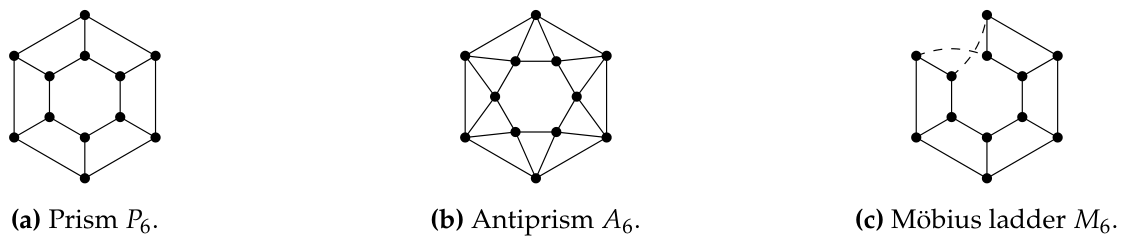
Figure 2.
Dominant-branch partition and chromatic roots for ; curves and sample points are schematic, not computed.
Figure 2.
Dominant-branch partition and chromatic roots for ; curves and sample points are schematic, not computed.
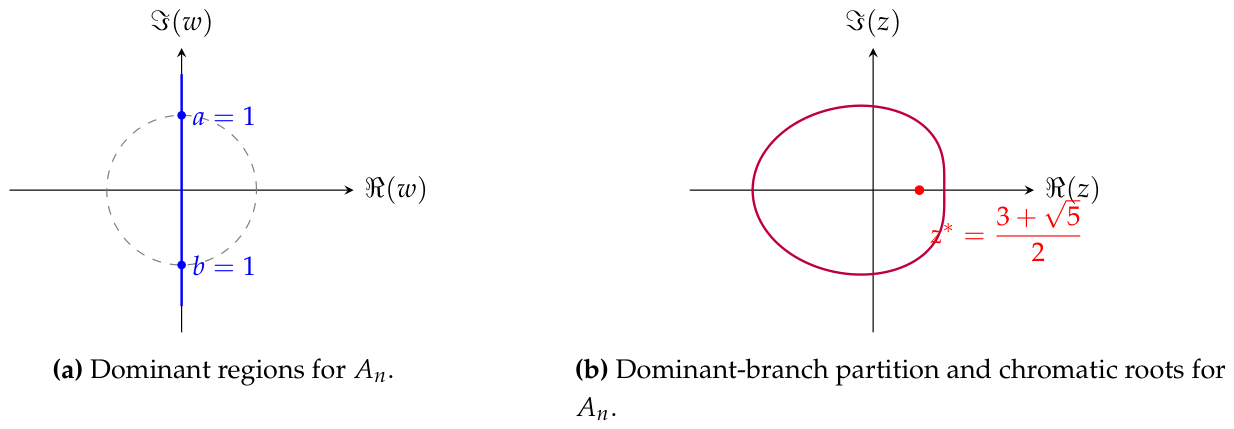
Figure 3.
Circulant graphs defined by jump sets and , illustrated for . Panel (b) shows the jump structure only; the chord analysis of §4.3 assumes , for which the two distance-3 neighbors are distinct.
Figure 3.
Circulant graphs defined by jump sets and , illustrated for . Panel (b) shows the jump structure only; the chord analysis of §4.3 assumes , for which the two distance-3 neighbors are distinct.
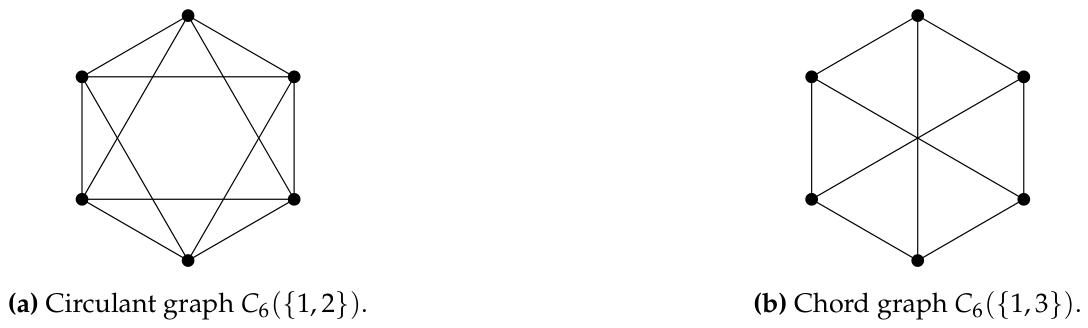
Figure 4.
Schematic root distributions. Left: prism and Möbius ladder , governed by the prism equimodular curve from (distinct from Q). Right: , governed by the quartic (4).
Figure 4.
Schematic root distributions. Left: prism and Möbius ladder , governed by the prism equimodular curve from (distinct from Q). Right: , governed by the quartic (4).
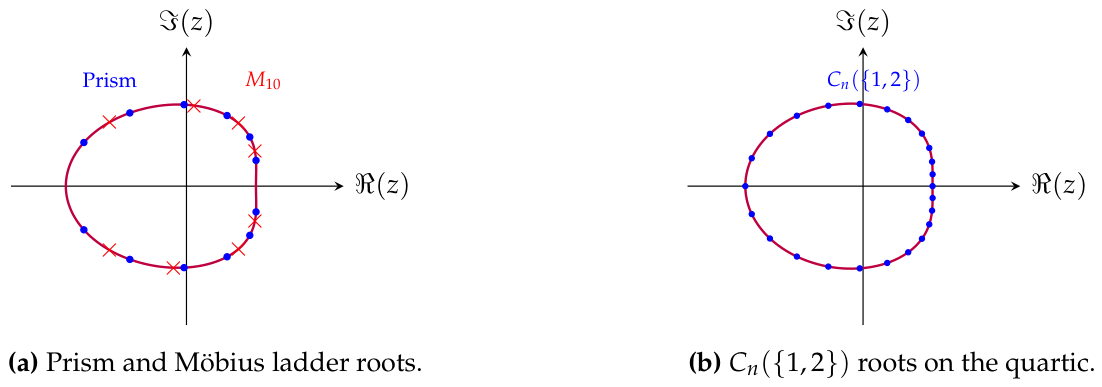
Figure 5.
Ladder graph and Generalized Petersen family for .
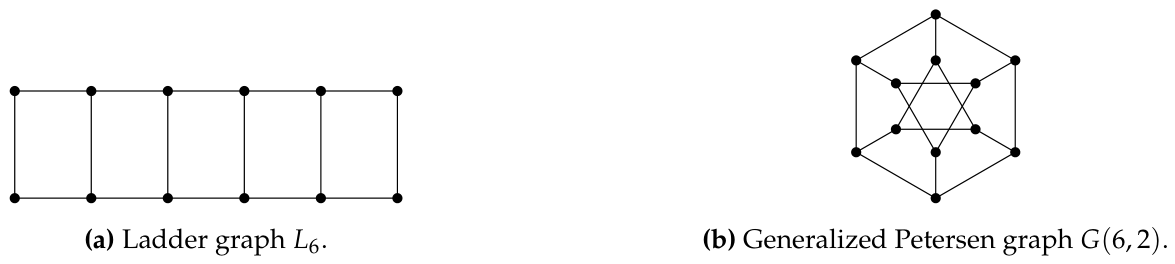
Figure 6.
Degenerate limiting geometries for the chord and ladder families.
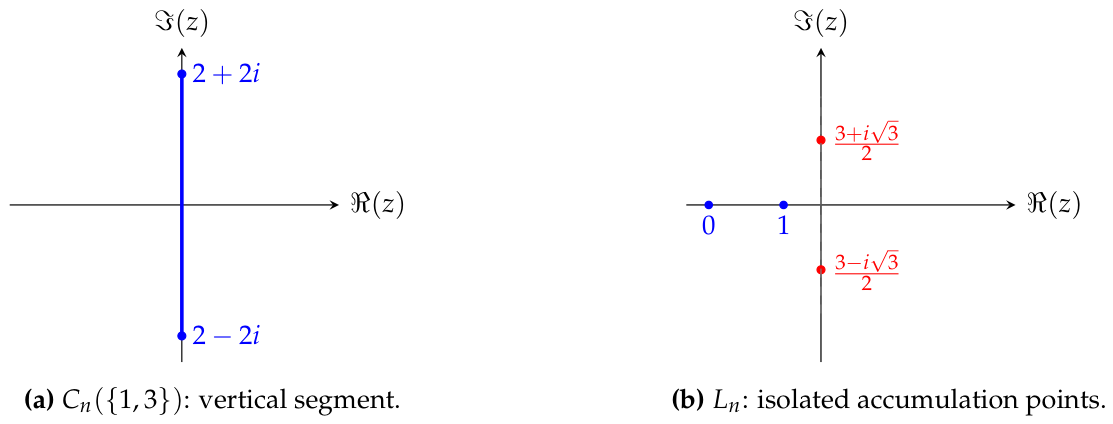
Figure 7.
Schematic chromatic-root distribution for (); curves and points illustrate multibranch cubic competition and are not computed loci.
Figure 7.
Schematic chromatic-root distribution for (); curves and points illustrate multibranch cubic competition and are not computed loci.
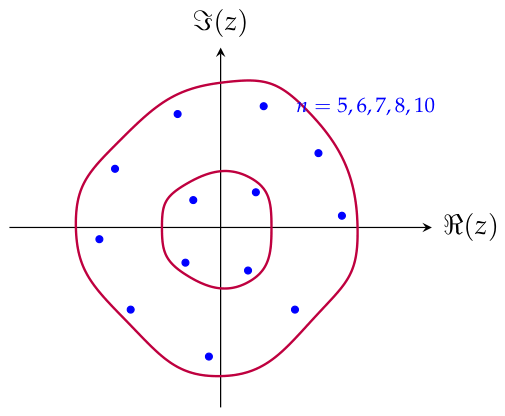
Figure 8.
Spectral hierarchy for prism-derived graph families.
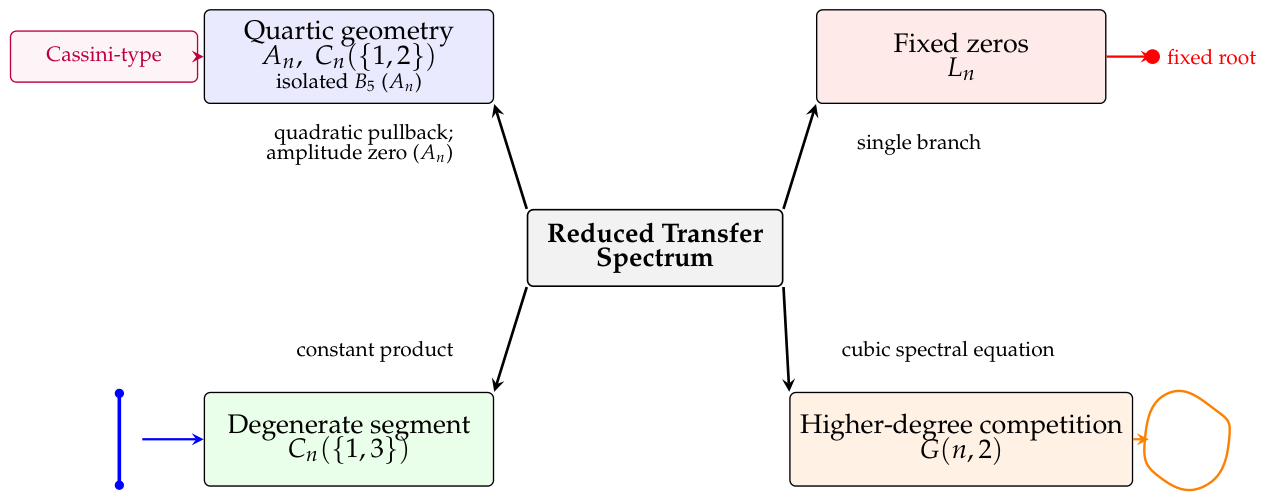

Table 1.
Spectral profiles of the prism-derived families.
| Family | Reduced degree | Spectral structure | Limiting geometry | Isolated points |
|---|---|---|---|---|
| Prism | 2 | const. disc.; | quartic‡ | none |
| Antiprism | 2 | quartic Q | ||
| Möbius | 2 | prism spectrum | quartic‡ | none |
| 2 | quartic Q | none | ||
| 2 | quartic | none | ||
| 2 | segment† () | none | ||
| Ladder | 1 | single branch | fixed zeros | fixed pair |
| 3 | irreducible cubic | higher-degree set | unknown |
† Established as the equimodular locus of the reduced spectral pair (Theorem 7); dominance over the residual sectors of the full transfer operator is not analyzed. ‡ The prism and Möbius equimodular curve is determined by the quadratic constant-sector branch , the reduced row–column discriminant being the constant 4; it is a quartic in distinct from of (4), obtained in [2]. The shared quartic Q of item 1 in Remark 2 applies only to the pair .
Disclaimer/Publisher’s Note: The statements, opinions and data contained in all publications are solely those of the individual author(s) and contributor(s) and not of MDPI and/or the editor(s). MDPI and/or the editor(s) disclaim responsibility for any injury to people or property resulting from any ideas, methods, instructions or products referred to in the content. |
© 2026 by the authors. Licensee MDPI, Basel, Switzerland. This article is an open access article distributed under the terms and conditions of the Creative Commons Attribution (CC BY) license (http://creativecommons.org/licenses/by/4.0/).
Copyright: This open access article is published under a Creative Commons CC BY 4.0 license, which permit the free download, distribution, and reuse, provided that the author and preprint are cited in any reuse.


