

Submitted:
07 June 2026
Posted:
08 June 2026
You are already at the latest version
Abstract
Indoor badminton venues are common mass-fitness spaces in China, but their acoustic environment remains underexamined relative to lighting, thermal comfort, and functional facilities. This study uses grounded theory to examine how users perceive acoustic conditions within the broader experience of indoor badminton venues. A total of 4,721 raw online reviews for seven purposively selected venues in five Chinese cities were collected, and 3,937 valid reviews remained after preprocessing. A hybrid text-processing procedure combining DeepSeek-V3-assisted term pre-screening and Python jieba segmentation identified 74 core high-frequency terms; all grounded-theory coding was conducted manually in NVivo 15. Open, axial, and selective coding generated 32 initial categories, 6 main categories, and an Indoor Badminton Venue User Experience Perception Model. Acoustic-related categories were then extracted to construct an Acoustic Environment Perception Mechanism sub-model. The results show that noise level was directly mentioned in only 45 reviews but was indirectly embedded in sport atmosphere, time-based flow, and user experience, indicating a latent perceptual role. Moderate sound may be interpreted as a vibrant sport atmosphere, whereas crowd overload and reverberant spatial conditions may shift perception toward chaotic noise. The findings provide qualitative evidence for integrating user-centered acoustic considerations into the design and operation of mass-leisure sports venues.
Keywords:
indoor badminton venue
; acoustic environment perception
; grounded theory
; user experience
; online reviews
1. Introduction
Indoor sports facilities have become essential infrastructure in modern urban environments, supporting the growing global emphasis on physical activity and public health [1]. As a key provider of mass fitness, the environmental quality of indoor sports venues directly affects users’ exercise experiences and health benefits. Badminton, one of the most popular sports in China, benefits from being weather-independent, having flexible exercise intensity, and a low participation threshold; consequently, indoor badminton venues have become core sports facilities in urban communities and commercial complexes. However, while venue construction has flourished, issues with the acoustic environment have long been overlooked. Indoor badminton venues, owing to their large space volumes and numerous reflective surfaces, are highly prone to acoustic problems such as excessive reverberation and noise accumulation [2,3], severely impairing users’ communication and exercise experiences [4].
Studies have shown that the acoustic environmental quality of sports buildings varies significantly with venue type, spatial enclosure, and user density. Yoo [2] found that the Ulsan Sports Hall in Korea suffers from severe acoustic issues (e.g., excessive reverberation, echoes, and sound focusing) due to its large volume and abundant hard reflective interior surfaces. Al-Arja et al. [3] conducted in-situ acoustic measurements in 20 indoor fitness halls in Amman, Jordan, finding reverberation times as high as 1.09–5.38 s and equivalent sound pressure levels of 80–110 dB(A) during activity, with 90% of the personal daily noise exposure measurements exceeding the occupational exposure limit of 85 dB(A); most venues lacked any acoustic treatment. Conetta et al. [4] examined 9 indoor sports halls and gymnasiums in the UK and found that mid-frequency reverberation times in most venues far exceeded standards, with noise levels significantly elevated during physical education classes due to high student density. Del Brenna [5] surveyed 18 sports halls across 14 venues in Helsinki, with fewer than half meeting current acoustic specifications. Ansari [6] pointed out that indoor swimming pools represent one of the most acoustically challenging types of sports buildings, where the enormous space and humid environment lead to particularly prominent reverberation problems. Deng [7] surveyed the acoustic environment of 10 sports training halls and identified excessive reverberation time as the core acoustic deficiency. Chen and Ma [8] studied 8 large-space buildings in Tianjin, including sports buildings, and found that background noise was generally high in many large-space settings; overall, more than 90% of surveyed users reported that the acoustic environment affected their mood, attention, thinking, or behavior. Similar acoustic challenges have been confirmed in other large-span public spaces such as airport departure lounges [9] and hospital outpatient halls [10].
Existing research on the acoustic environment of sports buildings has mostly focused on large comprehensive venues or professional competition venues [2,4,5,6,7], while studies on mass-oriented badminton venues, primarily used for fitness and social activities, are relatively scarce. Sjödin [11] used the 2017 BWF World Badminton Championships as the experimental setting and found that equivalent noise and impulsive sound levels exceeded limits during prolonged work by technical officials, posing a risk of hearing damage; however, that study focused on professional events rather than mass leisure venues. Furthermore, existing studies and standards generally emphasize the measurement and analysis of objective acoustic parameters [12,13], while the systematic exploration of users’ subjective perceptual experiences remains insufficient, leading to a disconnect between objective measurement and subjective perception [8]. A recent study by Huang et al. [14] conducted an empirical study in six high-traffic badminton venues to examine the relationship between acoustic and emotional factors in badminton hall environments and users’ evaluations of acoustic comfort. The findings indicated that noise levels in indoor badminton venues exhibit pronounced temporal fluctuations, and fewer than half of the respondents reported satisfaction with the acoustic conditions. In addition, users’ intrinsic interest in and enthusiasm for badminton significantly influenced their subjective perception of acoustic comfort. Concurrent with this, the contribution of acoustic comfort to overall environmental comfort was found to surpass that of thermal comfort.
While the above studies, particularly the recent findings by Huang et al. [14], have offered initial empirical evidence on users’ subjective perceptions of the acoustic environment in indoor badminton venues, these insights remain largely descriptive and derived from structured surveys. Such approaches may not fully capture the complexity, contextual richness, and latent dimensions of user experience as it unfolds in real-world settings. A more in-depth, inductive inquiry is therefore needed to systematically explore how users perceive, interpret, and respond to the acoustic conditions within the holistic context of badminton hall use. To address this gap, the present study adopts grounded theory—a qualitative methodology that enables theoretical constructs to emerge directly from empirical data.
Grounded Theory was proposed by Glaser and Strauss [15] in 1967 as a bottom-up inductive qualitative research method. Its core lies in deriving theory grounded in practice through the collection, coding, and analysis of real-world data. Through inductive reasoning and data analysis, theoretical saturation is reached—i.e., when newly added data no longer generate new conceptual categories, theory construction is complete. The research process is non-linear and can be iteratively refined [15,16,17]. Its core operational logic is to identify core concepts and their internal connections and to construct a theoretical system bottom-up [18,19], through three levels of analysis: open coding, axial coding, and selective coding [16,20].
Grounded theory has been widely applied in urban open spaces [21], urban parks [22], landscape architecture [23], and soundscape studies [24,25,26]. In the field of environmental perception, Glover [27] used narrative interviews and grounded theory to extract the operational patterns of social capital in community gardens. Related soundscape-emotion research has also provided useful measurement references: Zhang et al. [28] conducted a laboratory audio-visual experiment using 16 urban open-space soundscape excerpts from Harbin and a Chinese questionnaire, developed semantic differential scales from 92 candidate emotional-descriptive terms, and identified 5 categories of felt emotions and 7 categories of perceived emotions through factor analysis. Hussein et al. [29] adopted constructivist grounded theory and proposed a practical pathway for incorporating cultural memory protection into historic urban landscape management. Li et al. [24] used grounded theory to construct a five-dimensional integration model of traditional Chinese garden elements in modern urban landscape design. Moshona et al. [25] derived an eight-dimensional taxonomy of soundscape interventions based on 43 real-world soundscape intervention cases worldwide, while Ercakmak Osma and Dokmeci Yorukoglu [30] further proposed Indoor Soundscape Intervention (ISI) criteria for architectural practice through a systematic review with grounded theory analysis.
In soundscape research, Liu and Kang [31] used grounded theory to reveal five core categories of subjective understanding of urban soundscapes: soundscape definition, soundscape memory, soundscape emotion, soundscape expectation, and soundscape esthetics. Cao and Kang [21] used grounded theory to construct a perceptual structure of soundscapes in urban public spaces, identifying four perceptual dimensions: sound classification, sound features, psychological responses, and soundscape preferences. Orhan and Yilmazer [32] adopted grounded theory to investigate the indoor soundscape perception framework of neonatal intensive care units. These studies indicate that grounded theory, as the qualitative research method recommended by the International Organization for Standardization (ISO) 12913-3 [33], is particularly suitable for exploring emerging interdisciplinary fields lacking mature theoretical support.
For the methodological combination of “online reviews + grounded theory,” several recent representative studies are also available: Tao and Duan [34] used Qianmen Street in Beijing as a case study and constructed a historic street renewal evaluation system containing 4 first-level and 15 second-level indicators based on online reviews and grounded theory; a study on age-friendly rural public spaces [35] further integrated grounded theory with FKANO and DEMATEL to identify priority levels of user needs; grounded theory analysis driven by online review data has also been successfully extended to shared bicycle winter travel [36] and Airbnb user experience [37], among other domains. Meanwhile, large language model–based mining of Dianping reviews has been validated in consumer perception research—e.g., applying the Qwen3-32B model to perform Function-Experience-Symbolism (F-E-S) framework semantic mapping on reviews of Beijing time-honored restaurants [38]. These studies provide direct methodological references for the present research design. Additionally, Lyu [22] collected review texts of urban parks from Dianping and other platforms and used grounded theory to construct a tourist satisfaction evaluation system; Chen [39] applied three-level grounded coding to build a post-occupancy evaluation model for archeological site parks; Liu [40] combined grounded theory to identify localized sound sources in She ethnic villages and comparatively analyzed perceptual differences between hosts and guests regarding sound sources and soundscapes.
Based on the above background, this study employs grounded theory to qualitatively analyze the acoustic environment of indoor badminton venues. In terms of research strategy, this paper deliberately adopts a two-stage path of “first constructing an overall experience model, then extracting the acoustic sub-model” rather than coding only acoustic-related reviews in isolation. The specific objectives include: (1) using authentic online reviews from Dianping as the raw data to bottom-up construct an indoor badminton venue user experience perception model; (2) within this model framework, isolating and focusing on the acoustic dimension to refine an acoustic environment perception mechanism sub-model; (3) clarifying the latent role of the acoustic environment in overall experience, its core influencing factors, and users’ latent acoustic needs, thereby providing theoretical support for subsequent quantitative evaluation and optimized design of the acoustic environment. This strategy is adopted because acoustic requirements in badminton venues do not exist as isolated technical parameters; rather, they are embedded in multi-dimensional interactions among physical space, crowd-flow operation, and users’ psychological expectations. Locating the acoustic dimension within the overall experience framework, therefore, helps reveal the latent characteristics of acoustic needs more accurately.
2. Materials and Methods
The overall research procedure is summarized in Figure 1.
2.1. Selection of Study Venues
To deeply explore the multi-dimensional perceptual characteristics and evaluative demands of users regarding the acoustic environment of badminton venues in real exercise scenarios, this study constructed a theoretical model of acoustic experience and evaluation for such specific sports venues bottom-up by scraping authentic online review data from the Dianping platform.
Grounded theory emphasizes building theory bottom-up from raw data, requiring authentic, natural texts close to users’ on-site experiences. As textual carriers of users’ spontaneous evaluations, online reviews offer stronger immediacy and authenticity than questionnaire surveys and structured interviews [41,42]. This “online reviews + grounded theory” research paradigm has recently been exemplarily validated in the field of built environment evaluation [34], and the present research design directly draws on these prior works.
Dianping (Dianping.com) is a major Chinese local lifestyle service rating platform, with functions and a business model similar to those of Yelp and TripAdvisor internationally [38]. The platform aggregates a large volume of spontaneous feedback from consumers after authentic on-site experiences; reviews actively posted by users after actual consumption are less affected by researcher-imposed preset questions and can therefore more authentically present subjective feelings [41,43,44]. In recent years, text mining methods based on such online reviews have been widely applied in tourism experience [43], restaurant services [44], brand image research [38], and public space perception [34], among other fields. Grounded theory analysis based on online reviews has also recently extended to digital platform studies such as Airbnb user experience [37], further supporting the methodological feasibility of using online reviews as the corpus in this study. Although the samples in this study are all drawn from Chinese cities, mass-oriented indoor badminton venues exhibit globally common spatial configurations (large span, high clearance, hard reflective surfaces) and usage patterns (high density, leisure socializing); thus, the findings provide reference value for the acoustic design of similar indoor leisure sports venues internationally.
In terms of sample selection, to ensure the richness of the raw text database and to enable the data to reach the saturation required by grounded theory, this study comprehensively considered factors such as urban distribution, venue popularity, and audience reach. Ultimately, 7 differentiated badminton venues located in 5 cities—Beijing, Shanghai, Guangzhou, Wuhan, and Nanning—were selected as research samples. Venue selection was based on a comprehensive evaluation of indicators such as user star ratings, the number of valid reviews, operational status, and information completeness on Dianping; the selection covered a differentiated gradient of star ratings from 3.3 to 4.8 and prices from 35 to 114 CNY/hour, in order to maximize the richness of perceptual features. Distribution information of the 7 sampled venues is shown in Table 1, and their geographic distribution is shown in Figure 2.
2.2. Data Collection and Preprocessing
This study used a Python plug-in to collect review data from the Dianping platform, selecting user reviews of the 7 above-mentioned badminton venues from December 2022 to February 2026, yielding a total of 4721 raw reviews. Each review primarily contained the user name, review time, star rating, and review text. Before text analysis, usernames and other personal identifiers were removed or anonymized.
After acquiring the raw review data, the textual material was preprocessed to enhance the quality of subsequent coding analysis: duplicate posts, meaningless spam, reviews containing only simple emoticons, and reviews with no substantive information were removed; special characters, garbled text, and ineffective content with low relevance to the research topic were deleted; after format unification, 3937 valid records remained. The valid review texts were then divided in a 2:1 ratio into two groups: two-thirds (with 123,234 characters after preprocessing) served as the core sample for three-level coding, while the remaining one-third (with 51,192 characters after preprocessing) was reserved for subsequent theoretical saturation testing. All valid texts were finally imported into NVivo 15 for coding analysis.
In qualitative research using online reviews as material, conducting word frequency analysis first allows researchers to quickly grasp core issues and refine sensitive concepts before initiating open coding, which improves the targeted nature of concept extraction and category induction.
2.3. Hybrid Text Analysis Method
In preliminary attempts at text preprocessing and word frequency mining, this study found that the traditional text mining tool ROST CM-6 has clear limitations in Chinese segmentation accuracy. Because such software relies primarily on built-in traditional dictionaries, its ability to recognize domain-specific terminology (e.g., sports venues, exercise experience) and out-of-vocabulary words common in online reviews is weak. Relying solely on manually supplemented custom dictionaries is not only labor-intensive but also highly susceptible to omissions and errors caused by the researcher’s subjective oversight.
Accordingly, to ensure the reliability and validity of text analysis, this study constructed a hybrid text processing pipeline coordinating “large language model (LLM)-based semantic assistance + Python natural language processing.” Semantic mining of Dianping reviews based on large language models has recently been validated in consumer perception research [38], and the methodological reasoning of this study aligns with that line of work. The specific steps are as follows:
(1) AI-assisted high-frequency term pre-screening. A front-end processing framework (Cherry Studio) connected to the DeepSeek API was introduced for preliminary text denoising and semantic recognition. The specific model used was DeepSeek-V3 (released in December 2024). Compared with the mechanical segmentation of traditional software, large language models have stronger contextual understanding capabilities. By inputting the full review text (with user nicknames removed) into the model, the top 100 high-frequency core conceptual terms most relevant to “user experience” and “environmental perception” were automatically extracted within the overall semantic context. An example input prompt was: “Please extract from the following badminton gym user review text the top 100 high-frequency core conceptual terms most relevant to ‘user exercise experience’ and ‘venue environmental perception,’ ranked by frequency from high to low; output only the terms and estimated frequencies, with no further explanation.” It is important to emphasize that AI was involved only in the preliminary screening of high-frequency terms and did not participate in any grounded-theory coding process. All three-level coding (open coding, axial coding, selective coding) was performed manually by the researchers in NVivo 15.
(2) Python dual-dimensional word frequency statistics. The Python jieba segmentation library was introduced for dual quantitative validation: on the one hand, the 100 core terms preliminarily extracted by AI were used as a target list, and a Python script was used to perform absolute matching and term-by-term tracing in the original corpus, accurately counting actual occurrence frequencies; on the other hand, the jieba algorithm was directly applied to the raw corpus to perform independent text segmentation and term frequency–inverse document frequency (TF–IDF) statistics, generating an independent top-100 high-frequency word list natively from the algorithm.
(3) Cross-validation and calibration of results. The two sets of results were compared and calibrated: in cases of statistical inconsistency, custom domain segmentations consistent with the actual usage scenario of badminton venues were preferred; meaningless function words were removed; and synonymous terms were merged with normalized expressions. Through manual verification, approximately 15% of the AI-screened terms had biased frequency estimates and were corrected through Python’s precise statistics; about 8% of the terms were judged by the researchers to be of low relevance to the research topic and were removed. Finally, 74 core high-frequency terms closely related to the research topic were obtained.
2.4. Grounded Theory Coding Procedure
Regarding text-processing tools, NVivo, as one of the most widely used qualitative analysis software packages [45,46,47], supports systematic grounded-theory coding analysis through its powerful coding management and visualization functions, enabling fine-grained organization of massive raw data [48].
This study performed coding analysis of the initial textual material based on grounded theory to derive a user experience perception model for indoor badminton venues. This method enables exploration of the position and weight of the acoustic environment within other perceptual categories and evaluation systems in indoor badminton venues. Systematic coding analysis based on grounded theory comprises three core steps:
(1) Open Coding. Using the raw text as the analytical basis, the material is decomposed sentence by sentence, and the textual content is conceptualized; an initial label is assigned to each evaluation. Through continuous comparison, merging, and reduction, initial categories that authentically reflect users’ perceptions and evaluations within badminton venues are refined, accurately capturing respondents’ auditory experiences and core pain points in actual usage scenarios.
(2) Axial Coding. Building on the fragmented initial categories produced by open coding, the internal logical relationships among categories—including causal relations, conditional relations, contextual associations, mechanisms, and coping strategies—are further organized to identify the affiliations, associations, and hierarchical structures among categories. Categories that are semantically similar or logically related are grouped and integrated to form main categories with higher generality and explanatory power.
(3) Selective Coding. From the multiple main categories formed, a single core category with the strongest commanding and explanatory power is further refined, and the logical associations between the other main categories and the core category are systematically organized to establish the overall theoretical model.
After coding is completed, theoretical saturation testing is conducted; if saturation is not achieved, the analysis returns to the coding stage for iterative refinement until saturation is reached. To reduce pre-coding bias, the high-frequency term list was used only as a sensitizing reference for identifying potentially relevant semantic fields, rather than as a fixed coding framework. Ambiguous coding results were repeatedly compared against the original review texts and resolved through discussion among the research team before category consolidation.
3. Results
3.1. High-Frequency Term Analysis
Based on the hybrid text-processing pipeline, this study ultimately extracted 74 core high-frequency terms; their frequency statistics are partially shown in Table 2.
As visualized in Figure 3, the high-frequency terms cover multiple dimensions, including venue hardware, service experience, price/value, environmental atmosphere, and travel convenience. Among them, “court” appears 2571 times, far exceeding other terms, indicating that court conditions are the core anchor of user evaluation. Positive sentiment terms such as “very good” and “nice” rank near the top, reflecting that the overall sample evaluation is dominated by positive feedback.
Further classifying the high-frequency terms (Table 3), they can be grouped into eight categories. The category “courts and spatial environment” contains the most high-frequency terms, fully indicating that, as a sport with extremely high requirements for hardware conditions such as space height and floor non-slip properties, the physical environmental quality of the venue directly determines users’ core exercise experience. Notably, “atmosphere” (108 occurrences), as a term closely related to the acoustic environment, ranks 52nd among the high-frequency terms; its meaning in the original texts carries both positive (“the playing atmosphere is great”) and negative (“too noisy, the atmosphere is chaotic”) connotations, providing important clues for the construction of the subsequent acoustic environment sub-model. Considering that this dual semantic orientation points specifically to the acoustic–social dimension, this study lists it as an independent category rather than grouping it under the pure spatial environment category.
3.2. Open Coding Results
In the open coding stage, the raw reviews were decomposed sentence by sentence and conceptualized, ultimately yielding 32 initial categories. The following example illustrates the concept extraction process using an original review:
Original review: “The courts are quite spacious, with about 16 badminton courts—more than enough. Court 12 is a bit small for singles, so be careful when booking. The service is okay, the group-buy voucher worked smoothly. The lighting in this gym is quite bright, and the good thing is it’s not glaring. The courts and the toilets are clean.”
The extracted concepts include: spacious court, sufficient court quantity (reflecting positive evaluation of spatial scale and satisfaction with court supply); singles court too small, booking caution required (reflecting negative feedback on court specifications and the influence of court differentiation on booking decisions); decent service, smooth booking, bright lighting, lighting not causing eye discomfort, clean ancillary facilities (highly summarizing the comprehensive evaluation of soft service and hard environment).
To avoid inflating the popularity of a category due to multiple concepts being repeatedly counted within a single review, this study adopted “number of comments involved” for the frequency statistics of initial categories—i.e., counting the number of independent reviews mentioning that category—in order to better reflect the prevalence of each issue among the user population.
It should be noted that, since a single review often involves multiple dimensions (e.g., a single review may simultaneously mention court conditions, lighting, and noise level), the same review may be counted once in each related category. Consequently, the cumulative “number of comments involved” across the 32 initial categories totals 3575, which is greater than the number of independent reviews used in coding (2625)—this cumulative value reflects the breadth of coverage of each issue across user reviews rather than the actual number of sample reviews. This statistical approach follows the basic principle of “concept–category coverage” in grounded theory, more accurately reflecting the prevalence of issues among the user population rather than emphasizing repeated mentions by individual users. The 32 initial categories and their numbers of comments involved are shown in Table 4.
After coding was completed, the high-frequency term list was used to retrospectively verify the online review texts and check whether any initial categories had been omitted. After verification, the extracted concepts and initial categories were confirmed to broadly cover the various aspects of badminton venue user experience and scene perception, encompassing both core perceptual elements at the physical level (e.g., venue facilities, environmental conditions) and subjective experience dimensions (e.g., exercise experience, service interaction); thus, the analysis could proceed to subsequent axial coding and theoretical model construction.
Although the "noise level" category accounts for only a small share of the total comments, the acoustic issues it reflects (excessive reverberation, peak-period noise compounding, adjacent-zone interference) correspond to typical acoustic deficiencies identified in sports building research [3,4,7]. The latent role of these acoustic concerns within the broader experience model is further examined in Section 4.3.
3.3. Axial Coding Results
3.4. Selective Coding and Model Construction
Building on the results of open coding and axial coding, and through continued comparison and in-depth analysis of the user review text data and the main categories, this study constructed the “Indoor Badminton Venue User Experience Perception Model.” The model reveals that the user perception path follows a progressive logic from “comprehensive cost evaluation” to “on-site core perception” and finally to “comprehensive value judgment and behavior” (Figure 6).
3.5. Theoretical Saturation Test
To examine the completeness and generality of the model, this study used the reserved one-third of valid review texts (51,192 characters in total) for the theoretical saturation test. After importing the reserved texts into NVivo 15, the analysis strictly followed the three-level coding procedure. The results showed: no new initial concepts or sub-categories were extracted during coding; no new dimensional supplements emerged within the internal features of the existing main categories; and the logical relationships among categories were all encompassed by the existing theoretical framework, with no new structural relationships emerging.
The following examples illustrate the saturation test process: in the reserved sample, comments such as “when there are many people in the gym, the sound just hums” could be directly classified under the existing “noise level” category; “on weekday afternoons the courts are empty, very comfortable to play” could be classified at the intersection of “time-based flow” and “user experience”; “after the sound-absorbing cotton was installed, it became much quieter than before” could be classified under “noise level.” None of these new comments exceeded the explanatory boundaries of the existing category system. Accordingly, the model constructed in this study is judged to have achieved theoretical saturation.
4. Discussion
4.1. Interpretation of the User Experience Perception Model
The constructed “Indoor Badminton Venue User Experience Perception Model” indicates that the formation of user evaluation is not a simple superposition of various elements, but a dynamic process centered on “Operation & Use Experience” as the core main category and serving as a key transformation link. Comprehensive user perception evaluation frameworks have been widely adopted in public space research [49], and the six-main-category model in this study is consistent with this line of thinking.
Comprehensive cost evaluation stage. Users’ venue selection and evaluation begin with comprehensive cost evaluation. Before making a consumption decision, users need to weigh two dimensions simultaneously: the time and convenience cost constituted by “Location & Accessibility” (geographic location, transport access, parking service), and the direct monetary cost of “Price & fees.” Together, these constitute the gating filter for users entering the venue.
On-site core perception stage. Once inside the venue, users are situated within the foundational environment constructed by “Physical Space & Court Conditions” and “Facilities & Service Support.” The physical space of the courts (court size, court height, floor quality, etc.) is the most direct hardware interface, ensuring not only the basic conduct of exercise but also significantly influencing comfort across the visual, tactile, and somatic dimensions, thereby directly constituting “Environmental Comfort & Perception.” At this stage, the latent yet critical position of the acoustic environment within overall environmental perception must be specially noted. Environmental comfort encompasses not only manifest physical conditions such as temperature and lighting, but also the auditory dimension—the acoustic environment—as a core indicator of spatial quality. Existing research has confirmed via structural equation modeling (SEM) that the influence of indoor fitness environments on activity intensity is mainly mediated by perceived variables such as comfort and convenience [50]; although acoustic comfort has not been explicitly incorporated into prior models, the present study suggests, through grounded theory, that it may also play a comparable mediating role. On this basis, the venue’s inherent resource constraints (capacity constraint), through management mechanisms (booking system, time-based flow), interact with the core activity to jointly shape the “Operation & Use Experience.”
Comprehensive value judgment stage. Based on the comprehensive comparison between prior cost evaluation and on-site core experience, users complete value judgment and behavioral intent output, determining repurchase intention and use frequency, and achieving the transition from one-off consumption to long-term retention.
4.2. Interpretation of the Acoustic Environment Perception Mechanism Sub-Model
Building on the user experience perception model, this study further extracts categories such as “noise level,” “time-based flow,” “sport atmosphere,” and “physical space” to construct the “Indoor Badminton Venue Acoustic Environment Perception Mechanism” sub-model (Figure 7). The core mechanisms of this sub-model are as follows:
(1) Objective determinative role of physical space. The physical space of the venue (court size, ceiling height, presence of sound-absorbing materials) constitutes an important physical condition of the acoustic environment and may influence reverberation characteristics. Existing BIM-based research [51] indicates that reverberation time is a key parameter related to building acoustic comfort and can be optimized through the placement of sound-absorbing materials.
(2) Dynamic regulatory role of time-based flow. Variations in time-based flow constitute the dynamic regulatory factor of the acoustic environment. During peak periods, capacity constraints cause activity density between courts to surge sharply, with shuttle-impact sounds, shouting, and friction sounds compounding at high frequency. If the physical space lacks adequate sound-absorbing and noise-reducing design, users’ descriptions suggest that high crowd density may interact with reverberant spatial conditions, potentially producing a perceived high-noise environment.
(3) Duality of sport atmosphere and noise level—interpretation based on the ISO 12913 soundscape evaluation framework. In the text mining, users frequently mentioned “great atmosphere” and “lively” alongside “too noisy” and “chaotic,” revealing a unique attribute of the acoustic environment of indoor leisure badminton venues: the acoustic environment and sport atmosphere are “two sides of the same coin.” This finding can be theoretically interpreted via the two-dimensional soundscape evaluation circumplex proposed by Axelsson et al. [52] in ISO 12913-1 [53]. In this model, soundscape perception is distributed along two orthogonal dimensions—Pleasantness and Eventfulness—forming four quadrants: Vibrant, Chaotic, Calm, and Monotonous [54,55]. Moderate shuttle-impact sounds and conversational sounds fall within the “Vibrant” quadrant—pleasant and eventful—being decoded as a positive sport atmosphere that can elicit excitement; under such conditions, an increase in SPL does not necessarily lead to acoustic discomfort. Evidence from public open-space soundscape research suggests that activity-oriented zones may tolerate or even benefit from higher sound-event levels than restoration-oriented zones [56]. However, when crowd overload is perceived to intensify sound energy and acoustic disorder, soundscape perception crosses from the “Vibrant” quadrant into the “Chaotic” quadrant—unpleasant and eventful—and sport atmosphere is instantly transformed into negative noise-level perception, undermining concentration and overall comfort. This critical transition from positive to negative is a core feature distinguishing the acoustic environment of mass leisure badminton venues from that of professional competition venues. This finding aligns with the coexistence of “high SPL–high preference” phenomena in the field of leisure noise [57,58].
(4) Regulatory role of users’ subjective expectations. Faced with the same objective acoustic conditions and crowd density, the final value evaluation varies among individuals. Some users have higher tolerance for the acoustic environment and tend to interpret high SPL as a manifestation of a vibrant exercise atmosphere; others are extremely sensitive to shouting and mechanical noise and feel significant noise pressure within the venue. This individual variation further confirms the principle of “context-dependency” of soundscape perception emphasized by the ISO 12913 standard [53].
4.3. Latent Characteristic of Acoustic Environment Perception
An important finding of this study is that acoustic environment perception exhibits a pronounced “latent” characteristic. Although users seldom directly use professional acoustic terminology in everyday evaluations, and may even subjectively neglect the independent existence of the acoustic environment, this does not signify the absence of acoustic demands. As an indispensable dimension under the “Environmental Comfort & Perception” main category, “noise level” subtly yet profoundly influences exercise concentration and psychological comfort. A poor acoustic environment is directly translated into negative perceptions such as “noisy” and “loud disturbance,” breaking exercise concentration and even masking the venue’s strengths in other hardware aspects such as court size and floor quality. However, current mass-oriented badminton venues generally lack sufficient attention to acoustic environment design. This finding not only highlights the importance of meeting latent acoustic demands for elevating overall venue experience, but also validates the research significance of conducting quantitative evaluation of the acoustic environment in such building spaces, which are highly prone to dense activity noise.
Figure 8 further illustrates the distribution of the 32 initial categories. Among these categories, the “noise level” category, which directly points to acoustics, involves only 45 reviews (approximately 1.3%), and its data weight is relatively limited. This study demonstrates the latent influence of the acoustic environment through cross-category associations such as “sport atmosphere” and “time-based flow”; nevertheless, this proportion also objectively reflects that the acoustic environment indeed occupies a “latent” rather than “manifest” position in users’ spontaneous evaluations. This phenomenon itself constitutes an important methodological finding of the present study: as spontaneous feedback, online reviews can still reveal the critical role of the acoustic environment through cross-category semantic associations even when users do not actively use acoustic terminology—and this is precisely the unique value of the “bottom-up” grounded theory approach relative to structured questionnaires.
4.4. Architectural Design and Operation Optimization Recommendations
Based on the above findings, this study proposes the following potential practical recommendations for the optimization of the acoustic environment of indoor badminton venues, addressed to architects and venue operators. A systematic review of Indoor Soundscape Intervention (ISI) criteria for architectural practice has already been formed [30], providing a theoretical basis for the recommendations below.
(1) Low-cost sound absorption measures. Economical sound-absorbing materials (e.g., sound-absorbing curtains, perforated metal panel composite sound-absorbing structures, or polyester fiber sound-absorbing panels) can be installed on the venue’s side walls to reduce mid- and high-frequency reverberation time. Such acoustic retrofits can be conducted in conjunction with energy-efficiency renovation projects, improving overall indoor environmental quality (IEQ) performance [59]. As shown in users’ positive feedback such as “with sound-absorbing walls all around, noise is very low while playing,” such measures may enhance user experience. Acoustic-deficiency studies of large-volume public buildings of a similar type (e.g., hospital outpatient halls) likewise confirm that parallel walls and hard finishes can reduce speech transmission index (STI) performance and produce flutter echoes [10]; these findings provide a useful reference for badminton venues, although venue-specific acoustic measurements are still needed before detailed design.
(2) Crowd density regulation. By optimizing the time-slot management of the booking system, the number of simultaneously used courts during peak periods can be controlled to avoid spiraling SPL increases caused by excessive activity density (the Lombard effect/“café effect”: as background noise rises, speakers instinctively raise their volume, forming a positive feedback loop in multi-person environments). Especially during evening and weekend peak periods, appropriately lowering the court booking ceiling may be considered, provided that operational feasibility and user demand are also evaluated.
(3) Spatial acoustic zoning. In venue planning, acoustic zoning of courts may be considered through methods such as partition curtains and half-height walls, reducing acoustic crosstalk between adjacent courts and improving users’ exercise concentration and verbal communication quality with companions. Because ceiling heights of m can better accommodate sports such as volleyball and badminton [60], zoning design should not compromise safety, visibility, ventilation, or sport clearance, and should optimize the sound-absorbing performance of interface materials while ensuring sufficient clearance.
4.5. Limitations
This study has the following limitations, which should be considered when interpreting the conclusions:
(1) Bias in data sources. Online reviews are subject to survivor bias, i.e., users at the extremes of satisfaction or dissatisfaction are more inclined to post reviews, while the voices of moderate users may be underrepresented. Additionally, the user demographic on Dianping may skew younger, neglecting the acoustic perception characteristics of middle-aged and older exercisers. Subsequent research could draw on the mixed-method approach of disability-friendly design research [61], expanding the sample to cover the acoustic needs of special groups such as the elderly and people with disabilities.
(2) Lack of corresponding objective acoustic measurement data. This study is purely qualitative and did not obtain objective acoustic parameters (e.g., reverberation time , background noise SPL, STI) or detailed building physical-spatial parameters (e.g., venue volume, composition of major surface materials) for the 7 sampled venues; thus, cross-validation between the subjective perceptions extracted from text (e.g., “loud echoes,” “too noisy”) and objective acoustic data could not be performed. Subsequent research should supplement on-site acoustic measurements to fill this gap, and could also incorporate machine learning methods to prioritize categories identified by grounded theory [36].
(3) Cultural and regional limitations. All samples were drawn from the Dianping platform in Chinese cities; generalization of the conclusions to other cultures and regions should be approached with caution. Although the spatial configuration of badminton venues is globally common, users’ sensitivity to speech intelligibility under different linguistic backgrounds may differ [62], and tolerance and preferences for the acoustic environment may also vary across cultural backgrounds.
5. Conclusions
Using grounded theory, this study collected 4721 raw Dianping reviews of seven purposively selected indoor badminton venues across five Chinese cities; after preprocessing, 3937 valid reviews were retained for analysis. The main conclusions are as follows:
(1) The study constructed an indoor badminton venue user experience perception model that follows a progressive pathway from cost evaluation to core on-site experience and then to value-based behavioral intention. This model shows that acoustic perception is embedded within a broader experience system rather than operating as an isolated environmental factor.
(2) The acoustic environment occupies a latent but structurally important position in spontaneous user reviews. Although “noise level” was directly mentioned in only 45 reviews, acoustic-related meanings were indirectly connected with categories such as “sport atmosphere,” “time-based flow,” and “user experience,” indicating that users may perceive acoustic problems without necessarily expressing them in professional acoustic terms.
(3) The acoustic perception mechanism of indoor badminton venues is characterized by the dual relationship between sport atmosphere and noise perception. Moderate activity sounds may be interpreted as a vibrant sport atmosphere, whereas excessive crowd density and acoustically reflective spatial conditions may shift perception toward chaotic noise within the ISO 12913 soundscape framework.
(4) The findings suggest that acoustic optimization in mass-leisure badminton venues should combine physical design and operational management. Potential strategies include low-cost sound absorption, time-slot-based crowd-density regulation, and spatial acoustic zoning, but these qualitative findings should be further validated through objective acoustic measurements and subjective evaluation in future research.
Author Contributions
Conceptualization, K.H. and L.L.; methodology, K.H. and J.L.; software, K.H.; validation, J.L. and Y.L.; formal analysis, K.H. and C.H.; investigation, K.H. and J.L.; resources, L.L.; data curation, K.H. and C.H.; writing—original draft preparation, K.H. and C.H.; writing—review and editing, L.L., J.L. and Y.L.; visualization, K.H. and J.L.; supervision, L.L. and Y.L.; project administration, L.L. All authors have read and agreed to the published version of the manuscript.
Funding
This research was supported by the National Natural Science Foundation of China (51968001), the Guangxi Middle-aged and Young Teachers’ Basic Ability Promotion Project (2024KY0028),the Research Start-up Funding for Young Talents (ZX02080030324022).
Institutional Review Board Statement
Ethics review and approval were waived for this study because it used only publicly available online review data scraped from the Dianping platform, with all personal identifiers (e.g., user nicknames) removed prior to analysis. No human participants were directly recruited, contacted, or interviewed.
Informed Consent Statement
Not applicable. This study analyzed only publicly accessible online reviews voluntarily posted by users on the Dianping platform; no direct interaction with human participants occurred.
Data Availability Statement
Restrictions apply to the availability of these data. The data were collected from Dianping, and the raw review texts are not publicly shared due to platform terms and user privacy considerations. Anonymized coding results and aggregated frequency statistics are available from the corresponding author upon reasonable request.
Acknowledgments
During the preparation of this study, the authors used DeepSeek-V3 via Cherry Studio only for preliminary high-frequency term pre-screening. The authors reviewed and verified all AI-assisted outputs, and all grounded-theory coding was manually conducted by the researchers. The authors take full responsibility for the content of this publication.
Conflicts of Interest
The authors declare no conflicts of interest.
Appendix A. Full Open and Axial Coding Tables
This appendix presents the full versions of Table 4 and Table 5 from the main text. Table A1 provides the full open-coding output, including representative concept extractions and quoted user reviews for each of the 32 initial categories. Table A2 provides the full axial-coding aggregation showing how each of the 32 initial categories was assigned to one of the 6 main categories.

Table A1.
Full open coding results: 32 initial categories with concept-extraction examples and quoted user reviews.
Table A1.
Full open coding results: 32 initial categories with concept-extraction examples and quoted user reviews.
| No. | Initial Category | Concept Extraction (Examples) | Original Review (Examples) | Comments Involved |
|---|---|---|---|---|
| 1 | Court size | Large court area, strong sense of openness, smaller singles court size | a. The courts are quite large; b. Overall feels very spacious; c. The singles court is indeed a bit small | 427 |
| 2 | Court height | Suitable ceiling height, clear lobs touching the ceiling | a. High ceiling, very convenient to play; b. Clear lobs almost always touch the ceiling | 55 |
| 3 | Spatial division | Sufficient spacing between courts, no mutual interference | a. The distance between courts is large enough, no interference | 45 |
| 4 | Floor quality | Good court mat, floor, and joists, comfortable underfoot feel | a. The court mat, floor, and joists are OK; b. Floor and court mat have good slip resistance | 146 |
| 5 | Noise level | Perceived noise level, loud user shouting, noisy environment, sound-absorbing wall effect, echo interference | a. With sound-absorbing walls all around, noise is very low while playing; b. Some people shout loudly, really noisy; c. Echoes are too loud, can’t hear when shouting | 45 |
| 6 | Thermal perception | Perceived temperature level, good air conditioning cooling | a. The court is stuffy at noon; b. AC works well, very cool | 155 |
| 7 | Lighting condition | Side-mounted lighting not glaring, top LED lights obstructing sight | a. Lights are arranged on the sides, not glaring while playing; b. Top LED lights make it impossible to see the shuttle | 195 |
| 8 | Air humidity | Plum rain season, damp feel | a. During plum rain season it’s just unplayable | 2 |
| 9 | Ventilation | Inner courts ventilation moderate, central AC configured | a. Ventilation in inner courts is mediocre; b. With central AC, ventilation is good | 89 |
| 10 | Visual presentation | Court layout exquisite, dark green wall surfaces | a. Layout is very exquisite; b. Dark green walls, visually very suitable | 33 |
| 11 | Environmental odor | Sweat smell pervading the court, restroom odor | a. The whole court smells of sweat | 10 |
| 12 | Court quality | Excellent environmental performance, relatively new gym | a. The environment is impeccable, spacious and clean, fairly professional | 159 |
| 13 | Court quantity | Large scale, sufficient number of courts | a. The courts are very large, visually at least 20+ courts | 91 |
| 14 | Capacity constraint | Fully booked on weekends, very popular | a. Almost fully booked on weekends, extremely popular | 34 |
| 15 | Booking system | Advance booking, convenient booking system | a. Booked two or three days in advance, this gym is quite popular | 109 |
| 16 | Time-based flow | Time-based traffic differences, large evening crowd | a. Few people in the afternoon, but lots in the evening | 134 |
| 17 | Sport atmosphere | Good playing atmosphere, friendly to beginners, lively but orderly, crowded and noisy | a. The playing atmosphere is great, as a beginner I had a lot of fun; b. Too many people on weekends, can’t communicate due to noise | 139 |
| 18 | User experience | Excellent first-time experience, exercising the body, social interaction | a. Excellent first-time experience, both exercise and meeting friends | 194 |
| 19 | Overall rating | Excellent venue rating | a. A really great badminton gym | 47 |
| 20 | Social interaction | Watching others to improve skills, exchanges among players | a. You learn a lot watching others play | 52 |
| 21 | Use frequency | Exercise during holidays, high weekly frequency | a. Come three or four times a week | 81 |
| 22 | Repurchase intention | Intent to book courts with team, repeated repurchase | a. Will come again with friends if there’s a chance | 52 |
| 23 | Transport access | Convenient self-driving, deficiencies in some transport modes | a. Driving is very convenient; b. Taxi is more convenient | 121 |
| 24 | Geographic location | Excellent location, close to home | a. Excellent location, close to home | 106 |
| 25 | Parking service | Large parking lot, sufficient spaces | a. Large parking lot at the entrance, plenty of spaces | 55 |
| 26 | Surroundings | Surrounding dining options, post-exercise stroll | a. There are restaurants nearby, after playing we go for a meal | 17 |
| 27 | Price & fees | Mid-to-high price, value-for-money advantage | a. With advance booking discounts, more cost-effective than many gyms | 334 |
| 28 | Facility completeness | Equipped with locker rooms and showers, sufficient seating | a. The gym has locker rooms and showers, very convenient and modern | 268 |
| 29 | Facility hygiene | Locker room clean and tidy, regular cleaning | a. The locker room is fairly clean | 71 |
| 30 | Management standards | Standardized court management, hard-soled shoes prohibited | a. The courts are managed in a fairly standardized way | 12 |
| 31 | Service attitude | Warm service attitude, negative front-desk attitude | a. The staff are friendly and enthusiastic; b. The front-desk lady has a poor attitude and ignores court squatting | 272 |
| 32 | Coaching service | Patient coaching, experienced coaches | a. The coaches are particularly patient in providing guidance | 25 |
Table A2.
Full axial coding results: aggregation of 32 initial categories into 6 main categories, with comment counts and shares.
Table A2.
Full axial coding results: aggregation of 32 initial categories into 6 main categories, with comment counts and shares.
| No. | Main Category | Initial Category | Comments | Share (%) | Main Category Total |
|---|---|---|---|---|---|
| 1 | Physical Space & Court Conditions | Court size | 427 | 11.94 | 923 (25.80%) |
| Court height | 55 | 1.54 | |||
| Spatial division | 45 | 1.26 | |||
| Court quality | 159 | 4.45 | |||
| Court quantity | 91 | 2.55 | |||
| Floor quality | 146 | 4.08 | |||
| 2 | Environmental Comfort & Perception | Noise level | 45 | 1.26 | 529 (14.79%) |
| Thermal perception | 155 | 4.34 | |||
| Lighting condition | 195 | 5.45 | |||
| Air humidity | 2 | 0.06 | |||
| Ventilation | 89 | 2.49 | |||
| Visual presentation | 33 | 0.92 | |||
| Environmental odor | 10 | 0.28 | |||
| 3 | Facilities & Service Support | Facility completeness | 268 | 7.49 | 648 (18.13%) |
| Facility hygiene | 71 | 1.99 | |||
| Management standards | 12 | 0.34 | |||
| Service attitude | 272 | 7.61 | |||
| Coaching service | 25 | 0.70 | |||
| 4 | Operation & Use Experience | Capacity constraint | 34 | 0.95 | 610 (17.06%) |
| Booking system | 109 | 3.05 | |||
| Time-based flow | 134 | 3.75 | |||
| Sport atmosphere | 139 | 3.89 | |||
| User experience | 194 | 5.42 | |||
| 5 | Value & Behavioral Intent | Price & fees | 334 | 9.34 | 566 (15.83%) |
| Repurchase intention | 52 | 1.45 | |||
| Overall rating | 47 | 1.31 | |||
| Social interaction | 52 | 1.45 | |||
| Use frequency | 81 | 2.27 | |||
| 6 | Location & Accessibility | Transport access | 121 | 3.38 | 299 (8.36%) |
| Geographic location | 106 | 2.96 | |||
| Parking service | 55 | 1.54 | |||
| Surroundings | 17 | 0.48 |
Note: percentages are calculated based on the total “comments involved” of the 32 initial categories (3575), not on the 4721 raw reviews; the same review may involve multiple categories.
References
- World Health Organization. Global Status Report on Physical Activity 2022; Technical Report; World Health Organization: Geneva, Switzerland, 2022. [Google Scholar]
- Yoo, H.C. The room acoustics of gymnasium building. In Proceedings of the 5th Korea-Russia International Symposium on Science and Technology (KORUS 2001), Tomsk, Russia, 26 June–3 July 2001; Volume 3, pp. 35–38. [Google Scholar] [CrossRef]
- Al-Arja, O.A. Acoustic environment and noise exposure in fitness halls. Appl. Sci. 2020, 10, 6349. [Google Scholar] [CrossRef]
- Conetta, R.; Shield, B.; Cox, T.; Mydlarz, C.; Dockrell, J.; Connolly, D. Acoustics of indoor sports halls and gymnasia. In Proceedings of the 9th European Conference on Noise Control (Euronoise 2012), Prague, Czech Republic, 10–13 June 2012; pp. 34–38. [Google Scholar]
- Del Brenna, G. Noise Level in Indoor Sports Facilities and Factors Affecting the Acoustic Environment. Master’s Thesis, Aalto University, Espoo, Finland, 2021. [Google Scholar]
- Ansari, C. Analysis and Design Optimization of Acoustics in Swimming Pool Halls. Ph.D. Thesis, Technische Universität Wien, Vienna, Austria, 2021. [Google Scholar]
- Deng, H. Research on the Architectural Acoustic Design of Sports Training Halls. Master’s Thesis, Shandong Jianzhu University, Jinan, China, 2010. (In Chinese) [Google Scholar]
- Chen, J.; Ma, H. Acoustic environment analysis of large-space buildings. In South Architecture; School of Architecture, South China University of Technology: Guangzhou, China, 2019; pp. 48–53, (In Chinese). [Google Scholar] [CrossRef]
- Li, X.; Zhao, Y. Exploring factors influencing speech intelligibility in airport terminal pier-style departure lounges. Buildings 2025, 15, 426. [Google Scholar] [CrossRef]
- Zhu, Z.; Huang, X.; Wu, G.; Qin, J.; Zhang, Z. A study on the redesign of hospital outpatient halls based on acoustic environment requirements. Buildings 2026, 16, 808. [Google Scholar] [CrossRef]
- Sjödin, F.; Fahlström, M. Noise exposure and hearing related risks for technical officials during a major badminton tournament. Jacobs J. Phys. Rehabil. Med. 2018, 4, 1–11. [Google Scholar]
- ISO 3382-2:2008; Acoustics—Measurement of Room Acoustic Parameters—Part 2: Reverberation Time in Ordinary Rooms. International Organization for Standardization: Geneva, Switzerland, 2008.
- JGJ/T 131-2012; Code for the Acoustic Design and Measurement of Sports Venues. China Architecture & Building Press: Beijing, China, 2012. (In Chinese)
- Huang, K.; Liang, L.; Liu, L.; He, C. Assessment of the acoustic environment in popular indoor badminton gyms. Appl. Acoust. 2026, 242, 111048. [Google Scholar] [CrossRef]
- Glaser, B.G.; Strauss, A.L. The Discovery of Grounded Theory: Strategies for Qualitative Research; Aldine Publishing Company: Chicago, IL, USA, 1967. [Google Scholar]
- Corbin, J.; Strauss, A. Grounded theory research: Procedures, canons, and evaluative criteria. Qual. Sociol. 1990, 13, 3–21. [Google Scholar] [CrossRef]
- Chen, X. The approach and methods of grounded theory. In Educational Research and Experiment; Educational Research and Experiment Editorial Department: Wuhan, China, 1999; pp. 58–63. (In Chinese) [Google Scholar]
- Wu, Y.; Wu, G.; Ma, S. A review of the origin, schools and applications of grounded theory: A case analysis based on workplace learning. J. Distance Educ. 2016, 35, 32–41. (In Chinese) [Google Scholar] [CrossRef]
- Wu, S.; Li, M. The history and logic of grounded theory. Sociol. Stud. 2020, 35, 75–98. [Google Scholar] [CrossRef]
- Charmaz, K. Constructing Grounded Theory: A Practical Guide through Qualitative Analysis, 2nd ed.; SAGE Publications: London, UK, 2014. [Google Scholar]
- Cao, J.; Kang, J. A perceptual structure of soundscapes in urban public spaces using semantic coding based on the grounded theory. Int. J. Environ. Res. Public Health 2023, 20, 2932. [Google Scholar] [CrossRef]
- Lyu, J. Research on the Evaluation of Tourist Perception Satisfaction in Urban Parks of Zhengzhou Based on Grounded Theory. Master’s Thesis, Henan Agricultural University, Zhengzhou, China, 2024. (In Chinese) [Google Scholar]
- Li, M.; Zhou, Y.; Gong, D.; Dong, J.; Yan, H. Incorporation mechanism of traditional Chinese garden elements in modern urban landscape design: An exploratory analysis based on grounded theory. J. Asian Archit. Build. Eng. 2025, 24, 4088–4102. [Google Scholar] [CrossRef]
- Moshona, C.C.; Fiebig, A.; Aletta, F.; Chen, X.; Kang, J.; Mitchell, A.; Oberman, T.; Schulte-Fortkamp, B. A framework to characterize and classify soundscape design practices based on grounded theory. Noise Mapp. 2024, 11, 20240002. [Google Scholar] [CrossRef]
- Chen, X.; Aletta, F.; Moshona, C.C.; Fiebig, A.; Henze, H.; Kang, J.; Mitchell, A.; Oberman, T.; Schulte-Fortkamp, B.; Tong, H. Developing a taxonomy of soundscape interventions from a catalogue of real-world examples. Acta Acust. 2024, 8, 55. [Google Scholar] [CrossRef]
- Yilmazer, S.; Acun, V. A grounded theory approach to assess indoor soundscape in historic religious spaces of Anatolian culture: A case study on Hacı Bayram Mosque. Build. Acoust. 2018, 25, 137–150. [Google Scholar] [CrossRef]
- Glover, T.D. Social capital in the lived experiences of community gardeners. Leis. Sci. 2004, 26, 143–162. [Google Scholar] [CrossRef]
- Zhang, Y.; Kang, J.; Yang, B. Comparison between perceived and felt emotions in the soundscape evaluation of urban open spaces. J. Acoust. Soc. Am. 2024, 155, 2756–2768. [Google Scholar] [CrossRef]
- Hussein, F.; Stephens, J.; Tiwari, R. Grounded theory as an approach for exploring the effect of cultural memory on psychosocial well-being in historic urban landscapes. Soc. Sci. 2020, 9, 219. [Google Scholar] [CrossRef]
- Erçakmak Osma, U.B.; Dökmeci Yörükoğlu, P.N. Indoor soundscape intervention (ISI) criteria for architectural practice: A systematic review with grounded theory analysis. Acoustics 2025, 7, 46. [Google Scholar] [CrossRef]
- Liu, F.; Kang, J. A grounded theory approach to the subjective understanding of urban soundscape in Sheffield. Cities 2016, 50, 28–39. [Google Scholar] [CrossRef]
- Orhan, C.; Yilmazer, S. The neonatal intensive care unit (NICU) context and the perceived soundscape: A grounded theory approach. HERD Health Environ. Res. Des. J. 2024, 17, 77–96. [Google Scholar] [CrossRef]
- Technical Specification ISO/TS 12913-3:2019; Acoustics—Soundscape—Part 3: Data Analysis. International Organization for Standardization: Geneva, Switzerland, 2019.
- Tao, S.; Duan, W. A post-evaluation study on the renewal of public space in Qianmen Street of Beijing’s central axis based on grounded theory. Buildings 2024, 14, 3969. [Google Scholar] [CrossRef]
- Zhang, Z.; Zhan, Z.; Li, Y. User–designer cognitive synergy: Enhancing age-friendly rural public space design. Buildings 2025, 15, 3078. [Google Scholar] [CrossRef]
- Du, Y.; Ji, X.; Dou, C.; Wang, R. Boosting winter green travel: Prioritizing built environment enhancements for shared bike users accessing public transit in the first/last mile using machine learning and grounded theory. Sustainability 2024, 16, 9843. [Google Scholar] [CrossRef]
- Cerdá-Mansilla, E.; Lozano-Blasco, R.; Rubio, N. User experience dimensions in digital peer-to-peer platforms: A grounded theory study of Airbnb online experiences. Adm. Sci. 2025, 15, 169. [Google Scholar] [CrossRef]
- Li, X.; Zhou, A.; Meng, B.; Wang, R. Brand image of Beijing’s time-honored restaurants: An analysis through large language model-driven review mining. J. Theor. Appl. Electron. Commer. Res. 2025, 20, 300. [Google Scholar] [CrossRef]
- Chen, F. Post-Occupancy Evaluation of Daming Palace National Archaeological Site Park Based on Grounded Theory. Master’s Thesis, Xi’an University of Architecture and Technology, Xi’an, China, 2023. (In Chinese) [Google Scholar]
- Liu, R. Research on the Subject-Object Perception and Optimization Strategies of Localized Soundscapes in She Ethnic Villages of Jingning, Zhejiang. Master’s thesis, Zhejiang University, Hangzhou, China, 2023. (In Chinese) [Google Scholar]
- Kozinets, R.V. Netnography: Redefined, 2nd ed.; SAGE Publications: London, UK, 2015. [Google Scholar]
- Mudambi, S.M.; Schuff, D. What makes a helpful online review? A study of customer reviews on Amazon.com. MIS Q. 2010, 34, 185–200. [Google Scholar] [CrossRef]
- Guo, Y.; Barnes, S.J.; Jia, Q. Mining meaning from online ratings and reviews: Tourist satisfaction analysis using latent Dirichlet allocation. Tour. Manag. 2017, 59, 467–483. [Google Scholar] [CrossRef]
- Yan, X.; Wang, J.; Chau, M. Customer revisit intention to restaurants: Evidence from online reviews. Inf. Syst. Front. 2015, 17, 645–657. [Google Scholar] [CrossRef]
- Bazeley, P.; Jackson, K. Qualitative Data Analysis with NVivo, 3rd ed.; SAGE Publications: London, UK, 2019. [Google Scholar]
- Hutchison, A.J.; Johnston, L.H.; Breckon, J.D. Using QSR-NVivo to facilitate the development of a grounded theory project: An account of a worked example. Int. J. Soc. Res. Methodol. 2010, 13, 283–302. [Google Scholar] [CrossRef]
- Welsh, E. Dealing with data: Using NVivo in the qualitative data analysis process. Forum Qual. Soc. Res. 2002, 3, 26. [Google Scholar]
- Bandara, W.; Miskon, S.; Fielt, E. A systematic, tool-supported method for conducting literature reviews in information systems. In Proceedings of the 19th European Conference on Information Systems (ECIS 2011), Helsinki, Finland, 9–11 June 2011. [Google Scholar]
- Huang, Y.; Ye, L.; Chen, Y. Sustainable urban landscape quality: A user-perception framework for public space assessment and development. Sustainability 2025, 17, 3992. [Google Scholar] [CrossRef]
- Wei, W.; Xu, W.; Hong, M. Differentiated impacts of indoor and outdoor fitness environments on residents’ activity intensity: A perspective on homo urbanicus. Buildings 2024, 14, 3323. [Google Scholar] [CrossRef]
- Aguilar, A.J.; De La Hoz-Torres, M.L.; Martínez-Aires, M.D.; Ruiz, D.P. Development of a BIM-based framework using reverberation time (BFRT) as a tool for assessing and improving building acoustic environment. Buildings 2022, 12, 542. [Google Scholar] [CrossRef]
- Axelsson, Ö.; Nilsson, M.E.; Berglund, B. A principal components model of soundscape perception. J. Acoust. Soc. Am. 2010, 128, 2836–2846. [Google Scholar] [CrossRef]
- ISO 12913-1:2014; Acoustics—Soundscape—Part 1: Definition and Conceptual Framework. International Organization for Standardization: Geneva, Switzerland, 2014.
- Torresin, S.; Albatici, R.; Aletta, F.; Babich, F.; Kang, J. Assessment methods and factors determining positive indoor soundscapes in residential buildings: A systematic review. Sustainability 2019, 11, 5290. [Google Scholar] [CrossRef]
- Rachman, Z.; Aletta, F.; Kang, J. Exploring soundscape assessment methods in office environments: A systematic review. Buildings 2024, 14, 3408. [Google Scholar] [CrossRef]
- Xu, Z.; Yang, M.; Yu, L. Identification, evaluation, and influencing factors of soundscapes in public open spaces in high-density residential areas. Appl. Sci. 2024, 14, 6946. [Google Scholar] [CrossRef]
- Beach, E.; Williams, W.; Gilliver, M. Estimating young Australian adults’ risk of hearing damage from selected leisure activities. Ear Hear. 2013, 34, 75–82. [Google Scholar] [CrossRef]
- Lee, D.; Han, W. Noise levels at baseball stadiums and the spectators’ attitude to noise. Noise Health 2019, 21, 47–54. [Google Scholar] [CrossRef] [PubMed]
- Miletić, M.; Komatina, D.; Babić, L.; Lukić, J. Evaluating energy retrofit and indoor environmental quality in a Serbian sports facility: A comprehensive case study. Appl. Sci. 2024, 14, 9401. [Google Scholar] [CrossRef]
- Xiong, D.; Shao, C.; Zhang, R. The evaluation of spatial allocation and sustainable optimization strategies for sports venues in urban planning based on multi-source data: A case study of Xi’an. Buildings 2025, 15, 1354. [Google Scholar] [CrossRef]
- Selanon, P.; Puggioni, F.; Dejnirattisai, S. An inclusive park design based on a research process: A case study of Thammasat Water Sport Center, Pathum Thani, Thailand. Buildings 2024, 14, 1669. [Google Scholar] [CrossRef]
- Park, C.J.; Haan, C.H. Initial study on the reverberation time standard for the Korean middle and high school classrooms using speech intelligibility tests. Buildings 2021, 11, 354. [Google Scholar] [CrossRef]
Figure 1.
Research methodology flowchart. The workflow includes research design, data collection and preprocessing, grounded-theory coding, theoretical saturation testing, and model construction.
Figure 1.
Research methodology flowchart. The workflow includes research design, data collection and preprocessing, grounded-theory coding, theoretical saturation testing, and model construction.
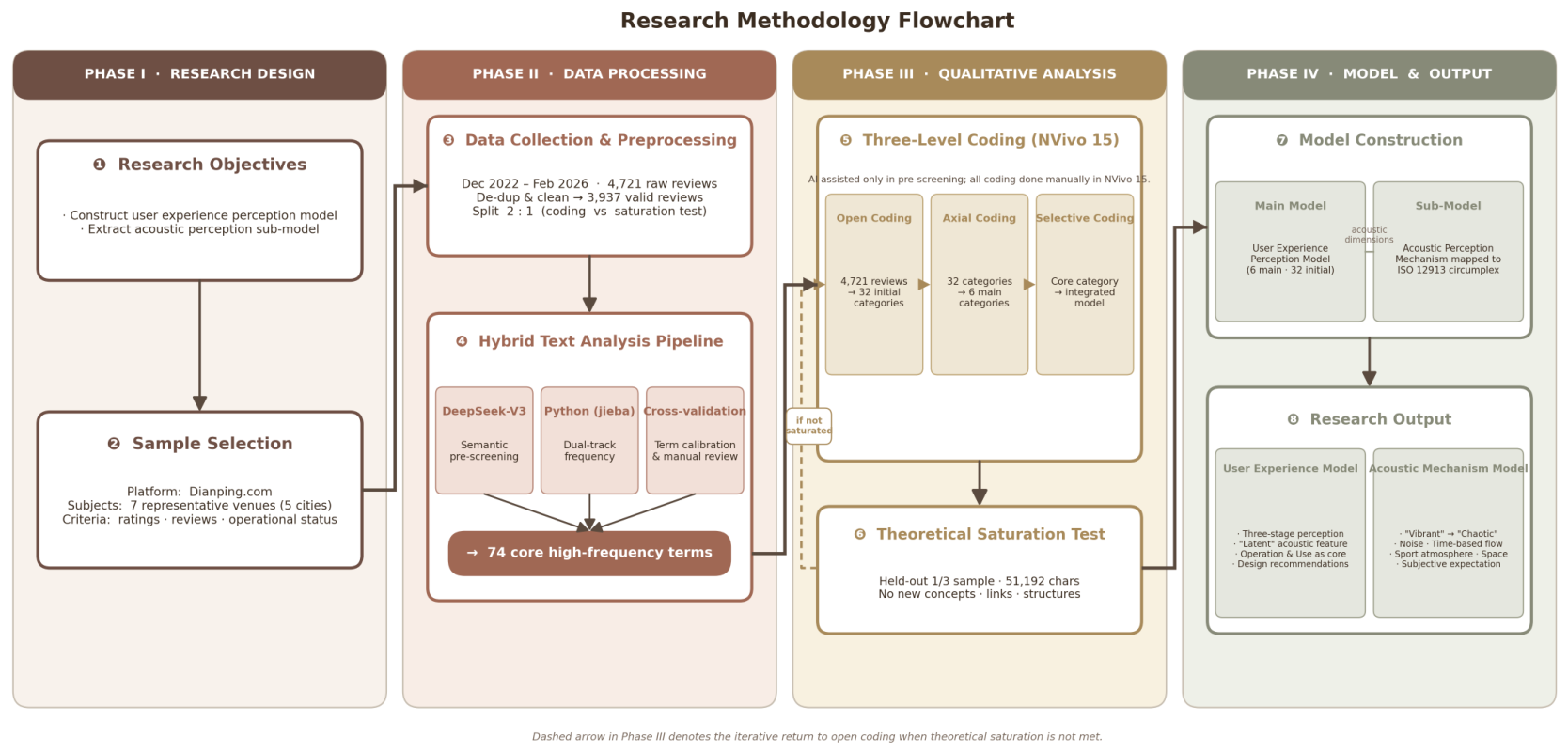
Figure 2.
Geographic diribution of the seven sampled badminton venues. The map shows the city-level distribution of the sampled venues and review counts.
Figure 2.
Geographic diribution of the seven sampled badminton venues. The map shows the city-level distribution of the sampled venues and review counts.
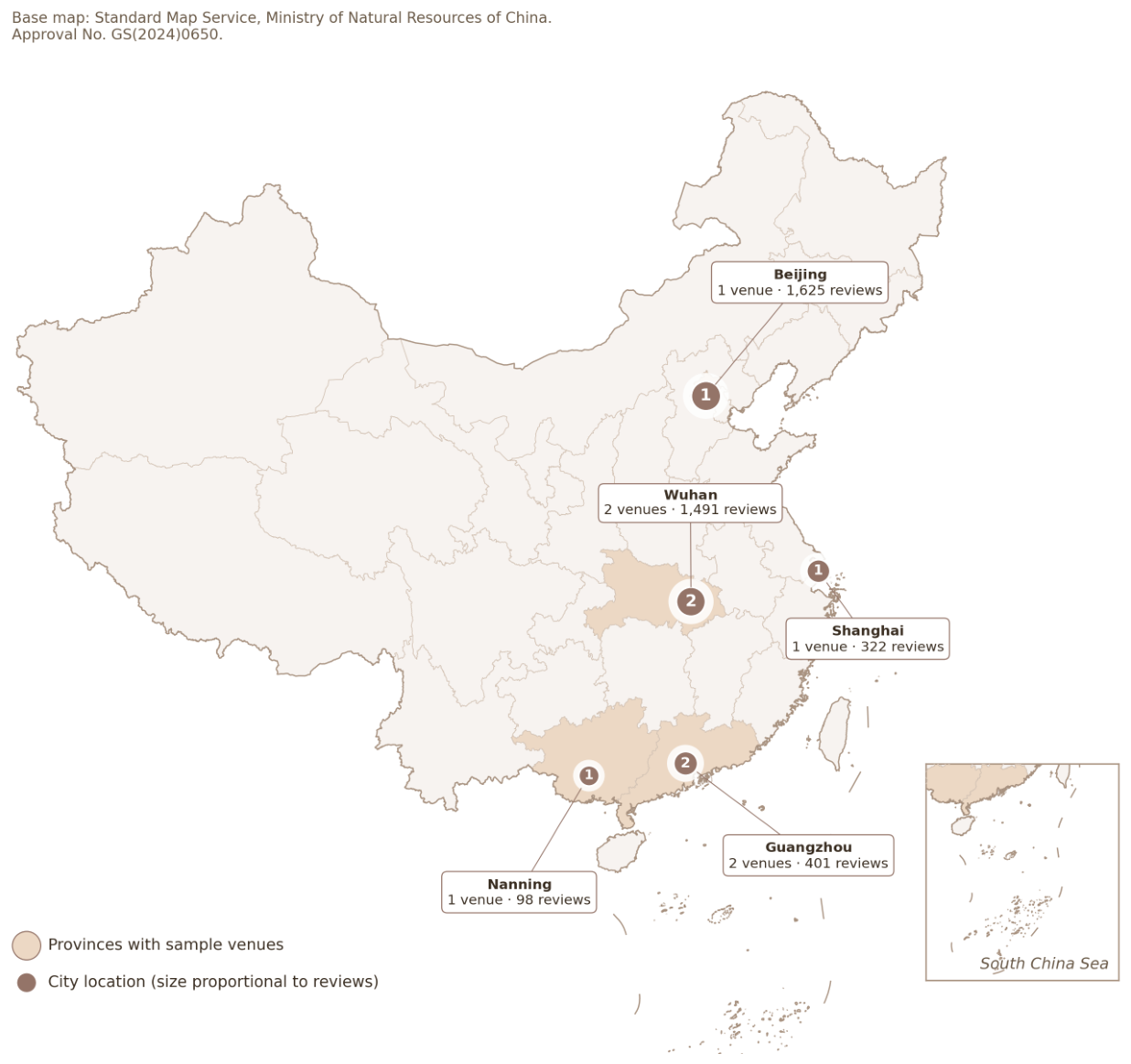
Figure 3.
Word cloud and Top-20 bar chart of 74 core high-frequency terms. The visualization highlights the dominant position of court-related, service-related, environmental, and value-related terms in user reviews.
Figure 3.
Word cloud and Top-20 bar chart of 74 core high-frequency terms. The visualization highlights the dominant position of court-related, service-related, environmental, and value-related terms in user reviews.
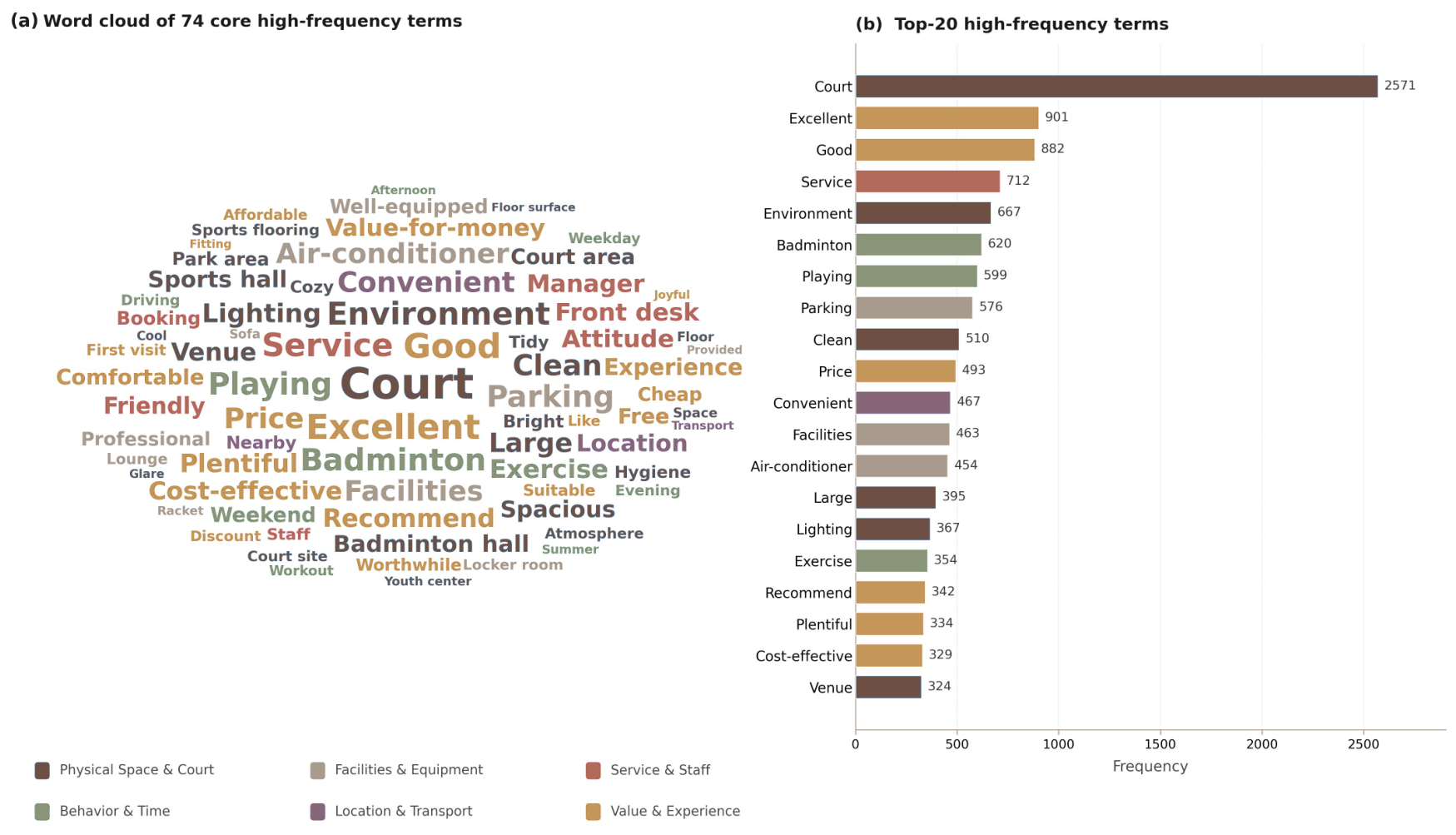
Figure 4.
Hierarchical distribution of perception categories. The sunburst diagram shows the relationship between the 6 main categories and the 32 initial categories.
Figure 4.
Hierarchical distribution of perception categories. The sunburst diagram shows the relationship between the 6 main categories and the 32 initial categories.
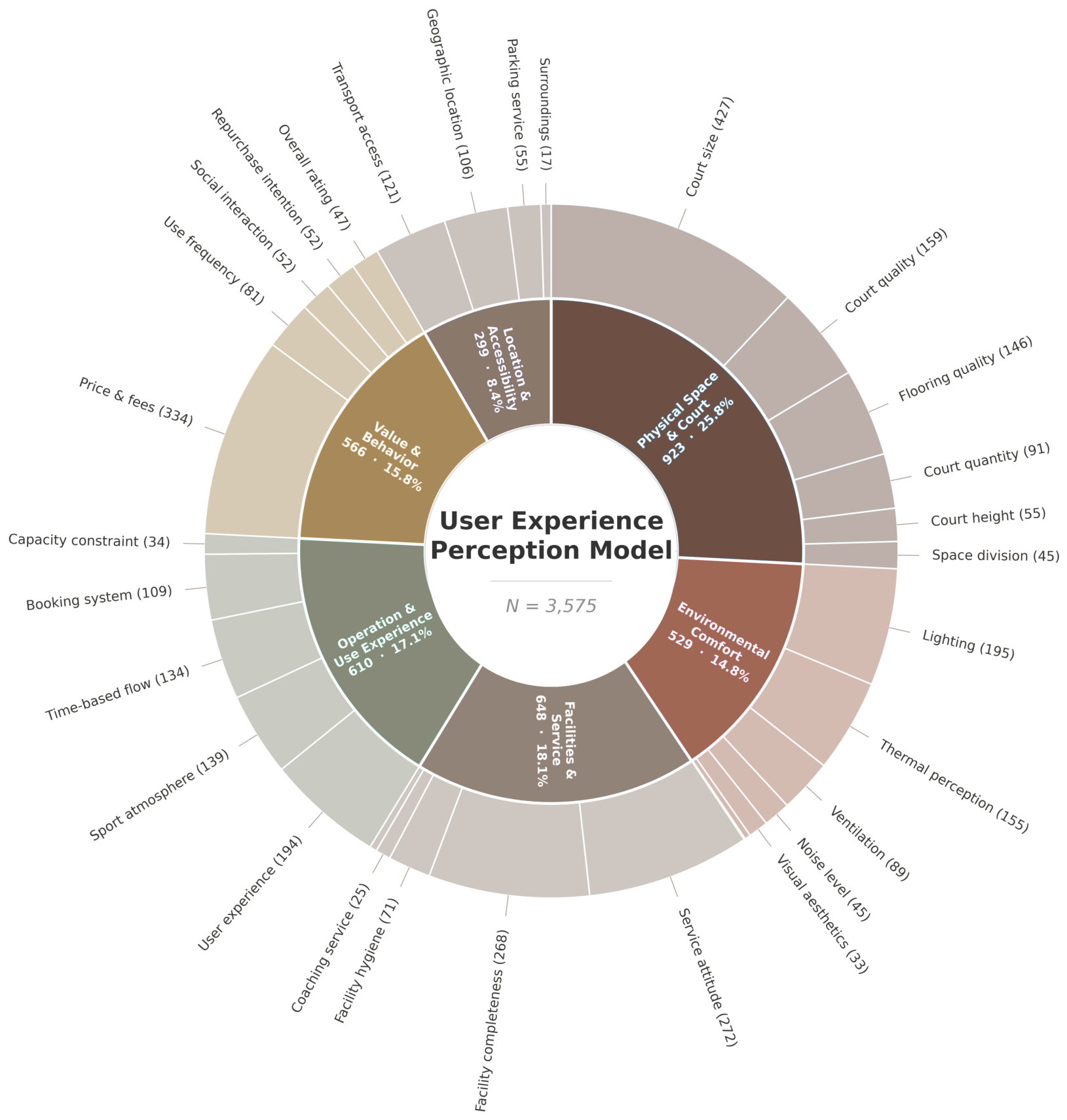
Figure 5.
Sankey diagram of the axial-coding flow from 32 initial categories to 6 main categories, showing how open-coding categories were consolidated during axial coding.
Figure 5.
Sankey diagram of the axial-coding flow from 32 initial categories to 6 main categories, showing how open-coding categories were consolidated during axial coding.
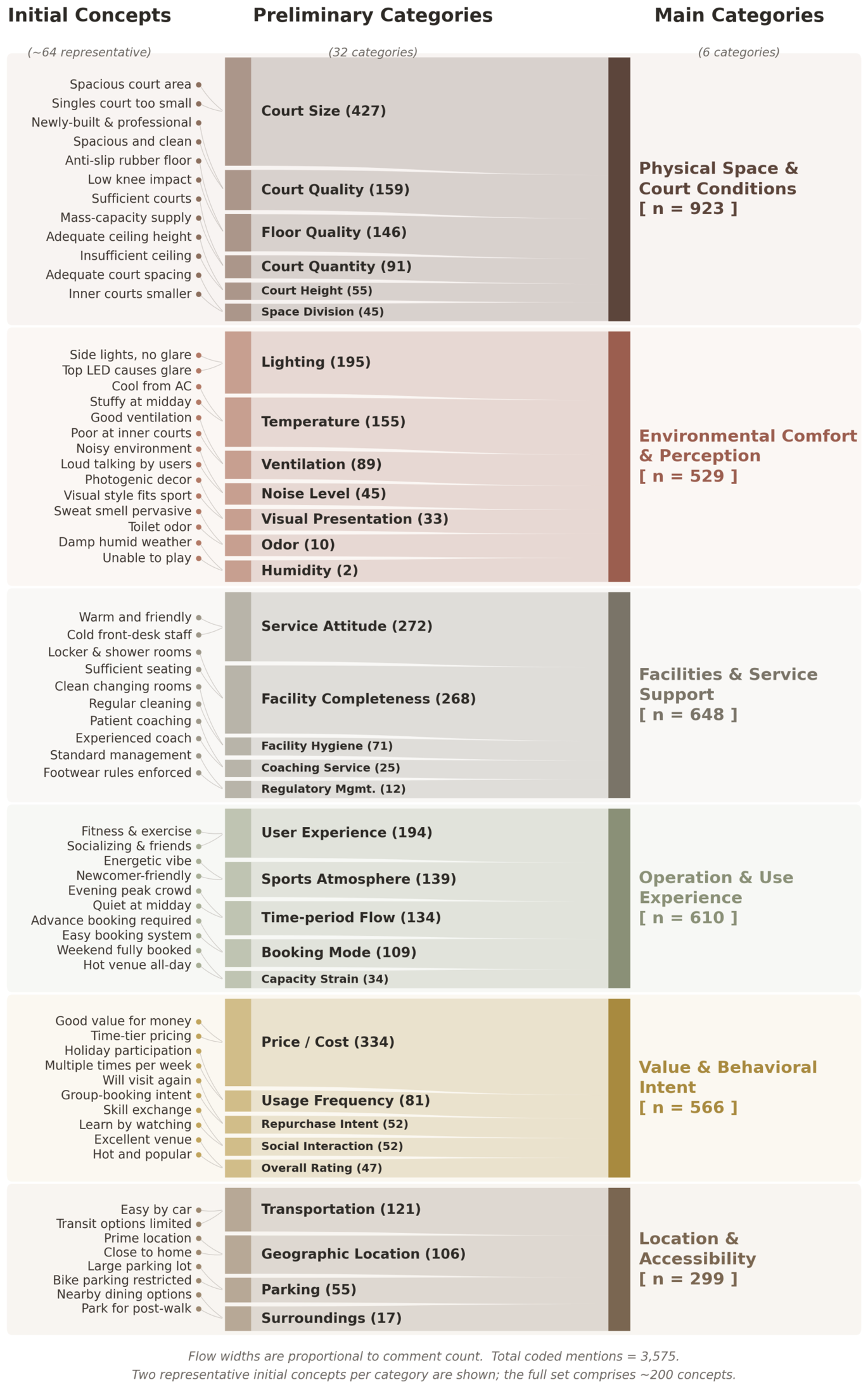
Figure 6.
User experience perception model for indoor badminton venues. The model shows a three-stage pathway from cost evaluation to core on-site experience and value-based behavioral intention.
Figure 6.
User experience perception model for indoor badminton venues. The model shows a three-stage pathway from cost evaluation to core on-site experience and value-based behavioral intention.
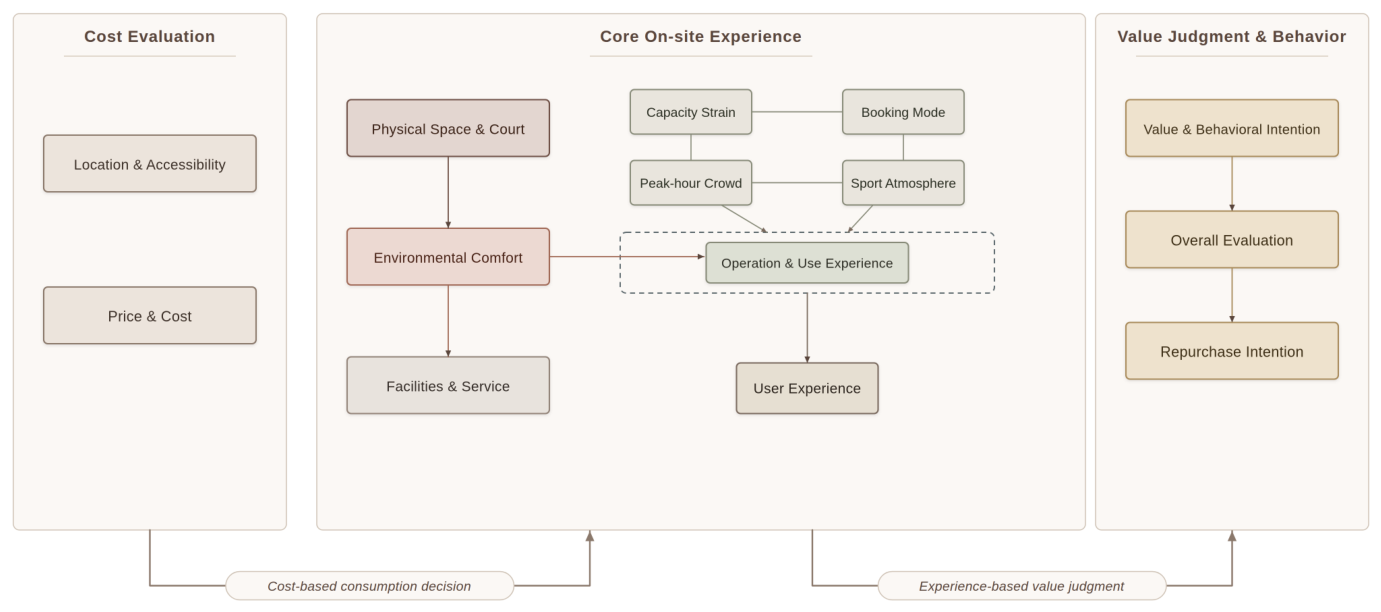
Figure 7.
Acoustic perception sub-model with the ISO 12913 two-dimensional soundscape circumplex. The figure interprets the shift from positive sport atmosphere to negative noise perception through the Pleasantness–Eventfulness framework.
Figure 7.
Acoustic perception sub-model with the ISO 12913 two-dimensional soundscape circumplex. The figure interprets the shift from positive sport atmosphere to negative noise perception through the Pleasantness–Eventfulness framework.
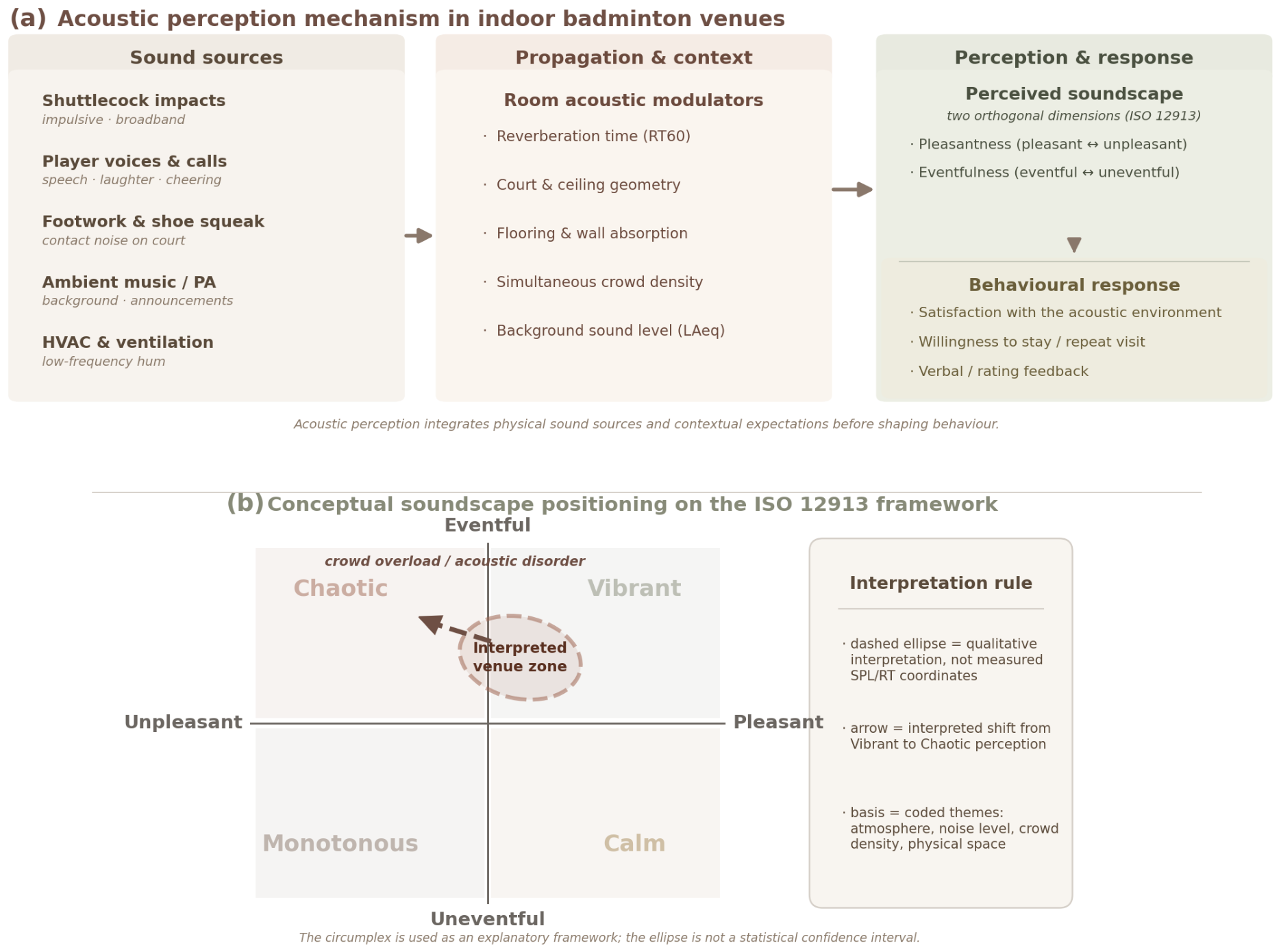
Figure 8.
Distribution of 32 initial categories across six main categories. The figure supports the interpretation that acoustic perception appears as a low-frequency but cross-category issue in spontaneous reviews.
Figure 8.
Distribution of 32 initial categories across six main categories. The figure supports the interpretation that acoustic perception appears as a low-frequency but cross-category issue in spontaneous reviews.
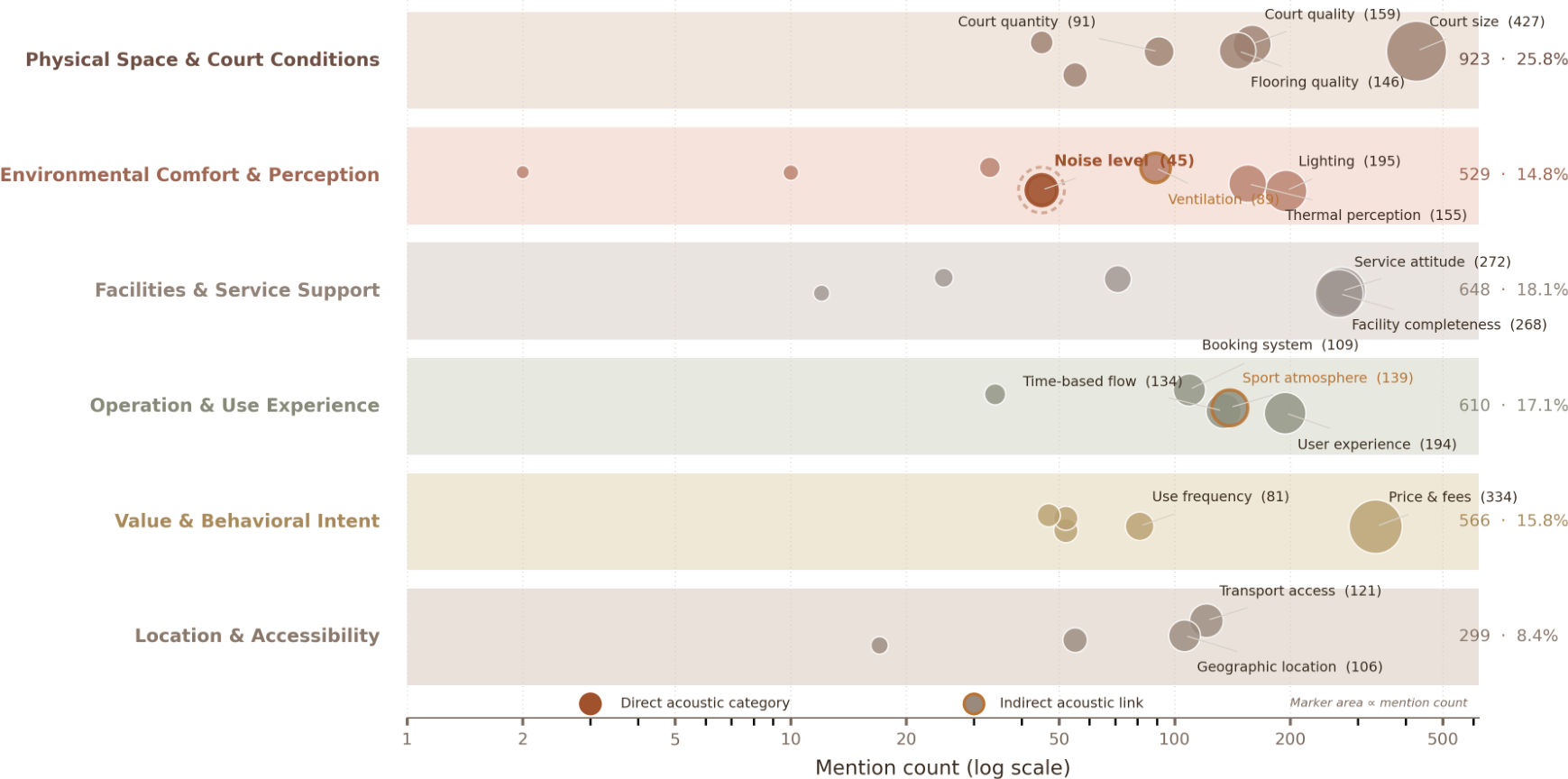
Table 1.
Basic information of the 7 sampled badminton venues.
| Venue Name | City | Valid Reviews | Star Rating (out of 5) | Average Price (CNY/Court) |
|---|---|---|---|---|
| SUPERBOX Super Show | Beijing | 1625 | 4.8 | 114 |
| Binjiangge | Wuhan | 810 | 4.8 | 80 |
| Youth Palace Badminton Center | Wuhan | 681 | 4.3 | 65 |
| 588 Badminton Gym | Shanghai | 322 | 4.2 | 46 |
| 104 Badminton Gym | Guangzhou | 159 | 3.6 | 107 |
| New Elite Badminton Gym | Guangzhou | 242 | 3.4 | 65 |
| Xiuxiang Aoguan Gym | Nanning | 98 | 3.3 | 35 |
Table 2.
Statistical results of the top 74 high-frequency terms in online review texts (partial display).
Table 2.
Statistical results of the top 74 high-frequency terms in online review texts (partial display).
| No. | Term | Frequency | No. | Term | Frequency |
|---|---|---|---|---|---|
| 1 | Court (changdi) | 2571 | 38 | Booking (yuyue) | 165 |
| 2 | Very good (henhao) | 901 | 39 | Compound (yuanqu) | 158 |
| 3 | Nice (bucuo) | 882 | 40 | Bright (mingliang) | 151 |
| 4 | Service (fuwu) | 712 | 41 | Nearby (fujin) | 149 |
| 5 | Environment (huanjing) | 667 | 42 | Tidy (zhengjie) | 140 |
| 6 | Badminton (yumaoqiu) | 620 | 43 | Comfortable (shushi) | 137 |
| 7 | Playing (daqiu) | 599 | 44 | Hygiene (weisheng) | 137 |
| 8 | Parking (tingche) | 576 | 45 | Worthwhile (zhide) | 134 |
| 9 | Clean (ganjing) | 510 | 46 | Staff (gongzuorenyuan) | 126 |
| 10 | Price (jiage) | 493 | 47 | Suitable (shihe) | 122 |
| 11 | Convenient (fangbian) | 467 | 48 | Court mat (dijiao) | 116 |
| 12 | Facilities (sheshi) | 463 | 49 | First time (diyici) | 113 |
| 13 | Air conditioning (kongtiao) | 454 | 50 | Rest (xiuxi) | 111 |
| 14 | Spacious (henda) | 395 | 51 | Evening (wanshang) | 109 |
| 15 | Lighting (dengguang) | 367 | 52 | Atmosphere (fenwei) | 108 |
Table 3.
Classification of high-frequency terms for badminton venue user experience and scene perception (revised version).
Table 3.
Classification of high-frequency terms for badminton venue user experience and scene perception (revised version).
| No. | Category | High-Frequency Terms |
|---|---|---|
| 1 | Courts and spatial environment | Court, compound, spacious, large, space, ground, floor, court mat, court area, venue, badminton gym, gymnasium, ground area |
| 2 | Physical environmental conditions (light, thermal, visual) | Lighting, bright, glaring, air conditioning, cool, tidy, comfortable, hygienic, clean |
| 3 | Facilities and equipment | Facilities, complete, rest, locker room, sofa, parking, free, racket, provide, professional |
| 4 | Service management and staff evaluation | Service, staff, front desk, owner, attitude, enthusiastic, booking |
| 5 | Activity behavior and time | Playing, exercise, workout, badminton, weekend, weekday, evening, afternoon, first time, driving |
| 6 | Acoustic and social atmosphere | Atmosphere (with both positive and negative connotations) |
| 7 | Location and transportation | Location, nearby, traffic, convenient |
| 8 | Price and experience evaluation | Price, cost-effective, cheap, affordable, value-for-money, discount, worthwhile, suitable, appropriate, like, comfortable, experience, very good, nice, recommend, happy |
Table 4.
Open coding results: 32 initial categories with comment frequencies. Full version with concept-extraction examples and quoted reviews is provided in Table A1 (Appendix A).
Table 4.
Open coding results: 32 initial categories with comment frequencies. Full version with concept-extraction examples and quoted reviews is provided in Table A1 (Appendix A).
| No. | Initial Category | Comments | No. | Initial Category | Comments |
|---|---|---|---|---|---|
| 1 | Court size | 427 | 17 | Sport atmosphere | 139 |
| 2 | Court height | 55 | 18 | User experience | 194 |
| 3 | Spatial division | 45 | 19 | Overall rating | 47 |
| 4 | Floor quality | 146 | 20 | Social interaction | 52 |
| 5 | Noise level | 45 | 21 | Use frequency | 81 |
| 6 | Thermal perception | 155 | 22 | Repurchase intention | 52 |
| 7 | Lighting condition | 195 | 23 | Transport access | 121 |
| 8 | Air humidity | 2 | 24 | Geographic location | 106 |
| 9 | Ventilation | 89 | 25 | Parking service | 55 |
| 10 | Visual presentation | 33 | 26 | Surroundings | 17 |
| 11 | Environmental odor | 10 | 27 | Price & fees | 334 |
| 12 | Court quality | 159 | 28 | Facility completeness | 268 |
| 13 | Court quantity | 91 | 29 | Facility hygiene | 71 |
| 14 | Capacity constraint | 34 | 30 | Management standards | 12 |
| 15 | Booking system | 109 | 31 | Service attitude | 272 |
| 16 | Time-based flow | 134 | 32 | Coaching service | 25 |
Table 5.
Axial coding results: 6 main categories aggregated from 32 initial categories. Full version with the initial-category breakdown is provided in Table A2 (Appendix A).
Table 5.
Axial coding results: 6 main categories aggregated from 32 initial categories. Full version with the initial-category breakdown is provided in Table A2 (Appendix A).
| No. | Main Category | Comments Involved | Share (%) |
|---|---|---|---|
| 1 | Physical Space & Court Conditions | 923 | 25.80 |
| 2 | Environmental Comfort & Perception | 529 | 14.79 |
| 3 | Facilities & Service Support | 648 | 18.13 |
| 4 | Operation & Use Experience | 610 | 17.06 |
| 5 | Value & Behavioral Intent | 566 | 15.83 |
| 6 | Location & Accessibility | 299 | 8.36 |
| Total | 3575 | 100.00 |
Note: percentages are calculated based on the total “comments involved” of the 32 initial categories (3575), not on the 4721 raw reviews; the same review may involve multiple categories.
Disclaimer/Publisher’s Note: The statements, opinions and data contained in all publications are solely those of the individual author(s) and contributor(s) and not of MDPI and/or the editor(s). MDPI and/or the editor(s) disclaim responsibility for any injury to people or property resulting from any ideas, methods, instructions or products referred to in the content. |
© 2026 by the authors. Licensee MDPI, Basel, Switzerland. This article is an open access article distributed under the terms and conditions of the Creative Commons Attribution (CC BY) license (http://creativecommons.org/licenses/by/4.0/).
Copyright: This open access article is published under a Creative Commons CC BY 4.0 license, which permit the free download, distribution, and reuse, provided that the author and preprint are cited in any reuse.