

Submitted:
17 July 2026
Posted:
20 July 2026
You are already at the latest version
Abstract
Background: Arrhythmia recurrence after cryoballoon ablation remains a clinically relevant problem in atrial fibrillation (AF). However, factors associated with documented recurrence in low-risk patients without major comorbidities are not well defined. This study aimed to evaluate factors associated with documented arrhythmia recurrence after cryoballoon ablation in a highly selected low-risk AF population. Methods: This retrospective study included 153 eligible patients selected from an institutional cryoablation database after application of predefined exclusion criteria. Only patients with a CHA₂DS₂-VA score ≤1 and without major comorbidities, including diabetes mellitus, hypertension, coronary artery disease, chronic kidney disease, cerebrovascular disease, and heart failure, were included. Recurrence was defined as electrocardiographically documented AF or atrial tachyarrhythmia lasting ≥30 seconds after the 3-month blanking period during 1-year follow-up. Results: The study population included 70 women (45.8%) and 83 men (54.2%). Paroxysmal AF was present in 125 patients (81.7%), whereas 28 patients (18.3%) had persistent AF. Documented arrhythmia recurrence occurred in 40 patients (26.1%). Female sex was more frequent in the recurrence group than in the no-recurrence group (62.5% vs. 39.8%, p = 0.013). In the primary multivariable logistic regression model including sex, age, AF type, and left atrial diameter, female sex was associated with documented arrhythmia recurrence (OR 2.69, 95% CI 1.14–6.37; p = 0.024). Left atrial diameter showed a borderline association, and persistent AF showed numerically higher odds of recurrence; however, these variables did not reach conventional statistical significance in the primary model. Conclusion: In this selected low-risk cohort undergoing second-generation cryoballoon ablation, female sex was associated with documented arrhythmia recurrence during 1-year follow-up. This finding should be interpreted as hypothesis-generating and requires confirmation in larger prospective studies using standardized rhythm monitoring.
Keywords:
atrial fibrillation
; cryoballoon ablation
; arrhythmia recurrence
; female sex
; CHA₂DS₂-VA score
Introduction
Atrial fibrillation (AF) is one of the most common cardiac arrhythmias and remains the most frequently treated arrhythmia in clinical practice (1,2). Its prevalence in the general population is approximately 1–2%, and it is associated with increased risks of heart failure, stroke, and mortality (3–5). Catheter ablation has become an established rhythm control strategy in symptomatic patients with AF, and cryoballoon ablation is widely used because of its procedural standardization, reproducibility, and favorable learning curve.
Despite the effectiveness of catheter ablation, arrhythmia recurrence remains a significant clinical challenge. Numerous studies have identified several predictors of recurrence after AF ablation, including left atrial enlargement, persistent AF, age, sex, and various laboratory parameters reflecting systemic inflammation or disease burden (6–10). In addition, clinical risk scores such as CHA₂DS₂-VASc have been reported to correlate with recurrence, probably because they reflect the cumulative impact of cardiovascular comorbidities and systemic risk factors (11–13).
However, most of the available evidence has been derived from heterogeneous AF populations with a relatively high burden of cardiovascular comorbidities and elevated CHA₂DS₂-VASc scores. In such populations, recurrence after ablation may be driven not only by atrial substrate and procedural factors, but also by systemic disease burden, inflammation, and comorbidity-related atrial remodeling. Therefore, predictors identified in these cohorts may not be directly applicable to patients with very low clinical risk.
In contrast, catheter ablation is increasingly performed at earlier stages of AF, resulting in a growing population of younger patients with fewer comorbidities and lower thromboembolic risk scores undergoing ablation. In this selected low-risk population, the mechanisms underlying recurrence may differ, and the relative contribution of sex, AF type, left atrial remodeling, renal function, body mass index, and routine inflammatory markers remains insufficiently defined.
According to the 2024 ESC guidelines, the CHA₂DS₂-VA score, in which the sex category is removed from the CHA₂DS₂-VASc score, is recommended for thromboembolic risk stratification in patients with AF. In the present study, we investigated factors associated with arrhythmia recurrence during 1-year follow-up after cryoballoon ablation in a highly selected low-risk AF population, defined by a CHA₂DS₂-VA score ≤1 and the absence of major comorbidities, including diabetes mellitus, hypertension, coronary artery disease, chronic kidney disease, cerebrovascular disease, and heart failure.
Methods
Study Population
The institutional cryoablation database was retrospectively reviewed and included 268 patients who underwent cryoablation procedures during the study period. After application of the predefined exclusion criteria and patient-level verification of eligibility, 153 patients who underwent cryoballoon ablation for pulmonary vein isolation due to atrial fibrillation between August 2020 and July 2024 were included in the final analysis. The patient-selection process is summarized in Figure 1.
Patients were excluded if they met any of the following criteria:
• History of hypo- or hyperthyroidism
• Prior catheter ablation
• Age <18 years
• Previous valvular surgery or intervention
• Significant valvular heart disease
• Inflammatory diseases
• Obstructive sleep apnea syndrome (OSAS)
• Failure to achieve pulmonary vein isolation
• Presence of a common pulmonary vein or a pulmonary venous anatomical variant
• Receiving dialysis treatment
• Major comorbidities, including diabetes mellitus, hypertension, coronary artery disease, chronic kidney disease, cerebrovascular disease, or heart failure
• CHA₂DS₂-VA score >1
Ablation Procedure
Cryoballoon ablation was performed using a standard technique with a second-generation cryoballoon catheter. A 28-mm cryoballoon was used in all patients.
Pulmonary vein isolation was achieved in all patients, and each pulmonary vein was targeted with one or more freeze applications based on procedural response and operator discretion. Pulmonary vein isolation was routinely confirmed in all patients by demonstrating both entrance and exit block. Patients in whom pulmonary vein isolation could not be achieved were excluded from the study. Freeze applications were delivered according to procedural response and operator discretion, taking into account pulmonary vein isolation, achieved temperature, and application duration. Pulmonary vein-specific nadir temperatures and freeze durations were extracted from the procedural reports and are presented in Table 3. All procedures were performed by experienced operators.
Procedural parameters extracted from the procedural reports included pulmonary vein-specific nadir temperature and freeze duration for the LUPV, LIPV, RUPV, and RIPV. Repeat cryoballoon applications to the same pulmonary vein were recorded when present.
Follow-Up and Definition of Recurrence
The first three-month period after the procedure was considered a blanking period. During this period, atrial arrhythmias were managed with medical therapy or cardioversion when necessary.
Arrhythmia recurrence was defined as electrocardiographically documented AF or atrial tachyarrhythmia occurring after the blanking period within one year of follow-up. Recurrence was accepted only when AF or atrial tachyarrhythmia was objectively documented by 12-lead electrocardiography or Holter monitoring. For Holter-detected episodes, a duration of ≥30 seconds was required. Patient-reported symptoms without electrocardiographic documentation were not counted as recurrence.
Patients were followed at 1, 3, 6, and 12 months with clinical evaluation and routine 12-lead electrocardiography. In addition to scheduled visits, patients were instructed to seek medical evaluation in the event of palpitations or other symptoms suggestive of arrhythmia recurrence. Unscheduled emergency department or outpatient clinic visits for rhythm-related symptoms included 12-lead electrocardiographic assessment, and Holter monitoring was performed when clinically indicated.
Continuous rhythm monitoring and universal scheduled Holter screening were not routinely performed; therefore, asymptomatic recurrences may have been underdetected. Because the original retrospective database did not prospectively distinguish whether each documented recurrence was detected during scheduled follow-up electrocardiography or during unscheduled emergency/outpatient evaluation, a source-specific recurrence-detection analysis could not be performed.
Medical Therapy
Periprocedural anticoagulation was managed according to the standards in use during the study period, and all patients received oral anticoagulation for 3 months after ablation. Because the study period predated the 2024 ESC guideline update, continuation beyond 3 months followed the contemporaneous CHA₂DS₂-VASc-based institutional protocol. After the initial 3-month post-ablation period, anticoagulation was continued according to thromboembolic risk, defined as a CHA₂DS₂-VASc score of ≥1 in men and ≥2 in women. Decisions regarding long-term continuation or discontinuation were based on thromboembolic risk assessment and were not determined solely by procedural success or the absence of documented arrhythmia recurrence. The specific anticoagulant used, dose adjustments, exact duration beyond the initial 3-month period, and rates of continuation or discontinuation were not systematically recorded.
The amiodarone and propafenone variables reported in Table 1 indicate antiarrhythmic therapy initiated after the ablation procedure. These variables do not represent active antiarrhythmic drug use at the time arrhythmia recurrence was detected. Amiodarone and propafenone were not routinely continued beyond the blanking period; continuation thereafter was individualized according to clinical need.
Statistical Analysis
Statistical analyses were performed using IBM SPSS Statistics version 25.0 (IBM Corp., Armonk, NY, USA).
Categorical variables were expressed as frequencies and percentages and were compared using the Pearson chi-square test or Fisher’s exact test. Continuous variables were tested for normality using the Shapiro–Wilk test. Normally distributed variables were compared using the independent samples t-test, whereas non-normally distributed variables were analyzed using the Mann–Whitney U test. A p-value of < 0.05 was considered statistically significant.
Because only 40 documented recurrence events were available, the primary multivariable logistic regression model was intentionally limited to four clinically relevant variables to reduce the risk of overfitting. Sex, age, AF type, and left atrial diameter were selected a priori based on clinical relevance and previous evidence regarding recurrence after AF ablation. Age and left atrial diameter were entered as continuous variables, whereas sex and AF type were entered as categorical variables. Male sex and paroxysmal AF were used as the reference categories. To avoid collinearity and redundancy, the CHA₂DS₂-VASc score was not entered into the multivariable logistic regression model, as age and sex were included as individual covariates and the major comorbid components of the score were absent in this selected low-risk cohort. An extended sensitivity model additionally including body mass index was performed and is presented as Supplementary Table S2.
Ethics
The study was conducted in accordance with the Declaration of Helsinki and approved by the local ethics committee (Approval number: 2025-325, Date: 03/09/2025).
Results
The study population consisted of 153 patients, including 70 women (45.8%) and 83 men (54.2%). Most patients had paroxysmal AF (n=125, 81.7%), while persistent AF was present in 28 patients (18.3%). During the 1-year follow-up period, documented arrhythmia recurrence occurred in 40 patients (26.1%), whereas 113 patients (73.9%) had no documented recurrence.
During follow-up, symptom-triggered Holter monitoring was performed in 37 patients who reported palpitations, and paroxysmal AF was documented by Holter monitoring in one patient. Because rhythm surveillance included scheduled electrocardiography and symptom-driven unscheduled electrocardiographic evaluations, the frequency of symptom-triggered Holter monitoring was also compared according to sex to assess potential sex-related detection bias. Routine continuous rhythm monitoring was not performed. Regarding procedural characteristics, a second cryoballoon application in the same pulmonary vein was required in only four patients; therefore, repeat cryoballoon applications were not analyzed as a separate statistical variable.
As shown in Table 1, the proportion of female patients was significantly higher in the arrhythmia recurrence group than in the no-recurrence group (62.5% vs. 39.8%, p = 0.013). Post-ablation use of beta-blockers, non-dihydropyridine calcium channel blockers, amiodarone, propafenone, and digoxin did not differ significantly between the groups (all p > 0.05). Although persistent AF was more frequent among patients with recurrence than among those without recurrence (25.0% vs. 15.9%), the difference was not statistically significant (p = 0.202).

Table 2.
Comparison of continuous variables according to arrhythmia recurrence.
| Variable | No Recurrence (n=113) | Recurrence (n=40) | Test statistic | p-value |
| CRP | 4.85 (IQR: 4.10) | 5.30 (IQR: 7.28) | Z=−1.259 | 0.208d |
| Left atrial diameter (mm) | 39.00 (IQR: 3.00) | 40.00 (IQR: 7.00) | Z=−1.517 | 0.129d |
| Hemoglobin | 12.40 (IQR: 3.30) | 12.20 (IQR: 2.53) | Z=−0.557 | 0.578d |
| Platelet | 250.50 (IQR: 124.50) | 240.00 (IQR: 99.25) | Z=−1.246 | 0.213d |
| White blood cell count | 9.70 ± 2.74 | 9.50 ± 2.56 | t=0.415 | 0.679c |
| Lymphocyte | 2.45 (IQR: 1.76) | 2.71 (IQR: 1.31) | Z=−0.084 | 0.933d |
| Monocyte | 0.56 (IQR: 0.56) | 0.47 (IQR: 0.55) | Z=−0.578 | 0.563d |
| Neutrophil | 5.86 (IQR: 3.93) | 4.78 (IQR: 4.96) | Z=−0.430 | 0.667d |
| Urea | 45.30 (IQR: 29.70) | 50.50 (IQR: 34.80) | Z=−0.354 | 0.723d |
| Creatinine | 0.94 (IQR: 0.53) | 0.99 (IQR: 0.37) | Z=−1.141 | 0.254d |
| Sodium | 141.00 (IQR: 10.25) | 136.00 (IQR: 10.50) | Z=−1.556 | 0.120d |
| Potassium | 4.60 (IQR: 1.52) | 4.30 (IQR: 1.03) | Z=−1.281 | 0.200d |
| Total cholesterol | 253.00 (IQR: 54.00) | 238.00 (IQR: 53.50) | Z=−1.316 | 0.188d |
| LDL cholesterol | 163.17 ± 35.90 | 152.33 ± 33.60 | t=1.579 | 0.117c |
| Triglycerides | 207.65 ± 79.58 | 219.25 ± 87.49 | t=−0.730 | 0.466c |
| Total protein | 77.00 (IQR: 17.00) | 66.50 (IQR: 12.50) | Z=−1.423 | 0.155d |
| Albumin | 44.50 (IQR: 16.25) | 42.00 (IQR: 10.75) | Z=−0.615 | 0.538d |
| Height (cm) | 170.16 ± 9.15 | 167.48 ± 8.48 | t=1.615 | 0.108c |
| Body mass index (kg/m²) | 28.20 ± 4.30 | 28.80 ± 5.68 | t=−0.695 | 0.488c |
| Age (years) | 55.80 ± 11.25 | 57.83 ± 10.70 | t=−0.992 | 0.323c |
| Weight (kg) | 81.44 ± 12.47 | 80.35 ± 13.81 | t=0.459 | 0.647c |
| CHA₂DS₂-VA score | 0.00 [IQR: 0.00] | 0.00 [IQR: 0.00] | Z=−0.338 | 0.735d |
| CHA₂DS₂-VASc score | 0.00 [IQR: 1.00] | 1.00 [IQR: 1.00] | Z=−2.207 | 0.027d |
| Estimated Glomerular Filtration Rate | 69.65 (IQR: 52.50) | 61.30 (IQR: 48.07) | Z=−0.175 | 0.861d |
Normally distributed continuous variables are presented as mean ± standard deviation and were compared using the independent-samples t-test. Non-normally distributed continuous variables are presented as median [interquartile range (IQR)] and were compared using the Mann–Whitney U test. c: Independent sample t test d: Mann Whitney U test
As presented in Table 2, the CHA₂DS₂-VASc score was significantly higher in patients with arrhythmia recurrence than in those without recurrence (median: 1.00 [IQR: 1.00] vs. 0.00 [IQR: 1.00], p = 0.027). No statistically significant differences were observed between the groups in age, anthropometric measurements, left atrial diameter, renal function parameters, lipid profile, inflammatory markers, hematological parameters, serum electrolytes, total protein, albumin, or CHA₂DS₂-VA score (all p > 0.05).
Table 3.
Procedural cryoballoon parameters according to arrhythmia recurrence.
| Procedural parameter | No Recurrence (n=113) | Recurrence (n=40) | Test statistic | p-value |
| LUPV nadir temperature, °C | -58.0 [6.0] | -60.0 [5.0] | Z=−0.981 | 0.326 |
| LIPV nadir temperature, °C | -52.0 [2.0] | -52.0 [1.5] | Z=−1.290 | 0.197 |
| RUPV nadir temperature, °C | -45.0 [10.0] | -43.0 [9.5] | Z=−0.457 | 0.647 |
| RIPV nadir temperature, °C | -47.0 [3.0] | -47.0 [2.75] | Z=−0.330 | 0.741 |
| LUPV freeze duration, s | 180.0 [90.0] | 150.0 [90.0] | Z=−0.061 | 0.951 |
| LIPV freeze duration, s | 240.0 [0.0] | 240.0 [0.0] | Z=−2.347 | 0.019 |
| RUPV freeze duration, s | 240.0 [0.0] | 240.0 [0.0] | Z=−1.045 | 0.296 |
| RIPV freeze duration, s | 240.0 [0.0] | 240.0 [0.0] | Z=−0.791 | 0.429 |
Data are presented as median [interquartile range]. Between-group comparisons were performed using the Mann–Whitney U test. Asymptotic two-tailed p values are reported. Abbreviations: IQR, interquartile range; LIPV, left inferior pulmonary vein; LUPV, left superior pulmonary vein; RIPV, right inferior pulmonary vein; RUPV, right superior pulmonary vein; s, seconds.
Procedural cryoballoon parameters were largely comparable between patients with and without AF recurrence. Among the evaluated parameters, only LIPV freeze duration showed a statistically significant difference between groups in rank distribution, despite identical median values, whereas nadir temperatures and freeze durations of the remaining pulmonary veins did not differ significantly (Table 3).
These findings suggest that the observed recurrence difference was not primarily attributable to major differences in routinely available cryoballoon procedural parameters.
Table 4.
Primary multivariable logistic regression analysis for factors associated with documented arrhythmia recurrence.
Table 4.
Primary multivariable logistic regression analysis for factors associated with documented arrhythmia recurrence.
| Variable | Odds Ratio (OR) | p value | 95% CI |
| Left atrial diameter (mm) | 1.086 | 0.085 | 0.989–1.192 |
| Sex (Female) | 2.69 | 0.024 | 1.14–6.37 |
| AF type (Persistent AF) | 1.95 | 0.195 | 0.71–5.38 |
| Age (years) | 0.990 | 0.675 | 0.946–1.037 |
CI: confidence interval; AF: atrial fibrillation. Male sex and paroxysmal AF were used as the reference categories.
In the primary multivariable logistic regression model including sex, age, AF type, and left atrial diameter, female sex was associated with documented arrhythmia recurrence (OR 2.69, 95% CI 1.14–6.37; p = 0.024). Left atrial diameter showed a borderline association with recurrence but did not reach conventional statistical significance (OR 1.086, 95% CI 0.989–1.192; p = 0.085). Persistent AF was associated with numerically higher odds of recurrence compared with paroxysmal AF, but this association was not statistically significant (OR 1.95, 95% CI 0.71–5.38; p = 0.195). Age was not associated with documented recurrence in the primary model (OR 0.990, 95% CI 0.946–1.037; p = 0.675). These findings should be interpreted cautiously, particularly for left atrial diameter and AF type, because the limited number of recurrence events may have reduced statistical power. An extended sensitivity model additionally including body mass index yielded consistent findings and is presented in Supplementary Table S2.
The frequency of symptom-triggered Holter monitoring did not differ significantly between male and female patients (26.5% vs. 21.4%, respectively; p = 0.465; Supplementary Table S1).
Discussion
In the present study, we evaluated factors associated with arrhythmia recurrence after cryoballoon ablation in a highly selected AF population characterized by a CHA₂DS₂-VA score ≤1 and the absence of major cardiovascular comorbidities. The main finding was that female sex was associated with documented arrhythmia recurrence during 1-year follow-up in a parsimonious clinically driven multivariable model including sex, age, AF type, and left atrial diameter. Left atrial diameter showed a borderline association, and persistent AF showed numerically higher odds of recurrence; therefore, the lack of conventional statistical significance for these variables should not be interpreted as evidence of no association.
Arrhythmia recurrence after catheter ablation remains an important clinical problem despite technical advances and increasing procedural experience. Previous studies have reported variable recurrence rates after AF ablation, largely depending on patient characteristics, AF type, ablation strategy, and follow-up intensity (14). In our cohort, recurrence occurred in 26.1% of patients, which is within the lower range of previously reported rates. This relatively favorable outcome may be related to the limited comorbidity burden and generally favorable clinical profile of the study population.
The association between female sex and recurrence observed in our study is consistent with previous evidence suggesting sex-related differences in AF ablation outcomes. Cheng et al. reported in a large meta-analysis that women had lower freedom from AF or atrial tachycardia recurrence after catheter ablation compared with men (15). Similarly, a subanalysis of the FIRE AND ICE trial showed that female sex was associated with a higher risk of efficacy failure after catheter ablation for paroxysmal AF (16). In the present study, female sex was associated with documented recurrence after adjustment for age, AF type, and left atrial diameter. This finding may reflect sex-related differences in post-ablation rhythm outcomes within this cryoballoon-treated cohort, but it should not be interpreted as evidence of a direct causal effect.
Potential explanations for sex-related differences in documented recurrence include differences in atrial substrate, autonomic regulation, hormonal milieu, non-pulmonary vein triggers, symptom perception, and referral patterns. However, these mechanisms were not directly assessed in the present study. Menopausal status, hormone therapy, direct hormonal measurements, autonomic testing, cardiac magnetic resonance imaging, high-density electroanatomical mapping, systematic non-pulmonary vein trigger assessment, validated symptom-burden scales, and quality-of-life instruments were not available. Although the frequency of symptom-triggered Holter monitoring did not differ significantly between male and female patients, sex-related differences in symptom perception or healthcare-seeking behavior cannot be completely excluded. Therefore, mechanistic interpretations should be regarded as hypothesis-generating, and future prospective studies should incorporate standardized rhythm monitoring together with structural, electrophysiological, hormonal, and patient-reported outcome measures.
Because all procedures in the present study were performed exclusively with a second-generation cryoballoon, the observed association should be regarded as specific to this ablation technology and should not be extrapolated to radiofrequency ablation or pulsed field ablation. Different energy sources vary in lesion formation, tissue selectivity, procedural characteristics, safety profile, and potentially lesion durability; these differences may interact with sex-related variations in atrial anatomy and substrate. Energy source may also influence post-procedural symptom burden and perceived quality of life independently of documented rhythm recurrence (18). A recent meta-analysis comparing pentaspline pulsed field ablation with high-power short-duration or very high-power short-duration radiofrequency ablation reported broadly similar efficacy and safety profiles but different procedural and fluoroscopy times, further supporting an energy-source-specific interpretation of outcomes (19). Accordingly, female sex should not be interpreted as a universal predictor across all AF ablation modalities. Comparative prospective studies using standardized rhythm monitoring and patient-reported outcome measures are needed to determine whether the present findings apply to other ablation platforms.
Routinely available cryoballoon procedural parameters were compared to explore potential procedural confounding. Pulmonary vein-specific nadir temperatures and freeze durations were broadly similar between patients with and without documented recurrence. Although LIPV freeze duration reached statistical significance in rank distribution, the median values were identical in both groups, limiting its clinical interpretability. These findings suggest that no major difference was evident in the recorded freeze duration or nadir temperature parameters. However, these routinely available variables do not fully capture pulmonary vein anatomy, ostial dimensions, balloon occlusion quality, time to isolation, lesion durability, or non-pulmonary vein triggers; therefore, a contribution from unmeasured procedural or anatomical factors cannot be definitively excluded.
Left atrial enlargement and persistent AF are well-established factors associated with recurrence after AF ablation. Previous cryoballoon studies have identified left atrial diameter and persistent AF as important variables associated with late recurrence (20,21). In our study, larger left atrial diameter showed a borderline association with documented recurrence (p = 0.085), whereas persistent AF showed numerically higher odds of recurrence but did not reach conventional statistical significance (p = 0.195). These findings should be interpreted cautiously, because the modest number of recurrence events may have limited the ability to detect clinically relevant associations. Left atrial remodeling was assessed only by the anteroposterior left atrial diameter. Left atrial volume index was not available, and the measured diameter was not indexed to body surface area. Because the same absolute left atrial diameter may represent a different degree of structural remodeling in women and men, particularly in individuals with different body sizes, adjustment for anteroposterior diameter alone may not have fully accounted for sex-related differences in atrial substrate. Therefore, the observed association between female sex and recurrence may have been influenced, at least in part, by unmeasured structural atrial differences. Because only 40 documented recurrence events were available, the primary model was intentionally limited to four clinically relevant variables, corresponding to approximately 10 events per variable. Nevertheless, the modest number of events and the relatively wide confidence interval for female sex (OR 2.69, 95% CI 1.14–6.37) indicate limited precision of the estimated associations. An extended sensitivity model additionally including body mass index yielded similar results, but these findings should still be interpreted as exploratory. Furthermore, the clinically homogeneous, low-risk nature of the cohort may have reduced between-patient variability and attenuated the detectable effects of conventional factors. Accordingly, type II error cannot be excluded, and the absence of conventional statistical significance for left atrial diameter, AF type, age, or other covariates should not be interpreted as evidence of no association.
Clinical risk scores such as CHA₂DS₂-VASc have previously been associated with AF recurrence after ablation (11). In the present study, the CHA₂DS₂-VASc score was higher in patients with documented recurrence in the unadjusted group comparison, whereas the CHA₂DS₂-VA score did not differ between the groups. This finding should be interpreted with caution because female sex contributes one point to CHA₂DS₂-VASc and was more frequent in the recurrence group, while most of the other score components were absent or markedly restricted by the study design. Consequently, female sex and CHA₂DS₂-VASc were mathematically non-independent in this cohort, and interpreting the score as a separate recurrence predictor would be circular. The absence of a corresponding difference in CHA₂DS₂-VA further supports the interpretation that the observed CHA₂DS₂-VASc difference was largely driven by its sex component rather than by a greater burden of conventional thromboembolic risk factors. For this reason, CHA₂DS₂-VASc was not entered into the multivariable model, and its unadjusted association should not be interpreted as evidence that the score independently predicts post-ablation recurrence in this selected cohort.
Post-ablation anticoagulation was routinely maintained for 3 months in all patients. Thereafter, continuation was guided by the CHA₂DS₂-VASc-based protocol in use before publication of the 2024 ESC guidelines, including continuation beyond 3 months in patients with a CHA₂DS₂-VASc score of ≥1 in men and ≥2 in women. Importantly, long-term anticoagulation decisions were based on thromboembolic risk rather than ablation success or the apparent absence of arrhythmia recurrence. Recent meta-analytic evidence suggests that, in appropriately selected patients after apparently successful AF ablation, oral anticoagulation discontinuation may reduce major bleeding without a statistically significant increase in thromboembolic events, supporting individualized risk-based decision-making and careful long-term follow-up (22). However, because the anticoagulant type, exact duration beyond 3 months, treatment continuation rates, and bleeding or thromboembolic outcomes were not systematically collected, the safety and net clinical benefit of this strategy could not be evaluated in the present cohort.
Although systemic inflammation has been linked to post-ablation arrhythmia recurrence, routine inflammatory markers were not associated with recurrence in our cohort (23). The exclusion of patients with inflammatory diseases and substantial cardiovascular comorbidity may have reduced the overall inflammatory burden and attenuated the discriminatory value of these parameters. Routine inflammatory markers may therefore provide limited prognostic information in clinically homogeneous patients undergoing cryoballoon ablation.
The present findings may have clinical relevance in the context of contemporary AF management. Current guidelines increasingly support catheter ablation at earlier stages of AF and in patients with fewer accompanying diseases (1). Consequently, recurrence predictors derived from older or more heterogeneous populations may not perform similarly in patients undergoing earlier intervention. In this cryoballoon-treated cohort, female sex was associated with documented recurrence in the primary multivariable model. Left atrial diameter and AF type showed directionally consistent but statistically non-significant associations, which may reflect limited power rather than absence of effect. Overall, these findings should be regarded as hypothesis-generating and require prospective validation in larger studies using systematic rhythm monitoring.
Conclusion
In this highly selected low-risk AF cohort treated with second-generation cryoballoon ablation, female sex was associated with higher odds of electrocardiographically documented arrhythmia recurrence during 1-year follow-up. Left atrial diameter and persistent AF showed directionally consistent but statistically non-significant associations in the parsimonious model. Given the retrospective design, limited number of recurrence events, and non-systematic rhythm monitoring, these findings should be interpreted as hypothesis-generating rather than causal or definitive. Larger prospective studies using standardized rhythm monitoring and more comprehensive assessment of atrial substrate are needed to confirm whether sex adds clinically relevant information for recurrence risk assessment in low-risk patients undergoing cryoballoon ablation.
Limitations
This study has several limitations. First, the retrospective, single-center design and the modest number of documented recurrence events limit causal inference, external generalizability, and the precision of the estimated associations. Although the primary multivariable model was intentionally restricted to four clinically relevant variables to reduce overfitting, residual confounding and type II error remain possible. Second, rhythm follow-up was based on scheduled 12-lead electrocardiography and clinically indicated Holter monitoring rather than continuous monitoring or universal scheduled Holter screening. Therefore, asymptomatic recurrences may have been missed, and source-specific detection of recurrence could not be analyzed. Although symptom-triggered Holter monitoring did not differ significantly by sex, sex-related differences in symptom perception or healthcare-seeking behavior cannot be completely excluded. Third, atrial remodeling was assessed only by anteroposterior left atrial diameter; left atrial volume index and body-size-indexed left atrial measurements were not available. Fourth, menopausal status, hormone therapy, validated symptom-burden or quality-of-life scores, atrial fibrosis assessment, high-density mapping, systematic non-pulmonary vein trigger evaluation, detailed pulmonary vein anatomy, balloon occlusion quality, time to isolation, and lesion-durability data were not collected. These limitations preclude definitive mechanistic interpretation of the observed sex-related association. Finally, all procedures were performed with a second-generation cryoballoon, and detailed post-ablation anticoagulation data beyond the initial 3 months were not systematically recorded. Accordingly, the findings should not be generalized to other ablation technologies or used to infer anticoagulation safety outcomes.
Supplementary Materials
The following supporting information can be downloaded at the website of this paper posted on Preprints.org.
Author Contributions
Conceptualization, M.E.A.; methodology, M.E.A.; formal analysis, M.E.A.; investigation, M.E.A. and G.İ.B.A.; data curation, Y.İ. and G.Ç.; writing—original draft preparation, M.E.A.; writing—review and editing, M.E.A., V.P., S.B. and E.Ö.; supervision, T.A.; project administration, M.E.A. All authors have read and agreed to the published version of the manuscript.
Funding
This research received no external funding.
Institutional Review Board Statement
The study was conducted in accordance with the Declaration of Helsinki and approved by the Ethics Committee of Başakşehir Çam and Sakura City Hospital (Approval number: 2025-325, Date: 03/09/2025).
Informed Consent Statement
The requirement for written informed consent was waived by the Ethics Committee because of the retrospective design of the study and because all patient data were analyzed anonymously.
Data Availability Statement
The data presented in this study are available from the corresponding author upon reasonable request. The data are not publicly available due to privacy and ethical restrictions.
Acknowledgments
Not applicable.
Conflicts of Interest
The authors declare no conflicts of interest.
References
- Van Gelder, I.C.; Rienstra, M.; Bunting, K.V.; et al. 2024 ESC Guidelines for the management of atrial fibrillation developed in collaboration with the European Association for Cardio-Thoracic Surgery (EACTS). Eur. Heart J. 2024, 45, 3314–3414. [Google Scholar] [CrossRef] [PubMed]
- Sagris, M.; Vardas, E.P.; Theofilis, P.; et al. Atrial Fibrillation: Pathogenesis, Predisposing Factors, and Genetics. Int. J. Mol. Sci. 2021, 23(1), 6. [Google Scholar] [CrossRef] [PubMed]
- Piccini, J.P.; Hammill, B.G.; Sinner, M.F.; et al. Incidence and prevalence of atrial fibrillation and associated mortality among Medicare beneficiaries, 1993–2007. Circ. Cardiovasc Qual. Outcomes 2012, 5(1), 85–93. [Google Scholar] [CrossRef] [PubMed]
- Vlachos, K.; Letsas, K.P.; Korantzopoulos, P.; et al. Prediction of atrial fibrillation development and progression: current perspectives. World J. Cardiol. 2016, 8(3), 267–276. [Google Scholar] [CrossRef] [PubMed]
- Ko, D.; Chung, M.K.; Evans, P.T.; et al. Atrial Fibrillation: A Review. JAMA 2025, 333(4), 329–342. [Google Scholar] [CrossRef] [PubMed]
- Boyalla, V.; Harling, L.; Snell, A.; et al. Biomarkers as predictors of recurrence of atrial fibrillation post ablation: an updated and expanded systematic review and meta-analysis. Clin. Res. Cardiol. 2022, 111(6), 680–691. [Google Scholar] [CrossRef]
- Liu, F.; Song, T.; Hu, O.; et al. Body mass index and atrial fibrillation recurrence post ablation: a systematic review and dose-response meta-analysis. Front Cardiovasc Med. 2023, 9, 999845. [Google Scholar] [CrossRef] [PubMed]
- Hermida, A.; Burtin, J.; Kubala, M.; et al. Sex differences in the outcomes of cryoablation for atrial fibrillation. Front Cardiovasc Med. 2022, 9, 893553. [Google Scholar] [CrossRef] [PubMed]
- Taylan, G.; Gök, M.; Kurtul, A.; et al. Integrating the left atrium diameter to improve the predictive ability of the age, creatinine, and ejection fraction score for atrial fibrillation recurrence after cryoballoon ablation. Anatol. J. Cardiol. 2023, 27(10), 567–572. [Google Scholar] [CrossRef] [PubMed]
- Chen, Q.; Huang, J.J.; Jiang, L.; et al. Relationship between left atrial isolated surface area and early-term recurrence in patients with persistent atrial fibrillation after cryoballoon ablation. Eur. J. Med. Res. 2024, 29(1), 478. [Google Scholar] [CrossRef] [PubMed]
- Rordorf, R.; Iacopino, S.; Verlato, R.; et al. Role of CHA₂DS₂-VASc score in predicting atrial fibrillation recurrence in patients undergoing pulmonary vein isolation with cryoballoon ablation. J. Interv. Card. Electrophysiol. 2023, 66, 1193–1200. [Google Scholar] [CrossRef] [PubMed]
- Jacobs, V.; May, H.T.; Bair, T.L.; et al. The impact of risk score (CHADS2 versus CHA2DS2-VASc) on long-term outcomes after atrial fibrillation ablation. Heart Rhythm 2015, 12(4), 681–686. [Google Scholar] [CrossRef] [PubMed]
- Jiang, L.Q.; Zhong, Y.H.; Chen, X.H.; et al. A nomogram integrating the CHA2DS2-VASc score for predicting atrial fibrillation recurrence following catheter ablation. BMC Cardiovasc Disord. 2025, 25(1), 713. [Google Scholar] [CrossRef] [PubMed]
- Dretzke, J.; Chuchu, N.; Agarwal, R.; et al. Predicting recurrent atrial fibrillation after catheter ablation: a systematic review of prognostic models. Europace 2020, 22(5), 748–760. [Google Scholar] [CrossRef] [PubMed]
- Cheng, X.; Hu, Q.; Gao, L.; et al. Sex-related differences in catheter ablation of atrial fibrillation: a systematic review and meta-analysis. Europace 2019, 21(10), 1509–1518. [Google Scholar] [CrossRef] [PubMed]
- Kuck, K.H.; Brugada, J.; Fürnkranz, A.; et al. Impact of female sex on clinical outcomes in the FIRE AND ICE trial of catheter ablation for atrial fibrillation. Circ. Arrhythmia Electrophysiol. 2018, 11(5), e006204. [Google Scholar] [CrossRef] [PubMed]
- Yao, R.J.R.; Macle, L.; Deyell, M.W.; et al. Impact of female sex on clinical presentation and ablation outcomes in the CIRCA-DOSE study. JACC Clin. Electrophysiol. 2020, 6(8), 945–954. [Google Scholar] [CrossRef] [PubMed]
- Matteucci, A.; Russo, M.; Galeazzi, M.; et al. Impact of Ablation Energy Sources on Perceived Quality of Life and Symptom in Atrial Fibrillation Patients: A Comparative Study. J. Clin. Med. 2025, 14(8), 2741. [Google Scholar] [CrossRef] [PubMed]
- Mariani, M.V.; Matteucci, A.; Pierucci, N.; et al. Pentaspline Pulsed Field Ablation Versus High-Power Short-Duration/Very High-Power Short-Duration Radiofrequency Ablation in Atrial Fibrillation: A Meta-Analysis. J. Cardiovasc Electrophysiol. 2025, 36(9), 2165–2178. [Google Scholar] [CrossRef] [PubMed]
- Aksu, T.; Baysal, E.; Guler, T.E.; et al. Predictors of atrial fibrillation recurrence after cryoballoon ablation. J. Blood Med. 2015, 6, 211–217. [Google Scholar] [CrossRef] [PubMed]
- Quan, D.; Huang, H.; Kong, B.; et al. Predictors of late atrial fibrillation recurrence after cryoballoon-based pulmonary vein isolation: a meta-analysis. Kardiol. Pol. 2017, 75(4), 376–385. [Google Scholar] [CrossRef] [PubMed]
- Matteucci, A.; Mariani, M.V.; Pandozi, C.; et al. Oral Anticoagulation After Atrial Fibrillation Ablation: An Updated Systematic Review and Meta-Analysis of 267,443 Patients. Eur. J. Haematol. 2026, 116(6), 915–927. [Google Scholar] [CrossRef] [PubMed]
- Ozkan, E.; Elcik, D.; Barutcu, S.; et al. Inflammatory markers as predictors of atrial fibrillation recurrence: exploring the C-reactive protein to albumin ratio in cryoablation patients. J. Clin. Med. 2023, 12(19), 6313. [Google Scholar] [CrossRef] [PubMed]
Figure 1.
Patient-selection flow diagram.
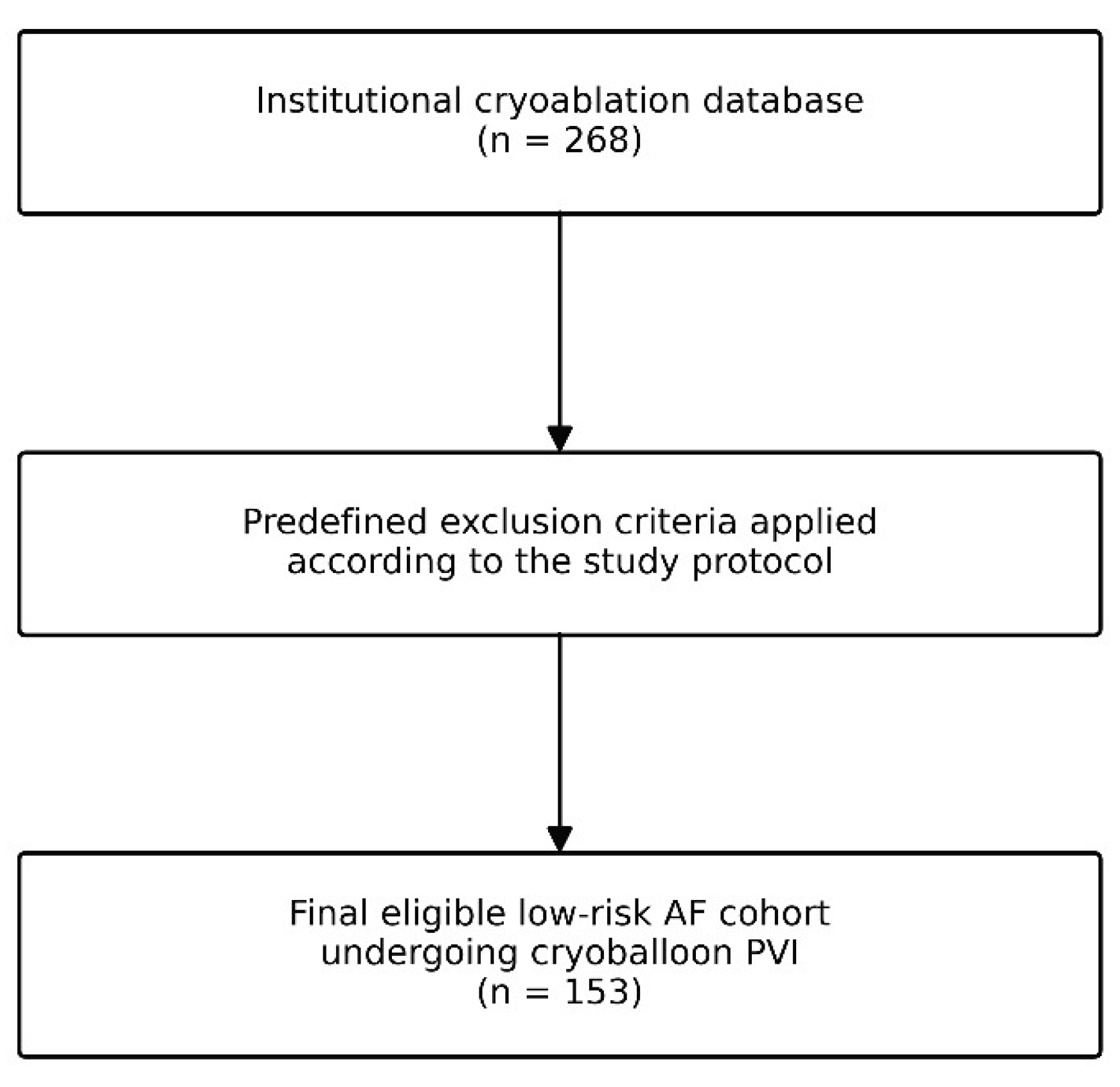
Table 1.
Comparison of categorical variables according to arrhythmia recurrence.
| Variable | No recurrence (n:113) | Recurrence (n:40) | p-value |
| Sex | 0.013a | ||
| Female | 45 (39.8%) | 25 (62.5%) | |
| Male | 68 (60.2%) | 15 (37.5%) | |
| Post-ablation beta-blocker use | 33 (29.2%) | 11 (27.5%) | 0.838a |
| Post-ablation non-DHP CCB use | 17 (15.2%) | 8 (20.0%) | 0.480a |
| Post-ablation amiodarone use | 11 (9.8%) | 2 (5.0%) | 0.515b |
| Post-ablation propafenone use | 4 (3.6%) | 2 (5.0%) | 0.654b |
| Post-ablation digoxin use | 2 (1.8%) | 3 (7.5%) | 0.114b |
| AF type | 0.202a | ||
| Paroxysmal | 95 (84.1%) | 30 (75.0%) | |
| Persistent | 18 (15.9%) | 10 (25.0%) |
a: Pearson chi square test b: Fisher exact test. Non-DHP CCB: Non-dihydropyridine calcium channel blocker
Disclaimer/Publisher’s Note: The statements, opinions and data contained in all publications are solely those of the individual author(s) and contributor(s) and not of MDPI and/or the editor(s). MDPI and/or the editor(s) disclaim responsibility for any injury to people or property resulting from any ideas, methods, instructions or products referred to in the content. |
© 2026 by the authors. Licensee MDPI, Basel, Switzerland. This article is an open access article distributed under the terms and conditions of the Creative Commons Attribution (CC BY) license (http://creativecommons.org/licenses/by/4.0/).
Copyright: This open access article is published under a Creative Commons CC BY 4.0 license, which permit the free download, distribution, and reuse, provided that the author and preprint are cited in any reuse.


