

Submitted:
06 June 2026
Posted:
08 June 2026
You are already at the latest version
Abstract
Background: Textbook Outcome (TO) is an emerging composite indicator to assess quality of care in colorectal cancer surgery by integrating oncologic adequacy and short-term postoperative outcomes into a single measure. However, its applicability in second-level hospitals remains poorly explored. Methods: A retrospective analysis of consecutive patients undergoing curative-intent colorectal cancer resection between January 2023 and December 2024 was performed. TO was defined as: R0 resection, ≥12 lymphnodes harvested, no major complications (Clavien-Dindo ≥IIIb), no re-operations, no 30-day readmission, length of stay < 10 days, and 90-day survival. Primary analysis focused on elective resections. Emergency cases were analyzed separately. Comparisons between groups were performed using the Mann–Whitney U test for continuous variables and Fisher’s exact test with risk ratios for categorical variables. Results: Seventy-seven patients were included: 62 elective and 15 emergency resections. Overall, TO was achieved in 45 of 77 patients (58.4%); specifically, TO was achieved in 69.4% (43/62) of elective cases. Individual TO components were satisfied in >90% of elective patients except LOS (72.6%). Emergency resections showed a markedly lower TO rate (13.3% vs 69.4%; p=0.0001), driven mainly by length of stay failure, higher major morbidity and mortality. Frailty, emergency surgery, open approach, and locally advanced tumor (p< 0.05) appeared significantly associated with TO failure. Conclusions: TO represents a valuable quality measure in colorectal surgery. Even in second-level hospital settings a satisfying rate of TO achievement can be reached. Emergency resections dramatically reduced TO attainment, despite preserved oncological standards, supporting separate reporting and benchmarking for elective and emergency colorectal cancer surgery.
Keywords:
textbook outcome
; colorectal surgery
; surgical oncology
; quality of care
; composite outcome
; second-level hospital
Introduction
Colorectal cancer (CRC) remains a leading cause of cancer-related mortality worldwide [1,2,3]. While adherence to oncological surgical principles, including radical resection and adequate lymphadenectomy is essential [4,5,6,7], these factors alone do not fully capture the quality of surgical care. Postoperative morbidity, mortality, readmissions, and length of stay (LoS) also play a crucial role in determining patient outcomes. Consequently, the use of isolated indicators is insufficient to capture the complexity of real-world clinical pathways [8,9,10].
To overcome this limitation, the concept of Textbook Outcome (TO) was introduced as a composite quality metric reflecting the proportion of patients who achieve an ideal postoperative course, evaluating the quality of surgical procedures. First proposed in colorectal surgery by Kolfschoten et al., TO integrates multiple desirable perioperative and oncologic endpoints, such as radical resection, absence of major complications, no reinterventions or readmissions, and acceptable LoS, into a single patient-centered metric. [11]. Achieving TO has been associated not only with improved short-term outcomes but also with superior long-term survival in CRC patients [12].
However, considerable heterogeneity persists in TO definitions, particularly regarding included components and LOS thresholds, limiting comparability across institutions. Moreover, most evidence derives from high-volume or tertiary centres, raising concerns about the generalisability of TO to lower-volume or second-level hospitals [13]. This has reinforced the perception that optimal oncologic outcomes can be consistently achieved only within centralized care models [14,15,16]. Nevertheless, emerging data suggest that surgeon expertise, standardized clinical pathways, and organizational quality may play a role that is at least partially independent of institutional volume [17,18,19].
Therefore, this study aimed not only to evaluate TO achievement and its predictors in a second-level hospital, but also to explore whether combining elective and emergency CRC surgery within a single TO metric may introduce bias in benchmarking surgical performance.
Materials and Methods
This single-center retrospective cohort study was conducted at the Department of General Surgery of Cittiglio–Angera Hospital (ASST Settelaghi, Varese, Italy), a second-level referral center. Data were prospectively collected, and subsequently analyzed retrospectively. All consecutive adult patients who underwent curative-intent surgery for CRC between January 2023 and December 2024 were screened for eligibility among 135 patients treated with colorectal resection. The data were anonymized in accordance with the Declaration of Helsinki and informed consent was waived due to the retrospective, non-interventional design. Patients were included if aged ≥18 years, with histologically confirmed colorectal adenocarcinoma, undergoing elective or emergency curative-intent surgery, with or without stoma. Exclusion criteria were metastatic disease at diagnosis, recurrent CRC, palliative surgery, or non-adenocarcinoma histology
For each patient, demographic variables (age, sex, and body mass index), clinical characteristics (American Society of Anesthesiologists physical status classification, Charlson Comorbidity Index [19], and Clinical Frailty Scale [20]), surgical details (tumor location, surgical setting, surgical approach, type of resection, and stoma formation), postoperative outcomes (complications graded according to the Clavien–Dindo classification, reoperation within 30 days, readmission within 30 days, LoS, and 90-day mortality), and pathological findings (pathological T and N stage according to the AJCC 8th edition [21], number of harvested lymph nodes, and resection margin status) were extracted from electronic medical records.
The primary endpoint of the study was the achievement of a TO, defined as the concurrent fulfillment of seven postoperative criteria [8,9,11]: R0 resection, retrieval of at least 12 lymph nodes, absence of major postoperative complications (Clavien–Dindo [22] grade IIIb or higher), no reoperation within 30 days, no readmission within 30 days, LoS ranging from 10 to 14 days and survival at 90 days after surgery. TO was achieved only if all criteria were met. Given the heterogeneity in the definition of LoS within TO reported in the literature, different thresholds have been adopted, ranging from fixed cut-offs such as a postoperative stay shorter than 14 days in earlier studies [11], to more recent relative definitions based on the distribution of the study population (e.g., LoS below the 75th percentile, [12]). In the present study, a cut-off of 10 days was selected, as it corresponded to the median value of the LoS of the cohort, thereby reflecting institutional practice while allowing discrimination between standard and prolonged recovery. The LOS threshold was selected to reflect institutional practice and to explore how different LOS definitions may influence TO interpretation.
Secondary endpoints included the identification of predictors of TO failure among demographic, clinical, surgical, and pathological variables and the comparison of TO rates between elective and emergency procedures.
Statistical Analysis
The primary analysis focused on patients undergoing elective CRC resection, in order to evaluate TO achievement in a homogeneous clinical setting. Emergency procedures were analysed separately because of their different clinical context and the limited sample size.
Continuous variables were expressed as median and range, while categorical variables were reported as number and percentage.
Comparisons between groups were performed using the Mann–Whitney U test for continuous variables and Fisher’s exact test for categorical variables, given the relatively small sample size and the presence of expected cell counts below five in several contingency tables.
Effect sizes were expressed as risk ratios (RR) with 95% confidence intervals (95% CI) when variables were dichotomous and a 2×2 contingency table was applicable. For variables with more than two categories or for continuous variables, only p-values were reported.
After the primary elective analysis, a secondary exploratory comparison between elective and emergency surgery was performed to evaluate differences in TO achievement and in the individual TO components. Because of the limited number of emergency cases, this comparison was considered descriptive and hypothesis-generating.
When contingency tables contained zero cells, the Haldane–Anscombe correction was applied to allow estimation of risk ratios and confidence intervals.
All tests were two-sided and p < 0.05 was considered statistically significant. Given the relatively small cohort size, particularly in the emergency subgroup, no multivariable regression analysis was performed.
Results
Study Population
Seventy-seven out of 93 oncologic patients met the inclusion criteria and were included in the analysis. Among them, 62 patients (80.5%) underwent elective surgery, while 15 patients (19.5%) required emergency procedures.
Baseline demographic, clinical, surgical and pathological characteristics according to surgical setting are reported in Table 1.
Patients undergoing emergency surgery were significantly older than those treated electively (median 79 vs 73 years; p = 0.041) and exhibited a higher prevalence of moderate-to-severe frailty (p = 0.0169).
Surgical management differed substantially between groups: all emergency procedures were performed via an open approach, whereas 75.8% of elective resections were completed laparoscopically (p < 0.001). Stoma formation was also more frequent in the emergency setting (53.3% vs 24.2%; p = 0.037).
From an oncological perspective, emergency patients presented with more advanced disease. Locally advanced tumors (pT3–4 and/or N+) were significantly more prevalent compared with earlier-stage tumors, suggesting delayed diagnosis and more aggressive clinical presentation.
Textbook Outcome Achievement
Overall, TO was achieved in 45 of 77 patients (58.4%), while 32 patients (41.6%) failed to achieve the composite outcome. The distribution of the individual TO components and the overall TO achievement rate are illustrated in Figure 1. The TO achievement rate differed markedly according to surgical setting, reaching 69.4% in elective surgery compared with 13.3% in emergency procedure. Among patients undergoing elective surgery, most individual TO components were satisfied in the vast majority of cases (R0 resection: 95.2%, ≥12 lymph nodes harvested: 90.3%, no major complications: 98.4%, no reoperation: 100%, no 30-day readmission: 96.8%, 90-day survival: 100%). The LoS criterion represented the most frequent cause of TO failure, with 72.6% of elective patients discharged within 10 days.
Among the 17 elective patients with prolonged LoS, most had minor or no complications (94.1%). Two patients developed major complications, both due to anastomotic leakage requiring reoperation and stoma formation (Table 2). Emergency surgery was associated with a markedly higher probability of failing several TO components. In particular, prolonged LoS (≥10 days) occurred significantly more frequently after emergency procedures (80.0% vs 27.4%; p = 0.0002; RR 2.92, 95% CI 1.81–4.70). Similarly, major postoperative complications were significantly more frequent in the emergency group (20.0% vs 3.2%; p = 0.004; RR 12.4, 95% CI 1.39–111). Furthermore, 90-day mortality occurred exclusively in the emergency subgroup (13.3% vs 0%; p = 0.036). In contrast, oncological quality indicators, including R1 resection and inadequate lymph node harvest (<12 nodes), did not significantly differ between elective and emergency procedures.
Predictors of Textbook Outcome
Univariate analysis was performed to explore predictors of TO achievement (Table 3).
Patients who failed to achieve TO were significantly older than those achieving the composite outcome (median 79 vs 72.5 years; p = 0.016). Frailty emerged as the strongest patient-related determinant of TO, as patients with moderate or severe frailty had a significantly lower probability of achieving TO compared with mildly frail patients (RR 0.55, 95% CI 0.37–0.80; p < 0.005). Surgical factors also influenced TO attainment: open surgery was associated with a significantly lower likelihood of achieving TO compared with laparoscopic procedures (RR 0.51, 95% CI 0.27–0.96; p < 0.005). The largest effect was observed for surgical setting, as patients undergoing emergency surgery had a markedly lower probability of achieving TO compared with elective procedures (RR 0.19, 95% CI 0.05–0.71; p < 0.005). Stoma formation showed a negative association with TO achievement (RR 0.66, 95% CI 0.45–0.95; p = 0.006). No significant associations were observed for sex, ASA score, Charlson Comorbidity Index, BMI, tumor location, or nodal status.
TO 11. In colorectal surgery, achieving TO has also been associated with favourable short- and long-term outcomes, including survival rates aligned with clinical expectations [8,9].
A recent meta-analysis including over 300,000 patients reported TO rates of up to 56% after elective CRC surgery and 54% in mixed cohorts [13], consistent with previous literature [8,9,12,25,26,27,28,29]. However, heterogeneity in TO definitions remains a major limitation. An Italian Delphi consensus proposed a standardized definition excluding LOS due to variability, suggesting ERAS-related criteria and inclusion of stoma only if preoperatively planned [25]. The present study demonstrates that TO assessment is feasible in a second-level hospital, with rates comparable to high-volume centres [13,26,27,28]. Nearly 70% of elective patients achieved TO, supporting that high-quality care can be delivered outside tertiary institutions when structured pathways and surgical expertise are present. Oncological outcomes were satisfactory, with R0 resection in >96% and adequate lymph node harvest in >90% of cases, alongside low readmission and 90-day mortality rates. These findings suggest that adherence to established CRC treatment guidelines can translate into satisfactory oncological and perioperative performance even in a peripheral hospital setting.
Although tumor stage differed between elective and emergency settings, nodal status was not associated with TO achievement. Adequate lymph node retrieval was maintained even in emergency procedures, confirming preservation of oncological standards. These findings suggest that TO is primarily influenced by perioperative and patient-related factors rather than tumor biology alone.
In the context of surgical oncology in a spoke hospital, emergency surgery remains unavoidable [29]. TO rates were significantly lower in emergency compared to elective procedures (13.3% vs 69.4%, p<0.005), reflecting the older, frailer, and more clinically unstable patient population. These findings suggest that TO should not be interpreted as a universal quality indicator when applied to mixed elective and emergency cohorts, as it may systematically underestimate institutional performance in centers with a high emergency workload. Such differences are primarily driven by patient-related and perioperative factors, which are independently associated with worse short-term outcomes and a lower likelihood of achieving TO.In our series, emergency surgery was associated with a substantially higher probability of failing the LOS criterion (80.0% vs 27.4%), a higher incidence of major morbidity (20.0% vs 3.2%), and the occurrence of postoperative mortality exclusively in the emergency group (13.3% vs 0%). These findings are clinically consistent, as emergency patients often present with dehydration, septic shock, and organ dysfunction, all of which increase perioperative risk and limit the effectiveness of preoperative optimization strategies. Failure to optimize preoperative management (such as managing comorbidities or achieving clinical stability) can compromise TO achievement [30]. Indeed, TO achievement for the LOS component (62.3% overall) was dramatically reduced in emergency surgery (20%). This likely reflects the difficult postoperative management of elderly and frail patients with locally advanced tumours, often requiring prolonged hospitalisation and logistic difficulties related to transfer to rehabilitation facilities.
Taken together, these findings clearly demonstrate the methodological inappropriateness of pooling elective and emergency CRC resections into a single TO estimate when benchmarking institutional performance. Such an approach fails to account for fundamental differences in patient characteristics and clinical context, thereby introducing substantial bias. Separate reporting, and potentially distinct composite definitions or benchmarking targets, are therefore required to ensure meaningful and clinically interpretable quality assessment. In second-level hospitals, where emergency surgery represents an intrinsic component of service delivery, failure to adequately stratify by surgical setting may lead to systematically misleading conclusions regarding institutional performance.
This issue is particularly relevant when considering national benchmarking systems such as the Italian National Outcomes Program (Programma Nazionale Esiti, PNE), which evaluates healthcare performance using outcome and process indicators. This limitation may have important implications for national benchmarking systems, where risk adjustment for surgical urgency is often incomplete. Although the PNE is a valuable tool for monitoring quality and supporting clinical audit, its reliance on administrative data and population-level comparisons may limit its ability to fully capture clinical complexity and variability in surgical case-mix.
In particular, the use of aggregated outcomes without adequate stratification for surgical urgency may introduce significant bias, especially in centers with a high proportion of emergency procedures. Emergency CRC patients are typically older, frailer, and present with more advanced disease, all factors associated with poorer short-term outcomes. Consequently, hospitals with a higher emergency workload may appear to perform worse when assessed using insufficiently adjusted indicators, despite delivering appropriate and guideline-compliant care.
These considerations highlight the need for caution in interpreting benchmarking data and support the integration of clinically informed, risk-adjusted composite measures.
Although most patients underwent laparoscopic resection in our study (61%), emergency and advanced disease often required open approaches, negatively affecting TO. Nevertheless, oncological radicality was maintained even in urgent settings. En-bloc excision of the tumor and its lymphatic drainage along with the associated lymph nodes significantly affecting the long-term prognosis after CRC surgery [7,8], and our data confirm that this standard can be maintained even in urgent settings.
Frailty also emerged as an important determinant of TO failure. Previous studies have demonstrated that frail patients are less likely to achieve TO because they have a higher risk of developing postoperative medical or surgical complications, longer hospital stays, increased readmission rates, and reduced functional recovery [31,32,33]. For this reason, preoperative assessment of frailty may be essential in tailoring treatment strategies and perioperative care pathways for CRC patients [33,34].
The role of stoma formation in TO achievement remains controversial. While stomas created to relieve obstruction or mitigate the consequences of anastomotic leakage may improve short-term outcomes, their inclusion as a determinant of TO is still debated [35,36]. In our cohort, stoma formation was associated with lower probability of achieving TO; however, this association should be interpreted cautiously. Stomas are more frequently constructed in complex clinical scenarios, including emergency presentations and frail patients, and therefore likely represent a surrogate marker of disease severity and operative complexity rather than an independent determinant of poor outcomes.
Despite a not-high volume of cancer patients, in our hospital we ensure a good standard quality of care, performing resections according to CRC treatment guidelines [37,38,39,40]. All procedures in this study were performed within a structured surgical team including an experienced colorectal surgeon supervising or assisting junior surgeons. As originally proposed by Kolfschoten and colleagues, TO can be considered a comprehensive measure of hospital performance [12]. In this context, our findings indicate that surgical practice in a second level centre could be consistent with the standards expected from institutions providing high-quality CRC care.
This consideration supports overcoming the pure volume as criterion of accreditation for treating cancers, consistently with some Literature suggestions [18,19,20,41]. Furthermore, these results offer a promising solution to well-known barriers to cancer care [42], including inadequate numbers of trained personnel and dearth of adequate facilities, along with lack of cancer awareness, cultural barriers to presentation, and lack of affordable basic population healthcare provisions. Being able to count on a network of cancer centers including second-level hospitals (with specific accredited expertise and resources and tools able to minimize failure to rescue rate) could help to solve some problems of centralization [43].
Limitations
This study has important limitations. Even if this study prospectively collected unselected CRC cases surgically treated by the same surgical teams in a short timeframe, it presents an analysis conducted on a retrospective observational series. Hence, it necessarily has a lot of selection biases, possibly affecting its results reliability. For example, the inclusion of distal rectal cancer with its clinical management implications could be considered a weakness point.
Its retrospective design and single-centre scope limit generalisability, and the relatively small number of emergency cases precluded robust multivariable modelling. The use of a centre-specific LOS cut-off reduces comparability with other institutions, and long-term oncological outcomes were not available for correlation with TO achievement. Finally, the inclusion of distal rectal cancers, with their specific management challenges, may have introduced additional heterogeneity.
Conclusions
In conclusion, our findings suggest that TO assessment is feasible and informative in a second-level hospital in elective CRC surgery. However, considering our results, it may be necessary to adopt distinct TO definitions or reporting strategies for elective and emergency CRC surgery in order to ensure fair and clinically meaningful benchmarking. With this regard, for a careful real-world analysis we are collecting survival data in order to verify TO long-term reliability in our peripheral setting. Future multicentre studies incorporating patient-level data and long-term outcomes are warranted to refine TO definitions for different surgical settings and to better capture the complex interplay between patient frailty, tumour biology and perioperative care pathways.
Authorship
Conceptualization and study plan: MSM, MF, GDL and SR. ;Principal investigator: MSM; Local data collection and anonymization: MSM, LL, VP. ;Data analysis: MF, DI, VP, FP;Interpretation of data: MF, LB, FF, FG and SR. ;Manuscript drafting: MSM, MF, LL, SMG and SR. ;SR and GDL critically reviewed the study proposal.;All authors read and approved the final manuscript.
Author Agreement
It is hereby certified that all authors have seen and approved the final version of the manuscript being submitted. All authors warrant that the article is the authors' original work, hasn't received prior publication and isn't under consideration for publication elsewhere.
Funding
This research received no external funding.
Informed Consent Statement
Patient consent was waived due to the retrospective, non-interventional design of the study and the use of anonymized clinical data. No identifiable patient information is included in the manuscript.
Data Availability Statement
The data supporting the findings of this study are not publicly available, as they were derived from anonymized clinical records. The datasets analyzed during the current study are available from the corresponding author upon reasonable request.
Conflicts of Interest
The authors declare no conflicts of interest.
Abbreviations
The following abbreviations are used in this manuscript:
CI: confidence intervals
CRC: Colorectal cancer
LOS: length of stay
RR: risk ratio
TO: Textbook Outcome
References
- Conceptualization 2020. GLOBOCAN estimates of incidence and mortality worldwide for 36 cancers in 185 countries. CA Cancer J. Clin. 2021, 71, 209–249. [Google Scholar]
- Bray, F.; Laversanne, M.; Sung, H.; Ferlay, J.; Siegel, R.L.; Soerjomataram, I.; Jemal, A. Global cancer statistics 2022: GLOBOCAN estimates of incidence and mortality worldwide for 36 cancers in 185 countries. CA Cancer J. Clin. 2024, 74, 229–263. [Google Scholar] [CrossRef]
- Siegel, R.L.; Torre, L.A.; Soerjomataram, I.; et al. Global patterns and trends in colorectal cancer incidence in young adults. Gut, 2019; 68, pp. 2179–2185. [Google Scholar] [CrossRef]
- Yoshino, T.; Argilés, G.; Oki, E.; Martinelli, E.; Taniguchi, H.; Arnold, D.; et al. Pan-Asian adapted ESMO clinical practice guidelines for diagnosis, treatment and follow-up of patients with localised colon cancer. Ann. Oncol. 2021, 32, 1496–1510. [Google Scholar] [CrossRef] [PubMed]
- NCCN Clinical Practice Guidelines in Oncology: Colon Cancer. Version 4.2024. Available online: https://www.nccn.org (accessed on July 2024).
- Argilés, G.; Tabernero, J.; Labianca, R.; Hochhauser, D.; Salazar, R.; Iveson, T.; et al. Localised colon cancer: ESMO clinical practice guidelines for diagnosis, treatment and follow-up. Ann. Oncol. 2020, 31, 1291–1305. [Google Scholar] [CrossRef]
- Le Voyer, T.E.; Sigurdson, E.R.; Hanlon, A.L.; Mayer, R.J.; Macdonald, J.S.; Catalano, P.J.; Haller, D.G. Colon cancer survival is associated with increasing number of lymph nodes analyzed. J. Clin. Oncol. 2003, 21, 2912–2919. [Google Scholar] [CrossRef]
- Yang, C.C.; Tian, Y.F.; Liu, W.S.; Chou, C.L.; Cheng, L.C.; Chu, S.S.; Lee, C.C. The association between textbook outcome and long-term survival in colon cancer. Medicine 2020, 99, e22447. [Google Scholar] [CrossRef]
- Manatakis, D.K.; Tzardi, M.; Souglakos, J.; Tsiaoussis, J.; Agalianos, C.; Kyriazanos, I.D.; et al. Achieving a textbook outcome in colon cancer surgery is associated with improved long-term survival. Curr. Oncol. 2023, 30, 2879–2888. [Google Scholar] [CrossRef]
- Warps, A.K.; Detering, R.; Tollenaar, R.A.E.M.; Tanis, P.J.; Dekker, J.W.T. Textbook outcome after rectal cancer surgery as a composite measure for quality of care. Eur. J. Surg. Oncol. 2021, 47, 2821–2829. [Google Scholar] [CrossRef]
- Kolfschoten, N.E.; Kievit, J.; Gooiker, G.A.; Van Leersum, N.J.; Snijders, H.S.; Eddes, E.H.; et al. Hospital variation in textbook outcome after colon cancer surgery. Eur. J. Surg. Oncol. 2013, 39, 156–163. [Google Scholar] [CrossRef]
- Arrighini, G.S.; Martinino, A.; Zecchin Ferrara, V.; Lorenzon, L.; Giovinazzo, F. Textbook oncologic outcomes in colorectal cancer surgery: a systematic review. Front Oncol. 2025, 15, 1474008. [Google Scholar] [CrossRef]
- Mac Curtain, B.M.; Qian, W.; O’Mahony, A.; et al. Textbook outcome(s) in colorectal surgery: a systematic review and meta-analysis. Ir. J. Med. Sci. 2024, 193, 2187–2194. [Google Scholar] [CrossRef] [PubMed]
- Huo, Y.R.; Phan, K.; Morris, D.L.; Liauw, W. Hospital and surgeon volume–outcome relationships in colorectal cancer surgery. J. Gastrointest. Oncol. 2017, 8, 534–546. [Google Scholar] [CrossRef]
- Sarjanoja, E.; Klintrup, K.; Ohtonen, P.; Kauppila, J.H. Hospital volume and colorectal cancer survival. Eur. J. Surg. Oncol. 2022, 48, 1650–1655. [Google Scholar] [CrossRef]
- van Gijn, W.; Gooiker, G.A.; Wouters, M.W.; Post, P.N.; Tollenaar, R.A.; van de Velde, C.J. Volume and outcome in colorectal cancer surgery. Eur. J. Surg. Oncol. 2010, 36 (Suppl 1), S55–S63. [Google Scholar] [CrossRef] [PubMed]
- Boyle, J.M.; van der Meulen, J.; Kuryba, A.; Cowling, T.E.; Braun, M.S.; Aggarwal, A.; et al. Impact of hospital and surgeon volumes on rectal cancer surgery outcomes. Colorectal Dis. 2023, 25, 1981–1993. [Google Scholar] [CrossRef]
- Baum, P.; Lenzi, J.; Diers, J.; Rust, C.; Eichhorn, M.E.; Taber, S.; et al. Risk-adjusted mortality rates outperform volume in surgical oncology. J. Clin. Oncol. 2022, 40, 1041–1050. [Google Scholar] [CrossRef]
- van Erning, F.N.; van Steenbergen, L.N.; van den Broek, W.T.; Rutten, H.J.; Lemmens, V.E. No difference between lowest and highest volume hospitals. Eur. J. Surg. Oncol. 2013, 39, 1199–1206. [Google Scholar] [CrossRef] [PubMed]
- Reis, M.E.; Ulusahin, M.; Cekic, A.B.; Usta, M.A.; Guner, A. Surgeon specialization vs volume in gastric cancer surgery. Eur. J. Surg. Oncol. 2023, 49, 107091. [Google Scholar] [CrossRef] [PubMed]
- Charlson, M.E.; Carrozzino, D.; Guidi, J.; Patierno, C. Charlson Comorbidity Index: a critical review. Psychother. Psychosom. 2022, 91, 8–35. [Google Scholar] [CrossRef]
- Church, S.; Rogers, E.; Rockwood, K.; Theou, O. Clinical Frailty Scale: a scoping review. BMC Geriatr. 2020, 20, 393. [Google Scholar] [CrossRef]
- Weiser, M.R. AJCC 8th edition: colorectal cancer. Ann. Surg. Oncol. 2018, 25, 1454–1455. [Google Scholar] [CrossRef]
- Dindo, D.; Demartines, N.; Clavien, P.A. Classification of surgical complications. Ann. Surg. 2004, 240, 205–213. [Google Scholar] [CrossRef] [PubMed]
- Sofia, S.; Degiuli, M.; Anania, G.; Baiocchi, G.L.; Baldari, L.; Baldazzi, G.; et al. Textbook outcome in colorectal surgery: Italian version. J. Clin. Med. 2024, 13, 4687. [Google Scholar] [CrossRef]
- Rubio García, J.J.; Mauri Barberá, F.; Villodre Tudela, C.; Carbonell Morote, S.; Fábregues Olea, A.I.; Alcázar López, C.; et al. Textbook outcome in colon carcinoma. Langenbecks Arch. Surg. 2023, 408, 218. [Google Scholar] [CrossRef]
- Sweigert, P.J.; Eguia, E.; Baker, M.S.; Link, C.M.; Hyer, J.M.; Paredes, A.Z.; et al. Variation in textbook oncologic outcomes. J. Gastrointest. Surg. 2021, 25, 775–785. [Google Scholar] [CrossRef]
- Ashraf Ganjouei, A.; Romero-Hernandez, F.; Conroy, P.C.; Miller, P.N.; Calthorpe, L.; Wang, J.J.; et al. Machine learning prediction of textbook outcome. Dis. Colon Rectum 2024, 67, 322–332. [Google Scholar] [CrossRef] [PubMed]
- Mulligan, J.A.; Fox-Rushby, J. Unit costs of health care inputs in low- and middle-income regions. Bethesda: Disease Control Priorities Project; 2003.
- Ahmed, A.; Khalid, S.; Sharif, G.; Ahmed, H.H.; Khattak, I.A.; Memon, S.K. ERAS in emergency colorectal surgery. Cureus 2024, 16, e71630. [Google Scholar] [CrossRef]
- Kristjansson, S.R.; Nesbakken, A.; Jordhoy, M.S.; Skovlund, E.; Audisio, R.A.; Johannessen, H.O.; et al. Comprehensive geriatric assessment predicts complications in elderly colorectal cancer surgery. Crit. Rev. Oncol. Hematol. 2010, 76, 208–217. [Google Scholar] [CrossRef]
- Tan, K.Y.; Kawamura, Y.J.; Tokomitsu, A.; Tang, T. Frailty assessment predicts morbidity in elderly colorectal cancer surgery. Am. J. Surg. 2012, 204, 139–143. [Google Scholar] [CrossRef]
- Fagard, K.; Leonard, S.; Deschodt, M.; Devriendt, E.; Wolthuis, A.; Prenen, H.; Flamaing, J.; Milisen, K.; Wildiers, H.; Kenis, C. Frailty and postoperative outcomes in colorectal cancer: systematic review. J. Geriatr. Oncol. 2016, 7, 479–491. [Google Scholar] [CrossRef]
- Taffurelli, G.; Montroni, I.; Ghignone, F.; Zattoni, D.; Garutti, A.; Di Candido, F.; Mazzotti, F.; Frascaroli, G.; Tamberi, S.; Ugolini, G. Frailty predicts textbook outcomes in colorectal surgery. Eur. J. Surg. Oncol. 2023, 49, 626–632. [Google Scholar] [CrossRef] [PubMed]
- Matthiessen, P.; Hallböök, O.; Rutegård, J.; Simert, G.; Sjödahl, R. Defunctioning stoma reduces anastomotic leakage. Ann. Surg. 2007, 246, 207–214. [Google Scholar] [CrossRef]
- Gastinger, I.; Marusch, F.; Steinert, R.; Wolff, S.; Koeckerling, F.; Lippert, H. Protective stoma in rectal carcinoma. Br. J. Surg. 2005, 92, 1137–1142. [Google Scholar] [CrossRef] [PubMed]
- Bhangu, A.; Kiran, R.P.; Slesser, A.; Fitzgerald, J.E.; Brown, G.; Tekkis, P. Survival after colorectal cancer resection. Ann. Surg. Oncol. 2013, 20, 4161–4168. [Google Scholar] [CrossRef]
- AIOM. Linee guida tumori del colon. 2024. Available online: https://www.iss.it (accessed on 2024).
- Benson, A.B.; Venook, A.P.; Adam, M.; et al. Colon cancer, version 3.2024. J. Natl. Compr. Canc Netw. 2024, 22, e240029. [Google Scholar] [CrossRef]
- Cervantes, A.; Adam, R.; Roselló, S.; Arnold, D.; Normanno, N.; Taïeb, J.; et al. Metastatic colorectal cancer: ESMO clinical practice guideline. Ann. Oncol. 2023, 34, 10–32. [Google Scholar] [CrossRef]
- Kartik, A.; Ven Fong, Z.; Stucky, C.C.; Cronin, P.A.; Etzioni, D.; Chang, Y.H.; et al. Minimum case volume recommendations for complex surgery. JAMA 2025, e2517274. [Google Scholar]
- Are, C.; Wong, S.; Leon, A. Global cancer surgery. Ann. Surg. Oncol. 2016, 23, 1–3. [Google Scholar] [CrossRef]
- Diaz, A.; Pawlik, T.M. Rural versus urban cancer care. JCO Oncol. Pract. 2024, 20, 1–3. [Google Scholar] [CrossRef] [PubMed]
Figure 1.
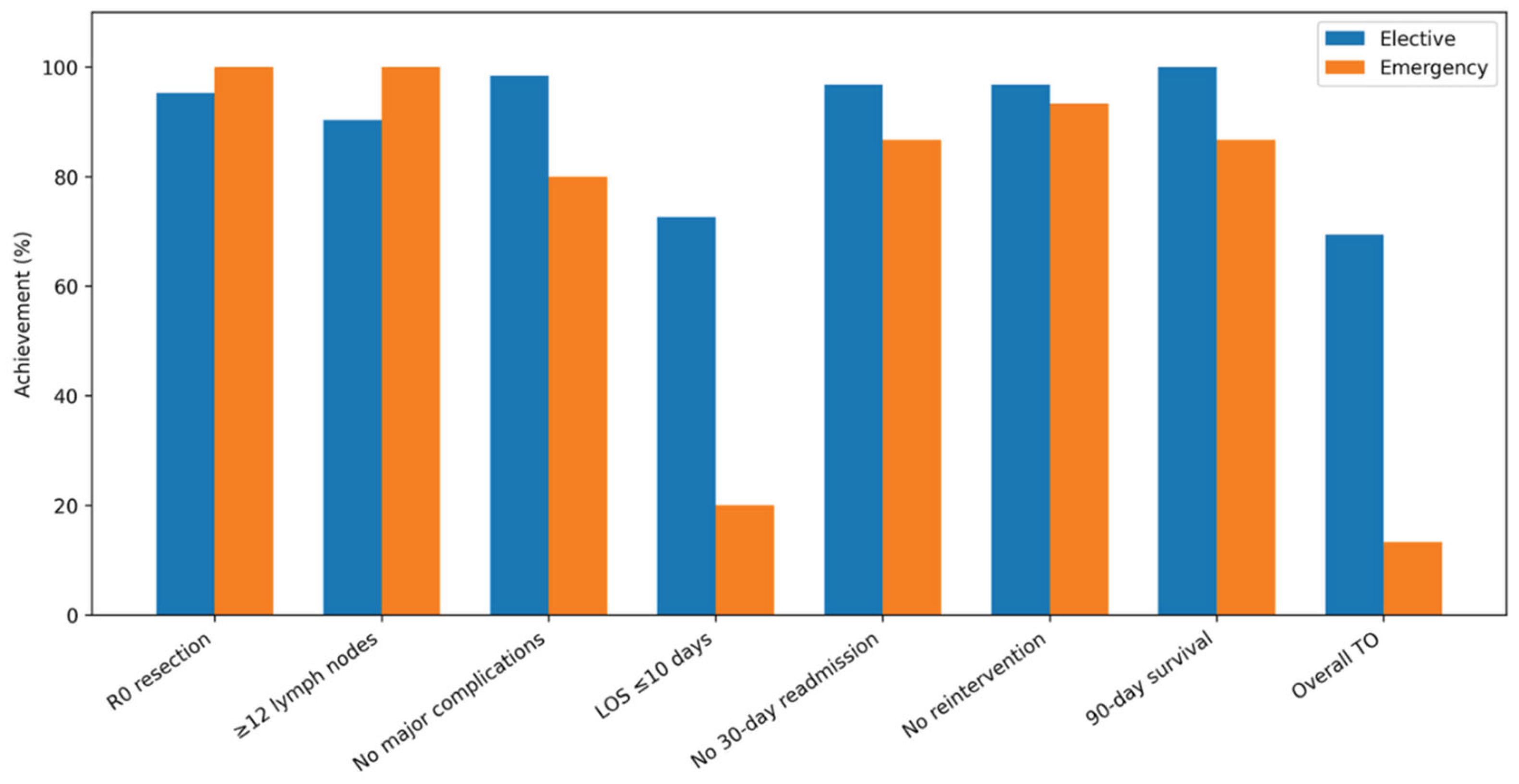

Table 1.
Demographic, clinical, surgical, postoperative and pathological variables distribution.
| ELECTIVE 62. patients). | EMERGENCY Surgery (15 patients) |
p-value | ||||
|---|---|---|---|---|---|---|
| Variable | N° | % | N° | % | ||
| Age | median (range) | 73 (50-92) | 79 (53-95) | 0.041 | ||
| Sex | M | 33 | 53.2 | 10 | 66.7 | 0.398 |
| F | 29 | 46.8 | 5 | 33,3 | ||
| ASA score | 1 | 14 | 22.6 | 3 | 20 | 0.346 |
| 2 | 32 | 51.6 | 6 | 40 | ||
| 3 | 16 | 25.8 | 5 | 33.3 | ||
| 4 | 0 | 0 | 1 | 6.7 | ||
| CCI | <5 | 28 | 45.2 | 5 | 33.3 | 0.214 |
| ≥5 | 34 | 54.8 | 10 | 66.7 | ||
| CFS | Mild (1-3) | 30 | 48.4 | 3 | 20 | 0.0169 |
| Moderate-Severe (≥4) | 32 | 51.6 | 12 | 80 | ||
| BMI | <18.5 | 4 | 6.4 | 0 | 0 | 0.447 |
| 18.5 - 24.9 | 28 | 45.2 | 7 | 46.7 | ||
| 25 - 29.9 | 24 | 38.7 | 5 | 33.3 | ||
| 30 - 35 | 6 | 9.7 | 3 | 20 | ||
| Tumor site | Right colon | 36 | 58.1 | 10 | 66.7 | 0.159 |
| Left/Sigmoid colon | 12 | 19.3 | 4 | 26.7 | ||
| Rectum | 12 | 19.3 | 1 | 6.6 | ||
| Multifocal | 2 | 3.3 | 0 | 0 | ||
| Surgery | Right Hemicolectomy | 36 | 58.1 | 10 | 66.7 | 0.564 |
| Left colon/Sigmoid Resection | 12 | 19.3 | 4 | 26.7 | ||
| Anterior Rectal Resection | 9 | 14.5 | 1 | 6.6 | ||
| Miles | 3 | 4.8 | 0 | 0 | ||
| Subtotal Colectomy | 2 | 3.3 | 0 | 0 | ||
| Approach | Laparoscopy | 47 | 75.8 | 0 | 0 | <0.001 |
|
Open or Conversion |
15 | 24.1 | 15 | 100 | ||
| Stoma | No | 47 | 75.8 | 7 | 46.7 | 0.037 |
| Yes | 15 | 24.2 | 8 | 53.3 | ||
| R status | R0 | 59 | 95.2 | 15 | 100 | 1 |
| R1 | 3 | 4.8 | 0 | 0 | ||
| Harvested nodes | <12 | 6 | 9.7 | 0 | 0 | 0.332 |
| ≥12 | 56 | 90.3 | 15 | 100 | ||
| pT | 1/2 | 18 | 29 | 1 | 6.7 | 0.04 |
| 3/4 | 44 | 71 | 14 | 93.3 | ||
| pN | 0 | 34 | 54.8 | 4 | 26.7 | 0.048 |
| + | 28 | 45.2 | 11 | 73.3 | ||
Abbreviations: ASA: American Society of Anesthesiologists; CCI: Charlson Comorbidity Index; CFS: Clinical Frailty Scale, BMI: Body Mass Index.
Table 2.
Comparison of failure rates of the individual textbook outcome components between elective and emergency colorectal surgery, with p-values and relative risks (RR).
Table 2.
Comparison of failure rates of the individual textbook outcome components between elective and emergency colorectal surgery, with p-values and relative risks (RR).
| ELECTIVE Surgery (62 patients) |
EMERGENCY Surgery (15 patients) |
p-value | RR | 95% CI | |||
|---|---|---|---|---|---|---|---|
| Variable | N° | % | N° | % | |||
| R1 resection | 3 | 4.8 | 0 | 0 | 1 | 0.57* | 0.03 – 10.35 |
| < 12 harvested nodes | 6 | 9.7 | 0 | 0 | 0.332 | 0.31* | 0.02 – 5.10 |
| Major complication | 2 | 3.2 | 3 | 20 | 0.004 | 12.4 | 1.39 – 111.0 |
| LOS ≥10 | 17 | 27.4 | 12 | 80 | 0.0002 | 2.92 | 1.81 – 4.70 |
| Readmission | 2 | 3.2 | 2 | 13.3 | 0.171 | 4.13 | 0.63 – 27.01 |
| Reintervention | 2 | 3.2 | 1 | 6.7 | 0.509 | 2.07 | 0.63 – 27.01 |
| 90-day mortality | 0 | 0 | 2 | 13.3 | 0.036 | 19.7* | 0.99 – 390.1 |
*RR calculated using Haldane–Anscombe correction due to zero cells.
Table 3.
Univariate analysis according to TO achievement .
| Variable | TO achieved n (%) or median (range) | TO not achieved n (%) or median (range) | p value | RR (95% CI) |
| AGE | 72.5 (50–91) | 79 (54–95) | 0.016 | — |
| GENDER | 0.685 | |||
| Male | 26 (60.5) | 17 (39.5) | 1 | |
| Female | 19 (55.9) | 15 (44.1) | 0.92 (0.63–1.36) |
|
| ASA | 0.103 | |||
| 1–2 | 31 (56.4) | 24 (43.6) | 1 | |
| 3–4 | 14 (63.6) | 8 (36.4) | 1.13 (0.76–1.67) |
|
| BMI | 0.767 | — | ||
| Underweight | 2 (40) | 3 (60) | ||
| Normal | 19 (55.9) | 15 (44.1) | ||
| Overweight | 19 (63.3) | 11 (36.7) | ||
| Obese | 5 (62.5) | 3 (37.5) | ||
| CCI | 0.373 | |||
| <5 | 21 (63.6) | 12 (36.4) | 1 | |
| ≥5 | 24 (54.5) | 20 (45.5) | 0.86 (0.59–1.24) |
|
| CFS | <0.005 | |||
| Mild | 26 (78.8) | 7 (21.2) | 1 | |
| Moderate/Severe | 19 (43.2) | 25 (56.8) | 0.55 (0.37–0.80) | |
| TUMOR SITE | 0.665 | — | ||
| Right-sided | 26 (56.5) | 20 (43.5) | ||
| Left-sided | 9 (56.3) | 7 (43.7) | ||
| Rectum | 8 (61.5) | 5 (38.5) | ||
| Multifocal | 2 (100) | 0 | ||
| SETTING | <0.005 | |||
| Elective | 43 (69.4) | 19 (30.6) | 1 | |
| Emergency | 2 (13.3) | 13 (86.7) | 0.19 (0.05–0.71) | |
| APPROACH | <0.005 | |||
| Laparoscopic | 37 (78.7) | 10 (21.3) | 1 | |
| Open | 8 (26.7) | 22 (73.3) | 0.51 (0.27–0.96) | |
| STOMA | 0.006 | |||
| No | 37 (68.5) | 17 (31.5) | 1 | |
| Yes | 8 (34.8) | 15 (65.2) | 0.66 (0.39–1.10) | |
| pT STAGE | 0.037 | — | ||
| 1–2 | 28 (87.5) | 4 (12.5) | ||
| 3–4 | 30 (66.7) | 15 (33.3) | ||
| pN STAGE | 0.714 | — | ||
| N0 | 17 (53.1) | 15 (46.9) | ||
| N+ | 22 (49.0) | 23 (51.0) |
Disclaimer/Publisher’s Note: The statements, opinions and data contained in all publications are solely those of the individual author(s) and contributor(s) and not of MDPI and/or the editor(s). MDPI and/or the editor(s) disclaim responsibility for any injury to people or property resulting from any ideas, methods, instructions or products referred to in the content. |
© 2026 by the authors. Licensee MDPI, Basel, Switzerland. This article is an open access article distributed under the terms and conditions of the Creative Commons Attribution (CC BY) license (http://creativecommons.org/licenses/by/4.0/).
Copyright: This open access article is published under a Creative Commons CC BY 4.0 license, which permit the free download, distribution, and reuse, provided that the author and preprint are cited in any reuse.


