

Submitted:
05 June 2026
Posted:
08 June 2026
You are already at the latest version
Abstract
Background: β-haemoglobinopathies, including sickle cell disease and transfusion-dependent β-thalassaemia, are among the most common monogenic disorders worldwide and represent a major global health burden. Conventional treatments, such as blood transfusions, iron chelation, fetal haemoglobin induction, and allogeneic haematopoietic stem cell transplantation, have im-proved outcomes but remain limited by treatment-related toxicity, donor availability, and incom-plete curative potential. Methods: A narrative literature review was conducted using PubMed up to 2025. Search terms included “sickle cell disease,” “sickle cell anemia,” “β-thalassemia,” “transfu-sion-dependent beta-thalassemia,” “gene therapy,” “gene addition,” “gene editing,” “CRISPR-Cas9,” “lentiviral vector,” “children,” “paediatric,” and “pediatric.” Relevant clinical tri-als, reviews, consensus statements, and guidelines were selected and qualitatively analysed. Results: Gene therapy for β-haemoglobinopathies is based mainly on two strategies: gene addition and gene editing. Gene addition uses lentiviral vectors to introduce functional or modified β-globin genes into autologous haematopoietic stem cells, whereas gene editing targets regulatory pathways, particu-larly BCL11A, to reactivate fetal haemoglobin synthesis or correct disease-causing mutations. Clin-ical studies have shown encouraging outcomes, including transfusion independence in many pa-tients with β-thalassaemia and marked reduction or elimination of vaso-occlusive crises in sickle cell disease. Paediatric and adolescent data are increasingly promising, although still limited. Conclu-sion: Gene therapy is reshaping the treatment landscape of β-haemoglobinopathies by offering a personalised and potentially curative approach. However, long-term safety, conditioning toxicity, fertility preservation, accessibility, costs, and implementation in high-prevalence regions remain critical challenges. Further studies are needed to optimise patient selection and expand equitable access.
Keywords:
β-haemoglobinopathies
; sickle cell disease
; transfusion-dependent β-thalassaemia
; gene therapy
; gene addition
; gene editing
1. Introduction
Haemoglobinopathies are the most common monogenic disorders worldwide. Approximately 7% of the global population carries a DNA variant affecting haemoglobin synthesis, giving rise to a heterogeneous group of conditions that include α- and β-thalassaemias, sickle cell disease, and haemoglobin variants associated with altered erythropoiesis [1,2,3,4].
Among these disorders, transfusion-dependent β-thalassaemia (TDT) and sickle cell disease (SCD) represent the greatest clinical and public health burden. Each year, an estimated 60,000 new cases of TDT and 300,000 new cases of SCD are diagnosed worldwide [5]. Both conditions result from alterations affecting the β-globin gene, which encodes the β chains of adult haemoglobin [5].
In TDT, more than 300 pathogenic variants have been described. These mutations lead to either reduced (β+) or absent (β0) β-globin chain production, resulting in an imbalance between α- and β-globin chains. The consequent accumulation of unmatched α chains impairs erythroid maturation, causes ineffective erythropoiesis, and leads to chronic anaemia requiring regular transfusion support [6].
In SCD, a single nucleotide substitution in the β-globin gene causes the replacement of glutamic acid with valine, producing sickle haemoglobin. Under conditions such as hypoxia, dehydration, or physiological stress, sickle haemoglobin polymerises, deforming red blood cells into the characteristic sickle shape. This process promotes haemolysis, recurrent vaso-occlusive events, chronic inflammation, progressive organ damage, and reduced life expectancy [7,8,9].
Given their high prevalence, lifelong morbidity, and impact on survival and quality of life, haemoglobinopathies represent a major and growing global health challenge [3]. Conventional management has historically relied on supportive approaches, including regular blood transfusions, iron chelation therapy, and pharmacological induction of fetal haemoglobin synthesis [4]. Allogeneic haematopoietic stem cell transplantation (allo-HSCT) has long represented the only established curative option. However, its use is limited by the availability of suitable donors, the risk of graft rejection and graft-versus-host disease, conditioning-related toxicity, and significant treatment-associated morbidity and mortality [4,10,11].
A deeper understanding of haemoglobin biology, erythropoiesis, and the molecular mechanisms underlying β-haemoglobinopathies has enabled the development of gene-based therapeutic strategies. These approaches use autologous haematopoietic stem cells and aim either to introduce a functional β-globin gene or to modify endogenous regulatory pathways, particularly those controlling fetal haemoglobin expression. As a result, autologous gene therapy is emerging as a potentially curative strategy that may complement, and in selected cases provide an alternative to, allogeneic transplantation [12].
The aim of this narrative review is to provide an overview of the current gene therapy landscape for β-haemoglobinopathies, with a focus on SCD and TDT. In particular, this review describes the main technologies currently under investigation, highlights the key differences between gene addition and gene editing approaches, and discusses available clinical outcomes and safety considerations.
2. Methods
A comprehensive literature search was conducted in PubMed to identify relevant articles published up to 2025. The search strategy included combinations of the following keywords and Medical Subject Headings, where applicable: “sickle cell disease,” “sickle cell anemia,” “β-thalassemia,” “beta-thalassemia,” “transfusion-dependent beta-thalassemia,” “hemoglobinopathies,” “gene therapy,” “gene addition,” “gene editing,” “genome editing,” “CRISPR-Cas9,” “lentiviral vector,” “children,” “paediatric,” and “pediatric.”
Boolean operators were used to combine search terms, including: “sickle cell disease” OR “sickle cell anemia”; “beta-thalassemia” OR “transfusion-dependent beta-thalassemia”; “gene therapy” OR “gene addition” OR “gene editing”; and “children” OR “paediatric” OR “pediatric.” Additional relevant publications were identified by screening the reference lists of selected articles and key reviews.
The search focused on original clinical studies, clinical trials, review articles, consensus statements, and guidelines addressing gene therapy approaches for β-haemoglobinopathies, particularly sickle cell disease and transfusion-dependent β-thalassaemia. Studies were considered relevant if they described gene addition or gene editing strategies, clinical outcomes, safety data, patient eligibility criteria, or paediatric applications. Articles not written in English, studies not focused on haemoglobinopathies, and publications without direct relevance to gene therapy were excluded.
Given the narrative nature of this review, no formal systematic review protocol was registered, and no quantitative meta-analysis was performed. The selected literature was analysed qualitatively, with particular attention to therapeutic mechanisms, available clinical evidence, safety considerations, and current limitations of gene therapy in both adult and paediatric populations.
3. Gene Therapy
Haemoglobin synthesis is a tightly regulated developmental process controlled by the α-globin gene cluster on chromosome 16 and the β-globin gene cluster on chromosome 11. During fetal life, erythropoiesis is characterised by predominant production of fetal haemoglobin (HbF), composed of two α-globin and two γ-globin chains. After birth, a physiological “haemoglobin switch” occurs, usually within the first months of life, leading to progressive silencing of γ-globin expression and replacement of HbF by adult haemoglobin (HbA). This process is largely regulated by transcriptional repressors, among which BCL11A plays a central role in inhibiting γ-globin expression [3].
The clinical manifestations of β-haemoglobinopathies generally become evident after this switch, when defective or abnormal β-globin production becomes functionally dominant [13,14,15]. In both β-thalassaemia and SCD, persistence of HbF has a protective effect. Hereditary persistence of fetal haemoglobin (HPFH), a naturally occurring condition characterised by continued γ-globin expression into adulthood, can reduce disease severity and, in some cases, markedly attenuate or prevent clinical manifestations [16]. This observation has provided a strong biological rationale for therapeutic strategies aimed at either restoring functional β-globin production or reactivating endogenous HbF synthesis.
Advances in molecular biology, viral vector engineering, and genome-editing technologies have made gene therapy a promising curative approach for β-haemoglobinopathies. Current strategies are broadly divided into two main categories: gene addition, which introduces a functional or modified β-globin gene into autologous haematopoietic stem and progenitor cells, and gene editing, which directly modifies genomic sequences involved in haemoglobin regulation or disease pathogenesis.
3.1. Gene Addition
Gene addition is based on the ex vivo modification of autologous CD34+ haematopoietic stem and progenitor cells through the insertion of a functional β-globin or β-globin–like therapeutic cassette. This approach has evolved over the past two decades through the development of increasingly efficient and safer viral vectors, together with the incorporation of key regulatory elements from the β-globin locus control region, particularly hypersensitive sites, which enhance erythroid-specific and sustained transgene expression [1,17,18].
Several viral vector platforms have been explored for gene transfer, including adenoviral, adeno-associated viral, retroviral, and lentiviral vectors. Among these, lentiviral vectors have become the preferred platform for β-haemoglobinopathies because they can efficiently transduce both dividing and non-dividing haematopoietic stem cells and allow stable integration of the therapeutic cassette into the host genome [1,19,20]. In current clinical applications, replication-incompetent lentiviral vectors are designed to deliver the therapeutic gene while minimising the risk of generating replication-competent virus. Their ability to engineer autologous CD34+ cells enables long-term production of corrected erythroid progeny after myeloablative conditioning and reinfusion of the modified cells [21].
In β-thalassaemia, gene addition aims to restore β-globin synthesis, reduce the α/non-α globin chain imbalance, improve ineffective erythropoiesis, and ultimately achieve transfusion independence. In SCD, the therapeutic objective is to introduce an anti-sickling β-globin variant capable of reducing the relative proportion and polymerisation of sickle haemoglobin, thereby limiting haemolysis and vaso-occlusive complications.
3.2. Gene Editing
Gene editing represents a distinct therapeutic strategy based on the targeted modification of specific genomic regions. In β-haemoglobinopathies, most current approaches aim to reactivate HbF synthesis by disrupting regulatory elements that normally repress γ-globin expression. In β-thalassaemia, increased HbF can compensate for deficient β-globin chain production, whereas in SCD it reduces the intracellular concentration of sickle haemoglobin and inhibits polymerisation, thereby preventing erythrocyte sickling [5,22,23,24].
This strategy reproduces, in therapeutic form, the protective effect observed in HPFH. Genome-editing platforms such as zinc-finger nucleases, transcription activator-like effector nucleases, and CRISPR-Cas systems can introduce targeted DNA modifications that alter regulatory sequences or silence repressors of γ-globin expression [11,25]. Among these targets, the erythroid-specific enhancer of BCL11A has emerged as one of the most clinically relevant, because its disruption reduces BCL11A expression selectively in erythroid cells while preserving its functions in other lineages.
Clinical studies by Frangoul et al. and Locatelli et al. have demonstrated the therapeutic potential of this approach using exagamglogene autotemcel (exa-cel), an autologous CD34+ cell product edited ex vivo with CRISPR-Cas9 to disrupt the erythroid-specific enhancer of BCL11A [5,26,27]. By removing the transcriptional repression of γ-globin, exa-cel induces robust and broadly distributed HbF production, with fetal haemoglobin levels exceeding 20% in treated patients and translating into sustained clinical benefit. In patients with severe SCD, this benefit has been reflected by prolonged freedom from vaso-occlusive crises, whereas in patients with TDT, including those with severe β0/β0 genotypes, treatment has resulted in transfusion independence or marked reduction in transfusion requirements [26,27].
Clinical benefit in these studies was assessed using disease-specific endpoints, including sustained absence of vaso-occlusive crises in SCD, transfusion independence in TDT, increases in total haemoglobin and HbF levels, improvement in haemolysis and iron-overload markers, discontinuation of iron chelation when appropriate, and improvements in patient-reported quality of life [26,27].

Table 1.
Main clinical outcomes used to assess the efficacy of gene therapy in sickle cell disease and transfusion-dependent β-thalassaemia.
Table 1.
Main clinical outcomes used to assess the efficacy of gene therapy in sickle cell disease and transfusion-dependent β-thalassaemia.
| SCD | TDT |
|---|---|
| Freedom from vaso-clusive crises for at least 12 months | Independence from transfusion regimen for at least 22 months |
| Increased total and fetal Hb levels | Early and clinically significant increase in both total and fetal Hb levels |
| Improvement in all markers of hemolysis (LDH, haptoglobin) | Improvement of markers of iron overload (reduction of serum ferritin levels and hepatic iron content) |
| Improvement in both general well-being and overall quality of life | Suspension of iron chelators |
| Improvements in erythropoiesis biomarkers | |
| Improvement in both general well-being and overall quality of life |
Abbreviations: Hb, haemoglobin; HbF, fetal haemoglobin; LDH, lactate dehydrogenase; QoL, quality of life; SCD, sickle cell disease; TDT, transfusion-dependent β-thalassaemia; VOCs, vaso-occlusive crises.
4. Gene Therapy for Paediatric Sickle Cell Disease
Both gene addition and gene editing strategies have been investigated for the treatment of paediatric SCD. These approaches are based on the ex vivo genetic modification of autologous haematopoietic stem and progenitor cells, usually CD34+ cells, followed by reinfusion after myeloablative conditioning. Gene addition relies on lentiviral vectors to introduce a therapeutic β-globin gene, whereas gene editing uses programmable nucleases, most commonly CRISPR-Cas systems, to modify genomic regions involved in SCD pathogenesis or haemoglobin regulation [28].
In gene addition approaches, lentiviral vectors may be used either to insert a modified β-globin gene capable of producing an anti-sickling haemoglobin variant, such as HbA^T87Q, or to deliver regulatory sequences, including short hairpin RNA (shRNA), designed to downregulate BCL11A and thereby increase γ-globin expression and HbF production [28,29]. In contrast, gene editing strategies initially focused on disrupting the erythroid-specific GATA1-binding region within the BCL11A enhancer, with the aim of reactivating γ-globin synthesis and increasing HbF levels [23,27,28,30,31,32,33].
More recently, newer genome-editing platforms have been developed to improve precision and reduce the potential risks associated with double-strand DNA breaks. These include cytosine and adenine base editors, which can introduce targeted nucleotide substitutions without inducing conventional double-strand breaks. Through these approaches, either the pathogenic SCD mutation itself or regulatory sequences within the BCL11A erythroid-specific enhancer can be targeted, leading respectively to restoration of normal HbA production or increased HbF expression [28,29,34,35,36,37,38,39]. Additional strategies using CRISPR-Cas12 systems to target γ-globin promoter regions have also shown promising preclinical results [28,40].
At present, two autologous haematopoietic stem cell gene therapies have been approved by the U.S. Food and Drug Administration (FDA) for patients with SCD aged 12 years and older and with a history of recurrent vaso-occlusive crises (VOCs). In December 2023, the FDA approved lovotibeglogene autotemcel, also known as lovo-cel or Lyfgenia® (bluebird bio, Inc., Somerville, Massachusetts, USA), and exagamglogene autotemcel, also known as exa-cel or Casgevy® (Vertex Pharmaceuticals Incorporated, Boston, Massachusetts, USA) [26,41,42,43]. Lovo-cel is a one-time ex vivo lentiviral gene addition therapy that introduces a modified β-globin gene into autologous CD34+ cells, resulting in production of the anti-sickling haemoglobin HbA^T87Q [41,42,43]. Exa-cel is a one-time ex vivo CRISPR-Cas9-based gene editing therapy that disrupts the erythroid-specific enhancer of BCL11A, thereby reactivating endogenous HbF production [26]. Thus, both a gene addition strategy and a gene editing strategy are currently available for selected adolescents and adults with SCD. Criteria for patient selection and for choosing between these approaches are discussed below.
The clinical pathway for SCD gene therapy includes several sequential phases: baseline evaluation, transfusion optimisation, stem cell mobilization, apheresis, product manufacturing, myeloablative conditioning, infusion of the gene-modified cellular product, and post-infusion monitoring. After a complete clinical assessment, patients generally initiate or continue a transfusion programme for approximately 8–12 weeks before stem cell collection. The objective is to reduce sickle haemoglobin to below 30% and maintain total haemoglobin between approximately 9 and 11 g/dL, thereby decreasing the risk of VOCs and other SCD-related complications during mobilisation and apheresis [28,44].
Mobilisation is usually performed only when the patient has been free from VOCs for at least 7–14 days. In SCD, granulocyte colony-stimulating factor (G-CSF) is contraindicated because of the risk of hyperviscosity, inflammation, and VOCs. Therefore, mobilization is performed using plerixafor, usually administered 2–4 hours before apheresis [28,44,45,46]. The target cell dose is substantially higher than that required for conventional autologous transplantation, generally around 15–20 × 10^6 CD34+ cells/kg, because cell loss may occur during ex vivo manufacturing and quality-control procedures [28,44,45,46]. Consequently, some patients require multiple mobilisation and apheresis cycles, and in a minority of cases inadequate collection may prevent treatment from proceeding.
Once sufficient CD34+ cells have been collected, the product is sent for manufacturing. This interval, which may last several weeks, can be used to continue transfusion support, complete pre-transplant reassessment, and address fertility preservation, which is particularly important in paediatric and adolescent patients because of the gonadotoxic effects of myeloablative conditioning [28,44]. When the manufactured product is available and the patient remains eligible, busulfan-based myeloablative conditioning is administered, followed by infusion of the gene-modified autologous cells and careful short- and long-term monitoring.
4.1. Exa-Cel Versus Lovo-Cel
Exa-cel and lovo-cel differ substantially in their mechanisms of action. Lovo-cel is a gene addition therapy that enables erythroid cells to produce the modified anti-sickling haemoglobin HbA^T87Q, whereas exa-cel is a gene editing therapy that reactivates endogenous HbF production through disruption of the BCL11A erythroid enhancer [26,43,47,48]. Although these mechanisms are biologically distinct, both aim to reduce intracellular sickle haemoglobin polymerisation, prevent erythrocyte sickling, decrease haemolysis, and reduce the frequency of VOCs.
Clinical data indicate that both therapies are highly effective in reducing severe VOCs. In the reported studies, approximately 93% of evaluable patients treated with lovo-cel achieved complete resolution of VOCs for a continuous period of at least 12 months, while approximately 97% of patients treated with exa-cel remained free from VOCs over a comparable assessment period [26,43,47,48]. Although these results appear numerically favourable for exa-cel, direct comparison should be interpreted with caution because the studies differed in design, eligibility criteria, baseline patient characteristics, and follow-up duration.
Notably, the lovo-cel studies included broader eligibility criteria than the exa-cel trials. Patients enrolled in lovo-cel protocols could include older individuals, patients with lower performance status, and, in some study phases, individuals with a history of overt stroke. In contrast, the exa-cel programme applied more restrictive criteria, including exclusion of some patients with chronic pain or specific prior complications [47]. Among lovo-cel-treated patients with previous overt stroke, available follow-up data showed maintenance of transfusion independence and no recurrent strokes over extended observation periods, although longer-term evidence remains necessary [47].
Differences also exist in the manufacturing process and cell collection requirements. Because CRISPR-Cas9 editing and subsequent product processing may be associated with additional haematopoietic stem cell loss, the recommended CD34+ cell collection target for exa-cel is higher than that for lovo-cel. The FDA label recommends a collection target of approximately 20 × 10^6 CD34+ cells/kg for exa-cel compared with approximately 16.5 × 10^6 CD34+ cells/kg for lovo-cel [47]. This distinction may be relevant in clinical practice, particularly for paediatric patients, patients with poor mobilisation, or those requiring repeated apheresis procedures.
Despite these differences, both therapies have shown similar overall biological and functional effects. They increase total haemoglobin, raise the proportion of anti-sickling haemoglobin, and lead to near-normalisation of haemolysis markers in many patients [26,43,47,48]. Clinically, episodes of severe acute pain requiring medical care are markedly reduced or eliminated. However, the interpretation of pain outcomes remains complex, particularly in patients with established chronic pain, central sensitisation, opioid exposure, or post-treatment pain syndromes [47].
The adverse events reported with both treatments have generally been consistent with the known toxicities of myeloablative busulfan conditioning and the underlying risks of SCD. These include cytopenias, infection risk, mucositis, febrile neutropenia, hepatic toxicity, and potential gonadal impairment. Long-term follow-up remains essential to assess durability of efficacy, clonal dynamics, insertional mutagenesis risk for integrating vectors, off-target or unintended editing effects, and late treatment-related malignancies [26,43,47,48].
In paediatric and adolescent populations, both therapies have shown particularly encouraging results. In the lovo-cel programme, 14 paediatric patients were treated using the current manufacturing process, and all evaluable paediatric participants achieved complete resolution of VOCs during 6–18 months of post-infusion follow-up [43,47]. Importantly, patients with prior overt or silent stroke remained stroke-free and transfusion-independent during extended follow-up. Similarly, all evaluable paediatric participants treated with exa-cel achieved at least 12 consecutive months without VOCs [26,47]. Adolescents treated with exa-cel also reported improvements in general health, well-being, physical functioning, emotional and social functioning, and pain experience [49].
Overall, exa-cel and lovo-cel represent major advances in the treatment of severe SCD and provide clinically meaningful benefit in selected paediatric and adolescent patients. However, current evidence is derived mainly from non-randomised, open-label, single-arm studies. Differences in trial design, eligibility criteria, cell collection targets, manufacturing processes, and follow-up duration limit direct comparison between the two products [47,48]. Further real-world data and longer follow-up will be necessary to clarify comparative effectiveness, durability of response, long-term organ protection, fertility outcomes, safety, accessibility, and optimal patient selection.
Additional gene therapy strategies for paediatric SCD are currently under investigation, including new lentiviral gene addition products, CRISPR-Cas9-based approaches, base-editing platforms, and alternative nuclease systems. Ongoing clinical trials listed in ClinicalTrials.gov continue to expand the therapeutic landscape and may help define future indications for younger children and for patients with different disease severities or comorbidity profiles [50].
Table 2.
Ongoing gene therapy clinical trials for sickle cell disease including paediatric or adolescent participants.
Table 2.
Ongoing gene therapy clinical trials for sickle cell disease including paediatric or adolescent participants.
| Clinical Trial | Study Population | Mechanism of Gene Therapy (Drug) | Study Design | Primary Efficacy Assessment | |
|---|---|---|---|---|---|
| Gene Addition | NCT07432867 | Severe Sickle Cell Anemia (genotype βSβS) Age 12 - 35 years old |
Autologous CD34+ Cells Transduced ex vivo by the Bifunctional βAS3m/miR7m Lentiviral Vector Expressing the Therapeutical Beta-globin βAS3m and a Micro-RNA (miRNA) Targeting Specifically the Endogenous βS-globin mRNA (DREAM01) |
Phase 1/2 Open Label Cohort Study Single IV infusion Monocentric (France) Time: 24 months after DREAM01 i.v. infusion |
Absence of VOCs Platelet and neutrophil recovery Adverse Events Mortality (Transplant-related and All-cause) |
| NCT06399107 | Severe Sickle Cell Disease (genotypes βSβS, βSβ+, βSβ0) Age 2 - 50 years old |
Autologous CD34+ HSCs transduced with BAH243 Lentiviral Vector carrying the βA-T87Q-globin gene (BAH243) |
Phase 1/2 Open Label Cohort Study Single IV infusion Monocentric (China) Time: 24 months after drug i.v. infusion (then, 13 years follow-up) |
Absence of VOCs Globin Response |
|
| Gene Editing | NCT06647979 | Severe Sickle Cell Disease (genotypes βSβS, βSβ0, βSβD, βSβO) Age 13 - 40 years old |
Autologous bone-marrow-derived CD34+ HSPCs electroporated with BCL11A-enhancer-targeting Cas9 ribonucleoprotein (No drug name) |
Phase 1/2 Open Label Cohort Study Single IV infusion Monocentric (USA) Time: 24 months after drug i.v. infusion |
Absence of severe VOCs Primary Engraftment Adverse Events Mortality |
| NCT04819841 | Severe Sickle Cell Disease Age 12 - 40 years old |
Autologous CRISPR-Cas9 edited and sickle mutation-corrected HSPC to Convert HbS to HbA (NULA-CEL) |
Phase 1/2 Open Label Cohort Study Single IV infusion Multicentric (USA) Time: 24 months after NULA-CEL i.v. infusion |
Absence of severe VOCs Neutrophil recovery Adverse Events Treatment-related Mortality Overall Survival |
Abbreviations: Cas, CRISPR-associated protein; CD34+, cluster of differentiation 34-positive haematopoietic stem/progenitor cells; CRISPR, clustered regularly interspaced short palindromic repeats; Hb, haemoglobin; HSCs, haematopoietic stem cells; HSPCs, haematopoietic stem and progenitor cells; i.v., intravenous; miRNA, microRNA; VOCs, vaso-occlusive crises.
4.2. Inclusion Criteria
Appropriate patient selection is essential to maximise the benefit–risk balance of gene therapy in sickle cell disease. Eligibility should be assessed through a multidisciplinary evaluation that considers disease severity, previous complications, response to standard therapies, organ function, transplant fitness, and the availability of alternative curative options, including an HLA-matched family donor. In this review, the main criteria proposed by the joint consensus conference of the European Hematology Association Specialized Working Group and the European Society for Blood and Marrow Transplantation Hemoglobinopathies Working Party are summarized in Table 3, while the FDA-based framework for selecting between currently approved gene therapy products is presented in Figure 1 [28,41].
5. Gene Therapy for Transfusion-Dependent β-Thalassaemia
As in SCD, gene therapy has emerged as a potentially curative therapeutic option for TDT. However, the biological rationale differs between the two disorders. In SCD, the main objective is to prevent haemoglobin S polymerisation and erythrocyte sickling, whereas in TDT the therapeutic goal is to restore effective β-like globin production, correct the imbalance between α- and β-globin chains, reduce the toxic accumulation of free α chains, and improve ineffective erythropoiesis [51,52].
Both gene addition and gene editing strategies are currently relevant for TDT. Gene addition aims to introduce a functional β-globin gene into autologous haematopoietic stem and progenitor cells, whereas gene editing aims mainly to reactivate HbF production by targeting regulators of γ-globin expression, such as the erythroid-specific enhancer of BCL11A. As in SCD, the therapeutic pathway includes baseline evaluation, stem cell mobilisation and collection, ex vivo cell manufacturing, myeloablative conditioning, infusion of the gene-modified cellular product, and long-term follow-up. Nevertheless, several disease-specific differences distinguish the clinical pathway in TDT from that used in SCD, particularly with regard to mobilisation strategy, transfusion optimisation, iron overload assessment, and post-treatment management [28,44].
5.1. Clinical Pathway for TDT Gene Therapy
5.1.1. Phase A: Eligibility Assessment and Fertility Preservation
The first step is the careful identification of patients who may benefit from gene therapy and who are sufficiently fit to tolerate the procedure. In 2021, the Italian Society of Thalassaemias and Haemoglobinopathies (SITE) developed a consensus statement for selecting patients with β-thalassaemia for gene therapy, which was subsequently considered within the broader European haematology context [53]. According to this framework, eligibility should be based on transfusion burden, age, disease severity, organ function, comorbidities, and the patient’s ability to undergo myeloablative conditioning.
Transfusion dependence is a key criterion and is generally defined as a transfusion-free interval of no more than 6 weeks during the previous two years, or an annual transfusion requirement of at least 100 mL/kg of packed red blood cells over the same period [54]. Candidates should be followed regularly in a comprehensive haemoglobinopathy centre with expertise in transfusion management, iron chelation, organ monitoring, and transplant or cellular therapy procedures [55]. In most current frameworks, patients should be older than 12 years, while an upper age limit is generally interpreted in relation to organ function, comorbidities, and overall transplant fitness [53].
Because gene therapy currently requires busulfan-based myeloablative conditioning, a rigorous pre-treatment assessment is mandatory. Particular attention should be paid to iron-related organ damage. Patients with significant hepatic iron overload, commonly defined by liver iron concentration (LIC) greater than 7 mg Fe/g dry weight, may require intensified chelation before proceeding to gene therapy [53]. Cardiac evaluation is equally important: active myocardial iron overload, reflected by a cardiac T2* magnetic resonance imaging value below 10 ms, pulmonary hypertension, advanced heart failure, recent ischaemic events, restrictive cardiomyopathy, or clinically relevant arrhythmias may substantially increase procedural risk [53].
Hepatic status should also be carefully assessed, as advanced fibrosis or cirrhosis increases the risk of conditioning-related complications, including sinusoidal obstruction syndrome/veno-occlusive disease. Optimal candidates should have absent or minimal liver fibrosis, controlled iron overload, and no active viral hepatitis. Patients with occult or chronic hepatitis B virus infection require strict antiviral prophylaxis and specialist evaluation before treatment [53]. Additional comorbidities may influence eligibility. Diabetes mellitus may impair the bone marrow microenvironment and reduce stem cell mobilisation capacity, while renal dysfunction requires careful risk assessment. Hypersplenism may also negatively affect engraftment and should be considered during candidate selection [53,56].
On the basis of these criteria, patients may be classified as high-priority candidates, temporarily non-eligible patients requiring optimisation and re-evaluation, or permanently non-eligible patients because of excessive procedural risk [53]. However, eligibility criteria are evolving rapidly as clinical experience increases. Recent recommendations emphasise that final candidate selection should balance three elements: the intrinsic risk of the underlying disease, the expected risk of the gene therapy procedure, including conditioning toxicity, and the availability of appropriate expertise and gene therapy platforms at the treating centre [57].
Once eligibility has been established, fertility preservation should be addressed before conditioning. This is particularly important in children, adolescents, and young adults, as myeloablative busulfan is associated with a substantial risk of gonadal damage and permanent infertility [58].
5.1.2. Phase B: Haematopoietic Stem Cell Mobilisation
Before mobilisation, patients with TDT should be clinically optimised. During the 8–12 weeks preceding stem cell collection, transfusion support is generally intensified to maintain haemoglobin levels around or above 11 g/dL, with the aim of improving patient condition and supporting an adequate stem cell harvest [44].
Unlike in SCD, granulocyte colony-stimulating factor (G-CSF) can be safely used in TDT. Therefore, the combination of G-CSF and plerixafor is considered the preferred mobilisation strategy, as it allows efficient and relatively rapid collection of CD34+ haematopoietic stem and progenitor cells [59]. This represents a major difference from SCD, where G-CSF is avoided because of the risk of vaso-occlusive complications.
5.1.3. Phase C: Apheresis and Cellular Manufacturing
After successful mobilisation, CD34+ cells are collected by apheresis. Because a proportion of cells may be lost during ex vivo genetic modification, quality-control procedures, cryopreservation, and product release, the target collection dose is higher than that required for conventional autologous transplantation. A target yield of approximately 15–20 × 10^6 CD34+ cells/kg is generally recommended to allow manufacturing of the therapeutic product while preserving an adequate back-up graft if needed [44].
The collected cells are then transferred to specialised manufacturing facilities, where they undergo either lentiviral transduction for gene addition or genome editing, depending on the therapeutic platform used. During this manufacturing interval, patients continue standard supportive care, including transfusion and chelation therapy, and undergo repeat clinical assessment to confirm ongoing eligibility [44].
5.1.4. Phase D: Myeloablative Conditioning
Before infusion of the gene-modified product, patients receive myeloablative conditioning, most commonly with busulfan. Busulfan depletes endogenous haematopoietic stem cells and creates marrow niches that allow engraftment of the modified autologous cells [60]. Because busulfan has a narrow therapeutic window and relevant interpatient pharmacokinetic variability, careful dosing, therapeutic drug monitoring, and organ toxicity surveillance are essential, particularly in paediatric patients and in individuals with pre-existing iron-related organ damage [44,60].
5.1.5. Phase E: Reinfusion and Early Post-Transplant Supportive Care
After completion of conditioning and adequate busulfan washout, usually within 2–7 days, the gene-modified cellular product is thawed and infused intravenously [44]. Early post-infusion management is similar to that used after autologous haematopoietic stem cell transplantation and includes monitoring for neutrophil and platelet recovery, transfusion support, infection prophylaxis, mucositis management, and surveillance for hepatic, renal, and other conditioning-related toxicities.
5.1.6. Phase F: Long-Term Follow-Up
Long-term follow-up is essential to evaluate durability, safety, and late effects. Because myeloablative conditioning causes profound immunosuppression, patients require antimicrobial prophylaxis during the early post-transplant period, including antibacterial, antiviral, and antifungal measures according to institutional protocols [44].
Transfusion independence is typically achieved within 3–6 months after infusion in responding patients. Once transfusions are discontinued and erythropoiesis stabilises, management of residual iron overload becomes a major objective. In patients with adequate haemoglobin levels, therapeutic phlebotomy is often preferred over continued chelation to remove excess iron stores [44].
Long-term surveillance should include regular assessment of haemoglobin levels, vector copy number or editing durability according to the product used, clonal haematopoiesis, organ function, iron burden, endocrine function, and fertility-related outcomes. Gynaecological, andrological, and endocrinological evaluations are particularly important in children, adolescents, and young adults because of the risk of gonadal failure after busulfan conditioning. Follow-up visits should continue at progressively extended intervals to monitor the stability of engraftment, durability of clinical benefit, and potential late adverse events [44].
5.2. Genotype-Dependent Responses and Evolving Genetic Strategies
β-thalassaemia is characterised by a highly heterogeneous mutational landscape, and the underlying genotype can influence response to gene therapy. In the early development of lentiviral gene addition, genotype represented an important determinant of outcome. Patients with β0/β0 genotypes, who completely lack endogenous β-globin production, often showed slower haematological recovery and lower rates of transfusion independence than patients with non-β0/β0 genotypes. These patients may require higher cell doses and higher vector copy numbers to achieve sufficient therapeutic β-globin expression [53].
The emergence of genome-editing strategies has partly changed this perspective. By targeting the erythroid-specific enhancer of BCL11A, CRISPR-Cas-based therapies reactivate endogenous γ-globin expression and increase HbF production. Because this mechanism does not depend on the specific β-globin mutation, it has the potential to overcome genotype-related variability and provide clinical benefit even in patients with severe β0/β0 genotypes [61]. This mutation-independent mechanism represents one of the main advantages of HbF-reactivating gene editing approaches in TDT and may broaden the population of patients who can benefit from curative autologous gene therapy.
6. Conclusions
Haemoglobinopathies represent a major and growing global public health challenge because of their high prevalence, lifelong morbidity, and substantial impact on survival and quality of life. Over recent decades, advances in the understanding of haemoglobin structure, erythropoiesis, and haemoglobin switching have supported the development of conventional therapies, including chronic transfusion programmes, iron chelation, and pharmacological induction of HbF [4]. More recently, progress in gene transfer and genome-editing technologies has profoundly transformed the therapeutic landscape of β-haemoglobinopathies, offering realistic prospects for curative treatment in both sickle cell disease and transfusion-dependent β-thalassaemia.
Current gene therapy strategies are based mainly on two complementary approaches. Gene addition uses lentiviral vectors to introduce functional or modified β-globin genes into autologous haematopoietic stem and progenitor cells, whereas gene editing modifies endogenous regulatory pathways, particularly those involved in HbF repression, or directly targets disease-causing mutations. Both strategies are designed to restore effective erythropoiesis, reduce disease-related complications, and provide durable clinical benefit.
Clinical studies available to date have shown highly encouraging results. In TDT, gene therapy has enabled many patients to achieve transfusion independence or a substantial reduction in transfusion requirements. In SCD, both gene addition and gene editing have been associated with a marked reduction or complete elimination of severe VOCs. The use of autologous haematopoietic stem cells also avoids several limitations of allogeneic transplantation, including donor availability, graft rejection, and graft-versus-host disease.
Despite these advances, important challenges remain. Current approaches still require myeloablative conditioning, which is associated with acute toxicity, infertility risk, infectious complications, and potential long-term sequelae. Long-term follow-up is also essential to evaluate durability of response, stability of gene expression or genome editing, clonal haematopoiesis, oncogenic safety, and late adverse events. In addition, the high cost, complex manufacturing process, need for specialised centres, and limited availability in regions with the highest disease burden remain major barriers to equitable access.
Further studies are needed to optimise patient selection, improve conditioning regimens, reduce procedural risks, and clarify long-term outcomes in both adult and paediatric populations. Particular attention should be given to younger patients, in whom early intervention could prevent irreversible organ damage, and to low- and middle-income countries, where haemoglobinopathies are most prevalent. Overall, gene therapy represents one of the most promising frontiers in translational medicine for β-haemoglobinopathies and has the potential to redefine the standard of care by offering a personalised, disease-modifying, and potentially definitive therapeutic approach.
Author Contributions
FF wrote the first draft of the manuscript; GC, MB, and DC performed the literature review; S.E. supervised the project, revised the first draft of the manuscript, and gave a substantial scientific contribution. All authors have read and agreed to the published version of the manuscript.
Funding
None.
Institutional Review Board Statement
Not applicable.
Informed Consent Statement
Not applicable.
Data Availability Statement
No new data were created or analyzed in this study.
Conflicts of Interest
The authors declare no conflict of interest.
References
- Locatelli, F.; Cavazzana, M.; Frangoul, H.; Fuente, J.; de la; Algeri, M.; Meisel, R. Autologous gene therapy for hemoglobinopathies: From bench to patient’s bedside. Mol. Ther. 2024, 32(5), 1202–1218. [Google Scholar] [CrossRef] [PubMed]
- Harteveld, C.L.; Achour, A.; Arkesteijn, S.J.G.; et al. The hemoglobinopathies, molecular disease mechanisms and diagnostics. Int. J. Lab Hematol. 2022, 44 Suppl 1(Suppl 1), 28–36. [Google Scholar] [CrossRef]
- Williams, T.N.; Weatherall, D.J. World distribution, population genetics, and health burden of the hemoglobinopathies. Cold Spring Harb. Perspect. Med. 2012, 2(9), a011692. [Google Scholar] [CrossRef]
- Zittersteijn, H.A.; Harteveld, C.L.; Klaver-Flores, S.; et al. A Small Key for a Heavy Door: Genetic Therapies for the Treatment of Hemoglobinopathies. Front Genome Ed. 2020, 2, 617780. [Google Scholar] [CrossRef]
- Frangoul, H.; Altshuler, D.; Cappellini, M.D.; et al. CRISPR-Cas9 Gene Editing for Sickle Cell Disease and β-Thalassemia. N Engl. J. Med. 2021, 384(3), 252–260. [Google Scholar] [CrossRef]
- Origa, R. β-Thalassemia. Genet Med. 2017, 19(6), 609–619. [Google Scholar] [CrossRef] [PubMed]
- Piel, F.B.; Steinberg, M.H.; Rees, D.C. Sickle Cell Disease. N Engl. J. Med. 2017, 376(16), 1561–1573. [Google Scholar] [CrossRef]
- Shah, M.H.; McAleese, S.; Kadam, S.; et al. Emerging Antibiotic Resistance Patterns in a Neonatal Intensive Care Unit in Pune, India: A 2-Year Retrospective Study. Front Pediatr. 2022, 10, 864115. [Google Scholar] [CrossRef] [PubMed]
- Cao, A.; Galanello, R. Beta-thalassemia. Genet Med. 2010, 12(2), 61–76. [Google Scholar] [CrossRef]
- Angelucci, E.; Matthes-Martin, S.; Baronciani, D.; et al. Hematopoietic stem cell transplantation in thalassemia major and sickle cell disease: indications and management recommendations from an international expert panel. Haematologica 2014, 99(5), 811–820. [Google Scholar] [CrossRef]
- Cavazzana, M.; Antoniani, C.; Miccio, A. Gene Therapy for β-Hemoglobinopathies. Mol. Ther. 2017, 25(5), 1142–1154. [Google Scholar] [CrossRef]
- Cavazzana, M.; Bushman, F.D.; Miccio, A.; André-Schmutz, I.; Six, E. Gene therapy targeting haematopoietic stem cells for inherited diseases: progress and challenges. Nat. Rev. Drug Discov. 2019, 18(6), 447–462. [Google Scholar] [CrossRef]
- Canver, M.C.; Orkin, S.H. Customizing the genome as therapy for the β-hemoglobinopathies. Blood 2016, 127(21), 2536–2545. [Google Scholar] [CrossRef]
- Orkin, S.H. The Fetal-to-Adult Hemoglobin Switch - Mechanism and Therapy. N Engl. J. Med. 2025, 392(21), 2135–2149. [Google Scholar] [CrossRef]
- Liu, N.; Hargreaves, V.V.; Zhu, Q.; et al. Direct Promoter Repression by BCL11A Controls the Fetal to Adult Hemoglobin Switch. Cell. 2018, 173(2), 430–442.e17. [Google Scholar] [CrossRef]
- Steinberg, M.H. Fetal hemoglobin in sickle cell anemia. Blood 2020, 136(21), 2392–2400. [Google Scholar] [CrossRef]
- Grosveld, F.; van Assendelft, G.B.; Greaves, D.R.; Kollias, G. Position-independent, high-level expression of the human beta-globin gene in transgenic mice. Cell. 1987, 51(6), 975–985. [Google Scholar] [CrossRef] [PubMed]
- Leboulch, P.; Huang, G.M.; Humphries, R.K.; et al. Mutagenesis of retroviral vectors transducing human beta-globin gene and beta-globin locus control region derivatives results in stable transmission of an active transcriptional structure. EMBO J. 1994, 13(13), 3065–3076. [Google Scholar] [CrossRef] [PubMed]
- Magrin, E.; Miccio, A.; Cavazzana, M. Lentiviral and genome-editing strategies for the treatment of β-hemoglobinopathies. Blood 2019, 134(15), 1203–1213. [Google Scholar] [CrossRef]
- Lundstrom, K. Viral Vectors in Gene Therapy. Diseases 2018, 6(2), 42. [Google Scholar] [CrossRef] [PubMed]
- Cavazza, A.; Moiani, A.; Mavilio, F. Mechanisms of retroviral integration and mutagenesis. Hum. Gene Ther. 2013, 24(2), 119–131. [Google Scholar] [CrossRef]
- Bauer, D.E.; Orkin, S.H. Hemoglobin switching’s surprise: the versatile transcription factor BCL11A is a master repressor of fetal hemoglobin. Curr. Opin. Genet Dev. 2015, 33, 62–70. [Google Scholar] [CrossRef]
- Bauer, D.E.; Kamran, S.C.; Lessard, S.; et al. An erythroid enhancer of BCL11A subject to genetic variation determines fetal hemoglobin level. Science 2013, 342(6155), 253–257. [Google Scholar] [CrossRef]
- Antoniani, C.; Meneghini, V.; Lattanzi, A.; et al. Induction of fetal hemoglobin synthesis by CRISPR/Cas9-mediated editing of the human β-globin locus. Blood 2018, 131(17), 1960–1973. [Google Scholar] [CrossRef] [PubMed]
- Lidonnici, M.R.; Scaramuzza, S.; Ferrari, G. Gene Therapy for Hemoglobinopathies. Hum. Gene Ther. 2023, 34(17-18), 793–807. [Google Scholar] [CrossRef]
- Frangoul, H.; Locatelli, F.; Sharma, A.; et al. Exagamglogene Autotemcel for Severe Sickle Cell Disease. N Engl. J. Med. 2024, 390(18), 1649–1662. [Google Scholar] [CrossRef] [PubMed]
- Locatelli, F.; Lang, P.; Wall, D.; et al. Exagamglogene Autotemcel for Transfusion-Dependent β-Thalassemia. N Engl. J. Med. 2024, 390(18), 1663–1676. [Google Scholar] [CrossRef]
- de Franceschi, L.; Locatelli, F.; Rees, D.; et al. Selecting patients with sickle cell disease for gene addition or gene editing-based therapeutic approaches: Report on behalf of a joint EHA Specialized Working Group and EBMT Hemoglobinopathies Working Party consensus conference. Hemasphere 2025, 9(3), e70089. [Google Scholar] [CrossRef] [PubMed]
- Komor, A.C.; Kim, Y.B.; Packer, M.S.; Zuris, J.A.; Liu, D.R. Programmable editing of a target base in genomic DNA without double-stranded DNA cleavage. Nature 2016, 533(7603), 420–424. [Google Scholar] [CrossRef]
- Jinek, M.; Chylinski, K.; Fonfara, I.; Hauer, M.; Doudna, J.A.; Charpentier, E. A programmable dual-RNA-guided DNA endonuclease in adaptive bacterial immunity. Science 2012, 337(6096), 816–821. [Google Scholar] [CrossRef]
- Jiang, F.; Doudna, J.A. CRISPR-Cas9 Structures and Mechanisms. Annu Rev. Biophys. 2017, 46, 505–529. [Google Scholar] [CrossRef]
- Branzei, D.; Foiani, M. Regulation of DNA repair throughout the cell cycle. Nat. Rev. Mol. Cell Biol. 2008, 9(4), 297–308. [Google Scholar] [CrossRef] [PubMed]
- Frangoul, H.; Altshuler, D.; Cappellini, M.D.; et al. CRISPR-Cas9 Gene Editing for Sickle Cell Disease and β-Thalassemia. N Engl. J. Med. 2021, 384(3), 252–260. [Google Scholar] [CrossRef]
- Psatha, N.; Paschoudi, K.; Papadopoulou, A.; Yannaki, E. In Vivo Hematopoietic Stem Cell Genome Editing: Perspectives and Limitations. Genes 2022, 13(12), 2222. [Google Scholar] [CrossRef] [PubMed]
- Nishimasu, H.; Shi, X.; Ishiguro, S.; et al. Engineered CRISPR-Cas9 nuclease with expanded targeting space. Science 2018, 361(6408), 1259–1262. [Google Scholar] [CrossRef]
- Gaudelli, N.M.; Lam, D.K.; Rees, H.A.; et al. Directed evolution of adenine base editors with increased activity and therapeutic application. Nat. Biotechnol. 2020, 38(7), 892–900. [Google Scholar] [CrossRef]
- Therapeutic base editing of human hematopoietic stem cells - PubMed. Available online: https://pubmed.ncbi.nlm.nih.gov/32284612/ (accessed on 23 May 2026).
- Antoniou, P.; Hardouin, G.; Martinucci, P.; et al. Base-editing-mediated dissection of a γ-globin cis-regulatory element for the therapeutic reactivation of fetal hemoglobin expression. Nat. Commun. 2022, 13(1), 6618. [Google Scholar] [CrossRef]
- Newby, G.A.; Yen, J.S.; Woodard, K.J.; et al. Base editing of haematopoietic stem cells rescues sickle cell disease in mice. Nature 2021, 595(7866), 295–302. [Google Scholar] [CrossRef] [PubMed]
- Zhang, L.; Zuris, J.A.; Viswanathan, R.; et al. AsCas12a ultra nuclease facilitates the rapid generation of therapeutic cell medicines. Nat. Commun. 2021, 12(1), 3908. [Google Scholar] [CrossRef]
- Leonard, A.; Tisdale, J.F.; Bonner, M. Gene Therapy for Hemoglobinopathies: Beta-Thalassemia, Sickle Cell Disease. Hematol. Oncol. Clin. North Am. 2022, 36(4), 769–795. [Google Scholar] [CrossRef]
- FDA Approves First Gene Therapies to Treat Patients with Sickle Cell Disease | FDA. Available online: https://www.fda.gov/news-events/press-announcements/fda-approves-first-gene-therapies-treat-patients-sickle-cell-disease (accessed on 23 May 2026).
- Kanter, J.; Thompson, A.A.; Pierciey, F.J.; et al. Lovo-cel gene therapy for sickle cell disease: Treatment process evolution and outcomes in the initial groups of the HGB-206 study. Am. J. Hematol. 2023, 98(1), 11–22. [Google Scholar] [CrossRef] [PubMed]
- Frangoul, H.; Stults, A.; Bruce, K.; et al. Best Practices in Gene Therapy for Sickle Cell Disease and Transfusion-dependent β-Thalassemia. Transpl. Cell Ther. 2025, 31(6), 352.e1–352.e10. [Google Scholar] [CrossRef] [PubMed]
- Esrick, E.B.; Manis, J.P.; Daley, H.; et al. Successful hematopoietic stem cell mobilization and apheresis collection using plerixafor alone in sickle cell patients. Blood Adv. 2018, 2(19), 2505–2512. [Google Scholar] [CrossRef]
- Justus, D.G.; Manis, J.P. Parameters affecting successful stem cell collections for genetic therapies in sickle cell disease. Transfus. Apher. Sci. 2021, 60(1), 103059. [Google Scholar] [CrossRef]
- Leonard, A.; Kanter, J. Clinical data comparison for FDA-approved gene therapies in sickle cell disease. Exp. Biol. Med. 250, 10806. [CrossRef] [PubMed]
- Inam, Z.; Han, H.; Webb, J.; Delaney, M. Gene Therapies for Hemoglobinopathies: Efficacy, Cell Collection & Transfusion Support. Transfus. Med. Rev. 2025, 39(4), 150930. [Google Scholar] [CrossRef]
- Sharma, A.; Locatelli, F.; Bhatia, M.; et al. Improvements in health-related quality of life in patients with severe sickle cell disease after exagamglogene autotemcel. Blood Adv. 2025, 9(24), 6481–6490. [Google Scholar] [CrossRef]
- Home | ClinicalTrials.gov. Available online: https://clinicaltrials.gov/ (accessed on 23 May 2026).
- Rivella, S. Ineffective erythropoiesis and thalassemias. Curr. Opin. Hematol. 2009, 16(3), 187–194. [Google Scholar] [CrossRef]
- Locatelli, F.; Thompson, A.A.; Kwiatkowski, J.L.; et al. Betibeglogene Autotemcel Gene Therapy for Non-β0/β0 Genotype β-Thalassemia. N Engl. J. Med. 2022, 386(5), 415–427. [Google Scholar] [CrossRef]
- Baronciani, D.; Casale, M.; De Franceschi, L.; et al. Selecting β-thalassemia Patients for Gene Therapy: A Decision-making Algorithm. Hemasphere 2021, 5(5), e555. [Google Scholar] [CrossRef]
- JOSHA’S CRITICAL REVIEW OF “GENE THERAPY IN PATIENTS WITH TRANSFUSION-DEPENDENT β-THALASSEMIA” BY A.A. Thompson et al. N Engl J Med 2018; 378:1479- 1493. - Josha Journal. Available online: https://josha-journal.org/articles/josha-s-critical-review-of-gene-therapy-in-patients-with-transfusion-dependent-thalassemia-by-a-a-thompson-et-al-n-engl-j-med-2018-378-1479-1493/ (accessed on 24 May 2026).
- Forni, G.L.; Puntoni, M.; Boeri, E.; Terenzani, L.; Balocco, M. The influence of treatment in specialized centers on survival of patients with thalassemia major. Am. J. Hematol. 2009, 84(5), 317–318. [Google Scholar] [CrossRef]
- Fadini, G.P.; DiPersio, J.F. Diabetes mellitus as a poor mobilizer condition. Blood Rev. 2018, 32(3), 184–191. [Google Scholar] [CrossRef]
- Greco, R.; Ruggeri, A.; McLornan, D.P.; et al. Indications for haematopoietic cell transplantation and CAR-T for haematological diseases, solid tumours and immune disorders: 2025 EBMT practice recommendations. Bone Marrow Transplant. 2025, 60(11), 1499–1525. [Google Scholar] [CrossRef] [PubMed]
- Brachet, C.; Heinrichs, C.; Tenoutasse, S.; Devalck, C.; Azzi, N.; Ferster, A. Children with sickle cell disease: growth and gonadal function after hematopoietic stem cell transplantation. J. Pediatr. Hematol. Oncol. 2007, 29(7), 445–450. [Google Scholar] [CrossRef]
- Karponi, G.; Psatha, N.; Lederer, C.W.; et al. Plerixafor+G-CSF-mobilized CD34+ cells represent an optimal graft source for thalassemia gene therapy. Blood 2015, 126(5), 616–619. [Google Scholar] [CrossRef]
- Trame, M.N.; Bergstrand, M.; Karlsson, M.O.; Boos, J.; Hempel, G. Population pharmacokinetics of busulfan in children: increased evidence for body surface area and allometric body weight dosing of busulfan in children. Clin. Cancer Res. 2011, 17(21), 6867–6877. [Google Scholar] [CrossRef] [PubMed]
- Liu, H.; Zhang, P. Advances in β-Thalassemia Gene Therapy: CRISPR/Cas Systems and Delivery Innovations. Cells 2025, 14(20), 1595. [Google Scholar] [CrossRef] [PubMed]
Figure 1.
FDA-based decision pathway for selecting gene therapy in patients with sickle cell disease. Abbreviations: FDA, U.S. Food and Drug Administration; SCD, sickle cell disease; lovo-cel, lovotibeglogene autotemcel; exa-cel, exagamglogene autotemcel; HSCs, haematopoietic stem cells; VOCs, vaso-occlusive crises.
Figure 1.
FDA-based decision pathway for selecting gene therapy in patients with sickle cell disease. Abbreviations: FDA, U.S. Food and Drug Administration; SCD, sickle cell disease; lovo-cel, lovotibeglogene autotemcel; exa-cel, exagamglogene autotemcel; HSCs, haematopoietic stem cells; VOCs, vaso-occlusive crises.
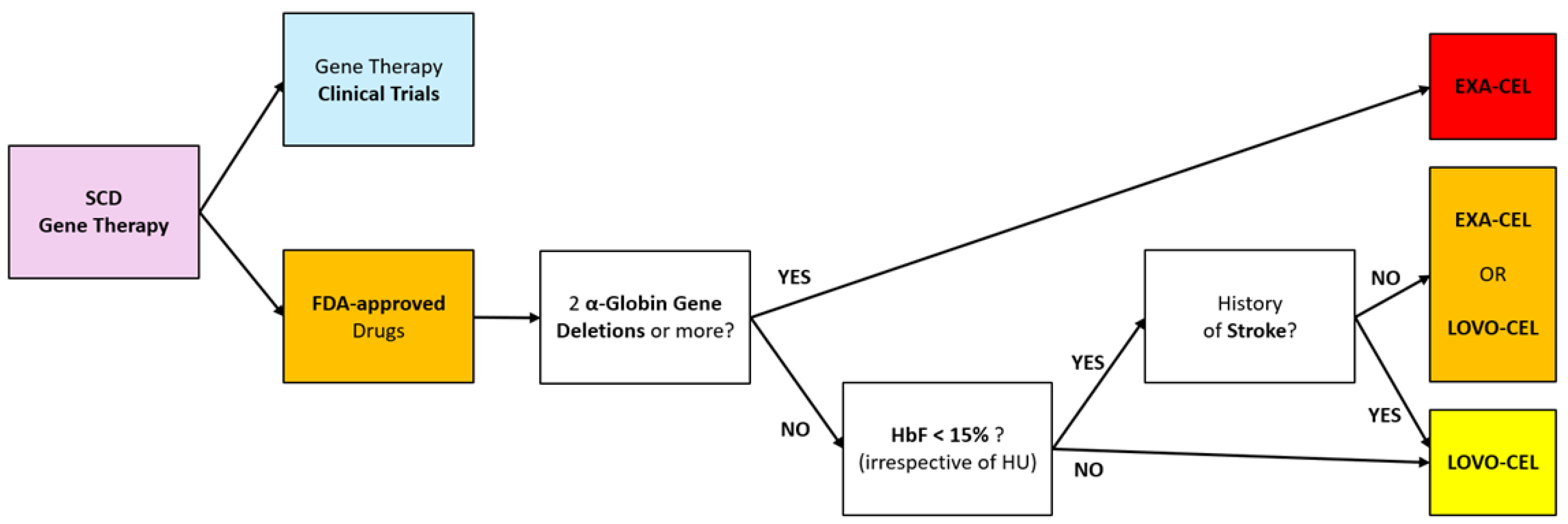
Table 3.
Proposed eligibility criteria for gene therapy in patients with sickle cell disease.
| Present Regulatory Agency Criteria | Potential Future Candidates | Not Eligible Patients |
|---|---|---|
| • Patients followed by a comprehensive center for hemoglobinopathies • Genotype βSβS, βSβ+ and severe βSβ0 • No HLA-matched family donor • Patients over 12 years of age • 2 VOC requiring hospitalization per year in the 2 previous years with no response to HC at MTD, either alone or in combination with other treatments • Having at least 2 ACS in the prior 2 years |
• Patients followed by a comprehensive center for hemoglobinopathies • Genotype βSβS, βSβ+ and severe βSβ0 • No HLA-matched family donor • Patients aged more than 2 years and <45 years • at least 2 hospitalized VOCs per year in the 2 previous years with no response to HC at the MTD, either alone or in combination with other treatments • Recurrence of ACS in spite of HC at MTD • Diastolic dysfunction in the absence of restrictive myocardiopathy • PH defined as a mean pulmonary arterial pressure between 25–29 mmHg defined by heart cardiac catheterization • Chronic cholangiopathy/hepatopathy without hepatic failure • Chronic kidney disease ≤2 stage with or without ACE or ARB treatment • Urine albumin/creatinine ratio >30 mg/mmol without renal failure • Persistently abnormal TCD velocities despite HU at MTD • Significant cerebrovascular disease treated with regular blood transfusions • History of HTR/severe hemolytic reaction? • Co-existent auto-immune disease |
• Baseline HbF > 30% • Organ dysfunction not compatible with myeloablative conditioning regimen • Active infection (HBV, HCV, HIV) • Patients with NYHA III or above • PH with pulmonary arterial pressure >30 mmHg defined by heart cardiac catheterization • Significant arrhythmia requiring therapy • Myocardial ischemia in the previous 12 months • Restrictive myocardiopathy • Chronic HBV and HCV infection • Liver fibrosis grade ≥3 • Liver cirrhosis • If LIC >7 mg/Fe/gr liver, iron chelation therapy should be started until LIC <7 mg/Fe/gr liver • CKD stage 3−4 or higher • End-stage renal disease (ESRD) under hemodialysis • Severe cerebrovascular disease with moyamoya • Lupus anticoagulant (LAC) or anti-phospholipids |
Abbreviations: ACE, angiotensin-converting enzyme; ACS, acute chest syndrome; ARB, angiotensin receptor blocker; CKD, chronic kidney disease; EHA SWG, European Hematology Association Specialized Working Group; EBMT, European Society for Blood and Marrow Transplantation; HbF, fetal haemoglobin; HBV, hepatitis B virus; HCV, hepatitis C virus; HIV, human immunodeficiency virus; HLA, human leukocyte antigen; HTR, haemolytic transfusion reaction; LIC, liver iron concentration; MTD, maximum tolerated dose; NYHA, New York Heart Association; PH, pulmonary hypertension; SCD, sickle cell disease; TCD, transcranial Doppler; VOC, vaso-occlusive crisis.
Disclaimer/Publisher’s Note: The statements, opinions and data contained in all publications are solely those of the individual author(s) and contributor(s) and not of MDPI and/or the editor(s). MDPI and/or the editor(s) disclaim responsibility for any injury to people or property resulting from any ideas, methods, instructions or products referred to in the content. |
© 2026 by the authors. Licensee MDPI, Basel, Switzerland. This article is an open access article distributed under the terms and conditions of the Creative Commons Attribution (CC BY) license.
Copyright: This open access article is published under a Creative Commons CC BY 4.0 license, which permit the free download, distribution, and reuse, provided that the author and preprint are cited in any reuse.


