
Submitted:
06 June 2026
Posted:
08 June 2026
You are already at the latest version
Abstract
Background. Musculoskeletal pain (MSP) is highly prevalent among undergraduate students and may originate during early adulthood, increasing the risk of chronicity later in life. Modifiable factors such as reduced muscle flexibility and prolonged sedentary behavior have been proposed as contributors; however, longitudinal evidence among student populations remains scarce. This study aimed to prospectively examine changes in MSP prevalence and hip muscle length over one year and to identify independent predictors of MSP. Methods. A prospective longitudinal study was conducted among 62 first-year undergraduate students assessed at baseline and at one-year follow-up. MSP was evaluated using a modified Standardized Nordic Questionnaire, and demographic data including physical activity and sitting behavior were recorded. Hamstrings and the iliopsoas muscles' length were measured by passive straight-leg raise and modified Thomas tests, respectively. Changes over time were analyzed using paired t-tests and McNemar tests. Multivariable logistic regression was also performed to identify predictors of MSP at follow-up. Results. Most participants were female (79%, n = 49), with a mean age of 25.8 ± 6.0 years and body mass index of 23.6 ± 4.4 kg/m². Significant reductions in hamstrings (P < 0.001; d = −0.55 to −0.70) and iliopsoas muscles` length (P< 0.001; d = −1.32 to −1.46) were observed over one year. Health-science students manifested a significant decrease in hamstrings length over time compared to their counterparts in other programs (P ≤ 0.002). MSP prevalence increased across all body regions, particularly in the low back (46.8% to 71.0%) and cervical spine (46.8% to 61.3%). Baseline MSP was the only independent predictor of MSP at follow-up (upper quadrant: OR = 12.89, 95% CI: 2.38–69.65, P=0.003; lower quadrant: OR = 6.35, 95% CI: 1.39–28.90, P=0.018). Conclusions. MSP prevalence increased concurrently with significant reductions in hip muscles length over one year. While muscle shortening was not predictive of future MSP, baseline pain demonstrated strong prognostic value. These findings underscore the importance of early identification and targeted preventive strategies addressing modifiable behavioral risk factors in young adults.
Keywords:
musculoskeletal pain
; hip muscles length
; students
; history of pain
1. Introduction
Musculoskeletal pain (MSP) is a leading contributor to disability and reduced quality of life worldwide and represents one of the most common reasons for healthcare utilization [1,2,3]. MSP encompasses pain arising from muscles, joints, tendons, ligaments, and spinal structures, with low back pain, neck pain, and lower-limb pain among the most frequently reported conditions [4,5]. Notably, low back pain is the leading cause of years lived with disability globally, underscoring the substantial public health burden associated with MSP [2,6]. Although MSP is often associated with older adults and occupational populations, accumulating evidence indicates a high prevalence among young adults, particularly undergraduate students [7,8,9,10].
University students are exposed to multiple physical and psychosocial risk factors during a critical developmental stage. These include prolonged sitting, extensive screen use, suboptimal ergonomics, academic stress, reduced physical activity, and irregular sleep patterns [11,12,13,14]. Such exposures may contribute to the development and persistence of MSP and may interact within a biopsychosocial framework [2,15]. Importantly, musculoskeletal pain experienced during early adulthood has been shown to track into later life and is associated with an increased risk of chronic pain and long-term functional limitations [16].
In recent years, increasing attention has been directed toward the role of muscle length and flexibility, particularly of the hip musculature in the development and maintenance of MSP [17,18,19]. Hip muscles play a central role in lumbopelvic stability and lower-limb biomechanics [20,21]. Reduced muscle extensibility, especially of the iliopsoas and hamstrings, has been associated with altered pelvic alignment, increased lumbar spine loading, and compensatory movement patterns [21,22,23]. These biomechanical alterations may increase susceptibility to low back pain, hip dysfunction, and lower-extremity overuse injuries [24,25]. Furthermore, prolonged sitting, a common behavior among university students, has been linked to adaptive shortening of hip flexors and reduced flexibility of the posterior chain, potentially contributing to postural deviations and movement dysfunction [21,26,27].
Despite growing interest in this area, most existing studies are cross-sectional and have primarily focused on athletic or clinical populations, limiting both generalizability and the ability to infer temporal relationships [28,29]. Longitudinal evidence examining changes in hip muscle length and their relationship with MSP in undergraduate populations remains scarce. Given that hip muscles length is a modifiable factor, understanding its temporal changes and potential association with MSP may have important implications for early identification and preventive strategies.
Therefore, the main aim of this study was to examine changes in musculoskeletal pain prevalence and hip muscles length over a one-year period among undergraduate students. We also aim to explore potential factors associated with MSP at follow-up.
We hypothesized that undergraduate students would demonstrate (1) an increased prevalence of musculoskeletal pain and (2) a significant reduction in hip muscles length over the one-year follow-up period.
2. Materials and Methods
2.1. Study Design and Participants
This longitudinal study was conducted among first-year undergraduate students enrolled in full-time bachelor’s degree programs at Zefat Academic College, Israel. The study included a one-year follow-up period.
Participants were recruited between May and June 2024 through institutional communication channels (e.g., college website and social media platforms). Eligible participants were students aged ≥18 years who were enrolled in one of five academic programs (Nursing, Physiotherapy, Occupational Therapy, Social Work, and Art and Literature). Recruitment across multiple programs was intended to enhance sample heterogeneity. Exclusion criteria were: (1) pregnancy; (2) history of spinal or lower extremity surgery; (3) diagnosed neuromusculoskeletal disorders; and (4) structural deformities of the spine or thoracic cage. A total of 70 students were initially recruited, of whom 62 completed the one-year follow-up assessment (Figure 1).
All participants provided written informed consent prior to participation. The study was conducted in accordance with the Declaration of Helsinki and was approved by the Institutional Research Ethics Committee of Zefat Academic College (approval number: 2-2024).
2.2. Data Collection and Outcome Measures
Data collection and physical assessments were performed at two points: baseline (May-June 2024) and follow-up (May-June 2025).
Musculoskeletal Pain (MSP) was assessed using a hard copy of modified version of the validated Standardized Nordic Questionnaire [30]. Participants reported the presence of musculoskeletal pain in specific body regions (e.g., cervical, thoracic, lumbar spine, upper and lower extremities) during the preceding three months and the past week. Pain intensity was measured following visual analog scale (VAS) [31].
MSP was also categorized into two regions: (1) upper quadrant includes the cervical and thoracic spine, and upper extremities and (2) lower quadrant involves lumbar spine and lower extremities. Sociodemographic and lifestyle-related variables were also collected and included age, sex, smoking status, physical activity, and sedentary behavior [32,33]. Physical activity was recorded as a dichotomous variable (yes/no), based on self-reported engagement in aerobic exercise. Sedentary behavior was assessed by reporting the daily sitting time and categorized as ≤5 hours or >5 hours per day. Stress-related variables (e.g., academic and personal stress) were assessed using a four-point Likert scale (very high, high, low, none) referring to the preceding month [32]. Anthropometric measurements were obtained using a calibrated digital scale (Shekel H150-5). Body mass index (BMI) was calculated as weight (kg) divided by height squared (m²).
Hip muscles length assessment was carried out using standardized clinical tests that have an acceptable reliability and validity outcomes [34,35]. Hamstrings and iliopsoas lengths were measured using the passive straight-leg raise (SLR) test and modified Thomas test, respectively [19].
All measurements were performed by a single trained examiner (RN) who was blinded to participants’ MSP status to reduce measurement bias. Each measurement was repeated three times per limb, and the mean value was used for analysis.
2.3. Statistical Analysis
A post hoc power analysis was conducted based on the final sample size (n = 62), accounting for 8 dropouts (11%), with a two-sided α level of 0.05 and statistical power set at 0.80. The study was adequately powered to detect moderate-to-large effect sizes (r > 0.40). Additionally, baseline characteristics (e.g., age and hip muscles length) were comparable between participants who completed the study and those lost to follow-up, suggesting a low risk of attrition bias. The intraclass correlation coefficient (ICC) was calculated to assess intra-tester and inter-tester reliability of muscle flexibility measurements over 5-7 days intervals, based on repeated assessments in a subsample of 15 participants. Normality of continuous variables (e.g., age, weight, and muscle length) was evaluated using the Kolmogorov-Smirnov test. Descriptive statistics were used to summarize participant characteristics: continuous variables are presented as mean ± standard deviation (SD), while categorical variables are reported as frequencies and percentages.
Changes in hip muscles length between baseline and follow-up were analyzed using paired-samples t-tests. Between-group differences (health science vs. non-health science students) in muscle length changes were assessed using independent-samples t-tests. Changes in the prevalence of musculoskeletal pain (MSP) over time were evaluated using the McNemar test. Given the sample size (n = 62) and the number of outcome events (48-49 MSP cases at follow-up in both upper and lower body quadrants), the number of predictors included in the multivariable logistic regression models was carefully restricted to avoid overfitting and unstable estimates. Although the number of events was relatively high, the overall sample size remained modest, which may compromise model stability if too many predictors are included. In accordance with methodological recommendations regarding the events-per-variable (EPV) ratio (commonly ≥10 events per predictor), the present data support the inclusion of approximately 4-5 predictors per model. Therefore, to maintain an adequate EPV ratio and enhance model robustness, only a limited set of clinically and theoretically relevant variables was selected a priori (e.g., baseline MSP, muscle length measurements). This parsimonious approach reduces the risk of overfitting, limits inflation of effect estimates, and improves the generalizability and interpretability of the findings. Statistical significance was set when P-value < 0.05.
3. Results
The intra-tester and inter-tester reliability results (ICCs) for measuring the hamstring and iliopsoas lengthening were very high: 0.995 to 0.985 and 0.992 to 0.942, respectively. As a relatively small sample size (started with 70 and ended with 62 students), we can reliably detect only moderate to large effects (≥ 0.4).
3.1. Demographic Characteristics
The majority were female (79%, n = 49), and 71% (n = 44) were enrolled in health science programs (Table 1). The mean age of participants was 25.8 ± 6.0 years, and the mean body mass index (BMI) was 23.6 ± 4.4 kg/m². Approximately 12.9% (n = 8) of participants were smokers, and 51.6% (n = 32) reported engaging in aerobic physical activity. Prolonged sitting (>5 hours/day) was reported by 51.6% (n = 32) of the sample. High to very high levels of study-related stress were reported by 83.9% (n = 52) of participants.
3.1. Changes in Hip Muscle Length
Significant reductions in both hamstrings and iliopsoas muscle lengths were observed over the one-year follow-up period (P < 0.001) (Table 2). The effect sizes (Cohen’s d) indicated moderate-to-large reductions in hamstrings length (d = −0.55 to −0.70) and large reductions in iliopsoas length (d = −1.32 to −1.46). These findings suggest that the decline in muscle length was moderate for the hamstrings and substantial for the iliopsoas over time. In addition, the large shortening in hip muscles length over time was significantly greater among health-science students compared to other students only for hamstrings length (P ≤ 0.002; d = −0.78 to −1.01) (Table 3).
3.1. Musculoskeletal Pain (MSP)
The prevalence of musculoskeletal pain increased across all assessed body regions over time (Table 4). The largest increases were observed in low back pain (from 46.8% to 71.0%) and cervical spine pain (from 46.8% to 61.3%). Substantial increases were also noted in the thoracic region (24.2% to 46.8%) and in the wrist and hand (21.0% to 43.5%). Smaller increases were observed in lower-limb regions, including the hip, knee, and ankle.
Analysis by body quadrant demonstrated a statistically significant increase in MSP prevalence over time in both the upper quadrant (64.5% to 77.4%, P = 0.021) and lower quadrant (54.8% to 79.0%, P < 0.001) (Table 5). Stratified analyses indicated that these increases were statistically significant among non-health science students but not among health science students.
Multivariable logistic regression analysis identified baseline MSP as the only significant predictor of MSP at follow-up. Participants reporting MSP at baseline had substantially higher odds of experiencing MSP at follow-up in both the upper quadrant (OR = 12.89, 95% CI: 2.38 – 69.65, P = 0.003) and lower quadrant (OR = 6.35, 95% CI: 1.39 - 28.90, P = 0.018) (Table 6). Neither muscle length nor stress-experience were associated with pain over one-year follow-up.
4. Discussion
This study demonstrated an increase and a high prevalence of musculoskeletal pain (MSP) alongside a reduction in hip muscles length among first-year undergraduate students over a one-year follow-up period at Zefat Academic College. To the best of our knowledge, this is among the first studies to examine longitudinal changes in hip muscles length within an undergraduate population, thereby limiting direct comparisons with existing literature.
The findings revealed a significant reduction in the length of both the iliopsoas and hamstrings muscles bilaterally, with moderate to large effect sizes (Cohen’s d ranging from -0.55 to - 1.46). Notably, the reduction was more pronounced in the iliopsoas muscles (d = -1.32 to -1.46), suggesting greater susceptibility of this muscle to change over time. One plausible explanation for this observation is the high prevalence of prolonged sitting reported by participants, with approximately 52% indicating sitting durations exceeding five hours per day. Previous studies have demonstrated associations between prolonged sitting and alterations in muscle length and increased stiffness [27,36,37,38]. For example, Boukabache et al. reported a significant association between prolonged sitting and reduced passive hip extension [38].
Several physiological mechanisms may explain the relationship between prolonged sitting and reduced muscle extensibility. Reduced movement and sustained static postures may contribute to increased passive stiffness through alterations in connective tissue properties, reduced muscle perfusion, and impaired metabolic activity [39,40,41,42,43]. These changes may promote increased cross-bridge formation within muscle fibers, ultimately contributing to increased passive resistance and reduced flexibility [44,45]. However, it should be noted that these mechanisms remain theoretical within the context of the present study, as no direct physiological measures were obtained. Furthermore, the reduction in hamstrings length was more pronounced among health science students compared to their peers from other programs. One possible explanation is the greater academic workload typically associated with health science programs, which may result in longer periods of sedentary behavior and reduced opportunities for movement-breaks. Although sitting duration was not directly compared between academic groups in the present study, due to small sample size, this suggests that academic-related behavioral patterns may influence musculoskeletal adaptations and warrants further investigation.
Our findings also demonstrated an increase and a high prevalence of MSP prevalence across all assessed body regions over time. This outcome agrees with others [46,47,48]. The most notable increases were observed in the lower back (46.8% to 71%) and cervical region (46.8% to 61.3%), followed by the wrist and hand and the thoracic spine. These findings are consistent with previous studies indicating that the lower back and neck are the most affected regions in young adult populations [12,14,49,50]. The observed increase in MSP may be partially explained by prolonged sitting and sustained postures, which have been associated with increased mechanical loading, postural strain, and muscle fatigue.
Prolonged sitting has also been linked to broader musculoskeletal and metabolic consequences. For instance, previous research has demonstrated associations between sitting duration and upper quadrant pain, including neck and shoulder symptoms [51,52]. Gupta et al. (2015) reported a positive association between sitting time and the intensity of low back pain [53]. From a biomechanical perspective, shortened hip flexors, as observed in the present study, may contribute to anterior pelvic tilt, thereby altering lumbar spine alignment and increasing spinal loading [54,55]. These adaptations may provide a potential explanation for the concurrent increase in MSP and reduction in muscle length observed in the present study; however, causal relationships cannot be established.
Analysis of MSP by body quadrant (upper vs. lower) revealed a statistically significant increase over time in both regions. Interestingly, the increase in MSP was more pronounced among students from non-health science programs. This finding suggests that factors beyond muscle length and sitting duration such as differences in ergonomic awareness, or psychosocial stressors may contribute to pain development [14,49,50]. These variables were not fully explored in the present study and should be considered in future research.
The multivariable logistic regression analysis demonstrated that the presence of MSP at baseline (in both upper and lower body quadrants) was the only significant predictor of MSP at the one-year follow-up. This finding is consistent with existing literature indicating that a history of musculoskeletal pain is a strong predictor of future symptoms [56,57]. For instance, a recent longitudinal study among health science students reported that a prior history of pain was significantly associated with the occurrence of low back pain over a two-year follow-up period [56]. However, the magnitude of the observed associations should be interpreted cautiously due to the instability of the estimates, as reflected by the wide confidence intervals. In addition, the Nagelkerke R² values for the regression models ranged from 0.47 to 0.55, indicating that approximately 50% of the variance in MSP at follow-up was explained by the variables included in the models. This suggests that additional unmeasured factors such as ergonomic exposures, sleep disturbances, and other lifestyle or psychosocial variables may also contribute to the development and persistence of MSP.
Limitations of the study. This study should be interpreted considering several limitations. First, the relatively small sample size limited statistical power, restricted the number of predictors in the regression models, and may have contributed to overfitting and imprecise estimates, as reflected by the wide confidence intervals. Second, the sample was derived from a single academic institution, which may limit the generalizability of the findings. Additionally, reliance on self-reported questionnaire data introduces the potential for bias, including recall bias and the influence of unmeasured socioeconomic factors. Third, although musculoskeletal pain (MSP) is a multifactorial condition, some relevant lifestyle-related variables such as sleep quality, sitting posture, and duration of mobile device use were not assessed, potentially limiting a more comprehensive understanding of contributing factors. Finally, pain assessment was relatively limited, as detailed characteristics of MSP (e.g., frequency, duration, and type of pain) were not systematically evaluated, thereby restricting insights into its heterogeneity.
Clinical implication. The findings of this study highlight the importance of early identification and prevention of musculoskeletal impairments among undergraduate students. The observed reduction in hip muscles length, alongside increased MSP prevalence, suggests that modifiable behavioral factors, particularly prolonged sitting, may play an important role in musculoskeletal health. Intervention strategies such as incorporating regular movement breaks, implementing targeted stretching programs (particularly for the hip flexors and hamstrings), and promoting ergonomic awareness may help mitigate these effects. In addition, screening individuals with a history of MSP may be valuable, as baseline pain was identified as a strong predictor of future symptoms. Future research should aim to evaluate the effectiveness of such interventions using larger, well-powered longitudinal or interventional study designs.
5. Conclusions
This longitudinal study demonstrates an increase in musculoskeletal pain (MSP) alongside a reduction in hip muscles length among undergraduate students over one year. These findings suggest that modifiable factors, such as prolonged sitting, may contribute to early musculoskeletal changes, while baseline MSP appears to be a strong predictor of future symptoms. Early preventive strategies targeting modifiable behaviors may help reduce the burden of MSP in this population.
Author Contributions
Conceptualization N.R. and J.A.; methodology N.R. and K.H.; validation and data collection N.R.; investigation N.R., J.A. and K.H.; original draft preparation J.A.; writing- review and editing J.A. and K.H.; supervision J.A.; administration J.A. and K.H. All authors have read and agreed to the published version of the manuscript.
Funding
This research received no external funding.
Institutional Review Board Statement
The ethical committee of Zefat Academic College (Code: 2-24, Date 16th January 2024) approved this research.
Informed Consent Statement
Informed consent was obtained from all subjects involved in the study.
Data Availability Statement
Datasets are available to download on request. Requests should be directed to the authors.
Acknowledgments
The authors would like to thank the students at Zefat Academic College who took part in this research.
Conflicts of Interest
The authors declare no conflicts of interest.
References
- GBD 2019 Diseases and Injuries Collaborators. Global burden of 369 diseases and injuries in 204 countries and territories, 1990–2019. Lancet 2020, 396, 1204–1222. [CrossRef] [PubMed]
- Hartvigsen, J.; Hancock, M.J.; Kongsted, A.; et al. What low back pain is and why we need to pay attention. Lancet 2018, 391, 2356–2367. [Google Scholar] [CrossRef]
- Vos, T.; Lim, S.S.; Abbafati, C.; et al. Global burden of 369 diseases and injuries in 204 countries and territories, 1990–2019. Lancet 2020, 396, 1204–1222. [Google Scholar] [CrossRef]
- Cieza, A.; Causey, K.; Kamenov, K.; Hanson, S.W.; Chatterji, S.; Vos, T. Global estimates of the need for rehabilitation based on the Global Burden of Disease study. Lancet 2021, 396, 2006–2017. [Google Scholar] [CrossRef] [PubMed]
- Blyth, F.M.; Briggs, A.M.; Schneider, C.H.; Hoy, D.G.; March, L.M. The global burden of musculoskeletal pain—where to from here? Am. J. Public Health 2019, 109, 35–40. [Google Scholar] [CrossRef]
- Wu, A.; March, L.; Zheng, X.; et al. Global low back pain prevalence and years lived with disability. Ann. Transl. Med. 2020, 8, 299. [Google Scholar] [CrossRef]
- Wynne-Jones, G.; Cowen, J.; Jordan, J.L.; et al. Absence from work and return to work in people with back pain: A systematic review and meta-analysis. Occup. Environ. Med. 2014, 71, 448–455. [Google Scholar] [CrossRef]
- Silva, A.N.; Guedes, C.R.; Santos-Pinto, C.D.B.; Miranda, E.S.; Ferreira, L.M.; Vettore, M.V. Demographics, socioeconomic status, social distancing, psychosocial factors and psychological well-being among undergraduate students during the COVID-19 pandemic. Int. J. Environ. Res. Public Health 2021, 18, 7215. [Google Scholar] [CrossRef] [PubMed]
- Briggs, A.M.; Woolf, A.D.; Dreinhöfer, K.; et al. Reducing the global burden of musculoskeletal conditions. Bull. World Health Organ. 2018, 96, 366–368. [Google Scholar] [CrossRef]
- Keating, X.D.; Guan, J.; Piñero, J.C.; Bridges, D.M. A meta-analysis of college students’ physical activity behaviors. J. Am. Coll. Health 2005, 54, 116–125. [Google Scholar] [CrossRef]
- Afolabi, J.O.; Abel, P.T.; Oyeyemi, A.L. Prevalence of musculoskeletal disorders and associated risk factors among undergraduates of a private university in Nigeria. Work 2025, 82, 154–164. [Google Scholar] [CrossRef]
- Alshagga, M.A.; Nimer, A.R.; Yan, L.P.; Ibrahim, I.A.; Al-Ghamdi, S.S.; Radman Al-Dubai, S.A. Prevalence and factors associated with neck, shoulder and low back pain among medical students. BMC Res. Notes 2013, 6, 244. [Google Scholar] [CrossRef]
- Falavigna, A.; Teles, A.R.; Mazzocchin, T.; et al. Increased prevalence of low back pain among physiotherapy students compared to medical students. Eur. Spine J. 2011, 20, 500–505. [Google Scholar] [CrossRef]
- Alanazi, S.A.; Kashoo, F.Z. Musculoskeletal pain among university students and its correlations with risk factors: A cross-sectional study. J. Clin. Med. 2025, 14, 6076. [Google Scholar] [CrossRef]
- Gatchel, R.J.; Peng, Y.B.; Peters, M.L.; Fuchs, P.N.; Turk, D.C. The biopsychosocial approach to chronic pain: Scientific advances and future directions. Psychol. Bull. 2007, 133, 581–624. [Google Scholar] [CrossRef] [PubMed]
- Hestbaek, L.; Leboeuf-Yde, C.; Kyvik, K.O.; Manniche, C. The course of low back pain from adolescence to adulthood. Spine 2006, 31, 468–472. [Google Scholar] [CrossRef]
- Kim, M.H.; Yoo, W.G. Effects of stretching exercise on low back pain and flexibility. J. Phys. Ther. Sci. 2015, 27, 23–27. [Google Scholar]
- Norris, C.M.; Matthews, M. Interrelationships between muscle flexibility and low back pain. Man. Ther. 2008, 13, 443–450. [Google Scholar]
- Abbas, J.; Reif, N.; Hamoud, K. Is hip muscle flexibility associated with low back pain among first-year undergraduate students? J. Clin. Med. 2024, 13, 7598. [Google Scholar] [CrossRef]
- Kendall, F.P.; McCreary, E.K.; Provance, P.G.; Rodgers, M.M.; Romani, W.A. Muscles: Testing and Function with Posture and Pain, 5th ed.; Lippincott Williams & Wilkins: Philadelphia, PA, USA.
- Neumann, D.A. Kinesiology of the Musculoskeletal System: Foundations for Rehabilitation, 2nd ed.; Mosby: St. Louis, MO, USA, 2010. [Google Scholar]
- Harvey, L.A. Stretch for the treatment and prevention of contractures. Cochrane Database Syst. Rev. 2016, CD007455. [Google Scholar] [CrossRef] [PubMed]
- van Dillen, L.R.; Sahrmann, S.A.; Norton, B.J. Movement system impairment-based categories for low back pain. Phys. Ther. 2000, 80, 802–822. [Google Scholar]
- Sahrmann, S.; Azevedo, D.C.; Dillen, L.V. Diagnosis and treatment of movement system impairment syndromes. Braz. J. Phys. Ther. 2017, 21, 391–399. [Google Scholar] [CrossRef] [PubMed]
- Powers, C.M. The influence of abnormal hip mechanics on knee injury. J. Orthop. Sports Phys. Ther. 2010, 40, 42–51. [Google Scholar] [CrossRef]
- O’Sullivan, P.B.; Dankaerts, W.; Burnett, A.F.; Farrell, G.T.; et al. Effect of different upright sitting postures on spinal-pelvic curvature in a pain- free population. Spine 2006, 31. [Google Scholar] [CrossRef]
- Beach, T.A.; Parkinson, R.J.; Stothart, J.P.; Callaghan, J.P. Effects of prolonged sitting on lumbar spine stiffness. Spine J. 2005, 5, 145–154. [Google Scholar] [CrossRef]
- Sedgwick, P. Cross-sectional studies: Advantages and disadvantages. BMJ 2014, 348. [Google Scholar] [CrossRef]
- Mann, C.J. Observational research methods. Emerg. Med. J. 2003, 20, 54–60. [Google Scholar] [CrossRef] [PubMed]
- Kuorinka, I.; Jonsson, B.; Kilbom, A. Standardised Nordic questionnaires. Appl. Ergon. 1987, 18, 233–237. [Google Scholar] [CrossRef]
- Bodian, C.A.; Freedman, G.; Hossain, S.; Eisenkraft, J.B.; Beilin, Y. Visual analog scale for pain. Anesthesiology 2001, 95, 1356–1361. [Google Scholar] [CrossRef]
- Jessor, R.; Turbin, M.S.; Costa, M.F. Survey of Personal and Social Development at CU; Available online; Institute of Behavioral Sciences, University of Colorado: Boulder, CO, USA, 2003; Volume 19, p. 2016. [Google Scholar]
- Thompson, W.R.; Gordon, N.F.; Pescatello, L.S. ACSM’s Guidelines for Exercise Testing and Prescription, 9th ed.; Lippincott Williams & Wilkins: Philadelphia, PA, USA, 2014. [Google Scholar]
- Clapis, P.A.; Davis, S.M.; Davis, R.O. Reliability of inclinometer measurements. Physiother. Theory Pract. 2008, 24, 135–141. [Google Scholar] [CrossRef] [PubMed]
- Attrey, P.; Yadav, M.; Singh, S. Relationship between SLR test and flexibility tests. J 2016. [Google Scholar]
- Fatima, G.; Qamar, M.M.; Ul Hassan, J.; Basharat, A. Extended sitting can cause hamstring tightness. Saudi J. Sports Med. 2017, 17, 110–114. [Google Scholar] [CrossRef]
- Kett, A.R.; Milani, T.; Sichting, F. Sitting and muscle stiffness. Front. Sports Act. Living 2021, 3, 760533. [Google Scholar]
- Boukabache, A.; Preece, S.J.; Brookes, N. Prolonged sitting and hip extension. Musculoskelet. Sci. Pract. 2021, 51, 102282. [Google Scholar] [CrossRef]
- Wisdom, K.M.; Delp, S.L.; Kuhl, E. Muscle adaptation to stimuli. Biomech. Model. Mechanobiol. 2015, 14, 195–215. [Google Scholar] [CrossRef] [PubMed]
- McGill, S.M.; Hughson, R.L.; Parks, K. Lumbar muscle oxygenation. Ergonomics 2000, 43, 486–493. [Google Scholar] [CrossRef]
- Valachi, B.; Valachi, K. Musculoskeletal disorders in dentistry. J. Am. Dent. Assoc. 2003, 134, 1344–1350. [Google Scholar] [CrossRef] [PubMed]
- Visser, B.; van Dieën, J.H. Pathophysiology of muscle disorders. J. Electromyogr. Kinesiol. 2006, 16, 1–16. [Google Scholar] [CrossRef] [PubMed]
- Kell, R.T.; Bhambhani, Y. Muscle oxygenation and endurance. Eur. J. Appl. Physiol. 2008, 102, 243–250. [Google Scholar] [CrossRef]
- Proske, U.; Morgan, D.L. Muscle stretch tension. J. Muscle Res. Cell Motil. 1999, 20, 433–442. [Google Scholar] [CrossRef]
- Campbell, K.S.; Lakie, M. Cross-bridge mechanism. J. Physiol. 1998, 510, 941–962. [Google Scholar] [CrossRef]
- Hendi, O.M.; Abdulaziz, A.A.; Althaqafi, A.M.; Hindi, A.M.; et al. Prevalence of Musculoskeletal Disorders and its Correlation to Physical Activity Among Health Specialty Students. Int. J. Prev. Med. 2019, 10, 48. [Google Scholar] [CrossRef]
- Ng, A.; Hayes, M.J.; Polster, A. Musculoskeletal disorders among students. Healthcare 2016, 4. [Google Scholar] [CrossRef] [PubMed]
- Kandasamy, G.; Almanasef, M.; Almeleebia, T.; Orayj, K.; et al. Prevalence of musculoskeletal pain among undergraduate students. Front Med. 2024, 11, 1403267. [Google Scholar] [CrossRef] [PubMed]
- Parto, D.N.; Wong, A.Y.L.; Macedo, L. Musculoskeletal disorders in students. BMC Musculoskelet. Disord. 2023, 24, 501. [Google Scholar]
- Alsaadi, S.M. Musculoskeletal pain and sleep quality. Int. J. Environ. Res. Public Health 2022, 19, 13929. [Google Scholar] [CrossRef]
- Hallman, D.M.; Gupta, N.; Mathiassen, S.E.; et al. Sitting time and neck pain. Int. Arch. Occup. Environ. Health 2015, 88, 1031–1042. [Google Scholar] [CrossRef]
- Brink, Y.; Louw, Q.A. Sitting and musculoskeletal pain. Man. Ther. 2013, 18, 281–288. [Google Scholar] [CrossRef]
- Gupta, N.; Christiansen, C.S.; Hallman, D.M.; et al. Sitting time and low back pain. PLoS ONE 2015, 10, e0121159. [Google Scholar]
- Preece, S.; Fang, F.; Alghamdi, T.; Frances, A. Hip flexor stretching effects. J. Manip. Physiol. Ther. 2020. [Google Scholar]
- Glard, Y.; Launay, F.; Viehweger, E.; et al. Hip flexion contracture. J. Pediatr. Orthop. 2005, 25, 476–478. [Google Scholar] [CrossRef]
- Abbas, J.; Abu-Leil, S.; Hamoud, K.; Joubran, K. Low back pain characteristics among undergraduates. J. Clin. Med. 2026, 15, 684. [Google Scholar] [CrossRef]
- Abbas, J.; Yousef, M.; Hamoud, K.; Joubran, K. Machine learning analysis of low back pain. J. Clin. Med. 2025, 14, 2046. [Google Scholar] [CrossRef]
Figure 1.
Flow chart of the study sample within one-year follow-up.
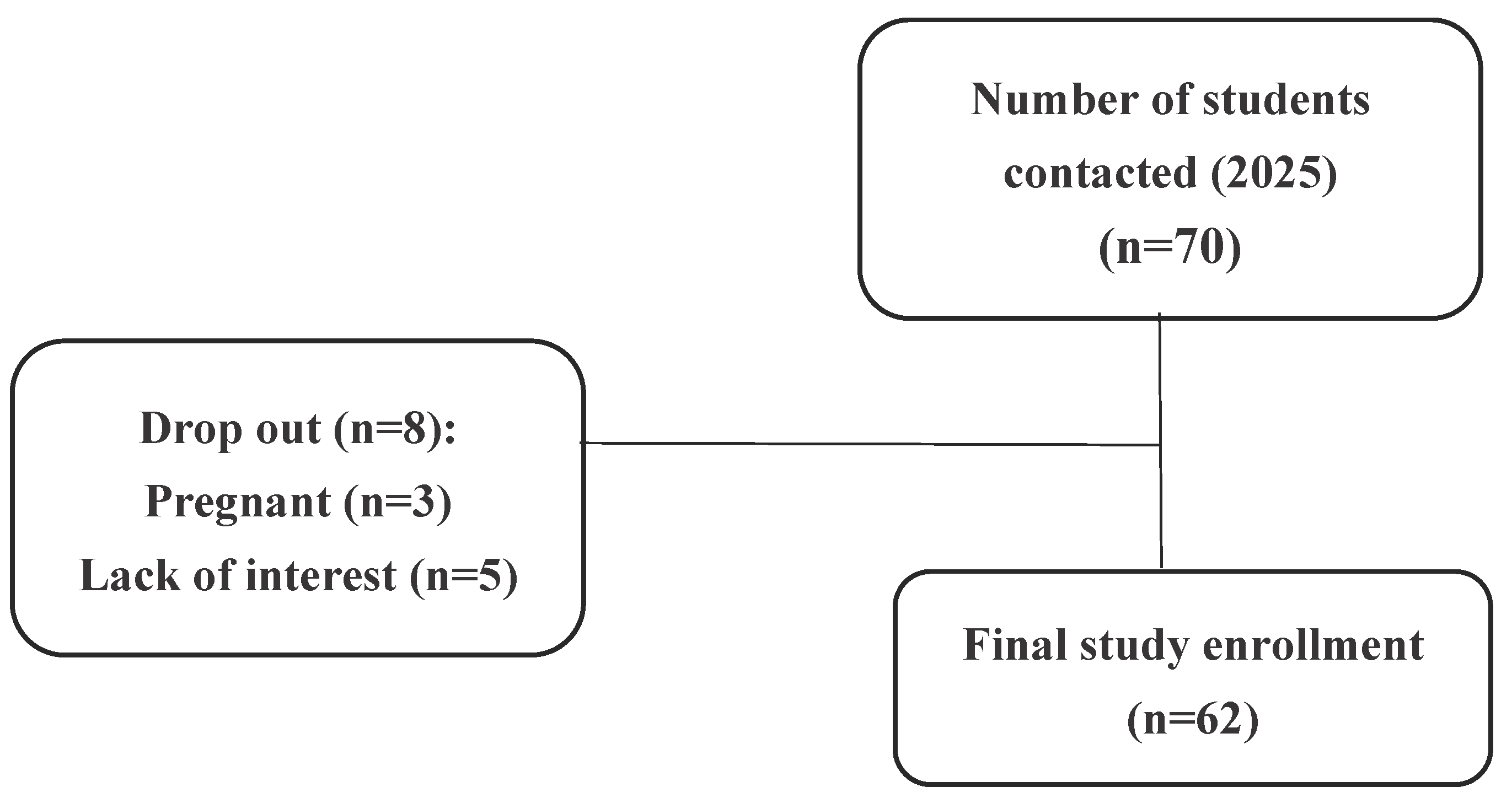

Table 1.
Participants characteristics at 1-year follow up (n-62).
| Variable | n (%)/ or mean ± SD |
|---|---|
| Male Female |
13 (21) 49 (79) |
| Mean age (year) | 25.8 ± 6 |
| Mean BMI (kg/m2) | 23.6 ± 4.4 |
| Smoking | 8 (12.9) |
| Physical activity (yes) | 32 (51.6) |
| Prolonged daily sitting: up to 5 h >5 h |
30 (48.4) 32 (51.6) |
| *Study related stress: Very high- high Little-none |
52 (83.9) 10 (16.1) |
| Health-science Other |
44 (71) 18 (29) |
BMI- Body mass index, SD-standard deviation. * Stress-related variable appeared alone, as this variable was the most common compared to other types of stress.
Table 2.
Changes in hip muscles length between baseline and one-year follow-up (paired-samples t-test).
Table 2.
Changes in hip muscles length between baseline and one-year follow-up (paired-samples t-test).
| Muscle | Mean ± SD Baseline (n=62) |
Mean ± SD Follow-up (n-62) |
T (61) | P value | Cohen’s d |
|---|---|---|---|---|---|
| Hamstrings rt | 92.3 ± 18 | 81 ± 20 | -5.48 | <0.001 | -0.70 |
| Hamstrings lt | 91.3 ± 17 | 81± 19 | -4.31 | <0.001 | -0.55 |
| Iliopsoas rt | 11.3 ± 7 | -0.8 ± 8 | -11.47 | <0.001 | -1.46 |
| Iliopsoas lt | 12.4 ± 7 | 0.98 ± 8 | -10.37 | <0.001 | -1.32 |
SD- standard deviation, rt- right, lt- left. Negative T values and Cohen’s d indicate a reduction in muscle length over time.
Table 3.
Comparison of changes in hip muscles length between health science vs. other students (independent-samples t-test).
Table 3.
Comparison of changes in hip muscles length between health science vs. other students (independent-samples t-test).
| Muscle | Muscle length decreases (mean ± SD) |
T (df) | P value | Cohen’s d | |
|---|---|---|---|---|---|
| Health science (n=44) | Others (n=18) | ||||
| Hamstrings rt | -13.88 ± 15 | -2.63 ± 10 | -3.23 (45.58) | 0.002 | -0.78 |
| Hamstrings lt | -14.10 ± 17 | 1.83 ± 10 | -4.43 (52) | <0.001 | -1.01 |
| Iliopsoas rt | -11.89 ± 8 | -10.25 ± 6 | -0.83 (40.78) | 0.413 | -0.208 |
| Iliopsoas lt | -12.17 ± 8 | -9.55 ± 8 | -1.10 (32.83) | 0.279 | -0.303 |
SD- standard deviation, rt- right, lt- left. Negative T values indicate a reduction in muscle length. Cohen’s d represents effect size.
Table 4.
Prevalence of musculoskeletal pain across body regions at baseline and follow-up.
| Body region | MSP at the baseline % (n) | MSP at the follow-up % (n) |
|---|---|---|
| Cervical spine | 46.8 (29) | 61.3 (38) |
| Thoracic spine | 24.2 (15) | 46.8 (29) |
| Shoulder | 35.5 (22) | 45.2 (28) |
| Elbow | 1.6 (1) | 14.5 (9) |
| Wrist and fingers | 21 (13) | 43.5 (27) |
| LBP | 46.8 (29) | 71 (44) |
| Hip | 8.1 (5) | 16.1 (10) |
| knee | 22.6 (14) | 29 (18) |
| Ankle and foot | 11.3 (7) | 16.1 (10) |
Table 5.
Changes in musculoskeletal pain prevalence by body quadrant (upper vs. lower) over time (McNemar test).
Table 5.
Changes in musculoskeletal pain prevalence by body quadrant (upper vs. lower) over time (McNemar test).
| Quadrant | MSP baseline % (n) | MSP follow-up % (n) | X2 (1) | P value |
|---|---|---|---|---|
| Upper | 64.5 (40) | 77.4 (48) | 5.33 | 0.021 |
| Lower | 54.8 (34) | 79 (49) | 11.27 | <0.001 |
Table 6.
Multivariable logistic regression analysis of factors associated with musculoskeletal pain at one-year follow-up by each quadrant separately.
Table 6.
Multivariable logistic regression analysis of factors associated with musculoskeletal pain at one-year follow-up by each quadrant separately.
| Upper quadrant Pain Nagelkerke R²- 0.465 | |||
|---|---|---|---|
| Variable | Adjusted OR | CI 95% | P value |
| Upper quadrant pain (baseline) | 12.89 | 2.38- 69.65 | 0.003 |
| Mean hamstrings (baseline) | 1.06 | 0.99- 1.13 | 0.079 |
| Mean iliopsoas (baseline) | 0.95 | 0.85 - 1.06 | 0.333 |
| BMI (baseline) | 0.86 | 0.74 - 1.06 | 0.180 |
| Study-related stress | 0.41 | 0.08- 2.22 | 0.303 |
|
Lower quadrant pain Nagelkerke R²- 0.552 | |||
| Lower quadrant pain (baseline) | 6.35 | 1.39 - 28.90 | 0.018 |
| Mean hamstrings (baseline) | 1.03 | 0.99 - 1.07 | 0.187 |
| Mean iliopsoas (baseline) | 1.05 | 0.99 - 1.12 | 0.137 |
| BMI (baseline) | 0.96 | 0.87 - 1.06 | 0.369 |
| Study-related stress | 1.51 | 0.50- 4.52 | 0.463 |
BMI- Body mass index, CI- confidence intervals.
Disclaimer/Publisher’s Note: The statements, opinions and data contained in all publications are solely those of the individual author(s) and contributor(s) and not of MDPI and/or the editor(s). MDPI and/or the editor(s) disclaim responsibility for any injury to people or property resulting from any ideas, methods, instructions or products referred to in the content. |
© 2026 by the authors. Licensee MDPI, Basel, Switzerland. This article is an open access article distributed under the terms and conditions of the Creative Commons Attribution (CC BY) license (http://creativecommons.org/licenses/by/4.0/).
Copyright: This open access article is published under a Creative Commons CC BY 4.0 license, which permit the free download, distribution, and reuse, provided that the author and preprint are cited in any reuse.


