

Submitted:
05 June 2026
Posted:
08 June 2026
You are already at the latest version
Abstract
Background/Objectives: Clomiphene citrate (CC) is widely used off-label for male infertility despite limited evidence and inconsistent guideline recommendations. Although previous studies suggest variability in clinical practice, real-world data on prescribing patterns, patient selection, monitoring, and treatment success definitions remain limited. This study assessed CC prescribing patterns among urologists and identified factors associated with its use. Methods: A national, cross-sectional, web-based survey was conducted among urologists in Türkiye between November and December 2025. Of 1,558 invited participants, 421 responded (27.0%), and 402 were included in the final analysis. The questionnaire was based on European Association of Urology and American Urological Association guidelines, refined through expert consensus, and pilot-tested. Multivariable logistic regression identified independent predictors of CC use. Results: CC was used by 39.3% of respondents and was independently associated with private practice (odds ratio [OR] = 2.90, p < 0.001), greater professional experience (OR = 2.18, p = 0.002), and higher infertility case volume (OR = 2.27, p = 0.001). Substantial heterogeneity was observed in patient selection, dosing, monitoring, and success definitions. Treatment goals mainly focused on surrogate laboratory outcomes, including semen parameters and testosterone levels, rather than pregnancy and live birth. An indication paradox was identified for hypogonadotropic hypogonadism, and 31.6% of clinicians reported not routinely providing risk counseling. Conclusions: CC prescribing for male infertility remains heterogeneous and mainly driven by clinician experience rather than standardized protocols. The reliance on surrogate outcomes highlights a gap between evidence and practice, emphasizing the need for standardized frameworks and clearer guidance on patient selection, monitoring, and counseling.
Keywords:
clomiphene citrate
; male infertility
; physician practice patterns
1. Introduction
Infertility affects a significant number of couples worldwide and is defined as the inability to conceive after 12 months of regular unprotected intercourse [1,2]. Male factors account for about 40% of cases, highlighting the importance of male reproductive health in fertility treatment [3]. Despite advances in diagnostic methods, many men are still diagnosed with idiopathic infertility, for which proven treatment options are limited [4,5,6,7,8].
In this context, empirical medical therapies (EMT), including antioxidants and hormonal agents, are often used despite limited supporting evidence. Among these, clomiphene citrate (CC), a selective estrogen receptor modulator (SERM), is frequently prescribed off-label for men to stimulate endogenous gonadotropin and testosterone production [9,10]. Although generally well tolerated, its clinical application shows significant variability in dosing, treatment duration, patient selection, and outcome assessment [9,11,12,13,14].
Current international guidelines emphasize the low quality of evidence supporting the use of SERMs in male infertility and avoid making strong recommendations [4,8]. Similarly, recent meta-analyses indicate that although CC may improve surrogate outcomes, such as semen parameters and hormonal profiles, its impact on clinically meaningful endpoints, such as pregnancy and live birth, remains uncertain [15,16]. Despite this uncertainty, survey data indicate that CC remains widely used in clinical practice, highlighting a gap between guideline recommendations and actual practice [17,18,19]. However, detailed real-world data on prescribing patterns, monitoring strategies, and definitions of treatment success are still limited, especially at the national level.
To our knowledge, this is among the first nationally representative surveys to examine real-world prescribing patterns of CC among urologists. The study highlights a critical gap between guideline recommendations and routine clinical practice by offering insights into prescribing behavior, patient selection, monitoring strategies, and outcome assessment. By characterizing these patterns and evaluating perceived effectiveness and safety, the findings could inform future guideline development, support the standardization of care, and align clinical decision-making with patient-centered fertility outcomes.
2. Materials and Methods
2.1. Study Design and Ethical Approval
This cross-sectional, web-based survey aimed to assess current clinical practices among urologists in Türkiye regarding the use of CC in managing male infertility. The study protocol received approval from the Ethics Committee of Aydın Adnan Menderes University (Approval No: 2025/298). Participation was voluntary and anonymous, and electronic informed consent was obtained from all participants before the survey commenced.
2.2. Survey Development and Structure
Clomiphene citrate (CC) was selected as the focus of this study because it is widely used as empirical medical therapy for male infertility and serves as a pragmatic model for examining real-world prescribing behaviors [17,20]. Although other empirical treatments, such as aromatase inhibitors and gonadotropins, are also used in selected clinical settings, CC’s widespread off-label use and variability in prescribing practices make it particularly suitable for evaluating patterns of clinical decision-making at a national level [17,18,19].
The questionnaire was developed by the corresponding author based on current European Association of Urology (EAU) and American Urological Association (AUA) guidelines [4,8] and previously published international surveys [17,18,19]. The initial draft was reviewed by seven urologists with expertise in andrology and male infertility, all members of the Andrology Working Group of the Society of Urological Surgery in Türkiye [21]. Based on their feedback, the questionnaire was revised. A structured online consensus meeting was then conducted, during which all items were reviewed and finalized. The revised questionnaire was pilot-tested with a separate group of 10 urologists to assess clarity, understanding, and practicality. The final version was implemented on an online platform (Google Forms), with all items marked as mandatory to ensure complete responses. Although the questionnaire underwent expert review, consensus development, and pilot testing to support content validity, formal psychometric validation was not performed, as the tool was designed to capture observable clinical behaviors and practice patterns rather than latent constructs [22,23].
The final questionnaire included three main sections: (1) demographic and professional characteristics; (2) reasons for not using CC among non-users; and (3) detailed clinical practices among CC users, such as patient selection, indications and contraindications, dosing strategies, monitoring approaches, treatment goals, perceived treatment success, and adverse effect management. Participants who reported CC use in their clinical practice answered 28 items, while those not using CC completed a shorter 10-item version. The full questionnaire is available in the Supplementary Material (Appendix S1).
Likert-scale items were used to assess the perceived frequency of adverse events, and an optional open-ended question allowed participants to provide additional comments.
2.3. Data Collection and Study Population
The survey link was shared through professional WhatsApp groups affiliated with the Society of Urological Surgery in Türkiye, which included urologists from different regions of the country. Members were invited twice: an initial invitation was sent in November 2025, and a reminder message was sent one month later to enhance participation. The survey was open from November 2025 to December 2025.
The invitation was sent to about 1,558 urologists. A total of 421 responses were received (response rate: 27.0%). After excluding responses from residents and duplicate submissions, 402 responses were included in the final analysis; the participant flow is shown in Figure 1. All survey items were mandatory, so there were no partial or incomplete submissions. The study was reported following the STROBE guidelines, and key methodological aspects of the CHERRIES checklist for internet-based surveys were considered [24,25].
2.4. Statistical Analysis
Statistical analyses were performed using IBM SPSS Statistics for Windows, version 31.0 (IBM Corp., Armonk, NY, USA). The normality of continuous variables was assessed using both visual methods (histograms and probability plots) and analytical tests.
Categorical variables were analyzed using the chi-square test or Fisher’s exact test, as appropriate, with Bonferroni correction applied for post hoc comparisons. Continuous variables were compared with the Mann–Whitney U test. Multiple-response items were evaluated as response counts rather than participant counts.
To identify independent predictors of CC use, multivariable logistic regression analysis was conducted. Variables that were statistically significant in univariable analysis were included in the multivariable logistic regression model. Due to potential collinearity between age and years in practice, only years as a urology specialist were retained in the final model to represent professional seniority. Collinearity was evaluated before constructing the model. Results are reported as odds ratios (ORs) with 95% confidence intervals (CIs). Model calibration was assessed using the Hosmer–Lemeshow goodness-of-fit test, and classification performance was evaluated using overall accuracy, sensitivity, and specificity.
A two-sided p-value less than 0.05 was considered statistically significant.
3. Results
3.1. Participant Demographics and Professional Characteristics
A total of 402 urologists participated in the survey, of whom 158 (39.3%) reported using CC in their clinical practice, whereas 244 (60.7%) reported no use. CC users were significantly older than non-users (median age 46.5 vs. 41.0 years, p < 0.001), whereas gender and academic degree were not associated with CC use. In univariate analysis, professional and practice-related factors, including professional seniority, institutional setting, subspecialty, particularly andrology, and clinical exposure to male infertility, were associated with CC use. These demographic and professional characteristics are shown in Table 1.
In multivariable logistic regression analysis (Table 2), working in a private practice setting was independently associated with a higher likelihood of CC use compared with non-private settings (OR = 2.90, 95% CI = 1.70–4.93, p < 0.001). Similarly, urologists with more than 20 years of experience were more likely to prescribe CC than those with 20 years or less of experience (OR = 2.18, 95% CI = 1.34–3.56, p = 0.002). A higher infertility case volume, defined as more than five new cases per week, was also independently associated with increased CC use (OR = 2.27, 95% CI = 1.41–3.67, p = 0.001). Although an andrology-focused practice showed a higher likelihood of CC use, this association did not reach statistical significance (OR = 2.35, 95% CI = 0.85–6.49, p = 0.098).
3.2. Reasons for Non-Use of Clomiphene Citrate
Among urologists who did not prescribe CC, several reasons for non-use were reported, including insufficient evidence or uncertainty about effectiveness, perceived inconsistency with current clinical guidelines, uncertainty about patient selection, lack of knowledge or clinical experience, and a preference for alternative treatments or referral to assisted reproductive techniques as a first-line approach. All reported reasons for non-use are summarized in Table 3.
3.3. Indications, Contraindications, and Treatment Goals
Among CC users, idiopathic male infertility was the most commonly reported indication (77.2%), followed by hypogonadotropic hypogonadism and unexplained infertility. In contrast, hypergonadotropic hypogonadism was rarely selected as an indication (10.8%) but was the most frequently cited contraindication (79.0%). Treatment goals were primarily focused on laboratory outcomes, with improvements in sperm concentration and increases in serum testosterone levels being the most commonly reported objectives. Goals related to sperm motility, pregnancy or live birth, morphology, and sexual function were reported less frequently. Indications, contraindications, and treatment goals of CC use are shown in Table 4.
3.4. Pretreatment Evaluation and Treatment Strategies
Pretreatment evaluation primarily relied on standard assessments. Most respondents routinely performed semen analysis and baseline hormonal tests, including total testosterone, follicle-stimulating hormone (FSH), and luteinizing hormone (LH). Estradiol measurement and physical examination were also commonly reported, whereas advanced tests, such as sperm DNA fragmentation testing and dual-energy X-ray absorptiometry, were used less frequently. Substantial variation was observed in CC dosing strategies, with daily doses of 25 mg or 50 mg being the most common, followed by cyclic regimens and alternate-day schedules. High-dose regimens of 100 mg/day or higher were rarely reported. Most urologists prescribed CC together with antioxidants or nutritional supplements, whereas CC monotherapy or combination therapy with other hormonal agents was less frequently reported. Pretreatment evaluation and treatment strategies are shown in Table 5.
3.5. Risk Counseling and Follow-Up Practices
Reported risk counseling practices varied widely. Before starting CC therapy, counseling most often focused on possible increases in liver enzymes (41.8%), gynecomastia (36.1%), and changes in libido (35.4%), whereas counseling about thromboembolic risk, mood changes, headache, visual disturbances, deterioration of semen parameters, and bone mineral density loss was less common. Notably, 31.6% of respondents reported not providing routine risk counseling before treatment initiation. Follow-up strategies mainly focused on hormonal levels and physical examination findings. During the first follow-up visit, total testosterone, FSH, and LH were assessed more frequently than semen analysis or advanced semen testing. Follow-up visits were most often scheduled every three months. The typical duration of CC therapy ranged from 4 to 6 months, followed by 3 months; longer treatment durations were less frequently reported. Risk counseling and follow-up practices are shown in Table 6.
3.6. Treatment Success Definitions and Management Strategies
Definitions of treatment success varied widely among respondents. Improvement in semen parameters was the most frequently reported indicator of success, followed by spontaneous pregnancy, increased success rates with assisted reproductive techniques, and increases in serum testosterone levels, whereas symptom improvement was reported less often. Among patients perceived as responders at three months, the most commonly preferred strategy was to continue treatment at the same dose for up to six months (60.8%). In contrast, management of non-responders most frequently involved referral for assisted reproductive techniques (70.3%), followed by the addition of antioxidants or supplements, continuation of current treatment with reassessment, or switching to another empirical medical therapy. Treatment success definitions and management strategies are shown in Table 7.
3.7. Perceived Success Rates and Adverse Effects
Self-reported success rates varied across different outcome measures. Based on respondents’ definitions of treatment success, the perceived clinical benefit of CC was most often rated as moderate or slight (Figure 2).
Although various adverse effects were reported, including changes in libido, gastrointestinal symptoms, and elevated liver enzymes, frequent or severe adverse events were rare. Observed adverse effects during CC therapy are shown in Figure 3.
When adverse effects occurred, preferred management strategies included discontinuing treatment (37.3%), temporarily stopping treatment (18.4%), and lowering the dose (16.5%). Conversely, 25.3% of respondents reported no adverse effects requiring treatment modification.
4. Discussion
4.1. Principal Findings
This survey captures how urologists navigate CC prescribing in male infertility amid limited evidence and cautious guideline recommendations. Instead of assessing efficacy, the study focuses on real-world decision-making within a therapeutic “gray zone,” where practice reflects adapting to uncertainty rather than following evidence-based consensus.
Only two in five respondents reported using CC, showing that its use remains limited even within a single urology community in Türkiye. Non-use mainly stemmed from concerns about insufficient evidence, inconsistent with guidelines, and uncertainty in patient selection.
Prescribing behavior was not random: multivariable analysis identified clinician seniority, private-sector practice, and higher infertility case volume as independent predictors of CC use. Although an andrology-focused practice was associated with higher use, this association did not remain statistically significant after adjustment, possibly due to limited power. Overall, these findings suggest that prescribing decisions are primarily influenced by clinician experience and practice setting.
Importantly, treatment success was mainly defined by surrogate laboratory outcomes rather than pregnancy or live birth, highlighting a significant gap between clinical practice and patient-centered fertility goals.
Taken together, these findings indicate that, without strong evidence, CC prescribing mainly relies on clinical experience and surrogate biological signals rather than outcome-based evidence, emphasizing a persistent gap between real-world practice and meaningful fertility results.
4.2. Navigating the Evidence-Guideline Gap: The Role of Experience
The variability in CC use likely reflects an adaptive, experience-based response to the lack of consensus-driven clinical guidance. Current international guidelines emphasize the low quality and inconsistency of evidence supporting selective estrogen receptor modulators in male infertility and therefore refrain from making strong recommendations [4,8]. In this context, our findings suggest that clinicians frequently extend beyond these cautious guideline positions in real-world practice—particularly in cases of idiopathic infertility—indicating a clear divergence between guideline recommendations and clinical decision-making, and highlighting the need for more robust evidence and better alignment between research, guidelines, and practice [4,8]. While certain aspects of practice, such as avoidance in hypergonadotropic hypogonadism, appear to align with guideline principles, the frequent use of CC in idiopathic infertility and heterogeneous dosing strategies reflect areas of divergence from current recommendations.
This experience-driven pattern aligns with prior research. Thaker et al. reported that about 80% of respondents used empirical medical therapies, with nearly all CC use among reproductive urologists (98%) [17]. Similarly, Catford et al. found that CC was the most frequently selected agent (78%) among EMT users, even though urologists accounted for only a minority of respondents [18]. In our study, CC use was also more common among clinicians with higher infertility case volume, private-sector practice, and greater years of professional experience, further supporting the influence of clinical autonomy and experience on prescribing behaviors.
Taken together, these findings suggest that, in the absence of definitive evidence, prescribing decisions are driven more by clinician heuristics than by formal evidence hierarchies, reflecting a shift toward experience- and context-based decision-making in male infertility management.
Notably, this pattern does not seem to be exclusive to CC. Both earlier and recent survey data indicate that empirical medical treatments for idiopathic male infertility often include other EMTs, especially hCG/LH, aromatase inhibitors, and, in certain cases, FSH-based regimens. There is considerable variation among clinicians in terms of medication choices and adoption rates [17,18,26]. In previous AUA survey literature, the most frequently used agents were clomiphene citrate, hCG, and anastrozole. More recent research continues to show clomiphene and hCG as common options, despite the lack of an officially approved medical therapy for idiopathic male infertility [17,18,26].
This broader EMT landscape highlights the same structural tensions found in our study: widespread real-world application, dependence on clinician judgment, and ongoing reliance on surrogate endpoints—like hormonal or semen parameters—in a field where guidelines are cautious and clinically significant outcomes, such as pregnancy and live birth, are still not well-established [4,8,15,16].
Viewed in this context, the gap between evidence and practice for CC should not be seen as an isolated prescribing issue but rather as a broader characteristic across the field of empirical medical therapy in male infertility. This has important implications for research and clinical practice, highlighting the need for standardized outcome frameworks, greater emphasis on patient-centered endpoints, and more consistent integration of evidence into clinical decision-making.
Importantly, although this study was conducted within a national context, the observed variability in clomiphene citrate prescribing is unlikely to be unique to Türkiye. Similar patterns of heterogeneity in empirical medical therapy use have been reported in national surveys from other regions, including North America and Australia, where clinician experience and local practice environments similarly shape treatment decisions [17,18,26]. Therefore, our findings should be interpreted not only as a description of national practice but also as a representative example of global challenges in the empirical management of male infertility.
4.3. Surrogate Outcomes Versus Fertility Endpoints: The Central “Goal Gap”
The reliance on surrogate outcomes in our study underscores a well-known limitation in the male infertility field. A systematic review of randomized controlled trials has revealed significant discrepancies in outcome reporting, mainly emphasizing semen-related measures and often overlooking clinically meaningful endpoints such as pregnancy and live birth [15].
Although meta-analyses suggest that CC and other hormonal therapies may improve semen parameters and hormonal profiles [12,16,27,28,29], these biological improvements do not consistently translate into meaningful reproductive outcomes. This disconnect is further supported by earlier randomized evidence, including the World Health Organization trial, which found no significant increase in pregnancy rates despite hormonal treatment [30].
These findings collectively highlight a critical gap between surrogate markers and patient-centered outcomes, indicating that clinical decisions are often influenced more by biological signals than by robust evidence of reproductive success. This gap is further complicated by the fact that outcomes such as pregnancy and live birth reflect the integrated contribution of both partners and the broader reproductive context, making it difficult to attribute these endpoints solely to male-directed therapy in real-world settings.
A more structured approach to outcome assessment may therefore be achieved through a tiered framework, incorporating (1) male-biologic endpoints (e.g., semen parameters and hormonal profiles), (2) intermediate couple-level outcomes such as time-to-pregnancy and clinically confirmed pregnancy, and (3) ultimate reproductive outcomes such as live birth. Such a framework may help balance clinical relevance with feasibility while providing a more comprehensive evaluation of treatment effects.
Future research should accordingly prioritize pragmatic study designs and multicenter registries that capture both biological and reproductive outcomes while explicitly accounting for female factors and shared decision-making processes. In addition, the development of core outcome sets incorporating clinically meaningful endpoints—such as time-to-pregnancy, pregnancy, and live birth—may improve comparability across studies and enhance the clinical relevance of emerging evidence.
Emerging international frameworks—such as the APHRODITE classification—further aim to standardize patient stratification by grouping men with similar clinical and biological profiles. By reducing heterogeneity in study populations, these approaches may enable more consistent evaluation of treatment effects and support the development of evidence-based, outcome-oriented clinical guidelines for male infertility [31].
4.4. Patient Selection and the Indication Paradox
In Türkiye, the evaluation and management of male infertility are often performed by general urologists rather than within a uniformly structured andrology subspecialty framework. Although European guidelines recommend that the male partner be evaluated by a urologist trained in male reproductive health [4], access to standardized andrology-focused training and referral pathways may vary across clinical settings. In practice, most clinicians manage male infertility based on residency training, sometimes supplemented by short-term courses or fellowships. This organizational structure may partially explain the heterogeneity observed in clinical practice patterns. Similar training models are reported in other countries, where male reproductive health is incorporated into urology residency with optional subspecialty training opportunities [26].
Within this clinical and educational context, substantial heterogeneity in patient selection was observed. While CC is commonly used for idiopathic infertility and hypogonadotropic hypogonadism, the latter was also identified as a contraindication by a notable proportion of respondents, suggesting an “indication paradox.” This likely reflects inconsistent differentiation between functional and irreversible hypogonadotropic states.
Men with functional or reversible hypogonadism and preserved pituitary reserve may benefit from CC, whereas those with irreversible hypogonadism usually require exogenous gonadotropins [32]. Baseline gonadotropin levels, especially follicle-stimulating hormone (FSH), are important predictors of treatment response, with low to normal levels generally linked to better outcomes [32]. Conversely, hypergonadotropic hypogonadism correctly indicates primary testicular failure and is a contraindication.
Importantly, the coexistence of hypogonadotropic hypogonadism as both an indication and a contraindication not only reflects inconsistency but also highlights a lack of consensus in clinical stratification. This indicates that key diagnostic distinctions are not applied consistently in practice, raising concerns about misclassification and suboptimal treatment choices. Consequently, this “indication paradox” represents a significant knowledge gap, emphasizing the need for clearer definitions, standardized thresholds, and evidence-based frameworks for patient selection. In this context, a simplified clinical stratification framework based on baseline gonadotropin levels and clinical context may help reduce misclassification and improve consistency in clinical decision-making.
4.5. Dosing, Monitoring, and Empirical Pragmatism
Our findings demonstrate substantial heterogeneity in CC dosing, treatment duration, and monitoring practices, reflecting empirical pragmatism rather than standardized protocols. Reported regimens ranged from 25–50 mg daily to alternate-day and cyclic schedules, consistent with existing literature [9,12].
Treatment duration generally ranged from 3–6 months, although shorter (8–12 weeks) and longer (6–12 months) protocols have been documented in experimental and observational studies [33]. In our group, most clinicians reported treatment durations of 4–6 months, with follow-up intervals usually set at 8–12 weeks. Monitoring methods were mainly laboratory-based, focusing on serum testosterone, LH, FSH, and semen parameters [33].
In the absence of robust comparative evidence linking specific protocols to clinically meaningful fertility outcomes, this heterogeneity likely represents an adaptive response rather than inconsistent practice. However, it also limits comparability across studies and highlights the need for standardized treatment pathways.
4.6. Safety Perceptions and Gaps in Informed Consent
Consistent with previous reports, CC was generally perceived as safe and well-tolerated, with serious adverse events reported infrequently [12,34]. However, nearly one-third of clinicians did not routinely provide formal risk counseling before treatment, representing a notable gap in clinical practice.
Although often regarded as a harmless EMT, CC carries potential risks. A systematic review reported paradoxical worsening in semen parameters in some men, with rates between 17% and 24% [35]. Additional adverse effects, including visual disturbances and thromboembolic events [36,37], as well as possible negative effects on bone mineral density [38], further suggest that this therapy is not without risks.
Given its off-label use for male infertility and the lack of consistent evidence linking improvements in hormonal or semen parameters to clinically meaningful outcomes such as pregnancy or live birth, structured pre-treatment counseling should be considered a minimum standard of responsible prescribing [15,16,39,40]. At a minimum, this process should include discussion of the therapy’s off-label status; the possibility of improvement in surrogate parameters without guaranteed reproductive benefit; common adverse effects (e.g., gynecomastia, changes in libido, mood symptoms, gastrointestinal complaints, and laboratory abnormalities); less frequent but clinically relevant risks (e.g., visual disturbances and thromboembolic events); the potential for paradoxical deterioration in semen parameters; and the intended duration of therapy, monitoring strategy, and stopping criteria [12,34,35,36,37,38,39,40].
In addition, documenting this counseling in the medical record—including the clinical rationale, uncertainties discussed, and planned follow-up—may support both shared decision-making and medico-legal transparency, particularly in the context of off-label empirical therapy [39].
Taken together, these findings underscore the importance of structured counseling and shared decision-making in managing male infertility. Clinicians should clearly communicate both the potential benefits and limitations of CC therapy as part of responsible prescribing. These results should be interpreted cautiously, as self-reported practices may be influenced by social desirability bias.
4.7. Strengths, Limitations, and Clinical Implications
In light of these findings, the present study demonstrates that the challenges observed are not confined to a single national context but reflect a broader, field-wide issue in male infertility management. Addressing this variability will require coordinated international efforts to standardize definitions, harmonize treatment protocols, and prioritize clinically meaningful reproductive outcomes.
This study has several strengths, including its national scope, a relatively large sample size compared to many physician surveys, and the use of multivariable modeling to identify independent factors associated with CC use.
Several limitations should be recognized. First, although the sample size was relatively large, the participation rate (27%) may be considered modest and should be interpreted with caution. Physician web-based surveys among specialists typically yield comparable response rates, supporting the methodological acceptability of our design but not excluding the possibility of non-response bias [41,42,43]. This may have led to an overestimation of CC use if clinicians with greater interest or experience in male infertility were more likely to participate.
Second, a formal comparison with demographic data from the Society of Urological Surgery in Türkiye could not be performed, as publicly available sources lack sufficiently detailed member-level characteristics, such as age, practice sector, subspecialty profile, and infertility caseload. Consequently, the characteristics of non-responders remain unknown, limiting the ability to formally assess representativeness or apply weighted adjustments. Therefore, the findings should be interpreted as reflecting the practices of participating urologists rather than those of all urologists in Türkiye.
Third, reliance on self-reported practices introduces the possibility of recall bias and social desirability bias. Fourth, although the questionnaire was developed using guideline- and literature-based input and refined by experts, it was not formally psychometrically validated, which limits conclusions regarding constructs such as perceived benefit and counseling quality. Future studies should consider formal psychometric validation of survey instruments to better capture constructs such as perceived benefit and counseling practices.
Finally, the study does not include patient-level outcomes and therefore cannot evaluate the effectiveness of CC on clinically meaningful fertility endpoints. In addition, multivariable analysis was limited to available clinician-level variables, and residual confounding may still be present.
Despite these limitations, the findings provide valuable insights into how clinicians handle therapeutic uncertainty and highlight areas with notable practice variation. Three main priorities emerge: (1) establishing consensus-based patient selection criteria, including standardized interpretation of gonadotropins and baseline semen parameters; (2) setting minimum standards for monitoring and patient counseling, particularly emphasizing the gap between surrogate improvements and actual fertility outcomes; and (3) aligning future research with patient-centered endpoints and standardized outcome definitions. Multicenter prospective studies and registries that include both biological and reproductive outcomes, such as time-to-pregnancy and live birth, are crucial for bridging the gap between surrogate markers and meaningful clinical outcomes. Additionally, creating core outcome sets for male infertility trials would improve comparability and increase the relevance of emerging evidence.
5. Conclusions
Clomiphene citrate remains widely used in male infertility, despite ongoing uncertainty about its clinical benefits and considerable variability in real-world use. Our findings reveal a clear disconnect between guideline recommendations and actual practice, with prescribing mainly influenced by clinician experience and practice setting rather than standardized, evidence-based protocols. Success is primarily measured by surrogate laboratory outcomes instead of patient-centered endpoints like pregnancy or live birth, exposing a significant “goal gap” in current practice. The so-called “indication paradox” for hypogonadotropic hypogonadism further highlights inconsistencies in patient selection and a lack of consensus in clinical decision-making. Overall, these results emphasize the need for adopting standardized, outcome-driven treatment frameworks and better aligning clinical practice with evidence-based guidance and meaningful reproductive results.
Author Contributions
Conceptualization, T.B., G.C., C.O. and M.G.; methodology, T.B., G.C., C.O. and M.G.; formal analysis, T.B. and M.B.D.; investigation, T.B., G.C., E.C., A.C.A., M.B.D., C.O. and M.G.; data curation, T.B., G.C., E.C., A.C.A., M.B.D., C.O. and M.G.; writing—original draft preparation, T.B.; writing—review and editing, G.C., E.C., A.C.A., C.O. and M.G.; supervision, C.O. and M.G.; project administration, T.B., C.O. and M.G. All authors have read and agreed to the published version of the manuscript.
Funding
This research received no external funding.
Institutional Review Board Statement
The study was conducted in accordance with the Declaration of Helsinki and was approved by the Ethics Committee of Aydın Adnan Menderes University (Approval No: 2025/298).
Informed Consent Statement
Participation was voluntary and anonymous, and informed consent was obtained electronically from all participants prior to survey completion.
Data Availability Statement
The datasets generated during this study are not publicly accessible due to participant confidentiality, but can be obtained from the corresponding author upon reasonable request.:.
Acknowledgments
None.
Conflicts of Interest
The authors declare no conflicts of interest.
Abbreviations
The following abbreviations are used in this manuscript:
| AI | Artificial intelligence |
| APHRODITE | Addressing Male Patients with Hypogonadism and/or Infertility Owing to Altered Idiopathic Testicular Function |
| ART | Assisted reproductive techniques |
| AUA | American Urological Association |
| CC | Clomiphene citrate |
| CHERRIES | Checklist for Reporting Results of Internet E-Surveys |
| CI | Confidence interval |
| DEXA | Dual-energy X-ray absorptiometry |
| DNA | Deoxyribonucleic acid |
| EAU | European Association of Urology |
| EMT | Empirical medical therapy |
| FDA | Food and Drug Administration |
| FSH | Follicle-stimulating hormone |
| hCG | Human chorionic gonadotropin |
| hMG | Human menopausal gonadotropin |
| IQR | Interquartile range |
| LH | Luteinizing hormone |
| OR | Odds ratio |
| SERM | Selective estrogen receptor modulator |
| SPSS | Statistical Package for the Social Sciences |
| STROBE | Strengthening the Reporting of Observational Studies in Epidemiology |
References
- World Health Organization. WHO Manual for the Standardized Investigation and Diagnosis of the Infertile Couple; Cambridge University Press: Cambridge, United Kingdom, 2000.
- Inhorn, M. C.; Patrizio, P. Infertility around the Globe: New Thinking on Gender, Reproductive Technologies and Global Movements in the 21st Century. Hum. Reprod. Update 2015, 21, 411–426. [CrossRef]
- Kumar, N.; Singh, A. K. Trends of Male Factor Infertility, a Significant Cause of Infertility: A Review of the Literature. J. Hum. Reprod. Sci. 2015, 8, 191–196. [CrossRef]
- Minhas, S.; Boeri, L.; Capogrosso, P.; Cocci, A.; Corona, G.; Dinkelman-Smit, M.; et al. European Association of Urology Guidelines on Male Sexual and Reproductive Health: 2025 Update on Male Infertility. Eur. Urol. 2025, 87, 601–616. [CrossRef]
- Surampudi, P.; Swerdloff, R. S.; Wang, C. An Update on Male Hypogonadism Therapy. Expert Opin. Pharmacother. 2014, 15, 1247–1264. [CrossRef]
- Corona, G.; Rastrelli, G.; Maggi, M. The Pharmacotherapy of Male Hypogonadism besides Androgens. Expert Opin. Pharmacother. 2015, 16, 369–387. [CrossRef]
- Ribeiro, R. S.; Abucham, J. Clomiphene Fails to Revert Hypogonadism in Most Male Patients with Conventionally Treated Nonfunctioning Pituitary Adenomas. Arq. Bras. Endocrinol. Metabol. 2011, 55, 266–271. [CrossRef]
- Brannigan, R. E.; Hermanson, L.; Kaczmarek, J.; Kim, S. K.; Kirkby, E.; Tanrikut, C. Updates to Male Infertility: AUA/ASRM Guideline. J. Urol. 2024, 212, 789–799. [CrossRef]
- Cannarella, R.; Condorelli, R. A.; Mongioì, L. M.; Barbagallo, F.; Calogero, A. E.; La Vignera, S. Effects of the Selective Estrogen Receptor Modulators for the Treatment of Male Infertility: A Systematic Review and Meta-Analysis. Expert Opin. Pharmacother. 2019, 20, 1517–1525. [CrossRef]
- U.S. Food and Drug Administration. Clomid (Clomiphene Citrate Tablets USP): Prescribing Information. Available online: https://www.accessdata.fda.gov/drugsatfda_docs/label/2012/016131s026lbl.pdf (accessed on 6 January 2026).
- Willets, A. E.; Corbo, J. M.; Brown, J. N. Clomiphene for the Treatment of Male Infertility. Reprod. Sci. 2013, 20, 739–744. [CrossRef]
- Huijben, M.; Huijsmans, R. L. N.; Lock, M. T. W. T.; de Kemp, V. F.; de Kort, L. M. O.; van Breda, J. H. M. K. Clomiphene Citrate for Male Infertility: A Systematic Review and Meta-Analysis. Andrology 2023, 11, 987–996. [CrossRef]
- Sokol, R. Z.; Steiner, B. S.; Bustillo, M.; Petersen, G.; Swerdloff, R. S. A Controlled Comparison of the Efficacy of Clomiphene Citrate in Male Infertility. Fertil. Steril. 1988, 49, 865–870. [CrossRef]
- Wheeler, K. M.; Smith, R. P.; Kumar, R. A.; Setia, S.; Costabile, R. A.; Kavoussi, P. K. A Comparison of Secondary Polycythemia in Hypogonadal Men Treated with Clomiphene Citrate versus Testosterone Replacement: A Multi-Institutional Study. J. Urol. 2017, 197, 1127–1131. [CrossRef]
- Rimmer, M. P.; Howie, R. A.; Subramanian, V.; Anderson, R. A.; Bertolla, R. P.; Beebeejaun, Y.; et al. Outcome Reporting across Randomized Controlled Trials Evaluating Potential Treatments for Male Infertility: A Systematic Review. Hum. Reprod. Open 2022, 2022, hoac010. [CrossRef]
- Khashaba, S.; Khashaba, S.; Krishan, A.; Bruce, A.; Almaghlouth, A.; Huang, J.; et al. Efficacy of Clomiphene Citrate and Tamoxifen on Pregnancy Rates in Idiopathic Male Subfertility: A Systematic Review and Meta-Analysis. Asian J. Urol. 2025, 12, 15–22. [CrossRef]
- Thaker, H.; Ko, E. Y.; Sabanegh, E. S.; Brannigan, R. E.; Alukal, J. P.; Samplaski, M. K. Empirical Medical Therapy for Idiopathic Male Infertility. FS Rep. 2020, 1, 15–20. [CrossRef]
- Catford, S. R.; Katz, D.; McLachlan, R. I. Use of Empirical Medical Therapies for Idiopathic Male Infertility in Australia and New Zealand. Clin. Endocrinol. 2024, 100, 565–574. [CrossRef]
- Seifer, D. B.; Wantman, E.; Sparks, A. E.; Luke, B.; Doody, K. J.; Toner, J. P.; et al. National Survey of the Society for Assisted Reproductive Technology Membership Regarding Insurance Coverage for Assisted Reproductive Technologies. Fertil. Steril. 2018, 110, 1081–1088.e1. [CrossRef]
- Guo, D. P.; Zlatev, D. V.; Li, S.; Baker, L. C.; Eisenberg, M. L. Demographics, Usage Patterns, and Safety of Male Users of Clomiphene in the United States. World J. Mens Health 2020, 38, 220–225. [CrossRef]
- Çeker, G.; Deliktaş, H.; Gül, Ü.; Turunç, T. The Andrology Working Group of the Society of Urological Surgery in Turkiye: Bridging Academic Gaps and Advancing Male Reproductive or Sexual Health. J. Urol. Surg. 2025, 12, 101–107. [CrossRef]
- Glatstein, I. Z.; Harlow, B. L.; Hornstein, M. D. Practice Patterns among Reproductive Endocrinologists: The Infertility Evaluation. Fertil. Steril. 1997, 67, 443–451. [CrossRef]
- Barnhart, K. T.; Nakajima, S. T.; Puscheck, E.; Price, T. M.; Baker, V. L.; Segars, J. Practice Patterns, Satisfaction, and Demographics of Reproductive Endocrinologists: Results of the 2014 Society for Reproductive Endocrinology and Infertility Workforce Survey. Fertil. Steril. 2016, 105, 1281–1286. [CrossRef]
- von Elm, E.; Altman, D. G.; Egger, M.; Pocock, S. J.; Gøtzsche, P. C.; Vandenbroucke, J. P. The Strengthening the Reporting of Observational Studies in Epidemiology (STROBE) Statement: Guidelines for Reporting Observational Studies. Lancet 2007, 370, 1453–1457. [CrossRef]
- Eysenbach, G. Improving the Quality of Web Surveys: The Checklist for Reporting Results of Internet E-Surveys (CHERRIES). J. Med. Internet Res. 2004, 6, e34. [CrossRef]
- Ko, E. Y.; Siddiqi, K.; Brannigan, R. E.; Sabanegh, E. S., Jr. Empirical Medical Therapy for Idiopathic Male Infertility. J. Urol. 2012, 187, 973–978. [CrossRef]
- Shukla, J.; Moni, S. N.; Hasan, M. M.; Islam, M. A.; Shikha, A. N.; Jahan, N. W.; et al. Clomiphene Citrate Improves Sperm Parameters in Infertile Men with Idiopathic Oligoasthenozoospermia. Clin. Exp. Reprod. Med. 2025, 52, 252–258. [CrossRef]
- Chua, M. E.; Escusa, K. G.; Luna, S.; Tapia, L. C.; Dofitas, B.; Morales, M. Revisiting Oestrogen Antagonists (Clomiphene or Tamoxifen) as Medical Empiric Therapy for Idiopathic Male Infertility: A Meta-Analysis. Andrology 2013, 1, 749–757. [CrossRef]
- Santi, D.; Pallotti, F.; Tienforti, D.; Spaggiari, G.; Barbonetti, A. Empirical Hormonal Treatments for Idiopathic Male Infertility: A Network Meta-Analysis Comparing Antiestrogens and Follicle-Stimulating Hormone. Eur. J. Endocrinol. 2025, 193, 95–S105. [CrossRef]
- World Health Organization. A Double-Blind Trial of Clomiphene Citrate for the Treatment of Idiopathic Male Infertility. Int. J. Androl. 1992, 15, 299–307. [CrossRef]
- Esteves, S. C.; Humaidan, P.; Ubaldi, F. M.; et al. APHRODITE Criteria: Addressing Male Patients with Hypogonadism and/or Infertility Owing to Altered Idiopathic Testicular Function. Reprod. Biomed. Online 2023, 48, 103647. [CrossRef]
- Jiang, T.; Osadchiy, V.; Santamaria, A.; Zheng, M. H.; Modiri, N.; Sigalos, J. T.; et al. Initial Gonadotropin Levels and Sperm Parameters Differentiate the Response to Clomiphene Citrate in Subfertile Men. Transl. Androl. Urol. 2022, 11, 116–123. [CrossRef]
- Hohl, A.; Chavez, M. P.; Pasqualotto, E.; Ferreira, R. O. M.; Sande-Lee, S. V.; Ronsoni, M. F. Clomiphene or Enclomiphene Citrate for the Treatment of Male Hypogonadism: A Systematic Review and Meta-Analysis of Randomized Controlled Trials. Arch. Endocrinol. Metab. 2025, 69, e250093. [CrossRef]
- Krzastek, S. C.; Sharma, D.; Abdullah, N.; Sultan, M.; Machen, G. L.; Wenzel, J. L.; et al. Long-Term Safety and Efficacy of Clomiphene Citrate for the Treatment of Hypogonadism. J. Urol. 2019, 202, 1029–1035. [CrossRef]
- Gundewar, T.; Kuchakulla, M.; Ramasamy, R. A Paradoxical Decline in Semen Parameters in Men Treated with Clomiphene Citrate: A Systematic Review. Andrologia 2021, 53, e13848. [CrossRef]
- Purvin, V. A. Visual Disturbance Secondary to Clomiphene Citrate. Arch. Ophthalmol. 1995, 113, 482–484. [CrossRef]
- Kavoussi, P. K.; Machen, G. L.; Wenzel, J. L.; Ellis, A. M.; Kavoussi, M.; Kavoussi, K. M.; et al. Medical Treatments for Hypogonadism Do Not Significantly Increase the Risk of Deep Vein Thrombosis over General Population Risk. Urology 2019, 124, 127–130. [CrossRef]
- Kacker, R.; Conners, W.; Zade, J.; Morgentaler, A. Bone Mineral Density and Response to Treatment in Men Younger than 50 Years with Testosterone Deficiency and Sexual Dysfunction or Infertility. J. Urol. 2014, 191, 1072–1076. [CrossRef]
- General Medical Council. Prescribing Unlicensed Medicines. Available online: https://www.gmc-uk.org/professional-standards/ethical-hub/prescribing-unlicensed-medicines (accessed on 3 May 2026).
- Omar, M. I.; Pal, R. P.; Kelly, B. D.; Bruins, H. M.; Yuan, Y.; Diemer, T.; et al. Benefits of Empiric Nutritional and Medical Therapy for Semen Parameters and Pregnancy and Live Birth Rates in Couples with Idiopathic Infertility: A Systematic Review and Meta-Analysis. Eur. Urol. 2019, 75, 615–625. [CrossRef]
- Cunningham, C. T.; Quan, H.; Hemmelgarn, B.; Noseworthy, T.; Beck, C. A.; Dixon, E.; et al. Exploring Physician Specialist Response Rates to Web-Based Surveys. BMC Med. Res. Methodol. 2015, 15, 32. [CrossRef]
- Weaver, L.; Beebe, T. J.; Rockwood, T. The Impact of Survey Mode on the Response Rate in a Survey of the Factors That Influence Minnesota Physicians’ Disclosure Practices. BMC Med. Res. Methodol. 2019, 19, 73. [CrossRef]
- American Association for Public Opinion Research. Standard Definitions: Final Dispositions of Case Codes and Outcome Rates for Surveys, 10th ed.; American Association for Public Opinion Research: Deerfield, IL, United States, 2025. Available online: https://aapor.org/standards-and-ethics/standard-definitions/ (accessed on 3 May 2026).
Figure 1.
Flow diagram of survey dissemination, responses, exclusions, and final analytic sample.
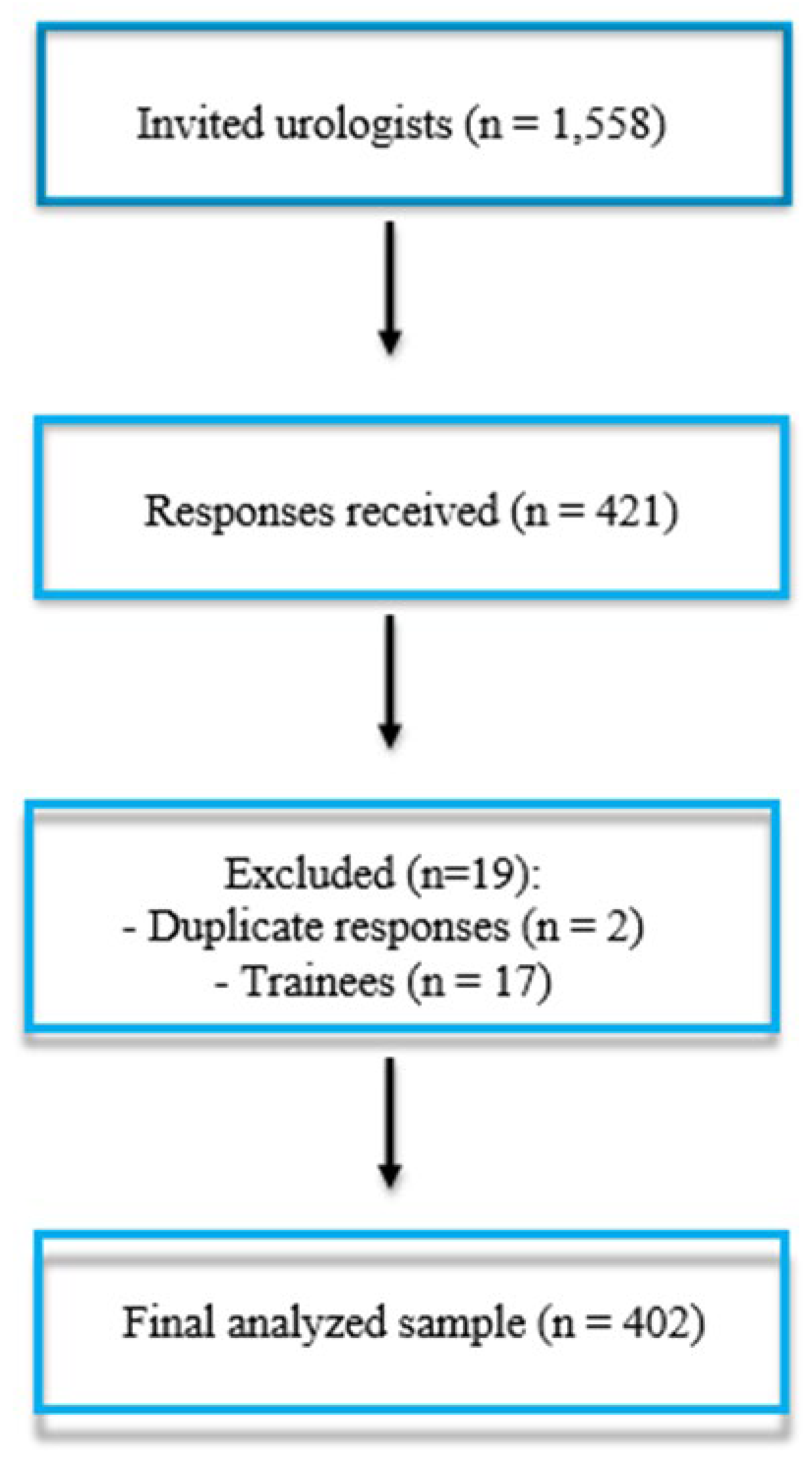
Figure 2.
Respondents’ self-reported evaluation of fertility outcomes associated with clomiphene citrate use. Distribution of perceived benefit of clomiphene citrate among urologists shows that most respondents rate the treatment as moderately beneficial, with fewer reporting high or very high benefit.
Figure 2.
Respondents’ self-reported evaluation of fertility outcomes associated with clomiphene citrate use. Distribution of perceived benefit of clomiphene citrate among urologists shows that most respondents rate the treatment as moderately beneficial, with fewer reporting high or very high benefit.
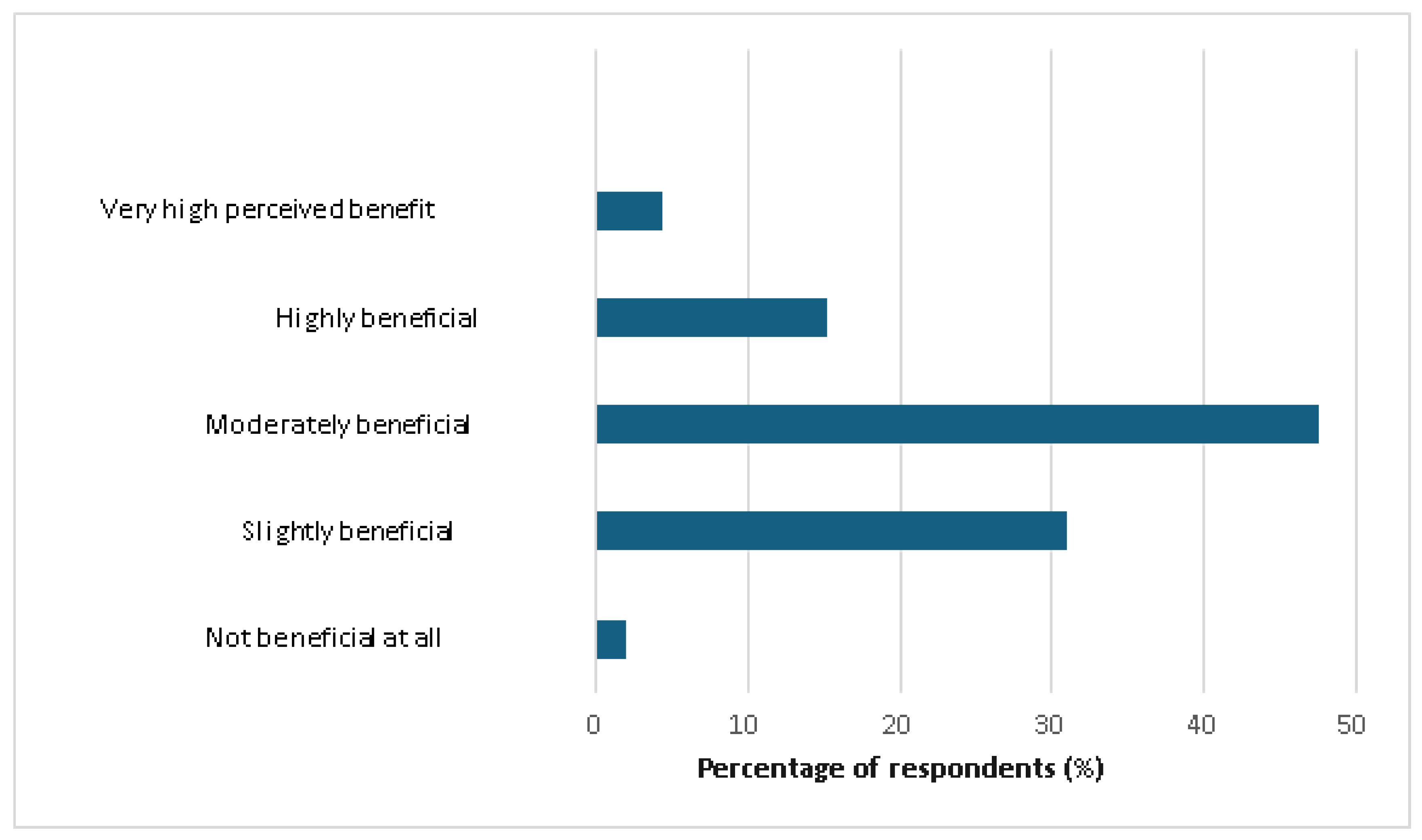
Figure 3.
Self-reported frequency of adverse effects during clomiphene citrate therapy among CC users.Frequency of self-reported adverse effects during clomiphene citrate therapy, showing that most side effects are reported as none or rare, with headache, mood changes, and gastrointestinal complaints being among the more common effects.
Figure 3.
Self-reported frequency of adverse effects during clomiphene citrate therapy among CC users.Frequency of self-reported adverse effects during clomiphene citrate therapy, showing that most side effects are reported as none or rare, with headache, mood changes, and gastrointestinal complaints being among the more common effects.
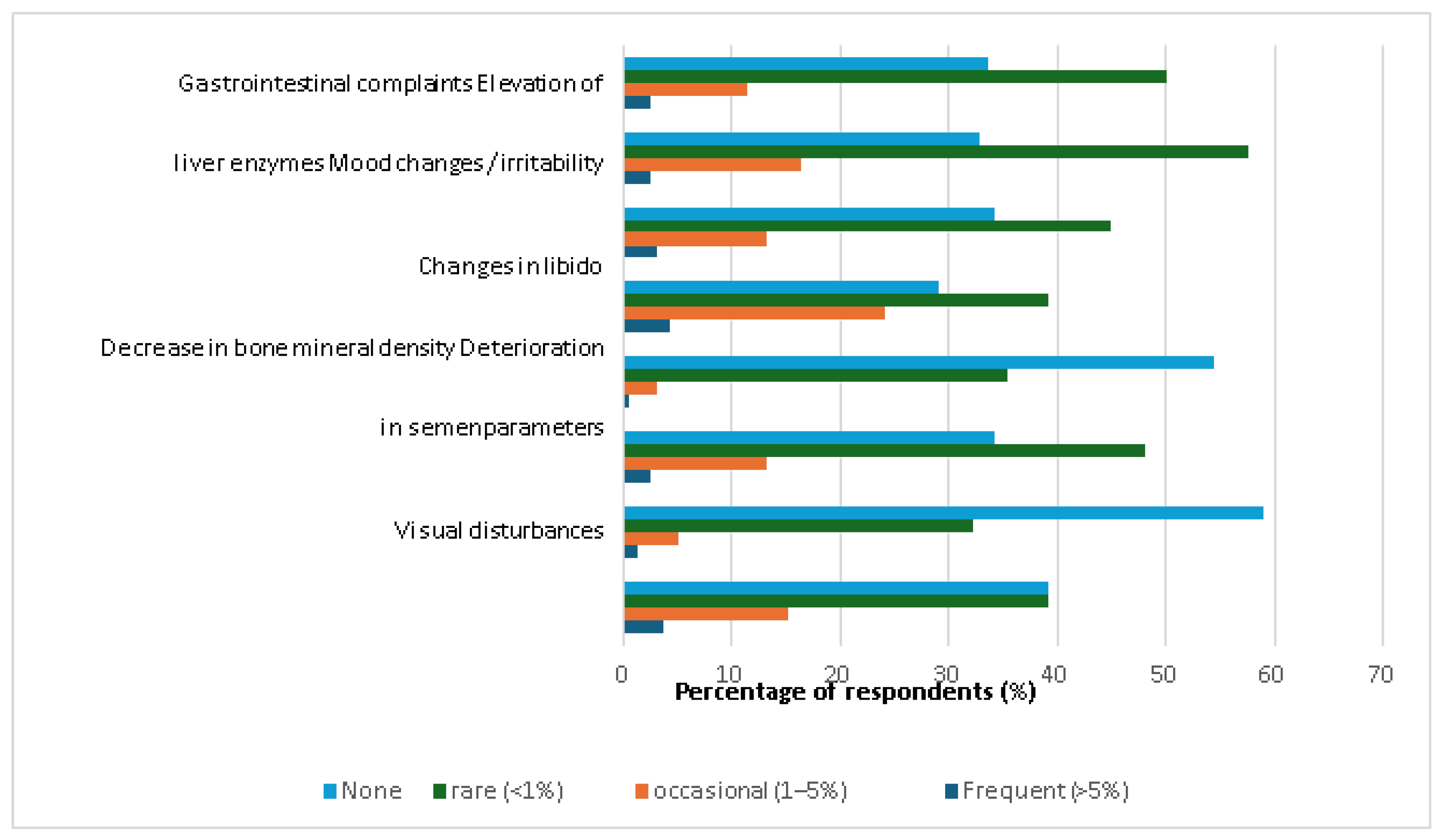

Table 1.
Demographic and professional characteristics of urologists according to clomiphene citrate use.
Table 1.
Demographic and professional characteristics of urologists according to clomiphene citrate use.
| Variable | Category | Yes (n, %) | No (n, %) | P value |
|---|---|---|---|---|
| Age (continuous) | Median (IQR) | 46.5 (16.0) | 41.0 (13.0) | <0.001ʸ |
| Gender | Male | 158 (100) | 242 (99.2) | 0.522 |
| Female | 0 (0.0) | 2 (0.8) | ||
| Age group (years) | 30–39 | 40 (25.3)ᵃ | 105 (43.0)ᵇ | <0.001ᵡ |
| 40–49 | 53 (33.5) | 83 (34.0) | ||
| 50–59 | 36 (22.8)ᵃ | 34 (13.9)ᵇ | ||
| 60–69 | 23 (14.6)ᵃ | 20 (8.2)ᵇ | ||
| 70–79 | 6 (3.8)ᵃ | 2 (0.8)ᵇ | ||
| Academic degree | Specialist | 89 (56.3) | 144 (59.0) | 0.658 |
| Assistant Professor | 17 (10.8) | 30 (12.3) | ||
| Associate Professor | 31 (19.6) | 47 (19.3) | ||
| Professor | 21 (13.3) | 23 (9.4) | ||
| Years as a urology specialist | <5 years | 16 (10.1)ᵃ | 73 (29.9)ᵇ | 0.001ᵡ |
| 5–10 years | 28 (17.7) | 47 (19.3) | ||
| 11–20 years | 46 (29.1) | 73 (29.9) | ||
| >20 years | 68 (43.0)ᵃ | 51 (20.9)ᵇ | ||
| Type of institution | State hospital | 33 (20.9) | 60 (24.6) | 0.001ᵡ |
| Training & research / City hospital | 30 (19.0)ᵃ | 111 (45.5)ᵇ | ||
| University hospital | 34 (21.5) | 37 (15.2) | ||
| Private hospital/clinic | 61 (38.6)ᵃ | 36 (14.8)ᵇ | ||
| Main urology subspecialty | General urology | 130 (82.3) | 191 (78.3) | <0.001ᵡ |
| Andrology | 18 (11.4)ᵃ | 6 (2.5)ᵇ | ||
| Uro-oncology | 4 (2.5)ᵃ | 20 (8.2)ᵇ | ||
| Endourology | 5 (3.2)ᵃ | 20 (8.2)ᵇ | ||
| Functional urology | 1 (0.6) | 3 (1.2) | ||
| Pediatric urology | 0 (0.0) | 4 (1.6) | ||
| Infertility patient proportion | None | 1 (0.6) | 2 (0.8) | <0.001ᵡ |
| <10% | 92 (58.2)ᵃ | 192 (78.7)ᵇ | ||
| 11–25% | 47 (29.7)ᵃ | 45 (18.4)ᵇ | ||
| 26–50% | 11 (7.0)ᵃ | 5 (2.0)ᵇ | ||
| 51–75% | 2 (1.3) | 0 (0.0) | ||
| >75% | 5 (3.2)ᵃ | 0 (0.0)ᵇ | ||
| Weekly new male infertility cases | None | 1 (0.6) | 8 (3.3) | 0.004ᵡ |
| 1–5 | 97 (61.4)ᵃ | 177 (72.5)ᵇ | ||
| 6–10 | 37 (23.4) | 45 (18.4) | ||
| 11–20 | 20 (12.7)ᵃ | 10 (4.1)ᵇ | ||
| 21–50 | 3 (1.9) | 4 (1.6) |
Values are presented as n (%) unless otherwise indicated. Continuous variables are expressed as median (IQR). Superscript letters (ᵃ,ᵇ) denote statistically significant pairwise comparisons within each variable; categories sharing the same letter are not significantly different, whereas those with different letters differ significantly (Bonferroni-adjusted). ᵡ Pearson chi-square test; ʸ Mann–Whitney U test. Statistical significance was set at p < 0.05.
Table 2.
Multivariable logistic regression analysis of factors associated with CC use, including model fit statistics.
Table 2.
Multivariable logistic regression analysis of factors associated with CC use, including model fit statistics.
| Variable | OR | 95% CI | p-value |
|---|---|---|---|
| >20 years of experience Private practice Andrology practice |
2.18 | 1.34–3.56 | 0.002 |
| 2.90 | 1.70–4.93 | <0.001 | |
| 2.35 | 0.85–6.49 | 0.098 | |
| >5 cases/week |
2.27 | 1.41–3.67 | 0.001 |
OR, odds ratio; CI, confidence interval. Reference categories: ≤20 years as a urology specialist; non-private practice setting; non-andrology subspecialty; ≤5 new male infertility cases per week. Variables entered into the model: years as a urology specialist (>20 vs ≤20 years), type of institution (private vs non-private), urology subspecialty (andrology vs non-andrology), and weekly number of new male infertility cases (>5 vs ≤5). Model calibration and discrimination were acceptable (Hosmer–Lemeshow χ2 = 6.19, p = 0.185; overall accuracy 67.9%, sensitivity 39.9%, specificity 86.1%).
Table 3.
Reported reasons for non-use of clomiphene citrate among non-users.
| Reason for non-use | n (responses) | % of respondents* |
|---|---|---|
| Insufficient evidence / uncertain efficacy | 97 | 39.8 |
| Inconsistency with clinical guidelines | 90 | 36.9 |
| Uncertainty in patient selection | 72 | 29.5 |
| Lack of knowledge or experience | 70 | 28.7 |
| Preference for alternative treatments | 56 | 23.0 |
| Referral to ART as the first-line approach | 55 | 22.5 |
| Lack of benefit in personal clinical experience | 43 | 17.6 |
| Concerns about adverse effects | 37 | 15.2 |
| Medico-legal concerns | 30 | 12.3 |
| Lack of FDA approval | 22 | 9.0 |
| Laboratory and follow-up limitations | 20 | 8.2 |
| Risk of paradoxical deterioration in semen parameters | 16 | 6.6 |
| Drug availability or cost issues | 16 | 6.6 |
| Referral to endocrinology | 16 | 6.6 |
| Patient preference or poor compliance | 15 | 6.1 |
| Concerns regarding bone health/monitoring burden | 3 | 1.2 |
| Other | 9 | 3.7 |
| Total responses | 667 | 273.4 |
Multiple responses allowed. *Percentage calculated based on the number of non-users (n=244).
Table 4.
Indications, contraindications, and treatment goals of clomiphene citrate.
| Domain | Item | n | % of respondents* |
|---|---|---|---|
| Indications | Idiopathic male infertility | 122 | 77.2 |
| Hypogonadotropic hypogonadism | 75 | 47.5 | |
| Unexplained infertility | 67 | 42.4 | |
| Hypergonadotropic hypogonadism | 17 | 10.8 | |
| Other | 7 | 4.4 | |
| Contraindications | Hypergonadotropic hypogonadism | 124 | 79.0 |
| Hypogonadotropic hypogonadism | 42 | 26.8 | |
| Unexplained infertility | 22 | 14.0 | |
| Idiopathic male infertility | 10 | 6.4 | |
| Other | 2 | 1.3 | |
| Primary treatment goals | Increase sperm count | 134 | 85.9 |
| Increase serum testosterone | 101 | 64.7 | |
| Improve sperm motility | 66 | 42.3 | |
| Increase pregnancy/live birth | 65 | 41.7 | |
| Improve morphology | 44 | 28.2 | |
| Improve libido/sexual function | 44 | 28.2 |
Multiple responses allowed. *Percentage calculated based on the number of users (n=158).
Table 5.
Pretreatment evaluation and treatment strategies.
| Category | Parameter / Strategy | n | % |
|---|---|---|---|
| Pretreatment assessment | Semen analysis | 141 | 89.2 |
| Total testosterone | 138 | 87.3 | |
| FSH | 138 | 87.3 | |
| LH | 121 | 76.6 | |
| Estradiol | 90 | 57.0 | |
| Physical examination | 88 | 55.7 | |
| Prolactin | 71 | 44.9 | |
| Liver function tests | 71 | 44.9 | |
| Erectile function evaluation | 63 | 39.9 | |
| Free testosterone | 55 | 34.8 | |
| Scrotal ultrasonography | 55 | 34.8 | |
| Sperm DNA fragmentation / advanced tests | 19 | 12.0 | |
| DEXA scan | 1 | 0.6 | |
| Dosing regimen | 25 mg/day | 44 | 27.8 |
| 50 mg/day | 37 | 23.4 | |
| 50 mg/day (25 on / 5 off) | 34 | 21.5 | |
| 25 mg (25 on / 5 off) | 23 | 14.6 | |
| 50 mg every other day | 14 | 8.9 | |
| ≥100 mg/day | 2 | 1.3 | |
| Treatment modality | CC and antioxidants/supplements | 127 | 80.4 |
| CC monotherapy | 37 | 23.4 | |
| CC and aromatase inhibitor | 22 | 13.9 | |
| CC and gonadotropins | 18 | 11.4 |
Multiple responses allowed. *Percentage calculated based on the number of users (n=158).
Table 6.
Risk counseling and follow-up practices.
| Domain | Item | n | % |
|---|---|---|---|
| Risks routinely discussed | Elevated liver enzymes | 66 | 41.8 |
| Gynecomastia | 57 | 36.1 | |
| Libido changes | 56 | 35.4 | |
| Thromboembolic complications | 51 | 32.3 | |
| Mood changes/irritability | 42 | 26.6 | |
| Headache | 33 | 20.9 | |
| Visual disturbances | 30 | 19.0 | |
| Sperm deterioration | 24 | 15.2 | |
| Bone mineral density loss | 18 | 11.4 | |
| No routine counseling | 50 | 31.6 | |
| Parameters at first follow-up | Total testosterone | 119 | 75.3 |
| Physical examination | 111 | 70.3 | |
| FSH | 109 | 69.0 | |
| LH | 94 | 59.5 | |
| Estradiol | 64 | 40.5 | |
| Liver function tests | 66 | 41.8 | |
| Semen analysis | 32 | 20.3 | |
| Advanced semen tests | 5 | 3.2 | |
| Follow-up timing | Monthly | 34 | 21.5 |
| Every 3 months | 114 | 72.2 | |
| Every 6 months | 7 | 4.4 | |
| No routine follow-up | 2 | 1.3 | |
| Typical treatment duration | 4–6 months | 94 | 59.5 |
| 3 months | 32 | 20.3 | |
| 7-9 months | 15 | 9.5 | |
| 10-12 months | 12 | 7.6 |
Multiple responses allowed. *Percentage calculated based on the number of users (n=158).
Table 7.
Treatment success definitions and management strategies.
| Domain | Definition / Strategy | n | % |
|---|---|---|---|
| Definition of success | Semen parameter improvement | 149 | 94.3 |
| Spontaneous pregnancy | 105 | 66.5 | |
| Increased ART success | 74 | 46.8 | |
| Serum testosterone increases | 77 | 48.7 | |
| Symptom improvement | 52 | 32.9 | |
| Management of responders at 3 months | Continue the same dose up to 6 months | 96 | 60.8 |
| Discontinue treatment | 27 | 17.1 | |
| Gradually taper the dose | 14 | 8.9 | |
| Continue up to 12 months | 14 | 8.9 | |
| Introduce drug holidays at defined intervals | 15 | 9.5 | |
| Continue treatment until pregnancy is achieved | 11 | 7.0 | |
| Management of non-responders at 3 months | Refer to ART | 111 | 70.3 |
| Add antioxidants/supplements | 54 | 34.2 | |
| Continue current treatment and reassess after 3 months | 33 | 20.9 | |
| Switch to another empirical therapy | 35 | 22.2 | |
| Add gonadotropins (FSH or hMG) | 31 | 19.6 | |
| Add an aromatase inhibitor to the current treatment | 20 | 12.7 | |
| Increase the dose of the current treatment | 11 | 7.0 |
Multiple responses allowed. *Percentage calculated based on the number of users (n=158).
Disclaimer/Publisher’s Note: The statements, opinions and data contained in all publications are solely those of the individual author(s) and contributor(s) and not of MDPI and/or the editor(s). MDPI and/or the editor(s) disclaim responsibility for any injury to people or property resulting from any ideas, methods, instructions or products referred to in the content. |
© 2026 by the authors. Licensee MDPI, Basel, Switzerland. This article is an open access article distributed under the terms and conditions of the Creative Commons Attribution (CC BY) license (http://creativecommons.org/licenses/by/4.0/).
Copyright: This open access article is published under a Creative Commons CC BY 4.0 license, which permit the free download, distribution, and reuse, provided that the author and preprint are cited in any reuse.


