

Submitted:
05 June 2026
Posted:
08 June 2026
You are already at the latest version
Abstract
Polyamines such as putrescine, spermidine, and spermine are small, positively charged organic cations that interact with negatively charged molecules, notably nucleic acids. These molecules play a vital role in cell proliferation, differentiation, and growth. Their involvement in wound healing has attracted considerable research interest, as they are key regulators of keratinocyte and fibroblast proliferation—two cell types essential for re-epithelialization and tissue regeneration. Polyamines also influence gene expression and protein synthesis, facilitating the transition of cells from a quiescent to an active state during the healing process. Enzymes such as Adenosylmethionine Decarboxylase 1 (AMD1), which are involved in polyamine biosynthesis, are upregulated during wound healing and contribute to gene regulation at multiple levels. In parasitic protozoa—including Plasmodium falciparum (malaria), Trypanosoma spp. (sleeping sickness), and Leishmania spp. (leishmaniasis)—polyamines are crucial for DNA stabilization, protein synthesis, and cellular proliferation. These parasites depend on both endogenous polyamine synthesis and host-derived polyamines to sustain their metabolic functions. Notably, Plasmodium falciparum, the causative agent of malaria, possesses a bifunctional enzyme complex linking S-Adenosylmethionine decarboxylase (AdoMetDC) and ornithine decarboxylase (ODC), unlike the human form, where these enzymes are separate. This structural distinction makes the parasite’s AdoMetDC/ODC complex a promising target for drug development. In Mycobacterium tuberculosis (Mtb), polyamine metabolites have been shown to influence DNA methylation patterns, thereby affecting gene expression and bacterial adaptation. A 2025 study revealed that altered polyamine levels in the blood of patients with multidrug-resistant TB were associated with changes in Mtb DNA methylation, suggesting a potential role in resistance mechanisms. This chapter explores the multifaceted roles of polyamines in wound healing, parasitic infections, and tuberculosis-related bacteria. It also considers emerging technologies for wound treatment and highlights parasite-specific targets that may inform novel therapeutic strategies against TB.
Keywords:
polyamines
; putrescine
; spermidine
; parasites
; TB
1. Introduction
Putrescine, spermidine, and spermine are essential polyamines (PAs) found in nearly all living organisms (Xuan et al., 2023; Rossi et al., 2024). They are synthesized through the decarboxylation of amino acids, such as L-ornithine (Sagar et al., 2021). The history of polyamines dates to 1678, when Antonie van Leeuwenhoek discovered crystalline structures of spermine in dried semen, although these were absent in fresh samples (Bachrach, 2010). By 1791, the nature of these crystals remained unknown, but in 1878, they were identified as basic compounds. In 1888, Ladenburg and Abel proposed the name “spermine” for this substance (Tabor and Tabor, 1984; Pegg, 2009). A decade later, in 1898, Poehl suggested using spermine for the treatment of various complex diseases (Pegg, 2009). In 1924, Rosenheim successfully synthesized spermine, spermidine, and putrescine, laying the groundwork for modern polyamine research (Pegg, 2009). Putrescine and spermidine were later identified in microorganisms during the 19th and 20th centuries, respectively.
Polyamines have been reported to play diverse biochemical roles in both eukaryotes and prokaryotes, including the synthesis, function, maintenance, and stabilization of nucleic acids such as DNA and RNA, as well as proteins. Beyond these structural functions, polyamines are actively involved in cell signaling, DNA binding, transcription, and RNA splicing. They also contribute to cytoskeletal organization and play a crucial role in eukaryotic translation by facilitating the maturation of translation initiation factor 5A (eIF5A) (Firpo et al., 2023; Tauc et L., 2021).
Wound healing is a dynamic process driven by gene expression changes that promote re-epithelialization. One notable example is the essential role of the polyamine regulator AMD1, which has been shown to facilitate cell migration at the wound edge. AMD1 is significantly upregulated following injury in human skin biopsies. Knockdown of AMD1 using small hairpin RNAs has been reported to impair cell migration—a defect that can be rescued by the addition of spermine. These findings highlight polyamines as highly promising molecules for further study in the context of wound healing (Lim et al., 2018).
Malaria remains one of the leading causes of death in Sub-Saharan Africa, with Plasmodium falciparum responsible for millions of fatalities over recent decades. This urgent public health challenge underscores the need for immediate advances in drug development and treatment strategies (add reference). Polyamines have emerged as ideal drug targets due to their critical roles in parasite cell proliferation, development, and growth. Notably, Plasmodium falciparum possesses a bifunctional enzyme complex linking S-Adenosylmethionine decarboxylase (AdoMetDC) and ornithine decarboxylase (ODC), unlike the human system, where these enzymes are separate. This structural difference makes the parasite’s AdoMetDC/ODC complex an attractive therapeutic target, as it allows selective inhibition without disrupting human polyamine metabolism (Koomoa et al., 2009).
Polyamines are considered crucial targets in the treatment of tuberculosis because they specifically affect bacterial pathways without interfering with those of the human host. This selectivity arises from the distinct metabolic mechanisms found in Mycobacterium tuberculosis compared to human cells. In this review, we aim to highlight recent findings and explore how polyamine-related targets can be leveraged to develop bacterial-focused therapies. Furthermore, we discuss how these insights may inform innovative treatment strategies for parasitic infections, including malaria (Sanyaolu et al., 2025).
2. Biochemistry and Cellular Functions of Polyamines
Polyamines are essential for the growth and proliferation of mammalian cells and are intricately involved in key biological processes such as DNA replication, transcription, translation, and post-translational modification (Figure 1). These processes collectively regulate cellular proliferation, differentiation, apoptosis, and tumorigenesis. Arginine serves as a precursor for the synthesis of the primary polyamines—putrescine, spermidine, and spermine. Within mammalian cells, polyamines are indispensable; their depletion leads to a complete cessation of cell growth and proliferation (Sagar et al., 2021).
Arginine serves as a precursor in the biosynthesis of polyamines in humans, parasites, and bacteria. These small molecules are essential for the survival of bacteria and parasites, which are responsible for diseases such as tuberculosis and malaria. The genus Plasmodium includes several species, notably P. vivax, P. ovale, P. malariae, P. knowlesi, and P. falciparum. Among them, P. falciparum is the primary causative agent of malaria and is considered the deadliest parasite in sub-Saharan Africa. This underscores the urgent need for effective interventions to combat the disease (Sato, 2021).
Polyamines offer a promising therapeutic target by focusing on the parasite’s unique bifunctional enzyme structure—S-adenosylmethionine decarboxylase (AdoMetDC) and ornithine decarboxylase (ODC). What makes this structure particularly interesting is its distinct configuration compared to the human host (Figure 2). In humans, AdoMetDC and ODC are separate enzymes, whereas in P. falciparum, they are fused into a single bifunctional unit. This structural difference presents an ideal opportunity for drug development, as a single compound could potentially inhibit polyamine synthesis in the parasite without affecting the host.
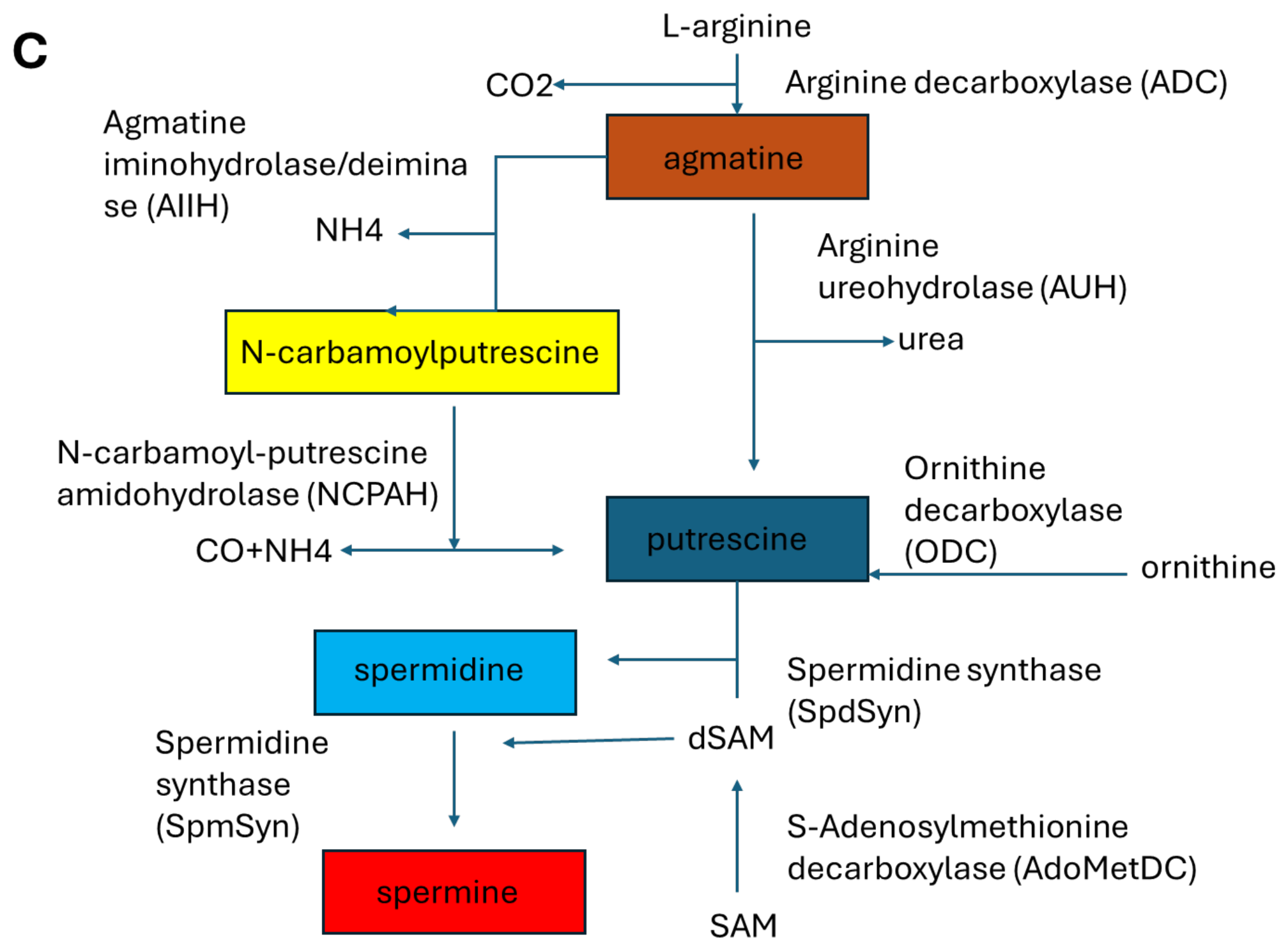
On the other hand, polyamine synthesis in bacteria is regulated by amino acids such as methionine, ornithine, lysine, and arginine (Figure 3). Bacterial polyamine biosynthesis occurs through various pathways that have been studied in species including Escherichia coli, Pseudomonas aeruginosa, Salmonella enterica, Campylobacter jejuni, and Streptomyces coelicolor. It is suggested that bacteria typically produce diamines such as putrescine and cadaverine, as well as triamines like spermidine. While some bacteria are capable of synthesizing longer-chain polyamines such as spermine, they primarily produce diamines. Interestingly, certain pathogenic bacteria do not produce polyamines at all (Tofalo et al., 2019).
3. Polyamines in Bacteria Related to Tuberculosis
3.1. The Biology and Pathogenicity of Mycobacterium tuberculosis
Mycobacterium tuberculosis is known as the causative agent of tuberculosis (Pai et al., 2016). It is a Gram-positive, non-motile, rod-shaped bacterium with a high gluconeogenesis (GC) content of 65.9% (Gordon and Parish, 2018a). It can grow under facultative anaerobic as well as aerobic conditions (Cole et al., 1998). Another characteristic feature of M. tuberculosis is its slow growth; the duplication time is 24 hours. M. tuberculosis belongs to the phylum Actinobacteria and the class Mycobacterium. Due to its unique cell wall properties, the bacterium can only be detected by Ziehl-Neelsen acid staining (Gordon and Parish, 2018a). An additional characteristic feature of M. tuberculosis is the structure of its cell wall. The inner layer of the cell wall contains various glycolipids. Overlying the cell membrane are the three main cell wall structures, consisting of peptidoglycans covalently linked to arabinogalactans. The arabinogalactans, in turn, are linked to long mycolic acid chains. Additionally, there are deposits in the mycolic layer, which forms the outer membrane and also possesses waxy structures. The outer capsule is formed by a layer of proteins and polysaccharides. These special properties of the cell wall enable the bacterium to survive within human macrophages. The cell wall is impermeable to certain antibiotics and protects the bacterium from hydrophilic compounds (Brennan, 2003; Delogu et al., 2013; Abrahams and Besra, 2018). In addition, the cell wall also possesses immunomodulatory molecules such as sulfolipids and lipoarabinomannan (Gordon and Parish, 2018b).Every year after 2020, approximately 10 million people contracted tuberculosis, and around 1.5 million died from the disease that same year. Tuberculosis remains a serious illness, classified as an epidemic (World Health Organization, 2021). It is a droplet-transmitted disease. Infected individuals release droplets containing infectious agents into the air (Churchyard et al., 2017). These droplets can enter the lungs and thus the alveoli. Here, they are phagocytosed by alveolar macrophages and taken up into the phagosome (Hmama et al., 2015; Pai et al., 2016; Bussi and Gutierrez, 2019). From there, they can also reach other organs via the lymphatic system or the bloodstream and infect them (Delogu et al., 2013).
In macrophages, phagosome maturation is blocked, thus preventing the digestion of the bacterium. Fusing of the phagosome and lysosome does not occur in the macrophages. Furthermore, there is no decrease in pH within the phagosome, which allows M. tuberculosis to persist and multiply within the cell (Armstrong and Hart, 1975; Hmama et al., 2015). Because M. tuberculosis is not broken down in the macrophages, antigen presentation does not occur, and therefore the adaptive immune response is not activated (Hmama et al., 2015).
The invasion of M. tuberculosis into macrophages triggers a localized pro-inflammatory response, causing mononuclear cells from the surrounding blood vessels to migrate to the site of inflammation. This leads to the formation of a granuloma, also known as a tubercle. Within this granuloma are infected macrophages, which are trapped in its core. A layer of lymphocytes—B and T cells, dendritic cells, and monocytes—surrounds the infected macrophages, preventing their spread. Simultaneously, the granuloma structure provides protection against immune cells (Russell, 2001).
The formation of granulomas keeps the disease contained, resulting in no or asymptomatic symptoms, and the affected individual is not contagious. This is a latent infection (Russell, 2001). Within the granuloma, the bacteria are in a dormant state characterized by a slow metabolism and a low replication rate. M. tuberculosis can thus survive for years in these granulomas and, consequently, in humans (Gengenbacher and Kaufmann, 2012). If the host’s immune system is weakened, the bacteria’s metabolism can reactivate, leading to bacterial cell proliferation. This reactivation causes the granuloma to become necrotic, rupture, and release bacterial cells. As a result, the latent infection transitions into an active infection, potentially infecting other individuals (Gengenbacher and Kaufmann, 2012; Delogu et al., 2013). Triggers for this can include HIV infection, cancer, malnutrition, or advanced age (Delogu et al., 2013).
Four antibiotics are available for the treatment of tuberculosis: rifampicin, isoniazid, ethambutol, and pyrazinamide. In addition to these, alternative antibiotics are also available. Therapy with these antibiotics lasts approximately six to nine months (Dover and Coxon, 2011; Pai et al., 2016). However, this therapy can lead to significant side effects (Zumla et al., 2013). It has been shown that resistance to these antibiotics has increasingly developed. For example, there are cases of multidrug-resistant TB (MDR-TB), in which M. tuberculosis is resistant to rifampicin and isoniazid. Furthermore, cases of extensively drug-resistant TB (XDR-TB) have also been reported. In this form, M. tuberculosis is additionally resistant to fluoroquinolones and to an alternative antibiotic (Zumla et al., 2013; Zhang and Yew, 2015). Furthermore, there are intolerances to certain antibiotics, necessitating the use of alternative antibiotics. Interactions with other medications also complicate treatment. For example, drugs used to treat HIV can lead to reduced efficacy, intolerances, or even toxicity when used in conjunction with tuberculosis treatment (Zumla et al., 2013).
A vaccine against M. tuberculosis exists; however, it can only be administered to infants and young children. While the vaccine protects against severe cases, it does not prevent infection and is therefore no longer used in most industrialized countries (Russell, 2001).
3.2. Fundamentals of Nitrogen Assimilation in M. tuberculosis
When M. tuberculosis enters a bacterial cell, the environmental conditions within the bacterium change. It is assumed that conditions within the phagosome are low in oxygen and nutrients, and the bacteria are also exposed to nitrosative and oxidative stress (Schnappinger et al., 2003). Therefore, alternative nutrient sources must be utilized (Russell, 2001).
One such alternative nutrient source is ammonium (NH4+), which is required for the construction of vital structures within the cell. Ammonium is, for example, a component of amino acids and the cell wall. In addition to ammonium, amino acids, nitrate, and urea can also be utilized. To utilize ammonium, it must first be synthesized into glutamate or glutamine, which serve as primary nitrogen sources (Leigh and Dodsworth, 2007; Gouzy et al., 2014).
In M. tuberculosis, two pathways are involved in nitrogen assimilation (Gouzy et al., 2014). The first is a high-affinity pathway involving glutamate dehydrogenase (GDH). However, this pathway is primarily used for glutamate degradation. The second is a low-affinity pathway, based on glutamine synthetase and glutamine oxoglutarate aminotransferase (GOGAT). This is the main pathway for nitrogen assimilation (Leigh and Dodsworth, 2007; Gouzy et al., 2014). Ammonium is taken up via an ammonium transporter (AMT). The ammonium now exposed in the cytosol is assimilated from glutamate by the glutamine synthetase GlnA (also known as GlnA1 in M. tuberculosis using ATP. Glutamine can also be synthesized from glutamate by the glutamine oxoglutarate aminotransferase (GOGAT), which consists of the two enzymes GltB and GltD and is only active together, along with 2-oxoglutarate (2-OG). Glutamate dehydrogenase (GDH) can then cleave glutamate into ammonium (NH4+) and 2-oxoglutarate (2-OG). The resulting 2-oxoglutarate (2-OG) can be used for the citric acid cycle (Leigh and Dodsworth, 2007; Gouzy et al., 2014).
3.3. The Role of Polyamines During M. tuberculosis Infection
Polyamines are not only essential for bacteria, but they can also be toxic to bacteria at high concentrations (Pegg, 2013; Miller-Fleming et al., 2015). Not only the polyamines themselves, but also their intermediate products have a toxic effect (Pegg, 2013). At the same time, it is known that polyamine concentrations increase during mycobacterial infections (Hirsch and Dubos, 1952).
M. tuberculosis is able to influence the differentiation of human immune cells, specifically macrophages, thereby ensuring its own persistence (Muraille et al., 2014). Macrophages can differentiate into an M1 or an M2 stage. The M1 stage possesses various mechanisms to combat intracellular pathogens. In contrast, the M2 stage possesses mechanisms that support cell repair. During this stage, increased amounts of polyamines are released. M. tuberculosis can attenuate the expression of M1 markers, which in turn leads to the increased expression of M2 markers. The induction of the M2 stage triggers polyamine release (Gordon, 2003; Muraille et al., 2014). It is hypothesized that GlnA3 from M. tuberculosis can detoxify polyamines and use them as a nitrogen source to survive in a polyamine-rich environment (Krysenko et al., 2021).
GlnA [L-glutamate: ammonia ligase (ADP forming) (E.C. 6.3.1.2)] plays an important role in nitrogen assimilation. It utilizes ammonium and glutamate to assimilate glutamine. GlnA is essential for the growth and survival of M. tuberculosis (Tullius et al., 2003). It consists of two hexameric rings that together form a dodecamer. A single subunit has a mass of 58 kDa (Gill et al., 2002). M. tuberculosis possesses three other proteins similar to GlnA: GlnA2 (Rv2222c), GlnA3 (Rv1878), and GlnA4 (Rv2860c). Compared to GlnA, GlnA2, GlnA3, and GlnA4 are not essential for growth under normal conditions (Tullius et al., 2003). Using a knockout mutant of GlnA, it was shown that GlnA2, GlnA3, and GlnA4 cannot take over the function of GlnA (Harth et al., 2005). Little is yet known about the function of GlnA2Mt and GlnA4Mt. GlnA3Mt has been described as a γ-glutamylpolyamine synthetase, which utilizes polyamines for nitrogen assimilation instead of ammonium (Krysenko et al., 2025). The products resulting from the addition of various polyamines to GlnA3Mt could be detected by LC/MS. It was demonstrated that spermine and spermidine could be synthesized, but not putrescine and cadaverine. GlnA3Mt was shown to synthesize spermine together with L-glutamine to form γ-glutmylspermine. In a substrate specificity test, where several polyamines, monoamines, and amino acids were the only metabolizable substrate, spermine was observed to be the preferred polyamine (Krysenko et al., 2025).
4. Conclusions
The investigation of the cellular metabolism of mycobacteria, leading to the identification of new drug targets, can provide a subsequent rationale and effective design for new anti-TB and anti-MDR-TB agents. Proteins from polyamine metabolism would contribute completely novel targets, and their inhibition would offer new perspectives for innovative combination therapy. Furthermore, known problematic resistance mechanisms should not protect M. tuberculosis from the inhibition of polyamine metabolism-related proteins. The inhibition of mycobacterial proteins from polyamine metabolism would constitute a novel strategy to control tuberculosis and potentially other mycobacterial infections by overcoming the natural polyamine resistance of M. tuberculosis and simultaneously supporting the natural immune response of the host during the infection.
References
- Xuan, M.; Gu, X.; Li, J.; et al. Polyamines: their significance for maintaining health and contributing to diseases. Cell Commun Signal 2023, 21, 348. [Google Scholar] [CrossRef]
- Rossi, M.N.; Cervelli, M. Polyamine Metabolism and Functions: Key Roles in Cellular Health and Disease. Biomolecules 2024, 14, 1570. [Google Scholar] [CrossRef]
- Sagar, N.A.; Tarafdar, S.; Agarwal, S.; Tarafdar, A.; Sharma, S. Polyamines: Functions, Metabolism, and Role in Human Disease Management. Med Sci (Basel) 2021, 9(2), 44. [Google Scholar] [CrossRef] [PubMed] [PubMed Central]
- Bachrach, U. The early history of polyamine research. Plant Physiol Biochem Epub 2010 Feb 17. 2010, 48(7), 490–5. [Google Scholar] [CrossRef] [PubMed]
- Tabor, H.; Tabor, C. W. Polyamines. Annual Review of Biochemistry 1984, 53, 749–790. [Google Scholar] [CrossRef] [PubMed]
- Pegg, A. E. Mammalian polyamine metabolism and function. IUBMB Life 2009, 61(9), 880–894. [Google Scholar] [CrossRef] [PubMed]
- Firpo, M.R.; LoMascolo, N.J.; Petit, M.J.; Shah, P.S.; Mounce, B.C. Polyamines and eIF5A hypusination facilitate SREBP2 synthesis and cholesterol production leading to enhanced enterovirus attachment and infection. PLoS Pathog 2023, 19(4), e1011317. [Google Scholar] [CrossRef]
- Tauc, M.; Cougnon, M.; Carcy, R. The eukaryotic initiation factor 5A (eIF5A1), the molecule, mechanisms and recent insights into the pathophysiological roles. Cell Biosci 2021, 11, 219. [Google Scholar] [CrossRef]
- Lim, H.K.; Rahim, A.B.; Leo, V.I.; Das, S.; Lim, T.C.; Uemura, T.; Igarashi, K.; Common, J.; Vardy, L.A. Polyamine Regulator AMD1 Promotes Cell Migration in Epidermal Wound Healing. J Invest Dermatol. 2018, 138(12), 2653–2665. [Google Scholar] [CrossRef] [PubMed]
- Koomoa, D.L.; Borsics, T.; Feith, D.J.; Coleman, C.C.; Wallick, C.J.; Gamper, I.; Pegg, A.E.; Bachmann, A.S. Inhibition of S-adenosylmethionine decarboxylase by inhibitor SAM486A connects polyamine metabolism with p53-Mdm2-Akt/protein kinase B regulation and apoptosis in neuroblastoma. Mol Cancer Ther 2009, 8(7), 2067–75, Epub 2009 Jul 7. [Google Scholar] [CrossRef] [PubMed] [PubMed Central]
- Sanyaolu, A.; Marinkovic, A.; Prakash, S.; Balendra, V.; Shazley, O.; Gardellini, T.; Jan, A.; Younis, K.; Okorie, C.; Izurieta, R. Emerging Molecular Mechanisms in Malaria Pathogenesis and Novel Therapeutic Approaches: A Focus on P. falciparum Malaria. Biomolecules 2025, 15(7), 1038. [Google Scholar] [CrossRef] [PubMed] [PubMed Central]
- Sato, S. Plasmodium—a brief introduction to the parasites causing human malaria and their basic biology. J Physiol Anthropol 2021, 40, 1. [Google Scholar] [CrossRef]
- Tofalo, R.; Cocchi, S.; Suzzi, G. Polyamines and Gut Microbiota. Front. Nutr. 2019, 6, 16. [Google Scholar] [CrossRef]
- Cole, S. T.; Brosch, R.; Parkhill, J.; Garnier, T.; Churcher, C.; Harris, D.; Gordon, S. V.; Eiglmeier, K.; Gas, S.; Barry, C. E.; Tekaia, F.; Badcock, K.; Basham, D.; Brown, D.; Chillingworth, T.; Connor, R.; Davies, R.; Devlin, K.; Feltwell, T.; Gentles, S.; Hamlin, N.; Holroyd, S.; Hornsby, T.; Jagels, K.; Krogh, A.; Mclean, J.; Moule, S.; Murphy, L.; Oliver, K.; Osborne, J.; Quail, M. A.; Rajandream, M. A.; Rogers, J.; Rutter, S.; Seeger, K.; Skelton, J.; Squares, R.; Squares, S.; Sulston, J. E.; Taylor, K.; Whitehead, S.; Barrell, B. G. Deciphering the biology of Mycobacterium tuberculosis from the complete genome sequence. Nature 1998, 393(6685), 537–544. [Google Scholar] [CrossRef] [PubMed]
- Gordon, S. V.; Parish, T. Microbe Profile: Mycobacterium tuberculosis: Humanity’s deadly microbial foe. Microbiology 2018a, 164(4), 437–439. [Google Scholar] [CrossRef] [PubMed]
- Gordon, S. V.; Parish, T. Microbe Profile: Mycobacterium tuberculosis: Humanity's deadly microbial foe. Microbiology 2018b, 164(4), 437–439. [Google Scholar] [CrossRef]
- Pai, M.; Behr, M. A.; Dowdy, D.; Dheda, K.; Divangahi, M.; Boehme, C. C.; Ginsberg, A.; Swaminathan, S.; Spigelman, M.; Getahun, H.; Menzies, D.; Raviglione, M. Tuberculosis. Nature Reviews Disease Primers 2016, 2(1). [Google Scholar] [CrossRef]
- Abrahams, K. A.; Besra, G. S. Mycobacterial cell wall biosynthesis: a, 2018.
- multifaceted antibiotic target; Brennan, P. J. Structure, function, and biogenesis of the cell wall of Mycobacterium tuberculosis. Parasitology;Tuberculosis 2003, 145(2) 83(1), 116-133 91-97. [Google Scholar] [CrossRef]
- Churchyard, G.; Kim, P.; Shah, N. S.; Rustomjee, R.; Gandhi, N.; Mathema, B.; Dowdy, D.; Kasmar, A.; Cardenas, V. What We Know About Tuberculosis Transmission: An Overview. The Journal of Infectious Diseases 2017, 216 (suppl_6), S629–S635. [Google Scholar] [CrossRef] [PubMed]
- Delogu, G.; Sali; M. und Fadda, G. The biology of mycobacterium tuberculosis infection. Mediterranean journal of hematology and infectious diseases 2013, 5(1), e2013070–e2013070. [Google Scholar] [CrossRef]
- Bussi, C.; Gutierrez, M. G. Mycobacterium tuberculosis infection of host cells in space and time. FEMS Microbiology Reviews 2019, 43(4), 341–361. [Google Scholar] [CrossRef]
- Hmama, Z.; Peña-Díaz, S.; Joseph; S. und Av-Gay, Y. Immunoevasion and immunosuppression of the macrophage by M ycobacterium tuberculosis. Immunological reviews 2015, 264(1), 220–232. [Google Scholar] [CrossRef] [PubMed]
- Armstrong; J. A. und Hart, P. D. Phagosome-lysosome interactions in cultured macrophages infected with virulent tubercle bacilli. Reversal of the usual nonfusion pattern and observations on bacterial survival. Journal of Experimental Medicine 1975, 142(1), 1–16. [Google Scholar] [CrossRef]
- Gengenbacher, M.; Kaufmann, S. H. Mycobacterium tuberculosis: success through dormancy. FEMS microbiology reviews 2012, 36(3), 514–532. [Google Scholar] [CrossRef]
- Russell, D. G. Mycobacterium tuberculosis: here today, and here tomorrow. Nature Reviews Molecular Cell Biology 2001, 2(8), 569–578. [Google Scholar] [CrossRef]
- Dover, L. G.; Coxon, G. D. Current Status and Research Strategies in Tuberculosis Drug Development. Journal of Medicinal Chemistry 2011, 54(18), 6157–6165. [Google Scholar] [CrossRef]
- Zhang; Y. und Yew, W. Mechanisms of drug resistance in Mycobacterium tuberculosis: update 2015. The International Journal of Tuberculosis and Lung Disease 2015, 19(11), 1276–1289. [Google Scholar] [CrossRef]
- Zumla, A.; Nahid, P.; Cole, S. T. Advances in the development of new tuberculosis drugs and treatment regimens. Nature Reviews Drug Discovery 2013, 12(5), 388–404. [Google Scholar] [CrossRef] [PubMed]
- Gordon, S. Alternative activation of macrophages. Nature Reviews Immunology 2003, 3(1), 23–35. [Google Scholar] [CrossRef]
- Krysenko, S.; Matthews, A.; Busche, T.; Bera, A.; Wohlleben, W. Poly- and Monoamine Metabolism in Streptomyces coelicolor: The New Role of Glutamine Synthetase-Like Enzymes in the Survival under Environmental Stress. Microbial Physiology. 2021.
- Muraille, E.; Leo, O.; Moser, M. Th1/Th2 Paradigm Extended: Macrophage Polarization as an Unappreciated Pathogen-Driven Escape Mechanism? Frontiers in Immunology 2014, 5, 603. [Google Scholar] [CrossRef] [PubMed]
- Tullius, M.v.; Harth, G.; Horwitz, M.A. Glutamine Synthetase GlnA1 Is Essential for Growth of Mycobacterium tuberculosis in Human THP-1 Macrophages and Guinea Pigs. Infection and Immunity 2003, 71(7), 3927–3936. [Google Scholar] [CrossRef] [PubMed]
- Leigh, J. A.; Dodsworth, J. A. Nitrogen regulation in bacteria and archaea. Annu. Rev. Microbiol. 2007, 61, 349–377. [Google Scholar] [CrossRef] [PubMed]
- Gouzy, A.; Poquet; Y. und Neyrolles, O. Nitrogen metabolism in Mycobacterium tuberculosis physiology and virulence. Nat Rev Microbiol 2014, 12(11), 729–37. [Google Scholar] [CrossRef]
- Pegg, A. E. Toxicity of Polyamines and Their Metabolic Products. Chemical Research in Toxicology 2013, 26(12), 1782–1800. [Google Scholar] [CrossRef] [PubMed]
- Miller-Fleming, L.; Olin-Sandoval, V.; Campbell, K.; Ralser, M. Remaining Mysteries of Molecular Biology: The Role of Polyamines in the Cell. Journal of Molecular Biology 2015, 427(21), 3389–3406. [Google Scholar] [CrossRef]
- Hirsch, J. G.; Dubos, R. J. The effect of spermine on tubercle bacilli. The Journal of experimental medicine 1952, 95(2), 191–208. [Google Scholar] [CrossRef]
- Krysenko, S.; Emani, C.S.; Bäuerle, M.; Oswald, M.; Kulik, A.; Meyners, C.; Hillemann, D.; Merker, M.; Prosser, G.; Wohlers, I.; Hausch, F.; Brötz-Oesterhelt, H.; Mitulski, A.; Reiling, N.; Wohlleben, W. GlnA3Mt is able to glutamylate spermine but it is not essential for the detoxification of spermine in Mycobacterium tuberculosis. J Bacteriol. 2025, 207(2), e0043924. [Google Scholar] [CrossRef] [PubMed] [PubMed Central]
- World Health Organization. “Global tuberculosis report 2021”; 2021. [Google Scholar]
Figure 1.
Polyamine biosynthesis in mammalian. Arginine is the precursor to form, ornithine, which then synthesized to form putrescine, spermidine and spermine. AdoMet is then converted into dAdoMet via AdoMetDC, SpdS forms MTA or AdoMetDC via dAdoMet and SpmS to MTA. N-Acetyl-spermidine, APAO, SAT1 converted back from spermidine.
Figure 1.
Polyamine biosynthesis in mammalian. Arginine is the precursor to form, ornithine, which then synthesized to form putrescine, spermidine and spermine. AdoMet is then converted into dAdoMet via AdoMetDC, SpdS forms MTA or AdoMetDC via dAdoMet and SpmS to MTA. N-Acetyl-spermidine, APAO, SAT1 converted back from spermidine.
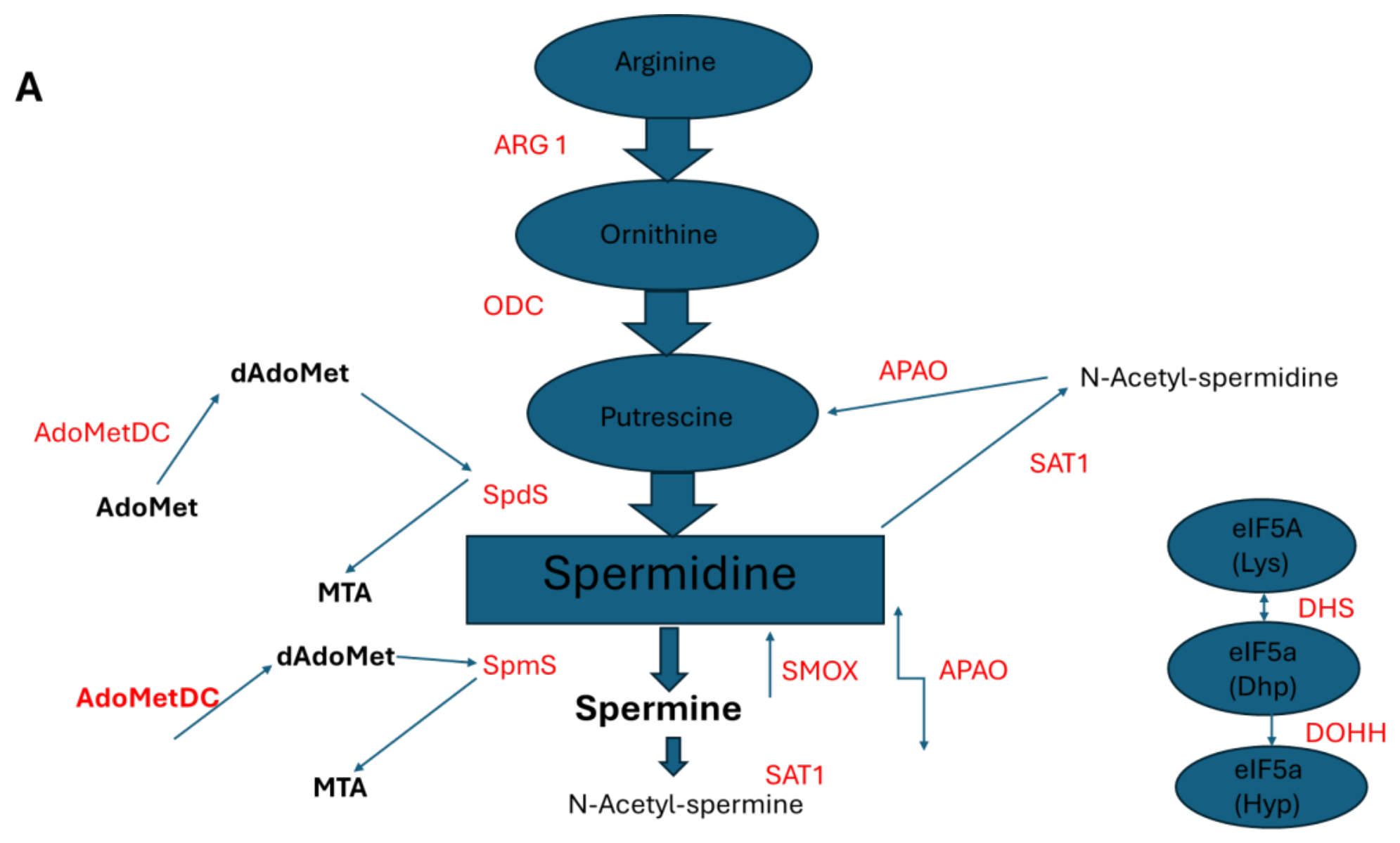
Figure 2.
Polyamine bionsynthesis in Plasmodium falciparum. AdoMet get converted to AdoMetDC/ODC, dAdoMet, SpdS, DHS, eIF5a, gets Deoxyhypusine intermediate, eIF5a, hyp.
Figure 2.
Polyamine bionsynthesis in Plasmodium falciparum. AdoMet get converted to AdoMetDC/ODC, dAdoMet, SpdS, DHS, eIF5a, gets Deoxyhypusine intermediate, eIF5a, hyp.
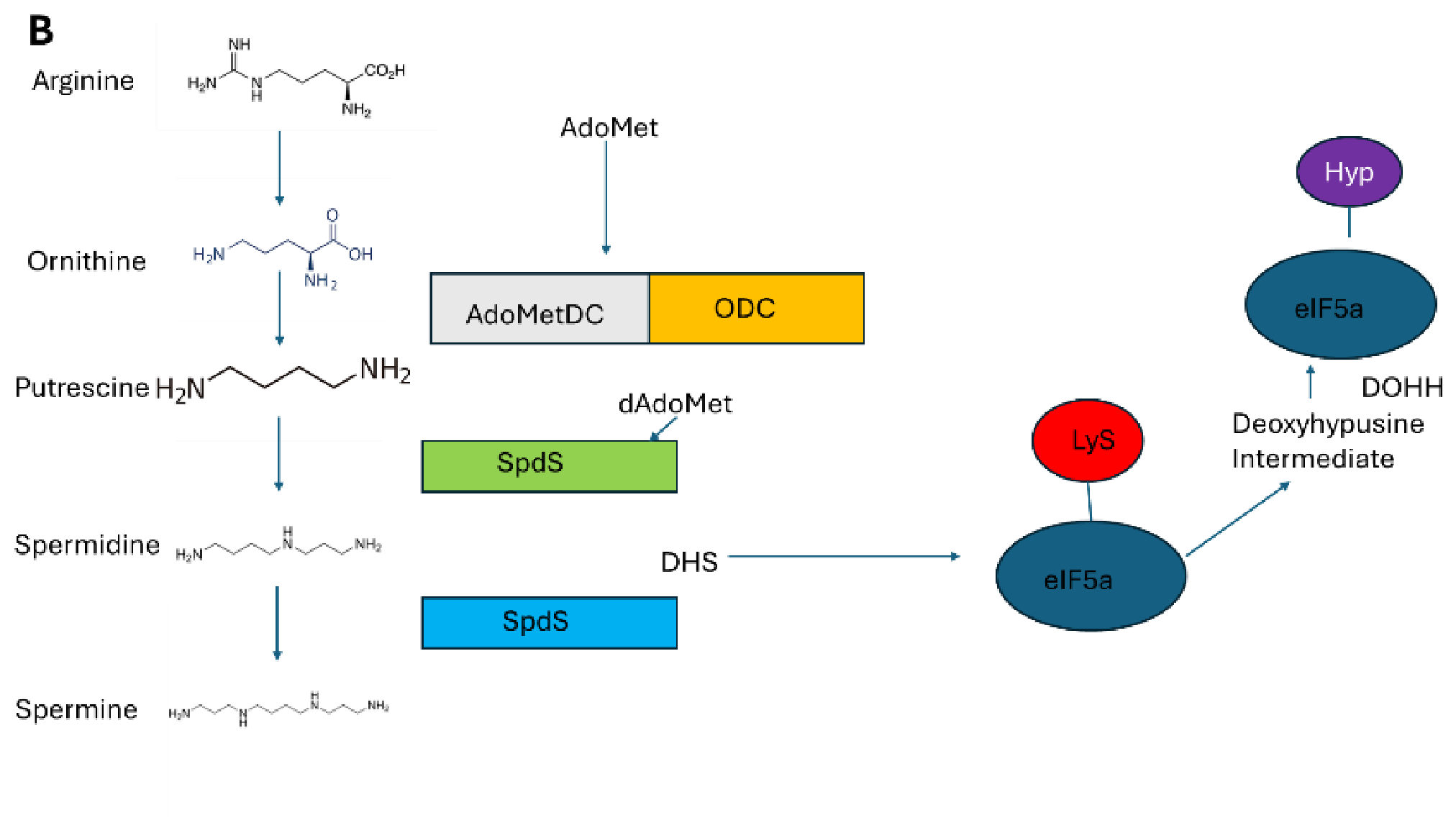
Figure 3.
Summary of polyamine biosynthesis in Bacterial.
Disclaimer/Publisher’s Note: The statements, opinions and data contained in all publications are solely those of the individual author(s) and contributor(s) and not of MDPI and/or the editor(s). MDPI and/or the editor(s) disclaim responsibility for any injury to people or property resulting from any ideas, methods, instructions or products referred to in the content. |
© 2026 by the authors. Licensee MDPI, Basel, Switzerland. This article is an open access article distributed under the terms and conditions of the Creative Commons Attribution (CC BY) license (http://creativecommons.org/licenses/by/4.0/).
Copyright: This open access article is published under a Creative Commons CC BY 4.0 license, which permit the free download, distribution, and reuse, provided that the author and preprint are cited in any reuse.


