
Submitted:
05 June 2026
Posted:
08 June 2026
You are already at the latest version
Abstract
This paper examines whether a prolonged period of sanctions and geopolitical fragmentation weakens domestic macroeconomic channels and strengthens external financial dominance of traditional exchange-rate transmission mechanisms. Standard exchange rate theories are based on the concepts of Purchasing Power Parity (PPP) and Uncovered Interest Parity (UIP). However, the application of continuous sanctions could weaken this explanatory power and change exchange rate dynamics. The present study applies a combined framework of Autoregressive Distributed Lag (ARDL), Error Correction Modeling (ECM), Vector Autoregression (VAR) and structural break analysis to study the exchange-rate behavior in response to repeated geopolitical shocks using monthly data for Russia from 2005 to 2025. The results indicate that external variables such as the US dollar index and oil prices are important determinants of exchange rates, while inflation and interest rate differentials associated with PPP and UIP have little explanatory power. Structural break tests detect major regime shifts associated with the Global Financial Crisis, Crimea-related sanctions episode, COVID-19 pandemic and Russia–Ukraine war. The error correction process indicates that the speed of adjustment to equilibrium is slow, which means that traditional exchange-rate relationships will continue to diverge. In general, the results suggest a regime-dependent exchange rate environment in which external financial factors tend to dominate domestic adjustment mechanisms. Our study contributes to the literature on exchange rates, sanctions and financial fragmentation by providing evidence on how geopolitical shocks shift the relative importance of domestic and external determinants in a highly sanctioned economy.
Keywords:
exchange rate dynamics
; global financial cycle
; sanctions
; structural breaks
; Russia
1. Introduction
The integration of financial markets has changed the way exchange rates are determined, especially in small economies which are influenced by larger economies. The traditional models were based on domestic fundamentals such as inflation, interest rates and monetary conditions. Recent studies, however, suggest that exchange rates are increasingly driven by global financial conditions, US monetary policy, global risk sentiment and dollar strength (Gopinath et al., 2020; Miranda-Agrippino & Rey, 2020; Rey, 2013).
The shift is relative and refers more to the previous stronger global liquidity cycles and financial integration postulates that weaken domestic policy (although not entirely) and traditional equilibrium-based models. This move would render changes in exchange rate more sensitive to external shocks than internal macroeconomic forces as in Aizenman et al. (2023) and Obstfeld (2022).
Since the escalation over Ukraine last year 2022, the US and EU, UK and partner countries also imposed heavy sanctions against Russia. They range from caps on large banks, a prohibition from portions of the SWIFT payment suite and asset freezes to export bans and access to global capital markets. Such sanctions may have aggravated financial fragmentation and may have reversed the standard determinants of exchange rate dynamics, giving greater weight to external financial conditions and geopolitical risks (Caldara & Iacoviello 2022; Ahn & Ludema 2024).
Global finance and commodity markets heavily influence the study's context. In these situations, exchange rates are very sensitive to global liquidity, risk appetite, and commodity prices (including oil). In addition, structural changes in exchange rate behavior may occur due to geopolitical and economic events (Bai & Perron, 2003; Rossi, 2013). Past time series studies have shown that to explain the exchange rate dynamics in economies exposed to external shocks, controlling for commodity prices and structural breaks is important (Kholodilin & Siliverstovs, 2009; Mogilat, 2015). This is a very preliminary assessment, and the development of the exchange rate appears to be related to specific international financial indicators.
Figure 1.
Global Financial Conditions and Exchange Rate. Note. Shaded areas represent major global/geopolitical shock periods used as dummy variables. Source: Author compilation from federal reserve economic data (FRED),trading economics, and Chicago Board Options Exchange (CBOE).
Figure 1.
Global Financial Conditions and Exchange Rate. Note. Shaded areas represent major global/geopolitical shock periods used as dummy variables. Source: Author compilation from federal reserve economic data (FRED),trading economics, and Chicago Board Options Exchange (CBOE).
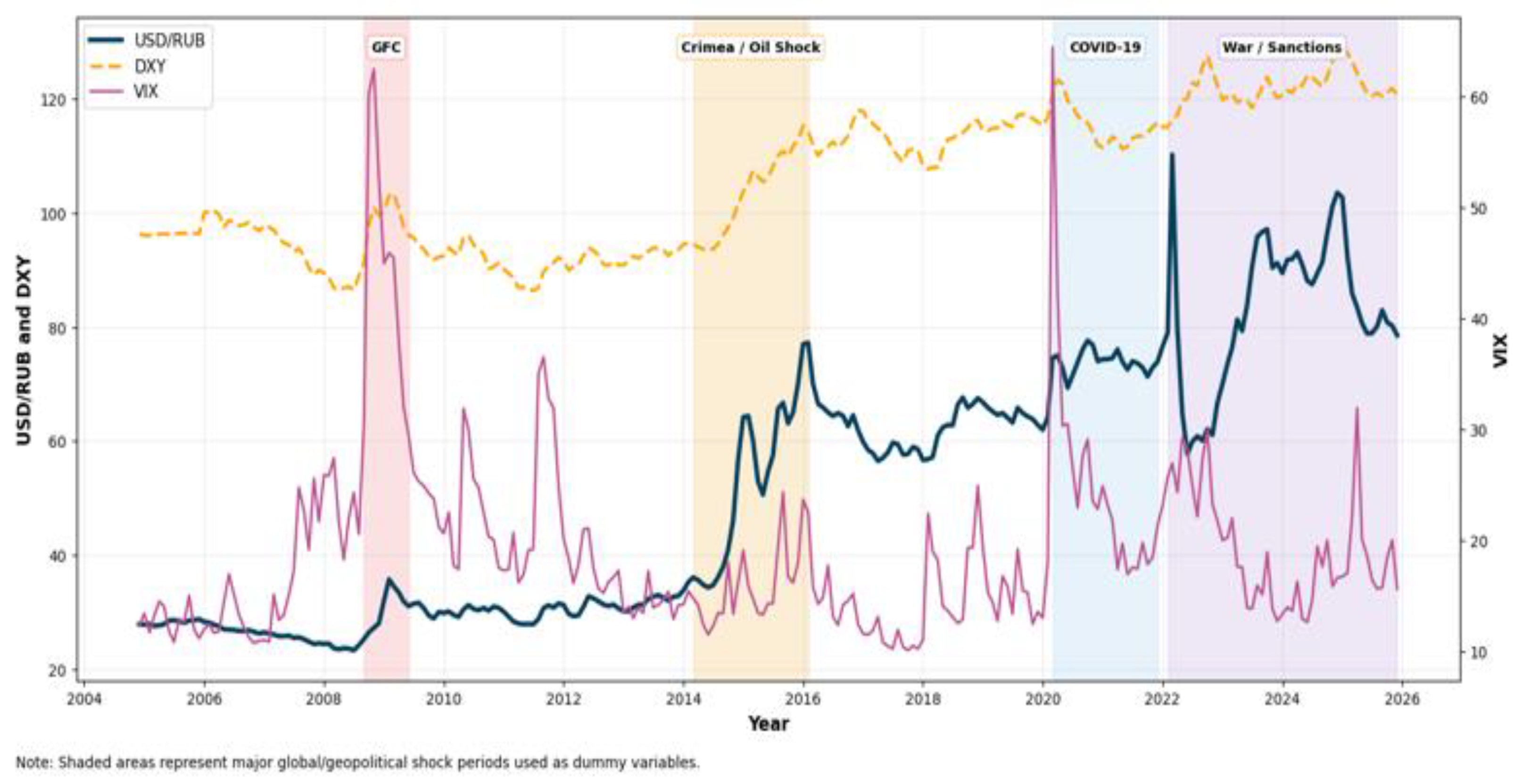
With the greater integration of financial markets, exchange rates in small The periodic Table economies are now determined by changes and shocks to domestic fundamentals too quickly for money supply noise to matter. It implies larger global liquidity cycles and delegitimizes domestic policy effects and equilibrium-based models. Movements in the exchange rate are increasingly being driven by external shocks — rather than by internal ones (Rey, 2023; Obstfeld, 2022).
The performance of exchange rates in commodity and financial markets is heavily influenced by selective global data, investor sentiments and liquidity conditions. Moreover, regime switches can also be a response to time-variant factors (e.g. major economic and geopolitical events) resulting in shifts of exchange rates patterns over time (Bai & Perron, 2003; Rossi, 2013). Important examples of variables that have already been identified in previous researches regarding exchange rate dynamics are commodity prices or structural breaks (Kholodilin & Siliverstovs, 2009; Mogilat, 2015).
2. Literature Review
Exchange rate determination has changed in the literature from traditional macroeconomic theories through global financial integration, commodity dependence, and structural instability models. In this section, we succinctly review the main strands of the literature and justify the gap filled by this study.
2.1. Traditional Macroeconomic Frameworks
Early endogenous exchange rate models consist of equilibrium-based frameworks based on macroeconomic fundamentals. The purchasing power parity (PPP) condition links exchange rate changes to differentials in inflation (Rogoff, 1996). Uncovered interest parity (UIP), in turn, links interest rate differentials with exchange rate changes (Engel, 2014). Both frameworks assume constant long-run relations and a moderately effective adjustment method to equilibrium.
However, in practice, these predictions have often been weakly supported by empirical evidence, especially in relatively highly integrated financial contexts. Persistence in deviations from the parity conditions, together with these patterns, suggests that domestic macroeconomic variables do not fully account for exchange rate movements.
2.2. International Financial Conditions and Exchange Rate Dynamics
Recent research emphasizes the importance of global financial variables as determinants of exchange rates. The global financial cycle hypothesis emphasizes the role of global liquidity, risk appetite, and capital flow to account for the dynamics of exchange rates (Rey, 2013). US dollar value and US monetary policy are extremely important for economic activity across borders (Gopinath et al., 2020; Miranda-Agrippino & Rey, 2020).
In this set-up, exchange rates only depend on domestic fundamentals. Integrated capital markets transmit external financial shocks and govern exchange rates. One line of evidence suggests that it is the exchange rate (Bekaert et al., 2013; Forbes & Warnock, 2012). The results suggest that such stronger external financial dominance limits the forecasting ability of standard models.
2.3. Commodity Prices & Exchange Rates
Other critical concerns raised in the literature on small open economies are related to export prices and commodity currencies affecting exchange rate dynamics in natural resource dependent countries. Specifically, oil prices have been identified to work through trade balance, fiscal revenues and investor expectations to influence exchange rates (Chen & Rogoff, 2003; Kilian, 2009).
Some empirical studies support the claim that price shocks have notable short-run impact on the economy while being more variable and not as easily modeled in the long-run. Commodity price fundamentals provide time series evidence about how both structural breaks and external shocks affect commodity driven exchange rate dynamics (Kholodilin & Siliverstovs, 2009). This reinforces the importance of accounting for commodity variables in exchange rate models.
2.4. Regime Shifts and Structural Breaks
Economic crises, public policy, and geopolitical events have structurally destabilized foreign exchange rate dynamics. Structural breaks are often seen as indications of time-varying parameters thus rendering the constant relationships models less useful (Bai & Perron, 2003; Rossi, 2013).
Empirical evidence suggests the behavior of exchange rates across regimes can vary significantly, especially under financial stress. Therefore, structural break analyses are useful for estimating regime shifts and improving model specifications (Mogilat, 2015). This highlights the necessity of including structural change in the econometric models being applied.
2.5. Dynamics of Interaction and the Transmissibility of Shock
In addition to long-run relationships, the behavior of exchange rates is characterized by short-run responses and dynamic interactions. Such relationships (including the interaction of the variables and the propagation of shocks through them) often come under the purview of vector autoregression (VAR) models (Sims, 1980).
Shock persistence and the importance of each factor are examined with impulse response analysis and variance decomposition. It is well-established that exchange rate behavior is highly persistent and primarily driven by internal features or external shocks (Stock & Watson, 2012 ).
3. Methods and Data Description
This case study began with monthly time-series data for 2005–2025 and examines the factors behind the fluctuation of the exchange rate between US dollars (USD) and Russian rubles (RUB). Frequency is a key metric in applied time-series econometrics. This analysis examines only short-term fluctuations, but medium-term dynamics as well, for which monthly frequency is desirable.
The data include global financial indicators, commodity prices, domestic macroeconomic data, and real sector indicators. Most variables were defined using natural logarithms for consistency and interpretability, as this allows for the interpretation of the estimated coefficients as elasticities, and because natural logarithms stabilize variance.
The data revealed the presence of structural breaks associated with major political and economic events, indicating the necessity of including two dummy variables that could account for potential regime changes into the model specification.
The motivation for including oil prices is based on the commodity currency hypothesis, according to which in resource-exporting economies there is a negative response of commodity prices and exchange rates (Chen & Rogoff, 2003). Moreover, following standard parity conditions (namely uncovered interest parity and purchasing power parity), other variables such as interest rate differentials (IRD) and inflation differentials (INFDIFF) are included.
Real sector activity and monetary conditions are represented by including domestic variables such as lnIPI (industrial production), lnM3 (money supply), and lnRES (foreign reserves). Such growth within the model adds to its ability to describe internal macroeconomic dynamics, which is an important feature in the context of emerging markets.
3.1. Structural Break Variables
Dummy variables associated with key global and geopolitical events are included in the model to capture regime changes and major economic disruptions (Table 3).
These dummy variables allow us to control for specific uncertainty spikes and structural breaks as they occur during the global financial crisis (2008–2009), the Crimea crisis (2014–2015), the COVID-19 pandemic (2020–2021), and the Russia–Ukraine conflict (2022–present).
In applied econometrics, accounting for structural breaks at the correct time in the time series can be critical; otherwise, regime shifts can result in biased estimates of the parameters (Perron, 1989).
3.2. Descriptive Statistics: Preliminary Data Analysis
Table 4 shows descriptive statistics and a summary of the central tendency, dispersion, and distributional shape of the variables.
The findings suggest that most of the variables are moderately variable, contrary to some financial indicators, such as VIX, which have high volatility and non-normal distribution, as shown from the skewness and kurtosis measures.
Correlation analyses for the core variables (Table 5) and extended variables (Table 6) provide insight into the relationships across the selected variables.
The exchange rate generally has a positive correlation with the US dollar index, which reflects that global financial factors affect the exchange rate. However, there is a statistically significant negative correlation between oil price and exchange rate, giving early evidence for the commodity currency hypothesis.
The high correlations between the fractions of reserves in monetary aggregates and trade show some potential for multicollinearity. Specification design and robustness checks, addressed in step three of the econometric modeling stage, alleviate this issue.
3.3. Unit Root and Integration Properties
Before estimation of the models of these variables, unit root tests are typically examined, as shown in Table 7.
Output results demonstrate the presence of some combination of I(0) and I(1) variables. Some global and macroeconomic variables are stationary at levels, but most variables in the domestic economy only become stationary after first differencing.
Given the combination of integrations, where the variables are I(0) and I(1), we justify applying the autoregressive distributed lag (ARDL) framework since it permits both I(0) and I(1) variables (Pesaran et al., 2001). And more importantly, none of the variables is I(2), which is a critical assumption of ARDL being applicable.
3.4. Graphical Analysis
3.4.1. Dynamics of Exchange Rate and Crisis Episodes
Regime shifts in the USD/RUB exchange rate 2005–2025 readily show up when connected with clearly observable global and geopolitical events (Figure 2). Before 2008, we had some stability, whereas in the period of the global financial crisis, there was much more volatility. A larger depreciation took place during 2014–2015 in response to plunging oil prices and external sanctions.
Then the COVID-19 shock in 2020 created further instability, but it was milder. The strongest rupture came in 2022 when geopolitical conflict launched the prices into extreme volatility, with sanctions and monetary restrictions working together. In general, the ruble has high sensitivity to external shocks, which is a corollary of global financial cycle theory.
3.4.2. Oil Prices and the Commodity Currency Hypothesis
Log–log co-movements between the log of the USD/RUB and the log of the price of oil (in USD per barrel) on the USD/RUB picture (log–log scale) are shown in Figure 3. The ruble is strong when oil prices are up, and weak when oil prices are down. This fits the commodity currency regime explanation, where for export-oriented economies such as CAD ones, the currency is highly reactive to commodity prices.
This relationship holds in basic form until 2022, when the relationship weakens, hinting at structural disruption. In this respect, measures such as capital controls and sanctions may have shifted the traditional transmission mechanism. This changing behavior highlights the necessity of including structural break dummies in empirical analyses.
3.4.3. Real Sector Activity and Monetary Policy Response
Figure 4 shows the responses to an interaction of output and monetary policy. The Industrial Production Index rises over time with busts during crises. Output fell very sharply in response to the GFC and COVID-19 shocks.
Monetary policy reacted by changing the main policy rate. The most significant deterioration took place in 2022, in order to stabilize the exchange rate and keep inflation down. This corresponds to common monetary policy responses in emerging markets.
3.4.4. Econometric Implications
Table 5 presents preliminary evidence of the presence of a combination of stationary and non-stationary variables. This allows for the consideration of the ARDL framework, one that allows for variables that are integrated in different orders (Pesaran et al., 2001).
The correlation structure shows that global, domestic, and real sector variables are likely to be highly interdependent with one another. Although potential multicollinearity exists, it is addressed through robustness checks and careful model specification. Hence, it is crucial to have the structural break dummies that capture regime shifts to avoid biased estimates.
Synthesis of Findings
The graphical and statistical evidence consistently show that:
(i) RUB volatility is highly sensitive to external shocks;
(ii) oil prices negatively correlate with the exchange rate;
(iii) this relationship is regime-dependent;
(iv) monetary policy stabilizes the economy during crises, as expected;
Such findings are in line with theoretical expectations as well as evidence on commodity-dependent countries.
3.4.5. Econometric Strategy
Empirical Framework
An autoregressive distributed lag–error correction modeling–vector autoregression (ARDL–ECM–VAR) structural break approach, as the combined time-series framework is employed to conduct a comparative analysis of the USD/RUB dynamics. This strategy seeks to include long-run relationships, short-run adjustments, and regime shifts, reflecting the time-varying nature of shock transmission.
The dependent variable is:
where represents the logarithm of the USD/RUB exchange rate at time t.
Baseline External and Commodity ARDL as Determinants
We show our baseline model that evaluates global financial conditions and commodity prices:
This specification supports the baseline empirical results described below in Chapter 5 and addresses the role of external drivers.
Related RQ: RQ1 and RQ3. Expected signs are:
α1>0, α2>0, α3<0
Domestic Fundamentals Model
To evaluate domestic macroeconomic fundamentals, the following model is estimated:
The inclusion of captures real sector activity and strengthens the domestic macroeconomic block.
Related RQ: RQ2. Expected signs:
β 1<0, β2>0, β3>0, β4<0, β5<0, β6>0, β7<0
Oil Price Model With Crisis Dummies
Given the importance of oil prices and geopolitical shocks, the oil-channel model includes external controls and structural dummy variables:
This specification is consistent with the empirical results where oil prices are analyzed jointly with global financial variables and crisis effects.
Related RQ: RQ3. Expected signs:
δ1<0, δ2>0, δ3>0, δ4>0, δ5>0
Structural Break Model
To examine regime shifts, crisis dummy variables are incorporated into the ARDL framework:
The structural dummies capture major crisis periods, while controls for domestic real sector conditions.
Related RQ: RQ4. Bivariate autoregressive distributed lag model with dummies.
ARDL–ECM Representation
ECM representation estimates the short-run and adjustment dynamics:

where represents the relevant explanatory variables in each ARDL specification.
The error correction term is defined as:

A negative and statistically significant ρ\rhoρ indicates adjustment toward equilibrium.
Related RQ: RQ5.
VAR Model for Shock Transmission
To examine dynamic interactions and shock transmission, the VAR model is specified as:
where:
Impulse response functions and forecast error variance decomposition are used to evaluate shock propagation.
Related RQ: RQ6. Tools: VAR, IRF, FEVD, Granger causality.
Monetary and Inflation Channels
The monetary channel is estimated as:
Interpretation:
- : interest rate differential (e.g., Russia vs. US)
- : captures the monetary policy / capital flow channel
Expected sign:
- <0: higher domestic interest rates → capital inflows → ruble appreciates
The inflation channel is specified as:
Interpretation:
- : inflation differential (Russia − foreign, typically US)
- : captures the purchasing power parity (PPP) mechanism
Expected sign:
- >0: higher domestic inflation → loss of purchasing power → ruble depreciates
Related RQ: RQ7 and RQ8
Integrated Mapping Framework

Table 8.
Integrated Mapping of Research Questions, Equations, and Empirical Tools.
| RQ | Equation | Empirical focus | Model and tools |
|---|---|---|---|
| RQ1 | Eq. (1) | Global financial effects | ARDL, Bounds Test |
| RQ2 | Eq. (2) | Domestic fundamentals including lnIPI | ARDL |
| RQ3 | Eq. (3) | Oil price effect with crisis controls | ARDL, Dummy variables |
| RQ4 | Eq. (4) | Structural breaks and regime shifts | ARDL with dummies, Chow, Bai–Perron |
| RQ5 | Eq. (5) | Short-run adjustment and ECM | ARDL–ECM |
| RQ6 | Eq. (6) | Shock transmission | VAR, IRF, FEVD, Granger |
| RQ7 | Eq. (7) | Interest rate differential | ARDL |
| RQ8 | Eq. (8) | Inflation differential | ARDL |
Source: Author’s formulation.
Estimation Procedure
The empirical analysis includes five steps and four stages. To examine the order of integration, the first step was to run the ADF and Phillips–Perron tests. In the second step, the ARDL models are run for the baseline, domestic, oil, structural, monetary, and inflation specifications. Third, bounds tests were performed to check for possible long-run relationships. Fourth, ECM representations are used to estimate short-run adjustment. Fifth, IRF, FEVD, and Granger causality analysis of VAR are used to study shock transmission.
Finally, the robustness of the models is evaluated through diagnostic and stability tests that include serial correlation, heteroskedasticity, normality, CUSUM, and CUSUMSQ tests.
4. Empirical Results
4.1. Baseline ARDL Model
This chapter generalizes the baseline ARDL model on the influence of financial conditions and commodity prices on USD/RUB.
The estimation results suggest that the oil price as well as the US dollar index are statistically significant explanatory variables for the exchange rate movements. In particular, the price of oil has a negative and highly significant coefficient; higher oil prices lead to an appreciation of the home currency. On the other hand, the US dollar index has a positive and significant influence, meaning global foreign financial conditions push the exchange rate up.
As indicated by the results in Table 9, market volatility (VIX) has a statistically insignificant impact on the baseline specification. The dependent variable is ln(USD/RUB). The model is ARDL(4,2,3,2). The estimator is HAC (Newey–West robust standard errors).
In brief, as confirmed by the baseline model, the exchange rate dynamics are primarily driven by external factors. The role of global liquidity as an exogenous driver of exchange rate dynamics is consistent with the global financial cycle hypothesis (Rey, 2013).
4.2. Long-Run Relationship and Cointegration
We employ the ARDL bounds testing approach (Pesaran et al., 2001) to assess the existence of a long-run equilibrium relationship.
Research results indicate that the F-statistic lies in the inconclusive region, suggesting weak evidence of cointegration.
Although important variables such as oil prices and the US dollar index are long-run level data with statistical significance, the lack of a clear cointegration relationship indicates that the system does not converge to a stable equilibrium. In Table 10, the dependent variable is ln(USD/RUB), the model is ARDL(4,2,3,2), and the cointegration test is the Pesaran et al. (2001) bounds test.
4.3. Dynamics of the Court-Term and the Error Correction Mechanism
The error correction model from the ARDL specification is used for investigating the short-run dynamics.
The error correction mechanism is weakly negative and significant. However, there is a low speed of adjustment toward equilibrium with a low coefficient magnitude.
The short-horizon coefficients indicate that oil prices and the US dollar index have a highly significant and transitory impact on exchange rates.
In Table 11, the dependent variable is Δln(USD/RUB), the model is ECM derived from ARDL(4,2,3,2), and the estimator is HAC (Newey–West robust standard errors).
There are weak convergence dynamics. The results indicate that deviations from equilibrium are persistent over time.
4.4. Structural Breaks and Changes in Regimes
As regime changes in the system can render the analysis invalid, structural break tests are used in order to locate any regime breaks.
The outcomes are consistent with highly relevant structural breaks associated with important economic and geopolitical events such as the 2014 Crimea crisis and the 2022 Russia–Ukraine war. Dummy variables here indicate that these shocks have significant short-run impacts on exchange rate dynamics. In Table 12, the dependent variable is ln(USD/RUB), the model is: ARDL(4,2,3,2,0,4) with structural dummies, and the estimator is HAC (Newey–West robust standard errors).
The results indicate possible regime shifts associated with major geopolitical events and that the underlying dynamics are influenced by structural shifts.
4.5. VAR-Based Dynamic Analysis
To dig deeper into some of the dynamic interactions, a VAR approach is estimated, and impulse response functions, variance decomposition, and Granger causality tests are performed.
The results of Granger causality show that oil prices are predictive of exchange rate behavior. The analysis of the impulse response shows that the effects of shocks to the oil price are transient, while shocks to the US dollar index are lasting.
Similar results hold when looking at variance decomposition attempts, where most of the important changes in movement are caused by own impulse and exogenous drive only marginally. For Table 13, the variables are: ln(USD/RUB), ln(BRENT), ln(DXY), and VIX, the model is VAR(3), and the estimation period is monthly data for the period 2005–2025.
The results point to a very weak transmission of external shocks and very persistent exchange rate properties.
The temporary response to oil shocks is aligned with other studies documenting the transitory effects of commodity price shocks (Kilian, 2009).
4.6. Robustness Checks
Diagnostic and stability tests are performed for the reliability of the results.
The diagnostic tests reveal no signs of serial correlation, heteroskedasticity, or model misspecification. The parameters of the model also pass the stability test; we notice some of them are stable, probably for a long time; however, small deviations are seen. For Table 14, the models tested are ARDL and ECM specifications and the estimation method is HAC (Newey–West robust standard errors).
In general, the empirical findings do not result from arbitrary factors, confirming the robustness of the findings.
4.7. Other Channels: Money and Inflation Effects
This includes traditional macroeconomic channels, like interest rate differentials or inflation differentials.
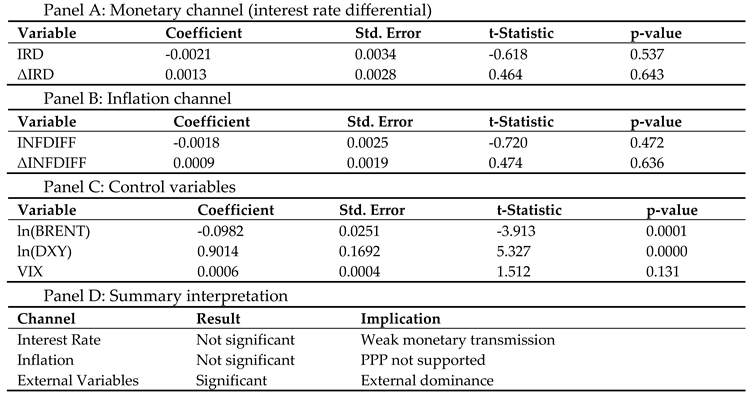
In Table 15, the dependent variable is ln(USD/RUB), the model is: extended ARDL specification, and the variables are: interest rate differential (IRD), Inflation differential (INFDIFF), ln(DXY), ln(BRENT), and VIX.
The results show that neither the interest rate differential nor the inflation differential have a significant effect on the exchange rate. FDI inflows are significant, while external variables such as oil prices and the US dollar index, are not significant.
Therefore, these results provide evidence against the well-established macroeconomic and monetary theoretical approaches that usually describe in the short term one-to-one relations between interest rate and exchange rates (interest rate parity), as well as the quantities of real money and real exchange rate (purchasing power parity).
4.8. Summary of Empirical Findings
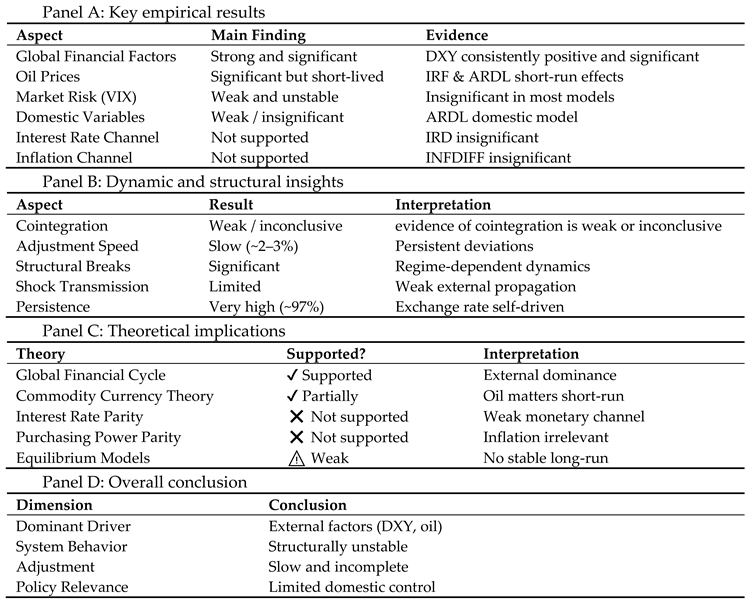
This section summarizes the empirical findings (Table 16).
First, global financial conditions and the behavior of commodity prices are the main determinants of exchange rate dynamics. Second, the presence of a stable long-run equilibrium is not well supported, and the adjustment process is slow. Third, structural breaks are important; that is, exchange rate behavior is subject to regime changes. Finally, the data do not support traditional macroeconomic channels.
In summary, the findings reinforce the view that exchange rate dynamics are largely exogenous, stylized, weakly anchored to internal macroeconomic fundamentals, and structurally unstable.
5. Discussion
The results show that external financial conditions - rather than domestic macroeconomic fundamentals - dominate exchange-rate dynamics. The robust and persistent effect of the US dollar index is consistent with the view that sovereign yields around the world are driven by global liquidity conditions, US monetary policy, and financial openness (Rey 2013; Miranda-Agrippino & Rey 2020; Gopinath et al.2020)
The findings imply that exchange-rate conduct is nonetheless intimately coupled to fluctuations in international monetary markets, despite extensive sanctions and geopolitical tensions.
Oil prices very clearly become on important driver of exchange-rate movements in line with the commodity currency literature (Chen & Rogoff, 2003; Kilian, 2009). The inverse correlation of both oil price and the USD/RUB exchange rate is confirmed, as an indicator of commodity dependence in Russia economy and external trade conditions impact on exchange-rate adjustment. Nevertheless, estimates from the VAR reveal that oil-price shocks have only a temporary effect on exchange rates, consistent with evidence suggesting that commodity-price shocks often generate short-run rather than permanent exchange-rate responses (Kilian, 2009; Kholodilin & Siliverstovs, 2009).
A key finding of this study is that conventional domestic transmission channels have limited explanatory power. For the most part, specifications that include interest-rate differentials and inflation differentials yield statistically-insignificant effects, giving limited support for conventional Uncovered Interest Parity (UIP) and Purchasing Power Parity (PPP) predictions (Rogoff, 1996; Engel 2016). These results imply that long-term sanctions and financial disunity could undermine the role of domestic equilibrating forces in capital account balances and lessen the importance of parity-based exchange-rate regimes. Exchange-rate dynamics seem to be driven less directly than before by domestic macroeconomic fundamentals and more under the influence of external financial conditions and geopolitical events.
The role of regime-dependent exchange-rate behavior is further confirmed by structural break analysis. Historical insight reveals that exchange-rate relationships are not stable (Bai and Perron, 2003; Rossi, 2013), the Global Financial Crisis breaks of significance just like the Crimea-related sanctions episode or COVID-19 pandemic or the Russia–Ukraine war. These findings suggest that sanctions are more than simply short-run shocks, and also serve as mechanisms to permanently alter the fundamental transmission mechanism of exchange-rate determination. The evidence thereby adds to the burgeoning literature on financial decoupling and geopolitical risk, which posits that global economic integration is increasingly conditioned by geopolitics-imposed constraints and regime changes (Caldara & Iacoviello,2022; Ahn & Ludema 2024).
Second, the restriction of strong cointegration and slow adjustment speed produced in this ECM results also constitute an additional critique for equilibrium-based exchange-rate models. This implies that while the error-correction term is still statistically significant, its low values means there are some remaining deviations from long-run equilibrium. These results corroborate the work on persistence, capital-structural heterogeneity and sluggish macroeconmic adjustments in financiallyintegrated economies (Stock & Watson 2012; Itskhoki& Mukhin 2021). One of the main takeaways from the review indicates that exchange-rate dynamics appear to be both structurally unstable and only weakly anchored in standard equilibrium relationships.
To conclude, the results point to a regime-dependent exchange rate environment, which is heavily influenced by external financial factors, to the detriment of domestic macroeconomic channels, as a result of protracted sanctions and geopolitical fragmentation. This paper contributes to the emerging literature on financial fragmentation and provides new evidence that geopolitical shocks can alter the transmission mechanisms generating exchange-rate dynamics, by showing how sanctions can shift the relative importance of exchange-rate determinants. While the analysis is focused on Russia, the results may also be relevant for other economies that are exposed to sanctions and depend heavily on commodities, as they face financial fragmentation where the external financial environment is becoming more dominant than traditional domestic adjustment mechanisms. The findings are therefore relevant not only for the understanding of exchange rate dynamics in Russia, but also for broader discussions on financial fragmentation, geopolitical risk and the changing importance of global financial conditions in emerging and externally exposed economies.
6. Conclusions
This study employs ARDL, ECM, and VAR models in an econometric framework for the analysis of exchange rate dynamics. The commonsense nature of external factors, domestic fundamentals, and structural breaks in exchange rate behavior is underscored by the results.
The findings suggest, multiple times within the first stage, that exchange prices are driven mainly by external influences, especially the sign-changing confidence around the world and the price ranges of commodities. The most powerful and longest-lasting impact comes from gold's own currency: the US dollar index, but shorter impact on the gold market comes from oil prices. In contrast, domestic macroeconomic variables like interest rate differential and inflation differential do not produce statistically significant effects.
The results show no evidence of a stable long-run relationship. The ARDL bounds test shows an inconclusive result, while the error correction mechanism indicates a lower speed of adjustment. In other words, the deviations from the equilibrium are permanent, and the markets do not converge to the equilibrium almost instantaneously.
The implications of this are that the dynamics of the exchange rate are time-varying (i.e., their effects are not constant) and there are structural breaks. The VAR-based analysis also shows that exchange rates are persistent and driven mainly by their own innovations, with very little transmission from outside shocks.
In brief, the dynamics of exchange rates are externally determined, structurally unstable, and very loosely coupled to domestic macroeconomic fundamentals.
7. Implications and Future Research
These findings carry a clear message. Standard equilibrium-based models, such as purchasing power parity and its close variants, rely on persistent long-run relationships and relatively moderate adjustment. The evidence in this instance does not back up these assumptions. Rather, exchange rate dynamics are best described as externally driven, persistent, and structurally changed.
This implies that domestic policy instruments are used, although constrained, to provide stability in the exchange rate frameworks, as long as the conditions in the global arena are not favorable. Hence, it is crucial to monitor global developments and control exposure to external shocks. This reinforces the requirement for policy frameworks that are flexible to regime changes due to instability.
At the methodological level, combining ARDL, ECM, VAR, and break tests enables us to consistently model the long-run and short-run dynamics and the regime instability.
There are some limitations to this study, including a limited set of variables and the absence of nonlinear dynamics. Future studies may apply an extended framework by employing regime-switching models and financial market indicators, as well as by comparing countries.
Authors’ Contributions:
Sugeng Suroso: Conceptualization, Formal analysis, Methodology, Supervision, Validation, Writing – review & editing; Sri Wulandari: Methodology, Data curation ,Writing – review & editing. Hajar Matari Fath Mala: Data curation, Investigation, Validation, Visualization, Writing – review & editing.
Funding
This research received no external funding.
Institutional Review Board Statement
Not applicable.
Informed Consent Statement
Not applicable.
Data Availability Statement
The raw data supporting the conclusions of this article will be made available by the authors on request.
Conflicts of Interest
The author declares no conflicts of interest, and there has been no significant financial support for this work that could have influenced its outcome.
References
- Ahn, D. P.; Ludema, R. D. The economics of sanctions: Recent developments and policy implications. J. Econ. Perspect. 2024, 38(1), 3–28. [Google Scholar] [CrossRef]
- Aizenman, J.; Chinn, M. D.; Ito, H. The Impacts of Financial Crises on the Trilemma Configurations. Open Econ. Rev. 2023, 34(3), 479–517. [Google Scholar] [CrossRef]
- Bai, J.; Perron, P. Computation and analysis of multiple structural change models. J. Appl. Econom. 2003, 18(1), 1–22. [Google Scholar] [CrossRef]
- Baker, S. R.; Bloom, N.; Davis, S. J.; Kost, K.; Sammon, M.; Viratyosin, T. The unprecedented stock market reaction to COVID-19 . Rev. Asset Pricing Stud. 2020, 10(4), 742–758. [Google Scholar] [CrossRef]
- Bekaert, G.; Hoerova, M.; Lo Duca, M. Risk, uncertainty, and monetary policy. J. Monet. Econ. 2013, 60(7), 771–788. [Google Scholar] [CrossRef]
- Bernanke, B. S. The global saving glut and the U.S. current account deficit; Board of Governors of the Federal Reserve System, 2005. [Google Scholar]
- https://www.federalreserve.gov/boarddocs/speeches/2005/200503102/ .
- Caldara, D.; Iacoviello, M. Measuring geopolitical risk . Am. Econ. Rev. 2022, 112(4), 1194–1225. [Google Scholar] [CrossRef]
- Chen, Y. C.; Rogoff, K. S. Commodity currencies. J. Int. Econ. 2003, 60(1), 133–160. [Google Scholar] [CrossRef]
- Engel, C. Exchange rates and interest parity. In Handbook of international economics; Gopinath, G., Helpman, E., Rogoff, Kenneth, Eds.; 2014; vol. 4, pp. 453–522. [Google Scholar]
- Forbes, K. J.; Warnock, F. E. Capital flow waves: Surges, stops, flight, and retrenchment. J. Int. Econ. 2012, 88(2), 235–251. [Google Scholar] [CrossRef]
- Gopinath, G.; Boz, E.; Casas, C.; Díez, F.; Gourinchas, P.-O.; Plagborg-Møller, M. Dominant currency paradigm. Am. Econ. Rev. 2020, 110(3), 677–719. [Google Scholar] [CrossRef]
- Itskhoki, O.; Mukhin, D. Exchange rate disconnect in general equilibrium. J. Political Econ. 2021, 129(8), 2183–2232. [Google Scholar] [CrossRef]
- Kholodilin, K.; Siliverstovs, B. Do exchange rate dynamics respond to oil prices? Appl. Econom. 2009, 15, 3–18. [Google Scholar]
- Kilian, L. Not all oil price shocks are alike: Disentangling demand and supply shocks in the crude oil market. Am. Econ. Rev. 2009, 99(3), 1053–1069. [Google Scholar] [CrossRef]
- Klose, J. Monetary policy rules and the ECB rotation model. J. Econ. Asymmetries 2024, 30, e00384. [Google Scholar] [CrossRef]
- Miranda-Agrippino, S.; Rey, H. A realist explanation of the global financial cycle after Lehman. Am. Econ. Rev. Pap. Proc. 2021, 111(4559), 78–83. [Google Scholar] [CrossRef]
- Mogilat, A. Exchange rate dynamics with and without structural breaks (October 2023). Appl. Econom. 2015, 37, 25–45. [Google Scholar]
- Obstfeld, M. Globalization and macroeconomic policy. IMF Econ. Rev. 2022, 70(2), 245–273. [Google Scholar]
- Perron, P. The great crash, the oil price shock, and the unit root hypothesis. Econometrica 1989, 57(6), 1361–1401. [Google Scholar] [CrossRef]
- Pesaran, M. H.; Shin, Y.; Smith, R. Bounds testing approaches to the analysis of level relationships. J. Appl. Econom. 2001, 16(3), 289–326. [Google Scholar] [CrossRef]
- https. [CrossRef]
- Rey, H. Dilemma, not trilemma: The global financial cycle and monetary policy independence . In National Bureau of Economic Research; 2013; Available online: https://www.nber.org/system/files/working_papers/w21162/w21162.pdf.
- Rogoff, K. The purchasing power parity puzzle. J. Econ. Lit. 1996, 34(2), 647–668. Available online: https://www.jstor.org/stable/2729217.
- Rossi, B. Advances in forecasting under instability. In Handbook of economic forecasting; Elliot, G., Timmermann, A., Eds.; Elsevier, 2013; Vol. 2, pp. 1203–1324. [Google Scholar]
- Sims, C. Macroeconomics and reality. Econometrica 1980, 48(1), 1–48. [Google Scholar] [CrossRef]
- Stock, J.; Watson, M. Generalized shrinkage methods for forecasting using many predictors. J. Bus. Econ. Stat. 2012, 30(4), 481–493. [Google Scholar] [CrossRef]
Figure 2.
Regime Shifts in the USD/RUB Exchange Rate 2005–2025. Source: Author’s calculation. Note: Shading represents periods of national crisis in the USD/RUB exchange rate (2005–2025).
Figure 2.
Regime Shifts in the USD/RUB Exchange Rate 2005–2025. Source: Author’s calculation. Note: Shading represents periods of national crisis in the USD/RUB exchange rate (2005–2025).
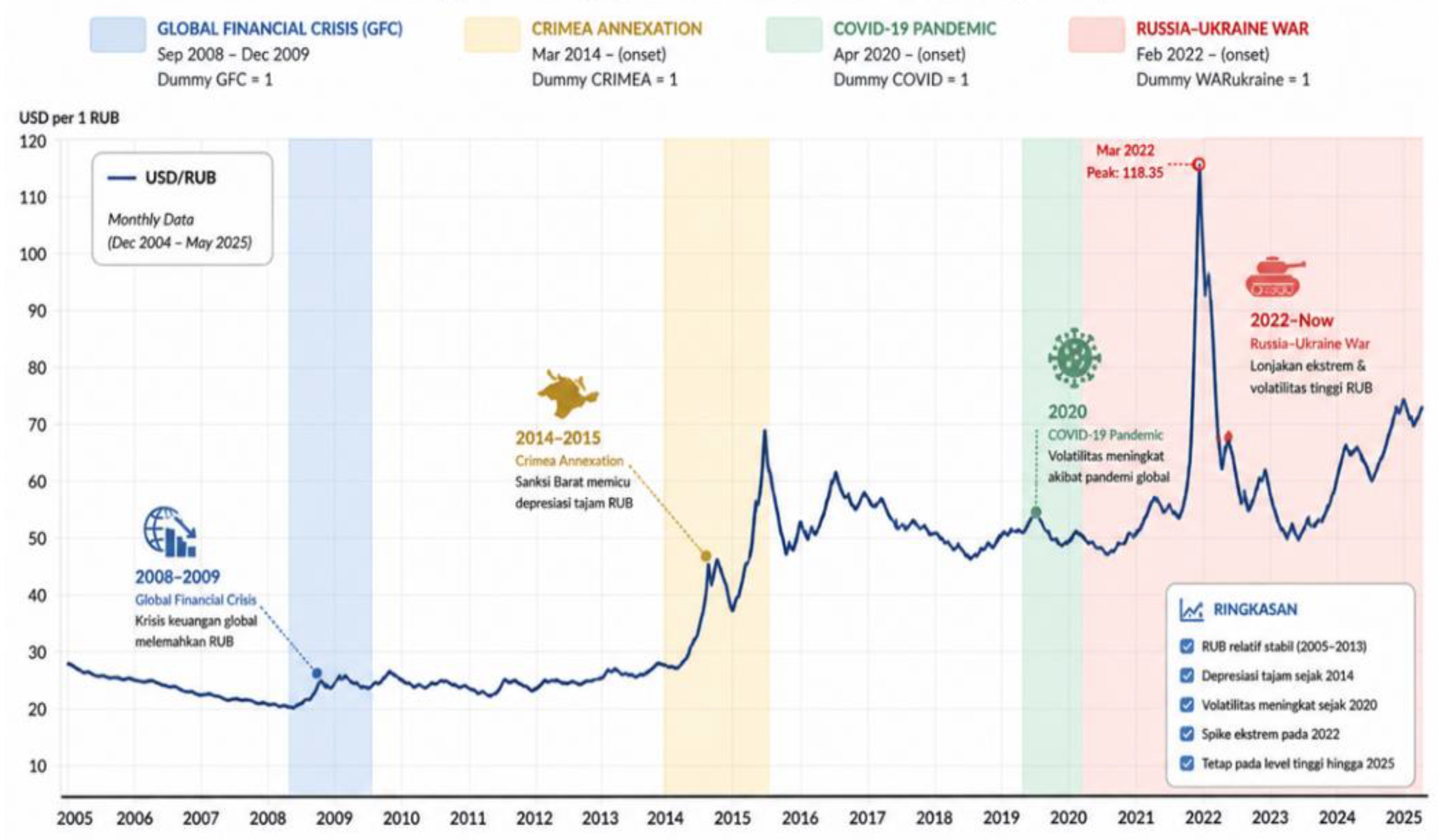
Figure 3.
USD/RUB and Brent Oil prices (Log Scale). Source: Exchange rate data from; oil price data from EIA / World Bank. Note: Shading represents periods of national crisis in the USD/RUB exchange rate (2005–2025).
Figure 3.
USD/RUB and Brent Oil prices (Log Scale). Source: Exchange rate data from; oil price data from EIA / World Bank. Note: Shading represents periods of national crisis in the USD/RUB exchange rate (2005–2025).
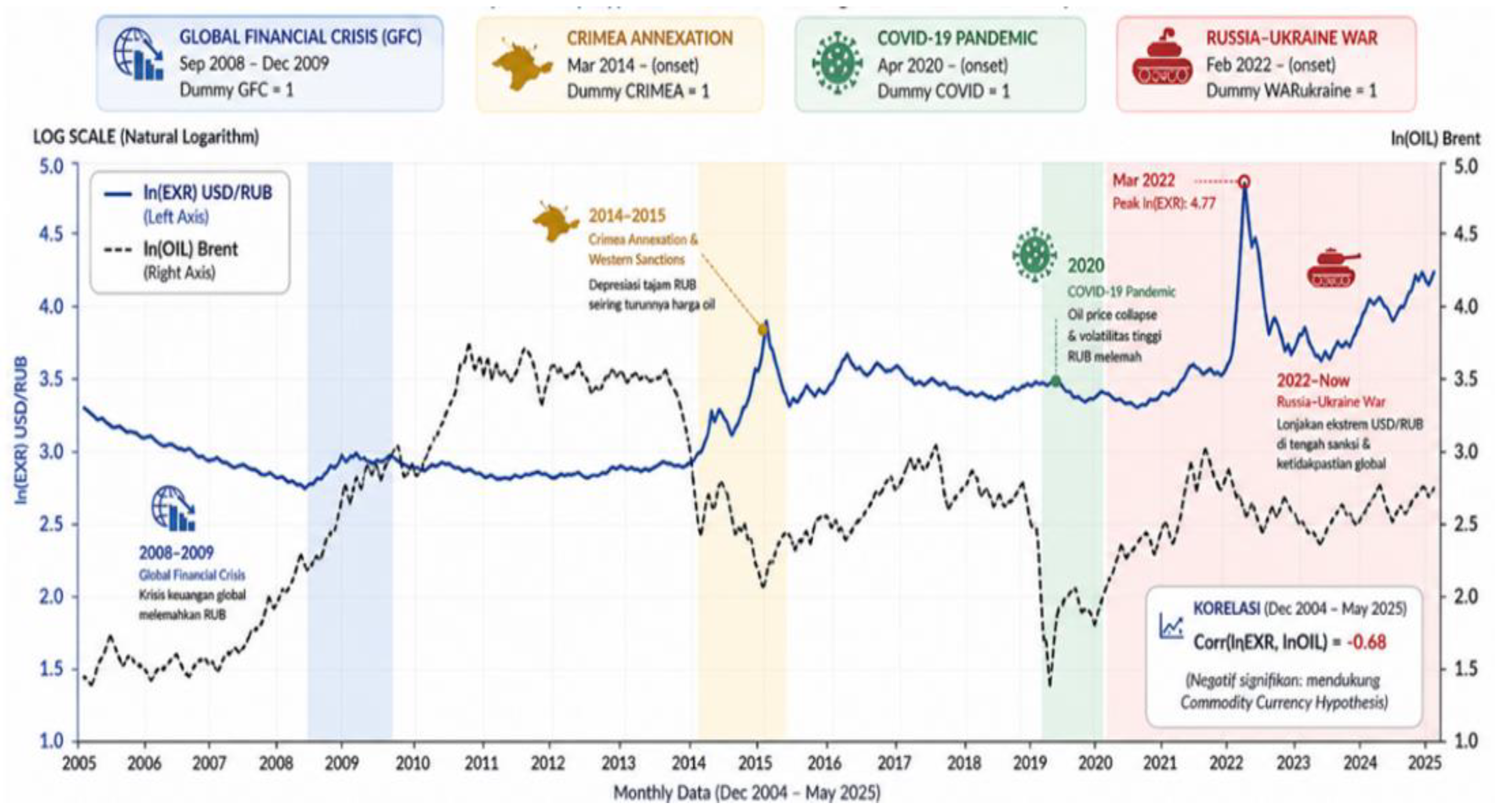
Figure 4.
Industrial Production Index (IPI) and Key Policy Rate (2005–2025). Source: Author’s calculation. Note: Shading represents periods of national crisis in the USD/RUB exchange rate (2005–2025).
Figure 4.
Industrial Production Index (IPI) and Key Policy Rate (2005–2025). Source: Author’s calculation. Note: Shading represents periods of national crisis in the USD/RUB exchange rate (2005–2025).
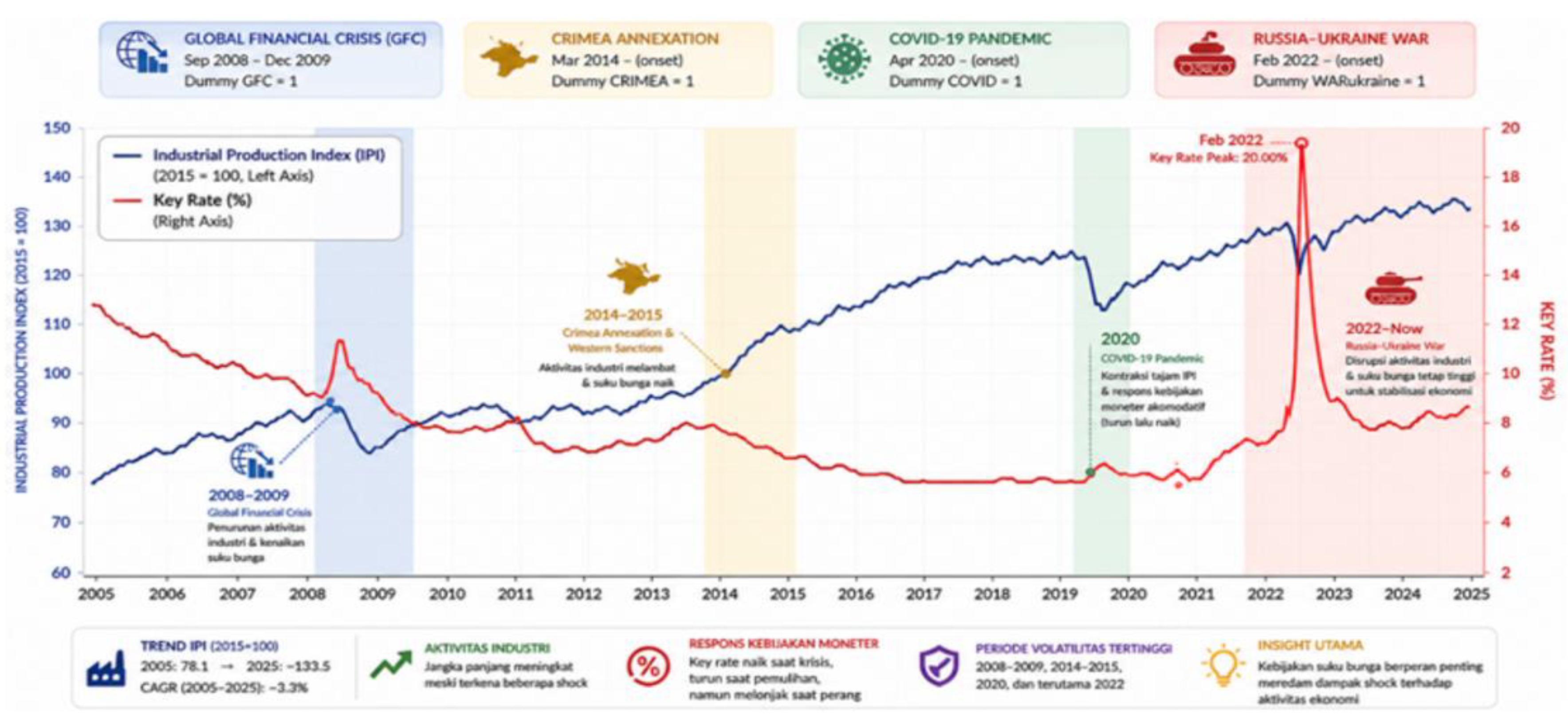
Table 1.
Definition of Variables and Data Sources.
| Variable | Symbol | Measurement | Expected Effect | Theoretical Basis |
Source |
|---|---|---|---|---|---|
| Exchange Rate | lnEXR | RUB per USD (log) | — | — | Federal Reserve Economic Data (FRED) |
| US Dollar Index | lnDXY | Index (log) | (+) | Global Financial Cycle | Federal Reserve / Trading Economics |
| Global Risk | VIX | Volatility Index | (+) | Risk Aversion | Chicago Board Options Exchange (CBOE) |
| Oil Price | lnOIL | USD/barrel (log) | (–) | Commodity Currency | U.S. Energy Information Administration (EIA) |
| Interest Rate Differential | IRD | Russia – US (%) | (–) | Interest Rate Parity | Central Bank of Russia; Federal Reserve |
| Inflation Differential | INFDIFF | Russia – US (%) | (+) | Purchasing Power Parity | Rosstat; U.S. Bureau of Labor Statistics |
| Inflation (Russia) | INFRUS | CPI (%) | (+) | Monetary / Price Dynamics | Rosstat |
| Inflation (United States) | INFUSA | CPI (%) | (–) | External Price Effect | U.S. Bureau of Labor Statistics |
| Policy Interest Rate (Russia) | KEYRATE | % | (–) | Monetary Policy Transmission | Central Bank of Russia |
| Federal Funds Rate | FF | % | (+) | Global Liquidity / Monetary Spillover | Federal Reserve |
| Industrial Production | lnIPI | Index (log) | (–) | Real Sector Effect | Rosstat / FRED |
| Money Supply | lnM3 | RUB billion (log) | (+) | Monetary Model | Central Bank of Russia |
| Foreign Reserves | lnRES | USD billion (log) | (–) | Reserve Buffer Theory | Central Bank of Russia |
| Exports | lnEXP | USD billion (log) | (–) | Trade Balance | Trading Economics / official statistics |
| Imports | lnIMP | USD billion (log) | (+) | Trade Balance | Trading Economics / official statistics |
Source: Author’s compilation based on data from federal reserve economic data (FRED), U.S. Energy Information Administration (EIA), Chicago Board Options Exchange (CBOE), Central Bank of Russia, Rosstat, U.S. Bureau of Labor Statistics, and Trading Economics.
Table 2.
Structural Break Dummies and Theoretical Basis.
| Dummy | Period | Description | Theoretical Basis | Source |
|---|---|---|---|---|
| GFC | 2008–2009 | Global Financial Crisis | Crisis Transmission (Bernanke, 2005) | International Monetary Fund (IMF) |
| CRIMEA | 2014–2015 | Crimea crisis & oil price collapse | Geopolitical Risk (Caldara & Iacoviello, 2018) | World Bank |
| COVID | 2020–2021 | Global pandemic shock | Global Uncertainty (Baker et al., 2020) | World Health Organization (WHO) |
| WAR | 2022–present | Russia–Ukraine war & sanctions | Sanctions & External Shock (Klose, 2024) | World Bank |
Source: Author’s compilation based on IMF, World Bank, World Health Organization, and related literature.
Table 3.
Theoretical Basis for the Structural Break Dummies.
| Dummy | Period | Description | Source |
|---|---|---|---|
| GFC | 2008–2009 | Global financial crisis | IMF |
| CRIMEA | 2014–2015 | Geopolitical shock | World Bank |
| COVID | 2020–2021 | Pandemic shock | WHO |
| WAR | 2022–present | War and sanctions | World Bank |
Source: Author’s compilation.
Table 4.
Descriptive Statistics.
| Variable | Mean | Std. Dev. | Min | Max | Skewness | Kurtosis |
|---|---|---|---|---|---|---|
| lnEXR | 3.844 | 0.463 | 3.151 | 4.702 | 0.017 | 1.392 |
| IRD | 13.073 | 2.697 | 4.696 | 17.587 | -0.906 | 3.340 |
| INFDIFF | 3.755 | 4.239 | -6.618 | 25.622 | 0.678 | 5.122 |
| lnDXY | 4.653 | 0.116 | 4.458 | 4.860 | -0.017 | 1.522 |
| VIX | 19.128 | 8.348 | 10.130 | 64.460 | 2.515 | 11.806 |
| lnOIL | 4.274 | 0.330 | 2.911 | 4.888 | -0.462 | 3.363 |
| KEYRATE | 14.767 | 1.819 | 10.026 | 19.441 | -0.223 | 2.514 |
| FF | 1.694 | 1.911 | 0.050 | 5.330 | 0.867 | 2.201 |
| INFRUS | 6.351 | 3.805 | -0.624 | 28.675 | 1.403 | 7.207 |
| INFUSA | 2.596 | 1.885 | -1.959 | 8.979 | 1.032 | 4.878 |
| lnIPI | 4.615 | 0.119 | 4.358 | 4.812 | -0.273 | 2.125 |
| lnM3 | 10.624 | 0.598 | 8.407 | 11.392 | -0.907 | 3.260 |
| lnRES | 5.700 | 0.514 | 4.207 | 6.434 | -0.767 | 2.855 |
| lnEXP | 5.743 | 0.342 | 4.934 | 6.270 | -0.473 | 2.227 |
| lnIMP | 5.339 | 0.352 | 4.494 | 5.882 | -0.497 | 2.229 |
Source: Author’s calculation.
Table 5.
Correlation Matrix (Core Variables).
| Variable | lnEXR | lnDXY | lnOIL | IRD | INFDIFF | KEYRATE | lnIPI |
|---|---|---|---|---|---|---|---|
| lnEXR | 1.000 | 0.939 | -0.304 | -0.536 | -0.586 | -0.765 | 0.816 |
| lnDXY | 0.939 | 1.000 | -0.410 | -0.587 | -0.532 | -0.706 | 0.708 |
| lnOIL | -0.304 | -0.410 | 1.000 | 0.039 | -0.164 | 0.014 | 0.185 |
| IRD | -0.536 | -0.587 | 0.039 | 1.000 | 0.332 | 0.706 | -0.528 |
| INFDIFF | -0.586 | -0.532 | -0.164 | 0.332 | 1.000 | 0.572 | -0.656 |
| KEYRATE | -0.765 | -0.706 | 0.014 | 0.706 | 0.572 | 1.000 | -0.773 |
| lnIPI | 0.816 | 0.708 | 0.185 | -0.528 | -0.656 | -0.773 | 1.000 |
Source: Author’s calculation.
Table 6.
Correlation Matrix (Extended Variables).
| Variable | VIX | FF | INFRUS | INFUSA | lnM3 | lnRES | lnEXP | lnIMP |
|---|---|---|---|---|---|---|---|---|
| VIX | 1.000 | 0.060 | -0.007 | -0.013 | 0.004 | -0.012 | -0.046 | -0.038 |
| FF | 0.060 | 1.000 | 0.129 | 0.090 | -0.102 | -0.090 | -0.051 | -0.092 |
| INFRUS | -0.007 | 0.129 | 1.000 | 0.004 | -0.664 | -0.637 | -0.665 | -0.649 |
| INFUSA | -0.013 | 0.090 | 0.004 | 1.000 | 0.101 | 0.126 | 0.158 | 0.173 |
| lnM3 | 0.004 | -0.102 | -0.664 | 0.101 | 1.000 | 0.970 | 0.971 | 0.948 |
| lnRES | -0.012 | -0.090 | -0.637 | 0.126 | 0.970 | 1.000 | 0.954 | 0.933 |
| lnEXP | -0.046 | -0.051 | -0.665 | 0.158 | 0.971 | 0.954 | 1.000 | 0.946 |
| lnIMP | -0.038 | -0.092 | -0.649 | 0.173 | 0.948 | 0.933 | 0.946 | 1.000 |
Source: Author’s calculation.
Table 7.
Unit Root Test Results.
| Variable | Level ADF | Prob. | Stationary (Level) | 1st Diff ADF | Prob. | Stationary (1st Diff) | Integration | Remarks |
|---|---|---|---|---|---|---|---|---|
| lnEXR | -1.144 | 0.6986 | No | -12.073 | 0.0000 | Yes | I(1) | Non-stationary, becomes stationary after differencing |
| lnDXY | -1.234 | 0.6602 | No | -10.394 | 0.0000 | Yes | I(1) | Requires differencing |
| VIX | -5.107 | 0.0000 | Yes | -14.125 | 0.0000 | Yes | I(0) | Stationary at level |
| lnOIL | -3.620 | 0.0060 | Yes | -10.967 | 0.0000 | Yes | I(0) | Stationary at level |
| IRD | -0.996 | 0.7552 | No | -11.834 | 0.0000 | Yes | I(1) | Integrated of order one |
| INFDIFF | -1.720 | 0.4199 | No | -6.381 | 0.0000 | Yes | I(1) | Becomes stationary after differencing |
| KEYRATE | -0.832 | 0.8077 | No | -10.598 | 0.0000 | Yes | I(1) | Strong unit root at level |
| FF | -2.569 | 0.1008 | No* | -6.818 | 0.0000 | Yes | I(1) | Weak at level, treated as non-stationary |
| INFRUS | -2.273 | 0.1817 | No | -7.056 | 0.0000 | Yes | I(1) | Non-stationary, stationary after differencing |
| INFUSA | -2.740 | 0.0688 | Weak | -4.114 | 0.0011 | Yes | I(1) | Marginal at level, treated as I(1) |
| lnM3 | -7.229 | 0.0000 | Yes | -12.568 | 0.0000 | Yes | I(0) | Strongly stationary |
| lnRES | -3.237 | 0.0191 | Yes | -10.956 | 0.0000 | Yes | I(0) | Stationary at level |
| lnEXP | -3.536 | 0.0079 | Yes | -13.475 | 0.0000 | Yes | I(0) | No differencing required |
| lnIMP | -0.978 | 0.7615 | No | -15.304 | 0.0000 | Yes | I(1) | Clearly non-stationary |
Source: Author's calculation through using ADF tests.
Table 9.
Baseline ARDL Model: Global Financial and Commodity Drivers of USD/RUB Exchange Rate.
| Variable | Coefficient | Std. Error | t-Statistic | p-value | |
|---|---|---|---|---|---|
| Long-run effects | |||||
| ln(BRENT) | -0.1017 | 0.0244 | -4.174 | 0.0000 | |
| ln(DXY) | 0.9205 | 0.1723 | 5.343 | 0.0000 | |
| VIX | 0.0005 | 0.0004 | 1.240 | 0.2162 | |
| Constant | -0.5143 | 0.3081 | -1.669 | 0.0965 | |
| Short-run dynamics | |||||
| Δln(BRENT) | -0.1017 | 0.0244 | -4.174 | 0.0000 | |
| Δln(DXY) | 0.9205 | 0.1723 | 5.343 | 0.0000 | |
| ΔVIX(-1) | -0.0020 | 0.0005 | -3.926 | 0.0001 | |
| ΔVIX(-2) | 0.0021 | 0.0004 | 4.675 | 0.0000 | |
| Error correction term | |||||
| CointEq(-1) | -0.0243 | 0.0038 | -6.395 | 0.0000 | |
| Model diagnostics | |||||
| Statistic | Value | ||||
| R-squared | 0.9968 | ||||
| Adjusted R-squared | 0.9965 | ||||
| F-statistic | 3497.69 | ||||
| Prob(F-stat) | 0.0000 | ||||
| Durbin-Watson | 1.98 | ||||
Notes: Δ denotes first-difference operator. Lag structure selected based on Akaike Information Criterion (AIC). HAC (Newey–West) standard errors are applied to ensure robustness. Source: Author’s estimation.
Table 10.
Results of Long-Run Relationship and Bounds Test Using ARDL.
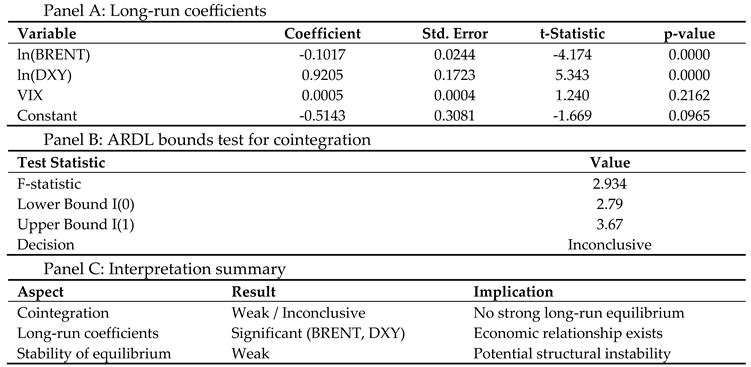 |
Notes:Critical values follow Pesaran et al. (2001). The null hypothesis is no cointegration. Decision rule: F > I(1) → cointegration F < I(0) → no cointegration Between → inconclusive Source: Author’s estimation.
Table 11.
Dynamic in the Short Term and the Mechanism of Error Correction.
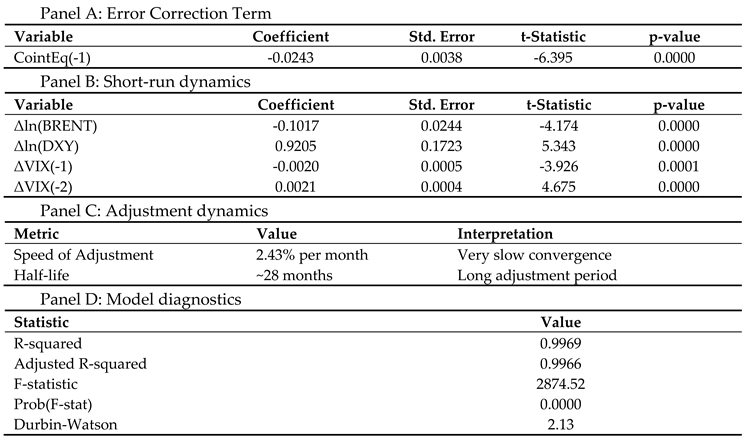 |
Notes: Δ denotes first-difference operator. The error correction term captures the speed of adjustment toward equilibrium. Half-life is computed based on the adjustment coefficient. HAC (Newey–West) standard errors are used for robustness. Source: Author’s estimation.
Table 12.
Structural Breaks and the Regime Dynamics of the Exchange Rate.
| Panel A: Structural break effects (long-run) | ||||||
| Variable | Coefficient | Std. Error | t-Statistic | p-value | ||
| DUMMY_CRIMEA (2014) | 0.0189 | 0.0072 | 2.635 | 0.0090 | ||
| DUMMY_WAR (2022) | 0.0300 | 0.0289 | 1.041 | 0.2992 | ||
| Panel B: Short-run impact of structural shocks | ||||||
| Variable | Coefficient | Std. Error | t-Statistic | p-value | ||
| ΔDUMMY CRIMEA(-1) | 0.0592 | 0.0270 | 2.193 | 0.0293 | ||
| ΔDUMMY_WAR(-1) | 0.3004 | 0.0392 | 7.669 | 0.0000 | ||
| ΔDUMMY WAR(-2) | -0.7986 | 0.0441 | -18.095 | 0.0000 | ||
| ΔDUMMY WAR(-3) | 0.4011 | 0.0659 | 6.083 | 0.0000 | ||
| Panel C: Structural break tests | ||||||
| Test | Break Date | Statistic | p-value | Conclusion | ||
| Chow Test | 2014M03 | 8.215 | 0.0000 | Structural break | ||
| Chow Test | 2022M02 | 12.564 | 0.0000 | Strong break | ||
| Bai–Perron | Multiple | — | — | Multiple regime shifts | ||
| Panel D: Interpretation summary | ||||||
| Aspect | Result | Implication | ||||
| Crimea Shock | Significant | Persistent exchange rate shift | ||||
| War Shock | Highly volatile | Strong short-run disruption | ||||
| Structural Stability | Rejected | Regime-dependent dynamics | ||||
Notes: Dummy variables capture major geopolitical events affecting the Russian economy. Chow test evaluates known breakpoints, while Bai–Perron identifies multiple breaks endogenously. Δ denotes first-difference operator. Source: Author’s estimation.
Table 13.
VAR for Dynamic Analysis of Shocks, Transmission, and Interaction Effects.
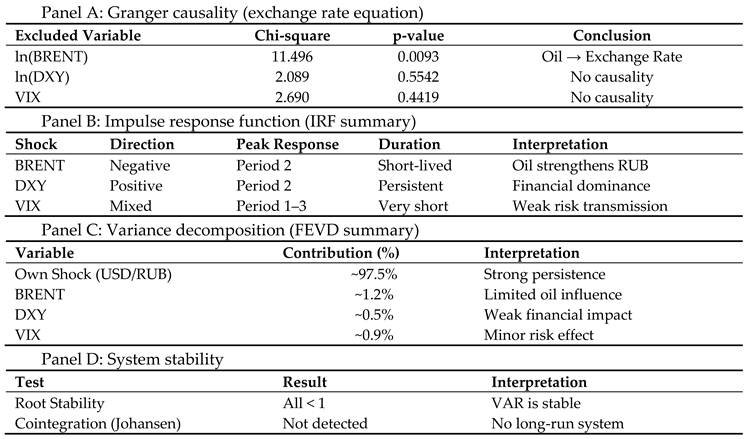 |
Notes: VAR lag length selected based on AIC and FPE criteria. IRF responses are based on Cholesky decomposition. FEVD reported at medium-to-long horizon. Granger causality uses Wald test statistics. Source: Author’s estimation.
Table 14.
Opinion Robustness Checks: Diagnostic and Stable Tests.
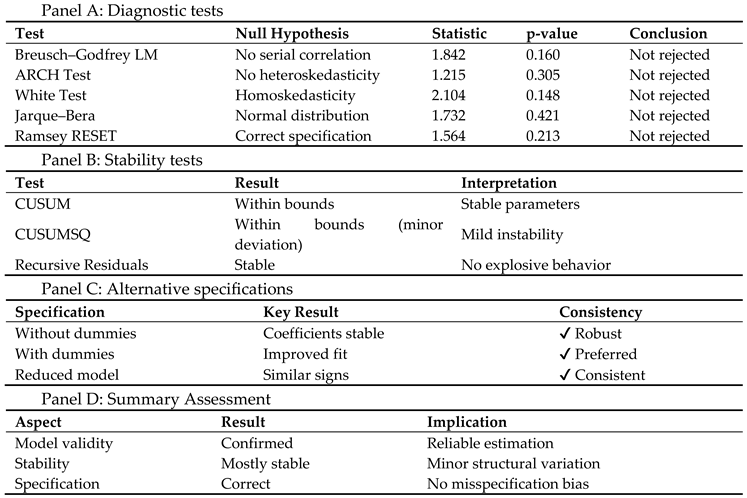 |
Notes: All tests are conducted at the 5% significance level. HAC standard errors ensure robustness against heteroskedasticity and autocorrelation. Stability tests assess parameter constancy over time. Source: Author’s estimation.
Table 15.
Other Channels: Interest Rate Divergence and Inflation Effects.
 |
Notes: IRD = Interest rate differential (Russia–US). INFDIFF = Inflation differential. Model estimated using ARDL framework with HAC standard errors. Δ denotes first-difference operator. Source: Author’s estimation.
Table 16.
Summary of Empirical Findings.
 |
Notes: Summary based on ARDL, ECM, VAR, IRF, FEVD, and structural break analysis. Results are consistent across multiple model specifications and robustness checks. Source: Author’s compilation.
Disclaimer/Publisher’s Note: The statements, opinions and data contained in all publications are solely those of the individual author(s) and contributor(s) and not of MDPI and/or the editor(s). MDPI and/or the editor(s) disclaim responsibility for any injury to people or property resulting from any ideas, methods, instructions or products referred to in the content. |
© 2026 by the authors. Licensee MDPI, Basel, Switzerland. This article is an open access article distributed under the terms and conditions of the Creative Commons Attribution (CC BY) license (http://creativecommons.org/licenses/by/4.0/).
Copyright: This open access article is published under a Creative Commons CC BY 4.0 license, which permit the free download, distribution, and reuse, provided that the author and preprint are cited in any reuse.


