

Submitted:
28 May 2026
Posted:
05 June 2026
You are already at the latest version
Abstract
Goal: This study aims to: (1) analyze the influence of human logical thinking on the use of mathematical concepts in culture; (2) identify aspects of human logical thinking relevant to ethnomathematics; and (3) explain the relationship between human logical thinking and the development of mathematical concepts in society, specifically within the geometric patterns of Batak Toba ulos and Mandailing woven fabrics. Methods: A qualitative literature review was conducted. The researcher collected and analyzed 32 sources (peer-reviewed journals, books, conference proceedings) published between 2013-2026. Thematic analysis was used with three a priori themes: patterns and relationships, systems and structures, and problem-solving. Social implications: Recognizing mathematics as embedded in cultural practices supports culturally responsive mathematics education, preserves indigenous knowledge systems, and challenges the view of mathematics as culturally neutral. This helps educators design contextual learning and policymakers integrate local wisdom into curricula.
Keywords:
human logical thinking
; ethnomathematics
; geometric patterns
; Batak Toba ulos
; Mandailing weaving
1. Introduction
Ethnomathematics examines the relationship between mathematics and culture, recognizing that mathematical concepts emerge from social practices and daily life (D'Ambrosio, 2018). Mathematics is not merely abstract formulas but also a human activity embedded in specific cultural and historical contexts (Cimen, 2020). Traditional societies develop counting systems, measurement methods, and geometric patterns that reflect logical reasoning, even without formal mathematical training (Baker, 2022).
The theoretical background draws from three perspectives. First, D'Ambrosio's (2018) ethnomathematics program establishes that mathematical knowledge is culturally produced. Second, cognitive theories suggest logical thinking develops through interaction with environmental and social contexts. Third, Tall's (2013) three worlds of mathematics provides a framework for understanding how mathematical thinking evolves from concrete cultural activities to abstract reasoning.
A significant gap remains in the literature. Most existing studies focus on describing mathematical content in cultural artifacts without investigating the cognitive mechanism that enables individuals to recognize, apply, and transmit those mathematical concepts (Umbara et al., 2023). Specifically, the role of human logical thinking as a mediating process between culture and mathematical understanding has been overlooked.
This study covers that gap by shifting focus from artifact description to cognitive process analysis, specifically examining geometric patterns in Batak Toba ulos and Mandailing woven fabrics, which contain repetitive triangular and rhombus motifs arranged in arithmetic progressions.
Research questions:
- How does human logical thinking relate to the development of mathematical concepts in society?
- How does human logical thinking influence the use of mathematical concepts in culture?
- What aspects of human logical thinking are relevant to ethnomathematics?
Objectives:
- To explain the relationship between human logical thinking and the development of mathematical concepts in society.
- To analyze the influence of human logical thinking on the use of mathematical concepts in culture.
- To identify aspects of human logical thinking relevant to ethnomathematics.
2. Study Design
2.1. Sample and Data
This qualitative study used a literature review method (Fink, 2022). The sample consisted of 32 sources: 18 peer-reviewed journal articles, 8 academic books, 4 conference proceedings, and 2 dissertation chapters published between 2013-2026. Databases used: Google Scholar, Scopus, and ERIC. Keywords: "ethnomathematics," "human logical thinking," "mathematical concepts," "Batak weaving," "ulos," and "Mandailing fabric." Inclusion criteria: direct relevance to ethnomathematics or logical reasoning, peer-reviewed (for journals), full-text availability. Exclusion criteria: non-peer-reviewed sources (except academic books) and studies without explicit cultural or logical focus.
2.2. Measures of Variables
Human logical thinking was defined as the ability to recognize patterns, understand cause-and-effect relationships, draw conclusions through deduction/induction, and solve problems systematically (Paul & Elder, 2022). Indicators: (a) pattern recognition, (b) systematic reasoning, (c) logical inference, (d) problem-solving strategies.
Ethnomathematical practice was defined as cultural activities embodying mathematical concepts such as counting, measuring, patterning, symmetry, and spatial organization within traditional contexts (Rosa & Orey, 2021). Indicators: (a) geometric motifs, (b) arithmetic sequences, (c) systematic measurement, (d) logical organization of cultural spaces or rituals.
Geometric patterns were operationalized as repetitive triangular and rhombus motifs documented in published images and ethnographic descriptions of ulos and Mandailing woven fabrics.
2.3. Models and Data Analysis Procedure
Thematic analysis (Braun & Clarke, 2006) was conducted in six phases:
- Phase 1: Familiarization with all 32 sources
- Phase 2: Initial coding (e.g., "pattern recognition," "systematic structure," "problem-solving strategy")
- Phase 3: Theme identification guided by three research questions → three a priori themes
- Phase 4: Theme review against coded extracts and full dataset
- Phase 5: Theme definition with sub-themes
- Phase 6: Synthesis, comparison with literature, interpretation
No statistical models were used. Analysis was qualitative, interpretive, and iterative.
2.4. Ethical Approval
This study did not involve human participants or experimental animals. All data were collected from publicly available published sources (peer-reviewed journals, books, and conference proceedings). Therefore, approval from a research ethics committee was not required under the Declaration of Helsinki guidelines. No informed consent was necessary as no human subjects were directly observed, surveyed, or interviewed. The study adhered to standard academic integrity practices, including accurate citation and avoidance of plagiarism.
3. Results and Discussion
Relationship between Logic and Mathematical Concepts
The findings indicate that logical thinking and mathematical concepts have a reciprocal and mutually reinforcing relationship. Logic serves as the foundation for the formation and understanding of mathematical concepts, while mathematics simultaneously strengthens systematic and analytical reasoning. This relationship is clearly reflected in Batak and Mandailing weaving traditions, particularly in the arrangement of ulos motifs that follow arithmetic progression patterns. For example, a weaving design may begin with three motifs in the first row, increase to five motifs in the second row, and continue systematically until reaching twenty-one motifs in the tenth row. Such a pattern demonstrates that artisans unconsciously employ logical reasoning to recognize regularities and predict subsequent arrangements. These findings support the theoretical perspective of Tall (2013), which emphasizes the central role of logical reasoning in mathematical concept development, while extending the discussion into a cultural and ethnomathematical context.
Influence of Logic on the Cultural Use of Mathematics
The study further reveals that logical thinking enables the practical application of mathematics in various cultural activities. Within Batak and Mandailing communities, logic functions as a cognitive tool for planning, measurement, resource allocation, and problem-solving. Weavers, for instance, are often able to calculate the total number of motifs in a pattern using mathematical reasoning rather than counting each motif individually. Through the application of arithmetic series formulas, they can determine that the total number of motifs in ten rows reaches 120 without direct counting. Similar logical principles are evident in the construction of traditional houses such as Rumah Bolon and Bagas Godang, where proportional symmetry and geometric balance are carefully maintained. These examples illustrate how logical reasoning facilitates efficient decision-making and practical mathematical thinking in everyday cultural practices. The findings confirm the arguments of D’Ambrosio (2018) regarding the embedded nature of mathematics within cultural activities while providing additional evidence concerning the cognitive mechanisms that support such applications.
Aspects of Logical Thinking in Ethnomathematics
The analysis identified three interconnected aspects of logical thinking within Batak and Mandailing ethnomathematics: recognition of patterns and relationships, understanding of systems and structures, and problem-solving abilities. Pattern recognition is evident in the identification of recurring geometric motifs and symmetrical designs found in traditional weaving. Systems and structures are represented through cultural frameworks such as Dalihan Na Tolu, a kinship system that organizes social relationships according to clear and consistent rules. Meanwhile, problem-solving skills emerge through practical estimation techniques and adaptive strategies used by community members in weaving, construction, and daily activities. These three aspects operate together rather than independently, forming an integrated framework of reasoning that supports both cultural continuity and mathematical understanding. The findings extend the work of Fouze and Amit (2018) by demonstrating that ethnomathematical practices involve not only pattern recognition and structural understanding but also sophisticated problem-solving processes. Consequently, ethnomathematics can be viewed as a rich context for developing multiple dimensions of logical thinking simultaneously.
3.1. Relationship Between Logical Thinking and Mathematical Concepts
The relationship between human logical thinking and mathematical concepts is mutually reinforcing. Logic provides the foundation for understanding numbers, operations, and patterns. For example, addition, subtraction, multiplication, and division require recognizing relationships between quantities—a fundamentally logical process (Cellucci, 2013). Conversely, mathematics trains systematic thinking through deduction, induction, and formal proof (Goranko, 2023).
In Batak weaving, this relationship appears clearly. The motif pattern follows an arithmetic sequence: first row = 3 motifs, each subsequent row increases by 2 motifs. The 10th row has 21 motifs (U₁₀ = 3 + 9×2 = 21). The weaver uses logical reasoning to continue the pattern without recalculating each row. This finding aligns with Tall's (2013) claim that mathematical thinking develops through pattern recognition but extends it by showing how cultural artifacts embody those patterns. This relationship was expected and confirms prior cognitive theories.
3.2. Influence of Logical Thinking on Cultural Use of Mathematics
Logical thinking enables three practical applications of mathematics in culture. First, planning: Weavers determine total motifs before starting. The sum of 10 rows (S₁₀ = 10/2 × (3+21) = 120 motifs) is calculated logically. Second, measurement: Traditional houses (Rumah Bolon, Bagas Godang) are built using proportional measurements and symmetry, requiring geometric reasoning. Third, resource management: Ceremonial arrangements require systematic calculations of participants, food distribution, and spatial positioning.
This finding confirms that mathematics in culture is not decorative but functional (Verschaffel et al., 2020). An unexpected finding was the absence of explicit mathematical terminology among weavers; they use practical language ("add two more," "match the sides") rather than formal terms ("arithmetic progression," "symmetry"). This suggests logical thinking operates tacitly.
3.3. Aspects of Logical Thinking Relevant to Ethnomathematics
Three cognitive aspects are consistently relevant. First, patterns and relationships: Humans naturally recognize repetitions, symmetries, and sequences. In ulos weaving, triangular and rhombus motifs repeat in structured arrangements, demonstrating implicit understanding of geometry and arithmetic.
Second, systems and structures: Communities organize knowledge systematically. Batak kinship (Dalihan Na Tolu) and traditional architecture reflect hierarchical classification and proportional balance—mathematical structures.
Third, problem-solving: Weavers solve practical challenges (e.g., maintaining symmetry across fabric width) using estimation, pattern continuation, and spatial visualization—higher-order thinking skills.
These three aspects extend D'Ambrosio's (2018) framework by specifying how logical thinking operates. Compared to Fouze and Amit (2018), who focused on indigenous games, this study identifies problem-solving as a distinct logical dimension. Compared to Rosa and Orey's (2021) ethnomodelling, this study highlights the cognitive process behind modeling.
3.4. Generalizability
The three-aspect framework is likely generalizable to other Indonesian weaving traditions (Ikat, Songket, Tenun) and other cultural contexts (architecture, ritual calendars). However, empirical testing through comparative studies is needed.
Figure 1 illustrates the dynamic relationship between logical thinking, culture, and mathematical concepts within the context of Batak and Mandailing ethnomathematics. Logical thinking serves as the cognitive foundation that enables individuals to recognize patterns, identify relationships, and construct systematic reasoning processes (Syahnia, S. M., Haenilah, E. Y., Perdana, R., & Caswita, C., 2024). Through logical reasoning, members of the community are able to organize knowledge, make estimations, and solve practical problems encountered in daily life. This logical framework supports the development of mathematical concepts such as arithmetic sequences, geometric patterns, proportionality, symmetry, and measurement. Consequently, logic acts as a bridge that transforms cultural experiences into meaningful mathematical understanding.
At the same time, culture provides the context in which mathematical ideas are created, applied, and transmitted across generations. Traditional practices such as ulos weaving, the construction of Rumah Bolon and Bagas Godang, and the implementation of the Dalihan Na Tolu kinship system embody mathematical principles that have been developed through long-term cultural experiences. These practices require individuals to apply logical reasoning when planning designs, managing resources, maintaining proportional relationships, and preserving social structures. As a result, culture becomes a living environment where mathematical concepts are continuously practiced and refined. The findings demonstrate that mathematical knowledge is not isolated from social life but is deeply embedded within cultural activities and traditions. (Siregar, T., 2025)
Furthermore, the figure highlights the reciprocal interaction among the three components. Logical thinking facilitates the understanding and application of mathematical concepts, while mathematical activities strengthen analytical and systematic reasoning abilities (Daniel, F., Turmudi, T., Juandi, D., & Kusnandi, K., 2025). Simultaneously, cultural practices provide authentic situations that stimulate the use of both logic and mathematics in meaningful ways. This cyclical relationship creates a continuous process of knowledge construction in which culture enriches mathematical understanding, mathematics supports cultural practices, and logical thinking connects the two domains (Br Ginting, S. S., Simanjorang, M., & Gultom, S., 2024). The model therefore suggests that ethnomathematics can serve as an effective framework for integrating cultural knowledge and mathematical learning while fostering higher-order thinking skills. Such a perspective extends existing theories in mathematics education by emphasizing the interconnected roles of cognition, culture, and mathematical reasoning in human learning.
Figure 2 presents the three interconnected aspects of logical thinking identified within the ethnomathematical practices of Batak and Mandailing communities: patterns and relationships, systems and structures, and problem-solving. These aspects collectively represent the cognitive processes through which individuals interpret, organize, and apply mathematical knowledge in cultural contexts. Rather than functioning independently, each aspect contributes to a comprehensive framework of logical reasoning that supports both cultural practices and mathematical understanding (Br Ginting, S. S., Simanjorang, M., & Gultom, S., 2024). The findings indicate that logical thinking emerges naturally through participation in traditional activities and social interactions. Consequently, ethnomathematics provides a rich environment for the development of higher-order thinking skills.
The first aspect, patterns and relationships, refers to the ability to identify regularities, sequences, and connections among objects or events. This aspect is evident in the recognition of repeating geometric motifs, symmetrical arrangements, and arithmetic progressions found in ulos weaving (Daniel, F., Turmudi, T., Juandi, D., & Kusnandi, K., 2025). Weavers must observe recurring designs and understand how each motif relates to the overall pattern in order to produce harmonious and balanced compositions (M. Murniati and S. S. B. Ginting, 2023). Through these activities, individuals develop the capacity to predict subsequent elements, classify shapes, and establish mathematical relationships. Such cognitive processes demonstrate how cultural artifacts can serve as meaningful contexts for developing mathematical reasoning and abstraction.
The second and third aspects, systems and structures and problem-solving, further illustrate the complexity of logical thinking within ethnomathematics. Systems and structures are reflected in organized cultural frameworks such as the Dalihan Na Tolu kinship system, where social roles and relationships operate according to consistent rules and hierarchical arrangements (Kartika, D., Suwanto, F. R., & Surbakti, N. M., 2024). Understanding these structures requires individuals to think systematically and recognize the interdependence of various components within a larger system. Meanwhile, problem-solving is demonstrated through practical estimation strategies, resource management, and decision-making processes used in weaving, construction, and other traditional activities. Community members often rely on logical reasoning to overcome constraints, optimize materials, and achieve desired outcomes efficiently (Fredrik, J., Budiyono, & Siswanto, 2021). Together, these three aspects reveal that ethnomathematics encompasses not only mathematical content but also sophisticated forms of logical thinking that are essential for both cultural preservation and intellectual development.
Figure 3 illustrates an integrated conceptual framework that explains how logical thinking operates within ethnomathematical practices and contributes to the development of mathematical understanding. The framework positions logical thinking as the central cognitive mechanism that connects cultural experiences with mathematical knowledge construction (Fredrik, J., Budiyono, & Siswanto, 2021). Through engagement in culturally embedded activities, individuals encounter patterns, structures, and practical challenges that require reasoning and decision-making (Dominikus, W. S., Udil, P. A., Nubatonis, O. E., & Blegur, I. K. S., 2023). These experiences stimulate the development of logical processes such as classification, comparison, inference, generalization, and systematic analysis. As a result, mathematical concepts emerge not merely as abstract knowledge but as meaningful understandings grounded in cultural practices and everyday experiences.
The framework further demonstrates that ethnomathematical activities provide authentic contexts in which logical thinking can be continuously exercised and refined. In Batak and Mandailing communities, traditional weaving practices, architectural designs, and kinship systems offer opportunities to identify patterns, understand proportional relationships, and solve practical problems. For example, weavers apply logical reasoning when determining motif arrangements, predicting pattern extensions, and estimating material requirements (Fredrik, J., Budiyono, & Siswanto, 2021). Similarly, the construction of traditional houses requires consideration of symmetry, balance, and spatial relationships. These cultural practices function as learning environments where individuals naturally integrate observation, reasoning, and mathematical thinking. Consequently, ethnomathematics serves as a bridge between informal cultural knowledge and formal mathematical concepts.
The integrated logic-of-thinking scheme also highlights the cyclical and reciprocal relationship among culture, logical reasoning, and mathematics. Cultural practices provide the context and resources for logical exploration, while logical thinking enables individuals to extract mathematical ideas from those practices. In turn, mathematical concepts strengthen analytical and systematic reasoning, allowing individuals to engage more effectively with cultural activities (M. Murniati and S. S. B. Ginting, 2023). This continuous interaction creates a dynamic process of knowledge construction in which culture, logic, and mathematics mutually reinforce one another (Dominikus, W. S., Udil, P. A., Nubatonis, O. E., & Blegur, I. K. S., 2023). The framework therefore suggests that ethnomathematics should be viewed not only as a source of contextualized mathematical content but also as a powerful medium for cultivating logical thinking and higher-order cognitive skills. Such an integrated perspective contributes to a broader understanding of mathematics education by emphasizing the inseparable relationship between cognition, culture, and mathematical learning.
Figure 4 presents examples of traditional Batak Toba ulos and Mandailing woven fabrics characterized by repetitive geometric patterns that reflect sophisticated mathematical ideas embedded within local cultural practices. The motifs displayed in these textiles consist of recurring arrangements of lines, rectangles, diamonds, and symmetrical shapes organized according to specific design principles. These patterns are not randomly created but follow structured sequences that require careful planning and precise execution. Through the repetition and arrangement of motifs, weavers demonstrate an intuitive understanding of mathematical concepts such as symmetry, transformation, tessellation, and geometric regularity. The visual evidence provided by the woven fabrics illustrates how mathematical thinking is naturally integrated into artistic and cultural expression.
The repetitive geometric structures found in the fabrics also reveal the role of logical thinking in the weaving process. Before weaving begins, artisans must determine the sequence of motifs, the spacing between patterns, and the proportional relationships among design elements. Such decisions require the recognition of patterns, prediction of subsequent arrangements, and maintenance of consistency throughout the textile. In many cases, weavers rely on inherited knowledge and practical reasoning to ensure that the overall design remains balanced and harmonious. This process reflects the application of logical thinking through pattern recognition, systematic organization, and continuous monitoring of relationships among geometric elements. Consequently, the weaving tradition serves as a practical example of how logic supports the construction and implementation of mathematical ideas in everyday cultural activities.
The figure highlights the significance of ethnomathematics as a bridge between cultural heritage and mathematical learning. The geometric motifs embedded in Batak Toba and Mandailing textiles provide authentic contexts through which abstract mathematical concepts can be explored and understood. Students and researchers can analyze these patterns to investigate concepts such as symmetry, sequences, proportional reasoning, spatial visualization, and geometric transformations. By connecting mathematics with culturally meaningful artifacts, ethnomathematics promotes a more contextualized and inclusive understanding of mathematical knowledge. Therefore, the woven fabrics shown in Figure 4 not only represent important cultural symbols but also serve as valuable educational resources for fostering logical reasoning and mathematical literacy through culturally relevant learning experiences.
3.5. Example of Ethnomathematics-Based Mathematics Problem
Problem: A Batak Toba ulos craftsman creates repeating geometric patterns. The first row has 3 motifs. Each subsequent row increases by 2 motifs.
Questions:
- How many motifs in the 10th row?
- What is the total number of motifs from row 1 to row 10?
- Explain the relationship between this pattern and Batak logical thinking.
Solution:
- U₁₀ = 3 + (10-1)×2 = 21 motifs
- S₁₀ = 10/2 × (3+21) = 120 motifs
Connection: This problem reflects three framework elements: patterns (arithmetic sequence), systems (organized arrangement), and problem-solving (logical calculation without individual counting).
4. Conclusion
4.1. Theoretical Implications
This study advances ethnomathematics theory in three ways. First, it operationalizes human logical thinking as three distinct cognitive dimensions—patterns and relationships, systems and structures, problem-solving—that mediate between cultural practices and mathematical concepts. Prior frameworks treated logical thinking as unitary; this study specifies its components.
Second, it challenges the assumption that mathematical knowledge is culturally neutral. By demonstrating Batak weavers employ arithmetic progression and symmetry without formal Western training, the study supports a socio-constructivist view of mathematical cognition (D'Ambrosio, 2018).
Third, it extends Tall's (2013) three worlds of mathematics by showing the "conceptual-embodied" world is not merely a developmental stage but a culturally sustained mode of reasoning.
4.2. Policy and Managerial Implications
For curriculum developers: Integrate local weaving patterns into mathematics lessons on arithmetic sequences, symmetry, and spatial reasoning. The Indonesian Kurikulum Merdeka already emphasizes local wisdom; this study provides empirical justification.
For teacher training: Develop modules helping teachers identify ethnomathematical content in their communities and transform it into lesson plans using the three-aspect framework.
For schools: Design culturally responsive lessons. Example: Use ulos motifs to teach arithmetic series. Ask: "If row 1 has 3 motifs and each row increases by 2, how many in row 10? Total?"
For cultural heritage organizations: When preserving woven fabrics, also document the logical strategies used to create them.
4.3. Ideas for Future Research
- Comparative studies: Replicate with Ikat, Songket, and Tenun traditions to test the three-aspect framework.
- Experimental designs: Measure mathematics achievement and logical thinking skills comparing ethnomathematics-based instruction versus conventional methods.
- Ethnographic fieldwork: Conduct observation and think-aloud protocols with master weavers to capture tacit reasoning.
- Developmental studies: Investigate how children in weaving communities acquire pattern recognition and arithmetic reasoning naturally.
- Design-based research: Collaborate with teachers and weavers to develop, implement, and refine ethnomathematics curriculum units.
- Cross-cultural cognitive studies: Compare logical thinking in ethnomathematical contexts across continents (e.g., Batak weaving, Andean textiles, African kente cloth).
4.4. Limitations
Methodological limitations: Literature-based only; no primary data from weavers through observation or interviews. Important tacit knowledge may be missing.
Contextual limitations: Focuses specifically on Batak Toba and Mandailing cultures. Findings may not generalize without replication.
Temporal limitations: Sources 2013-2026; practices may have changed due to modernization and tourism.
Linguistic limitations: Sources restricted to English and Indonesian; Dutch colonial documentation or local language sources may have been excluded.
Theoretical limitations: Cognitive framework adopted; other frameworks (embodied cognition, distributed cognition, postcolonial theory) might reveal different aspects.
Funding
This research received no specific grant from any funding agency.
Ethical Approval
Not applicable (no human or animal participants).
Consent for Publication
The author has agreed to publication.
Data Availability Statement
No new data were created. This research is based on a literature review of published sources.
Acknowledgments
The author expresses gratitude to Universitas Negeri Padang and UIN Syekh Ali Hasan Ahmad Addary Padangsidimpuan for academic support.
Declaration of Competing Interest
The author declares no known competing financial interests or personal relationships that could have influenced this work.
References
- Anderson-Pence, K. L. Ethnomathematics: The role of culture in the teaching and learning of mathematics. Utah Math. Teach. 2015, 3(2), 52–60. [Google Scholar]
- Ascher, M.; D'Ambrosio, U. Ethnomathematics: A dialogue. Learn. Math. 1994, 14(2), 36–43. Available online: http://www.jstor.org/stable/40248114.
- Baker, M. The western mathematic and the ontological turn: Ethnomathematics and cosmotechnics for the pluriverse. In Indigenous knowledge and ethnomathematics; Vandendriessche, E., Pinxten, R., Eds.; Springer, 2022; pp. 123–145. [Google Scholar] [CrossRef]
- Bernardi, L. dos S.; Santos, J. A. Math education in intercultural contexts: A logical-mathematical interpretation for duality Kaingang Kamé-Kairu. Ciência Educ. 2021, 27, e21011. [Google Scholar] [CrossRef]
- Bishop, A. J. Mathematical enculturation: A cultural perspective on mathematics education; Kluwer Academic Publishers, 1988. [Google Scholar]
- Br Ginting, S. S.; Simanjorang, M.; Gultom, S. DIVERSED ETHNOMATHEMATICS EXPLORATIONS OF BATAK CULTURES IN NORTH SUMATERA. Ethnomathematics J. 2024, 5(1), 1–13. [Google Scholar] [CrossRef]
- Cellucci, C. Rethinking logic: Logic in relation to mathematics, evolution, and method; Springer, 2013. [Google Scholar]
- Cimen, O. A. Discussing ethnomathematics: Is mathematics culturally dependent? J. Educ. Sci. 2020, 12(3), 45–56. [Google Scholar] [CrossRef]
- D’Ambrosio, U. Ethnomathematics and its place in the history and pedagogy of mathematics. In Second international handbook of mathematics education; Bishop, A., Clements, M. A., Keitel, C., Kilpatrick, J., Leung, F., Eds.; Springer, 2018; pp. 243–268. [Google Scholar]
- D'Ambrosio, U. The program ethnomathematics: Cognitive, anthropological, historic and socio-cultural bases. PNA 2018, 12(4), 229–247. [Google Scholar] [CrossRef]
- Daniel, F.; Turmudi, T.; Juandi, D.; Kusnandi, K. Exploring Mathematical Concepts in Buna Woven Fabric Motifs of the Amanuban Community and Their Integration into Mathematics Education. J. La. Edusci 2025, 6(2), 230–247. [Google Scholar] [CrossRef]
- Dominikus, W. S.; Udil, P. A.; Nubatonis, O. E.; Blegur, I. K. S. Exploration of the weaving activities in Timor Island for mathematics learning. Ethnomathematics J. 2023, 4(1), 1–18. [Google Scholar] [CrossRef]
- Fauzi, A. H.; Rahma, M. A.; Insyiroh, R. N.; Laili, S. N.; Rizki, A. Ethnomathematics-based examination of logical reasoning and measurement within the Sritanjung and Sidapaksa legend for mathematics education. LINEAR J. Math. Educ. 2026, 7(1), 31–43. [Google Scholar]
- Fink, A. Conducting research literature reviews: From the internet to paper, 6th ed.; Sage Publications, 2022. [Google Scholar]
- Fouze, A. Q.; Amit, M. Development of mathematical thinking through integration of ethnomathematics folklore game in math instruction. EURASIA J. Math. Sci. Technol. Educ. 2018, 14(2), 617–630. [Google Scholar] [CrossRef] [PubMed]
- Fredrik, J.; Budiyono; Siswanto. Ethnomathematics activities in kain timur making (The Moi tribe mas kawin tradition, Sorong City, West Papua). In Proceedings of the Annual International Conference on Education and Social Science (AICESS 2021); Atlantis Press, 2021. [Google Scholar] [CrossRef]
- Gerdes, P. Geometry from Africa: Mathematical and educational explorations; Mathematical Association of America, 1999. [Google Scholar]
- Goranko, V. Logic as a tool: A guide to formal logical reasoning; John Wiley & Sons, 2023. [Google Scholar]
- Kartika, D.; Suwanto, F. R.; Surbakti, N. M. AMBATIG: Android application for generating batik motifs using frieze symmetry group transformations. ZERO J. Sains Mat. Dan Terap. 2024, 9(3). [Google Scholar] [CrossRef]
- Murniati, M.; Ginting, S. S. B. “Ethnomathematics in Ulos Abit Godang of South Tapanuli, North Sumatra”. IJSME 2023, vol. 6(no. 3), 341–350. [Google Scholar] [CrossRef]
- Nur, A. S.; Waluya, S. B.; Rochmad, R.; Wardono, W. Contextual learning with ethnomathematics in enhancing the problem solving based on thinking levels. JRAMathEdu 2020, 5(3), 331–344. [Google Scholar] [CrossRef]
- Paul, R.; Elder, L. The miniature guide to critical thinking concepts and tools, 8th ed.; Rowman & Littlefield, 2022. [Google Scholar]
- Rosa, M.; Orey, D. C. State of the art in ethnomathematics. In Current and future perspectives of ethnomathematics as a program; Rosa, M., D’Ambrosio, U., Orey, D. C., Shirley, L., Alangui, W. V., Palhares, P., Gavarrete, M. E., Eds.; Springer, 2016; pp. 11–37. [Google Scholar]
- Rosa, M.; Orey, D. C. Applying ethnomodelling to explore glocal mathematical knowledge systems. Acta Sci. 2021, 23(1), 199–232. [Google Scholar] [CrossRef]
- Siregar, T. Etnomatematika Nusantara. In Goresan Pena; 2025. [Google Scholar]
- Siregar, T. Application of the Peer Tutoring Method in Enhancing Students’ Mathematical Understanding and Learning Motivation; Preprints., 2025. [Google Scholar]
- Syahnia, S. M.; Haenilah, E. Y.; Perdana, R.; Caswita, C. Ethnomathematics-based Problem Based Learning (PBL) model to increase students' critical thinking in mathematics learning. Lect. J. Pendidik. 2024, 15(2), 571–581. [Google Scholar] [CrossRef]
- Tall, D. How humans learn to think mathematically: Exploring the three worlds of mathematics; Cambridge University Press, 2013. [Google Scholar] [CrossRef]
- Umbara, U.; Prabawanto, S.; Jatisunda, M. G. Combination of mathematical literacy with ethnomathematics: How to perspective Sundanese culture. Infin. J. 2023, 12(2), 393–414. [Google Scholar] [CrossRef]
- Untuk memperkuat bagian ethnomathematics Batak/Mandailing, Anda juga dapat menambahkan referensi berikut.
- Verschaffel, L.; Schukajlow, S.; Star, J.; Van Dooren, W. Word problems in mathematics education: A survey. ZDM Math. Educ. 2020, 52, 1–16. [Google Scholar] [CrossRef]
Figure 1.
The Relationship between Thinking Logic, Culture, and Mathematical Concepts.
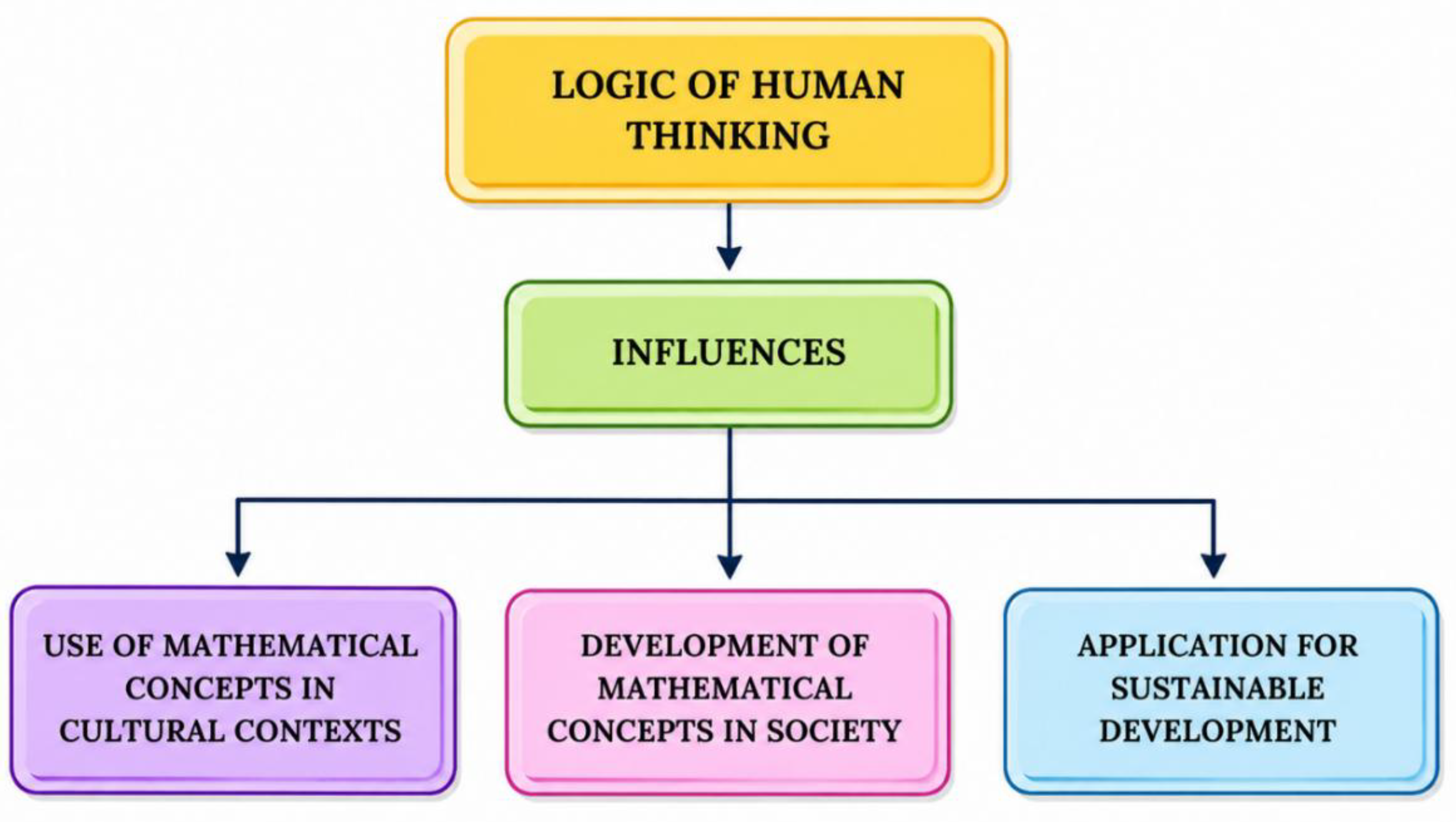
Figure 2.
Aspects of Thinking Logic in the Ethnomathematics Context.
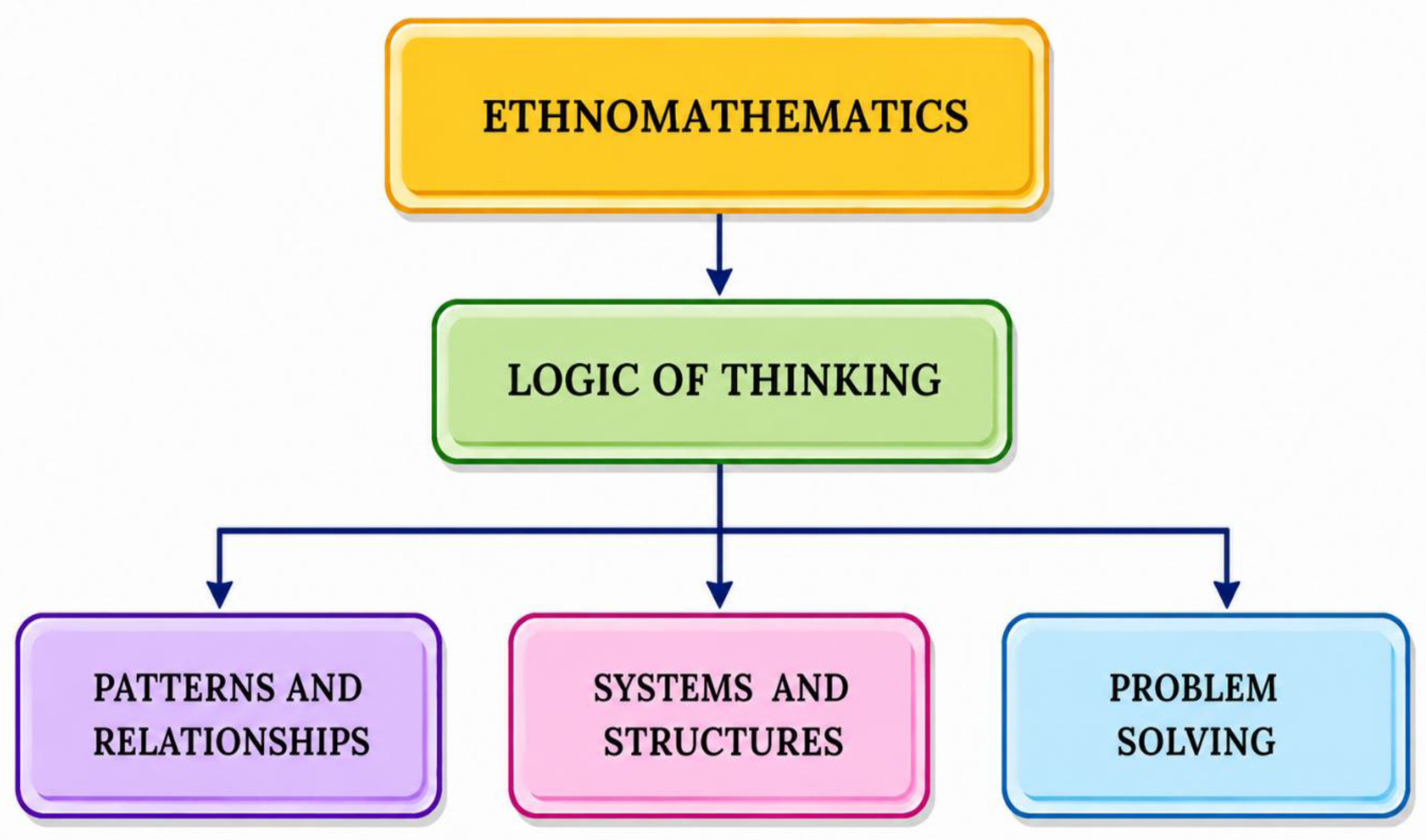
Figure 3.
Conceptual Elaboration of the Integrated Logic-of-Thinking Scheme in Ethnomathematics.
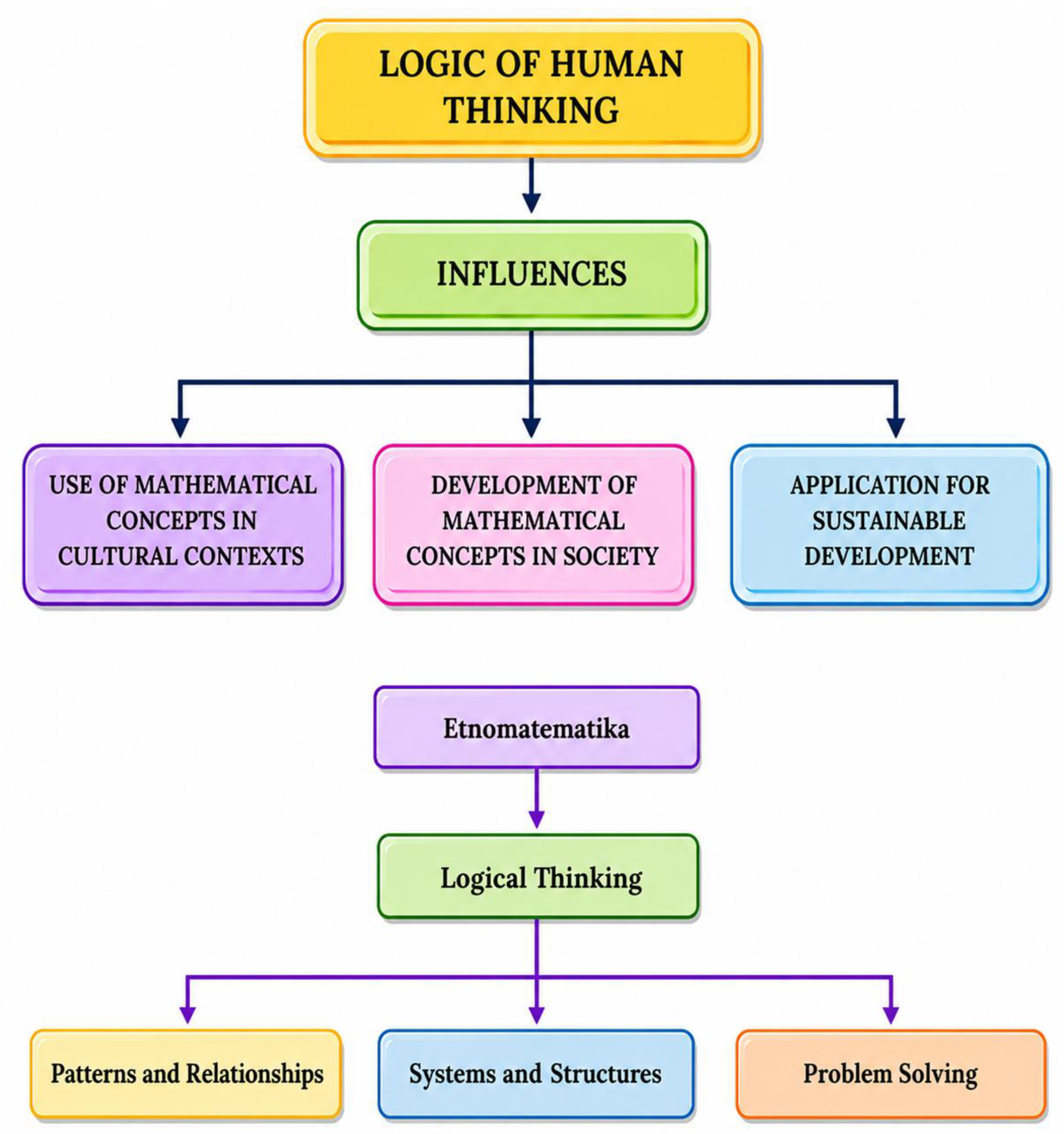
Figure 4.
Examples of Batak Toba Ulos and Mandailing Woven Fabrics with Repetitive Geometric Patterns. Source: Department of Culture and Tourism of North Sumatra Province, Indonesia, 2026.
Figure 4.
Examples of Batak Toba Ulos and Mandailing Woven Fabrics with Repetitive Geometric Patterns. Source: Department of Culture and Tourism of North Sumatra Province, Indonesia, 2026.
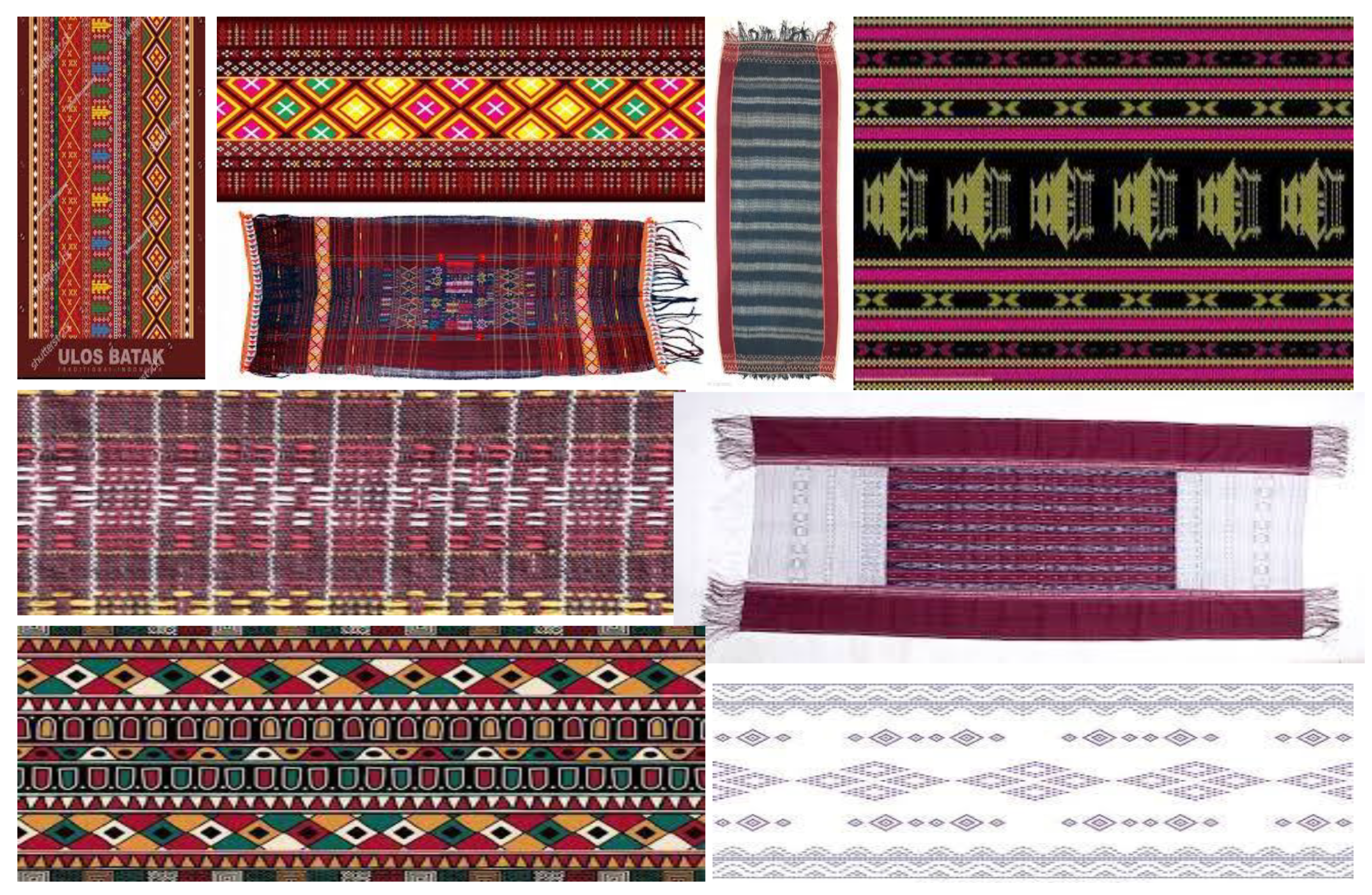

Table 1.
Summary of Main Findings.
| Research Question | Key Finding | Evidence from Batak/Mandailing Weaving | Comparison with Literature |
| RQ1: Relationship between logic and math concepts | Mutual influence: logic enables concept formation; math trains systematic thinking | Arithmetic progression in ulos motifs (row 1: 3 motifs, row 2: 5, row 10: 21) | Supports Tall (2013); extends to cultural context |
| RQ2: Influence of logic on cultural use of mathematics | Logic enables practical application in planning, measurement, resource management, problem-solving | Weavers calculate total motifs without individual counting (S₁₀ = 120); traditional houses (Rumah Bolon, Bagas Godang) use proportional symmetry | Confirms D'Ambrosio (2018); adds specific cognitive mechanisms |
| RQ3: Aspects of logical thinking in ethnomathematics | Three interconnected aspects: patterns & relationships, systems & structures, problem-solving | Recognition of repeating geometric motifs; systematic kinship (Dalihan Na Tolu); practical estimation strategies | Extends Fouze & Amit (2018); adds problem-solving dimension |
Disclaimer/Publisher’s Note: The statements, opinions and data contained in all publications are solely those of the individual author(s) and contributor(s) and not of MDPI and/or the editor(s). MDPI and/or the editor(s) disclaim responsibility for any injury to people or property resulting from any ideas, methods, instructions or products referred to in the content. |
© 2026 by the authors. Licensee MDPI, Basel, Switzerland. This article is an open access article distributed under the terms and conditions of the Creative Commons Attribution (CC BY) license (http://creativecommons.org/licenses/by/4.0/).
Copyright: This open access article is published under a Creative Commons CC BY 4.0 license, which permit the free download, distribution, and reuse, provided that the author and preprint are cited in any reuse.