

Submitted:
04 June 2026
Posted:
05 June 2026
You are already at the latest version
Abstract
Sustainable agri-food value chains increasingly depend on smallholders' capacity to participate in markets in stable, remunerative and upgrade-oriented ways. Yet in conflict-affected and politically constrained settings, market integration is weakened by mobility restrictions, insecure logistics, payment disruptions, volatile input systems, thin market information and uncertain enforcement. This integrative review synthesizes peer-reviewed evidence on how these constraints reshape smallholder integration across agricultural value chains and how governance and institutional arrangements can reduce, or sometimes reproduce, market exclusion. A structured narrative search of Scopus, Web of Science and Google Scholar was organized around smallholders, market integration, agricultural value chains and conflict or political constraint. Evidence was coded across seven diagnostic dimensions: inputs and supplies, production capacity and technology, end-markets and trade, value chain governance, sustainable production and energy use, value chain finance, and the enabling business and socio-political environment. The synthesis shows that governance and institutions operate as a conditional bridge: cooperatives, contracting, trader coordination, market-support institutions and public enabling arrangements can lower transaction costs and stabilize exchange, but only where transparency, credible enforcement, fair risk-sharing and protection against opportunism are present. The review concludes with a measurement-focused research agenda for resilient and sustainable value-chain integration under constraint.
Keywords:
smallholder farmers
; market integration
; agricultural value chains
; sustainable food systems
; conflict-affected settings
; political constraints
; transaction costs
; governance
; institutions
; resilience
1. Introduction
Agri-food systems in low- and middle-income countries have undergone a marked restructuring. The growth of processors, traders, logistics firms, retailers and service providers has moved value creation beyond the farm gate and has made coordination, quality differentiation and service bundles central to market access [1]. For smallholders, this transformation means that market integration cannot be reduced to whether a farmer sells output at least once. A more useful understanding asks whether the farmer can engage markets in a sustained, remunerative and upgrade-oriented manner: whether sales relationships are credible, whether inputs and information arrive on time, whether product quality can be rewarded, and whether participation generates incentives for further investment.
This distinction matters for both development and sustainability. Value-chain participation can support income growth when it changes production decisions, marketing behavior and household investment rather than merely shifting the point of sale [2]. At the same time, the benefits of value-chain development are not uniform. Evidence from Nepal shows that agricultural value-chain interventions can raise agricultural income and reshape marketing behavior, but the distribution of gains can differ across social groups [2,3]. Similarly, value-chain inclusiveness can improve resilience to shocks when coordination arrangements provide predictable outlets and support services, as shown in Zambia’s sugar belt [4]. However, recent multi-country evidence from Burkina Faso, Mozambique and Cote d’Ivoire cautions against assuming a simple value-chain participation to nutrition pathway, particularly where power relations and gendered risks are insufficiently addressed [5].
Conflict-affected and politically constrained environments make this problem sharper. Farmers may possess productive potential, yet the feasibility of market engagement is shaped by constraints that destabilize the basic functions of exchange. Mobility limitations, disrupted banking, unreliable fuel and electricity, uncertain information, and weak enforcement can raise transaction costs, reduce market predictability and discourage quality upgrading. In Myanmar, for example, post-coup disruptions to banking and transport increased distribution margins and price dispersion in the rice value chain [6]. Broader evidence from Myanmar’s agrifood value chains shows that disruption travels across farmers, input retailers, traders, millers and vendors, affecting both farm and consumer prices [7].
Political constraint also changes bargaining power. When farmers depend on a restricted number of intermediaries who themselves face high risk, information asymmetry and opportunistic grading or delayed payments can become more likely. This is especially important because high physical and institutional transaction costs limit the intensity and quality of market participation, while collective action may improve welfare only if it avoids weak governance and elite capture [8]. Collaboration in agricultural value chains, whether vertical, horizontal or network-based, can improve participation when it is supported by reliable public and non-public actors [9]. Yet such collaboration is particularly difficult where distance is administrative, political and infrastructural as well as geographical [10].
This review therefore asks two connected questions. First, what constraints most consistently weaken smallholder market integration in conflict-affected and politically constrained agricultural value chains? Second, under what conditions do governance and institutional arrangements help stabilize market integration rather than simply moving risk onto smallholders? The paper answers these questions through an integrative review, bringing together evidence from market access studies, value-chain analysis, New Institutional Economics and recent empirical work on fragile and constrained food systems. The contribution is threefold. It provides a seven-dimension diagnostic synthesis of market-integration bottlenecks, develops a governance-centered interpretation of why bridging arrangements work or fail under constraint, and clarifies how market integration is measured across household, value-chain and market-system levels.
The article is intentionally positioned for the sustainability of agri-food value chains. In this framing, sustainability is not limited to environmental performance. It also concerns the reliability, inclusiveness and resilience of the chain relationships through which food, money, information and risk move. A value chain that cannot sustain credible exchange under predictable political stress is unlikely to support long-term investment in product quality, resource use, value addition or food-system resilience.
2. Materials and Methods
2.1. Review Design and Scope
The paper uses an integrative review design. It is not presented as a systematic review or meta-analysis, because the relevant evidence is dispersed across agricultural economics, food policy, development studies, value-chain analysis, institutional economics and conflict studies. The purpose is therefore conceptual and diagnostic rather than exhaustive: to synthesize mechanisms, map recurring constraints and identify governance conditions that appear to shape integration outcomes under high transaction costs and weak enforcement. This choice is appropriate where studies use different units of analysis, ranging from household commercialization and channel choice to spatial price transmission, value-chain margins, adoption and resilience.
The review focuses on smallholder farmers and small-scale producers, while recognizing that smallholders are heterogeneous in land size, assets, market orientation, risk exposure and adaptive capacity. The setting of interest is conflict-affected or politically constrained environments. This includes cases where insecurity, occupation, mobility restrictions, sanctions, regulatory uncertainty, institutional weakness, finance disruption, transport risk or enforcement limitations materially affect value-chain functions. The unit of analysis is the agricultural value chain, including inputs, production, aggregation, storage, processing, logistics, wholesale, retail and market-support functions.
2.2. Search Strategy and Eligibility Criteria
The search was conducted through Scopus, Web of Science and Google Scholar using four keyword blocks: (i) smallholder OR small-scale farmer; (ii) market integration OR market participation OR market access OR commercialization; (iii) value chain OR supply chain OR agrifood chain; and (iv) conflict OR fragility OR political constraint OR occupation OR governance OR institutions OR cooperative OR contract OR coordination. Backward and forward citation tracing was used for cornerstone papers on market participation, value-chain transformation, contract farming, collective action and spatial market integration. Institutional web sources were consulted only to clarify terminology and identify leads; the synthesis itself is based on peer-reviewed journal articles.
Articles were eligible when they addressed smallholder market integration or a closely related proxy and examined at least one barrier, enabling condition, governance arrangement or institutional factor relevant to market participation. Studies were included if they reported empirical evidence, conceptual frameworks or review-based findings that helped explain mechanisms across value-chain nodes. Articles were excluded when they were purely macro trade analyses without a smallholder or value-chain mechanism, non-peer-reviewed opinion pieces, project reports without journal publication, or papers that discussed conflict or food security without an identifiable pathway to market integration.

Table 1.
Search strategy, boundaries and eligibility rules used in the integrative review.
| Review Element | Operational Decision | Purpose in the Synthesis |
|---|---|---|
| Population | Smallholder and small-scale farmers, as defined by each study. | Avoids imposing a single farm-size threshold across heterogeneous regions. |
| Setting | Conflict-affected, fragile or politically constrained environments; comparable high-risk settings were included when they clarified mechanisms. | Captures insecurity, occupation, mobility limits, sanctions, banking disruption, enforcement weakness and policy uncertainty. |
| Value-chain unit | Inputs, production, aggregation, processing, logistics, finance, end markets and support institutions. | Prevents the review from treating market access as a farm-gate issue only. |
| Integration outcomes | Commercialization intensity, channel choice, sustained participation, price transmission, margins, transaction costs, quality compliance and upgrading. | Allows comparison across household, chain and market-system evidence. |
| Inclusion criteria | Peer-reviewed studies addressing market integration or close proxies and at least one barrier, enabler, governance arrangement or institutional condition. | Focuses the synthesis on mechanisms that can inform sustainable value-chain design. |
| Exclusion criteria | Macro trade studies without a smallholder mechanism; non-peer-reviewed reports; opinion pieces; studies without value-chain relevance. | Improves conceptual coherence while recognizing that this is not a systematic review. |
2.3. Data Extraction and Synthesis
Eligible studies were coded using an extraction matrix with five fields: context characteristics, chain nodes, constraint type, governance or institutional arrangement, and integration outcome or proxy. The coding was then organized into seven diagnostic dimensions: inputs and supplies; production capacity and technology; end-markets and trade; governance of value chains; sustainable production and energy use; value chain finance; and business environment and socio-political context. These dimensions were selected because they cover the main functional sites where political constraints can amplify transaction costs and weaken integration.
The synthesis proceeded in two stages. First, recurring patterns and contradictions were consolidated within each diagnostic dimension. Second, cross-cutting interpretation was used to identify how governance and institutions mediate integration under high risk. Special attention was given to whether arrangements reduce transaction costs, stabilize information and payments, support upgrading, distribute risk fairly and remain credible when formal enforcement is weak. The review was not preregistered and does not claim comprehensive coverage of all relevant studies; instead, it provides a transparent, conceptually structured synthesis designed to be replicable in its logic and cautious in its claims.
2.4. Analytical Framework
The analytical framework combines value-chain theory, market access theory and New Institutional Economics (NIE). Value-chain theory maps where value is created, captured or lost across actors and nodes. Market access theory explains how transport, information, search, bargaining and payment costs influence participation intensity and channel choice. NIE adds the governance and enforcement layer, explaining why contracts, cooperatives, relational agreements and public-private arrangements appear when spot markets are too risky and full vertical integration is infeasible. Figure 1 summarizes how political constraints and enforcement challenges interact with seven diagnostic dimensions to shape market integration outcomes.
3. Conceptual Framing: Market Integration Under Constraint
3.1. Defining Smallholder Market Integration
In this review, smallholder market integration refers to the extent to which farmers are effectively connected to output markets and value-chain relationships in ways that shape production decisions, sales strategies and upgrading investments. This definition moves beyond the simple fact of selling. Farmers may sell surplus at the farm gate and still remain only weakly integrated if sales are occasional, prices are opaque, quality premia are not credible, or buyers do not provide stable demand.
Three strands of literature inform this definition. The first focuses on market participation and commercialization, locating smallholders along a continuum between subsistence and market-oriented production. From this perspective, the central problem is that fixed and proportional barriers can prevent participation or keep farmers below a profitable participation threshold [11,12]. The second strand examines sustained participation in modern or high-value markets, where quality, reliability, traceability and timely payment are part of the market relationship rather than optional extras [13,14]. The third strand treats market integration as a governance problem: exchange must be organized and protected when quality is difficult to observe, enforcement is costly and opportunism is possible [15,16].
Empirically, market integration is therefore measured in several ways. Household-level studies often use the share or value of output sold, commercialization indices, channel choice or participation in premium outlets [17]. Market-system studies, especially in fragile settings where household data are limited, use price transmission, cointegration, margins and price dispersion to infer whether markets are connected and incentives are transmitted across space [22,23]. Both approaches are necessary. Household measures show whether farmers participate; market-system measures show whether the market environment can support credible and sustained participation.
3.2. Value Chains, Networks and Institutions
Value-chain analysis is useful because it directs attention to the organization of inputs, production, aggregation, processing, logistics and retail. In developing-country agriculture, upgrading depends not only on farm-level productivity but also on market access, infrastructure, resources, chain-network structure and governance [18]. More recent work argues that smallholder inclusion should be understood through value networks rather than linear chains: service providers, local traders, producer organizations, financial actors, public agencies and non-governmental organizations often determine whether integration is empowering or merely extractive [19].
NIE further clarifies why hybrid arrangements emerge in smallholder value chains. When uncertainty, asset specificity, quality measurement problems and enforcement costs are high, transactions are often governed neither by pure spot markets nor by full hierarchy. They take hybrid forms such as contracts, cooperatives, joint governance, relational agreements and coordinated service packages [20,21]. These arrangements can lower transaction costs, but they are not automatically inclusive. Their performance depends on monitoring, transparency, dispute resolution, credible commitment and the ability to prevent opportunism without imposing excessive dependence on farmers.
In conflict-affected and politically constrained settings, this institutional dimension becomes decisive. The same arrangement that works in a stable market may fail under checkpoint delays, border closures, banking disruption, fuel shortages or sudden security escalation. Governance mechanisms are therefore assessed here not simply by whether they exist, but by whether they remain credible when the transaction environment deteriorates.
4. Results: Diagnostic Synthesis Across Value-Chain Dimensions
Table 2 presents an evidence map linking selected studies to value-chain nodes, constraint types and integration measures. The purpose is not to rank studies, but to show the diversity of empirical windows through which integration under constraint has been examined.
4.1. Mapping Dimension: Chain Structure and Weak Linkages
Across the reviewed evidence, constrained value chains usually retain many of their actors: farmers still produce, traders still aggregate, processors still operate and consumers still buy food. What changes is the strength and reliability of the links among these actors. Payment systems become less predictable, routes become more costly, fuel and electricity become uncertain, and information becomes localized. The effective market size shrinks, even when nominal market demand remains. This is why fragile environments often show chain activity without robust integration.
Myanmar provides a clear example. In the rice chain, instability did not eliminate trade, but it raised margins and widened price dispersion because banking and transport became more difficult [6]. Broader agrifood evidence shows that disruption spread across input retailers, traders, millers and food vendors, not only farmers [7]. This matters because the weak link may not be production itself. It may be the coordination infrastructure that moves products, money and information across the chain.
The mapping exercise also shows why value addition is often limited under constraint. The midstream functions of storage, drying, sorting, cooling, processing, transport and short-term finance require continuity. If those functions are underfinanced or interrupted, farmers may still sell, but they are less able to access channels where quality and reliability are rewarded [35]. This is an important sustainability concern because value chains that cannot sustain midstream coordination tend to pass risk back to producers and consumers.
4.2. Inputs and Supplies
Input systems in constrained environments are exposed to import restrictions, transport risk, price volatility, retail disruption and payment uncertainty. Fertilizer evidence from Myanmar shows that conflict intensity is associated with higher fertilizer prices, lower use at both extensive and intensive margins, and reduced fertilizer-use efficiency [24]. Multi-node agrifood evidence from the same context confirms that input retailers face operational disruptions similar to farmers and traders, contributing to unstable production conditions [7].
Input constraints are also informational and institutional. Even when inputs are physically available, farmers may not use them efficiently without extension, reliable advice or confidence that output markets will reward the investment. In the West Bank, extension is associated with the adoption of improved varieties, fertilizers, pesticides and biological control despite occupation-related constraints [25]. Evidence from Palestinian olive farms also suggests that cooperative membership can improve efficiency and productivity, partly by pooling services and reducing information and procurement costs [27].
Governance matters most where input constraints are bundled with liquidity constraints. Resource-providing contracts in Ghanaian oil palm production improved input use and yields more than marketing contracts because they bundled inputs, services and credit [28]. Value-chain finance research reaches a similar conclusion: effective financial systems are embedded in transaction records, service bundles and value-chain relationships rather than isolated credit products [29]. Under political constraint, such bundles can be useful, but only if farmers regard pricing, grading and repayment terms as transparent and enforceable [14].
4.3. Production Capacity and Technology
Production capacity under conflict is shaped by lower input use, labor disruption, land insecurity, service interruptions and post-harvest risk. Satellite-based evidence from Syria shows that civil war increased spatial and interannual variation in productive cropland, indicating that conflict alters land use and productive stability well beyond farm management choices [30]. In Myanmar, conflict-driven fertilizer shocks weakened productivity incentives and the efficiency of input use [24].
Post-harvest losses are a less visible but important barrier to integration. Higher-value markets require consistent quality, storage, handling and delivery. Experimental evidence from Ethiopia shows that relatively small policy changes can accelerate adoption of improved on-farm storage technologies, suggesting that adoption in low-liquidity contexts often depends on institutional support rather than information alone [31]. In fragile contexts, storage and handling technologies can function as market-integration infrastructure because they allow farmers to avoid distress sales and meet quality requirements.
Extension and training remain important, but their effect depends on continuity and trust. West Bank evidence links agricultural extension to technology adoption under occupation-related constraints [25]. In Afghanistan, development-program evidence shows that intended production outcomes can diffuse beyond target areas, while also generating unintended political and spatial consequences in a fragile setting [32]. In Palestine, organic farming is associated with higher technical efficiency in olive production, suggesting a possible value-addition route under severe geopolitical constraint [33]. These findings indicate that production upgrading must be coupled with credible routes to market; otherwise, technical success may not translate into integration [6,7].
4.4. End-Markets and Trade
End-market constraints appear through restricted access, unstable demand, buyer concentration and weak spatial arbitrage. In Somalia, conflict slows price transmission in cereal markets, consistent with the view that conflict acts as a transaction cost wedge between spatially connected markets [22]. In Sudan, cereal market integration is weak and heterogeneous under a combination of sanctions, conflict and macroeconomic instability [23]. For smallholders, weak price transmission means that market signals are less reliable. Decisions about when to sell, where to sell and whether to invest in quality are then made under greater uncertainty.
Standards and compliance costs provide another gatekeeping mechanism. Research on high-value horticulture indicates that sustained participation depends on transparent grading, reliable buyers and payment assurance [14]. In certified coffee systems, training and access to credit are linked to technical efficiency, demonstrating that standards alone do not create integration unless support services help farmers comply [34]. Thus, under political constraint, premium markets may become inaccessible not simply because farmers lack capacity, but because the institutions that make quality signals credible are weak or costly.
Market power is a further concern. When buyer options are thin, the form of contract can influence whether firms are able to markdown prices received by farmers, as shown in a high-value crop context in India [36]. In constrained settings, this is particularly relevant because exit options are limited and enforcement is costly. Strengthening end-market integration therefore requires more than connecting farmers to a buyer. It requires credible grading, payment discipline, dispute resolution and midstream finance for aggregation, storage and reliable delivery [35].
4.5. Governance of Value Chains
Governance problems begin where exchange is exposed to information asymmetry, opportunism and enforcement weakness. Contract farming is often proposed as an integration tool, but evidence shows that contracts can fail when farmers distrust grading, prices, repayment terms or payment timing. In Ghana, smallholders reported dissatisfaction and dropout from contract schemes despite economic benefits, mainly because of mistrust and perceived lack of transparency [37]. Similar preferences for transparent grading and reliable payments appear in evidence on participation in modern value chains [14].
Producer organizations and cooperatives offer a different governance route. By pooling volume, coordinating transport and sharing information, cooperatives can lower per-unit marketing costs and strengthen bargaining power. Palestinian olive-farm evidence indicates that cooperatives can improve efficiency and productivity under severe constraints [27]. However, cooperatives are not inherently effective. They require managerial capacity, member trust, accountability and service quality. Without these conditions, collective action may reproduce exclusion or become vulnerable to elite capture [8].
Trader-led coordination is also common in constrained environments. Traders are often the actors who can move information, credit and products despite risk. Recent work on farmer-trader governance mechanisms shows that such linkages can support resilience and sustainability goals when incentives are aligned and relationships are credible [38]. Yet reliance on traders also creates vulnerability when competition is low and grading is opaque. The central governance question is therefore not whether a particular form exists, but whether it reduces transaction costs while maintaining transparency and fair risk distribution.
4.6. Sustainable Production and Energy Use
Sustainable production in conflict settings is constrained by the practical feasibility of maintaining production, processing and logistics. Conflict changes land use and damages or disrupts infrastructure, as Syrian crop evidence demonstrates [30]. In Myanmar, fuel and electricity interruptions were among the factors affecting agrifood chain operation and widening gaps between producer and consumer prices [7]. Energy reliability is therefore not only a technical input; it is part of the coordination infrastructure that allows food to move, be processed and retain value.
Two enabling pathways emerge from the literature. The first is governance for resilience: relational stability and coordinated investments can make chains better able to continue functioning under shock [38]. The second is sustainability-oriented upgrading linked to credible market channels. Palestinian olive evidence suggests that organic farming may improve technical efficiency and support value-addition possibilities under geopolitical constraint [33]. Certified coffee evidence similarly indicates that sustainability standards require complementary training and credit to produce efficiency gains [34].
The evidence also reveals a gap. Many studies show adoption or efficiency effects, but fewer demonstrate whether these effects translate into price premia, sustained premium market access or improved bargaining power. For a sustainability journal, this gap is important. Sustainable production practices may remain economically fragile if farmers cannot access markets that reward them.
4.7. Value Chain Finance
Finance constraints under political restriction involve more than credit. They include liquidity, payment systems, working capital, transaction records, risk-sharing and the capacity of midstream actors to procure, store, transport and process products. Where banking systems are disrupted, procurement slows, margins widen and farm-gate incentives weaken [6,7]. This is especially important because the midstream is often where value is added and quality is maintained, yet it is frequently underfinanced [35].
The literature points toward embedded finance rather than stand-alone credit. Agricultural value-chain finance is most effective when it is built on transaction histories, service bundles and relationships that allow lenders to understand production and marketing risk [29]. Resource-providing contracts illustrate one form of embedded finance because input credit and technical support are tied to a marketing relationship [28]. Yet embedded finance also creates dependence if terms are unclear or enforcement is uneven. Dissatisfaction with contract schemes shows that financial integration can become a source of exit when trust and transparency are absent [37].
A practical distinction is needed between finance for production and finance for integration. Production finance helps farmers purchase inputs. Integration finance supports aggregation, assured payment, storage, quality preservation, transport and the working capital of traders and processors. Under constraint, the second category may be more binding than the first because it determines whether market participation can be timely, credible and quality-oriented.
4.8. Business Environment and Socio-Political Context
The enabling environment is the dimension that amplifies all others. Conflict raises the cost of moving goods and information, reduces spatial arbitrage, weakens price transmission and increases volatility [22,23]. In Myanmar, disruptions to banking, transport, fuel, electricity and internet access shaped margins, prices and food affordability [7]. These conditions are not background variables; they determine whether chain governance remains viable.
Land access and institutional capacity are also central. In Nigeria, conflict shocks reduced land rental market activity, while institutional factors such as credit access and women’s participation in decision-making moderated the effect [39]. In the West Bank, land and movement restrictions shape technology adoption and investment horizons [25]. Mobility restrictions associated with checkpoints and the separation wall also increase travel time and distance, raising the unpredictability of ordinary economic activities [26].
Interventions in such environments cannot substitute for political resolution. However, they can reduce the degree to which political constraint becomes value-chain failure. Relevant levers include reducing post-harvest losses through storage support [31], strengthening financial systems that build transaction histories [29], and designing institutions that stabilize access to land, services, quality infrastructure and market information.
Box 1. Political constraints as value-chain shock amplifiers: Illustration from Palestine.
Political constraints can transform routine chain activities into high-variance transactions. Moving inputs, accessing land, transporting products, obtaining extension advice and receiving payments become more uncertain when checkpoints, land restrictions and the risk of future loss shape daily economic decisions. Palestinian evidence shows that mobility restrictions increase travel distance and time, while West Bank studies connect occupation-related land constraints with technology adoption and investment behavior [25,26]. In such settings, market integration barriers are interaction effects: mobility, enforcement, land access, finance and information uncertainty combine to weaken the credibility of exchange.
5. Cross-Cutting Synthesis: Governance and Institutions as a Conditional Bridge
Across the seven dimensions, the same pattern recurs. The most binding constraints are not only technical. They are transactional and institutional: high search and transport costs, uncertain payments, weak price transmission, unreliable quality signals, financing gaps and enforcement risk. Governance and institutions matter because they can bridge the gap between smallholders and markets by making exchange more predictable. However, the bridge is conditional. It works when it reduces specific transaction costs and aligns risk-sharing with farmers’ expectations of fairness. It breaks down when transparency is weak, enforcement is not credible or benefits are captured by better-positioned actors.
Two bridging mechanisms are especially prominent. The first is collective action through producer organizations and cooperatives. Evidence from Kenya shows that collective marketing by smallholder banana farmers improved income even when price premiums were modest [40]. Ethiopian evidence associates cooperative membership with improved wellbeing and faster technology adoption [41,42]. These findings are consistent with the idea that cooperatives can lower marketing costs, improve service access and strengthen bargaining. Yet the benefits depend on governance quality; weak management, elite capture or inability to enforce side-selling discipline can undermine the arrangement [8].
The second mechanism is vertical coordination through contracts and relational exchange. Contract farming can stabilize outlets and provide service bundles, but the design matters. Resource-providing contracts in Ghana were more effective than simple marketing contracts because they addressed input and liquidity constraints [28]. Meta-evidence finds positive income effects for contract farming, but also warns of selection, publication and survivor biases [43]. Relational contracting can discipline exchange where formal enforcement is limited, as shown in Kenyan rose exports during a supply shock [44]. Nevertheless, trust is fragile. If grading is perceived as arbitrary or payments are delayed, side-selling and exit become rational responses [37].
Table 3 summarizes four institutional arrangement categories that recur in the evidence and links them to mechanisms, expected integration effects and likely failure modes.
6. Measuring Market Integration and Assessing Evidence Quality
Market integration is multidimensional, and the evidence base reflects this diversity. At household level, commercialization indices and the share of output sold remain useful because they connect participation to welfare and nutrition outcomes [17,46]. However, they may overstate integration if sales are distress-driven or if farmers sell through low-return channels without stable relationships. Channel-based measures address this limitation by distinguishing traditional, modern, export-oriented or premium channels and by examining whether participation is sustained [13,14].
Market-system measures are especially useful in conflict-affected settings. Price transmission, cointegration, price dispersion and margin analysis show whether markets are connected and whether incentives move across space [22,23]. These indicators are not substitutes for household evidence, but they help explain why farmers may remain weakly integrated even when they are willing to produce for market. If spatial arbitrage is slow or margins widen because of transport, banking or security disruptions, farm-level upgrading will not be reliably rewarded [6,7].
Complementary indicators are therefore needed: price received, payment timing, rejection rates, grading transparency, transaction costs, storage losses, access to finance, bargaining outcomes and continuity of buyer relationships. The evidence quality is uneven. Cross-sectional studies remain common, and selection bias is a particular concern in cooperative and contract-farming research because more capable farmers may self-select into arrangements [43]. Political constraints also complicate causal inference because conflict intensity can jointly shape participation, input use, land access and prices. Future empirical studies should combine household commercialization and channel-choice data with market-system indicators and should model interaction effects among infrastructure, information, collective action and governance.
Table 4.
Practical measurement options for future studies of market integration under constraint.
| Measurement Family | Example Indicators | Strength | Limitation Under Constraint |
|---|---|---|---|
| Household commercialization | Share or value of output sold; commercialization index [17,46]. | Directly captures participation intensity and can be linked to welfare outcomes. | May confuse distress sales with sustainable integration. |
| Channel and relationship measures | Modern/premium channel participation; repeated buyer relationship; contract or cooperative membership [13,14]. | Captures quality of integration and possibility of upgrading. | Selection effects and survivorship bias can be substantial. |
| Market-system indicators | Price transmission, cointegration, margins and price dispersion [22,23]. | Useful where household data are limited and market connectivity is the concern. | Does not identify which farmers benefit or lose. |
| Governance and transaction-cost indicators | Payment delay, grading transparency, rejection rates, transport time, search costs and dispute resolution. | Links mechanisms to observed participation outcomes. | Requires detailed surveys or mixed methods often difficult in fragile areas. |
7. Discussion
7.1. Implications for Sustainable Agri-Food Value Chains
The review suggests that sustainable value-chain integration under political constraint should be treated as a problem of reliability. Smallholders do not invest in quality, storage, grading, certification or long-term buyer relationships merely because a market exists. They do so when the expected return to upgrading is credible. Credibility depends on transport reliability, payment systems, transparent quality assessment, accessible finance, and dispute resolution. These functions are institutional as much as technical.
This has practical implications for development partners and policymakers. First, interventions should prioritize the reduction of time-cost volatility and post-harvest loss, not only road construction or farm productivity. Storage, aggregation and payment systems can be as important as input supply. Second, cooperative development should focus less on forming groups and more on governance quality, service delivery, financial sustainability and member accountability. Third, contract farming should be designed around transparent pricing, clear grading criteria, timely payment and credible dispute mechanisms. Resource-providing contracts can be effective when they genuinely ease input and liquidity constraints, but they can also create dependence if farmers cannot verify terms [28,37].
Fourth, market-support institutions should be regarded as sustainability infrastructure. Grading services, market information systems, inspection, quality assurance, and transparent standards reduce uncertainty and make premium participation more credible. The evidence on mobile-phone market information in Niger shows that better information can reduce price dispersion and search costs [45], but information alone is insufficient where market power or movement restriction prevents farmers from acting on it.
7.2. Implications for Politically Constrained Settings
In politically constrained environments such as the West Bank, market integration cannot be separated from mobility, land access, administrative restrictions and the credibility of institutions. The evidence on Palestinian agriculture shows that extension, cooperatives and organic upgrading can produce measurable benefits [25,27,33]. Yet these benefits operate within a broader environment where land constraints and movement restrictions shape the feasibility of investment [26]. The policy implication is not that value-chain interventions are irrelevant under political constraint. Rather, their design must explicitly account for the uncertainty that political conditions impose on ordinary chain functions.
For such contexts, the most defensible strategy is to design integration around risk reduction before asking farmers to upgrade. This means strengthening collective logistics, local storage, transparent grading, payment assurance, and service bundles that remain accessible during disruption. It also means avoiding overclaims. Value-chain governance can reduce some consequences of political constraint, but it cannot fully compensate for restrictions that alter market geography, land access and enforcement.
7.3. Limitations and Future Research
The review has limitations. It is an integrative narrative review, not a systematic review. Although the search strategy and eligibility criteria were made explicit, the paper does not claim comprehensive retrieval of all studies. The evidence base is also heterogeneous: some studies examine households, others value-chain actors, markets, prices, adoption, land access or resilience. This heterogeneity is analytically useful, but it limits direct comparison and precludes meta-analysis.
Future research should move in four directions. First, it should model interaction effects among infrastructure, information, collective action and governance rather than estimating each factor in isolation. Second, it should combine household market-integration indicators with market-system indicators such as price transmission and margins. Third, it should examine who is excluded from governance arrangements, not only who benefits from them. Fourth, it should study institutional durability under shocks: whether cooperatives, contracts, trader relationships and public-private mechanisms continue to function when transport, finance and enforcement are disrupted.
8. Conclusions
Smallholder market integration in conflict-affected and politically constrained settings is best understood as a jointly produced outcome of value-chain capability and institutional reliability. The reviewed evidence shows that the most persistent barriers are transactional and systemic: high transport and search costs, financial disruption, weak price transmission, uncertain enforcement, opaque grading, thin buyer options and discouragement of quality investment. These constraints do not always stop trade, but they reduce the credibility and profitability of sustained market participation.
Governance and institutional arrangements can bridge this gap. Cooperatives, resource-providing contracts, trader coordination, market-support institutions and public enabling arrangements can reduce transaction costs, stabilize exchange and support upgrading. Yet these arrangements are conditional. They must provide transparency, credible enforcement, fair risk-sharing and protection against opportunism. Where these conditions are absent, governance mechanisms may reproduce market exclusion or shift risk onto farmers.
For sustainable agri-food value chains, the central task is therefore not only to connect smallholders to markets, but to make market relationships reliable enough to justify investment. Future research and policy should assess integration through multiple indicators, including household commercialization, channel sustainability, price transmission, transaction costs, governance quality and institutional durability under shock.
Author Contributions
Conceptualization, I.M.; methodology, I.M.; formal analysis, I.M.; investigation, I.M.; writing—original draft preparation, I.M.; writing—review and editing, I.M.; visualization, I.M.; project administration, I.M. The author has read and agreed to the published version of the manuscript.
Funding
This research received no external funding. The APC funding statement should be updated by the author before submission if publication charges are supported by an institution or grant.
Institutional Review Board Statement
Not applicable. This study is an integrative review of published literature and did not involve human participants, animals, human tissue or identifiable personal data.
Informed Consent Statement
Not applicable.
Data Availability Statement
No new data were created or analyzed in this study. The review is based on published literature cited in the reference list.
Acknowledgments
The author thanks the scholarly community whose published work made this synthesis possible. Any use of editorial assistance or language tools should be disclosed here according to the journal policy, if applicable.
Conflicts of Interest
The author declares no conflict of interest.
References
- Barrett, C.B.; Reardon, T.; Swinnen, J.; Zilberman, D. Agri-food value chain revolutions in low- and middle-income countries. J. Econ. Lit. 2022, 60, 1316–1377. [Google Scholar] [CrossRef]
- Kafle, K.; Songsermsawas, T.; Winters, P. Agricultural value chain development in Nepal: Understanding mechanisms for poverty reduction. Agric. Econ. 2022, 53, 356–373. [Google Scholar] [CrossRef]
- Songsermsawas, T.; Kafle, K.; Winters, P. Decomposing the impacts of an agricultural value chain development project by ethnicity and gender in Nepal. World Dev. 2023, 168, 106259. [Google Scholar] [CrossRef]
- Manda, S.; Miti, C. Does value chain inclusiveness increase smallholder resilience during pandemics? Lessons from Zambia’s sugar-belt. J. Int. Dev. 2024, 36, 773–794. [Google Scholar] [CrossRef]
- Schurman, R.; Munro, W.; Bassett, T.; Kone, M.; Moseley, W.; Ouedraogo, M.; Gengenbach, H.; Come, A.; Nhabinde, J.; Gunther, M. Agricultural value chain development projects and household nutrition in Burkina Faso, Mozambique and Cote d’Ivoire. Dev. Change 2025, 56, 335–371. [Google Scholar] [CrossRef]
- Minten, B.; Goeb, J.; Zin Win, K.; Pye Zone, P. Agricultural value chains in a fragile state: The case of rice in Myanmar. World Dev. 2023, 167, 106244. [Google Scholar] [CrossRef]
- Goeb, J.; Minten, B.; Aung, Z.W.; Htar, M.T.; Sabai, M.; Kham Syntb, N.L.; Zu, A.M.; Mahrt, K. Disruptions to agrifood value chains in fragile and conflict-affected states: Evidence from Myanmar. Int. Food Agribus. Manag. Rev. 2025. [Google Scholar] [CrossRef]
- Gelo, D.; Muchapondwa, E.; Shimeles, A.; Dikgang, J. Aid, collective action and benefits to smallholders: Evaluating the World Food Program’s Purchase for Progress pilot. Food Policy 2020, 97, 101911. [Google Scholar] [CrossRef]
- Mishra, V.; Ishdorj, A.; Tabares Villarreal, E.; Norton, R. Collaboration in agricultural value chains: A scoping review of the evidence from developing countries. J. Agribus. Dev. Emerg. Econ. 2024, 15, 1168–1192. [Google Scholar] [CrossRef]
- van der Lee, J.; Oosting, S.; Klerkx, L.; Opinya, F.; Bebe, B.O. Effects of proximity to markets on dairy farming intensity and market participation in Kenya and Ethiopia. Agric. Syst. 2020, 184, 102891. [Google Scholar] [CrossRef]
- Barrett, C.B. Smallholder market participation: Concepts and evidence from eastern and southern Africa. Food Policy 2008, 33, 299–317. [Google Scholar] [CrossRef]
- Fafchamps, M.; Hill, R.V. Selling at the farmgate or traveling to market. Am. J. Agric. Econ. 2005, 87, 717–734. [Google Scholar] [CrossRef]
- Ola, O.; Menapace, L. Revisiting constraints to smallholder participation in high-value markets: A best-worst scaling approach. Agric. Econ. 2020, 51, 595–608. [Google Scholar] [CrossRef]
- Ola, O.; Menapace, L. Smallholders’ perceptions and preferences for market attributes promoting sustained participation in modern agricultural value chains. Food Policy 2020, 97, 101962. [Google Scholar] [CrossRef]
- Barrett, C.B.; Bachke, M.E.; Bellemare, M.F.; Michelson, H.C.; Narayanan, S.; Walker, T.F. Smallholder participation in contract farming: Comparative evidence from five countries. World Dev. 2012, 40, 715–730. [Google Scholar] [CrossRef]
- Gereffi, G.; Humphrey, J.; Sturgeon, T. The governance of global value chains. Rev. Int. Political Econ. 2005, 12, 78–104. [Google Scholar] [CrossRef]
- Ogutu, S.O.; Godecke, T.; Qaim, M. Agricultural commercialisation and nutrition in smallholder farm households. J. Agric. Econ. 2020, 71, 534–555. [Google Scholar] [CrossRef]
- Trienekens, J.H. Agricultural value chains in developing countries: A framework for analysis. Int. Food Agribus. Manag. Rev. 2011, 14, 51–82. [Google Scholar]
- Schoneveld, G.C.; Weng, X. Smallholder value creation in agrifood chains: Value network approach. Land Use Policy 2023, 131, 106676. [Google Scholar] [CrossRef]
- Williamson, O.E. Comparative economic organization: The analysis of discrete structural alternatives. Adm. Sci. Q. 1991, 36, 269–296. [Google Scholar] [CrossRef]
- Menard, C. Hybrids: Where are we? J. Institutional Econ. 2022, 18, 297–312. [Google Scholar] [CrossRef]
- Hastings, J.V.; Phillips, S.G.; Ubilava, D.; Vasnev, A. Price transmission in conflict-affected states: Evidence from cereal markets of Somalia. J. Afr. Econ. 2022, 31, 272–291. [Google Scholar] [CrossRef]
- Abay, K.A.; Abdelfattah, L.; Breisinger, C.; Siddig, K. Evaluating cereal market (dis)integration in less developed and fragile markets: The case of Sudan. Food Policy 2023, 114, 102399. [Google Scholar] [CrossRef]
- Takeshima, H.; Minten, B.; van Asselt, J.; Lambrecht, I.B.; Masias, I.; Goeb, J.; Aung, Z.W.; Htar, M.T. Fertilizer and conflicts: Evidence from Myanmar. Food Policy 2025, 133, 102786. [Google Scholar] [CrossRef]
- Tomoki, N.; Kenichi, K.; Kiyokazu, U. Effect of agricultural extension on technology adoption by Palestinian farmers under Israeli occupation in the West Bank. PLoS ONE 2023, 18, e0294023. [Google Scholar] [CrossRef] [PubMed]
- Aburas, H.; Shahrour, I. Impact of the mobility restrictions in the Palestinian territory on the population and the environment. Sustainability 2021, 13, 13457. [Google Scholar] [CrossRef]
- Kashiwagi, K. The impact of agricultural cooperatives on efficiency and productivity: Evidence from olive-growing farms in West Bank of Palestine. New Medit. 2020, 19, 21–41. [Google Scholar] [CrossRef]
- Ruml, A.; Qaim, M. Effects of marketing contracts and resource-providing contracts in the African small farm sector: Insights from oil palm production in Ghana. World Dev. 2020, 136, 105110. [Google Scholar] [CrossRef]
- Villalba, R.; Venus, T.E.; Sauer, J. The ecosystem approach to agricultural value chain finance: A framework for rural credit. World Dev. 2023, 164, 106177. [Google Scholar] [CrossRef]
- Li, X.-Y.; Li, X.; Fan, Z.; Mi, L.; Kandakji, T.; Song, Z.; Li, D.; Song, X.-P. Civil war hinders crop production and threatens food security in Syria. Nat. Food 2022, 3, 38–46. [Google Scholar] [CrossRef]
- Brander, M.; Abro, Z.; Kassie, M.; Mittmann, W.; Stiefel, L.; Huss, M. Small policy changes can accelerate the adoption of improved on-farm storage among smallholder farmers. World Dev. 2025, 195, 107118. [Google Scholar] [CrossRef]
- Davidson, A.A.; Leake, J.; Zeng, D.; O’Connor, P. Striving for food security in a fragile and conflict-affected situation: The unintended consequences of delivering intended outcomes in Afghanistan. Glob. Food Secur. 2025, 47, 100890. [Google Scholar] [CrossRef]
- Kashiwagi, K.; Kamiyama, H. Effect of adoption of organic farming on technical efficiency of olive-growing farms: Empirical evidence from West Bank of Palestine. Agric. Food Econ. 2023, 11, 26. [Google Scholar] [CrossRef]
- Navichoc, D.; Alamneh, M.; Mortara Batistic, P.M.; Dietz, T.; Kilian, B. Voluntary sustainability standards and technical efficiency of Honduran smallholder coffee producers. World Dev. Perspect. 2024, 36, 100637. [Google Scholar] [CrossRef]
- Ambler, K.; de Brauw, A.; Herskowitz, S.; Pulido, C. Viewpoint: Finance needs of the agricultural midstream. Food Policy 2023, 121, 102530. [Google Scholar] [CrossRef] [PubMed]
- Kopp, T.; Dsouza, A.; Mishra, A.K. The relation between contract type and market power: Evidence from a high-value crop in India. Food Policy 2024, 127, 102683. [Google Scholar] [CrossRef]
- Ruml, A.; Qaim, M. Smallholder farmers’ dissatisfaction with contract schemes in spite of economic benefits: Issues of mistrust and lack of transparency. J. Dev. Stud. 2021, 57, 1106–1119. [Google Scholar] [CrossRef]
- Navarrete-Cruz, A.; Birkenberg, A. How do governance mechanisms between farmer and traders advance sustainability goals and enhance the resilience of agricultural value chains? World Dev. Perspect. 2024, 35, 100618. [Google Scholar] [CrossRef]
- Olanrewaju, O.; Bamiwuye, T.; Omotayo, A.O. Impact of conflict shocks on land rental market dynamics: Panel evidence from Nigeria. Land Use Policy 2025, 158, 107748. [Google Scholar] [CrossRef]
- Fischer, E.; Qaim, M. Linking smallholders to markets: Determinants and impacts of farmer collective action in Kenya. World Dev. 2012, 40, 1255–1268. [Google Scholar] [CrossRef]
- Ahmed, M.H.; Mesfin, H.M. The impact of agricultural cooperatives membership on the wellbeing of smallholder farmers: Empirical evidence from eastern Ethiopia. Agric. Food Econ. 2017, 5, 6. [Google Scholar] [CrossRef]
- Abebaw, D.; Haile, M.G. The impact of cooperatives on agricultural technology adoption: Empirical evidence from Ethiopia. Food Policy 2013, 38, 82–91. [Google Scholar] [CrossRef]
- Ton, G.; Vellema, W.; Desiere, S.; Weituschat, S.; D’Haese, M. Contract farming for improving smallholder incomes: What can we learn from effectiveness studies? World Dev. 2018, 104, 46–64. [Google Scholar] [CrossRef]
- Macchiavello, R.; Morjaria, A. The value of relationships: Evidence from a supply shock to Kenyan rose exports. Am. Econ. Rev. 2015, 105, 2911–2945. [Google Scholar] [CrossRef]
- Aker, J.C. Information from markets near and far: Mobile phones and agricultural markets in Niger. Am. Econ. J. Appl. Econ. 2010, 2, 46–59. [Google Scholar] [CrossRef]
- Carletto, C.; Corral, P.; Guelfi, A. Agricultural commercialization and nutrition revisited: Empirical evidence from three African countries. Food Policy 2017, 67, 106–118. [Google Scholar] [CrossRef] [PubMed]
Figure 1.
Integrative analytical framework for smallholder market integration under political constraints.
Figure 1.
Integrative analytical framework for smallholder market integration under political constraints.
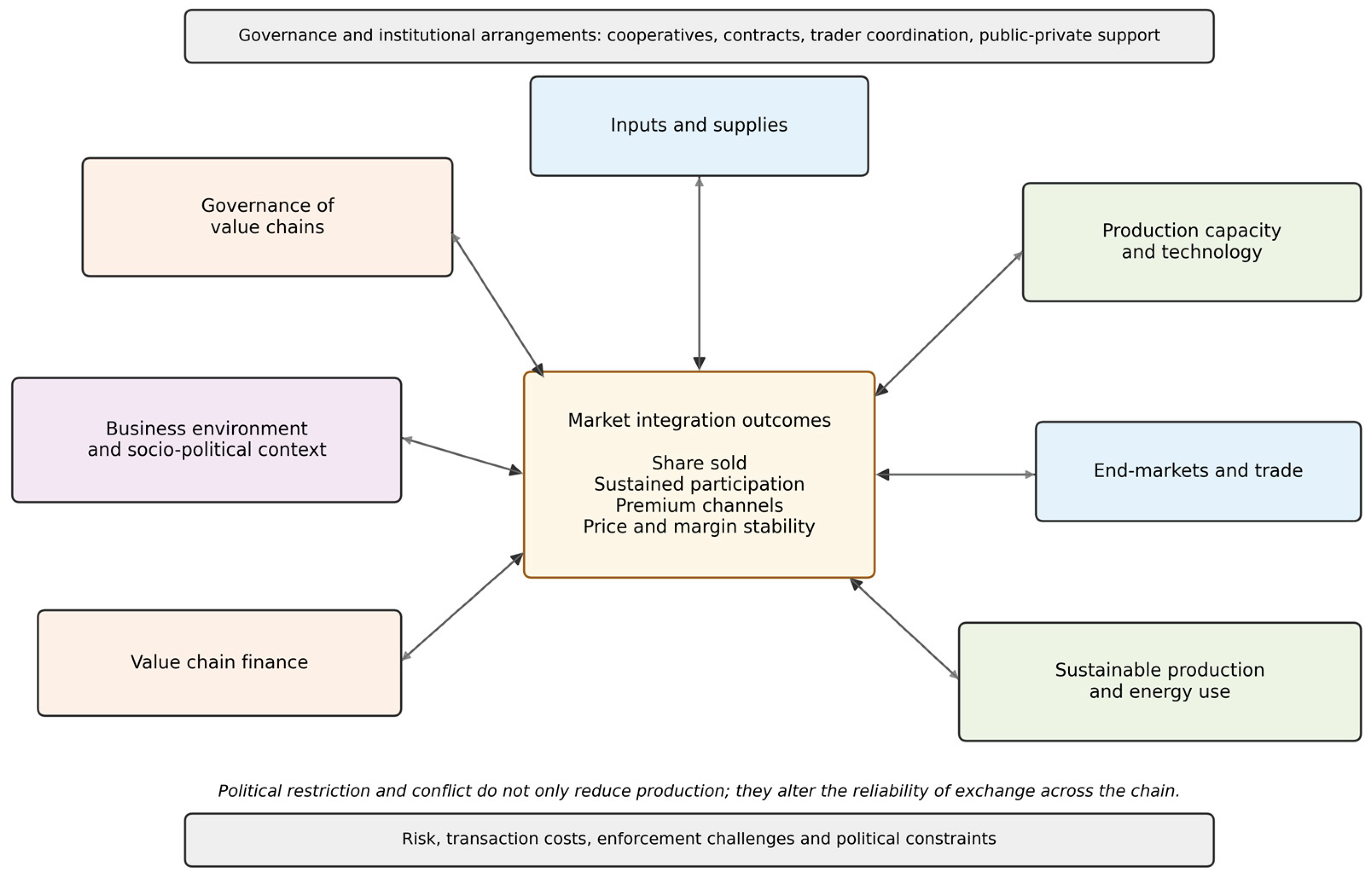
Table 2.
Study-by-study evidence map linking chain nodes, constraint types and integration measures.
Table 2.
Study-by-study evidence map linking chain nodes, constraint types and integration measures.
| Study | Setting | Chain / Commodity | Primary Node(s) | Constraint Type | Outcome Measure(s) |
|---|---|---|---|---|---|
| [6] | Myanmar | Rice | Farm -> milling -> retail | Post-coup transport and banking constraints | Distribution margins, retail prices, spatial price dispersion |
| [7] | Myanmar | Multiple agrifood chains | Farmers, input retailers, traders, millers, vendors | Banking, transport, fuel, electricity and connectivity disruptions | Input prices, farm sales prices, retail food prices, dietary cost estimates |
| [24] | Myanmar | Fertilizer | Input supply and on-farm use | Violent conflict intensity | Fertilizer prices, adoption, intensity and efficiency |
| [23] | Sudan | Wheat and sorghum | Markets and trade | Fragility, sanctions, conflict and macro instability | Spatial market integration through price cointegration and adjustment |
| [22] | Somalia | Rice, maize and sorghum | Markets and trade | Conflict as transaction cost shock | Speed of price transmission across markets |
| [25] | West Bank | Mixed crop technologies | Production and extension | Occupation-related land and movement constraints | Adoption of improved varieties, fertilizers, pesticides and biological control |
| [32] | Afghanistan | Wheat program context | Production and development delivery | Fragile and conflict-affected program dynamics | NDVI-based yield trends and spillover patterns |
| [39] | Nigeria | Land rental market | Enabling environment | Violent conflict shocks | Land rental sizes and values; moderating institutional factors |
| [27] | West Bank | Olives | Collective action and production | Geopolitical constraint | Technical efficiency, total factor productivity and cooperative effects |
Table 3.
Institutional arrangements, mechanisms, expected effects and typical failure modes.
| Institutional Arrangement | Mechanism | Expected Effect on Market Integration | Typical Failure Mode |
|---|---|---|---|
| Market-support institutions | Reduce information asymmetry; stabilize grading, inspection and price discovery; improve market intelligence [45]. | More credible planning, lower rejection risk and greater ability to participate in standards-based or premium channels. | Information does not translate into better terms because of market power; services are inaccessible, costly or captured. |
| Collective action institutions | Pool output, coordinate logistics, share services and strengthen bargaining [40,41,42]. | Higher participation intensity, better service access and potential entry into higher-value channels. | Weak internal governance, elite capture, low member trust, poor service quality or side-selling discipline failure. |
| Contracting institutions | Stabilize buyer-seller relations, bundle inputs, credit and advice, specify quality and allocate risk [28,37,43]. | Reduced price and payment risk, stronger upgrading incentives and improved service access. | Opaque grading or pricing, delayed payment, weak enforcement, opportunism or farmer dissatisfaction. |
| Public enabling institutions | Lower transport and time costs, support storage and trade facilitation, improve regulatory predictability [31,35]. | Larger effective market size, improved spatial integration and greater feasibility of quality upgrading. | Infrastructure inaccessible or politically constrained; benefits bypass smallholders or reinforce unequal access. |
Disclaimer/Publisher’s Note: The statements, opinions and data contained in all publications are solely those of the individual author(s) and contributor(s) and not of MDPI and/or the editor(s). MDPI and/or the editor(s) disclaim responsibility for any injury to people or property resulting from any ideas, methods, instructions or products referred to in the content. |
© 2026 by the authors. Licensee MDPI, Basel, Switzerland. This article is an open access article distributed under the terms and conditions of the Creative Commons Attribution (CC BY) license (http://creativecommons.org/licenses/by/4.0/).
Copyright: This open access article is published under a Creative Commons CC BY 4.0 license, which permit the free download, distribution, and reuse, provided that the author and preprint are cited in any reuse.


