

Submitted:
04 June 2026
Posted:
05 June 2026
You are already at the latest version
Abstract
Thumb pain is involved in multiple conditions—de Quervain’s tenosynovitis, carpometacarpal (CMC) osteoarthritis, carpal tunnel syndrome, intersection syndrome, and myofascial pain syndrome—that frequently coexist, yet they are traditionally managed as separate entities. These conditions may share a common pathological substrate: fascial densification characterized by hyaluronic acid aggregation and impaired fascial gliding. This narrative review synthesizes anatomical, biomolecular, and clinical evidence supporting a unified fascial basis for five converging thumb pain conditions. We describe a representative 15-point ultrasound-guided fascia hydrorelease (FHR) protocol targeting the shared fascial substrate of the thumb–wrist–forearm complex, with each treatment point mapped to specific anatomical stress concentration sites. Ultrasound examination consistently reveals “stacking fascia”—densified fascial layers visualized as hyperechoic band-like lesions with reduced gliding—across multiple anatomical sites in patients regardless of primary diagnosis. A four-direction screening test assessing thumb flexion, extension, abduction, and adduction in three modes (active contraction, resistance loading, and passive stretch), combined with nine validated clinical tests (Finkelstein, Eichhoff, WHAT, Phalen, Tinel-wrist, Grind, Lever, Durkan, and Tinel-dorsal/Wartenberg), enables systematic identification of the affected fascial structures. The 15-point FHR protocol addresses dorsal and volar fascial pathology, including periarterial release for potential vascular improvement in CMC osteoarthritis. We propose Thumb Pain Syndrome (TPS) as a unifying clinical framework recognizing the shared fascial substrate underlying five common thumb pain conditions. The 15-point FHR protocol offers a systematic, minimally invasive treatment approach that may serve as a non-surgical alternative for refractory cases where conventional pharmacological or surgical interventions have reached their limits. Further controlled studies are needed to validate this integrated fascial perspective.
Keywords:
fascia hydrorelease
; thumb pain syndrome
; de Quervain disease
; stacking fascia
; ultrasound-guided treatment
; fascial densification
; hyaluronic acid
; YAP/TAZ mechanotransduction
1. Introduction
Thumb pain represents a significant clinical challenge due to its multifactorial etiology and the functional importance of the thumb in daily activities. The thumb is estimated to account for approximately 40% of hand function, and pain in this region can severely impair quality of life [1]. Traditionally, conditions affecting the thumb—including de Quervain’s tenosynovitis, carpometacarpal (CMC) osteoarthritis, carpal tunnel syndrome (CTS), intersection syndrome, and referred pain from proximal structures—have been diagnosed and treated as separate entities [2,3].
However, clinical observation reveals that these conditions frequently coexist in the same patient, suggesting a common underlying fascial mechanism. This raises the possibility that thumb pain may be better understood as a syndrome in which fascial abnormalities serve as the shared substrate connecting these five pathologies [4].
The fascia is a continuous network of connective tissue that envelops and connects muscles, tendons, nerves, and vessels throughout the body [5,6]. Recent advances in fascial science have demonstrated that pathological changes in the fascia—particularly densification characterized by aggregation of hyaluronic acid (HA) within the loose connective tissue layers—can cause pain, restricted mobility, and nerve entrapment [7,8]. Stecco et al. have shown that HA densification increases viscosity within fascial planes, reducing gliding capacity and generating nociceptive signals [9]. Densification is conceptually defined as a reversible, HA-mediated change in the loose connective tissue, distinct from irreversible collagen-based fibrosis [40]; however, hyperechoic findings on ultrasound alone cannot reliably distinguish between these two states, and dynamic ultrasound assessment of fascial gliding can serve as an adjunctive diagnostic tool.
Fascia hydrorelease (FHR) was first described by Kimura et al. in 2014, and the term “fascia hydrorelease” was officially adopted by the Japanese Non-surgical Orthopedics Society (JNOS) in 2017 [10,24]. FHR is defined as “an injection technique for the release (separation and relaxation) of abnormal fasciae to improve the extensibility and sliding, in addition to having analgesic effects”, described as being “akin to peeling off thin stacking papers and separating fasciae themselves” [10,24]. This technique has gained increasing attention as a minimally invasive alternative to surgical intervention for various musculoskeletal conditions.
FHR has been applied to anatomical regions beyond the thumb. For example, our previous work demonstrated significant improvements in range of motion and pain reduction following FHR on the coracohumeral ligament in patients with frozen shoulder [25].
In this narrative review, we present evidence for the fascial basis of five converging thumb pain conditions, describe a representative 15-point FHR treatment protocol targeting the shared fascial substrate (detailed in Section 5; see Videos S1–S15), and discuss the molecular mechanisms underlying fascial densification and its reversal by hydrorelease.
2. Fascial Involvement in Five Converging Thumb Pain Conditions
2.1. Five Converging Pathologies and Their Common Fascial Abnormalities
The thumb region—encompassing the thumb through the radial aspect of the wrist—is affected by several common pain-generating conditions: de Quervain’s tenosynovitis, CMC osteoarthritis, carpal tunnel syndrome, and intersection syndrome. Differential diagnoses for symptoms in this region include C6 radiculopathy, radial nerve entrapment at the spiral groove or supinator, myofascial pain (within the spectrum of myofascial pain syndrome, MPS) from the brachioradialis and extensor pollicis longus presenting as referred pain to the thumb area, and rarely, central causes such as cerebrovascular events. Despite comprehensive evaluation, cases frequently remain unexplained and prove refractory to treatment.
It should be noted that conditions causing symptoms in the thumb region extend beyond these five entities to include neuropathic pain (central nervous system lesions, C6 radiculopathy, radial nerve palsy), osseous pathology (Colles fracture, scaphoid fracture, stress fractures, Kienböck disease [lunate avascular necrosis]), traumatic ligament injury (ulnar collateral ligament [UCL] injury of the thumb), and systemic inflammatory diseases (rheumatoid arthritis, CPPD). In this narrative review, we propose to define a pathological spectrum of the five anatomically based thumb conditions with fascia as their common key pathological substrate, fundamentally excluding the above conditions. However, these excluded conditions may coexist as comorbidities, or fascial abnormalities may persist following resolution of these primary diseases.
These conditions overlap considerably in their anatomical distribution, and from a fascial perspective, their pain mechanisms share much in common. Notably, ultrasound examination of these patients consistently reveals fascial abnormalities—particularly “stacking fascia”—a structural phenotype comprising compacted (densified) fascial layers, visualized as hyperechoic stripe-shaped lesions on ultrasound [10]—across multiple anatomical sites, regardless of which primary diagnosis predominates [4]. This clinical observation suggests that these five conditions may share a common fascial substrate.
2.2. Evidence for a Shared Fascial Substrate
This shared imaging finding of stacking fascia—observed across all five conditions and at multiple anatomical sites in the thumb–wrist region (Figure 7)—suggests a unifying pathological mechanism that connects these pathologies.
This shared fascial substrate can be understood through the anatomical continuity of fascial planes in the thumb–wrist region, extending proximally into the forearm. The extensor retinaculum, which forms the six dorsal compartments, is continuous with the antebrachial fascia proximally and the deep fascia of the hand distally [13]. Similarly, the flexor retinaculum (transverse carpal ligament) is continuous with the palmar fascia and the fascial sheaths of the thenar and hypothenar muscles [14]. Thus, fascial densification in one region can propagate along these continuous planes, affecting multiple structures simultaneously.
3. Diagnosis and Evaluation
3.1. Clinical Presentation
Patients with these converging thumb pain conditions typically present with pain and functional impairment in the thumb region that does not conform neatly to a single diagnostic category. Physical examination may reveal the following:
- Positive Finkelstein test (suggesting de Quervain’s disease);
- Pain at the intersection of the first and second extensor compartments;
- Tenderness and crepitus at the CMC joint;
- Positive Phalen’s or Tinel’s test (suggesting CTS);
- Referred pain patterns from proximal trigger points.
The screening test evaluates four cardinal movements of the thumb (Figure 1): flexion, extension, abduction, and adduction. Each movement is assessed in three modes (Figure 2)—active contraction, resistance loading, and passive stretch—to identify the affected fascial structures (Table 1). The diagnostic accuracy of common clinical tests and their interpretation under the fascial perspective are summarized in Table 2.
Note: Sensitivity and specificity values are for diagnosing each individual condition. In the presence of fascial abnormalities (particularly stacking fascia), these tests may become positive even without the specific target condition, supporting the concept that fascial densification serves as a common pathological substrate that cross-activates multiple clinical tests in these converging conditions [4,9,32].
Importantly, patients with these converging conditions frequently demonstrate simultaneous positivity across multiple tests. This does not indicate the coexistence of multiple independent diseases, but rather suggests that fascial densification is a common pathological substrate that elicits positive findings across multiple clinical tests [4,9]. This pattern of cross-test positivity itself constitutes clinical evidence supporting the concept of a common fascial substrate.
3.2. Pain Sources Classified by Movement Direction
Understanding the relationship between thumb movement direction and specific pain sources is essential for targeted treatment (Figure 3). Based on the biomechanical principles of muscle contraction and stretching, pain sources in these five conditions can be systematically classified according to the direction of thumb movement that provokes pain. This classification distinguishes between contraction pain (pain arising from the actively contracting muscles and their fascial connections) and stretch pain (pain arising from structures being elongated by the movement). Table 3 presents this classification in detail.
We propose that contraction pain occurs when fascial densification in or around the agonist muscles impairs their normal contraction mechanics, building on prior observations that fascial densification disrupts gliding and generates nociceptive signals [9]. For example, during thumb adduction, contraction pain arises from the thenar muscles, first dorsal interosseous, and adductor pollicis—the primary adductors. During extension, the extensor compartments (first through third) become the pain sources.
This reciprocal pattern—herein proposed as a novel conceptual framework—also accounts for stretch pain: structures that are stretched during a given movement become pain sources when fascial adhesions restrict their normal elongation [9]. Thus, during thumb adduction, the first extensor compartment (antagonist to adduction) and the intersection of the first and second extensor compartments generate stretch pain. During extension, the flexor group—thenar muscles, median nerve complex, and flexor pollicis longus—becomes symptomatic as these structures resist elongation.
Several structures generate pain regardless of movement direction: the extensor retinaculum, the deep palmar arch, and the metacarpal/trapezium articulation (CMC joint). These represent stress concentration sites [26] where mechanical forces converge from multiple directions, making them vulnerable to fascial densification independent of the specific movement pattern.
This movement-based classification directly informs the clinical application of the 15-point FHR protocol. By identifying which movements provoke pain and whether the pattern is consistent with contraction or stretch pain, the clinician can prioritize specific treatment points from the protocol, ensuring efficient and targeted fascial release.
4. Ultrasound-Guided Fascia Hydrorelease Technique
4.1. Principles
Fascia hydrorelease (FHR) is an injection technique used to release abnormal fasciae (separation and relaxation) to improve extensibility and sliding, in addition to having analgesic effects [10,24]. The technique of ultrasound-guided FHR targets hyperechoic strip-shaped lesions on ultrasound images, akin to peeling off thin stacking papers and separating fasciae themselves [24]. FHR is performed under real-time ultrasound guidance using a high-frequency linear transducer (12–18 MHz). The basic principle involves the following steps:
- Identification of the target fascial plane on ultrasound, recognizing “stacking fascia”—densified, multilayered fascial tissue—as hyperechoic stripe-shaped lesions with reduced gliding;
- Needle insertion under ultrasound guidance (typically a 27G needle);
- Injection of normal saline or extracellular fluid (e.g., bicarbonate Ringer’s solution) to mechanically separate the densified fascial layers [26];
- Confirmation of fascial plane separation on ultrasound in real time.
- In TPS treatment, the volume of injectate is typically 1–2 mL per point, reflecting the small anatomical structures of the thumb–wrist region [10,24]. Injection depth is not standardized and varies among individuals depending on the target fascial layer and patient-specific anatomy; real-time ultrasound visualization allows precise depth confirmation in each case, with the depth scale displayed on the left side of each supplementary video (Videos S1–S15) providing direct visual reference. The duration over which fascial separation is maintained varies among individuals and depends on the chronicity and duration of the patient’s symptoms.
4.2. Safety Considerations
The ultrasound-guided approach provides several safety advantages:
- Real-time visualization of the needle tip relative to critical structures (nerves, arteries);
- Ability to avoid direct injection into tendons, nerves, or vessels;
- Confirmation of correct needle placement before injection;
- Monitoring of injectate distribution.
For procedures involving peripheral nerves (e.g., median nerve hydrorelease), very fine needles (27G, 30G, or 32G) should be used, and attention must be paid to bevel orientation during insertion. Local anesthetics are not recommended for intraneuronal hydrorelease, as the therapeutic goal is fascial release rather than nerve blockade [24]. Key structures requiring particular attention include the radial artery (Points 5 and 6), the median nerve (Points 11, 12, 13, and 14), the ulnar artery (supplementary points), and the deep palmar arch (Point 9).
5. Anatomical Basis of the 15-Point Treatment Protocol
The treatment approach for these converging thumb pain conditions depends on the underlying pathology. For intra-articular synovitis (inflammatory conditions), corticosteroid-containing intra-articular block injections may be performed. However, for the treatment of surrounding tissues including the joint capsule, with fascia as the primary target, ultrasound-guided fascia hydrorelease (USFHR) is indicated. Furthermore, as an intervention for aggravating factors, relearning of whole upper limb movements related to the CMC joint and thumb motion—including forearm pronation/supination and upper arm to shoulder movements—is also important. In this way, by focusing on anatomical sites and pathology rather than being misled by disease names alone, accurate diagnosis and targeted treatment become possible.
The systematic treatment of these converging thumb pain conditions requires addressing fascial abnormalities at multiple anatomical sites. We have developed a representative 15-point protocol based on the fascial anatomy of the thumb–wrist region, organized from dorsal to palmar structures (Table 4). Notably, each of these 15 treatment points corresponds to one or more of the eight anatomical stress concentration site categories we have previously described [26]: curved areas (joint capsules), cross-sections (muscle intersections), areas where multiple structures gather, tunnel structures (carpal tunnel), adipose tissue, superficial fascia near vessels/nerves (radial artery), and sites of accessory muscles. The thumb–wrist region is particularly rich in such stress concentration sites, which explains the convergence of multiple pathologies in this region. The FHR procedure for each point is demonstrated in the accompanying Supplementary Videos (Videos S1–S15).
Abbreviations: APB, abductor pollicis brevis; FPB, flexor pollicis brevis; FPL, flexor pollicis longus; APL, abductor pollicis longus; EPB, extensor pollicis brevis; EPL, extensor pollicis longus; ECRL, extensor carpi radialis longus; ECRB, extensor carpi radialis brevis; FCR, flexor carpi radialis; TCL, transverse carpal ligament; CTS, carpal tunnel syndrome.
The selection of these treatment points is grounded in the concept of “Eight Anatomical Stress Concentration Sites” that we proposed in a prior study [26]: (1) curved areas, (2) cross-sections, (3) areas where multiple structures gather, (4) areas around tunnel structures, (5) adipose tissue, (6) superficial fascia near vessels/nerves, (7) ligamentum flavum and epidural fascia, and (8) sites of accessory muscles. All 15 points in the thumb–wrist region correspond to one or more of these stress concentration categories, providing a theoretical basis for understanding why fascial densification preferentially occurs at these specific anatomical locations.
The point numbers represent a systematic anatomical classification rather than a prescribed treatment sequence. In clinical practice, the priority and selection of treatment points are determined by the patient’s pain location and clinical findings.
5.1. Dorsal Approach Releases
5.1.1. Point 1: First Extensor Compartment Release (de Quervain)
The first extensor compartment contains the APL and EPB tendons, enclosed by the extensor retinaculum and a tendon sheath. Densification of the fascial layers surrounding these tendons is the primary pathology in de Quervain’s disease. Under ultrasound guidance, saline is injected between the retinaculum and the tendon sheath to restore gliding.
Anatomy: APL (abductor pollicis longus), EPB (extensor pollicis brevis), retinaculum, sheath.
Indication: de Quervain’s tenosynovitis, thumb pain on abduction/extension.
Pressure pain sites: (1) directly over extensor retinaculum, (2) APL muscle belly, (3) EPB muscle belly.
Pain reproduction movements: (1) thumb: radial abduction resistance, (2) thumb: MP joint extension resistance from CMC joint slight abduction-flexion + IP joint slight flexion + MP joint flexion position.
Orthopedic test: Finkelstein test positive.
Procedure (Video S1):
- Position the affected forearm in pronation with the dorsum facing up; the operator works from the affected side;
- Place the probe dorsally directly over the extensor retinaculum;
- Identify the stacking fascia on ultrasound and confirm the APL and EPB tendons;
- Insert the needle where tenderness is present and fascial stacking is confirmed on ultrasound;
- Perform USFHR between the APL and EPB, releasing the stacking fascia.
5.1.2. Point 2: Third Extensor Compartment Release (EPL)
The third extensor compartment contains the extensor pollicis longus (EPL) tendon, which passes around Lister’s tubercle of the radius. Fascial adhesion at this point can contribute to thumb extension weakness and pain.
Anatomy: EPL (extensor pollicis longus), Lister’s tubercle.
Indication: Pain on thumb extension, post-fracture stiffness.
Pressure pain sites: (1) EPL muscle belly, (2) Lister tubercle (over EPL tendon running on ulnar side).
Pain reproduction movements: thumb: IP joint extension resistance.
Procedure (Video S2):
- Position the forearm in pronation with the dorsum facing up;
- Place the probe dorsally directly over Lister tubercle;
- Identify the EPL tendon of the third extensor compartment lateral to Lister tubercle;
- Insert the needle where tenderness is present and fascial stacking is confirmed;
- Perform USFHR to release the peri-EPL fascia.
5.1.3. Point 3: Intersection of First and Second Compartments (APL-EPB/ECRL-ECRB)
At the intersection where the first compartment tendons (APL, EPB) cross over the second compartment tendons (ECRL, ECRB), fascial friction and densification occur. This is the site of intersection syndrome. The dorsal approach at this intersection is illustrated in Figure 4.
Anatomy: APL, EPB crossing over ECRL (extensor carpi radialis longus) and ECRB (extensor carpi radialis brevis), radius, ulna.
Indication: Intersection syndrome, wrist motion pain, thumb pain conditions.
Pressure pain sites: (1) APL/EPB muscle bellies (at crossing with ECRL/ECRB), (2) ECRL/ECRB muscle bellies, (3) extensor retinaculum (directly over APL/EPB, ECRL/ECRB tendons).
Pain reproduction movements: (1) thumb: radial abduction resistance, MP joint extension resistance from CMC joint slight abduction-flexion + IP joint slight flexion + MP joint flexion position, (2) wrist: radial deviation + palmar flexion resistance, (3) wrist: dorsiflexion + radial deviation resistance.
Orthopedic test: tenderness at intersection site, crepitus during wrist motion.
Procedure (Video S3):
- Position the forearm in pronation with the dorsum facing up;
- Place the probe over the second dorsal compartment and identify the ECRL and ECRB tendons;
- Slide the probe ulnarly to identify the crossing point where the APL and EPB tendons from the first compartment cross over the second compartment;
- Insert the needle where fascial stacking is confirmed at the intersection of the first and second compartment tendons;
- Perform USFHR between the APL/EPB and ECRL/ECRB.
5.1.4. Point 4: Intersection of Second and Third Compartments (EPL/ECRB-ECRL)
A second intersection point exists where the EPL crosses the second compartment tendons. Fascial adhesion at this level contributes to combined thumb–wrist pain.
Anatomy: EPL, ECRB, ECRL.
Indication: Thumb pain conditions, wrist motion pain, lateral elbow pain.
Pressure pain sites: (1) ECRL/ECRB muscle bellies, (2) extensor retinaculum (over EPL tendon), (3) EPL muscle belly, (4) Lister tubercle (over EPL tendon running on ulnar side).
Pain reproduction movements: (1) wrist: dorsiflexion + radial deviation resistance (resistance applied to dorsal surface of index and middle metacarpals), (2) thumb: IP joint extension resistance.
Procedure (Video S4):
- Position the forearm in pronation with the dorsum facing up;
- Place the probe over the second dorsal compartment to identify the ECRL and ECRB tendons;
- Slide the probe ulnarly to identify the crossing of the EPL from the third compartment;
- Insert the needle where fascial stacking is confirmed between the second and third compartment tendons;
- Perform USFHR between the ECRL/ECRB and EPL.
5.1.5. Point 5: Radial Artery/First Compartment Crossing (Vascular Release)
The radial artery crosses superficial to the first extensor compartment (APL/EPB tendons) at the radial styloid level. Fascial adhesion at this vascular-tendinous crossing point creates a distinct pain generator that is separate from the de Quervain’s tendon sheath pathology. Ultrasound with color Doppler identifies the artery crossing the first compartment, and targeted hydrorelease at this interface can relieve vascular-fascial entrapment. This “vascular release” technique addresses pain that persists after conventional first compartment treatment alone.
Anatomy: Radial artery, APL, EPB, first extensor compartment, radial styloid.
Indication: Persistent radial wrist pain after de Quervain’s treatment, vascular-fascial entrapment at 1st compartment, thumb pain on abduction/extension.
Pressure pain sites: (1) crossing point of radial artery and first extensor compartment (APL/EPB), (2) periarterial tissue at radial styloid level.
Pain reproduction movements: (1) thumb: radial abduction resistance, (2) thumb: MP joint extension resistance from CMC joint slight abduction-flexion + IP joint slight flexion + MP joint flexion position.
Ultrasound assessment: color Doppler to confirm radial artery course and relationship to first compartment tendons.
Procedure (Video S5):
- Position the forearm in pronation with the dorsum facing up;
- Place the probe over the first extensor compartment at the level of the radial styloid;
- Use color Doppler to confirm the course of the radial artery and its relationship to the first compartment tendons (APL/EPB);
- Insert the needle where tenderness is present at the artery–tendon crossing and fascial stacking is confirmed;
- Carefully perform USFHR of the periarterial fascia, taking care to avoid arterial injury.
5.1.6. Point 6: Radial Artery/EPL-ECRB-ECRL Crossing (Vascular Release)
The radial artery crosses deep to the extensor pollicis longus (EPL) tendon at the level of the anatomical snuffbox. Additionally, at this level, the EPL intersects with the second compartment tendons (ECRL, ECRB), and the radial artery crosses deep to the EPL, ECRL, and ECRB. This vascular-tendon crossing is anatomically distinct from Point 5 (radial artery/first compartment crossing) and constitutes an independent pain source. Fascial adhesion between the EPL tendon and the radial artery causes pain during thumb extension and vascular-fascial entrapment. Using color Doppler to confirm the course of the radial artery in the snuffbox, fascial release is performed at the EPL crossing.
Anatomy: Radial artery (snuffbox portion), EPL tendon, anatomical snuffbox, ECRL and ECRB tendons.
Indication: Snuffbox pain, radial wrist pain during thumb extension, residual symptoms around the radial artery after Point 5 release.
Pressure pain sites: (1) crossing point of EPL tendon and radial artery in the anatomical snuffbox, (2) radial aspect of EPL tendon, (3) crossing of the first compartment tendon (EPL) and second compartment tendons (ECRL, ECRB).
Pain-reproducing movements: (1) thumb: resisted IP joint extension, (2) wrist: radial deviation + dorsiflexion resistance.
Orthopedic examination: Snuffbox tenderness (differential diagnosis with scaphoid fracture required).
Ultrasound assessment: color Doppler to confirm radial artery course in the snuffbox and its relationship to EPL tendon, evaluate arterial pulsation and surrounding fascial stacking.
Procedure (Video S6):
- With the forearm in pronation (dorsum of the affected hand facing up), the operator works from the affected side;
- Place the probe over the anatomical snuffbox;
- Use color Doppler to confirm the course of the radial artery in the snuffbox and its relationship to the EPL tendon and ECRL, ECRB tendons;
- Insert the needle where tenderness is present at the radial artery-EPL/ECRL/ECRB crossing and fascial stacking is confirmed on ultrasound;
- Carefully perform USFHR of the fascia between the radial artery and EPL/ECRL/ECRB tendons, taking care to avoid arterial injury.
5.1.7. Point 7: Gokoku (Hegu)—First Dorsal Interosseous/Adductor Pollicis/Deep Palmar Arch, FPL
At the dorsal aspect of the first web space (corresponding to the acupuncture point “Hegu”/LI-4), the first dorsal interosseous muscle, adductor pollicis, and FPL tendon converge around the second metacarpal. Additionally, the deep palmar arch runs along the palmar aspect of the adductor pollicis. Fascial densification in this region causes deep thumb pain and web space contracture.
Anatomy: First dorsal interosseous, second metacarpal, adductor pollicis, FPL tendon, deep palmar arch.
Indication: Deep thumb pain, web space contracture.
Pressure pain sites: acupuncture point “Hegu” (LI-4): dorsal web space between thumb and index finger.
Pain reproduction movements: (1) index finger: abduction resistance, (2) thumb: ulnar adduction resistance, palmar adduction resistance, IP joint flexion resistance.
Procedure (Video S7):
- Position the dorsum facing up in forearm pronation; the operator works from the affected side;
- Place the probe between the first and second metacarpals;
- While scanning, passively abduct the patient’s thumb radially to confirm the gliding of the adductor pollicis and identify its position;
- Insert the needle where intermetacarpal tenderness is present and fascial stacking between the first dorsal interosseous and adductor pollicis is confirmed;
- Perform USFHR between the first dorsal interosseous and adductor pollicis, between the adductor pollicis and FPL, and between the adductor pollicis and the deep palmar arch.
5.1.8. Point 8: Adductor Pollicis
The adductor pollicis muscle, with its oblique and transverse heads, is a major contributor to thumb adduction force. Fascial abnormalities of this muscle are often overlooked in conventional evaluation.
Anatomy: Adductor pollicis (oblique head, transverse head).
Indication: Pain on thumb adduction, grip weakness.
Pressure pain sites: palmar side from ulnar aspect of proximal phalanx base to third metacarpal.
Pain reproduction movements: (1) thumb: ulnar adduction resistance, palmar adduction resistance, (2) index finger: abduction resistance, MP joint resistance with IP joint in extension.
Procedure (Video S8):
- Position the dorsum facing up in forearm pronation;
- Place the probe between the second and third metacarpals;
- While scanning, passively abduct the patient’s thumb to confirm the gliding of the adductor pollicis and identify its position;
- Insert the needle where intermetacarpal tenderness is present and fascial stacking is confirmed;
- Perform USFHR between the dorsal interosseous and adductor pollicis, and between the adductor pollicis and lumbricals (typically 2 locations).
5.1.9. Point 9: Deep Palmar Arch/Dorsal and Palmar Interossei
The deep palmar arch (deep branch of the radial artery) runs between the dorsal and palmar interossei. Fascial adhesion in this deep plane can contribute to deep hand pain and impaired finger coordination. The palmar approach to the deep palmar arch (Point 9) is illustrated in Figure 5.
Anatomy: Dorsal interossei, palmar interossei, deep palmar arch.
Indication: Deep hand pain, grip dysfunction.
Pressure pain sites: artery itself (between metacarpals).
Pain reproduction movements: often difficult to reproduce pain with specific movements.
Orthopedic tests: various orthopedic tests negative.
Ultrasound assessment: Doppler response of deep palmar arch shows side-to-side asymmetry compared to unaffected side, or compression of arterial wall is observed.
Procedure (Video S9):
- Position the dorsum facing up in forearm pronation;
- Place the probe between the metacarpals;
- While scanning, passively abduct the patient’s thumb to confirm the gliding of the adductor pollicis and identify its position;
- Use Doppler mode to confirm pulsation of the deep palmar arch;
- Insert the needle where intermetacarpal tenderness is present and fascial stacking is confirmed;
- Perform USFHR between the dorsal interosseous muscles and the deep palmar arch.
5.2. Volar Approach Releases
5.2.1. Point 10: Thenar Muscles (Abductor Pollicis Brevis/Opponens Pollicis/Flexor Pollicis Brevis/Metacarpal)
The thenar muscles form superficial and deep layers over the first metacarpal. Fascial densification between these layers restricts thumb mobility and contributes to pain.
- Superficial layer: Abductor pollicis brevis, opponens pollicis.
- Deep layer: Flexor pollicis brevis (superficial and deep heads), flexor pollicis longus.
- Deepest: Adductor pollicis.
Indication: Thumb pain conditions, restricted thumb opposition, wrist motion pain
Pressure pain sites: thenar muscles.
Pain reproduction movements: (1) thumb: palmar abduction resistance, (2) CMC joint: internal rotation + flexion + abduction resistance, (3) MP joint: flexion resistance.
Procedure (Video S10):
- Position the palm facing up; the operator works from the affected side;
- Place the probe over the thenar eminence;
- Use the FPL tendon (visible as a hyperechoic foot-shaped structure) as a landmark to identify the APB, opponens pollicis, FPB, and adductor pollicis;
- Insert the needle where tenderness is present and fascial stacking is confirmed;
- Perform USFHR between the APB, opponens pollicis, FPL, FPB, and adductor pollicis at multiple sites (typically 3 locations).
5.2.2. Point 11: Median Nerve/Transverse Carpal Ligament
Direct fascial plane release within the carpal tunnel. Saline injection between the transverse carpal ligament (flexor retinaculum) and the median nerve reduces neural compression [34]. This point is the primary treatment site for carpal tunnel syndrome.
Anatomy: Transverse carpal ligament (flexor retinaculum), median nerve.
Indication: Carpal tunnel syndrome, median nerve entrapment.
Inspection: thenar muscle atrophy, ape hand deformity.
Pressure pain sites: median nerve (directly over transverse carpal ligament).
Orthopedic tests: (1) Tinel sign positive, (2) Phalen test positive, (3) thenar muscle weakness.
Neurological assessment: at the carpal tunnel level, sensation differs between medial and lateral sides of the fourth digit.
Procedure (Video S11):
- Position the forearm in supination with the palm facing up;
- Place the probe directly over the transverse carpal ligament;
- Identify the median nerve deep to the transverse carpal ligament;
- Confirm fascial stacking and perform USFHR between the transverse carpal ligament and median nerve;
- If symptoms do not improve, gradually advance the needle while injecting fluid to release the fascia between the median nerve and surrounding structures.
5.2.3. Point 12: Median Nerve (Paraneural Sheath and Interfascicular Epineurium)
Release of the paraneural sheath (paraneurium) and interfascicular epineurium of the median nerve. After releasing between the transverse carpal ligament and median nerve at Point 11, saline is injected into the paraneural sheath and interfascicular epineurium to further reduce intraneural compression. This releases adhesions between nerve fascicles and restores nerve mobility.
Anatomy: Paraneural sheath of the median nerve, interfascicular epineurium.
Indication: Carpal tunnel syndrome (when Point 11 provides insufficient improvement), internal entrapment of the median nerve.
Pressure pain sites: Median nerve (directly beneath transverse carpal ligament).
Pain reproduction movements: Same as Point 11.
Procedure (Video S12):
- Position as in Point 11;
- Perform this procedure when symptoms persist after the transverse carpal ligament-median nerve release (Point 11);
- Gradually advance the needle while injecting fluid to release the paraneural sheath of the median nerve;
- Continue advancing to release the interfascicular epineurium (USFHR);
- Inject saline between nerve fascicles to release interfascicular adhesions.
5.2.4. Point 13: Median Nerve/FPL/FCR Interface
The median nerve lies between the flexor carpi radialis (FCR) and flexor pollicis longus (FPL), adjacent to the radial artery. Fascial densification in this region can compress the median nerve before it enters the carpal tunnel.
Anatomy: Median nerve, FCR, FPL, radial artery.
Indication: Carpal tunnel syndrome, forearm pain, thumb pain conditions.
Pressure pain sites: (1) flexor retinaculum (over median nerve, FCR tendon, FPL tendon, radial artery), (2) FCR muscle belly, (3) FPL muscle belly.
Pain reproduction movements: (1) wrist: radial deviation + palmar flexion resistance (resistance on palmar surface of index/middle metacarpals), (2) thumb: IP joint flexion resistance.
Orthopedic tests: (1) nerve tension test: median nerve test positive, (2) Tinel sign positive.
Procedure (Video S13):
- Position the forearm in supination with the palm facing up; the operator works from the affected side;
- Place the probe over the distal radioulnar joint space;
- Identify the adjacent median nerve, FPL, FCR, and radial artery;
- Insert the needle where tenderness is present and fascial stacking is confirmed;
- Perform USFHR between the median nerve, FPL, FCR, and radial artery.
5.2.5. Point 14: Median Nerve/Flexor Pollicis Longus (Carpal Tunnel)
Deep to the transverse carpal ligament (flexor retinaculum), the median nerve and flexor pollicis longus (FPL) are adjacent. Fascial densification in this area contributes to carpal tunnel syndrome and thumb pain.
Anatomy: Transverse carpal ligament, median nerve, flexor pollicis longus.
Indication: Carpal tunnel syndrome, thumb pain conditions.
History: numbness or pain in the thumb.
Pressure pain sites: FPL tendon (base of metacarpal).
Pain reproduction movements: thumb: IP joint flexion resistance.
Procedure (Video S14):
- Position the forearm in supination with the palm facing up;
- Place the probe directly over the transverse carpal ligament and confirm the median nerve position;
- Slide the probe radially to identify the site where the median nerve and FPL tendon are adjacent;
- Insert the needle where tenderness is present and fascial stacking is confirmed;
- Perform USFHR between the median nerve and FPL tendon.
5.2.6. Point 15: Palmar Carpal Ligament Complex / Median Nerve
In this concept, the transverse carpal ligament (Point 11) is regarded as the superficial palmar band over the tunnel, whereas the palmar carpal ligament complex — comprising the palmar radiocarpal and palmar intercarpal ligaments — represents a deeper volar ligamentous wall closer to the carpal bones, contributing to the deep palmar boundary of the carpal tunnel. This complex frequently develops internal densification (stacking fascia) that impairs its normal gliding and contributes to wrist/thumb pain symptoms. Ultrasound-guided FHR is applied directly into this ligament complex, targeting intra-ligamentous densified layers (stacking fascia within the ligaments), thereby releasing the densified collagen sublayers and restoring physiological gliding of the structure (see Video S15). Combined release of both structures (Points 11 and 15) achieves complete decompression of the carpal tunnel.
Anatomy: Palmar radiocarpal and palmar intercarpal ligaments (palmar carpal ligament complex), median nerve.
Indication: Carpal tunnel syndrome (adjunct).
Pressure pain sites: directly over the palmar carpal ligament complex (deep to the transverse carpal ligament).
Pain reproduction movements: wrist: palmar flexion resistance.
Procedure (Video S15):
- Position the forearm in supination with the palm facing up;
- Place the probe directly over the palmar carpal ligament complex;
- Identify the palmar carpal ligament complex (deep to the transverse carpal ligament) and its relationship to the median nerve;
- Insert the needle where tenderness is present and fascial stacking is confirmed;
- Perform USFHR into the palmar carpal ligament complex, targeting intra-ligamentous densified layers (stacking fascia).
6. Pathology-Specific Application of the 15-Point Protocol
6.1. de Quervain’s Tenosynovitis
Traditional treatment includes splinting, NSAIDs, and corticosteroid injection into the first extensor compartment sheath. Surgical tendon sheath release is reserved for refractory cases. FHR addresses not only the first compartment sheath but also the surrounding fascial continuum—Points 1 and 5 directly, plus the adjacent dorsal structures targeted at Points 2–4—which conventional treatment neglects. Many patients who fail isolated first compartment injection respond to the broader fascial approach.
6.2. Intersection Syndrome
Intersection syndrome results from friction at the crossing of the first and second extensor compartments. While conventional treatment focuses on the intersection point itself, this approach recognizes that the fascial abnormality extends both proximally and distally. Points 5 and 6 directly target the two intersection zones.
6.3. CMC Osteoarthritis
CMC osteoarthritis has traditionally been attributed to cartilage degeneration at the trapeziometacarpal joint. However, the fascial perspective reveals that when fascial densification develops in both the extensor (Points 2–4) and flexor (Points 7–8, 10) compartments surrounding the CMC joint, abnormal mechanical loading is imposed on the joint during both extension and flexion through epimuscular myofascial force transmission [27]. Since CMC osteoarthritis is often accompanied by joint instability, direct capsular release may exacerbate this instability. Therefore, the FHR approach targets the surrounding extensor fascia (Points 2–4) and flexor fascia (Points 7–8, 10) rather than the joint capsule itself, thereby indirectly reducing abnormal mechanical loading on the joint. Beyond mechanical unloading, there is growing recognition that vascular pathology plays a role in the initiation and progression of osteoarthritis. Findlay proposed that episodically reduced blood flow through small vessels in subchondral bone, caused by venous stasis or microemboli, contributes to ischemia-driven cartilage degradation and osteocyte apoptosis [28]. Conaghan further hypothesized that progressive OA may represent an atheromatous vascular disease of subchondral bone [29], and recent evidence suggests that subchondral blood flow abnormalities may precede cartilage degeneration as an early pathological event [30]. In this context, periarterial fascial release at Point 6 (anatomical snuffbox) acquires particular significance for CMC osteoarthritis. The radial artery traverses the snuffbox before entering the deep palm and giving rise to the princeps pollicis artery, which is the principal blood supply to the thumb and CMC joint region. Fascial entrapment at this vascular-tendon crossing point—where the radial artery crosses deep to the EPL tendon and the ECRL/ECRB tendons—may compromise arterial flow to the CMC joint. Release of this fascial entrapment through FHR may therefore enhance periarticular tissue perfusion and metabolism, potentially addressing not only pain but also the vascular component of OA pathophysiology. To our knowledge, this periarterial fascial release approach to improving joint blood supply in CMC osteoarthritis has not been described previously. Additionally, corticosteroid injection is indicated for intra-articular inflammatory pathology, and dextrose prolotherapy may serve as a viable option for symptomatic pain relief and functional improvement [12]. This multilayered approach—mechanical unloading through surrounding fascial release, vascular improvement through periarterial release, and targeted intra-articular treatment—offers potential advantages over isolated local joint therapy and provides pain relief even in joints with significant radiographic degeneration.
6.4. Carpal Tunnel Syndrome
CTS is the most common entrapment neuropathy. While surgical carpal tunnel release remains the gold standard for severe cases, FHR offers a non-surgical alternative for mild to moderate CTS. Notably, Evers et al. demonstrated that ultrasound-guided hydrodissection significantly decreases gliding resistance of the median nerve within the carpal tunnel [34]. Points 7, 11, 12, and 14 provide systematic decompression of the median nerve at multiple levels—proximal to, within, and superficial to the carpal tunnel. The advantage over conventional corticosteroid injection is the avoidance of steroid-related tendon weakening and the ability to address the fascial pathology at multiple levels simultaneously.
6.5. Referred Pain
The fascial continuum extends from the cervicoscapular region through the upper arm and forearm to the hand. Fascial densification of the scalene, brachialis, brachioradialis, and supinator muscles can elicit referred pain extending to the thumb region, consistent with the classical trigger point referral patterns documented for these muscles [32]. Specifically, fascial densification of the anterior, middle, and posterior scalene muscles produces a widespread referred pain pattern extending from the shoulder through the upper arm and forearm to the thumb (Figure 6A); fascial densification of the supinator generates referred pain from the lateral elbow to the dorsum of the hand and thumb base (Figure 6B); and fascial densification of the brachialis characteristically refers pain to the palmar aspect of the thumb (Figure 6C). These referred pain patterns may explain the “spreading pain from the thumb to the forearm” commonly reported by patients with these conditions. When the local 15-point protocol does not achieve sufficient improvement, evaluation and treatment of these proximal fascial sources may be necessary for complete symptom resolution.
7. Discussion
This narrative review proposes that the five common thumb and wrist conditions—de Quervain’s tenosynovitis, CMC osteoarthritis, carpal tunnel syndrome, intersection syndrome, and myofascial pain syndrome—share a common fascial substrate characterized by stacking fascia on ultrasound examination. This shared pathological finding, together with the anatomical continuity of fascial planes from the thumb–wrist region into the forearm, supports a unified understanding of thumb pain. We propose the term “Thumb Pain Syndrome” (TPS) to describe this clinical entity in which multiple pain sources coexist within a connected fascial network [4].
Recent biomechanical evidence from cadaveric studies has confirmed that hydrorelease significantly reduces the gliding resistance force between fascial layers [33], providing objective support for the mechanical mechanism underlying FHR. Furthermore, the fascial perspective on pain is gaining broader recognition, with growing reports suggesting potential involvement of fascial abnormalities in conditions such as complex regional pain syndrome [31]. Moreover, an integrative model has been proposed that positions fascial densification and impaired gliding as important peripheral drivers of chronic pain in myofascial pain syndrome [11].
The fascial perspective on thumb pain offers several clinical advantages:
Comprehensive assessment: The four-direction screening test (flexion, extension, abduction, adduction) with three modes (contraction, resistance, stretch) provides a systematic method for identifying the specific fascial structures involved in each patient’s presentation.
Diagnostic significance: Conventional clinical tests such as the Finkelstein test, Phalen test, and Grind test have traditionally been used to diagnose specific individual conditions (de Quervain’s tenosynovitis, carpal tunnel syndrome, and CMC osteoarthritis, respectively). However, from the TPS perspective, the simultaneous positivity of multiple tests constitutes clinical evidence for the presence of fascial densification as a common pathological substrate. This “cross-test positivity” also provides theoretical support for the comprehensive treatment approach of the 15-point protocol.
Targeted multi-point treatment: Rather than treating a single diagnosis, the 15-point protocol addresses the entire fascial network of the thumb–wrist region. The specific points treated in each patient are determined by the screening examination findings and ultrasound evaluation.
Molecular rationale: The pathophysiology of fascial densification involves multiple molecular pathways. The gliding property of fascial layers is caused by hyaluronic acid (HA) within the loose connective tissue between adjacent fascial planes [9,35]. Under pathological conditions, HA aggregates through supramolecular interactions, increasing viscosity and transforming the normally lubricating layer into a viscous adhesive substance that impairs fascial gliding and generates nociceptive signals [36,37,38]. Beyond HA aggregation, fascial densification involves broader changes in the extracellular matrix (ECM), including increased collagen deposition, upregulation of MMPs/TIMPs, fibroblast-to-myofibroblast transformation, and increased TGF-β expression, creating a self-reinforcing cycle of fascial stiffening and pain [39]. Recent research has highlighted the role of the YAP/TAZ mechanotransduction pathway, which functions as a central mechanosensor in fibroblasts [23,41,42]. In densified fascia, increased tissue stiffness may activate YAP/TAZ nuclear translocation, potentially promoting further ECM production, myofibroblast differentiation, thereby creating a mechanobiological positive feedback loop [43]. We have proposed the “Fascial Memory Reset Hypothesis,” suggesting that FHR may break this feedback loop by acutely reducing mechanical tension at fascial planes, potentially leading to YAP/TAZ cytoplasmic sequestration and eventual normalization of ECM turnover [26]. However, this hypothesis remains a theoretical framework requiring further experimental validation. The therapeutic mechanism of FHR likely involves multiple pathways: mechanical separation of densified layers [33], HA dilution reducing viscosity [35,36], mechanotransduction reset via YAP/TAZ inactivation, nerve decompression through fascial plane separation, and vascular improvement through restored fascial mobility, although the relative contribution of each pathway remains to be elucidated.
Minimally invasive: FHR using normal saline avoids the risks associated with corticosteroid injection (tendon weakening, skin atrophy) and surgical intervention (scarring, recovery time).
Integrated therapeutic framework: The FHR approach for TPS is characterized by its integration of three therapeutic axes: (1) potential vascular improvement through periarterial fascial release to restore local circulation, (2) mechanical unloading through extensor and flexor fascial release to eliminate abnormal force transmission, and (3) range of motion restoration through fascial release to recover fascial gliding. For refractory cases where conventional pharmacological approaches such as peripheral nerve blocks and corticosteroid injections have reached their limits, this approach may offer a new paradigm focusing on fascial biomechanics and mechanotransduction (non-pharmacological hydrorelease). While normalization of mechanotransduction as proposed in the fascial memory reset hypothesis [26] requires further validation, this framework theoretically suggests that the approach can simultaneously address multiple pathological mechanisms.
Limitations of this narrative review include the lack of randomized controlled trials specifically evaluating the TPS concept and the 15-point protocol. The clinical observations described herein are based on the authors’ extensive experience treating more than 10,000 unique patients with over 360,000 ultrasound-guided FHR procedures across more than a decade of practice, but have not yet been validated through controlled studies. Future prospective studies with standardized outcome measures are needed to validate this approach, particularly to characterize how the duration of clinical effect varies with chronicity of symptoms—patients with longer symptom duration may require repeated treatment sessions to achieve sustained fascial release, while those with shorter symptom history often achieve longer-lasting benefit from fewer treatments. Additionally, the molecular mechanisms proposed remain partially theoretical and require further experimental confirmation. Notably, the concept of periarterial fascial release presented herein is not limited to the CMC joint; it may also be applicable to vascular-fascial interventions in other joints such as the shoulder, knee, and hip, warranting future investigation. Furthermore, in cases where fibrosis has become established, FHR alone may be insufficient, and consideration of additional therapeutic options may be warranted; this represents an important direction for future clinical investigation.
8. Conclusions
This narrative review has presented evidence that five common thumb and wrist pathologies—de Quervain’s tenosynovitis, CMC osteoarthritis, carpal tunnel syndrome, intersection syndrome, and myofascial pain syndrome—share a common fascial substrate characterized by stacking fascia. Based on this shared pathological basis and the anatomical continuity of fascial planes, we propose the concept of Thumb Pain Syndrome (TPS) as a clinically useful framework for understanding and treating these converging conditions. The 15-point ultrasound-guided fascia hydrorelease protocol provides a systematic, minimally invasive treatment approach that addresses the shared fascial substrate. Integration with fascial molecular biology—including HA densification, ECM remodeling, and YAP/TAZ mechanotransduction—provides a theoretical foundation for this therapeutic approach. Further clinical studies are needed to establish the efficacy and optimal application of this integrated fascial perspective. For clinical implementation, the protocol is delivered in the outpatient setting using standard ultrasound equipment and 27-gauge needles, and presupposes clinician proficiency in musculoskeletal ultrasound-guided procedures.

Table 5.
Supplementary video list and 15-point protocol correspondence.
| Video | Protocol Point | Content Description |
| S1 | Point 1 | First Extensor Compartment Release (de Quervain) |
| S2 | Point 2 | Third Extensor Compartment Release (EPL) |
| S3 | Point 3 | First-Second Compartment Intersection Release |
| S4 | Point 4 | Second-Third Compartment Intersection Release |
| S5 | Point 5 | Radial Artery/First Compartment Crossing Release |
| S6 | Point 6 | Radial Artery/EPL Crossing Release |
| S7 | Point 7 | Gokoku (Hegu) Release (First Dorsal Interosseous/Adductor Pollicis/Deep Palmar Arch, FPL) |
| S8 | Point 8 | Adductor Pollicis Release |
| S9 | Point 9 | Deep Palmar Arch/Interossei Release |
| S10 | Point 10 | Thenar Muscles (APB/Opponens/FPB) Release |
| S11 | Point 11 | Median Nerve/Transverse Carpal Ligament Release |
| S12 | Point 12 | Paraneural Sheath/Interfascicular Epineurium Release |
| S13 | Point 13 | Median Nerve/FCR/FPL/Radial Artery Release |
| S14 | Point 14 | Median Nerve/Flexor Pollicis Longus Release |
| S15 | Point 15 | Palmar Carpal Ligament Complex / Median Nerve Release |
Supplementary Materials
The following supporting information are deposited at Zenodo (DOI: 10.5281/zenodo.20485196; URL: https://doi.org/10.5281/zenodo.20485196): The FHR procedure for each of the 15 protocol points is demonstrated in 15 supplementary videos.
Author Contributions
Conceptualization, H.K.; methodology, H.K. and R.A.; investigation, H.K. and R.A.; writing—original draft preparation, H.K.; writing—review and editing, T.K. and H.O.; supervision, T.K. and H.O. All authors have read and agreed to the published version of the manuscript.
Funding
This research received no external funding.
Institutional Review Board Statement
This study is a review article and does not involve any new human subject research. Therefore, Institutional Review Board approval was not required.
Informed Consent Statement
Patient ultrasound images, procedure photographs, and procedure videos included in this manuscript were obtained at Kimura Pain Clinic between January 2017 and May 2021. Written informed consent for the research and educational use of images and videos was obtained from all patients at the time of clinical care, in accordance with the institutional informed consent policy implemented at Kimura Pain Clinic on 1 October 2016. All images and videos have been anonymized to remove personally identifiable information.
Data Availability Statement
No new datasets were created or analyzed in this narrative review article. The 15 supplementary procedural videos (Video S1–S15) demonstrating the ultrasound-guided fascia hydrorelease techniques are publicly available at Zenodo (Repository: Zenodo; DOI: 10.5281/zenodo.20485196; URL: https://doi.org/10.5281/zenodo.20485196), under a Creative Commons Attribution 4.0 International (CC BY 4.0) license.
Acknowledgments
The authors thank the clinical staff at Kimura Pain Clinic for their assistance in data collection and patient care. AI-assisted tools (Claude, Anthropic) were used for language editing and manuscript formatting. The authors reviewed and take full responsibility for the content of this manuscript.
Conflicts of Interest
The authors declare no conflicts of interest.
Abbreviations
| APB | abductor pollicis brevis |
| AdP | adductor pollicis |
| APL | abductor pollicis longus |
| CMC | carpometacarpal |
| CPPD | calcium pyrophosphate deposition disease |
| CTS | carpal tunnel syndrome |
| ECM | extracellular matrix |
| ECRB | extensor carpi radialis brevis |
| ECRL | extensor carpi radialis longus |
| EPB | extensor pollicis brevis |
| EPL | extensor pollicis longus |
| FCR | flexor carpi radialis |
| FHR | fascia hydrorelease |
| FPB | flexor pollicis brevis |
| FPL | flexor pollicis longus |
| HA | hyaluronic acid |
| IP | interphalangeal |
| JNOS | Japanese Non-surgical Orthopedics Society |
| MCP | metacarpophalangeal |
| MMP | matrix metalloproteinase |
| NSAID | non-steroidal anti-inflammatory drug |
| OP | opponens pollicis |
| TAZ | transcriptional co-activator with PDZ-binding motif |
| TCL | transverse carpal ligament |
| TGF-β | transforming growth factor-beta |
| TIMP | tissue inhibitor of metalloproteinases |
| TPS | Thumb Pain Syndrome |
| UCL | ulnar collateral ligament |
| USFHR | ultrasound-guided fascia hydrorelease |
| WHAT | Wrist Hyperflexion and Abduction of the Thumb |
| YAP | Yes-associated protein |
References
- Dias, R.; Chandrasenan, J.; Rajaratnam, V.; Burke, F.D. Basal thumb arthritis. Postgrad. Med. J. 2007, 83, 40–43. [Google Scholar] [CrossRef] [PubMed]
- Ilyas, A.M.; Ast, M.; Schaffer, A.A.; Thoder, J. de Quervain tenosynovitis of the wrist. J. Am. Acad. Orthop. Surg. 2007, 15, 757–764. [Google Scholar] [CrossRef]
- Atroshi, I.; Gummesson, C.; Johnsson, R.; Ornstein, E.; Ranstam, J.; Rosén, I. Prevalence of carpal tunnel syndrome in a general population. JAMA 1999, 282, 153–158. [Google Scholar] [CrossRef]
- Asaka, R.; Kimura, H.; Kobayashi, T. Ultrasound-guided fascia hydrorelease for thumb pain syndrome. Clin. Sports Med. (Rinsho Sports Igaku) (In Japanese) 2020, 37, 214–220. [Google Scholar]
- Stecco, C.; Macchi, V.; Porzionato, A.; Duparc, F.; De Caro, R. The fascia: The forgotten structure. Ital. J. Anat. Embryol. 2011, 116, 127–138. [Google Scholar] [CrossRef] [PubMed]
- Schleip, R.; Jäger, H.; Klingler, W. What is ‘fascia’? A review of different nomenclatures. J. Bodyw. Mov. Ther. 2012, 16, 496–502. [Google Scholar] [CrossRef]
- Stecco, A.; Stern, R.; Fantoni, I.; De Caro, R.; Stecco, C. Fascial disorders: Implications for treatment. PM R 2016, 8, 161–168. [Google Scholar] [CrossRef] [PubMed]
- Langevin, H.M.; Fox, J.R.; Koptiuch, C.; Badger, G.J.; Naumann, A.C.G.; A Bouffard, N.; E Konofagou, E.; Lee, W.-N.; Triano, J.J.; Henry, S.M. Reduced thoracolumbar fascia shear strain in human chronic low back pain. BMC Musculoskelet. Disord. 2011, 12, 203. [Google Scholar] [CrossRef]
- Stecco, C.; Stern, R.; Porzionato, A.; Macchi, V.; Masiero, S.; Stecco, A.; De Caro, R. Hyaluronan within fascia in the etiology of myofascial pain. Surg. Radiol. Anat. 2011, 33, 891–896. [Google Scholar] [CrossRef]
- Kobayashi, T.; Kimura, H.; Zenita, Y.; Imagita, H. Hydrorelease of fascia. In Fascia: The Tensional Network of the Human Body, 2nd ed.; Schleip, R., Stecco, C., Driscoll, M., Huijing, P., Eds.; Elsevier: Amsterdam, The Netherlands, 2022; pp. 609–617. [Google Scholar]
- Gromakovskis, V. Exploring fascia in myofascial pain syndrome: An integrative model of mechanisms. Front. Pain Res. 2025, 6, 1712242. [Google Scholar] [CrossRef]
- Reeves, K.D.; Hassanein, K. Randomized, prospective, placebo-controlled double-blind study of dextrose prolotherapy for osteoarthritic thumb and finger (DIP, PIP, and trapeziometacarpal) joints: Evidence of clinical efficacy. J. Altern. Complement. Med. 2000, 6, 311–320. [Google Scholar] [CrossRef]
- Taleisnik, J.; Gelberman, R.H.; Miller, B.W.; Szabo, R.M. The extensor retinaculum of the wrist. J. Hand Surg. Am. 1984, 9, 495–501. [Google Scholar] [CrossRef]
- Stecco, C.; Macchi, V.; Lancerotto, L.; Tiengo, C.; Porzionato, A.; De Caro, R. Comparison of transverse carpal ligament and flexor retinaculum terminology for the wrist. J. Hand Surg. Am. 2010, 35, 746–753. [Google Scholar] [CrossRef]
- Goubau, J.F.; Goubau, L.; Van Tongel, A.; Van Hoonacker, P.; Kerckhove, D.; Berghs, B. The wrist hyperflexion and abduction of the thumb (WHAT) test: A more specific and sensitive test to diagnose de Quervain tenosynovitis than the Eichhoff’s test. J. Hand Surg. Eur. Vol. 2014(39), 286–292. [CrossRef]
- MacDermid, J.C.; Wessel, J. Clinical diagnosis of carpal tunnel syndrome: A systematic review. J. Hand Ther. 2004, 17, 309–319. [Google Scholar] [CrossRef]
- Merritt, M.M.; Roddey, T.S.; Costello, C.; Olson, S. Diagnostic value of clinical grind test for carpometacarpal osteoarthritis of the thumb. J. Hand Ther. 2010, 23, 261–268. [Google Scholar] [CrossRef]
- Sela, Y.; Seftchick, J.; Wang, W.L.; Baratz, M.E. The diagnostic clinical value of thumb metacarpal grind, pressure-shear, flexion, and extension tests for carpometacarpal osteoarthritis. J. Hand Ther. 2019, 32, 35–40. [Google Scholar] [CrossRef] [PubMed]
- Wu, F.; Rajpura, A.; Sandher, D. Finkelstein’s test is superior to Eichhoff’s test in the investigation of de Quervain’s disease. J. Hand Microsurg. 2018, 10, 116–118. [Google Scholar] [CrossRef] [PubMed]
- Model, Z.; Liu, A.Y.; Kang, L.; Wolfe, S.W.; Burket, J.C.; Lee, S.K. Evaluation of physical examination tests for thumb basal joint osteoarthritis. Hand 2016, 11, 108–112. [Google Scholar] [CrossRef] [PubMed]
- Durkan, J.A. A new diagnostic test for carpal tunnel syndrome. J. Bone Jt. Surg. Am. 1991, 73, 535–538. [Google Scholar] [CrossRef]
- Lanzetta, M.; Foucher, G. Entrapment of the superficial branch of the radial nerve (Wartenberg’s syndrome): A report of 52 cases. Int. Orthop. 1993, 17, 342–345. [Google Scholar] [CrossRef]
- Liu, F.; Lagares, D.; Choi, K.M.; Stopfer, L.; Marinković, A.; Vrbanac, V.; Probst, C.K.; Hiemer, S.E.; Sisson, T.H.; Horowitz, J.C.; et al. Mechanosignaling through YAP and TAZ drives fibroblast activation and fibrosis. Am. J. Physiol. Lung Cell. Mol. Physiol. 2015, 308, L344–L357. [Google Scholar] [CrossRef] [PubMed]
- Japanese Non-surgical Orthopedics Society (JNOS). For Medical Professionals. Available online: https://www.jnos-global.org/for-medical (accessed on 7 April 2026).
- Kimura, H.; Suda, M.; Kobayashi, T.; Suzuki, S.; Fukui, S.; Obata, H. Effectiveness of ultrasound-guided fascia hydrorelease on the coracohumeral ligament in patients with global limitation of the shoulder range of motion: A pilot study. Sci. Rep. 2022, 12, 19782. [Google Scholar] [CrossRef]
- Kimura, H.; Kobayashi, T.; Obata, H. A Conceptual Fascial Memory Reset Hypothesis: Mechanobiological Insights into Stacking Fascia as an Ultrasound-Visible Structural Phenotype and the Potential Role of Fascial Hydrorelease. Int. J. Mol. Sci. 2026, 27, 3720. [Google Scholar] [CrossRef]
- Huijing, P.A.; Baan, G.C. Myofascial force transmission: Muscle relative position and length determine agonist and synergist muscle force. J. Appl. Physiol. 2003, 94, 1092–1107. [Google Scholar] [CrossRef]
- Findlay, D.M. Vascular pathology and osteoarthritis. Rheumatology 2007, 46, 1763–1768. [Google Scholar] [CrossRef]
- Conaghan, P.G.; Vanharanta, H.; Dieppe, P.A. Is progressive osteoarthritis an atheromatous vascular disease? Ann. Rheum. Dis. 2005, 64, 1539–1541. [Google Scholar] [CrossRef] [PubMed]
- Wang, T.; Wen, C.Y.; Yan, C.H.; Lu, W.W.; Chiu, K.Y. Is Osteoarthritis a Vascular Disease? Front. Biosci. 2024, 29, 113. [Google Scholar] [CrossRef]
- Pirri, C.; Pirri, N.; Petrelli, L.; Fede, C.; De Caro, R.; Stecco, C. An emerging perspective on the role of fascia in complex regional pain syndrome: A narrative review. Int. J. Mol. Sci. 2025, 26, 2826. [Google Scholar] [CrossRef]
- Donnelly, J.M.; Fernández-de-las-Peñas, C.; Finnegan, M.; Freeman, J.L. (Eds.) Travell, Simons & Simons’ Myofascial Pain and Dysfunction: The Trigger Point Manual, 3rd ed.; Wolters Kluwer: Philadelphia, PA, USA, 2018. [Google Scholar]
- Shiwaku, K.; Otsubo, H.; Suzuki, D.; Pirri, C.; Kodesyo, T.; Kamiya, T.; Taniguchi, K.; Ohnishi, H.; Teramoto, A.; Stecco, C. Biomechanical effects of fascia hydrorelease: A cadaveric study. BMC Musculoskelet. Disord. 2025, 26, 306. [Google Scholar] [CrossRef]
- Evers, S.; Thoreson, A.R.; Smith, J.; Zhao, C.; Geske, J.R.; Amadio, P.C. Ultrasound-guided hydrodissection decreases gliding resistance of the median nerve within the carpal tunnel. Muscle Nerve 2018, 57, 25–32. [Google Scholar] [CrossRef]
- Cowman, M.K.; Schmidt, T.A.; Raghavan, P.; Stecco, A. Viscoelastic properties of hyaluronan in physiological conditions. F1000Res 2015, 4, 622. [Google Scholar] [CrossRef] [PubMed]
- Matteini, P.; Dei, L.; Carretti, E.; Volpi, N.; Goti, A.; Pini, R. Structural behavior of highly concentrated hyaluronan. Biomacromolecules 2009, 10, 1516–1522. [Google Scholar] [CrossRef]
- Tesarz, J.; Hoheisel, U.; Wiedenhöfer, B.; Mense, S. Sensory innervation of the thoracolumbar fascia in rats and humans. Neuroscience 2011, 194, 302–308. [Google Scholar] [CrossRef]
- Hoheisel, U.; Rosner, J.; Mense, S. Innervation changes induced by inflammation of the rat thoracolumbar fascia. Neuroscience 2015, 300, 351–359. [Google Scholar] [CrossRef]
- Klingler, W.; Velders, M.; Hoppe, K.; Pedro, M.; Schleip, R. Clinical relevance of fascial tissue and dysfunctions. Curr. Pain Headache Rep. 2014, 18, 439. [Google Scholar] [CrossRef]
- Pavan, P.G.; Stecco, A.; Stern, R.; Stecco, C. Painful connections: Densification versus fibrosis of fascia. Curr. Pain Headache Rep. 2014, 18, 441. [Google Scholar] [CrossRef] [PubMed]
- Dupont, S.; Morsut, L.; Aragona, M.; Enzo, E.; Giulitti, S.; Cordenonsi, M.; Zanconato, F.; Le Digabel, J.; Forcato, M.; Bicciato, S.; et al. Role of YAP/TAZ in mechanotransduction. Nature 2011, 474, 179–183. [Google Scholar] [CrossRef]
- Pirri, C.; Caroccia, B.; Angelini, A.; Piazza, M.; Petrelli, L.; Caputo, I.; Montemurro, C.; Ruggieri, P.; De Caro, R.; Stecco, C. A new player in the mechanobiology of deep fascia: Yes-Associated Protein (YAP). Int. J. Mol. Sci. 2023, 24, 15389. [Google Scholar] [CrossRef] [PubMed]
- Panciera, T.; Azzolin, L.; Cordenonsi, M.; Piccolo, S. Mechanobiology of YAP and TAZ in physiology and disease. Nat. Rev. Mol. Cell Biol. 2017, 18, 758–770. [Google Scholar] [CrossRef]
Figure 7.
Representative ultrasound images of “stacking fascia” in the thumb–wrist region. Point numbers correspond to the 15-point treatment protocol described in Section 5. (A) Dorsal aspect at the third extensor compartment (Point 2): extensor pollicis longus (EPL) crossing the extensor digitorum tendons at the level of Lister’s tubercle. (B) Vascular crossing at the first extensor compartment (Point 5): radial artery passing adjacent to abductor pollicis longus (APL) and extensor pollicis brevis (EPB). (C) Palmar deep aspect at the thenar region (Point 10): layered thenar muscles (abductor pollicis brevis, opponens pollicis, superficial and deep heads of flexor pollicis brevis, adductor pollicis) around the metacarpal bones, with the flexor pollicis longus (FPL) tendon visible. Cyan arrows indicate hyperechoic strip-shaped “stacking fascia”; yellow arrows indicate the injection site for ultrasound-guided fascia hydrorelease (US-FHR).
Figure 7.
Representative ultrasound images of “stacking fascia” in the thumb–wrist region. Point numbers correspond to the 15-point treatment protocol described in Section 5. (A) Dorsal aspect at the third extensor compartment (Point 2): extensor pollicis longus (EPL) crossing the extensor digitorum tendons at the level of Lister’s tubercle. (B) Vascular crossing at the first extensor compartment (Point 5): radial artery passing adjacent to abductor pollicis longus (APL) and extensor pollicis brevis (EPB). (C) Palmar deep aspect at the thenar region (Point 10): layered thenar muscles (abductor pollicis brevis, opponens pollicis, superficial and deep heads of flexor pollicis brevis, adductor pollicis) around the metacarpal bones, with the flexor pollicis longus (FPL) tendon visible. Cyan arrows indicate hyperechoic strip-shaped “stacking fascia”; yellow arrows indicate the injection site for ultrasound-guided fascia hydrorelease (US-FHR).
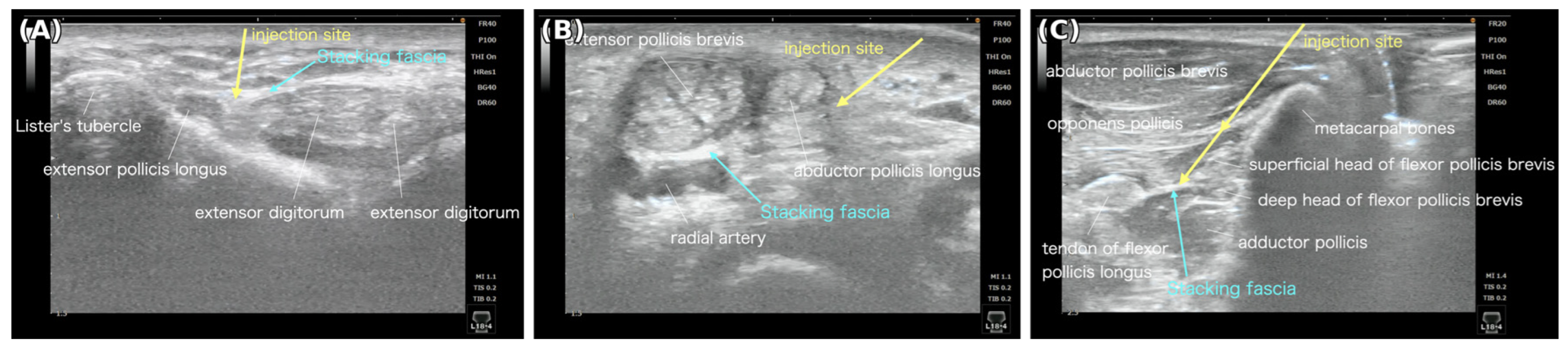
Figure 1.
Screening test for five thumb pain conditions—Four cardinal movement directions of the thumb (flexion, extension, abduction, adduction) with the primary pain-generating fascial structures associated with each direction.
Figure 1.
Screening test for five thumb pain conditions—Four cardinal movement directions of the thumb (flexion, extension, abduction, adduction) with the primary pain-generating fascial structures associated with each direction.
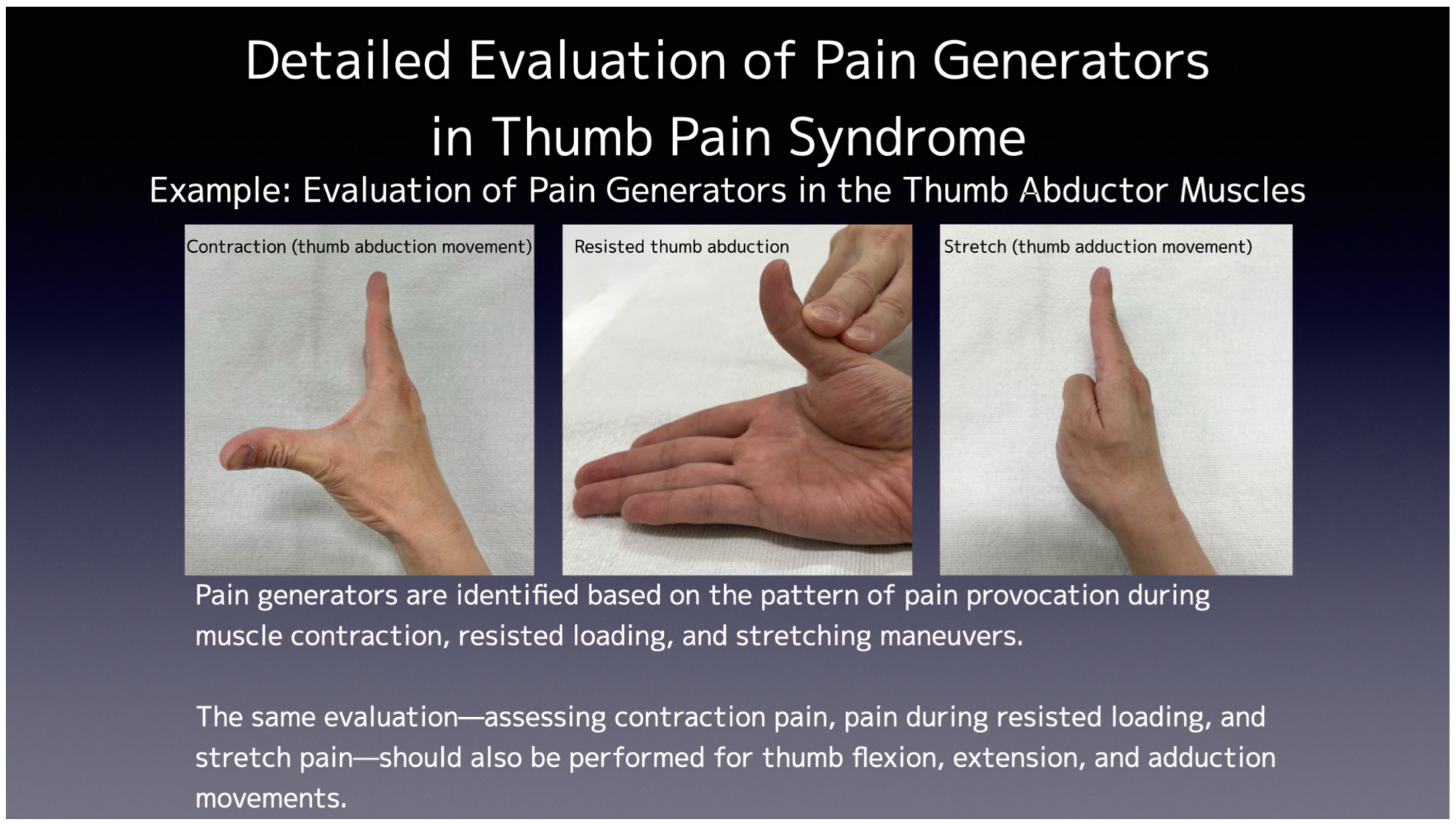
Figure 2.
Detailed evaluation of five thumb pain conditions—Using thumb abduction as an example, the three evaluation modes (active contraction, resistance loading, passive stretch) are demonstrated. The same protocol is applied to all movement directions.
Figure 2.
Detailed evaluation of five thumb pain conditions—Using thumb abduction as an example, the three evaluation modes (active contraction, resistance loading, passive stretch) are demonstrated. The same protocol is applied to all movement directions.
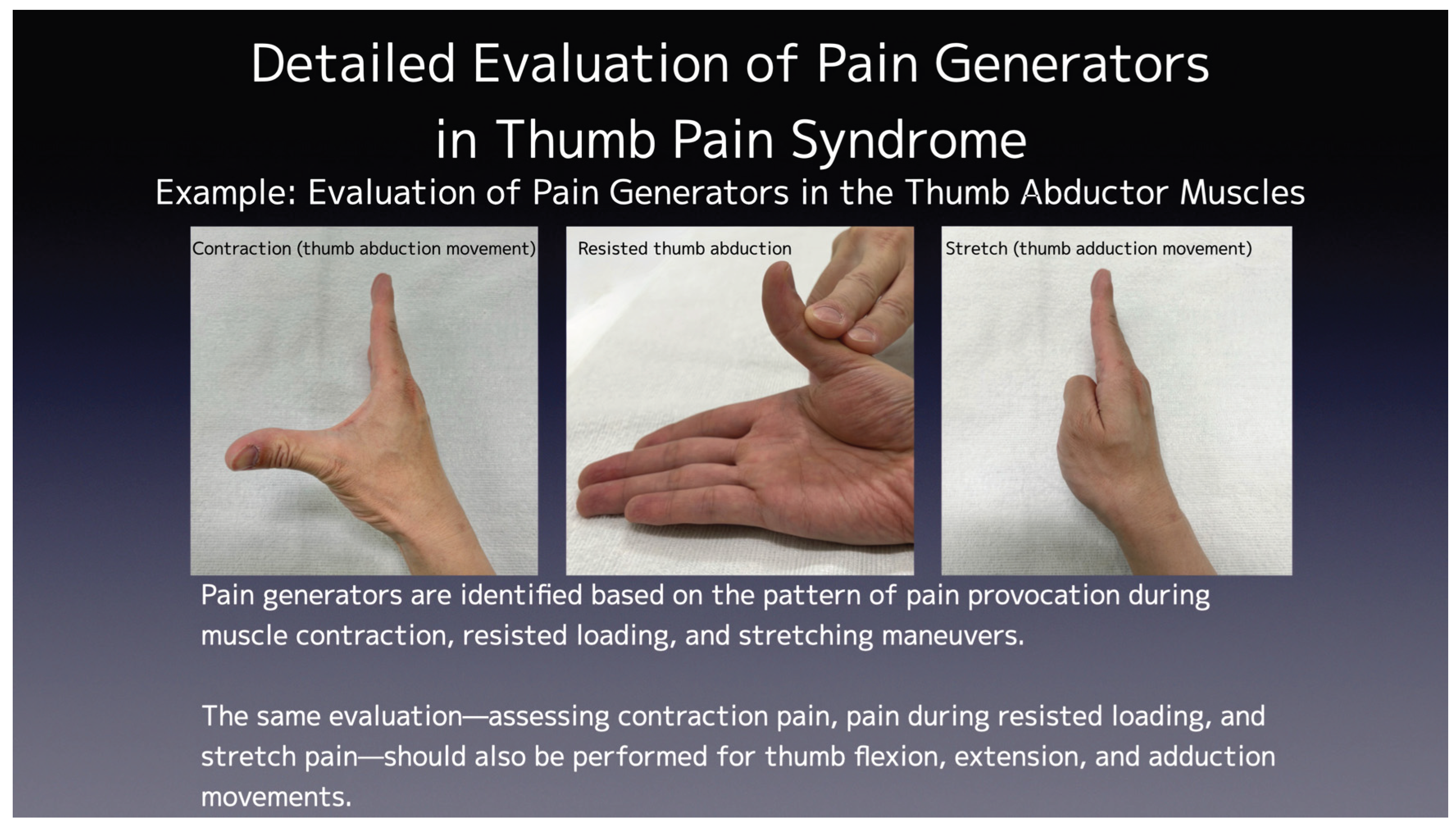
Figure 3.
Movement–direction-specific pain source mapping—For each of the four cardinal directions (flexion, extension, abduction, adduction), the anatomical structures requiring evaluation are listed in numbered order.
Figure 3.
Movement–direction-specific pain source mapping—For each of the four cardinal directions (flexion, extension, abduction, adduction), the anatomical structures requiring evaluation are listed in numbered order.
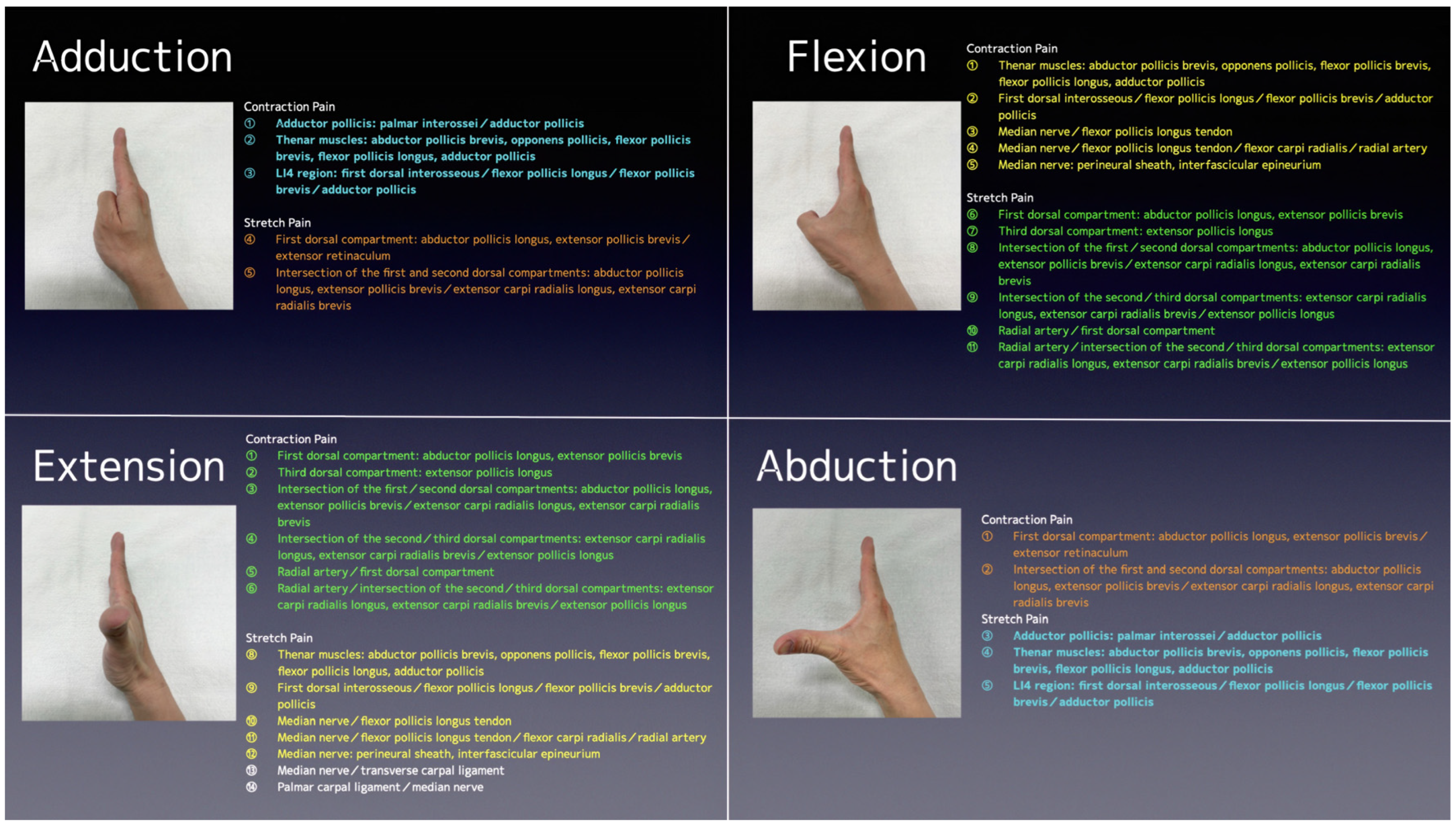
Figure 4.
Dorsal Approach—ultrasound-guided fascia hydrorelease of the first and second extensor compartments (Point 3). Panel (①): clinical photograph showing probe placement and needle insertion (cross-section approach). Panel (②): ultrasound image identifying APL, EPB (1st Compartment) crossing over ECRL, ECRB (2nd Compartment), with needle insertion point indicated. Panel (③): post-release ultrasound confirming fascial plane separation.
Figure 4.
Dorsal Approach—ultrasound-guided fascia hydrorelease of the first and second extensor compartments (Point 3). Panel (①): clinical photograph showing probe placement and needle insertion (cross-section approach). Panel (②): ultrasound image identifying APL, EPB (1st Compartment) crossing over ECRL, ECRB (2nd Compartment), with needle insertion point indicated. Panel (③): post-release ultrasound confirming fascial plane separation.
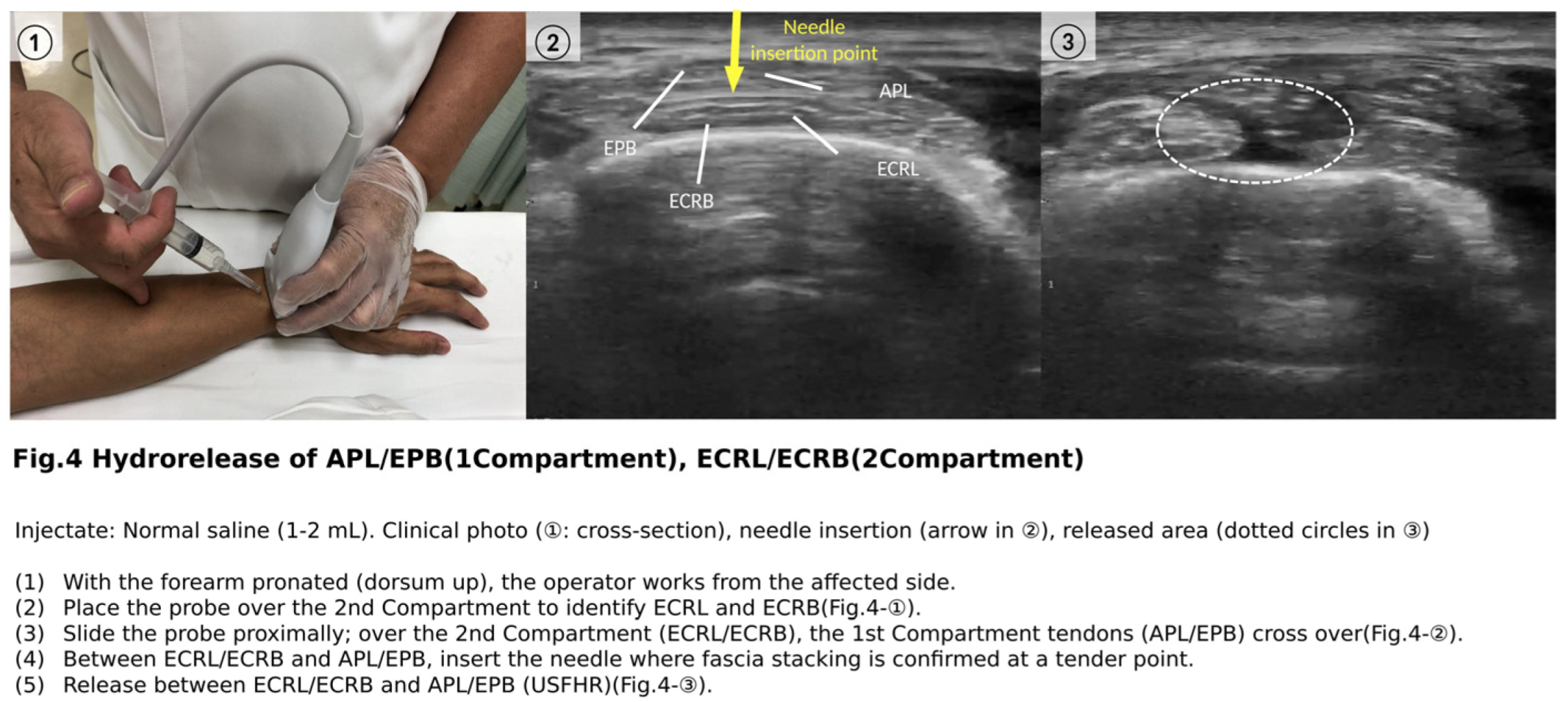
Figure 5.
Palmar approach—ultrasound-guided fascia hydrorelease between dorsal interosseous muscle and deep palmar arch (Point 9). Panel (①): clinical photograph. Panel (②): ultrasound image with color Doppler showing the deep palmar arch (red) and needle insertion point. Panel (③): post-release ultrasound confirming fascial separation around the vascular structure.
Figure 5.
Palmar approach—ultrasound-guided fascia hydrorelease between dorsal interosseous muscle and deep palmar arch (Point 9). Panel (①): clinical photograph. Panel (②): ultrasound image with color Doppler showing the deep palmar arch (red) and needle insertion point. Panel (③): post-release ultrasound confirming fascial separation around the vascular structure.
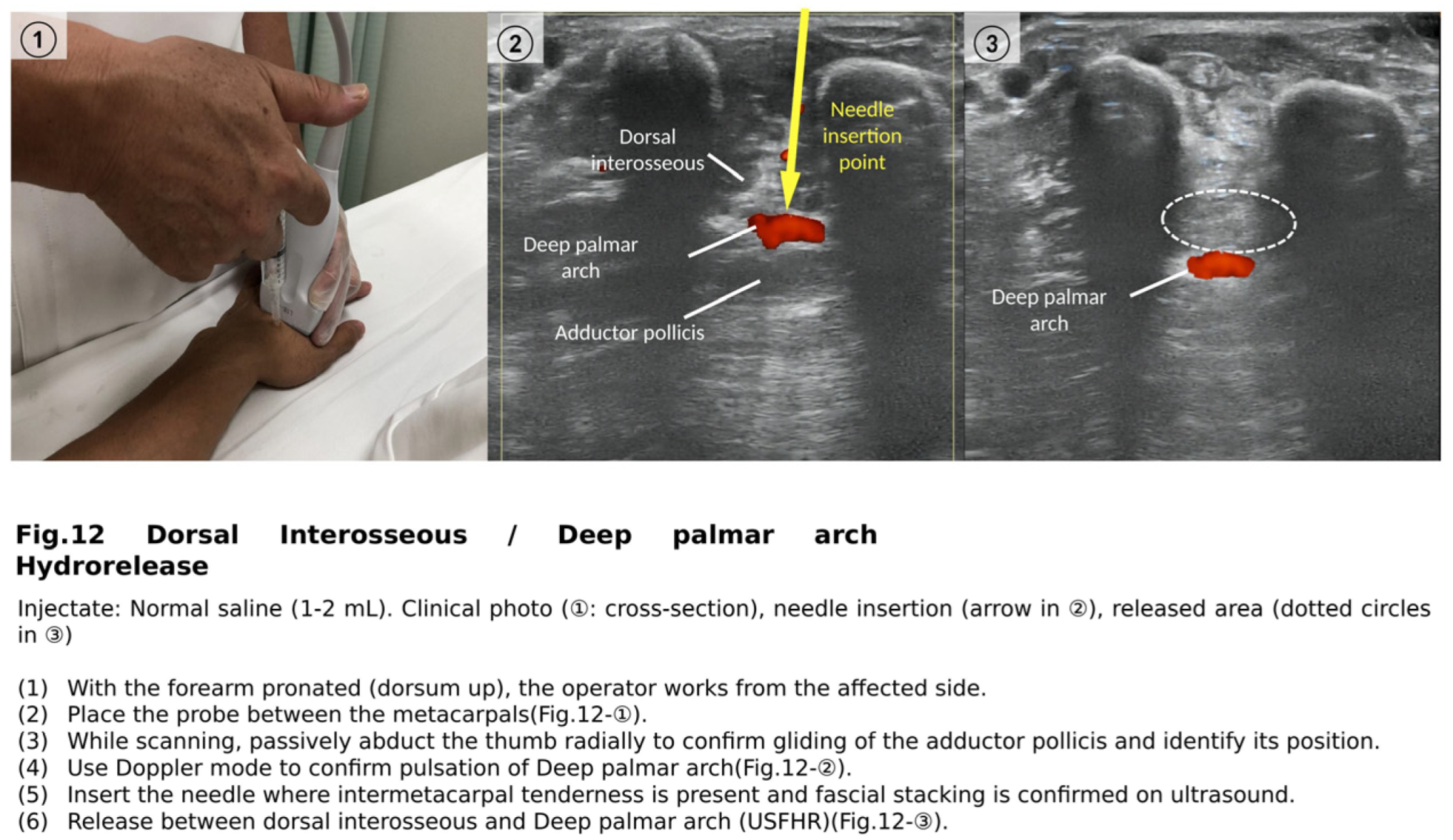
Figure 6.
Referred pain patterns from proximal fascial densification to the thumb region. (A) Anterior, middle, and posterior scalene muscles: a widespread referred pain area (red stippled region) extending from the shoulder through the upper arm and forearm to the thumb. (B) Supinator: referred pain pattern from the lateral elbow to the dorsum of the hand and thumb base. (C) Brachialis: referred pain pattern centered on the palmar aspect of the thumb. (D) Brachioradialis: referred pain pattern from the lateral forearm to the dorsum of the hand and thumb. These proximal fascial sources may contribute to persistent pain when the local 15-point protocol yields insufficient improvement. Anatomical referral patterns adapted from the Trigger Point Manual [32]. Illustration: Ayato Kurosawa (Trigger Point Therapy Clinic).
Figure 6.
Referred pain patterns from proximal fascial densification to the thumb region. (A) Anterior, middle, and posterior scalene muscles: a widespread referred pain area (red stippled region) extending from the shoulder through the upper arm and forearm to the thumb. (B) Supinator: referred pain pattern from the lateral elbow to the dorsum of the hand and thumb base. (C) Brachialis: referred pain pattern centered on the palmar aspect of the thumb. (D) Brachioradialis: referred pain pattern from the lateral forearm to the dorsum of the hand and thumb. These proximal fascial sources may contribute to persistent pain when the local 15-point protocol yields insufficient improvement. Anatomical referral patterns adapted from the Trigger Point Manual [32]. Illustration: Ayato Kurosawa (Trigger Point Therapy Clinic).
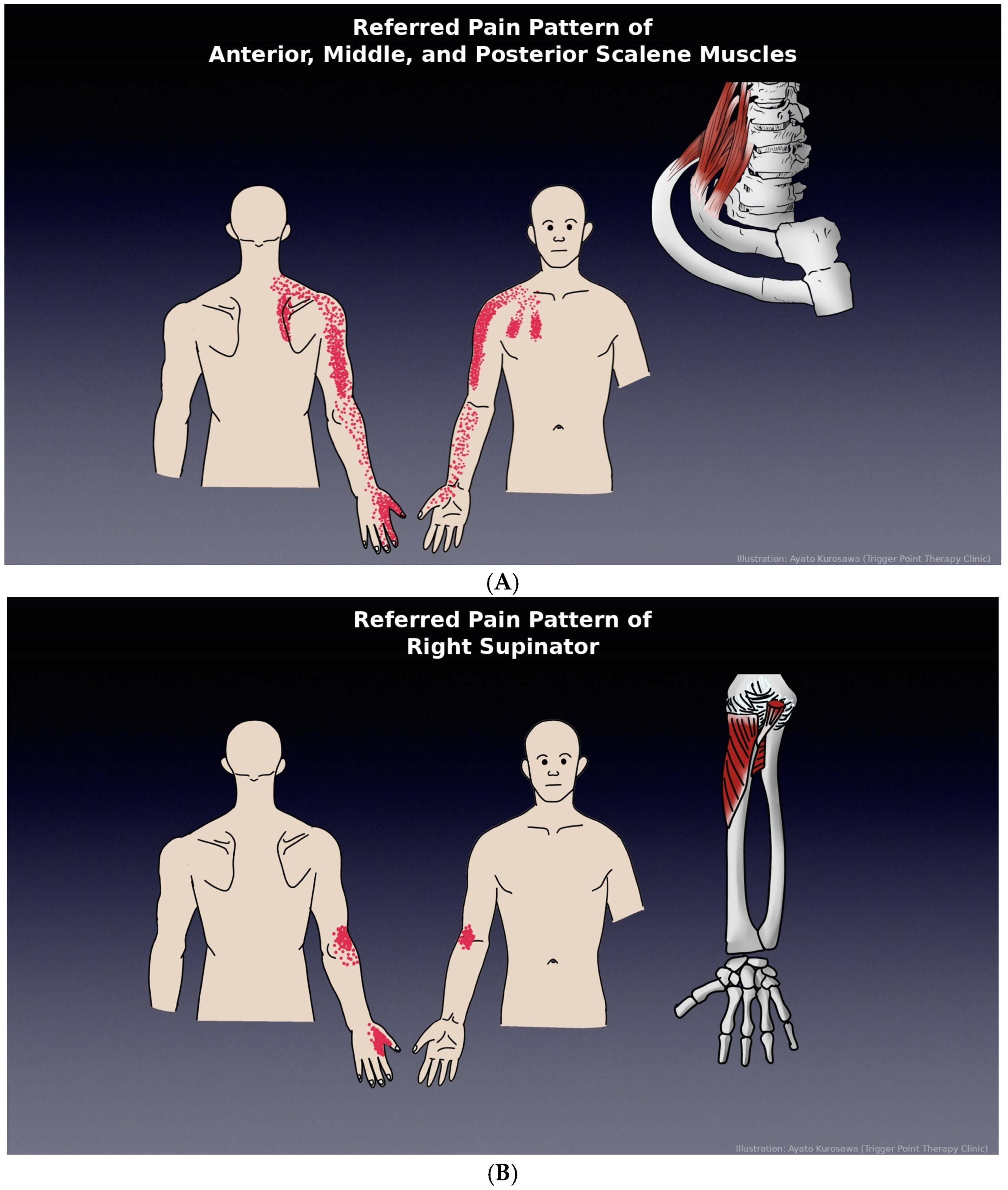
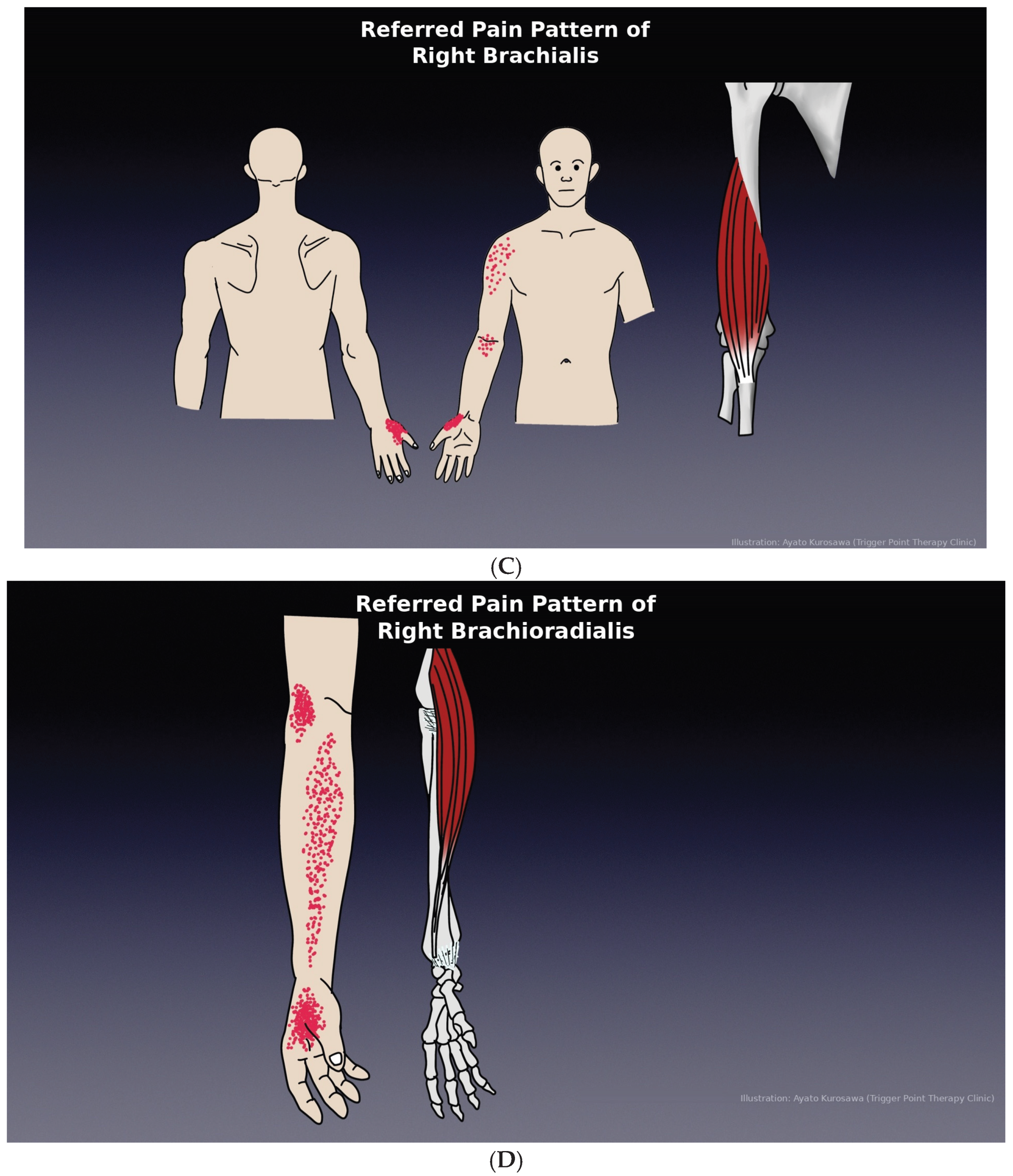
Table 1.
Screening test for five thumb pain conditions.
| Movement | Contraction | Resistance | Stretch | Primary Fascial Targets |
| Flexion | Active thumb flexion | Resist thumb flexion | Passive thumb extension | FPL, thenar muscles, median nerve |
| Extension | Active thumb extension | Resist thumb extension | Passive thumb flexion | EPL, EPB, APL, extensor retinaculum |
| Abduction | Active thumb abduction | Resist thumb abduction | Passive thumb adduction | APL, EPB, 1st/2nd compartment intersection |
| Adduction | Active thumb adduction | Resist thumb adduction | Passive thumb abduction | Adductor pollicis, thenar muscles, deep palmar arch |
Table 2.
Diagnostic accuracy of clinical tests and their significance in five thumb pain conditions.
Table 2.
Diagnostic accuracy of clinical tests and their significance in five thumb pain conditions.
| Clinical Test | Target Condition | Sensitivity (%) | Specificity (%) | Clinical Significance |
| Finkelstein test | de Quervain’s | 84 | 96 | May be positive with fascial densification (Points 1–2) even without de Quervain’s [15] |
| Phalen test | CTS | 42–85 | 54–98 | Reflects fascial abnormality within carpal tunnel (Points 11–15) [16] |
| Tinel sign (wrist) | CTS | 45–59 | 78–90 | Indicator of perimedian nerve fascial densification [16] |
| Grind test | CMC OA | 30–64 | 80–100 | Periarticular fascia (Points 7–10) may cause false negatives [17,18] |
| Eichhoff test | de Quervain’s | — | 89 | Often confused with Finkelstein. Higher false-positive rate with fascial densification [15,19] |
| WHAT test | de Quervain’s | 99 | 29 | High sensitivity but low specificity. Useful for screening fascial abnormalities [15] |
| Lever test | CMC OA | 82 | 81 | Higher sensitivity than Grind test. Also applicable to periarticular fascia (Points 7–10) assessment [20] |
| Durkan test | CTS | 87–91 | 90–95 | Direct carpal tunnel compression. May also be positive with perimedian nerve fascial densification [21] |
| Tinel sign (dorsal wrist) | Wartenberg syndrome | — | — | Superficial radial nerve entrapment. Important for differential diagnosis with these five conditions [22] |
Table 3.
Pain sources in five thumb pain conditions classified by movement direction and pain type.
| Movement Direction | Contraction Pain (Agonist Structures) | Stretch Pain (Antagonist Structures) |
| Adduction | Adductor pollicis Thenar muscles (OP, APB, FPB, FPL, AdP) 1st dorsal interosseous/FPL/FPB/AdP |
1st compartment (APL, EPB) 1st/2nd compartment intersection (APL, EPB/ECRL, ECRB) |
| Flexion | Thenar muscles (as above) 1st dorsal interosseous/FPL/FPB/AdP Median nerve/FPL Median nerve/FPL/FCR/Radial artery Median nerve (TCL, paraneural sheath, interfascicular epineurium) |
1st compartment (APL, EPB) 3rd compartment (EPL) 1st/2nd compartment intersection 2nd/3rd compartment intersection (ECRL, ECRB/EPL) Radial artery/1st compartment Radial artery/2nd/3rd compartment intersection (ECRL, ECRB/EPL) |
| Extension | 1st compartment (APL, EPB) 3rd compartment (EPL) 1st/2nd compartment intersection 2nd/3rd compartment intersection (ECRL, ECRB/EPL) Radial artery/1st compartment Radial artery/2nd/3rd compartment intersection (ECRL, ECRB/EPL) |
Thenar muscles (as above) 1st dorsal interosseous/FPL/FPB/AdP Median nerve/FPL Median nerve/FPL/FCR/Radial artery Median nerve (TCL, paraneural sheath, interfascicular epineurium) Median nerve/TCL Palmar carpal ligament complex / Median nerve |
| Abduction | 1st compartment (APL, EPB) 1st/2nd compartment intersection (APL, EPB/ECRL, ECRB) Radial artery/1st compartment |
Adductor pollicis Thenar muscles (as above) 1st dorsal interosseous/FPL/FPB/AdP |
|
Common (all directions) |
Extensor retinaculum Deep palmar arch Metacarpal/Trapezium (CMC joint) |
|
Table 4.
The 15-point FHR treatment protocol for five thumb pain conditions.
| Point | Target Structure | Compartment/Region | Key Indication |
| 1 | APL/EPB sheath and retinaculum | 1st extensor compartment | De Quervain’s disease |
| 2 | EPL/Lister’s tubercle | 3rd extensor compartment | Thumb extension pain |
| 3 | APL-EPB/ECRL-ECRB intersection | 1st–2nd compartment crossing | Intersection syndrome |
| 4 | EPL/ECRB-ECRL intersection | 2nd–3rd compartment crossing | Wrist-thumb combined pain |
| 5 | Radial artery/1st compartment crossing | Radial styloid (vascular crossing) | Vascular-fascial entrapment |
| 6 | Radial artery/EPL crossing | Anatomical snuffbox (vascular crossing) | Radial artery-EPL entrapment |
| 7 | 1st dorsal interosseous/adductor pollicis/deep palmar arch, FPL | First web space (Hegu) | Deep thumb pain |
| 8 | Adductor pollicis (oblique + transverse heads) | Deep thenar | Adduction pain, grip weakness |
| 9 | Dorsal and palmar interossei/deep palmar arch | Deep palm | Deep hand pain |
| 10 | APB/opponens pollicis/FPB/metacarpal | Thenar eminence | Thumb mobility restriction |
| 11 | TCL/Median Nerve | Carpal tunnel | Carpal tunnel syndrome |
| 12 | Paraneural Sheath/Interfascicular Epineurium | Carpal tunnel (intraneural) | CTS (internal entrapment) |
| 13 | Median Nerve/FPL/FCR Interface | Distal volar forearm | CTS, forearm pain |
| 14 | Median Nerve/FPL (Carpal Tunnel) | Carpal tunnel (deep) | CTS, thumb pain |
| 15 | Palmar carpal ligament complex / median nerve | Superficial carpal tunnel | CTS (adjunct) |
Disclaimer/Publisher’s Note: The statements, opinions and data contained in all publications are solely those of the individual author(s) and contributor(s) and not of MDPI and/or the editor(s). MDPI and/or the editor(s) disclaim responsibility for any injury to people or property resulting from any ideas, methods, instructions or products referred to in the content. |
© 2026 by the authors. Licensee MDPI, Basel, Switzerland. This article is an open access article distributed under the terms and conditions of the Creative Commons Attribution (CC BY) license (http://creativecommons.org/licenses/by/4.0/).
Copyright: This open access article is published under a Creative Commons CC BY 4.0 license, which permit the free download, distribution, and reuse, provided that the author and preprint are cited in any reuse.


