

Submitted:
04 June 2026
Posted:
05 June 2026
You are already at the latest version
Abstract
Background/Objectives: Acute pulmonary embolism (PE) is a major cause of cardio-vascular mortality, with prognosis influenced by hemodynamic status, comorbidities, and biomarker profiles. Although several laboratory markers have demonstrated prog-nostic relevance in PE, it remains unclear whether their predictive performance differs in patients with active malignancy. This study aimed to identify laboratory predictors of in-hospital mortality in acute PE and to evaluate the modifying effect of malignancy on biomarker-based prognostic stratification. Methods: This retrospective multicenter cohort study included 2803 consecutive patients with computed tomography-confirmed acute PE enrolled in the Regional Pulmonary Embolism Registry (REPER) between January 2015 and April 2026. Univariate and multivariable logistic regression analyses were performed to identify predictors of in-hospital mortality in the overall cohort and in subgroups stratified by malignancy status. Interaction analyses were used to assess effect modification by malignancy. Results: Active malignancy was present in 14.02% of patients, while overall in-hospital mortality was 14.93%. In the overall cohort, multivariable analysis identified malignancy (OR 1.698, 95% CI 1.128–2.555, p = 0.011), C-reactive protein (CRP), glucose, creatinine clearance (CrCl), platelet count, and white blood cell count as independent predictors of in-hospital mortality (BNP was excluded from multivariable models due to missing data). Mortality was significantly higher in patients with ma-lignancy compared with those without (20.9% vs. 13.2%, p < 0.001). In patients with malignancy, CRP and glucose remained independent predictors, whereas in non-malignant patients, CRP, glucose, and CrCl were independently associated with mortality. Significant interaction effects were observed for CrCl, age, glucose, and white blood cell count. Conclusions: Malignancy is an important predictor of in-hospital mortality in acute PE and may partially influence the prognostic performance of certain conventional biomarkers. These findings suggest that while standard risk markers remain broadly reliable, specific parameters might benefit from a cautious, malignancy-aware interpretation.
Keywords:
pulmonary embolism
; malignancy
; biomarkers
; risk stratification
1. Introduction
Acute pulmonary embolism (PE) represents one of the most significant cardiovascular emergencies in contemporary clinical practice. Therefore, PE imposes a substantial and persistent burden on healthcare systems globally, with in-hospital mortality ranging from approximately 2% in low-risk patients to over 30% among those with overt hemodynamic compromise [1,2,3].
Validated clinical scores — most notably the Pulmonary Embolism Severity Index (PESI) and its simplified version (sPESI) — provide a structured approach to early mortality risk assessment; however, their performance may be suboptimal in unselected real-world populations. Moreover, because they rely largely on clinical variables and do not incorporate routinely available biomarkers, their prognostic precision may be limited [4,5].
Clinical and laboratory biomarkers are gaining increasing importance as tools for prognostic assessment, as they reflect key pathophysiological processes, including systemic inflammation, thrombotic burden, and cardiorenal dysfunction. Among these, C-reactive protein (CRP) — an acute-phase reactant reflecting interleukin-6–mediated systemic inflammatory activation — has demonstrated significant prognostic value in PE [6,7]. Elevated CRP levels in acute PE have been associated with right ventricular dysfunction, greater thrombus burden, and increased short-term mortality, providing information complementary to conventional cardiac biomarkers [6]. D-dimer, as a direct marker of fibrinolytic activation and thrombotic burden, has established prognostic relevance across the full spectrum of PE severity [4]. Admission blood glucose, reflecting stress-induced catecholamine release, endothelial dysfunction, and glycation-related procoagulant effects, is a consistent independent predictor of adverse in-hospital outcomes [8,9]. Similarly, estimated glomerular filtration rate (eGFR) reflects cardiorenal impairment and serves as an indicator of hemodynamic compromise [4].
Among clinical factors modifying PE prognosis, active malignancy exerts a disproportionately large and multifaceted impact. Active cancer is associated with a three- to fourfold increase in short-term mortality after PE. In addition, large studies consistently show that in-hospital mortality is about twice as high in patients with malignancy compared with those without, while the overall risk of venous thromboembolism in oncological patients is estimated to be four- to sevenfold higher than in the general population. This elevated risk reflects a complex interplay of mechanisms, including tumor-driven overexpression of tissue factor, chronic systemic inflammation mediated by tumor-derived cytokines, endothelial injury, venous stasis, prothrombotic effects of antineoplastic therapies, and paraneoplastic activation of the coagulation cascade [10,11,12,13,14]. This bidirectional relationship — whereby thrombosis promotes tumor dissemination, and malignancy sustains a hypercoagulable state — renders that cancer-associated PE may represent a clinically distinct subgroup entity with unique pathophysiological characteristics [12].
However, it remains unclear whether routinely available laboratory biomarkers retain the same prognostic value in patients with active malignancy. Because cancer can alter inflammation, coagulation, renal function, and hematologic reserve, malignancy may modify the interpretation of standard PE risk markers. In this study, we therefore evaluated laboratory predictors of in-hospital mortality in a large cohort of patients with acute PE, with a particular focus on effect modification by malignancy status.
Aim
The aim of this study was to identify clinical and laboratory predictors of in-hospital mortality in patients with acute pulmonary embolism, with a particular focus on the impact of malignancy on prognostic stratification. Additionally, the study sought to compare predictive patterns between patients with and without malignancy and to evaluate whether the prognostic significance of established biomarkers differs according to malignancy status.
2. Materials and Methods
2.1. Study Design and Population
This was a retrospective, multicenter cohort study based on data from the Regional Pulmonary Embolism Registry (REPER), established in 2015. The registry collects information on hospitalized patients diagnosed with PE confirmed by multi-detector computed tomography pulmonary angiography (MDCT-PA). Participating centers include five university hospitals in Serbia (Military Medical Academy Belgrade, Institute for Pulmonary Diseases Vojvodina, Clinical Centers Zemun, Niš, and Kragujevac), one general hospital (Pančevo), and three university cardiology clinics in Banja Luka (Bosnia and Herzegovina), Podgorica (Montenegro), and Skopje (North Macedonia).
For the present analysis, 2803 consecutive patients enrolled between January 2015 and April 2026 were included. The inclusion criteria were: age ≥18 years, symptoms potentially attributable to acute PE within the preceding two weeks, hospitalization in cardiology or pulmonology wards at the time of diagnosis, and positive MDCT-PA findings demonstrating at least one segmental or three or more subsegmental thrombi. Patients with only one or two isolated subsegmental defects were excluded. The sole exclusion criterion was hospital admission due to terminal illness.
Routine admission laboratory tests included complete blood count parameters (total leukocyte count (TLC), hemoglobin (Hb), platelet count (PLT)), while D-dimer and glucose were measured separately, using standardized methods across participating centers. Troponin, B-type natriuretic peptide (BNP), and CRP were measured within the first 24 hours after admission, according to local laboratory protocols. Renal function was estimated by the Cockcroft–Gault formula retrospectively for all patients using serum creatinine values obtained at hospital admission. In subsequent analyses, values obtained by this formula were considered as CrCl. Active malignancy was defined as a PE occurring as the first clinical manifestation of cancer, or PE in patients with a known cancer diagnosis who had received cancer-directed treatment within the preceding 6 months (including surgery, chemotherapy, immunotherapy, radiotherapy, or symptomatic oncological therapy).
2.2. Handling of Missing Data
Missing data were systematically assessed for all variables. The total study cohort comprised 2,803 patients. However, the number of available observations varied across parameters: CRP (n=2691), BNP (n=882), Troponin I (n=1139), D-dimer (n=2597), glucose (n=2718), CrCl (n=2181), platelet count (n=2729), total leukocyte count (n=2779), neutrophils (n=1720), lymphocytes (n=1538), and hemoglobin (n=2778).
For univariate analyses, all patients with available data for the respective variable were included. In the multivariable logistic regression model, only patients with complete data across all selected predictors were retained (listwise deletion), resulting in a final sample size of 1,878. BNP was excluded from the multivariable model due to a high proportion of missing values (≈68.5%), which could have biased the analysis.
2.3. Outcome Measure
The primary endpoint was in-hospital mortality from any cause.
2.4. Statistical Analysis
Continuous variables are presented as mean ± standard deviation or median with interquartile range (IQR), depending on data distribution, while categorical variables are reported as counts and percentages.
Between-group comparisons (patients with vs. without malignancy) used the Student’s t-test or Mann–Whitney U test for continuous variables and the chi-square test for categorical variables, as appropriate.
Associations with in-hospital mortality were evaluated using univariate logistic regression, followed by multivariable logistic regression to identify independent predictors. Because BNP had a high proportion of missing values, it was excluded from the multivariable model. For other variables, listwise deletion was applied, resulting in 1878 patients included in the final multivariable analysis. Multivariable logistic regression was performed using the forward stepwise likelihood ratio method.
Analyses were conducted in the overall cohort and repeated in subgroups defined by malignancy status. Variables with skewed distribution were log-transformed (natural log) before regression analysis. For descriptive statistics and group comparisons, absolute values are presented.
Effect modification by malignancy was assessed by including interaction terms between malignancy and selected variables (age, CrCl, TLC, CRP, Hb, D dimer, and PLT) in the multivariable models.
Results are reported as odds ratios (OR) with 95% confidence intervals (CI) for regression analyses. A two-sided p-value < 0.05 was considered statistically significant. Statistical analyses were conducted using SPSS software (version 26, IBM Corp., Armonk, NY, USA).
3. Results
A total of 2,803 patients with pulmonary embolism (PE) were included in the study. The mean age of the overall cohort was 64.78 ± 15.63 years, and 47.09% of patients were male. According to risk stratification, 841 (30.00%) patients were classified as low-risk, 1,521 (54.26%) as intermediate-risk, and 441 (15.73%) as high-risk PE. A total of 393 (14.02%) patients in our cohort were diagnosed with active malignancy. The overall in-hospital mortality rate was 14.93%. Baseline characteristics are presented in Table 1.
3.1. Predictors of In-Hospital Mortality in the Overall Cohort
In univariate logistic regression analysis for in-hospital mortality, age and malignancy were significantly associated with the outcome. Among laboratory parameters, CRP, BNP, D-dimer, glucose, and TLC were positively associated with mortality. Conversely, higher CrCl, Hb, and PLT were associated with lower mortality risk. Troponin, Neutrophils, Lymphocytes, Hematocrit, and gender were not significant predictors. In multivariable analysis (BNP was excluded due to a high proportion of missing data), CRP, glucose, CrCl, PLT, TLC, and malignancy remained independent predictors of in-hospital mortality (Table 2).
3.2. Comparison Between Malignant and Non-Malignant PE
For this analysis, only variables that demonstrated statistical significance in the univariate regression model were compared between patients with and without malignancy. Patients with malignancy were significantly older compared to those without (66.78 ± 11.85 vs. 64.47 ± 16.13 years, p = 0.001), while the proportion of male patients did not differ significantly (43.8% vs. 47.6%, p = 0.159).
Significant differences were observed in several laboratory parameters. Patients with malignancy had higher CRP levels, D-dimer, and TLC, as well as lower Hb levels and CrCl. Platelet counts were also higher in patients with malignancy, although this difference was borderline significant (p = 0.050). No significant differences were observed in BNP or glucose levels between the groups (Table 3).
In-hospital mortality was significantly higher in patients with malignancy compared to those without (20.9% vs 13.2%, p < 0.001).
3.3. Predictors of Mortality Stratified by Malignancy Status
In patients without malignancy, age, CRP, BNP, D-dimer, glucose, CrCl, Hb, and TLC count were significantly associated with mortality.
In contrast, in patients with malignancy, fewer variables remained significant predictors. CRP, BNP, D-dimer, PLT, and glucose were significantly associated with mortality, while age, CrCl, Hb, and TLC were not significant predictors (Figure 1).
In patients with malignancy, multivariable analysis identified CRP and glucose as independent predictors of in-hospital mortality. In contrast, in patients without malignancy, CRP, glucose, and CrCl remained independently associated with mortality (Figure 2).
Quartile-based analyses compared each quartile with the reference Q1 and revealed different patterns of association between biomarkers and in-hospital mortality according to malignancy status. In patients without malignancy, higher CRP quartiles (Q3 and Q4) were significantly associated with increased mortality, while progressively higher CrCl quartiles were associated with significantly lower mortality risk. In patients with active malignancy, only the highest glucose quartile (Q4) showed a significant association with mortality. Although elevated odds ratios were also observed across CRP and D-dimer quartiles in malignant patients, these associations did not reach statistical significance when compared with Q1 (Figure 3).
3.4. Interaction Analyses
Interaction analyses were performed to assess whether the effect of selected variables on mortality differed according to malignancy status. A significant interaction was observed between CrCl and malignancy (OR for interaction 1.033, 95% CI 1.021–1.045, p < 0.001), indicating that the association between renal function and mortality differed between groups. Similarly, significant interactions were observed for age (OR 0.975, 95% CI 0.950–1.000, p = 0.050), glucose (OR 1.120, 95% CI 1.039–1.208, p = 0.003), and TLC (OR 0.940, 95% CI 0.911–0.969, p < 0.001) (Figure 4).
In contrast, no significant interaction effects were found for CRP, D dimer, Hb, or platelet count.
To further explore the discriminatory performance of individual biomarkers, ROC analyses were performed separately in patients with and without malignancy (Figure 5).
In the non-malignant group, age (AUC 0.670, 95% CI 0.623–0.717), CRP (AUC 0.655, 95% CI 0.607–0.702), glucose (AUC 0.621, 95% CI 0.568–0.674), and leukocyte count (AUC 0.622, 95% CI 0.569–0.676) demonstrated moderate discrimination. In contrast, in the malignant group, CRP (AUC 0.673, 95% CI 0.590–0.756), glucose (AUC 0.653, 95% CI 0.552–0.753), and leukocyte count (AUC 0.694, 95% CI 0.606–0.781) retained discriminatory ability, whereas age and CrCl lost predictive value (AUC 0.476 and 0.433, respectively).
4. Discussion
The present study provides a comprehensive analysis of clinical and laboratory predictors of in-hospital mortality in a large cohort of patients with acute PE, with a particular focus on the modifying effect of active malignancy. In the univariate analysis of a cohort, a range of parameters was identified as being associated with in-hospital mortality, including age CRP, BNP, D-dimer, glucose, CrCl, PLT, TLC, Hb, and malignancy. Based on these findings, a multivariable model was constructed in which CRP, glucose, CrCl, PLT, TLC, and malignancy emerged as independent predictors (BNP was excluded due to a substantial proportion of missing data). These biomarkers capture different dimensions of the physiological response to an acute embolic event and collectively enable a comprehensive assessment of disease severity.
Elevated CRP and TLC reflect systemic inflammation and stress response [15,16,17]. Lower platelet counts may reflect consumptive coagulopathy and increased thrombus burden [18]. Glucose reflects stress-induced hyperglycemia and endothelial dysfunction (8,20,21), while reduced eGFR signals impaired cardiorenal reserve and multi-organ vulnerability [9,19,20,21,22]. The predictive value of these markers in PE patients is therefore expected and has been consistently confirmed in previous studies. Interestingly, although numerous studies have demonstrated that troponin is a reliable marker of short-term prognosis in acute PE, as confirmed by the current AHA/ACC guidelines, in our cohort troponin I did not show a significant association with in-hospital mortality [23].
4.1. Impact of Malignancy as a Central Determinant of Outcome
Malignancy emerged as an important independent determinant of outcome. Its impact reflects a complex interplay of hypercoagulability, tumor burden, aggressive disease biology, systemic inflammation, and a higher burden of comorbidities, along with frequent accompanying factors such as immobility, frailty, and malnutrition. In our cohort, patients with malignancy had nearly double the in-hospital mortality rate compared to those without, and malignancy remained a strong independent predictor, consistent with numerous prior literature identifying it as a key risk factor for adverse PE outcomes [13,24,25,26,27]. However, the question arises whether malignancy is merely a predictor in this cohort or exerts a broader influence.
4.2. Comparative Clinical and Biological Profiles: Malignant vs. Non-Malignant PE
Direct comparison between patients with malignant and non-malignant PE revealed significant differences in demographic and biological characteristics. Patients with malignancy were significantly older, likely reflecting the increased incidence of both cancer and venous thromboembolism in older populations [28,29].
Patients with malignancy exhibited significantly higher CRP levels and TLC, consistent with malignancy-associated inflammatory processes. Cancer patients frequently exhibit chronic inflammation related to both the tumor and its treatment. Elevated values may reflect a paraneoplastic inflammatory response, driven by tumor-derived cytokines such as TNF-α and IL-6, which stimulate bone marrow activity and hepatic CRP synthesis [30,31,32].
Lower Hb and CrCl in the malignant group could indicate a more pronounced systemic and multi-organ impact of cancer. Although borderline significant in this cohort, reduced CrCl may result from nephrotoxic effects of chemotherapy, paraneoplastic glomerulopathies, or a higher prevalence of chronic kidney disease in older, comorbid populations. Lower Hb levels may reflect anemia of chronic disease, as well as the effects of chemotherapy or radiotherapy. Elevated platelet counts in patients with malignancy likely reflect tumor-driven inflammation and reactive thrombocytosis, which correlate with disease progression and enhanced thrombotic activity [33]. Given the borderline p-value, we cannot assert a statistically robust difference, yet the tendency toward higher values in malignancy is evident. D-dimer levels were significantly higher in cancer patients. This elevation may reflect the prothrombotic milieu characteristic of cancer, where tumor cells are thought to promote continuous thrombin generation and fibrin formation through tissue factor expression and cytokine-mediated pathways, thereby contributing to the greater thrombotic burden observed in malignancy [34].
Overall, in-hospital mortality was nearly twice as high in the malignant cohort, as previously noted. No significant differences were observed between groups in other parameters (glucose, BNP).
4.3. Analysis of Predictors of In-Hospital Mortality: Malignant vs. Non-Malignant PE
Comparative analysis of prognostic factors between patients with PE with and without malignancy reveals clearly divergent risk patterns. In the non-malignant population, univariate analysis identified multiple parameters (age, CRP, BNP, D-dimer, glucose, CrCl, hemoglobin, and TLC) as significant predictors of in-hospital mortality. In contrast, in patients with malignancy, some of these parameters lost statistical significance, suggesting that the presence of malignancy substantially alters the interpretation of conventional prognostic markers.
This pattern may reflect a masking effect of malignancy, whereby cancer-related inflammation, organ dysfunction, and treatment-related factors reduce the discriminatory value of standard PE biomarkers.
4.3.1. Loss of Predictive Power of Traditional Biomarkers in Malignancy
One example is the loss of the prognostic significance of age in patients with malignancy. This may be explained by the dominance of tumor biology over chronological factors, with disease stage, metastatic burden, and overall tumor load exerting a greater influence on short-term outcomes than age itself [35].
A similar pattern was observed for TLC. As mentioned before, underlying malignancy, systemic inflammation, and oncologic therapy may reduce their specificity as a marker of PE severity.
Although CrCl and hemoglobin were significant predictors in non-malignant patients, their prognostic value was lost in the malignant group, consistent with a significant interaction between CrCl and malignancy status (OR for interaction 1.033, p < 0.001). In non-malignant patients, reduced CrCl reflects hemodynamic compromise and cardiorenal syndrome [22,36]. However, in cancer patients, renal dysfunction and anemia are frequently present at baseline, limiting their ability to discriminate outcomes. Additionally, CrCl estimation may be less reliable in cancer patients due to sarcopenia and reduced creatinine production, leading to potential overestimation of renal function with creatinine-based equations. In this context, alternative markers such as cystatin C may provide a more accurate assessment [37].
An additional notable finding is the role of platelet count, which emerged as a significant predictor of mortality exclusively in the malignant group, despite no significant difference in mean values between groups (there is even a trend toward higher values in patients with malignancy, p = 0.050). While thrombocytosis is often associated with poor prognosis in cancer due to its role in tumor progression and hypercoagulability, our results could indicate that relative reductions in platelet count, even within the normal laboratory range and in the absence of overt thrombocytopenia, are associated with increased mortality [38,39]. Malignancy is known to profoundly influence platelet activation, consumption, and thromboinflammatory signaling, and therefore, part of the prognostic effect attributed to platelet count may reflect cancer-related systemic processes rather than an entirely independent mechanism. This suggests that relative thrombocytopenia may be a marker of reduced hematologic reserve, advanced disease, or treatment-related toxicity in cancer-associated PE. There is a limited body of literature addressing this phenomenon; a 2024 study demonstrated that patients with pulmonary embolism and markedly low platelet counts have higher mortality rates. However, our findings indicate that platelet count is a predictor only within the subgroup of PE patients with malignancy [40].
4.3.2. Stable and Universal Predictors Across Subgroups
Despite these differences, certain biomarkers retain prognostic value across both groups. BNP, as an indicator of right ventricular strain and the immediate mechanism of hemodynamic collapse, remains relevant regardless of malignancy status (univariate analysis), in line with existing literature [28,41,42]. D-dimer, reflecting overall thrombotic burden and coagulation activation, maintains a central role in risk assessment [41,43]. Similarly, glucose remains a strong predictor in both populations, supporting the concept that stress-induced hyperglycemia represents a universal marker of acute illness severity (although the predictive value varied according to malignancy) [9,19,20]. The results also demonstrated that CRP is a predictor of mortality in both groups, which is consistent with the literature emphasizing that CRP may be useful in the context of oncological PE. In cancer patients, CRP reflects general inflammatory and tumor activity and can predict the risk of VTE or adverse outcomes [44,45].
In patients with malignancy, glucose and CRP were the independent predictors of in-hospital mortality, whereas in the non-malignant population, CRP, glucose, and CrCl remained independently associated with mortality. This pattern is consistent with the previously described findings.
In non-malignant patients, there is a progressive and statistically significant increase in risk across higher CRP quartiles (Q3 and Q4 vs Q1), reflecting the direct, deleterious impact of heightened systemic inflammation on the host. By contrast, among patients with active malignancy, the increases in risk across CRP quartiles do not reach statistical significance, which may reflect a degree of physiological adaptation to chronic, tumour-induced low-grade inflammation. Glucose shows the opposite pattern: in non-malignant patients quartile-based increases in glucose produce only a modest, non-significant rise in risk, whereas in the oncological cohort risk rises sharply and becomes highly significant only in the highest quartile (Q4 vs Q1: OR = 3.321, p = 0.005). This isolated jump may reflect the existence of a metabolic threshold associated with severe insulin resistance, but alternative explanations cannot be excluded.
Moreover, significant interactions between malignancy and CrCl, age, TLC, and glucose confirm that the effect of these variables on mortality is not uniform but depends on malignancy status. Stratified ROC analyses confirmed the interaction findings: age and CrCl were strong predictors in patients without malignancy but lost discriminatory power in those with active malignancy. Conversely, CRP, glucose, and leukocyte count maintained or even improved predictive performance in the malignant subgroup. In this context, the loss of prognostic significance of CrCl in cancer patients does not imply biological irrelevance, but rather reflects reduced discriminatory capacity in the setting of baseline homeostatic imbalance. In contrast, glucose, although it significantly interacts with malignancy, remains relatively independent of these chronic influences and retains stable prognostic value across both populations. Taken together, these findings suggest that malignancy acts not only as a strong independent risk factor but also as a key modifier of biomarker performance in acute PE. Therefore, these findings collectively support the concept that cancer-associated PE should not be viewed simply as a higher-risk form of PE, but as a distinct clinical entity with different prognostic patterns.
4.4. Clinical Implications
Our findings suggest that conventional risk stratification models developed in unselected PE populations may not be directly applicable to patients with malignancy. Biomarkers such as CrCl should be interpreted with caution in oncological patients, as baseline abnormalities may reduce their discriminatory capacity. In contrast, glucose remained independently associated with mortality in both subgroups, although effect modification was observed. These results support the need for malignancy-adapted risk stratification approaches that integrate both cancer-related and PE-related factors to improve prognostic accuracy.
4.5. Study Limitations
This study has several limitations. First, its retrospective design introduces the possibility of residual confounding and limits causal inference. Second, missing data for certain variables, particularly BNP, may have influenced the multivariable models. Third, although detailed oncological data were available, including cancer type and treatment, these variables were not incorporated into the present analysis, as this was beyond the predefined scope of the study. Finally, only in-hospital outcomes were assessed, without long-term follow-up. These limitations should be considered when interpreting the results.
5. Conclusions
In this large multicenter cohort of patients with acute PE, active malignancy represents an important prognostic factor. Crucially, routinely available laboratory biomarkers demonstrated robust consistency, with CRP and glucose emerging as shared independent predictors of all-cause in-hospital mortality in both patients with and without active cancer. However, interaction and stratified analyses indicate that malignancy status may selectively influence the prognostic performance of some common risk markers. Most notably, while renal function (CrCl) retained independent prognostic value specifically in the non-malignant subgroup, both renal function and age demonstrated significant interaction effects, with their baseline discriminatory power appearing attenuated in the presence of active cancer. These findings suggest that while core inflammatory and metabolic markers remain globally reliable, the interpretation of specific parameters like renal function might potentially benefit from a malignancy-aware approach to subtly refine risk stratification in acute PE.
Author Contributions
Conceptualization, S.S. and S.O.; methodology, S.S., A.K. and S.I.; validation, S.O., A.N.; formal analysis, S.S, A.K., S.I., J.M., A.N., S.O.; investigation, S.S., A.K., S.I., B.D., B.S., J.M., M.B., T.K., A.KK., I.M., V.M., E.M., A.N. and S.O.; resources, A.K., V.M. and S.O.; data curation, S.S., A.K., S.I., B.D., B.S., J.M., M.B., T.K., A.KK., I.M., V.M., E.J., A.N.; writing—original draft preparation, S.S., A.K. and S.I.; writing—review and editing, S.S., A.K., S.I., B.D., J.M., A.N. and S.O.; visualization, S.I. and A.N.; supervision, S.S. and S.O.; project administration, S.S. and S.O. All authors have read and agreed to the published version of the manuscript.
Funding
This research received no external funding.
Institutional Review Board Statement
This study was conducted in accordance with the Declaration of Helsinki and was approved by Ethical Committee of the Military Medical Academy Belgrade which approved the constitution of the PE registry and the protocol of data management under the REPER. Local Review Boards gave permission for each institution for participation in REPER and use of data.
Informed Consent Statement
All patients provided written informed consent for participation in the academic, non-interventional Regional Pulmonary Embolism Registry (REPER). Patient identity is not disclosed. In earlier phases, oral consent was obtained.
Data Availability Statement
Data will be available on reasonable request.
Acknowledgments
We sincerely thank all the institutions whose collaboration and support ensured the success of this study. We are equally grateful to the committed researchers who carried out the processes of data collection and analysis. The realization of this work was made possible only through the joint dedication and effort of everyone involved. Your contributions have greatly enhanced the quality and impact of our findings.
Conflicts of Interest
The authors declare no conflicts of interest.
Abbreviations
The following abbreviations are used in this manuscript:
| PE | Pulmonary embolism |
| REPER | Regional Pulmonary Embolism Registry |
| PESI | Pulmonary Embolism Severity Index |
| sPESI | Simplified Pulmonary Embolism Severity Inde |
| VTE | Venous thromboembolism |
| MDCT-PA | Multi-detector computed tomography pulmonary angiography |
| CRP | C-reactive protein |
| BNP | B-type natriuretic peptide |
| eGFR | estimated glomerular filtration |
| CrCl | creatinine clearance |
| PLT | Platelet count |
| TLC | Total leukocyte count |
| Hb | Hemoglobin |
| OR | Odds ratio |
| CI | Confidence interval |
| IQR | Interquartile range |
| SD | Standard deviation |
References
- Hagiya, H.; Harada, K.; Nishimura, Y.; Yamamoto, M.; Nishimura, S.; Yamamoto, M.; Niimura, T.; Osaki, Y.; Vu, Q.T.; Fujii, M.; et al. Global Trends in Mortality Related to Pulmonary Embolism: An Epidemiological Analysis of Data from the World Health Organization Mortality Database from 2001 to 2023. eClinicalMedicine 2025, 86, 103389. [Google Scholar] [CrossRef]
- Ogunsola, A.S.; Farhadi, K.; Mercy, U.C.; Elenwa, F.; Karaye, R.M.; Baba, M.J.; Olatunji, E.A.; Yunusa, I.; Karaye, I.M. Analysis of Contemporary Mortality Trends in Pulmonary Embolism, United States, 1999–2020. Thromb. Res. 2023, 223, 53–60. [Google Scholar] [CrossRef]
- Mitevska, I.; Salinger, S. (Eds.) Pulmonary Embolism: Contemporary Diagnosis, Risk Stratification and Management; Nova Science Publishers, 2023; ISBN 979-8-89113-175-0. [Google Scholar]
- Lüthi-Corridori, G.; Giezendanner, S.; Kueng, C.; Boesing, M.; Leuppi-Taegtmeyer, A.B.; Mbata, M.K.; Schuetz, P.; Leuppi, J.D. Risk Factors for Hospital Outcomes in Pulmonary Embolism: A Retrospective Cohort Study. Front. Med. 2023, 10. [Google Scholar] [CrossRef]
- Konstantinides, S.V.; Meyer, G.; Becattini, C.; Bueno, H.; Geersing, G.-J.; Harjola, V.-P.; Huisman, M.V.; Humbert, M.; Jennings, C.S.; Jiménez, D.; et al. 2019 ESC Guidelines for the Diagnosis and Management of Acute Pulmonary Embolism Developed in Collaboration with the European Respiratory Society (ERS): The Task Force for the Diagnosis and Management of Acute Pulmonary Embolism of the European Society of Cardiology (ESC). Eur. Heart J. 2020, 41, 543–603. [Google Scholar] [CrossRef]
- Najarro, M.; Rodríguez, C.; Morillo, R.; Jara-Palomares, L.; Vinson, D.R.; Muriel, A.; Álvarez-Mon, M.; Yusen, R.D.; Bikdeli, B.; Jimenez, D. C-Reactive Protein and Risk of Right Ventricular Dysfunction and Mortality in Patients With Acute Symptomatic Pulmonary Embolism. Arch. Bronconeumol. 2024, 60, 344–349. [Google Scholar] [CrossRef]
- Büyükşirin, M.; Anar, C.; Polat, G.; Karadeniz, G.; Büyükşirin, M.; Anar, C.; Polat, G.; Karadeniz, G. Can the Level of CRP in Acute Pulmonary Embolism Determine Early Mortality? Thorac. Res. Pract. 2021. [Google Scholar] [CrossRef]
- Panchagnula, N.; Brasher, W.P. Hyperglycemia and Venous Thromboembolism. Diagnostics 2024, 14, 1994. [Google Scholar] [CrossRef]
- Liao, J.; Lu, D.; Wang, M.; Yu, H. Positive Association between Stress Hyperglycemia Ratio and ICU Mortality in Patients with Pulmonary Embolism: A Retrospective Study. PLoS ONE 2025, 20, e0320644. [Google Scholar] [CrossRef]
- Girardi, L.; Wang, T.-F.; Ageno, W.; Carrier, M. Updates in the Incidence, Pathogenesis, and Management of Cancer and Venous Thromboembolism. ATVB 2023, 43, 824–831. [Google Scholar] [CrossRef]
- Khorana, A.A.; Mackman, N.; Falanga, A.; Pabinger, I.; Noble, S.; Ageno, W.; Moik, F.; Lee, A.Y.Y. Cancer-Associated Venous Thromboembolism. Nat. Rev. Dis. Prim. 2022, 8, 11. [Google Scholar] [CrossRef]
- Falanga, A.; Marchetti, M. Cancer-Associated Thrombosis: Enhanced Awareness and Pathophysiologic Complexity. J. Thromb. Haemost. 2023, 21, 1397–1408. [Google Scholar] [CrossRef]
- Sedhom, R.; Beshai, R.; Moussa, P.; Megaly, M.; Mohsen, A.; Abramov, D.; Stoletniy, L.; Elgendy, I.Y. Outcomes With Malignancy-Associated High-Risk Pulmonary Embolism: A Nationwide Analysis. Mayo Clin. Proc. 2024, 99, 81–89. [Google Scholar] [CrossRef]
- Muñoz-Guglielmetti, D.; Cooksley, T.; Ahn, S.; Beato, C.; Aramberri, M.; Escalante, C.; Font, C. the Multinational Association of Supportive Care in Cancer (MASCC) Hemostasis Study Group Risk Stratification for Clinical Severity of Pulmonary Embolism in Patients with Cancer: A Narrative Review and MASCC Clinical Guidance for Daily Care. Support Care Cancer 2022, 30, 8527–8538. [Google Scholar] [CrossRef]
- Tukiendorf, A.; Feusette, P. Does C-Reactive Protein Exhibit High Prognostic Information Value in Acute Pulmonary Embolism? A Novel Structural Pathway for Disease Progression beyond Classical Statistical Associations. PLoS ONE 2026, 21, e0343108. [Google Scholar] [CrossRef]
- Demelo-Rodríguez, P.; Galeano-Valle, F.; Marcelo-Ayala, A.; Fernández-Carracedo, E.; Cuenca-Zarzuela, A.; Gómez-Morales, M.; Alvarez-Sala-Walther, L.A.; Bellón-Cano, J.M.; del-Toro-Cervera, J. C-Reactive Protein Level Predicts 30-Day Mortality and Bleeding in Patients with Venous Thromboembolism: A Prospective Single-Center Study. Med. Clínica 2020, 155, 51–56. [Google Scholar] [CrossRef]
- Galeano-Valle, F.; Ordieres-Ortega, L.; Oblitas, C.M.; del-Toro-Cervera, J.; Alvarez-Sala-Walther, L.; Demelo-Rodríguez, P. Inflammatory Biomarkers in the Short-Term Prognosis of Venous Thromboembolism: A Narrative Review. Int. J. Mol. Sci. 2021, 22, 2627. [Google Scholar] [CrossRef]
- Association between Mean Platelet Volume and Pulmonary Embolism: A Systematic Review and Meta-Analysis | Aging. Available online: https://www.aging-us.com/article/203205 (accessed on 19 May 2026).
- Scherz, N.; Labarère, J.; Aujesky, D.; Méan, M. Elevated Admission Glucose and Mortality in Patients with Acute Pulmonary Embolism. Diabetes Care 2012, 35, 25–31. [Google Scholar] [CrossRef]
- (PDF) An Inverted U-Shaped Relationship between Glycemic Variability and Mortality in Patients with Severe Pulmonary Embolism: A Retrospective Study. ResearchGate 2026. [CrossRef]
- Ģībietis, V.; Kigitoviča, D.; Vītola, B.; Strautmane, S.; Skride, A. Glomerular Filtration Rate as a Prognostic Factor for Long-Term Mortality after Acute Pulmonary Embolism. Med. Princ. Pract. 2019, 28, 264–272. [Google Scholar] [CrossRef]
- Kostrubiec, M.; Pływaczewska, M.; Jiménez, D.; Lankeit, M.; Ciurzynski, M.; Konstantinides, S.; Pruszczyk, P. The Prognostic Value of Renal Function in Acute Pulmonary Embolism—A Multi-Centre Cohort Study. Thromb. Haemost. 2019, 119, 140–148. [Google Scholar] [CrossRef]
- AHA/ACC/ACCP/ACEP/CHEST/SCAI/SHM/SIR/SVM/SVN Guideline for the Evaluation and Management of Acute Pulmonary Embolism in Adults: A Report of the American College of Cardiology/American Heart Association Joint Committee on Clinical Practice Guidelines. In Circulation; 2026.
- Hakgor, A.; Kultursay, B.; Keskin, B.; Sekban, A.; Tokgoz, H.C.; Tanyeri, S.; Karagoz, A.; Kaymaz, C. Baseline Characteristics, Management Patterns and Outcome in Patients with Pulmonary Embolism and Malignancy: Insights from a Single-Centre Study. Int. J. Cardiol. 2025, 419, 132719. [Google Scholar] [CrossRef]
- Salinger, S.; Kozic, A.; Dzudovic, B.; Subotic, B.; Matijasevic, J.; Benic, M.; Miloradovic, V.; Jevtic, E.; Kovacevic-Preradovic, T.; Kos, L.; et al. Outcome of Patients With Cancer-Associated Pulmonary Embolism: Results From the Regional Pulmonary Embolism Registry. Cancer Med. 2025, 14, e70886. [Google Scholar] [CrossRef]
- Mai, A.S.; Matetić, A.; Elgendy, I.Y.; Lopez-Mattei, J.; Kotronias, R.A.; Sun, L.Y.; Yong, J.H.; Bagur, R.; Spall, H.G.C.V.; Mamas, M.A. The Association between Cancer Diagnosis, Care, and Outcomes in 1 Million Patients Hospitalized for Acute Pulmonary Embolism. Int. J. Cardiol. 2023, 371, 354–362. [Google Scholar] [CrossRef]
- Venous Thromboembolism in Cancer Patients: ESMO Clinical Practice Guideline☆ - Annals of Oncology. Available online: https://www.annalsofoncology.org/article/S0923-7534%2822%2904786-X/fulltext?utm_source=copilot.com (accessed on 11 April 2026).
- Nemțuț, D.M.; Voiță-Mekeres, F.; Ulmeanu, R.; Bodog, F.; Avram, G.; Voiță, I.B.; Voiță, N.C.; Racoviță, M.; Motofelea, A.C.; Davidescu, L. Malignancy-Associated Pulmonary Embolism: Mortality, Recurrence, and Bleeding Risks. J. Clin. Med. 2025, 14, 7819. [Google Scholar] [CrossRef]
- Zuin, M.; Nohria, A.; Henkin, S.; Krishnathasan, D.; Sato, A.; Piazza, G. Pulmonary Embolism–Related Mortality in Patients With Cancer. JAMA Netw. Open 2025, 8, e2460315. [Google Scholar] [CrossRef] [PubMed]
- Mohamed, A.H.; Ahmed, A.T.; Al Abdulmonem, W.; Bokov, D.O.; Shafie, A.; Al-Hetty, H.R.A.K.; Hsu, C.-Y.; Alissa, M.; Nazir, S.; Jamali, M.C.; et al. Interleukin-6 Serves as a Critical Factor in Various Cancer Progression and Therapy. Med. Oncol. 2024, 41, 182. [Google Scholar] [CrossRef]
- Singh, N.; Baby, D.; Rajguru, J.P.; Patil, P.B.; Thakkannavar, S.S.; Pujari, V.B. Inflammation and Cancer. Ann. Afr. Med. 2019, 18, 121–126. [Google Scholar] [CrossRef]
- Xie, H.; Wang, S.; Wei, L.; Lin, S.; Shi, H.; Chen, J. Inflammatory Score as a Predictor of Survival and Nutritional Deterioration in Cancer Patients: Insights from a Multicenter Cohort Study. Front. Nutr. 2025, 12. [Google Scholar] [CrossRef]
- Ran, J.; Ran, Y.; Ran, Y.; Zhu, Y.; Pan, L.; Yang, B.; Ran, X.; Ding, H.; Jiang, L.; Wu, S. Platelet Count Has a U-Shaped Association with All-Cause Mortality in COPD Patients. Sci. Rep. 2026, 16, 5341. [Google Scholar] [CrossRef]
- Eraslan, B.Z.; Bayrak, B.; Kıral, N.; Cömert, S. Elevated D-Dimer and Hypoalbuminemia as Predictors of Early Mortality in Cancer-Associated Pulmonary Embolism. Oncology 2025, 538–545. [Google Scholar] [CrossRef]
- Park, D.Y.; An, S.; Kashoor, I.; Ezegwu, O.; Gupta, S. In-Hospital Prognosis of Malignancy-Related Pulmonary Embolism: An Analysis of the National Inpatient Sample 2016–2018. J. Thromb. Thrombolysis 2022, 54, 630–638. [Google Scholar] [CrossRef]
- Pływaczewska, M.; Pruszczyk, P.; Kostrubiec, M. Does Kidney Function Matter in Pulmonary Thromboembolism Management? Cardiol. J. 2022, 29, 858–865. [Google Scholar] [CrossRef] [PubMed]
- Arora, A.; Shukla, P.; Srinivasan, V.; Oteiza, L.Z.; LeMense, Z.; Vang, G.; Hanna, P.E. GFR Evaluation Among Patients with Cancer: Insights and Clinical Implications. Cancers 2026, 18. [Google Scholar] [CrossRef]
- Agoston, A.T.; Srivastava, A.; Zheng, Y.; Bueno, R.; Odze, R.D.; Szallasi, Z. Paraneoplastic Thrombocytosis Is Associated with Increased Mortality and Increased Rate of Lymph Node Metastasis in Oesophageal Adenocarcinoma. Pathology 2017, 49, 471–475. [Google Scholar] [CrossRef]
- Giannakeas, V.; Kotsopoulos, J.; Brooks, J.D.; Cheung, M.C.; Rosella, L.; Lipscombe, L.; Akbari, M.R.; Austin, P.C.; Narod, S.A. Platelet Count and Survival after Cancer. Cancers 2022, 14, 549. [Google Scholar] [CrossRef]
- Stuby, J.; Stalder, O.; Limacher, A.; Righini, M.; Rodondi, N.; Tritschler, T.; Méan, M.; Aujesky, D. Baseline Platelet Count and Long-Term Clinical Outcomes in Patients with Acute Venous Thromboembolism: A Prospective Cohort Study. Ann. Hematol. 2024, 103, 4721–4729. [Google Scholar] [CrossRef]
- Nemtut, D.M.; Petreanu, C.A.; Ulmeanu, R.; Rajnoveanu, A.G.; Rajnoveanu, R.M. Life Expectancy in Cancer Patients with Pulmonary Thromboembolism: From Clinical Prognostic Biomarkers and Paraclinical Investigations to Therapeutic Approaches (Review). Exp. Ther. Med. 2024, 28, 354. [Google Scholar] [CrossRef] [PubMed]
- Fakılı, F.; Taylan, M.; Bilgiç, İ.Z.; Düzen, İ.V. Predictors of Mortality in Pulmonary Embolism: A Real-Life Study. Eur. J. Ther. 2023, 29, 588–596. [Google Scholar] [CrossRef]
- Poenou, G.; Dumitru Dumitru, T.; Lafaie, L.; Mismetti, V.; Ayoub, E.; Duvillard, C.; Accassat, S.; Mismetti, P.; Heestermans, M.; Bertoletti, L. Pulmonary Embolism in the Cancer Associated Thrombosis Landscape. J. Clin. Med. 2022, 11, 5650. [Google Scholar] [CrossRef]
- Șiancu, P.; Oprinca, G.-C.; Vulcu, A.-C.; Pătran, M.; Croitoru, A.E.; Tănăsescu, D.; Bratu, D.; Boicean, A.; Tănăsescu, C. The Significance of C-Reactive Protein Value and Tumor Grading for Malignant Tumors: A Systematic Review. Diagnostics 2024, 14. [Google Scholar] [CrossRef] [PubMed]
- Dix, C.; Zeller, J.; Stevens, H.; Eisenhardt, S.U.; Shing, K.S.C.T.; Nero, T.L.; Morton, C.J.; Parker, M.W.; Peter, K.; McFadyen, J.D. C-Reactive Protein, Immunothrombosis and Venous Thromboembolism. Front. Immunol. 2022, 13. [Google Scholar] [CrossRef]
Figure 1.
Univariate logistic regression analysis of predictors of in-hospital mortality according to malignancy status. The figure shows odds ratios (ORs) with 95% confidence intervals (CIs) for predictors in patients with and without active malignancy. In patients with malignancy, significant predictors included CRP, BNP, D-dimer, platelet count, and glucose. Abbreviations: CRP, C-reactive protein; BNP, B-type natriuretic peptide; CrCl, creatinine clearance.
Figure 1.
Univariate logistic regression analysis of predictors of in-hospital mortality according to malignancy status. The figure shows odds ratios (ORs) with 95% confidence intervals (CIs) for predictors in patients with and without active malignancy. In patients with malignancy, significant predictors included CRP, BNP, D-dimer, platelet count, and glucose. Abbreviations: CRP, C-reactive protein; BNP, B-type natriuretic peptide; CrCl, creatinine clearance.
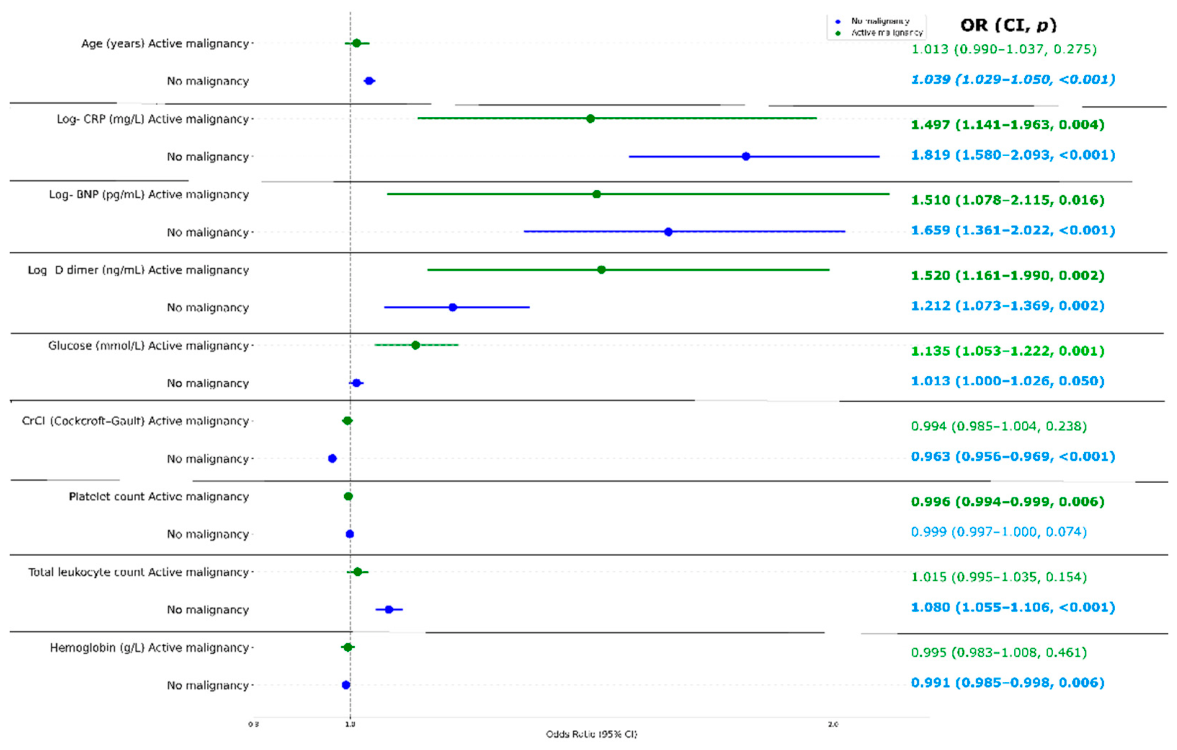
Figure 2.
Multivariable logistic regression analysis of independent predictors of in-hospital mortality stratified by malignancy status. (a) Patients without malignancy (N=1617), in whom CRP, glucose, and CrCl were independently associated with in-hospital mortality. (b) Patients with active malignancy (N=261), in whom CRP and glucose remained independent predictors. Abbreviations: OR, odds ratio; CI, confidence interval; CRP, C-reactive protein; CrCl, creatinine clearance.
Figure 2.
Multivariable logistic regression analysis of independent predictors of in-hospital mortality stratified by malignancy status. (a) Patients without malignancy (N=1617), in whom CRP, glucose, and CrCl were independently associated with in-hospital mortality. (b) Patients with active malignancy (N=261), in whom CRP and glucose remained independent predictors. Abbreviations: OR, odds ratio; CI, confidence interval; CRP, C-reactive protein; CrCl, creatinine clearance.
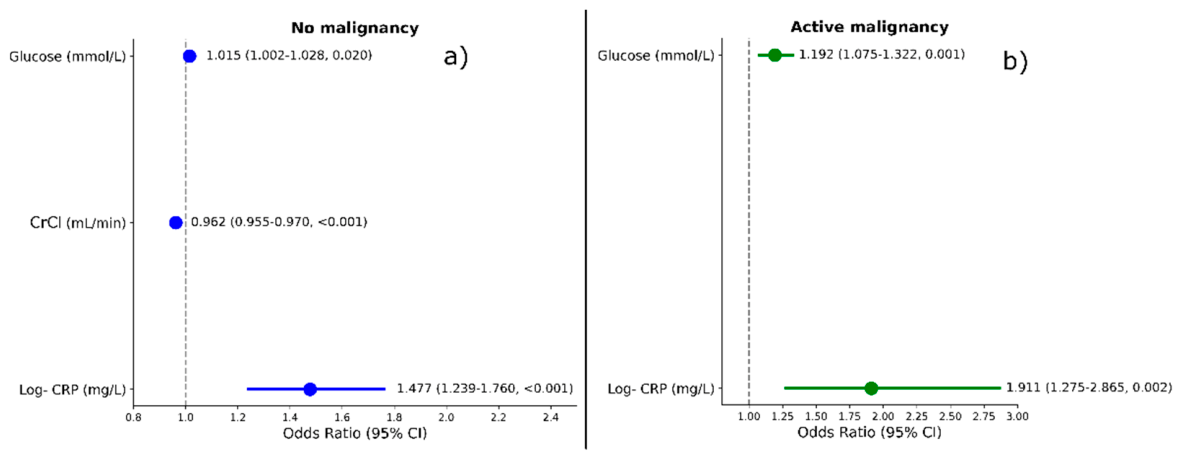
Figure 3.
Quartile-based associations of biomarkers with in-hospital mortality according to malignancy status. (a) Forest plot of odds ratios for CRP, glucose, and CrCl quartiles in patients without malignancy (N=1617). Higher CRP quartiles (Q3 and Q4 vs Q1) were significantly associated with increased mortality, while progressively higher CrCl quartiles (vs Q1) were associated with significantly lower mortality risk. (b) Forest plot of odds ratios for CRP and glucose quartiles in patients with active malignancy (N=261). Only the highest glucose quartile (Q4 vs Q1) showed a significant association with mortality, while elevated odds ratios for CRP did not reach statistical significance versus Q1.
Figure 3.
Quartile-based associations of biomarkers with in-hospital mortality according to malignancy status. (a) Forest plot of odds ratios for CRP, glucose, and CrCl quartiles in patients without malignancy (N=1617). Higher CRP quartiles (Q3 and Q4 vs Q1) were significantly associated with increased mortality, while progressively higher CrCl quartiles (vs Q1) were associated with significantly lower mortality risk. (b) Forest plot of odds ratios for CRP and glucose quartiles in patients with active malignancy (N=261). Only the highest glucose quartile (Q4 vs Q1) showed a significant association with mortality, while elevated odds ratios for CRP did not reach statistical significance versus Q1.
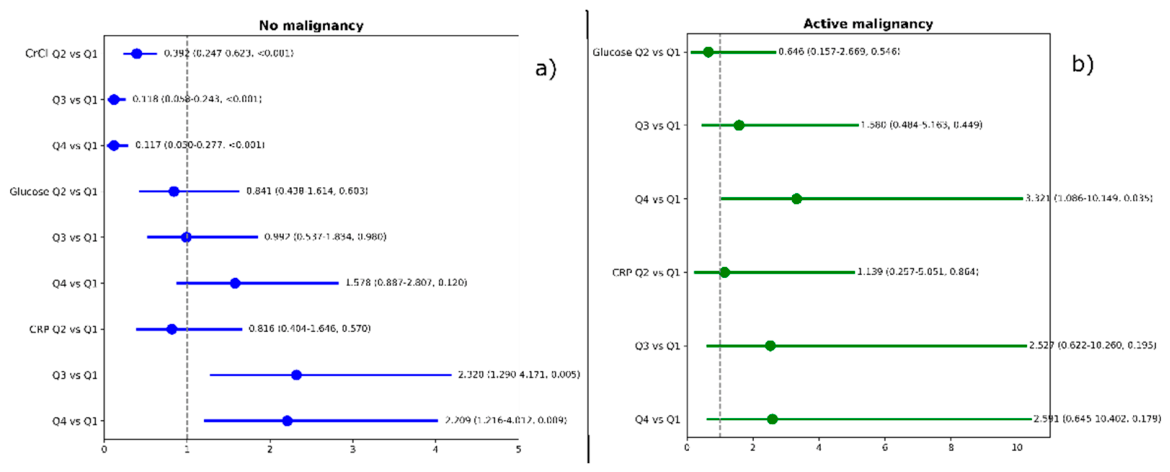
Figure 4.
Interaction analyses of biomarkers with malignancy status in relation to in-hospital mortality. (a) Interaction between CrCl and malignancy status. (b) Interaction between TLC and malignancy status. (c) Interaction between age and malignancy status. (d) Interaction between glucose and malignancy status.
Figure 4.
Interaction analyses of biomarkers with malignancy status in relation to in-hospital mortality. (a) Interaction between CrCl and malignancy status. (b) Interaction between TLC and malignancy status. (c) Interaction between age and malignancy status. (d) Interaction between glucose and malignancy status.
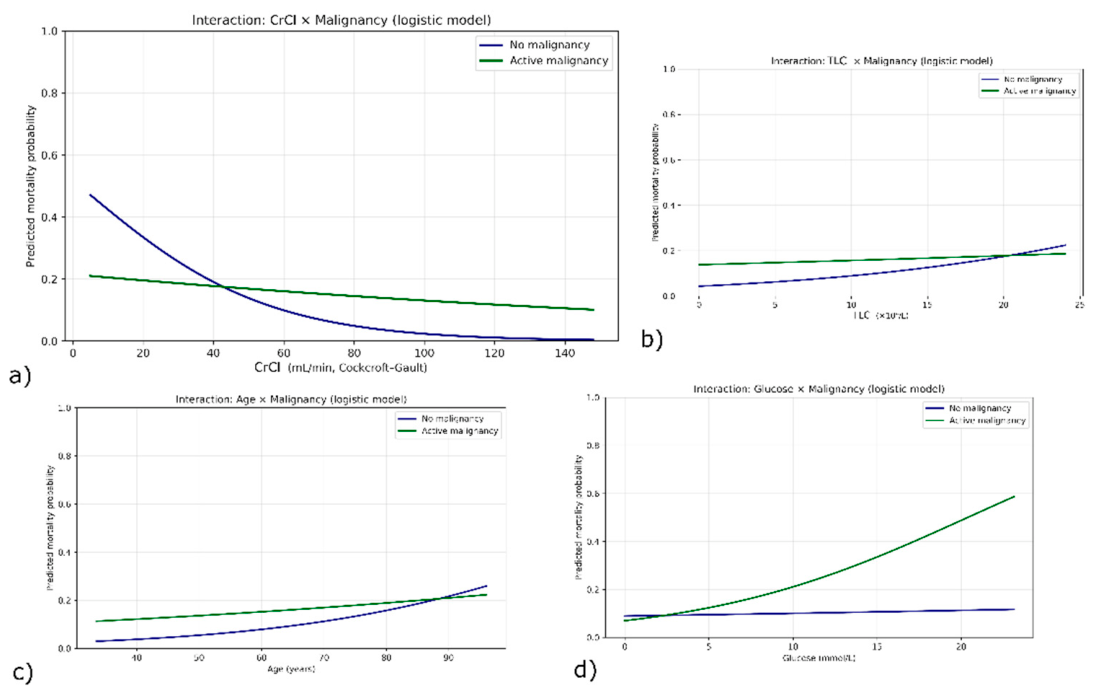
Figure 5.
Receiver operating characteristic (ROC) analyses of clinical variables stratified by malignancy status. (a) ROC curves for patients without malignancy. (b) ROC curves for patients with active malignancy. Variables shown include age, CRP, D-dimer, glucose, CrCl, platelet count, total leukocyte count, and hemoglobin. AUC values with 95% confidence intervals are provided in the figure.
Figure 5.
Receiver operating characteristic (ROC) analyses of clinical variables stratified by malignancy status. (a) ROC curves for patients without malignancy. (b) ROC curves for patients with active malignancy. Variables shown include age, CRP, D-dimer, glucose, CrCl, platelet count, total leukocyte count, and hemoglobin. AUC values with 95% confidence intervals are provided in the figure.
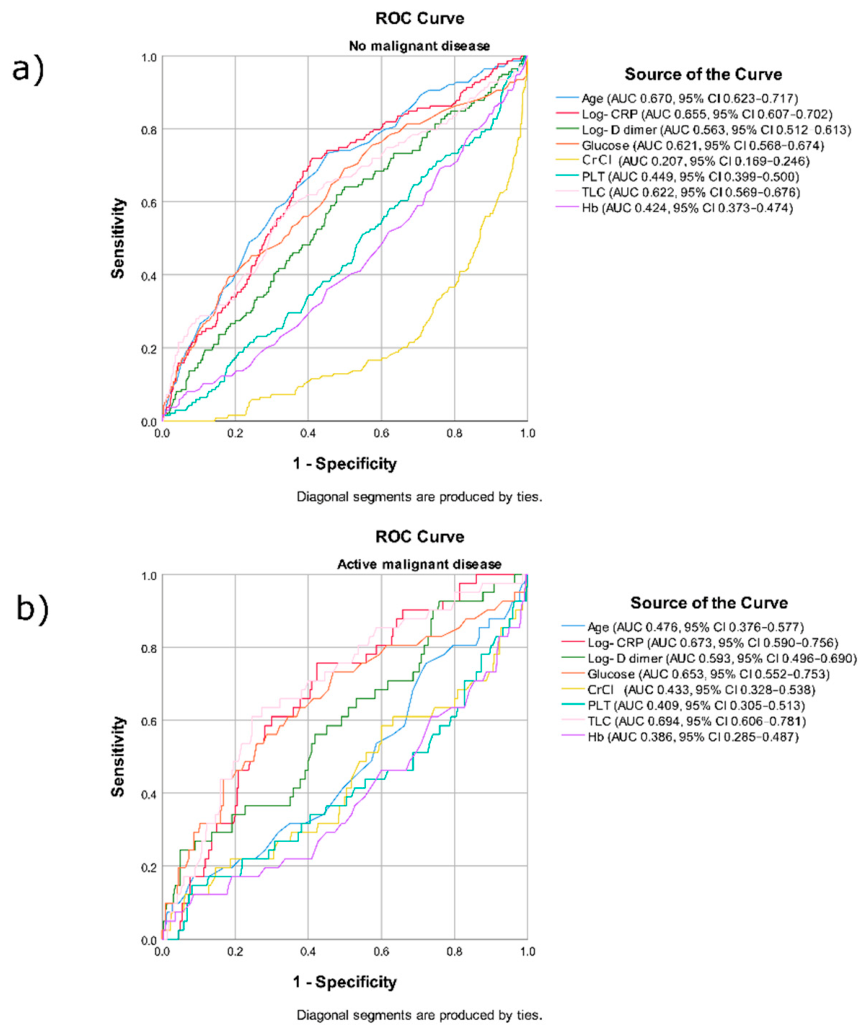

Table 1.
Baseline characteristics of the study population.
| Parameter | N (patients) | Value |
|---|---|---|
| Male, % | 2803 | 47.09 |
| Age (years), mean ± SD | 2803 | 64.78 ± 15.63 |
| Active malignancy, % | 2803 | 14.02 |
| In-hospital mortality, % | 2803 | 14.93 |
| CRP (mg/L), median (25th–75th) | 2691 | 42.40 (15.50 – 95.30) |
| BNP (pg/mL), median (25th–75th) | 882 | 176.85 (57.30 – 484.50) |
| Troponin I (ng/mL), median (25th–75th) | 1139 | 0.08 (0.01 – 0.53) |
| D-dimer (ng/mL), median (25th–75th) | 2597 | 4260.00 (2228.50 – 8972.50) |
| Glucose (mmol/L), mean ± SD | 2718 | 7.89 ± 7.62 |
| CrCl (mL/min), mean ± SD | 2181 | 76.06 ± 35.96 |
| PLT (×10⁹/L), mean ± SD | 2729 | 243.10 ± 102.55 |
| TLC (×10⁹/L), mean ± SD | 2779 | 11.02 ± 6.50 |
| Neutrophils (×10⁹/L), median (25th–75th) | 1720 | 7.90 (5.69 – 11.40) |
| Lymphocytes (×10⁹/L), median (25th–75th) | 1538 | 1.62 (1.15 – 2.22) |
| Hemoglobin (g/L), mean ± SD | 2778 | 129.43 ± 21.63 |
Abbreviations: SD, standard deviation; CRP, C-reactive protein; BNP, B-type natriuretic peptide; CrCl, creatinine clearance; PLT, platelet count; TLC, total leukocyte count.
Table 2.
Univariate and multivariable logistic regression analysis of predictors of in-hospital mortality.
Table 2.
Univariate and multivariable logistic regression analysis of predictors of in-hospital mortality.
| Parameter | Univariate Analysis OR (95% CI, p) |
Multivariable Analysis OR (95% CI, p) |
|---|---|---|
| Sex (Male vs Female) | 0.809 (0.638–1.027, 0.082) | - |
| Age (years) | 1.035 (1.026–1.045, <0.001) | - |
| Active malignancy (yes vs. no) | 1.743 (1.295-2.346, <0.001) | 1.698 (1.128-2.555, 0.011) |
| Log- CRP (mg/L) | 1.779 (1.570–2.016, <0.001) | 1.542 (1.315–1.808, <0.001) |
| Log- BNP (pg/mL) | 1.604 (1.355–1.898, <0.001) | - |
| Log- Troponin I (ng/mL) | 1.093 (0.957–1.249, 0.188) | - |
| Log- D- dimer (ng/mL) | 1.276 (1.141-1.428, <0.001) | - |
| Glucose (mmol/L) | 1.016 (1.001–1.031, 0.034) | 1.018 (1.004–1.031, 0.009) |
| CrCl (mL/min) | 0.970 (0.965–0.976, <0.001) | 0.973 (0.967–0.979, <0.001) |
| PLT (×10⁹/L) | 0.998 (0.997–0.999, 0.004) | 0.998 (0.996–0.999, 0.011) |
| TLC (×10⁹/L) | 1.057 (1.038–1.077, <0.001) | 1.017 (1.000–1.034, 0.046) |
| Neutrophils (×10⁹/L) | 1.002 (0.998–1.006, 0.356) | - |
| Lymphocytes (×10⁹/L) | 0.992 (0.930–1.058, 0.801) | - |
| Hemoglobin (g/L) | 0.990 (0.985–0.996, <0.001) | - |
| Hematocrit (%) | 0.986 (0.971–1.002, 0.084) | - |
*Multivariable logistic regression included N=1878 patients with complete data for all variables. BNP was excluded from the multivariable model due to a high proportion of missing values. Abbreviations: OR, odds ratio; CI, confidence interval; CRP, C-reactive protein; BNP, B-type natriuretic peptide; CrCl, creatinine clearance; PLT, platelet count; TLC, total leukocyte count; Log-, logarithmically transformed variable.
Table 3.
Comparison of baseline characteristics between patients with and without active malignancy.
Table 3.
Comparison of baseline characteristics between patients with and without active malignancy.
| Parameter | No Malignancy | Active Malignancy | p |
|---|---|---|---|
| Age (years), mean ± SD | 64.47 ± 16.13 | 66.78 ± 11.85 | 0.001 |
| CRP (mg/L), median (25th–75th) | 39.25 (14.80 – 89.33) | 63.50 (24.00 – 127.15) | <0.001 |
| BNP (pg/mL), median (25th–75th) | 176.85 (57.34 – 489.00) | 177.15 (56.20 – 476.00) | 0.990 |
| D-dimer (ng/mL), median (25th–75th) | 4220.00 (2187.00 – 8620.00) | 4879.00 (2500.00 – 10058.50) | 0.016 |
| Glucose (mmol/L), mean ± SD | 7.96 ± 8.12 | 7.47 ± 3.16 | 0.238 |
| CrCl (mL/min), mean ± SD | 76.65 ± 36.18 | 72.23 ± 34.38 | 0.051 |
| TLC (×10⁹/L), mean ± SD | 10.86 ± 5.30 | 12.02 ± 11.32 | 0.048 |
| PLT (×10⁹/L), mean ± SD | 241.25 ± 98.62 | 254.18 ± 123.21 | 0.050 |
| Hemoglobin (g/L), mean ± SD | 13.13 ± 2.10 | 11.76 ± 2.18 | <0.001 |
Abbreviations: SD, standard deviation; CRP, C-reactive protein; BNP, B-type natriuretic peptide; CrCl, creatinine clearance; TLC, total leukocyte count, PLT, platelet count.
Disclaimer/Publisher’s Note: The statements, opinions and data contained in all publications are solely those of the individual author(s) and contributor(s) and not of MDPI and/or the editor(s). MDPI and/or the editor(s) disclaim responsibility for any injury to people or property resulting from any ideas, methods, instructions or products referred to in the content. |
© 2026 by the authors. Licensee MDPI, Basel, Switzerland. This article is an open access article distributed under the terms and conditions of the Creative Commons Attribution (CC BY) license (http://creativecommons.org/licenses/by/4.0/).
Copyright: This open access article is published under a Creative Commons CC BY 4.0 license, which permit the free download, distribution, and reuse, provided that the author and preprint are cited in any reuse.