
Submitted:
04 June 2026
Posted:
05 June 2026
You are already at the latest version
Abstract
Introduction - This study analyzes the ipsilesional hemifields in patients with hemianopia and Biofeedback Training (BT). Methods - Prospectively, BT stimulated the paracentral ipsilesional hemifields. BT was compared to a control group using C 10-2 program 68 points on the MAIA microperimetry (Centervue, Padova, Italy). Five weekly BT sessions of 20 minutes delivered. 34 subjects enrolled, 28 in treatment, 6 into control group. Outcomes: General retinal sensitivity (RS), average of the central two columns, the paracentral column of the blind hemifield, ipsilesional hemifield, and the whole ipsilesional and blind hemifields. Paired t-tests used for statistical analysis. Results - Control and treatment groups were equal demographically. In control group, no difference found pre-and-post BT. Baseline RS on the ipsilesional hemifield was 21.4 ± 4.5, lower than the normal cut-off value of 25 dB (p < 0.001). BT improved RS from 14.0 ± 4.2 (1.6, 20.9) to 15.0 ± 4.8 (3.8, 27.5), p= 0.01, paracentral two columns, 16.3 ± 5.3 (2.2, 24.5) to 17.8 ± 5.6 (3.8, 30.7), p = 0.01, central column in ipsilesional hemifield, 20.7 ± 5.4 (2.2, 29.1) to 21.8 ± 4.8 (7.3, 30.7), p = 0.05, and ipsilesional hemifield, 21.42 ± 4.8 (2.5, 28.5) to 22.39 ± 4.24 (7.5, 29.4), p=0.01.Discussion - Ipsilesional hemifields were abnormal and BT improved RS, benefiting patients with hemianopia.
Keywords:
stroke
; brain tumour
; biofeedback training
; retinal sensitivity
; MAIA microperimetry
; sightblindness
; brain trauma
; brain infection
Introduction
Homonymous hemianopia (HH) is the most common visual deficit following a lesion in the retrochiasmal visual pathways. It results in the loss of vision in the contralesional visual field of both eyes. Stroke remains the leading cause of HH, with approximately 70% of posterior cerebral artery strokes leading to visual field loss.1
Patients with HH exhibit alterations of the micro saccades that contribute to deficits in visual scanning, spatial exploration, and orientation.2 As a result, mobility, independent ambulation, and overall quality of life are impaired.3-5 One of the most common complaints is also reading difficulty related to parafoveal field loss and splitting of the fixation.6 Additionally, visual field loss causes a shift in the perceived subjective midline, which can disrupt balance and increase the risk of falls.7
While HH has been considered to preserve the ipsilesional hemifields, recent research suggests that subtle deficits may also exist within these fields, a phenomenon termed sightblindness.8 This term has been used in opposition to blindsight, which has been extensively studied in HH patients. The quality of vision in the central visual field and the supposedly intact visual field has received little attention and has traditionally been assumed to remain intact, in spite of its relevance for low vision rehabilitation. Recent studies suggest that neither the central visual field nor the ipsilateral fields are entirely functional in hemianopic patients.9 The method used for perimetry can greatly influence the detection of defects or progression in hemianopia hemifields. Microperimeters are instruments that obtain a fundus image while tracking the eye movements during the test. A recent study showed the differences between the MAIA microperimeter and the Humphrey automated standard perimeter in hemianopia. The MAIA microperimeter showed it may detect more subtle field defects in comparison to the Humphrey perimeter given the characteristics of each device.10
Although the standard of care in hemianopia is observation, that is, no intervention, some centers utilize prisms and saccades training for vision rehabilitation.11-14 New research evidence suggests that visual perceptual training can partially restore the visual fields in cortical blindness and protect the retinal thinning of the ganglion cell complex from the affected retinal correspondent hemifields. 15-17 Our group has been studying a new emerging vision rehabilitation technique called biofeedback training on the microperimeter (BT) for patients with hemianopia. BT started being used in vision rehabilitation for central vision loss 20 years ago, harnessing eccentric viewing.18 Recently its use in cortical blindness was studied, showing significant improvements in visual functions.19 BT provides the brain with an audio-luminous feedback from the eye position, training the fixation stability and stimulating brain attention using alternative pathways. Functional MRI studies have shown primary visual cortex activation post-BT in patients with Stargardt’s disease.20 We preconceived BT stimulation and fixation training with bimodal audio-luminous static stimuli at a retinal locus 2-3 degrees on the ipsilateral fields close to the transitional area on the macula and to the fovea. 12 patients treated improved significantly their visual function and self-referred quality of life.21
This prospective non-randomized controlled study aimed to: 1) Determine whether the ipsilesional hemifield presents abnormalities on the microperimetry in patients with hemianopia; 2) Assess whether BT would improve its retinal sensitivity.
Methods
This was a prospective, interventional, non-randomized, controlled study. Patients with various stable causes of brain injury and a diagnosis of hemianopia confirmed through MRI and visual fields were included. The 20 central degrees of the visual fields were assessed using the Macular Integrity Assessment (MAIA) microperimeter (Centerview, Padova, Italy), C 10-2 program, 4-2 strategy.
The patients were recruited from the Low Vision Clinic at the Toronto Western Hospital, University of Toronto, Canada. Criteria for inclusion were diagnosis of hemianopia based on visual fields, brain injury from various etiologies, age between 18 and 90 years old, and ability to follow the visual, auditory stimuli, and training instructions. Exclusion criteria were previous perceptual learning treatment for low vision rehabilitation, significant underlying ocular pathology not related to the hemianopia physiopathology, and cognitive impairment that prevents an adequate test and training performance.
Patients had one baseline visit 1 (V1), five BT visits (V2-6), and 1 month follow up visit (V7). Control group had one baseline visit (V1) and one control visit (V2) 6 weeks later that assessed the same variables as the baseline visit.
Ethics Statement
The study was approved by the University Health Network Research Ethics Board, reference number 20-5618 (Toronto, Canada) and registered at ClinicalTrials.gov (NCT05397873A). Data was collected from July 2021 to November 2022. Written informed consent was obtained from all patients.
Assessment and Outcomes
For the treated and control groups, during V1, a MAIA microperimeter test was performed using the C 10-2, 4-2 strategy, 68 stimuli program. A standard LED fixation target consisting of a small red circle of about 0.76° diameter was presented for microperimetry and fixation tests.
Participants underwent a structured audio-luminous biofeedback training (BT) program to stimulate areas of residual function within the paracentral ipsilesional visual field. A Fixation Training Target (FTT) was selected on the MAIA result map, that was 2-3 degrees temporal from the foveal fixation, on a better retinal sensitivity locus than the transitional scotoma or paracentral retinal sensitivity area. The patients were treated on the MAIA with 5 BT weekly sessions of 20 minutes (100 min in total) over a 5-week period.
The outcomes (Figure 1) were Average Retinal Sensitivity of the 68 points measured (RS), paracentral retinal sensitivity (PRS, average of the retinal sensitivity 20 points in the paracentral 2 columns, -1 and 1), average retinal sensitivity in the central column of the blind hemifield (-1), average retinal sensitivity in the central column of the ipsilesional hemifield (1), average retinal sensitivity in the ipsilesional hemifield (1-5), and average retinal sensitivity in the blind hemifield (-1 to -5).
Intervention
BT involved luminous stimulation with auditory feedback was performed on the MAIA microperimeter, using the biofeedback module. After the patient completed the microperimetry C10-2 test on the same device, the ophthalmologist analyzed the retinal sensitivity map report to determine the trained retinal locus (TRL) to be used for BT. This locus should be located no more than 3° from the fovea, and toward the seeing hemifield on the retina, or blind hemi-visual field, to bring the patient’s fixation locus to a larger span area on the retina. The TRL was selected on the screen on top of the microperimetry C10-2 report in the eye that was ipsilateral to the visual field defect, and both eyes remained open during the procedure. Only the ipsilateral eye to the hemi blind visual field was stimulated.The BT session involved the presentation of a standard LED fixation point consisting of a small red circle of about 0.76°diameter on the display monitor. The participant was instructed to look at the LED target while listening to the audio feedback. The participant was asked to move the eye toward the TRL under the technician’s scrutiny. The fixation was monitored in real time on the device’s screen. The auditory feedback changed according to the position of the eye relative to the TRL. The frequency of the auditory feedback (intermittent beeping sound) would increase progressively and become a continuous beep once the TRL was reached. Consequently, a luminous white dot appeared at the TRL to produce bimodal stimulation. During this task, the participant actively controlled their eye movements and repeatedly fixated to practice oculomotor control toward and at the TRL. After the sessions, the patient would ideally naturally fixate using the TRL for reading, seeing faces, and others, voluntarily or unconsciously (Figure 2).
From V2 to V6, BT was performed weekly for 5 weeks. Each BT session was 20 minutes long representing a total of 100 minutes. Pauses were allowed whenever needed.
Data
Data analysis was based on descriptive statistics . Eventual missing data were discounted from baseline and outcome measures. Statistical comparisons were performed using Paired T-Tests and Wilcoxon Signed Rank, and a p < 0.05 was considered a significant difference on the comparisons.
Results
34 patients were studied in total. 28 patients were in the treated group and 6 patients were in the control group. There was no difference between the control and treatment groups in terms of sex, age, treated eye, or diagnosis (see Table 1). The demographic characteristics and time after the brain injury are described in Table 2.
In the control group, no difference was found in the average retinal sensitivity of the 68 points measured (whole hemifield RS), paracentral retinal sensitivity (PRS, average of the retinal sensitivity 20 points in the paracentral 2 columns, -1 to 1), average retinal sensitivity in the central column of the blind hemifield (-1), average retinal sensitivity in the central column of the ipsilateral hemifield (1), average retinal sensitivity in the ipsilateral hemifield (1-5), and average retinal sensitivity in the blind hemifield (-1 to -5) between pre-and-control measures (Table 3).
Table 3 and Figure 3 show that the treated group had significant improvements post-BT. For the average retinal sensitivity of the 68 points measured (whole hemifield RS), there was an improvement from 14 ± 4.2 dB to 15 ± 4.8 dB (p=0.01). The paracentral retinal sensitivity (PRS, average of the retinal sensitivity 20 points in the paracentral 2 columns,-1 to1) improved from 16.3 ± 5.3 dB to 17.8 ± 5.6 dB (p=0.01), and the ipsilesional hemifield (1 to 5) improved from 21.42 ± 4.8 to 22.3 ± 4.2 dB (p=0.01). The average retinal sensitivity in the central column of the blind hemifield (-1) showed a trend for improvement, from 11.9 ± 6.4 to 13.8 ± 7.6 (p=0.06), and the average retinal sensitivity in the central column of the ipsilateral hemifield (1) improved from 20.7 ± 5.4 to 21.8 ± 4.8 (p=0.05). The blind hemifield did not improve in the treated group.
Figure 4.
Microperimetric results of a patient who improved his retinal sensitivity in the columns -2, -1, and 1 post-BT (inside the red box). On the left, C 10-2 MAIA microperimetry Pre-BT, Retinal Sensitivity 12.6 dB, paracentral columns 20 points average (Paracentral Retinal Sensitivity) 13.6 dB. On the right, results Post-BT, Retinal Sensitivity 13.8 dB, Paracentral Retinal Sensitivity 18.2 dB. There was a 4.4 dB increase in the paracentral area.
Figure 4.
Microperimetric results of a patient who improved his retinal sensitivity in the columns -2, -1, and 1 post-BT (inside the red box). On the left, C 10-2 MAIA microperimetry Pre-BT, Retinal Sensitivity 12.6 dB, paracentral columns 20 points average (Paracentral Retinal Sensitivity) 13.6 dB. On the right, results Post-BT, Retinal Sensitivity 13.8 dB, Paracentral Retinal Sensitivity 18.2 dB. There was a 4.4 dB increase in the paracentral area.
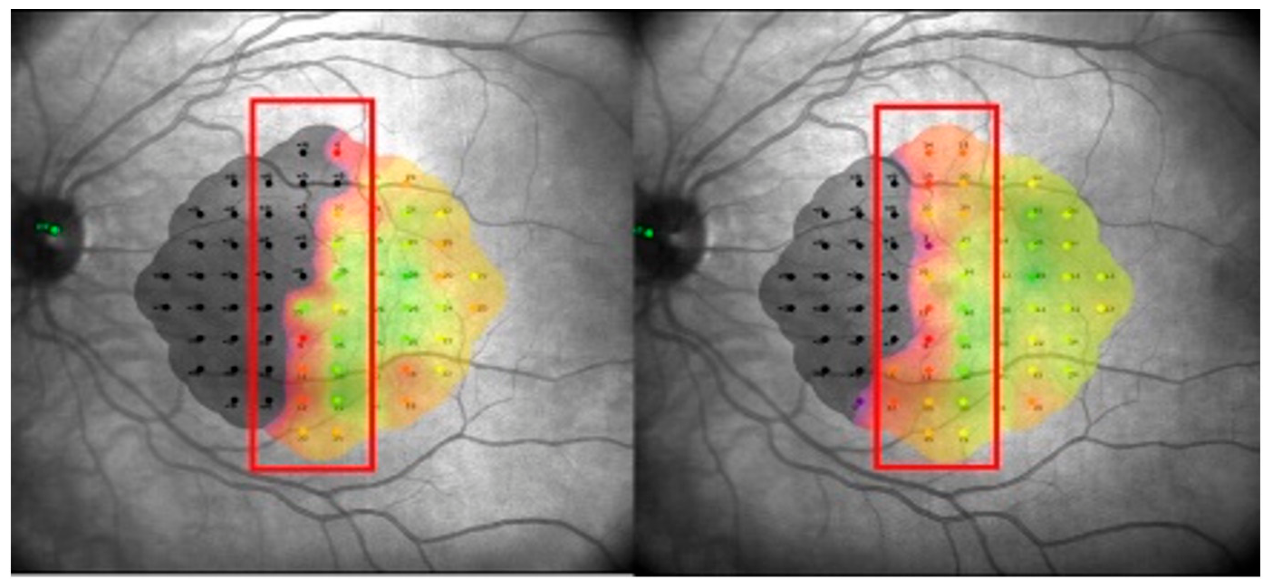
Noticeably, as shown in Table 4, regarding the retinal sensitivity on the ipsilateral hemifields, considered in general to be the “sound hemifields”, the currently accepted cut-off for a normal retinal sensitivity for the MAIA microperimeter is of 25 dB. 22 Before BT, the mean pretreatment RS on the ipsilateral hemifield for all patients (control plus treated) was 21.4 ± 4.5, significantly lower than the normal cut-off value of 25 dB (p < 0.001).

Table 3.
Comparison of Baseline and Post-treatment Average Retinal Sensitivity (decibels) measured on MAIA microperimeter.
Table 3.
Comparison of Baseline and Post-treatment Average Retinal Sensitivity (decibels) measured on MAIA microperimeter.
| Baseline (95% CI) | Post-BT (95% CI) | p (Wilcoxon Signed Rank) | ||
| Control | Whole field (RS) | 13.9 ± 3.4 (9.8, 19.2) | 13.9 ± 3.7 (9.9, 19.7) | 0.92 |
| Blind Hemifield (-5 to -1) | 6.3 ± 3.5 (10.6, 20.0) | 6.3 ± 4.3 (1.5, 12.26) | 0.92 | |
| Ipsilateral hemifield (1 to 5) | 21.4 ± 3.1 (17.7, 26.5) | 21.6 ± 2.6 (18.1, 25.3) | 0.6 | |
| Paracentral field (-1 to 1) | 15.0 ± 3.5 (10.6, 20.0) | 15.8 ± 3.2 (11.2, 19.4) | 0.35 | |
| Central column (-1) | 9.8 ± 4.8 (3.0, 16.1) | 10.5 ± 4.2 (5.2, 14.9) | 0.35 | |
| Central column (1) | 20.1 ± 3.6 (16.0, 26.4) | 21.1 ± 3.2 (17.2, 25.8) | 0.35 | |
| Treatment | Whole field | 14.0 ± 4.2 (1.6, 20.9) | 15.0 ± 4.8 (3.8, 27.5) | 0.01* |
| Blind Hemifield (-5 to -1) | 6.5 ± 5.9 (0.2,19.7) | 7.6 ± 7.2 (0, 25.6) | 0.16 | |
| Ipsilesional hemifield (1 to 5) | 21.42 ± 4.8 (2.5, 28.5) | 22.39 ± 4.24 (7.5, 29.4) | 0.01* | |
| Paracentral field (-1 to 1) | 16.3 ± 5.3 (2.2, 24.5) | 17.8 ± 5.6 (3.8, 30.7) | 0.01* | |
| Central column (-1) | 11.9 ± 6.4 (0.3, 23.0) | 13.8 ± 7.6 (0.0, 31.1) | 0.06 | |
| Central column (1) | 20.7 ± 5.4 (2.2, 29.1) | 21.8 ± 4.8 (7.3, 30.7) | 0.05* |
BT: biofeedback therapy; columns -5 to 5 refer to
Figure 1, RS: retinal sensitivity.
Discussion
Our study demonstrated that the average retinal sensitivity in the ipsilesional hemifields (columns 1 to 5) of patients with hemianopia was reduced by 6 decibels compared to the normal average measured by the MAIA microperimeter. This represents a substantial reduction; for comparison, in Humphrey visual field testing, a 1.2 dB decline per year is used as a criterion for glaucoma progression.²³ While no comparable data exist for hemianopia, unlike glaucoma and age-related macular degeneration, even subtle changes in hemianopia may carry functional significance.
This finding aligns with previous research showing that patients with hemianopia exhibit diminished spatial and temporal sensitivities within their seemingly intact hemifield.
8,9,24
These impairments include reduced contrast sensitivity, prolonged reaction times, and task-dependent deficits when compared to healthy individuals. Some patients with hemianopia report perceptual difficulties, especially during visual search tasks that require input from both visual fields. It is plausible that the ipsilateral hemifield does not function entirely “normally” due to impaired integration of visual information from the lesioned hemifield.
Karlijn et al. employed the Useful Field of Vision (UFOV) test—an established predictor of driving ability and performance in everyday tasks such as identifying coins or reading food labels.
25
Their UFOV results revealed visual impairments in hemianopia that are not detectable using standard perimetry, highlighting previously unrecognized sensory deficits in the ipsilesional hemifield. This underscores the limitations of conventional standard automated perimetry (SAP), which may fail to detect subtle deficits in the “intact” hemifield. The MAIA microperimeter has also demonstrated greater sensitivity in patients with homonymous hemianopia (HH), owing to differences in stimulus characteristics, background, and intensity range.¹⁰
Microperimeters are advanced devices that track eye movements at 25 Hz, pausing testing upon fixation loss. This ensures accurate measurement of scotoma size, minimizing confounding effects from eye movements.²⁶
Given the importance of the ipsilesional hemifield in performing activities of daily living, its rehabilitation may represent a critical area of interest—on par with the rehabilitation of blind visual areas using alternative pathways. Vision restoration is believed to occur via such mechanisms. According to the Residual Vision Activation Theory, clinically relevant neuroplasticity primarily occurs in areas of “residual vision” or “relative defects.” These areas - typically located at the borders of visual field loss (columns -2, -1, 1, and 2 in our study) - are believed to undergo synaptic plasticity through repeated stimulation (training), which stabilizes synchronous neuronal firing even after cessation of treatment.27,28 This process may underlie the physiological basis of vision restoration.
Previous studies have demonstrated the effectiveness of low vision rehabilitation using the MAIA and MP1 microperimeter (Nidek, Japan) audio-luminous biofeedback training in patients with central vision loss. Reported benefits include improvements in visual acuity, fixation stability, retinal sensitivity, and reading speed.29-37 MP1-based pattern stimulation has also shown modest visual field improvements in hemianopic patients, restoring areas of residual visual function.¹⁹
Our group hypothesized that biofeedback training (BT) using the MAIA microperimeter in patients with hemianopia could yield measurable gains in visual field sensitivity, thereby improving quality of life. Our protocol targeted a training locus located 3 degrees into the ipsilateral (seeing) hemifield to enhance paracentral vision and potentially stimulate connections with the adjacent transitional scotoma. After five weekly 20-minute sessions, participants demonstrated a 2.7 ± 0.9 dB increase in paracentral retinal sensitivity (summed values from columns -1 and 1) in 9 of 11 patients. Notable improvements were also observed in fixation stability (8/12 participants), contrast sensitivity (6/12 participants), and near visual acuity (10/12 participants). Reading speed increased by 32.5 ± 32.4 words per minute in 10 of 11 participants, and self-reported visual quality, as measured by the Massof 48-item questionnaire, also improved.²¹
Using the same BT stimulation protocol, the present study demonstrated a significant post-treatment improvement in overall retinal sensitivity in the treated group, with no corresponding improvement in the control group. Furthermore, paracentral retinal sensitivity (columns -1 and 1) and sensitivity in the central column of the ipsilateral hemifield (column 1) improved significantly. Overall, the entire ipsilateral hemifield showed a significant retinal sensitivity gain. As anticipated from previous research, no significant changes were observed in the blind hemifield of the treated group; however, a trend toward improvement was noted in the central column of the blind hemifield (column -1), confirming the Residual Vision Activation Theory and the mechanism of restoration from the border of the scotoma to the periphery in hemianopia.
Given the baseline reduction in retinal sensitivity in the ipsilateral hemifield and its subsequent improvement following BT, this form of stimulation may serve as an effective rehabilitation strategy to enhance quality of life in patients with hemianopia, as demonstrated in our previous work.²¹
Interestingly, despite targeting stimulation to the ipsilesional (seeing) hemifield, column -1 (in the blind hemifield) showed a trend toward improvement. This observation supports one more time the Residual Vision Activation Theory, suggesting that stimulation at a single locus may activate adjacent synaptic networks and enhance nearby regions. Improved fixation stability, also trained during BT, may have further contributed to enhanced retinal sensitivity. Functional MRI studies in patients with Stargardt’s disease have shown that BT can significantly activate the primary visual cortex compared to controls, reinforcing the role of cortical plasticity in vision restoration.²⁰ Future studies using functional MRI (fMRI) will be able to elucidate the mechanisms underlying BT. Audio-visual BT, which delivers bimodal stimulation, may amplify effects - potentially via the superior colliculus.³⁸
Our study has limitations, including the small sample size, particularly in the control group, and the lack of a placebo activity. Designing a credible sham intervention that adequately mimics BT is challenging. However, we acknowledge that the placebo effect itself may positively influence outcomes, potentially enhancing the therapeutic effects of BT. Further studies with larger cohorts are warranted to confirm our findings and to better understand the underlying mechanisms and efficacy of BT in hemianopic patients.
Funding Statements
Dr. Monica Daibert Nido is a clinician Scientist at the Krembil Research Institute, affiliated to the University Health Network (UHN), Toronto, Canada, consequently, the funding for this study came from the UHN Foundation.
Acknowledgments
We acknowledge the kind collaboration of our research assistants, Oluwafikunmi Adeyemo and Nuzhat Zaman for their great job in our Clinical Research Unit at the University Health Network, Toronto Western Hospital.
Declaration of interest
Monica Daibert-Nido receives funding from Donald K. Johnson Eye Institute, which is affiliated with the Krembil Research Institute for research in low vision rehabilitation. None of the other authors have conflicts of interest nor commercial relationship disclosures.
References
- Pambakian, A.L.M.; Kennard, C. Can visual function be restored in patients with homonymous hemianopia? Br. J. Ophthalmol. 1997, 81(4), 324–8. [Google Scholar] [CrossRef]
- Gao, Y.; Sabel, B.A. Microsaccade dysfunction and adaptation in hemianopia after stroke. Restor. Neurol. Neurosci. 2017, 35(4), 365–76. [Google Scholar] [CrossRef]
- Goodwin, D. Homonymous hemianopia: challenges and solutions. Clin. Ophthalmol. 2014, 8, 1919–27. [Google Scholar] [CrossRef]
- Dundon, N.M.; Bertini, C.; Làdavas, E.; Sabel, B.A.; Gall, C. Visual rehabilitation: visual scanning, multisensory stimulation and vision restoration training. Front Behav. Neurosci. 2015, 9, 192. [Google Scholar] [CrossRef]
- Chokron, S.; Perez, C.; Peyrin, C. Behavioral consequences and cortical reorganization in homonymous hemianopia. Front Syst. Neurosci. 2016, 10, 57. [Google Scholar] [CrossRef]
- Leff, A.P.; Scott, S.K.; Crewes, H.; Hodgson, T.L.; Cowey, A.; Howard, D.; et al. Impaired reading in patients with right hemianopia. Ann. Neurol. 2000, 47(2), 171–8. [Google Scholar] [CrossRef]
- Wing, J.J.; Burke, J.F.; Clarke, P.J.; Feng, C.; Skolarus, L.E. The role of the environment in falls among stroke survivors. Arch. Gerontol. Geriatr. 2017, 72, 1–5. [Google Scholar] [CrossRef]
- Cavézian, C.; Perez, C.; Peyrin, C.; Gaudry, I.; Obadia, M.; Gout, O.; et al. Is there an ipsilesional deficit in hemianopia? The question of sightblindness in the ‘intact’ visual field. Cortex 2015, 69, 166–74. [Google Scholar] [CrossRef]
- Bola, M.; Gall, C.; Sabel, B.A. “Sightblind”: perceptual deficits in the “intact” visual field. Front Neurol. 2013, 4, 80. [Google Scholar] [CrossRef]
- Redmond, B.V.; Fahrenthold, B.K.; Yang, J.; Saionz, E.L.; Cavanaugh, M.R.; Huxlin, K.R. MAIA and Humphrey Perimetry Differ in Their Estimation of Homonymous Visual Field Defects. Transl. Vis. Sci. Technol. 2024, 13(11), 15. [Google Scholar] [CrossRef] [PubMed] [PubMed Central]
- Peli, E. Field expansion for homonymous hemianopia by optically induced peripheral exotropia. Optom. Vis. Sci. 2000, 77, 453–64. [Google Scholar]
- Sahraie, A.; Smania, N.; Zihl, J. Use of NeuroEyeCoach to improve eye movement efficacy in patients with homonymous visual field loss. BioMed Res. Int. 2016, 2016, 5186461. [Google Scholar] [CrossRef]
- Weinberg, J.; Diller, L.; Gordon, W.A.; Gerstman, L.J.; Lieberman, A. Visual scanning training effect on reading-related tasks in acquired right brain damage. Arch. Phys. Med. Rehabil. 1977, 58, 479–86. [Google Scholar]
- Pollock, A.; Hazelton, C.; Rowe, F.J.; Jonuscheit, S.; Kernohan, A.; Angilley, J.; et al. Interventions for visual field defects in people with stroke. Cochrane Database Syst. Rev. 2019, 5, CD008388. [Google Scholar]
- Fahrenthold, B.K.; Cavanaugh, M.R.; Tamhankar, M.; Lam, B.L.; Feldon, S.E.; Johnson, B.A.; et al. Training in cortically blinded fields appears to confer patient-specific benefit against retinal thinning. Invest Ophthalmol. Vis. Sci. 2024, 65(4), 29. [Google Scholar] [CrossRef] [PubMed] [PubMed Central]
- Saionz, E.L.; Busza, A.; Huxlin, K.R. Rehabilitation of visual perception in cortical blindness. Handb. Clin. Neurol. 2022, 184, 357–73. [Google Scholar] [CrossRef] [PubMed] [PubMed Central]
- Mueller, I.; Poggel, D.; Kenkel, S.; Kasten, E.; Sabel, B.A. Vision restoration therapy after brain damage: subjective improvements of activities of daily life and their relationship to visual field enlargements. Vis. Impair Res. 2003, 5, 157–78. [Google Scholar] [CrossRef]
- Qian, T.; Xu, X.; Liu, X.; Yen, M.; Zhou, H.; Mao, M.; et al. Efficacy of MP-3 microperimeter biofeedback fixation training for low vision rehabilitation in patients with maculopathy. BMC Ophthalmol. 2022, 22(1), 197. [Google Scholar] [CrossRef] [PubMed] [PubMed Central]
- de Rossi, F.; Guidobaldi, M.; Moscato, U.; Marra, C.; Amore, F. Rehabilitative effect of the patterned stimulation with MP1 microperimeter in homonymous hemianopia. Vis. Rehabil. Int. 2020, 11(1), 41–7. [Google Scholar]
- Melillo, P.; Prinster, A.; Di Iorio, V.; Olivo, G.; D’Alterio, F.M.; Cocozza, S.; et al. Biofeedback rehabilitation and visual cortex response in Stargardt’s disease: a randomized controlled trial. Transl. Vis. Sci. Technol. 2020, 9(6), 6. [Google Scholar] [CrossRef] [PubMed] [PubMed Central]
- Misawa, M.; Pyatova, Y.; Sen, A.; Markowitz, M.; Markowitz, S.N.; Reber, M.; et al. Innovative vision rehabilitation method for hemianopsia: comparing pre- and post audio-luminous biofeedback training for ocular motility improving visual functions and quality of life. Front Neurol. 2023, 14, 1151736. [Google Scholar] [CrossRef] [PubMed] [PubMed Central]
- Charng, J.; Sanfilippo, P.G.; Attia, M.S.; Dolliver, M.; Arunachalam, S.; Chew, A.L.; et al. Interpreting MAIA microperimetry using age- and retinal loci-specific reference thresholds. Transl. Vis. Sci. Technol. 2020, 9(7), 19. [Google Scholar] [CrossRef] [PubMed] [PubMed Central]
- Kummet, C.M.; Zamba, K.D.; Doyle, C.K.; Johnson, C.A.; Wall, M. Refinement of pointwise linear regression criteria for determining glaucoma progression. Invest Ophthalmol. Vis. Sci. 2013, 54, 6234–41. [Google Scholar] [CrossRef]
- Cavézian, C.; Perez, C.; Peyrin, C.; Gaudry, I.; Obadia, M.; Gout, O.; et al. Hemisphere-dependent ipsilesional deficits in hemianopia: sightblindness in the ‘intact’ visual field. Cortex 2015, 69, 166–74. [Google Scholar] [CrossRef]
- Woutersen, K.; Geuzebroek, A.C.; van den Berg, A.V.; Goossens, J. Useful field of view performance in the intact visual field of hemianopia patients. Invest Ophthalmol. Vis. Sci. 2020, 61(5), 43. [Google Scholar] [CrossRef] [PubMed]
- Markowitz, S.N.; Reyes, S.V. Microperimetry and clinical practice: an evidence-based review. Can. J. Ophthalmol. 2013, 48(5), 350–7. [Google Scholar] [CrossRef] [PubMed]
- Sabel, B.A.; Henrich-Noack, P.; Fedorov, A.; Gall, C. Vision restoration after brain and retina damage: the “residual vision activation theory.”. Prog. Brain Res. 2011, 192, 199–262. [Google Scholar]
- Fahrenthold, B.K.; Cavanaugh, M.R.; Tamhankar, M.; Lam, B.L.; Feldon, S.E.; Johnson, B.A.; et al. Training in cortically blinded fields appears to confer patient-specific benefit against retinal thinning. Invest Ophthalmol. Vis. Sci. 2024, 65(4), 29. [Google Scholar] [CrossRef]
- Amore, F.M.; Paliotta, S.; Silvestri, V.; Piscopo, P.; Turco, S.; Reibaldi, A. Biofeedback stimulation in patients with age-related macular degeneration: comparison between 2 different methods. Can. J. Ophthalmol. 2013, 48(5), 431–7. [Google Scholar] [CrossRef]
- Morales, M.U.; Saker, S.; Wilde, C.; Rubinstein, M.; Limoli, P.; Amoaku, W.M. Biofeedback fixation training method for improving eccentric vision in patients with loss of foveal function secondary to different maculopathies. Int. Ophthalmol. 2020, 40(2), 305–12. [Google Scholar] [CrossRef]
- Daibert-Nido, M.; Markowitz, S.N. Vision rehabilitation with biofeedback training. Can. J. Ophthalmol. 2018, 53(1), E83–4. [Google Scholar] [CrossRef] [PubMed]
- Morales, M.U.; Saker, S.; Wilde, C.; Rubinstein, M.; Limoli, P.; Amoaku, W.M. Biofeedback fixation training method for improving eccentric vision in patients with loss of foveal function secondary to different maculopathies. Int. Ophthalmol. 2020, 40(2), 305–12. [Google Scholar] [CrossRef] [PubMed]
- Daibert-Nido, M.; Patino, B.; Markowitz, M.; Markowitz, S.N. Rehabilitation with biofeedback training in age-related macular degeneration for improving distance vision. Can. J. Ophthalmol. 2019, 54(3), e103–6. [Google Scholar] [CrossRef] [PubMed]
- Sharma, P.; Tandon, R.; Kumar, S.; Anand, S. Reduction of congenital nystagmus amplitude with auditory biofeedback. J. AAPOS 2000, 4(5), 287–90. [Google Scholar] [CrossRef]
- Daibert-Nido, M. Biofeedback training for pediatric nystagmus: improving visual functions and quality of life. Invest Ophthalmol. Vis. Sci. 2020, 61(7), 3380. [Google Scholar]
- Daibert-Nido, M.; Pyatova, Y.; Markowitz, M.; Markowitz, S.N. Visual outcomes of audio-luminous biofeedback training for a child with idiopathic nystagmus. Arq. Bras. Oftalmol. 2020, 83(6), 514–7. [Google Scholar] [CrossRef]
- Melillo, P.; Prinster, A.; Di Iorio, V.; Olivo, G.; D’Alterio, F.M.; Cocozza, S.; et al. Biofeedback rehabilitation and visual cortex response in Stargardt’s disease: a randomized controlled trial. Transl. Vis. Sci. Technol. 2020, 9(6), 6. [Google Scholar] [CrossRef] [PubMed] [PubMed Central]
- Hughes, H.C.; Nelson, M.D.; Aronchick, D.M. Spatial characteristics of visual-auditory summation in human saccades. Vis. Res. 1998, 38(24), 3955–63. [Google Scholar] [CrossRef] [PubMed]
Figure 1.
MAIA Microperimetry C 10-2 68 point program for the OD of a patient in the study: paracentral retinal sensitivity (PRS, average of the retinal sensitivity 20 points in the paracentral 2 columns, -1 and 1), average retinal sensitivity in the central column of the blind hemifield (-1), average retinal sensitivity in the central column of the ipsilateral hemifield (1), average retinal sensitivity in the ipsilateral hemifield (1-5), and average retinal sensitivity in the blind hemifield (-1 to -5).
Figure 1.
MAIA Microperimetry C 10-2 68 point program for the OD of a patient in the study: paracentral retinal sensitivity (PRS, average of the retinal sensitivity 20 points in the paracentral 2 columns, -1 and 1), average retinal sensitivity in the central column of the blind hemifield (-1), average retinal sensitivity in the central column of the ipsilateral hemifield (1), average retinal sensitivity in the ipsilateral hemifield (1-5), and average retinal sensitivity in the blind hemifield (-1 to -5).
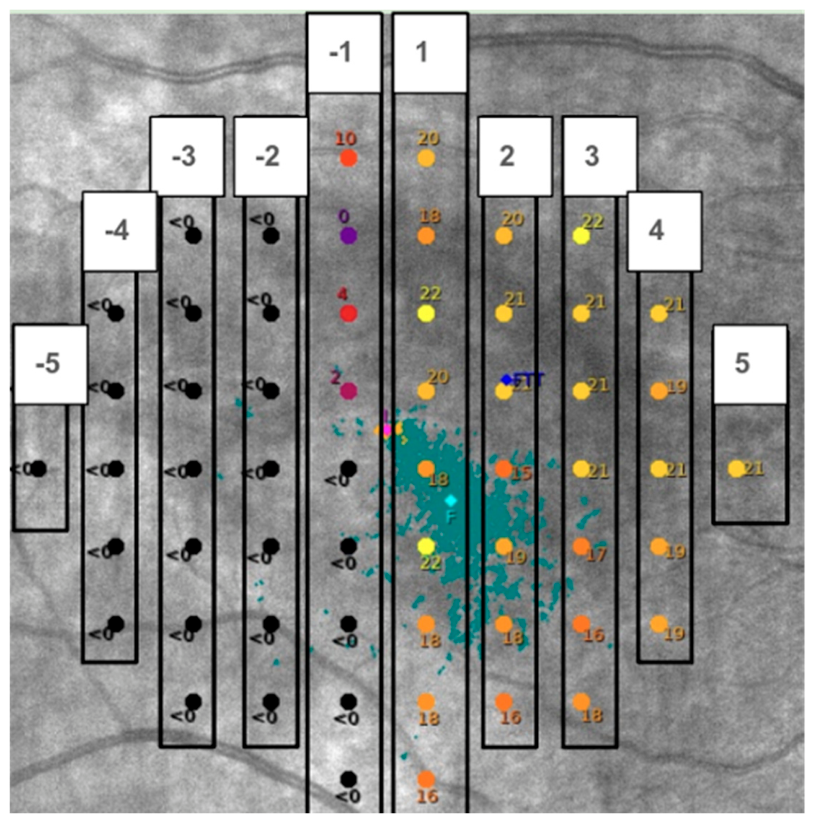
Figure 2.
A) Pre-BT microperimetry C10-2, left eye. Each green point is an attempt of fixation. Preferred retinal locus (PRL) center is located initially at a 22dB point, there is splitting of fixation. A trained retinal locus (TRL) was selected towards the seeing retina on a 25 510 dB retinal point. B) Biofeedback training session as reported by MAIA microperimeter: green dots – fixation attempts. Original PRL (on the left) has more fixation attempts (green dot), while BT training moves fixation points towards the TRL (on the right). C) The center of the new PRL area is located at a 25 dB retinal point. The microperimetry shown in C is a 2 year follow up for patient 2.
Figure 2.
A) Pre-BT microperimetry C10-2, left eye. Each green point is an attempt of fixation. Preferred retinal locus (PRL) center is located initially at a 22dB point, there is splitting of fixation. A trained retinal locus (TRL) was selected towards the seeing retina on a 25 510 dB retinal point. B) Biofeedback training session as reported by MAIA microperimeter: green dots – fixation attempts. Original PRL (on the left) has more fixation attempts (green dot), while BT training moves fixation points towards the TRL (on the right). C) The center of the new PRL area is located at a 25 dB retinal point. The microperimetry shown in C is a 2 year follow up for patient 2.
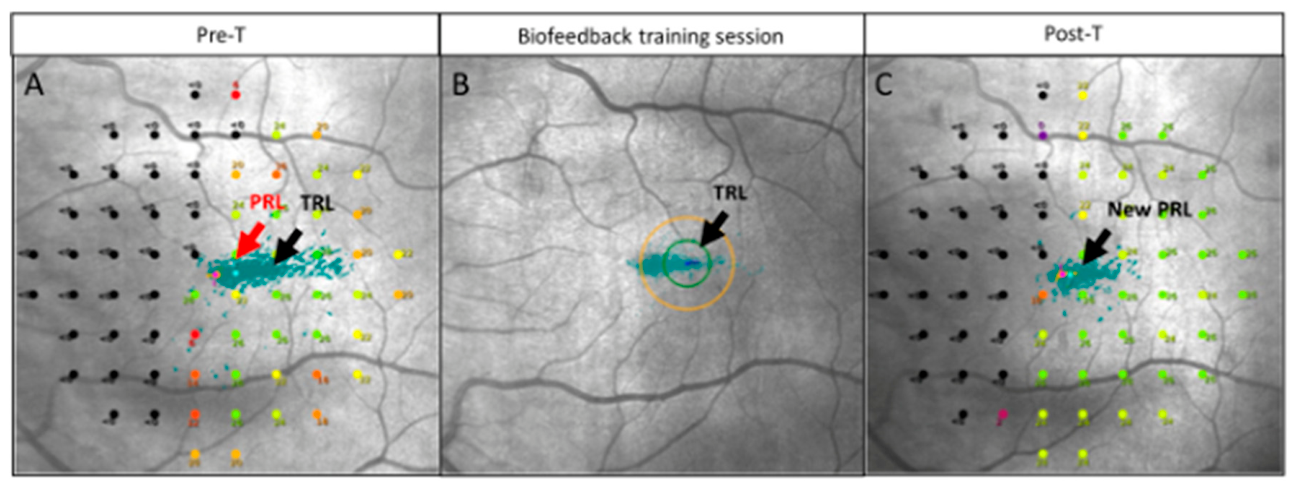
Figure 3.
Comparison of the retinal sensitivity within the different regions of the fields between pre-and post-BT in the treated group.
Figure 3.
Comparison of the retinal sensitivity within the different regions of the fields between pre-and post-BT in the treated group.
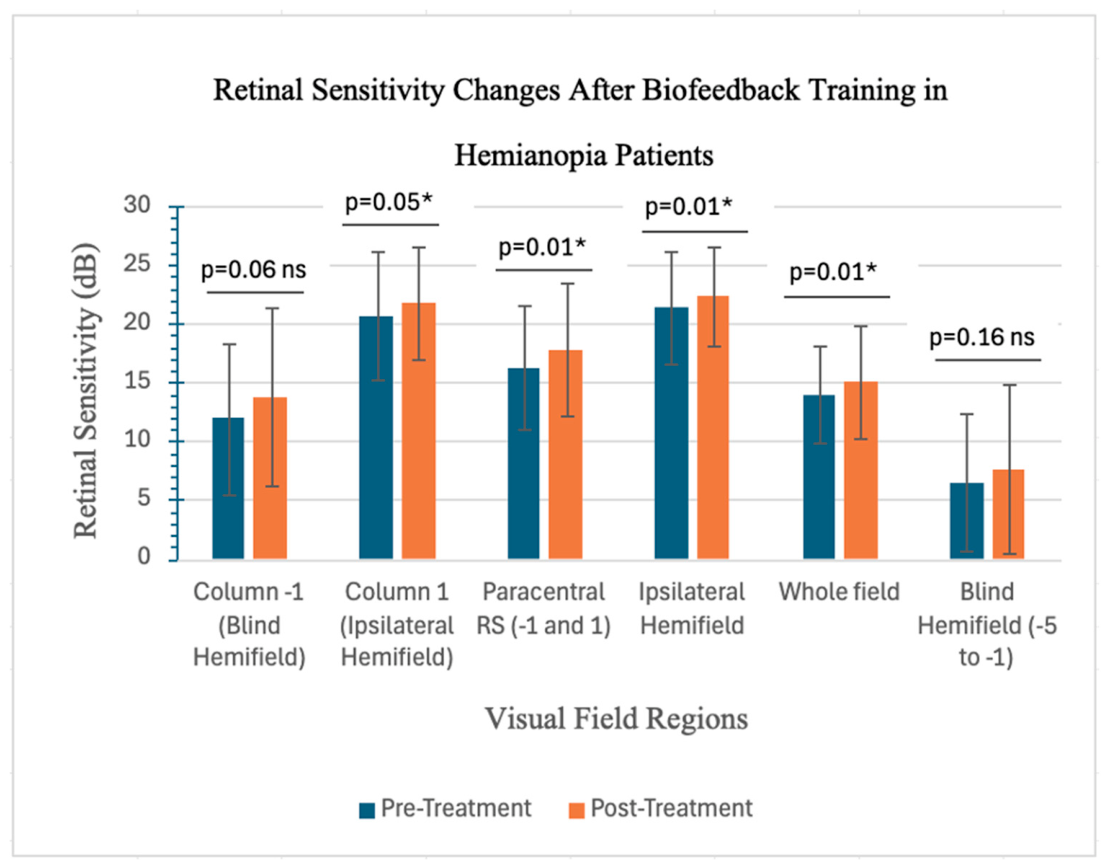
Table 1.
Baseline characteristics.
|
Control (%) n=6 |
Treatment (%) n=28 |
p | ||
| Sex | 0.67 | |||
| Female Male |
2 (33.3) 4 (66.7) |
12 (42.9) 16 (57.1) |
||
| Age | 52.3 ± 28.7 | 60.6 ± 15.0 | 0.52 | |
| Eye | 0.91 | |||
| Right | 2 (33.3) | 10 (35.7) | ||
| Cause | 0.20 | |||
| Stroke | 5 (83.3) | 22 (78.6) | ||
| Neurosurgery/Tumour | 1 (16.7) | 5 (17.9) | ||
| Herpes encephalitis | 1 (3.6) | |||
*p value: t-tests, paired samples analysis.
Table 2.
Patient demographics.
| ID | Group | Age | Sex | Ethnicity | Diagnosis |
Treated Eye |
Time from event (months) |
| 1 | BT | 57 | M | Black | Stroke | L | 7 |
| 2 | BT | 40 | F | Caucasian | Stroke | L | 12 |
| 3 | BT | 72 | M | Caucasian | Herpes encephalitis | L | 7 |
| 4 | BT | 64 | F | Caucasian | Neurosurgery/Tumour | R | 6 |
| 5 | BT | 82 | M | Latin | Stroke | R | 2.6 |
| 9 | BT | 80 | F | Asian | Stroke | L | 7 |
| 10 | BT | 63 | M | Asian | Neurosurgery/Tumour | R | 14 |
| 11 | BT | 84 | F | Caucasian | Stroke | L | 12 |
| 12 | BT | 51 | F | Caucasian | Stroke | R | 10 |
| 14 | BT | 57 | M | Asian | Stroke | L | 5 |
| 15 | BT | 62 | M | Caucasian | Stroke | L | 3 |
| 16 | BT | 80 | F | Caucasian | Stroke | L | 8 |
| 17 | BT | 65 | F | Caucasian | Stroke | R | 15 |
| 18 | BT | 68 | F | Black | Stroke | L | 5 |
| 20 | BT | 64 | F | Caucasian | Stroke | L | 12 |
| 21 | BT | 64 | F | Asian | Stroke | L | 8 |
| 22 | BT | 58 | F | Caucasian | Stroke | R | 6 |
| 23 | BT | 48 | M | Caucasian | Stroke | L | 6 |
| 25 | BT | 51 | F | Caucasian | Stroke | R | 6 |
| 26 | BT | 34 | M | Asian | Stroke | R | 10 |
| 27 | BT | 17 | M | Caucasian | Neurosurgery/Tumour | L | 19 |
| 28 | BT | 69 | M | Caucasian | Stroke | L | 5 |
| 30 | BT | 47 | M | Asian | Stroke | L | 24 |
| 31 | BT | 74 | M | Caucasian | Stroke | L | 18 |
| 32 | BT | 18 | M | Asian | Neurosurgery/Tumor | L | 12 |
| 33 | BT | 42 | M | Caucasian | Stroke | R | 7 |
| 36 | BT | 55 | M | Asian | Neurosurgery/Tumor | L | 6 |
| 37 | BT | 57 | M | Black | Stroke | R | 11 |
| 38 | Control | 17 | M | Black | Neurosurgery/Tumour | L | 13 |
| 39 | Control | 39 | F | Caucasian | Stroke | R | 14 |
| 40 | Control | 90 | F | Latin | Stroke | R | 6 |
| 41 | Control | 61 | M | Caucasian | Stroke | L | 7 |
| 42 | Control | 78 | M | Caucasian | Stroke | L | 6 |
| 43 | Control | 29 | M | Caucasian | Stroke | L | 8 |
BT, biofeedback training; M, male; F, female; L, left; R, right.
Table 4.
Comparison of sound hemifield values in all patients vs. normal value of 25 dB.
| Mean (95% CI) | p (vs. normal = 25 dB) | ||
| All (control + treated Baseline measures) | Pre-treatment ipsilateral (“sound”) hemifield | 21.4 ± 4.5 | < 0.001* |
Disclaimer/Publisher’s Note: The statements, opinions and data contained in all publications are solely those of the individual author(s) and contributor(s) and not of MDPI and/or the editor(s). MDPI and/or the editor(s) disclaim responsibility for any injury to people or property resulting from any ideas, methods, instructions or products referred to in the content. |
© 2026 by the authors. Licensee MDPI, Basel, Switzerland. This article is an open access article distributed under the terms and conditions of the Creative Commons Attribution (CC BY) license (http://creativecommons.org/licenses/by/4.0/).
Copyright: This open access article is published under a Creative Commons CC BY 4.0 license, which permit the free download, distribution, and reuse, provided that the author and preprint are cited in any reuse.


