

Submitted:
04 June 2026
Posted:
05 June 2026
You are already at the latest version
Abstract
The association between obesity and a distinct, non-allergic, late-onset, neutrophilic asthma phenotype has been recognised for over two decades. However, establishing obesity as a causal factor rather than a comorbidity remains methodologically chal-lenging. Randomised allocation to obesity is neither feasible nor ethical. The relationship is mediated by a complex network of mechanical, immunometabolic, microbial, hor-monal, and epigenetic mechanisms. This review applies Sir Austin Bradford Hill’s nine viewpoints (1965) as a structured framework for causal inference to the 2020–2026 evi-dence linking obesity to non-T2 asthma. Evidence for strength (effect sizes 1.4–6.8; E-values 4.8–13.4; Mendelian-randomisation summary risk ratio 1.05 per 1 kg/m²), con-sistency (replication across continents, age groups, sexes, and study designs), temporality (cohort and life-course Mendelian-randomisation evidence), biological gradient (BMI dose–response with TNFα, IL-17A, and Th17 frequency), plausibility (a twelve-layer architecture from adipose dysfunction to bronchial epithelium), coherence with the natural history of the phenotype, experimental support (bariatric surgery, lifestyle weight loss, GLP-1 receptor agonist pharmaco-epidemiology, murine and in vitro stud-ies), and analogy with other obesity-related Th17 diseases collectively support a causal interpretation. Specificity, the weakest of Hill’s viewpoints, is satisfied at the phenotype level. Hill’s viewpoints are situated within the context of the 1964 U.S. Surgeon General’s Report, the GRADE framework, and contemporary counterfactual, directed acyclic graph, and Mendelian-randomisation methodologies, which serve as complementary tools. The cumulative evidence supports treating obesity as a cause of the late-onset, non-allergic asthma phenotype, with implications for primary prevention, endo-type-targeted therapy, and longitudinal research.
Keywords:
causal inference
; Bradford Hill viewpoints
; obesity
; asthma
; non-allergic asthma
; non-T2 asthma
; neutrophilic asthma
; obesity-related asthma
; obesity-associated asthma
; Th17
; RORC
1. Introduction
Causal inference in observational epidemiology is more challenging than in experimental research because investigators cannot manipulate exposures. This challenge is particularly pronounced for multifactorial chronic diseases, where the proposed cause, such as obesity, represents a complex and slowly evolving phenotype. Randomised allocation to obesity is neither feasible nor ethical. As a result, the evidence base comprises cohort, case-control, cross-sectional, mechanistic, and quasi-experimental studies of varying quality. Therefore, a structured heuristic is required to assess whether associational evidence supports a causal interpretation and to identify gaps in the evidence.
The most widely cited heuristic for causal inference is the framework established by Sir Austin Bradford Hill in his 1965 Presidential Address to the Section of Occupational Medicine of the Royal Society of Medicine [1]. Hill proposed nine “aspects of associations”—strength, consistency, specificity, temporality, biological gradient, plausibility, coherence, experiment, and analogy—as viewpoints rather than as a checklist. Recent methodological scholarship has reinforced this interpretation [2,3].
Asthma in the setting of obesity is a paradigmatic test case for causal inference in observational respiratory epidemiology. Holguin and colleagues [4] partitioned the obese-asthmatic population into an early-onset, allergic phenotype, in which obesity is a comorbidity of pre-existing type-2 (T2) asthma, and a late-onset, non-allergic phenotype, in which obesity precedes asthma and is associated with neutrophilic, steroid-resistant, female-predominant, clinically severe disease. The non-allergic phenotype is reflected in the 2025 update of the Global Initiative for Asthma (GINA) strategy report [5], which lists obesity as a modifiable risk factor for exacerbations and recommends weight loss as adjunctive treatment.
A second decade of evidence has materially changed the inferential landscape. Bidirectional and life-course Mendelian randomisation (MR) analyses now provide genetic-instrumental triangulation [6,7,8,9,10]; updated cohort studies and meta-analyses have refined strength and biological gradient [11,12,13,14]; epigenome-wide association studies have extended methylation findings beyond their original cohorts [15,16]; the immunological architecture has been complemented by single-cell transcriptomic, NLRP3-inflammasome and lipidomic data [17,18]; and pharmaco-epidemiological studies of glucagon-like peptide-1 (GLP-1) receptor agonists, with an ongoing dedicated randomised controlled trial, have introduced a quasi-experimental modifier of the proposed exposure [19,20,21]. The Mexican context is particularly relevant: the National Health and Nutrition Survey 2022 reported overweight in 38.3% and obesity in 36.9% of Mexican adults, with abdominal obesity in 81.0% [22], and most paediatric asthma in Latin America is non-atopic [23].
Hill’s framework is systematically applied to the contemporary evidence base, contextualised within its 1964 U.S. Surgeon General’s Report antecedent [24] and the modern toolkit of GRADE [25], counterfactual inference [26,27], directed acyclic graphs (DAGs) [27], and Mendelian randomisation [28]. Besides, the author’s translational research on the TNFα–IL-17A–RORC axis and its epigenetic regulation in Mexican adolescents [29,30,31] is incorporated into the evidence base.
2. The Bradford Hill Viewpoints in Their Original Form
Hill delivered his 1965 address in the context of the smoking–lung cancer debate, presenting his nine viewpoints not as criteria but as “aspects of that association which we should especially consider before deciding that the most likely interpretation of it is causation” [1]. He cautioned that none could “bring indisputable evidence for or against the cause-and-effect hypothesis” and that none, except temporality, could be “required as a sine qua non.” The subsequent popularisation of these as “Hill’s criteria” has narrowed the original intent. In this review, the viewpoints are employed as Hill intended: as structured perspectives that organise heterogeneous evidence into a coherent causal argument, triangulated with quantitative tools unavailable in 1965, including the E-value for unmeasured confounding [32], Mendelian randomisation [6,7,8,9,10,28], DAGs [27], and GRADE [25].
3. Application of the Nine Viewpoints to Non-Allergic Asthma Associated with Obesity
3.1. Strength of Association
In the prospective Nurses’ Health Study II, Carlos A. Camargo Jr. et al. [33] reported an odds ratio (OR) of 2.7 (95% CI 2.3–3.1) for incident asthma among women who became obese. The classic 2007 meta-analysis by David A. Beuther and Elliot R. Sutherland [34] (seven cohorts, 333,102 participants; OR 1.92, 95% CI 1.43–2.59) has since been superseded by the 2023 systematic review and meta-analysis by Parasuaraman et al. [11], which included more than sixteen cohorts and demonstrated a monotonic dose–response relationship between body mass index (BMI) and adult asthma incidence, with separate gradients for waist circumference and weight gain. A total of sixteen studies (63,952 cases and 1,161,169 participants) were included in the quantitative synthesis. The pooled relative risk (RR) was 1.32 (95% CI 1.21–1.44; I2 = 94.6%, p_heterogeneity < 0.0001; n = 13) per 5 kg/m2 increase in BMI, 1.26 (95% CI 1.09–1.46; I2 = 88.6%, p_heterogeneity < 0.0001; n = 5) per 10 cm increase in waist circumference, and 1.33 (95% CI 1.22–1.44; I2 = 62.3%, p_heterogeneity = 0.05; n = 4) per 10 kg increase in weight gain. Overall, there was a clear dose–response relationship between increasing adiposity and asthma risk.
Two additional large cohort studies published in 2024 further support these findings. Vartiainen et al. [12], in a cohort of 59,668 Finnish adults, demonstrated that obesity (BMI ≥ 30 kg/m2) increased asthma risk in both sexes independently of smoking and physical activity. During follow-up, 4,612 (14%) women and 2,578 (9.3%) men developed asthma. Compared with the reference BMI category (<24.9 kg/m2), obesity was associated with hazard ratios (HRs) of 1.57 (95% CI 1.44–1.71) in women and 1.63 (95% CI 1.44–1.83) in men.
Similarly, Bloodworth et al. [13], in a cohort of 90,081 US adults, disentangled the contributions of adiposity and components of metabolic syndrome, demonstrating that both independently predicted incident asthma. Among the 90,081 eligible participants, 836 incident asthma cases (0.93%) were identified. Diabetes mellitus at baseline, in the absence of other metabolic syndrome components, was associated with an increased risk of asthma (adjusted HR 1.85, 95% CI 1.27–2.71; p = 0.0002). Independent of other metabolic syndrome components, overweight and obesity were associated with a 10-year attributable asthma risk of 15.4%.
In paediatric populations, effect sizes appear even larger. The Tucson Children’s Respiratory Study by José A. Castro-Rodríguez et al. [35] demonstrated that girls aged 6–13 years who became overweight or obese had an OR of 6.8 (95% CI 2.4–19.4) for asthma at age 13.
The Taiwanese paediatric cohort study by Chen et al. [14] evaluated the causal association between obesity and childhood asthma using a Mendelian randomisation (MR) design. A total of 7,069 children aged 12 years from the Taiwan Children’s Health Study were included. Cross-sectional logistic regression, one-sample MR, summary-level MR sensitivity analyses, and prospective survival analyses were used to investigate causal pathways. In the prospective survival analysis, obesity was associated with the highest risk of incident asthma per 1-interquartile-range increase (HR 1.28, 95% CI 1.05–1.56).
Three paediatric meta-analyses further support these findings [36,37,38]. Chen et al. [36] analysed three cohorts involving 14,083 children and reported an RR of 2.02 (95% CI 1.16–3.50). Egan et al. [37] analysed two cohorts involving 15,688 children and found an RR of 1.50 (95% CI 1.22–1.83). Likewise, Deng et al. [38], in eight cohorts comprising 73,252 children, reported an OR of 1.40 (95% CI 1.29–1.52).
Collectively, these effect sizes are best characterised as moderate at the population level and large within specific subgroups. They exceed the threshold at which residual confounding by a single unmeasured covariate would provide a parsimonious alternative explanation. From a quantitative perspective, the E-value [32] required to fully explain away the OR of 2.7 reported by Camargo et al. [33] is approximately 4.8. In contrast, the E-value corresponding to the OR of 6.8 reported by Castro-Rodríguez et al. [35] exceeds 13.4. Consequently, an unmeasured confounder would need to be associated with both obesity and incident asthma, with relative risks of at least 4.8 and 13.4, respectively, even after adjustment for measured covariates, to nullify the observed associations. Plausible confounders, such as physical activity, dietary patterns, socioeconomic position, and indoor allergen exposure, rarely show associations of this magnitude with both the exposure and the outcome simultaneously.
Finally, the Mendelian randomisation meta-analysis by Mikkelsen et al. [10] provides a complementary causal estimate of approximately 1.05 (95% CI 1.03–1.07) per 1 kg/m2 increase in BMI, with the genetic instrumental signal being substantially stronger for non-atopic and adult-onset moderate-to-severe asthma phenotypes.
3.2. Consistency
The association has been demonstrated in adult cohorts in the United States [13,33,34], Northern Europe [12], and in paediatric cohorts in Asia [36], the United States [35], and Latin America [23]. Cross-sectional inflammatory studies in Turkey, Korea, Germany, Italy, Poland, China, the Gulf region, and Mexico report concordant findings on Th17 frequency and elevated IL-17A levels in obese subjects [29,30,31,39]. Latin American consistency is particularly relevant. Cooper and colleagues [23], within the Social Change, Asthma and Allergy in Latin America (SCAALA) programme, established that most paediatric asthma in Latin America is non-atopic, with risk strongly associated with diet, obesity, and psychosocial stress. The Mexican Global Asthma Network Phase I data [40] report wheezing in the past 12 months of 10.2% among children and 11.6% among adolescents, compared with the contemporary obesity prevalence reported in ENSANUT 2022 [22].
A 2025 Qatari cross-sectional study by Shailesh et al. [39] replicated the inflammatory pattern in 364 children. Asthma was independently associated with elevated levels of IL-17A, IL-22, IL-33, and TNF-α. Obesity moderated rather than amplified these elevations through statistically significant interactions. The Qatari replication of earlier Mexican findings in a culturally and dietetically distinct population is a strong signal of consistency. Cluster-analytical replication is also informative. The U-BIOPRED Cluster T4 [41] — predominantly obese female patients with uncontrolled severe asthma — has been replicated in the Chinese C-BIOPRED severe asthma study [42]. Sex-specificity (stronger effects in females) [10,14,35] refines rather than undermines consistency. Earlier Mexican null findings in preschool and school-age children [43,44] fit within the broader pattern that the obesity–asthma association is weaker in early childhood than in adolescence and adulthood, consistent with the life-course-MR finding that adult adiposity drives the adult-onset phenotype.
3.3. Specificity
Specificity is the weakest of Hill’s viewpoints; Hill himself acknowledged that one-cause-one-effect relationships are rare in chronic disease. Modern reformulations reinterpret specificity at the effect level rather than at the exposure level. Read this way, the obesity–asthma association is remarkably specific. Holguin et al. [4] used cluster analysis on Severe Asthma Research Programme data to identify the late-onset, non-allergic phenotype, characterised by Th17 polarisation, elevated IL-17A and TNFα, neutrophilic airway inflammation, and a distinctive transcriptional signature involving the NLRP3–IL1B–IL17 axis [17,45]. The Nyambuya meta-analysis confirmed a Th1-dominant rather than Th2-dominant immune response in this phenotype [46].
Mendelian randomisation evidence considerably sharpens the specificity argument. Sun et al. [6] reported odds ratios per 1-SD (4.1 kg/m2) increase in BMI of 1.42–1.72 for non-atopic asthma versus 1.18–1.26 for atopic asthma, with reverse causation excluded through bidirectional MR. Wang et al. [8] showed that whole-body and trunk fat mass causally increase the risk of asthma. Urquijo et al. [7] showed that adult adiposity drives the adult-onset phenotype more strongly than childhood adiposity does. Together, these MR analyses provide phenotype-level specificity on a genetic-instrumental basis that observational evidence alone cannot deliver.
Data from the authors’ research align with this phenotype-level specificity. In a cross-sectional study of 102 Mexican adolescents, stratified into healthy controls, allergic asthma without obesity, obesity without asthma, and non-allergic asthma with obesity, serum TNFα, serum IL-17A, and the messenger RNA expression of TNFA, IL-17A, and RORC in peripheral blood leukocytes were specifically elevated in the non-allergic asthma with obesity group. The methylation profile of the RORC promoter was specifically reduced [29,31]. RORC messenger RNA expression discriminated non-allergic asthma among obese adolescents, with an area under the receiver-operating characteristic curve of 0.95 (95% CI 0.86–0.99) [29], a discriminative performance approaching diagnostic-test thresholds. At the molecular level, the non-allergic-with-obesity phenotype was distinguishable from the other three groups in ways that the allergic-asthma-without-obesity group was not.
3.4. Temporality
Temporality is the only Hill viewpoint that is genuinely a sine qua non for causation. For obesity and asthma, the temporal direction is supported by several independent prospective cohorts. In the Nurses’ Health Study II [33], women who became obese during follow-up had a substantially elevated risk of subsequently developing asthma. In the Tucson Children’s Respiratory Study [35], girls who became overweight before age 11 had a significantly elevated incidence of asthma-like symptoms at age 13. The Vartiainen 2024 Finnish cohort [12] adds Northern European replication. Most pertinent to the late-onset, non-allergic phenotype, the Swiss SAPALDIA cohort study [47] followed adults for 10 years and found that those with subsequent increases in BMI developed adult-onset non-atopic asthma. This was accompanied by detectable epigenetic changes in inflammatory pathways, including reduced methylation of CpG sites in the NLRP3–IL1B–IL17 axis. This temporal sequence was captured at the molecular and clinical levels.
Life-course Mendelian randomisation provides genetic instrumental support for the same temporal directionality. Urquijo et al. [7] showed that childhood adiposity raises paediatric asthma risk modestly (OR 1.20), but adulthood adiposity raises adult-onset asthma risk substantially (OR 1.37, p = 7×10⁻¹²). Childhood adiposity attenuates after adjustment for adult BMI, implying that adult adiposity is the proximal cause and that childhood adiposity acts through its predictive power for adult adiposity. Sun’s bidirectional analysis [6] independently excluded reverse causation. Genetic instruments for BMI are, by virtue of their prenatal allocation, temporally upstream of any asthma outcome. We recorded the year of obesity onset and the year of asthma diagnosis at recruitment in our own study. In the non-allergic-asthma-with-obesity group, the median duration of obesity was 9 years, substantially exceeding the median duration of asthma at 5 years, providing patient-level evidence consistent with obesity preceding asthma in this phenotype [29].
3.5. Biological Gradient (Dose–Response)
A monotonic dose–response relationship strengthens a causal interpretation. For obesity and asthma, dose–response relationships are observed both clinically and at the molecular level. Clinically, the Parasuaraman 2023 meta-analysis [11] provides the most authoritative recent dose–response evidence, showing a monotonic increase in risk across BMI categories, with separate gradients for waist circumference, abdominal fatness, and weight gain. At the molecular level, Shin et al. [48] reported a positive correlation between BMI and serum TNFα in adolescents (r = 0.39, p < 0.01). Schindler et al. [49] reported a positive correlation between BMI and Th17 cell frequency in peripheral blood (r = 0.42, p = 0.0005). Marijsse et al. [50] reported a positive correlation between BMI and IL17A messenger RNA expression in induced sputum (r = 0.22, p = 0.009). The Mendelian-randomisation per-1-kg/m2 estimate by Mikkelsen et al. [10] (RR 1.05) is itself a dose–response estimate based on genetic instrumental variables, concordant in direction and of approximate magnitude with the observational gradients.
3.6. Biological Plausibility
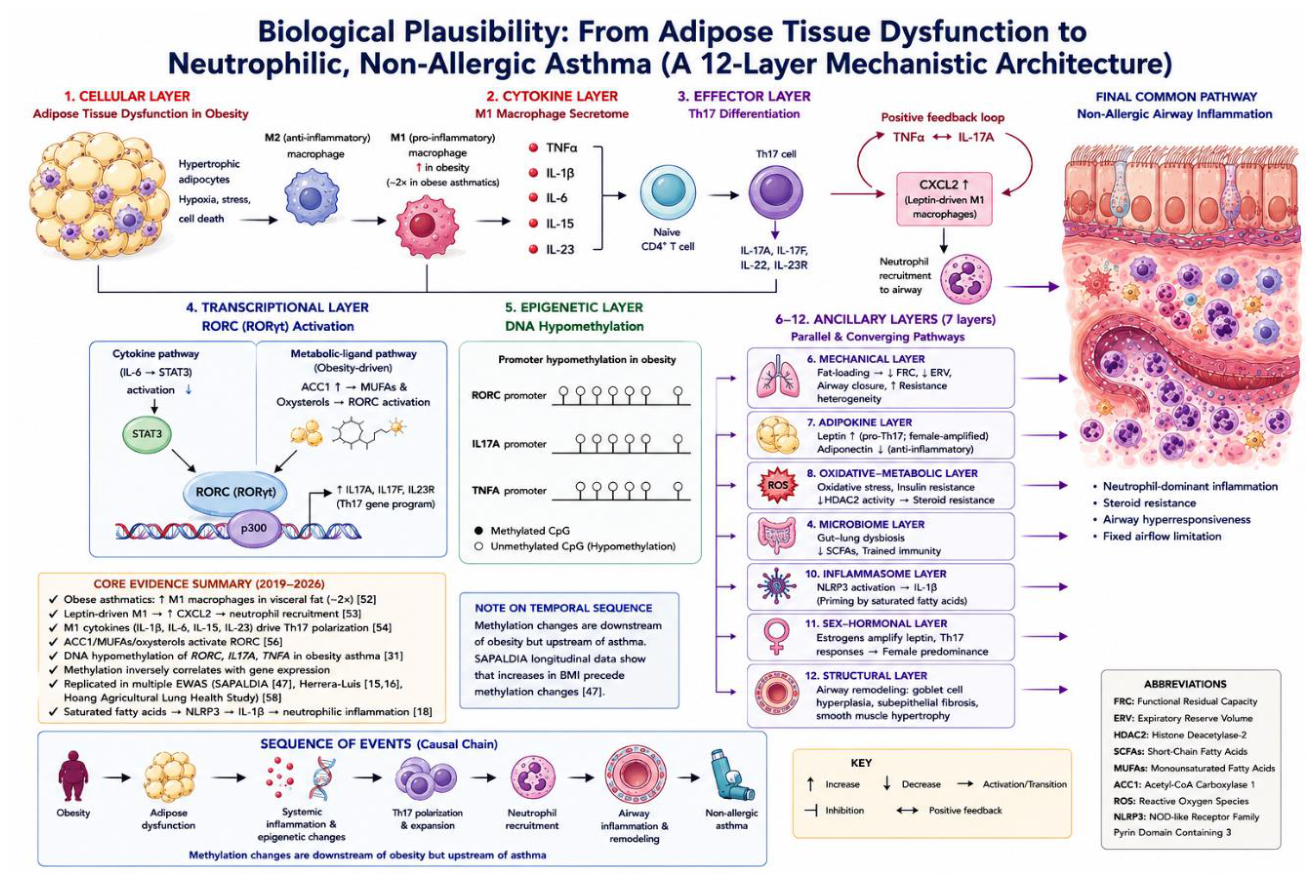
Plausibility is the viewpoint to which most contemporary research has been devoted, and it is also where the case for causation is strongest. The mechanistic chain is traceable from adipose tissue to the bronchial epithelium, spanning 12 distinct yet interacting layers—cellular, cytokine, transcriptional, epigenetic, effector, mechanical, adipokine, oxidative-metabolic, microbial, inflammasome, sex-hormonal, and structural—each supported by recent (2019–2026) human or translational evidence. We summarise the core immunological chain in detail and the ancillary layers more briefly.
Adipose tissue dysfunction in obesity drives an M2-to-M1 phenotypic switch in resident macrophages, with M1 cells secreting TNFα, IL-1β, IL-6, and IL-15, and the abundance of these cytokines correlates with BMI [51]. Periyalil et al. [52] showed that obese asthmatic adults have approximately twice the M1 macrophage density in visceral adipose tissue compared with obese non-asthmatic controls. The 2023 study by Wang Y et al. [53] in Molecular Medicine extended this picture: in human obese asthma, leptin-driven M1 polarisation produces elevated CXCL2, providing a soluble signal that recruits neutrophils to the airway. The cytokines secreted by M1 macrophages (IL-1β, IL-6, IL-15, IL-23) are precisely those that drive naïve CD4+ T-cell differentiation into Th17 effectors, producing a positive feedback loop in which TNFα and IL-17A are reciprocally induced [54]. Pinkerton et al. [17] showed in 2022 that type-2 cytokine and inflammasome responses interact in the obese airway in ways that classical T2-dominated asthma models do not predict.
At the transcriptional level, RORC (retinoid-related orphan receptor C; RORγt in mouse) is the master transcription factor for Th17 differentiation [55]. Its expression is induced by both classical cytokine signalling — IL-6 acting through STAT3 — and by metabolic ligands. The metabolic-ligand pathway, characterised by Endo et al. [56], involves acetyl-CoA carboxylase 1 (ACC1), an enzyme of fatty acid biosynthesis whose expression is upregulated in obesity; ACC1-derived monounsaturated fatty acids and oxysterols act as ligand-dependent activators of RORC, providing a direct biochemical link between adiposity and Th17 polarisation. The dual routes to RORC activation — cytokine- and metabolite-mediated — explain why Th17 polarisation is particularly pronounced in obesity. Active RORC, with the histone acetyltransferase coactivator p300, binds the chromatin of Th17 lymphocytes and stimulates expression of IL17A, IL17F and IL23R [55].
The epigenetic layer is considered the most informative for explaining the durability of the phenotype. Mazzoni et al. [57] demonstrated that the methylation profile of the RORC and IL17A promoters is markedly lower in differentiated Th17 cells than in naïve CD4+ cells, establishing demethylation as a structural feature of the Th17 lineage. In 2020, it was hypothesised that obesity-driven hypomethylation of the TNFA promoter in M1 macrophages and of the IL17A and RORC promoters in Th17 lymphocytes constitutes the epigenetic mechanism by which obesity sustains the non-atopic asthma phenotype [30]. This hypothesis was directly tested in 2022 [31]: in 102 Mexican adolescents, methylation-specific quantitative PCR in peripheral blood leukocytes showed that RORC promoter methylation was significantly lower in the non-allergic-asthma-with-obesity group (median 43.9%, IQR 40.9–48.2) than in healthy controls (54.8%; p < 0.001) or in obesity without asthma (50.6%; p < 0.01); IL17A and TNFA methylation showed similar reductions. Importantly, RORC methylation was inversely correlated with both RORC (rₛ = −0.39, p < 0.001) and IL17A (rₛ = −0.37, p < 0.01) messenger RNA expression. These coupled methylation–expression correlations provide strong evidence that DNA methylation is the proximal regulator of the elevated transcript levels characterising the non-allergic asthma with obesity phenotype. Replication is provided by the Swiss SAPALDIA EWAS [47], the Herrera-Luis EWAS in Hispanic/Latino youth [15], the Herrera-Luis EWAS in African-American and Hispanic youth [16], and the Hoang Agricultural Lung Health Study EWAS, in which 98.5% of differentially methylated CpGs in non-allergic adult asthma were hypomethylated relative to healthy controls [58]. The directionality caveat from Wahl et al. — that many BMI-associated methylation differences are consequences rather than causes of adiposity [59] — does not contradict the proposed pathway, as the sequence is obesity → systemic inflammation/methylation changes → asthma; the methylation marks are downstream of obesity but upstream of asthma. The longitudinal SAPALDIA design, in which increases in BMI precede changes in methylation, provides temporal anchoring [47].
The remaining ancillary layers reinforce the core chain. Mechanical fat loading reduces functional residual capacity and expiratory reserve volume, with peripheral airway closure and oscillometric heterogeneity in resistance and compliance documented in obese asthmatic adults [60,61]. Adipokine biology contributes through leptin (pro-Th17, sex-stratified, female-amplified) and adiponectin (anti-inflammatory, reduced in obesity). Oxidative stress and insulin resistance reduce histone deacetylase 2 activity and contribute to corticosteroid resistance. Gut–lung microbial axis dysbiosis modulates short-chain fatty acid signalling and trained innate immunity. The NLRP3 inflammasome and ILC3-derived IL-17A constitute a parallel innate-immunological route to neutrophilic effector inflammation; the 2025 McCright et al. paper [18] in Science Translational Medicine showed in mice and humans that dietary saturated fatty acids drive lung-macrophage NLRP3 priming and IL-1β-mediated neutrophil-predominant inflammation, with the same monocyte signature identified in obese humans with asthma. Sex-hormonal modulation explains the female predominance via oestrogen-driven adipose accumulation, which increases leptin levels and amplifies Th17 polarisation. Airway remodelling — epithelial and sub-epithelial alterations, smooth-muscle hyperplasia, increased airway vascularity — represents the durable structural correlate of the chronic inflammatory state [62]. The plausibility argument is therefore not a single argument, but a stack of mutually reinforcing arguments distributed across twelve layers — cellular, cytokine, transcriptional, epigenetic, effector, mechanical, adipokine, oxidative-metabolic, microbial, inflammasome, sex-hormonal and structural — each supported by recent (2019–2026) human or translational evidence.
Figure 1.
Biological plausibility of obesity-associated non-allergic asthma: a 12-layer mechanistic architecture. The figure summarises the proposed biological pathway linking adipose tissue dysfunction in obesity with neutrophilic, non-allergic asthma. The sequence begins with adipocyte hypertrophy, hypoxia, cellular stress and macrophage polarisation from an anti-inflammatory M2 phenotype toward a pro-inflammatory M1 phenotype. M1 macrophages release TNFα, IL-1β, IL-6, IL-15 and IL-23, which promote naïve CD4+ T-cell differentiation into Th17 cells and generate a reinforcing TNFα–IL-17A inflammatory loop. Leptin-driven M1 polarisation and CXCL2 production further promote neutrophil recruitment to the airway. At the transcriptional level, RORC/RORγt activation occurs through both cytokine-mediated IL-6–STAT3 signalling and obesity-driven metabolic ligand pathways involving ACC1, monounsaturated fatty acids and oxysterols. Epigenetically, hypomethylation of the RORC, IL17A and TNFA promoters supports sustained inflammatory gene expression, positioning methylation changes downstream of obesity but upstream of asthma expression. The first five layers represent the core immunological pathway—cellular, cytokine, effector, transcriptional and epigenetic—whereas the seven ancillary layers—mechanical, adipokine, oxidative-metabolic, microbial, inflammasome, sex-hormonal and structural—complete the 12-layer architecture and converge on the final common pathway of non-allergic airway inflammation.
Figure 1.
Biological plausibility of obesity-associated non-allergic asthma: a 12-layer mechanistic architecture. The figure summarises the proposed biological pathway linking adipose tissue dysfunction in obesity with neutrophilic, non-allergic asthma. The sequence begins with adipocyte hypertrophy, hypoxia, cellular stress and macrophage polarisation from an anti-inflammatory M2 phenotype toward a pro-inflammatory M1 phenotype. M1 macrophages release TNFα, IL-1β, IL-6, IL-15 and IL-23, which promote naïve CD4+ T-cell differentiation into Th17 cells and generate a reinforcing TNFα–IL-17A inflammatory loop. Leptin-driven M1 polarisation and CXCL2 production further promote neutrophil recruitment to the airway. At the transcriptional level, RORC/RORγt activation occurs through both cytokine-mediated IL-6–STAT3 signalling and obesity-driven metabolic ligand pathways involving ACC1, monounsaturated fatty acids and oxysterols. Epigenetically, hypomethylation of the RORC, IL17A and TNFA promoters supports sustained inflammatory gene expression, positioning methylation changes downstream of obesity but upstream of asthma expression. The first five layers represent the core immunological pathway—cellular, cytokine, effector, transcriptional and epigenetic—whereas the seven ancillary layers—mechanical, adipokine, oxidative-metabolic, microbial, inflammasome, sex-hormonal and structural—complete the 12-layer architecture and converge on the final common pathway of non-allergic airway inflammation.
3.7. Coherence
Coherence asks whether the proposed causal interpretation is consistent with the broader body of knowledge about the disease’s natural history and biology. For the obesity–non-T2 asthma association, the answer is largely affirmative.
The late-onset obese-asthma phenotype is characterised by greater asthma severity, neutrophilic rather than eosinophilic airway inflammation, female predominance, and reduced responsiveness to inhaled corticosteroids [4,45,63]. Each of these clinical features correlates with the proposed Th17/neutrophilic mechanism. Steroid resistance is itself molecularly coherent: glucocorticoids do not suppress IL-17A production in vitro [64]. Liu et al. [63], in 2024, in the European Respiratory Journal, report sputum neutrophilia in obese asthma at 52% versus 36% in lean asthma, with cluster analyses confirming that neutrophilic non-T2 phenotypes are more severe. The 2024 American Journal of Respiratory and Critical Care Medicine state-of-the-art review by Althoff et al. [65] consolidates the mechanism–treatment link specifically for obesity-related asthma. A point of partial incoherence — anti-IL-17 trial nulls in unselected severe asthma populations [66] — most plausibly reflects the absence of biomarker-based selection for obese, neutrophilic, IL-17A-high subgroups rather than a flaw in the underlying causal model.
3.8. Experimental Evidence
Hill identified experimental evidence as the most decisive of his nine viewpoints. For obesity and asthma, true randomised allocation to obesity is impossible; experimental evidence comes instead from four converging streams: weight-loss interventions (bariatric surgery and lifestyle), GLP-1 receptor agonist pharmaco-epidemiology, animal models, and pharmacological blockade of the implicated pathway.
For obesity and asthma, experimental evidence comes from four converging streams. First, weight-loss interventions provide the closest analogue to a clinical experiment. The 2023 systematic review and meta-analysis of 15 studies by Xie et al. [67] showed consistent pre- and post-bariatric surgery reductions in asthma medication use; Smith et al. [68] reported a durable 5-year benefit in 2024. Sharma et al. [69], in 2025, in Chest, reported a randomised controlled trial of a Counterweight-based programme in difficult-to-treat asthma with obesity, demonstrating clinically meaningful improvements in asthma control and lung function with formula-based total diet replacement.
Second, glucagon-like peptide-1 receptor agonists provide the most informative quasi-experimental modifier. Foer et al. [19] in 2021 used an electronic health records cohort to show that GLP-1RA initiators (reference) had substantially fewer asthma exacerbations than initiators of comparator antihyperglycaemic drugs (incidence rate ratios of 1.83–2.98). Wang J et al. [20] in 2024 confirmed heterogeneous treatment effects, with the strongest benefit in obese patients with prior exacerbations. Huang YC et al. [21], in JAMA Network Open in 2025, reported that among TriNetX-matched adolescents with concurrent asthma and overweight/obesity, GLP-1RA users had 49% fewer asthma exacerbations, 58% fewer emergency department visits, and 34% lower systemic corticosteroid use. The Vanderbilt-led GATA-3 randomised controlled trial (NCT05254314) is in progress, with results expected in 2026.
Third, pharmacological modulation of the proposed effector pathway provides direct experimental evidence. Tezepelumab — the only biologic approved for non-T2 asthma — reduced annualised exacerbation rates by 48% in patients with baseline blood eosinophils <150 cells/μL and 40% in those with FeNO <25 ppb in pooled NAVIGATOR + PATHWAY analyses [70,71]. Anti-IL-17 trials (brodalumab, CJM112, risankizumab) [66] enrolled unselected severe-asthma populations without biomarker-based selection for obese, neutrophilic, IL-17A-high subgroups; biomarker-stratified trials in the obese-asthma endotype are warranted. Fourth, animal models reproduce the phenotype: Mathews et al. [72] showed in C57BL/6J mice on a high-fat diet that IL-17A elevation precedes the development of airway hyperresponsiveness, providing temporal precedence at the mechanistic level.
3.9. Analogy
The TNFα/Th17 axis driving obesity-related asthma also drives obesity-related psoriasis, inflammatory bowel disease, rheumatoid arthritis, non-alcoholic fatty liver disease and type 2 diabetes mellitus [73]. A new analogy stream has emerged in the GLP-1 receptor agonist literature: the same agents that reduce asthma exacerbations in obesity reduce major adverse cardiovascular events, ameliorate non-alcoholic steatohepatitis, and have signalled benefit in chronic obstructive pulmonary disease pharmaco-epidemiology. The shared metabolic–inflammatory mechanism across diseases makes the analogy informative.
4. The 1964 Surgeon General Antecedent, GRADE and Contemporary Causal-Inference Methods
Hill’s framework descends directly from the 1964 U.S. Surgeon General’s Report on Smoking and Health [24], which articulated five criteria — consistency, strength, specificity, temporality and coherence — for inferring causation from epidemiological evidence. Hill expanded these to nine in his 1965 address by adding biological gradient, plausibility, experiment and analogy, reflecting his concern that observational epidemiology be brought into closer dialogue with biological mechanism and quantitative regularities. Subsequent Surgeon General’s Reports introduced a four-tier classification of the strength of causal inference (sufficient evidence, suggestive but not sufficient, inadequate, suggestive of no causal relationship). Applied to the obesity–non-T2 asthma association, our reading of the cumulative 2020–2026 evidence corresponds most closely to the second tier (“suggestive but not yet sufficient”) for the strict causal claim that obesity causes the late-onset, non-allergic asthma phenotype, and to the first tier (“sufficient evidence”) for the weaker claim that obesity is causally associated with increased risk of incident asthma in general.
The GRADE framework [25] complements rather than replaces Hill’s viewpoints. Hill asks: Should this association be interpreted as causal? GRADE asks: How confident should I be in the magnitude and direction of this effect estimate when using it for clinical decisions? In the GRADE schema, observational evidence starts at “low” certainty and can be upgraded for large effect sizes, dose–response, or the directionality of plausible residual confounding. For the obesity–non-T2 asthma association, several upgrade criteria are met: some paediatric estimates exceed the conventional large-effect threshold; a graded dose–response is documented at population, molecular and genetic-instrumental levels; and the directionality of plausible residual confounding (socioeconomic position, dietary pattern, physical activity) is conservative, biasing the association toward rather than away from the null. A reasonable summary GRADE assessment of the body of evidence for obesity → incident asthma is therefore of moderate certainty.
Three further methodological developments are particularly relevant. The counterfactual or potential-outcomes framework [26,27] forces the investigator to specify exactly which hypothetical intervention is being modelled — in this case, the average causal effect of a population-wide intervention on asthma incidence that maintains BMI below 25 kg/m2 throughout adulthood. Directed acyclic graphs (DAGs) [27] visually encode causal assumptions and clarify confounders, mediators, and colliders — essential for the obesity–asthma question, because adjustment for body composition mediators (visceral fat, leptin, insulin resistance) when estimating the total effect produces biased estimates. Mendelian randomisation [28], in which genetic variants associated with BMI are used as instrumental variables, is the most consequential development for the obesity–asthma question: six MR studies of particular relevance [6,7,8,9,10] jointly transform the inferential picture, with phenotype-specific amplification of the signal in non-atopic, adult-onset and female-predominant subgroups, and consistent exclusion of reverse causation. A methodological gap remains: no MR study has yet stratified asthma by the non-T2/late-onset/neutrophilic subtype, with BMI as the exposure. Phenotype-specific MR is now the most decisive missing piece of the causal argument.
5. Synthesis and Implications
The cumulative evidence from 2020 to 2026 supports the assertion that obesity causally drives a distinctive, non-allergic, late-onset asthma phenotype in susceptible individuals. This argument is based on prospective cohort and life-course Mendelian randomisation evidence establishing temporality (Camargo [33], Castro-Rodríguez [35], Vartiainen [12], SAPALDIA [47], Sun [6], Urquijo [7]), updated meta-analytic evidence establishing strength and consistency (Parasuaraman [11], Bloodworth [13], Chen [14]), and molecular and epigenetic evidence establishing biological plausibility across 12 layers. Central mechanisms include the M1–Th17 feedback loop, the RORC transcriptional network, the ACC1-mediated metabolic-ligand pathway, and the epigenetic remodelling of the RORC, IL17A, and TNFA promoters. Additional support comes from murine and in vitro mechanistic evidence, GLP-1 receptor agonist pharmaco-epidemiology, bariatric/lifestyle weight-loss data, and clinical analogy with other obesity-related Th17 diseases. All nine Hill viewpoints are satisfied to varying degrees: strength, consistency, biological gradient, plausibility, coherence, experiment, and analogy substantively; specificity at the phenotype level; and temporality as a sine qua non.

Table 1.
Summary of the nine Bradford Hill viewpoints applied to obesity → non-allergic asthma, with status of evidence and key 2020–2026 references (numbering as in the reference list).
Table 1.
Summary of the nine Bradford Hill viewpoints applied to obesity → non-allergic asthma, with status of evidence and key 2020–2026 references (numbering as in the reference list).
| 1. Strength | Met (moderate to large) | OR 1.4–6.8 across paediatric and adult cohorts and meta-analyses [11,12,13,14,33,34,35,36,37,38]; E-values 4.8 (Camargo) [33] and 13.4 (Castro-Rodríguez) [35]; Mendelian-randomisation summary RR 1.05 per 1 kg/m2 [10]. |
| 2. Consistency | Met | Replication across continents (Parasuaraman [11], Vartiainen [12], Bloodworth [13], Cooper SCAALA [23], Shailesh Qatar [39]); Mexican GAN data [40]; cluster replication U-BIOPRED → C-BIOPRED [41,42]; ENSANUT 2022 prevalence [22]. |
| 3. Specificity | Met at the phenotype level | Cluster analysis (Holguin) [4]; bidirectional MR with non-atopic > atopic ORs (Sun) [6]; fat-distribution MR (Wang) [8]; Th1-dominant immune response (Nyambuya meta-analysis) [46]; RORC mRNA AUC 0.95 (Leija-Martínez) [29]. |
| 4. Temporality | Met (sine qua non) | Camargo NHS-II cohort [33]; Castro-Rodríguez Tucson cohort [35]; Vartiainen Finnish cohort [12]; SAPALDIA epigenetic temporality [47]; Urquijo life-course MR [7]; Sun bidirectional MR exclusion of reverse causation [6]. |
| 5. Biological gradient | Met | Parasuaraman dose–response cohort meta-analysis [11]; molecular gradients (Shin TNFα [48], Schindler Th17 frequency [49], Marijsse IL17A mRNA [50]); MR meta-analytic per-1-kg/m2 estimate (Mikkelsen) [10]. |
| 6. Plausibility | Strongly met (12 layers) | Adipose/M1 (Lumeng [51], Periyalil [52], Wang Y 2023 [53]); M1–Th17 feedback (Chehimi [54], Pinkerton [17]); RORC and ACC1 (Ivanov [55], Endo [56]); epigenetics (Mazzoni [57], Leija-Martínez [30,31], Hoang [58], Herrera-Luis [15], Herrera-Luis [16]); mechanical (Rabec [60], Chan & Lipworth [61]); NLRP3 (McCright 2025 [18]); remodelling (Listyoko [62]); integrative reviews (Althoff [65], Jiang [73]). |
| 7. Coherence | Met (with caveats) | Neutrophilic, steroid-resistant, female-predominant phenotype [4,45,63]; Liu ERJ 2024 non-T2 review [63]; Althoff AJRCCM 2024 state-of-the-art article [65]; molecular steroid resistance (McKinley) [64]; partial incoherence: anti-IL-17 unselected-population trial nulls (Busse) [66]. |
| 8. Experiment | Met (4 streams) | Bariatric (Xie meta-analysis [67], Smith 5-year follow-up [68]); lifestyle weight-loss RCT (Sharma 2025 Chest) [69]; GLP-1RA pharmaco-epidemiology (Foer [19], Wang J [20], Huang YC adolescents –49% [21]); GATA-3 RCT (NCT05254314); tezepelumab T2-low subgroup (Menzies-Gow [70], Corren pooled [71]); animal model temporal precedence (Mathews) [72]. |
| 9. Analogy | Met | Same TNFα/Th17 axis in obesity-related psoriasis, inflammatory bowel disease, rheumatoid arthritis, non-alcoholic fatty liver disease, and type 2 diabetes mellitus; shared GLP-1RA cardiometabolic and inflammatory benefit across diseases. |
Three primary implications emerge. First, from a public health perspective, preventing obesity in childhood and adolescence should be prioritised as a primary prevention strategy for the late-onset, non-T2 asthma phenotype, particularly in middle-income countries experiencing sharp increases in childhood and adolescent obesity prevalence. The Mexican prevalence figures from ENSANUT 2022 [22] (overweight: 38.3%; obesity: 36.9%; abdominal obesity: 81.0% in adults; rising sedentary behaviour and BMI in school-age and adolescent populations) provide relevant context. The life-course-MR finding that adult adiposity drives adult-onset asthma [7] underscores the importance of paediatric prevention, as childhood and adolescent obesity is the strongest predictor of sustained adult adiposity. Second, in therapeutic terms, this phenotype necessitates endotype-targeted strategies, including GLP-1 receptor agonists (with the GATA-3 RCT pending), tezepelumab for non-T2 asthma, and biomarker-stratified anti-IL-17 strategies. The 2021 finding that RORC mRNA expression discriminates non-allergic asthma among obese adolescents, with an AUC of 0.95 [29], indicates that RORC transcriptional readouts, possibly combined with promoter methylation analysis, may serve as the patient-selection biomarker that anti-IL-17 trials in obese asthma have lacked. Third, research priorities include longitudinal cohorts sampling BMI, immunological readouts, and methylation profiles at multiple time points; phenotype-stratified Mendelian randomisation studies; and single-cell methylation profiling of sorted peripheral immune cells.
6. Limitations and Methodological Gaps
Several limitations and methodological gaps must be acknowledged. First, the directionality of the BMI–methylation association is partly downstream rather than upstream [59]; the proposed pathway (obesity → systemic inflammation/methylation → asthma) aligns with this finding, and the SAPALDIA longitudinal design [47] provides temporal anchoring. However, the predominantly cross-sectional nature of the supporting epigenetic literature, including the authors’ studies [29,30,31], does not allow for directionality to be resolved at the individual level. Second, the cell of origin for the methylation signal in peripheral blood leukocytes remains undetermined; single-cell methylation profiling is the logical next step. Third, evidence for GLP-1 receptor agonists is primarily derived from pharmaco-epidemiological data, with the GATA-3 RCT as the first dedicated trial. Fourth, the anti-IL-17 trial nulls [66] present a significant challenge to the experimental viewpoint; biomarker-stratified trials in the obese-asthma endotype are warranted but have not yet been conducted. Fifth, the most decisive Mendelian randomisation studies stratify by atopic versus non-atopic asthma, but not by the molecular phenotypes addressed in this manuscript (non-T2, late-onset, neutrophilic, steroid-resistant). Phenotype-specific Mendelian randomisation analyses are now the most important missing element in the causal argument.
7. Conclusions and Future Directions
Sixty years after Hill’s Presidential Address, his nine viewpoints continue to serve as the most effective organising framework for causal inference in observational respiratory epidemiology, provided they are interpreted as structured viewpoints rather than as a checklist. Systematic application of this framework to the 2020–2026 evidence base on obesity and the non-allergic, late-onset, neutrophilic asthma phenotype yields a coherent causal interpretation. The evidentiary landscape has been transformed in the past five years by bidirectional and life-course Mendelian randomisation analyses, GLP-1 receptor agonist pharmaco-epidemiology, translational epigenetic and single-cell evidence, and integrative clinical syntheses. It is now appropriate to regard obesity as a cause of the late-onset, non-allergic, neutrophilic asthma phenotype. Primary prevention of childhood and adolescent obesity, endotype-targeted therapeutics, including GLP-1 receptor agonists and biomarker-stratified anti-IL-17 strategies, and longitudinal triangulation of the causal model through phenotype-specific Mendelian randomisation studies and single-cell methylation profiling are recommended as next steps for the field.
Author Contributions
Conceptualization, J.J.L.-M. and E.E.C.; methodology, J.J.L.-M. and E.E.C.; epidemiological and epistemological framework, J.J.L.-M. and E.E.C.; clinical and methodological interpretation of the Bradford Hill viewpoints, J.J.L.-M. and E.E.C.; biological plausibility, immunological interpretation, and clinical contextualization, F.S.-M., B.E.D.-R.-N., N.R.-N. and F.H.; translational research integration, J.J.L.-M., E.E.C., F.S.-M., B.E.D.-R.-N., N.R.-N. and F.H.; investigation, J.J.L.-M., E.E.C., F.S.-M., B.E.D.-R.-N., N.R.-N. and F.H.; resources, F.S.-M., B.E.D.-R.-N., N.R.-N. and F.H.; writing—original draft preparation, J.J.L.-M.; writing—review and editing, J.J.L.-M., E.E.C., F.S.-M., B.E.D.-R.-N., N.R.-N. and F.H.; visualization, J.J.L.-M. and E.E.C.; supervision, B.E.D.-R.-N., F.S.-M. and F.H.; project administration, J.J.L.-M. All authors have read and agreed to the published version of the manuscript.
Funding
This research received no external funding.
Institutional Review Board Statement
Not applicable. This review article was based exclusively on previously published literature and did not involve human participants, animals, identifiable personal data, or original clinical data collection; therefore, ethical review and approval were not required.
Informed Consent Statement
Not applicable. This review article did not involve human participants or identifiable patient data; therefore, informed consent was not required.
Data Availability Statement
No new data were created or analysed in this study. Data sharing does not apply to this article.
Acknowledgments
The authors acknowledge the academic and institutional support provided by their respective institutions during the preparation of this manuscript.
Conflicts of Interest
The authors declare no conflicts of interest.
References
- HILL, A.B. THE ENVIRONMENT AND DISEASE: ASSOCIATION OR CAUSATION? Proc. R Soc. Med. 1965, 58(5), 295–300. [Google Scholar] [CrossRef] [PubMed]
- Lesko, C.R.; Fox, M.P. An evolved interpretation of Austin Bradford Hill’s causal viewpoints and their influence on epidemiologic methods. Am. J. Epidemiol. 2025, 194(6), 1476–1481. [Google Scholar] [CrossRef]
- Shimonovich, M.; Thomson, H.; Pearce, A.; Katikireddi, S.V. Applying Bradford Hill to assessing causality in systematic reviews: A transparent approach using process tracing. Res. Synth. Methods 2024, 15(6), 826–838. [Google Scholar] [CrossRef] [PubMed]
- Holguin, F.; Bleecker, E.R.; Busse, W.W.; et al. Obesity and asthma: an association modified by age of asthma onset. J. Allergy Clin. Immunol. 2011, 127(6), 1486–93.e2. [Google Scholar] [CrossRef] [PubMed]
- Global Strategy for Asthma Management and Prevention. 2025. Available online: https://ginasthma.org</u>.
- Sun, Y.Q.; Brumpton, B.M.; Langhammer, A.; Chen, Y.; Kvaløy, K.; Mai, X.M. Adiposity and asthma in adults: a bidirectional Mendelian randomisation analysis of The HUNT Study. Thorax 2020, 75(3), 202–208. [Google Scholar] [CrossRef]
- Urquijo, H.; Leyden, G.M.; Davey Smith, G.; Richardson, T.G. A lifecourse Mendelian randomization study uncovers age-dependent effects of adiposity on asthma risk. iScience Published. 2023, 26(12), 108356. [Google Scholar] [CrossRef]
- Wang, K.; Chen, Z.; Wei, Z.; He, L.; Gong, L. Association between body fat distribution and asthma in adults: results from the cross-sectional and bidirectional Mendelian randomization study. Front Nutr. Published. 2024, 11, 1432973. [Google Scholar] [CrossRef]
- Ha, T.W.; Jung, H.U.; Kim, D.J.; et al. Association Between Environmental Factors and Asthma Using Mendelian Randomization: Increased Effect of Body Mass Index on Adult-Onset Moderate-to-Severe Asthma Subtypes. Front Genet. Published. 2021, 12, 639905. [Google Scholar] [CrossRef]
- Mikkelsen, H.; Landt, E.M.; Benn, M.; Nordestgaard, B.G.; Dahl, M. Causal risk factors for asthma in Mendelian randomization studies: A systematic review and meta-analysis. Clin. Transl. Allergy 2022, 12(11), e12207. [Google Scholar] [CrossRef]
- Parasuaraman, G.; Ayyasamy, L.; Aune, D.; et al. The association between body mass index, abdominal fatness, and weight change and the risk of adult asthma: a systematic review and meta-analysis of cohort studies. Sci. Rep. Published. 2023, 13(1), 7745. [Google Scholar] [CrossRef]
- Vartiainen, V.A.; Jousilahti, P.; Tuomilehto, J.; Laatikainen, T.; Vartiainen, E. Body Mass Index and the Risk of Adult-Onset Asthma: A Prospective Observational Study among 59,668 Middle-Aged Men and Women in Finland. Nutrients Published. 2024, 16(15), 2515. [Google Scholar] [CrossRef]
- Bloodworth, M.H.; Staso, P.J.; Huang, S.; et al. Impact of metabolic and weight components on incident asthma using a real-world cohort. Ann. Allergy Asthma Immunol. 2024, 133(6), 660–666.e5. [Google Scholar] [CrossRef]
- Chen, Y.C.; Su, M.W.; Brumpton, B.M.; Lee, Y.L. Investigating obesity-related risk factors for childhood asthma. Pediatr. Allergy Immunol. 2022, 33(1), e13710. [Google Scholar] [CrossRef] [PubMed]
- Herrera-Luis, E.; Li, A.; Mak, A.C.Y.; et al. Epigenome-wide association study of lung function in Latino children and youth with asthma. Clin. Epigenet. Published. 2022, 14(1), 9. [Google Scholar] [CrossRef]
- Herrera-Luis, E.; Rosa-Baez, C.; Huntsman, S.; et al. Novel insights into the whole-blood DNA methylome of asthma in ethnically diverse children and youth. Eur. Respir. J. Published. 2023, 62(6), 2300714. [Google Scholar] [CrossRef]
- Pinkerton, J.W.; Kim, R.Y.; Brown, A.C.; et al. Relationship between type 2 cytokine and inflammasome responses in obesity-associated asthma. J. Allergy Clin. Immunol. 2022, 149(4), 1270–80. [Google Scholar] [CrossRef]
- McCright, S.J.; Harding, O.; Chini, J.; et al. Dietary saturated fatty acids promote lung myeloid cell inflammasome activation and IL-1β-mediated inflammation in mice and humans. Sci. Transl. Med. 2025, 17(813), eadp5653. [Google Scholar] [CrossRef]
- Foer, D.; Beeler, P.E.; Cui, J.; et al. Asthma exacerbations in patients with type 2 diabetes and asthma on glucagon-like peptide-1 receptor agonists. Am. J. Respir. Crit. Care Med. 2021, 203(7), 831–40. [Google Scholar] [CrossRef]
- Wang, J.; Lu, Y.; Cahill, K.N.; et al. Glucagon-like peptide 1 receptor agonists and asthma exacerbations: which patients benefit most? Ann. Am. Thorac. Soc. 2024, 21(11), 1496–506. [Google Scholar] [CrossRef] [PubMed]
- Huang, Y.C.; Tsai, M.C.; Lin, T.C.; et al. Glucagon-like peptide-1 receptor agonists and asthma risk in adolescents with obesity. JAMA Netw. Open. 2025, 8(12), e2551611. [Google Scholar] [CrossRef] [PubMed]
- Campos-Nonato, I.; Galván-Valencia, O.; Hernández-Barrera, L.; et al. Prevalencia de obesidad y factores de riesgo asociados en adultos mexicanos: resultados de la Ensanut 2022. Salud Publica Mex. 2023, 65(supl 1), S238–47. [Google Scholar] [CrossRef] [PubMed]
- Cooper, P.J.; Figueiredo, C.A.; Rodriguez, A.; et al. Understanding and controlling asthma in Latin America: a review of recent research informed by the SCAALA programme. Clin. Transl. Allergy 2023, 13(3), e12232. [Google Scholar] [CrossRef]
- U.S. Department of Health; Education; and Welfare. Smoking and Health: Report of the Advisory Committee to the Surgeon General of the Public Health Service. U.S. Government Printing Office: Washington, DC, 1964. [Google Scholar]
- Guyatt, G.H.; Oxman, A.D.; Vist, G.E.; et al. GRADE: an emerging consensus on rating quality of evidence and strength of recommendations. BMJ. 2008, 336(7650), 924–6. [Google Scholar] [CrossRef]
- Rubin, D.B. Estimating causal effects of treatments in randomized and nonrandomized studies. J. Educ. Psychol. 1974, 66(5), 688–701. [Google Scholar] [CrossRef]
- Hernán, M.A.; Robins, J.M. Causal inference: what if; Chapman & Hall/CRC: Boca Raton, 2020. [Google Scholar]
- Davey Smith, G.; Hemani, G. Mendelian randomization: genetic anchors for causal inference in epidemiological studies. Hum. Mol. Genet. 2014, 23(R1), R89–98. [Google Scholar] [CrossRef]
- Leija-Martínez, J.J.; Del-Río-Navarro, B.E.; Sanchéz-Muñoz, F.; et al. Associations of TNFA, IL17A, and RORC mRNA expression levels in peripheral blood leukocytes with obesity-related asthma in adolescents. Clin. Immunol. 2021, 229, 108715. [Google Scholar] [CrossRef]
- Leija-Martínez, J.J.; Huang, F.; Del-Río-Navarro, B.E.; et al. Decreased methylation profiles in the TNFA gene promoters in type 1 macrophages and in the IL17A and RORC gene promoters in Th17 lymphocytes have a causal association with non-atopic asthma caused by obesity: a hypothesis. Med. Hypotheses 2020, 134, 109527. [Google Scholar] [CrossRef]
- Leija-Martínez, J.J.; Giacoman-Martínez, A.; Del-Río-Navarro, B.E.; et al. Promoter methylation status of RORC, IL17A, and TNFA in peripheral blood leukocytes in adolescents with obesity-related asthma. Heliyon 2022, 8(11), e12316. [Google Scholar] [CrossRef]
- VanderWeele, T.J.; Ding, P. Sensitivity analysis in observational research: introducing the E-value. Ann. Intern Med. 2017, 167(4), 268–74. [Google Scholar] [CrossRef] [PubMed]
- Camargo, C.A., Jr.; Weiss, S.T.; Zhang, S.; Willett, W.C.; Speizer, F.E. Prospective study of body mass index, weight change, and risk of adult-onset asthma in women. Arch. Intern Med. 1999, 159(21), 2582–8. [Google Scholar] [CrossRef] [PubMed]
- Beuther, D.A.; Sutherland, E.R. Overweight, obesity, and incident asthma: a meta-analysis of prospective epidemiologic studies. Am. J. Respir. Crit. Care Med. 2007, 175(7), 661–6. [Google Scholar] [CrossRef] [PubMed]
- Castro-Rodríguez, J.A.; Holberg, C.J.; Morgan, W.J.; Wright, A.L.; Martinez, F.D. Increased incidence of asthmalike symptoms in girls who become overweight or obese during the school years. Am. J. Respir. Crit. Care Med. 2001, 163(6), 1344–9. [Google Scholar] [CrossRef] [PubMed]
- Chen, Y.C.; Dong, G.H.; Lin, K.C.; Lee, Y.L. Gender difference of childhood overweight and obesity in predicting the risk of incident asthma: a systematic review and meta-analysis. Obes. Rev. 2013, 14(3), 222–31. [Google Scholar] [CrossRef] [PubMed]
- Egan, K.B.; Ettinger, A.S.; Bracken, M.B. Childhood body mass index and subsequent physician-diagnosed asthma: a systematic review and meta-analysis of prospective cohort studies. BMC Pediatr. 2013, 13, 121. [Google Scholar] [CrossRef]
- Deng, X.; Ma, J.; Yuan, Y.; Zhang, Z.; Niu, W. Association between overweight or obesity and the risk for childhood asthma and wheeze: an updated meta-analysis on 18 articles and 73 252 children. Pediatr. Obes. 2019, 14(9), e12532. [Google Scholar] [CrossRef]
- Shailesh, H.; Noor, S.; Hayati, L.; et al. Asthma and obesity increase inflammatory markers in children. Front Allergy 2025, 5, 1536168. [Google Scholar] [CrossRef]
- Global Asthma Network. The Global Asthma Report 2022; Global Asthma Network: Auckland, 2022. [Google Scholar]
- Lefaudeux, D.; De Meulder, B.; Loza, M.J.; et al. U-BIOPRED clinical adult asthma clusters linked to a subset of sputum omics. J. Allergy Clin. Immunol. 2017, 139(6), 1797–807. [Google Scholar] [CrossRef]
- Ou, C.; Deng, Z.; Liao, Y.; et al. C-BIOPRED severe asthma clinical phenotypes: link to complement and coagulation pathways and galectin 10. ERJ Open Res. Published. 2025, 11(4), 01016–2024. [Google Scholar] [CrossRef]
- Vázquez-Nava, F.; Vazquez-Rodriguez, E.M.; Reyes-Guevara, S.; et al. Effect of obesity and breastfeeding on asthma and wheezing-related symptoms in Mexican preschool children. ScientificWorldJournal 2010, 10, 1339–46. [Google Scholar] [CrossRef]
- Bedolla-Barajas, M.; Morales-Romero, J.; Robles-Figueroa, M.; Fregoso-Fregoso, M. Asthma in Mexican school-age children is not associated with passive smoking or obesity. Allergol. Immunopathol. (Madr) 2013, 41(4), 225–31. [Google Scholar] [CrossRef]
- Shailesh, H.; Bhat, A.A.; Janahi, I.A. Obesity-associated non-T2 mechanisms in obese asthmatic individuals. Biomedicines 2023, 11(10), 2797. [Google Scholar] [CrossRef]
- Nyambuya, T.M.; Dludla, P.V.; Mxinwa, V.; Nkambule, B.B. Obesity-related asthma in children is characterised by T-helper 1 rather than T-helper 2 immune response: a meta-analysis. Ann. Allergy Asthma Immunol. 2020, 125(4), 425–32. [Google Scholar] [CrossRef] [PubMed]
- Jeong, A.; Imboden, M.; Ghantous, A.; et al. DNA methylation in inflammatory pathways modifies the association between BMI and adult-onset non-atopic asthma. Int. J. Env. Res. Public Health 2019, 16(4), 600. [Google Scholar] [CrossRef]
- Shin, J.Y.; Kim, S.Y.; Jeung, M.J.; et al. Serum adiponectin, C-reactive protein and TNF-α levels in obese Korean children. J. Pediatr. Endocrinol. Metab. 2008, 21(1), 23–9. [Google Scholar] [CrossRef]
- Schindler, T.I.; Wagner, J.J.; Goedicke-Fritz, S.; et al. TH17 cell frequency in peripheral blood is elevated in overweight children without chronic inflammatory diseases. Front Immunol. 2017, 8, 1543. [Google Scholar] [CrossRef]
- Marijsse, G.S.; Seys, S.F.; Schelpe, A.S.; et al. Obese individuals with asthma preferentially have a high IL-5/IL-17A/IL-25 sputum inflammatory pattern. Am. J. Respir. Crit. Care Med. 2014, 189(10), 1284–5. [Google Scholar] [CrossRef]
- Lumeng, C.N.; Bodzin, J.L.; Saltiel, A.R. Obesity induces a phenotypic switch in adipose tissue macrophage polarization. J. Clin. Invest. 2007, 117(1), 175–84. [Google Scholar] [CrossRef]
- Periyalil, H.A.; Wood, L.G.; Wright, T.A.; et al. Obese asthmatics are characterized by altered adipose tissue macrophage activation. Clin. Exp. Allergy 2018, 48(6), 641–9. [Google Scholar] [CrossRef] [PubMed]
- Wang, Y.; Wan, R.; Hu, C. Leptin/obR signaling exacerbates obesity-related neutrophilic airway inflammation through inflammatory M1 macrophages. Mol. Med. 2023, 29(1), 100. [Google Scholar] [CrossRef] [PubMed]
- Chehimi, M.; Vidal, H.; Eljaafari, A. Pathogenic role of IL-17-producing immune cells in obesity, and related inflammatory diseases. J. Clin. Med. 2017, 6(7), 68. [Google Scholar] [CrossRef]
- Ivanov, I.I.; McKenzie, B.S.; Zhou, L.; et al. The orphan nuclear receptor RORγt directs the differentiation program of proinflammatory IL-17+ T helper cells. Cell. 2006, 126(6), 1121–33. [Google Scholar] [CrossRef] [PubMed]
- Endo, Y.; Asou, H.K.; Matsugae, N.; et al. Obesity drives Th17 cell differentiation by inducing the lipid metabolic kinase, ACC1. Cell Rep. 2015, 12(6), 1042–55. [Google Scholar] [CrossRef] [PubMed]
- Mazzoni, A.; Santarlasci, V.; Maggi, L.; et al. Demethylation of the RORC2 and IL17A in human CD4+ T lymphocytes defines Th17 origin of nonclassic Th1 cells. J. Immunol. 2015, 194(7), 3116–26. [Google Scholar] [CrossRef]
- Hoang, T.T.; Sikdar, S.; Xu, C.J.; et al. Epigenome-wide association study of DNA methylation and adult asthma in the Agricultural Lung Health Study. Eur. Respir. J. 2020, 56(3), 2000217. [Google Scholar] [CrossRef]
- Wahl, S.; Drong, A.; Lehne, B.; et al. Epigenome-wide association study of body mass index, and the adverse outcomes of adiposity. Nature 2017, 541(7635), 81–6. [Google Scholar] [CrossRef] [PubMed]
- Rabec, C.; Janssens, J.P.; Murphy, P.B. Ventilation in the obese: physiological insights and management. Eur. Respir. Rev. 2025, 34(176), 240190. [Google Scholar] [CrossRef]
- Chan, R.; Lipworth, B. Clinical impact of obesity on oscillometry lung mechanics in adults with asthma. Ann. Allergy Asthma Immunol. 2023, 131(3), 338–342. [Google Scholar] [CrossRef]
- Listyoko, A.S.; Okazaki, R.; Harada, T.; et al. Impact of obesity on airway remodeling in asthma: pathophysiological insights and clinical implications. Front Allergy 2024, 5, 1365801. [Google Scholar] [CrossRef]
- Liu, T.; Woodruff, P.G.; Zhou, X. Advances in non-type 2 severe asthma: from molecular insights to novel treatment strategies. Eur. Respir. J. 2024, 64(2), 2300826. [Google Scholar] [CrossRef]
- McKinley, L.; Alcorn, J.F.; Peterson, A.; et al. TH17 cells mediate steroid-resistant airway inflammation and airway hyperresponsiveness in mice. J. Immunol. 2008, 181(6), 4089–97. [Google Scholar] [CrossRef]
- Althoff, M.D.; Gaietto, K.; Holguin, F.; Forno, E. Obesity-related Asthma: A Pathobiology-based Overview of Existing and Emerging Treatment Approaches. Am. J. Respir. Crit. Care Med. 2024, 210(10), 1186–1200. [Google Scholar] [CrossRef]
- Busse, W.W.; Holgate, S.; Kerwin, E.; et al. Randomized, double-blind, placebo-controlled study of brodalumab, a human anti-IL-17 receptor monoclonal antibody, in moderate to severe asthma. Am. J. Respir. Crit. Care Med. 2013, 188(11), 1294–302. [Google Scholar] [CrossRef] [PubMed]
- Xie, L.; Chandrasekhar, A.; DeSantis, S.M.; et al. Discontinuation and reduction of asthma medications after metabolic and bariatric surgery: a systematic review and meta-analysis. Obes. Rev. 2023, 24(2), e13527. [Google Scholar] [CrossRef]
- Smith, B.M.; Fitzsimmons, A.J.; Kovacs, A.J.; et al. Impact of bariatric surgery on asthma severity and medication use. Obes. Surg. 2024, 34(8), 2814–9. [Google Scholar] [CrossRef]
- Sharma, V.; Ricketts, H.C.; McCombie, L.; et al. A 1-year weight management program for difficult-to-treat asthma with obesity: a randomized controlled study. Chest 2025, 167(4), 939–52. [Google Scholar] [CrossRef] [PubMed]
- Menzies-Gow, A.; Corren, J.; Bourdin, A.; et al. Tezepelumab in adults and adolescents with severe, uncontrolled asthma. N Engl. J. Med. 2021, 384(19), 1800–9. [Google Scholar] [CrossRef]
- Corren, J.; Menzies-Gow, A.; Chupp, G.; et al. Efficacy of Tezepelumab in Severe, Uncontrolled Asthma: Pooled Analysis of the PATHWAY and NAVIGATOR Clinical Trials. Am. J. Respir. Crit. Care Med. 2023, 208(1), 13–24. [Google Scholar] [CrossRef] [PubMed]
- Mathews, J.A.; Wurmbrand, A.P.; Ribeiro, L.; Neto, F.L.; Shore, S.A. Induction of IL-17A precedes development of airway hyperresponsiveness during diet-induced obesity and correlates with complement factor D. Front Immunol. 2014, 5, 440. [Google Scholar] [CrossRef]
- Jiang, Z.; Tabuchi, C.; Gayer, S.G.; et al. Immune dysregulation in obesity. Annu Rev. Pathol. 2025, 20(1), 483–509. [Google Scholar] [CrossRef]
Disclaimer/Publisher’s Note: The statements, opinions and data contained in all publications are solely those of the individual author(s) and contributor(s) and not of MDPI and/or the editor(s). MDPI and/or the editor(s) disclaim responsibility for any injury to people or property resulting from any ideas, methods, instructions or products referred to in the content. |
© 2026 by the authors. Licensee MDPI, Basel, Switzerland. This article is an open access article distributed under the terms and conditions of the Creative Commons Attribution (CC BY) license (http://creativecommons.org/licenses/by/4.0/).
Copyright: This open access article is published under a Creative Commons CC BY 4.0 license, which permit the free download, distribution, and reuse, provided that the author and preprint are cited in any reuse.


