

Submitted:
04 June 2026
Posted:
04 June 2026
You are already at the latest version
Abstract
The concept of an extended PID controller is introduced for the first time. This controller combines the properties of two well-known variants of the classical PID controller. The extended PID controller includes two additional parameters in addition to the three parameters of the classical PID controller. Its properties are examined using the yaw channel of a rocket angular stabilization system equipped with an extended PID controller. Linearized equations of motion for the yaw channel of the rocket angular stabilization system with the extended PID controller are formulated. The transfer function of the rocket angular stabilization system and its characteristic polynomial are obtained. Stability and performance indices of the rocket angular stabilization system are introduced. These indices are determined from the coefficients of the characteristic polynomial and are expressed directly in terms of the parameters of the extended PID controller of the stabilization system. Based on sufficient conditions for stability and performance of the stabilization system, systems of algebraic inequalities are derived with respect to the required values of the control-law parameters that satisfy the stability and performance requirements of the stabilization system. It is shown that the set of their solutions is nonempty. It is demonstrated that the introduction of additional extension parameters into the classical PID controller makes it possible to vary the zeros of the transfer function of the stabilization system. This enables the stability and performance requirements of the rocket angular stabilization system to be satisfied independently of one another. At the same time, by varying the additional parameters, the zeros of the transfer function of the stabilization system can be made equal to its poles. This changes the structure of the transfer function by reducing its order by two. Numerical experimental studies of the dynamics of the rocket angular stabilization system are carried out using the technical characteristics of the developed test bench for the rocket angular stabilization system. The results confirm the high effectiveness of the extended PID controller: 1) the transient response retains an aperiodic character, which follows directly from the form of the transfer function of the extended PID controller; 2) the settling time is reduced by a factor of 7.53 compared with the classical PID controller.
Keywords:
PID controller
; extension of the number of parameters
; stability and performance of an automatic control system
; rocket angular stabilization system
; stability indices
; performance indices
1. Introduction
The classical PID controller remains simple and widely used; however, its fixed structure makes it less effective for nonlinear, time-varying, or uncertain systems. For this reason, numerous modern modifications of the classical PID controller have been developed. These modifications introduce fractional order, fuzzy logic, neural-network-based identification, reinforcement learning, sliding mode control [1,2,3,4,5,6,7,8,9,10,11,12,13,14,15,16,17,18,19,20], and other mechanisms. They make it possible to construct adaptive and robust controllers that automatically adjust their gains in response to changing operating conditions and improve accuracy, stability, and dynamic response compared with the classical PID controller.
Fractional-order controllers, such as FOPID and , replace the conventional integral and derivative terms with fractional-order integro-differential operators. These controllers introduce additional tuning parameters, which allows the system dynamics to be shaped more precisely [1]. An FOPID controller based on the Grünwald–Letnikov operator provides lower tracking errors and smoother control signals for a three-axis gyroscope [2]. Modified derivative terms and improved structures of the controller introduce the exponent Æ into the derivative channel, making it possible to vary the order of differentiation in real time. Compared with the classical PID controller, reduces the response time and settling time while preserving implementation simplicity [3].
Fuzzy controllers use fuzzy set theory to construct “if–then” rules and membership functions. This enables continuous adjustment of PID gains depending on the error, its derivative, and other parameters. Variable gains are more effective for nonlinear processes with uncertainties [4]. A fuzzy adaptive PID controller developed for autonomous underwater vehicles combines the PID algorithm with fuzzy logic, thereby accelerating convergence and reducing oscillations compared with a conventional PID controller [5]. Other studies include a segmented adaptive PID algorithm with a variable control coefficient for thermal systems [6] and variable-universe fuzzy PID controllers with hybrid optimization, which reduce stabilization time and improve the energy efficiency of unmanned surface vessels [7].
Neural-network-based self-tuning PID control employs two neural networks for system identification and PID parameter recommendation. This approach enables the controller gains to be selected almost in real time, within 2 s, thereby substantially reducing the number of tuning attempts [8]. For an electronic throttle, a self-consistent PID controller with a variable rate coefficient has been proposed. Unlike a conventional PID controller with constant gains, this approach varies the integration and differentiation rates during operation, providing faster and more accurate regulation [9].
A sliding-mode PID controller is nonlinear and ensures system invariance with respect to uncertainties. In [10], a quasi-sliding surface is constructed using the hyperbolic tangent function. This reduces chattering and, together with an RBF neural network, compensates for nonlinearities, ensuring accurate trajectory tracking. Other studies use neural networks or extreme learning to select the controller gains, thereby maintaining stability under changes in the mathematical model [11]. In [12], an adaptive PID control scheme is presented that does not require knowledge of the mathematical model. Its gains are adjusted using gradient descent while stability is preserved according to the criterion of a stable PID-gain adaptation process.
In studies devoted to PID modification using reinforcement learning, the Deep Deterministic Policy Gradient (DDPG) algorithm or other RL methods dynamically adjust PID gains on the basis of the system errors and states. This provides better tracking performance and greater robustness to changing operating conditions than a conventional PID controller [13]. Multi-agent RL approaches are used in fractional-order controllers for DC converters [14] and in phase-adaptive control of cruise missiles, where the gains are varied across different flight phases, improving accuracy by 36.3% [15]. Predictive RL-based PID schemes combine prediction and reinforcement learning, improving stability and short-term predictability [16]. In digital twins of networks, adaptive PID control provides real-time state synchronization, which is required for correct coupling between the virtual and physical systems [17].
In the servomotor experiment reported in [18], two language-model-based “agents” are used: one generates control commands, while the other adjusts the PID gains. This scheme reduces tracking errors and demonstrates the potential of artificial intelligence in PID tuning. In [19], the Seesaw algorithm varies the PID gains depending on the sign and magnitude of the error and its derivative. This accelerates transient processes and reduces error accumulation compared with the classical PID controller. In [20], GA-FAPID employs a genetic algorithm to tune a fractional-order adaptive PID controller. This results in shorter rise times and reduced overshoot compared with a conventional adaptive PID controller.
A common property of all the above modifications of the classical PID controller is that they do not change its structure, leaving the number of control-law parameters equal to three. These modifications only quantitatively change the influence of a particular channel on the dynamic characteristics of the automatic control system by adjusting the values of the control-law parameters in response to parametric and external uncontrolled disturbances. These modifications can also be applied to the extended PID controller proposed below, which may further improve the stability and performance indices of the automatic control system.
2. Extension of the Number of PID Controller Parameters
In the modifications of the classical PID controller described above, the control signal is generated on the basis of feedback signals corresponding to the deviation of the current value of the controlled variable from its reference value through three channels: proportional, integral, and derivative:
where and are the reference and current values of the controlled variable, respectively; is the deviation of the current value of the controlled variable from its reference value; ; and , , and are the PID controller gains in the proportional, integral, and derivative channels, respectively, i.e., the parameters of the control law.
A second variant of the classical PID controller is also known [21]. In this case, two of the three parameters of the implemented control law define the gains applied to the current value of the controlled variable and to its derivative in the proportional and derivative channels:
The dynamic characteristics of automatic control systems with the same controlled plants differ significantly when the above variants of the classical PID controller are used. This is because, in the first case, the transfer function of the closed-loop automatic control system with the same controlled plant has zeros, whereas in the second case it has no zeros. Accordingly, depending on the relationships between the dynamic parameters of the controlled plant and the actuator of the automatic control system, the first variant of the PID controller provides better control performance in some cases, whereas the second variant is preferable in other cases.
The use of the second variant of the PID controller in automatic control systems for flight vehicles, such as aircraft and rockets, substantially reduces the sensitivity of low-frequency system motions to variations in their aerodynamic characteristics over wide ranges. These variations mainly affect the high-frequency motions of the automatic control system and have only a weak influence on its low-frequency motions. Automatic control systems with such PID controllers possess parametric invariance properties similar to those of sliding mode control systems (SMC) and are referred to as parametrically invariant compensation systems [21].
The absence of zeros in the transfer function of parametrically invariant compensation systems is achieved by introducing feedback from the output signals of the controlled plant. These signals are fed through the proportional and derivative channels directly to the PID controller, bypassing the comparison element between the current and reference values of the output signals of the automatic control system. With this method of feedback implementation, the signals supplied to the PID controller inputs through the proportional and derivative channels are continuously differentiable, smoother in character, and vary without jumps or chattering, which are typical of sliding mode control systems (SMC). Under such proportional and derivative control signals, actuator saturation does not occur. However, due to the smoother growth of the output signals supplied through feedback, the transient response time becomes longer.
In the first variant of the PID controller, feedback based on the deviation of the current output signal from its reference value is supplied through the proportional and derivative channels to the PID controller input via the comparison element between the current and reference values of the output signals of the automatic control system. With this method of feedback implementation, the deviation of the current output signal from its reference value supplied to the PID controller input may contain jumps and chattering, which can cause the actuator drive to enter saturation.
The concept of an extended PID controller combining the properties of both PID controller variants (1) and (2) is introduced [22]. This is achieved by adding two additional parameters, , to the three parameters of the classical PID controller. These additional dimensionless coefficients define the weights of the portions of the control signals formed on the basis of and in the proportional and derivative control channels of the PID controller. Accordingly, and define the weights of the control signals formed on the basis of and in the proportional and derivative control channels of the classical PID controller. As a result, the control law of the extended PID controller takes the following form:
As follows from the form of the control law (3), the basis for generating the control signal in the extended PID controller is considerably broader. Physically, this signal is formed as a combination of five output signals from sensors through five channels, as opposed to three signals through three channels in the classical PID controller. Accordingly, the number of control-law parameters in the extended PID controller is equal to five, instead of the three parameters used in the classical PID controller.
3. Transfer Function of the Rocket Angular Stabilization System with an Extended PID Controller
As an example illustrating the high effectiveness of the extended PID controller, consider the yaw-channel angular stabilization system of a rocket, whose block diagram is shown in Figure 1. Here, is the reference value of the rocket yaw angle ; is the deviation of the rocket yaw angle from its reference value; u, , and are control signals generated by the control unit; , , and are control signals formed on the basis of the yaw-angle deviation ; and and are control signals formed on the basis of the rocket yaw angle and its rate .
Let , , , , , and denote the Laplace transforms of the time functions , , , , , and , respectively. The transfer functions of the elements of the angular stabilization system are given as follows: which is the transfer function of the actuator, consisting of the servomotor and the drive mechanism of the movable nozzle, where T is the time constant and p is the differentiation operator. The transfer functions of the controlled plant are where F is the engine thrust force; l is the distance from the point of application of the engine thrust force to the rocket center of mass; is the moment of inertia of the rocket about the z-axis; , , and are the gains of the extended PID controller in the derivative, proportional, and integral channels, respectively, i.e., the control-law parameters. The parameters are additional dimensionless coefficients that define the weights of the portions of the control signals formed on the basis of the deviation in the proportional and derivative control channels of the extended PID controller, respectively. Accordingly, and are the weights of the control signals formed on the basis of the yaw angle and its derivative , respectively.
In deriving the transfer functions of the angular stabilization system elements, their linearized equations of motion are used under the assumption that the deviations of the yaw angle from the reference values are small. If the deviations of the current yaw-angle values from the reference values do not exceed , the linearization error associated with replacing the sin of the deviation angle by the deviation angle itself does not exceed 0.05%.
Let us derive the control transfer function of the angular stabilization system,
using the rules for block-diagram transformation [23]. The transfer function of the open-loop chain consisting of two elements connected in series, with transfer functions and , is
The transfer function of the first closed loop, consisting of the element with transfer function in the forward path and the feedback element with transfer function , is
The transfer function of the open-loop chain consisting of two elements connected in series, with transfer functions and , is
The transfer function of the second closed loop, consisting of the element with transfer function in the forward path and the feedback element with transfer function , is
where
The transfer function of three parallel-connected elements with transfer functions
is given by
The transfer function of the open-loop chain consisting of two series-connected elements with transfer functions and is
The transfer function of the rocket angular stabilization system, i.e., the third closed loop consisting of the element with transfer function in the forward path and enclosed by unity feedback, is
where
is the characteristic polynomial of the angular stabilization system. The characteristic equation of the angular stabilization system has the form
where
As follows from the form of the transfer function (10), the dynamic characteristics of the angular stabilization system depend on five control-law parameters: , , , , and . The classical PID controller has only three parameters, , , and . Therefore, the introduction of two additional parameters, and , substantially extends its capabilities. As follows from the characteristic Equation (11), its coefficients and roots do not depend on the parameters and . Hence, the values of these additional parameters do not affect the stability of the angular stabilization system, which is determined only by the three PID controller parameters , , and .
4. Stability and Performance Analysis of the Angular Stabilization System
The stability analysis of the angular stabilization system is carried out using the coefficient method and sufficient stability conditions [21,24]. Let the stability indices be introduced as
where n is the order of the characteristic equation of the angular stabilization system (11). In the present case, the order of the characteristic equation is . Therefore, there are two stability indices:
Substituting the expressions for the coefficients of the characteristic Equation (11) into these relations gives the stability indices expressed in terms of the PID controller parameters, i.e., the control-law parameters , , and :
According to [21,24], for asymptotic stability of the angular stabilization system with characteristic Equation (11), it is sufficient that the following inequalities hold:
For the stability indices , , conditions (15) mean that all roots of the characteristic polynomial (10) have negative real parts. In other words, all roots are located in the left half of the complex root plane.
Solving inequalities (15) with respect to the control-law parameters , , and gives
or, equivalently,
This system of two inequalities contains three unknowns, , , and . Therefore, one of them can be assigned freely, for example, . It is shown below that the constraint on can be specified on the basis of the performance requirements imposed on the angular stabilization system.
It is evident that, for a selected positive value of , the solution set of inequalities (16) with positive values of and is nonempty. To construct this solution set, can be expressed through from the second inequality, while can be expressed through and from the first inequality. To satisfy the stability conditions of the angular stabilization system, it is sufficient that the values of the control-law parameters , , and satisfy inequalities (16).
The performance analysis of the angular stabilization system is also carried out using the coefficient method and sufficient performance conditions [21,24]. Let the performance indices be introduced as
where n is the order of the characteristic equation and , , are the coefficients of the characteristic equation of the system (11). In the present case, the order of the characteristic equation of the angular stabilization system is . Therefore, there are three performance indices:
It should be specifically noted that the performance indices (17) were introduced in [21,24] for automatic control systems whose transfer functions have no zeros. Therefore, these performance indices can be used for the extended PID controller only in the particular case where the parameters and are equal to zero.
For the practical application of analysis and synthesis methods in the design of automatic control systems, the case in which overshoot of the transient response must be eliminated is of particular interest. Sufficient conditions for the absence of overshoot (aperiodicity) of the transient response, when , are expressed, according to [21,24], through the performance indices of the automatic control system as
Taking into account relations (17), this yields three inequalities with respect to the control-law parameters , , and :
For the performance indices
conditions (19) mean that all roots of the characteristic polynomial (10) are negative and real. In other words, all roots are located on the real axis in the left half of the complex root plane.
The solution of this system of three inequalities with respect to the three unknowns , , and satisfies the conditions for the aperiodicity in the angular stabilization system. It follows from inequalities (19) that the parameter depends only on the specified parameters of the controlled plant , F, l, and T. The parameter depends on and on the parameters , F, and l, while depends on and . This leads to the following straightforward algorithm for solving the system of inequalities (19):
determine the maximum admissible value of from the third inequality for :
using the obtained values of , determine the maximum admissible value of from the inequality for :
using the obtained values of and , determine the maximum admissible value of from the inequality for :
It is evident that, for any positive value of satisfying inequality (20), the solution set of inequalities (20)–(22) with positive values of and is nonempty. The above-mentioned constraint on the values of is described by inequality (20) for the performance index .
It should be emphasized once again that the sufficient conditions for the aperiodicity in the transient response (19) are valid for automatic control systems whose transfer function (10) has no zeros. This case corresponds to zero values of the additional parameters of the extended PID controller,
i.e., when the transfer function of the angular stabilization system (10) takes the form
5. Analysis of the Influence of the PID Controller Extension Coefficients on the Performance Indices of the Angular Stabilization System
Let us consider the influence of the PID controller extension coefficients and on the performance indices of the angular stabilization system with a classical PID controller in the case where the characteristic polynomial of the transfer function (23) satisfies the stability conditions (15) and the aperiodicity(no-overshoot) conditions (19). In this case, all poles of the transfer function (23) are real and negative, , , and its characteristic polynomial (10) can be represented as
Let the roots of polynomial (24) be ordered in increasing proximity to the imaginary axis of the complex plane:
Consider separately the second-order polynomial in the numerator of the transfer function (10) of the angular stabilization system with the extended PID controller:
where the coefficients, i.e., the parameters of the control law, are known, while the PID controller extension parameters and are unknown but belong to the unit interval: .
The problem is to determine the values of and such that the roots of the second-order polynomial , i.e., the zeros of the transfer function (10) of the angular stabilization system, are real and negative. In this case, the polynomial can be represented as
where are the zeros of the transfer function (10) of the angular stabilization system, i.e., the roots of the polynomial . These zeros depend on the values of the extension parameters and and are ordered in increasing proximity to the imaginary axis of the complex plane.
The roots of the polynomial are determined by
where
is the discriminant of the polynomial.
For the roots of the polynomial to be real, its discriminant must be nonnegative, , i.e.,
In the case , the following equality holds:
Taking into account expression (17) for the performance index of the angular stabilization system, this equality can be written as
In this case, the roots of the polynomial are multiple roots:
or, taking into account equality (29),
In the case , the following inequality holds:
which can be written as
In this case, the roots of the polynomial are distinct:
and the root is the closest one to the imaginary axis.
In the case , conditions (29) and (31) imply that as well, i.e., the classical PID controller is obtained. These conditions also show that the upper bound of the parameter depends on the value of the parameter and on the performance index of the angular stabilization system. In the case , it depends only on the value of the performance index of the angular stabilization system. Figure 2 presents a geometric interpretation of conditions (29) and (28) for .
In the particular case where , polynomial (25) takes the form
whose root is determined as
If the value of the parameter is chosen so that the root is equal to the root of the characteristic polynomial of the angular stabilization system (24) that is closest to the imaginary axis, i.e.,
then the order of the transfer function of the angular stabilization system (10) is reduced by one, and it takes the form
Thus, in the case , the introduction of the additional parameter of the extended PID controller makes it possible to reliably reduce the order of the transfer function of the rocket angular stabilization system by one. This leads to a substantial improvement in the dynamic characteristics of the angular stabilization system.
In the general case where , it is necessary to consider the conditions imposed on the parameters and under which the roots of the polynomial (25) coincide with the roots and of the characteristic polynomial of the angular stabilization system (10):
These equalities define a system of two algebraic equations with respect to the unknown parameters and :
By adding both sides of equations (37), we obtain
from which the expression for in terms of is found as
By subtracting the corresponding sides of the second equation in (37) from the first equation, we obtain
Squaring both sides of equality (39) gives
Substituting the value of from (38) into (40), we obtain a quadratic equation with respect to the parameter :
This equality can be transformed into the following form:
The first solution with respect to the parameter is the trivial solution . The second solution is determined from the condition that the expression in braces in Equation (41) is equal to zero:
The corresponding value of the parameter is determined from equality (38):
Thus, for the values of the parameters and given by expressions (42) and (43), equalities (36) for the zeros and poles of the transfer function of the angular stabilization system (10) are satisfied. In this case, taking into account equalities (36), the order of the transfer function of the angular stabilization system (10) is reduced by two, and it takes the form
This means that the use of the extended PID controller with the additional parameters and defined by (42) and (43) structurally modifies the transfer function of the angular stabilization system (10), leading to a substantial improvement in its dynamic characteristics. As can be seen from the expression for the transfer function of the angular stabilization system with an extended PID controller (44), it has no zeros.
6. Numerical Simulation of the Influence of PID Controller Extension Coefficients on the Performance of the Angular Stabilization System
Let us experimentally evaluate the influence of the PID controller extension coefficients and on the performance of the angular stabilization system in the case where the transfer function of the angular stabilization system (23) satisfies the stability conditions (15) and the performance conditions (19). Numerical experimental studies of the dynamics of the rocket angular stabilization system were carried out using the technical characteristics of the developed test bench for the rocket angular stabilization system, shown in Figure 3. Its technical characteristics are presented in Table 1.
The parameters and l were obtained from the design documentation of the developed laboratory rocket test bench. The design documentation was prepared using Autodesk Inventor CAD software, which automatically calculates these parameters. The parameter T was calculated from the motor datasheet and verified experimentally. The parameter was provided by the developers of the test-bench motor on the basis of numerical calculations and physical measurements performed on the laboratory rocket test bench.
The mathematical model of the yaw-angle stabilization system of the rocket test bench corresponds to the block diagram shown in Figure 1. The values of the control-law parameters , , and , satisfying the sufficient stability conditions (15) and performance conditions (19) of the angular stabilization system, were determined. In the authors’ work [24], the stability and performance regions of the angular stabilization system of the rocket test bench were constructed in the space of the sought parameters , , and . It was shown that the set of points in these three-dimensional regions is nonempty. To construct the performance region of the angular stabilization system, a method was proposed for decomposing the system design problem into the problem of obtaining the required transient-response shape and the problem of achieving the required response speed. An extended decomposition method adapted to the specific features of the rocket angular stabilization system dynamics was also proposed.
6.1. Synthesis of the Classical PID Controller Parameters
The extended decomposition method [24] is used, since in this case the order of the characteristic equation of the angular stabilization system (11) is equal to four, whereas the number of its coefficients , , and , whose values can be varied by selecting the control-law parameters , , and , is only three. The coefficients and do not depend on the control-law parameters. Let us transform the characteristic equation of the angular stabilization system (11) into the following form:
In Equation (45), let us introduce a new complex variable s by the substitution . As a result, the normalized characteristic equation of the angular stabilization system is obtained:
where
are dimensionless coefficients that remain unchanged when the time scale is varied. Thus, they do not characterize the response speed of the angular stabilization system, but determine only the shape of its transient response.
In characteristic Equation (45), the coefficient of the complex variable is constant, since it does not depend on the control-law parameters , , and . Taking this independence into account, characteristic Equation (45) should be written as
where is the scale factor for the transition from normalized, or relative, time to absolute time t; and , , and are the coefficients of the normalized characteristic equation. By definition of the normalized characteristic equation, .
When passing from the normalized characteristic Equation (46) to the original characteristic Equation (47), the performance indices , , of the angular stabilization system change as follows:
According to the requirements imposed on the transient-response shape (18), the performance indices , , must satisfy these inequalities, which ensure aperiodic transient responses [24].
Analyzing the expressions for the performance indices , , in (48), it can be seen that the performance indices and remain unchanged, whereas the performance index decreases in inverse proportion to the value of the time-scale factor . Taking this dependence into account, the indices and can be kept equal to their boundary values, while the requirement (18) for the performance index must be satisfied as a strict inequality. This is necessary to provide a margin for this performance index in case the value of the time-scale factor is increased in order to improve the response speed of the angular stabilization system:
From the first equality in (49), taking into account that , it follows that , or . This equality is satisfied by the following values of the coefficients of the normalized characteristic Equation (47):
The value of the coefficient is known:
i.e., all required values of the normalized characteristic Equation (46) are known. Substituting them into relations (49) gives
From the inequality in (52) for the performance index , it follows that the corresponding requirement is satisfied with the following safety factor:
This means that the value of the time-scale factor can be increased up to without violating requirement (18) for the performance index . Indeed, when , the performance index in equality (48) is equal to its boundary value:
As shown in the authors’ work [24], in this case the settling time in absolute time t is reduced by a factor of relative to the settling time in normalized time .
When conditions (50) and (51) are satisfied, the normalized characteristic equation of the angular stabilization system (46) takes the form
The transient response of the angular stabilization system in normalized time , corresponding to this equation and to the transfer function of the angular stabilization system with the classical PID controller (23), under a reference step input , is shown in Figure 4. The response is aperiodic, and the normalized settling time is .
6.2. Synthesis of the Extended PID Controller Parameters
Let us calculate the normalized values of the control-law parameters , , and corresponding to the normalized characteristic Equation (46):
Let us calculate the values of the control-law parameters for absolute time t at the transition scale (50):
The roots of the characteristic polynomial in (57) are calculated and arranged in ascending order of their values:
The roots of the polynomial are real and negative and satisfy the stability requirements (15) and performance requirements (19) of the angular stabilization system. The transient-response plot of the angular stabilization system in absolute time t, corresponding to characteristic Equation (57) and to the transfer function of the angular stabilization system (23) with the classical PID controller, is shown in Figure 5, curve 1. The response is aperiodic, and the absolute settling time is . Thus, it is reduced by a factor of 1.5655 compared with the normalized settling time of the classical PID controller, while preserving the specified transient-response performance.
In the particular case of the extended PID controller, when , the polynomial in the numerator of the transfer function of the angular stabilization system (10) takes the form (32), and the value of the parameter , determined by formula (34), is
The transient-response plot of the angular stabilization system in absolute time t, corresponding to characteristic Equation (57) and to the transfer function of the angular stabilization system (35), is also shown in Figure 5, curve 2. The transient response is also aperiodic, which follows directly from the form of the transfer function of the angular stabilization system (35) with the extended PID controller. The settling time is , i.e., it is reduced by a factor of 3.06 compared with the classical PID controller, while preserving the specified transient-response performance.
In the general case, when , the values of the PID controller extension parameters and , calculated using formulas (42) and (43), are
The corresponding zeros of the transfer function of the angular stabilization system (10), i.e., the roots of polynomial (25), are
Comparison of the zeros and of the transfer function of the angular stabilization system (10) with its pole values (58) shows that they coincide with the poles and .
The transient-response plot of the angular stabilization system in absolute time t, corresponding to characteristic Equation (57) and to the transfer function of the angular stabilization system (44), is shown in the same Figure 5, curve 3. The transient response retains an aperiodic character, which follows directly from the form of the transfer function of the extended PID controller (44). The settling time is , i.e., it is reduced by a factor of 7.53 compared with the classical PID controller, while preserving the specified transient response performance.
Thus, the introduction of the additional parameters and into the classical PID controller substantially improves the response speed of the angular stabilization system by reducing the settling time by a factor of 7.53, while preserving the specified transient-response performance.
7. Conclusions
A review of scientific publications has shown that active research is being conducted on the improvement of PID controllers. Modern modifications of the PID controller make it possible to develop adaptive and robust controllers that automatically adjust their gains in response to changing operating conditions and improve accuracy, stability, and response speed compared with the classical PID controller. However, its structure remains unchanged.
The concept of an extended PID controller is introduced for the first time. This controller combines the properties of two known variants of the classical PID controller. The extended PID controller includes two additional parameters in addition to the three parameters of the classical PID controller. Linearized equations of motion for the yaw channel of the rocket angular stabilization system with the extended PID controller are formulated. The transfer function of the rocket angular stabilization system and its characteristic polynomial are obtained.
Stability and performance indices of the rocket angular stabilization system are introduced. These indices are determined from the coefficients of the characteristic polynomial and are expressed directly in terms of the parameters of the extended PID controller of the angular stabilization system. Based on sufficient conditions for stability and aperiodicity of the transient response of the angular stabilization system, systems of algebraic inequalities are derived with respect to the required values of the control-law parameters that satisfy the stability and performance requirements of the angular stabilization system. It is shown that the set of their solutions is nonempty.
It is shown that the transfer function of the rocket angular stabilization system with the first variant of the classical PID controller has two zeros, whereas the transfer function of the rocket angular stabilization system with the second variant of the classical PID controller has no zeros. The introduction of additional extension parameters into the classical PID controller makes it possible to vary the zeros of the transfer function of the angular stabilization system. This enables the stability and performance requirements of the rocket angular stabilization system to be satisfied independently of one another.
The influence of the additional extension parameters of the classical PID controller is investigated. It is shown that, by varying these parameters, the zeros of the transfer function of the angular stabilization system can be made equal to its poles. This changes the structure of the transfer function of the angular stabilization system by reducing its order by two, thereby substantially improving the dynamic characteristics of the angular stabilization system and extending its functional capabilities.
Numerical experimental studies of the dynamics of the rocket angular stabilization system are carried out using the technical characteristics of the developed test bench for the rocket angular stabilization system. The results confirm the high effectiveness of the extended PID controller: 1) the transient response retains an aperiodic character, which follows directly from the form of the transfer function of the extended PID controller; 2) the settling time is reduced by a factor of 7.53 compared with the classical PID controller.
Author Contributions
Conceptualization, M.M.; methodology, M.M., A.A. and Y.O.; software, A.A., Y.O., A.B. and N.T.; validation, A.A., Y.O., A.B. and N.T.; formal analysis, A.A. and Y.O.; investigation, M.M., A.A., Y.O., A.B., N.Z. and N.T.; resources, Y.O., A.B. and N.T.; data curation, Y.O., A.B. and N.T.; writing–original draft preparation, N.Z., A.A. and Y.O.; writing–review and editing, M.M. and N.Z.; visualization, A.A., A.B. and N.T.; supervision, M.M.; project administration, M.M.; funding acquisition, M.M. All authors have read and agreed to the published version of the manuscript.
Funding
This research is funded by the Science Committee of the Ministry of Science and Higher Education of the Republic of Kazakhstan (Grant No. BR31715767).
Data Availability Statement
Not applicable.
Conflicts of Interest
The authors declare no conflicts of interest.
References
- Sandhya, A.; Sandhya, R.; Prameela, M. An Overview of Fractional Order PID Controllers and Its Industrial Applications. Int. J. Innov. Eng. Technol. (IJIET) 2016, 6, 534–546. [Google Scholar]
- Zhang, M.-G.; Qiang, M.-H. Study of PID Neural Network Control for Nonlinear System. In Proceedings of the 2006 8th International Conference on Signal Processing (ICSP 2006); IEEE: Piscataway, NJ, USA, 2006; Volume 3. [Google Scholar] [CrossRef]
- Barrera-Fernández, J.M.; Manzo Hernández, J.P.; Escobedo, K.M.; Vázquez-Cervantes, A.; Solano-Vargas, J.-C. PI-DÆ: An Adaptive PID Controller Utilizing a New Adaptive Exponent (Æ) Algorithm to Solve Derivative Term Issues. Algorithms 2025, 18, 391. [Google Scholar] [CrossRef]
- Basics of PID Controllers: Design and Applications. Available online: https://www.integrasources.com/blog/basics-of-pid-controllers-design-applications/ (accessed on 30 May 2026).
- Barrera-Fernández, J.M.; Hernández, J.P.M.; Escobedo, K.M.; Vázquez-Cervantes, A.; Solano-Vargas, J.-C. PI-DÆ: An Adaptive PID Controller Utilizing a New Adaptive Exponent (Æ) Algorithm to Solve Derivative Term Issues. Algorithms 2025, 18, 391. [Google Scholar] [CrossRef]
- Gao, Y.; Zhu, W. A Segmented Adaptive PID Temperature Control Method Suitable for Industrial Dispensing System. Electronics 2025, 14, 2306. [Google Scholar] [CrossRef]
- Zhang, H.; Zhao, Z.; Wei, Y.; Liu, Y.; Wu, W. A Self-Tuning Variable Universe Fuzzy PID Control Framework with Hybrid BAS-PSO-SA Optimization for Unmanned Surface Vehicles. J. Mar. Sci. Eng. 2025, 13, 558. [Google Scholar] [CrossRef]
- Lee, Y.-S.; Jang, D.-W. Optimization of Neural Network-Based Self-Tuning PID Controllers for Second Order Mechanical Systems. Appl. Sci. 2021, 11, 8002. [Google Scholar] [CrossRef]
- Liu, C.; Liu, P.; Cheng, Y. Self-Coupling PID Control with Adaptive Transition Function for Enhanced Electronic Throttle Position Tracking. Symmetry 2025, 17, 673. [Google Scholar] [CrossRef]
- Pham, T.T.; Nguyen, C.-N. Adaptive PID Sliding Mode Control Based on New Quasi-Sliding Mode and Radial Basis Function Neural Network for Omni-Directional Mobile Robot. AIMS Electron. Electr. Eng. 2023, 7, 121–134. [Google Scholar] [CrossRef]
- Sato, T.; Tajika, H.; Vilanova, R.; Konishi, Y. Adaptive PID Control System with Assigned Robust Stability. In Electr. Electron. Eng.; IEEJ, Translator; 2018; Volume 13, pp. 617–623. [Google Scholar] [CrossRef]
- Boubakir, A.; Souanef, T.; Labiod, S.; Whidborne, J.F. A Robust Adaptive PID-like Controller for Quadrotor Unmanned Aerial Vehicle Systems. Aerospace 2024, 11, 980. [Google Scholar] [CrossRef]
- Hao, X.; Xin, Z.; Huang, W.; Wan, S.; Qiu, G.; Wang, T.; Wang, Z. Deep Reinforcement Learning Enhanced PID Control for Hydraulic Servo Systems in Injection Molding Machines. Sci. Rep. 2025, 15, 23005. [Google Scholar] [CrossRef] [PubMed]
- Ghamari, S.M.; Habibi, D.; Aziz, A. Robust Adaptive Fractional-Order PID Controller Design for High-Power DC–DC Dual Active Bridge Converter Enhanced Using Multi-Agent Deep Deterministic Policy Gradient Algorithm for Electric Vehicles. Energies 2025, 18, 3046. [Google Scholar] [CrossRef]
- Tan, C.; Wang, J.; Cai, H.; Hu, S.; Zhang, B.; Zhu, W. Phase-Adaptive Reinforcement Learning for Self-Tuning PID Control of Cruise Missiles. Aerospace 2025, 12, 849. [Google Scholar] [CrossRef]
- Ma, C.; Zhang, Z. Predictive Reinforcement Learning Based Adaptive PID Controller. arXiv 2025, arXiv:2506.08509. [Google Scholar] [CrossRef]
- Sengendo, J.; Granelli, F. Building Network Digital Twins Part II: Real-Time Adaptive PID for Enhanced State Synchronization. arXiv 2025, arXiv:2510.20753. [Google Scholar]
- Arif, T.M.; Rahim, M.A. Agentic AI for Real-Time Adaptive PID Control of a Servo Motor. Actuators 2025, 14, 459. [Google Scholar] [CrossRef]
- Manzo Hernández, J.P.; Solano Vargas, J.C.; Barrera Fernández, J.M.; Moreno Orduña, D.; Sánchez Saquín, C.H. A Novel Adaptive PID Controller with New Seesaw Algorithms Using Alternative Derivatives. Syst. Sci. Control Eng. 2024, 12, 2363625. [Google Scholar] [CrossRef]
- Boukhalfa, A.; Bensafia, Y.; Khettab, K. Performance Improvement of a DC Motor Using a Fractional-Order Adaptive PID Controller Optimized by Genetic Algorithm. Sci. Eng. Technol. 2025, 5, 98–105. [Google Scholar] [CrossRef]
- Petrov, B.N.; Sokolov, N.I.; Lipatov, A.V.; et al. Automatic Control Systems for Plants with Variable Parameters: Engineering Methods of Analysis and Synthesis; 256p. (In Russian). Mashinostroenie: Moscow, Russia, 1986. [Google Scholar]
- Moldabekov, M.M.; Zhumabekova, N.N.; Tilektes, N.Zh.; Batenov, A.B. Extension of the Classical PID Controller. First Congr. Math. Kazakhstan. Conf. Abstr. 2026, 693–695. Available online: https://www.mathcongresskz2026.com/ru/_files/ugd/ff2cc1_31a1d292a8c4494faa3e839a2f4da477.pdf (accessed on 30 May 2026).
- Besekersky, V.A.; Popov, E.P. Theory of Automatic Control Systems, (In Russian), 4th ed.; Professiya: St. Petersburg, Russia, 2007; p. 752p. ISBN 5-93913-035-6. [Google Scholar]
- Moldabekov, M.; Aden, A.; Orazaly, Y.; Zhumabekova, N.; Kaliyev, M. The Design of a Rocket Angular Stabilization System Based on Stability and Performance Indices Using the Coefficient Method. Mathematics 2025, 13, 3529. [Google Scholar] [CrossRef]
Figure 1.
Block diagram of the rocket yaw-angle stabilization system.
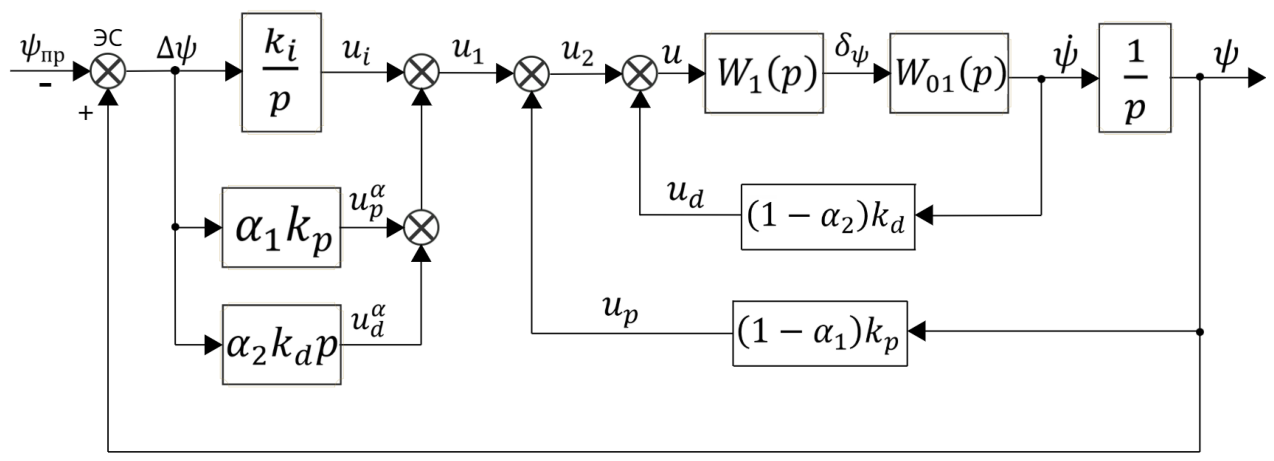
Figure 2.
Region of admissible values of the parameters and .
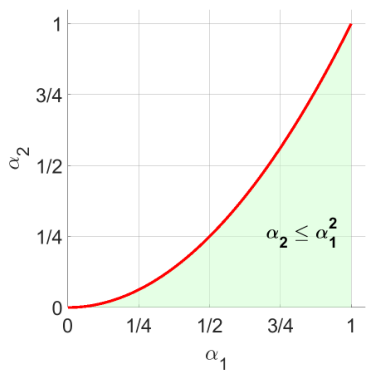
Figure 3.
Test bench for the rocket angular stabilization system.
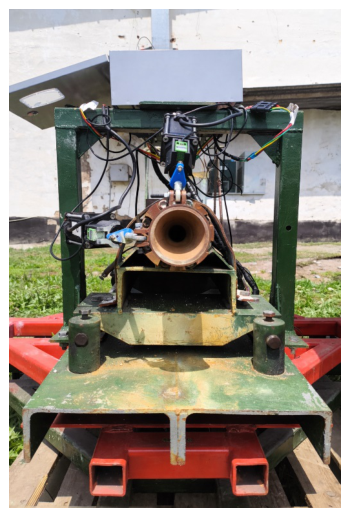
Figure 4.
Transient response of the angular stabilization system with the classical PID controller
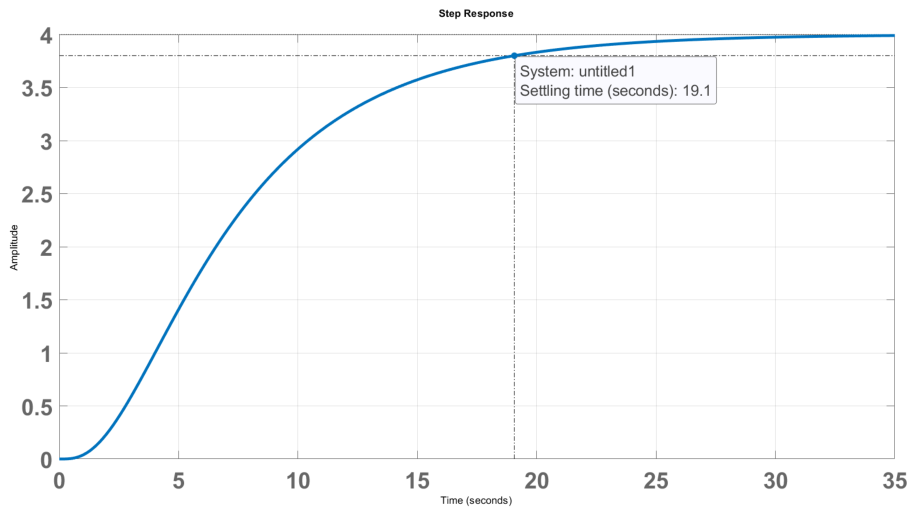
Figure 5.
Transient responses of the angular stabilization system with the classical and extended PID controllers.
Figure 5.
Transient responses of the angular stabilization system with the classical and extended PID controllers.
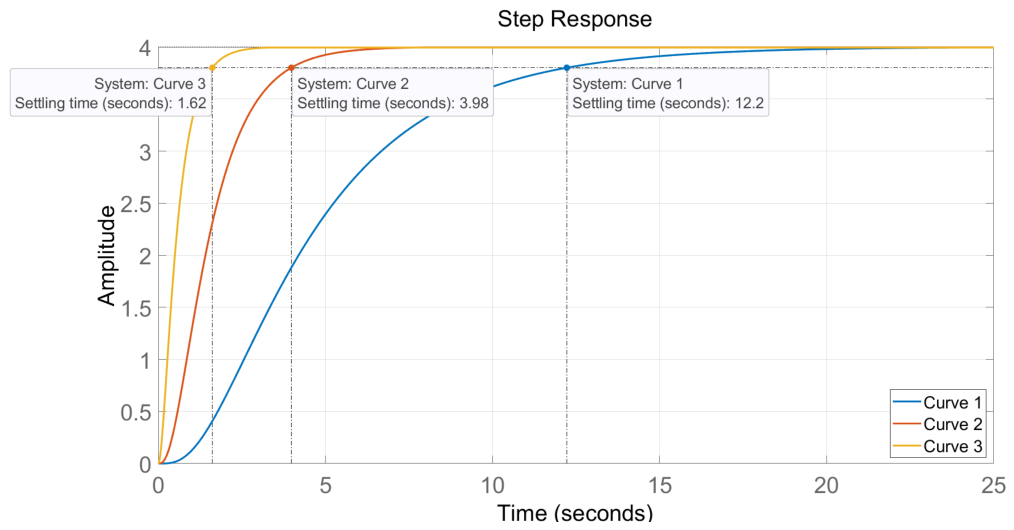

Table 1.
Parameters of the rocket angular stabilization system.
| Parameter | Symbol | Value | Unit |
|---|---|---|---|
| Moment of inertia | 13.338026 | kg·m2 | |
| Moment arm length | l | 0.2955 | m |
| Time constant | T | 0.2 | s |
| Thrust force | 100 | N |
Disclaimer/Publisher’s Note: The statements, opinions and data contained in all publications are solely those of the individual author(s) and contributor(s) and not of MDPI and/or the editor(s). MDPI and/or the editor(s) disclaim responsibility for any injury to people or property resulting from any ideas, methods, instructions or products referred to in the content. |
© 2026 by the authors. Licensee MDPI, Basel, Switzerland. This article is an open access article distributed under the terms and conditions of the Creative Commons Attribution (CC BY) license (http://creativecommons.org/licenses/by/4.0/).
Copyright: This open access article is published under a Creative Commons CC BY 4.0 license, which permit the free download, distribution, and reuse, provided that the author and preprint are cited in any reuse.


