

Submitted:
02 June 2026
Posted:
05 June 2026
You are already at the latest version
Abstract
Background/Objectives: Healthcare institutional betrayal (HIB) is a betrayal trauma that occurs when a healthcare organization or system perpetrates wrongdoing against or fails to protect an individual who depends upon that system for care. Known consequences of experiencing HIB include increased healthcare system and provider distrust and anticipated healthcare avoidance, highlighting the public health implications of unaddressed HIB. Little is known about actions that healthcare stakeholders can take to repair HIB. Thus, this study experimentally tested the effects of receiving one of two reparative actions post HIB (empathic apology vs. organizational change) performed by one of two healthcare system stakeholders: healthcare provider or system administrator. Methods: Residual HIB perceptions, trust, expectations for future healthcare, and intentions to avoid future care were assessed post-repair conditions. Initially, undergraduate participants (N = 198) were asked to imagine themselves experiencing a common healthcare scenario which included HIB. After post-HIB baseline measurements, participants were then randomly assigned to one of four conditions (three with HIB repair actions vs. one control). Participants receiving any type of HIB repair reported significantly lower residual HIB, higher positive expectations for future healthcare, and greater trust in healthcare post-repair, with effect sizes ranging from small to large. Results: Generally, two HIB repair conditions (organizational change HIB repair and healthcare provider HIB repair) outperformed the healthcare administrator HIB apology repair condition; all repair conditions outperformed the control condition. Conclusions: Our finding that specific actions can facilitate post-HIB recovery is clinically meaningful. Medical professionals and healthcare administrators need to address patients’ past negative experiences with healthcare and take action to repair HIB to improve patients’ ongoing and future healthcare experiences.
Keywords:
healthcare institutional betrayal
; repair
; healthcare avoidance
1. Introduction
Institutional betrayal [1] occurs when institutions, such as universities, healthcare systems, the armed services, and religious organizations are responsible for perpetrating wrongdoings against individuals who are dependent on them. For example, a healthcare system may dismiss the patient’s concerns, fail to provide best practice care, or fail to respond adequately to patients’ complex medical needs, thereby betraying the patient’s trust and reducing their sense of safety. When wrongdoings (through acts of omission or commission) occur within a healthcare system or via a healthcare encounter, they are labeled as healthcare institutional betrayal (HIB) [2]. Experiencing at least one act of HIB is common among college students reporting on their worst healthcare experience [3,4,5] and patients coping with chronic health conditions [6,7]. Furthermore, experiencing acts of HIB during a healthcare encounter has been linked to deleterious outcomes, including anticipated healthcare avoidance, and reduced trust in healthcare organizations and providers [3,8].
Post-HIB disengagement with healthcare can have serious public health implications. For example, choosing not to utilize preventative healthcare services may result in delayed diagnoses or worsening of chronic disease [9,10]. Conversely, research indicates that preventative care utilization (e.g., breast cancer screenings and routine immunizations) is associated with large healthcare savings [11]. Problematically, little is known about the corrective actions that can be taken by healthcare system stakeholders to repair HIB and restore trust between the individual and their healthcare institution. Understanding what actions are needed and by whom may illuminate directions for best-practice medical care and offer ideas for ways to facilitate patient healing after experiencing HIB. For example, practicing how to assess for, react to, and repair a patient’s HIB history could be part of training for healthcare professionals, health system administrators, nurses, and medical students.
1.1. Theoretical Considerations
Several theoretical frameworks highlight the need for repair after patient experiences of HIB. The first framework, BITTEN, describes the influence of past experiences of HIB on the patient’s current healthcare experience and their anticipated future interactions with healthcare. Specifically, the BITTEN framework postulates the following: A Betrayal history by a healthcare-related institution (i.e., HIB), can be activated in the context of a current Indicator for healthcare engagement. When activated, unresolved HIB can trigger Trauma symptoms, reduce Trust in current healthcare providers, and lead to different patient Expectations and Needs in both the current and future healthcare encounters [12] (Figure 1).
An underlying assumption of this model is that past occurrences of HIB are typically unresolved and likely have not been assessed nor addressed in the current medical encounter. HIB may even have occurred with a different healthcare team and thus may be unknown to the current provider. Yet, repair is an ongoing patient need post-HIB that would require the current healthcare team to assess and address a patient’s history of HIB, perhaps through the administration of a brief screener developed from existing measures of HIB. Importantly, the BITTEN framework aligns with the national push for trauma-informed care (TIC), which, in theory, also includes patients’ need for recognition and repair of past HIB and activated trauma symptoms [12]. Patients’ needs as depicted in TIC and as also described in BITTEN framework are “what the patient requires in order to be cared for in a competent and holistic manner, consisting of both physical and psychosocial needs” ([12], p. 295). To fulfill those needs, responsibility for repair often falls to a medical institution’s healthcare providers. However, little research has examined outcomes related to different approaches to HIB repair, including healthcare system-level change.
A second model draws from an advancement of betrayal trauma theory. This model emphasizes the need for a healthcare institution and its members to embrace institutional courage, particularly when faced with knowledge of institutional betrayal. Institutional Courage has been described as “accountability, transparency, actively seeking justice, and making reparations where needed” ([13], p. 494,14). The delineation of institutional courage as the main antidote to institutional betrayal highlights the need for medical institutions to repair their relationship with individuals they have harmed by being accountable for, apologizing, and bearing witness to injustices the system and its representatives may have perpetuated. In this model, both institutional acts of repair and acknowledgement of harm are ways that institutions can exemplify courage. Similarly, recent work by Kähkönen and colleagues (2021) [15] indicates that HIB repair must go beyond any of the specific individuals associated with committing that transgression (e.g., the patient needs more than an apology from the offender). Instead, these authors suggest that organizational reform (e.g., changing organizational policies, conducting open investigations, institutional penance) is needed for HIB repair, as HIB, by definition, is a transgression that has occurred at the system level. As much of the current research on HIB has relied on cross-sectional work, this study tested the supposition made by Kähkönen and colleagues (2021) [15] utilizing an experimental design. In this way, the current work helps to gain an understanding of how HIB repair from different personnel at various levels of the healthcare system might differentially cause changes in residual HIB, avoidance, and altered healthcare expectations.
1.2. Purpose of the Present Study
Specifically, this study examined the effects of two different healthcare stakeholders (healthcare provider or a healthcare system administrator) initiating one of two specific reparative actions (empathic apology or organizational change) on participants’ perceptions of HIB repair and related constructs (i.e., residual healthcare institutional betrayal, trust in the healthcare system, expectations for future encounters, and anticipated healthcare avoidance) after patients’ have imagined themselves experiencing a routine healthcare encounter that included HIB. These aims were addressed through random assignment of participants to one of four experimental repair conditions after they experienced HIB: 1) healthcare provider HIB repair (i.e., the healthcare provider discusses the patient’s HIB, empathizes, and apologizes in an effort to address HIB and improve the interpersonal relationship), 2) healthcare administrator HIB repair (i.e. the healthcare administrator discusses the patient’s HIB, empathizes, and apologizes), 3) organizational change HIB repair (i.e., a system representative communicates that organizational-level change will ensue due to the patient’s experience of HIB), and 4) no repair (control condition).
Hypotheses were as follows: 1) participants assigned to vignettes with any HIB repair behaviors would report greater perceived repair (a manipulation check), decreased residual HIB, and increased levels of restored trust in the healthcare system post-HIB, and 2) participants assigned to any of the three HIB repair conditions would also report higher positive expectations for future healthcare encounters and lower negative expectations for future healthcare encounters, in addition to lowered residual anticipated healthcare avoidance. A priori, it was expected that participants would report the best outcomes in response to the organizational change HIB repair condition as that type of repair might serve to acknowledge the patient’s own HIB, increase the likelihood of preventing future occurrences of HIB for self and others, and earn patient respect by demonstrating institutional courage.
2. Materials and Methods
2.1. Participants
Participants were undergraduate students from a large public university located within the Southeastern United States. All were recruited online via the psychology department’s SONA system. Participants received either extra credit or course credit upon study completion. Participants could choose not to answer any or all questions. IRB approval was obtained before this study was conducted, and ethical procedures were followed throughout.
2.2. Procedure
At the outset, all participants were randomly assigned to read one of two standard healthcare scenarios depicting HIB occurring within a primary care visit that was initiated by the participant. Full vignettes available upon request. The two scenarios were identical except for the presenting medical problem, both chosen to be common concerns of college students: either persistent headaches (n = 95) or unexplained abdominal pain (n = 103). A pilot study of these stimuli confirmed the number of HIB acts needed so these scenarios would be perceived as both realistic and betraying by participants. Each scenario included the same six HIB acts that were derived from Smith’s (2017) [16] Healthcare Institutional Betrayal Questionnaire (IBQ-H). These were: 1) minimizing the patient’s concerns, 2) denying the patient’s experience, 3) not taking steps to prevent unpleasant healthcare experiences, 4) making it difficult to report concerns, 5) experiencing a lack of communication between providers, and 6) seeing that they system may have created an environment where continuing to seek care was difficult [16]. After reading and imaging themselves in the scenario, participants completed measures assessing their perceptions of HIB occurring in the encounter, the degree to which they were immersed in the scenario (serving as HIB healthcare scenario manipulation check), their level of trust in the depicted healthcare provider and the associated healthcare system, their expectations for future healthcare encounters, and their anticipated level of healthcare avoidance if this HIB encounter had happened to them.
After completing the post-HIB healthcare scenario measures, all participants were again randomly assigned to one of the four experimental post-HIB repair scenarios:1) healthcare provider HIB repair (i.e., discuss the HIB, empathize, and apologize), 2) healthcare administrator HIB repair (i.e., the system representative discusses the HIB, empathizes, and apologizes), 3) organizational change HIB repair (i.e., system representative explaining that the patient’s HIB experience has prompted organizational-level change), and 4) no repair (control condition). After reading their particular repair vignette, participants rated their residual HIB, current trust in this healthcare provider, expectations for future healthcare encounters (positive and negative), and anticipated healthcare avoidance/disengagement. They also rated their perceptions of whether they experienced repair via what was offered to them (HIB repair manipulation check). To conclude the study, participants answered demographic questions.
2.3. Measures
2.3.1. Healthcare Institutional Betrayal: Institutional Betrayal Questionnaire—Medical Systems (IBQ-MS)
The IBQ-MS is a 42-item scale measuring IB within the medical system [17]. It consists of three components—negative cognitive-affective patient reactions, doctor- and system-level actions, and system-level reactions to reports of negative healthcare experiences. Items are measured on a five-point Likert scale (from “never” to “almost always” for behavioral items and “not at all” to “extremely” for emotional response items). In the current study, the coefficient alpha for this measure was excellent at .97. The IBQ-MS was administered twice, once after the initial HIB scenario and again after the HIB repair or no repair condition vignette.
2.3.2. Wake Forest Physician Trust Scale
This is a 10-item scale which assesses an individual’s trust in their physician [18]. Item responses are on a five-point Likert scale from “strongly agree” to “strongly disagree”. The coefficient alpha for this measure was excellent (α =.94) in the current study. The Wake Forest Physician Trust Scale was also administered twice, once after the initial HIB scenario and again after the HIB repair or no repair condition vignette.
2.3.3. Expectations for Healthcare
The Negative Expectations for Healthcare Scale (NEHS) [19] consists of 5-items which examine the extent to which the participant expects the following negative experiences to occur in future healthcare encounters: “to be left alone for extended periods of time,” “to be ignored,” “to have your symptoms minimized, “to be judged,” and “to be left out of your treatment planning.” Responses are rated on a five-point Likert scale ranging from “Not at all” to “Extremely.” The NEHS scale is summed to create an overall score, such that higher scores indicate more negative expectations for healthcare. This scale has demonstrated good internal consistency in previous samples (e.g., α = .84 in over 1000 college students as reported by Gigler et al., 2024) [3]. The internal consistency for these items in the current study was adequate, α = .72.
In the current study, four parallel items were created to assess positive expectations for future healthcare encounters (PEHS) [20]. These items include: “to be listened to”, “to receive clear explanation and instructions about your condition”, “to be treated by staff who show care/concern/compassion”, and “to be treated by staff who are professional in their work”. Response options again ranged from 0 “not at all,” to 4 “extremely.” The positive expectations for healthcare scale had a Cronbach’s alpha of .82 in this sample, demonstrating good internal consistency.
2.3.4. Healthcare Institutional Betrayal Repair
A pilot study was conducted to test the efficacy of six questions to determine HIB repair (HIB- Repair) [20]. Factor analysis of these six items showed all items loading onto a single factor with excellent internal consistency. Consequently, all were retained and utilized in the current study: 1) “After your last interaction, to what degree do you believe that the provider’s behavior facilitated restoring your trust in them? 2)“After your last interaction, to what degree do you believe that the provider’s behavior facilitated restoring your trust in that healthcare clinic? 3) After your last interaction, to what degree do you believe that the provider’s behavior facilitated restoring your trust in the healthcare system as a whole? 4) “After your last interaction, to what degree did their behavior sufficiently repair your relationship with the provider you saw?” 5) “After your last interaction, to what degree did their behavior sufficiently repair your relationship with the clinic where you were receiving services?” and 6) “After your last interaction, to what degree did their behavior sufficiently repair your relationship with the healthcare system as a whole?” Responses were coded on a scale from 1 “not at all” to 5, “extremely”. A total score was computed by summing up all six items. Again, a factor analysis of these six items in the current sample indicated that all items loaded onto a single factor, indicating a cohesive construct, with excellent internal consistency (α = .93). The HIB-Repair measure was administered only once, after participants experienced one of the four repair conditions.
2.3.5. Anticipated Healthcare Avoidance/Disengagement
Anticipated healthcare avoidance/disengagement was measured by three previously published questions assessing anticipated avoidance [9,10]. These include: “To what extent do you expect to avoid accessing healthcare services after this experience?” “To what extent do you expect to delay seeking medical care after this experience?” and “To what extent do you expect to deliberately withhold information from healthcare providers after this experience?” Response options ranged from “not at all” to “extremely,” with higher scores representing a greater anticipated healthcare avoidance/disengagement. The Cronbach's alpha for this three-item scale was acceptable at .78. The measure of anticipated healthcare avoidance was administered only once, after participants experienced one of the four repair conditions.
2.3.6. Demographic Questions
Each participant completed demographic questions describing their gender identity, sexual orientation, race/ethnicity, chronic health condition status, and insurance status.
3. Results
Initially, there were 245 total participants in this study. However, after removing duplicates and responses from participants who failed any of three embedded validity checks, 198 participants remained for data analysis. Patterns of missing data were examined using Little’s MCAR test [21]. Missing data was missing completely at random (p > .05) for all scales besides Perceived Repair, p = .03; Post-Repair HIB, p = .04; and the Post-Repair Wake Forest Trust Scale, p = .001. These three measures were located at the end of the survey. Due to length of the study, some participants quit before fully completing these final questionnaires; however, attrition did not differ by condition. Only data from participants who completed at least 80% of these scales were retained for final analysis. As with other missing data, mean imputation occurred for missing values per scale by participant. Thus, n’s vary slightly across analyses.
Participants ranged in age from 17 to 60, with a mean age of 20.5 years (SD = 4.6 years). Most participants self-identified as women (58%) and as heterosexual (78%). Just over half the sample (53%) self-identified as White; participants also reported identifying as Black (24%), South Asian (7%), and multi-racial (6%) among other identities. Complete sample demographics can be found in Table 1.
After reading the opening HIB scenario, participants were randomly assigned into the four healthcare repair conditions. Participants were retained similarly in the healthcare provider HIB repair (n = 47), healthcare administrator HIB repair (n = 47), organizational change HIB repair (n = 53), or control (no repair) (n = 51) conditions.
3.1. Two Healthcare Scenarios
Independent sample t-tests revealed no differences in how realistic participants thought the two initial healthcare encounter scenarios were on a scale of one to five, t(194) = .32, p = .38 (headache M = 4.17, SD = .92, abdominal pain M = 4.13, SD = .80). The two scenarios were also perceived to contain similar levels of HIB, t(194) = -.88, p = .50. Importantly, both initial vignettes generated similar levels of distrust in the healthcare team, t(194) = .39, p = .99, and negative expectations for future healthcare encounters, t(196) = .89, p = .80. Given that the two initial healthcare scenarios functioned very similarly, all subsequent analyses combined responses across these two conditions to increase statistical power.
3.2. Repair Condition Analyses
As expected from a manipulation check, results of a one-way ANOVA indicated a significant effect of the HIB repair condition on participants’ perceptions of repair, F(3, 189) = 47.35, p < .001. Tukey’s HSD test for multiple comparisons found that participants in all three HIB repair conditions reported significantly higher repair scores compared to participants assigned to the no HIB repair control condition (n = 48; M = 9.97; all p’s < .001). Mean HIB repair scores were significantly different between the healthcare provider (n = 47; M = 18.98, SD = 4.50) and healthcare administrator HIB repair conditions (n = 46; M = 16.22, SD = 4.96; 95% CI = .37-5.34; p = .025), with the healthcare provider HIB repair condition generating greater perceptions of repair than the same repair actions undertaken by a healthcare administrator. Mean repair scores were also significantly different between the organizational change HIB repair condition (n = 52, M = 20.33, SD = 4.05) and the healthcare administrator HIB repair condition, with the organizational change HIB repair condition generating greater perceptions of repair (95% CI = 1.8-6.66; p < .001). However, there were no significant differences in perceptions of repair between the healthcare provider and the organizational change HIB repair conditions (p = .15). The overall effect of HIB repair condition on repair scores was moderate (η2= .43).
3.3. Healthcare Institutional Betrayal
As hypothesized, there was a significant effect of HIB repair condition on post-repair residual HIB scores, F(3,190) = 23.85, p < .001 (Table 2).
Pairwise comparisons indicated significant differences among all conditions except between the healthcare provider HIB repair and organizational change HIB repair conditions as found for repair perceptions (95% CI = -9.66-10.52, p = .93). All other differences were statistically significant with p’s < .01 such that the highest levels of residual HIB were reported by those in the no HIB repair control condition. Lesser amounts of persisting HIB were reported by those randomly assigned to the healthcare administrator HIB repair condition. Importantly, the greatest HIB repair was reported for the healthcare system organizational change and healthcare provider HIB repair conditions. The overall effect size of repair condition on post-repair HIB was moderate in strength (η2= .27).
3.4. Trust
There was a significant moderate effect (η2= .20) of repair condition on perceptions of trust, F(3,191) = 15.69, p < .001 (Table 2). Ratings of trust obtained from participants after reading the HIB healthcare scenario but before experiencing their randomly assigned HIB repair condition were used as a covariate in these analyses. Pairwise comparisons indicated statistically significant differences between the healthcare provider and the healthcare administrator HIB repair conditions (95% CI = 3.38-9.82, p < .001), as well as the control condition (95% CI = 4.64-10.95, p < .001), with the healthcare provider HIB repair condition generating greater trust scores post-HIB. Similarly, those randomly assigned to the healthcare system organizational-change HIB repair condition (M = 34.74, SD = 9.18) reported significantly higher trust scores post-repair compared to those assigned to the healthcare administrator HIB repair or the no HIB repair control condition, as noted in Table 2. Healthcare provider and healthcare system organizational change HIB-repair conditions did not differ significantly in restoring healthcare related trust.
3.5. Expectation
In terms of anticipated negative expectations for future healthcare encounters, after conducting a one-way ANOVA and controlling for negative expectations for healthcare after the experiencing the initial HIB filled healthcare scenario, there was a statistically significant effect by repair condition, F(3,193) = 5.17, p = .002. As shown in Table 2, participants randomly assigned to the no HIB repair control condition reported the most negative expectations for future healthcare encounters as compared to those randomly assigned to the healthcare provider (95% CI = .41-3.50, p = .01) or organizational change HIB repair conditions (95% CI = 1.24-4.25, p < .001). Again, these two repair strategies were not found to significantly differ from each other in reducing negative expectations for future healthcare. The overall effect size for HIB-repair on reducing negative expectations for future healthcare was small (η2= .074).
Additionally, there was a significant but small effect of HIB repair condition (η2= .082) on positive expectations for future healthcare encounters, F(1, 193) = 5.77, p < .001. This analysis consisted of a one-way ANOVA among the four HIB repair conditions with post-HIB positive expectations for healthcare entered as a covariate. Pairwise comparisons demonstrated that participants assigned to any of the three HIB repair conditions reported higher positive expectations for future healthcare encounters compared with those assigned to the no-repair control condition (all p’s < .01). There were no statistically significant differences found in restoring positive expectations for healthcare among the three HIB repair conditions.
3.6. Avoidance/Disengagement
Results from a one-way ANOVA indicated that there was no statistically significant effect of HIB repair condition on reducing residual anticipated healthcare avoidance, F(3,191) = 1.34, p = .26.
4. Discussion
This study examined the perceived effectiveness of two potential HIB repair strategies (empathic apology vs. organizational change) undertaken by different healthcare stakeholders (either the healthcare provider or a healthcare system administrator) to repair and mitigate the known consequences of HIB [8,16]. Repair from HIB is essential given its prevalence among the worst healthcare experiences of college students [3,8], and among patients with complex chronic health conditions [7] and its associations with deleterious outcomes. Importantly, this is the first known study to utilize an experimental design to better elucidate the potential restorative effects associated with specific HIB repair strategies.
Importantly, findings indicated that use of any HIB repair strategy by a healthcare provider or a healthcare administrator was associated with a large reduction in residual HIB. Participants assigned to any of the HIB repair conditions reported higher levels of perceived repair compared with those assigned the control condition, suggesting that any reparative action by healthcare team members or healthcare system representatives is likely to be perceived as beneficial to the patient. However, contrary to expectation, perceptions of repair did not differ between those assigned to the healthcare provider HIB repair condition and those assigned to the organizational change condition. In fact, across the majority of the tested HIB impact variables, these two different repair approaches resulted in similar levels of patient recovery. These findings contradicted a priori hypotheses that healthcare system organizational change actions would result in greater perceptions of repair, as this commitment by the system might address both the individual’s HIB while potentially reducing instances of future HIB for others.
As a whole, these findings suggest that there are two viable pathways to restoring trust and beginning the process of patient healing after HIB has occurred in a routine medical encounter. One is provider-centered in that the healthcare provider provides a direct acknowledgment of the harm experienced by the patient and offers an apology. The second pathway more directly acknowledges that the harm experienced was institutional in nature, as it requires the healthcare institution to agree to enact systemic change in response to the patient’s HIB through policy, procedure, and prevention efforts. Theoretically, this second pathway not only helps the individual post-HIB but also demonstrates institutional courage as the system works to prevent harm and enact quality care for all patients over time.
This pattern of finding similarly effective repair strategies generally persisted across measures, although the effect sizes were smaller for participants’ healthcare expectations. Specifically, when working to restore positive healthcare expectations post a HIB-laden healthcare encounter, all repair strategies were helpful, as participants within any of three HIB repair conditions reported greater restoration in their positive expectations for future healthcare encounters compared to those randomly assigned to the control/no HIB repair condition. Furthermore, post-HIB negative future expectations for healthcare remained significantly elevated among those receiving no-HIB repair as compared to those randomly assigned to either the healthcare provider and organizational change HIB-repair conditions; however, again, the healthcare provider and organizational change HIB-repair conditions appeared to have similar and superior restorative effects.
Finally, contrary to hypothesis, for healthcare avoidance/disengagement behaviors, there were no statistically significant reparative effects by repair condition. One possibility for this non-finding is that individuals may still find it difficult to re-engage with the healthcare system after experiencing HIB, despite reparative actions. Other factors may also play a role in addressing healthcare avoidance among college students. Additional research is needed.
At the outset, this work was informed by betrayal trauma theory [22] and the BITTEN model of trauma-informed care [12]. Lewis and colleagues (2019) [12] posited that there is a need for patient’s current healthcare providers to initiate repair following HIB (regardless of whether they were involved in the HIB) to improve the patient’s interaction with the healthcare system in the future. This study affirms that acts of repair are ways to address residual HIB effects. All three repair strategies showed the ability to facilitate restored provider, healthcare team, and system trust. In keeping with the suppositions of the BITTEN model, repair, at the interpersonal-provider level and at the organizational change level, are critical methods to address patient responses to HIB as well as potential pathways toward helping patients’ heal their relationship with the healthcare system.
4.1. Practice Implications
It is worth noting that these findings suggest that the potentially arduous HIB repair strategy of initiating systemic or organizational change to address an individual patient’s experience of HIB did not lead to better patient perceptions of repair and trust as compared to the healthcare provider simply listening to, acknowledging, and apologizing for the HIB the patient had experienced. These findings indicate that a short, targeted acknowledgement and apology, that takes relatively little time and no money, holds the potential to facilitate clinically meaningful repair between an individual and their healthcare system. As such, it may be important to consider training healthcare professionals to routinely assess for and repair HIB as a standard part of patient care as providers are unlikely to acknowledge and address HIB they are unaware of. This training could be provided to physicians, PAs, nurse practitioners, pharmacists, and other patient-facing staff. However, this strategy may not be effective at preventing subsequent HIB, as systemic failures might persist if left unaddressed. Therefore, efforts to encourage organizational courage on the part of healthcare systems remain a necessity.
4.2. Study Limitations and Future Directions
One limitation of this study was that the sample was composed entirely of college students who were imagining themselves experiencing a routine healthcare encounter that contained multiple acts of HIB. Results may not generalize to other patient populations even though researchers have found that college students already had significant interactions with the healthcare system and their past problematic interactions often included HIB [3]. Findings are also bolstered by participants’ assessment that the encounter they read was realistic. Data was also collected cross-sectionally using self-report instruments. Longitudinal studies and observational designs would benefit the field.
Because the opening HIB scenario constituted only one negative healthcare encounter, this study’s results may also not generalize to chronic or ongoing healthcare situations that contain HIB. Future studies may consider testing whether differing lengths of experiencing HIB (one-time vs. chronic) influence participants’ perceptions of repair strategies. For example, the organizational change HIB repair condition may be more important when repairing long-standing HIB, HIB among patients with chronic conditions, or HIB that seems to be differentially directed to patients from vulnerable populations. Furthermore, continued efforts are needed to study HIB from a population-health perspective and determine whether organizational change is critical for sustainable HIB reduction.
Several other future directions emerged from this study. First, future research needs to explore how to train professionals to systematically assess patients for prior HIB that could be activated in the current encounter. This type of screening may be integrated into encounters, much like the PHQ-9 is now routinely delivered to assess for patient need for behavioral health. Moreover, future studies on HIB in general, and on healthcare institutional betrayal repair in particular, should focus on recruiting historically underserved populations to these studies, given the breadth of literature indicating that those with minority identities are more likely to experience HIB [4,7,23] and these participants may react differently to individualized apologies versus systemic change. Additionally, future research should investigate perceptions of repair following HIB by conducting focus groups or interviews with individuals whose lived healthcare experiences include HIB. Qualitative research could help determine whether certain repair strategies have already been experienced by patients but were not perceived as repairing; whether the timing of a repair strategy impacts perceived repair; whether there are longer-term impacts of specific repair behaviors on patient health; and even the degree to which patients view their healthcare provider as a key representative of the larger system and as acting on behalf of the organization as a whole or not. Future studies may consider the chronicity or severity of the illness or condition that was occurring during HIB exposure and whether this HIB is associated with the current provider or is activated in the current encounter (or not) as these variations likely may impact encounter perceptions as well as the utility of certain HIB repair strategies.
Finally, although healthcare provider HIB repair was effective in improving trust, increasing positive future healthcare expectations, and reducing HIB, there are many implementation barriers to consider for this strategy. For example, physicians have historically been advised against making apologies or admitting to medical errors to avoid malpractice lawsuits [24]. Although apology laws, which allow physicians to apologize without those statements being used in lawsuits [25], have made this kind of practice more acceptable, some research suggests that professional norms in the field of medicine still preclude apologies. Finally, apology laws have not been shown to effectively facilitate physician transparency [26,27]. There are also issues with healthcare provider time and capacity, both resources can be in short supply within a given healthcare encounter.
4.3. Conclusion
Findings indicated that reparative actions significantly mitigated some negative outcomes associated with HIB (e.g., reducing residual trust deficits, negative future expectations, feelings of betrayal). As such, a healthcare experience containing HIB does not (necessarily) damage the patient-healthcare system relationship irreparably. Further, there are specific actions that various stakeholders can take to facilitate patient recovery post-HIB. Having a healthcare provider acknowledge and apologize to patients who have experienced HIB results in significant repair and may be a critical first step as the institution gathers its courage to enact more cost-prohibitive and time-intensive organizational changes.
Author Contributions
Conceptualization, F. R. and J.L.-R.; data analysis, F.R.; methodology, F. R. and J.L.-R.; writing—original draft preparation, F. R. and J.L.-R.; writing- review and editing, F.R., J.L.-R., C.G., B.J., and D.D; project administration, F.R., J.L.-R., and C.G. All authors have read and agreed to the published version of the manuscript.
Funding
This research received no external funding.
Institutional Review Board Statement
The study was conducted in accordance with the Declaration of Helsinki, and approved by the Institutional Review Board (or Ethics Committee) of the University of North Carolina (IRB-22-0483; 31 May 2022).
Informed Consent Statement
Informed consent was obtained from all subjects involved in the study.
Data Availability Statement
Data are available upon reasonable request.
Acknowledgments
The authors would like to thank Pedram Rastegar, L. Cai, Grace Schroeder, and Claire Johnson for their instrumental work in facilitating research dissemination as part of the UNC Charlotte THRIVE lab team.
Conflicts of Interest
The authors declare no conflict of interest.
References
- Smith, C.P.; Freyd, J.J. Institutional betrayal. Am. Psychol. 2014, 69, 575–587. [Google Scholar] [CrossRef]
- Smith, C.P. First, do no harm: Institutional betrayal and trust in health care organizations. J. Multidiscip. Healthc. 2017, 10, 133–144. [Google Scholar] [CrossRef]
- Gigler, M.E.; Lathan, E.C.; Cardarelli, O.; et al. Young adults’ expectations for healthcare following institutional betrayal. J. Trauma Dissociation 2024, 25, 299–314. [Google Scholar] [CrossRef] [PubMed]
- Gómez, J.M. Gender, campus sexual violence, cultural betrayal, institutional betrayal, and institutional support in US ethnic minority college students: A descriptive study. Violence Against Women 2022, 28, 93–106. [Google Scholar] [CrossRef] [PubMed]
- Smith, C.P.; Freyd, J.J. Dangerous safe havens: Institutional betrayal exacerbates sexual trauma. J. Trauma Stress 2013, 26, 119–124. [Google Scholar] [CrossRef]
- Bloeser, K.; McCarron, K.K.; Merker, V.L.; et al. “Because the country, it seems though, has turned their back on me”: Experiences of institutional betrayal among veterans living with Gulf War Illness. Soc. Sci. Med. 2021, 284, 114211. [Google Scholar] [CrossRef]
- Langhinrichsen-Rohling, J.; Lewis, C.L.; McCabe, S.; et al. They’ve been BITTEN: Reports of institutional and provider betrayal and links with Ehlers-Danlos Syndrome patients’ current symptoms, unmet needs and healthcare expectations. Ther. Adv. Rare Dis. 2021, 2, 1–12. [Google Scholar] [CrossRef] [PubMed]
- Selwyn, C.N.; Lathan, E.C.; Richie, F.; et al. Bitten by the system that cared for them: Towards a trauma-informed understanding of patients’ healthcare engagement. J. Trauma Dissociation 2021, 22, 481–497. [Google Scholar] [CrossRef]
- Rastegar, P.J.; Cai, L.; Langhinrichsen-Rohling, J. Racial discrimination as a traumatic bedrock of healthcare avoidance: A pathway through healthcare institutional betrayal and mistrust. Healthcare 2025, 13, 486. [Google Scholar] [CrossRef]
- Rastegar, P.J.; Langhinrichsen-Rohling, J. Understanding college students’ healthcare avoidance: From early maladaptive schemas, through healthcare institutional betrayal and betrayal trauma appraisal of worst healthcare experiences. Healthcare 2024, 12, 1126. [Google Scholar] [CrossRef]
- Maciosek, M.V.; Coffield, A.B.; Flottemesch, T.J.; et al. Greater use of preventive services in US health care could save lives at little or no cost. Health Aff. 2010, 29, 1656–1660. [Google Scholar] [CrossRef]
- Lewis, C.L.; Langhinrichsen-Rohling, J.; Selwyn, C.N.; et al. Once BITTEN, twice shy: An applied trauma-informed healthcare model. Nurs. Sci. Q. 2019, 32, 291–298. [Google Scholar] [CrossRef]
- Smidt, A.M.; Freyd, J.J. Government-mandated institutional betrayal. J. Trauma Dissociation 2018, 19, 491–499. [Google Scholar] [CrossRef]
- Smidt, A.M.; Adams-Clark, A.A.; Freyd, J.J. Institutional courage buffers against institutional betrayal, protects employee health, and fosters organizational commitment following workplace sexual harassment. PLoS ONE 2023, 18, e0278830. [Google Scholar] [CrossRef]
- Kähkönen, T.; Blomqvist, K.; Gillespie, N.; et al. Employee trust repair: A systematic review of 20 years of empirical research and future research directions. J. Bus. Res. 2021, 130, 98–109. [Google Scholar] [CrossRef]
- Smith, C.P. First, do no harm: Institutional betrayal and trust in health care organizations. J. Multidiscip. Healthc. 2017, 10, 133–144. [Google Scholar] [CrossRef] [PubMed]
- Tamaian, A.; Klest, B. Institutional betrayal in the Canadian medical system: Reliability and validity of a self-report questionnaire. J. Aggress. Maltreat Trauma 2018, 27, 703–719. [Google Scholar] [CrossRef]
- Hall, M.A.; Zheng, B.; Dugan, E.; et al. Measuring patients’ trust in their primary care providers. Med. Care Res. Rev. 2002, 59, 293–318. [Google Scholar] [CrossRef]
- Lathan, E.C.; Langhinrichsen-Rohling, J. Negative expectations for healthcare scale. Unpublished measure 2019.
- Richie, F.J. Repair following healthcare institutional betrayal. dissertation, The University of North Carolina at Charlotte, Charlotte (NC), 2023. [Google Scholar]
- Little, R.J. A test of missing completely at random for multivariate data with missing values. J. Am. Stat. Assoc. 1988, 83, 1198–1202. [Google Scholar] [CrossRef]
- Freyd, J.J. Betrayal trauma. In Encyclopedia of Psychological Trauma; 1996; p. 76. [Google Scholar]
- Smidt, A.M.; Rosenthal, M.N.; Smith, C.P.; et al. Out and in harm’s way: Sexual minority students’ psychological and physical health after institutional betrayal and sexual assault. J. Child Sex. Abus 2021, 30, 41–55. [Google Scholar] [CrossRef] [PubMed]
- Lamb, R.M.; Studdert, D.M.; Bohmer, R.M.; et al. Hospital disclosure practices: Results of a national survey. Health Aff. 2003, 22, 73–83. [Google Scholar] [CrossRef]
- Ho, B.; Liu, E. Does sorry work? The impact of apology laws on medical malpractice. J. Risk Uncertain. 2011, 43, 141–167. [Google Scholar] [CrossRef]
- Ross, N.E.; Newman, W.J. The role of apology laws in medical malpractice. J. Am. Acad. Psychiatry Law. 2021, 49, 406–414. [Google Scholar] [CrossRef] [PubMed]
- Wei, M. Doctors, apologies, and the law: An analysis and critique of apology laws. J. Health Law. 2006, 39, 107–159. [Google Scholar]
Figure 1.
The Role of Healthcare Institutional Betrayal in the BITTEN Model.
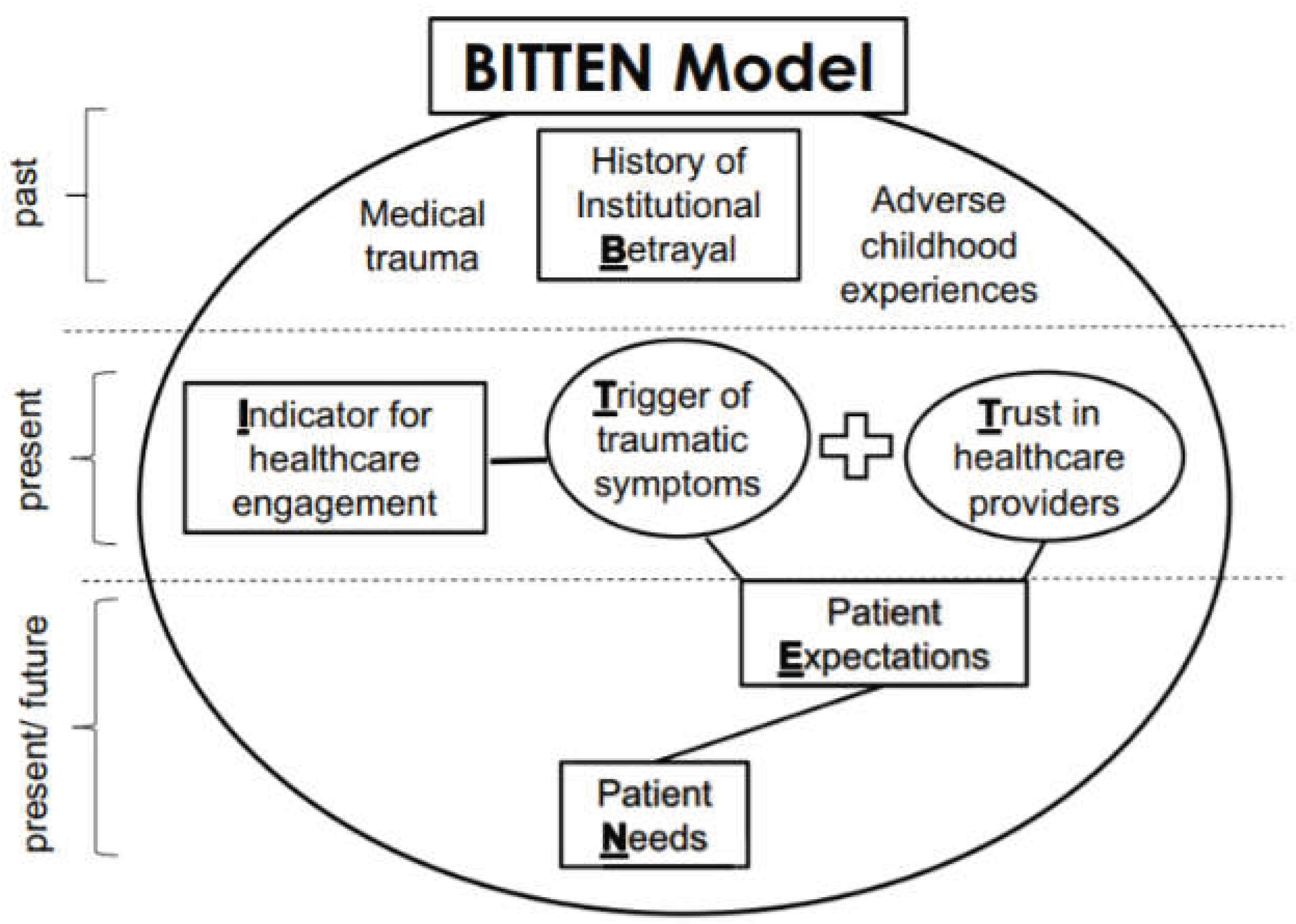

Table 1.
Demographic Variable Frequencies.
| Variable | N | % |
|---|---|---|
| Gender Identity Man Woman Transgender or Genderqueer Prefer not to respond |
76 115 6 1 |
38.4% 58.1% 3.0% <1% |
| Sexual Orientation Heterosexual Gay/Lesbian Bisexual Queer Questioning/Unsure Pansexual Prefer not to respond or missing |
154 7 23 1 6 4 3 |
77.8% 3.5% 11.6% 0.5% 3% 2% 1.5% |
| Race White Black/African American South Asian East Asian Middle Eastern/Arab Native Hawaiian/PI Multiracial Other or prefer not to respond Chronic Health Condition Yes No Prefer not to respond Health Insurance Status Uninsured Medicaid Private Insurance Prefer not to respond |
105 47 14 6 2 1 12 10 31 159 8 3 40 129 26 |
53% 23.7% 7.1% 3% 1% 0.5% 6.1% 5.1% 15.7% 80.3% 4% 1.5% 20.2% 65.2% 13.1% |
Table 2.
Adjusted Means and Standard Deviations for Institutional Betrayal, Trust, and Expectations Across Repair Conditions.
Table 2.
Adjusted Means and Standard Deviations for Institutional Betrayal, Trust, and Expectations Across Repair Conditions.
| Variable | ||||
|---|---|---|---|---|
| Healthcare Provider HIB Repair N = 47 M(SD) |
Healthcare Administrator HIB Repair N = 47 M(SD) |
Organizational Change HIB Repair N =53 M(SD) |
No Repair Control N =51 M(SD) |
|
| Post-HIB Institutional Betrayal |
152.90 (26.41) |
143.76 (40.05) |
152.88 (31.28) |
149.12 (33.29) |
| Post-Repair Institutional Betrayal |
111.26 (32.81)a |
126.26 (36.48)b |
110.83 (25.83)a |
144.58 (34.56)c |
| Post-HIB Trust |
24.05 (10.37) |
24.87 (12.56) |
21.90 (10.05) |
24.65 (12.61) |
| Post-Repair Trust |
34.87 (10.58)a |
28.78 (10.72)b |
34.38 (8.89)a |
27.45 (11.82)b |
| Post-HIB Expect-NEG Post-Repair |
5.14 (6.08) | 7.13 (6.61) | 9.07 (6.45) | 7.07 (6.21) |
| Expect-NEG | 3.58 (4.03)a | 5.89 (5.60)b | 4.93 (4.68)a | 6.59 (6.12)b,c |
| Post-HIB Expect-POS |
12.32 (4.95) | 10.06 (5.67) | 9.30 (5.71) | 11.08 (5.73) |
| Post-Repair Expect-POS |
13.49 (3.32)a | 12.09 (4.34)a | 12.30 (3.89)a | 10.86 (5.29)b |
Note. Post-HIB encounter scores were collected prior to the repair experience; they were entered into each analysis as a covariate. N’s vary slightly across analyses due to missing data. Post-Repair means with different superscripts are significantly different from one another using Tukey’s Least Significant Differences.
Disclaimer/Publisher’s Note: The statements, opinions and data contained in all publications are solely those of the individual author(s) and contributor(s) and not of MDPI and/or the editor(s). MDPI and/or the editor(s) disclaim responsibility for any injury to people or property resulting from any ideas, methods, instructions or products referred to in the content. |
© 2026 by the authors. Licensee MDPI, Basel, Switzerland. This article is an open access article distributed under the terms and conditions of the Creative Commons Attribution (CC BY) license (http://creativecommons.org/licenses/by/4.0/).
Copyright: This open access article is published under a Creative Commons CC BY 4.0 license, which permit the free download, distribution, and reuse, provided that the author and preprint are cited in any reuse.


