

Submitted:
03 June 2026
Posted:
04 June 2026
You are already at the latest version
Abstract
Metallo-β-lactamase (MBL)-producing multidrug-resistant (MDR) bacteria have emerged as one of the most critical threats to global public health. These zinc-dependent enzymes, particularly NDM, VIM, and IMP, hydrolyze carbapenems, the last-resort antibiotics for treating severe Gram-negative infections. Unlike serine-β-lactamases, MBLs evade all clinically approved β-lactamase inhibitors, leaving a profound therapeutic vacuum.
This review synthesizes evidence from 204 peer-reviewed articles (1970–2026) to examine the molecular diversity, global burden, diagnostic approaches, risk factors, and future directions for MBL-producing pathogens, including Escherichia coli, Klebsiella pneumoniae, Pseudomonas aeruginosa, and Acinetobacter baumannii. MBL genes are predominantly disseminated via mobile genetic elements (plasmids and integrons) and high-risk clones, facilitating rapid cross-border spread. Geographic disparities are striking: Asia accounts for 80% of MBL-producing Acinetobacter reports, while the Eastern Mediterranean and Africa show the highest prevalence of carbapenem-resistant A. baumannii (42.1% and 36.1%, respectively). In contrast, Europe and the Americas report prevalence below 1%, though absolute case numbers remain substantial due to robust surveillance.
Phenotypic detection methods (combined disc test, E-test, and modified Hodge test) are practical in resource-limited settings but suffer from poor specificity and subjective interpretation. Genotypic methods (PCR, whole-genome sequencing, and MALDI-TOF MS) offer definitive gene identification but require specialized infrastructure and expertise. Critical risk factors for MBL acquisition include prior carbapenem exposure, prolonged ICU stays, invasive devices, immunosuppression, and healthcare-associated transmission. The absence of Food and Drug Administration (FDA)-approved MBL inhibitors forces reliance on antibiotics that have limited efficacy, high toxicity, and emerging resistance. Addressing this crisis demands a coordinated, multi-pronged strategy: strengthening global genomic surveillance; deploying rapid molecular diagnostics at the point of care; accelerating the development of novel MBL inhibitors; enforcing antimicrobial stewardship to curb carbapenem overuse; and implementing rigorous infection prevention and control measures.
Keywords:
Metallo- β-lactamases
; muti-drug resistance
; global threat
; antibiotic resistance challenges
; molecular insights of antibiotic resistance
; MBLs-production
1. Introduction
Antimicrobial resistance (AMR) is a major global health threat, in which microorganisms adapt to survive drugs intended to kill or inhibit them [1,2,3]. The introduction and widespread use of antimicrobial agents have revolutionized modern medicine, greatly improving treatment and outcomes for many infectious diseases [4,5,6]. However, the rapid spread of multidrug resistance (MDR) in clinical settings poses serious challenges and threatens global healthcare systems and modern medical practices [7,8,9]. MDR organisms resist multiple antibiotics, making treatment harder, increasing illness and death rates, and raising healthcare costs [10]. This crisis threatens a century of medical progress, risking a return to a time when common infections were often deadly [11,12].
To establish antibiotic resistance, bacteria employ two primary categories of mechanisms: intrinsic and acquired [2,5,13,14]. The intrinsic resistance is natural, chromosome-encoded ability to resist antibiotics due to its structural or functional traits [14]. Acquired resistance arises when bacteria gain resistance through mutations or by obtaining genes from other microbes [5,15]. Bacteria use various strategies to resist antibiotics, such as breaking them down, altering targets, reducing drug entry, or pumping them out [16,17]. These resistance mechanisms hinder treatment, weaken antibiotic effectiveness, and demand urgent action in drug development, stewardship, and infection control [9,18]. The rise and spread of resistant pathogens, especially 'superbugs' resistant to multiple antibiotics, threaten the ability to treat common infections effectively [12,19,20,21].
Beta-lactam antibiotics, accounting for about 60% of global antibiotic use, are the most widely used due to their efficacy, broad spectrum, and safety [22,23]. They inhibit bacterial cell wall synthesis by binding to penicillin-binding proteins (PBPs), mimicking the D-alanine-D-alanine sequence in peptidoglycans [23,24]. This inhibits trans-peptidases, crucial enzymes in cell wall formation[25]. However, their effectiveness is challenged by bacteria producing β-lactamases, which hydrolyze these antibiotics [25,26].
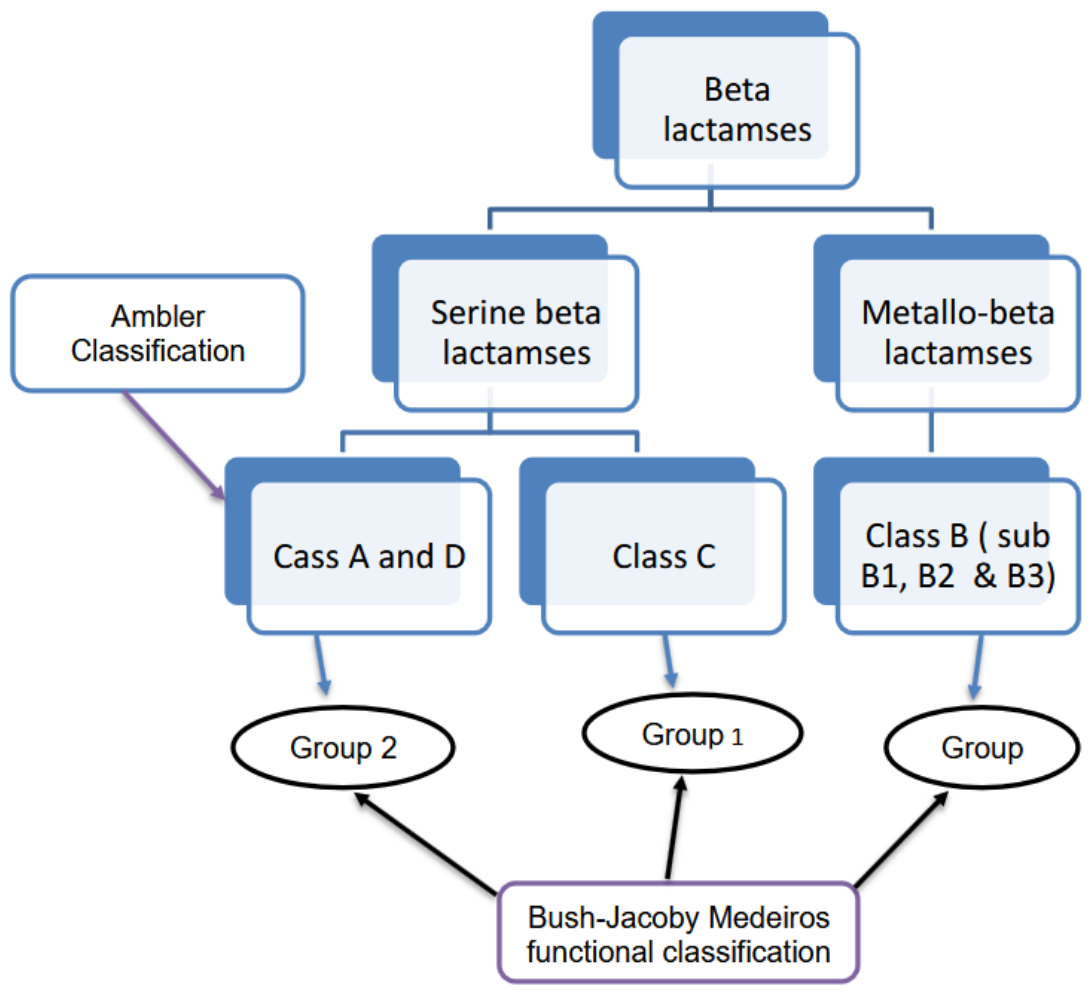
Beta-lactamases are diverse enzymes that evolved as bacterial defense mechanisms against β-lactam antibiotics, and they are classified using two complementary systems [27,28]. The Ambler classification, based on amino acid sequence similarity, divides β-lactamases into four molecular classes: classes A, C, and D ( serine-β-lactamases) that use serine nucleophiles to form covalent acyl-enzyme complexes, and class B (metallo-β-lactamases) that require zinc ions for carbapenem hydrolysis [29]. Class A notably contains most Extended Spectrum β-Lactamases (ESBLs) that resist first through third-generation cephalosporins but remain susceptible to clavulanic acid inhibition [29,30,31,32,33]. The Bush-Jacoby-Medeiros functional classification organizes these enzymes into three groups based on substrate specificity and inhibitor response: Group 1 (class C cephalosporinases with minimal clavulanic acid inhibition), Group 2 (the largest category of serine-β-lactamases from classes A and D that are generally inhibited by β-lactamase inhibitors), and Group 3 (MBLs with broad substrate range including penicillins, cephalosporins, and carbapenems, which are minimally affected by most β-lactam antibiotics except monobactams [31,32,34]. Together, these classification frameworks provide essential molecular and functional understanding for clinical β-lactamase characterization and antimicrobial resistance management.
Figure 1.
Complementary functional and molecular classification of β-lactamase enzymes. Class B (group 3) metallo-β-lactamases (MBLs) are further divided into subclasses B1, B2, and B3 according to differences in active-site amino acid sequences, zinc ligands and stoichiometry, loop architecture, and substrate profiles. Subclass B1 hydrolyzes all β-lactams except monobactams (e.g., aztreonam) and includes most acquired MBLs, such as IMP, NDM, and VIM[29,35].
Figure 1.
Complementary functional and molecular classification of β-lactamase enzymes. Class B (group 3) metallo-β-lactamases (MBLs) are further divided into subclasses B1, B2, and B3 according to differences in active-site amino acid sequences, zinc ligands and stoichiometry, loop architecture, and substrate profiles. Subclass B1 hydrolyzes all β-lactams except monobactams (e.g., aztreonam) and includes most acquired MBLs, such as IMP, NDM, and VIM[29,35].
Metallo-β-lactamases (MBLs) are a class of zinc-dependent enzymes capable of hydrolyzing a wide range of β-lactam antibiotics, including carbapenems which contributes to their clinical importance, even though they represent only about 10% of all β-lactamases [36,37]. Unlike serine-β-lactamases, MBLs are not inhibited by traditional β-lactamase inhibitors such as clavulanate, sulbactam, or tazobactam, but they are susceptible to inhibition by metal chelators like ethylene diamine tetraacetic acid (EDTA) [38,39]. MBLs require one or two zinc ions for their enzymatic activity and currently have no approved inhibitors for clinical use [40]. They are classified into three subgroups: B1, B2, and B3, based on differences in their active sites. Subgroup B1 is most often associated with antibiotic resistance, whereas B3 enzymes are typically found in environmental and healthcare-associated bacteria [41,42].
MBL-producing bacteria, including Enterobacteriaceae, pseudomonas aeruginosa (P. aeruginosa), Acinetobacter baumannii(A. baumannii), and Klebsiella pneumoniae (K. pneumonia) severe infections with high morbidity and mortality due to resistance to β-lactams, including carbapenems, and a lack of effective inhibitors [43,44]. They constitute a significant public health threat due to their role in complicating the management of infectious diseases [45,46], and their emergence is associated with elevated rates of mortality and morbidity, prolonged hospitalization, and increased healthcare expenditures. These organisms are particularly prevalent in hospital environments, with a notable concentration in ICUs, where vulnerable patient populations and high selective pressure from antimicrobial use facilitate their dissemination [47,48].
2. Method and Materials
This narrative review was developed through a comprehensive literature search conducted across PubMed Central, Google Scholar, and Web of Science using the following keywords and Boolean combinations: "Metallo-β-lactamases," "Multi-drug resistance," "Global threat of antibiotic resistance mechanism," "Antibiotic resistance challenges," "Molecular insights of antibiotic resistance," and "MBLs production." Only peer-reviewed, full-text articles published in English between 1970 and 2026 were included, as antibiotic resistance has remained a persistent global challenge due to continuously evolving bacterial resistance mechanisms and declining antibiotic efficacy. Articles published before 1970, non-English publications, and conference abstracts without full texts were excluded. A total of 229 records were initially retrieved from the database searches. After removing 15 duplicates, 214 unique records remained. Subsequently, 7 articles were excluded for falling outside the specified publication timeframe (pre-1970), and 3 articles were removed for being published in languages other than English, resulting in a final total of 204 articles included for full review. The synthesized literature was used to address the global threat of metallo-β-lactamase-producing multidrug-resistant bacteria, with a specific focus on molecular insights, risk factors, and urgent challenges.
3. Objective of the Seminar
This review aims to synthesize current knowledge on metallo-β-lactamase-producing multidrug-resistant bacteria by examining their molecular diversity and resistance mechanisms, evaluating the global burden and regional disparities in their distribution, and delineating the critical risk factors and urgent clinical challenges that necessitate immediate public health and research interventions.
To establish a foundation for understanding the escalating threat of MBL-producing multidrug-resistant bacteria, this literature review consolidates current knowledge across several interconnected domains. It begins by exploring the molecular diversity and resistance mechanisms that characterize MBL-producing pathogens, followed by an analysis of the global burden and regional disparities shaping their epidemiology. Subsequent sections review contemporary approaches to resistance gene profiling and detection, examine the risk factors and urgent challenges associated with clinical management, and conclude with a discussion of future directions and mitigation strategies, encompassing integrated initiatives from enhanced surveillance to the development of novel therapeutic agents.
Figure 2.
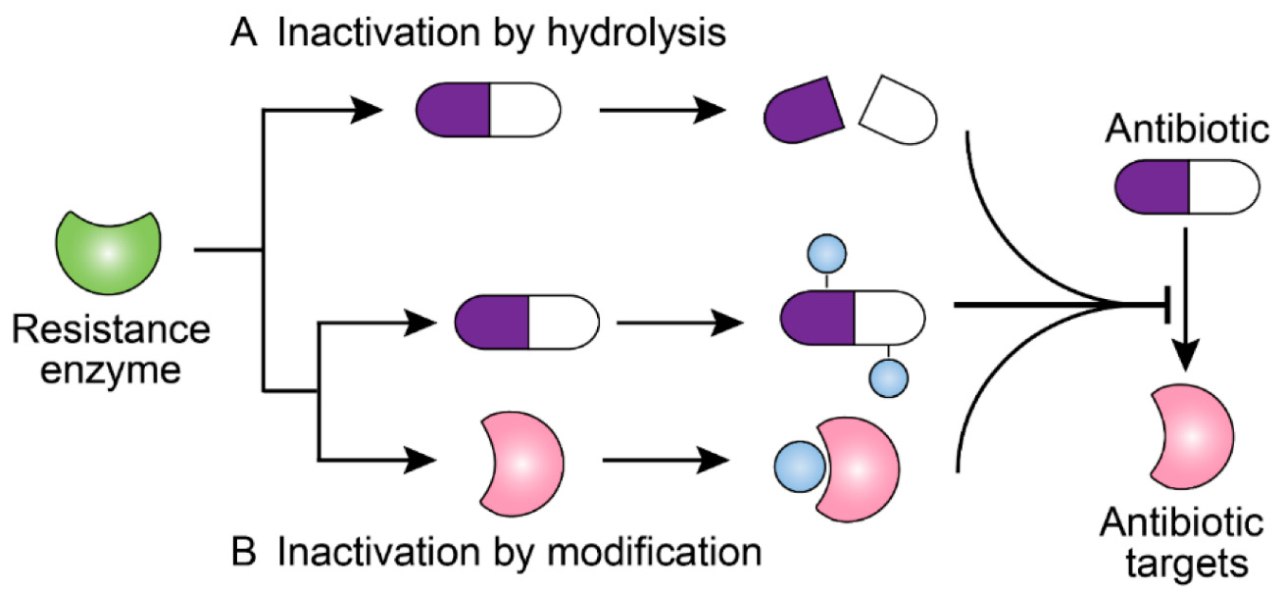
Scheme of antibiotic resistance mechanisms mediated by bacterial resistance enzymes. (A) Resistance enzymes hydrolyze antibiotics, conferring resistance. (B) Resistance enzymes modify the structure of antibiotics or antibiotic targets, preventing the antibiotics from binding to their targets and conferring resistance [49].
Figure 2.
Scheme of antibiotic resistance mechanisms mediated by bacterial resistance enzymes. (A) Resistance enzymes hydrolyze antibiotics, conferring resistance. (B) Resistance enzymes modify the structure of antibiotics or antibiotic targets, preventing the antibiotics from binding to their targets and conferring resistance [49].
4.1.1. Bacterial Hosts and High-Risk Clones
MBL genes are disseminated horizontally across Gram-negative bacilli via mobile genetic elements[50]. These determinants are frequently identified in clinically significant pathogens, including Acinetobacter species, Enterobacterales (e.g., K. pneumoniae, Providencia stuartii), and P .aeruginosa [51,52]. A. baumannii is a prominent reservoir for blaNDM, blaVIM, and blaIMP, often exhibiting drug-resistant phenotypes [57] extensively. Similarly, P. aeruginosa demonstrates high MBL carriage rates, particularly in burn wound and nosocomial infections, further complicating treatment [53].
High-risk clones are specific bacterial lineages, defined by their sequence type (ST), that possess an enhanced capacity for global dissemination and environmental persistence [54). These lineages are primary drivers in the worldwide spread of critical MBL genes and pose a threat that extends beyond clinical settings, with documented persistence in wildlife reservoirs and hospital plumbing systems, where aerosolization can facilitate transmission [55,56].
In P. aeruginosa, the dissemination of MBLs, particularly VIM-type (predominant), IMP, and NDM variants, is largely driven by well-characterized high-risk clones, including ST111, ST233, ST235, ST357, ST654, and ST773 [57]. Similarly, the global spread of carbapenemases such as NDM-1 and KPC-2 in K. pneumoniae is associated with distinct pandemic lineages, most notably ST11, ST147, ST258, ST38, and ST617 [58,59]. In A. baumannii, the acquisition of NDM-type carbapenemases is frequently observed within globally disseminated lineages, including the dominant international clone ST2 (corresponding to ICII), as well as ST85 and ST107 [60]. The clinical challenge posed by these clones is compounded by their carriage of a large repertoire of resistance determinants, which severely limits therapeutic options [60].
4.1.2. Molecular Diversity of MBL-Producing Bacteria
MBL genes pose a significant global public health threat because they encode enzymes that inactivate nearly all β-lactam antibiotics [61]. These genes are often found on plasmids, enabling their rapid spread across various bacterial species [62]. MBL genes can be acquired via mobile genetic elements such as plasmids and integrons, or they may be inherited[35,63,64]. The MBL family encompasses over 10 variants, including Imipenemase (IMP), Seoul imipenemase (SIM), Verona integron-encoded metallo-β-lactamase (VIM), New Delhi metallo-β-lactamase (NDM), São Paulo metallo-β-lactamase (SPM), Serratia metallo-β-lactamase (SMB), Tripoli metallo-β-lactamase (TMB), Germany imipenemase (GIM), Florence imipenemase (FIM), and Dutch imipenemase (DIM), with NDM, VIM, SPM, GIM, SIM, and IMP being the most clinically significant acquired types that contribute substantially to global resistance against broad-spectrum β-lactam antibiotics [51,65].
Globally, the most frequently reported MBL-encoding genes are blaNDM, blaVIM, and blaIMP [51,66]. The geographical distribution of these variants reveals distinct epidemiological patterns: NDM enzymes have shown remarkable global dissemination since their initial identification in 2008, with particularly high prevalence in South Asia and subsequent spread to Europe, North America, and other regions [67,68,69]. VIM variants are predominantly found in Mediterranean countries and have been associated with nosocomial outbreaks [70,71,72]; whilst IMP enzymes were first identified in Japan and have since spread throughout Asia and other continents [73]. Amongst these variants, VIM, SPM, and GIM are rapidly disseminating MBLs located on transferable genetic elements, while IMPs and VIMs are the most prevalent and widely distributed in Pseudomonas, Acinetobacter, and Enterobacteriaceae species [74].

Table 1.
Historical Timeline and Geographic Distribution of MBL Discoveries.
| Type of MBLs | Sub123456class | First isolate | Origin | 1St Discovery | β-LA123456HP | GL(s) | ANO | Refer |
| NDM | B1 | K. pneumoniae | New Delhi, India | 2008 | Broad -S | Plasmid, chromosome | JQ080305 | [44,75] |
| VIM | B1 | P. aeruginosa | Verona, Italy | 1997 | Broad-spectrum | Plasmid, chromosome | GU724868 | [44,75,77,[44,75,77,] |
| IMP | B1 | S. marcescens | Japan | 1991 | Broad-spectrum | Plasmid, chromosome | HM036079 | [43,64,66,69] |
| GIM | B1 | P. aeruginosa | Düsseldorf, Germany | 2002 | Broad-spectrum | Plasmid | JF414726 | [44,75,81] |
| SIM | B1 | A. baumannii | Seoul, South Korea | 2005 | Broad-array 123456Narrow carbapenem | Plasmid, chromosome | GQ288397 | [44,75,78,82] |
| DIM | B1 | P. stutzeri | Netherlands | 2007 | Broad spectrum, | Plasmid | GU323019 | [44,75,83,84] |
| SPM | B1 | P. aeruginosa | São Paulo, Brazil | 1997 | Broad spectrum | Plasmid, chromosome | GU831565 | [44,75,83,85] |
| AIM | B3 | P.aeruginosa | Adelaide, Australia | 2011 | Broad spectrum | Plasmid | AM998375 | [44,75,83,86] |
| BlaB | B1 | C.meningosepticum | - | 1996 | Broad spectrum | Chromosome | AF189298. | [62,89,93,[62,89,93,] |
| CcrA | B1 | B. fragilis | England | 1987 | Broad-spectrum | Chromosome | AB087225 | [62,73,93,94] |
| CphA | B2 | A. hydrophila | Italy | 1995 | Narrow spectrum123456 | Chromosome | AY261378 | (62,93,95,95,96) |
| ImiS | B2 | A. sobria | United Kingdom | 1996 | Narrow spectrum | Chromosome | Y10415 | [62,97,98] |
| ImiH | B2 | A. hydrophila | Italy | 1998 | Narrow spectrum | Chromosome | AJ548797 | [62,98] |
| CAU | B3 | C. crescentus | - | 2004 | Broad spectrum | Chromosome | AJ308331 | [62,93,99,100] |
| FEZ | B3 | L. gormanii | - | 2001 | Broad spectrum | Chromosome | Y17896 | [62,93,101,102] |
| L1, L2 | B3 | S. maltophilia | - | 1982 | Broad spectrum | Chromosome | AJ272109 | [103,104] |
| IND | B1 | B. rium indologenes | India | 2007 | Broad spectrum | Plasmid, chromosome | EF394436 | [81] |
| GOB | B3 | E. meningoseptica | Guadalajara, Spain | 2007 | Broad spectrum | Chromosome | AF090141 | [89,92] |
| DHT2 | B3 | S. maltophilia | Germany | 2016 | Broad spectrum | Chromosome | KU167035 | [62,105] |
| ALG6 | B3 | J. lividum | Algeria | 2016 | Broad-spectrum | Chromosome | KU167038 | [62,105] |
| Sfh-1 | B2 | S. maltophilia | Portugal | 1990s | Narrow spectrum | Chromosome | AF197943 | [62,106] |
| CRD3 | B3 | Erythrobacter | Denmark | 2016 | Narrow spectrum | Chromosome | KU167037 | [105] |
| SLB | B1 | S.maltophilia | Islands | 2005 | Broad spectrum | Chromosome | AY590118 | [35,107] |
| SFB | B1 | S. frigidimarina | Islands | 2005 | Narrow spectrum | Chromosome | AY590119 | [44,62,107] |
| TMB 123456 | B1 | A. xylosoxidans | Tripoli, Libya | 2010 | Broad spectrum | Chromosome | FR771847 | [35,108] |
*NDM: New Delhi Metallo-β-lactamase; ImiH: Imipenem-hydrolyzing enzyme; VIM: Verona Integron-encoded Metallo-β-lactamase; GIM: German Imipenemase; SIM: Seoul Imipenemase; DIM: Dutch Imipenemase; AIM: Adelaide Imipenemase; IND: Integron-associated; GOB: Guadalajara Imipenemase; SPM: São Paulo Metallo-β-lactamase; TMB: Tripoli Metallo-β-lactamase; Ini/Comp: Initial/ complete characterization; CAU: Caucasus Metallo-β-lactamase; β-LAHP: beta lactam antibiotic hydrolysis profile; GL: genetic location; ANO: Accession number.
4.1.3. Antibiotic Resistance Mechanism of MBL-Producing Bacteria
Antimicrobial resistance can be intrinsic, adaptive, or acquired. Intrinsic resistance is naturally present in all members of a species, while adaptive resistance is triggered by antibiotic exposure. Acquired resistance results from gaining resistance genes from other microorganisms [109] . Gram-negative bacteria primarily resist β-lactam antibiotics by producing β-lactamases, enzymes that destroy the compounds [51]. Based on their catalytic mechanism, β-lactamases are classified as either serine-β-lactamases (SBLs) or MBLs. SBLs employ a catalytic serine for a nucleophilic attack, whereas MBLs utilize zinc ions to activate a hydroxide nucleophile. Consequently, SBL-targeting inhibitors are largely ineffective against MBLs [36].
Resistance to β-lactam antibiotics occurs via four main mechanisms: limited drug uptake, modification of the drug target or altered peptidoglycan binding protein (PBP), drug efflux, and drug inactivation. MβLs are enzymes that inactivate a broad range of β-lactam antibiotics, including last-resort carbapenems [110].
Bacteria with outer membranes rely on porin channels for drug uptake. Reducing porin numbers or altering their selectivity through mutations can therefore limit drug entry [111]. Bacteria produce PBPs with reduced affinity for β-lactams, modifying the drug target rather than neutralizing it. For example, Enterococcus species intrinsically resist β-lactams by expressing low-affinity PBPs [36,51]. Resistance can occur through modifications to drug targets, such as altering the structure or number of transpeptidase enzymes [112]. Bacteria use chromosomally encoded efflux pumps to expel toxins. These pumps can be constitutively active, induced, or overexpressed under certain conditions [113]. Drug inactivation by bacteria occurs through: degradation (e.g., by β-lactamases) or modification via the addition of acetyl, phosphoryl, or adenyl groups [113]. MBLs contribute to antibiotic resistance by breaking down carbapenems, penicillins, and cephalosporins. Unlike serine-β-lactamases, they have a distinct structure, active site, and catalytic mechanism. Understanding this mechanism has been difficult, hindering the development of effective inhibitors.
Carbapenem-resistant A. baumannii (CRAB) is increasingly lethal in ICUs worldwide, where few effective therapies remain. A. baumannii overcomes last-line carbapenems through a sophisticated combination of resistance mechanisms, including enzymatic inactivation, decreased drug uptake, active efflux, and membrane alterations. These mechanisms work in concert, creating a formidable barrier to treatment [114]. Deciphering the molecular basis of resistance is critical for guiding the development of new and effective therapies. Resistance to nearly all available antibiotics renders CRAB an urgent threat with high mortality rates [115]. Plasmid-encoded β-lactamase, OXA-23, is the predominant gene responsible for making A. baumannii resistant to carbapenems, largely owing to its location on mobile genetic elements that enable its rapid and widespread dissemination [116,117].
4.2. Global Burden and Regional Disparities of MBL-Producing MDR Bacterial Pathogens
MBLs are a growing public health threat because they inactivate nearly all β-lactam antibiotics, including last-resort carbapenems [48,51]. These enzymes are produced by diverse Gram-negative pathogens such as A. baumannii, P. aeruginosa, and Enterobacterales (e.g., K. pneumoniae and E. coli) [51]. Infections caused by MBL-producing pathogens lead to severe outcomes, such as prolonged hospital and ICU stays and elevated mortality rates (ranging from 0% to 55.3% across studies) [118]. Key risk factors include prior antibiotic use and extended hospitalization[118].
The burden, however, varies significantly by region [45,51]. Global prevalence figures can be misleading, as they mask dramatic regional variations [45]. For instance, while a recent meta-analysis estimated global MBL-producing carbapenem-resistant A. baumannii (CRAB) prevalence at just 5.3%, this low figure is skewed by very low rates in some areas and does not reflect the intense pressure in hotspots [45].
4.2.1. Geographic Disparities in the Burden of MBL-Producing Pathogens
Epidemiological data reveal marked geographic heterogeneity in the distribution of MBL-producing pathogens, with the highest burdens concentrated in specific regions [119,120,121]. Asia is a major hub for MBL epidemiology. One review found that 80% of reports on MBL-producing Acinetobacter originated from Asia [45]. However, a separate study identified more MBL-producing Enterobacterales isolates in Europe, Asia contributed 31.4% of global isolates and was the source of nearly all IMP-type producers (99%) [118]. The pooled prevalence of MBLs in CRAB in South-East Asia is 17.9% [45].
The Eastern Mediterranean and African regions exhibit some of the highest reported prevalence rates of MBL-producing CRAB, estimated at 42.1% and 36.1%, respectively [122]. Country-level analyses, such as those from Nigeria, underscore the contribution of specific determinants, particularly blaVIM to the dissemination of MDR in hospital settings [123]. In Latin America, data from Brazil reveal a high pooled prevalence of MBL genes (44.6%) among K. pneumoniae isolates, with blaNDM identified as the predominant variant. Substantial international variation exists, with the highest prevalence observed in the Southeast region [124]. Regional conference data further corroborate NDM and KPC as the most prevalent [125].
The epidemiological landscape in Europe is complex. Although one study reported the highest absolute count of MBL-producing Enterobacterales isolates (58.0%), this is likely influenced by extensive surveillance and reporting infrastructure [118]. In contrast, the prevalence of MBL-producing CRAB in Europe is estimated at less than 1% [122]. Notably, the region constitutes a hotspot for VIM-type MBL producers[118]. Similar to Europe, MBL prevalence among CRAB isolates in the Americas is estimated at below 1% [122]. However, this figure does not indicate an absence of threat, as evidenced by the distinct challenges posed by MBL-producing organisms in specific settings, such as Brazil [124]. The type of MBL gene also varies geographically, which is critical for diagnostics and treatment [126].
Africa is increasingly recognized as a significant region for the dissemination of MBL-producing pathogens. A 2025 systematic review on MBL-producing Acinetobacter reported that 16.5% of global publications originated from Africa, second only to Asia (80%) [45]. The epidemiology of MBLs in Africa is complex, marked by significant regional variation in the distribution of enzyme types [45]. A multi-country investigation provided valuable data on carbapenemase genes across several African nations [127].
Nigeria exhibits a notably high diversity of MBL genes. Data from 2022 indicate that among carbapenemase-producing isolates, NDM predominated, followed by VIM-types (VIM-2, VIM-5, VIM-44), with IMP and GES-type MBLs also detected [128]. This heterogeneity suggests multiple introductions and a complex evolutionary landscape, posing significant challenges for treatment and control.
North Africa presents a notable epidemiological contrast. While Egypt exhibits a strong predominance of NDM-type MBLs, Morocco and Tunisia demonstrate a higher prevalence of VIM-type enzymes, which often co-circulate with OXA-48-like serine carbapenemases [128,129]. This heterogeneity underscores the role of local epidemiological factors in shaping the establishment and dissemination of specific resistance genes within a region. A study across Burkina Faso, Gabon, Ghana, and Tanzania detected no carbapenem resistance among tested isolates, suggesting carbapenems remain viable options in these settings [130].
In Ethiopia, the first report of carbapenemase-producing bacteria emerged in 2017, involving an NDM-producing A. baumannii isolate [131]. Since then, NDM has become the predominant carbapenemase, frequently detected in K. pneumoniae, A. baumannii, and E. coli. A critical concern is the co-harbouring of multiple carbapenemase genes particularly NDM alongside OXA-type enzymes, which severely constrains treatment options [131].
4.3. Resistance Gene Profiling and Detection Methods
Profiling resistance genes is crucial for surveillance, infection control, and guiding therapy [132]. Antibiotic resistance genes are profiled using phenotypic or genotypic methods [133].One unit of β-lactamase is defined as the amount of enzyme required to hydrolyze 1.0 μmol of nitrocefin per minute at pH 7.0 and 25 °C. Β-Lactamase activity is measured by monitoring the hydrolysis of nitrocefin, a chromogenic cephalosporin substrate widely used for detecting β-lactamase enzymes produced by various microorganisms. The resulting colorimetric product, measured at 490 nm (A₄₉₀), is proportional to the enzymatic activity present [134].
4.3.1. Phenotypic Detection Type
4.3.1.1. Sulfamoyl Heteroarylcarboxylic Acid Inhibitors
MBL-specific sulfamoyl heteroarylcarboxylic acid ( SHCs) inhibitors enabled highly sensitive and specific phenotypic detection of MBL-producing P. aeruginosa and Acinetobacter spp., offering a practical, cost-effective alternative for laboratories lacking molecular tools [135]. These inhibitors selectively bind to the active-site zinc ions of MBLs via their carboxylic acid and sulfamoyl groups, blocking enzyme function. This restores the activity of carbapenems, normally destroyed by MBLs, through a synergistic principle, allowing the co-administered β-lactam antibiotic to exert its lethal effect [136]. As highly specific "rescuing" agents, they neutralize MBL-mediated resistance, with results visualized through standard antimicrobial susceptibility testing[135,136]. SHCs competitively inhibit clinically relevant MBLs (IMP, NDM, VIM) at nanomolar to micromolar levels, restoring meropenem efficacy against most MBL-producing Enterobacteriaceae [135]. X-ray crystallography shows SHCs coordinate to active-site zinc ions via their sulfamoyl and carboxylate groups. With low toxicity and high stability in preclinical models, SHCs represent promising lead compounds for MBL inhibitors to combat CRE [135].
In contrast to SHCs, traditional inhibitors such as ethylenediaminetetraacetic acid (EDTA) are non-selective against MBLs; they inhibit a wide range of zinc-dependent bacterial enzymes and can impede bacterial growth, resulting in false-positive interpretations. Furthermore, EDTA is toxic and chelates calcium and magnesium in agar media, which can distort assay results [137].
4.3.1.2. The Combined Disc Synergy Test
The Combined Disc Synergy Test (CDST) is a straightforward and resource-efficient phenotypic assay routinely employed in clinical microbiology to detect specific antibiotic resistance determinants, most notably extended-spectrum β-lactamases (ESBLs) and MBLs [138]. The fundamental principle of this method is based on the visualization of enzyme inhibition, achieved by placing two antibiotic-impregnated discs in proximity, typically 15 to 20 mm apart, on an agar surface inoculated with the test organism [139]. One disc contains a standard antibiotic, such as ceftazidime, while the other contains the same antibiotic supplemented with a specific enzyme inhibitor, such as clavulanic acid. During incubation, the antibiotics and inhibitors diffuse radially into the medium, establishing overlapping concentration gradients. In the presence of an ESBL-producing isolate, the organism exhibits resistance to the standard antibiotic disc, resulting in a minimal or absent zone of inhibition around that disc. However, within the zone of gradient overlap, the inhibitor (e.g., clavulanic acid) inactivates the ESBL enzyme, thereby permitting the antibiotic to exert its bactericidal effect. This localized neutralization manifests as a discernible expansion or characteristic “keyhole” distortion of the inhibition zone adjacent to the combined disc, visually indicating synergy and confirming the presence of the resistance mechanism.
Growth-based methods, such as the CDST and modified Hodge test (MHT), infer antimicrobial resistance by evaluating bacterial growth in the presence of an antibiotic. In contrast, hydrolysis-based techniques, including matrix-assisted laser desorption ionization–time of flight mass spectrometry (MALDI-TOF MS), directly detect enzymatic carbapenem degradation, while lateral flow immunoassays employ specific antibodies for the immunochromatographic identification of carbapenemase enzymes [140]. The advantage of CDST is its simplicity to perform, requires no specialized automated equipment and incurs low costs, making it well-suited for routine use in resource-limited laboratories [141].
However, as a phenotypic method, it detects the functional effect of resistance, namely enzyme activity, without identifying the specific genetic determinants. Interpretation may be challenging when inhibitor diffusion is suboptimal or when multiple resistance mechanisms coexist, and the test is incapable of detecting all clinically relevant resistance types [141]. The catalytic efficiency of carbapenemases toward carbapenem antibiotics is governed by specific amino acid residues within the active site that mediate key interactions with the β-lactam ring [142,143]. These interactions facilitate the destabilization of the amide bond in the β-lactam ring, promoting its hydrolytic cleavage and thereby rendering the antibiotic therapeutically inactive [144].
4.3.1.3. The Modified Hodge Test (MHT)
The Modified Hodge Test (MHT) is a phenotypic method employed to detect carbapenemase production in Gram-negative bacteria, particularly members of the Enterobacteriaceae family (e.g., E. coli, K. pneumoniae). Carbapenemases are enzymes that hydrolyze carbapenem antibiotics (such as meropenem or imipenem), which are considered last-resort agents for treating infections caused by MDR organisms [145]. The test operates on the principle of synergy through enzymatic inactivation: a test organism producing a carbapenemase releases the enzyme into the agar medium, where it degrades the diffused carbapenem from a centrally placed disk (typically meropenem or the more sensitive ertapenem), thereby permitting the growth of a nearby carbapenem-susceptible indicator strain, a standardized E. coli ATCC 25922 with no intrinsic carbapenemase activity that serves as a biosensor whose growth within the inhibition zone signifies localized antibiotic inactivation [146]. When applied to MBL detection, the same principle applies, with the enzyme hydrolyzing the carbapenem in a zinc-dependent manner (requiring trace zinc ions in the agar as essential cofactors), producing a characteristic cloverleaf indentation within the zone of inhibition [147]. However, the MHT alone cannot distinguish MBLs from serine-based carbapenemases such as KPC or OXA-48, a limitation with direct therapeutic implications, as MBLs render ceftazidime-avibactam ineffective [148,149]. Consequently, while the MHT may successfully identify carbapenemase-producing organisms, accurate MBL-specific detection requires confirmatory methods, including EDTA combination tests, the Carba NP test with EDTA, molecular techniques such as PCR, or immunochromatographic lateral flow assays [148,149].
4.3.1.4. Epsilometer Test (E-Test)
The MBL E-test principle is based on EDTA-mediated chelation of the zinc ions essential for MBL catalytic activity [150,151]. Removal of these metal cofactors irreversibly inactivates the enzyme, preventing carbapenem hydrolysis and resulting in a reduced MIC and restored susceptibility [151,152]. A double-sided plastic strip bearing exponential gradients of a carbapenem. alone on one side and with a fixed EDTA concentration on the other, is applied to an inoculated agar plate [153]. Following incubation, two elliptical inhibition zones develop [150,152]. A ≥3- to 5-fold MIC reduction on the carbapenem+EDTA side relative to the carbapenem-alone side (e.g., imipenem >32 µg/mL vs. imipenem+EDTA 5 µg/mL) denotes a positive MBL result [153]. The lack of a substantial MIC difference suggests alternative resistance mechanisms, including serine carbapenemases or porin loss [151,154].
Despite its utility in routine diagnostics, the E-test has limitations [151,154]. EDTA may increase cell wall permeability, leading to false-positive results independent of MBL activity[151]. Sensitivity and specificity for MBL detection are approximately 94% and 95%, respectively [154]. Therefore, positive results are presumptive and require confirmatory genotypic testing (e.g., PCR for blaIMP, blaVIM, blaNDM) for definitive identification and infection control [151,154].
4.3.1.4. Matrix-Assisted Laser Desorption Ionization–Time of Flight Mass Spectrometry
MALDI-TOF MS is a technique that identifies bacteria and fungi by measuring the mass-to-charge ratio of their proteins [155]. It has revolutionized clinical microbiology by reducing identification time from 24–48 hours to just minutes [156,157]. This technique works through four stages. First, during sample preparation, the microorganism is mixed with a matrix on a metal plate to protect and prepare biomolecules for analysis. Next, in the ionization (MALDI) step, a laser fires at the sample and the matrix absorbs the energy, releasing intact, charged ions from the biomolecules. Then, during acceleration and separation (TOF), the ions are accelerated into a flight tube, where lighter ions travel faster and reach the detector first, separating them by mass. Finally, for detection and analysis, the detector records arrival times to generate a unique spectral fingerprint, which is matched against a database to identify the organism [155,156,157].
MALDI-TOF MS generates a mass spectrum from ion arrival times and abundances, producing a unique proteomic fingerprint, dominated by ribosomal proteins, that is matched against reference databases for rapid organism identification, making it a clinical standard [158,159]. Beyond identification, modified sample preparation enables functional assays to detect antimicrobial resistance. For MBL detection, the platform assesses carbapenem hydrolysis with results in 2.5–4 hours [159]. The direct-on-target microdroplet growth assay (DOT-MGA) evaluates bacterial growth in the presence of a carbapenem and EDTA, a zinc chelator that specifically inhibits MBLs. Growth with carbapenem alone indicates resistance; growth inhibition upon EDTA addition confirms MBL-mediated resistance. This approach enables rapid, accurate MBL detection through both hydrolysis-based and inhibitor-based methodologies [158].
4.3.2. Genotypic Detection Type
Phenotypic assays are inherently variable, with results influenced by inoculum density, culture medium composition (e.g., zinc concentration affecting MBL activity), EDTA concentration and diffusion, incubation parameters, and subjective interpretation of inhibition zones [160,161]. Genotypic methods overcome these limitations by providing standardized, objective results (gene presence or absence), high inter-laboratory reproducibility when using validated protocols, archivable data (e.g., DNA sequences, amplicons) amenable to retrospective re-analysis, and digital data formats compatible with large-scale databases and bioinformatic pipelines[162,163]. Rapid genotypic methods facilitate same-day MBL gene detection, enabling early targeted therapy, avoiding ineffective carbapenems and ceftazidime-avibactam, prompt implementation of infection control measures (e.g., isolation, contact precautions), and reduced broad-spectrum antibiotic exposure, thereby minimizing collateral damage to the microbiome [164,165,166]. Rapid genotypic confirmation, via lateral flow immunoassays or multiplex PCR, enables definitive gene identification and expedites clinical intervention [167,168]. In contrast, comprehensive genotypic characterization using WGS supports epidemiological surveillance, outbreak investigations, and translational research [169,170].
Table 2.
Comparative summary of phenotypic versus genotypic detection methods for MBLs. Phenotypic methods detect MBL activity as a family but cannot distinguish specific enzyme types (e.g., NDM vs. VIM), require pure culture, and are subject to variability in sensitivity and interpretation. Genotypic methods enable specific gene and allele identification, simultaneous detection of co-resistance genes, assessment of transmission potential via plasmid typing, faster turnaround times (15 minutes to 5 hours), direct application to clinical specimens, and the ability to discover novel genes through WGS and metagenomics, though they require molecular biology expertise and bioinformatics support for WGS analysis.
Table 2.
Comparative summary of phenotypic versus genotypic detection methods for MBLs. Phenotypic methods detect MBL activity as a family but cannot distinguish specific enzyme types (e.g., NDM vs. VIM), require pure culture, and are subject to variability in sensitivity and interpretation. Genotypic methods enable specific gene and allele identification, simultaneous detection of co-resistance genes, assessment of transmission potential via plasmid typing, faster turnaround times (15 minutes to 5 hours), direct application to clinical specimens, and the ability to discover novel genes through WGS and metagenomics, though they require molecular biology expertise and bioinformatics support for WGS analysis.
| Parameter | Phenotypic Detection | Genotypic Detection |
| Specificity | MBL family only (cannot distinguish NDM vs. VIM) | Specific gene family and allele |
| Sensitivity | Affected by expression level; false negatives possible | Affected by expression level; false negatives possible |
| Co-resistance | Requires separate testing for each drug | Simultaneous detection of all resistance genes |
| Transmission potential | Cannot determine | Reveals plasmid type and genetic context |
| Time to result (post-culture) | 16–48 hours | 15 minutes to 5 hours (rapid methods) |
| Culture requirement | Requires pure, viable isolate | Can be performed directly on specimens |
| Novel gene discovery | Not possible | Possible via WGS and metagenomics |
| Data reproducibility | Variable; subjective interpretation | Highly standardized; digital data |
| Expertise required | Basic microbiology training | Molecular biology skills; bioinformatics for WGS |
4.4. Risk Factors and Urgent Challenges for MBLs-Producing MDR Bacteria
4.4.1. MBL: Silent Pandemic Intensifiers
Metallo-β-lactamases (MBLs) are zinc-dependent enzymes that hydrolyse nearly all β-lactam antibiotics, including carbapenems, the last line of defence [171]. Unlike serine-β-lactamases, MBLs evade all clinically available inhibitors, from clavulanic acid to the newer avibactam and relebactam [109]. The most clinically significant MBLs, IMP, VIM, and NDM, thrive in multidrug-resistant Enterobacterales, Pseudomonas aeruginosa, and Acinetobacter baumannii, driving extremely drug-resistant (XDR) and pan-drug-resistant (PDR) phenotypes [172,173]. The following sections detail the risk factors for acquisition and infection, alongside the urgent challenges in detection, treatment, and containment.
4.4.2. Risk Factors for Acquisition and Infection
4.4.2.1. Host-Specific Risk Factors
The burden of MBL-MDR infections falls disproportionately on patients with significant medical comorbidities and extensive healthcare exposure[174]. Immunosuppressed individuals, such as those with hematological malignancies, solid organ transplants, or undergoing chemotherapy, face heightened risk due to compromised innate immunity, the primary defence against Gram-negative bacteria [175]. Similarly, patients undergoing major surgery (particularly abdominal or liver transplantation) or sustaining severe trauma, including blast injuries, are highly susceptible, with MBL-producing Pseudomonas and Acinetobacter frequently causing surgical site infections, ventilator-associated pneumonia, and osteomyelitis [176,177]. Intensive care units serve as amplifiers of resistance, where high antibiotic selective pressure, invasive devices, and high patient acuity converge to facilitate MBL acquisition [178]. Indwelling medical devices, such as endotracheal tubes, central venous catheters, and urinary catheters, further compound risk by bypassing anatomical barriers and providing surfaces for biofilm formation, within which MBL-producing bacteria are shielded from both antibiotics and host immunity [179]. Prior antimicrobial use, especially carbapenems like meropenem, is a strong, dose-dependent risk factor that eliminates susceptible flora and enables MBL-producing organisms to thrive; broad-spectrum cephalosporins and fluoroquinolones also play a major role [180,181].
4.4.2.1. Epidemiological and Transmission Risk Factors
Beyond individual patient factors, broader epidemiological and environmental elements play a critical role in the spread of MBL-producing organisms [182]. Healthcare tourism has been a major driver of global dissemination, particularly for NDM, as patients receiving medical care in high-endemicity regions, such as the Indian subcontinent for NDM, or the Mediterranean and Latin America for VIM and KPC, frequently import these resistant organisms into low-prevalence countries [183]. Long-term care facilities serve as additional reservoirs, where patients with chronic wounds, indwelling catheters, and repeated antibiotic courses facilitate silent intestinal colonization with MBL-producing bacteria [179]. Compounding the issue, MBLs differ from serine carbapenemases by persisting in environmental reservoirs, such as drinking water, sewage, and agricultural soil in high-burden countries, highlighting a complex ecology where the environment serves as a lasting source of resistance [36,51].
4.5. Urgent Challenges
The management of MBL-MDR bacteria is hampered by a triad of challenges: detection, treatment, and prevention [46,184].
4.5.1. Diagnostic Blind Spots
Early identification of MBL producers is essential for reducing mortality, but current diagnostics fall short [185]. Phenotypic ambiguity in automated susceptibility testing can misclassify MBL producers as carbapenem-susceptible, leading to inappropriate therapy and higher mortality [186]. Compounding this, most laboratories report "Carbapenem-Resistant Enterobacterales" without distinguishing serine carbapenemases (e.g., KPC) from MBLs (e.g., NDM, VIM, and IMP), a critical distinction, as serine enzymes respond to ceftazidime-avibactam while MBLs do not [187]. Further complexity arises from MBL genes residing on mobile genetic elements that carry additional resistance determinants, alongside the emerging threat of co-production with other carbapenemases (e.g., NDM + OXA-48), rendering nearly all β-lactams inactive and evading standard PCR detection [118,188].
4.5.2. The Therapeutic Vacuum
No FDA-approved β-lactamase inhibitors currently target MBLs, forcing clinicians to rely on salvage therapy regimens with limited supporting data [189].Cefiderocol is a promising siderophore cephalosporin that leverages bacterial iron uptake to reach high periplasmic concentrations, but its use is limited by heteroresistance, high cost, and poor availability. Aztreonam combined with ceftazidime-avibactam is an off-label, unvalidated option requiring specialist oversight, while colistin has been relegated to last-line use due to nephrotoxicity, mobile colistin resistance-1(mcr-1), and poor lung penetration. Similarly, Tigecycline is effective for intra-abdominal infections but has poor serum and urine penetration, limiting its use in bacteremia or UTIs [190,191].
4.5.3. Infection Prevention and Decolonization
The gut serves as the primary reservoir for MBL-producing Enterobacterales, with colonized patients remaining asymptomatic while facilitating horizontal gene transfer to commensals and risking future autoinfection. A major challenge is the lack of reliable decolonization strategies; faecal microbiota transplantation remains experimental, and selective digestive decontamination risks selecting for higher resistance. Compounding this, MBL genes often reside on plasmids that confer tolerance to heavy metals and disinfectants such as quaternary ammonium compounds, enabling these bacteria to survive routine hospital disinfection and persist in sinks, drains, and medical equipment.
4.6. Future Directions and Mitigation Strategies
Addressing these challenges requires a multifaceted approach. Rapid diagnostics are essential, with molecular point-of-care testing, such as multiplex PCR directly from blood cultures, needed to distinguish MBLs from serine carbapenemases, moving labs from reporting "CRE" to identifying specific enzymes like NDM or VIM within hours. Novel therapeutics are emerging, including xerubactam, a diazabicyclooctane in development that inhibits both serine enzymes and MBLs, potentially offering a single-agent solution when combined with aztreonam; QPX9003, a siderophore cephalosporin with enhanced activity against MBL-producing Pseudomonas aeruginosa; and zinc chelators like disulfiram, explored as adjunctive therapy to disable MBL active sites. Strict antimicrobial stewardship must enforce carbapenem-sparing regimens and rapid de-escalation protocols to curb MBL selection. Finally, enhanced infection control, including screening high-risk patients and implementing contact precautions, is critical to preventing intra-hospital spread of MBL plasmids.
4.7. Combating the Global Threat of MBL-Producing Bacteria: From Surveillance to Novel Therapeutic Approaches
MBL-producing bacteria are globally widespread and highly diverse, with numerous variants and mobile resistance genes driving multidrug resistance in major pathogens [192]. Their transmission across continents and healthcare settings is often linked to prior antibiotic use and healthcare exposure[51,193]. Molecular surveillance reveals complex genetic backgrounds, frequent co-carriage of resistance genes, and high-risk clones enabling rapid dissemination [194]. This evolving threat demands continuous global monitoring, robust infection control, and new therapies [195].
To address MBL-mediated resistance, several strategies are emerging: The first strategy is the development of novel therapeutic approaches that include β-Lactam/β-Lactamase Inhibitor Combinations, contemporary drug discovery initiatives, and alternative antimicrobial classes [196,197]. The development of next-generation β-lactam/β-lactamase inhibitor (BL/BLI) combinations is a pivotal therapeutic advancement in combating MBL-mediated resistance [198]. These innovative formulations employ synergistic mechanisms that restore the antimicrobial activity of β-lactam antibiotics against MBL-producing pathogens through competitive or non-competitive inhibition of enzymatic activity [199,200]. A contemporary drug discovery initiative that focuses on structure-activity relationship studies and rational drug design approaches tailored to specific MBL subtypes (NDM, VIM, IMP variants) and the development of non-β-lactam antimicrobial agents that circumvent the MBL-mediated resistance mechanisms entirely are the comprehensive strategies that can be used to tackle MBL-mediated resistance [201,202]. Precision Medicine and Diagnostic innovation including rapid diagnostic technologies to implement advanced diagnostic platforms that enable the real-time MBL detection in clinical settings, simultaneous detection and characterization of multiple resistance determinants and rapid determination of antimicrobial susceptibility profiles are essential for the targeted antimicrobial therapy [16,152,203,204].
In general, global Surveillance enhancement; evidence-based infection prevention and control strategies; systematic deployment of antimicrobial stewardship initiatives; sustained funding for translational research; capacity building in resource-constrained settings; and international collaborative framework among governmental agencies, healthcare institutions, academic research centers, and pharmaceutical industry stakeholders are a comprehensive resistance mitigation framework to address the complex challenges posed by MBL-producing pathogens.
Conclusion
This seminar underscores that Metallo-β-lactamase-producing multidrug-resistant bacteria represent one of the most urgent global health threats. These pathogens, particularly E. coli, K. pneumoniae, P. aeruginosa, and A. baumannii, inactivate last-resort carbapenem antibiotics, leaving a critical therapeutic vacuum. The rapid global spread of MBL genes, such as blaNDM, blaVIM, and blaIMP, is driven by their location on mobile genetic elements and their association with high-risk clones that persist in healthcare settings, particularly ICUs.
The review highlights significant geographic disparities in MBL prevalence, with hotspots in Asia, the Eastern Mediterranean, and Africa, alongside complex regional epidemiology. Diagnostic challenges remain a major obstacle, as phenotypic methods often fail to distinguish MBLs from serine carbapenemases, leading to ineffective treatment with inhibitors like avibactam. This is compounded by a severe lack of FDA-approved MBL-targeting therapies, forcing clinicians to rely on salvage regimens with limited efficacy.
To combat this escalating crisis, the review calls for an urgent, multi-pronged strategy. This includes strengthening global surveillance with advanced tools like whole-genome sequencing, implementing robust infection prevention and control measures, and enforcing antimicrobial stewardship programs to curb unnecessary antibiotic use. The development of novel diagnostics and new therapeutics, such as next-generation β-lactamase inhibitors, is critical to closing the treatment gap and mitigating the devastating impact of MBL-mediated antimicrobial resistance.
Abbreviation
AMR: Antimicrobial resistance
BLI: β-lactam/β-lactamase inhibitor
CDST: Combined Disc Synergy Test
CRE: Carbapenem-resistant Enterobacteriaceae
CRAB: Carbapenem-resistant Acinetobacter baumannii
DIM: Dutch imipenemase
DOT-MGA: Direct-on-target microdroplet growth assay
EDTA: Ethylenediaminetetraacetic acid
ESBLs: Extended-spectrum β-lactamases
ETest: Epsilometer Test
FDA: Food and Drug Administration
FIM: Florence imipenemase
GIM: Germany imipenemase
ICUs: Intensive care units
IMP: Imipenemase
MALDI-TOF MS: Matrix-assisted laser desorption ionization–time of flight mass spectrometry
MBL: Metallo-β-lactamase
MHT: Modified Hodge test
NDM: New Delhi metallo-β-lactamase
PBP: Penicillin-binding protein (or peptidoglycan-binding protein)
PCR: Polymerase chain reaction
SBLs: Serine-β-lactamases
SHCs: Sulfamoyl heteroarylcarboxylic acids
SIM: Seoul imipenemase
SMB: Serratia metallo-β-lactamase
SPM: São Paulo metallo-β-lactamase
TMB: Tripoli metallo-β-lactamase
VIM: Verona integron-encoded metallo-β-lactamase
WGS: Whole-genome sequencing
References
- Sartorius B, Gray AP, Davis Weaver N, Robles Aguilar G, Swetschinski LR, Ikuta KS, et al. The burden of bacterial antimicrobial resistance in the WHO African region in 2019: a cross-country systematic analysis. Lancet Glob Heal. 2024;12(2):e201–16.
- Oliveira M, Antunes W, Mota S, Madureira-Carvalho Á, Dinis-Oliveira RJ, Dias da Silva D. An Overview of the Recent Advances in Antimicrobial Resistance. Microorganisms. 2024;12(9):1–50.
- Simmons BP, Larson EL. Multiple drug resistant organisms in healthcare: the failure of contact precautions. J Infect Prev. 2015;16(4):178–81.
- Munita JM, Arias CA. Mechanisms of antibiotic resistance. Virulence Mech Bact Pathog. 2016;(6):481–511.
- Belay WY, Getachew M, Tegegne BA, Teffera ZH, Dagne A, Zeleke TK, et al. Mechanism of antibacterial resistance, strategies and next-generation antimicrobials to contain antimicrobial resistance: a review. Front Pharmacol. 2024;15(August):1–26.
- Muteeb G, Rehman MT, Shahwan M, Aatif M. Origin of Antibiotics and Antibiotic Resistance, and Their Impacts on Drug Development: A Narrative Review. Pharmaceuticals. 2023;16(11):1–54.
- Tanwar J, Das S, Fatima Z, Hameed S. Multidrug resistance: An emerging crisis. Interdiscip Perspect Infect Dis. 2014;2014.
- Sharma S, Chauhan A, Ranjan A, Mathkor DM, Haque S, Ramniwas S, et al. Emerging challenges in antimicrobial resistance: implications for pathogenic microorganisms, novel antibiotics, and their impact on sustainability. Front Microbiol. 2024;15(April):1–17.
- C Reygaert W. An overview of the antimicrobial resistance mechanisms of bacteria. AIMS Microbiol. 2018;4(3):482–501.
- Prevention C for DC and. Antibiotic resistance threats in the United States 2019. Cdc. 2019;148.
- Drug-Resistant Infections. Drug-Resistant Infect. 2017;(March).
- Murray CJ, Ikuta KS, Sharara F, Swetschinski L, Robles Aguilar G, Gray A, et al. Global burden of bacterial antimicrobial resistance in 2019: a systematic analysis. Lancet. 2022;399(10325):629–55.
- Lin J, Nishino K, Roberts MC, Tolmasky M, Aminov RI, Zhang L. Mechanisms of antibiotic resistance. Front Microbiol. 2015;6(FEB):2013–5.
- Sandner-Miranda L, Vinuesa P, Cravioto A, Morales-Espinosa R. The genomic basis of intrinsic and acquired antibiotic resistance in the genus Serratia. Front Microbiol. 2018;9(MAY):1–16.
- Blair JMA, Webber MA, Baylay AJ, Ogbolu DO, Piddock LJV. Molecular mechanisms of antibiotic resistance. Nat Rev Microbiol. 2015;13(1):42–51.
- Khan RT, Sharma V, Khan SS, Rasool S, Rai AK, Rustagi S, et al. Prevention and potential remedies for antibiotic resistance: Current research and future challenges. 2024;(October).
- Mutuku C, Gazdag Z, Melegh S. Occurrence of antibiotics and bacterial resistance genes in wastewater: resistance mechanisms and antimicrobial resistance control approaches. World J Microbiol Biotechnol [Internet]. 2022;38(9):1–27. Available from: . [CrossRef]
- Fajardo A, Martínez-Martín N, Mercadillo M, Galán JC, Ghysels B, Matthijs S, et al. The neglected intrinsic resistome of bacterial pathogens. PLoS One. 2008;3(2):1–6.
- in brief Spreading out of the lung. 2022;20(december):41586.
- Sauer K, Stoodley P, Goeres DM, Hall-Stoodley L, Burmølle M, Stewart PS, et al. The biofilm life cycle: expanding the conceptual model of biofilm formation. Nat Rev Microbiol. 2022;20(10):608–20.
- Centers for Disease Control and Prevention. Antimicrobial Resistance Threats in the United States, 2021-2022. 2022;2021–2. Available from: https://www.cdc.gov/antimicrobial-resistance/data-research/threats/update-2022.html.
- Tooke CL, Hinchliffe P, Bragginton EC, Colenso CK, Hirvonen VHA, Takebayashi Y, et al. β-Lactamases and β-Lactamase Inhibitors in the 21st Century. J Mol Biol [Internet]. 2019;431(18):3472–500. Available from: . [CrossRef]
- Arer V, Kar D. Biochemical exploration of β-lactamase inhibitors. Front Genet. 2023;13(January):1–15.
- Turner J, Muraoka A, Bedenbaugh M, Childress B, Pernot L, Wiencek M, et al. The Chemical Relationship Among Beta-Lactam Antibiotics and Potential Impacts on Reactivity and Decomposition. Front Microbiol. 2022;13(March):1–18.
- Lohans CT. Medicinal Chemistry β -Lactam antibiotic targets and resistance substrates. Medchemcomm [Internet]. 2021;12:1623–39. Available from: http://dx.doi.org/10.1039/D1MD00200G.
- Naas T, Oueslati S, Bonnin RA, Dabos ML, Zavala A, Dortet L, et al. Beta-lactamase database (BLDB)–structure and function. J Enzyme Inhib Med Chem. 2017;32(1):917–9.
- Bush K, Bradford PA. b -Lactams and b -Lactamase Inhibitors: An Overview. 2016;(Table 1).
- Öztürk H, Ozkirimli E, Özgür A. Classification of beta-lactamases and Penicillin Binding Proteins using ligand-centric network models. PLoS One. 2015;10(2):1–23.
- Bush K, Jacoby GA. MINIREVIEW Updated Functional Classification of  -Lactamases ᰔ. 2010;54(3):969–76.
- Pandey D, Singhal N, Kumar M. β-LacFamPred: An online tool for prediction and classification of β-lactamase class, subclass, and family. Front Microbiol. 2023;13(January):1–12.
- Philippon A, Slama P, Dény P, Labia R. A structure-based classification of class A β-Lactamases, a broadly diverse family of enzymes. Clin Microbiol Rev. 2016;29(1):29–57.
- Bush K, Jacoby GA, Medeiros AA. MINIREVIEW A Functional Classification Scheme for  -Lactamases and Its Correlation with Molecular Structure. 1995;39(6):1211–33.
- Bush K, Jacoby GA, Medeiros AA. A functional classification scheme for β-lactamases and its correlation with molecular structure. Antimicrob Agents Chemother. 1995;39(6):1211–33.
- Tehrani KHME, Martin NI. Β-Lactam/Β-Lactamase Inhibitor Combinations: an Update. Medchemcomm. 2018;9(9):1439–56.
- Hall BG, Barlow M. Revised Ambler classification of β-lactamases [1]. J Antimicrob Chemother. 2005;55(6):1050–1.
- Bahr G, González LJ, Vila AJ. Metallo-β-lactamases in the Age of Multidrug Resistance: From Structure and Mechanism to Evolution, Dissemination, and Inhibitor Design. Chem Rev. 2021;121(13):7957–8094.
- Farley AJM, Ermolovich Y, Calvopiña K, Rabe P, Panduwawala T, Brem J, et al. Structural Basis of Metallo-β-lactamase Inhibition by N-Sulfamoylpyrrole-2-carboxylates. ACS Infect Dis. 2021;7(6):1809–17.
- Drusin SI, Le Terrier C, Poirel L, Bonomo RA, Vila AJ, Moreno DM. Structural basis of metallo-β-lactamase resistance to taniborbactam. Antimicrob Agents Chemother. 2024;68(2).
- Boattini M, Gaibani P, Comini S, Costa C, Cavallo R, Broccolo F, et al. In vitro activity and resistance mechanisms of novel antimicrobial agents against metallo-β-lactamase producers. Eur J Clin Microbiol Infect Dis [Internet]. 2025;44(5):1041–68. Available from: . [CrossRef]
- Bahr G, González LJ, Vila AJ. Metallo-β-lactamases and a tug-of-war for the available zinc at the host–pathogen interface. Curr Opin Chem Biol. 2022;66:1–15.
- Krco S, Davis SJ, Joshi P, Wilson LA, Monteiro Pedroso M, Douw A, et al. Structure, function, and evolution of metallo-β-lactamases from the B3 subgroup—emerging targets to combat antibiotic resistance. Front Chem. 2023;11(June):1–9.
- F. Mojica M, A. Bonomo R, Fast W. B1-Metallo-β-Lactamases: Where Do We Stand? Curr Drug Targets. 2015;17(9):1029–50.
- Parajuli NP, Acharya SP, Mishra SK, Parajuli K, Rijal BP, Pokhrel BM. High burden of antimicrobial resistance among gram negative bacteria causing healthcare associated infections in a critical care unit of Nepal. Antimicrob Resist Infect Control. 2017;6(1):1–9.
- Boyd SE, Livermore DM, Hooper DC, Hope WW. crossm Treatment Options , and the Development Pipeline. 2020;(September):1–20.
- Falagas ME, Kontogiannis DS, Zidrou M, Filippou C, Tansarli GS. Global Epidemiology and Antimicrobial Resistance of Metallo-β-Lactamase (MBL)-Producing Acinetobacter Clinical Isolates: A Systematic Review. Pathogens. 2025;14(6):557.
- Hidalgo-Tenorio C, Bou G, Oliver A, Rodríguez-Aguirregabiria M, Salavert M, Martínez-Martínez L. The Challenge of Treating Infections Caused by Metallo-β-Lactamase–Producing Gram-Negative Bacteria: A Narrative Review. Drugs [Internet]. 2024;84(12):1519–39. Available from: . [CrossRef]
- Hatami H, Motamedi S. Investigating the validity of mCIM and sCIM phenotypic methods in screening Pseudomonas aeruginosa isolates producing IMP , VIM , and NDM metallo-beta-lactamases isolated from burn wounds. J Antibiot (Tokyo) [Internet]. 2025;256–64. Available from: http://dx.doi.org/10.1038/s41429-025-00806-x.
- Tiseo G, Stefani S, Fasano FR, Falcone M. The burden of infections caused by Metallo-Beta-Lactamase- Producing Enterobacterales in Italy : epidemiology , outcomes , and management. 2025;249–60.
- Liu Y, Li R, Xiao X, Wang Z. Molecules that Inhibit Bacterial Resistance Enzymes. 2019;
- Cross BJ, Partridge SR, Sheppard AE. Impacts of mobile genetic elements on antimicrobial resistance genes in gram-negative pathogens : Current insights and genomic approaches. 2026;302.
- Boyd SE, Livermore DM, Hooper DC, Hope WW. Metallo-β-lactamases: Structure, function, epidemiology, treatment options, and the development pipeline. Antimicrob Agents Chemother. 2020;64(10):1–20.
- Acman M, Wang R, Dorp L Van, Shaw LP, Wang Q, Luhmann N, et al. Role of mobile genetic elements in the global dissemination of the carbapenem resistance gene blaNDM. 2022;1–13.
- Reynolds D, Kollef M. The Epidemiology and Pathogenesis and Treatment of Pseudomonas aeruginosa Infections : An Update. Drugs [Internet]. 2021;81(18):2117–31. Available from: . [CrossRef]
- The Role of International ‘ High-Risk Clones ’ in the Emergence of Metallo-β-Lactamase-Producing Pseudomonas aeruginosa in the UK A thesis submitted in fulfilment of the requirements for the degree of Doctor of Philosophy University of East Anglia Norwich Medical School. 2015;
- Sellera FP, Farias D, Monte M, Pedro J, Furlan R, Sacramento AG, et al. Multimetal tolerance in high - risk clones of KPC - 2 - and CTX - M - producing Enterobacterales isolated from Atlantic blue crabs in an anthropogenically contaminated estuarine environment. Environ Sci Pollut Res [Internet]. 2025;32(41):23707–16. Available from: . [CrossRef]
- Santonato D, Disease I, Biochemist IM, Biochemist AQ, Biochemist RS, Novau A, et al. Investigation of an outbreak of metallo- β -lactamase producing Pseudomonas aeruginosa linked to the water distribution system in a Hematopoietic Stem Cell Transplantation Unit. 2024;1–6.
- Flores-vega R, Partida-sanchez S, Ares MA, Ortiz-navarrete V, Rosales-reyes R. Heliyon High-risk Pseudomonas aeruginosa clones harboring β -lactamases : 2024 update Ver o. 2025;11(December 2024).
- Pilato V Di, Angelis LH De, Aiezza N, Baccani I, Niccolai C, Parisio EM, et al. Articles Resistome and virulome accretion in an NDM-1-producing ST147 sublineage of Klebsiella pneumoniae associated with an outbreak in Tuscany , Italy : a genotypic and phenotypic characterisation. The Lancet Microbe [Internet]. 2022;3(3):e224–34. Available from: http://dx.doi.org/10.1016/S2666-5247(21)00268-8.
- Aja-macaya P, Blanco-martín T, Mateo-león C, Rosario-quintana C, Piña C, Cruz-tabares E De, et al. Emergence of New Delhi Klebsiella pneumoniae Sequence Type 147 Clone in Spain and Outbreak in the Canary Islands. 2026;32(1):63–73.
- Surveillance E. Rapid investigation of New Delhi metallo-beta- lactamase ( NDM ) -1-producing Providencia stuartii in hospitals in Romania Methods Study design. 2024;(November).
- Phelan EK, Miraula M, Selleck C, Ollis DL, Schenk G, Mitić N. Metallo-β-Lactamases: A Major Threat to Human Health. Am J Mol Biol. 2014;04(03):89–104.
- Effective C. crossm. 2017;
- Rossolini GM. Acquired metallo-β-lactamases: An increasing clinical threat. Clin Infect Dis. 2005;41(11):1557–8.
- Omer KA, Arif SK, Othman HE. Molecular Detection of MBL Encoding Genes Among Carbapenemase-Producing Pseudomonas Aeruginosa Isolated from Sulaimaniyah Hospitals. Bahrain Med Bull. 2024;46(2):2007–10.
- Pollini S, Maradei S, Pecile P, Olivo G, Luzzaro F, Docquier JD, et al. FIM-1, a new acquired metallo-β-lactamase from a Pseudomonas aeruginosa clinical isolate from Italy. Antimicrob Agents Chemother. 2013;57(1):410–6.
- Sadeghi H, Khanjani S, Aslanimehr M, Aria N, Reza M, Farhad M. Encoding Genes of Metallo β - Lactamases ( IMP , NDM , and VIM ) in Klebsiella Pneumoniae in Iran : A Systematic Review and Meta - Analysis. 2025;1–14.
- Settings HC, Wu W. crossm NDM Metallo-  -Lactamases and Their Bacterial Producers in. 2019;23.
- Bi R, Kong Z, Qian H, Jiang F, Kang H, Gu B, et al. High Prevalence of blaNDM Variants Among Carbapenem-Resistant Escherichia coli in Northern Jiangsu Province, China. Front Microbiol. 2018;9(NOV).
- Findlay J, Poirel L, Kessler J, Kronenberg A, Nordmann P. New delhi metallo-β-lactamase- producing enterobacterales bacteria, Switzerland, 2019-2020. Emerg Infect Dis. 2021;27(10):2628–37.
- Siarkou VI, Vitti D, Protonotariou E, Ikonomidis A, Sofianou D. Molecular epidemiology of outbreak-related pseudomonas aeruginosa strains carrying the novel variant blaVIM-17 metallo-β-lactamase gene. Antimicrob Agents Chemother. 2009;53(4):1325–30.
- Cantón R, Akóva M, Carmeli Y, Giske CG, Glupczynski Y, Gniadkowski M, et al. Rapid evolution and spread of carbapenemases among Enterobacteriaceae in Europe. Clin Microbiol Infect. 2012;18(5):413–31.
- Robin F, Aggoune-Khinache N, Delmas J, Naim M, Bonnet R. Novel VIM metallo-β-lactamase variant from clinical isolates of Enterobacteriaceae from Algeria. Antimicrob Agents Chemother. 2010;54(1):466–70.
- Bobo LD, Dawson MC. The Quiet Before the Storm. Du Bois Rev. 2005;2(1):1–4.
- Queenan AM, Bush K. Carbapenemases : the Versatile  -Lactamases. 2007;20(3):440–58.
- Meropenem P, Davies DT, Leiris S, Zalacain M, Morrissey I, Magnet S, et al. crossm Discovery of a Novel Metallo-  -Lactamase Inhibitor That Resistant Enterobacteriaceae. 2018;
- Lauretti L, Riccio ML, Mazzariol A, Cornaglia G, Amicosante G, Fontana R, et al. Cloning and characterization of bla(VIM), a new integron-borne metallo- β-lactamase gene from a Pseudomonas aeruginosa clinical isolate. Antimicrob Agents Chemother. 1999;43(7):1584–90.
- Matthew Biancalana and Shohei Koide. 基因的改变NIH Public Access. Bone [Internet]. 2011;23(1):1–7. Available from: https://www.ncbi.nlm.nih.gov/pmc/articles/PMC3624763/pdf/nihms412728.pdf.
- Meini MR, Llarrull LI, Vila AJ. Evolution of metallo-β-lactamases: Trends revealed by natural diversity and in vitro evolution. Antibiotics. 2014;3(3):285–316.
- Osano E, Arakawa Y, Wacharotayankun R, Ohta M, Horii T, Ito H, et al. Molecular characterization of an enterobacterial metallo β-lactamase found in a clinical isolate of Serratia marcescens that shows imipenem resistance. Antimicrob Agents Chemother. 1994;38(1):71–8.
- Manuscript A. NIH Public Access. 2010;39(8):895–901.
- Castanheira M, Toleman MA, Jones RN, Schmidt FJ, Walsh TR. Molecular characterization of a β-lactamase gene, blaGIM.1, encoding a new subclass of metallo-β-lactamase. Antimicrob Agents Chemother. 2004;48(12):4654–61.
- Lee K, Yum JH, Yong D, Lee HM, Kim HD, Docquier JD, et al. Novel acquired metallo-β-lactamase gene, blaSIM-1, in a class 1 integron from Acinetobacter baumannii clinical isolates from Korea. Antimicrob Agents Chemother. 2005;49(11):4485–91.
- López C, Delmonti J, Bonomo RA, Vila AJ. Deciphering the evolution of metallo-β-lactamases: A journey from the test tube to the bacterial periplasm. J Biol Chem [Internet]. 2022;298(3):101665. Available from: . [CrossRef]
- Poirel L, Rodríguez-Martínez JM, Al Naiemi N, Debets-Ossenkopp YJ, Nordmann P. Characterization of DIM-1, an integron-encoded metallo-β-lactamase from a Pseudomonas stutzeri clinical isolate in the Netherlands. Antimicrob Agents Chemother. 2010;54(6):2420–4.
- Gales AC, Menezes LC, Silbert S, Sader HS. Dissemination in distinct Brazilian regions of an epidemic carbapenem-resistant Pseudomonas aeruginosa producing SPM metallo-β-lactamase. J Antimicrob Chemother. 2003;52(4):699–702.
- Toleman MA, Simm AM, Murphy TA, Gales AC, Biedenbach DJ, Jones RN, et al. Molecular characterization of SPM-1, a novel metallo-β-lactamase isolated in Latin America: Report from the SENTRY antimicrobial surveillance programme. J Antimicrob Chemother. 2002;50(5):673–9.
- Leiros HKS, Borr PS, Brandsdal BO, Edvardsen KSW, Spencer J, Walsh TR, et al. Crystal structure of the mobile metallo-β-lactamase AIM-1 from Pseudomonas aeruginosa: Insights into antibiotic binding and the role of Gln157. Antimicrob Agents Chemother. 2012;56(8):4341–53.
- Yong D, Toleman MA, Bell J, Ritchie B, Pratt R, Ryley H, et al. Genetic and biochemical characterization of an acquired subgroup B3 metallo-β-lactamase gene, blaAIM-1, and its unique genetic context in Pseudomonas aeruginosa from Australia. Antimicrob Agents Chemother. 2012;56(12):6154–9.
- Bellais S, Aubert D, Naas T, Nordmann P. Molecular and biochemical heterogeneity of class B carbapenem- hydrolyzing β-lactamases in Chryseobacterium meningosepticum. Antimicrob Agents Chemother. 2000;44(7):1878–86.
- Rossolini GM, Franceschini N, Lauretti L, Caravelli B, Riccio ML, Galleni M, et al. Cloning of a Chryseobacterium (Flavobacterium) meningosepticum chromosomal gene (blaA(CME)) encoding an extended-spectrum class a β- lactamase related to the Bacteroides cephalosporinases and the VEB-1 and PER β-lactamases. Antimicrob Agents Chemother. 1999;43(9):2193–9.
- Naas T, Bellais S, Nordmann P. Molecular and biochemical characterization of a carbapenem-hydrolysing β-lactamase from Flavobacterium johnsoniae. J Antimicrob Chemother. 2003;51(2):267–73.
- Yum JH, Lee EY, Hur SH, Jeong SH, Lee H, Yong D, et al. Genetic diversity of chromosomal metallo-β-lactamase genes in clinical isolates of Elizabethkingia meningoseptica from Korea. J Microbiol. 2010;48(3):358–64.
- Garau G, García-Sáez I, Bebrone C, Anne C, Mercuri P, Galleni M, et al. Update of the standard numbering scheme for class B β-lactamases. Antimicrob Agents Chemother. 2004;48(7):2347–9.
- Rasmussen BA, Bush K, Keeney D, Yang Y, Hare R, Gara CO, et al. Characterization of IMI-1  -Lactamase , a Class A Carbapenem- Hydrolyzing Enzyme from Enterobacter cloacae. 2014;(October 1996).
- Massidda O, Rossolini GM, Satta G. The Aeromonas hydrophila cphA gene: Molecular heterogeneity among class B metallo-β-lactamases. J Bacteriol. 1991;173(15):4611–7.
- Segatore B, Massidda O, Satta G, Setacci D, Amicosante G. High specificity of cphA-encoded metallo-β-lactamase from Aeromonas hydrophila AE036 for carbapenems and its contribution to β-lactam resistance. Antimicrob Agents Chemother. 1993;37(6):1324–8.
- Walsh TR, Neville WA, Haran MH, Tolson D, Payne DJ, Bateson JH, et al. Nucleotide and amino acid sequences of the metallo-β-lactamase, imiS, from Aeromonas veronii bv. sobria. Antimicrob Agents Chemother. 1998;42(2):436–9.
- Niumsup P, Simm AM, Nurmahomed K, Walsh TR, Bennett PM, Avison MB. Genetic linkage of the penicillinase gene, amp, and blrAB, encoding the regulator of β-lactamase expression in Aeromonas spp. J Antimicrob Chemother. 2003;51(6):1351–8.
- Docquier J denis, Pantanella F, Giuliani F, Thaller MC, Amicosante G, Galleni M, et al. CAU-1 , a Subclass B3 Metallo-  -Lactamase of Low Substrate Affinity Encoded by an Ortholog Present in the Caulobacter crescentus Chromosome. 2002;46(6):1823–30.
- Stoczko M, Fre J marie, Rossolini GM, Docquier J denis. Functional Diversity among Metallo-  -Lactamases : Characterization of the CAR-1 Enzyme of Erwinia carotovora ᰔ. 2008;52(7):2473–9.
- Boschi L, Mercuri PS, Riccio ML, Amicosante G, Galleni M, Frère JM, et al. The Legionella (Fluoribacter) gormanii metallo-β-lactamase: A new member of the highly divergent lineage of molecular-subclass B3 β-lactamases. Antimicrob Agents Chemother. 2000;44(6):1538–43.
- Docquier JD, Benvenuti M, Calderone V, Giuliani F, Kapetis D, De Luca F, et al. Crystal structure of the narrow-spectrum OXA-46 class D β-lactamase: Relationship between active-site lysine carbamylation and inhibition by polycarboxylates. Antimicrob Agents Chemother. 2010;54(5):2167–74.
- Yang Z, Liu W, Cui Q, Niu W, Li H, Zhao X, et al. Prevalence and detection of Stenotrophomonas maltophilia carrying metallo-β-lactamase blaL1 in Beijing, China. Front Microbiol. 2014;5(DEC):1–7.
- Fujii T, Sato K, Inoue M, Mitsuhashi S. Purification and properties of inducible penicillin β-lactamase isolated from Alcaligenes faecalis. Antimicrob Agents Chemother. 1985;27(4):608–11.
- Gudeta DD, Bortolaia V, Pollini S, Docquier JD, Rossolini GM, Gregory GC, et al. Expanding the repertoire of carbapenem-hydrolyzing metallo-β-lactamases by functional metagenomic analysis of soil microbiota. Front Microbiol. 2016;7(DEC):1–9.
- Saavedra MJ, Peixe L, Sousa JC, Henriques I, Alves A, Correia A. Sfh-I, a subclass B2 metallo-β-lactamase from a Serratia fonticola environmental isolate. Antimicrob Agents Chemother. 2003;47(7):2330–3.
- Héritier C, Poirel L, Nordmann P. Genetic and Biochemical Characterization of a Chromosome-Encoded Carbapenem-Hydrolyzing Ambler Class D β-Lactamase from Shewanella algae. Antimicrob Agents Chemother. 2004;48(5):1670–5.
- El Salabi A, Borra PS, Toleman MA, Samuelsen Ø, Walsh TR. Genetic and biochemical characterization of a novel metallo-β- lactamase, TMB-1, from an Achromobacter xylosoxidans strain isolated in Tripoli, Libya. Antimicrob Agents Chemother. 2012;56(5):2241–5.
- De Falco A, Alfano AI, Cutarella L, Mori M, Brindisi M. Harder than Metal: Challenging Antimicrobial Resistance with Metallo-β-lactamase Inhibitors. J Med Chem. 2025;
- Saini J, Gautam S, Sharma D, Khanduri A. Review Article Revisiting the Metallo- β -Lactamase – Mediated Antibiotic Resistance : Exploring Novel Mechanisms and Therapeutic Strategies. 2025;2025.
- Ude J, Tripathi V, Buyck JM, Söderholm S, Cunrath O. Outer membrane permeability : Antimicrobials and diverse nutrients bypass porins in Pseudomonas aeruginosa. 2021;1–8.
- Darby EM, Trampari E, Siasat P, Gaya MS, Alav I, Webber MA, et al. Molecular mechanisms of antibiotic resistance revisited. 2023;21(May):280–95.
- Zack KM, Sorenson T, Joshi SG. Types and Mechanisms of Efflux Pump Systems and the Potential of Efflux Pump Inhibitors in the Restoration of Antimicrobial Susceptibility , with a Special Reference to Acinetobacter baumannii. 2024;
- Souza J De, Regina H, Espindula SD, Ribeiro IDF, Gonçalves A, Pillonetto M, et al. Carbapenem Resistance in Acinetobacter baumannii : Mechanisms , Therapeutics , and Innovations. 2025;1–27.
- Chukamnerd A, Surachat K, Pomwised R, Palittapongarnpim P. Genomic Epidemiology of Carbapenem-Resistant Acinetobacter baumannii Isolated from Patients Admitted to Intensive Care Units in Network Hospitals in Southern Thailand. 2026;1–23.
- Reports S. Scientific Reports Article in Press baumannii shows epidemiology and transmission patterns in a China tertiary hospital IN AR IN. 2026;
- Oxa E. OXA  -Lactamases. 2014;27(2):241–63.
- Kanj SS, Kantecki M, Arhin FF, Gheorghe M. International Journal of Antimicrobial Agents Epidemiology and outcomes associated with MBL-producing Enterobacterales : A systematic literature review ✩. Int J Antimicrob Agents [Internet]. 2025;65(4):107449. Available from: . [CrossRef]
- Ventura M, Napoli A Di, Mateo-urdiales A, Pezzotti P, Fabiani M. Geographic heterogeneity of the epidemiological impact of the COVID-19 pandemic in Italy using a socioeconomic proxy-based classification of the national territory. 2023;(April):1–11.
- Chen Z, Lemey P, Yu H. Review Approaches and challenges to inferring the geographical source of infectious disease outbreaks using genomic data. The Lancet Microbe [Internet]. 2024;5(1):e81–92. Available from: http://dx.doi.org/10.1016/S2666-5247(23)00296-3.
- Veytsel G, Fox S, Dailey C, Alabady M, Bahl J. Characterizing spatial epidemiology in a heterogeneous transmission landscape using the spatial transmission count statistic. 2025;
- Karakonstantis S, Tziolos RN, Paneta M, Kritsotakis EI. resistant Acinetobacter baumannii : a systematic review and meta-analysis. 2026;36–8.
- Etang UE, Moses AE, Akpan SS, Eyo A augusta O, Moses EA. Predominance of metallo-beta-lactamase. 2025;18(1):105–13.
- Silva C, Jessé M, Antonny P, Victória E, Miranda C De, Beatriz A, et al. Nationwide Burden of Metallo- β -Lactamase Genes in Brazilian Clinical Klebsiella pneumoniae Isolates : A Systematic Review and Meta-Analysis. 2025;1–14.
- Bitterman R, Paul M, Carrara E, Retamar P, Thomas T, Waele J De, et al. European Society of Clinical Microbiology and Infectious Diseases ( ESCMID ) guidelines for the treatment of infections caused by multidrug-resistant Gram-negative bacilli ( endorsed by European society of intensive care medicine ) € ngd e. 2022;28.
- Barrio S, Shanafelt TD, Ojha J, Chaffee KG, Secreto C, Kortüm KM, et al. Genomic characterization of high-count MBL cases indicates that early detection of driver mutations and subclonal expansion are predictors of adverse clinical outcome. 2017;(July 2016):170–6.
- Yuan P bo, Dai L ting, Zhang Q ke, Zhong Y xia, Liu W ting, Yang L, et al. evolutionary benefits on antimicrobial resistance and virulence. 2024;12(7).
- Karlowsky JA, Bouchillon SK, El R, Kotb M, Mohamed N, Stone GG, et al. JAC- Antimicrobial Resistance Carbapenem-resistant Enterobacterales and Pseudomonas aeruginosa from the ATLAS programme ( 2018 – 20 ). 2022;1–8.
- Karlowsky JA, Lob SH, Kazmierczak KM, Badal RE, Young K, Motyl MR, et al. crossm In Vitro Activity of Imipenem against Enterobacteriaceae Isolates Collected by the SMART Global Surveillance Program from 2008 to 2014. 2017;55(6):1638–49.
- Elshobary ME, Badawy NK, Ashraf Y, Zatioun AA, Masriya HH, Ammar MM, et al. Combating Antibiotic Resistance : Mechanisms , Multidrug-Resistant Pathogens , and Novel Therapeutic Approaches : An Updated Review. 2025;
- Kindu M. Ethiopian Journal of Health and Biomedical Sciences Original article Open access Emergence and spread of carbapenemase producing Gram negative bacteria in Ethio- pia : a call for action. 2024;0:1–2.
- Jauneikaite E, Baker KS, Nunn JG, Midega JT, Hsu LY, Singh SR, et al. Series Harnessing Genomics for Antimicrobial Resistance Surveillance 2 Genomics for antimicrobial resistance surveillance to support infection prevention and control in health-care facilities. The Lancet Microbe [Internet]. 2023;4(12):e1040–6. Available from: http://dx.doi.org/10.1016/S2666-5247(23)00282-3.
- Manzoor H, Li H, Ur M, Kayani R. Identification of antibiotic resistance genes from whole genome and metagenome sequencing datasets. 2025;
- Callaghan CHO, Morris A, Kirby SM, Shingler AH. Novel Method for Detection of 3-Lactamases by Using a Chromogenic Cephalosporin Substrate. 1972;1(4):283–8.
- Wachino J ichi, Jin W, Kimura K, Kurosaki H, Sato A, Arakawa Y. crossm Lactamase Inhibitors for Controlling Bacterial Carbapenem.
- Enterobacterales M. Practical Agar-Based Disk Diffusion Tests Using Sulfamoyl Heteroarylcarboxylic Acids for Identi fi cation of Subclass B1.
- Matters M. HHS Public Access. 2019;39(7):635–47.
- Rawat V, Singhai M, Verma PK. Detection of Different β -Lactamases and their Co-existence by Using Various Discs Combination Methods in Clinical Isolates of Enterobacteriaceae and Pseudomonas spp. 2013;(1):21–5.
- Article O, Kaur J, Chopra S, Mahajan G. Modified Double Disc Synergy Test to Detect ESBL Production in Urinary Isolates of Escherichia coli and Klebsiella pneumoniae. 2013;7(30 mm):229–33.
- Tamma PD, Simner J. crossm Phenotypic Detection of Carbapenemase-Producing Organisms from Clinical Isolates. 2018;1–13.
- Picão RC, Andrade SS, Nicoletti AG, Campana EH, Moraes GC, Mendes RE, et al. Metallo-β-lactamase detection: Comparative evaluation of double-disk synergy versus combined disk tests for IMP-, GIM-, SIM-, SPM-, or VIM-producing isolates. J Clin Microbiol. 2008;46(6):2028–37.
- Hatzisarantinos T, Mansour E, Du JJ, Hibbs DE, Groundwater PW. Medicinal Chemistry Structural insights into the activity of carbapenemases : understanding the mechanism of action of current inhibitors and informing the. RSC Med Chem. 2025;
- Jeon JH, Lee JH, Lee JJ, Park KS, Karim AM. Structural Basis for Carbapenem-Hydrolyzing Mechanisms of Carbapenemases Conferring Antibiotic Resistance. 2015;0067:9654–92.
- Lactamases G type, Stewart NK, Smith CA, Frase H, Black DJ, Vakulenko SB. Kinetic and Structural Requirements for Carbapenemase Activity in GES-Type β - Lactamases. 2015;
- Ramana K V, Reddy LR. Modified Hodge test : A useful and the low - cost phenotypic method for detection of carbapenemase producers in Enterobacteriaceae members. 2013;4(2):346–8.
- Enterobacteriaceae C resistant, Kim H ki, Park JS, Sung H, Kim M na. Further Modification of the Modified Hodge Test for Detecting Metallo- β -Lactamase-Producing. 2015;48(Vim):298–305.
- Carvalhaes CG, Pica RC, Nicoletti AG, Xavier DE, Gales AC. Cloverleaf test ( modified Hodge test ) for detecting carbapenemase production in Klebsiella pneumoniae : be aware of false positive results. 2010;(December 2009):249–51.
- Mathers AJ, Carroll J, Sifri CD, Hazen C. Modified Hodge Test versus Indirect Carbapenemase Test : Prospective Evaluation of a Phenotypic Assay for Detection of Klebsiella pneumoniae Carbapenemase ( KPC ) in Enterobacteriaceae. 2013;51(4):1291–3.
- Zhong H, Wu M lu, Feng W juan, Huang S feng, Yang P. Journal of Global Antimicrobial Resistance Accuracy and applicability of different phenotypic methods for carbapenemase detection in Enterobacteriaceae : A systematic review and meta-analysis. Integr Med Res [Internet]. 2020;21:138–47. Available from: . [CrossRef]
- Walsh TR, Bolmstro A, Qwa A, Icrobiol JCLINM. Evaluation of a New Etest for Detecting Metallo-  -Lactamases in Routine Clinical Testing. 2002;40(8):2755–9.
- Bailey AL, Armstrong T, Dwivedi H prakash, Denys GA, Hindler J, Campeau S, et al. crossm Multicenter Evaluation of the Etest Gradient Diffusion Method for Ceftolozane-Tazobactam Susceptibility Testing of Enterobacteriaceae and Pseudomonas aeruginosa. 2018;56(9):1–8.
- Kaprou GD, Bergšpica I, Alexa EA, Alvarez-Ordóñez A, Prieto M. Rapid methods for antimicrobial resistance diagnostics. Antibiotics. 2021;10(2):1–30.
- Use I. Antimicrobial Susceptibility Testing. 2012;1–6.
- Hoffner SE, Klintz IL, Olsson-liliequist B, Bolmstrom A. Evaluation of Etest for Rapid Susceptibility Testing of Mycobacterium chelonae and M . fortuitum. 1994;32(8):1846–9.
- Calderaro A, Chezzi C. MALDI-TOF MS: A Reliable Tool in the Real Life of the Clinical Microbiology Laboratory. Microorganisms. 2024;12(2).
- Lasch P, Beyer W, Bosch A, Borriss R, Drevinek M, Dupke S, et al. A MALDI-ToF mass spectrometry database for identification and classification of highly pathogenic bacteria. 2025;1–13.
- Xiong Q, Guan H. Application of matrix-assisted laser desorption / ionization time- of fl ight mass spectrometry in clinical testing and diagnosis. 2025;(November):1–12.
- Clark AE, Kaleta EJ, Arora A, Wolk M. Matrix-Assisted Laser Desorption Ionization – Time of Flight Mass Spectrometry : a Fundamental Shift in the Routine Practice of Clinical. 2013;26(3):547–603.
- Graham DW. MALDI-TOF mass spectrometry : an emerging technology for microbial identification and diagnosis. 2015;6(August):1–16.
- Hattab S, Ma AH, Tariq Z, Prado IV, Drobish I, Lee R, et al. Rapid Phenotypic and Genotypic Antimicrobial Susceptibility Testing Approaches for Use in the Clinical Laboratory. 2024;
- Salam A, Al-amin Y, Singh J, Akhter N, Banu I. Saudi Journal of Biological Sciences Conventional methods and future trends in antimicrobial susceptibility testing. Saudi J Biol Sci [Internet]. 2023;30(3):103582. Available from: . [CrossRef]
- Kockum I, Huang J, Stridh P. Overview of Genotyping Technologies and Methods. 2023;1–18.
- Bhattacharyya RP, Bandyopadhyay N, Ma P, Son SS, Liu J, He LL, et al. Simultaneous detection of genotype and phenotype enables rapid and accurate antibiotic susceptibility determination. Nat Med [Internet]. 2019;25(December). Available from: http://dx.doi.org/10.1038/s41591-019-0650-9.
- Ventres JJ, Ting MH, Parente DM, Rogers R, Norris AM, Benitez G, et al. Combination of a Rapid Diagnostic Assay and Antimicrobial Stewardship Intervention for Gram-Negative Bacteremia. Open Forum Infect Dis [Internet]. 11(9):1–7. Available from: . [CrossRef]
- Banerjee R, Patel R. JAC- Antimicrobial Resistance Molecular diagnostics for genotypic detection of antibiotic resistance : current landscape and future directions. JAC-Antimicrobial Resist [Internet]. 2023;5(1):1–11. Available from: . [CrossRef]
- Upadhyay D, Sharma A. Detection of Metallo-Beta-Lactamase Encoding Genes by Multiplex RT-PCR among Clinical Isolates of Pseudomonas Aeruginosa. 2024;14(September):256–9.
- Kinyua DM, Memeu DM, Nyambura C, Mwenda M, Ventura B Della, Velotta R. Advancements and Applications of Lateral Flow Assays ( LFAs ): A Comprehensive Review. 2025;1–28.
- Boehringer HR, Farrell BJO. Mini-Review Lateral Flow Assays in Infectious Disease Diagnosis Mini-Review. 2022;58.
- Advantages P, Perspectives F. Implementing Whole Genome Sequencing (WGS) in Clinical Practice: Advantages, Challenges, and Future Perspectives. 2024;
- Zhang C, Vermorken JM, Zhang C, Liu X, Yao Y, Liu K, et al. Genotyping of Multiple Clinical Samples with a Combined Direct PCR and Magnetic Lateral Flow Assay Genotyping of Multiple Clinical Samples with a Combined Direct PCR and Magnetic Lateral Flow Assay. ISCIENCE [Internet]. 7:170–9. Available from: . [CrossRef]
- Bahr G, González LJ, Vila AJ. ScienceDirect Metallo- b -lactamases and a tug-of-war for the available zinc at the host – pathogen interface. Curr Opin Chem Biol [Internet]. 2022;66:102103. Available from: . [CrossRef]
- Article O. and AIM ) in the Clinical Isolates of Intensive Care Units , a University Hospital in Isfahan , Iran. 2017;1–6.
- Li X, Zhao J, Zhang B, Duan X, Jiao J. Drug development concerning metallo- β -lactamases in gram-negative bacteria.
- Kumar NR, Balraj TA, Kempegowda SN, Prashant A. Multidrug-Resistant Sepsis: A Critical Healthcare Challenge. Antibiotics. 2024;13(1):1–38.
- Jigoranu R alexandru, Leca D anicut, Prepeliuc CS, Pasare MA, Miftode R stefan. Novel Insights into Carbapenem Resistance : Mechanisms , Diagnostics , and Future Directions. 2026;1–31.
- Esposito S, Simone G De. Update on the main MDR pathogens : prevalence and treatment options. 2017;301–10.
- Marino A, Maniaci A, Lentini M, Ronsivalle S, Nunnari G, Cocuzza S, et al. The Global Burden of Multidrug-Resistant Bacteria. 2025;1–20.
- Cocker D, Birgand G, Zhu N, Rodriguez-manzano J, Ahmad R. Healthcare as a driver , reservoir and amplifier of antimicrobial resistance : opportunities for interventions. Nat Rev Microbiol [Internet]. 2024;22(October):636–49. Available from: http://dx.doi.org/10.1038/s41579-024-01076-4.
- Chandra N, Dadi T, Radochov B, Vargov J, Bujd H. Impact of Healthcare-Associated Infections Connected to Medical Devices — An Update. 2021;
- Naghavi M, Emil Vollset S, Ikuta KS, Swetschinski LR, Gray AP, Wool EE, et al. Global burden of bacterial antimicrobial resistance 1990–2021: a systematic analysis with forecasts to 2050. Lancet [Internet]. 2024;1–28. Available from: http://www.thelancet.com/article/S0140673624018671/fulltext%0Ahttp://www.thelancet.com/article/S0140673624018671/abstract%0Ahttps://www.thelancet.com/journals/lancet/article/PIIS0140-6736(24)01867-1/abstract.
- Papp-Wallace KM, Endimiani A, Taracila MA, Bonomo RA. Carbapenems: Past, present, and future. Antimicrob Agents Chemother. 2011;55(11):4943–60.
- Collaborators RF. Global burden and strength of evidence for 88 risk factors in 204 countries and 811 subnational locations , 1990 – 2021 : a systematic analysis for the Global Burden of Disease Study 2021. 2024;403:1990–2021.
- Chen LH, Wilson ME. The Globalization of Healthcare : Implications of Medical Tourism for the Infectious Disease Clinician. 2013;57:1752–9.
- Kabbani S, Mcdonald LC. Comment Treatment of multidrug-resistant Gram-negative infections : a stewardship imperative. Lancet Infect Dis [Internet]. 2026;3099(26):25–6. Available from: http://dx.doi.org/10.1016/S1473-3099(26)00113-1.
- Shrestha UT, Banjara MR, Rijal KR, Ghimire P. Biofilm Formation and Phenotypic Detection of ESBL , MBL , KPC and AmpC Enzymes and Their Coexistence in Klebsiella spp . Isolated at the National Reference Laboratory ,. 2021;683–97.
- Sumathi S, Metri R, Salmani MP. Phenotypic Detection of Metallobeta-Lactamase ( MBL ) Producing Clinical Isolates of Pseudomonas aeruginosa in a Tertiary Care Hospital in North Karnataka India. 2024;16(5):1111–5.
- Radhika A. Detection of Metallo Beta-Lactamase (MBL) Producing Pseudomonas aeruginosa in a Tertiary Care Hospital, Ghanpur, Medchal, India. 2022;17(1).
- Partridge SR, Kwong SM, Firth N, Jensen SO. Mobile genetic elements associated with antimicrobial resistance. Clin Microbiol Rev. 2018;31(4):1–61.
- Huang YS, Zhou H. Breakthrough Advances in Beta-Lactamase Inhibitors: New Synthesized Compounds and Mechanisms of Action Against Drug-Resistant Bacteria. Pharmaceuticals. 2025;18(2):1–18.
- Townsend ML, Pound MW, Drew RH. Tigecycline in the treatment of complicated intra-abdominal and complicated skin and skin structure infections. 2007;3(6):1059–70.
- Fomin P, Beuran M, Gradauskas A. Tigecycline is efficacious in the treatment of complicated intra-abdominal infections *. 2005;
- Bush K. Epidemiology of  -Lactamase-Producing Pathogens. 2020;
- Hidalgo-Tenorio C, Bou G, Oliver A, Rodríguez-Aguirregabiria M, Salavert M, Martínez-Martínez L. The Challenge of Treating Infections Caused by Metallo-β-Lactamase–Producing Gram-Negative Bacteria: A Narrative Review. Drugs [Internet]. 2024;(0
789). Available from: . [CrossRef] - Findlay J, Hallal O, Raro F, Poirel L, Nordmann P, Network N. Molecular analysis of metallo - beta - lactamase - producing Pseudomonas aeruginosa in Switzerland 2022 – 2023. 2024;43:551–7.
- Ain NU, Iftikhar A, Bukhari SS, Abrar S, Hussain S, Haider MH, et al. High frequency and molecular epidemiology of metallo-β-lactamase-producing gram-negative bacilli in a tertiary care hospital in Lahore, Pakistan. Antimicrob Resist Infect Control. 2018;7(1):1–9.
- Lee CR, Cho IH, Jeong BC, Lee SH. Strategies to minimize antibiotic resistance. Int J Environ Res Public Health. 2013;10(9):4274–305.
- Vrancianu CO, Gheorghe I, Dobre EG, Barbu IC, Cristian RE, Popa M, et al. Emerging strategies to combat β-lactamase producing ESKAPE pathogens. Int J Mol Sci. 2020;21(22):1–46.
- Palacios AR, Rossi M, Mahler GS. Palacious_2020_Metallo-β-Lactamase Inhibitors Inspired on.pdf. Bomolecules. 2020;10(Figure 1).
- Sun J, Li D, Wu T, Yang Z, Ye D. Reclaiming the Microbial Battlefield : Adjuvant Strategies to Overcome Antibiotic Resistance. 2026;1–31.
- Kumar S, Prasad R, Ch S, Kumbham S. Current strategies against multidrug-resistant Staphylococcus aureus and advances toward future therapy. The Microbe [Internet]. 2025;6(February):100281. Available from: . [CrossRef]
- Vasala A, Hytönen VP, Laitinen OH. Modern Tools for Rapid Diagnostics of Antimicrobial Resistance. Front Cell Infect Microbiol. 2020;10(July).
- Reddy N, Balieiro AM, Silva JRA, Gouws CA, Mutshembele A, Arvidsson PI, et al. Navigating the complexities of drug development for metallo-β-lactamase inhibitors. RSC Med Chem. 2025;(Vim):14–7.
- Bhowmik P, Modi B, Roy P, Chowdhury A. Strategies to combat Gram-negative bacterial resistance to conventional antibacterial drugs: a review. Osong Public Heal Res Perspect. 2023;14(5):333–46.
- Gajic I, Kabic J, Kekic D, Jovicevic M, Milenkovic M, Culafic DM, et al. Antimicrobial Susceptibility Testing : A Comprehensive Review of Currently Used Methods. 2022;1–26.
Disclaimer/Publisher’s Note: The statements, opinions and data contained in all publications are solely those of the individual author(s) and contributor(s) and not of MDPI and/or the editor(s). MDPI and/or the editor(s) disclaim responsibility for any injury to people or property resulting from any ideas, methods, instructions or products referred to in the content. |
© 2026 by the authors. Licensee MDPI, Basel, Switzerland. This article is an open access article distributed under the terms and conditions of the Creative Commons Attribution (CC BY) license (http://creativecommons.org/licenses/by/4.0/).
Copyright: This open access article is published under a Creative Commons CC BY 4.0 license, which permit the free download, distribution, and reuse, provided that the author and preprint are cited in any reuse.