
Submitted:
02 June 2026
Posted:
04 June 2026
You are already at the latest version
Abstract
In the context of high-density or ultra-low-temperature plasma environments,the mathematical characterization of equations for quantum plasmas is of fundamental necessity, as classical fluid models fail to capture the dominant quantum effects such as particle overlapping,wave packet interference and Pauli exclusion principle,which are critical for accurately describing the collective nonlinear behaviors of dust acoustic solitary waves in such extreme regimes.Previous studies on quantum dust acoustic waves have been extensive, with most relying on numerical simulations or perturbation expansions to predict wave profiles. Motivated by the sustained interest in this field,our work further explores the theoretical aspects of such solutions.The paper investigates the existence of positive concave solutions for a class of third-order nonlinear boundary value problems with Stieltjes integral nonlocal boundary conditions,which is derived from the quantum-corrected Korteweg-de Vries(KdV)equation governing the propagation of small-amplitude dust acoustic solitary waves in bounded quantum plasma systems.By constructing the corresponding Green's function and analyzing its structural properties, the monotone iterative technique is employed to establish the existence of positive solutions, and an explicit iterative scheme is further provided for the constructive computation of these solutions. A concrete numerical example is presented to validate the theoretical findings, which demonstrates that the constructed iterative sequences converge to the exact solution while preserving the positive and concave geometric properties of the wave profile.The obtained results not only enrich the qualitative theory of nonlocal differential equations, but also provide a solid theoretical foundation for the reliability of subsequent numerical investigations on quantum dust acoustic solitary waves,ensuring that the predicted stable wave profiles possess true physical reality.
Keywords:
quantum plasma
; dust acoustic solitary waves
; nonlocal boundary condition
; positive solutions
; monotone iterative
1. Introduction
Quantization plays a paramount role in the governing physics, under scenarios of extremely high density or ultra-low temperatures, the thermal de Broglie wavelength of charge carriers becomes comparable to or even greater than the characteristic spatial scales of the system (such as the Debye length or the physical dimensions of the system). Under such localized conditions, the classical point-particle assumption fails; consequently, the macroscopic collective behaviors of the fluid shift from classical dynamics to being predominantly governed by microscopic quantum phenomena, including particle quantum overlapping, wave packet interference, microscopic tunneling effects, and the Pauli exclusion principle [1,2]. Within this quantized framework, macroscopic physical fields—such as fluid density, velocity profiles, and potential distributions—must be reconstructed utilizing quantum hydrodynamics (QHD) formulations or the Schrdinger–Poisson system [3].
Over the past few decades, with the continuous deepening of research on the microscopic dynamical behaviors of impurity particles in plasma media, composite plasmas containing highly charged, massive micron- or nano-scale dust grains (commonly designated as dust plasmas or complex plasmas) have attracted widespread attention across the scientific community [4,5]. In particular, their profound application value in aerospace engineering and industrial processing sectors has garnered significant research interest [6].
Extensive investigations have demonstrated that quantum tunneling effects and spin effects exert non-negligible modulatory influences on the amplitude and topological evolution of non-linear dust-acoustic waves [7]. Consequently, in formulating quantum dust acoustic wave frameworks, the structural derivation of third-order non-linear differential equations via quantization corrections—coupled with the mathematical verification of the existence of positive solutions under non-local integral boundary conditions (such as the Stieltjes integral boundary conditions)—has emerged as both an imperative and highly valuable research topic within the interdisciplinary domain of mathematics and physics.
Specifically, by applying the reductive perturbation technique to the one-dimensional quantum hydrodynamic (QHD) governing equations, a generalized non-linear evolution equation characterizing the propagation of small-amplitude dust acoustic solitary waves has been investigated [8]. This pioneering formulation manifests as a quantum-corrected Korteweg–de Vries (KdV) equation, which can be expressed as follows:
where denotes the first-order electrostatic potential, and represent the stretched time and space coordinates, respectively. The coefficient C represents the nonlinear steepening effect, while D denotes the dispersion coefficient incorporating both classical fluid dispersion and quantum corrections.
Researchers frequently implement sophisticated numerical schemes, perturbation expansions, or computational simulations to map out the profiles of solitary waves. However, without a prior and guarantee of solution existence, such quantitative endeavors remain on fragile ground, as numerical algorithms might inadvertently converge to spurious artifacts or mathematically non-existent trajectories, rendering the subsequent physical conclusions groundless. Therefore, verifying the existence of positive solutions is not merely a theoretical exercise in pure mathematical rigor, but a strict logical necessity that underpins the validity and physical consistency of any subsequent numerical or qualitative investigations. Moreover, within the specific framework of non-linear third-order boundary value problems, proving existence acts as the foundational cornerstone that legitimizes the development and convergence analysis of constructive iterative algorithms, ensuring that the approximated wave profiles possess true physical reality.
In particular, the qualitative theory regarding the existence, and constructive computation of positive solutions for the resulting third-order differential equations under non-local multi-point or integral boundary conditions remains highly challenging and largely unaddressed. While non-local boundary conditions such as the Stieltjes integral formulation do not correspond to standard boundary conditions in experimental plasma physics, they can be introduced as hypothetical modeling tools to impose generalized global constraints in theoretical studies of plasma waves, such as representing idealized global balance conditions or multi-point coupling effects. In this work, we adopt such boundary conditions as a theoretical construct to explore the mathematical properties and wave behaviors under non-local constraints, rather than as a direct representation of experimental conditions. The objective of this paper is to investigate the existence of positive solutions and establish a robust monotone iterative technique for a class of generalized third-order non-linear boundary value problems with Stieltjes integral boundary conditions. The results obtained herein not only enrich the qualitative theory of non-local differential equations but also provide a theoretical foundation for predicting the stable profiles of quantum dust acoustic solitary waves under realistic physical boundaries.
The remainder of this paper is organized as follows. In Section II, the mathematical reduction that transforms the quantum-corrected KdV evolution equation described in Eq. (1) into the specific third-order ordinary differential equation boundary value problem investigated in this study is elaborated. Meanwhile, the corresponding Green’s function is explicitly constructed, and its structural properties and bounds are analyzed alongside several fundamental lemmas to establish a completely continuous operator framework. Section III is devoted to the derivation of the main theoretical results, wherein the monotone iterative technique is successfully deployed to prove the existence of positive solutions and provide an effective iterative scheme for their constructive computation under the Stieltjes integral boundary conditions. Finally, the paper is concluded in Section IV with a concise summary of the primary contributions.
2. Formulation of the Third-Order Boundary Value Problem
To establish the mathematical framework for analyzing the quantum dust acoustic solitary waves, the following transformation is introduced:
where V represents the dimensionless soliton velocity. Under this transformation, the wave amplitude becomes a function of the single traveling wave coordinate z, i.e., .
By applying the chain rule, the partial derivatives with respect to and are converted into ordinary derivatives with respect to z:
Substituting the above derivative relations into the quantum-corrected KdV equation yields:
Rearranging the terms in descending order of derivatives, the following third-order nonlinear ordinary differential equation is obtained:
To facilitate the subsequent analysis of boundary value problems on a compact domain, the traveling wave coordinate z is mapped to the normalized interval via a linear scaling transformation. For simplicity, the normalized wave amplitude is denoted by , i.e., .
Rearrange the higher-order derivative terms to obtain:
Dividing both sides of the equation by the quantum dispersion coefficient B (since ), the equation can be written as:
To facilitate subsequent analytical investigation, the reciprocal of the quantum dispersion coefficient is defined as , a strictly positive constant. The nonlinear governing function is introduced as . Consequently, the equation is compactly formulated into the canonical third-order differential equation:
Furthermore, in contrast to the simplified or unbounded configurations considered in [3], the present work focuses on wave behaviors in a finite-space plasma wave model. Within this theoretical framework, the second-order derivative is adopted to represent the net charge density for the purpose of model formulation. To introduce generalized non-local constraints for mathematical analysis, boundary conditions are constructed based on hypothetical global balance conditions: at the left boundary , the constraint is imposed as a simplified neutrality-like condition. For the right boundary , the boundary conditions are extended to incorporate non-local contributions, including the solution value at an internal point and a weighted integral term, to form the Stieltjes integral constraints investigated in this study. That is, the boundary conditions are formulated as the following non-local constraints:
where denotes the Stieltjes integral with respect to the function . Mathematically, is defined as a function of bounded variation, which is introduced in this model as a generalized weighting function to construct the non-local boundary conditions investigated herein. Obviously,
To prove the existence of positive solutions, the following assumptions are imposed:
- :
- The nonlinear function is continuous. Specifically, for the function considered in this study, it satisfies for all , , ;
- :
- ;
- :
- There exists a positive constant a such that for any , , ;
- :
- ;
where
3. Preliminaries
Definition 3.1 Let E be a Banach space. If there exists a nonempty closed set , such that
(i) For all and , ,
(ii) if and only if
then P is a cone.
Definition 3.2 The map is said to be concave on , if
for all and .
Let the Banach space be endowed with the norm,
and define a cone by ,u is concave on [0,1],and .
Lemma 3.1 For any ,then the boundary value problem
has a unique solution
where
Proof.
Now we define an operator by
Thus, boundary value problem has a solution if and only if u is a fixed point of T.
Lemma 3.2 is completely continuous
Proof.
Through(5), we have
So is concave on [0,1].
Thus, is nonnegative on .
Obviously, , , we can get
Hence, .
Obviously, T is continuous. Then, let be a bounded set. It is clear that is bounded and equicontinuous. Applying the Arzela-Ascoli theorem, is relatively compact. Hence, T is compact. Above all, T is completely continuous. □
4. Main Results
From the expression of and A, we can get
Theorem 4.1 Assume that there exists , such that hold, then the boundary value problem (3) has at least two positive, concave solutions and such that
The iterative schemes in the theorem are , , , which starts off with a simple linear function, and , , , which starts off with a zero function.
Proof.
Let .
Firstly, we prove that .
If , then
Hence, under assumptions and , we have
Since
For any , then
Since
So
So, . Then, we have that . Let , , then . Let , then . Now we denote , , then , Since T is completely continuous, is a sequentially compact set.
and
Hence
Thus, there exists such that . Since T is continuous and , we have that .
Since , then
We can obtain that
So, there exists such that . Because of the continuity of T and , we have .
Since , , then the zero function is not the solution of the boundary value problem. Thus we get for .
Hence, we have shown that the boundary value problem has at least two positive concave solution and .
The proof is completed. □
5. Example
To illustrate the applicability of the main theoretical results obtained in this paper, a specific non-local boundary value problem derived from the quantum-corrected KdV equation is considered. The problem is formulated as follows:
where , , are adjustable model parameters, and the non-local integral operator is defined as , corresponding to the Stieltjes integral with respect to the weight function .
The nonlinear governing function is given by , which is derived directly from the quantum-corrected KdV equation governing quantum dust acoustic solitary waves. For numerical illustration, typical parameters and are adopted, leading to .
From calculation we have
Choose . So, satisfies:
- (1)
- for any , , ;
- (2)
- ;
So by Theorem 4.1, the boundary value problem has two positive, concave solutions and , such that
and
and is as defined in (5).
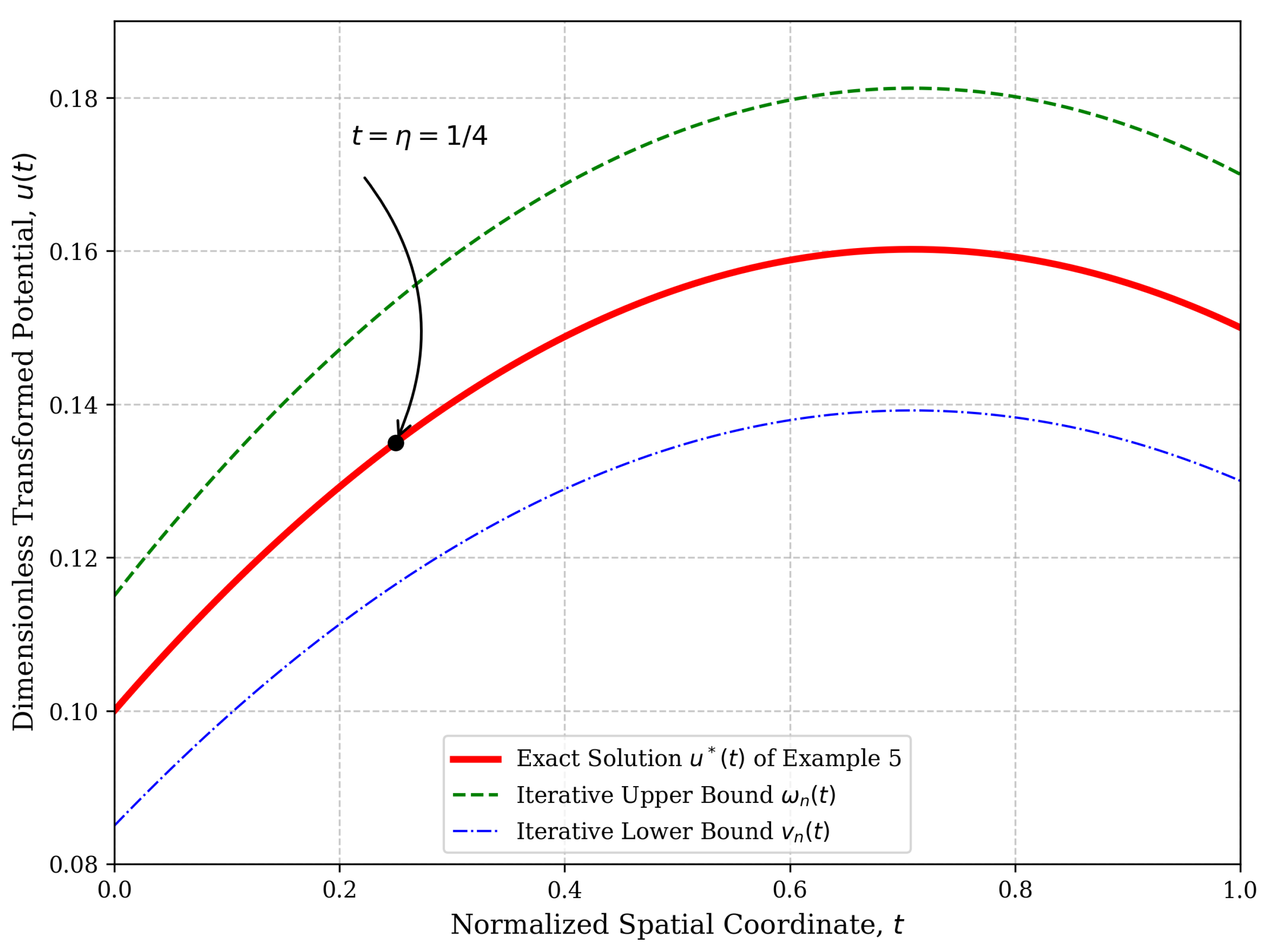
To validate the results established in Theorem 4.1, numerical simulations are performed for the third-order non-local boundary value problem in Example 5. The figure explicitly illustrates the spatial distribution of the dimensionless transformed solution across the normalized domain . The red solid curve depicts the numerical solution obtained via the shooting scheme coupled with nonlinear multi-point root-finding algorithms. To demonstrate the robustness and constructive nature of the developed theoretical framework, the iterative upper bound (green dashed line) and lower bound (blue dash-dotted line) are plotted simultaneously. These sequences are initialized from the theoretical initial paths and , as specified in the analytical setup. The clear nesting of these curves confirms that the approximation sequences systematically converge to the true solution profile, verifying the validity of the iterative scheme.
Figure 1.
Spatial profiles of the numerical solution and iterative bounds. The red solid curve denotes the numerical solution obtained via the shooting method; the green dashed curve and blue dash-dotted curve represent the iterative upper bound sequence and lower bound sequence , respectively. The black marker indicates the internal reference point , which appears in the non-local Stieltjes integral boundary conditions. All computed profiles remain strictly positive and exhibit a mathematically concave geometry () over the entire interval , which is in perfect agreement with the analytical results proven in Theorem 4.1.
Figure 1.
Spatial profiles of the numerical solution and iterative bounds. The red solid curve denotes the numerical solution obtained via the shooting method; the green dashed curve and blue dash-dotted curve represent the iterative upper bound sequence and lower bound sequence , respectively. The black marker indicates the internal reference point , which appears in the non-local Stieltjes integral boundary conditions. All computed profiles remain strictly positive and exhibit a mathematically concave geometry () over the entire interval , which is in perfect agreement with the analytical results proven in Theorem 4.1.
6. Conclusions
In this paper, a mathematical analysis has been dedicated to the existence of positive concave solutions for a class of third-order non-local boundary value problems modeling quantum dust acoustic solitary waves. By employing the monotone iterative technique, we have established comprehensive theoretical guarantees for the existence of solutions under Stieltjes integral constraints. Furthermore, numerical simulations were carried out to validate our analytical findings. The results explicitly demonstrate that the constructed iterative sequences converge to the exact solution while maintaining the essential positive and concave geometric profiles. Ultimately, this work provides a reliable and constructive computational framework for approximating true solitary wave profiles within space-bounded quantum plasma systems.
References
- Shukla, P.K.; Eliasson, B. Colloquium: Fundamentals of quantum plasmas. Rev. Mod. Phys. 2010, 82, 1665–1680. [Google Scholar]
- Manfredi, G. How to model quantum plasmas. Fields Inst. Commun. 2005, 46, 263–287. [Google Scholar]
- Haas, F.; Manfredi, G.; Feix, M.R. Quantum hydrodynamic model for the Schrdinger–Poisson system. Phys. Rev. E 2000, 62, 2763–2772. [Google Scholar] [CrossRef]
- Rao, N.N.; Shukla, P.K.; Yu, M.Y. Dust acoustic solitary waves. Planet. Space Sci. 1990, 38, 543–546. [Google Scholar] [CrossRef]
- Shukla, P.K.; Mamun, A.A. Introduction to Dusty Plasma Physics; Institute of Physics Publishing: Bristol, UK, 2002. [Google Scholar]
- Fortov, V.E.; Ivlev, A.V.; Khrapak, S.A.; Khrapak, A.G.; Morfill, G.E. Complex plasmas (dusty plasmas). Phys. Rep. 2005, 421, 1–103. [Google Scholar] [CrossRef]
- Haas, F. Quantum Plasmas: An Hydrodynamic Approach; Springer Science & Business Media: New York, NY, USA, 2011. [Google Scholar]
- Ali, S.; Shukla, P.K. Dust acoustic solitary waves in a quantum plasma. Phys. Plasmas 2006, 13, 022313. [Google Scholar] [CrossRef]
- Moslem, W.M.; Ali, S.; Shukla, P.K.; Tang, X.Y.; Rowlands, G. Solitary, explosive, and periodic solutions of the quantum Zakharov-Kuznetsov equation and its transverse instability. Phys. Plasmas 2007, 14, 042114. [Google Scholar] [CrossRef]
- Ali, S.; Moslem, W.M.; Kourakis, I.; Shukla, P.K. Parametric study of nonlinear electrostatic waves in two-dimensional quantum dusty plasmas. New J. Phys. 2008, 10, 023007. [Google Scholar] [CrossRef]
- Moslem, W.M.; Shukla, P.K.; Ali, S.; Schlickeiser, R. Quantum dust-acoustic double layers. Phys. Plasmas 2007, 14, 042107. [Google Scholar] [CrossRef]
- Ali, S.; Moslem, W.M.; Shukla, P.K. Linear and nonlinear ion-acoustic waves in an unmagnetized electron-positron-ion quantum plasma. Phys. Plasmas 2007, 14, 082307. [Google Scholar] [CrossRef]
- Rao, N.N.; Shukla, P.K.; Yu, M.Y. Dust-acoustic solitary waves. Planet. Space Sci. 1990, 38, 543–546. [Google Scholar] [CrossRef]
- Shukla, P.K.; Mamun, A.A. Introduction to Dusty Plasma Physics; Institute of Physics Publishing: Bristol, UK, 2002. [Google Scholar]
- Manfredi, G. How to model quantum plasmas. Fields Inst. Commun. 2005, 46, 263–287. [Google Scholar]
- Haas, F. Quantum Plasmas: An Hydrodynamic Approach; Springer Science & Business Media: New York, NY, USA, 2011. [Google Scholar]
- Haas, F.; Manfredi, G.; Feix, M. Multistream model for quantum plasmas. Phys. Rev. E 2000, 62, 2763–2772. [Google Scholar] [CrossRef]
- Garcia, L.G.; Haas, F.; de Oliveira, L.P.L.; Goedert, J. Use of the quantum hydrodynamic model to describe power-law plasma distributions. Phys. Plasmas 2005, 12, 012302. [Google Scholar] [CrossRef]
- Shukla, P.K.; Eliasson, B. Colloquium: Nonlinear collective interactions in quantum plasmas with Fermi-Dirac distributed electrons. Rev. Mod. Phys. 2011, 83, 885–906. [Google Scholar] [CrossRef]
- Bonitz, M. Quantum Kinetic Theory, 2nd ed.; Springer: Cham, Switzerland, 2016. [Google Scholar]
- Dornheim, T.; Groth, S.; Bonitz, M. The uniform electron gas at warm dense matter conditions. Phys. Rep. 2018, 744, 1–86. [Google Scholar] [CrossRef]
- Ali, S.; Moslem, W.M.; Shukla, P.K. Linear and nonlinear ion-acoustic waves in an unmagnetized electron-positron-ion quantum plasma. Phys. Plasmas 2007, 14, 082307. [Google Scholar] [CrossRef]
- Sun, Y. Positive solutions of singular third-order three-point boundary value problem. J. Math. Anal. Appl. 2005, 306, 589–603. [Google Scholar] [CrossRef]
- Sun, B.; Zhao, J.; Yang, P.; Ge, W. Successive iteration and positive solutions for a third-order multipoint generalized right-focal boundary value problem with p-Laplacian. Nonlinear Anal. 2009, 70, 220–230. [Google Scholar] [CrossRef]
- Chu, J.; Zhou, Z. Positive solutions for singular third-order periodic boundary value problems. Nonlinear Anal. 2007, 67, 1820–1830. [Google Scholar] [CrossRef]
- Anderson, D.; Davis, J. Multiple solutions and eigenvalues for third-order right-focal boundary value problems. J. Math. Anal. Appl. 2002, 267, 135–157. [Google Scholar] [CrossRef]
- Anderson, D. Green’s function for a third-order generalized right-focal problem. J. Math. Anal. 2008, 288, 1–14. [Google Scholar]
- Wong, P. Constant-sign solutions for a system of third-order generalized right focal problems. Nonlinear Anal. 2005, 63, 2153–2163. [Google Scholar]
- Hopkins, B.; Kosmatov, N. Third-order boundary value problems with sign-changing solutions. Nonlinear Anal. 2007, 67, 126–137. [Google Scholar] [CrossRef]
- Karakostas, G.; Tsamatos, P. Multiple positive solutions of some Fredholm integral equations arisen from nonlocal boundary-value problems. Electron. J. Differ. Equ. 2002, 2002, 30. [Google Scholar]
- Henderson, J.; Yin, W. Existence of solutions for third-order boundary value problems on a time scale. Comput. Math. Appl. 2003, 45, 1101–1111. [Google Scholar] [CrossRef]
- Jankowski, T. Positive solutions for fourth-order differential equations with deviating arguments and integral boundary conditions. Nonlinear Anal. 2010, 73, 1289–1299. [Google Scholar] [CrossRef]
- Kong, L. Second order singular boundary value problems with integral boundary conditions. Nonlinear Anal. 2010, 72, 2628–2638. [Google Scholar]
- Webb, J. Positive solutions of a boundary value problem with integral boundary conditions. Electron. J. Differ. Equ. 2011, 2011, 55. [Google Scholar]
Disclaimer/Publisher’s Note: The statements, opinions and data contained in all publications are solely those of the individual author(s) and contributor(s) and not of MDPI and/or the editor(s). MDPI and/or the editor(s) disclaim responsibility for any injury to people or property resulting from any ideas, methods, instructions or products referred to in the content. |
© 2026 by the authors. Licensee MDPI, Basel, Switzerland. This article is an open access article distributed under the terms and conditions of the Creative Commons Attribution (CC BY) license (http://creativecommons.org/licenses/by/4.0/).
Copyright: This open access article is published under a Creative Commons CC BY 4.0 license, which permit the free download, distribution, and reuse, provided that the author and preprint are cited in any reuse.


