

Submitted:
03 June 2026
Posted:
04 June 2026
You are already at the latest version
Abstract
Plane tessellations naturally generate local combinatorial invariants such as vertex degree and vertex type, which encode essential geometric and topological information. In the present work, these invariants are used to construct complete bicolored graphs whose edge coloring is induced intrinsically by the equality or inequality of local tessellation properties. Two classes of structured Ramsey graphs are introduced: vertex-degree graphs and vertex-type graphs. Unlike classical Ramsey colorings, the proposed colorings are not arbitrary but arise from equivalence relations generated by local geometric invariants. Consequently, the resulting graphs possess a partition-generated or semi-transitive structure in which one color forms disjoint complete cliques corresponding to equivalence classes, while the complementary color connects distinct classes. Within this framework, a sharp Ramsey-type theorem is established: every such graph on five vertices necessarily contains a monochromatic triangle. The combinatorial core of the theorem reduces to the statement that among five values either three coincide or three are pairwise distinct. Turán numbers for the introduced structured colorings are calculated and shown to possess a characteristic asymmetry that is absent in classical extremal graph theory. The relation-ship between geometric symmetries of tessellations and automorphism groups of the associated Ramsey graphs is analyzed, demonstrating that tessellation symmetries induce graph automorphisms, while additional purely combinatorial symmetries may emerge from degree degeneracies. The results establish a direct connection between tessellation geometry, equivalence relations, Ramsey theory, and extremal graph theory.
Keywords:
tessellation
; graph theory
; Ramsey graph
; Turán numbers
MSC: 05C15; 05B45; 05D10
1. Introduction
Plane tessellations constitute a classical object of geometry, combining local combinatorial structure with global symmetry. A tessellation encodes extensive information through simple local invariants such as vertex degree (valency) and vertex type, which reflects how polygons meet at a point. These local characteristics are preserved under geometric symmetries and therefore serve as natural invariants in the study of periodic and non-periodic tilings [1,2,3].
In parallel, Ramsey theory studies unavoidable patterns in sufficiently large structures. A central result asserts that any sufficiently large edge-coloured complete graph necessarily contains monochromatic subgraphs of prescribed type [4,5,6]. Closely related extremal problems are addressed within Turán theory, which studies the maximal number of edges avoiding prescribed subgraphs [7,8,9]. Classical Ramsey theory deals with arbitrary colourings; however, in many natural settings, colourings are not arbitrary but generated by intrinsic structures. Understanding how such structured colourings influence Ramsey-type phenomena remains an important and largely unexplored direction.
In this work, we introduce a new class of structured bicolored graphs generated by tessellations, which we call vertex-degree Ramsey graphs (VDG) and vertex-type Ramsey graphs (VTG). In these constructions, the colouring is not imposed externally but arises from the equality or inequality of local geometric invariants. Specifically, edges are coloured according to whether two vertices share the same degree or the same vertex type (defined by the specific arrangement and sides of polygons meeting at a vertex). This leads to a highly constrained class of colourings, which we term semi-transitive or partition-generated graphs.
The key structural feature of these graphs is that one colour corresponds to an equivalence relation and therefore forms a disjoint union of complete cliques, while the complementary colour connects different equivalence classes. Thus, the entire graph is completely determined by a partition of the vertex set. This sharply contrasts with arbitrary Ramsey colourings and places the problem in a fundamentally different combinatorial regime [6,9,10,11]. Within this framework, we establish a sharp Ramsey-type result: every vertex-degree or vertex-type graph on five vertices necessarily contains a monochromatic triangle. Remarkably, this result reduces to a purely combinatorial statement about integers: among five values, either three coincide or three are pairwise distinct. The tessellation provides a geometric realization of this combinatorial principle.
Combinatorial properties of tessellations were addressed recently [12]. In particular, combinatorial properties of the Voronoi tessellations were reported [13]. Voronoi tessellations represent a convenient and important mathematical structure for the suggested Ramsey analysis [14,15,16,17,18,19,20,21,22]. Voronoi diagrams provide a natural framework for studying statistical tessellation-generated Ramsey structures and enable the investigation of equivalence-based and non-transitive graph topologies arising in disordered geometric systems.
A second central focus of the paper is the calculation of Turán numbers for semi-transitive graphs [23,24,25]. Unlike classical extremal graph theory, where a single extremal number is considered, the present setting naturally leads to a pair of extremal quantities corresponding to the two colours. We show that these extrema are asymmetric and cannot be realized simultaneously, revealing a new structural feature of partition-generated colorings.
We further analyze the relationship between geometric symmetry of tessellations and combinatorial symmetry of the associated Ramsey graphs. We demonstrate that the passage from tessellations to vertex-degree graphs acts as a projection: geometric symmetries induce graph automorphisms, but additional purely combinatorial symmetries may emerge due to degeneracy of degree classes. This leads to the general relation , where is a graph on X vertexes set, which is strict in typical cases [10,23,24,25].
Finally, we extend the construction from vertex degree to vertex types, showing that the same Ramsey phenomenon persists when the colouring is induced by equality of vertex type. This demonstrates that the observed behaviour is not specific to the degree, but reflects a broader principle: Ramsey-type structures naturally emerge from equivalence relations generated by local invariants of tessellations.
The results presented in this paper establish a direct bridge between geometry, combinatorics, and extremal graph theory. They show that tessellations provide a natural source of structured Ramsey graphs in which combinatorial inevitability arises not from randomness or size alone, but from intrinsic geometric constraints.
2. Mathematical Foundations and Definitions
2.1. Vertex-Degree Ramsey Graphs Generated by Tessellations
We start with an arbitrary plane tessellation T. Let be set of its vertices. For every vertex we introduce its degree or valency, namely the number of edges of the tessellation meeting at v, denoted . Now we introduce the notion of the vertex-degree graph abbreviated VDG.
Definition 1. Definition of the vertex-degree graph (VDG).
Choose a finite set of vertices from a given tessellation T. We construct the complete graph on these vertices, and color each edge as follows:
where is the coloring function. Thus, the tessellation generates a complete bicolored graph , where , and col is the above coloring rule.
Thus, a complete bicolored, vertex-degree Ramsey graph (VDG) emerges. This is not an arbitrary 2-coloring. It is generated by equality/inequality of a numerical invariant, namely vertex degree. Therefore, the coloring of VDG has an internal structure. Define a relation on vertices by
The relation defined by Eq. 2 is an equivalence relation. Hence the green edges join vertices belonging to the same equivalence class, while red edges join vertices from different classes. So, the graph has the following structure: the green subgraph is a disjoint union of complete cliques, the red edges connect vertices belonging to different green cliques. This is what may be called a semi-transitive or partition-generated Ramsey graph. Now we introduce the notion of degree classes.
Definition 2. Degree classes
The equivalence classes induced by equality of vertex degree are called the degree classes of X. Then, green cliques are exactly the complete subgraphs generated by individual degree classes. Thus, structural Theorem 1 immediately emerges.
Theorem 1.
Every vertex-degree Ramsey graph of a tessellation is completely determined by the partition of the chosen vertices into degree classes.
Proof
The color of an edge of a VDG depends solely on whether its endpoints belong to the same or different degree classes. Hence once the partition into equal-degree classes is known, every edge color is fixed. So, the graph is a partition graph in the strongest possible sense.
The relation establishing the green color of the edge linking vertices i and j is transitive, thus if vertices i and j are connected with a green link, and vertices j and k are connected with a green link, necessarily vertices i and k are also connected with an green link. However, the relation establishing the red color of the edge linking vertices i and j is not transitive. If vertices i and j are connected with a red link, and vertices j and k are connected with a red link, it is possible that vertices i and k are connected with a red link, and it is also possible that they are connected with a green link. Thus, VDG is not a usual Ramsey graph; is it the semi-transitive Ramsey graph. A semi-transitive Ramsey graph with five vertices necessarily contains at least one monochromatic triangle, as demonstrated in the following theorem.
Theorem 2
Let be any set of five vertices chosen from a plane tessellation, and let be the complete bicolored graph defined by . Then contains a monochromatic triangle.
Proof
Define on set X the equivalence relation . Let the equivalence classes of this relation be the degree classes By construction: if two vertices belong to the same class , the edge joining them is green; if two vertices belong to different classes, the edge joining them is red. We now distinguish between two cases:
Case 1. One degree class contains at least three vertices.
Assume that for some r, Choose three distinct vertices . Since all three belong to the same degree class, we have Hence the three edges , and are green, therefore a, b, c forms an green triangle.
Case 2. Every degree class contains at most two vertices
Assume now that Since the total number of vertices is 5, it is impossible to cover all five vertices with only one or two classes of size at most 2. Therefore, there must be at least three distinct degree classes. This allows us to choose vertices from three different classes . Because these vertices belong to different degree classes, their degrees are pairwise different: Hence all three edges , and are red, and therefore a, b, c form a red triangle. In both cases, contains a monochromatic triangle. This proves the theorem.
Simply speaking: The coloring is induced by the equivalence relation , so the chosen vertices are partitioned into degree classes. If one degree class contains at least three vertices, these three vertices form the red triangle. If every degree class has size of at most two, then five vertices must occupy at least three distinct degree classes; choosing one vertex from each of the three classes yields a red triangle, since vertices from different classes are joined by red edges. Hence, a monochromatic triangle always exists. In other words, every partition-generated 2-coloring of has a monochromatic triangle. Using the terminology of tessellations, we state that in any set of five vertices of a tessellation, one necessarily finds either a triple of equal valency or a triple of mutually different valencies. The generalization of Theorem 2 is straightforward. Since the coloring depends only on the degree of the vertices, the whole construction reduces to a statement about integers. Given five integers either: three of them are equal, or three of them are pairwise distinct.
This is exactly the combinatorial core of Theorem 2. The tessellation supplies the geometric meaning of the integers. The extension for regular tessellations is trivial.
In a regular tessellation all vertices have the same degree, so every edge is red. The degree-Ramsey graph is therefore a complete red clique.
2.2. Calculation of the Turán Numbers for the Semi-Transitive Graphs
Now, we calculate the Turán numbers for the semi-transitive graphs [26]. Consider a semi-transitive graph with n vertices. Let the degree classes have sizes:
Green edges occur inside degree classes:
Red edges occur between different degree classes:
A green triangle appears exactly if and only if at least one degree class has a size of at least three. Therefore, to avoid green triangles, all degree classes must have size of at most 2. The maximal number of green edges is then obtained by splitting the vertices into pairs: , and possibly one remaining vertex. Hence:
A red triangle appears exactly when there are at least three distinct degree classes. Therefore, to avoid red triangles, the partition may contain at most two degree classes. The number of red edges is then maximized by splitting the vertices into two classes as evenly as possible, namely: Thus, we calculate:
For five vertices: realized by the partition 2+2while realized by partition It should be emphasized that these two extrema are not realized simultaneously. The partition 2+2+1 avoids green triangles but it already contains a red triangle. The partition avoids red triangles but contains an green triangle. This asymmetry is the distinctive Mantel–Turán feature of semi-transitive VDGs. Finally, the Turán numbers for semi-transitive graphs are given by Eq. 6 and Eq. 7.
2.3. Symmetry of the Tessellation and Symmetry of the Vertex-Degree Ramsey Graph
Let T be a plane tessellation, and let be its symmetry group, i.e. the group of all isometries of the plane mapping T onto itself. Let be a finite set of vertices, and let be the corresponding vertex-degree Ramsey graph. Note that every symmetry preserves the degree of a vertex:
Indeed, an isometry that maps the tessellation onto itself preserves the local incidence structure of edges meeting at every vertex, and therefore preserves valency. Hence, if , then:
Therefore, the color of the edge is the same as the color of the edge . It should be emphasized that the symmetry group of the tessellation does not automatically pass to the graph in full, but is restricted to the subgroup that stabilizes the set X. More precisely, if we define the stabilizer , then every element of induces a color-preserving automorphism of . The stabilizer consists of all symmetries of the tessellation that map the chosen vertex set X onto itself. Therefore, there is a natural group homomorphism In particular, symmetry-equivalent vertices always belong to the same degree class, so degree classes are unions of symmetry orbits. For vertex-transitive tessellations all vertices have the same degree, and the corresponding graph is a complete green clique.
It is not true in general that , rather The graph retains only information regarding vertex degrees, rather than the full geometry of the tessellation. So, the graph may have “extra” automorphisms obtained by permuting vertices within the same degree class, even when these permutations do not come from geometric symmetries of the tessellation. Thus, the passage from the tessellation to the vertex-degree Ramsey graph may be viewed as a projection from geometric symmetry to combinatorial symmetry, in which part of the geometric information is lost while new purely combinatorial symmetries may emerge.
This is well-exemplified with the seminal Cairo tiling depicted in Figure 1.
Example 1. Symmetry and VDG of Cairo tiling
The Cairo tiling is a standard periodic pentagonal tiling [27,28,29,30]; in the dual-to-snub-square form it has wallpaper symmetry group p4g, and its vertices are of two valencies, 3 and 4, i.e. where vertices in have degree 3 and vertices in have degree 4. Because every symmetry of the tessellation preserves valency, every symmetry sends to and to . Thus, the geometric symmetry group acts on the two-degree classes, but it is constrained by the actual embedding of the vertices in the plane. Now choose a finite subset containing, say, three vertices from and two vertices from and choose them generically, so that no nontrivial symmetry of the Cairo tiling preserves X as a set. Then the stabilizer may be trivial. In contrast, the corresponding vertex-degree Ramsey graph depends only on the partition of X into degree classes and may therefore admit additional automorphisms obtained by permuting vertices within the same class. Hence, in general, The symmetry considerations developed above impose strong structural constraints on the vertex-degree Ramsey graph , which are directly responsible for the Ramsey-type result established in Section 2.1. Since the coloring is entirely determined by vertex degree, the set X is partitioned into degree classes, and the resulting graph is a complete bicolored graph in which edges within each class are green, while edges between distinct classes are red. This induces a semi-transitive structure: the green relation is an equivalency relation, whereas the red relation encodes its complement. Such a restricted class of colorings is far from arbitrary. In particular, when , these structural constraints force the appearance of a monochromatic triangle. Therefore, the Ramsey property in vertex-degree graphs should be understood as a geometric–combinatorial consequence: the tessellation, through its symmetry and degree distribution, generates a constrained coloring in which Ramsey-type substructures are unavoidable. Now consider one more example.
Example 2. Regular square tessellation
Consider the regular square tessellation (wallpaper group p4m). All vertices have degree 4. Hence for any choice consequently all edges are green. Thus, is the complete green clique, and . Now consider two possibilities of the vertices choice:
Case A: symmetric choice. Let X be vertices of a square, in this case Case B: generic choice. We pick 5 random vertices. In this case , but . This demonstrates that the symmetry of the graph does not come from geometry, but from degree degeneracy.
We conclude that the automorphism group of the vertex-degree graph is determined not by geometric symmetry, but by the multiplicities of degree classes; thus, it reflects degeneracy rather than geometry.
2.4. Vertex Type Ramsey Graphs Generated by Tessellations
Now we address vertex type generated by tessellations. We distinguish between two levels of geometric detail.
Definition 3. Vertex type invariants: multisets and sequences
For every vertex from set , we define its vertex type using one of the following invariants: vertex multiset – an unordered collection of the number of sides ℓ of the polygons meeting at (Figure 2). This represents a relaxed invariant that ignores the spatial arrangement of the cells. And vertex symbol , defined as the ordered sequence of polygons meeting at vertex . This invariant preserves the spatial orientation of the cells.
Definition 4. Definition of the vertex type graph
Choose a finite set of vertices from the given tessellation T. We construct the complete graph on these vertices, and color each edge as follows:
where is the coloring function, and the “same vertex type” is determined by the equality of chosen invariants: . Thus, the tessellation generates a complete bicolored graph , where , and col is the above coloring rule. Thus, a complete, bicolored, vertex-type Ramsey graph (VTG) emerges. The Ramsey-type theorem immediately emerges.
Theorem 3. Ramsey theorem for vertex-type graphs generated by tessellations.
Let T be a plane tessellation, and let be a finite set of vertices. To every vertex assign its vertex invariant (either the multiset or the vertex symbol ). Construct the complete graph , where , and color every edge by: .
Then every vertex-type graph with contains a monochromatic triangle. Moreover, the bound is sharp: there exist vertex-type graphs on four vertices with no monochromatic triangle.
Proof
The relation is an equivalence relation. Hence, the green edges form disjoint complete subgraphs corresponding to the equivalence classes of equal vertex types. Red edges connect vertices belonging to different equivalence classes. Now take five vertices. If at least three vertices have the same vertex type, they form an green triangle. If no three vertices share a common vertex type, then the five vertices are distributed among classes of size at most two. Therefore, at least three vertices must belong to three distinct vertex-type classes. The edges between them are all red, and hence they form a red triangle. Thus every with five vertices contains a monochromatic triangle.
Thus, vertex-type Ramsey graphs generated by tessellations obey the same sharp 5-vertex monochromatic-triangle theorem as vertex-degree Ramsey graphs. The reason is that both constructions are induced by equality of a local combinatorial invariant: vertex degree in the former case, and vertex type in the present case.
3. Practical Implementation and Numerical Results
3.1. Computational Framework and Coloring Rules
The proposed concepts are illustrated through the analysis of random Voronoi tessellations. The numerical generation of Voronoi tessellations and the subsequent construction of the associated Ramsey graphs were implemented using Python. The statistical analysis of the generated data, including curve fitting and visualization of results, was performed using Wolfram Mathematica.
Let be a discrete set of distinct points, called generators, sites, or seeds. For every generator , we define its Voronoi cell by: , where denotes the Euclidean norm. The collection is called the Voronoi tessellation (or Voronoi diagram) generated by the set . We consider a set of N random generator points distributed uniformly within a square domain under periodic boundary conditions, topologically equivalent to a torus. Periodic boundary conditions are necessary to avoid boundary effects on graph edges and polygon sets.
The Voronoi diagram partitions the torus into N distinct cells. The cell corresponding to a generator s comprises all points in the space that are closer to s than to any other generator. The vertices of these cells—defined as the points equidistant from three or more generators — constitute the set of nodes V of the spatial tessellation T. For a standard Voronoi tessellation on a plane, the number of nodes is given by .
We construct a complete graph on the vertex set . For every edge , we apply a coloring function based on four rules: one VDG and three VTG rules (MEG, SEG, and SIG). For each classification rule, we analyze the following structural and statistical characteristics:
- The percentage of green edges
- The distribution and total number K of equivalence classes.
- The maximum clique size within the green and red subgraphs.
- The transitivity violation count TV (instances where and are green, but is red).
- Turán number estimations and the analysis of rule-specific trends.
Then we will analyze asymptotic estimations. The applied rules are following:
- 1)
- Rule 1. VDG (Vertex-Degree Graph)
Since we assume a standard non-degenerate Voronoi diagram where exactly three cells meet at each vertex, all nodes have a degree of three. Consequently, under the VDG rule, the entire complete graph becomes green , number of equivalence classes , . The maximum green and red clique sizes are , . Although this rule is degenerate, it serves to validate the computational implementation.
- 2)
- Rule 2. MEG. Graph Based on Multiset Identity (Multiset-Equivalence Graph (MEG))
An edge is colored according to color function Eq. 10, the node type is defined by its multiset of adjacent cell types . This rule defines a rigorous equivalence relation. The green edges partition the vertex set V into disjoint equivalence classes (cliques), ensuring that no transitivity violations occur. That means that .
- 3)
- Rule3. SEG. Graph Based on Ordered Sequences (Sequence-Equivalence Graph (SEG))
This rule refines Rule 2 MEG by incorporating spatial orientation and clockwise (or counter-clockwise) traversal order of the adjacent cells surrounding the node. In other words, we use vertex symbol in Eq. 10. This rule imposes a stricter geometric symmetry requirement than the unordered multiset identity.
- 4)
- Rule4 SIG. Graph Based on Non-Empty Set Intersection (Set Intersection Graph (SIG))
An edge is colored green if the multisets of the two nodes possess a non-empty intersection: . This rule relaxes the strict identity requirement of Rule 2 MEG. Since a single cell type can link distinct multisets, this relation is non-transitive, resulting in transitivity violations and the formation of complex, overlapping cluster structures rather than disjoint cliques.
In the following formulas we will use the number of the rules as its index.
3.2. Statistical Distribution of Cell Types and Vertex Neighborhoods
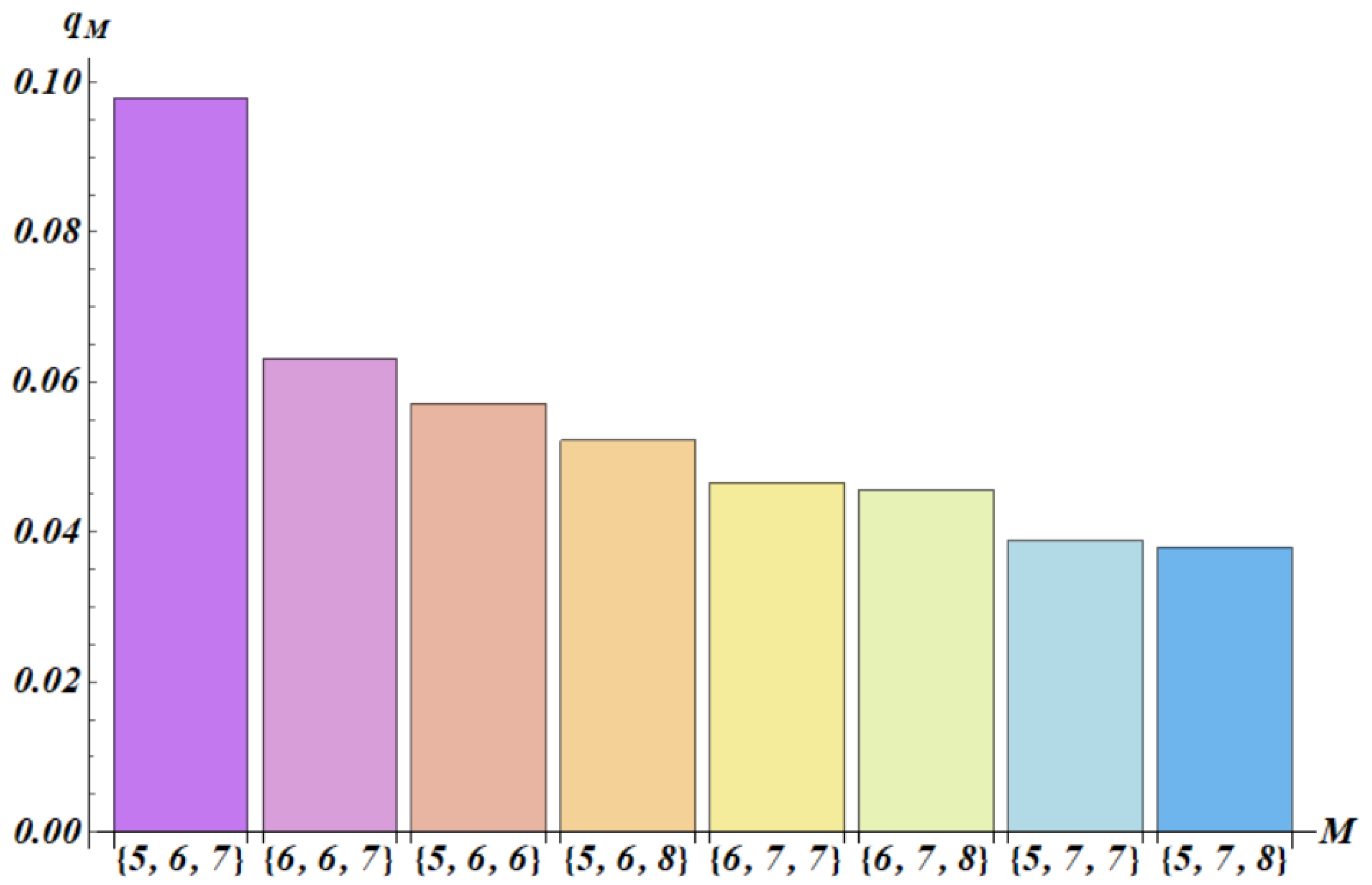
First, the distribution of cell types ℓ and the node neighborhoods must be determined (see Appendix A, Figures 1A, 2A). While no analytical solution exists for the Voronoi distribution, numerous studies have provided similar calculations for cell distribution [14].
3.3. Analysis of Rule 2 MEG
The exact formulas for the number of green and red edges can be derived using 2-combinations of class sizes:
To analyze the statistical behavior, we rewrite Eq. 11 in terms of the mean class size and the biased variance :
Equations 11 through Eq. 12,13 become:
This indicates that a greater dispersion (variance) in equivalence class sizes (see Figure 5B) directly increases the number of green connections.
Accordingly, the fraction of green connections:
To characterize the asymptotic behavior, is estimated using simple combinatorial arguments: if we have , in which we have in average connections, then:
Empirically, is observed to grow logarithmically with n (Figure 3B). This fact enables the following estimation. where the number of classes is interpreted similarly to number of Boltzmann states (see Figure 9 for p in log-log scale).
Now we consider the clique formation. The green graph is a set of cliques. The red graph is a complete graph. The maximum green clique size corresponds to the maximum class size: . Maximal red clique is equal to number of classes (we choose one node from each class): .
How can , be estimated from the average class size ? Considering it as a deviation from the mean, , and compare the real with its normal distribution estimation (see Figure 4), allows for a better understanding of the graph’s topological structure.
For normal distribution for large number of independent (it’s not like that) clique sizes maximum asymptotic gives . For relation between is (Figure 5A). This clearly demonstrates that the system exhibits structural order, with nodes being unevenly distributed among classes. The significant deviation from the mean µ compared to a random graph suggests that a dominant class (ideally {6, 6, 6}) imposes its structure on the remaining nodes. If the relation between were less than one, then one could say that the variance of the classes would be small. The class sizes would be almost the same. The presence of one domain prevents adjacent domains from sharing the same type.
Using the approximation for , we can estimate Ramsey-type threshold: the number of nodes at which a red clique of size is expected to appear. It is :

Table 1.
Ramsey threshold estimation.
| (red clique size) | Estimated n |
| 3 | 15 |
| 4 | 16 |
| 5 | 17 |
| 6 | 17 |
| 10 | 21 |
Finally, we provide estimation for Turán number and compare it with direct calculations. The exact formula for Turán number – the maximal number of edges in subgraph on n nodes:
We will consider the relation:
Considering Eq 16: , and upper bound for Turán number: we get:
tending to zero (logarithmically slow) as becomes big (Figure 6A).
For the red graph:
that is, the classes in this approximation are divided into commensurate groups, and the graph approaches the Turán graph (empirically 0.976).
Through mean and variance:
3.4. Analysis of Rule 3 SEG
We now consider the ordering within MEG classes. Triples that cannot be mapped onto each other via cyclic shifts (e.g. (5, 6, 7) and (5, 7, 6)) are partitioned into two distinct classes. The only classes in MEG that split up are the ones in which all three types of cells ℓ are different. We will consider such a vertex symbol as chirality property (Figure 7).
This rule is identical to the MEG, so the previous estimations are the same, only number of classes is different. Since , the following relations hold: , , , ,. (see Appendix B).
Empirical results indicate that approximately half of MEG classes are chiral: Then , what is seen from the strict calculation (Figure 8). This is due to the distribution of polygons . The probability of a chiral node (estimated for independent cells) is given by:
3.5. Analysis of Rule 4 SIG
For large , the fraction of green connections approaches to a constant value. It means that depends on distribution only, and independent on . We denote this asymptotic value as .Empirically it’s 85.7±0.4% (see Figure 9).
Now we will estimate in three ways. A lower bound can be established by assuming that primary connections arise from the presence of at least one hexagon in :
where – is probability that in at least one hexagon.
Let’s denote the number of common for two nodes: . Then the expectation is:
If we assume that has Poisson distribution, then expectation . The next estimation for :
It is well-established that Voronoi tessellations do not follow a Poisson distribution, as there is a correlation between cell types (5-gon and 7-gon come with hexagon more often). So, it is not a random distribution. It’s closer to sub-Poisson distribution as variance of is less than expectation :
That is, the intersections of the types are distributed closer to the average than in the random case. Deviation from Poisson distribution corresponds to correlation between cells.
More precise approach is considering independent cell type combinations, forming . It is easier to calculate that two nodes don’t have intersection ():
This estimate is in close agreement with a Monte Carlo simulation performed for 105 pairs. Simulated (84.4%). The difference between empirical value (~1.3%) is caused by correlation presence. The estimated values of are depicted in Figure 10.
Finally, knowing we can estimate transitivity violation . The number of violating ordered links triples (i, j, k), that is, such that ij is green, jk is green, ik is red (random graph approximation):
It describes the empirical data quite well (Figure 11): the fitted constant , , as . Relative difference is 0.14.
Green and red cliques
Calculating the maximum green clique is an NP-hard problem. In the program we tried to estimate the lower bound going along the nodes with maximal connections number. We will see that we can consider it quite close to the real value, since we actually going through all the nodes containing hexagon – the maximum clique.
Theoretically we should take and find all M containing the most frequent polygon (hexagon) and sum up the probabilities:
This perfectly matches the program calculation (Figure 12). We see a linear relationship. The slope (sum of probabilities) is 0.66 (66% of all nodes contain at least one hexagon).
The red clique for large n is constant and equals 3:
This can be understood in terms of the Pigeonhole Principle (or Dirichlet’s box principle). If we consider a multiset {3, 4,..., 12} with equally probable elements, then we place triples with identical elements in Dirichlet boxes. Then the maximum click is 10 (number of types: 12-3+1). In reality, this does not happen because of the distribution. We have to think about Dirichlet boxes, which consume three different elements that do not repeat in other boxes. Maximum: 10/3~3 (Figure 13).
Turán ratio
From Eq. 27 we can approximate , therefore:
what matches empirical data (Figure 14).
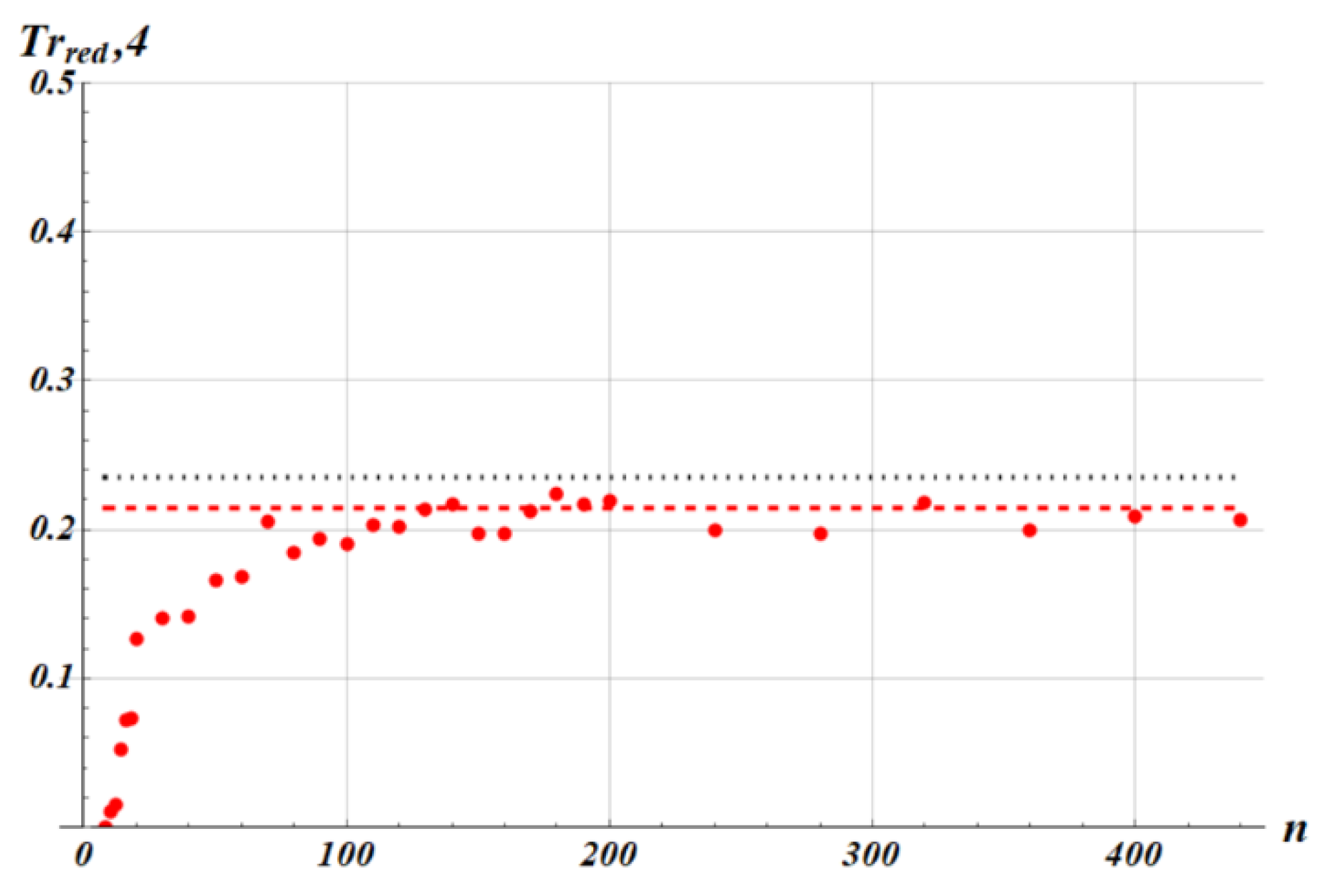
For Turán ratio in red subgraph, we only have to estimate number of red connections: Turán number: Consequently:
where is a fraction of red connections.
Figure 15.
Red points: empirical values. Red dashed line: asymptotic corresponding to Eq. 30 with empirical . Black dashed line: Eq. 30 with analytical .
Figure 15.
Red points: empirical values. Red dashed line: asymptotic corresponding to Eq. 30 with empirical . Black dashed line: Eq. 30 with analytical .
Discussion
The present work introduces a new class of structured Ramsey graphs generated intrinsically by plane tessellations. In contrast to classical Ramsey theory, where edge colorings are arbitrary [6,7], the colorings studied here arise naturally from local geometric invariants, namely vertex degree and vertex type. This distinction is fundamental. The resulting graphs are not generic bicolored complete graphs but highly constrained, partition-generated structures in which one color corresponds to an equivalence relation. Consequently, the Ramsey properties established in the present work originate not from the randomness of the coloring but from the internal combinatorial organization imposed by tessellation geometry [31]. The introduced vertex-degree graphs (VDGs) and vertex-type graphs (VTGs) demonstrate that tessellations provide a natural geometric realization of equivalence-relation Ramsey structures. The obtained monochromatic-triangle theorem for five vertices has a particularly transparent combinatorial interpretation: among five values, either three coincide or three are pairwise distinct. Thus, the geometric Ramsey phenomenon reduces to a structural property of partitions. The tessellation serves as the geometric carrier of this combinatorial inevitability. An important feature of the introduced framework is the asymmetry between the two colors. In classical extremal graph theory, Turán-type optimization is usually formulated for a single graph class [7,8,9]. In the present setting, however, the two colors possess fundamentally different structural meanings. One color corresponds to equivalence classes and therefore generates disjoint cliques, whereas the complementary color connects distinct classes. As a result, the extremal configurations maximizing the two edge types cannot generally be realized simultaneously. This asymmetry constitutes a characteristic property of partition-generated Ramsey graphs and distinguishes them sharply from arbitrary two-colorings. The relation between geometric symmetry and graph symmetry also deserves attention. The symmetry group of the tessellation acts naturally on the associated Ramsey graph through preserving local invariants, such as valency and vertex type. However, the passage from tessellation to graph is not straightforward. The graph retains only partial geometric information, namely the partition into equivalence classes. Consequently, additional purely combinatorial automorphisms may emerge which are absent in the original tessellation. The obtained inclusion expresses this projection from geometric symmetry to combinatorial symmetry. The Cairo tiling illustrates this phenomenon particularly clearly: although the geometric stabilizer of a finite vertex subset may be trivial, the associated VDG may still possess nontrivial automorphisms generated by permutations within degree classes.
The practical implementation based on Voronoi tessellations further demonstrates that the introduced framework extends naturally beyond ideal periodic tilings [32]. Random tessellations generate rich statistical families of structured Ramsey graphs whose properties depend on distributions of local cell configurations. The distinction between equivalence-based rules (MEG, SEG) and non-transitive intersection-based rules (SIG) reveals the transition from partition-generated structures to genuinely non-transitive graph topologies with overlapping clusters and transitivity violations (see Table 2).
In this sense, Voronoi tessellations provide a natural laboratory for studying structured Ramsey phenomena in disordered systems [32]. The present work opens several directions for future research. First, higher-dimensional generalizations may be developed for spatial tessellations and Voronoi decompositions in and higher dimensions. Second, the framework may be extended from bicolorings to multicolor Ramsey structures generated by several local invariants simultaneously. Third, probabilistic versions of tessellation-generated Ramsey graphs may be investigated for stochastic geometric processes. Finally, the introduced approach suggests a broader principle: local geometric invariants naturally induce structured combinatorial colorings whose Ramsey properties reflect the interplay between geometry, symmetry, equivalence relations, and extremal graph theory [33].
5. Conclusions
A new class of structured Ramsey graphs, generated by plane tessellations, has been introduced and analyzed. Unlike classical Ramsey graphs, where edge colorings are arbitrary, the colorings considered in the present work arise intrinsically from local geometric invariants, namely vertex degree and vertex type. This construction leads naturally to partition-generated or semi-transitive complete bicolored graphs in which one color corresponds to an equivalence relation and forms disjoint cliques, while the complementary color connects distinct equivalence classes.
Within this framework, sharp Ramsey-type results were established for vertex-degree (VDG) and vertex-type graphs (VTG), where VTG includes both multiset (MEG) and sequence-based (SEG) implementations. In particular, every such graph on five vertices necessarily contains a monochromatic triangle. The resulting theorem possesses a straightforward combinatorial core: given five values, either three coincide or three are pairwise distinct. Thus, the Ramsey property emerges as a direct consequence of the partition structure induced by local tessellation invariants.
Turán numbers for the introduced structured colorings were calculated. In contrast to classical extremal graph theory, the two colors exhibit a fundamental asymmetry because they represent inequivalent combinatorial structures: equivalence-class cliques versus inter-class connections. The corresponding extremal configurations therefore cannot generally be realized simultaneously.
The relation between geometric symmetry of tessellations and combinatorial symmetry of the associated Ramsey graphs was also clarified. Tessellation symmetries induce graph automorphisms through preservation of local invariants; however, additional combinatorial automorphisms may emerge due to degeneracies of degree or vertex-type classes. Thus, the passage from tessellations to Ramsey graphs acts as a projection from geometry to combinatorics.
The practical implementation based on Voronoi tessellations demonstrated that the proposed framework extends naturally to random and disordered tessellations. Equivalence-based and non-transitive coloring rules were shown to generate qualitatively different graph topologies, ranging from disjoint clique structures to overlapping non-transitive cluster systems.
The present work bridges between tessellation geometry, equivalence relations, Ramsey theory, and extremal graph theory. More broadly, it suggests that local geometric invariants constitute a natural source of structured Ramsey colorings, in which combinatorial inevitability arises from intrinsic geometric organization rather than arbitrary edge assignment.
Author Contributions
Conceptualization, E. B.; A.G. and S.S.; methodology, E. B.; A.G. and S.S.;.software, A.G.; validation, A.G.; E.B. and A. G.; investigation, E. B.; A.G. and S.S.
Funding
This research received no external funding.
Data Availability Statement
The original contributions presented in this study are included in the article. Further inquiries can be directed to the authors.
Conflicts of Interest
The authors declare no conflicts of interest.
Abbreviations
The following abbreviations are used in this manuscript:
| MDPI | Multidisciplinary Digital Publishing Institute |
| DOAJ | Directory of open access journals |
| MEG | Multiset-Equivalence Graph |
| SEG | Sequence-Equivalence Graph |
| SIG | Set Intersection Graph |
| TV | Transitivity Violation |
| VDG | Vertex-Degree Ramsey Graph |
| VTG | Vertex-Type Ramsey Graph |
Appendix A
Appendix A.1
Figure A1.
Distribution of cell types ℓ.
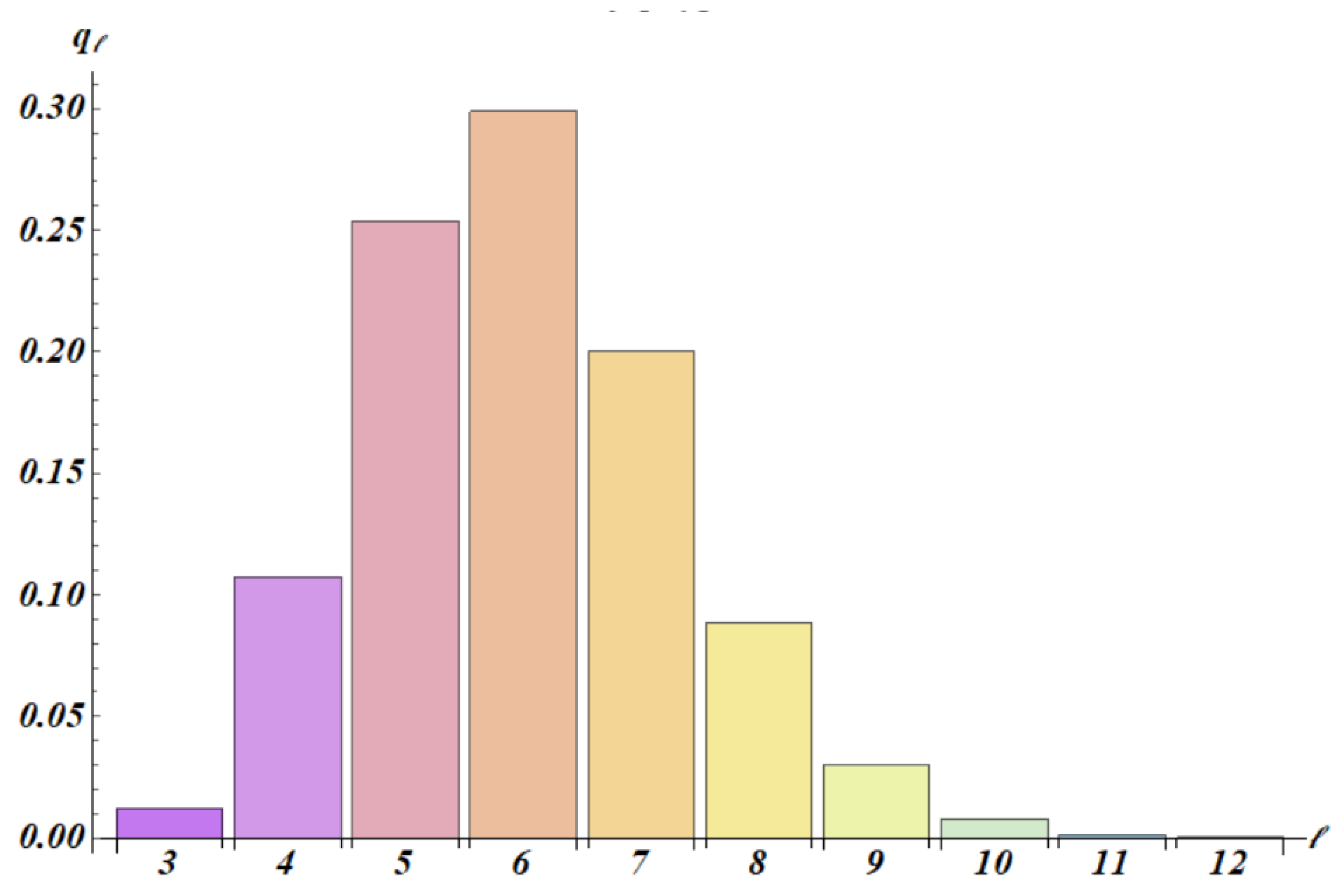
Table A1.
Comparative table for computational distribution and reported by [14].
Table A1.
Comparative table for computational distribution and reported by [14].
| ℓ | by [14] | |
| 6 | 0.29895 | 0.29473 |
| 4 | 0.107502 | 0.106838 |
| 8 | 0.0882781 | 0.0897 |
| 5 | 0.253834 | 0.25946 |
| 7 | 0.20026 | 0.19877 |
| 3 | 0.0121601 | 0.01124 |
| 9 | 0.0296985 | 0.0295 |
| 10 | 0.00767202 | 0.00743 |
| 11 | 0.00135112 | 0.00149 |
| 12 | 0.000293722 | 0.00025 |
Figure A2.
Distribution of multisets M.
Appendix B
Results for corresponding values , , ,. .
Figure 1.
A) Maximal green clique size , B) variance of classes and C) for MEG (blue) and SEG (green) rules.
Figure 1.
A) Maximal green clique size , B) variance of classes and C) for MEG (blue) and SEG (green) rules.
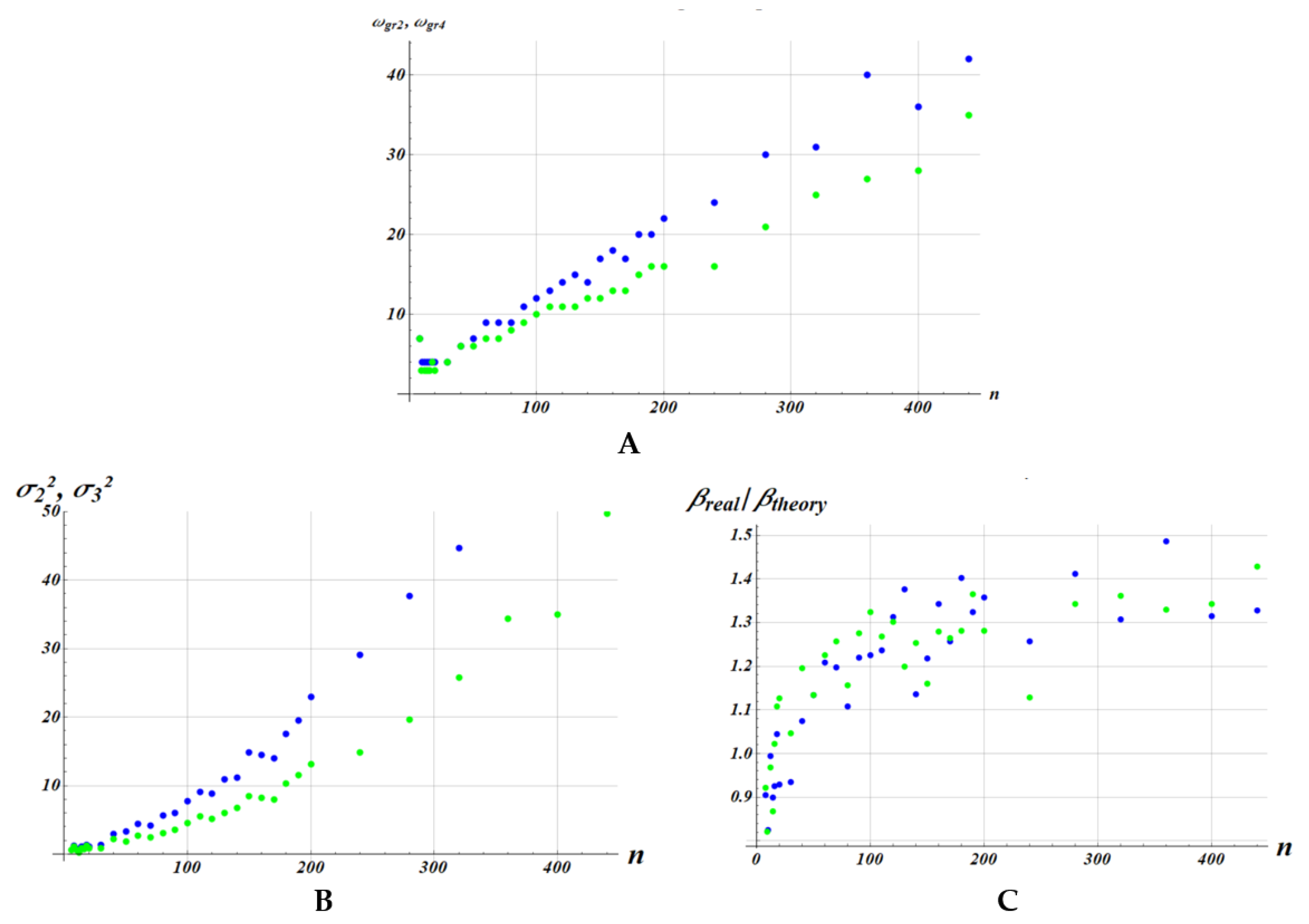
Figure 2.
Turán ratio for green (A) and red (B) subgraphs for MEG (blue) and SEG (green) graphs.
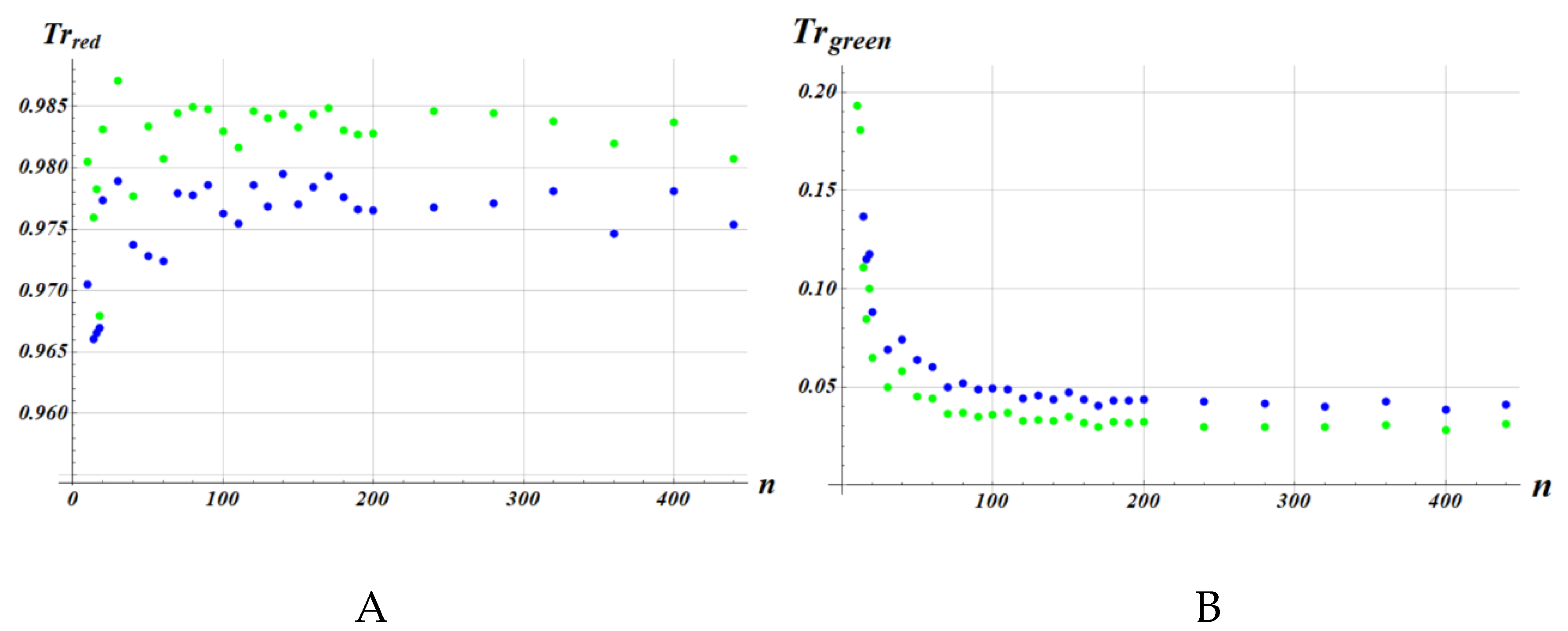
Table 1.
Ramsey threshold estimation.
| (red clique size) | Estimated n | |
| 3 | 11 | 15 |
| 4 | 12 | 16 |
| 5 | 13 | 17 |
| 6 | 14 | 17 |
| 10 | 18 | 21 |
References
- Grünbaum, B.; Shephard, G.C. Tilings and Patterns; W.H. Freeman: New York, NY, USA, 1987. [Google Scholar]
- Conway, J.H.; Burgiel, H.; Goodman-Strauss, C. The Symmetries of Things; A K Peters: Natick, MA, USA, 2008. [Google Scholar]
- Senechal, M. Quasicrystals and Geometry; Cambridge University Press: Cambridge, UK, 1995. [Google Scholar]
- Ramsey, F.P. On a Problem of Formal Logic. Proc. Lond. Math. Soc. 1930, s2-30, 264–286. [Google Scholar] [CrossRef]
- Graham, R.L.; Rothschild, B.L.; Spencer, J.H. Ramsey Theory, 2nd ed.; Wiley: New York, NY, USA, 1990. [Google Scholar]
- Diestel, R. Graph Theory, 5th ed.; Springer: Berlin/Heidelberg, Germany, 2017. [Google Scholar]
- Turán, P. On an Extremal Problem in Graph Theory. Mat. Fiz. Lapok 1941, 48, 436–452. [Google Scholar]
- Mantel, W. Problem 28. Wiskd. Opgaven 1907, 10, 60–61. [Google Scholar]
- Bollobás, B. Modern Graph Theory; Springer: New York, NY, USA, 1998. [Google Scholar]
- Godsil, C.; Royle, G. Algebraic Graph Theory; Springer: New York, NY, USA, 2001. [Google Scholar]
- Stanley, R.P. Enumerative Combinatorics, 2nd ed.Cambridge University Press: Cambridge, UK, 2011; Vol. 1. [Google Scholar]
- Thäle, C.; Weiß, V. The Combinatorial Structure of Spatial STIT Tessellations. Discret. Comput. Geom. 2013, 50, 649–672. [Google Scholar] [CrossRef]
- Frank, N.P. Detecting Combinatorial Hierarchy in Tilings Using Derived Voronoi Tessellations. Discret. Comput. Geom. 2003, 29, 459–467. [Google Scholar] [CrossRef]
- Calka, P. Precise Formulae for the Distributions of the Numbers of Edges of the Typical Poisson–Voronoi Cell. Adv. Appl. Probab. 2003, 35, 551–562. [Google Scholar] [CrossRef]
- Møller, J. Lectures on Random Voronoi Tessellations; Springer: New York, NY, USA, 1994. [Google Scholar]
- Cowan, R. Properties of Poisson–Voronoi Tessellations Relevant to Random Spatial Division. In Statistics of Spatial Processes; Springer: Berlin/Heidelberg, Germany, 1991; pp. 145–161. [Google Scholar]
- Coxeter, H.S.M. Introduction to Geometry, 2nd ed.; Wiley: New York, NY, USA, 1969. [Google Scholar]
- Gilevich, A.; Shoval, S.; Nosonovsky, M.; Frenkel, V.; Bormashenko, E. Converting Tessellations into Graphs: From Voronoi Tessellations to Complete Graphs. Mathematics 2024, 12, 2426. [Google Scholar] [CrossRef]
- Legchenkova, I.; Frenkel, V.; Shvalb, N.; Shoval, S.; Bormashenko, E. From Chaos to Ordering: New Studies in the Shannon Entropy of 2D Patterns. Entropy 2022, 24, 802. [Google Scholar] [CrossRef] [PubMed]
- Frenkel, V.; Legchenkova, I.; Bormashenko, E.; Shoval, S.; Nosonovsky, V. Extreme Values and Convergence of the Voronoi Entropy for 2D Random Point Processes and for Long-Range Order. Entropy 2026, 28, 95. [Google Scholar] [CrossRef] [PubMed]
- Okabe, A.; Boots, B.; Sugihara, K.; Chiu, S.N. Spatial Tessellations: Concepts and Applications of Voronoi Diagrams, 2nd ed.; Wiley: Chichester, UK, 2000. [Google Scholar]
- Aurenhammer, F. Voronoi Diagrams---A Survey of a Fundamental Geometric Data Structure. ACM Comput. Surv. 1991, 23, 345–405. [Google Scholar] [CrossRef]
- Biggs, N. Algebraic Graph Theory, 2nd ed.; Cambridge University Press: Cambridge, UK, 1993. [Google Scholar]
- Harary, F. Graph Theory; Addison-Wesley: Reading, MA, USA, 1969. [Google Scholar]
- Wilson, R.J. Introduction to Graph Theory, 5th ed.; Pearson Education: Harlow, UK, 2010. [Google Scholar]
- Erdos, P.; Stone, A.H. On the Structure of Linear Graphs. Bull. Am. Math. Soc. 1946, 52, 1087–1091. [Google Scholar] [CrossRef]
- Weisstein, E.W. Cairo Tessellation. Available online: https://mathworld.wolfram.com/CairoTessellation.html (accessed on 28 May 2026).
- Grünbaum, B.; Shephard, G.C. Tilings by Regular Polygons. Math. Mag. 1977, 50, 227–247. [Google Scholar] [CrossRef]
- Shi, L.; Xiong, Z.; Wang, H. Quasicrystal Approximants in Isoreticular Metal-Organic Frameworks via Cairo Pentagonal Tiling. Chem 2024, 10, 2464–2472. [Google Scholar] [CrossRef]
- Kovács, G.; Nagy, B.; Turgay, N.D. Distance on the Cairo Pattern. Pattern Recognit. Lett. 2021, 145, 141–146. [Google Scholar] [CrossRef]
- Erdos, P.; Rényi, A. On Random Graphs I. Publ. Math. Debr. 1959, 6, 290–297. [Google Scholar] [CrossRef]
- Jungck, J. R.; Biswas, P. Graph Theoretic Analyses of Tessellations of Five Aperiodic Polykite Unitiles. Mathematics 2025, 13, 2982. [Google Scholar] [CrossRef]
- Alexandrov, A.D. Convex Polyhedra; Springer: Berlin/Heidelberg, Germany, 2005. [Google Scholar]
Figure 1.
Cairo tiling. The Cairo tiling is a periodic plane tessellation by congruent convex pentagons, widely known from the paving patterns of streets in Cairo. It belongs to the class of monohedral pentagonal tilings and possesses wallpaper symmetry group p4g. Red point corresponds to the 3-valency vertex, yellow – to the 4-valency vertex.
Figure 1.
Cairo tiling. The Cairo tiling is a periodic plane tessellation by congruent convex pentagons, widely known from the paving patterns of streets in Cairo. It belongs to the class of monohedral pentagonal tilings and possesses wallpaper symmetry group p4g. Red point corresponds to the 3-valency vertex, yellow – to the 4-valency vertex.
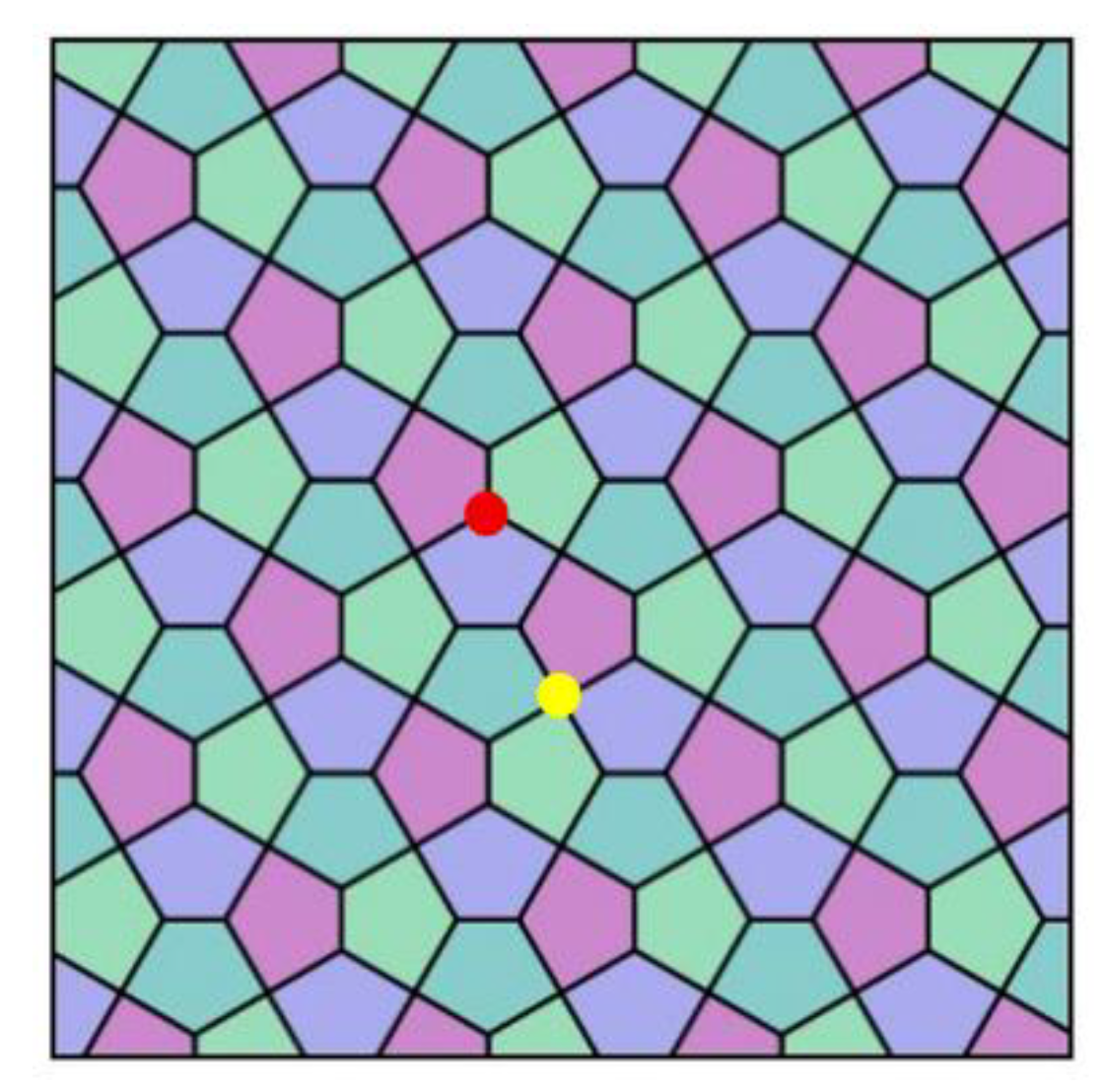
Figure 2.
Vertex v of the type corresponding to the multiset is depicted as a red point. Orange points are the seeds of Voronoi tessellation.
Figure 2.
Vertex v of the type corresponding to the multiset is depicted as a red point. Orange points are the seeds of Voronoi tessellation.
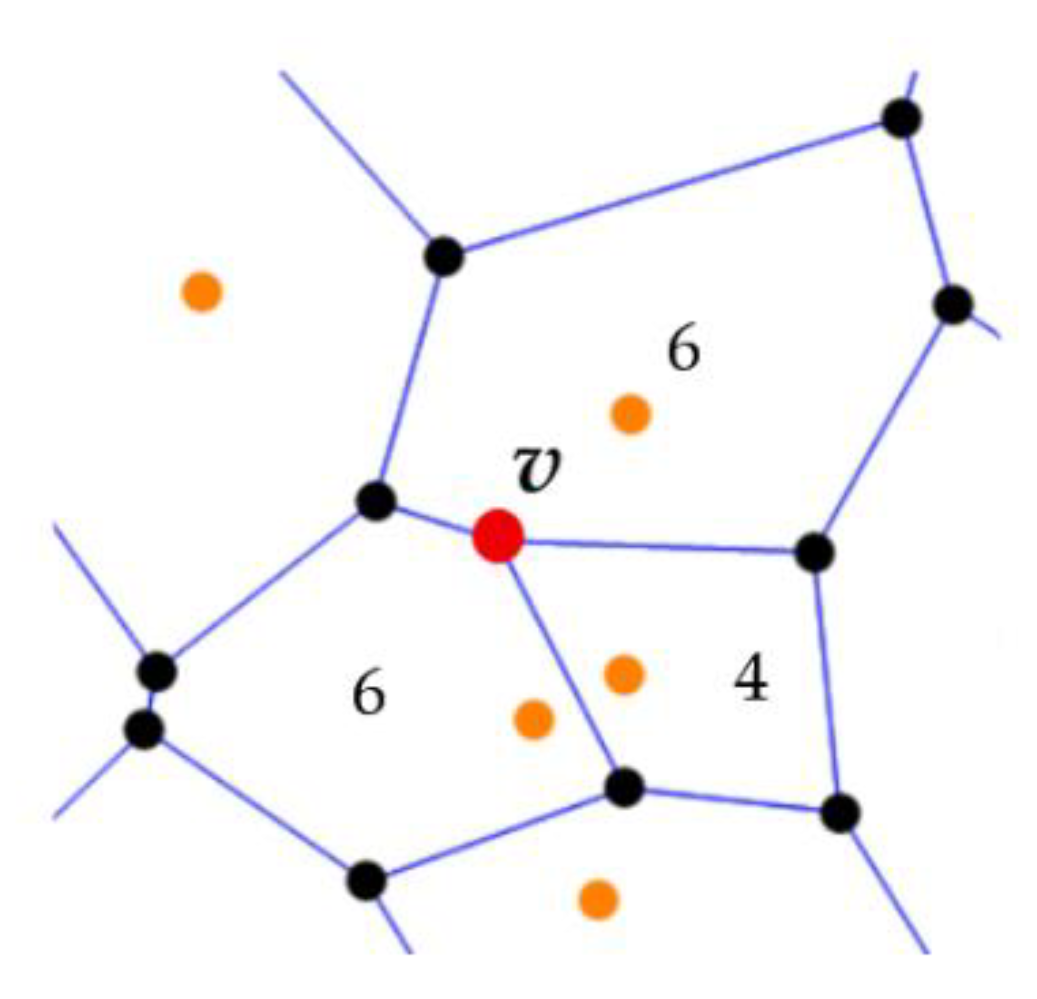
Figure 3.
A) The fraction of green links in MEG graph with fitting , . B) Number of classes with logarithmic fitting , .
Figure 3.
A) The fraction of green links in MEG graph with fitting , . B) Number of classes with logarithmic fitting , .
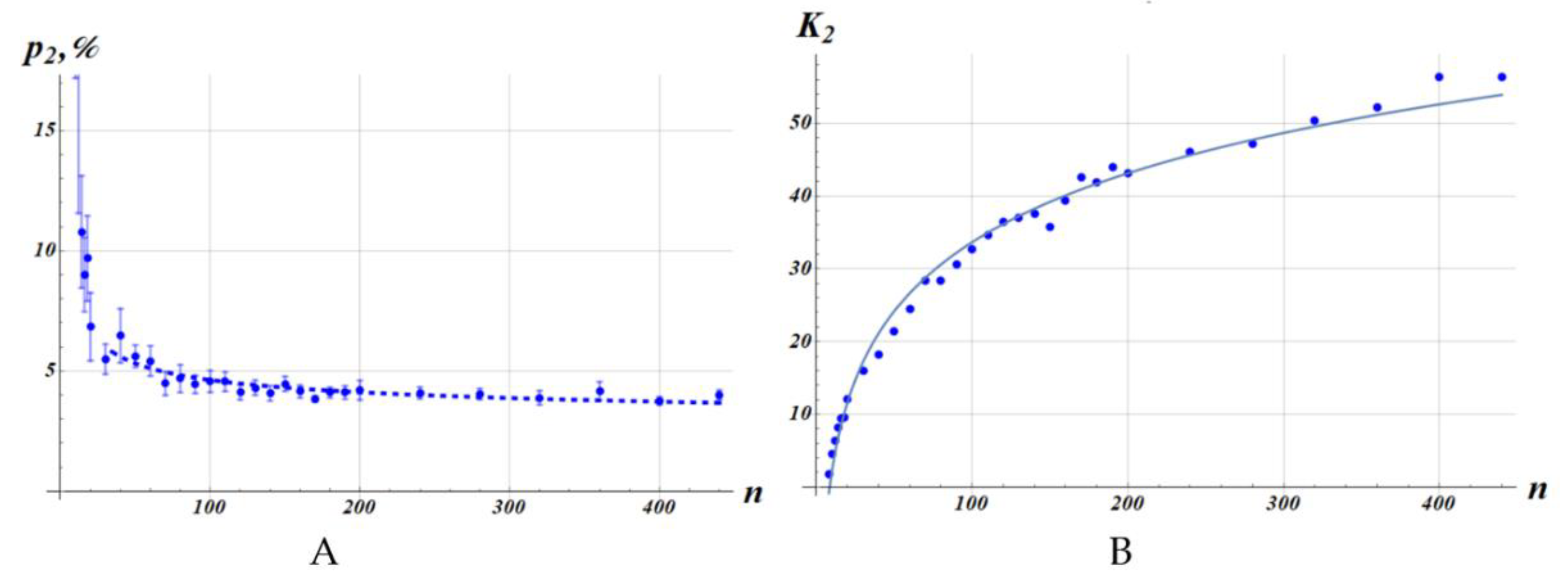
Figure 4.
The maximum size of clique in the green MEG subgraph. Blue points – the real ones, the red – estimation .
Figure 4.
The maximum size of clique in the green MEG subgraph. Blue points – the real ones, the red – estimation .
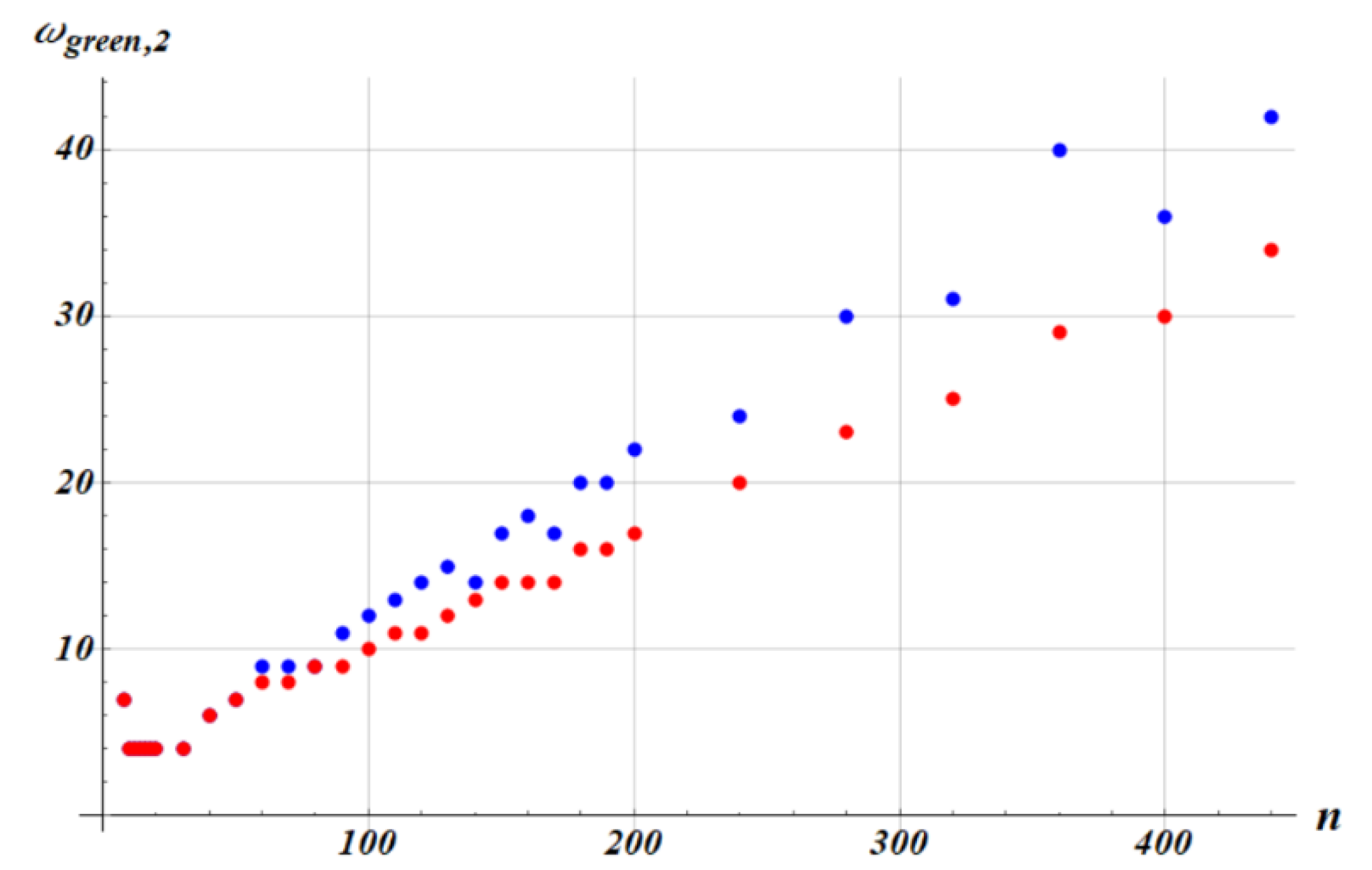
Figure 5.
A) The relation between coefficient , calculated directly from data, and estimated one . B) The variance of the sizes of equivalence classes.
Figure 5.
A) The relation between coefficient , calculated directly from data, and estimated one . B) The variance of the sizes of equivalence classes.
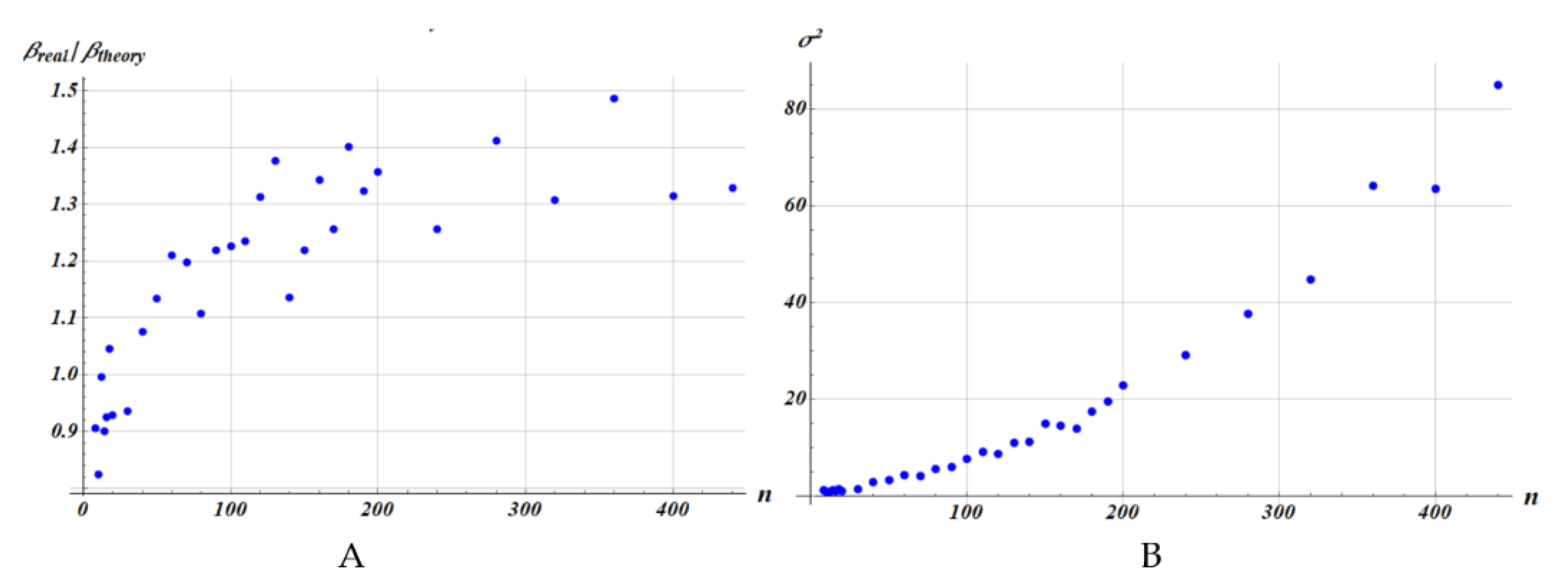
Figure 6.
A) Turán ratio for MEG green subgraph. B) Turán ratio for MEG red subgraph. Blue points correspond to directly calculated Turán number (Eq. 17), red ones – to estimation (Eq. 19, 20).
Figure 6.
A) Turán ratio for MEG green subgraph. B) Turán ratio for MEG red subgraph. Blue points correspond to directly calculated Turán number (Eq. 17), red ones – to estimation (Eq. 19, 20).
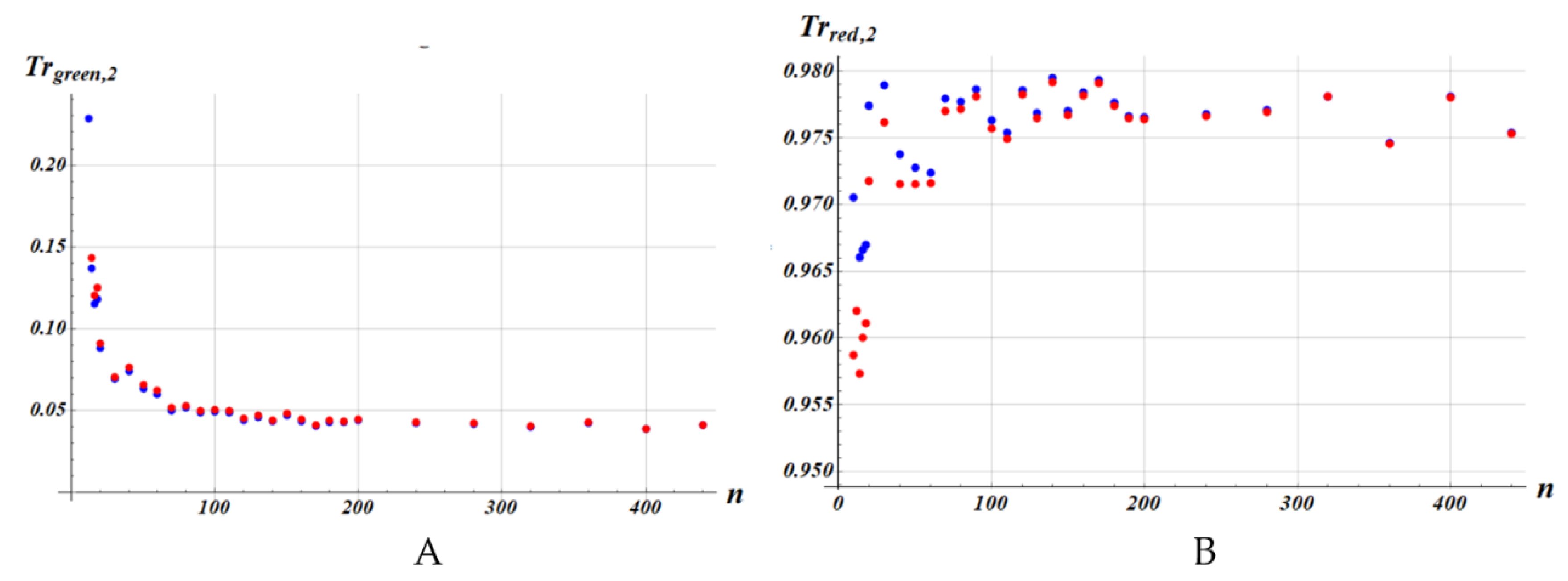
Figure 7.
Percentage of the chiral nodes.
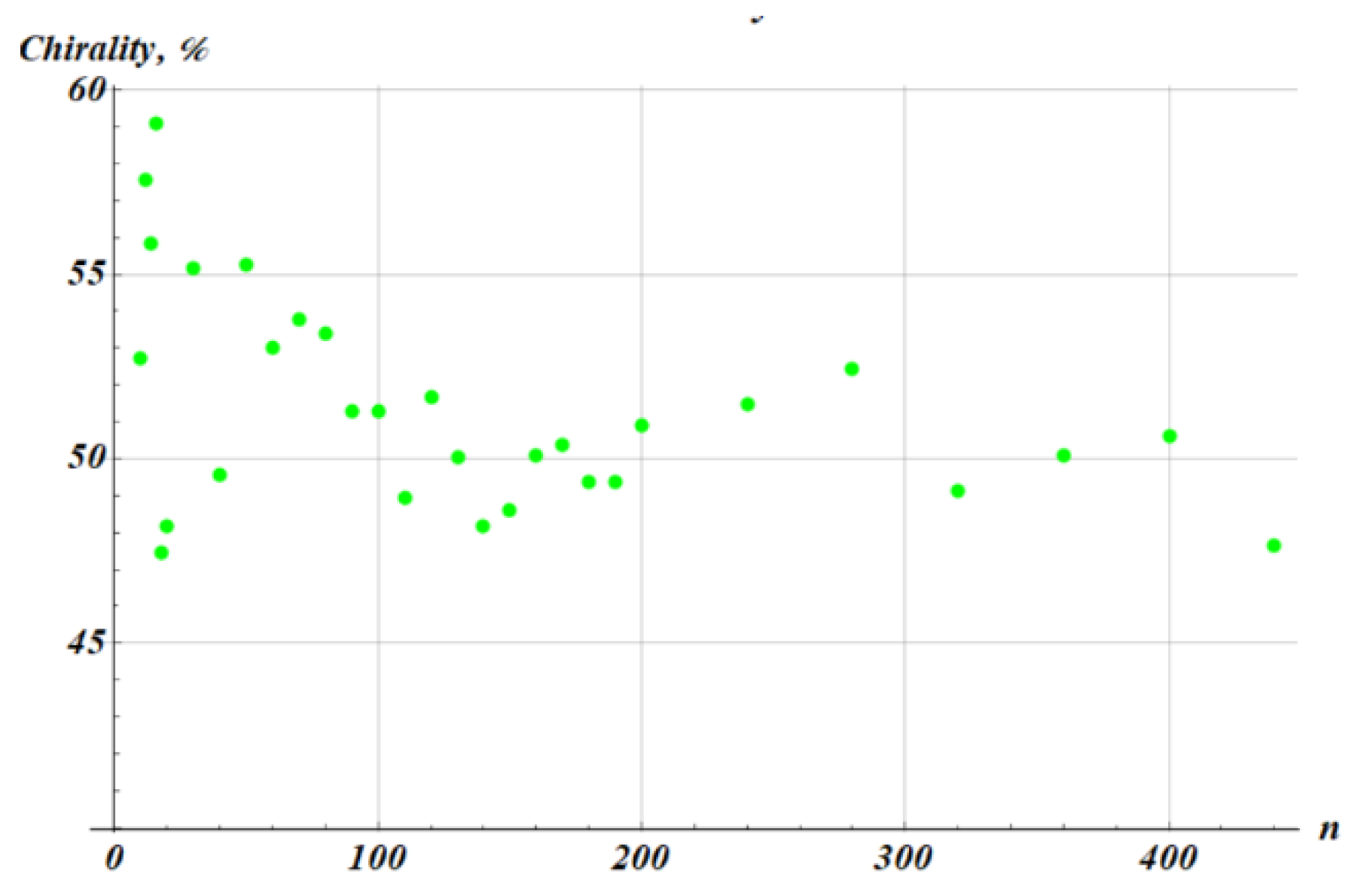
Figure 8.
A) Number of classes with logarithmic fitting , ; , . B) Relative relation between and .
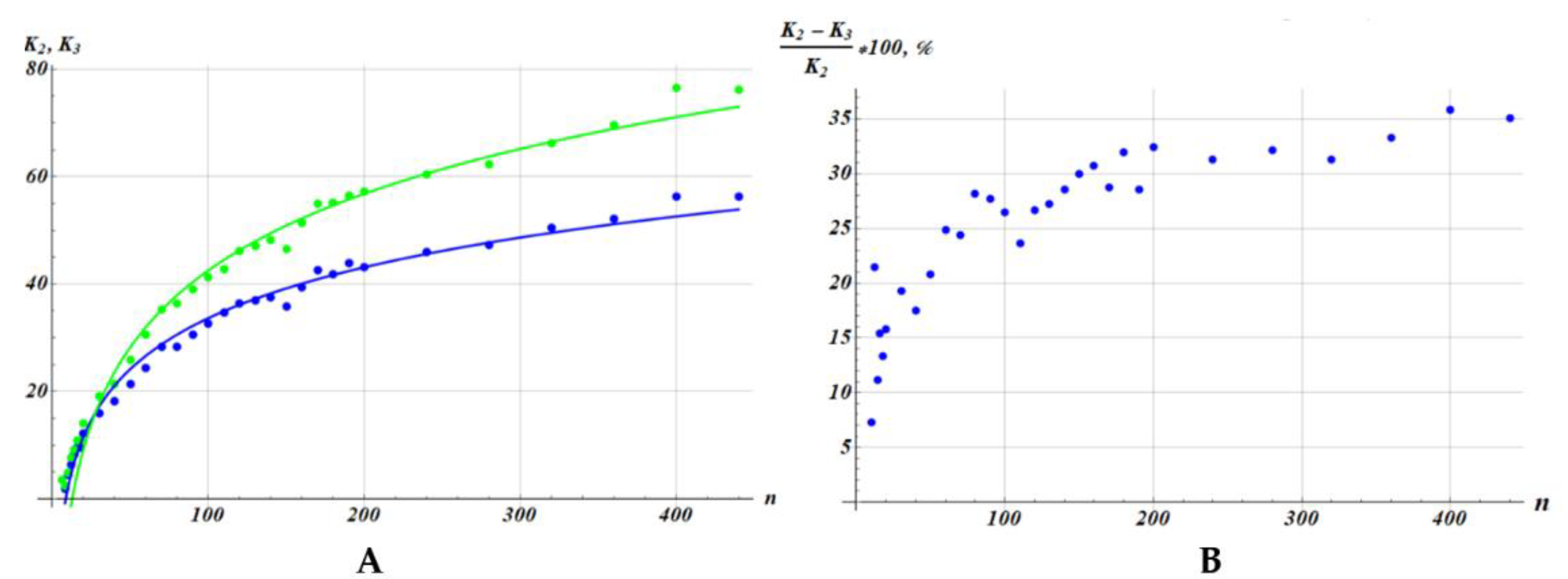
Figure 9.
The fraction of green links p in log-log scale for three rules: blue – rule 2 MEG, green – rule 3 SEG, red – rule 4 SIG. Dashed lines correspond to logarithmic fitting for rules 2 and 3, and constant for rule 4: , ; ; 85.7±0.4%.
Figure 9.
The fraction of green links p in log-log scale for three rules: blue – rule 2 MEG, green – rule 3 SEG, red – rule 4 SIG. Dashed lines correspond to logarithmic fitting for rules 2 and 3, and constant for rule 4: , ; ; 85.7±0.4%.
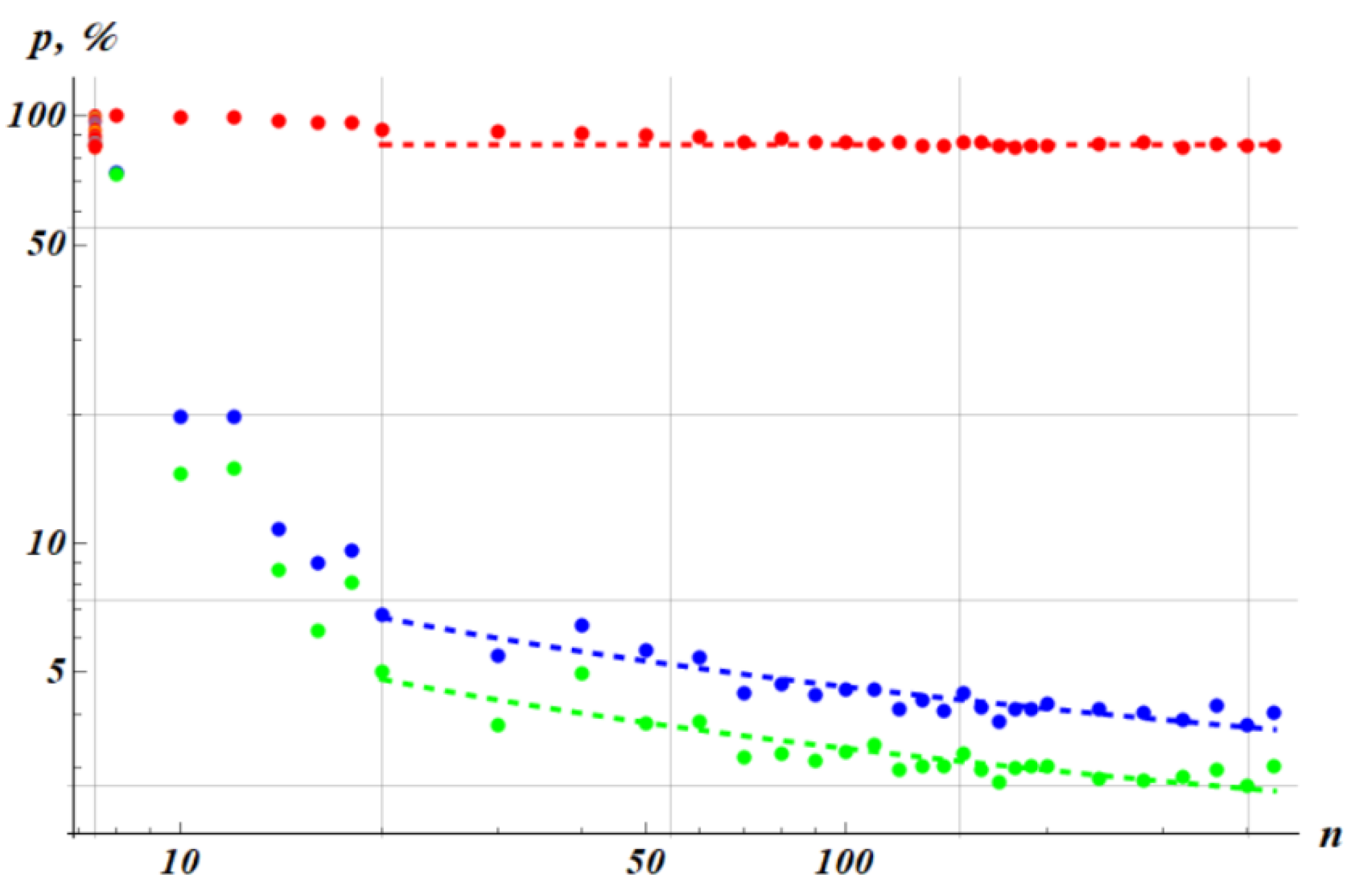
Figure 10.
Four estimations: lower bound (Eq. 23), Poisson approximation (Eq. 24), multiset combinations (Eq. 25), Monte Carlo. Blue bar is the empirical value.
Figure 10.
Four estimations: lower bound (Eq. 23), Poisson approximation (Eq. 24), multiset combinations (Eq. 25), Monte Carlo. Blue bar is the empirical value.
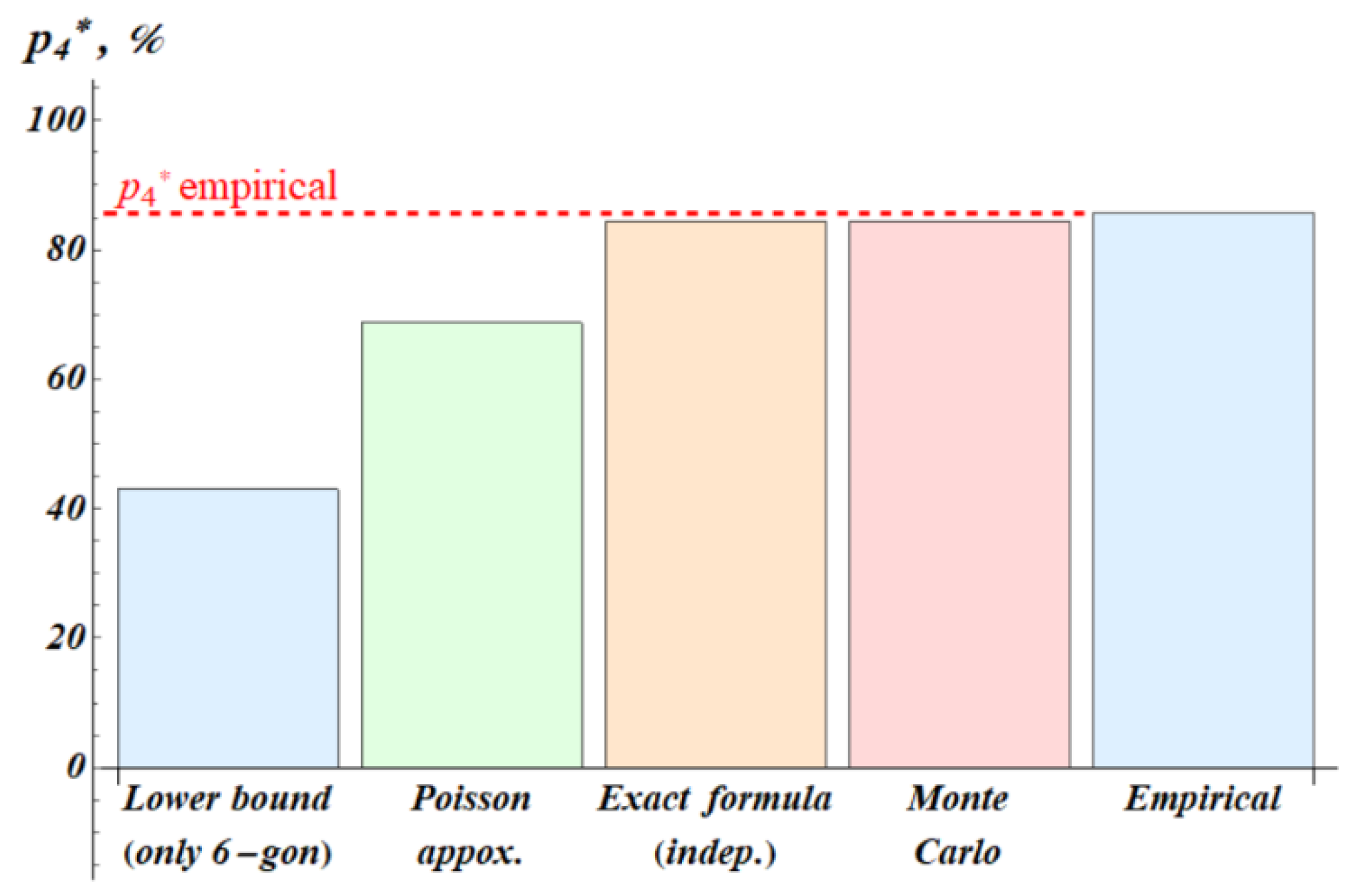
Figure 11.
Red point: strict computational counting. Green dashed line: fitting with Eq. 26 (, ). Black dotted line: Eq 26 with constant .
Figure 11.
Red point: strict computational counting. Green dashed line: fitting with Eq. 26 (, ). Black dotted line: Eq 26 with constant .
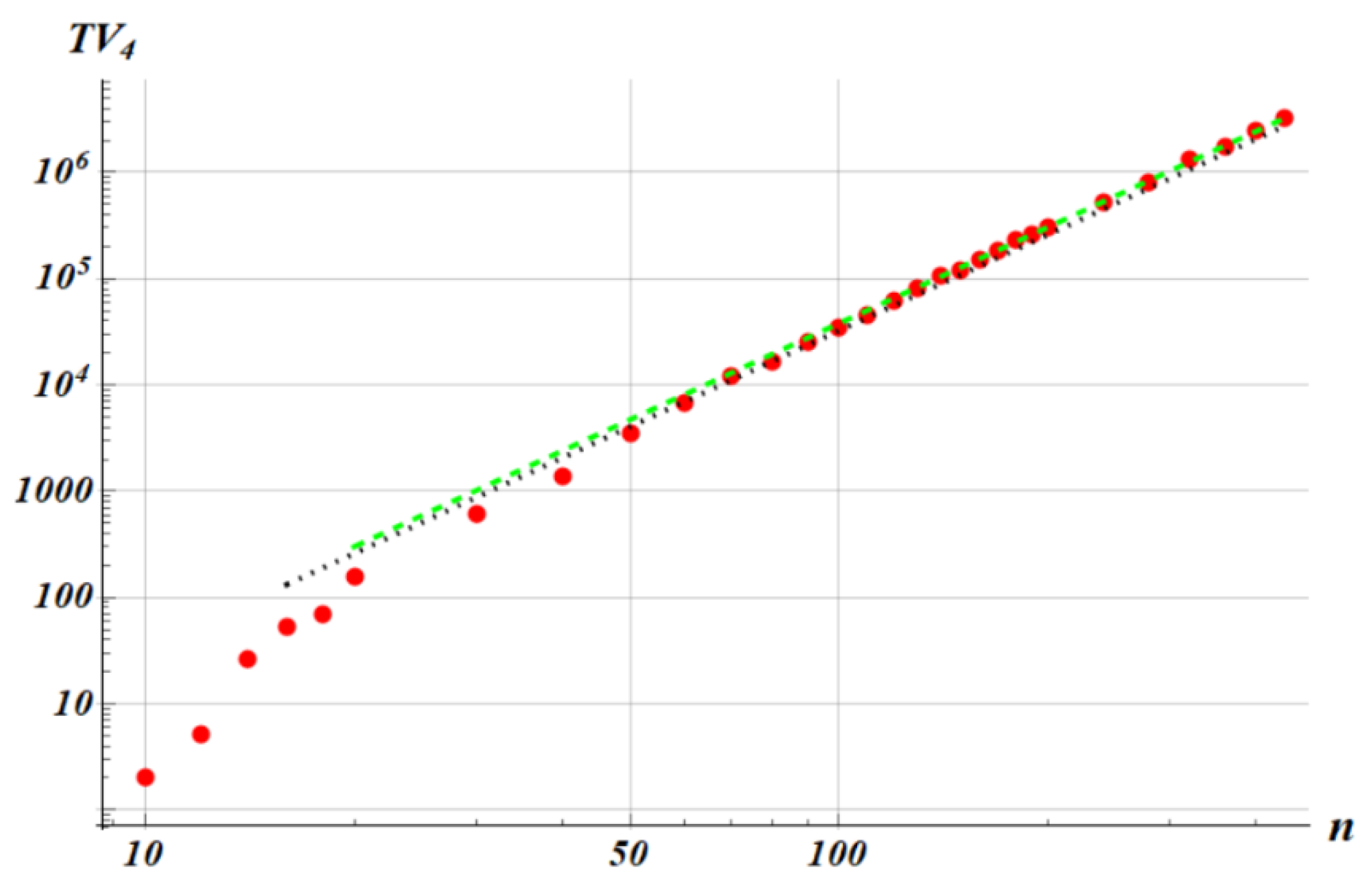
Figure 12.
Red points: results of a “greedy algorithm”. Black points: estimation with Eq. 27.
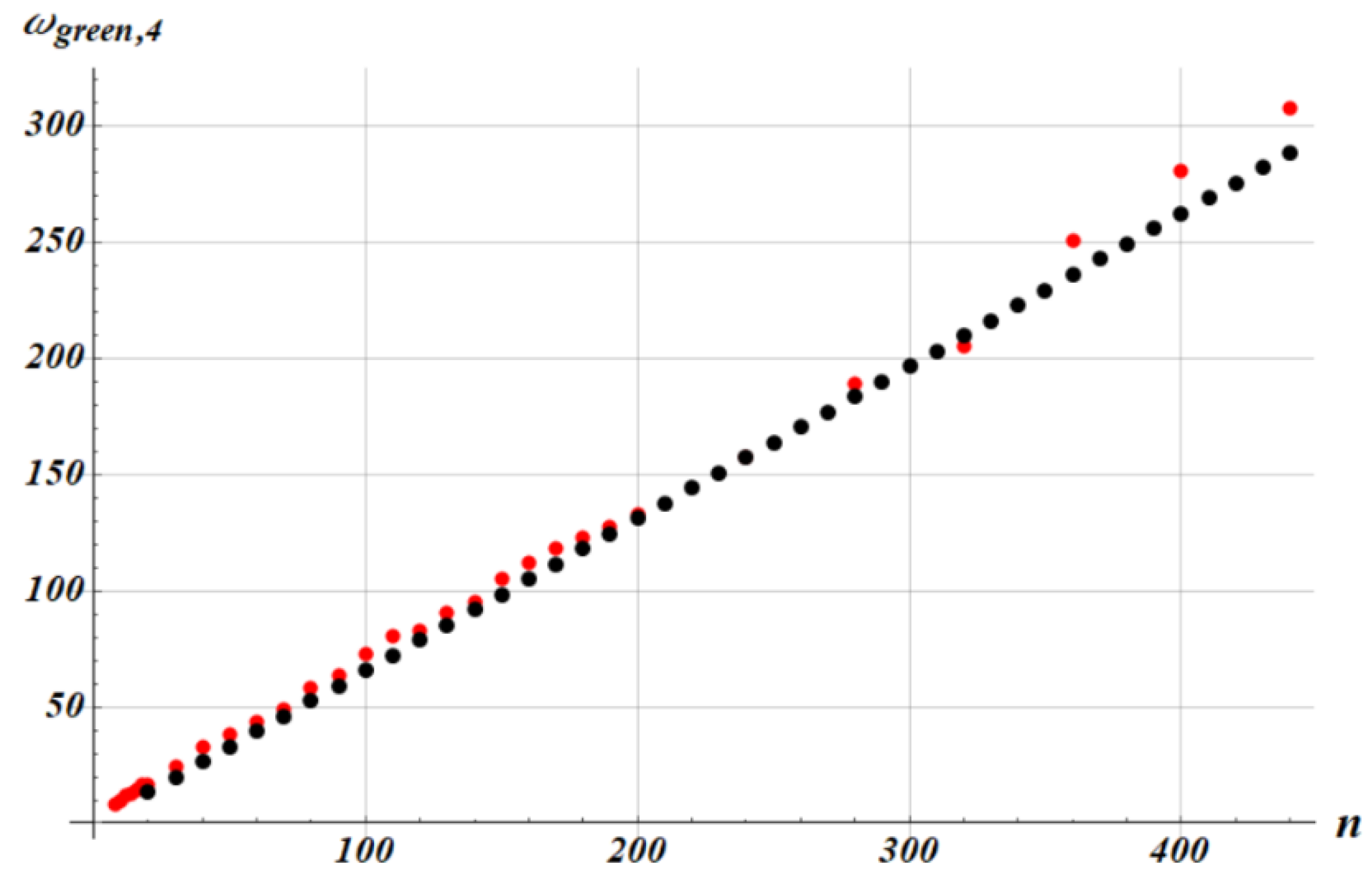
Figure 13.
Maximal red clique values.
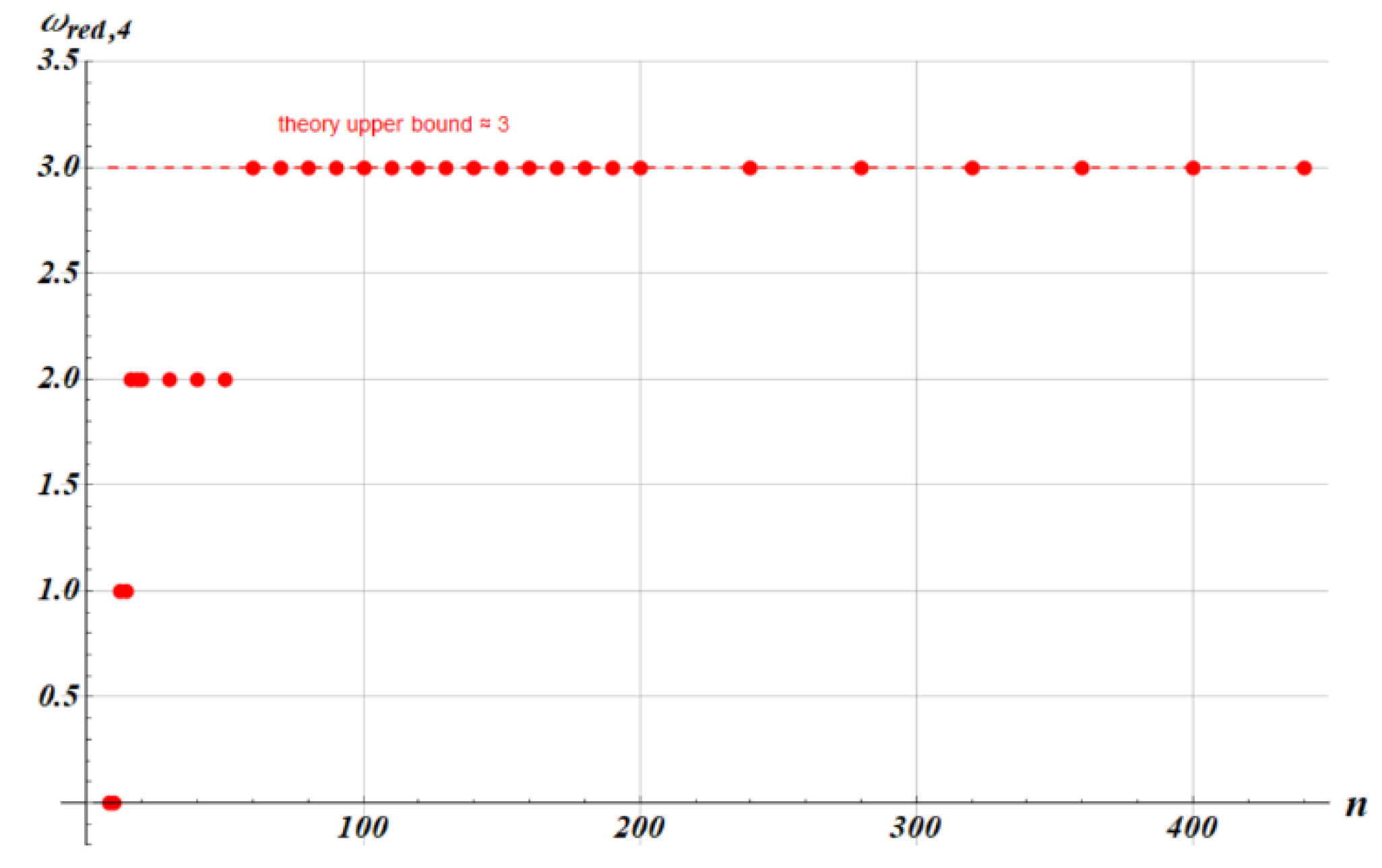
Figure 14.
Red points: empirical Turán ratio data. Red dashed line: the asymptotics according to Eq. 29.
Figure 14.
Red points: empirical Turán ratio data. Red dashed line: the asymptotics according to Eq. 29.
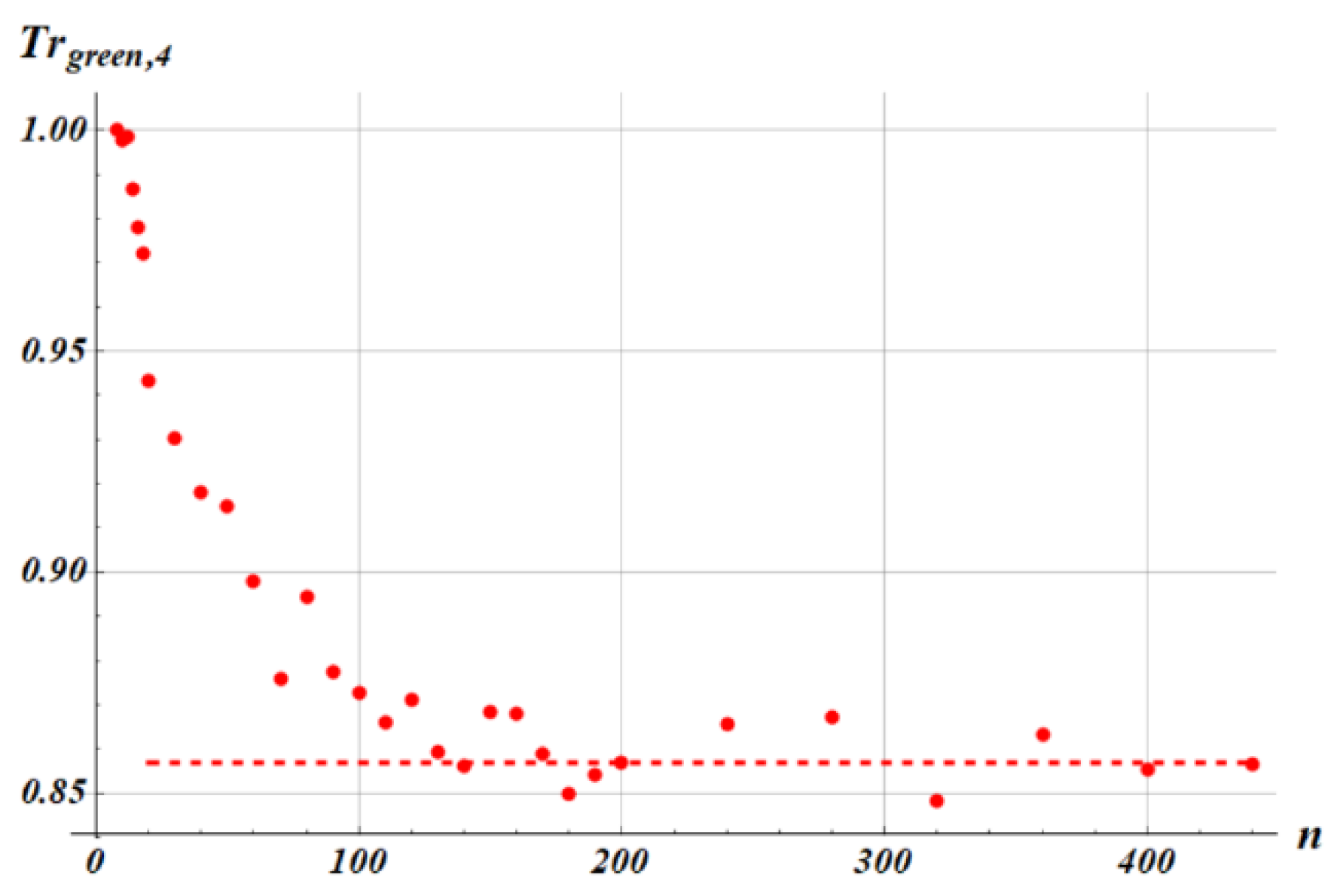
Table 2.
Summary of Tessellation-Generated Ramsey Graph Rules.
| Feature | VDG (Rule 1) | MEG/SEG (Rules 2 and 3) | SIG (Rule 4) |
| Equivalence relation | True | True | True |
| Transitivity | Transitive (TV=0) | Transitive (TV=0) | Non-transitive () |
| Graph Topology | Disjoint complete green cliques | Disjoint complete green cliques | Overlapping cluster structures |
| Asymptotic Green Fraction (p) | Decays logarithmically ; | Approaches constant | |
| Max Green Clique | Max size of equivalence class; | Linear growth | |
| Max Red Clique | ; | Constant | |
| Turán ratio | 1 |
,. |
|
Disclaimer/Publisher’s Note: The statements, opinions and data contained in all publications are solely those of the individual author(s) and contributor(s) and not of MDPI and/or the editor(s). MDPI and/or the editor(s) disclaim responsibility for any injury to people or property resulting from any ideas, methods, instructions or products referred to in the content. |
© 2026 by the authors. Licensee MDPI, Basel, Switzerland. This article is an open access article distributed under the terms and conditions of the Creative Commons Attribution (CC BY) license (http://creativecommons.org/licenses/by/4.0/).
Copyright: This open access article is published under a Creative Commons CC BY 4.0 license, which permit the free download, distribution, and reuse, provided that the author and preprint are cited in any reuse.


