Preprint
Article

This version is not peer-reviewed.

Changes in Functional Status, Mental Health, and Quality of Life After Participation in a Community-Based Day Center Program for Older Adults: A Two-Year Pre–Post Study in Chile

Submitted:

03 June 2026

Posted:

04 June 2026

You are already at the latest version

Abstract

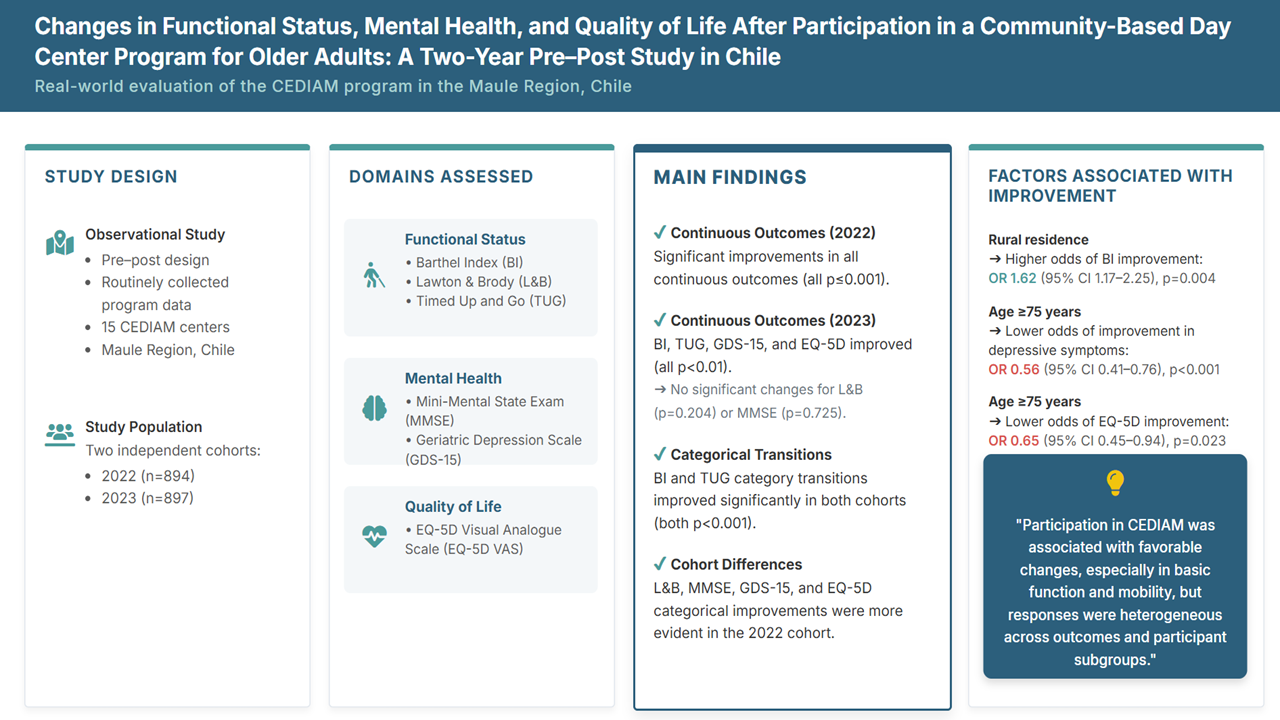
Objective: To examine changes in functional status, mental health, and quality of life among older adults participating in the CEDIAM program in the Maule Region of Chile in 2022 and 2023. Methods: Pre-post observational study using routinely collected data from 15 CEDIAM centers. The 2022 and 2023 datasets were analyzed as independent cohorts. Functional status was assessed with the Barthel Index (BI), Lawton and Brody scale (L&B), and Timed Up and Go test (TUG); mental health with the Mini-Mental State Examination (MMSE) and Geriatric Depression Scale-15 (GDS-15); and quality of life with the EuroQol-5D visual analogue scale (EQ-5D). Paired comparisons, category-transition analyses, and multivariable logistic regression models of improvement were performed. Results: Baseline samples included 894 participants in 2022 and 897 in 2023. In 2022, all continuous outcomes improved significantly (all p≤0.001). In 2023, BI, TUG, GDS-15, and EQ-5D improved (all p<0.01), whereas L&B (p=0.204) and MMSE (p=0.725) did not. Category-transition analyses showed significant improvements in BI and TUG in both cohorts (both p<0.001), while significant categorical changes in L&B, MMSE, GDS-15, and EQ-5D were observed only in 2022 (all p≤0.01). Rural residence was associated with higher odds of BI improvement (OR 1.62, 95% CI 1.17-2.25; p=0.004), whereas age ≥75 years was associated with lower odds of improvement in GDS-15 (OR 0.56, 95% CI 0.41-0.76; p<0.001) and EQ-5D (OR 0.65, 95% CI 0.45-0.94; p=0.023). Conclusion: Participation in CEDIAM was associated with favorable changes, particularly in basic functional status and mobility, although responses varied across outcomes and participant subgroups.
Keywords: 
;  ;  

1. Introduction

Population ageing is transforming health and social care systems worldwide and has become one of the most important public health challenges of the 21st century [1,2]. In this context, healthy ageing has increasingly been understood not only as survival into older age, but as the ability to maintain functional capacity, autonomy, psychological well-being, and participation in community life. This broader perspective is especially relevant in countries such as Chile, where demographic ageing has progressed rapidly over recent decades and now poses major challenges for health systems, social support, and long-term care policies [3,4,5,6].This approach is also consistent with the contemporary framework of healthy ageing proposed by the World Health Organization, which emphasizes the maintenance of functional ability as a central goal in later life [7].
Within this scenario, community-based care models for older adults have gained increasing attention as potential strategies to support ageing in place, preserve independence, and reduce the need for institutional care [8]. Among these, day care centers (DCCs) for older people may provide opportunities to improve social participation, mental health, physical functioning, and quality of life [9,10]. However, the literature also shows substantial heterogeneity in the structure, aims, and intensity of these services, which makes it difficult to compare findings across studies and to draw firm conclusions regarding effectiveness [9]. Recent reviews suggest that day center-based interventions may offer benefits in rehabilitation, activity promotion, and social participation, but they also emphasize marked variability in intervention components, professionals involved, and outcomes assessed [11]. Likewise, evidence on psychosocial interventions delivered in day care services highlights potential benefits, while underscoring the diversity and complexity of these models [12].
In Chile, one of the main public strategies aimed at promoting healthy ageing is the Centros Diurnos del Adulto Mayor (CEDIAM) program, launched in 2013 by the National Service for Older Adults (SENAMA) as part of the country’s policy response to population ageing [13]. The program is designed to support community-dwelling older adults aged 60 years and over in maintaining autonomy, strengthening social inclusion, and promoting active participation in their local environment, while also offering preventive support to caregivers [14]. CEDIAM centers provide structured activities focused on personal care, social integration, and community engagement, and older adults are expected to attend at least two to three times per week for a minimum of six months [13]. Given its expansion across the country and its relevance within the Chilean social and health policy landscape, evaluating the real-world performance of this program is important from both a gerontological and a public health perspective.
Despite its policy relevance, the effectiveness of CEDIAM has been only scarcely evaluated. Previous studies in Chile have generally involved smaller samples, shorter follow-up periods, or narrower outcome assessment [13,14,15]. Moreover, the extent to which participation in CEDIAM is associated with changes across multiple domains of healthy ageing remains insufficiently characterized, particularly in real-world program settings. Therefore, the present study aimed to examine changes in functional status, mental health, and quality of life among older adults participating in CEDIAM centers in the Maule Region of Chile during the 2022 and 2023 cohorts older adults in the Maule Region during 2022 and 2023.

2. METHODOLOGY

2.1. Study design and data source

This was a pre–post observational study based on routinely collected data from the Centros Diurnos del Adulto Mayor (CEDIAM) program in the Maule Region, Chile. Data were obtained from the 15 CEDIAM centers operating in the region during 2022 and 2023 and were provided by the National Service for Older Adults (SENAMA). Because no individual participant was assessed in both calendar years, the datasets from 2022 and 2023 were considered independent cohorts.

2.2. Participants

Participants were eligible for inclusion if they had completed the required entry and exit assessments established by the CEDIAM program for the outcomes evaluated in this study. Records were excluded when information was missing, inconsistent, or clearly erroneous. Because completeness varied across instruments, the analytical sample differed according to each scale. Therefore, only participants with paired entry–exit data for a given instrument were included in the corresponding analysis.

2.3. Geriatric assessment and study outcomes

The geriatric assessment covered three domains: functional status, mental health, and quality of life. All assessments were conducted by trained CEDIAM staff following standardized program procedures.

2.4. Functional status

Functional status was assessed using three instruments. The Barthel Index (BI) was used to evaluate basic activities of daily living, with scores ranging from 0 to 100 points, where higher scores indicate greater independence. For categorical analyses, BI scores were classified as independent (100 points), mild dependence (>60 and <100 points), and moderate dependence (≤60 points) [16,17]. Instrumental activities of daily living were assessed using the Lawton and Brody scale (L&B), with scores ranging from 0 to 8 points and higher values indicating greater independence. For categorical analyses, scores were classified as independent (8 points), mild dependence (6–7 points), moderate dependence (4–5 points), severe dependence (2–3 points), and total dependence (0–1 point) [17,18]. Mobility and fall risk were assessed using the Timed Up and Go test (TUG), which measures the time required to stand up from a chair, walk three meters, turn, return, and sit down again. Participants performed the test without physical assistance. For categorical analyses, TUG performance was classified as no risk of falls (<10 seconds) and risk of falls (≥10 seconds) [17,19].

2.5. Mental health

Mental health was assessed using the Mini-Mental State Examination (MMSE) and the 15-item Geriatric Depression Scale (GDS-15). The MMSE evaluates global cognitive function on a 0–30-point scale, with higher scores indicating better performance. Cognitive status was categorized as no cognitive impairment (>27 points), mild cognitive impairment (22–26 points), and suspected dementia (≤21 points) [17,20]. Depressive symptoms were assessed with the GDS-15, which includes 15 yes/no items and yields a total score ranging from 0 to 15 points. Scores were categorized as no depression (0–5 points), mild depression (6–9 points), and moderate-to-severe depression (≥10 points [17,21].

2.6. Quality of life

Quality of life was assessed using the EuroQol-5D visual analogue scale (EQ-5D), in which participants rate their perceived health status from 0 (worst imaginable health) to 100 (best imaginable health). For categorical analyses, scores were grouped as excellent/very good/good (≥60 points) and fair/poor (≤59 points) [22,23].

2.7. Definition of improvement

For secondary analyses, improvement was defined as any increase in score between entry and exit for BI, L&B, MMSE, and EQ-5D, and as any reduction in time or score for TUG and GDS-15, respectively.

2.8. Covariates

The following participant characteristics were included in multivariable analyses: residence (urban/rural), sex (men/women), age group (<75 years/≥75 years), multimorbidity (<2/≥2 chronic conditions), educational level (low education: primary school completed or less; higher education: above primary school), arterial hypertension (yes/no), and type 2 diabetes mellitus (yes/no).

2.9. Statistical analysis

Analyses were performed using IBM SPSS Statistics version 23.0 (IBM Corp., Armonk, NY, USA) and GraphPad Prism version 8. Descriptive data are presented as median and interquartile range (IQR) for continuous variables and as number and percentage for categorical variables. Baseline comparisons between the 2022 and 2023 cohorts were performed using the Mann–Whitney U test for continuous variables and the chi-square test for categorical variables. Within each cohort, pre–post changes in continuous scale scores were evaluated using the Wilcoxon signed-rank test. Changes in paired categorical classifications were analyzed using the McNemar test for outcomes with two categories and the McNemar–Bowker test for outcomes with more than two categories. When global tests were statistically significant, post hoc pairwise comparisons with Bonferroni correction were applied. To identify sociodemographic and clinical factors associated with improvement in each outcome, multivariable binary logistic regression models were fitted separately for each scale (BI, L&B, TUG, MMSE, GDS-15, and EQ-5D). For each instrument, the dependent variable was coded as 1 for participants who improved between entry and exit and 0 for those who did not improve, according to the predefined criteria for each scale. Independent variables were entered as binary covariates: residence (urban = 0, rural = 1), sex (men = 0, women = 1), age group (<75 years = 0, ≥75 years = 1), multimorbidity (<2 = 0, ≥2 chronic conditions = 1), educational level (higher education = 0, low education = 1), arterial hypertension (no = 0, yes = 1), and type 2 diabetes mellitus (no = 0, yes = 1). Because participants belonged exclusively to one cohort and no individual was evaluated in both years, analyses were conducted per outcome without repeated-measures adjustment by year. Adjusted odds ratios (ORs) and 95% confidence intervals (CIs) were estimated. Multicollinearity was assessed using variance inflation factors (VIFs), all of which were <2. A two-tailed p-value <0.05 was considered statistically significant.

2.10. Data authorization and ethical considerations

The study was based on a governmental database provided and authorized for use by SENAMA. Data was analyzed in anonymized form, and no direct contact with participants or additional data collection was performed for the present study.

3. RESULTS

3.1. Baseline characteristics of the 2022 and 2023 cohorts

A total of 894 participants in 2022 and 897 in 2023 were included in the baseline description (Table 1). The median age was similar across cohorts [74 (68–78) years in 2022 and 73 (68–77.5) years in 2023; p = 0.081]. Women represented approximately 80% of participants in both years (80.3% in 2022 and 80.5% in 2023; p = 0.830). Compared with the 2022 cohort, participants in 2023 were more frequently from rural areas (27.8% vs. 19.0%; p < 0.0001) and more often had multimorbidity (54.1% vs. 44.6%; p < 0.0001). Educational level was similar between cohorts, with more than half of participants in both years having low educational attainment (60.5% in 2022 and 59.2% in 2023; p = 0.346).

3.2. Changes in continuous scores between entry and exit

Paired sample sizes varied across instruments according to the availability of complete entry and exit assessments (Table 2a and Table 2b). In the 2022 cohort, statistically significant improvements were observed in all evaluated outcomes, including BI, L&B, TUG, MMSE, GDS-15, and EQ-5D (all p ≤ 0.001). In the 2023 cohort, significant improvements were observed in BI, TUG, GDS-15, and EQ-5D, whereas no significant changes were detected for L&B (p = 0.204) or MMSE (p = 0.725). Distributions of individual scores at entry and exit for both cohorts are shown in Supplementary Figure 1 and Figure 2.
Results are presented as median (IQR). Comparisons between entry and exit were performed using the Wilcoxon signed-rank test. n (paired) indicates participants with complete entry–exit assessments for each scale.

3.3. Category transitions between entry and exit
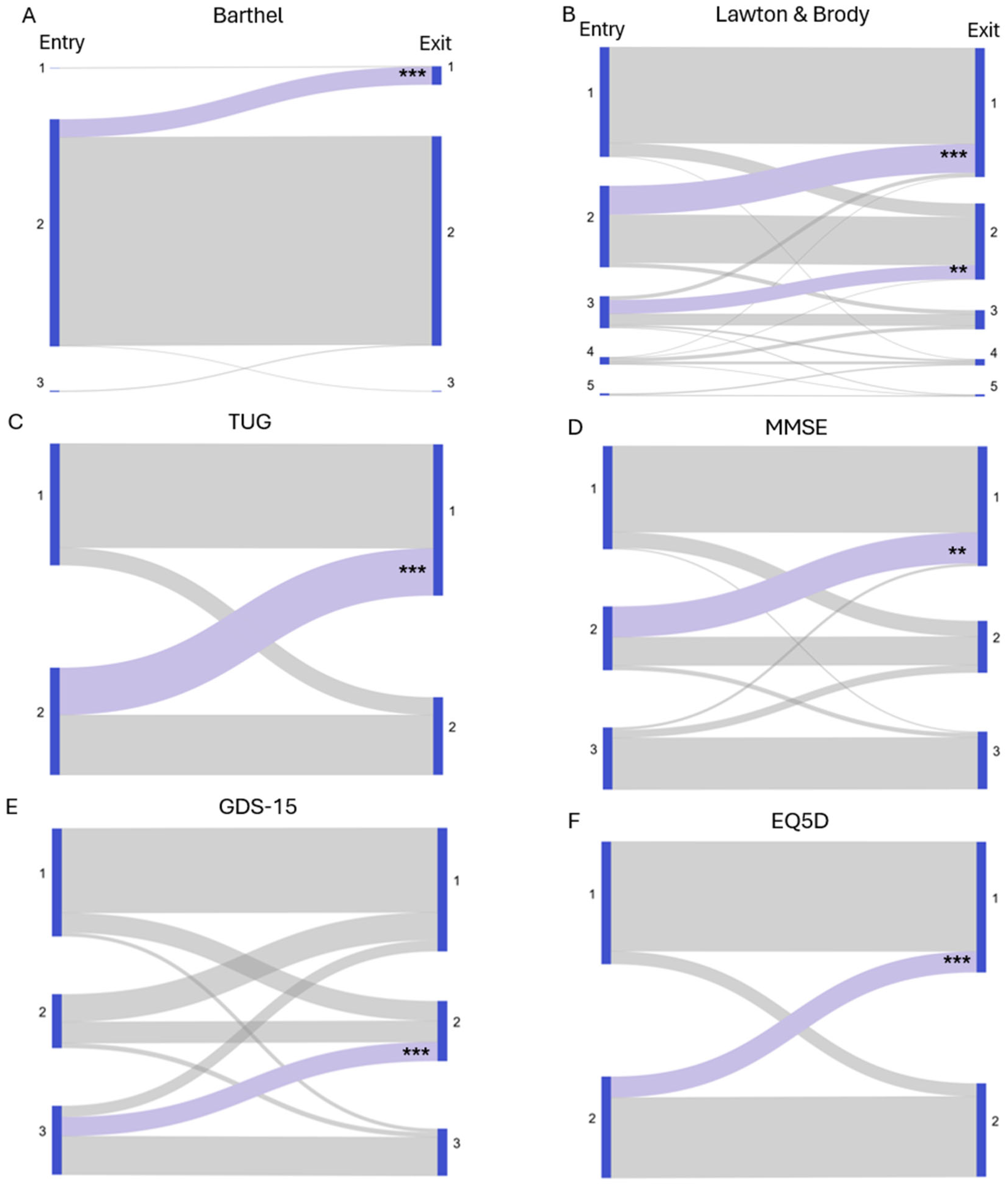
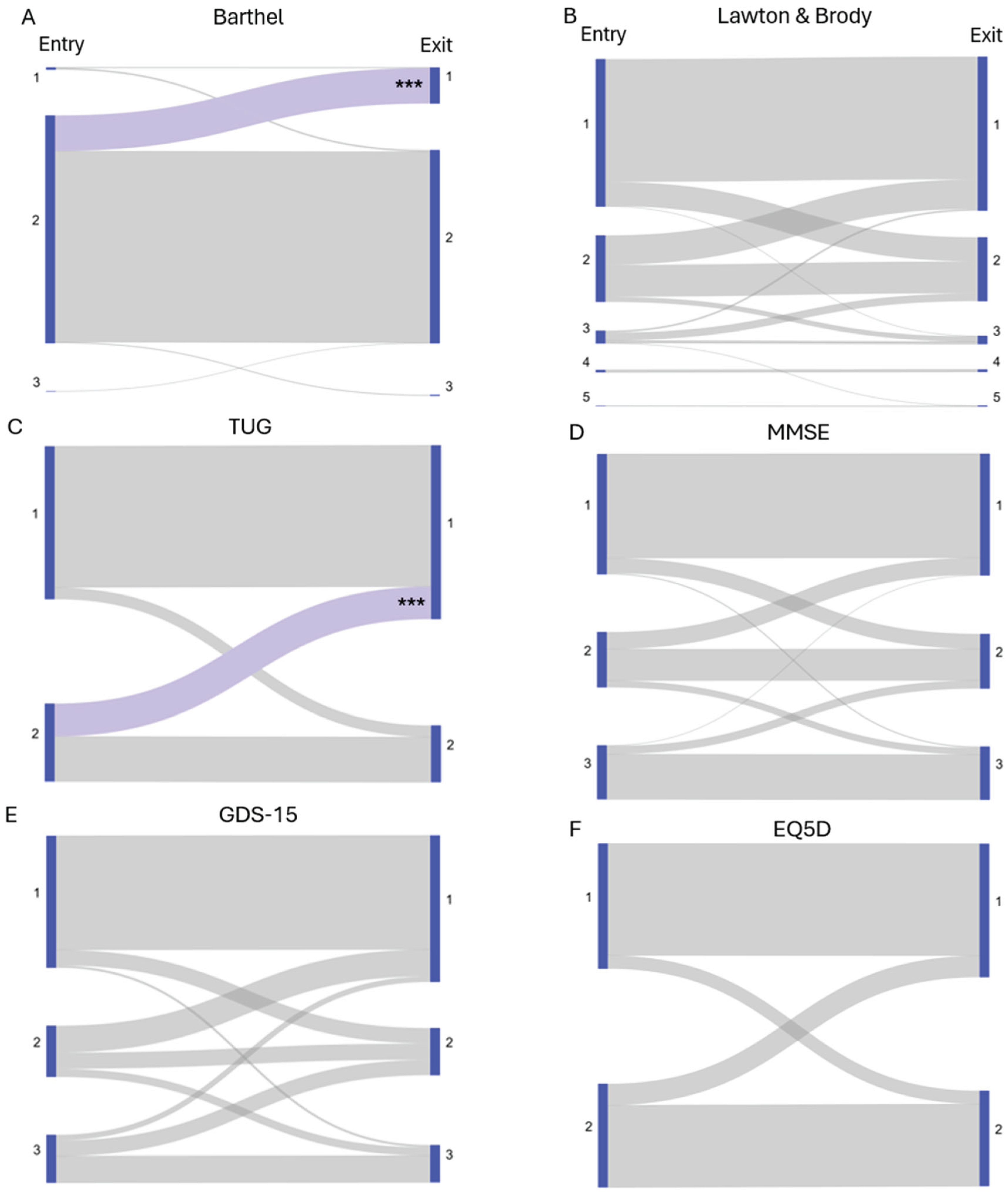
Changes in outcome categories between entry and exit are summarized in Supplementary Table 1s and illustrated in Figure 2 and Figure 3. In the functional domain, both cohorts showed a significant transition in BI categories from mild dependence to independence (p < 0.001). A significant reduction in fall risk according to TUG was also observed in both years, with participants moving from the “risk of falls” category to the “no risk of falls” category (p < 0.001). In contrast, significant upward transitions in L&B categories were observed only in the 2022 cohort, particularly from mild and moderate dependence to better functional categories (p < 0.001 and p < 0.01, respectively).
For mental health and quality of life, significant categorical changes were more evident in 2022. In that cohort, MMSE categories showed a significant shift from mild cognitive impairment to normal cognitive function (p < 0.01). Likewise, GDS-15 categories showed a favorable redistribution, with a reduction in moderate-to-severe depressive symptoms (p < 0.001). Self-rated quality of life also improved significantly in 2022, with participants more frequently moving from fair/poor to good, very good, or excellent health categories (p < 0.001). No significant category transitions were highlighted for MMSE, GDS-15, or EQ-5D in the 2023 cohort.
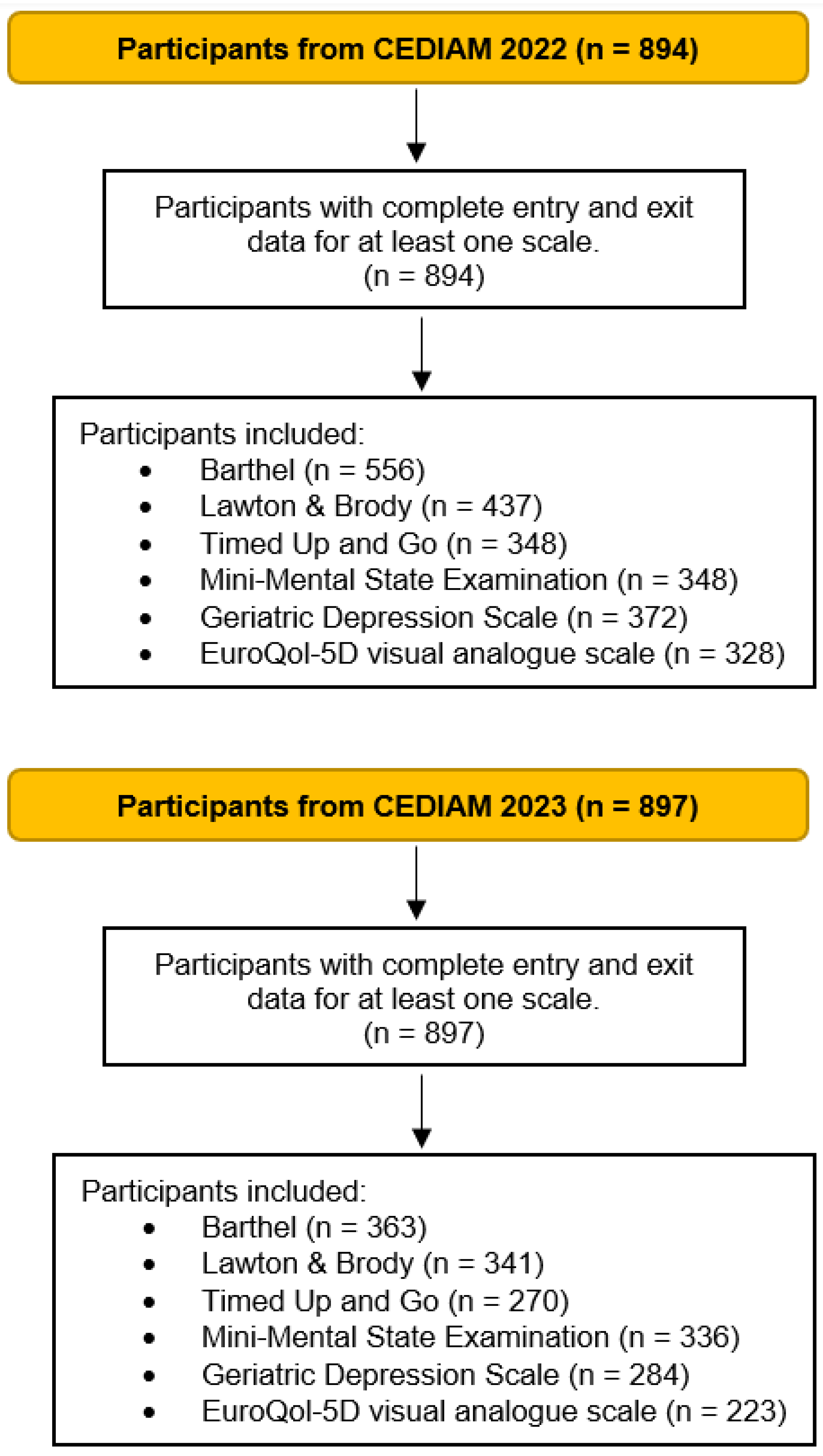
Figure 1. Flowchart of Participant Selection for the CEDIAM Evaluation Study (2022–2023). Sample size varies by scale according to availability of complete entry and exit assessment.
Preprints 216893 g001
Figure 2. Sankey plots showing categories transitions in functional status, mental health, and quality of life from entry to exit to the CEDIAM in 2022. Each panel (A–F) displays category changes for a specific scale: (A) Barthel Index, (B) Lawton & Brody, (C) Timed Up and Go (TUG), (D) Mini-Mental State Examination (MMSE), (E) Geriatric Depression Scale (GDS-15), and (F) EQ-5D. Category codes correspond to: Barthel (1 = independent, 2 = mild dependency, 3 = moderate dependency); Lawton & Brody (1 = independent, 2 = mild dependency, 3 = moderate dependency, 4 = severe dependency, 5 = total dependency); TUG (1 = no risk of falls, 2 = risk of falls); MMSE (1 = no impairment, 2 = mild impairment, 3 = suspected dementia); GDS-15 (1 = no depression, 2 = mild depression, 3 = moderate–severe depression); EQ-5D (1 = excellent/very good/good, 2 = fair/poor). Scales with two categories (TUG and EQ-5D) were evaluated using the McNemar test. Scales with three or more categories (Barthel, Lawton & Brody, MMSE, and GDS-15) were evaluated using the McNemar–Bowker test for paired categorical data. Post hoc comparisons were Bonferroni-adjusted. Purple flows indicate statistically significant transitions, while grey flows represent non-significant changes. ** p < 0.01, *** p < 0.001.
Preprints 216893 g002
Figure 3. Sankey plots showing categories transitions in functional status, mental health, and quality of life from entry to exit to the CEDIAM in 2023. Each panel (A–F) displays category changes for a specific scale: (A) Barthel Index, (B) Lawton & Brody, (C) Timed Up and Go (TUG), (D) Mini-Mental State Examination (MMSE), (E) Geriatric Depression Scale (GDS-15), and (F) EQ-5D. Category codes correspond to: Barthel (1 = independent, 2 = mild dependency, 3 = moderate dependency); Lawton & Brody (1 = independent, 2 = mild dependency, 3 = moderate dependency, 4 = severe dependency, 5 = total dependency); TUG (1 = no risk of falls, 2 = risk of falls); MMSE (1 = no impairment, 2 = mild impairment, 3 = suspected dementia); GDS-15 (1 = no depression, 2 = mild depression, 3 = moderate–severe depression); EQ-5D (1 = excellent/very good/good, 2 = fair/poor). Scales with two categories (TUG and EQ-5D) were evaluated using the McNemar test. Scales with three or more categories (Barthel, Lawton & Brody, MMSE, and GDS-15) were evaluated using the McNemar–Bowker test for paired categorical data. Post hoc comparisons were Bonferroni-adjusted. Purple flows indicate statistically significant transitions, while grey flows represent non-significant changes. *** p < 0.001.
Preprints 216893 g003

3.4. Factors associated with improvement across outcomes

Multivariable logistic regression models showed heterogeneity in factors associated with improvement across domains (Table 3, Table 4 and Table 5). In the BI model, rural residence was independently associated with higher odds of improvement (OR 1.62, 95% CI 1.17–2.25; p = 0.004). No significant associations were found for the remaining covariates. In the L&B model, female sex (OR 0.62, 95% CI 0.42–0.93; p = 0.019), multimorbidity (OR 0.55, 95% CI 0.36–0.84; p = 0.005), hypertension (OR 0.57, 95% CI 0.34–0.98; p = 0.041), and type 2 diabetes mellitus (OR 0.16, 95% CI 0.04–0.98; p = 0.017) were associated with a lower likelihood of improvement. No covariate was significantly associated with improvement in TUG performance.
In the mental health domain, hypertension was associated with lower odds of MMSE improvement (OR 0.52, 95% CI 0.29–0.94; p = 0.031), while age ≥75 years was associated with a lower likelihood of improvement in depressive symptoms according to GDS-15 (OR 0.56, 95% CI 0.41–0.76; p < 0.0001). Regarding quality of life, women had higher odds of improvement in EQ-5D (OR 1.62, 95% CI 1.02–2.58; p = 0.041), whereas participants aged ≥75 years were less likely to improve (OR 0.65, 95% CI 0.45–0.94; p = 0.023). No other covariates were significantly associated with improvement in MMSE, GDS-15, or EQ-5D.

4. DISCUSSION

This study examined changes in functional status, mental health, and quality of life among community-dwelling older adults participating in the CEDIAM program in the Maule Region of Chile across two consecutive cohorts. Overall, participation in CEDIAM was associated with favorable changes in several outcomes relevant to healthy ageing, particularly in basic activities of daily living and mobility. However, these changes were not uniform across all domains or participant subgroups. Improvements in instrumental activities of daily living, cognitive performance, and self-rated quality of life were less consistent across cohorts, and multivariable analyses suggested that age, rural residence, sex, multimorbidity, hypertension, and diabetes influenced the likelihood of improvement in specific outcomes. Taking together, these findings suggest that the benefits associated with participation in CEDIAM are multidimensional but heterogeneous. Recent evidence from senior day centers further highlights substantial variation in intervention content, professional involvement, and outcomes assessed [11]. This pattern should be interpreted within the broader framework of healthy ageing, which emphasizes the maintenance of functional ability rather than the mere absence of disease [7]. In parallel, the international literature has consistently shown that day care centers for older adults are highly heterogeneous in their structure, purpose, and intensity of intervention [9,10,24].
This variability extends to the type of professionals involved, the balance between social and rehabilitative components, and the outcomes evaluated, which complicates direct comparisons across studies [9,10,11,24]. In that context, the present findings are best understood as evidence from a specific community-based public program implemented in a middle-income setting, rather than as a universal estimate of the effects of all-day center models.
In the functional domain, the most consistent findings were observed for basic activities of daily living and mobility. Improvements in BI and TUG were detected in both cohorts, suggesting that participation in CEDIAM may be associated with gains in basic autonomy and mobility-related performance. This interpretation is consistent with previous work showing that community-based or day care-related interventions may improve selected functional outcomes, particularly when they include structured activity, assessment, and follow-up [10,25,26,27,28]. . Moreover, broader evidence from community-based complex interventions suggests that multidimensional care models are more likely to improve some ADL-related outcomes than broader constructs such as global quality of life [11,29]
By contrast, improvement in instrumental activities of daily living was less consistent, with significant changes observed only in one cohort and lower odds of improvement among women and participants with multimorbidity, hypertension, or diabetes. This is plausible because IADLs are more complex than basic ADLs and are likely to depend not only on physical performance, but also on cognitive demands, environmental context, social roles, and chronic disease burden [24]. Therefore, IADLs may be less responsive to a general community-based program than more proximal outcomes such as mobility or basic autonomy. This interpretation is also coherent with the broader literature showing that community-based interventions in older adults do not improve all domains equally, and that outcomes related to independence often respond differently depending on intervention complexity and baseline vulnerability [29]
The finding that rural residence was associated with greater odds of improvement in BI is noteworthy. One possible explanation is that older adults from rural areas may enter the program with greater unmet needs or lower prior access to structured supportive services, thus presenting a greater margin for functional benefit. Although this interpretation should be made cautiously, it suggests that community-based ageing programs may have particular value for populations with historically lower access to preventive or supportive care. This point is relevant in Chile, where territorial inequities remain an important consideration in the organization of services for older adults [3,6].
In the mental health domain, the findings were more heterogeneous. Continuous MMSE scores improved only in the 2022 cohort, and hypertension was associated with a lower probability of improvement in cognitive performance. This suggests that any cognitive benefit associated with participation in CEDIAM may be modest and context-dependent. Because CEDIAM is not designed as a specialized cognitive intervention and admission criteria favor participants without severe impairment, ceiling effects and limited room for cognitive gain are plausible explanations. This interpretation is also consistent with broader evidence indicating that community-based interventions may improve cognition in some settings, but that such effects are generally smaller and more variable than functional gains [29].
The pattern observed for depressive symptoms appears more favorable. In 2022, categorical transitions suggested a reduction in more severe depressive symptoms, and continuous-score analyses also supported improvement. This aligns with previous literature indicating that one of the most consistent potential benefits of day center attendance lies in the psychosocial domain, including mood, social participation, and perceived emotional support [10,25,27,28,30]. More broadly, recent evidence suggests that the mental health benefits of social participation in later life are themselves heterogeneous and may be greater in socially or socioeconomically vulnerable groups [31]. In that sense, the present findings reinforce the idea that community-based programs may influence emotional well-being not only through formal intervention content, but also through routine, connectedness, and sustained social engagement.
At the same time, the lower likelihood of GDS-15 improvement among participants aged 75 years and older suggests that depressive symptoms in older subgroups may be more strongly shaped by accumulated health burden, loss, reduced resilience, or longer-standing psychosocial adversity. Although this study cannot determine the mechanisms involved, the result is clinically relevant because it suggests that older participants may require more tailored mental health support than that provided by a general community-based program alone. Quality of life showed a similarly heterogeneous pattern. Categorical improvement was clearer in 2022, whereas continuous-score analyses suggested a more modest but still favorable pattern. Women had higher odds of improvement, whereas participants aged 75 years and older were less likely to improve. Because EQ-5D captures self-perceived health rather than only objective function, these findings may reflect a broader and more subjective response to program participation, potentially influenced by social engagement, perceived support, or emotional adaptation. Importantly, this result is coherent with evidence indicating that improvements in quality of life are often less consistent than gains in more proximal functional outcomes in community-based interventions for older adults [29].
One of the main contributions of this study is therefore not only the documentation of pre–post changes, but the demonstration that response to a community-based ageing program is not homogeneous. The combination of paired score comparisons, category-transition analyses, and multivariable models provides a more nuanced understanding of program-associated change than a simple average pre–post comparison. From a gerontological perspective, this is important because healthy ageing trajectories are inherently diverse, and the same intervention is unlikely to affect all older adults in the same way [7]. From a programmatic perspective, it suggests that future optimization of CEDIAM may benefit from greater tailoring according to age, multimorbidity, and cardiometabolic burden.
These findings also have implications for public policy in ageing. In middle-income settings, where evidence on real-world community-based programs remains limited, this study provides relevant information on the potential contribution of day center models within broader healthy ageing strategies [32]. The results do not suggest a uniform effect across all domains; rather, they indicate that these programs may be particularly useful for supporting basic function, mobility, and selected aspects of mental well-being, while other domains may require more intensive or targeted intervention components. This interpretation is aligned with the growing international view that community-based care for older adults should be multidimensional, integrated, and adapted to varying levels of vulnerability [7,29].
Several limitations should be considered. First, the pre–post observational design without a non-intervention comparison group limits causal inference, and the observed changes cannot be attributed exclusively to program participation. Second, the use of routinely collected program data resulted in different paired sample sizes across scales. Third, some instruments may have been affected by ceiling effects, particularly because the program includes relatively functional older adults at baseline. Fourth, the available database did not include detailed information on adherence, number of attended sessions, or the exact intensity and content of interventions received in each center, which limits interpretation of the mechanisms underlying improvement. Finally, although the study included two consecutive cohorts and 15 centers, findings correspond to one Chilean region and may not be directly generalizable to all CEDIAM settings or other national contexts.
Despite these limitations, the study has important strengths. It evaluated a large sample of community-dwelling older adults across 15 centers, included two consecutive cohorts, and examined multiple domains relevant to healthy ageing using real-world data. In addition, the combination of continuous-score analyses, category transitions, and multivariable models allowed a broader and more clinically informative understanding of participant response than prior local evaluations focused on fewer outcomes or shorter time frames.

5. CONCLUSION

Participation in the CEDIAM program was associated with favorable changes in several domains relevant to healthy ageing among community-dwelling older adults in the Maule Region of Chile, particularly in basic functional status and mobility. However, these benefits were not consistent across all outcomes, and the likelihood of improvement varied according to participant characteristics such as age, rural residence, multimorbidity, and cardiometabolic conditions. Rather than suggesting a uniform program effect, the present findings indicate that response to community-based day center participation is heterogeneous and domain-specific. From a gerontological and public health perspective, this is an important message. In ageing societies, community-based programs should not be evaluated only on whether they produce average improvement, but also on whether they help sustain functional ability in meaningful domains and whether they reach those older adults most likely to benefit. In this regard, the present study supports the relevance of day center programs as part of healthy ageing strategies in middle-income settings, especially for preserving basic autonomy, mobility, and selected aspects of emotional well-being.
At the same time, the observed heterogeneity suggests that future strengthening of CEDIAM and similar initiatives should move toward more tailored approaches. Older participants, those with multimorbidity, and those with chronic cardiometabolic conditions may require more targeted or intensive components if benefits are to extend beyond basic function toward cognition, instrumental function, and quality of life. These results also support the value of integrating program evaluation into ageing policy, so that expansion of community-based services is accompanied by better evidence on effectiveness, implementation, and equity. Future research should therefore prioritize comparative designs, longer-term follow-up, and the incorporation of additional clinically and policy-relevant outcomes, including frailty, healthcare utilization, institutionalization, and mortality. It should also examine adherence, dose of intervention, and variation across centers, which are likely to be critical for understanding why some participants improve more than others. In this way, evidence from programs such as CEDIAM can contribute not only to local service improvement, but also to the broader development of more responsive and evidence-informed ageing policies in Chile and Latin America.

Supplementary Materials

The following supporting information can be downloaded at the website of this paper posted on Preprints.org.

CRediT authorship contribution statement.

Armando Cifuentes-Amigo: Conceptualization, Methodology, Formal analysis, Investigation, Visualization, Writing – original draft. Diego Arauna: Conceptualization, Methodology, Formal analysis, Writing – review & editing, Supervision. Claudia Fica: Data curation, Resources, Writing – review & editing. Ignacio Salas: Data curation, Resources, Writing – review & editing. Nacim Molina: Methodology, Visualization, Writing – review & editing. Eduardo Fuentes: Conceptualization, Methodology, Supervision, Writing – review & editing. Iván Palomo: Conceptualization, Methodology, Supervision, Writing – review & editing.

Competing interest statement

The authors declare that they have no known competing financial interests or personal relationships that could have appeared to influence the work reported in this paper.

Funding statement

This work was funded by the Agencia Nacional de Investigación y Desarrollo (ANID), Chile, through the Fondo Nacional de Desarrollo Científico y Tecnológico (FONDECYT Regular), grant numbers 1260612 and 1260773.

References

  1. Albala, C. EL ENVEJECIMIENTO DE LA POBLACIÓN CHILENA Y LOS DESAFÍOS PARA LA SALUD Y EL BIENESTAR DE LAS PERSONAS MAYORES. Rev. Médica Clínica Las Condes 2020, 31(1), 7–12. [Google Scholar] [CrossRef]
  2. Lunenfeld, B. An Aging World--demographics and challenges. Gynecol. Endocrinol. 2008, 24(1), 1–3. [Google Scholar] [CrossRef] [PubMed]
  3. Thumala, D.; Kennedy, B.K.; Calvo, E.; Gonzalez-Billault, C.; Zitko, P.; Lillo, P.; et al. Aging and Health Policies in Chile: New Agendas for Research. Health Syst. Reform. 2017, 3(4), 253–60. [Google Scholar] [CrossRef] [PubMed]
  4. Quevedo, I.; Ormeño, J.C.; Weissglas, B.; Opazo, C. Epidemiology and Direct Medical Cost of Osteoporotic Hip Fracture in Chile. J. Osteoporos. 2020, 2020, 5360467. [Google Scholar] [CrossRef] [PubMed]
  5. Saldivia, S.; Aslan, J.; Cova, F.; Bustos, C.; Inostroza, C.; Castillo-Carreño, A. Life satisfaction, positive affect, depression and anxiety symptoms, and their relationship with sociodemographic, psychosocial, and clinical variables in a general elderly population sample from Chile. Front Psychiatry 2023, 14, 1203590. [Google Scholar] [CrossRef] [PubMed]
  6. Villalobos Dintrans, P. [Aging and long-term care in Chile: challenges in the OECD context]. Rev. Panam. Salud Publica 2017, 41, e86. [Google Scholar] [PubMed]
  7. Beard, J.R.; Officer, A.; de Carvalho, I.A.; Sadana, R.; Pot, A.M.; Michel, J.P.; et al. The World report on ageing and health: a policy framework for healthy ageing. Lancet 2016, 387(10033), 2145–54. [Google Scholar] [CrossRef] [PubMed]
  8. Kuzuya, M.; Masuda, Y.; Hirakawa, Y.; Iwata, M.; Enoki, H.; Hasegawa, J.; et al. Day care service use is associated with lower mortality in community-dwelling frail older people. J. Am. Geriatr. Soc. 2006, 54(9), 1364–71. [Google Scholar] [CrossRef] [PubMed]
  9. Lunt, C.; Dowrick, C.; Lloyd-Williams, M. What is the impact of day care on older people with long-term conditions: A systematic review. Health Soc. Care Community 2021, 29(5), 1201–21. [Google Scholar] [PubMed]
  10. Orellana, K.; Manthorpe, J.; Tinker, A. Day centres for older people: a systematically conducted scoping review of literature about their benefits, purposes and how they are perceived. Ageing Soc. 2020, 40(1), 73–104. [Google Scholar] [PubMed]
  11. Jönsson, M.; Pettersson, C.; Lindvall, M.A. Rehabilitation interventions at senior day centres for older adults: a scoping review. Front Public Health 2025, 13, 1659493. [Google Scholar] [CrossRef] [PubMed]
  12. Tuohy, D.; Kingston, L.; Carey, E.; Graham, M.; Dore, L.; Doody, O. A scoping review on the psychosocial interventions used in day care service for people living with dementia. PLoS ONE 2023, 18(12), e0295507. [Google Scholar] [CrossRef] [PubMed]
  13. SENAMA. Guía de Operaciones para Centros Diurnos Comunitarios. 2025.
  14. Rubio, M.; Miranda, C. Centros diurnos para personasmayores, Servicio Nacional del AdultoMayor: realidad y desafíos a tres añosde su implementación. In Propuestas para Chile2017; Católica, P.U., Ed.;
  15. Glasinovic, A.; Rodríguez, C.; Martín, P.S.; González, D.; Guzmán, R.; Ureta, M.D.P.; et al. Efectividad a mediano plazo de un programa multidimensional en personas mayores en centros diurnos en Chile. Rev. Médica De Chile 2022, 150, 23–32. [Google Scholar] [CrossRef]
  16. Cid-Ruzafa, J.; Damián-Moreno, J. Valoración de la discapacidad física: el indice de Barthel. Rev. Española De Salud Pública 1997, 71, 127–37. [Google Scholar] [CrossRef]
  17. Salud Md. ESTRATEGIA DE RESIDENCIAS SANITARIAS. GUÍA DE RECOMENDACIONES PARA EL CUIDADO DE PERSONAS MAYORES EN LAS RESIDENCIAS SANITARIAS. 2020.
  18. Graf, C. The Lawton instrumental activities of daily living scale. Am. J. Nurs. 2008, 108(4), 52-62; quiz -3. [Google Scholar] [CrossRef]
  19. Cruz-Jentoft, A.J.; Bahat, G.; Bauer, J.; Boirie, Y.; Bruyère, O.; Cederholm, T.; et al. Sarcopenia: revised European consensus on definition and diagnosis. Age Ageing 2019, 48(1), 16–31. [Google Scholar] [CrossRef] [PubMed]
  20. Quiroga, P.; Albala, C.; Klaasen, G. [Validation of a screening test for age associated cognitive impairment, in Chile]. Rev. Med. Chil. 2004, 132(4), 467–78. [Google Scholar] [PubMed]
  21. Yesavage, J.A.; Sheikh, J.I. 9/Geriatric Depression Scale (GDS). Clin. Gerontol. 1986, 5(1-2), 165–73. [Google Scholar] [CrossRef]
  22. Badia Llach, X.; Herdman, M.; Schiaffino, A. Determining correspondence between scores on the EQ-5D "thermometer" and a 5-point categorical rating scale. Med. Care 1999, 37(7), 671–7. [Google Scholar] [CrossRef] [PubMed]
  23. Herdman, M.; Badia, X.; Berra, S. [EuroQol-5D: a simple alternative for measuring health-related quality of life in primary care]. Aten. Primaria 2001, 28(6), 425–30. [Google Scholar] [PubMed]
  24. Kitamura, M.; Izawa, K.P.; Kurihara, K.; Yamamoto, S.; Ozawa, S.; Uchida, E.; et al. Relationship between IADL, physical function, physical activity, and fall-related efficacy among older people using daycare centers. Discov. Public Health 2025, 22(1), 478. [Google Scholar] [CrossRef]
  25. Jacob, M.E.; Abraham, V.J.; Abraham, S.; Jacob, K.S. The effect of community based daycare on mental health and quality of life of elderly in rural south India: a community intervention study. Int. J. Geriatr. Psychiatry 2007, 22(5), 445–7. [Google Scholar] [PubMed]
  26. Malone, M.; Hill, A.; Smith, G. Three-month follow up of patients discharged from a geriatric day hospital. Age Ageing 2002, 31(6), 471–5. [Google Scholar] [CrossRef] [PubMed]
  27. Song, M.; Seo, K.; Choi, S.; Choi, J.; Ko, H.; Lee, S.J. Seniors centre-based health intervention programmes in the United States and South Korea: A systematic review. Int. J. Nurs. Pract. 2017, 23(5). [Google Scholar] [PubMed]
  28. Burch, S.; Longbottom, J.; McKay, M.; Borland, C.; Prevost, T. A randomized controlled trial of day hospital and day centre therapy. Clin. Rehabil. 1999, 13(2), 105–12. [Google Scholar] [CrossRef] [PubMed]
  29. Ho, L.; Malden, S.; McGill, K.; Shimonovich, M.; Frost, H.; Aujla, N.; et al. Complex interventions for improving independent living and quality of life amongst community-dwelling older adults: a systematic review and meta-analysis. Age Ageing 2023, 52(7), afad132. [Google Scholar] [CrossRef] [PubMed]
  30. Bøen, H.; Dalgard, O.S.; Johansen, R.; Nord, E. A randomized controlled trial of a senior centre group programme for increasing social support and preventing depression in elderly people living at home in Norway. BMC Geriatr. 2012, 12, 20. [Google Scholar] [CrossRef] [PubMed]
  31. Takemura, Y.; Inoue, K.; Sato, K.; Haseda, M.; Shiba, K.; Kondo, N. Social Participation and Depressive Symptoms Among Older Adults. JAMA Netw. Open. 2025, 8(9), e2530523–e. [Google Scholar] [CrossRef] [PubMed]
  32. Sadarangani, T.; Fernandez Cajavilca, M.; Qi, X.; Zagorski, W. Adult day services: a potential antidote to social isolation and loneliness in marginalized older adults. Front Public Health 2024, 12, 1427425. [Google Scholar] [CrossRef] [PubMed]

Table 1. Sociodemographic and clinical characteristics of participants upon entry to CEDIAM centers in 2022 and 2023.
Variables 2022 (n=894) 2023 (n=897) p-value
Age (years) (median (IQR)a 74 (68-78) 73 (68-77.5) 0.081
Sex n (%)b 0.830
Women 718 (80.3) 724 (80.5)
Men 176 (19.7) 173 (19.5)
Residence n (%)b <0.0001
- Urban 724 (81) 647 (72.1)
- Rural 170 (19) 250 (27.8)
Multimorbidity n (%)b <0.0001
- < 2 diseases 495 (55.4) 411 (45.9)
- ≥ 2 diseases 399 (44.6) 486 (54.1)
Education level n (%)b 0.346
- Low education (≤ primary completed) 542 (60.5) 532 (59.2)
- Higher education (≥ secondary uncompleted) 327 (36.6) 352 (39.1)
- Unregistered 25 (2.9) 13 (1.4) -
Values are shown as median (IQR) or number (%). aMann-Whitney test and bchi-square test were used for comparisons.
Table 2. a. Comparisons of functional status, mental health, and quality of life outcomes at entry and exit to the CEDIAM in 2022.
2022
Functional status
Scales n (paired) Entry (median [IQR]) Exit (median [IQR]) p-value
BI 556 90 (85–95) 90 (85–85) <0.0001
L&B 437 7 (6–8) 8 (7–8) <0.0001
TUG 348 10 (8–13) 9 (8–12) <0.0001
Mental health
MMSE 348 26 (20.3–29) 27 (21.3–30) <0.0001
GDS-15 372 6 (3–10) 5 (3–8) <0.0001
Quality of life
EQ-5D 324 60 (12–80) 70 (14.8–80) <0.001
Table 2. b. Comparisons of functional status, mental health, and quality of life outcomes at entry and exit to the CEDIAM in 2023.
2023
Functional status
Scales n (paired) Entry (median [IQR]) Exit (median [IQR]) p-value
BI 363 90 (85–95) 95 (90–95) <0.0001
L&B 353 7 (7–8) 8 (7–8) 0.204
TUG 276 9 (7–11) 8 (7–10) <0.0001
Mental health
MMSE 336 27 (22–30) 27 (23–30) 0.725
GDS-15 284 5 (2–9) 4 (2–7) <0.0001
Quality of life
EQ-5D 223 60 (11–80) 60 (11–80) <0.01
Results are presented as median (IQR). Comparisons between entry and exit were performed using the Wilcoxon signed-rank test. n (paired) indicates participants with complete entry–exit assessments for each scale.
Table 3. Predictors of improvement in Functional status (Barthel Index, Lawton & Brody, and Timed Up and Go): multivariable logistic regression model.
Barthel Index Lawton & Brody Timed Up and Go
Covariate OR (CI 95%) p-value OR (CI 95%) p-value OR (CI 95%) p-value
Residence (rural) 1.62 (1.17–2.25) 0.004 1.38 (0.94–2.04) 0.105 1.05 (0.73–1.51) 0.788
Sex (woman) 0.86 (0.61–1.20) 0.366 0.62 (0.420.93) 0.019 1.15 (0.78–1.68) 0.487
Age ≥75 years 0.98 (0.74–1.29) 0.866 1.17 (0.83–1.66) 0.360 1.02 (0.74–1.4) 0.915
Low educational level 0.87 (0.66–1.15) 0.326 1.36 (0.95–1.94) 0.097 1.29 (0.93–1.78) 0.133
Multimorbidity (≥2 diseases) 0.97 (0.70–1.35) 0.851 0.55 (0.360.84) 0.005 1.30 (0.82–2.06) 0.259
Hypertension 0.79 (0.51–1.21) 0.271 0.57 (0.340.98) 0.041 0.89 (0.51–1.54) 0.672
Type 2 diabetes mellitus 0.50 (0.18–1.11) 0.083 0.16 (0.040.98) 0.017 0.48 (0.17–1.34) 0.160
Reference categories: urban residence, men, age <75 years, <2 diseases, no hypertension, no diabetes, higher education level. Outcome coded as 1 = improvement; 0 = no improvement. OR = odds ratio; CI = confidence interval.
Table 4. Predictors of improvement in mental health (Mini-Mental State Examination and Geriatric Depression Scale): multivariable logistic regression model.
Mini-Mental State Examination Geriatric Depression Scale
Covariate OR (CI 95%) p-value OR (CI 95%) p-value
Residence (rural) 0.92 (0.6–1.37) 0.677 1.02 (0.71–1.47) 0.904
Sex (woman) 1.21 (0.81–1.80) 0.347 1.08 (0.74–1.57) 0.697
Age ≥75 years 0.99 (0.72–1.36) 0.936 0.56 (0.410.76) <0.0001
Low educational level 1.34 (0.97–1.85) 0.080 0.91 (0.66–1.25) 0.569
Multimorbidity (≥2 diseases) 1.34 (0.89–2.02) 0.166 1.20 (0.79–1.81) 0.387
Hypertension 0.52 (0.290.94) 0.031 1.38 (0.81–2.36) 0.234
Type 2 diabetes mellitus 1.29 (0.46–3.58) 0.629 1.04 (0.35–3.07) 0.948
Reference categories: urban residence, men, age <75 years, <2 diseases, no hypertension, no diabetes, higher educational level. Outcome coded as: 1 = improvement; 0 = no improvement. OR = odds ratio; CI = confidence interval.
Table 5. Predictors of improvement in quality of life (EuroQol-5D visual analogue scale): multivariable logistic regression model.
Covariate OR (CI 95%) p-value
Residence (rural) 0.83 (0.55–1.24) 0.360
Sex (woman) 1.62 (1.022.58) 0.041
Age ≥75 years 0.65 (0.450.94) 0.023
Low educational level 0.93 (0.63–1.37) 0.702
Multimorbidity (≥2 diseases) 1.55 (0.93–2.60) 0.094
Hypertension 0.57 (0.31–1.06) 0.075
Type 2 diabetes mellitus 0.89 (0.31–2.55) 0.826
Reference categories: urban residence, men, age <75 years, <2 diseases, no hypertension, no diabetes, higher educational level. Outcome coded as: 1 = improvement; 0 = no improvement. OR = odds ratio; CI = confidence interval.
Disclaimer/Publisher’s Note: The statements, opinions and data contained in all publications are solely those of the individual author(s) and contributor(s) and not of MDPI and/or the editor(s). MDPI and/or the editor(s) disclaim responsibility for any injury to people or property resulting from any ideas, methods, instructions or products referred to in the content.
Copyright: This open access article is published under a Creative Commons CC BY 4.0 license, which permit the free download, distribution, and reuse, provided that the author and preprint are cited in any reuse.
Prerpints.org logo

Preprints.org is a free preprint server supported by MDPI in Basel, Switzerland.

Subscribe

© 2026 MDPI (Basel, Switzerland) unless otherwise stated

Accessibility

Disclaimer

Terms of Use

Privacy Policy

Privacy Settings