

Submitted:
03 June 2026
Posted:
04 June 2026
You are already at the latest version
Abstract
Octopus maya is a fast-growing species from the Yucatán Peninsula with high economic relevance, accounting for a major share of regional fishery production. However, a sig-nificant fraction of the organism, rich in type I collagen, is discarded as by-products, representing a promising and underutilized source for sustainable biomaterials. This study evaluated, through a 3² factorial design, the effect of two factors: (1) the type of food-grade polysaccharide, chitosan (Ch), hydroxypropyl methylcellulose (H), or starch (S), and (2) its proportion in blendings with Octopus maya insoluble collagen (CIPM), obtained by ultrasound-assisted extraction, using polysaccharide:collagen ratios of 30:70, 50:50, and 70:30 (w/w), and using rheological and dynamic mechanical properties of film-forming solutions (FFS) as response variables. This approach aims to valorize oc-topus by-products through the recovery and functional utilization of collagen. Rheo-logical properties were determined by rotational and oscillatory rheometry at 25 °C, with flow curves fitted to the Carreau-Yasuda model. All formulations exhibited pseu-doplastic behavior (n < 1), with viscosity decreasing as shear rate increased. Pure CIPM showed high viscosity (190.36 Pa·s at 1 s⁻¹), which decreased (0.3-10.44 Pa·s) in HPMC and chitosan systems, favoring applications requiring fluidity, such as spray coatings or film-forming solutions. In contrast, starch-based systems exhibited higher viscosities (33.54-197.53 Pa·s) and a more structured viscoelastic profile (G′ > G″), forming networks suitable for thick coatings or gels requiring structural stability. These results demonstrate that CIPM-polysaccharide systems enable tunable rheological properties, supporting the use of Octopus maya collagen as a sustainable functional material for advanced food and biomaterial design.
Keywords:
Octopus maya by-products
; insoluble collagen
; ultrasound assisted extraction
; rheological characterization
; film-forming solutions
1. Introduction
Film-forming solutions (FFS) are biopolymeric systems composed of proteins and/or polysaccharides capable of producing biodegradable films for food applications [1]. Interactions among these biopolymers can alter the viscosity, texture, and stability of the system through the formation of three-dimensional viscoelastic networks [2,3].
In these systems, polysaccharides (PS) directly influence the formation of viscoelastic gels that serve as the structural basis of the films, modifying the viscosity, microstructure, and barrier properties of the material due to their gelling ability and biodegradability. Three polysaccharides commonly used in food systems were selected for this study: (1) hydroxypropyl methylcellulose (HPMC, H), because of its ability to form thermoreversible gels between 50 and 90 °C and to produce transparent and resistant films, with tensile strength values close to 11 N and puncture resistance of approximately 6 N in 3% solutions [4,5]; (2) chitosan (Ch), due to its biodegradability, antimicrobial properties, and ability to improve the mechanical performance of biodegradable films, increasing tensile strength from 2.3 to 6.3 MPa and elongation from 50 to 63% [6,7]; and (3) corn starch (S), because of its abundance, renewability, and biodegradability, as well as its thickening capacity associated with amylopectin content (73%) and its structuring and gelling properties attributed to amylose (27%) [8].
In this context, collagen is a structural protein widely distributed in animal tissues. Approximately 28 collagen types have been identified, with type I collagen being the most abundant in connective tissues [9]. It is characterized by its gelling ability and capacity to form viscoelastic matrices with predominantly elastic behavior (G′ > G″), while also providing texturizing and stabilizing properties to the system [10]. Although the main commercial sources of collagen type I are bovine and poultry by-products, in which collagen accounts for nearly 30% of the total protein content [11], it remains relatively expensive with purified type I collagen costing approximately 60USD/Kg up to 10USD/g in lyophilized form. In this sense, marine sources such as fish, squid, jellyfish, and Octopus maya have attracted increasing interest due to their higher sanitary safety and high extraction yields, which may exceed 80% depending on the species and extraction method employed. In cephalopods such as squid and octopus, rapid metabolism influences the composition and structure of connective tissue, thereby affecting collagen solubility. In addition, the absence of ethical or religious restrictions positions marine sources as a viable alternative to terrestrial sources [12,13].
Octopus maya is a fast-growing species distributed throughout the Yucatán Peninsula and represents a highly important fishery resource. According to the Comisión Nacional de Acuacultura y Pesca [14], octopus accounts for 66% of fishery production in Yucatán, with approximately 40,000 tons captured annually, generating an estimated economic value of nearly 2,000 million of Mexican pesos (115 million of USD aprox.) through its commercialization and consumption. However, only 74% of the organism, mainly the arms, is commercially utilized, whereas the remaining 26%, corresponding to the mantle, tips, and viscera, is considered a by-product [15]. These by-products constitute a viable source of predominantly type I collagen, as collagen contents of up to 38% have been reported in cephalopod connective tissue [15,16,17]. These facts support their potential application in fishery waste valorization and the development of sustainable functional materials.
The rheological properties of FFS are closely linked to the performance of the resulting films and depend on factors such as component compatibility, polymer and plasticizer ratios, and the order of ingredient addition. Previous studies have reported protein-to-polysaccharide ratios ranging from 20:80 to 80:20 and plasticizer contents between 0.5 and 1.5% [18,19,20].These formulations enable the production of uniform, flexible, and thin films, generally with thicknesses below 0.3 mm [21], making them suitable for food and packaging applications [22,23].
Although the effect of polysaccharides in film-forming systems has been widely documented, their behavior in combination with insoluble collagen obtained from Octopus maya by-products remains unexplored. This limits the functional utilization of these by-products in applications such as edible coatings and biodegradable packaging. Insoluble collagen from Octopus maya (CIPM) represents a promising fraction because of its gelling ability and capacity to form viscoelastic matrices with structural potential in biopolymeric systems. Therefore, this study evaluated the effect of polysaccharide type and proportion (HPMC, Ch, and S) in mixtures with insoluble collagen from Octopus maya (CIPM) on the rheological properties of FFS, including viscosity, storage modulus (G′), loss modulus (G″), and tan δ. The results provide evidence supporting the applicability of these formulations in the development of functional materials for the food industry while promoting the sustainable valorization of marine by-products.
2. Materials and Methods
2.1. Extraction of Collagen from Octopus maya
Insoluble collagen from Octopus maya (CIPM) was obtained from raw by-products (mantle and arm tips) collected from specimens captured during the 2023-2024 fishing season along the coast of Yucatán, Mexico, in accordance with the guidelines established in NOM-008-PESC-1993. The organisms were provided through the project “Plataforma tecnológica pulpo maya para el desarrollo de productos de alto valor agregado 6559” and subsequently stored frozen until processing, following the procedure described by Ocampo-García [15].
The by-products were homogenized and subjected to an alkaline pretreatment with 0.1 M NaOH (700 mL per 100 g of sample) using an ultrasonic bath (Bransonic® 3510R-MT, Branson Ultrasonics Corporation, Danbury, CT, USA) for 15 min while maintaining the temperature below 35 °C. The alkaline supernatant was removed by centrifugation (4 °C, 20 min, 4500 rpm), and the solid fraction was washed with distilled water until residual NaOH was eliminated, yielding the pretreated material for acid extraction. The pretreated material was subsequently treated with glucono-δ-lactone (GDL, 700 mL) under ultrasonic conditions for 3 h while maintaining the temperature below 35 °C. After a second centrifugation step (4 °C, 20 min, 4500 rpm), two fractions were obtained: the supernatant (soluble fraction) and a gel-like precipitate (insoluble fraction). The insoluble fraction was selected for this study because of its behavior as a hydrated fibrous network, a characteristic associated with partially preserved collagen structures. Finally, a commercial protocol for lyophilized bovine type I collagen collagen supplied by Advanced BioMatrix (catalog. 5162) was adapted with minor modifications. Specifically, 0.04 M HCl was used for gel homogenization due to the gel-like nature of the extracted collagen.
2.2. Preparation of Film-Forming Solutions (FFS)
Analytical-grade polysaccharides used in this study included corn starch (S4126), high-molecular-weight chitosan with ≥ 75% degree of deacetylation (DA) (419419), and hydroxypropyl methylcellulose (HPMC) (423238), all purchased from Sigma-Aldrich (St. Louis, MO, USA). These polysaccharides were dissolved at different concentrations (Table 1) together with BioXtra glycerol ≥ 99.0% (GC) (G6279, Sigma-Aldrich, St. Louis, MO, USA) as a plasticizing agent, using proportions that allowed the formation of film-forming solutions with adequate structural integrity after drying by the casting method [19]. For film preparation, 16 mL of solution were poured into polystyrene Petri dishes and dried for 24 h at 45 ± 2 °C in a Heratherm® OGH100 oven (Thermo Scientific, Waltham, MA, USA). HPMC and corn starch were solubilized in distilled water at 60 °C and 90 °C, respectively, according to supplier technical recommendations. Chitosan was dissolved in 1% acetic acid, further ultrasonic bath (Ultrasonic Cleaner Bransonic™ B200, Branson Ultrasonics Corporation, USA) for 3 min (220 V, 50/60 Hz) was used to remove bubbles. CIPM was dispersed in 0.04 M HCl for 1.5 h until a homogeneous mixture was obtained. Once all systems were solubilized, glycerol was incorporated according to the proportions shown in Table 1.
The film-forming solution based on insoluble collagen from Octopus maya (FFS-CIPM) was mixed for 2 min until complete homogenization with the different polysaccharide-based film-forming solutions (FFS-PS): (1) FFS-H (HPMC), (2) FFS-S (starch), and (3) FFS-Ch (chitosan). The mixtures were prepared at the selected weight ratios of 30:70, 50:50, and 70:30 (FFS-CIPM:FFS-PS).
2.3. Rheological Characterization
2.3.1. Flow Behavior
Flow behavior and viscoelastic properties of the FFS were evaluated according to the methodology described by Ramirez-Sucre and Baigts-Allende [24], with minor modifications. Briefly, measurements were performed using a controlled-stress hybrid rheometer (Discovery DHR-2 Hybrid Rheometer, TA Instruments, New Castle, DE, USA) equipped with a Peltier temperature-controlled plate system and a 40 mm parallel plate geometry (Peltier Sandblasted - 104770) with a gap of 1050 μm. Approximately 2 mL of each sample were loaded at 25 °C and allowed to equilibrate for 5 min prior to analysis.
Viscosity curves were obtained as a function of shear rate over a range of 0.001 to 100 s−1. The experimental data were fitted to the Carreau-Yasuda model (Equation 1) using TRIOS software v5.7.2.101. This model was selected because it provided the best fit for flow parameters and high predictive accuracy for pseudoplastic biopolymeric systems, with a coefficient of determination of R2 = 0.999.
Equation 1. Carreau-Yasuda model
Where η is the viscosity, η0 is the zero-shear viscosity, η∞ is the infinite-shear viscosity, k is the consistency index, γ̇ is the shear rate, n is the flow behavior index, and α is the transition parameter.
2.3.2. Viscoelastic Behavior
To evaluate the viscoelastic response, oscillatory strain sweep tests were performed over a deformation range of 0.01–100% at a constant frequency of 1 Hz to determine the linear viscoelastic region (LVR). Frequency sweep tests were subsequently conducted from 0.01 to 100 Hz using a deformation value (0.1-1%) within the LVR. Storage modulus (G′), loss modulus (G″), and tan δ values were obtained as a function of frequency (Hz) from the mechanical spectra.
2.4. Experimental Desing and Statistical Analysis
A 32 factorial design was implemented to evaluate the effect of two factors: (1) polysaccharide type (HPMC, starch, or chitosan) and (2) FFS-CIPM:FFS-PS ratio (30:70, 50:50, and 70:30, w/w) on the rheological and mechanical properties of the systems. The response variables for flow behavior included apparent viscosity (Pa·s) measured at 1 s−1 and the Carreau-Yasuda model parameters (η0, η∞, k, n, and α). For mechanical behavior, the response variables included the viscoelastic parameters storage modulus (G′), loss modulus (G″), and tan δ at 1 Hz. All experiments were performed at least in duplicate, and results were expressed as mean ± standard deviation.
Statistical analysis was performed using Statgraphics Centurion XVI software (v.16.1.03). Data were analyzed by analysis of variance (ANOVA) at a 95% confidence level (p < 0.05) to determine the effects of the studied factors and their interactions on the response variables.
3. Results and Discussion
3.1. Flow Behavior
3.1.1. Flow Behavior of Control Film-Forming Solutions
Control film-forming solutions (FFS) prepared with each polysaccharide and glycerol (Table 1) exhibited a liquid and translucent appearance depending on the polysaccharide used, which favored system plasticization as well as the uniform spreading and distribution of the formulations during film formation.
HPMC formed a homogeneous and translucent gel, a behavior associated with its reversible thermal gelation properties [5]. This characteristic promotes the fluidity and uniform distribution of FFS during the casting process. The system exhibited a decrease in viscosity from η0 = 2.17 ± 0.02 Pa·s to η∞ = 0.01 ± 0.00 Pa·s as shear rate increased, which is characteristic of pseudoplastic systems.
Chitosan showed complete solubilization under acidic conditions due to the protonation of its available amino groups. Its moderate degree of deacetylation (75%) indicates that a substantial fraction of the polymer contains free amino groups capable of protonation, favoring polymer chain dispersion and intermolecular interactions [6], and consequently influencing system viscosity. The chitosan-based system exhibited viscosities ranging from η0 = 0.74 ± 0.26 Pa·s to η∞ = 0.14 ± 0.01 Pa·s, consistent with more fluid systems showing lower shear-rate dependence.
In contrast, starch showed a noticeable increase in system consistency after gelatinization temperture, associated with the thickening effect of amylopectin (73%) and the structuring and gelling contribution of amylose (27%) [8]. The starch-based formulation displayed viscosities ranging from η0 = 13.05 ± 2.31 Pa·s to η∞ = 0.004 ± 0.00 Pa·s, characteristic of systems with high initial viscosity and pronounced shear-thinning behavior as shear rate increased.
3.1.2. Flow Behavior of Film-Forming Solutions
The apparent viscosity of insoluble collagen from Octopus maya (CIPM) was 190.36 ± 19.43 Pa·s at 1 s−1. The high viscosity observed may be attributed to the insoluble nature of CIPM, which behaves as a dispersed fibrillar network whose response to deformation is associated more with structural rearrangement than with the deformation of individual polymer chains, thereby increasing resistance to flow. Fitting of the experimental curves to the Carreau–Yasuda model (R2 > 0.99) revealed high zero-shear viscosity values (η0CIPM = 47,944 ± 5,318 Pa·s; η0FFS-CIPM = 5,830 ± 1,539 Pa·s), followed by a decrease to low infinite-shear viscosity values (η∞CIPM = 78.15 ± 41.22 Pa·s and η∞FFS-CIPM = 0.75 ± 0.33 Pa·s). This behavior reflects a progressive reduction in flow resistance as shear rate increased.
Subsequent homogenization of CIPM in 0.04 M HCl was associated with the partial disruption of intermolecular interactions and improved collagen dispersion within the system [25]. After glycerol incorporation into the homogenized CIPM (Table 1), a homogeneous FFS-CIPM with lower apparent viscosity (33.95 ± 5.69 Pa·s) was obtained, indicating reduced flow resistance compared with the original CIPM and promoting a more fluid behavior (Figure 1). Previous studies on aqueous collagen solutions have demonstrated that viscosity strongly depends on collagen concentration and intermolecular interactions. Kawamata et al. [26] reported a progressive increase in viscosity with increasing tilapia collagen concentration, attributing this behavior to the formation of network-like structures among collagen molecules in aqueous solution. The same authors also observed that HCl addition significantly reduced system viscosity (from 113 to 68 mPa·s), suggesting a weakening of the interactions responsible for network formation. In this context, the lower viscosity observed for FFS-CIPM may be associated with the collagen concentration used (3%), with the incorporation of 0.04 M HCl and glycerol during formulation, conditions that promote more fluid and processable systems for applications such as film-forming solutions.
In general, after polysaccharide incorporation into FFS-CIPM, formulations containing HPMC and chitosan maintained viscosities below 11 Pa·s (Table 2) and without significant differences according to the statistical analysis. In both cases, the formulations mantained fluid behavior as the polysaccharide proportion increased, suggesting that these polysaccharides provided limited structural organization to the system and therefore did not promote high flow resistance.
HPMC-based systems showed a progressive decrease in viscosity as the HPMC fraction increased (Figure 1A). Apparent viscosity increased with CIPM content in FFS-H, ranging from 0.024 ± 0.003 Pa·s for the individual FFS-H system to 8.43 ± 0.16 Pa·s for C70:30H (Figure 1A). A similar trend was reported by Ding et al. [27] in systems formulated with type I collagen extracted from calf skin and HPMC. In collagen:HPMC mixtures (70:30, 50:50, and 30:70), viscosities of approximately 90, 60, and 30 Pa·s, respectively, were observed as the polysaccharide fraction increased, compared with 120 Pa·s for collagen alone at a shear rate of ~1 s−1. Although the viscosities reported by these authors were higher than those obtained in the present study, likely due to differences in collagen origin and composition, both studies agree that increasing HPMC content promotes more fluid systems with lower flow resistance. This behavior has previously been associated with reduced structural organization within the protein network [27,28]. Therefore, formulations with higher HPMC content may have potential applications in systems requiring high fluidity and easy spreading, such as spray-applied coatings and film-forming solutions.
In chitosan-based systems, viscosity increased as the proportion of CIPM increased (ηC70:30Ch > ηC50:50Ch > ηC30:70Ch) (Figure IB), reaching values between 1.47 ± 0.26 and 10.44 ± 0.59 Pa·s (Table 2). ). This poor miscibility behavior may be attributed to the greater structural organization promoted by higher collagen fractions, whereas the contribution of chitosan remained limited by its moderate degree of deacetylation (DA = 75%), which partially restricts its interaction capacity under acidic conditions. As a result, CIPM acted as the main component responsible for the increase in flow resistance as its proportion increased. Similarly, Heidenreich et al. [29] reported that collagen–chitosan mixtures maintain higher viscosities only when collagen acts as the predominant structural component, favoring the formation of denser and more stable matrices. Accordingly, C30:70Ch and C50:50Ch, which contained lower collagen proportions available to form the primary structural network, exhibited relatively low viscosities (1.47 ± 0.26 and 1.84 ± 0.02 Pa·s, respectively). The observed trend is also consistent with the findings of Zheng et al. [30] who evaluated type I collagen extracted from calf skin combined with chitosan of higher deacetylation degree (95%) than that used in the present study (75%). These authors reported a significant decrease in viscosity as the chitosan proportion increased, from 862.54 to 0.60 Pa·s at 0.05 s−1. Together, these results suggest that increasing chitosan content promotes more fluid systems with lower flow resistance, regardless of collagen source.
Overall, viscosity increased with increasing collagen proportion in all systems except those formulated with starch, in which the highest viscosities were observed as the starch fraction increased (Figure 1C). In contrast to the behavior of the other polysaccharides, decreasing the FFS-CIPM fraction while increasing FFS-S significantly increased viscosity (up to 197.53 ± 80.21 Pa·s; Table 2). This behavior may be attributed to the ability of starch granules to swell as the temperature increase and interact with the protein matrix, forming denser networks with greater resistance to flow at low shear rates. Such protein–starch synergism has been described as an interaction capable of modifying texture and increasing gel viscosity in food systems [8]. These results suggest that although starch alone exhibited low viscosity (0.049 ± 0.02 Pa·s), its combination with collagen promoted the formation of a more developed structural network, whose viscosity depended on the interactions between both biopolymers (Figure 1C).
In addition to the differences in apparent viscosity among formulations, the flow curves revealed important changes in the rheological response of the systems as shear rate increased. CIPM, FFS-CIPM, and the polysaccharide-containing formulations all exhibited pronounced pseudoplastic behavior (Figure 1). This behavior was confirmed by fitting the data to the Carreau-Yasuda model, in which all systems showed flow behavior index (n) values lower than 1, characteristic of pseudoplastic fluids [31]. On the other hand, starch-based formulations exhibited the highest zero-shear viscosity (η0) values, particularly C30:70S and C50:50S, whereas systems formulated with HPMC and chitosan showed considerably lower values. These results indicate greater initial flow resistance in the presence of starch and more fluid behavior in HPMC and chitosan-based formulations.
The FFS-CIPM:FFS-PS formulations (30:70, 50:50, and 70:30) allowed evaluation of the effects of polysaccharide type (A) and collagen-to-polysaccharide ratio (B) on formulation viscosity. Statistical analysis showed that both factors, as well as their interaction (A × B), significantly affected system viscosity (p < 0.05) (Table 3). These findings indicate that the effect of CIPM on flow behavior depended on the polysaccharide used, resulting in distinct rheological responses among formulations, particularly in starch-based systems, where increasing the polysaccharide proportion caused a marked increase in viscosity (Figure 2A).
Multifactorial analysis revealed that polysaccharide type (A), the FFS-CIPM:FFS-PS ratio (B), and their interaction (A × B) significantly affected (p < 0.05) several parameters of the Carreau-Yasuda model. The η0 parameter showed significant effects for all evaluated factors, indicating that formulation composition modified the initial viscosity of the system under low shear-rate conditions, which is associated with the degree of interaction and entanglement between collagen and polysaccharides. In contrast, η∞ showed no significant differences (p > 0.05) for any of the evaluated factors, suggesting that at high shear rates the formulations tended toward similar flow behavior. The k parameter was also significantly influenced by polysaccharide type, proportion, and their interaction, indicating that formulation composition affected the viscosity, decreasing as shear rate increased. The flow behavior index (n) was affected only by polysaccharide type, suggesting that the chemical nature influenced the degree of pseudoplasticity of the formulations. As shown in Figure 2B, formulations containing chitosan exhibited the highest n values, whereas those formulated with HPMC and starch showed lower values. Although slight variations in n were observed among formulations the interaction between polysaccharide type and proportion was not significant (p > 0.05), indicating that the effect of proportion on this parameter was similar across all systems. Therefore, pseudoplastic behavior depended mainly on the polysaccharide employed rather than on the specific combination of both factors. Likewise, the transition parameter α showed a significant effect only for the A × B interaction, indicating that the transition between the Newtonian region and pseudoplastic behavior depended on the specific combination of polysaccharide type and formulation ratio. Finally, apparent viscosity (η) was significantly affected by all evaluated factors, demonstrating that formulation composition modified both the magnitude of viscosity and its response to increasing shear rate.
3.2. Viscoelastic Behavior
Frequency sweep tests of CIPM and FFS-CIPM (Figure 3) showed that, in both systems, the storage modulus (G′) remained higher than the loss modulus (G″), with tan δ values lower than 1. Both G′ and G″ increased with frequency in all formulations; however, this increase was more pronounced in the polysaccharide control systems, whereas CIPM and several CIPM-polysaccharide formulations exhibited a weaker frequency dependence. Such behavior may be associated with the formation of more organized and structurally stable networks. Overall, these results confirms the typical viscoelastic response of gel systems, in which the elastic component of the network predominates [3]. CIPM exhibited a markedly elastic behavior, with G′ (1.51 ± 0.03 Pa) exceeding G″ (0.19 ± 0.01 Pa) and a low tan δ value (0.13 ± 0.005), consistent with a well-organized network structure. This pattern is similar to that reported for collagen gels composed of densely packed fibrillar networks, characterized by minimal dissipation of the energy stored within the structure [32].
In contrast, FFS-CIPM exhibited significantly lower moduli (G′ = 0.18 ± 0.01 Pa; G″ = 0.03 ± 0.002 Pa), indicating a weaker and more flexible network structure. This reduction is consistent with the partial disruption of the fibrillar network during acid solubilization and with the plasticizing effect of glycerol. According to Ghani et al. [32], less compact systems tend to exhibit higher G″ and tan δ values because of the greater mobility of polymer chains. In this context, the more fluid behavior of FFS-CIPM reflects a less consolidated network, suitable for its function as a film-forming solution. Although G′ remained higher than G″ throughout the entire frequency range, the proximity between both moduli at high frequencies (> 50 Hz) may indicate a transition toward liquid-like viscoelastic behavior under more intense or prolonged deformation conditions [31]. A similar behavior was also observed in the FFS-CIPM:FFS-PS systems at 50:50 and 70:30 ratios, regardless of the polysaccharide employed, suggesting that this response was mainly associated with the contribution of collagen within the system (Figure 3).
HPMC-based formulations (Figure 3A) exhibited the lowest G′ and G″ values (Table 4), particularly when the polysaccharide predominated in the system. The reduction in viscoelastic moduli suggests that the structural network formed between collagen and HPMC had a limited elastic contribution and a reduced capacity to store energy during oscillatory deformation, a behavior also reported by Ding et al. [27] in systems containing high HPMC concentrations. This weak structuring may be explained by the predominantly physical interactions established between both biopolymers [33], which limit the formation of strong three-dimensional networks. In addition, the presence of glycerol in the FFS further reduced network rigidity, thereby weakening the already limited interactions between collagen and HPMC and explaining the low G′ values observed in systems with higher HPMC content. Nevertheless, this behavior may represent a technological advantage, since systems with lower viscoelastic resistance favor the spreading and leveling of film-forming solutions during the drying process.
Likewise, in chitosan-based formulations (Figure 3B), increasing collagen content strengthened the viscoelastic response of the system. The C70:30Ch formulation exhibited the highest G′ and G″ values (Table 4) and the lowest tan δ value (0.26 ± 0.01), indicating a predominantly elastic behavior (G′ > G″) at frequencies below 50 Hz. However, at higher frequencies, a crossover between both moduli was observed, suggesting that the system tended to dissipate energy to a greater extent than to store it elastically. From an application perspective, this behavior could favor the fluidity and leveling of the FFS during film formation. Nevertheless, the lower viscoelastic stability at high frequencies may affect the structural uniformity of the system prior to drying, potentially compromising the final mechanical resistance of the film.
As chitosan content increased, both viscoelastic moduli decreased while tan δ increased, reflecting a gradual loss of structural organization. In C30:70Ch (tan δ = 0.54 ± 0.18), lower modulus values were observed (Table 4), together with a reduced initial separation between G′ and G″ (Figure 3B), indicating a weaker network that progressively lost its elastic dominance at high frequencies. Although all formulations exhibited tan δ values lower than 1, confirming the predominance of elastic behavior, the increase in tan δ with higher chitosan content indicates a shift toward more viscous behavior, which may favor extensibility properties in coating applications. This trend is consistent with the findings of Zheng et al. [30] who reported that high chitosan contents reduced viscoelastic moduli and increased tan δ values (>1), reflecting weakening of the collagen-chitosan network. However, glycerol reduced the rigidity of all systems; therefore, even though C30:70Ch exhibited more viscous behavior at high frequencies, tan δ values did not exceed 1.
All starch-based systems maintained low tan δ values (0.12-0.14) and a pronounced elastic dominance (G′ > G″), indicating a stable viscoelastic network throughout the frequency sweep. Although a slight decrease in G′ was observed at high frequencies, the elastic behavior of the system remained predominant (Figure 3C). Unlike the HPMC and chitosan-based systems, in which increasing polysaccharide proportion reduced the viscoelastic moduli and promoted more fluid systems, starch-based formulations exhibited the opposite behavior. Increasing starch content enhanced the viscoelastic moduli, particularly in the C30:70S system (G′ = 1.35 ± 0.057 Pa), demonstrating a greater capacity to store elastic energy. This behavior is consistent with the protein-starch synergism described in the literature, where starch granule swelling and physicochemical interactions promote the formation of more rigid and cohesive networks [8]. Overall, these results suggest that starch acts as a structuring agent in collagen-based systems.
Overall, the results demonstrate that the viscoelastic behavior of the systems depended primarily on polysaccharide type and, to a lesser extent, on formulation ratio, reflecting differences associated with the chemical nature and compatibility of the biopolymers. Consistent with these observations, statistical analysis showed that both G′ and G″ were significantly affected by polysaccharide type, proportion, and their interaction (p < 0.05), indicating that the effect of formulation ratio depended on the polysaccharide employed (Table 5; Figure 4A). In contrast, tan δ showed no significant interaction effect (p > 0.05), indicating that the balance between elastic and viscous components responded similarly to changes in formulation ratio regardless of the polysaccharide used (Table 5; Figure 4B). These findings demonstrate that both polysaccharide selection and formulation ratio can be used to modulate the rheological and viscoelastic properties of FFS-CIPM:FFS-PS systems. This allows the differentiation of systems with lower elastic response and greater deformability, potentially suitable for coatings requiring good extensibility, from more elastic and structured systems that may favor the formation of films with higher mechanical integrity. Overall, these results highlight the potential of collagen-polysaccharide systems for designing matrices with tunable properties according to their intended application as biodegradable films.
4. Conclusions
The valorization of Octopus maya by-products enabled the extraction of insoluble collagen (CIPM) with suitable functionality for incorporation into film-forming solutions (FFS) combined with food-grade polysaccharides.
The rheological properties of the systems could be modulated through the selection of polysaccharide type and proportion, directly influencing both flow behavior and viscoelastic response.
Starch-based FFS formed denser and more rigid matrices, suitable for applications requiring high flow resistance, such as thick coatings or gels that must maintain structural integrity during drying. In contrast, formulations containing HPMC and chitosan produced more fluid systems, appropriate for spray-applied coatings, atomization processes, or FFS that require rapid spreading over surfaces.
In addition, all FFS exhibited pseudoplastic behavior with flow behavior index values lower than 1 (n < 1), a favorable characteristic for achieving uniform spreading on surfaces.
Overall, these findings confirm the potential of collagen from Octopus maya as a versatile functional ingredient for the development of biomaterials, coatings, and film-forming solutions with tunable rheological properties tailored to specific technological applications, while simultaneously contributing to the sustainable utilization of local marine resources.
Author Contributions
Conceptualization, M.O.R.-S., I.M.R.-B., E.G-M and M.F.A.-P.; methodology, M.O.R.-S., I.M.R.-B., J.V.C.-R., E.G-M and M.F.A.-P.; software, M.O.R.-S., I.M.R.-B., E.G-M and M.F.A.-P.; validation, M.O.R.S., I.M.R.-B. and J.V.C.-R.; formal analysis, M.O.R.-S., I.M.R.-B., and E.G-M and M.F.A.-P.; investigation, M.O.R.-S., and M.F.A.-P.; resources, M.O.R.-S.; data curation, M.O.R.-S.; writing—original draft preparation, M.F.A.P.; writing—review and editing, M.O.R.-S., I.M.R.-B., E.G-M and M.F.A.-P.; visualization, I.M.R.-B.; supervision, M.O.R.-S.; project administration, M.O.R.-S.; funding acquisition, M.O.R.-S. All authors have read and agreed to the published version of the manuscript.
Funding
Please add: To the project 6559 “Plataforma tecnológica pulpo maya para el desarrollo de productos de alto valor agregado” and to SECIHTI for the scholarship No. 4000427 granted to author María Fernanda Acosta-Pacheco.
Data Availability Statement
The original contributions presented in this study are included in the article. Further inquiries can be directed to the corresponding author.
Acknowledgments
To the SELTA Food Lab of the Southeast Headquarters of the CIATEJ for the support and technical assistance in Rheological data acquisition and analysis.
Conflicts of Interest
The authors declare no conflicts of interest.
References
- Zhao, Y.; Li, B.; Li, C.; Xu, Y.; Luo, Y.; Liang, D.; Huang, C. Comprehensive review of polysaccharide-based materials in edible packaging: A sustainable approach. Foods 2021, 10(8), 1845. [Google Scholar] [CrossRef]
- Guo, Y.; Ma, C.; Xu, Y.; Du, L.; Yang, X. Food gels based on polysaccharide and protein: Preparation, formation mechanisms, and delivery of bioactive substances. Gels 2024, 10(11), 735. [Google Scholar] [CrossRef]
- Saha, D.; Bhattacharya, S. Hydrocolloids as thickening and gelling agents in food: A critical review. J. Food Sci. Technol. 2010, 47(6), 587–597. [Google Scholar] [CrossRef]
- Nieto, M. B. Structure and function of polysaccharide gum-based edible films and coatings. In Edible films and coatings for food applications; Huber, K., Embuscado, M., Eds.; Springer, 2009; pp. 57–112. [Google Scholar] [CrossRef]
- Zhang, H.; Zhang, F.; Yuan, R. Applications of natural polymer-based hydrogels in the food industry. In Hydrogels based on natural polymers; Reddy, M. M., Mishra, A. K., Thakur, M., Eds.; Elsevier, 2020; pp. 357–410. [Google Scholar] [CrossRef]
- Aranaz, I.; Alcántara, A. R.; Civera, M. C.; Arias, C.; Elorza, B.; Heras Caballero, A.; Acosta, N. Chitosan: An overview of its properties and applications. Polymers 2021, 13(19), 3256. [Google Scholar] [CrossRef] [PubMed]
- Mitantsoa, J. T.; Ravelonandro, P. H.; Andrianony, F. A.; Andrianaivoravelona, R. R. Elaboration and characterization of bioplastic films based on bitter cassava starch (Manihot esculenta) reinforced by chitosan extracted from crab (Shylla seratta) shells. arXiv 2023, arXiv:2310.15172. [Google Scholar] [CrossRef]
- Zhang, Y.; Li, S.; Yu, J.; Wang, S. The effect of protein–starch interaction on the structure and properties of starch and its application in flour products. Foods 2025, 14(4), 778. [Google Scholar] [CrossRef]
- Meisenberg, G.; Simmons, W. H. Principios de bioquímica médica, 4.ª ed.; Elsevier, 2018. [Google Scholar]
- Ahmad, M. I.; Li, Y.; Pan, J.; Liu, F.; Dai, H.; Fu, Y.; Huang, T.; Farooq, S.; Zhang, H. Collagen and gelatin: Structure, properties, and applications in food industry. Int. J. Biol. Macromol. 254 2024, 128037. [Google Scholar] [CrossRef]
- Ricard-Blum, S. The collagen family. Cold Spring Harb. Perspect. Biol. 2011, 3(1), a004978. [Google Scholar] [CrossRef]
- Ahmed, M.; Verma, A. K.; Patel, R. Collagen extraction and recent biological activities of collagen peptides derived from sea-food waste: A review. Sustain. Chem. Pharm. 18 2020, 100315. [Google Scholar] [CrossRef]
- Farooq, S.; Ahmad, M. I.; Zheng, S.; et al. A review on marine collagen: Sources, extraction methods, colloids properties, and food applications. Collagen Leather 2024, 6, 11. [Google Scholar] [CrossRef]
- Comisión Nacional de Acuacultura y Pesca. Anuario estadístico de acuacultura y pesca 2023. Secretaría de Agricultura y Desarrollo Rural. 2023. Available online: https://nube.conapesca.gob.mx/sites/cona/dgppe/2023/ANUARIO_ESTADISTICO_DE_ACUACULTURA_Y_PESCA_2023.pdf.
- Ocampo-García, L. Extracción de colágeno de subproductos de pulpo maya (Octopus maya) y su caracterización tecnofuncional. Tesis de maestría, Maestría en Ciencias en Innovación Biotecnológica, Centro de Investigación y Asistencia en Tecnología y Diseño del Estado de Jalisco, A.C., 2022. [Google Scholar]
- Tapia Vásquez, A. E. Identificación y caracterización estructural de los diferentes tipos de piridinolina presentes en fibras de colágeno de pulpo (Octopus vulgaris) y calamar gigante (Dosidicus gigas). Tesis de doctorado, Universidad de Sonora, 2022. [Google Scholar]
- Torres-Arreola, W.; Pacheco-Aguilar, R.; Sotelo-Mundo, R.; Rouzaud-Sandez, O.; Ezquerra-Brauer, J. Caracterización parcial del colágeno extraído a partir del manto, aleta y tentáculos de calamar gigante (Dosidicus gigas). Cienc. Y Tecnol. Aliment. 2008, 6(2), 101–108. [Google Scholar] [CrossRef]
- Moscoso, J. L. A. Estudio de biopelículas de compósitos de colágeno de calamar gigante (Dosidicus gigas) y quitosina. Tesis de maestría, Universidad de Sonora, 2009. [Google Scholar]
- Sánchez-Soto, J. M.; López-Alcántara, R.; Sánchez-González, A. del P.; Torres-Mendoza, E. J. Evaluation of mechanical properties of matrices derived from fish scale collagen. Rev. Colomb. De Investig. Agroindustriales 2022, 9(2), 119–129. [Google Scholar] [CrossRef]
- Ulfariati, C.; Aprilia, S.; Munawar, A. A. Development of biocomposite edible film food packaging based on gelatin from chicken claw waste. Case Stud. Chem. Environ. Eng. 2023, 8, 100371. [Google Scholar] [CrossRef]
- Ribeiro, A. M.; Estevinho, B. N.; Rocha, F. Preparation and incorporation of functional ingredients in edible films and coatings. Food Bioprocess Technol. 2021, 14, 209–231. [Google Scholar] [CrossRef]
- Chakravartula, S. S. N.; Soccio, M.; Lotti, N.; Balestra, F.; Dalla Rosa, M.; Siracusa, V. Characterization of composite edible films based on pectin/alginate/whey protein concentrate. Materials 2019, 12(15), 2454. [Google Scholar] [CrossRef]
- Rossman, J. M. Commercial manufacture of edible films. In Edible films and coatings for food applications; Huber, K., Embuscado, M., Eds.; Springer, 2009; pp. 367–390. [Google Scholar] [CrossRef]
- Ramírez-Sucre, M. O.; Baigts-Allende, D. K. Efecto del tratamiento térmico en el comportamiento reológico de salsas de chile habanero (Capsicum chinense) adicionadas con gomas guar y xantana. Agrociencia 2016, 50(7), 837–847. Available online: http://www.scielo.org.mx/scielo.php?script=sci_arttext&pid=S1405-31952016000700837.
- Gonapinuwala, S. T.; Kirk, S.; Jones, J. R.; et al. Collagen with native triple-helical structure from representative cold-water and warm-water fish skins using a modified protocol. Food Bioprocess Technol. 2025, 18, 7993–8007. [Google Scholar] [CrossRef]
- Kawamata, H.; Kuwaki, S.; Mishina, T.; Ikoma, T.; Tanaka, J.; Nozaki, R. Hierarchical viscosity of aqueous solution of tilapia scale collagen investigated via dielectric spectroscopy between 500 MHz and 2.5 THz. Sci. Rep. 2017, 7, 45398. [Google Scholar] [CrossRef] [PubMed]
- Ding, C.; Zhang, M.; Li, G. Rheological properties of collagen/hydroxypropyl methylcellulose (COL/HPMC) blended solutions. J. Appl. Polym. Sci. 2014, 131(7), 40042. [Google Scholar] [CrossRef]
- Tang, P.; Li, X.; Li, H.; Li, J.; Tang, B.; Zheng, T. Development of active film based on collagen and hydroxypropyl methylcellulose incorporating apple polyphenol for food packaging. Int. J. Biol. Macromol. 273 2024, 132960. [Google Scholar] [CrossRef]
- Heidenreich, A. C.; Pérez-Recalde, M.; González Wusener, A.; Hermida, É. B. Collagen and chitosan blends for 3D bioprinting: A rheological and printability approach. Polym. Test. 2020, 82, 106297. [Google Scholar] [CrossRef]
- Zheng, T.; Tang, P.; Shen, L.; Bu, H.; Li, G. Rheological behavior of collagen/chitosan blended solutions. J. Appl. Polym. Sci. 2021, e50840. [Google Scholar] [CrossRef]
- Herrada-Manchón, H.; Fernández, M. A.; Aguilar, E. Essential guide to hydrogel rheology in extrusion 3D printing: How to measure it and why it matters? Gels 2023, 9(7), 517. [Google Scholar] [CrossRef] [PubMed]
- Ghani, A.; Okada, M.; Sun, B.; Zhang, X.; Higuchi, I.; Takagi, Y. Comparative Study of the Gel-Forming Ability of Type I Collagens Extracted from Different Organs and Fish Species. Gels 2025, 11(7), 533. [Google Scholar] [CrossRef] [PubMed]
- Tang, C.; Zhang, L.; Huang, Q. Mechanisms of gel formation in collagen/hydroxypropyl methylcellulose aqueous mixtures. Int. J. Biol. Macromol. 2025, 251, 142407. [Google Scholar] [CrossRef] [PubMed]
Figure 1.
Viscosity (η) curves as a function of shear rate (γ̇) (10−3-101 s−1) for collagen (C) combined with the studied polysaccharides (PS) (◆): (a) hydroxypropyl methylcellulose (H), (b) chitosan (Ch), and (c) starch (S), at C:PS ratios of 30:70 (■), 50:50 (✚), and 70:30 (●). Reference curves for insoluble collagen from Octopus maya (CIPM, △, left embedded figure) and FFS-CIPM (▲, right embedded figure).
Figure 1.
Viscosity (η) curves as a function of shear rate (γ̇) (10−3-101 s−1) for collagen (C) combined with the studied polysaccharides (PS) (◆): (a) hydroxypropyl methylcellulose (H), (b) chitosan (Ch), and (c) starch (S), at C:PS ratios of 30:70 (■), 50:50 (✚), and 70:30 (●). Reference curves for insoluble collagen from Octopus maya (CIPM, △, left embedded figure) and FFS-CIPM (▲, right embedded figure).
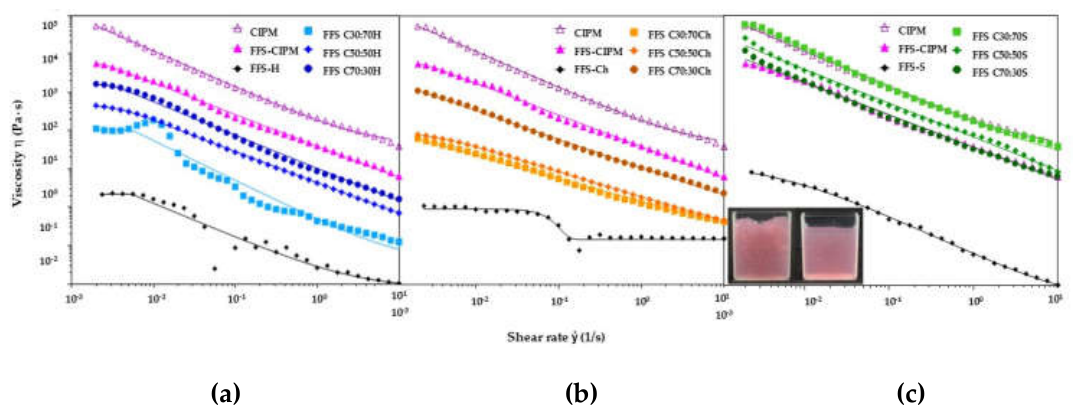
Figure 2.
Interaction plots between polysaccharide type and the FFS-CIPM:FFS-PS ratio on the Carreau–Yasuda model parameters: (a) apparent viscosity (η) and (b) flow behavior index (n). Lines represent the 30:70, 50:50, and 70:30 ratios. H: Hydroxypropyl methylcellulose; Ch: Chitosan; S: Starch.
Figure 2.
Interaction plots between polysaccharide type and the FFS-CIPM:FFS-PS ratio on the Carreau–Yasuda model parameters: (a) apparent viscosity (η) and (b) flow behavior index (n). Lines represent the 30:70, 50:50, and 70:30 ratios. H: Hydroxypropyl methylcellulose; Ch: Chitosan; S: Starch.
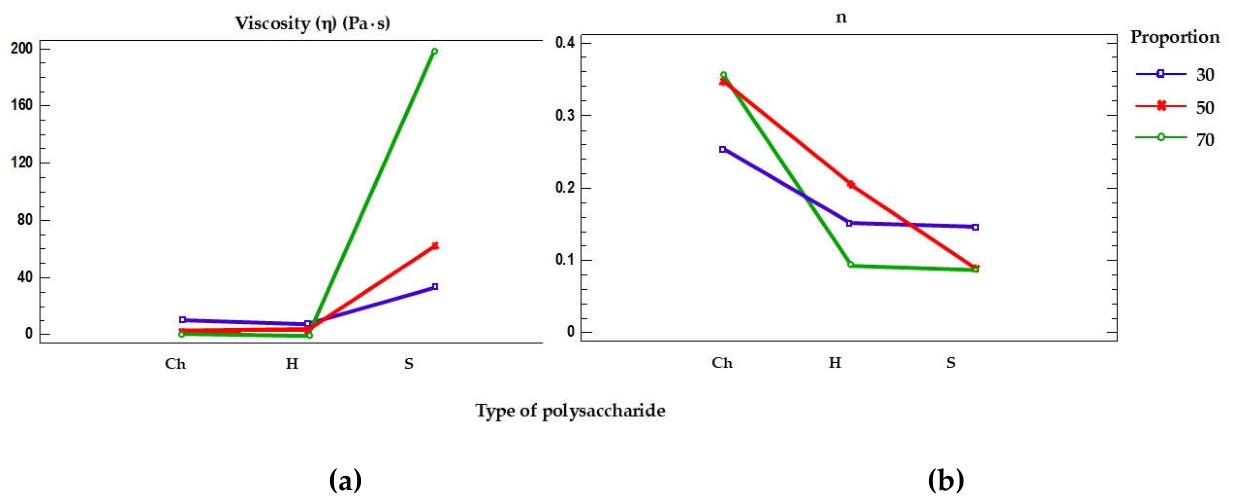
Figure 3.
Viscoelastic curves showing storage modulus (G′) and loss modulus (G″) as a function of frequency (f) (10−1–102 Hz) for polysaccharides (PS, ◆): (a) hydroxypropyl methylcellulose (H), (b) chitosan (Ch), and (c) starch (S), at collagen-to-polysaccharide ratios (C:PS) of 30:70 (■), 50:50 (✚), and 70:30 (●). Reference curves for insoluble collagen from Octopus maya (CIPM, ▲) and FFS-CIPM (▼).
Figure 3.
Viscoelastic curves showing storage modulus (G′) and loss modulus (G″) as a function of frequency (f) (10−1–102 Hz) for polysaccharides (PS, ◆): (a) hydroxypropyl methylcellulose (H), (b) chitosan (Ch), and (c) starch (S), at collagen-to-polysaccharide ratios (C:PS) of 30:70 (■), 50:50 (✚), and 70:30 (●). Reference curves for insoluble collagen from Octopus maya (CIPM, ▲) and FFS-CIPM (▼).
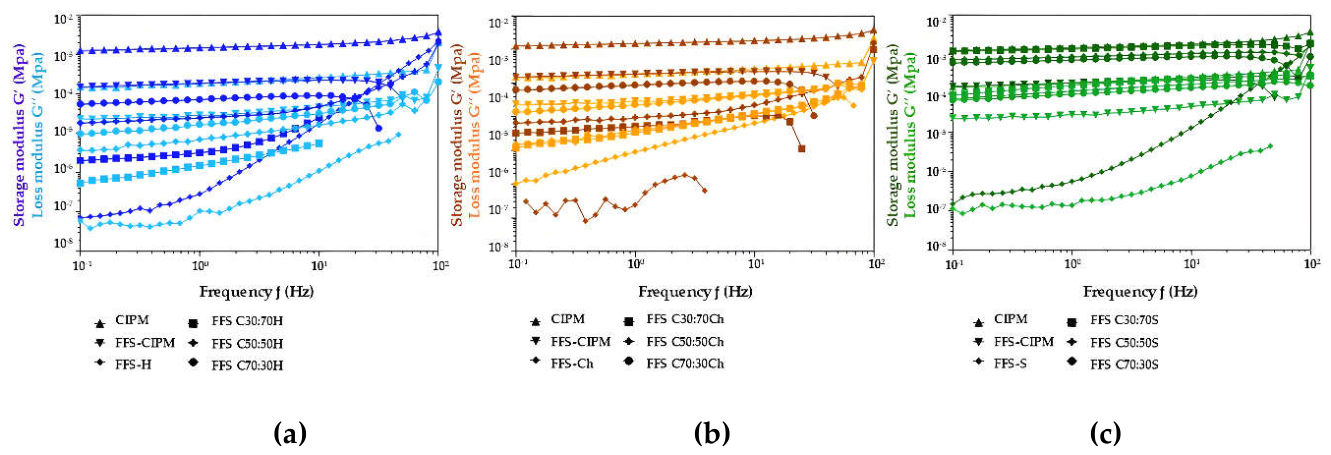
Figure 4.
Effect of the interaction between polysaccharide type and the FFS-CIPM:FFS-PS ratio on the viscoelastic behavior of the formulations: (A) storage modulus (G’’) and (B) tan δ. Lines represent the 30:70, 50:50, and 70:30 ratios. H: Hydroxypropyl methylcellulose; Ch: Chitosan; S: Starch.
Figure 4.
Effect of the interaction between polysaccharide type and the FFS-CIPM:FFS-PS ratio on the viscoelastic behavior of the formulations: (A) storage modulus (G’’) and (B) tan δ. Lines represent the 30:70, 50:50, and 70:30 ratios. H: Hydroxypropyl methylcellulose; Ch: Chitosan; S: Starch.
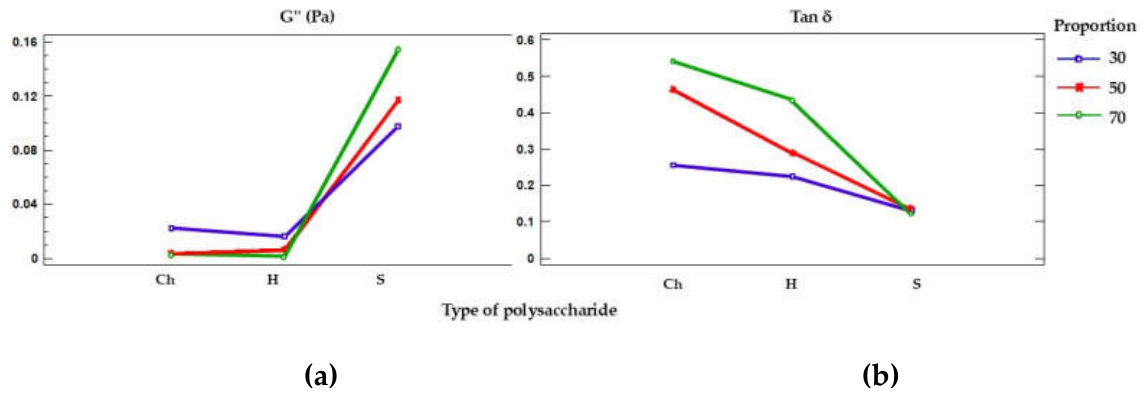

Table 1.
Composition of film-forming solutions.
| Nomenclature | Base of FFS system | Concentration (%) | |
| Polysaccharide | Glycerol | ||
| FFS-CIPM | Insoluble collagen | 3 | 0.6 |
| FFS-H | HPMC | 2 | 1 |
| FFS-Ch | Chitosan | 0.5 | 0.6 |
| FFS-S | Starch | 2.5 | 2 |
CIPM: Insoluble collagen from Octopus maya. HPMC: Hydroxypropyl methylcellulose.
Table 2.
Apparent viscosity (η) values measured at 1 s−1 and the Carreau-Yasuda model parameters, including zero-shear viscosity (η0), infinite-shear viscosity (η∞), consistency index (k), flow behavior index (n), and transition parameter (α), of the different FFS formulations. Results are expressed as mean ± standard deviation (n = 2).
Table 2.
Apparent viscosity (η) values measured at 1 s−1 and the Carreau-Yasuda model parameters, including zero-shear viscosity (η0), infinite-shear viscosity (η∞), consistency index (k), flow behavior index (n), and transition parameter (α), of the different FFS formulations. Results are expressed as mean ± standard deviation (n = 2).
| Treatments | |||||||
| Proportion (%) (FFS-PS: FFS-CIPM) |
η (Pa.s) |
η0 (Pa.s) |
η∞ (Pa.s) |
κ (s) |
n | α | |
| C30:70H | 0.3 ± 0.05 | 35.84 ± 32.51 | 0.03 ± 0.00 | 151.85 ± 58.13 | 0.09 ± 0.13 | 72.28 ± 0.50 | |
| HPMC | C50:50H | 3.14 ± 0.38 | 412.49 ± 8.62 | 0.04 ± 0.004 | 445.44 ± 17.60 | 0.21 ± 0.01 | 30.49 ± 33.88 |
| C70:30H | 8.43 ± 0.16 | 1454.70 ± 170.03 | 0.10 ± 0.004 | 360.48 ± 44.41 | 0.15 ± 0.03 | 8.41 ± 0.04 | |
| C30:70Ch | 1.47 ± 0.26 | 109.07 ± 64.69 | 0.06 ± 0.002 | 656.77 ± 200.96 | 0.36 ± 0.04 | 35.76 ± 0.25 | |
| Chitosan | C50:50Ch | 1.84 ± 0.02 | 110.87 ± 33.28 | 0.04 ± 0.002 | 540.72 ± 274.14 | 0.35 ± 0.003 | 21.70 ± 27.53 |
| C70:30Ch | 10.44 ± 0.59 | 1052.64 ± 76.75 | 0.23 ± 0.11 | 481.23 ± 2.04 | 0.25 ± 0.01 | 68.09 ± 3.21 | |
| C30:70S | 197.53 ± 80.21 | 103631 ± 14116.68 | 1.37 ± 1.38 | 979.71 ± 336.09 | 0.09 ± 0.03 | 37.93 ± 24.15 | |
| Starch | C50:50S | 79.63 ± 1.61 | 23410.85 ± 3955.91 | 2.10 ± 2.91 | 808.64 ± 66.03 | 0.09 ± 0.05 | 42.75 ± 10.64 |
| C70:30S | 33.54 ± 0.60 | 23665.80 ± 830.85 | 0.06 ± 0.06 | 1864.20 ± 86.75 | 0.14 ± 0.01 | 13.33 ± 0.98 | |
PS: Polysaccharide; FFS: Film-forming solution. CIPM or C: Insoluble collagen from Octopus maya; HPMC or H: Hydroxypropyl methylcellulose; Ch: Chitosan; S: Starch.
Table 3.
Effects of studied factors: polysaccharide type, proportion, and their interaction on flow behavior based on the Carreau-Yasuda model parameters (p-values).
Table 3.
Effects of studied factors: polysaccharide type, proportion, and their interaction on flow behavior based on the Carreau-Yasuda model parameters (p-values).
| Factors | η0 (Pa.s) |
η∞ (Pa.s) |
κ (s) |
n | α |
|---|---|---|---|---|---|
| Polysaccharide type (A) | <0.0001 | 0.1835 | <0.0001 | 0.0001 | 0.5833 |
| Proportion (B) | <0.0001 | 0.6441 | 0.0159 | 0.4592 | 0.1653 |
| AxB | <0.0001 | 0.6087 | 0.0028 | 0.1101 | 0.0177 |
η0 corresponds to the zero-shear viscosity (low shear-rate viscosity), η∞ to the infinite-shear viscosity (high shear-rate viscosity), k to the consistency index, n to the flow behavior index, and α to the transition parameter.
Table 4.
Storage modulus (G′), loss modulus (G″), and tan δ values of film-forming solutions (FFS). Results are expressed as mean ± standard deviation (n = 2).
Table 4.
Storage modulus (G′), loss modulus (G″), and tan δ values of film-forming solutions (FFS). Results are expressed as mean ± standard deviation (n = 2).
| Treatments | ||||
| Proportion (%) (FFS-PS: FFS-CIPM) |
G′ (Storage modulus) (Pa) |
G″ (Loss modulus) (Pa) |
tan δ (Tangent delta) |
|
| C30:70H | 0.004 ± 0.001 | 0.002 ± 0.0003 | 0.44 ± 0.05 | |
| HPMC | C50:50H | 0.020 ± 0.001 | 0.007 ± 0.0000 | 0.29 ± 0.01 |
| C70:30H | 0.070 ± 0.001 | 0.017 ± 0.0007 | 0.23 ± 0.01 | |
| C30:70Ch | 0.006 ± 0.002 | 0.003 ± 0.0002 | 0.54 ± 0.18 | |
| Chitosan | C50:50Ch | 0.008 ± 0.002 | 0.004 ± 0.0005 | 0.47 ± 0.05 |
| C70:30Ch | 0.089 ± 0.004 | 0.023 ± 0.0000 | 0.26 ± 0.01 | |
| C30:70S | 1.35 ± 0.057 | 0.155 ± 0.0071 | 0.12 ± 0.00 | |
| Starch | C50:50S | 0.880 ± 0.023 | 0.118 ± 0.0007 | 0.14 ± 0.01 |
| C70:30S | 0.750 ± 0.046 | 0.098 ± 0.0028 | 0.13 ± 0.00 | |
Table 5.
Effects of the studied factors polysaccharide type, proportion, and their interaction on G′ (storage modulus), G″ (loss modulus), and tan δ values, which describe the balance between the elastic and viscous components of the system.
Table 5.
Effects of the studied factors polysaccharide type, proportion, and their interaction on G′ (storage modulus), G″ (loss modulus), and tan δ values, which describe the balance between the elastic and viscous components of the system.
| Table of p-values | |||
|---|---|---|---|
| G’ (Pa) | G’’ (Pa) | tan δ | |
| Polysaccharide type (A) | <0.0001 | <0.0001 | 0.0001 |
| Proportion (B) | <0.0001 | 0.0002 | 0.0069 |
| AxB | <0.0001 | <0.0001 | 0.0703 |
Disclaimer/Publisher’s Note: The statements, opinions and data contained in all publications are solely those of the individual author(s) and contributor(s) and not of MDPI and/or the editor(s). MDPI and/or the editor(s) disclaim responsibility for any injury to people or property resulting from any ideas, methods, instructions or products referred to in the content. |
© 2026 by the authors. Licensee MDPI, Basel, Switzerland. This article is an open access article distributed under the terms and conditions of the Creative Commons Attribution (CC BY) license (http://creativecommons.org/licenses/by/4.0/).
Copyright: This open access article is published under a Creative Commons CC BY 4.0 license, which permit the free download, distribution, and reuse, provided that the author and preprint are cited in any reuse.


