

Submitted:
03 June 2026
Posted:
04 June 2026
You are already at the latest version
Abstract
Renewable energy communities (RECs) are increasingly recognized as a strategic instrument for enhancing energy system resilience, promoting local renewable integration, and reducing consumer exposure to electricity market volatility. This study assesses the economic performance of RECs relative to individual consumers using high-frequency hourly data from 2021 to 2023, covering both the 2022 European energy crisis and the subsequent Italian regulatory reform of incentive mechanisms. An optimized REC configuration is developed to maximize shared photovoltaic generation and minimize external grid dependence. Through panel econometric analysis, we estimate the sensitivity of economic value to electricity price fluctuations and demonstrate that RECs exhibit significantly lower price dependence than standalone consumers. To complement these findings, machine learning techniques and SHAP (SHapley Additive exPlanations) analysis are employed to capture non-linear dynamics and quantify the relative contribution of electricity prices to value formation. Results consistently show that while market prices remain an important determinant, RECs substantially attenuate their impact, particularly during periods of extreme price stress. A policy counterfactual comparison between pre- and post-reform incentive structures further indicates that the revised regulatory framework introduces a more stable and counter-cyclical compensation mechanism, strengthening the protective role of RECs. Overall, the study provides robust empirical evidence that renewable energy communities function not only as instruments for renewable deployment but also as effective mechanisms for economic stabilization under volatile market conditions.
Keywords:
energy communities
; price volatility
; energy resilience
1. Introduction
Recent geopolitical tensions and structural transformations in global energy systems have significantly increased electricity price volatility, raising concerns about the economic vulnerability of end-users and local energy systems. The energy crisis observed in 2022, characterized by unprecedented price spikes across European electricity markets, has highlighted the exposure of consumers to market dynamics and the limitations of traditional centralized energy systems. In this context, understanding how energy systems respond to price shocks has become a central issue, as empirical evidence shows that energy consumption reacts significantly to price variations, particularly in the short run [1].
Within this evolving landscape, Renewable Energy Communities (RECs) have emerged as a key instrument for promoting decentralized energy systems and enhancing local energy autonomy. RECs enable collective generation, consumption, and sharing of renewable energy, fostering new forms of local electricity markets and peer-to-peer interactions. Existing studies demonstrate that, compared to individual prosumers, energy communities can improve economic efficiency and increase the utilization of locally generated energy through collective self-consumption mechanisms [2]. In this perspective, the economic viability of energy communities depends not only on technological factors but also on the internal allocation of energy and the interaction among participants.
At the same time, the growing diffusion of local energy markets has led to increasing attention to pricing mechanisms and internal energy transactions within energy communities. Recent contributions show that the design of pricing rules and peer-to-peer exchanges plays a crucial role in determining both individual incentives and collective outcomes [3]. In particular, simulation-based approaches highlight that internal pricing mechanisms can significantly influence the distribution of economic benefits and the efficiency of energy sharing within communities.
Despite these advances, the economic performance of energy communities cannot be fully understood without considering the role of market volatility. Electricity prices are increasingly characterized by high-frequency fluctuations driven by fuel price uncertainty, renewable intermittency, and geopolitical factors [4]. While previous literature has extensively analyzed the profitability and financial structure of energy communities—highlighting both opportunities and challenges related to revenue streams, cost allocation, and capital investment [5]—less attention has been devoted to their role in mitigating exposure to price volatility. In particular, the relationship between energy communities and price sensitivity remains underexplored, especially in the presence of extreme market conditions.
Furthermore, recent studies emphasize that the integration of demand-side flexibility within energy communities can enhance their performance and contribute to system stability [6]. By improving the alignment between local generation and consumption, flexibility mechanisms may reduce dependence on external markets and mitigate the impact of price fluctuations. However, the combined effect of energy sharing, flexibility, and price dynamics has not yet been fully quantified using empirical high-frequency data.
In addition, forecasting studies highlight the increasing complexity of electricity price dynamics, showing that both statistical and machine learning approaches are required to capture non-linearities and temporal dependencies in energy markets [7] . These findings suggest that traditional linear approaches may not be sufficient to fully capture the behavior of decentralized energy systems under volatile market conditions.
Against this background, this study investigates whether energy communities can act as a stabilizing mechanism in electricity markets by reducing the sensitivity of economic value to price volatility. The analysis focuses on three key aspects: differences in price responsiveness between individual and community configurations, the role of non-linear dynamics during high-price periods, and the impact of incentive schemes on value stability.
To address these issues, the study employs a high-frequency dataset with hourly observations covering the period 2021–2023, explicitly capturing both the 2022 price shock and subsequent regulatory changes. Methodologically, the analysis combines panel econometric models with machine learning techniques. While econometric models provide a benchmark for estimating average price sensitivity, machine learning approaches—interpreted through SHAP (Shapley Additive Explanations)—allow for the identification of heterogeneous and state-dependent effects.
The results show that, although both individual users and energy communities benefit from increases in electricity prices, the latter exhibit a significantly lower sensitivity to price fluctuations. This difference becomes particularly pronounced during high-price periods, indicating that energy communities act as a conditional resilience mechanism. Moreover, the analysis highlights that policy design can introduce counter-cyclical effects, further reducing the dependence of economic value on market dynamics.
Overall, this study contributes to the literature by providing new empirical evidence on the role of energy communities not only as instruments supporting the energy transition but also as mechanisms for managing price risk in increasingly volatile electricity markets.
2. Legislative Framework
The development of Renewable Energy Communities (RECs) in Europe is strongly rooted in the regulatory framework established by the Clean Energy for All Europeans Package, which promotes decentralized energy systems and active consumer participation in electricity markets [16]. In particular, Directive (EU) 2018/2001 (RED II) introduced the concept of renewable energy communities, defining them as legal entities that enable collective generation, consumption, and sharing of renewable energy at the local level.
In Italy, the transposition of the European directives has led to the progressive implementation of a regulatory framework aimed at fostering the diffusion of energy communities. An initial experimental phase was introduced with the transposition of RED II, allowing small-scale collective self-consumption schemes and establishing the first incentive mechanisms for shared energy. These schemes were later consolidated and expanded through subsequent regulatory updates, culminating in a more structured framework that defines the operational and economic conditions of energy communities.
A central element of the Italian framework is the incentive mechanism applied to shared energy. This mechanism remunerates the portion of electricity that is simultaneously generated and consumed within the community, thereby encouraging local balancing between supply and demand. During the period 2021–2023, the incentive was characterized by a fixed tariff component, which provided a stable remuneration per unit of shared energy. This structure ensured predictability but did not explicitly account for market conditions.
More recent regulatory developments have introduced a revised incentive scheme, combining a fixed component with a variable component linked to electricity market prices. In this configuration, the total incentive decreases as market prices increase, introducing a counter-cyclical mechanism. This design aims to balance efficiency and stability by reducing excessive remuneration during high-price periods while maintaining support under normal conditions.
The evolution of the incentive scheme has important implications for the economic performance of energy communities. Under a fixed tariff, the value of shared energy is largely independent of market dynamics, whereas under a variable scheme, the incentive becomes partially dependent on electricity prices. This change modifies the relationship between market signals and economic value, potentially affecting both the level and the volatility of revenues.
Within this regulatory context, the present study incorporates both incentive structures in order to assess their impact on the economic value and stability of energy communities. By comparing the pre-reform and post-reform schemes, the analysis provides insights into how policy design influences the resilience of community-based energy systems in the presence of price volatility.
3. Literature Review
The increasing diffusion of Renewable Energy Communities (RECs) has generated a growing body of literature investigating their economic, technical, and regulatory implications. However, existing studies have often developed along partially disconnected strands, focusing separately on economic performance, market design, or price dynamics, with limited integration between these dimensions [11].
A first stream of literature focuses on the economic performance of energy communities compared to individual prosumers. Several studies show that collective self-consumption mechanisms can improve the efficiency of distributed energy systems by increasing the utilization of locally generated renewable energy and reducing reliance on external markets. In particular, comparative analyses highlight that energy communities can achieve higher economic value than stand-alone configurations due to demand aggregation and internal energy sharing [2]. Additional contributions emphasize the importance of optimizing energy allocation and sharing mechanisms to improve both technical and economic performance [13].
Closely related to this, a second line of research investigates the role of heterogeneity in consumption and production profiles. The literature highlights that differences in user behavior are a key driver of system efficiency, as they enable a better temporal alignment between electricity generation and demand. Recent studies propose classification approaches to identify consumption–production profiles within energy communities, showing that grouping users with complementary patterns significantly increases shared energy and reduces system imbalances [16]. This structural complementarity represents a fundamental advantage of community-based configurations over individual ones.
A third strand of literature examines the design of local electricity markets and pricing mechanisms within energy communities. With the emergence of peer-to-peer trading and decentralized market structures, increasing attention has been devoted to the rules governing internal energy exchanges. Simulation-based studies demonstrate that pricing mechanisms play a central role in determining both the distribution of economic benefits and the incentives for participation [3]. More recent research highlights that integrating price prediction and optimization models into energy sharing frameworks can improve decision-making and system efficiency.
Despite these advances, the interaction between energy communities and electricity price dynamics remains relatively underexplored. Electricity markets are increasingly characterized by high volatility, driven by fuel price fluctuations, renewable intermittency, and geopolitical shocks [4]. Empirical studies show that energy consumption responds to price variations, particularly in the short run [1]. At the same time, machine learning approaches highlight the increasing complexity of electricity price formation, emphasizing the need for high-resolution models capable of capturing multiple market drivers [14]. However, most existing contributions focus on forecasting or macro-level dynamics and do not explicitly analyze how different energy configurations respond to price variability.
In parallel, a growing body of research has investigated the broader economic effects of energy price shocks. These studies show that price volatility can have significant impacts not only at the micro level but also on macroeconomic stability [15]. However, the extent to which decentralized systems such as energy communities can mitigate these effects remains largely unexplored.
The financial sustainability of energy communities has also received increasing attention. Existing studies highlight both opportunities and challenges related to revenue streams, cost allocation, and investment structures. While energy communities can benefit from multiple sources of value, including self-consumption and incentive schemes, their performance is strongly influenced by regulatory frameworks and market conditions [5,10]. This highlights the central role of policy design in shaping both profitability and risk exposure.
More recent contributions emphasize the role of demand-side flexibility as a key factor in improving the performance of decentralized energy systems. Flexibility mechanisms allow users to adjust their consumption in response to generation patterns or price signals, thereby increasing self-consumption and reducing reliance on external markets. Literature reviews show that the integration of flexibility within energy communities can enhance system efficiency and contribute to stability [6], while social and behavioral dimensions are increasingly recognized as relevant factors influencing participation and performance [11].
Finally, the increasing complexity of electricity markets has led to the adoption of advanced modeling approaches combining econometric and machine learning techniques. Traditional linear models are often insufficient to capture non-linear relationships and extreme events, while machine learning models have proven effective in identifying complex patterns in electricity prices and demand [7]. However, their application to the analysis of energy communities remains limited, particularly in terms of interpretability and integration with economic analysis.
Taken together, the existing literature provides important insights into the functioning and performance of energy communities but leaves several gaps. In particular, there is a lack of studies that jointly consider high-frequency price dynamics, explicitly compare individual and community configurations, and integrate econometric and machine learning approaches within a unified framework. Moreover, the role of energy communities as a mechanism for reducing exposure to price volatility and enhancing economic resilience has not been fully explored.
This study addresses these gaps by providing an integrated analysis of energy communities under conditions of price volatility. By combining high-frequency data, econometric modeling, and machine learning techniques, the paper contributes to the literature by explicitly linking price dynamics, energy sharing mechanisms, and policy design, thereby advancing the understanding of energy communities as tools for enhancing resilience in modern energy systems.
4. Methodology
The empirical analysis is based on a high-frequency dataset covering the period from January 2021 to December 2023, constructed by integrating multiple data sources in order to capture consumption, generation, market conditions, and regulatory parameters. Electricity consumption profiles are derived from data provided by the Italian Regulatory Authority for Energy, Networks and Environment (ARERA), which defines standardized consumption patterns for residential users within the national tariff structure. These profiles serve as a baseline representation of typical household demand and are subsequently adapted to reflect heterogeneous behavioral characteristics.
Photovoltaic generation is estimated using the PVGIS (Photovoltaic Geographical Information System), which provides hourly data on solar irradiation and expected energy production. A photovoltaic system with a nominal capacity of 10 kW is considered, and the corresponding generation profile G(t)is reconstructed for the geographical area of Foggia, ensuring consistency between climatic conditions and consumption patterns. In addition, the dataset includes the hourly zonal electricity price Pt representing wholesale market dynamics, as well as the incentive component TIPt associated with shared energy within energy communities.
To account for heterogeneity in consumption behavior, four representative residential profiles are constructed for the area of Foggia (Italy). These profiles correspond to working households, retired households, families with children, and young households, each characterized by distinct temporal consumption patterns. Starting from the standardized ARERA load curves, the profiles are further refined using information derived from the Time-of-Use Survey (TUS), which provides empirical evidence on how electricity consumption is distributed throughout the day across different types of households.
The integration of ARERA profiles with TUS data is implemented through a calibration procedure that reshapes hourly consumption patterns while preserving total annual demand. Specifically, the intra-day distribution of consumption is adjusted to reflect observed behavioral differences, such as higher daytime consumption for retired households or more pronounced evening peaks for working families. This process, implemented through Python-based data processing routines, allows for the generation of synthetic yet realistic consumption profiles that are both consistent with regulatory benchmarks and representative of actual usage patterns.
The analysis considers both individual stand-alone configurations and a Renewable Energy Community composed of the four users. Within the community, a single photovoltaic system is assumed, and the allocation of generated energy is determined in order to maximize collective efficiency. At each time step, the available generation G(t) is first used to satisfy the demand of the prosumer, whose auto-consumption is defined as:
The remaining generation is then allocated to other members of the community as shared energy. The amount of shared energy is given by:
Any residual generation that cannot be locally consumed is injected into the grid:
while any unmet demand is satisfied through imports from the grid:
The optimal configuration of the energy community is determined by selecting the prosumer in such a way as to maximize the total amount of locally utilized energy. Formally, the optimal prosumer is identified as:
which is equivalent to minimizing the total energy exchanged with the grid:
This formulation ensures that the selected configuration maximizes both self-consumption and energy sharing while minimizing inefficient energy flows.
The economic value is computed on an hourly basis for both individual and community configurations. For individual users, the value is defined as:
where self-consumed energy is valued at a retail-equivalent price which includes not only the wholesale electricity price but also additional components such as network charges, taxes, and system costs. In line with existing literature, a markup factor is applied to approximate the retail price, assuming that the final price is approximately 30% higher than the wholesale zonal price. For the energy community, the value additionally includes the incentive associated with shared energy:
To evaluate the sensitivity of economic value to electricity prices, a panel econometric model is employed:
where identifies the community configuration and captures entity-specific effects. This framework allows for the comparison of price responsiveness between individual users and the energy community.
Given the non-linear nature of electricity markets, the econometric analysis is complemented by a machine learning model based on gradient boosting, which estimates the relationship:
without imposing linearity. SHAP (Shapley Additive Explanations) values are used to decompose predictions:
thereby allowing the identification of the marginal contribution of electricity prices under different conditions.
Finally, the role of policy is assessed through a counterfactual analysis of alternative incentive schemes, while system stability is evaluated using a risk-return indicator defined as:
which captures the trade-off between economic performance and volatility.
5. Results and Machine Learning Analysis
The empirical results provide a comprehensive assessment of the economic performance of energy communities compared to individual configurations, combining econometric evidence with machine learning-based insights. The analysis is structured to highlight both average effects and non-linear dynamics, with particular attention to periods of high price volatility.
5.1. Econometric Results: Price Sensitivity
The panel regression results show a statistically significant relationship between electricity prices and economic value across all configurations. For individual users, the estimated coefficient associated with the zonal price is positive and highly significant, indicating that increases in electricity prices lead to higher economic value. This result is consistent with the valuation mechanism, where both self-consumed and injected energy are monetized based on market prices.
However, the inclusion of the interaction term between price and the energy community configuration reveals a different dynamic. The estimated coefficient for the interaction term is negative and statistically significant, implying that the sensitivity of the community’s value to price changes is lower compared to individual users. In other words, while both configurations benefit from higher prices, the marginal effect of price is attenuated in the case of the energy community.
This result provides the first evidence supporting the hypothesis that energy communities reduce exposure to price fluctuations. Importantly, the effect is identified as an average relationship, reflecting the overall behavior across the entire sample period.
5.2. Non-Linear Dynamics and Machine Learning
To complement the econometric analysis, a machine learning approach based on gradient boosting is employed in order to capture non-linear relationships between economic value and its main drivers. The model is trained using key variables, including electricity prices, photovoltaic generation, and total consumption, and is evaluated against alternative non-linear models such as Random Forest and LightGBM.
The results show that all non-linear models achieve a high level of predictive accuracy, with Random Forest providing the lowest prediction error in terms of RMSE, followed by LightGBM and XGBoost. However, despite its slightly lower predictive performance, XGBoost is selected for the interpretability analysis due to its compatibility with SHAP values and its ability to provide stable and consistent explanations of variable contributions.
The comparison across models also suggests that the underlying system, while non-linear, does not exhibit extreme complexity, as indicated by the relatively small differences in predictive performance. This finding reinforces the validity of the econometric results while justifying the use of machine learning techniques to uncover more subtle dynamics.
5.3. SHAP Analysis: Interpreting Price Effects
The SHAP analysis provides a detailed decomposition of the contribution of each variable to the predicted economic value. In particular, the SHAP values associated with electricity prices allow for a direct assessment of their marginal impact under different conditions.
The results indicate that electricity prices are the dominant driver of economic value in both individual and community configurations. However, the distribution of SHAP values reveals important differences between the two cases. For individual users, the impact of price is more dispersed and exhibits higher variability, reflecting a stronger dependence on market conditions. In contrast, the energy community shows a more concentrated distribution of SHAP values, indicating a more stable response to price changes.
To further explore these differences, a comparative analysis of SHAP values is conducted by computing the difference between the marginal impact of price for individual users and for the energy community. The results show that this difference is relatively small under normal price conditions but increases significantly during periods of high prices. In particular, during the 2022 price shock, the impact of price on individual configurations becomes substantially larger than that observed for the energy community.
This finding highlights a key insight: energy communities do not fundamentally alter the relationship between value and price under normal conditions, but they significantly reduce exposure during periods of market stress. In this sense, the stabilizing effect of energy communities can be interpreted as a conditional mechanism that becomes particularly relevant during extreme events.
5.4. Policy Analysis: Incentive Schemes
The analysis of incentive schemes provides further insights into the interaction between market dynamics and regulatory design. By comparing the economic value of the energy community under different incentive structures, it is possible to isolate the impact of policy changes.
The results show that the introduction of a variable component in the incentive scheme reduces the dependence of the community’s value on electricity prices. In particular, the counter-cyclical nature of the revised mechanism dampens the increase in value during high-price periods, thereby contributing to a more stable revenue profile.
From a quantitative perspective, the estimated sensitivity of value to price decreases under the new incentive scheme, confirming that policy design plays a crucial role in shaping the resilience of energy communities. This effect is particularly relevant in the context of highly volatile markets, where excessive dependence on price dynamics can increase economic risk.
5.5. Stability and Risk Analysis
The comparison of stability across configurations is further supported by risk-based indicators. The analysis shows that, while individual users may achieve higher values during periods of high prices, they also exhibit greater variability over time. In contrast, the energy community demonstrates a more stable value profile, reflecting a lower exposure to price fluctuations.
This result is confirmed by the computation of risk-return metrics, which indicate that the energy community achieves a more balanced trade-off between average performance and volatility. In particular, during the 2022 price shock, the variability of value increases significantly for individual users, while the increase is more contained for the community configuration.
5.6. Synthesis of Results
Taken together, the results provide consistent evidence across different methodological approaches. The econometric analysis shows that energy communities have a lower average sensitivity to electricity prices, while the machine learning analysis reveals that this difference becomes more pronounced under conditions of high price volatility. The SHAP-based interpretation further confirms that the impact of price is less dispersed and more stable within the community framework.
These findings suggest that the primary advantage of energy communities does not lie in maximizing economic value under all conditions, but rather in reducing exposure to market risk. In this sense, energy communities can be interpreted as a mechanism for enhancing resilience in electricity markets, particularly in the presence of external shocks and regulatory changes.
6. Discussion
The empirical results provide robust evidence on the different responses of individual users and energy communities to electricity price dynamics, highlighting both structural and behavioral differences across configurations.
First, the panel econometric analysis reveals a clear and statistically significant relationship between electricity prices and economic value. The estimated coefficient for individual users (β ≈ 1.34–1.43) indicates a strong positive sensitivity of economic value to price variations. In contrast, the interaction term associated with the energy community is negative, leading to a lower overall sensitivity (β_CER ≈ 1.23–1.34 depending on specification). This result confirms that, although both configurations benefit from price increases, energy communities exhibit a systematically reduced responsiveness to price changes.
This finding is strongly supported by the time-series evidence shown in Figure 1 (Energy Community vs Individual Response to Price Shock).
During the 2022 price shock, individual users display significantly higher peaks and volatility in economic value compared to the energy community. In particular, while individual values reach levels above 1.5–1.6, the energy community remains more compressed, with lower peaks and smoother dynamics. This visual evidence reinforces the econometric result, suggesting that energy communities act as a stabilizing mechanism by dampening the transmission of price shocks.
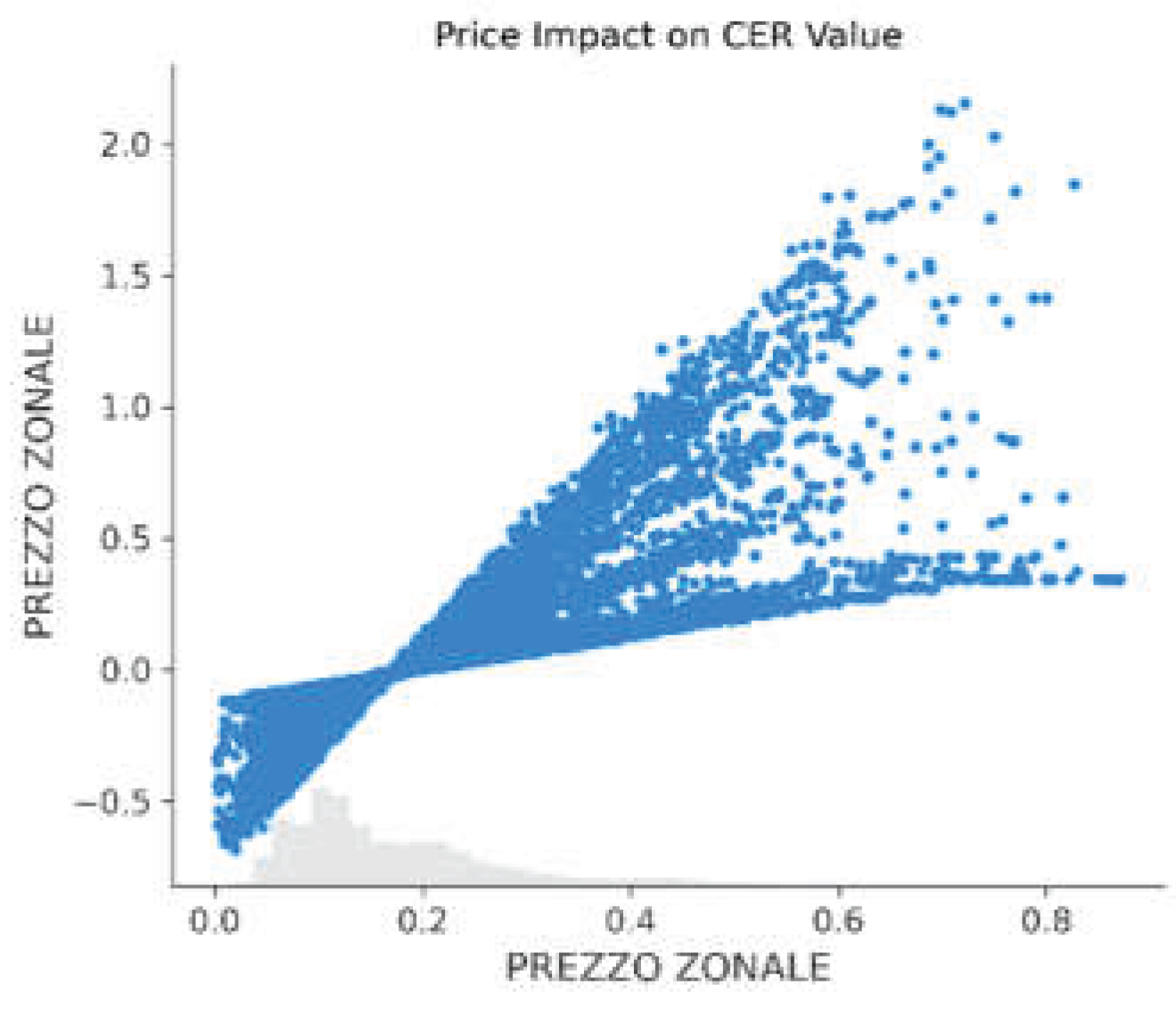
Second, the scatter plots relating price and value (Figure 2 and Figure 3) provide further insights into the structural differences between the two configurations. For individual users, the relationship between price and value exhibits a wider dispersion, especially at higher price levels. This indicates that the marginal effect of price increases is highly heterogeneous and can lead to extreme outcomes. In contrast, the energy community shows a more compact distribution, particularly in the upper range of prices, suggesting a saturation effect and a reduced marginal impact of price increases.
This pattern is consistent with the underlying economic mechanism of energy sharing. In individual configurations, value is directly tied to market exposure, meaning that higher prices translate into proportionally higher revenues or avoided costs. Conversely, in energy communities, part of the value is generated internally through shared energy, which reduces dependence on external price signals and limits the amplification of price shocks.
Third, the SHAP analysis provides a deeper understanding of the non-linear and state-dependent effects of price. The SHAP dependence plots show that, for individual users, the contribution of price to economic value increases sharply at higher price levels, with several observations exceeding a SHAP value of 2. This indicates a strong non-linear amplification effect, where extreme prices disproportionately increase economic value. In contrast, the energy community exhibits a more moderate SHAP response, with a lower upper bound and a more gradual increase.
The boxplot comparison of SHAP values (Fig. 4) further confirms this result. While both distributions are centered around similar median values, the distribution for individual users shows a significantly larger spread, particularly in the upper tail. This implies that individual users are more exposed to extreme positive shocks, but also to higher variability. The energy community, instead, exhibits a more concentrated distribution, indicating greater stability in the contribution of price to economic value.
Figure 4.
Boxplot comparison of SHAP values.
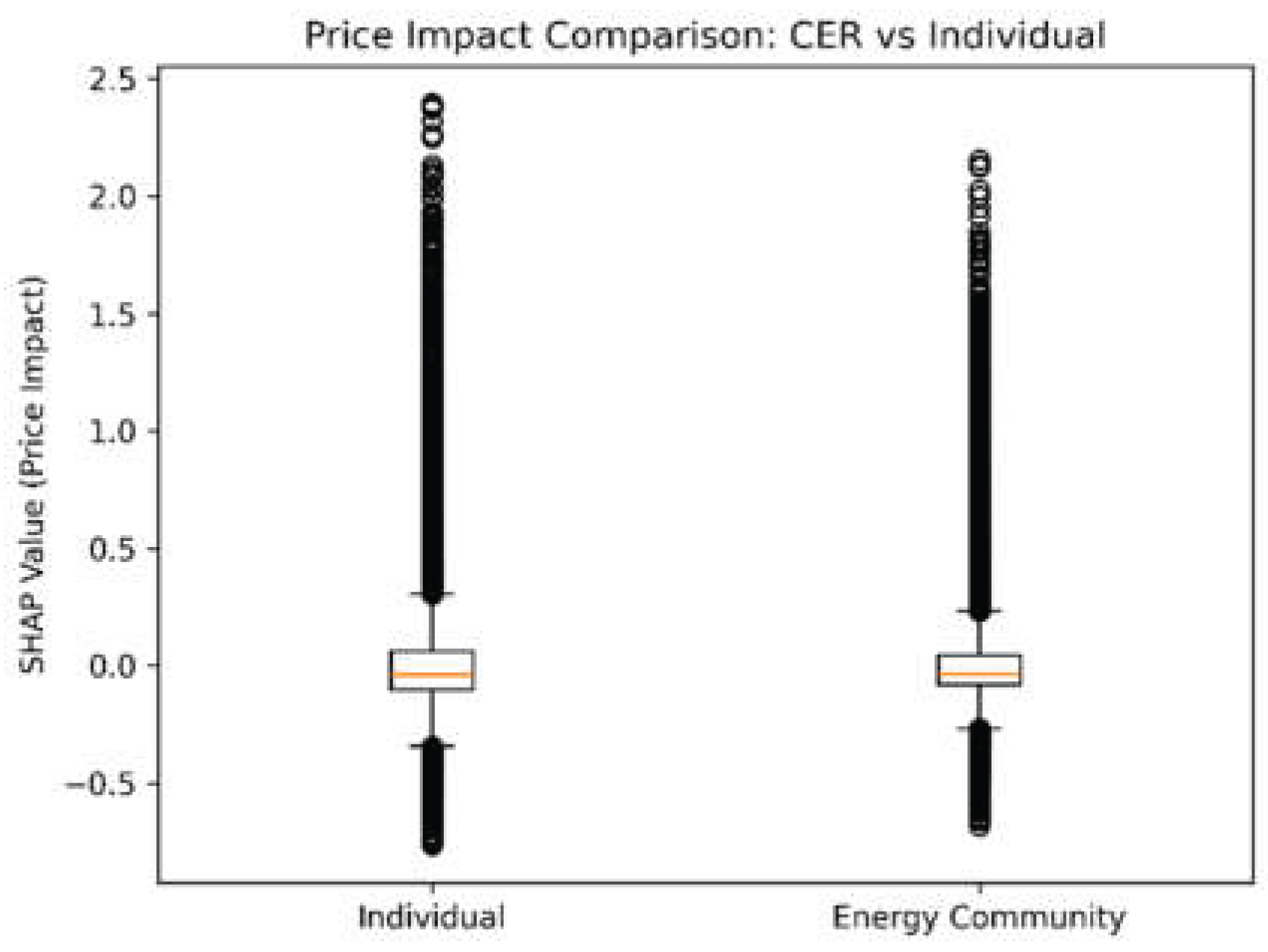
Figure 5.
SHAP beeswarm Individual.
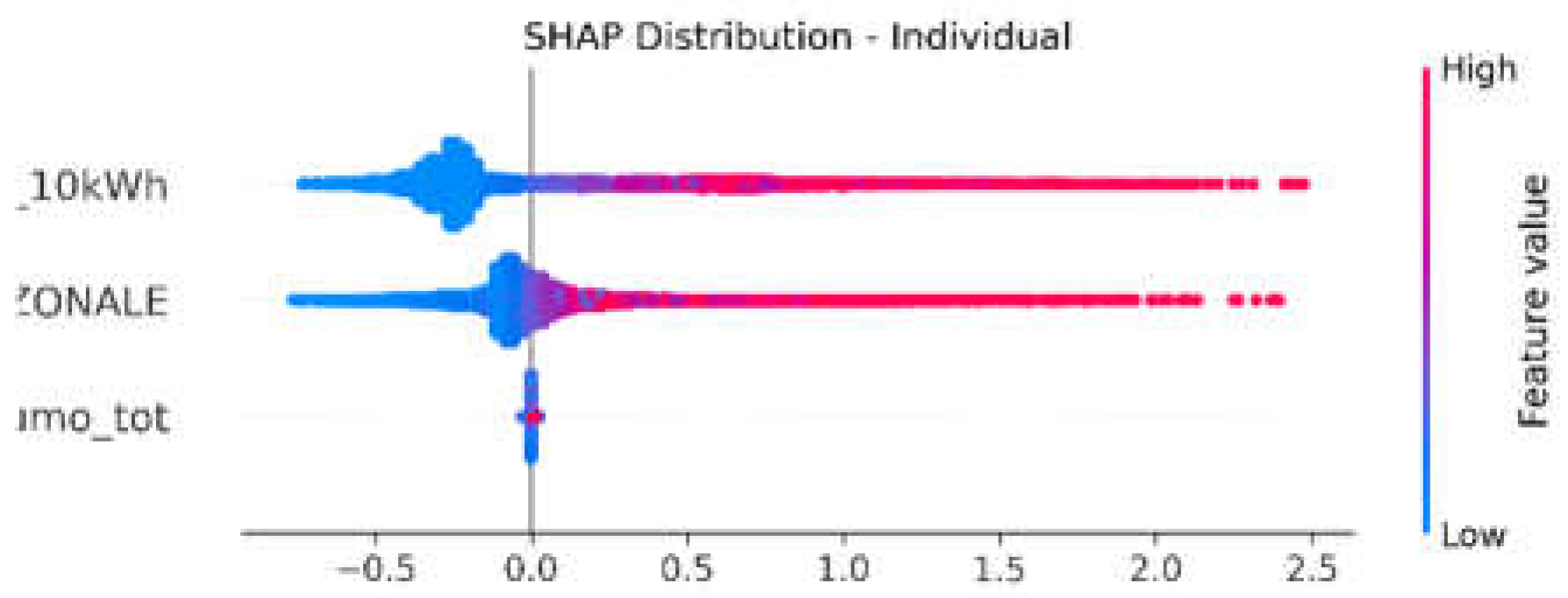
Figure 6.
SHAP beeswarm REC.
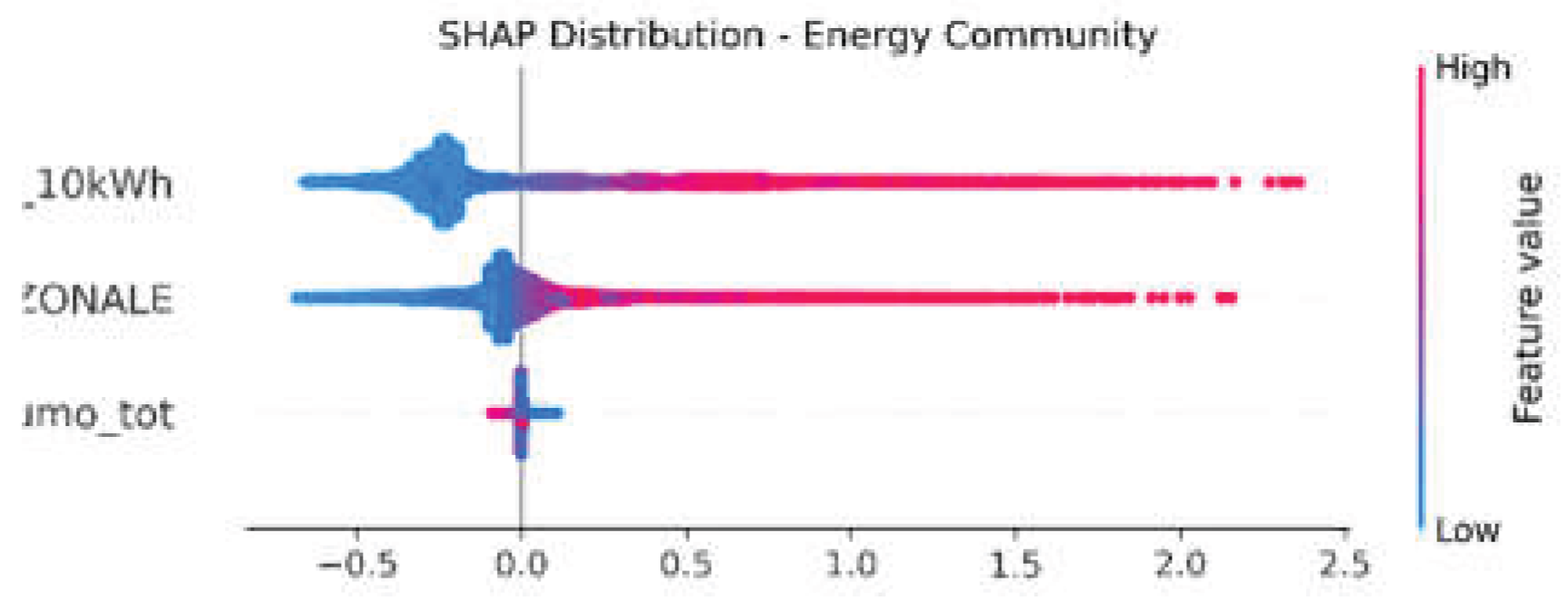
Finally, the SHAP beeswarm plots highlight the relative importance of different drivers. In both configurations, the zonal price emerges as the dominant factor influencing economic value. However, its impact is more dispersed and extreme in the individual case, while it is more contained in the energy community. At the same time, variables related to consumption (e.g., total consumption) show a limited marginal contribution, suggesting that price dynamics dominate the formation of value, particularly in high-volatility periods. Taken together, these results provide consistent evidence across econometric models, visual analysis, and machine learning interpretations. The convergence of these approaches strengthens the robustness of the findings and supports the conclusion that energy communities reduce the sensitivity of economic value to electricity price fluctuations.
Importantly, this stabilization effect should not be interpreted as a reduction in economic performance, but rather as a shift in the risk–return profile. While individual users may benefit more from extreme price increases, they are also more exposed to volatility. Energy communities, instead, trade off part of the upside potential in exchange for greater stability and predictability.
From a policy perspective, these findings are particularly relevant in the context of increasing energy market uncertainty. By reducing exposure to price volatility, energy communities can enhance the resilience of local energy systems and protect end-users from extreme market conditions. This suggests that their value extends beyond efficiency gains, encompassing a broader role in risk management and system stability.
7. Conclusions
This study investigated the role of Renewable Energy Communities (RECs) in mitigating the effects of electricity price volatility, with a particular focus on the comparison between individual users and community-based configurations. Using high-frequency hourly data over the period 2021–2023, the analysis combined econometric models and machine learning techniques to provide a comprehensive assessment of how different energy configurations respond to market dynamics.
The results show that, while both individual users and energy communities benefit from increases in electricity prices, the latter exhibit a significantly lower sensitivity to price fluctuations. This finding highlights a key property of energy communities: their ability to reduce exposure to market volatility through internal energy sharing and aggregation mechanisms. In particular, the analysis demonstrates that this stabilizing effect becomes more pronounced during periods of high price variability, such as the 2022 energy crisis, suggesting that energy communities act as a conditional resilience mechanism.
From an economic perspective, these results imply that the value of energy communities should not be assessed solely in terms of average profitability, but also in terms of their capacity to reduce variability and manage risk. While individual configurations may achieve comparable or higher short-term economic value under certain conditions, energy communities provide a more stable and predictable economic outcome, which is particularly relevant in increasingly volatile energy markets.
The analysis of incentive schemes further confirms the importance of policy design. The introduction of a dynamic component linked to electricity prices contributes to reducing the dependence of community value on market conditions, generating a counter-cyclical effect that enhances stability. This finding underscores the role of regulatory frameworks in shaping not only the profitability but also the resilience of decentralized energy systems.
Methodologically, the integration of econometric and machine learning approaches proved effective in capturing both average and non-linear dynamics. While panel models provided clear estimates of price sensitivity, machine learning techniques—interpreted through SHAP analysis—allowed for a deeper understanding of heterogeneous and state-dependent effects, particularly during extreme price events.
Overall, this study contributes to the literature by providing new empirical evidence on the role of energy communities as instruments for managing price risk in decentralized energy systems. By explicitly linking price volatility, energy sharing mechanisms, and policy design, the paper advances the understanding of energy communities as a key component of resilient energy systems.
Despite these contributions, some limitations remain. The analysis does not explicitly account for investment and operational costs, which may affect the overall economic attractiveness of energy communities. Furthermore, the results are based on a specific case study and may not fully capture the diversity of regulatory and market conditions across different contexts.
Future research should extend this framework by incorporating cost structures, exploring alternative community configurations, and analyzing the interaction between energy communities and additional flexibility resources such as storage and demand response. Further investigation is also needed to assess the scalability of these findings across different geographical areas and policy environments.
In conclusion, the findings of this study suggest that energy communities represent not only a tool for promoting renewable energy and local energy autonomy, but also a promising mechanism for enhancing resilience in electricity markets characterized by increasing uncertainty and volatility.
Author Contributions
Conceptualization, methodology, investigation P.C.; resources, writing—review and editing, supervision, M.B.
Funding
No Funding was received for this research.
Conflicts of Interest
The authors declare no conflicts of interest.
References
- Bastos, P.; Castro, L.; Cristia, J.; Scartascini, C. Does Energy Consumption Respond to Price Shocks? Research Insights 2023, 77. Inter-American Development Bank.
- Petrichenko, L.; Sauhats, A.; Diahovchenko, I.; Segeda, I. Economic Viability of Energy Communities versus Distributed Prosumers. Sustainability 2022, 14, 4634. [Google Scholar] [CrossRef]
- Mello, J.; de Lorenzo, C.; Campos, F.A.; Villar, J. Pricing and Simulating Energy Transactions in Energy Communities. Energies 2023, 16, 1949. [Google Scholar] [CrossRef]
- Murshed, M.; Tanha, M.M. Oil Price Shocks and Renewable Energy Transition: Empirical Evidence from Net Oil-Importing South Asian Economies. Energ. Ecol. Environ. 2021, 6, 183–203. [Google Scholar] [CrossRef] [PubMed]
- Khorrami, S.; Falvo, M.C.; Pompili, M. Financial Opportunities and Challenges in Energy Communities: Revenue, Costs, and Capital Structures. Energies 2026, 19, 937. [Google Scholar] [CrossRef]
- Lazdins, R.; Gavrilovs, A.; Antoskova, I.; Mihaila, D.; Borscevskis, O.; Mutule, A. Synergy Between Demand Flexibility and Energy Communities: A Literature Review. Sustainability 2026, 18, 1858. [Google Scholar] [CrossRef]
- Mazengia, D.H. Forecasting Spot Electricity Market Prices Using Time Series Models. Master’s Thesis, Chalmers University of Technology, Gothenburg, Sweden, 2008. [Google Scholar]
- Biancardi, M.; Catalano, P.; Sgarro, G.A.; Vairo, A. Price Prediction and Optimization of Energy. Appl. Math. Sci. 2025, 3, 131–148. [Google Scholar]
- Sharing in Renewable Energy Communities
- Proietti, S.; Moretti, E.; Stamponi, E.; Fortini, P.; Cotana, F. The Renewable Energy Communities in Italy and the Role of Public Administrations: The Experience of the Municipality of Assisi between Challenges and Opportunities. Sustainability 2023, 15, 11869. [Google Scholar] [CrossRef]
- Orsitto, L.; Riefolo, M.; Taormina, V.; Lombardi, M.; Faccilongo, N. Social and Political Dimensions of Renewable Energy Communities: A Systematic Literature Review. Sustainability 2026, 18, 3357. [Google Scholar] [CrossRef]
- Manso-Burgos, Á.; Ribó-Pérez, D.; Alcázar-Ortega, M.; Gómez-Navarro, T. Local Energy Communities in Spain: Economic Implications of the New Tariff and Variable Coefficients. Sustainability 2021, 13, 10555. [Google Scholar] [CrossRef]
- Biancardi, M.; Catalano, P. Forecasting Italian Electricity Prices for Smarter Energy Communities. Appl. Math. Sci. 2025, 19, 297–310. [Google Scholar] [CrossRef]
- Madadkhani, S.; Ikonnikova, S. Toward High-Resolution Projection of Electricity Prices: A Machine Learning Approach to Quantifying the Effects of High Fuel and CO2 Prices. Energy Econ. 2024, 129, 107241. [Google Scholar] [CrossRef]
- Lal Karn, A.; Kondamudi, B.R.; Gupta, R.K.; Pustokhin, D.A.; Pustokhina, I.V.; Alharbi, M.; Vairavasundaram, S.; Varadarajan, V.; Sengan, S. An Empirical Analysis of the Effects of Energy Price Shocks for Sustainable Energy on the Macro-Economy of South Asian Countries. Energies 2023, 16, 363. [Google Scholar] [CrossRef]
- Rozas, W.; Pastor-Vargas, R.; García-Vico, A.M.; Carpio, J. Consumption–production profile categorization in energy communities. Energies 2023, 16, 6996. [Google Scholar] [CrossRef]
- Presciutti, A.; Fagotti, L.; Martiniello, L.; Moretti, E. Simulation Tools for Renewable Energy Communities: A Comparative Multi-Scenario Analysis in Residential Contexts with High Energy Sharing Potential. Energies 2026, 19, 1490. [Google Scholar] [CrossRef]
Figure 1.
Energy Community vs Individual Response to Price Shock.
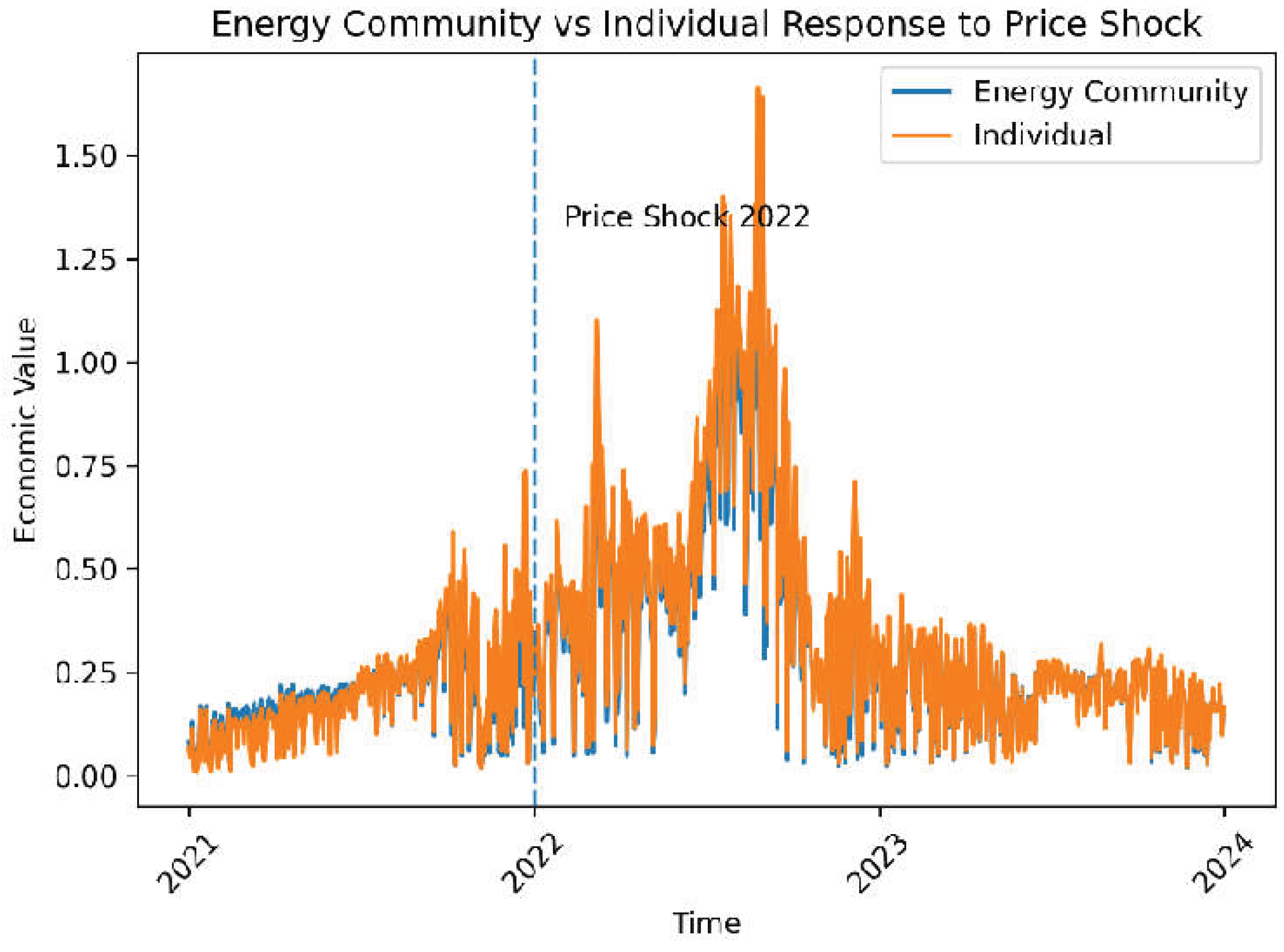
Figure 2.
Price impact on Individual Value –.
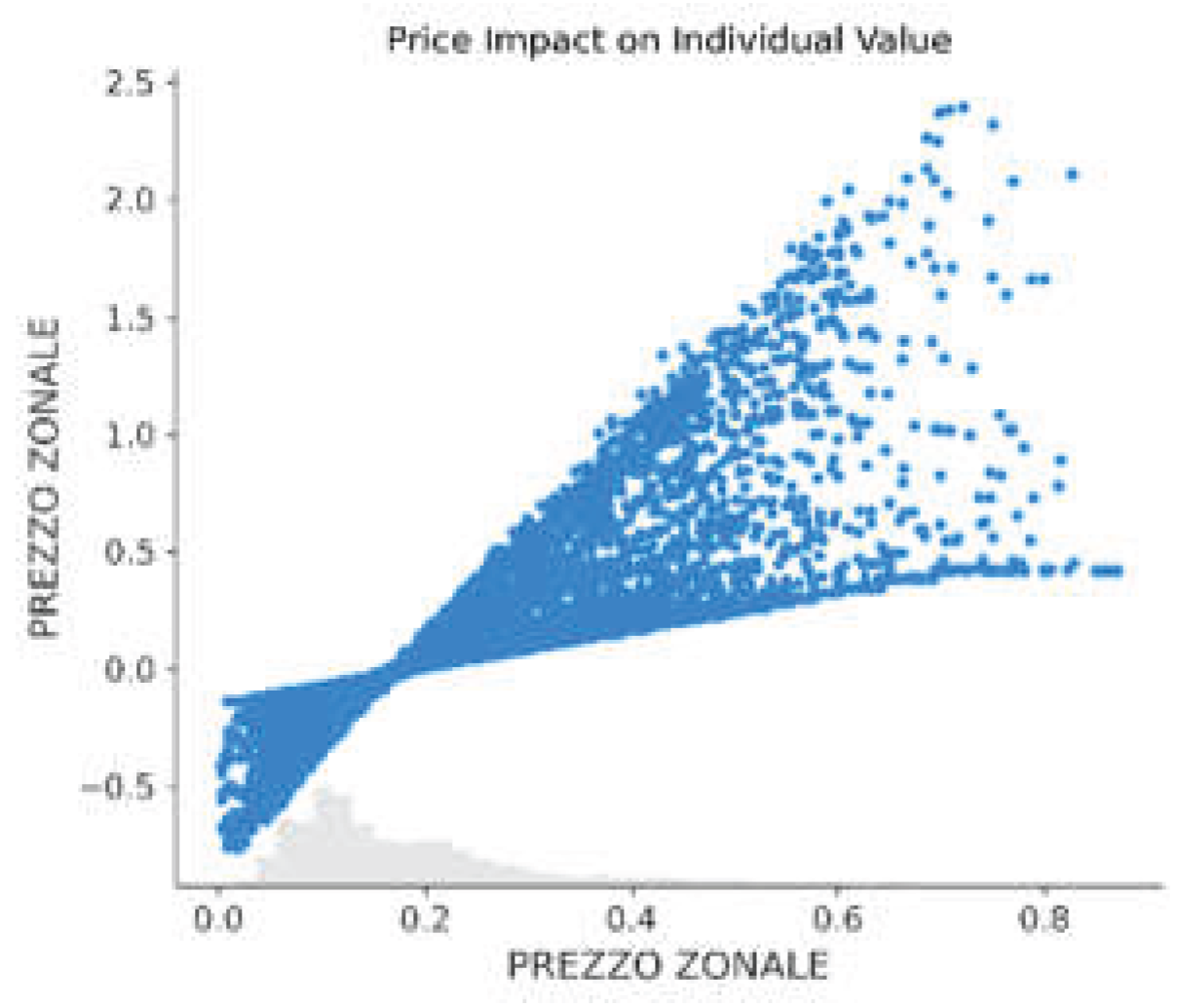
Figure 3.
Price impact on REC Value.
Disclaimer/Publisher’s Note: The statements, opinions and data contained in all publications are solely those of the individual author(s) and contributor(s) and not of MDPI and/or the editor(s). MDPI and/or the editor(s) disclaim responsibility for any injury to people or property resulting from any ideas, methods, instructions or products referred to in the content. |
© 2026 by the authors. Licensee MDPI, Basel, Switzerland. This article is an open access article distributed under the terms and conditions of the Creative Commons Attribution (CC BY) license (http://creativecommons.org/licenses/by/4.0/).
Copyright: This open access article is published under a Creative Commons CC BY 4.0 license, which permit the free download, distribution, and reuse, provided that the author and preprint are cited in any reuse.


