

Submitted:
02 June 2026
Posted:
04 June 2026
You are already at the latest version
Abstract
Background/ Objective: Healthcare institutions may foster environments that support nurses’ professional and personal growth. Therefore, nurses and healthcare facilities must provide a psychologically secure workplace. The purpose of the study is to investigate the relationship between nurses’ psychological safety atmosphere and ambidexterity, as well as the mediating function of adaptive performance. Methods: This investigation employed a descriptive correlational research design, following the STROBE criteria. To retain practical feasibility and guarantee adequate power to identify mediation effects, a target sample of roughly 400 nurses was established from Alexandria Main University Hospital, the largest academic hospital in Egypt, which is connected to Alexandria University, and was judged sufficient to meet the structural equation modeling (SEM) standards. The data gathering approach included three validated instruments: adaptable performance, ambidexterity behavior, and psychosocial safety climate (PSC). Results: Individual ambidexterity (β = 0.130, p = 0.025) and adaptive performance (β = 0.785, p < 0.001) were both strongly impacted by the psychological safety environment. Adaptive performance was a significant predictor of individual ambidexterity (β = 0.536, p < 0.001). Additionally, adaptive performance significantly moderates the relationship between individual ambidexterity and the psychological safety environment, according to a substantial indirect impact (β = 0.421). A satisfactory match was shown by the model fit indices (p < 0.001, CFI = 0.961, IFI = 0.950, RMSEA = 0.072, χ²/df = 9.239/3). Conclusions: psychosocial safety atmosphere greatly improves individual ambidexterity and adaptive performance, underscoring its role in developing a workforce that can successfully navigate between exploration and exploitation tasks while adapting to changing circumstances.
Keywords:
ambidexterity
; adaptive
; healthcare
; nurses
; psychosocial safety climate
1. Introduction
In healthcare organizations, nursing workers’ performance and well-being are crucial factors that have a direct impact on patient care quality and result in maintaining a robust healthcare system [1]. Nurses are frequently on the front lines of patient care, delivering crucial care, monitoring patient health, and carrying out medical procedures. As a result, patient safety, contentment, and recovery rates are greatly impacted by their physical, mental, and emotional well-being. The healthcare sector poses a major risk to the mental health and safety of its employees due to high expectations, complicated patient requirements, and little resources [2,3].
In addition to being beneficial to the staff, creating a supportive work environment for nurses is essential to maintaining high levels of patient care. The term "nurses’ work environment" refers to a wide range of factors that affect nurses’ interactions and experiences at work [4]. Healthcare institutions may create conditions that allow nurses to grow both personally and professionally. As a result, nurses and healthcare institutions need to create a psychological safety environment (PSC) [5].
Psychosocial safety climate (PSC)
Insecure labor in healthcare companies may be reduced by creating a safe, respectable, and healthy workplace and by creating high-quality jobs [6]. The well-being of nurses has a major impact on the sustainability of the workforce and, consequently, long-term organizational performance [7]. The psychosocial safety climate (PSC) is regarded as a certain organizational climate that comes before working circumstances and institutions’ capacity to establish work environments that foster both the universal and skilled development of employees as well as their personal growth. Therefore, by creating the PSC, the healthcare organization may highlight safeguards against psychological dangers and enhance the psychological well-being and safety of nurses. Furthermore, the PSC is seen as a managerial strategy that boosts the productivity and involvement of the nurses [5,8].
The psychosocial safety environment demonstrates the organization’s humanity and the extent to which management emphasizes and cherishes the well-being of nurses [9]. It encapsulates how nurses view the organization’s unique dedication to their mental health and well-being, which extends beyond output [10]. PSC is described as procedures, practices, and policies intended to safeguard the physical and mental well-being of employees. According to this theory, if the organization is concerned with preventing and managing psychosocial risks at work, it fosters an environment of trust and respect where nurses believe that management values their psychological well-being enough to make it a priority. As a result, nurses who believe that their leader is concerned about their success and mental health are willing to invest a lot of resources in work [5,11].
Moreover, PSC is a crucial framework that may be implemented at the corporate, group, and individual levels. Such a setting is expected to appropriately address psychological strain and occupational difficulties in the healthcare sector [12]. It has a major impact on work design by influencing nurses’ perceptions of job demands and resources. It is important to note that, with active involvement from both management and employees, PSC is dynamically molded and negotiated inside organizations through a range of workplace practices, organizational norms, power dynamics, communication channels, resource allocation, and job demands. As a result, a high PSC gives nurses the tools and self-assurance to voice their worries, feel in control, and apply their abilities to improve their profession. A positive PSC creates an environment where job demands are perceived as reasonable, resources are simpler to get, and there is a stronger sense of support [6,13]. As a result, a high PSC workplace improves working conditions and promotes increased productivity, engagement, creativity, and job satisfaction [13,14].
Therefore, by providing a supportive framework and workplace tools that help nurses manage stress, emotional weariness, and depression, PSC acts as a buffer, lessening the negative impacts of high job demands on nurses’ psychological health and well-being [3,6]. Its four guiding concepts are as follows: (a) management’s commitment to psychological well-being; (b) putting psychological well-being ahead of productivity goals; (c) effective communication, including being open to employee concerns; and (d) active engagement and consultation [5,15]. As a result, PSC is a crucial predictor of ambidexterity behavior and an organizational resource that boosts nurses’ psychological availability for extra-role acts [16,17].
Ambidexterity
Healthcare organizations are currently undergoing major upheaval as a result of unexpected technological breakthroughs and shifting societal needs [18]. To guarantee that high-quality care is provided, healthcare professionals, especially nurses, must therefore find a balance between developing new ideas and enhancing current services. The idea of ambidexterity, which involves utilizing current abilities while concurrently exploring and adaptably organizing new opportunities, can help achieve this balance [19].
Ambidexterity has been demonstrated to stand a vital aspect in cultivating overall organizational routine; it is described as the ability to invest in current services while simultaneously looking forward to new services [20,21]. It might be interpreted as having equal ease or skill with both hands. The ability to combine two things, duality, that appear to be very difficult or impossible to accomplish or perform simultaneously, is known as ambidexterity [22]. It is defined in the nursing context as the capability to simultaneously accomplish current patient care procedures (production-oriented) and look for future care procedures (development-oriented). Ambidexterity is the concept of balancing two strategies: exploration and exploitation. "Exploration" is the pursuit of new opportunities and the trialing with new thoughts, whereas "exploitation" is the enhancement and optimization of current progressions and services to maximum efficiency [19,23,24].
Nurses’ ambidexterity behaviors are critical to any healthcare organization, allowing them to efficiently manage patient care now while also adapting to future changes [19,24]. Ambidextrous nurses also play an important part in uncovering new ideas and taking risks due to their openness, as well as refining and implementing those ideas. Furthermore, ambidexterity is useful in affecting successful transformation. Accordingly, ambidextrous nurses are more likely to participate in proactive activities such as gathering new information and taking the initiative to improve patient care. Furthermore, ambidexterity in healthcare can generate an environment conducive to innovation [19,24,25].
Despite evidence tying ambidexterity to organizational success and innovation, most studies have been conducted at the organizational level. Individual ambidexterity has only lately gained attention, and theoretical and empirical research on it is still restricted. Previous study on ambidexterity has not addressed what exactly characterizes ambidextrous staff behavior [26]. Individual ambidexterity is most likely dependent on contextual factors (a supportive work environment) and resources that promote ambidextrous behaviors. Furthermore, it is linked to performance, corporate growth, creativity [27,28], innovation capabilities, customer happiness, and knowledge acquisition. Thus, it is maintained that promoting ambidexterity is essential to an organization’s long-term existence and well-being [29].
Adaptive performance:
One of the most important indicators of satisfying the quality criteria for healthcare services in the current healthcare environment is the performance of the public nursing staff. Positive patient outcomes depend on a nurse’s ability to operate adaptively, which includes managing dynamic situations, efficiently responding to unanticipated problems, and functioning in a variety of contexts [30,31,32]. By facilitating efficient patient problem-solving and crisis management, this ability directly improves clinical performance. As a result, there is a favorable correlation between adaptive performance and important organizational measures such as resistance to occupational stress and pressure, constructive workplace behaviors, and overall job performance [32,33].
Adaptive performance (AP), which boosts productivity via problem-solving, creativity, skill acquisition, crisis management, and interpersonal adaptability, is essential for nurses’ career success. All of these are necessary for healthcare organizations to prosper in evolving environments and maintain their inventiveness and competitiveness in the face of market shifts, technology advancements, and other outside factors [34,35]. Once a concept focused on individuals, adaptability is now crucial for corporations. These days, it includes proactive adaptation, innovative problem-solving, and people’s capacity to change with the market. Since flexibility is a key component of organizational success, this adaptation is essential for fostering innovation and enhancing patient care. It may be improved at many levels, including individuals, teams, processes, and organizations, and it boosts the organization’s capacity to deviate from established plans [35,36,37].
They define adaptability as a person’s capacity, motivation, and desire to change or adapt to any circumstance that affects a range of behaviors. In the workplace, AP helps nurses thrive in changing conditions, sustain productivity, improve skill development, propel organizational success, cultivate a culture of lifelong learning, and recognize outstanding professional performance. Learning agility, complexity management, physical flexibility, and the ability to think and act flexibly are all parts of this [31,35,37].
1.1. Research Hypothesis
We developed a conceptual model for this investigation based on the earlier conceptualizations (Figure 1). The following theories are put forth: Ambidexterity is the dependent variable, Psychosocial Safety Climate is the independent variable, and Adaptive Performance acts as a mediating factor.
H1: Individual ambidexterity among nurses is favorably correlated with the psychosocial safety atmosphere.
H2: Nurses’ adaptation performance is favorably correlated with the psychosocial safety atmosphere.
H3: Individual ambidexterity among nurses is favorably correlated with adaptive performance.
H4: Individual ambidexterity among nurses and the psychosocial safety atmosphere are mediated by adaptive performance.
1.2. The Significance of Study
Psychosocial safety environment (PSC) and occupational aspects are significantly correlated in high-demand healthcare settings with long working hours, varied shifts, and strict job demands [38]. Examining PSC’s effects on nurses’ behavior, performance, well-being, and safety is crucial given their vital role in patient care and wellbeing [3,38]. Therefore, the purpose of this study is to examine how PSC affects important aspects of occupational performance, particularly ambidextrous, and adaptive performance.
The psychosocial safety climate (PSC) has garnered significant scholarly attention and has been investigated across diverse sectors including industry [13,14,39], education [40], and general healthcare units [5,10]. Nevertheless, it remains inadequately defined and understood within the specific context of highly demanding critical care environments. This study directly addresses this critical gap by investigating the influence of PSC on critical care nurses. Given that PSC is a potent organizational construct and a known determinant of nurses’ organizational behaviors, job attitudes, psychological well-being, and professional quality of life [5,41].
This atmosphere is vital to deliver psychosocial, structural, and administrative motivational tools to foster a need to purify nursing care [5,41]. Therefore, nurses are likely to develop their own abilities, simultaneously demonstrate exploration and exploitation behaviors, and engage in ambidexterity. It is vital to address ambidexterity among nurses since it can lead to proactive work behavior, innovativeness, and improved organizational performance, identity, and career satisfaction, all of which can be crucial to both the organization and the individual nurse [20,21].
Moreover, nurse ambidexterity is essential to effectively manage patient care in the present and adapt to future changes, thereby directly enhancing adaptive performance (AP), a critical competency in unpredictable healthcare environments [19]. Despite their recognized importance in practice, ambidexterity and AP remain under-researched constructs within nursing science, particularly regarding their relationship with psychosocial safety climate (PSC) in high-stress clinical settings. This study addresses this gap by investigating the synergistic interaction between PSC, ambidexterity, and AP. Furthermore, it examines the mediating role of AP in the relationship between PSC and ambidexterity. The findings are critical for informing healthcare administrators and policymakers in Egypt, providing an evidence base for strategies designed to foster psychosocially safe workplaces. Ultimately, this research offers valuable insights into how these dynamics can improve nurse performance, retention, organizational resilience, and quality of care.
1.3. Aim of the Study
The study aims to explore the link between psychosocial safety climate and ambidexterity among nurses: the mediating role of adaptive performance.
2. Methodology
2.1. Research Design
A descriptive correlational research design was used for this investigation. according to STROBE’s (Strengthening the Reporting of Observational Studies in Epidemiology) standards.
STROBE Statement—Checklist of items that should be included in reports of cross-sectional studies
| Item No | Recommendation |
Page No |
|
| Title and abstract | 1 | (a) Indicate the study’s design with a commonly used term in the title or the abstract | 1 |
| (b) Provide in the abstract an informative and balanced summary of what was done and what was found | 1 | ||
| Introduction | |||
| Background/rationale | 2 | Explain the scientific background and rationale for the investigation being reported | 2-5 |
| Objectives | 3 | State specific objectives, including any prespecified hypotheses | 6 |
| Methods | |||
| Study design | 4 | Present key elements of study design early in the paper | 7 |
| Setting | 5 | Describe the setting, locations, and relevant dates, including periods of recruitment, exposure, follow-up, and data collection | 7 |
| Participants | 6 | (a) Give the eligibility criteria, and the sources and methods of selection of participants | 7 |
| Variables | 7 | Clearly define all outcomes, exposures, predictors, potential confounders, and effect modifiers. Give diagnostic criteria, if applicable | 8-9 |
| Data sources/measurement | 8* | For each variable of interest, give sources of data and details of methods of assessment (measurement). Describe comparability of assessment methods if there is more than one group | 9 |
| Bias | 9 | Describe any efforts to address potential sources of bias | 10 |
| Study size | 10 | Explain how the study size was arrived at | 7 |
| Quantitative variables | 11 | Explain how quantitative variables were handled in the analyses. If applicable, describe which groupings were chosen and why | 8 |
| Statistical methods | 12 | (a) Describe all statistical methods, including those used to control for confounding | 11 |
| (b) Describe any methods used to examine subgroups and interactions | 11 | ||
| (c) Explain how missing data were addressed | 11 | ||
| (d) If applicable, describe analytical methods taking account of sampling strategy | 11 | ||
| (e) Describe any sensitivity analyses | 11 | ||
| Results | |||
| Participants | 13* | (a) Report numbers of individuals at each stage of study—eg numbers potentially eligible, examined for eligibility, confirmed eligible, included in the study, completing follow-up, and analysed | 8 |
| (b) Give reasons for non-participation at each stage | - | ||
| (c) Consider use of a flow diagram | - | ||
| Descriptive data | 14* | (a) Give characteristics of study participants (eg demographic, clinical, social) and information on exposures and potential confounders | 12-13 |
| (b) Indicate number of participants with missing data for each variable of interest | 8 | ||
| Outcome data | 15* | Report numbers of outcome events or summary measures | 12-14 |
| Main results | 16 | (a) Give unadjusted estimates and, if applicable, confounder-adjusted estimates and their precision (eg, 95% confidence interval). Make clear which confounders were adjusted for and why they were included | 12-14 |
| (b) Report category boundaries when continuous variables were categorized | |||
| (c) If relevant, consider translating estimates of relative risk into absolute risk for a meaningful time period | 8 | ||
| Other analyses | 17 | Report other analyses done—eg analyses of subgroups and interactions, and sensitivity analyses | - |
| Discussion | |||
| Key results | 18 | Summarise key results with reference to study objectives | 14-17 |
| Limitations | 19 | Discuss limitations of the study, taking into account sources of potential bias or imprecision. Discuss both direction and magnitude of any potential bias | 17 |
| Interpretation | 20 | Give a cautious overall interpretation of results considering objectives, limitations, multiplicity of analyses, results from similar studies, and other relevant evidence | 12 |
| Generalisability | 21 | Discuss the generalisability (external validity) of the study results | 17 |
| Other information | |||
| Funding | 22 | Give the source of funding and the role of the funders for the present study and, if applicable, for the original study on which the present article is based | - |
| *Give information separately for exposed and unexposed groups. | |||
Note: An Explanation and Elaboration article discusses each checklist item and gives methodological background and published examples of transparent reporting. The STROBE checklist is best used in conjunction with this article (freely available on the Web sites of PLoS Medicine at http://www.plosmedicine.org/, Annals of Internal Medicine at http://www.annals.org/, and Epidemiology at http://www.epidem.com/). Information on the STROBE Initiative is available at www.strobe-statement.org.
2.2. Setting
The Alexandria Main University Hospital, which is affiliated with the University of Alexandria, will be the site of this investigation. It provides public non-paid health services and has about 6760 beds. It is the largest university hospital for education in Alexandria. The study will use all 23 critical care units: the second, third, and fourth units; the medical emergency unit; the surgical emergency unit; the intensive care unit of emergency operation; the transitional intensive care unit; the new transitional unit; the toxicity unit; the Maxillo- Facial and Plastic Surgery ICU; the Burn ICU; the Pulmonology ICU; the Neurosurgery ICU (1), the Neurosurgery ICU (2), the Neurosurgery ICU for pediatrics; the Hematemesis ICU, urology ICU, the Hepatic Transitional ICU, and the Diabetics ICU. and the Ear, Nose, and Trachea (ENT ICU).
2.3. Subjects
A convenience sample of 400 nurses is typically adequate to get stable parameter values and appropriate model fit indices for mediation models with a small number of latent variables and observable indicators. With inclusion criteria, currently listed nurses with at least 6 months of clinical experience, who guarantee familiarity with organizational procedures and psychosocial work conditions, as well as those who were willing to participate and give informed consent, were eligible participants. One study eliminated nurses on long-term leave, administrative personnel not directly involved in patient care, and participants who provided inconsistent or incomplete survey answers.
2.4. Tools
Three tools will be used in this study as follows:
Tool (1): Psychosocial Safety Climate Scale
Dollard (2010) created this tool [42]. It is a 12-item survey with a Likert-type answer scale ranging from 1 (strongly disagree) to 5 (strongly agree) [42]. Four subcomponents make up the instrument. The first dimension is termed management commitment (three things), followed by management priority (three items), organization communication (two items), and organizational engagement and involvement (four items). A 5-point Likert scale, from strongly agree (5) to strongly disagree (1), will be used to gauge the replies. With a Cronbach’s alpha of.97, the overall items demonstrated good dependability [42]. The total score is between 12 and 60. Low levels fall between 12 and 28, moderate levels between 28 and 44, and high levels between 44 and 60. Greater scores signify a higher degree of Psychosocial Safety Climate.
Tool (2): Individual Ambidexterity scale
Tempelaar et al. (2017) [43] created this tool. It has fourteen elements to gauge how ambidexterity is seen by nurses. A seven-point Likert scale, from strongly agree (7) to strongly disagree (1), will be used to gauge the replies. We had to remove two items from the exploration scale and one from the exploitation scale after doing an exploratory factor analysis of all 14 items. This resulted in a two-factor solution that included six items for exploitation (α =.85, CR = 0.90, AVE =.58) and five items for exploration (α =.73, composite reliability [CR] = 0.83, average variance extracted [AVE] =.50). The total score is between 17 and 98. Individual ambidexterity ranges from 17–44 at low levels, 44–71 at moderate levels, and 71–98 at high levels. Greater scores show a high level of individual ambidexterity among nurses.
Tool (3) Adaptive Performance Scale
Charbonnier-Voirin & Roussel (2012) [44]. created this tool. Reactivity in the face of emergencies and unforeseen events (4 things), managing job stress (3 items), creativity (4 items), training effort (4 items), and interpersonal adaptability (4 items) are the five characteristics that comprise its 19 items. A seven-point Likert scale, from strongly agree (7) to strongly disagree (1), will be used to gauge the replies. For every dimension, Cronbach’s Alpha was acceptable (range from.75 to.82) [44]. The total score falls between 19 to 133. Low levels are between 19 and 57, moderate levels are between 57 and 95, and high levels are between 95 and 133. Higher scores show that nurses have a high degree of adaptive performance.
The researcher will also create a demographic datasheet with questions on age, gender, years of service, working unit, educational background, and nursing experience.
2.5. Ethical Consideration
The highest ethical standards outlined in the Declaration of Helsinki were adhered to in this study to safeguard the rights, welfare, and privacy of each participant. The study was formally authorized by the XX University IRB and assigned a reference code (AU-20-8-349) by the XX University College of Nursing Research Ethics Committee. prior to gathering data. The goal, advantages, and possible hazards of the research were explained to each participant. Additionally, they were assured that their involvement was entirely voluntary and that they may leave at any moment without facing any consequences.
The data was randomized to prevent any identifying information from being connected to individuals, and the personal information was meticulously kept private. Each participant gave their informed permission before any data was collected, attesting to their knowledge of their rights and the study’s goals. The study also complied with international best practices in health research ethics and the ethical guidelines and standards for human subjects’ research established by the university’s ethics review board.
2.6. Pilot Study
In order to confirm the tools’ utility and usability and identify any potential issues or challenges during data collection, 10% of the nurses (n = 40) authorized the pilot project. Nothing could be changed. To prevent data contamination, pilot experiment participants were not allowed to continue the study. The results demonstrated that no modifications were necessary because each question was understandable, relevant, and consistent with the study’s objectives. The participants said that they had no trouble or doubt understanding the questions.
2.7. Data Collection
Each participating nurse received a copy of the study questionnaire from the researchers themselves. Each nurse was given a brief description of the study’s objective two minutes before it ended. To guarantee that the answers were genuine, comprehensive, and intelligible, the questionnaires were completed on-site under the guidance of a researcher. When participants asked questions, researchers answered them and provided any clarifications that were required. Because nurses were chosen from units, forms were delivered and collected faster, increasing response rates. It took fifteen to twenty minutes to finish the questionnaire. Two months of data collection were conducted in 2025, from June to August.
2.8. Data Analysis
A systematic coding and data input process was implemented to ensure correctness and integrity. The data was entered and analyzed using IBM SPSS AMOS (Version 23) and IBM SPSS Statistics (Version 23).
3. Results
3.1. Validity and Reliability
Table 1: Three components with eigenvalues greater than one were identified, according to the total variance explained.
Table 2: These components together accounted for 65.45% of the total variance, with the first factor explaining 45.74%, the second 11.29%, and the third 8.42%. Since the curve leveled off after the third component, the scree plot validated this three-factor answer. These results show that the instrument has a significant three-factor structure, good sample adequacy, and great reliability.
Table 3 showed the average age of the 400 participants in the study was 32.5 ± 5.8 years, with the biggest percentage of participants being between the ages of 20 and 30 (37.0%), 30 and under 40 (30.5%), 40 and under 50 (23.0%), and ≥50 (9.5%). Compared to men (29.2%), women made up the majority (70.8%). Fifty-five percent of the nurses were married, compared to 32.5% who were single, 9.0% who were widowed, and 8.0% who were divorced. Qualifications-wise, 17.0% had a high school diploma, 24.0% had a nursing institute diploma, and 49.0% had a bachelor’s degree in nursing. The ICU employed most nurses (58.8%), followed by internal departments (35.5%) and the CCU (5.8%). With 47.8% having 10–15 years, 26.5% having 1–5 years, 21.8% having ≥15 years, and 4.0% having 5–10 years, the average number of years of nursing experience was 9.46 ± 5.12 years. 46.0% had 1–5 years, 28.8% had 5–<10 years, 20.5% had 10–<15 years, and 4.8% had ≥15 years of experience in their present unit, with a mean of 7.34 ± 6.81 years.
Table 4 revealed the mean score for the Psychosocial Safety Climate (PSC) was 40.30 ± 9.32 (59.14 ± 19.54%), with 57.0% of nurses scoring at a moderate level, 37.8% at a high level, and 5.3% at a low level. Organizational engagement and involvement (13.28 ± 4.03; 58.02%) had the highest rating. On the other hand, organizational communication was the lowest (6.81 ± 2.32; 60.13%). Additionally, the mean score for individual ambidexterity was 47.45 ± 11.48 (59.72%), with 55.7% scoring moderate, 37.8% high, and 6.5% low. Moreover, averaging 57.88 ± 12.39 (51.48%), adaptive performance was primarily moderate (85.7%), with highs of 9.0% and lows of 5.3%. The top subdimensions were reaction to emergencies (13.22 ± 4.05; 57.63%), and the lowest was managing job stress (9.92 ± 2.71; 57.65%).
Table 5 showed the results of the correlation study, demonstrating a robust and favorable relationship between the overall psychosocial safety climate and both overall individual ambidexterity (r = 0.448, p < 0.001) and overall adaptive performance (r = 0.591, p < 0.001). Furthermore, there was a high correlation between individual ambidexterity and adaptive performance (r = 0.642, p < 0.001). These results imply that enhanced ambidexterity and adaptable performance among nurses are associated with a higher degree of psychosocial safety climate, and that adaptive performance is a major factor in the development of ambidextrous behaviors.
Table 6 revealed adaptive performance (B = 0.536, β = 0.579, p < 0.001) and psychosocial safety atmosphere (B = 0.130, β = 0.106, p = 0.026) were found to be significant predictors of individual ambidexterity, accounting for 41.6% of its variation (adjusted R2 = 0.416, F = 143.117, p < 0.001) in the regression model. The standardized effect of adaptive performance was significantly higher than that of psychosocial safety climate, suggesting that adaptive performance plays a more significant role in predicting individual ambidexterity.
F,p: f and p values for the model, R2: Coefficient of determination, B: Unstandardized Coefficients, Beta: Standardized Coefficients, t: t-test of significance, LL: Lower limit UL: Upper Limit, *: Statistically significant at p ≤ 0.05.
Table 7 revealed according to path analysis, the psychosocial safety atmosphere significantly influenced both individual ambidexterity (β = 0.130, p = 0.025) and adaptive performance (β = 0.785, p < 0.001). Individual ambidexterity was significantly predicted by adaptive performance (β = 0.536, p < 0.001) as shown also, figure (3). Furthermore, a significant indirect effect (β = 0.421) indicated that adaptive performance largely moderates the association between individual ambidexterity and the psychological safety climate. The model fit indices showed a good fit (p < 0.001, CFI = 0.961, IFI = 0.950, RMSEA = 0.072, χ2/df = 9.239/3).
Model fit parameters CFI; IFI; RMSEA (0.961; 950; 0.072), Model χ2/df. 9.239/3 p≤0.001, CFI: Comparative Fit Index, IFI: Incremental Fit Index, RMSEA: Root Mean Square Error of Approximation.
Table 8 presents the standardized regression weights for the measurement model and shows that all hypothesized factor loadings are positive, statistically significant, and substantial in magnitude. Specifically, every observed indicator loads significantly on its corresponding latent construct at the 0.001 level, indicating strong convergent validity and confirming that the items adequately represent their intended dimensions. Psychosocial Safety Climate, all four indicators (organizational participation and involvement, organizational communication, management priority, and management commitment demonstrate strong and significant loadings (β = 0.871 to 9.731, p < 0.001), with management commitment and organizational participation and involvement showing particularly high estimates. This pattern suggests that the construction is well captured by multiple facets of organizational practices related to employee psychosocial safety and supportive management. Similarly, Individual Ambidexterity is strongly reflected by its two indicators, with both exploration items showing statistically significant associations (β = 1.124 and 3.303, p < 0.001). The results confirm that the latent factor is reliably represented by the exploratory work-related behaviors included in the model. The Adaptive Performance construct is also well supported by its five indicators, all of which are significant at p < 0.001. Among these, interpersonal adaptability exhibits the strongest loading, followed by creativity, managing work stress, reactivity in emergencies and unexpected circumstances, and training effort. Collectively, these results indicate that adaptive performance is a multidimensional construct encompassing interpersonal, cognitive, and behavioral adjustment capabilities in dynamic work environments.
4. Discussion
The results of this study show that nurses’ adaptive performance and individual ambidexterity are significantly influenced by their psychosocial safety environment (PSC), with adaptive performance acting as a substantial partial mediator between the two. The nurses in the study have a mean age of 32.5 ± 5.8 years, and most of them are in the 20–30 age range. This indicates that the workforce is comparatively young. This implies that early- to mid-career professionals make up most of the nursing staff, which is in line with worldwide nursing demographics where younger cohorts are joining the field at a growing rate. Given that the nursing profession has historically been dominated by women, most participants (70.8%) were female [45]. More than half of the respondents (55.0%) were married, suggesting that the work-life balance may be impacted by dual roles and obligations. Nearly half (49.0%) of the workforce have a bachelor’s degree in nursing, indicating that they are well educated and able to meet professional demands. However, a sizable portion (41.0%) still have diploma-level qualifications, which may limit their opportunities for specialization and advancement.
Furthermore, most nurses focused on critical care units, such as intensive care units, according to the distribution of workplace assignments, underscoring the high staffing levels in acute and high-stakes settings. An experienced workforce was reflected in the average of 9.46 ± 5.12 years of clinical experience among nurses, with nearly half (47.8%) falling within the 10- to 15-year range. With nearly half (46.0%) having just been in their present placement for 1–5 years, the mean time in the current unit was shorter (7.34 ± 6.81 years), indicating moderate staff mobility across units. When taken as a whole, these demographic trends indicate that the sample under study is a relatively young, mostly female, moderately experienced nursing workforce that is highly concentrated in critical care settings and has solid educational backgrounds that enable flexibility and ambidexterity in challenging healthcare settings.
Nurses in this group generally reported moderate levels of individual ambidexterity and adaptable performance, as well as a moderate psychosocial safety environment (PSC). In terms of PSC, organizational engagement and involvement was the greatest component. This is because nurses are encouraged to get involved in psychological safety and health issues, and stress prevention in this institution incorporates all healthcare organizational levels. However, the reason for the lowest score in the organizational commitment dimension is that there is poor communication regarding psychological safety concerns, and my manager or supervisor has not adequately informed me about workplace psychological well-being.
This trend is consistent with research that indicates higher PSC is associated with better nurse safety performance, engagement, and reduced burnout mechanisms, all of which are thought to enhance ambidextrous and flexible behaviors in clinical practice [46]. Additionally, communication gaps are a recurring problem in healthcare systems and are often linked to a less robust patient safety culture, according to Tiwary et al. (2019). However, results vary depending on the context. While some studies report high PSC among healthcare professionals, others, especially in settings with limited resources or high demand, have found lower PSC [47]. These contextual differences may account for the moderate levels found in the current study [5,38].
Additionally, the moderate ambidexterity finding is consistent with previous research that demonstrates that it is possible to balance exploration (innovation, improvement) and exploitation (standardized protocols), but that this is often limited by organizational demands and workload, with climate and leadership serving as enabling conditions [17,48]. Additionally, the study’s adaptive behaviors for nurses received the highest score on "reactivity in emergencies," reflecting the nurses’ well-established capacity for crisis management. This is a result of their ability to swiftly assess potential solutions and their implications to choose the best one, make decisions about how to proceed to address the issue, and readily rearrange their work to accommodate changing conditions [49].
In contrast, the weakest aspect of adaptive performance was "managing job stress," which is in line with research that indicates occupational stress has a negative correlation with safety culture and adaptability, particularly in times of crisis like the COVID-19 pandemic [50]. All these results point to the urgent need to improve communication and put stress management strategies into place, even if the nursing staff in acute care shows resilience and adaptability. Stronger adaptive and ambidextrous outcomes may result from moderate PSC, according to recent research that supports the efficacy of treatments that increase speaking-up climates and integrated platforms intended to improve PSC [51,52].
Both individual ambidexterity and adaptive performance were considerably and favorably correlated with psychosocial safety climate (PSC), according to the current study, with ambidexterity and adaptive performance having a particularly strong correlation. These results are consistent with other studies that found a positive PSC encourages resilience, creativity, and employee engagement, all of which improve adaptive and ambidextrous behaviors in healthcare settings [53]. According to Slåtten et al. (2023), nurses must be able to balance exploration and exploitation, which is crucial in high-stress healthcare settings. This is demonstrated by the strong correlation between adaptive performance and ambidexterity [48].
Similar to the current findings, El-Gazar et al. (2024) discovered that supportive environments and psychological safety encourage nurses to be creative and use ambidextrous techniques [17]. Organizational restrictions may attenuate these correlations, as some researchers have found reduced associations between safety climate and performance results, especially in situations with high workloads and inadequate communication systems [38]. When combined, the findings show that PSC is a crucial contextual element that promotes ambidexterity and adaptability, with adaptive performance emerging as a significant motivator of ambidextrous behavior in nurses.
According to the regression study, individual ambidexterity was significantly predicted by both adaptive performance and psychosocial safety atmosphere, which combined accounted for 41.6% of the variance in the trait. Interestingly, the standardized effect of adaptive performance (β =.579, p <.001) was significantly stronger than that of psychosocial safety climate (β =.106, p =.026), highlighting the crucial role that adaptability plays in influencing ambidextrous behavior in nurses.
This result is consistent with that of K-Weerasinghe (2022), who found that effective performance in dynamic and uncertain contexts is critically dependent on flexibility [54]. Similar to this, recent research in healthcare settings has shown how adaptable performance helps nurses strike a balance between exploitation and exploration by adapting to clinical needs while adhering to established protocols [55]. Contextual safety perceptions may function more indirectly, for instance by encouraging adaptation, which in turn encourages ambidextrous behavior, even though a psychological safety atmosphere also contributed to ambidexterity.
This perspective aligns with research demonstrating that supportive environments foster innovation and creativity mainly by influencing proactive and adaptable work practices [56]. All these findings point to adaptable performance as a direct cause of ambidexterity, while the psychosocial safety climate acts as a contextual facilitator that fortifies adaptation and subtly encourages ambidextrous behavior.
The suggested connections between individual ambidexterity, adaptive performance, and psychosocial safety climate (PSC) were further supported by route analysis. Both individual ambidexterity (β =.130, p =.025) and adaptive performance (β =.785, p <.001) were significantly impacted by PSC, indicating that it is a contextual element that significantly influences nurses’ performance and capacity for innovation. Individual ambidexterity was strongly predicted by adaptive performance (β =.536, p <.001), indicating that adaptability is a proximal driver of ambidextrous behavior.
Crucially, adaptable performance significantly mediated the relationship between PSC and ambidexterity, as indicated by the considerable indirect effect (β =.421). This suggests that supportive psychosocial environments encourage ambidextrous practices primarily via improving nurses’ adaptability. This conclusion is consistent with other research showing that PSC influences proactive and adaptive behaviors, which in turn promote learning, creativity, and innovation [51,53]. The model fit indices (RMSEA = 0.072, IFI = 0.950, and CFI = 0.961) provided strong empirical evidence for the mediating function of adaptive performance in this connection and further validated the suitability of the proposed model. Collectively, these findings imply that although PSC directly enhances ambidexterity, its main effect is to increase nurses’ adaptive ability, which helps them successfully strike a balance between exploration and exploitation.
4.1. Theoretical Implication
The findings of this study offer several important theoretical implications for the literature on psychosocial safety climate, individual ambidexterity, and adaptive performance. First, the results reinforce the proposition that psychosocial safety climate (PSC) is a meaningful antecedent of positive employee outcomes. By demonstrating that PSC is strongly and significantly associated with adaptive performance, this study extends PSC theory beyond its traditional focus on stress reduction, well-being, and psychological health. The findings suggest that PSC is not only a protective organizational climate but also a performance-enabling climate that supports employees’ ability to adjust, respond, and function effectively in changing work conditions. this study contributes to the adaptive performance literature by identifying organizational climate as a crucial contextual driver of adaptability. Most previous studies have emphasized individual attributes, such as personality, cognition, or resilience, as predictors of adaptive performance. This study broadens that perspective by showing that employees’ adaptive capability is shaped by the psychosocial environment in which they work. Theoretically, this supports the view that adaptive performance should be understood not merely as an individual trait or skill, but as a dynamic outcome influenced by organizational conditions. Third, the role of individual ambidexterity adds an important theoretical layer. The findings indicate that employees who can balance exploration and exploitation are better positioned to adapt to changing demands. This supports the ambidexterity theory by suggesting that the ability to manage both novelty-seeking and efficiency-oriented behaviors is relevant not only for innovation and organizational performance but also for individual adaptability. In this way, the study extends individual ambidexterity theory into the domain of adaptive performance. Fourth, the study suggests that PSC may indirectly strengthen adaptive performance by creating conditions that encourage learning, experimentation, and flexibility. A climate that prioritizes employee participation, communication, management commitment, and concern for psychological health may reduce fear and uncertainty, thereby enabling employees to explore new approaches while still performing routine tasks effectively. This helps integrate PSC theory with behavioral and performance-based frameworks, showing how a supportive climate can foster both safety and adaptability.
4.2. Clinical Implication
The results of this study have significant therapeutic ramifications for employee performance and workplace mental health. Organizations and occupational health experts should place a high priority on creating psychologically safe work settings that lessen interpersonal danger, stress, and fear since psychosocial safety climate has been demonstrated to be highly connected with adaptive performance. In actuality, this is making certain that management actively promotes worker well-being, promotes candid communication, and reacts quickly to psychological hazards at work. Employees may feel more comfortable asking for assistance, picking up new skills, and adjusting to shifting expectations in an environment with high psychosocial safety, which can enhance both mental health and productivity. These results may be used by clinicians, counselors, and organizational psychologists to support treatments that enhance employee engagement, supportive leadership, and stress-prevention policies as part of broader workplace mental health initiatives.
4.3. Limitations
It is more difficult to establish a causal relationship between individual ambidexterity, adaptive performance, and the psychosocial safety atmosphere when a descriptive correlational methodology is used. The direction of these correlations cannot be proven, despite the identification of substantial links. Alexandria Main University Hospital was the sole hospital from which the data were gathered, which may limit the findings’ applicability to other healthcare environments, geographical areas, or nations. The results’ relevance may be impacted by variations in organizational culture, personnel trends, and working conditions among hospitals. The study used self-reported questionnaires, which are prone to answer bias, such as common method variance and social desirability bias. The observed associations may have been impacted by nurses’ overestimation or underestimation of their perceptions and behaviors. Factors such as department type, years of experience, workload, and managerial support were not fully explored and may have influenced the outcomes. The study examined only one mediator, adaptive performance, and did not consider other potentially important variables such as leadership style, job satisfaction, burnout, or organizational support, which may also affect ambidexterity.
4.4. Future Directions
Future studies should use longitudinal designs to better examine the causal relationships among psychosocial safety climate, adaptive performance, and individual ambidexterity over time. This would help clarify how changes in the work environment influence nurses’ adaptive behaviors and ambidextrous performance. Comparing public and private hospitals, as well as different departments and nursing specialties, may provide a more comprehensive understanding of these relationships across diverse organizational contexts.
5. Conclusion
The importance of a supportive psychosocial safety climate in promoting nurses’ professional behaviors and adaptability in challenging healthcare settings is highlighted by this study. The results showed that a psychosocial safety atmosphere greatly improves individual ambidexterity and adaptive performance, underscoring its role in developing a workforce that can successfully navigate between exploration and exploitation tasks while adapting to changing circumstances. Crucially, the association between nurses’ ambidextrous behaviors and the psychosocial safety atmosphere was found to be significantly mediated by adaptive performance, which also emerged as a strong predictor of ambidexterity.
Together, the findings imply that establishing an organizational climate that is psychologically safe not only gives nurses the freedom to try new things, be creative, and balance conflicting demands, but also improves their capacity to adapt to changing conditions, which is a crucial aspect of resilience in healthcare systems. The robustness of the suggested structural model is further confirmed by the good model fit indices. Practically speaking, these results highlight how important it is for legislators and healthcare executives to give priority to initiatives that create and maintain psychosocial safety environments. Institutions can improve nurses’ ambidexterity and adaptive performance in this way, which will ultimately improve patient care, organizational learning, and the long-term resilience of healthcare organizations.
Author Contributions
Amal Diab Ghanem Atalla: ideation, collecting data, producing the first draft, and manuscript revision and editing. Samia Roshdy Soliman Osman, Heba Ahmed Mohsen Hassen, Samia Mohamed Sobhi Mohamed, Asmaa Hany Fathallaa, Ohood Felemban, Marwa Samir Sorour, Ebaa M Felemban, Ghada Mohamed Hamouda, Makiah Mohammed Shebaili, and Heba Ahmed Hamza Zabady: data interpretation and statistical analysis. All authors have read and agreed to the published version of the manuscript.
Funding
This research received no external funding.
Ethics Approval and Consent to Participate
Every technique used in this investigation complied completely with the relevant guidelines provided in the Declaration of Helsinki (DoH-Oct2008). The research serial number (IRB00013620(9/19/2025)) is AU-20-8-348. The Research Ethics Committee of University Faculty of Nursing in Egypt formally approved and authorized the study. Nursing faculty members who voluntarily chose to participate in the study had to give written informed consent before they could do so.
Consent for Publication
Not applicable.
Clinical Trial Number
Not applicable.
Data Availability Statement
The datasets developed and analyzed during the current work will be made available by the corresponding author upon reasonable request.
Acknowledgments
We are deeply grateful to the hospital director and the first-level nurse managers of the clinical units at Main University Hospital for their valuable support and encouragement. Our heartfelt thanks also go to the nurses who participated in this study; their contribution was essential to the successful completion of this research.
Competing of Interest
No conflicts of interest have been disclosed by the authors.
References
- Haldane, V.; De Foo, C.; Abdalla, S.M.; Jung, A.S.; Tan, M.; Wu, S.; et al. Health systems resilience in managing the COVID19 pandemic: Lessons from 28 countries. Nat. Med. 2021, 27, 964–980. [Google Scholar] [CrossRef]
- Broetje, S.; Jenny, G.J.; Bauer, G.F. The Key Job Demands and Resources of Nursing Staff: An Integrative Review of Reviews. Front Psychol. 2020, 11, 510330. [Google Scholar] [CrossRef] [PubMed]
- Amoadu, M.; Agyare, D.F.; Doe, P.F.; et al. Examining the impact of psychosocial safety climate on working conditions, wellbeing and safety of healthcare providers: A scoping review. BMC Health Serv. Res. 2025, 25, 90. [Google Scholar] [CrossRef] [PubMed]
- Raineri, A.; Cartes, M. Psychological safety and work design as mediators of supervisors’ dark triad traits impact on nurses’ task performance. Int. J. Public Health 2024, 69, 1607340. [Google Scholar] [CrossRef] [PubMed]
- Arafat Abdeltwab, R.; Mohamed Abd Rabou, H.; Ahmed Abd Elhamid, L. The Relation between Psychosocial Safety Climate and Work Engagement among Staff Nurses. Egypt. J. Health Care 2025, 16(3), 312324. [Google Scholar] [CrossRef]
- Amoadu, M.; Ansah, E.W.; Sarfo, J.O. Influence of psychosocial safety climate on occupational health and safety: A scoping review. BMC Public Health 2023, 23, 1344. [Google Scholar] [CrossRef]
- Barnes, C.M.; Wagner, D.T.; Schabram, K.; Boncoeur, D. Human sustainability and work: A metasynthesis and new theoretical framework. J. Manag. 2023, 49, 1965–1996. [Google Scholar] [CrossRef]
- World Health Organization. WHO Guidelines on Mental Health at Work. World Health Organization. 2022. Available online: https://www.who.int/publications/i/item/9789240053052.
- Dollard, M.F.; Bakker, A.B. Psychosocial safety climate as a precursor to conducive work environments, psychological health problems, and employee engagement. J. Occup. Organ Psychol. 2010, 83, 579599. [Google Scholar] [CrossRef]
- Shee, P.Y.; Dollard, M.F.; Idris, M.A. How psychosocial safety climate affects employee wellbeing via basic psychological needs: A longitudinal multilevel moderated mediation study. Journal of Applied Psychology. 2025. Available online: https://psycnet.apa.org/doi/10.1037/apl0001304.
- Liu, X.; Huang, Y.; Kim, J.; Na, S. How ethical leadership cultivates innovative work behaviors in employees? Psychological safety, work engagement and openness to experience. Sustainability 2023, 15, 3452. [Google Scholar] [CrossRef]
- Mansour, S.; Faisal Azeem, M.; Dollard, M.; Potter, R. How psychosocial safety climate helped alleviate work intensification effects on presenteeism during the COVID19 crisis? A moderated mediation model. Int. J. Environ. Res. Public Health 2022, 19, 13673. [Google Scholar] [CrossRef]
- Loh, M.Y.; Dollard, M.F.; McLinton, S.S.; Brough, P. Translating psychosocial safety climate (PSC) into realworld practice: Two PSC intervention case studies. J. Occup. Health 2024, 66, uiae051. [Google Scholar] [CrossRef]
- Berglund, R.T.; Bäckström, I.; Johansson, P.E.; Omorede, A. EmployeeDriven Innovation: Exploring The Significance Of Psychosocial Safety Climate And Implications For Management. Int. J. Innov. Manag. 2024, 28, 2450034. [Google Scholar] [CrossRef]
- Dollard, M.F.; Bailey, T. Building psychosocial safety climate in turbulent times: The case of COVID19. J. Appl. Psychol. 2021, 106, 951964. [Google Scholar] [CrossRef] [PubMed]
- Addai, P. Ambidextrous Leadership as an Antecedent of Ambidextrous Innovation: Mediating Roles of Psychological Safety and Job Autonomy. SEISENSE Bus. Rev. 2025, 5, 114. [Google Scholar] [CrossRef]
- ElGazar, H.E.; Baghdadi, N.A.; Abdelaliem, S.M.; Zoromba, M.A. Sparking nurses’ creativity: The roles of ambidextrous leadership and psychological safety. BMC Nurs. 2024, 23, 643. [Google Scholar] [CrossRef]
- AlHussami, M.; Hamad, S.; Darawad, M.; Maharmeh, M. The effects of leadership competencies and quality of work on the perceived readiness for organizational change among nurse managers. Leadersh. Health Serv. 2017, 30, 443456. [Google Scholar] [CrossRef]
- ElGazar, H.E.; Zoromba, M.A.; Abousoliman, A.D.; Abou Zeid, M.A.G. Effect of an ambidexterity training program on innovative behavior and leadership competencies among nurse managers. Egypt. J. Health Care 2020, 11, 12261241. [Google Scholar] [CrossRef]
- Hiebl, M.; Pielsticker, D. Automation, organizational ambidexterity and the stability of employee relations: New tensions arising between corporate entrepreneurship, innovation management and stakeholder management. J. Technol. Transf. 2023, 48, 1978–2006. [Google Scholar] [CrossRef]
- El Sayed Hassan Helal, W.; Gamal Mohmed Elsagheir, S.; & Mohammed Soliman, S. Artificial Intelligence as the Driver for Organizational Excellence and Ambidexterity among Nurses. Egypt. J. Health Care 2023, 14, 12821298. [Google Scholar] [CrossRef]
- Slåtten, T.; Mutonyi, B.R.; Nordli, A.J.; et al. The role of ambidextrous leadership and employee ambidexterity in enhancing service quality of care and creativity – a study of health professionals. BMC Health Serv. Res. 2023, 23, 1252. [Google Scholar] [CrossRef]
- Hoang, T.H.; Le, Q.H. “A selfregulatory adapting mechanism to changing work setting: Roles of playful work design and ambidexterity”. Curr. Res. Behav. Sci. 2024, 6, 100148. [Google Scholar] [CrossRef]
- Karani, A.; Jayswal, M.; Panda, R.; Trivedi, P. “If you fulfill your promise, I will be an asset for you”: Exploring the relationship between psychological contract fulfillment and individual ambidexterity. Int. J. Sociol. Soc. Policy 2022, 42, 831851. [Google Scholar] [CrossRef]
- Ijigu, A.W.; Alemu, A.E.; Kuhil, A.M. The mediating role of employee ambidexterity in the relationship between highperformance work system and employee work performance: An empirical evidence from ethiotelecom. Cogent Bus. Manag. 2022, 9, 2135220. [Google Scholar] [CrossRef]
- Klonek, F.E.; Volery, T.; Parker, S.K. “Managing the paradox: Individual ambidexterity, paradoxical leadership and multitasking in entrepreneurs across firm life cycle stages”. Int. Small Bus. J. 2021, 39, 4063. [Google Scholar] [CrossRef]
- Chen, Y.; Fu, Y. “Guanxi HRM practices and employee creative performance”. Pers. Rev. 2020, 49, 17131729. [Google Scholar] [CrossRef]
- Poon, W.C.; Mohamad, O.; Yusoff, W.F.W. “Examining the antecedents of ambidextrous behaviors in promoting creativity among SMEs in Malaysia”. Glob. Bus. Rev. 2020, 21, 645662. [Google Scholar] [CrossRef]
- Raj, K.; Fredrick, D.P.; Kurahattidesai, C.; Hegde, C.S. “Artificial intelligence driven customer relationship management: Harnessing the power of technology to improve business efficiency”. Int. J. Commun. Netw. Inf. Secur. 2024, 16, 5865. Available online: https://ijcnis.org.
- Shahidan, A.N.; Azizan, F.L.; Arifin, M.A.; Abumandil, M.S.; Arshad, M.Z. Person environment fit and adaptive performance among nurses in Malaysian public hospitals. Int. J. Acad. Res. Bus. Soc. Sci. 2021, 11, 593604. [Google Scholar] [CrossRef]
- Ibrahim Mahmoud, S.; Ali Hassan, H.; Marzouk Amer, S. Relation between Nurses’ Cultural Intelligence and Adaptive Performance. Egypt. J. Health Care 2022, 13, 19221937. [Google Scholar] [CrossRef]
- Tabiu, A.; Pangil, F.; Othman, S.Z. Doestraining, job autonomy and career planningpredict employees’ adaptive performance? Glob. Bus. Rev. 2020, 21, 713724. [Google Scholar] [CrossRef]
- Saleh, J.I. The Role of Empowering Leadership in Enhancing the adaptive performance of employees. Int. Sci. J. About Technol. 2022, 8, 16. [Google Scholar] [CrossRef]
- Bednall, T.C.; Henricks, M.D. Adaptive performance: A review of managerial interventions. In Global perspectives on Change Management and Leadership in the Postcovid19 Era; 2021; p. 7189. [Google Scholar] [CrossRef]
- Setiyadi, D.; Septiarini, E.; Kurniasih, N.; Wijaya, A.; Boyke, H.; Umadato, H. Determinants of Adaptive Performance at Individual, Team, and Organizational Levels: A Systematic Review of Empirical Studies. J. Logist. Inform. Serv. Sci. 2024, 11, 3970. [Google Scholar] [CrossRef]
- Park, S.; Park, S. How can employees adapt to change? Clarifying the adaptive performance concepts. Hum. Resour. Dev. Q. 2021, 32. [Google Scholar] [CrossRef]
- Kaltiainen, J.; Hakanen, J. Fostering task and adaptive performance through employee wellbeing: The role of servant leadership. BRQ Bus. Res. Q. 2022, 25. [Google Scholar] [CrossRef]
- Abu Bakar, N.; Bulgiba, A.; Isahak, M. Perceived psychosocial safety climate (PSC) level and its association with occupational outcomes among clinical unit healthcare workers in a Malaysian hospital: A threewave longitudinal study. BMC Public Health 2025, 25, 1418. [Google Scholar] [CrossRef]
- Siami, S.; Martin, A.; Gorji, M.; Grimmer, M. How discretionary behaviors promote customer engagement: The role of psychosocial safety climate and psychological capital. J. Manag. Organ. 2022, 28, 379397. [Google Scholar] [CrossRef]
- Gan, K.H.; Kee, D.M.H. Exposing the Psychosocial Safety Climate’s Effect on the Education Industry: Perspectives from Youth Academicians. Asia Proc. Soc. Sci. 2023, 11, 119123. [Google Scholar] [CrossRef]
- Lateef, S.F.; Mohamed, F.R.; Hossny, E.K. The Relationship between Quality of Work Life, PsychoSocial Safety Climate and Nursing Staff Work Engagement and Organizational Commitment. Assiut Sci. Nurs. J. 2021, 9, 1829. [Google Scholar] [CrossRef]
- Dollard, M.F.; Tuckey, M.R.; Dormann, C. Psychosocial safety climate moderates the job demandresource interaction in predicting workgroup distress. Accid. Anal. Prev. 2012, 45, 694704. [Google Scholar] [CrossRef]
- Tempelaar, M.P.; Rosenkranz, N.A. Switching hats: The effect of role transition on individual ambidexterity. J. Manag. 2019, 45, 151739. [Google Scholar]
- Charbonnier-Voirin, A.; Roussel, P. Adaptive performance: A new scale to measure individual performance in organizations. Can. J. Adm. Sci. Can. Des. Sci. De l’Administration 2012, 29, 28093. [Google Scholar] [CrossRef]
- Masibo, R.M.; Kibusi, S.M.; Masika, G.M. Gender dynamics in nursing profession: Impact on professional practice and development in Tanzania. BMC Health Serv. Res. 2024, 24, 1179. [Google Scholar] [CrossRef]
- Amoadu, M.; Agyare, D.F.; Doe, P.F.; Abraham, S.A. Examining the impact of psychosocial safety climate on working conditions, wellbeing and safety of healthcare providers: A scoping review. BMC Health Serv. Res. 2025, 25, 90. [Google Scholar] [CrossRef] [PubMed]
- Tiwary, A.; Rimal, A.; Paudyal, B.; Sigdel, K.R.; Basnyat, B. Poor communication by health care professionals may lead to lifethreatening complications: Examples from two case reports. Wellcome Open Res. 2019, 4, 7. [Google Scholar] [CrossRef] [PubMed]
- Slåtten, T.; Mutonyi, B.R.; Nordli, A.J.; Lien, G. The role of ambidextrous leadership and employee ambidexterity in enhancing service quality of care and creativity–a study of health professionals. BMC Health Serv. Res. 2023, 23, 1252. [Google Scholar] [CrossRef] [PubMed]
- Krijgsheld, M.; Levels, E.; Schuurmans, M.M. Healthcare professionals as change agents: Factors influencing bottomup, personal initiatives on appropriate care, a qualitative study in the Netherlands. Health Policy 2024, 147, 105120. [Google Scholar] [CrossRef]
- Zabin, L.M.; Zaitoun, R.S.; Sweity, E.M.; de Tantillo, L. The relationship between job stress and patient safety culture among nurses: A systematic review. BMC Nurs. 2023, 22, 39. [Google Scholar] [CrossRef]
- Alruwaili, M.M.; Abuadas, F.H.; Alsadi, M.; Alruwaili, A.N.; Elsayed Ramadan, O.M.; Shaban, M.; Al Thobaity, A.; Alkahtani, S.M.; El Arab, R.A. Exploring nurses’ awareness and attitudes toward artificial intelligence: Implications for nursing practice. Digit. Health 2024, 10, 20552076241271803. [Google Scholar] [CrossRef]
- Boß, L.; Hannibal, S.; Lehr, D. Feasibility of online group stress management training compared to webbased individual training for employees—a randomized pilot study. Front. Psychol. 2025, 16, 1524285. [Google Scholar] [CrossRef]
- Elbus, L.M.; Mostafa, M.G.; Mahmoud, F.Z.; Shaban, M.; Mahmoud, S.A. Nurse managers’ managerial innovation and it’s relation to proactivity behavior and locus of control among intensive care nurses. BMC Nurs. 2024, 23, 485. [Google Scholar] [CrossRef]
- K-Weerasinghe, I. Adaptive Performance In A Constantly Changing Environment. Doctoral Dissertation, University Of Northampton, 2022. [Google Scholar] [CrossRef]
- Fagerdal, B.; Lyng, H.B.; Guise, V.; Anderson, J.E.; Thornam, P.L.; Wiig, S. Exploring the role of leaders in enabling adaptive capacity in hospital teams–a multiple case study. BMC Health Serv. Res. 2022, 22, 908. [Google Scholar] [CrossRef]
- Tran, H.Y.; Chu, T.M.; Diep, N.N.; Dai Long, K. The impact of individual and organizational factors on employee innovative work behavior: Empirical evidence from private companies in Vietnam. Probl. Perspect. Manag. 2025, 23, 193. [Google Scholar] [CrossRef]
Figure 1.
Proposed framework model by the researchers.
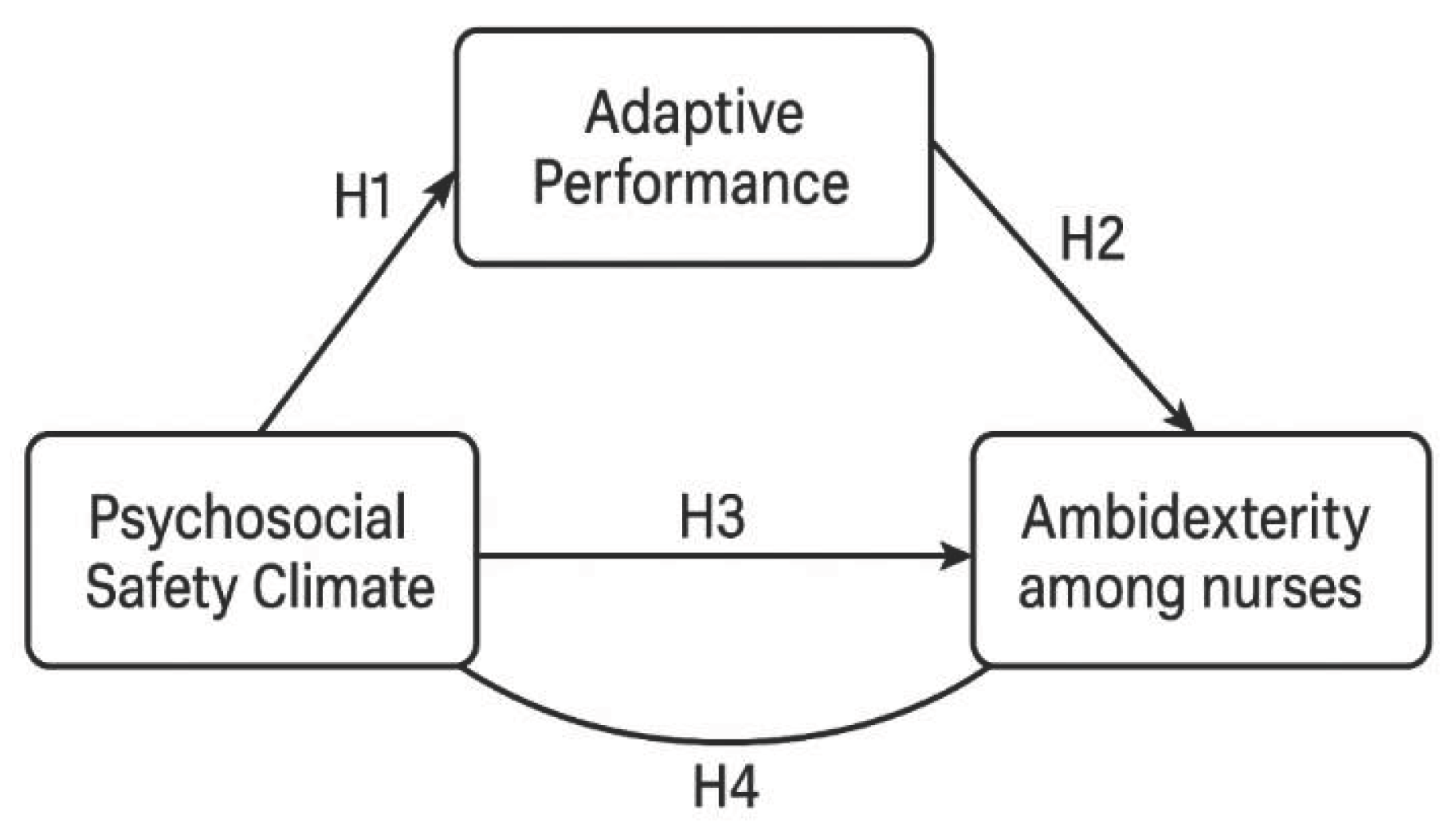

Table 1.
Sample Communalities of Items After Extraction.
| Communalities | ||
| Initial | Extraction | |
| Management Commitment | 1.000 | .604 |
| Management priority | 1.000 | .661 |
| Organizational communication | 1.000 | .655 |
| Organizational participation and involvement | 1.000 | .670 |
| Exploration | 1.000 | .641 |
| Exploitation | 1.000 | .661 |
| Reactivity in the face Emergencies | 1.000 | .531 |
| Managing work stress | 1.000 | .438 |
| Creativity | 1.000 | .772 |
| Training effort | 1.000 | .845 |
| Interpersonal Adaptability | 1.000 | .430 |
| Adaptive Performance | 1.000 | .947 |
| Extraction Method: Principal Component Analysis. | ||
Table 2.
Total Variance Explained.
| Total Variance Explained | ||||||
| Component | Initial Eigenvalues | Extraction Sums of Squared Loadings | ||||
| Total | % of Variance | Cumulative % | Total | % of Variance | Cumulative % | |
| 1 | 5.489 | 45.744 | 45.744 | 5.489 | 45.744 | 45.744 |
| 2 | 1.354 | 11.287 | 57.031 | 1.354 | 11.287 | 57.031 |
| 3 | 1.011 | 8.424 | 65.455 | 1.011 | 8.424 | 65.455 |
| 4 | .904 | 7.536 | 72.992 | |||
| 5 | .683 | 5.688 | 78.679 | |||
| 6 | .613 | 5.105 | 83.784 | |||
| 7 | .541 | 4.511 | 88.295 | |||
| 8 | .451 | 3.762 | 92.057 | |||
| 9 | .385 | 3.210 | 95.267 | |||
| 10 | .341 | 2.838 | 98.106 | |||
| 11 | .227 | 1.894 | 100.000 | |||
| 12 | 1.319E-16 | 1.100E-15 | 100.000 | |||
| Extraction Method: Principal Component Analysis. | ||||||
Table 3.
Distribution of the studied nurses according to demographic data (n =400).
| Demographic characteristics | No. | % |
| Age (years) | ||
| 20 -30 | 148 | 37.0 |
| 30 –<40 | 122 | 30.5 |
| 40 –<50 | 92 | 23.0 |
| ≥50 | 38 | 9.5 |
| Mean ±SD | 32.5± 5.8 | |
| Sex | ||
| Male | 117 | 29.2 |
| Female | 283 | 70.8 |
| Marital status | ||
| Single | 130 | 32.5 |
| Married | 202 | 50.5 |
| Widowed | 36 | 9.0 |
| Divorced | 32 | 8.0 |
| Qualification | ||
| High school diploma | 68 | 17.0 |
| Nursing institute diploma | 96 | 24.0 |
| Bachelor of nursing | 196 | 49.0 |
| Current working unit | ||
| CCU | 23 | 5.8 |
| ICU | 235 | 58.8 |
| Internal department | 142 | 35.5 |
| Experience years of nursing | ||
| 1- 5 | 106 | 26.5 |
| 5-<10 | 16 | 4.0 |
| 10-<15 | 191 | 47.8 |
| ≥15 | 87 | 21.8 |
| Mean ±SD | 9.46 ± 5.12 | |
| Experience years of current unit | ||
| 1- 5 | 184 | 46.0 |
| 5-<10 | 115 | 28.8 |
| 10-<15 | 82 | 20.5 |
| ≥15 | 19 | 4.8 |
| Mean ±SD | 7.34±6.81 | |
Table 4.
Distribution of the studied variables according to their levels and mean percent score (n =400).
Table 4.
Distribution of the studied variables according to their levels and mean percent score (n =400).
| Low | Moderate | High | Total score | Mean score | Mean percent score | ||||
| No. | % | No. | % | No. | % | Mean± SD | Mean± SD | Mean± SD | |
| Tool (1): Psychosocial Safety Climate | 21 | 5.3 | 228 | 57.0 | 151 | 37.8 | 40.30±9.32 | 3.37±0.78 | 59.14±19.54 |
| Management Commitment | 42 | 10.5 | 111 | 27.7 | 247 | 61.8 | 10.49±2.66 | 3.50±0.89 | 62.44±22.19 |
| Management priority | 39 | 9.8 | 166 | 41.5 | 195 | 48.7 | 9.72±2.62 | 3.24±0.87 | 55.98±21.84 |
| Organizational communication | 91 | 22.8 | 129 | 32.3 | 180 | 45.0 | 6.81±2.32 | 3.41±1.16 | 60.13±28.95 |
| Organizational participation and involvement | 75 | 18.8 | 166 | 41.5 | 159 | 39.8 | 13.28±4.03 | 3.32±1.01 | 58.02±25.17 |
| Tool 2 Individual Ambidexterity | 26 | 6.5 | 223 | 55.7 | 151 | 37.8 | 47.45±11.48 | 3.39±0.82 | 59.72±20.50 |
| Exploration | 35 | 8.8 | 238 | 59.4 | 127 | 31.8 | 23.29±5.89 | 3.33±0.84 | 58.18±21.05 |
| Exploitation | 31 | 7.8 | 190 | 47.5 | 179 | 44.7 | 24.16±6.33 | 3.45±0.90 | 61.27±22.61 |
| Tool 3 Adaptive Performance | 21 | 5.3 | 343 | 85.7 | 36 | 9.0 | 57.88±12.39 | 3.06±0.64 | 51.48±16.11 |
| Reactivity in the face Emergencies and unexpected circumstances | 75 | 18.8 | 153 | 38.2 | 172 | 43.0 | 13.22±4.05 | 3.31±1.01 | 57.63±25.34 |
| Managing work stress | 48 | 12.0 | 192 | 48.0 | 160 | 40.0 | 9.92±2.71 | 3.31±0.90 | 57.65±22.57 |
| Creativity | 88 | 22.0 | 213 | 53.2 | 99 | 24.8 | 12.28±3.69 | 3.07±0.92 | 51.75±23.09 |
| Training effort | 127 | 31.8 | 210 | 52.5 | 63 | 15.7 | 11.13±4.02 | 2.78±1.0 | 44.56±25.12 |
| Interpersonal Adaptability | 109 | 27.3 | 223 | 55.7 | 68 | 17.0 | 11.33±3.79 | 2.83±0.95 | 45.80±23.71 |
Table 5.
Correlation between the studied variables (n =400).
| Commitment | Priority | Organizational communication | Organizational participation | Overall Psychosocial Safety Climate | Exploration | Exploitation | Overall Individual Ambidexterity | Reactivity in the face Emergencies | Managing work stress | Creativity | Training effort | Interpersonal Adaptability | Overall Adaptive Performance | ||
| Management Commitment | r | ||||||||||||||
| p | |||||||||||||||
| Management priority | r | 0.508* | |||||||||||||
| p | <0.001* | ||||||||||||||
| Organizational communication | r | 0.411* | 0.545* | ||||||||||||
| p | <0.001* | <0.001* | |||||||||||||
| Organizational participation and involvement | r | 0.525* | 0.532* | 0.540* | |||||||||||
| p | <0.001* | <0.001* | <0.001* | ||||||||||||
| Overall Psychosocial Safety Climate | r | 0.757* | 0.792* | 0.752* | 0.866* | ||||||||||
| p | <0.001* | <0.001* | <0.001* | <0.001* | |||||||||||
| Exploration | r | 0.357* | 0.330* | 0.269* | 0.347* | 0.411* | |||||||||
| p | <0.001* | <0.001* | <0.001* | <0.001* | <0.001* | ||||||||||
| Exploitation | r | 0.357* | 0.352* | 0.267* | 0.374* | 0.429* | 0.762* | ||||||||
| p | <0.001* | <0.001* | <0.001* | <0.001* | <0.001* | <0.001* | |||||||||
| Overall Individual Ambidexterity | r | 0.380* | 0.364* | 0.285* | 0.385* | 0.448* | 0.934* | 0.943* | |||||||
| p | <0.001* | <0.001* | <0.001* | <0.001* | <0.001* | <0.001* | <0.001* | ||||||||
| Reactivity in the face Emergencies | r | 0.338* | 0.297* | 0.242* | 0.392* | 0.410* | 0.429* | 0.471* | 0.480* | ||||||
| p | <0.001* | <0.001* | <0.001* | <0.001* | <0.001* | <0.001* | <0.001* | <0.001* | |||||||
| Managing work stress | r | 0.242* | 0.204* | 0.153* | 0.196* | 0.249* | 0.338* | 0.288* | 0.332* | 0.366* | |||||
| p | <0.001* | <0.001* | 0.002* | <0.001* | <0.001* | <0.001* | <0.001* | <0.001* | <0.001* | ||||||
| Creativity | r | 0.308* | 0.379* | 0.321* | 0.371* | 0.434* | 0.431* | 0.447* | 0.468* | 0.413* | 0.308* | ||||
| p | <0.001* | <0.001* | <0.001* | <0.001* | <0.001* | <0.001* | <0.001* | <0.001* | <0.001* | <0.001* | |||||
| Training effort | r | 0.307* | 0.363* | 0.357* | 0.376* | 0.441* | 0.348* | 0.346* | 0.370* | 0.235* | 0.094 | 0.601* | |||
| p | <0.001* | <0.001* | <0.001* | <0.001* | <0.001* | <0.001* | <0.001* | <0.001* | <0.001* | 0.062 | <0.001* | ||||
| Interpersonal Adaptability | r | 0.359* | 0.316* | 0.218* | 0.411* | 0.423* | 0.437* | 0.496* | 0.498* | 0.314* | 0.198* | 0.315* | 0.293* | ||
| p | <0.001* | <0.001* | <0.001* | <0.001* | <0.001* | <0.001* | <0.001* | <0.001* | <0.001* | <0.001* | <0.001* | <0.001* | |||
| Overall Adaptive Performance | r | 0.465* | 0.469* | 0.391* | 0.530* | 0.591* | 0.589* | 0.614* | 0.642* | 0.702* | 0.521* | 0.792* | 0.691* | 0.641* | |
| p | <0.001* | <0.001* | <0.001* | <0.001* | <0.001* | <0.001* | <0.001* | <0.001* | <0.001* | <0.001* | <0.001* | <0.001* | <0.001* | ||
r: Pearson coefficient *: Statistically significant at p ≤ 0.05.
Table 6.
Multivariate Linear Regression Analysis for factors affecting Individual Ambidexterity (n =400).
Table 6.
Multivariate Linear Regression Analysis for factors affecting Individual Ambidexterity (n =400).
| Variable | B | Beta | t | p | 95% CI | |
| LL | UL | |||||
| Psychosocial Safety Climate | 0.130 | 0.106 | 2.234* | 0.026* | 0.016 | 0.245 |
| Adaptive Performance | 0.536 | 0.579 | 12.215* | <0.001* | 0.450 | 0.623 |
| R2=0.419, Adjusted R2=0.416, F= 143.117*,p<0.001* | ||||||
F,p: f and p values for the model, R2: Coefficient of determination, B: Unstandardized Coefficients, Beta: Standardized Coefficients, t: t-test of significance, LL: Lower limit UL: Upper Limit, *: Statistically significant at p ≤ 0.05.
Table 7.
The direct and indirect effect of.
| Direct effect | Indirect effect | Estimate | Indirect effect | S.E. | C.R. | P | |||
| Adaptive Performance | <--- | Psychosocial Safety Climate | 0.785 | 0.591 | 14.617* | <0.001* | 14.617 | ||
| Individual Ambidexterity | <--- | Adaptive Performance | 0.536 | 0.421 | 0.579 | 0.342 | 12.245* | <0.001* | 12.245 |
| Individual Ambidexterity | <--- | Psychosocial Safety Climate | 0.130 | 0.106 | 2.239* | 0.025* | 2.239 |
Model fit parameters CFI; IFI; RMSEA (0.961; 950; 0.072), Model χ2/df. 9.239/3 p≤0.001, CFI: Comparative Fit Index, IFI: Incremental Fit Index, RMSEA: Root Mean Square Error of Approximation.
Table 8.
Regression Weights.
| Estimate | S.E. | C.R. | P | |||
| Organizational participation and involvement | <--- | Psychosocial Safety Climate | 9.731 | 1.166 | 8.348* | <0.001* |
| Organizational communication | <--- | Psychosocial Safety Climate | 1.075 | 0.088 | 12.156* | <0.001* |
| Management priority | <--- | Psychosocial Safety Climate | 0.871 | 0.077 | 11.370* | <0.001* |
| Management Commitment | <--- | Psychosocial Safety Climate | 1.725 | 0.138 | 12.529* | <0.001* |
| Exploration 2 engage in work related activities | <--- | Individual Ambidexterity | 3.303 | 0.437 | 7.561* | <0.001* |
| Exploration 1 engage in work related | <--- | Individual Ambidexterity | 1.124 | 0.065 | 17.356* | <0.001* |
| Interpersonal Adaptability | <--- | Adaptive Performance | 4.795 | 0.668 | 7.178* | <0.001* |
| Training effort | <--- | Adaptive Performance | 0.454 | 0.066 | 6.906* | <0.001* |
| Creativity | <--- | Adaptive Performance | 1.043 | 0.101 | 10.371* | <0.001* |
| Managing work stress | <--- | Adaptive Performance | 0.962 | 0.104 | 9.229* | <0.001* |
| Reactivity in the face Emergencies and unexpected circumstances | <--- | Adaptive Performance | 0.895 | 0.098 | 9.129* | <0.001* |
Disclaimer/Publisher’s Note: The statements, opinions and data contained in all publications are solely those of the individual author(s) and contributor(s) and not of MDPI and/or the editor(s). MDPI and/or the editor(s) disclaim responsibility for any injury to people or property resulting from any ideas, methods, instructions or products referred to in the content. |
© 2026 by the authors. Licensee MDPI, Basel, Switzerland. This article is an open access article distributed under the terms and conditions of the Creative Commons Attribution (CC BY) license.
Copyright: This open access article is published under a Creative Commons CC BY 4.0 license, which permit the free download, distribution, and reuse, provided that the author and preprint are cited in any reuse.


