

Submitted:
03 June 2026
Posted:
04 June 2026
You are already at the latest version
Abstract
Background/Objectives: Angiographic stenosis severity and functional significance are discordant in up to 65% of intermediate coronary lesions. Fractional flow reserve (FFR)-guided percutaneous coronary intervention (PCI) has shown better clinical outcomes than standard angiography-guided PCI, therefore functional significance defines revas-cularization. This review evaluates the contemporary evidence for intracoronary physi-ology assessment tools, such as FFR, non-hyperemic pressure ratios (NHPRs), angi-ography-derived wire-free indices, and microvascular function testing and proposes a framework for their implementation into clinical practice.
Methods: We conducted a narrative review, synthesizing data from landmark ran-domized controlled trials (DEFER, FAME I–III, DANAMI-3-PRIMULTI, COM-PARE-ACUTE, DEFINE-FLAIR, iFR-SWEDEHEART, iMODERN, FAVOR III China and Europe, FAST III, ALL-RISE, CorMicA), along with pooled analyses, meta-analyses, po-sition papers, and relevant guidelines.
Results: FFR-guided revascularization resulted in a 28% reduction in cardiac death or myocardial infarction in pooled analyses (HR 0.72, 95% CI 0.54–0.96) leading to a Class I, Level A indication. NHPRs, including iFR, achieved non-inferiority to FFR at 1 year; however, a 5-year pooled meta-analysis raised concerns of increased all-cause mortality with iFR guidance compared to FFR (HR 1.34, 95% CI 1.08–1.67). Approximately 20% of lesions show FFR–iFR discordance, driven by vessel-specific physiology and microvas-cular factors. Wire-free technologies yielded conflicting results: the FAVOR III China trial favored QFR over angiography, yet FAVOR III Europe failed non-inferiority versus FFR, while recent FAST III and ALL-RISE trials demonstrated non-inferiority of angi-ography-derived physiology at 1 year. Up to 40% of patients with angina have non-obstructed coronary arteries, and coronary vasomotor function testing can identify treatable microvascular endotypes improving symptoms and quality of life.
Conclusions: Functional invasive coronary angiography is advocated to decipher vessel hemodynamics and guide treatment. FFR remains the gold standard for invasive physiological assessment while NHPRs and wire-free technologies are valuable adjuncts with specific indications and limitations. Thorough microvascular evaluation is essential for differentiating between various INOCA endotypes and is gradually being adopted by the interventional community. While NHPRs and virtual technologies struggle to de-throne the king FFR, comprehensive intracoronary physiology assessment is essential to guide treatment.
Keywords:
fractional flow reserve
; instantaneous wave-free ratio
; non-hyperemic pressure ratios
; quantitative flow ratio
; coronary microvascular dysfunction
; INOCA
; coronary physiology
; interventional cardiology
1. Introduction
Coronary angiography (CA) is the cornerstone for the diagnosis of coronary artery disease (CAD) since its introduction by Mason Sones in 1958 [1]. Its main strength is the direct visualization of the contrast filled coronary lumen by providing a two-dimensional luminogram. However, CA cannot reliably define vessel wall pathology, plaque burden or the physiological significance of a stenosis which attenuates its ability to decipher the complex interplay between plaque, lumen size and ischemia in CAD [2].
In particular, Glagov’s phenomenon, defined as the compensatory vascular positive remodeling, is characterized by outward expansion of the coronary arteries during early stage atherosclerosis, maintaining luminal patency despite the presence of plaque burden [3]. As a result, an angiographically normal vessel may conceal substantial atherosclerotic disease. Visual estimation of stenosis severity is also affected by eccentric lesion morphology, foreshortening, vessel overlap and diffuse disease without a normal reference segment [4]. These factors reinforce the notion that anatomical assessment alone is insufficient for clinical decision making.
The mechanisms of myocardial ischemia in chronic coronary syndromes are multifactorial and extend well beyond focal epicardial obstruction. As per the 2024 European Society of Cardiology (ESC) Guidelines on Chronic Coronary Syndromes, the main mechanisms include both epicardial and microvascular mechanisms [5]. Epicardially, ischemia may result from structural abnormalities, including focal or diffuse atherosclerosis, stabilized intramural hematoma, myocardial bridging or coronary aneurysm as well as functional disorders such as vasospasm related to endothelial dysfunction or vascular smooth muscle hyperactivity. At the microvascular level, ischemia may reflect structural disease, including inward arteriolar remodeling, capillary rarefaction, perivascular fibrosis or extramural compression or functional abnormalities such as impaired vasodilation, endothelial dysfunction and impaired vasoconstriction [5,6]. The different pathophysiological mechanisms may frequently coexist. Accurate identification is clinically important, because treatment differs substantially across epicardial obstruction, vasospasm and microvascular dysfunction. CA alone cannot distinguish these mechanisms which is why physiological assessment is often necessary for a complete lesion evaluation [7].
Visual assessment of angiographic severity and physiological significance are discordant in approximately 65% of patients with intermediate stenoses [8]. In lesions with 50 to 70% diameter stenosis, Fractional Flow Reserve (FFR) values ranged widely from 0.3 to 1.0 and only about 35% were functionally significant using the established threshold of ≤0.80. Even among lesions visually graded as 71% to 90% stenoses, approximately 20% had FFR >0.80. This discordance has direct clinical consequences: angiography may over- or underestimate lesion significance and subsequently falsely affect the decision to perform or defer revascularization.
Lesion specific physiological assessment has consistently improved clinical outcomes over angiography-guided decision making across the DEFER, FAME family of trials, establishing the principle that functional significance rather than anatomical appearance should define revascularization. FFR remains the gold standard for invasive physiological assessment, supported by Class I, Level A recommendation [5]. However, its dependence on pharmacological complexity, patient discomfort, time, cost and variable hyperemic responses limit its real-world uptake. These limitations led to the development of non-hyperemic pressure ratios (NHPRs) and angiography derived wire-free technologies as practical alternatives. Beyond epicardial disease, 40% of patients with angina and positive non-invasive stress tests are found to have non-obstructed coronary arteries at angiography. These patients carry a meaningful burden of symptoms and present adverse cardiovascular events. Targeted microvascular function testing, as demonstrated in the CorMicA trial, can identify treatable endotypes and improve quality of life [9]. This review synthesizes the contemporary evidence for the full spectrum of intracoronary physiological assessment tools and proposes a framework for their integration into clinical practice.
2. Methods
We performed a narrative review using PubMed/MEDLINE as the primary database. The search was designed to identify studies evaluating invasive and non-invasive coronary physiological assessment, including fractional flow reserve, non-hyperemic pressure ratios, angiography derived indices, computed tomography derived FFR, and coronary microvascular function testing. The following terms were used alone and in combination: “fractional flow reserve”, “FFR”, “instantaneous wave free ratio”, “iFR”, “non hyperemic pressure ratio”, “resting full cycle ratio”, “diastolic hyperemia free ratio”, “quantitative flow ratio”, “QFR”, “FFRangio”, “vessel FFR”, “CT FFR”, “coronary flow reserve”, “index of microcirculatory resistance”, “coronary microvascular dysfunction”, “vasospastic angina”, “INOCA”, “ANOCA”, and “coronary physiology”. We prioritized randomized controlled trials, large prospective registries, pooled analyses, meta-analyses, expert consensus statements, and international guideline documents. Particular emphasis was given on landmark studies that directly influenced clinical practice, including DEFER, FAME family of studies, DANAMI 3 PRIMULTI, COMPARE ACUTE, DEFINE FLAIR, iFR SWEDEHEART, iMODERN, FAVOR III China, FAVOR III Europe, FAST III, ALL RISE, CorMicA, and ILIAS ANOCA. Reference lists of selected articles were also screened to identify additional relevant publications. Given the narrative scope of this review, no formal systematic review protocol, risk of bias assessment, or meta-analytic pooling was undertaken.
3. Fractional Flow Reserve
3.1. Physiological Principles
FFR was introduced by Nico Pijls and Bernard De Bruyne in 1993 [10]. It represents the ratio of maximal achievable blood flow to a myocardial territory in the presence of a stenosis, to the maximum achievable flow in the absence of stenosis. FFR is calculated as the ratio of two pressures. During maximal hyperaemia, coronary flow and coronary pressure (Pd/Pa) achieve a linear correlation, as coronary resistance is kept stable and minimal. By translating coronary flow into a pressure ratio, FFR becomes independent of haemodynamic conditions.
FFR is calculated as FFR=(Pd − Pv)/(Pa − Pv), where Pd is the distal coronary pressure measured by a pressure guidewire placed distal to the stenosis, Pa represents proximal aortic pressure recorded at the guide catheter tip, and Pv represents central venous pressure [11]. During maximal hyperemia, it is assumed that Pv reaches zero, so the formula is simplified to FFR≈ Pd/Pa. This pressure based simplification is the key innovation that made FFR clinically practical, by avoiding the need for direct coronary flow measurement. An FFR value of ≤0.80 is the accepted threshold for hemodynamically significant stenosis and indicates a high probability of lesion-specific ischemia [12].
Maximal hyperemia can be achieved with adenosine, papaverine or regadenosone [13]. Adenosine remains the most commonly used agent in routine practice. It can be administered as continuous intravenous (IV) infusion, usually at 140 μg/kg/min through a central or large peripheral vein, or as an intracoronary bolus, commonly 100–200 μg in the left coronary artery or 50–100 μg in the right coronary artery. Hyperemia reduces coronary autoregulation and brings microvascular resistance to a low and relatively constant level, allowing pressure to approximate flow. IV adenosine is generally preferred when pressure pullback is required, whereas intracoronary administration is a practical option for single lesion assessment, even though it does not allow a continuous pressure pullback curve[14].
3.2. Evidence Base: The FAME Trilogy and Beyond
The clinical evidence for FFR guided revascularization was built mainly on the landmark DEFER and FAME trial programs, which established the superiority of physiology-guided over angiography-guided vascularization.
The DEFER study, published by Bech et al. in 2001, was the first randomized trial to demonstrate that deferral of percutaneous coronary intervention (PCI) for intermediate stenoses with FFR >0.75 was safe [15]. At 15-year follow-up, event rates remained low in the deferred group, with no excess in death or myocardial infarction compared to revascularized patients [16], providing the earliest evidence that non-ischemic lesions do not benefit from intervention.
FAME I, published in 2009, randomized 1,005 patients with multivessel coronary artery disease to angiography-guided versus FFR-guided PCI [17]. The FFR-guided approach resulted in reduced number of implanted stents (1.9 ± 1.3 vs. 2.7 ± 1.2, p < 0.001) and improved clinical outcomes with significantly reduced composite endpoint of death, myocardial infarction and repeat revascualrization at one year (13.2% vs. 18.3%, p = 0.02). This benefit was maintained at two years and was accompanied by lower resource use and improved cost-effectiveness [18].
In FAME 2 1,220 patients were enrolled with at least one stenosis and FFR≤0.80, randomizing them to PCI OMT versus OMT alone [19]. The study was prematurely terminated due to significantly lower rate of urgent revascularization in the PCI group. The 5-year follow-up showed a sustained reduction in the composite of death, myocardial infarction, or urgent revascularization with FFR guided PCI (13.9% vs. 27.0%, HR 0.46, 95% CI 0.34–0.63, p < 0.001) [20]. The benefit was driven mainly by reduction in urgent revascularizations, with a contribution from myocardial infarction reduction but without a clear mortality advantage.
A pooled analysis by Zimmermann et al., of FAME-2, DANAMI-3-PRIMULTI, and COMPARE-ACUTE further strengthened the evidence base. In this analysis, PCI of lesions with FFR≤0.80 reduced cardiac death or myocardial infarction compared to medical therapy (HR 0.72, 95% CI 0.54–0.96, p = 0.023), providing strong evidence for a hard endpoint benefit of FFR-guided revascularization [21].
FAME 3 addressed a different question: whether FFR guided PCI could match coronary artery bypass grafting (CABG) in patients with three-vessel disease [22]. At one year, FFR-guided PCI did not meet non inferiority compared to CABG (10.6% vs. 6.9%, HR 1.5, 95% CI 1.1–2.04, p = 0.35 for non-inferiority). Longer follow-up showed a persistent numerical trend favoring CABG (HR 1.16, 95% CI 0.89–1.52, p = 0.27), although the difference was not statistically significant. At the 5-year follow-up, there was no significant difference in a composite endpoint of death, stroke, myocardial infarction of FFR-guided PCI vs CABG, even though myocardial infarction and repeat revascularization rates were higher with PCI.
3.3. FFR as a Continuous Prognostic Marker
Beyond the commonly used threshold of 0.80, FFR provides continuous prognostic information. Johnson et al., in a pooled analysis of FAME I and II, demonstrated that the relationship between FFR and clinical outcomes is not binary but gradual. The expected benefit of PCI over deferral, measured as reduction in major adverse cardiac events (MACE) at two years was greatest at FFR ≤0.60, attenuated progressively as FFR approached 0.75–0.78, and neutralized at approximately 0.80. Above this threshold, revascularization conferred no benefit and carried unnecessary procedural risk. Lower FFR values therefore indicate not only a higher ischemic burden but a greater absolute likelihood of clinical benefit from intervention [23,24].
The same principle applies post PCI. Post procedural FFR carries significant prognostic data, since patients with lower post PCI FFR values have higher rates of major adverse cardiac events during follow-up. In the DEFINE PCI trial, a post-PCI iFR ≥0.95 was associated with significantly lower cardiac death, spontaenous myocardial infarction or clinically driven target vessel revascularization at 1 year. Similar findings have been reported for post-PCI FFR with a threshold of ≥0.90 predicting lower MACE at 1–3 years in the DKCRUSH VII registry and across multiple pooled analyses [25,26]. A satisfactory angiographic result does not guarantee an optimal physiological result. Residual diffuse disease, untreated serial lesions or suboptimal stent expansion may leave a persistent pressure gradient despite an apparently satisfactory final angiogram [27].
The prognostic value of FFR as a continuous variable was supported by the IRIS FFR registry of 5,846 patients. Among deferred lesions, the risk of MACE increased progressively as FFR decreased (adjusted HR 1.06 per 0.01 decrease, 95% CI 1.05–1.08, p < 0.001). Revascularization was associated with better outcomes than deferral when FFR ≤0.75 (adjusted HR 0.47, 95% CI 0.26–0.84, p = 0.012), whereas medical treatment appeared equally safe for lesions with FFR≥0.76 [28]. The results indicate that FFR thresholds are clinically useful but they should not obscure the graded relationship between physiology and risk.
3.4. Practical Considerations and Pitfalls
Accurate FFR measurement requires attention to technique at every stage of the procedure. Errors may occur during preparation with calibration and equalization, during measurement with pressure drift, guide catheter wedging, wire whipping and suboptimal hyperemia achievement or during interpretation with inconsistent cursor positioning [14].
Pressure drift is particularly important because it may not be apparent during measurement. Hence, the pressure wire should be withdrawn to the guide catheter tip after measurement to confirm that the distal and proximal pressures remain equal. Guide catheter related artifacts are another frequent source of error. Aortic ventricularization as characterized by the loss of the dicrotic notch and deep diastolic dipping results in a lower mean aortic pressure (Pa). Since FFR is calculated by Pd/Pa, an artificially reduced Pa raises the calculated ratio and produces a falsely high FFR value (falsely negative), leading to underestimation of lesion severity [30]. The same issue may occur with deep guide engagement or catheter dampening due to reduction of the aortic pressure signal, thus producing a falsely elevated FFR value. When these artifacts are seen, the guide catheter should be disengaged and the measurement replaced.
Adenosine is generally considered safe, though transient adverse effects are common. The most relevant events and their reported rates are summarized in Table 1, along with pooled estimates from a contemporary meta-analysis [29]. Adenosine should be avoided in patients with severe asthma or high degree atrioventricular block without a pacemaker. Its hemodynamic effect varies between patients. In a large prospective cohort, the change in mean aortic pressure during adenosine ranged from a 75% decrease to a 43% increase, with a median decrease of 9% [31]. Inadequate hyperemia may therefore affect FFR interpretation and has been linked to anatomical and functional mismatch, as well as discordance between low NHPR values and high FFR values [32]. Genetic variation in adenosine metabolism and receptor sensitivity has been proposed as one possible hypothesis, yet this remains mechanistic and not firmly established determinant in routine FFR practice.
3.5. Limitations of FFR
Despite its robust evidence base, FFR has important practical and physiological limitations. Firstly, achieving maximum hyperemia is a prerequisite. Use of adenosine increases cost, can be time consuming and bares the risk of side effects (Table 1). Intravenous administration of adenosine mandates for a large vein, while intracoronary administration is a useful alternative but does not allow pullback. Polymorphisms in genes for endothelial synthase and hemoglobin oxygenase, smoking, chronic kidney disease, increased microvascular resistance may hamper maximum vasodilatation after adenosine administration, leading to incorrect measurements[33].
Its routine interpretation relies on two assumptions: that venous pressure is negligible and that microvascular resistance is minimal and stable during maximal hyperemia [34]. Those assumptions are acceptable in the majority of patients. The standardization document by Toth et al., supports the practical use of the simplified Pd/Pa formula, even in patients with heart failure (HF) and elevated filling pressures and does not recommend routine correction for right atrial pressure [14].
Nevertheless, elevated central venous pressure (CVP) does have a directional effect on the simplified formula. When Pv is increased, as in acute HF or cardiogenic shock, the simplified Pd/Pa formula may overestimate true myocardial FFR (FFRMyo), producing a falsely reassuring result [35,36]. Toth et al., incorporated right atrial pressures in >1,600 coronary stenosis [35]. In 9% of those, the FFR moved from >0.80 to FFRmyo ≤0.80 once right atrial pressure was incorporated. The absolute difference was no greater than 0.03 and the overall agreement between FFR and FFRmyo remained excellent, with a mean difference 0.01. Thus, right atrial pressure correction is not needed in routine clinical practice but markedly elevated filling pressures should be recognized as a potential source of borderline misclassification.
Coronary microvascular dysfunction (CMD) is a clinically relevant limitation. When vasodilatory capacity is impaired, hyperemic microvascular resistance remains high, coronary flow augmentation is blunted and the pressure gradient across an epicardial stenosis may be attenuated. FFR may appear pseudonormal (false-negative) despite clinically important disease. Van de Hoef et al. demonstrated that for similar epicardial stenosis severity, FFR increased as hyperemic microvascular resistance increased, Adjustment for hyperemic microvascular resistance strengthened the relationship between FFR and stenosis resistance (r² from 0.54 to 0.73). In the same study, a substantial 63% of vessels with FFR >0.80 presented disturbed hemodynamics, including abnormal CFR in 52% and microcirculatory dysfunction in 33% [37].
Several patient related risk factors may influence the hyperemic response. Advanced age is one well supported example. With advancing age, minimal microvascular resistance increases, hyperemic flow decreases and FFR may underestimate the hemodynamic effect of a stenosis[38]. Similar concerns apply in patients with left ventricular hypertrophy and severe aortic stenosis, where microvascular remodeling and increased extravascular forces may blunt hyperemia. Diabetes mellitus is more complex. In the POST IT registry of 1,772 patients, Van Belle et al. found that diabetes was not associated with higher FFR values for a given angiographic stenosis. In fact, FFR values were lower in patients with diabetes across stenosis categories, reflecting more complex epicardial disease [39]. Diabetes alone should not be assumed to invalidate FFR. Chronic kidney disease and heavy smoking are biologically plausible contributors to microvascular dysfunction but have fewer direct evidence that they cause clinically meaningful FFR pseudonormalization compared to age, left ventricular hypertrophy or severe aortic stenosis.
The FFR grey zone between 0.75 – 0.80 remains a well recognized clinical dilemma. A systematic review and metanalysis by Andreou et al., including 2,683 lesions in this range, found no overall advantage of revascularization over deferral for study defined MACE, although target vessel revascularization was more frequent with deferral (9.1% vs. 5.8%, p = 0.04)[40]. Decisions in the patients with this range of FFR values should depend on lesion location, territory at risk, focal versus diffuse gradient pattern as assessed by pullback, symptom burden, quality of life, viability, bleeding risk, comorbidities and patient preference [41,42].
Additionally, the ability of FFR to localize the principal source of hemodynamic significance in patients with diffuse disease or serial lesions is limited. A single FFR measurement distal to multiple stenoses reflects the cumulative physiological effect but does not identify which lesion contributes most to flow limitation, hampering treatment decisions in complex anatomy. Pressure pullback gradient (PPG) can add important information by distinguishing focal from diffuse disease, in patients with FFR ≤0.80. Higher values, approaching 1, suggest a focal pressure drop that is more likely to respond well to PCI. Lower values, closer to 0, suggest diffuse disease where intervention may yield suboptimal physiological results and greater risk of residual ischemia or periprocedural injury. Collet et al., described PPG as a continuous metric and cautioned against rigid cutoffs [43]. Specific operating ranges have been proposed in later studies, describing 0-0.47 as indicator of diffuse disease and 0.65-1.00 as more consistent with focal/serial disease [44], while Sakai et al. used a median value of 0.66 in their cohort [45]. PPG should be interpreted as a descriptor of disease pattern and not as a standalone binary treatment threshold.
3.6. FFR in Acute Coronary Syndromes
The role of FFR in acute coronary syndromes is subject to important physiological limitations in the immediate post-infarction period. In STEMI, microvascular obstruction, impaired hyperemic response, and increased microvascular resistance in the culprit territory can attenuate the pressure gradient across non-culprit stenoses, producing falsely reassuring FFR values. This reflects acute microvascular stunning rather than true absence of ischemia and limits the reliability of FFR measurements obtained during the index primary PCI procedure. Accordingly, the ESC Guidelines advocate against FFR-guided assessment of non-culprit lesions in STEMI during the index procedure (Class III) [46], and should be delayed until microvascular function has recovered, typically several days after the acute event. The physiological context differs in NSTEMI, where microvascular function is generally preserved and FFR can be performed during the index procedure [46,47]. In line with this, current ESC guidelines recommend that invasive functional assessment should be considered to guide non-culprit lesion treatment during the index hospitalization in NSTEMI patients with multivessel disease (Class IIb) [5,46].
Several landmark trials have evaluated FFR-guided complete revascularization in STEMI with multivessel disease using a staged approach. In DANAMI-3-PRIMULTI, patients who had undergone successful primary PCI were randomized to FFR-guided complete revascularization of non-culprit lesions or infarct-related artery treatment alone, with FFR assessment performed after the acute phase [48]. At 10-year follow-up, FFR-guided complete revascularization reduced future cardiovascular events compared with infarct-related artery-only treatment (HR 0.76, 95% CI 0.60–0.94, p = 0.014), a benefit driven primarily by fewer repeat revascularizations rather than a reduction in death or recurrent myocardial infarction [49]. COMPARE-ACUTE similarly employed a staged FFR assessment strategy rather than immediate evaluation during primary PCI [50]. The FLOWER-MI trial added further context, demonstrating that FFR-guided and angiography-guided strategies for non-culprit lesion revascularization produced comparable clinical outcomes in STEMI patients [51]. The most recent and largest trial in this space, FULL REVASC, enrolled 1,542 patients with STEMI or very-high-risk NSTEMI and multivessel disease, randomizing them to FFR-guided complete revascularization of non-culprit lesions or culprit-lesion-only PCI [52]. At a median follow-up of 4.8 years, the composite of death from any cause, myocardial infarction, or unplanned revascularization did not differ between groups (19.0% vs. 20.4%; HR 0.93, 95% CI 0.74–1.17; p = 0.53), with no between-group differences in either component outcome. The trial evidence suggests that while FFR-guided staged assessment of non-culprit lesions is physiologically sound and procedurally feasible in the post-ACS setting, its incremental benefit over selective or angiography-guided approaches remains uncertain and falls short of the consistent advantage demonstrated in stable coronary disease.
3.7. FFR in Aortic Valve Disease
Severe aortic stenosis creates a distinct hemodynamic environment in which coronary physiology can be difficult to interpret. The combination of severe aortic stenosis and coronary artery disease behaves as two sequential stenoses [53,54]. The aortic valve acts as an upstream lesion that restricts flow into the coronary circulation, reducing the trans-stenotic pressure gradient across a downstream coronary stenosis and causing it to appear less hemodynamically significant than it truly is. This flow-limiting effect results in falsely elevated FFR values that underestimate the functional severity of the coronary lesion [55]. After aortic valve replacement, flow across the coronary stenosis increases, unmasking its true hemodynamic significance: FFR measured post-TAVI may be lower than pre-TAVI for the same anatomical lesion [56]. However, this serial stenosis model is an oversimplification.
The 2025 American Heart Association (AHA) Scientific Statement describes a more complex mechanism: in severe aortic stenosis, resting coronary flow may be increased to meet the oxygen demand of the hypertrophied left ventricle, which lower non-hyperemic pressure ratios (NHPR) and may overestimate hemodynamic severity [57]. At the same time, elevated left ventricular end diastolic pressure, increased microvascular resistance, myocardial fibrosis and capillary rarefaction all raise FFR across a given stenosis, underestimating lesion severity [56,57,58].
The COMIC-AS study provided useful mechanistic data in this setting. In patients with severe aortic stenosis, FFR ≤0.83 and RFR ≤0.85 predicted myocardial ischemia more accurately before aortic valve replacement than the conventional thresholds [59]. Six months post valve replacement, FFR decreased and RFR increased. The rise in RFR was attributed to lower resting coronary flow after regression of left ventricular mass and normalization of resting hemodynamics, rather than microvascular recovery alone, even though microvascular parameters (IMR, microvascular resistance reserve) also improved. In this cohort, 21.5% of lesions crossed the conventional FFR threshold at 6 months, with a mean FFR decrease of 0.028. Pre-TAVI FFR values in the 0.80-0.85 range may demarcate a “gray zone” that may drop below 0.80 after aortic valve replacement (TAVI/SAVR), whereas a shift to <0.75 would be less likely [56].
The FAITAVI trial addressed whether among TAVI candidates selected for PCI, FFR guidance was superior to angiographic guidance. 320 patients were enrolled, with median age 86 years and median SYNTAX score of 7 [60]. At 12 months, FFR guided PCI was associated with significantly fewer major adverse cardiovascular and cerebrovascular events (MACCEs) compared with angiography-guided PCI (8.5% vs. 16.0%; HR 0.52; 95% CI 0.27–0.99; p = 0.047), driven mainly by lower all cause mortality. The TCW trial extended this question to patients with more complex coronary anatomy, comparing FFR-guided PCI plus TAVI with the traditional surgical approach of SAVR plus CABG in patients aged ≥70 years with severe aortic stenosis and multivessel or complex coronary artery disease [61]. The trial was stopped early after enrolling 172 patients due to a significant difference favoring the percutaneous strategy. At 1 year, FFR-guided PCI plus TAVI was superior to SAVR plus CABG for the patient-oriented composite endpoint (HR 0.17, 95% CI 0.06–0.51, p<0.001), with lower all-cause mortality (0% vs. 10%, p=0.0025) and life-threatening bleeding (2% vs. 12%, p=0.010). These findings support selective, physiology-guided coronary revascularization in patients undergoing TAVI.
4. Non-Hyperemic Pressure Ratios (NHPRs)
4.1. Rationale for Adenosine-Free Assessment
FFR requires maximal hyperemia, achieved mainly via adenosine use. Although it is considered safe, shortness of breath and chest pain are common side-effects as described above. Additionally, it increases procedural time, costs, patient discomfort and requires drug preparation. Consequently, despite guideline recommendations, utilization of FFR remains lower than expected. In the ALL-RISE trial, physiological assessment of intermediate lesions was less than 20%, suggesting that workflow rather than lack of evidence remains a major obstacle in widespread utilization of FFR [62]. NHPRs were developed to address this gap by assessing the trans stenotic pressure gradient without the need for a hyperemic agent.
The physiological rationale for NHPRs is based on identifying periods in the cardiac cycle where microvascular resistance is minimal and relatively stable, omitting therefore the need for administering hyperemic agents. This is most relevant during diastole, when competing pressure waves are reduced and coronary flow is more directly related to the pressure gradient across a stenosis [63]. Table 2 includes a comparison of all the available NHPRs.
Nonetheless, resistance during these resting periods is never as low as achieved during pharmacological hyperemia, resulting in small trans-stenotic pressure gradients and narrower measurement range. Gotberg et al. demonstrated that the whole Pd/Pa cycle has the narrower measurement range, with 62% of values clustered around its operating point, compared to 50% for iFR and only 35% for FFR [64]. This is why resting indices are easier to perform but generally have less diagnostic separation than FFR.
Using the binary thresholds 0.89 for NHPRs and 0.80 for FFR, NHPRs agree with FFR in approximately 80% of cases (sensitivity of 78.9%, specificity of 82.4% and overall accuracy of 80.4%). Performance also varies by vessel. In an individual patient level, meta-analysis of 2,120 paired measurements, Storozhenko et al. found lower sensitivity and accuracy for NHPRs in non-LAD vessels than in the LAD vessels (69% vs. 87% sensitivity, 76% vs. 86% accuracy), with optimal cutoffs differing between LAD (≤0.88) and non-LAD (≤0.92) [65].
Long-term outcome data have also attracted some caution. In the 5 year pooled analysis of the DEFINE FLAIR and iFR SWEDEHEART, all cause mortality was higher with NHPR guided management than with FFR guided management (8.3% vs. 6.3%, HR 1.34, 95% CI 1.08–1.67) [66]. The mechanism remains uncertain, particularly because myocardial infarction and unplanned revascularization were not increased. This finding does not necessarily invalidate NHPR but it argues against treating them as interchangeable with FFR in every setting.
4.2. Instantaneous Wave-Free Ratio (iFR)
Instantaneous wave-free ratio (iFR) was the first NHPR to be widely adopted in clinical practice, introduced by Sen et al. in 2012 [63,67]. It is calculated as the ratio of distal coronary pressure to proximal aortic pressure during the “wave free period” of diastole. This period begins approximately 25% into diastole and ends 5 msec before the end of diastole. During this period, competing forward and backward pressure waves are quiescent, and microvascular resistance is at its lowest resting level, although it is never as low as during pharmacological hyperemia [68,69]. For this reason, the wave free period is better described as a phase of relatively low and stable resistance, rather than a true equivalent of maximal hyperemia.
An iFR value of ≤0.89 is generally used to define hemodynamic significance and corresponds approximately to the FFR threshold of ≤0.80 [70]. This index is proprietary to Philips Healthcare and requires a compatible console. Validation studies showed approximately 80-85% agreement between FFR and iFR, with comparable concordance against non-invasive and invasive ischemia tests, including stress echocardiography, single photon emission computed tomography (SPECT) and invasive coronary flow reserve[67].
The practical appeal of iFR is clear. It avoids adenosine, shortens workflow, reduces drug related discomfort, procedural time and cost without the need for maximal hyperemia[70]. Physiologically, iFR and FFR are not identical. In the JUSTIFY CFR study, iFR was more closely related to coronary flow velocity reserve (CFVR) than FFR, particularly in intermediate lesions. Among 216 stenoses in 185 patients, iFR showed stronger correlation with CFVR than FFR and a higher AUC for CFVR classification (0.82 vs. 0.72, p < 0.001), with the closer relationship most marked in the 0.6–0.9 FFR range[71].
The clinical validation of iFR-guided revascularization came from two landmark randomized controlled trials which awared it a class I indication in the guidelines. The DEFINE-FLAIR trial randomized 2,492 patients with stable coronary artery disease to iFR-guided versus FFR-guided PCI [72]. At 1 year, iFR-guided PCI was non-inferior to FFR-guided PCI for the composite endpoint of death, myocardial infarction, or unplanned revascularization (6.8% vs. 7.0%, p=0.78 for non-inferiority). The iFR-SWEDEHEART trial, enrolling 2,037 patients, similarly demonstrated non-inferiority of iFR guidance at 1 year (6.7% vs. 6.1%, p<0.001 for non-inferiority) [64,73].
The clinical significance of iFR's stronger correlation with coronary flow reserve compared to FFR lies in its reflection of resting microvascular function. During the wave-free period, microvascular resistance is at its lowest resting level, making the trans-stenotic pressure gradient more directly related to coronary flow without the confounding effects of hyperemic agents. In contrast, FFR measures the gradient under maximal hyperemia, which may be influenced by variable adenosine responsiveness, genetic polymorphisms in adenosine metabolism, and microvascular dysfunction that blunts the hyperemic response[71]. The stronger iFR-CFR relationship suggests that resting physiology may, in selected patients, provide a more physiologically stable assessment of stenosis severity, particularly when hyperemic reserve is impaired. However, this does not imply superiority: it reflects a different physiological state, and the two indices are complementary rather than interchangeable [74].
Long-term follow-up data, however, introduced important caution. At 5 years, the DEFINE-FLAIR trial showed higher mortality with iFR guidance compared to FFR guidance (HR 1.56, 95% CI 1.16–2.09), with the excess mortality confined to the revascularized arm rather than the deferred arm [75]. On the contrary, the iFR-SWEDEHEART trial showed no significant difference at 5 years (HR 1.09, 95% CI 0.84–1.43). A pooled 5-year meta-analysis of both trials by Eftekhari et al. found higher all-cause mortality with iFR-guided management (8.3% vs. 6.3%, HR 1.34, 95% CI 1.08–1.67, p=0.008) [66]. The mechanism remains uncertain, particularly because myocardial infarction and unplanned revascularization rates were not increased. Post-hoc analyses suggest the excess deaths were largely from non-cardiovascular or undetermined causes, raising questions about whether the mortality signal is causally related to iFR-guided decision-making or represents a chance finding. This uncertainty does not invalidate iFR but argues against treating it as interchangeable with FFR in every clinical setting.
iFR remains a useful and guideline supported tool, with a Class I, Level A recommendation. Its results should be carefully interpreted where resting and hyperemic physiology may diverge, including right coronary artery lesions, left main or proximal LAD disease, severe aortic stenosis, suspected microvascular dysfunction, or altered hemodynamics after contrast administration or β-blocker use [57].
4.3. iFR in Acute Coronary Syndromes
The iMODERN trial evaluated non-culprit lesion management after STEMI using a different physiological strategy. Nijveldt et al. randomized 1,146 patients who had undergone successful primary PCI to either immediate iFR-guided PCI of non-culprit lesions during the index procedure (n=558) or deferred management guided by cardiac stress MRI within 6 weeks (n=588). At 3 years, iFR-guided immediate PCI was not superior to the deferred MRI-guided strategy for the composite endpoint of all-cause death, recurrent myocardial infarction, or hospitalization for heart failure (9.3% vs. 9.8%, HR 0.95, 95% CI 0.65–1.40, p value for superiority not significant) [76]. Both strategies were safe and effective, though the MRI-guided approach led to fewer interventions without compromising outcomes (42.6% vs. 18.7% underwent non-culprit PCI).
In contrast, FFR-guided complete revascularization has demonstrated sustained clinical benefit in the STEMI setting. The 10-year follow-up of DANAMI-3-PRIMULTI showed that FFR-guided complete revascularization of non-culprit lesions remained superior to treatment of the infarct-related artery alone, with a 24% reduction in the composite of all-cause death, myocardial infarction, or repeat revascularization (HR 0.76, 95% CI 0.60–0.94, p=0.014), driven primarily by fewer repeat revascularizations [49]. These findings underscore that while iFR-guided immediate intervention did not prove superior to deferred imaging-guided management, FFR-guided staged complete revascularization provides durable long-term benefit in STEMI patients with multivessel disease.
4.4. iFR in Aortic Stenosis
The interaction between severe aortic stenosis and resting coronary physiology presents a distinct challenge for iFR interpretation. Jo et al. studied 189 coronary lesions in 106 patients with severe aortic stenosis and demonstrated a striking divergence between iFR and FFR in this setting. Among patients with severe aortic stenosis, iFR classified significantly more lesions as hemodynamically significant than FFR (66.6% with iFR ≤0.89 vs. 45.3% with FFR ≤0.80, p<0.001) [77].
This systematic overestimation by iFR reflects the altered hemodynamic state in severe aortic stenosis. Resting coronary flow is increased to meet the elevated myocardial oxygen demand of the hypertrophied left ventricle. Because iFR measures the trans-stenotic pressure gradient at rest, this elevated baseline flow generates a larger resting pressure drop across a given stenosis compared to what would be observed in the absence of aortic stenosis. In contrast, FFR which is measured during maximal hyperemia, is less influenced by the baseline flow state, as hyperemia effectively normalizes microvascular resistance across different hemodynamic conditions. Severe aortic stenosis underestimates epicardial lesion severity by FFR by reducing hyperemic flow, it overestimates severity by iFR by increasing resting flow.
In the Jo et al. study, FFR showed stronger association with clinical outcomes and better diagnostic concordance with stress imaging, while iFR retained utility primarily for its high negative predictive value, a normal iFR (>0.89) reliably excluded hemodynamically significant stenosis. However, an abnormal iFR in the setting of severe aortic stenosis should not be assumed to reflect true lesion-specific ischemia [78]. In patients being evaluated for TAVI where concomitant coronary artery disease is present, confirmation with hyperemic FFR assessment is recommended before revascularization decisions are made, particularly when iFR suggests significant disease. This recommendation aligns with the findings from COMIC-AS and FAITAVI trials.
4.5. Other Non-Hyperemic Indices
Following the commercial success of iFR, several other NHPRs were developed. Most differ in how they define the period of the cardiac cycle from which the pressure signal is derived, but their overall diagnostic performance is broadly similar [79,80]. Resting Full-cycle Ratio (RFR, Abbott) identifies the lowest filtered mean Pd/Pa during the entire cardiac cycle, using the same threshold of iFR ≤0.89. Unlike conventional Pd/Pa, RFR does not average pressure over the full cardiac cycle. Instead, it uses a beat-by-beat approach to identify the lowest Pd/Pa point, independent of ECG, landmark identification and timing withing the cardiac cycle [81]. In VALIDATE RFR [82] and REVALIDATE RFR, RFR showed diagnostic equivalence to iFR. Notably, in the VALIDATE RFR study, the lowest Pd/Pa was detected outside diastole in 12.2% of all cardiac cycles and in 32.4% of right coronary artery cycles, identifying stenoses that could be missed by indices restricted to diastole.
Diastolic Hyperemia-free Ratio (DFR, Boston Scientific, Marlborough, MA) uses a different approach. It calculates the average Pd/Pa over an approximated diastolic period, defined from the pressure tracing as negatively sloped segment during which instantaneous Pa is below the mean Pa. The measurement is averaged across five consecutive cardiac cycles, also using the threshold of ≤0.89. Validation studies have shown close agreement between DFR and iFR with DFR strongly correlating with FFR [83].
Resting Pd/Pa is the simplest non hyperemic index. It averages the distal to proximal pressure ratio across the entire cardiac cycle and uses a threshold of ≤0.91. Its main limitation is lower diagnostic resolution. This is better understood as a signal-to-noise issue rather than as a simple effect of systolic compression. Because the majority of coronary flow occurs in diastole, the systolic portion of the signal contributes less useful information. Including it narrows the dynamic range of Pd/Pa compared with iFR. Lee et al. demonstrated that iFR changed more clearly than Pd/Pa with increasing stenosis severity across angiographic measures, basal and hyperemic stenosis resistance and hyperemic myocardial blood flow [81]. Götberg et al. showed that 62% of Pd/Pa values cluster around its operating point versus 50% for iFR, resulting in lower discriminatory power [64]. Resting Pd/Pa is therefore easy to obtain, but is more vulnerable to drift and less suited for detailed pullback assessment in serial or diffuse disease.
4.6. Technical Considerations for NHPR Use
Several technical issues should be taken into account when NHPRs are used. Since resting trans-stenotic pressure gradients are smaller than the ones achieved by hyperemic gradients, NHPRs are more vulnerable to pressure drift and signal noise than FFR. A drift of 2-3mmHg may have little effect when the hyperemic gradient is 15-20mmHg, but it may be of clinical importance when the resting gradient is only 3-5 mmHg [80]. Piezoelectric sensors drift more than optical sensors and ±0.02 is considered an acceptable drift threshold, a magnitude proportionally far more consequential for NHPR than FFR [57].
Heart rate can also affect NHPR interpretation. Hennigan et al. identified baseline heart rate as an independent determinant of NHPR and FFR discordance on multivariable analysis [32] . Tachycardia shortens diastole, reducing the sample window for diastolic indices such as iFR and DFR. For whole cycle indices such as RFR and resting Pd/Pa, the measurement window remains available but the relative contribution of diastole to the full cycle signal is reduced [65].
β-Blockers may also influence resting physiological indices. In a study of 197 patients with 223 lesions, Verdoia et al. found that preprocedural β-blocker use was associated with numerically higher iFR values (0.94 ± 0.06 vs. 0.92 ± 0.06, p = 0.11) and a significantly lower rate of positive iFR (14.9% vs. 27.5%, p = 0.04). On multivariable analysis, β-blocker therapy was an independent predictor of iFR classification (OR 0.48, 95% CI 0.23–0.98, p = 0.05), translating into approximately half the odds of a positive iFR [84]. The mechanism is likely more complex than heart rate reduction alone. Different β-blocker generations may have different effects on coronary flow reserve through interactions between reduced resting flow, variable hyperemic flow and minimal coronary resistance, while vasodilating agents such as carvedilol and nebivolol may improve hyperemic flow through a-blockade or nitric oxide mediated effects [85]. Β-blocker use may reduce resting pressure gradients and contribute to false-negative NHPR results in selected patients.
5. Discordance Between FFR and NHPRs
Discordance between FFR and iFR occurs in approximately 20% of lesions, typically near the diagnostic thresholds [33,86]. The FiGARO study provided the two main patterns of discordance: FFR negative and iFR positive lesions, that were defined as FFR>0.80 with iFR ≤0.89 and FFR positive and iFR negative lesions, defined as FFR ≤0.80 with iFR >0.89[33]. These patterns reflect the fact that hyperemic and resting indices interrogate coronary physiology under different flow conditions.
In the FFR-negative/iFR-positive pattern, impaired vasodilatory reserve may blunt the hyperemic response: reduced flow augmentation during hyperemia attenuates the trans-stenotic gradient, producing a falsely normal FFR, while the resting iFR correctly identifies the lesion as hemodynamically significant. Lee et al. confirmed this interpretation, demonstrating that the low iFR/high FFR group had coronary flow reserve and resistance reserve ratio values comparable to the concordantly abnormal group, indicating impaired vasodilatory capacity [81]. This pattern is associated with smoking, chronic kidney disease, increased microvascular resistance as well as polymorphisms affecting endothelial nitric oxide synthase and heme oxygenase pathways [33].
The FFR-positive/iFR-negative pattern reflects an augmented vasodilatory response to adenosine, in which high coronary flow during hyperemia generates a large trans-stenotic gradient even when the lesion is not flow-limiting at rest. Lesions in this category often demonstrate preserved CFR; however, preserved CFR should not be considered fully reassuring, as data from the DEFINE-FLOW registry and the subanalysis of the COMPARE-ACUTE indicate that an abnormal FFR retains independent prognostic significance for target vessel failure even in the presence of preserved CFR [87,88].
The clinical consequences of this pattern are most relevant when the affected vessel is the left main or proximal LAD. In these territories, the large perfused myocardial mass amplifies the hyperemic flow response to adenosine, generating a proportionally larger trans-stenotic gradient that renders FFR positive while the resting iFR remains above 0.89. Kobayashi et al. examined this territory-specific effect in the CONTRAST study and underlined the reduced diagnostic accuracy of adenosine-free indices in LM/proximal LAD [89]. Clinically, the more consequential error in this territory is not a false-positive iFR, which would prompt revascularization, but a false-negative iFR that reassures the operator while FFR would have been positive. Deferral of a left main or proximal LAD stenosis on the basis of a reassuring iFR carries consequences disproportionate to those of the same error in vessel subtending smaller myocardial territory. When iFR assessment of the left main or proximal LAD yields values at or near the grey zone, FFR should be performed before any decision to defer.
5.1. Influence of Lesion Location
The diagnostic performance of NHPRs varies by coronary territory. In the left main and proximal LAD lesions, the basis for discordance is the large myocardial territory supplied. During adenosine induced hyperemia, the increase in coronary flow is greater in vessels subtending a larger myocardial mass which in turn produces a larger trans-stenotic gradient, that is captured by FFR but may be underestimated by resting indices. This explains why the FFR-positive/iFR-negative pattern clusters in these territories. FiGARO associated this pattern with the right coronary artery [33], while the CONTRAST study identified the left main and proximal LAD [86]. The clinical relevance of this concern is that functionally significant proximal lesions in vessels supplying large amounts of myocardium carry the worst prognosis and accurate classification is therefore critical.
The right coronary artery presents a different challenge. The RCA is subject to lower systolic compression than the LCA because right ventricular wall stress is substantially lower than left ventricular wall stress. As a consequence, the backward decompression wave, the diastolic suction force generated by myocardial re-expansion, is smaller in the RCA, and peak coronary flow occurs relatively later, in late systole and early diastole rather than in mid-diastole as in the LCA. This means the RCA is diastolic dominant but less markedly so, with a broader, flatter flow velocity profile across the cardiac cycle compared with the left system. Earlier Doppler studies raised concern that diastolic only indices may therefore not perform well in this vessel. The IDEAL study analyzed 482 simultaneous pressure and flow measurements and clarified that true systolic flow predominance is rare in both systems, occurring in only 2.1% of cases [90]. However, the RCA diastolic to systolic velocity ratio was significantly lower than in the LCA (1.53 vs 1.85 at rest, p<0.001) [90], confirming that the physiological basis for the concern is real even if frank systolic predominance is uncommon. The wave free diastolic window samples a less representative portion of total RCA flow than it does in the left system, and microvascular resistance during this period may be less uniformly stable. This mechanistic difference translates into measurable diagnostic degradation. The VALIDATE RFR study confirmed that both RFR and iFR sensitivity against FFR was lower in the right coronary artery, with RFR identifying the lowest Pd/Pa outside diastole in 32.4% of right coronary artery cardiac cycles [82]. Switching to whole cycle indices does not resolve the problem: the individual patient level meta-analysis by Storozhenko et al. showed lower diagnostic performance of NHPRs in non-LAD vessels compared with LAD lesions for sensitivity (69% vs 87%) and accuracy (76% vs 86%), regardless of whether the index was diastolic only or whole cycle [65].
5.2. Impact of Aortic Valve Disease on Discordance
The interaction between severe aortic stenosis and coronary physiology was studied by Jo et al. [78]. There was a striking divergence between iFR and FFR in this setting. Among patients with severe aortic stenosis, iFR classified more lesions as hemodynamically significant than FFR (66.6% with iFR ≤0.89 vs. 45.3% with FFR ≤0.80, p < 0.001). Severe aortic stenosis affects resting and hyperemic indices differently. iFR may overestimate lesion severity because resting coronary flow is increased in response to left ventricular hypertrophy and higher myocardial oxygen demand. FFR appears less affected by aortic stenosis severity and more closely associated with prognosis in this patient cohort. iFR retained utility for exclusion of significant stenosis given its high negative predictive value, but iFR in severe aortic stenosis patients should be interpreted with caution. All in all, in patients being evaluated for TAVI where concomitant CAD is present, confirmation with hyperemic assessment before revascularization decisions are made is required.
6. Virtual Hemodynamic Assessment of Coronary Lesions
6.1. Principles of Angiography-Derived Physiology
Angiography derived physiology aims to estimate the functional significance of a coronary stenosis without a pressure wire or pharmacological hyperemia. Anatomical imaging from invasive coronary angiography, computed tomography coronary angiography (CTCA) or intravascular imaging (IVUS, OCT) is used to 3D-reconstruct the coronary vessel and computional fluid dynamics (CFD) modeling estimate trans-stenotic pressure gradients [91,92].
Simplified analytical models apply the Bernoulli and Poiseuille principles to estimate pressure loss acorss stenotic segemnts and are typically used by angiography-derived systems. FFR-CT uses more complex computational fluid dynamics based on Navier-Stokes CFD [93]. Hyperemic flow is not measured directly in these systems, it is estimated by correlations between vessel size and myocardial territory or in the case of quantitative flow ratio (QFR) through frame count analysis of contrast opacification [94].
Diagnostic accuracy depends on image quality, reconstruction method, flow estimation, operator training and the specific algorithm used. Randomized control trials have contrasting results. In the FAVOR III Europe, QFR did not demonstrate non-inferiority over FFR [95], whereas in FAST III [96] and ALL RISE [97] vessel FFR and FFRAngio met non-inferiority against pressure wire based strategies at 1-year.
6.2. Quantitative Flow Ratio (QFR)
QFR estimates FFR from standard coronary angiography without the need for a pressure wire or pharmacological hyperemia. It combines 3D quantitative coronary analysis with simplified dynamic modelling and flow velocity is estimated from the frame count analysis of contrast opacification [98]. As with FFR, a value of QFR ≤0.80 defines hemodynamic significance.
Accurate QFR analysis depends heavily on image quality and acquisition technique. At least two angiographic projections, ideally separated by ≥25 degrees, without vessel overlap or foreshortening, table panning or inadequate contrast opacification. Long and brisk contrast injections are important, since poor opacification can affect frame count analysis and vessel reconstruction. Failure to meet these requirements leads to inaccurate 3D reconstruction and unreliable QFR calculations [91].
The clinical evidence for QFR is mixed. FAVOR III China randomized 3,825 patients with at least one intermediate stenosis (50–90% diameter stenosis) to QFR-guided versus angiography-guided PCI [99]. At 1-year, QFR guidance reduced MACE (5.8% vs. 8.8%, HR 0.65, 95% CI 0.51–0.83, p = 0.0004). At 2-years, MACE was 8.5% vs. 12.5% (HR 0.66, 95% CI 0.54–0.81, p < 0.0001), with myocardial infarction HR 0.58 (p=0.0002) and ischemia-driven revascularization HR 0.71 (p=0.02) [100]. The benefit was greatest when QFR altered the revascularization strategy compared to invasive angiography alone.
FAVOR III Europe reached a different conclusion. QFR did not demonstate non inferiority to FFR for guiding revascularization in patients with intermediate coronary stenoses [95]. Demonstrating superiority over angiography alone is not the same as replacing invasive pressure wire based physiology. The former shows that physiology improves visual decision making and the latter requires enough accuracy and reproducibility to match FFR.
The REPEAT-QFR substudy highlighted why this may be difficult in practice. Agreement between in procedure QFR and core laboratory QFR was only 72%, with a Spearman correlation of 0.58 and wide limits of agreement (−0.26 to 0.29) [101]. Variability was greater with suboptimal angiographic quality, poor in-procedure analysis quality, high SYNTAX score and diabetes. A subsequent post hoc analysis of FAVOR III Europe found that QFR-based deferral was associated with higher MACE than FFR based deferral among patients with complete study lesion deferral (5.6% vs. 2.8%, adjusted HR 2.07, 95% CI 1.07–4.03, p = 0.03)[102] , suggesting that inappropriate deferral was driven in part by false-negative QFR results.
6.3. FFRAngio and vFFR
Recent randomized evidence has been favorable for angiography-derived physiology, although from different computational platforms. The FAST III trial randomized 2,211 patients with intermediate coronary lesions to vessel FFR (vFFR)-guided versus FFR-guided revascularization [96]. At 1 year, vFFR guidance was non-inferior to FFR guidance for the composite of death, myocardial infarction or revascularization, (event rates: 7.5% vs. 7.5%, risk difference −0.02 percentage points, 95% CI −2.25 to 2.21, p = 0.004 for non-inferiority).
ALL-RISE evaluated a different angiography derived platform. FFRAngio (CathWorks Ltd., Kfar Saba, Israel) was non-inferior to a pressure wire guided strategy for the 1 year composite of all cause death, myocardial infarction, unplanned clinically indicated coronary revascularization (6.9% vs. 7.1%, p < 0.001 for non-inferiority)[62]. FFRAngio estimates lesion physiology from standard coronary angiography using a cloud-based CFD platform to compute FFR, automatically reconstructing the entire coronary tree from a single angiographic run.
The discrepant results between FAVOR III Europe, FAST III/ALL-RISE reflect differences in computational algorithms, image acquisition protocols, operator training, and patient populations rather than a fundamental limitation of the wire-free concept.
6.4. CT-Derived FFR
FFR derived from computed tomography angiography (CT-FFR), allows non-invasive functional assessment before entering a cardiac catheterization laboratory. It is most reliable when CCTA image quality is high, requires appropriate heart rate control (≤60 bpm), use of nitroglycerin and β-blockers when appropriate, acquisition protocols that minimize motion and misalignment and inclusion of the entire coronary tree [103].
FFR-CT has been validated in DISCOVER FLOW [104], DeFACTO [105] and NXT [106], while PLATFORM [107] showed its potential role as a gatekeeper to invasive coronary angiography. Patients with FFR-CT >0.80 can avoid invasive procedures, while those with FFR-CT ≤0.80 warrant catheterization.
Several limitations apply. Diagnostic accuracy is lower near the diagnostic threshold and in heavily calcified vessels. Blooming artifacts impair lumen assessment [108]. The image rejection rate varies between 2.9-13% across studies, limiting workflow [109]. A non-significant but consistent signal of higher myocardial infarction rates in some FFR CT-guided strategies has been observed [110]. FFR should not be used as a rigid binary test at the margins. Values close to 0.80 are best interpreted alongside symptoms, plaque burden, stenosis location, CCTA quality and expected clinical consequences of invasive angiography.
6.5. Current Guideline Recommendations for Virtual Coronary Physiology
The 2024 ESC Guidelines on Chronic Coronary Syndromes provide a Class I, Level B recommendation for QFR (significant ≤0.80) for the functional assessment of intermediate diameter stenoses during invasive coronary angiography [5]. The QFR recommendation was issued before FAVOR III Europe was published. The negative trial result, together with the confirmatory FAST III and ALL-RISE data for other platforms, will likely re-shape future guideline updates. The SCAI Roundtable emphasized that findings from one ADP platform should not be generalized to other, given the heterogeneous evidence across systems [111].
7. Assessment of Coronary Microcirculation
A substantial portion of patients, up to 40%, with angina and positive non-invasive stress tests referred for coronary angiography have non-obstructed coronary arteries [112]. This population has been mislabelled as having non-cardiac chest pain and reassured without further evaluation, yet this designation is not benign. Recent data have reported a nearly fourfold increase in the incidence of mortality and MACE in ischemia with non-obstructed coronary arteries (INOCA) patients compared with those without the diagnosis [113], with the highest risk concentrated in those with microvascular angina and impaired coronary flow reserve. Females are disproportionately affected, comprising 50 to 70% of women and 30 to 50% of men investigated for angina [114,115].
Patients with INOCA and angina with non-obstructive coronary arteries (ANOCA) describe clinical syndromes with several underlying pathophysiological mechanisms: coronary microvascular dysfunction (CMD), epicardial vasospastic angina (VSA) and their combination [6,7]. These mechanisms exist solely or in combination with obstructive epicardial disease, complicating both diagnosis and management. CMD frequently accompanies obstructive CAD. In the CE-MARC 2 substudy, 39% of patients with obstructive CAD had an abnormal index of microcirculatory resistance and 53% had abnormal CFR [116].
7.1. Coronary Flow Reserve (CFR)
Coronary flow reserve (CFR) is the ratio of hyperemic to resting coronary blood flow. It reflects the vasodilatory capacity of coronary circulation as a whole, incorporating both epicardial and microvascular components. CFR can be measured invasively using Doppler Flow velocity using a ComboWire or FloWire or with thermodilution using a pressure and temperature sensor wire [117]. The optimal CFR threshold depends on the measurement modality. The thermodilution threshold of 2.0 has poor sensitivity and Demir et al. recommended a threshold of 2.5 regardless of modality [118].
CFR <2.0-2.5 indicates impaired vasodilatory capacity and is associated with worse prognosis and persistent symptoms, independent of the presence of epicardial stenosis. When FFR or iFR is normal, a reduced CFR points towards microvascular dysfunction. CFR can be reduced in patients with normal FFR, identifying a population at increased cardiovascular risk that would not be detected by epicardial pressure assessment alone. FFR and CFR discordance is observed in up to 30-40% of vessels, making it a common scenario [37,119].
The DEFINE-FLOW registry revealed that patients with FFR≤0.80 but CFR>2.0 with deferred PCI had comparable outcomes to those who underwent revascularization, suggesting that CFR may identify patients who can safely defer PCI even with abnormal FFR [120]. On the contrary, a substudy of the randomized COMPARE-ACUTE trial evaluated patients with coronary lesions showing positive FFR but preserved pressure bounded CFR and compared PCI with medical therapy. Patients with FFR-positive coronary lesions but a preserved CFR had more clinical events when treated medically vs those treated with PCI. Abnormal FFR does not always reflect the same physiological risk when coronary flow reserve is preserved, reinforcing the need to interpret pressure-derived indices together with flow-based assessment in selected patients [88].
7.2. Index of Microcirculatory Resistance
The index of microcirculatory resistance (IMR) provides a quantitative measure of minimal microvascular resistance during maximal hyperemia. It is calculated as distal coronary pressure multiplied by mean transit time, IMR= Pd × Tmn at hyperemia [121].
Compared with CFR, IMR is less influenced by resting flow conditions and is more specific to microcirculation. IMR is independent of resting hemodynamics and myocardial mass, although mean transit time measurement has some form of operator dependence and positional variability [122].
An IMR value >25 is the most commonly used threshold for abnormal microvascular function and is supported by contemporary guidelines [57]. The optimal cutoff may vary according to patient population and clinical setting. In patients with INOCA, one study found that an IMR threshold >18 provided the best prognostic discrimination for MACE [123]. Doppler derived hyperemic microvascular resistance (HMR) provides a related measure using flow veloctiy rather than thermodilution, with abnormal thresholds generally reported between >1.9 and 2.5 mmHg/cm/s and >2.5 used in some studies. The Coronary Microvascular Disease Registry reported that 25.3% of symptomatic patients with non-obstructive CAD had confirmed microvascular dysfunction, with a mean IMR of 36.26 ± 19.23 [124].
7.3. Vasospasm Provocation Testing
Coronary vasospasm may involve the epicardial arteries, the microcirculation or both. It is a functional disorder in which excessive vasoconstriction leads to myocardial ischemia despite the absence of a fixed flow limiting stenosis. Provocative testing with intracoronary acetylcholine (ACh) is the reference test for diagnosis [125]. The COVADIS (Coronary Vasomotion Disorders International Study Group) criteria, define a positive test for epicardial spasm as transient total or subtotal artery narrowing as >90% constriction, with reproduction of the patient’s usual symptoms and ischemic ECG changes [126].
Microvascular spasm is diagnosed when symptoms and ischemic ECG changes occur without significant epicardial obstruction, usually <90% diameter reduction, reflecting vasoconstriction at the pre-arteriolar level (vessels <500μm) [127]. At the epicardial level, endothelial dysfunction is suggested by paradoxical vasoconstriction in response to ACh (≥20% or >0% depending on institutional criteria) and at the microvascular level, an inadequate increase in coronary blood flow, commonly <50% in response to Ach, supports endothelium dependent vasodilation [128]. Low-dose ACh (2–20 μg intracoronary) tests endothelium-dependent vasodilation, while high-dose ACh (100–200 μg) provokes vasoconstriction through direct smooth muscle effects. Incremental dosing allows differentiation between endothelial dysfunction, microvascular spasm, and epicardial spasm [129].
Several technical considerations should be considered. Nitroglycerin is routinely administered prior to physiological assessment but may affect the outcome of subsequent vasoconstriction testing depending on the interval between tests, by blunting the Ach response[130]. Doppler flow measurement is preferred for vasospasm testing because it allows continuous monitoring of flow during the provocative challenge [131]. The choice of spasm provoking agent, dose, duration and target vessel selection vary between centers.
7.4. The CorMicA Paradigm
CorMicA (Coronary Microvascular Angina) trial was the landmark randomized trial that established the practical value of invasive coronary function testing in patients with ANOCA. 151 patients were enrolled and randomized to either invasive coronary function testing (CFR, IMR, Ach provocation) with linked stratified medical therapy or standard angiography-guided care [9].
Treatable endotypes were identified in most patients. Microvascular angina (abnormal CFR and/or IMR), vasospastic angina (positive Ach testing) and combined disorders. Treatment was then tailored to the identified mechanism. At 1 year, patients in the intervention group experienced significantly greater improvement in angina symptoms (22–27% improvement in Seattle Angina Questionnaire scores) and quality of life with sustained benefits at follow-up [132].
The subsequent ILIAS ANOCA trial strengthened the evidence. 153 patients were randomized, without obstructive CAD who had undergone coronary function testing to disclosure of results combined with tailored therapy versus blinded standard care and found that the intervention group had significantly improved Seattle Angina Questionnaire summary scores at 6 months (intervention effect 9.4 units, 95% CI 3.9 to 14.9, p = 0.001) [133].
Invasive coronary function testing may identify treatable mechanisms, provide prognostic information when CFR or IMR is abnormal and prevent empiric treatment choices that may be inappropriate, such as β-blocker use in vasospastic angina [134]. Most importantly however, it provides the patients with an explanation for their symptoms that were previously dismissed due to normal coronary arteries.
8. Integrating Physiological Assessment in Clinical Practice
Management of suspected or established CAD is strongest when anatomical findings are interpreted alongside physiological data. No single index describes the entirety of the coronary circulation.
FFR and NHPRs address whether epicardial lesions cause hemodynamically significant obstruction. CFR evaluates the vasodilatory reserve of the coronary circulation as a whole, including both epicardial and microvascular components. IMR complements CFR by providing a more direct estimate of minimal microvascular resistance and is less dependent on resting flow, even though it relies on transit time as a surrogate for flow. Ach testing assesses vasomotor reactivity and tendency toward epicardial or microvascular spasm. Figure 2 synthesizes a practical algorithm for physiological assessment of intermediate coronary stenoses and table 3 has a summary of the landmark randomized trials and key registries in intracoronary physiological assessment.
9. Future Directions
Several questions remain unresolved. Primarily, longer term patient level analyses are required to clarify if the mortality benefit in pooled iFR vs FFR data is a true treatment related difference. Moreover, angiography derived physiology requires more direct platform to platform evaluation. Trials such as the FAVOR III Europe, FAST III and ALL-RISE suggest that wire free indices should not be treated as a single class and comparative studies in similar patient populations would help define where each technology performs best. After all, wireless modalities might serve as a gate-keeper before entering the cath-lab.
Automation is another important direction. Artificial intelligence (AI) integration and machine learning into coronary angiography may improve vessel reconstruction, reduce operator dependence and make physiological assessment easier to use in routine practice. These tools will require rigorous validation, transparent algorithms and randomized controlled trials to prove they can provide benefit in clinical decision making rather than simply producing faster measurements [135].
Clear pathways are required for integrating invasive and non-invasive physiology. FFR-CT, stress imaging, angiography derived indices, pressure wire assessment, CFR, IMR and acetylcholine testing should not compete as isolated tests, but we need to define when each test should be used, in which patient and when during the diagnostic pathway.
10. Conclusions
Coronary physiology has become an important part of contemporary CAD assessment. Evidence from DEFER, the FAME program, and subsequent randomized and registry studies has shown that physiological lesion assessment can improve patient selection for revascularization and reduce unnecessary interventions. FFR remains the most extensively validated invasive physiological index. Its value lies not only in the conventional threshold of ≤0.80, but also in the continuous relationship between FFR values, ischemic burden, and clinical risk.
NHPRs have expanded the practical use of physiology-guided decision-making by avoiding adenosine and simplifying workflow. Their 1-year non-inferiority to FFR supported their incorporation into guideline recommendations. Longer-term data, however, have introduced uncertainty, particularly the mortality signal observed in pooled trial analyses. This signal has not been fully mechanistically explained and has not been consistently reproduced in registry-level data. Until longer-term data are provided, FFR should remain the preferred confirmatory tool in settings where resting and hyperemic physiology are more likely to diverge, including proximal large territory vessels, severe aortic valve disease, suspected microvascular dysfunction, and altered resting hemodynamics.
Angiography-derived, wire-free physiology has now entered a more demanding phase of evaluation. The divergent results of FAVOR III Europe, FAST III, and ALL RISE show that these technologies should not be judged as a single class. Each platform relies on different computational assumptions, image acquisition requirements, and validation data. Their potential is considerable, since they might serve as a gate-keepers before referring a patient for invasive procedures.
A major recent advance has been the recognition that coronary physiology extends beyond the epicardial vessel. Invasive coronary function testing can identify microvascular and vasospastic endotypes in patients with ANOCA or INOCA, allowing treatment to be directed toward the underlying mechanism rather than the angiographic appearance alone. Trials such as CorMicA and ILIAS ANOCA have shown that this approach can improve symptoms and quality of life, offering a more coherent diagnostic and therapeutic pathway for patients who were previously reassured or dismissed after a “normal” angiogram.
The central challenge now is integration. No single measurement captures the entire circulation. The role of the interventional cardiologist is to select the appropriate tool for the clinical question, recognize when combined assessment is needed and interpret discordant results in context. Coronary physiology should not replace clinical judgment or anatomical assessment, but it should refine both. The future of coronary intervention will depend less on treating what appears severe on angiography and more on identifying which abnormalities are physiologically meaningful, clinically relevant and modifiable.
Author Contributions
Conceptualization, A.S.T.; methodology, S.C.K. and A.S.T.; writing, original draft preparation, S.C.K. and A.S.K.; writing, review and editing, I.X., L.E.P., I.I. and A.S.T.; supervision, A.S.T. All authors have read and agreed to the published version of the manuscript.
Funding
This research received no external funding.
Institutional Review Board Statement
Not applicable.
Informed Consent Statement
Not applicable.
Data Availability Statement
No new data were created or analyzed in this study. Data sharing is not applicable to this article.
Conflicts of Interest
None.
Abbreviations
The following abbreviations are used in this manuscript:
| Ach | Acetylcholine |
| AHA | American Heart Association |
| AI | Artificial intelligence |
| ANOCA | Angina with non-obstructive coronary arteries |
| ATP | Adenosine triphosphate |
| AUC | Area under the curve |
| AVR | Aortic valve replacement |
| CABG | Coronary artery bypass grafting |
| CAD | Coronary artery disease |
| CCTA | Coronary computed tomography angiography |
| CFD | Computational fluid dynamics |
| CFR | Coronary flow reserve |
| CFVR | Coronary flow velocity reserve |
| CI | Confidence interval |
| CMD | Coronary microvascular dysfunction |
| COVADIS | Coronary Vasomotion Disorders International Study Group |
| CT | Computed tomography |
| CVP | Central venous pressure |
| DAPT | Dual antiplatelet therapy |
| DFR | Diastolic hyperemia-free ratio |
| ECG | Electrocardiogram |
| ESC | European Society of Cardiology |
| FFR | Fractional flow reserve |
| FFRangio | Angiography-derived fractional flow reserve |
| FFR-CT | Computed tomography-derived fractional flow reserve |
| FFRMyo | Myocardial fractional flow reserve |
| HF | Heart failure |
| HMR | Hyperemic microvascular resistance |
| HR | Hazard ratio |
| iFR | Instantaneous wave-free ratio |
| IMR | Index of microcirculatory resistance |
| INOCA | Ischemia with non-obstructive coronary arteries |
| IV | Intravenous |
| IVUS | Intravascular ultrasound |
| LAD | Left anterior descending artery |
| LM | Left main |
| MACE | Major adverse cardiovascular events |
| MACCE | Major adverse cardiac and cerebrovascular events |
| MRI | Magnetic resonance imaging |
| NHPR | Non-hyperemic pressure ratio |
| OCT | Optical coherence tomography |
| OMT | Optimal medical therapy |
| PCI | Percutaneous coronary intervention |
| PET | Positron emission tomography |
| PPG | Pressure pullback gradient |
| QFR | Quantitative flow ratio |
| RCA | Right coronary artery |
| RFR | Resting full-cycle ratio |
| SAQ | Seattle Angina Questionnaire |
| SAVR | Surgical aortic valve replacement |
| SCAI | Society for Cardiovascular Angiography and Interventions |
| SPECT | Single photon emission computed tomography |
| STEMI | ST-elevation myocardial infarction |
| TAVI | Transcatheter aortic valve implantation |
| vFFR | Vessel fractional flow reserve |
| VSA | Vasospastic angina |
References
- Sones, F.M., Jr. Selective cine coronary arteriography in the diagnosis and evaluation of medical and surgical treatment of coronary atherosclerosis. Nihon Igaku Hoshasen Gakkai Zasshi 1968, 28(6), 714–9. [Google Scholar]
- Topol, E.J.; Nissen, S.E. Our preoccupation with coronary luminology. The dissociation between clinical and angiographic findings in ischemic heart disease. Circulation 1995, 92(8), 2333–42. [Google Scholar] [CrossRef]
- Glagov, S.; Weisenberg, E.; Zarins, C.K.; et al. Compensatory enlargement of human atherosclerotic coronary arteries. N Engl. J. Med. 1987, 316(22), 1371–5. [Google Scholar] [CrossRef]
- Leape, L.L.; Park, R.E.; Bashore, T.M.; et al. Effect of variability in the interpretation of coronary angiograms on the appropriateness of use of coronary revascularization procedures. Am. Heart J. 2000, 139 1 Pt 1, 106–13. [Google Scholar] [CrossRef]
- Vrints, C.; Andreotti, F.; Koskinas, K.C.; et al. 2024 ESC Guidelines for the management of chronic coronary syndromes. Eur. Heart J. 2024, 45(36), 3415–3537. [Google Scholar] [CrossRef]
- Kunadian, V.; Chieffo, A.; Camici, P.G.; et al. An EAPCI Expert Consensus Document on Ischaemia with Non-Obstructive Coronary Arteries in Collaboration with European Society of Cardiology Working Group on Coronary Pathophysiology & Microcirculation Endorsed by Coronary Vasomotor Disorders International Study Group. EuroIntervention 2021, 16(13), 1049–1069. [Google Scholar] [CrossRef]
- Taqueti, V.R.; Di Carli, M.F. Coronary Microvascular Disease Pathogenic Mechanisms and Therapeutic Options: JACC State-of-the-Art Review. J. Am. Coll. Cardiol. 2018, 72(21), 2625–2641. [Google Scholar] [CrossRef] [PubMed]
- Tonino, P.A.; Fearon, W.F.; De Bruyne, B.; et al. Angiographic versus functional severity of coronary artery stenoses in the FAME study fractional flow reserve versus angiography in multivessel evaluation. J. Am. Coll. Cardiol. 2010, 55(25), 2816–21. [Google Scholar] [CrossRef] [PubMed]
- Ford, T.J.; Stanley, B.; Good, R.; et al. Stratified Medical Therapy Using Invasive Coronary Function Testing in Angina: The CorMicA Trial. J. Am. Coll. Cardiol. 2018, 72 23 Pt A, 2841–2855. [Google Scholar] [CrossRef] [PubMed]
- Pijls, N.H.; De Bruyne, B.; Peels, K.; et al. Measurement of fractional flow reserve to assess the functional severity of coronary-artery stenoses. N Engl. J. Med. 1996, 334(26), 1703–8. [Google Scholar] [CrossRef]
- Pijls, N.H.; Van Gelder, B.; Van der Voort, P.; et al. Fractional flow reserve. A useful index to evaluate the influence of an epicardial coronary stenosis on myocardial blood flow. Circulation 1995, 92(11), 3183–93. [Google Scholar] [CrossRef]
- De Bruyne, B.; Pijls, N.H.; Kalesan, B.; et al. Fractional flow reserve-guided PCI versus medical therapy in stable coronary disease. N Engl. J. Med. 2012, 367(11), 991–1001. [Google Scholar] [CrossRef]
- De Bruyne, B.; Pijls, N.H.; Barbato, E.; et al. Intracoronary and intravenous adenosine 5'-triphosphate, adenosine, papaverine, and contrast medium to assess fractional flow reserve in humans. Circulation 2003, 107(14), 1877–83. [Google Scholar] [CrossRef] [PubMed]
- Toth, G.G.; Johnson, N.P.; Jeremias, A.; et al. Standardization of Fractional Flow Reserve Measurements. J. Am. Coll. Cardiol. 2016, 68(7), 742–53. [Google Scholar] [CrossRef] [PubMed]
- Bech, G.J.; De Bruyne, B.; Pijls, N.H.; et al. Fractional flow reserve to determine the appropriateness of angioplasty in moderate coronary stenosis: a randomized trial. Circulation 2001, 103(24), 2928–34. [Google Scholar] [CrossRef]
- Zimmermann, F.M.; Ferrara, A.; Johnson, N.P.; et al. Deferral vs. performance of percutaneous coronary intervention of functionally non-significant coronary stenosis: 15-year follow-up of the DEFER trial. Eur. Heart J. 2015, 36(45), 3182–8. [Google Scholar] [CrossRef]
- Tonino, P.A.; De Bruyne, B.; Pijls, N.H.; et al. Fractional flow reserve versus angiography for guiding percutaneous coronary intervention. N Engl. J. Med. 2009, 360(3), 213–24. [Google Scholar] [CrossRef]
- Pijls, N.H.; Fearon, W.F.; Tonino, P.A.; et al. Fractional flow reserve versus angiography for guiding percutaneous coronary intervention in patients with multivessel coronary artery disease: 2-year follow-up of the FAME (Fractional Flow Reserve Versus Angiography for Multivessel Evaluation) study. J. Am. Coll. Cardiol. 2010, 56(3), 177–84. [Google Scholar] [CrossRef]
- De Bruyne, B.; Fearon, W.F.; Pijls, N.H.; et al. Fractional flow reserve-guided PCI for stable coronary artery disease. N Engl. J. Med. 2014, 371(13), 1208–17. [Google Scholar] [CrossRef] [PubMed]
- Xaplanteris, P.; Fournier, S.; Pijls, N.H.J.; et al. Five-Year Outcomes with PCI Guided by Fractional Flow Reserve. N Engl. J. Med. 2018, 379(3), 250–259. [Google Scholar] [CrossRef]
- Zimmermann, F.M.; Omerovic, E.; Fournier, S.; et al. Fractional flow reserve-guided percutaneous coronary intervention vs. medical therapy for patients with stable coronary lesions: meta-analysis of individual patient data. Eur. Heart J. 2019, 40(2), 180–186. [Google Scholar] [CrossRef] [PubMed]
- Fearon, W.F.; Zimmermann, F.M.; De Bruyne, B.; et al. Fractional Flow Reserve-Guided PCI as Compared with Coronary Bypass Surgery. N Engl. J. Med. 2022, 386(2), 128–137. [Google Scholar] [CrossRef]
- Johnson, N.P.; Toth, G.G.; Lai, D.; et al. Prognostic value of fractional flow reserve: linking physiologic severity to clinical outcomes. J. Am. Coll. Cardiol. 2014, 64(16), 1641–54. [Google Scholar] [CrossRef]
- Boden, W.E.; O'Rourke, R.A.; Teo, K.K.; et al. Optimal medical therapy with or without PCI for stable coronary disease. N Engl. J. Med. 2007, 356(15), 1503–16. [Google Scholar] [CrossRef]
- Patel, M.R.; Jeremias, A.; Maehara, A.; et al. 1-Year Outcomes of Blinded Physiological Assessment of Residual Ischemia After Successful PCI: DEFINE PCI Trial. JACC Cardiovasc Interv. 2022, 15(1), 52–61. [Google Scholar] [CrossRef]
- Li, S.J.; Ge, Z.; Kan, J.; et al. Cutoff Value and Long-Term Prediction of Clinical Events by FFR Measured Immediately After Implantation of a Drug-Eluting Stent in Patients With Coronary Artery Disease: 1- to 3-Year Results From the DKCRUSH VII Registry Study. JACC Cardiovasc Interv. 2017, 10(10), 986–995. [Google Scholar] [CrossRef]
- Piroth, Z.; Toth, G.G.; Tonino, P.A.L.; et al. Prognostic Value of Fractional Flow Reserve Measured Immediately After Drug-Eluting Stent Implantation. Circ. Cardiovasc Interv. 2017, 10(8). [Google Scholar] [CrossRef]
- Ahn, J.M.; Park, D.W.; Shin, E.S.; et al. Fractional Flow Reserve and Cardiac Events in Coronary Artery Disease: Data From a Prospective IRIS-FFR Registry (Interventional Cardiology Research Incooperation Society Fractional Flow Reserve). Circulation 2017, 135(23), 2241–2251. [Google Scholar] [CrossRef]
- Parikh, R.V.; Liu, G.; Plomondon, M.E.; et al. Utilization and Outcomes of Measuring Fractional Flow Reserve in Patients With Stable Ischemic Heart Disease. J. Am. Coll. Cardiol. 2020, 75(4), 409–419. [Google Scholar] [CrossRef] [PubMed]
- Wijntjens, G.W.M.; van Lavieren, M.A.; van de Hoef, T.P.; et al. Pressure-derived estimations of coronary flow reserve are inferior to flow-derived coronary flow reserve as diagnostic and risk stratification tools. Int. J. Cardiol. 2019, 279, 6–11. [Google Scholar] [CrossRef] [PubMed]
- Scarsini, R.; Gallinoro, E.; Ancona, M.B.; et al. Characterisation of coronary microvascular dysfunction in patients with severe aortic stenosis undergoing TAVI. EuroIntervention 2024, 20(5), e289–e300. [Google Scholar] [CrossRef]
- Hennigan, B.; Oldroyd, K.G.; Berry, C.; et al. Discordance Between Resting and Hyperemic Indices of Coronary Stenosis Severity: The VERIFY 2 Study (A Comparative Study of Resting Coronary Pressure Gradient, Instantaneous Wave-Free Ratio and Fractional Flow Reserve in an Unselected Population Referred for Invasive Angiography). Circ. Cardiovasc Interv. 2016, 9(11). [Google Scholar]
- Kovarnik, T.; Hitoshi, M.; Kral, A.; et al. Fractional Flow Reserve Versus Instantaneous Wave-Free Ratio in Assessment of Lesion Hemodynamic Significance and Explanation of their Discrepancies. International, Multicenter and Prospective Trial: The FiGARO Study. J. Am. Heart Assoc. 2022, 11(9), e021490. [Google Scholar] [CrossRef]
- Perera, D.; Biggart, S.; Postema, P.; et al. Right atrial pressure: can it be ignored when calculating fractional flow reserve and collateral flow index? J. Am. Coll. Cardiol. 2004, 44(10), 2089–91. [Google Scholar] [CrossRef] [PubMed]
- Toth, G.G.; De Bruyne, B.; Rusinaru, D.; et al. Impact of Right Atrial Pressure on Fractional Flow Reserve Measurements: Comparison of Fractional Flow Reserve and Myocardial Fractional Flow Reserve in 1,600 Coronary Stenoses. JACC Cardiovasc Interv. 2016, 9(5), 453–9. [Google Scholar] [CrossRef] [PubMed]
- van Nunen, L.X.; Lenders, G.D.; Schampaert, S.; et al. Single bolus intravenous regadenoson injection versus central venous infusion of adenosine for maximum coronary hyperaemia in fractional flow reserve measurement. EuroIntervention 2015, 11(8), 905–13. [Google Scholar] [CrossRef] [PubMed]
- van de Hoef, T.P.; Bax, M.; Damman, P.; et al. Impaired Coronary Autoregulation Is Associated With Long-term Fatal Events in Patients With Stable Coronary Artery Disease. Circ. Cardiovasc Interv. 2013, 6(4), 329–35. [Google Scholar] [CrossRef]
- van de Hoef, T.P.; Echavarria-Pinto, M.; van Lavieren, M.A.; et al. Diagnostic and Prognostic Implications of Coronary Flow Capacity: A Comprehensive Cross-Modality Physiological Concept in Ischemic Heart Disease. JACC Cardiovasc Interv. 2015, 8(13), 1670–80. [Google Scholar] [CrossRef]
- Van Belle, E.; Cosenza, A.; Baptista, S.B.; et al. Usefulness of Routine Fractional Flow Reserve for Clinical Management of Coronary Artery Disease in Patients With Diabetes. JAMA Cardiol. 2020, 5(3), 272–281. [Google Scholar] [CrossRef]
- Andreou, C.; Zimmermann, F.M.; Tonino, P.A.L.; et al. Optimal Treatment Strategy for Coronary Artery Stenoses with Grey Zone Fractional Flow Reserve Values. A Systematic Review and Meta-Analysis. Cardiovasc Revasc Med. 2020, 21(3), 392–397. [Google Scholar] [CrossRef]
- Strisciuglio, T.; Barbato, E. The fractional flow reserve gray zone has never been so narrow. J. Thorac. Dis. 2016, 8(11), E1537–E1539. [Google Scholar] [CrossRef] [PubMed]
- Megaly, M.; Khalil, C.; Saad, M.; et al. Outcomes With Deferred Versus Performed Revascularization of Coronary Lesions With Gray-Zone Fractional Flow Reserve Values. Circ. Cardiovasc Interv. 2019, 12(12), e008315. [Google Scholar] [CrossRef]
- Collet, C.; Sonck, J.; Vandeloo, B.; et al. Measurement of Hyperemic Pullback Pressure Gradients to Characterize Patterns of Coronary Atherosclerosis. J. Am. Coll. Cardiol. 2019, 74(14), 1772–1784. [Google Scholar] [CrossRef] [PubMed]
- Scarsini, R.; Fezzi, S.; Leone, A.M.; et al. Functional Patterns of Coronary Disease: Diffuse, Focal, and Serial Lesions. JACC Cardiovasc Interv. 2022, 15(21), 2174–2191. [Google Scholar] [CrossRef]
- Sakai, K.; Mizukami, T.; Leipsic, J.; et al. Coronary Atherosclerosis Phenotypes in Focal and Diffuse Disease. JACC Cardiovasc Imaging 2023, 16(11), 1452–1464. [Google Scholar] [CrossRef]
- Byrne, R.A.; Rossello, X.; Coughlan, J.J.; et al. 2023 ESC Guidelines for the management of acute coronary syndromes. Eur. Heart J. 2023, 44(38), 3720–3826. [Google Scholar] [CrossRef]
- Layland, J.; Oldroyd, K.G.; Curzen, N.; et al. Fractional flow reserve vs. angiography in guiding management to optimize outcomes in non-ST-segment elevation myocardial infarction: the British Heart Foundation FAMOUS-NSTEMI randomized trial. Eur. Heart J. 2015, 36(2), 100–11. [Google Scholar] [CrossRef] [PubMed]
- Engstrom, T.; Kelbaek, H.; Helqvist, S.; et al. Complete revascularisation versus treatment of the culprit lesion only in patients with ST-segment elevation myocardial infarction and multivessel disease (DANAMI-3-PRIMULTI): an open-label, randomised controlled trial. Lancet 2015, 386(9994), 665–71. [Google Scholar] [CrossRef]
- Marquard, J.M.; Beske, R.P.; Kelbaek, H.; et al. 10-Year Outcome of Complete or Infarct Artery-Only Revascularization in STEMI With Multivessel Disease: The DANAMI-3-PRIMULTI Study. J. Am. Coll. Cardiol. 2025, 86(2), 119–129. [Google Scholar] [CrossRef]
- Smits, P.C.; Abdel-Wahab, M.; Neumann, F.J.; et al. Fractional Flow Reserve-Guided Multivessel Angioplasty in Myocardial Infarction. N Engl. J. Med. 2017, 376(13), 1234–1244. [Google Scholar] [CrossRef]
- Puymirat, E.; Cayla, G.; Simon, T.; et al. Multivessel PCI Guided by FFR or Angiography for Myocardial Infarction. N Engl. J. Med. 2021, 385(4), 297–308. [Google Scholar] [CrossRef]
- Bohm, F.; Mogensen, B.; Engstrom, T.; et al. FFR-Guided Complete or Culprit-Only PCI in Patients with Myocardial Infarction. N Engl. J. Med. 2024, 390(16), 1481–1492. [Google Scholar] [CrossRef]
- De Bruyne, B.; Pijls, N.H.; Heyndrickx, G.R.; et al. Pressure-derived fractional flow reserve to assess serial epicardial stenoses: theoretical basis and animal validation. Circulation 2000, 101(15), 1840–7. [Google Scholar] [CrossRef] [PubMed]
- Ahmad, Y.; Gotberg, M.; Cook, C.; et al. Coronary Hemodynamics in Patients With Severe Aortic Stenosis and Coronary Artery Disease Undergoing Transcatheter Aortic Valve Replacement: Implications for Clinical Indices of Coronary Stenosis Severity. JACC Cardiovasc Interv. 2018, 11(20), 2019–2031. [Google Scholar] [CrossRef] [PubMed]
- Zelis, J.M.; Tonino, P.A.L.; Johnson, N.P. Why Can Fractional Flow Reserve Decrease After Transcatheter Aortic Valve Implantation? J. Am. Heart Assoc. 2020, 9(5), e04905. [Google Scholar] [CrossRef]
- Triantafyllis, A.S.; Kadoglou, N.P.E. Hyperaemic and non-hyperaemic indices for functional assessment of coronary lesions in patients with severe aortic valve stenosis. Eur. Heart J. Case Rep. 2022, 6(9), ytac356. [Google Scholar] [CrossRef]
- Bangalore, S.; Fearon, W.F.; Fugar, S.; et al. Evidence-Based Practices in the Cardiac Catheterization Laboratory: Invasive Epicardial Coronary Physiologic Assessment: A Scientific Statement From the American Heart Association. Circulation 2026, 153(5), e25–e41. [Google Scholar] [CrossRef]
- Rajappan, K.; Rimoldi, O.E.; Dutka, D.P.; et al. Mechanisms of coronary microcirculatory dysfunction in patients with aortic stenosis and angiographically normal coronary arteries. Circulation 2002, 105(4), 470–6. [Google Scholar] [CrossRef] [PubMed]
- Minten, L.; McCutcheon, K.; Vanhaverbeke, M.; et al. Coronary Physiological Indexes to Evaluate Myocardial Ischemia in Patients With Aortic Stenosis Undergoing Valve Replacement. JACC Cardiovasc Interv. 2025, 18(2), 201–212. [Google Scholar] [CrossRef]
- Ribichini, F.L.; Scarsini, R.; Pesarini, G.; et al. Physiology vs angiography-guided percutaneous coronary intervention in transcatheter aortic valve implantation: the FAITAVI trial. Eur. Heart J. 2025. [Google Scholar] [CrossRef]
- Kedhi, E.; Hermanides, R.S.; Dambrink, J.E.; et al. TransCatheter aortic valve implantation and fractional flow reserve-guided percutaneous coronary intervention versus conventional surgical aortic valve replacement and coronary bypass grafting for treatment of patients with aortic valve stenosis and complex or multivessel coronary disease (TCW): an international, multicentre, prospective, open-label, non-inferiority, randomised controlled trial. Lancet 2025, 404(10471), 2593–2602. [Google Scholar]
- Fearon, W.F.; Jeremias, A.; Witberg, G.; et al. Angiography-Derived Fractional Flow Reserve to Guide PCI. N Engl. J. Med. 2026. [Google Scholar] [CrossRef] [PubMed]
- Sen, S.; Escaned, J.; Malik, I.S.; et al. Development and validation of a new adenosine-independent index of stenosis severity from coronary wave-intensity analysis: results of the ADVISE (ADenosine Vasodilator Independent Stenosis Evaluation) study. J. Am. Coll. Cardiol. 2012, 59(15), 1392–402. [Google Scholar] [CrossRef]
- Gotberg, M.; Cook, C.M.; Sen, S.; et al. The Evolving Future of Instantaneous Wave-Free Ratio and Fractional Flow Reserve. J. Am. Coll. Cardiol. 2017, 70(11), 1379–1402. [Google Scholar] [CrossRef]
- Storozhenko, T.; Collison, D.; Johnson, N.P.; et al. Diagnostic Performance of Non-Hyperemic Pressure Ratios Versus Fractional Flow Reserve Stratified by Coronary Artery: A Systematic Review and Meta-Analysis of Individual Patient Data. J. Am. Heart Assoc. 2026, 15(2), e040916. [Google Scholar] [CrossRef]
- Eftekhari, A.; Holck, E.N.; Westra, J.; et al. Instantaneous wave free ratio vs. fractional flow reserve and 5-year mortality: iFR SWEDEHEART and DEFINE FLAIR. Eur. Heart J. 2023, 44(41), 4376–4384. [Google Scholar] [CrossRef]
- Sen, S.; Asrress, K.N.; Nijjer, S.; et al. Diagnostic classification of the instantaneous wave-free ratio is equivalent to fractional flow reserve and is not improved with adenosine administration. Results of CLARIFY (Classification Accuracy of Pressure-Only Ratios Against Indices Using Flow Study). J. Am. Coll. Cardiol. 2013, 61(13), 1409–20. [Google Scholar] [CrossRef]
- Davies, J.E.; Whinnett, Z.I.; Francis, D.P.; et al. Evidence of a dominant backward-propagating "suction" wave responsible for diastolic coronary filling in humans, attenuated in left ventricular hypertrophy. Circulation 2006, 113(14), 1768–78. [Google Scholar] [CrossRef]
- Sen, S.; Nijjer, S.; Petraco, R.; et al. Instantaneous wave-free ratio: numerically different, but diagnostically superior to FFR? Is lower always better? J. Am. Coll. Cardiol. 2013, 62(6), 566. [Google Scholar] [CrossRef] [PubMed]
- Petraco, R.; Park, J.J.; Sen, S.; et al. Hybrid iFR-FFR decision-making strategy: implications for enhancing universal adoption of physiology-guided coronary revascularisation. EuroIntervention 2013, 8(10), 1157–65. [Google Scholar] [CrossRef] [PubMed]
- Petraco, R.; van de Hoef, T.P.; Nijjer, S.; et al. Baseline instantaneous wave-free ratio as a pressure-only estimation of underlying coronary flow reserve: results of the JUSTIFY-CFR Study (Joined Coronary Pressure and Flow Analysis to Determine Diagnostic Characteristics of Basal and Hyperemic Indices of Functional Lesion Severity-Coronary Flow Reserve). Circ. Cardiovasc Interv. 2014, 7(4), 492–502. [Google Scholar]
- Davies, J.E.; Sen, S.; Dehbi, H.M.; et al. Use of the Instantaneous Wave-free Ratio or Fractional Flow Reserve in PCI. N Engl. J. Med. 2017, 376(19), 1824–1834. [Google Scholar] [CrossRef]
- Gotberg, M.; Christiansen, E.H.; Gudmundsdottir, I.J.; et al. Instantaneous Wave-free Ratio versus Fractional Flow Reserve to Guide PCI. N Engl. J. Med. 2017, 376(19), 1813–1823. [Google Scholar] [CrossRef]
- Stegehuis, V.E.; Wijntjens, G.W.; Piek, J.J.; et al. Fractional Flow Reserve or Coronary Flow Reserve for the Assessment of Myocardial Perfusion: Implications of FFR as an Imperfect Reference Standard for Myocardial Ischemia. Curr. Cardiol. Rep. 2018, 20(9), 77. [Google Scholar] [CrossRef]
- Escaned, J.; Travieso, A.; Dehbi, H.M.; et al. Coronary Revascularization Guided With Fractional Flow Reserve or Instantaneous Wave-Free Ratio: A 5-Year Follow-Up of the DEFINE FLAIR Randomized Clinical Trial. JAMA Cardiol. 2025, 10(1), 25–31. [Google Scholar] [CrossRef]
- Nijveldt, R.; Maeng, M.; Beijnink, C.W.H.; et al. Immediate or Deferred Nonculprit-Lesion PCI in Myocardial Infarction. N Engl. J. Med. 2026, 394(10), 958–968. [Google Scholar] [CrossRef]
- Yamanaka, F.; Shishido, K.; Yokota, S.; et al. Discordance between fractional flow reserve and instantaneous wave-free ratio in patients with severe aortic stenosis: A retrospective cohort study. J. Cardiol. 2023, 81(2), 138–143. [Google Scholar] [CrossRef]
- Jo, H.H.; Kang, D.Y.; Lee, J.M.; et al. Evaluation of Instantaneous Wave-Free Ratio and Fractional Flow Reserve in Severe Aortic Valve Stenosis. Circ. Cardiovasc Interv. 2024, 17(5), e013237. [Google Scholar] [CrossRef]
- Alfonso, F.; Rivero, F. Hyperemic and non-hyperemic indexes in coronary physiology. Causes and implications of discordant results. Int. J. Cardiol. Heart Vasc. 2023, 47, 101225. [Google Scholar] [CrossRef]
- Michail, M.; Thakur, U.; Mehta, O.; et al. Non-hyperaemic pressure ratios to guide percutaneous coronary intervention. Open Heart 2020, 7(2). [Google Scholar] [CrossRef]
- Lee, J.M.; Choi, K.H.; Park, J.; et al. Physiological and Clinical Assessment of Resting Physiological Indexes. Circulation 2019, 139(7), 889–900. [Google Scholar] [CrossRef]
- Svanerud, J.; Ahn, J.M.; Jeremias, A.; et al. Validation of a novel non-hyperaemic index of coronary artery stenosis severity: the Resting Full-cycle Ratio (VALIDATE RFR) study. EuroIntervention 2018, 14(7), 806–814. [Google Scholar] [CrossRef]
- Vira, A.; Balanescu, D.V.; George, J.A.; et al. Diagnostic Performance of Diastolic Hyperemia-Free Ratio Compared With Invasive Fractional Flow Reserve for Evaluation of Coronary Artery Disease. Am. J. Cardiol. 2024, 214, 55–58. [Google Scholar] [CrossRef]
- Verdoia, M.; Gioscia, R.; Nardin, M.; et al. Preprocedural beta-Blockers in the Functional Assessment of Intermediate Coronary Lesions by Instantaneous Wave-Free Ratio. Angiology 2021, 72(7), 687–692. [Google Scholar] [CrossRef]
- Galderisi, M.; D'Errico, A. Beta-blockers and coronary flow reserve: the importance of a vasodilatory action. Drugs 2008, 68(5), 579–90. [Google Scholar] [CrossRef]
- Derimay, F.; Johnson, N.P.; Zimmermann, F.M.; et al. Predictive factors of discordance between the instantaneous wave-free ratio and fractional flow reserve. Catheter Cardiovasc Interv. 2019, 94(3), 356–363. [Google Scholar] [CrossRef]
- van de Hoef, T.P.; Stegehuis, V.E.; Madera-Cambero, M.I.; et al. Impact of core laboratory assessment on treatment decisions and clinical outcomes using combined fractional flow reserve and coronary flow reserve measurements - DEFINE-FLOW core laboratory sub-study. Int. J. Cardiol. 2023, 377, 9–16. [Google Scholar] [CrossRef]
- Haeck, J.D.E.; Van't Veer, M.; Zimmermann, F.M.; et al. Percutaneous Coronary Intervention vs Medical Therapy for Coronary Lesions With Positive Fractional Flow Reserve (FFR) but Preserved Pressure-Bounded Coronary Flow Reserve (CFR): A Substudy of the Randomized Compare-Acute Trial. J. Invasive Cardiol. 2021, 33(7), E557–E564. [Google Scholar] [CrossRef]
- Kobayashi, Y.; Johnson, N.P.; Berry, C.; et al. The Influence of Lesion Location on the Diagnostic Accuracy of Adenosine-Free Coronary Pressure Wire Measurements. JACC Cardiovasc Interv. 2016, 9(23), 2390–2399. [Google Scholar] [CrossRef]
- Seligman, H.; Nijjer, S.S.; van de Hoef, T.P.; et al. Phasic flow patterns of right versus left coronary arteries in patients undergoing clinical physiological assessment. EuroIntervention 2022, 17(15), 1260–1270. [Google Scholar] [CrossRef]
- Nikopoulos, S.; Papafaklis, M.I.; Tsompou, P.; et al. Virtual Hemodynamic Assessment of Coronary Lesions: The Advent of Functional Angiography and Coronary Imaging. J. Clin. Med. 2024, 13(8). [Google Scholar] [CrossRef]
- Terentes-Printzios, D.; Oikonomou, D.; Gkini, K.P.; et al. Angiography-based estimation of coronary physiology: A frame is worth a thousand words. Trends Cardiovasc Med. 2022, 32(6), 366–374. [Google Scholar] [CrossRef]
- Rajiah, P.; Cummings, K.W.; Williamson, E.; et al. CT Fractional Flow Reserve: A Practical Guide to Application, Interpretation, and Problem Solving. Radiographics 2022, 42(2), 340–358. [Google Scholar] [CrossRef]
- Koltowski, L.; Zaleska, M.; Maksym, J.; et al. Quantitative flow ratio derived from diagnostic coronary angiography in assessment of patients with intermediate coronary stenosis: a wire-free fractional flow reserve study. Clin. Res. Cardiol. 2018, 107(9), 858–867. [Google Scholar] [CrossRef]
- Andersen, B.K.; Sejr-Hansen, M.; Maillard, L.; et al. Quantitative flow ratio versus fractional flow reserve for coronary revascularisation guidance (FAVOR III Europe): a multicentre, randomised, non-inferiority trial. Lancet 2024, 404(10465), 1835–1846. [Google Scholar] [CrossRef] [PubMed]
- Daemen, J.; van der Eijk, J.A.; Barbierato, M.; et al. Angiography-Based Physiology to Guide Coronary Revascularization. N Engl. J. Med. 2026. [Google Scholar] [CrossRef] [PubMed]
- Redfors, B.; Madhavan, M.V.; Kirtane, A.J.; et al. FFRangio-guided versus pressure wire-guided PCI: design and rationale of the multicentre, randomised ALL-RISE trial. EuroIntervention 2025, 21(16), 961–969. [Google Scholar] [CrossRef] [PubMed]
- Tu, S.; Westra, J.; Yang, J.; et al. Diagnostic Accuracy of Fast Computational Approaches to Derive Fractional Flow Reserve From Diagnostic Coronary Angiography: The International Multicenter FAVOR Pilot Study. JACC Cardiovasc Interv. 2016, 9(19), 2024–2035. [Google Scholar] [CrossRef]
- Xu, B.; Tu, S.; Song, L.; et al. Angiographic quantitative flow ratio-guided coronary intervention (FAVOR III China): a multicentre, randomised, sham-controlled trial. Lancet 2021, 398(10317), 2149–2159. [Google Scholar] [CrossRef] [PubMed]
- Song, L.; Xu, B.; Tu, S.; et al. 2-Year Outcomes of Angiographic Quantitative Flow Ratio-Guided Coronary Interventions. J. Am. Coll. Cardiol. 2022, 80(22), 2089–2101. [Google Scholar] [CrossRef] [PubMed]
- Kristensen, S.K.; Holm, M.B.; Maillard, L.; et al. Repeatability and quality assessment of QFR in the FAVOR III Europe trial: the REPEAT-QFR study. EuroIntervention 2026, 22(1), e53–e65. [Google Scholar] [CrossRef] [PubMed]
- Andersen, B.K.; Holm, N.R.; Mogensen, L.J.H.; et al. Coronary revascularisation deferral based on quantitative flow ratio or fractional flow reserve: a post hoc analysis of the FAVOR III Europe trial. EuroIntervention 2025, 21(3), e161–e170. [Google Scholar] [CrossRef] [PubMed]
- Achenbach, S. Coronary CT angiography-future directions. Cardiovasc Diagn. Ther. 2017, 7(5), 432–438. [Google Scholar] [CrossRef]
- Koo, B.K.; Erglis, A.; Doh, J.H.; et al. Diagnosis of ischemia-causing coronary stenoses by noninvasive fractional flow reserve computed from coronary computed tomographic angiograms. Results from the prospective multicenter DISCOVER-FLOW (Diagnosis of Ischemia-Causing Stenoses Obtained Via Noninvasive Fractional Flow Reserve) study. J. Am. Coll. Cardiol. 2011, 58(19), 1989–97. [Google Scholar] [PubMed]
- Nakazato, R.; Park, H.B.; Berman, D.S.; et al. Noninvasive fractional flow reserve derived from computed tomography angiography for coronary lesions of intermediate stenosis severity: results from the DeFACTO study. Circ. Cardiovasc Imaging 2013, 6(6), 881–9. [Google Scholar] [CrossRef]
- Norgaard, B.L.; Leipsic, J.; Gaur, S.; et al. Diagnostic performance of noninvasive fractional flow reserve derived from coronary computed tomography angiography in suspected coronary artery disease: the NXT trial (Analysis of Coronary Blood Flow Using CT Angiography: Next Steps). J. Am. Coll. Cardiol. 2014, 63(12), 1145–1155. [Google Scholar] [CrossRef]
- Douglas, P.S.; De Bruyne, B.; Pontone, G.; et al. 1-Year Outcomes of FFRCT-Guided Care in Patients With Suspected Coronary Disease: The PLATFORM Study. J. Am. Coll. Cardiol. 2016, 68(5), 435–445. [Google Scholar] [CrossRef]
- Norgaard, B.L.; Gaur, S.; Leipsic, J.; et al. Influence of Coronary Calcification on the Diagnostic Performance of CT Angiography Derived FFR in Coronary Artery Disease: A Substudy of the NXT Trial. JACC Cardiovasc Imaging 2015, 8(9), 1045–1055. [Google Scholar] [CrossRef]
- Randhawa, M.K.; Takigami, A.K.; Thondapu, V.; et al. Selective Use of CT Fractional Flow at a Large Academic Medical Center: Insights from Clinical Implementation after 1 Year of Practice. Radiol. Cardiothorac. Imaging 2024, 6(2), e230073. [Google Scholar] [CrossRef]
- Kira, M.; Gabara, L.; Abouelasaad, M.; et al. Comparison of computed tomography coronary angiography (CTCA) alone vs. CTCA with selective FFR(CT) in patients presenting with stable chest pain: a FORECAST trial substudy. Eur. Heart J. Imaging Methods Pract. 2025, 3(4), qyaf113. [Google Scholar] [CrossRef]
- Shlofmitz, E.; Shin, D.; Alasnag, M.; et al. Angiography-Derived Physiology for Coronary Artery Disease Assessment: Expert Opinion From a SCAI Roundtable. J. Soc. Cardiovasc Angiogr. Interv. 2026, 5(3), 104156. [Google Scholar] [CrossRef] [PubMed]
- La, S.; Tavella, R.; Wu, J.; et al. Angina and Non-Obstructive Coronary Artery (ANOCA) Patients with Coronary Vasomotor Disorders. Life 2023, 13(11). [Google Scholar] [CrossRef]
- Odanovic, N.; Schwann, A.N.; Zhang, Z.; et al. Long-term outcomes of ischaemia with no obstructive coronary artery disease (INOCA): a systematic review and meta-analysis. Open Heart 2024, 11(2). [Google Scholar] [CrossRef]
- Patel, M.R.; Peterson, E.D.; Dai, D.; et al. Low diagnostic yield of elective coronary angiography. N Engl. J. Med. 2010, 362(10), 886–95. [Google Scholar] [CrossRef]
- Jespersen, L.; Hvelplund, A.; Abildstrom, S.Z.; et al. Stable angina pectoris with no obstructive coronary artery disease is associated with increased risks of major adverse cardiovascular events. Eur. Heart J. 2012, 33(6), 734–44. [Google Scholar] [CrossRef]
- Corcoran, D.; Young, R.; Adlam, D.; et al. PREVALENCE OF CORONARY MICROVASCULAR DYSFUNCTION IN PATIENTS WITH STABLE CORONARY ARTERY DISEASE: THE CE-MARC 2 CORONARY PHYSIOLOGY SUB-STUDY. JACC 2018, 71((11_) Supplement, A1079–A1079. [Google Scholar] [CrossRef]
- Aarnoudse, W.; Fearon, W.F.; Manoharan, G.; et al. Epicardial stenosis severity does not affect minimal microcirculatory resistance. Circulation 2004, 110(15), 2137–42. [Google Scholar] [CrossRef]
- Demir, O.M.; Boerhout, C.K.M.; de Waard, G.A.; et al. Comparison of Doppler Flow Velocity and Thermodilution Derived Indexes of Coronary Physiology. JACC Cardiovasc Interv. 2022, 15(10), 1060–1070. [Google Scholar] [CrossRef] [PubMed]
- Fearon, W.F.; Balsam, L.B.; Farouque, H.M.; et al. Novel index for invasively assessing the coronary microcirculation. Circulation 2003, 107(25), 3129–32. [Google Scholar] [CrossRef]
- Stegehuis, V.E.; Wijntjens, G.W.M.; van de Hoef, T.P.; et al. Distal Evaluation of Functional performance with Intravascular sensors to assess the Narrowing Effect-combined pressure and Doppler FLOW velocity measurements (DEFINE-FLOW) trial: Rationale and trial design. Am. Heart J. 2020, 222, 139–146. [Google Scholar] [CrossRef]
- Geng, Y.; Wu, X.; Liu, H.; et al. Index of microcirculatory resistance: state-of-the-art and potential applications in computational simulation of coronary artery disease. J. Zhejiang Univ. Sci. B 2022, 23(2), 123–140. [Google Scholar] [CrossRef]
- Deng, D.; Zhu, P.; Qu, X.; et al. Non-invasive assessment of microcirculatory resistance by coronary computed tomography angiography. EuroIntervention 2026, 22(1), e44–e52. [Google Scholar] [CrossRef] [PubMed]
- Mehta, P.K.; Quesada, O.; Al-Badri, A.; et al. Ischemia and no obstructive coronary arteries in patients with stable ischemic heart disease. Int. J. Cardiol. 2022, 348, 1–8. [Google Scholar] [CrossRef]
- Mileva, N.; Nagumo, S.; Mizukami, T.; et al. Prevalence of Coronary Microvascular Disease and Coronary Vasospasm in Patients With Nonobstructive Coronary Artery Disease: Systematic Review and Meta-Analysis. J. Am. Heart Assoc. 2022, 11(7), e023207. [Google Scholar] [CrossRef]
- Beltrame, J.F.; Crea, F.; Kaski, J.C.; et al. International standardization of diagnostic criteria for vasospastic angina. Eur. Heart J. 2017, 38(33), 2565–2568. [Google Scholar] [CrossRef] [PubMed]
- Ong, P.; Camici, P.G.; Beltrame, J.F.; et al. International standardization of diagnostic criteria for microvascular angina. Int. J. Cardiol. 2018, 250, 16–20. [Google Scholar] [CrossRef]
- Scarica, V.; Rinaldi, R.; Animati, F.M.; et al. Coronary microvascular dysfunction: pathophysiology, diagnosis, and therapeutic strategies across cardiovascular diseases. EXCLI J. 2025, 24, 454–478. [Google Scholar]
- Avtaar Singh, S.S.; Nappi, F. Pathophysiology and Outcomes of Endothelium Function in Coronary Microvascular Diseases: A Systematic Review of Randomized Controlled Trials and Multicenter Study. Biomedicines 2022, 10(12). [Google Scholar] [CrossRef]
- Feenstra, R.G.T.; Seitz, A.; Boerhout, C.K.M.; et al. Principles and pitfalls in coronary vasomotor function testing. EuroIntervention 2022, 17(15), 1271–1280. [Google Scholar] [CrossRef] [PubMed]
- Rehan, R.; Wong, C.C.Y.; Weaver, J.; et al. Impact of Nitroglycerin Administration on Acetylcholine Provocation Testing in Angina With Nonobstructive Coronary Arteries. J. Soc. Cardiovasc Angiogr. Interv. 2025, 4(8), 103668. [Google Scholar] [CrossRef]
- Feenstra, R.G.T.; Woudstra, J.; Bijloo, I.; et al. Post-spastic flow recovery time to document vasospasm induced ischemia during acetylcholine provocation testing. Int. J. Cardiol. Heart Vasc. 2023, 47, 101220. [Google Scholar] [CrossRef]
- Ford, T.J.; Stanley, B.; Sidik, N.; et al. 1-Year Outcomes of Angina Management Guided by Invasive Coronary Function Testing (CorMicA). JACC Cardiovasc Interv. 2020, 13(1), 33–45. [Google Scholar] [CrossRef] [PubMed]
- Boerhout, C.K.M.; Namba, H.F.; Liu, T.; et al. Coronary function testing vs angiography alone to guide treatment of angina with non-obstructive coronary arteries: the ILIAS ANOCA trial. Eur. Heart J. 2025, 46(42), 4396–4406. [Google Scholar] [CrossRef]
- AlBadri, A.; Bairey Merz, C.N.; Johnson, B.D.; et al. Impact of Abnormal Coronary Reactivity on Long-Term Clinical Outcomes in Women. J. Am. Coll. Cardiol. 2019, 73(6), 684–693. [Google Scholar] [CrossRef] [PubMed]
- Liu, T.; Liu, M.; Aisika, A.; et al. Efficacy of artificial intelligence-based FFR technology for coronary CTA stenosis detection in clinical management of coronary artery disease: a systematic review. Front Physiol. 2025, 16, 1635923. [Google Scholar] [CrossRef] [PubMed]
Figure 2.
A practical algorithm for physiological assessment of intermediate coronary stenoses.
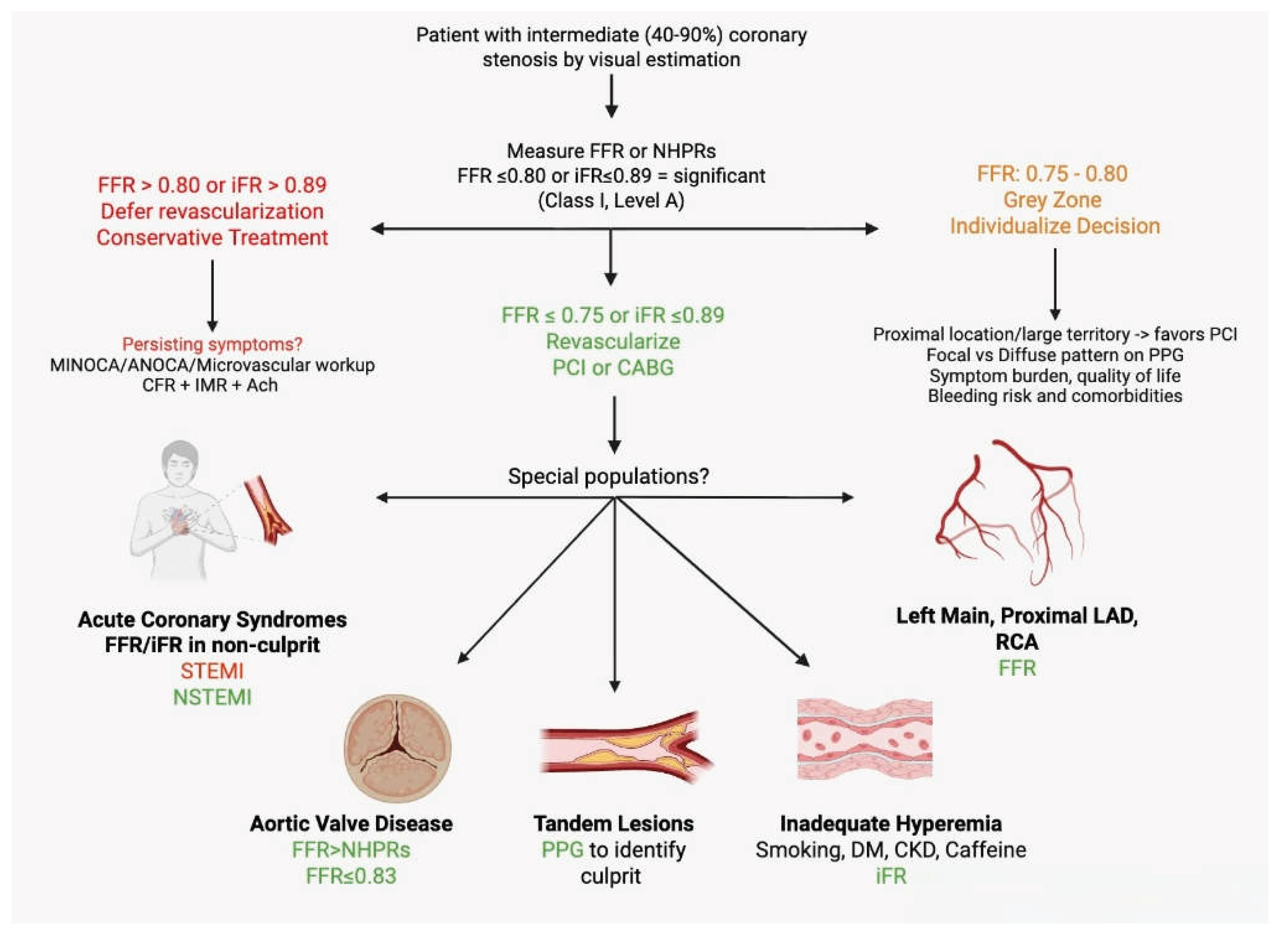

Table 1.
Adverse events related to adenosine administration during fractional flow re-serve measurement [29].
Table 1.
Adverse events related to adenosine administration during fractional flow re-serve measurement [29].
| Side effect | Cited rate | Meta-analysis rate (95% CI) |
| Chest pain | 35% | 29% (2–91%) |
| Dyspnea | 20% | 20% |
| Arrhythmia | 3.3% | 3% (1–16%) |
| Nausea | 0.9% | 0.9% |
| Bronchospasm | 0.2% | 0.2% (0.0–0.7%) |
| Vessel injury | 0.4% | 0.5% (dissection 0.2%, occlusion 0.2%, perforation 0.1%) |
| Hypotension | 0.9% | 0.8% (0.3–2.1%) |
Cited rates from registries and pooled rates from a contemporary meta-analysis. The cited rates fall within the confidence intervals of the meta-analysis, although the wide intervals for chest pain (2–91%) and arrhythmia (1–16%) reflect substantial heterogeneity across studies.
Table 2.
Comparison of currently available non-hyperemic pressure ratios (NHPRs).
| Index | Calculation |
Cardiac cycle |
Manufacturer | Threshold | Clinical evidence and caveats |
| iFR | Pd/Pa during the wave-free period of diastole | Wave-free period (diastole) | Philips | ≤0.89 | Validated by DEFINE-FLAIR and iFR-SWEDEHEART (non-inferior to FFR at 1 year). 5-year pooled meta-analysis showed higher all-cause mortality (HR 1.34); DEFINE-FLAIR 5-year follow-up showed mortality signal confined to revascularized patients. Lower specificity in LM/proximal LAD; lower sensitivity in non-LAD vessels. |
| RFR | Lowest filtered mean Pd/Pa over the entire cardiac cycle, unbiased beat-by-beat | Whole cycle | Abbott | ≤0.89 | VALIDATE RFR and RE-VALIDATE RFR: diagnostic equivalence to iFR. Captures lowest Pd/Pa outside diastole in 12% of cycles overall and 32% of RCA cycles. |
| DFR | Average Pd/Pa over the approximated diastolic period across 5 consecutive cycles | Diastole | Boston Scientific | ≤0.89 | Diagnostically equivalent to iFR in multiple validation studies. Diastolic-only window narrows with tachycardia. |
| Pd/Pa (resting) | Mean Pd/Pa over the entire cardiac cycle at rest | Whole cycle | Non-proprietary | ≤0.91 | Excellent agreement with iFR and FFR; narrowest dynamic range (62% of values cluster around the operating point); lower diagnostic resolution and higher susceptibility to drift. |
DFR, diastolic hyperemia-free ratio; FFR, fractional flow reserve; iFR, instantaneous wave-free ratio; LAD, left anterior descending artery; LM, left main; Pd/Pa, ratio of mean distal to proximal coronary pressure; RCA, right coronary artery; RFR, resting full-cycle ratio.
Table 3.
Summary of Key Clinical Trials in Coronary Physiology-Guided Revascularization.
| Trial | N | Comparison | FU | Primary Endpoint | Key Result |
| DEFER | 325 | Defer vs PCI if FFR > 0.75 | 15 yr | MACE | Deferral safe; no excess death/MI at 15 years |
| FAME I | 1,005 | FFR-guided vs angio-guided PCI (multivessel) | 1 yr | Death, MI, repeat revasc. | FFR-guided: 13.2% vs 18.3% (p = 0.02); fewer stents, lower cost |
| FAME 2 | 1,220 (888 randomized) |
PCI + OMT vs OMT alone (FFR ≤0.80) | 5 yr | Death, MI, urgent revasc. | PCI: 13.9% vs 27.0% (HR 0.46, p < 0.001); stopped early |
| FAME 3 | 1,500 | FFR-guided PCI vs CABG (3-vessel) | 1 yr / 5 yr |
1 yr: Death, MI, stroke, revasc. 5 yr: Death, MI, stroke |
1 yr: PCI did not meet non-inferiority vs CABG (HR 1.50, p = 0.35 for NI) 5 yr: No significant difference (HR 1.16, 95% CI 0.89–1.52, p = 0.27) |
| Pooled (Zimmermann) | ~2,400 | PCI vs OMT for FFR ≤0.80 | ~3 yr | Cardiac death or MI | PCI reduced cardiac death/MI: HR 0.72 (0.54–0.96, p = 0.023) |
| IRIS-FFR registry | 5,846 | FFR-guided treatment in real-world cohort | ~2 yr | MACE | Continuous FFR–MACE relationship (HR 1.06 per 0.01 decrease) |
| DEFINE-FLAIR | 2,492 | iFR-guided vs FFR-guided PCI | 5 yr | Death, MI, unplanned revasc. | 1-year non-inferior (6.8% vs 7.0%); 5-year: ↑ mortality with iFR (HR 1.56, 95% CI 1.16–2.09; mostly in revascularized arm) |
| iFR-SWEDEHEART | 2,037 | iFR-guided vs FFR-guided PCI | 5 yr | Death, MI, unplanned revasc. | Non-inferior at 1 and 5 years (5-yr HR 1.09) |
| Eftekhari pooled (DEFINE-FLAIR + iFR-SWEDEHEART) |
4,511 | iFR vs FFR | 5 yr | All-cause mortality, MACE | ↑ mortality with iFR (HR 1.34, 1.08–1.67); driven by undetermined causes (Berry et al.) |
| SWEDEHEART registry | ~24,000 | iFR vs FFR (propensity-matched) | 5 yr | MACE, all-cause mortality | No significant difference (adjusted HR ~0.96) |
| FAVOR III China | 3,825 | QFR-guided vs angio-guided PCI | 2 yr | MACE | 1-yr 5.8% vs 8.8% (HR 0.65); 2-yr 8.5% vs 12.5% (HR 0.66) |
| FAVOR III Europe | 2,000 | QFR-guided vs FFR-guided PCI | 1 yr | Death, MI, revasc. | QFR failed non-inferiority vs FFR |
| FAST III | 2,211 | vFFR-guided vs FFR-guided PCI | 1 yr | Death, MI, revasc. | Non-inferior: 7.5% vs 7.5% (p = 0.004 for NI) |
| ALL-RISE | 1,930 | FFRangio vs pressure wire | 1 yr | Death, MI, revasc. | Non-inferior: 6.9% vs 7.1% (p < 0.001 for NI) |
| iMODERN | 1,146 | Immediate iFR-guided vs deferred MRI-guided non-culprit PCI (STEMI) | 3 yr | Death, MI, HF hosp. | No difference: HR 0.95 (0.65–1.40) |
| DANAMI-3- PRIMULTI |
627 | FFR-guided complete vs IRA-only PCI (STEMI) | 10 yr | Composite events | FFR-guided complete reduced events: HR 0.76 (p = 0.014) |
| CorMicA | 151 | Function testing + stratified Rx vs standard care (ANOCA) | 1 yr | Seattle Angina Questionnaire | Improved angina (+22–27%) and QoL |
| ILIAS ANOCA | 153 | Disclosure vs non-disclosure of function testing (ANOCA) | 12 mo | SAQ score | SAQSS improved +9.4 units (p = 0.001); ↑ treatment satisfaction |
| FAITAVI | 320 | FFR-guided vs angio-guided PCI in TAVI | 12 mo | MACCE | FFR-guided 8.5% vs 16.0% (HR 0.52, p = 0.047) |
| NOTION-3 | 455 | PCI + TAVI vs TAVI alone (FFR ≤0.80 or ≥90% DS) | ~2 yr | Death, MI, urgent revasc. | PCI reduced composite; ↑ bleeding |
| PRO-TAVI | 466 | Deferral of routine PCI vs PCI in TAVI | 1 yr | Composite, bleeding | Deferral non-inferior; lower major bleeding |
| COMIC-AS | 116 | FFR/RFR before and after AVR | 6 mo | Reclassification | 21.5% lesions cross FFR cutoff after AVR; FFR ≤0.83, RFR ≤0.85 may be more accurate pre-AVR |
Abbreviations: AVR, aortic valve replacement; CABG, coronary artery bypass grafting; DS, diameter stenosis; FFR, fractional flow reserve; FFRangio, angiography-derived FFR; FU, follow-up; HF, heart failure; HR, hazard ratio; iFR, instantaneous wave-free ratio; IRA, infarct-related artery; MACE, major adverse cardiovascular events; MACCE, major adverse cardiac and cerebrovascular events; MI, myocardial infarction; NI, non-inferiority; OMT, optimal medical therapy; PCI, percutaneous coronary intervention; QFR, quantitative flow ratio; QoL, quality of life; RFR, resting full-cycle ratio; revasc., revascularization; Rx, therapy; SAQ, Seattle Angina Questionnaire; SAQSS, SAQ summary score; STEMI, ST-elevation myocardial infarction; TAVI, transcatheter aortic valve implantation; vFFR, vessel fractional flow reserve.
Disclaimer/Publisher’s Note: The statements, opinions and data contained in all publications are solely those of the individual author(s) and contributor(s) and not of MDPI and/or the editor(s). MDPI and/or the editor(s) disclaim responsibility for any injury to people or property resulting from any ideas, methods, instructions or products referred to in the content. |
© 2026 by the authors. Licensee MDPI, Basel, Switzerland. This article is an open access article distributed under the terms and conditions of the Creative Commons Attribution (CC BY) license (http://creativecommons.org/licenses/by/4.0/).
Copyright: This open access article is published under a Creative Commons CC BY 4.0 license, which permit the free download, distribution, and reuse, provided that the author and preprint are cited in any reuse.


