

Submitted:
02 June 2026
Posted:
03 June 2026
You are already at the latest version
Abstract
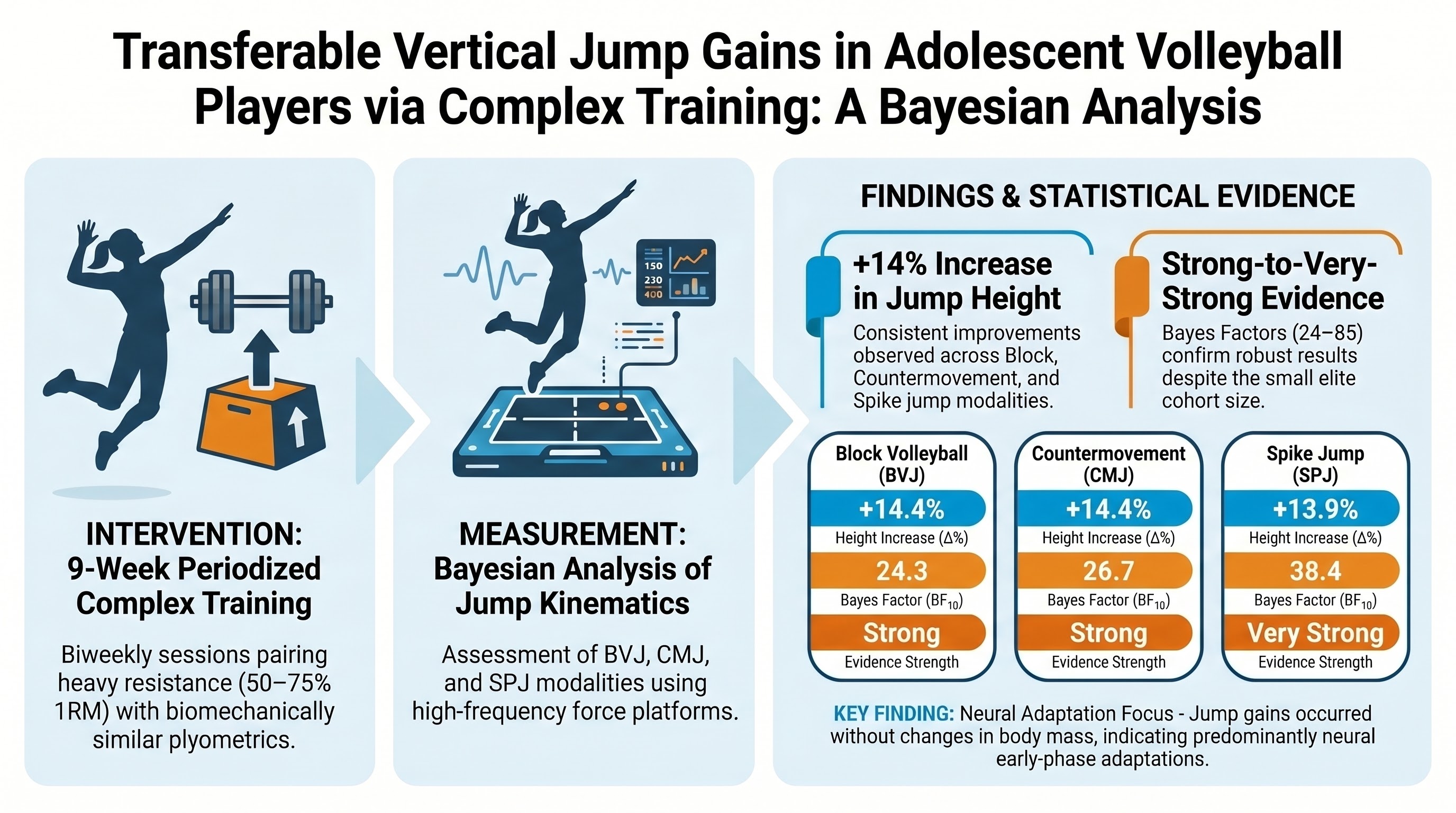
Background: Vertical jump performance is a key determinant of volleyball success. Prior evaluations of complex training in youth have relied largely on frequentist statistics, which are underpowered in the small, lean cohorts typical of elite youth sport. Objective: Apply Bayesian inference to evaluate vertical jump kinematics across short- and long-stretch-shortening-cycle modalities following a 9-week complex training program in adolescent female volleyball athletes. Methods: Eight athletes completed a periodized training protocol. Jump kinematics were assessed using a high-frequency force platform, and whole-body composition was assessed using bioelectrical impedance analysis. Data were analyzed using Bayesian inference. Results: Bayesian analysis indicated consistent improvements across jump modalities, with Block Volleyball Jump, Countermovement Jump, and Spike Jump heights increasing by 14.4%, 14.4%, and 13.9% (BF₁₀ = 24.3, 26.7, 38.4). Whole-body BIA detected no meaningful change in body mass (BF₁₀ = 0.37) or in muscle mass percentage (BF₁₀ = 1.67) over the intervention period. Conclusion: Complex training was associated with transferable neuromuscular improvements across the stretch-shortening cycle continuum. Bayesian inference provided an interpretable basis for evaluating training effects in a small elite cohort. The absence of a detectable change in whole-body composition is consistent with predominantly neural early-phase adaptation, although the single-arm design precludes causal attribution.
Keywords:
complex training
; Bayesian inference
; jump performance
; adolescent female athletes
; volleyball
; stretch-shortening cycle
; post-activation performance enhancement
1. Introduction
Volleyball is an explosive, intermittent sport in which athletes perform 100–300 maximal or near-maximal vertical jumps per match, depending on positional role and rally duration [1]. The capacity to generate vertical acceleration and convert horizontal approach velocity into vertical power underpins serving, setting, spiking, and blocking, making vertical jump performance a cornerstone of volleyball strength and conditioning [1,2,3]. The jump is shaped by the stretch-shortening cycle (SSC), an eccentric action, a brief amortization phase storing elastic energy, and an explosive concentric release facilitated by the stretch reflex [2]. Court actions recruit distinct SSC modalities: the Block Volleyball Jump (BVJ) relies on a short-SSC mechanism (contact < 250 ms) emphasizing tendinous stiffness and rate of force development (RFD), whereas the Spike Jump (SPJ) and Countermovement Jump (CMJ) use a long-SSC mechanism (contact > 300 ms) with deeper displacement and approach velocity [1].
To enhance SSC efficiency, strength, and conditioning programs widely use complex training (CT), the timed intra-session pairing of heavy resistance training with biomechanically homologous plyometric training [3,4]. Its rationale is Post-Activation Performance Enhancement (PAPE): high-force voluntary contractions transiently increase central drive, lower the recruitment threshold of fast-twitch (Type IIa/IIx) motor units, and phosphorylate myosin regulatory light chains, increasing myofilament calcium sensitivity and cross-bridge cycling [5,6]. This potentiated state enhances RFD and peak power and may yield greater chronic adaptation than resistance or plyometric training alone [7,8], and meta-analyses confirm that combined training improves jumping, sprinting, and change-of-direction performance in youth athletes [8,9]. However, prior analyses disagree on whether these adaptations transfer uniformly across short- and long-SSC modalities, motivating further investigation in adolescent female volleyball players.
A central methodological problem complicates this literature: sports science over-relies on frequentist null-hypothesis significance testing and the p < 0.05 threshold [10]; in the small samples typical of elite cohorts (n < 15), paired t-tests and repeated-measures ANOVA are underpowered, inflating Type II and Type M (error that occurs when overestimating or underestimating the actual size of the effect, especially in small samples) errors and undermining replicability [11]. Bayesian inference is better suited to small cohorts: by combining priors with the data via Markov Chain Monte Carlo simulation, it yields direct probabilistic statements about an effect, including the posterior probability of exceeding a Smallest Worthwhile Change (SWC) and the Bayes Factor (BF10) quantifying evidence for the alternative hypothesis [10].
Despite extensive evidence that complex training improves jump performance, an important gap persists: whether its benefits transfer uniformly across the short- and long-SSC continuum or are confined to specific movement vectors. This study addresses that gap by applying Bayesian inference to vertical jump kinematics in adolescent female volleyball players, a population and analytical approach seldom combined. We therefore ask whether a 9-week periodized complex training program produces transferable biomechanical improvements across vertical jump modalities in this population.
We hypothesize that Bayesian inference will reveal evidence of transferable vertical jump improvements, with high posterior probabilities of exceeding the SWC across both short-SSC (block jump) and long-SSC (countermovement and spike jump) modalities, in contrast to prior reports of limited, task-specific kinetic transfer in youth.
2. Materials and Methods
2.1. Experimental Design and Cohort Selection
This investigation used a single-arm, pre–post quasi-experimental design to assess the effects of complex training on adolescent athletes. The initial cohort comprised a girls' high school volleyball team; after applying the adherence criteria below, eight female volleyball players (mean age 16.4 ± 0.12 years; competitive experience 3.1 ± 0.6 years) met all criteria and were included in the final analysis.
Inclusion criteria required a minimum of two years of continuous competitive volleyball experience and the medically verified absence of severe musculoskeletal, neuro-articular, or systemic injury in the preceding six months. Exclusion criteria removed any participant whose training adherence or session attendance fell below 85% of the prescribed sessions to maintain intervention fidelity.
The Ethics Committee and Internal Review Board of the Faculty of Sports at the Autonomous University of Baja California approved the study protocol (Protocol Code: UABC-149/2/C/64/24). The protocol was conducted in accordance with the ethical guidelines of the World Medical Association's Declaration of Helsinki. Written informed consent was obtained from the legal guardians of all minor participants before baseline testing, and documented verbal assent was obtained from the athletes themselves.
Although a final sample of n = 8 is typically considered underpowered for classical null-hypothesis significance testing, Bayesian inference does not rely on asymptotic assumptions or large-sample sampling distributions [10]. The Bayesian approach accounts for the uncertainty associated with small samples by producing wider, more conservative credible intervals. A strong Bayes Factor obtained in an n = 8 cohort, therefore, reflects evidence that is robust even under these conservative conditions [10].
2.2. Study Design
Participants completed a periodized 9-week Complex Training (CT) program integrated into the team's general physical preparation phase (a 3-week anatomical adaptation mesocycle, a 3-week structural overload mesocycle, and a 3-week maximal-intensity mesocycle). Training was conducted twice weekly (Tuesdays and Thursdays) for 85 minutes per session. A minimum 48-hour recovery interval was enforced between consecutive sessions to allow central nervous system recovery, metabolic clearance, glycogen replenishment, and dissipation of peripheral neuromuscular fatigue [4].
The protocol used contrast loading, combining heavy resistance Weight Training (WT) with biomechanically similar Plyometric Training (PT) in sequential order. Each session included five strength exercises followed by five plyometric exercises. To elicit the intended PAPE effect, all WT sets were completed before the corresponding PT sets, separated by a 5-minute passive rest interval. This interval allows dissipation of acute localized metabolic fatigue (e.g., clearance of inorganic phosphate and hydrogen ions) while maintaining central neural excitation, motor pool excitability, and elevated myosin regulatory light chain phosphorylation [5].
WT relative intensity (% 1RM) progressed linearly across three mesocycles: Weeks 1–3 at 50–60% of 1-Repetition Maximum (1RM) for connective tissue adaptation; Weeks 4–6 at 60–70% 1RM for initial structural overload; and Weeks 7–9 at 70–75% 1RM to maximize neural drive. Core WT movements targeted the prime movers of the vertical jump kinetic chain, including the barbell half-back squat, machine leg press, dumbbell static lunges, and prone hamstring curls.
The PT component progressed from low-intensity, high-ground-contact exercises (e.g., ankle hops, jump-and-reach drills, and sub-maximal horizontal multi-jumps) in the early weeks to high-intensity, SSC-dominant tasks in the final mesocycle. These tasks included box drops from 45 cm, depth jumps, and sport-specific spike-jump approaches designed to load the series elastic components of the musculotendinous unit and engage the stretch reflex [7].
2.3. Body-Composition Assessment
Body-composition evaluations were conducted at baseline (Week 0) and immediately post-intervention (Week 10) under standardized laboratory conditions. All participants reported to the laboratory after a 12-hour overnight fast and had abstained from vigorous physical activity, caffeine, and diuretics for at least 24 hours before assessment to standardize fluid status [12].
Bioelectrical Impedance Analysis (BIA): Whole-body mass, fat mass, and skeletal muscle mass (SMM) were estimated non-invasively using a multi-frequency, eight-point tactile electrode BIA device (InBody 720, Biospace Co., Seoul, South Korea). BIA estimates total body water from the impedance relationship (height2/R) across multiple frequencies and infers total muscle mass [12]. While practical and efficient for epidemiological screening, its validity for detecting small localized changes in muscle in lean youth athletes is contested, as minor fluid shifts can affect the estimation algorithms [12,13]. Standing height, used in the impedance estimation, was recorded with a calibrated Seca 213 stadiometer (Hamburg, Germany).
2.4. Biomechanical Evaluation of Vertical Jumps
To assess SSC kinematics, stretch-reflex potentiation, and vertical force production, the athletes performed three vertical jump modalities relevant to volleyball: the CMJ, the BVJ, and the SPJ [1]. Jumps were captured on an AMTI ACG-0 ACCUGATE force platform (Advanced Mechanical Technology Inc., Watertown, MA, USA). Ground reaction force data were sampled at 1000 Hz and processed via AMTI NetForce software.
Following a standardized dynamic warm-up and a force-platform familiarization phase to control for learning effects, players performed three maximal repetitions of each jump with 30-second inter-repetition rest and 2-minute inter-modality rest to limit neuromuscular fatigue.
- Countermovement Jump (CMJ): Participants began in an upright stance, performed an eccentric countermovement to a self-selected depth, and jumped vertically with maximal effort using a double-arm swing. The CMJ is a standard assessment of long-SSC neuromuscular capability [1].
- Block Volleyball Jump (BVJ): Mimicking defensive net play, participants started in a pre-tensioned semi-squat with hands at chest height and jumped vertically without an arm swing, isolating lower-limb short-SSC propulsion and vertical rate of force development (RFD) [1].
- Spike Jump (SPJ): Emulating offensive attack mechanics, athletes used a 3- to 4-step approach, translating horizontal velocity into vertical displacement through a long SSC amortization phase and a double-arm upward swing [1].
Total absolute flight time (t) and the specific ground reaction forces were directly utilized to mathematically calculate the maximal vertical jump absolute height (h) using the rigorously standardized ballistic flight equation:
h = (g · t2) / 8
Where g is the acceleration due to gravity (9.81 m/s2). This equation assumes that the center of mass is at the same vertical position at take-off and landing. This assumption is satisfied for the standing CMJ and BVJ but is only approximately met for the SPJ, whose multi-step approach alters body configuration between take-off and landing; SPJ heights derived by this method should therefore be interpreted as estimates and compared chiefly within, rather than across, jump modalities. Peak power output (W) was derived from the force–time and velocity–time records generated by the AMTI NetForce software [1].
2.5. Advanced Bayesian Statistical Analysis
All biomechanical and body-composition data were analyzed within a Bayesian framework rather than a conventional frequentist NHST paradigm. Because the small sample (n = 8) precludes reliable assessment of normality, pre- and post-intervention measures were compared using the rank-based Bayesian Wilcoxon signed-rank test. Posterior distributions for the standardized effect size were estimated by Markov Chain Monte Carlo sampling (1,000 samples). The absolute BF10 was formally computed to quantitatively assess the relative predictive success of the alternative hypothesis (H1): the specific jump metrics increased post-intervention, against the standard null hypothesis (H0: absolutely no reliable biological change occurred) [10].
A default Cauchy prior with a scale of r = 0.707 was placed on the standardized effect size. This prior posits that effects in trained athletic populations are likely to be small to moderate while allowing larger effects to remain possible without unduly biasing the posterior distribution [10]. BF10 values were interpreted according to the conventional heuristics proposed by Jeffreys [14]: values of 1–3 indicate anecdotal evidence, 3–10 moderate evidence, 10–30 strong evidence, 30–100 very strong evidence, and values greater than 100 decisive evidence for the alternative hypothesis [10].
To assess the practical relevance of the findings, the posterior probability that the observed effect size exceeded the SWC was calculated. The SWC was defined a priori as 0.2 × the baseline between-subjects standard deviation (SD) of each measure [10]. All Bayesian models and Markov Chain Monte Carlo computations were performed in JASP (Version 0.14.1) and cross-validated in R (BayesFactor package) [10].
3. Results
Bayesian Inference of Biomechanical Adaptations
The Bayesian analysis of the 9-week periodized complex training protocol revealed consistent biomechanical improvements across all three vertical jump modalities. Table 1 summarizes the descriptive statistics, Bayes factors (BF10), and posterior effect sizes (δ) with their 95% credible intervals (CrI).
The biomechanical data indicate that the intervention was not restricted to a single movement vector but was associated with improvements across the vertical jump modalities. The BVJ showed strong evidence (BF10 = 24.3) for a 14.4% increase in jump height (26.40 to 30.14 cm; Table 1). Analysis of the posterior distribution indicated a 99.8% probability that the BVJ height improvement exceeded the SWC of 0.78 cm, supporting practical relevance for defensive on-court performance. The accompanying increase in BVJ peak power output (BF10 = 71.5) is consistent with an effect on rate-of-force-development parameters operating within the constrained temporal window of the short-SSC phase.
The CMJ, a standardized assessment of long-SSC capability, showed a comparable relative change (+14.4% in height, 26.93 to 30.81 cm), with strong evidence under the Bayesian framework (BF10 = 26.7). The SPJ likewise showed strong evidence for improvement (BF10 = 38.4), with approach jump height increasing by 13.9%. SPJ peak power also increased (BF10 = 15.7), consistent with the athletes integrating lower-limb strength gains into the high-velocity, multi-joint offensive movement chain.
In contrast to the jump kinematics, whole-body composition, assessed by multi-frequency BIA, showed no meaningful change over the intervention period. Body mass was essentially unchanged (56.7 ± 9.4 kg pre vs. 56.7 ± 9.6 kg post; BF10 = 0.37), and BIA-derived muscle mass percentage shifted only marginally (38.4 ± 3.5% to 38.0 ± 3.7%; BF10 = 1.67, anecdotal). The Bayesian evidence therefore favored the null hypothesis for whole-body composition, indicating that the jump-performance gains occurred without a detectable change in body composition by this method.
4. Discussion
This Bayesian analysis indicates that a 9-week periodized complex training program integrating heavy resistance training with biomechanically homologous plyometric exercises was associated with improvements in vertical jump performance among adolescent female volleyball players. The Bayesian analysis addresses a common assumption in the youth training literature: that complex training transfers only to highly specific movement vectors rather than across the stretch-shortening cycle spectrum. The present results suggest instead that complex training was associated with system-wide neuromuscular improvement across jumping modalities.
4.1. Transferability of Neuromuscular Improvements Across the SSC Continuum
A key feature of the present dataset is the consistency of the biomechanical adaptation across jump types. Rather than a disproportionate response favoring the short-SSC Block Volleyball Jump over the Countermovement Jump, the Bayesian analysis (Table 1) shows a comparable 14.4% increase in both BVJ and CMJ height, along with a 13.9% increase in the Spike Jump.
This consistency suggests that complex training increased the motor pool’s baseline capacity rather than refining a single motor pattern. Heavy resistance loading (half-squats and leg presses at 70–75% 1RM) imposes mechanical tension and central nervous system load, lowering the recruitment threshold for fast-twitch (Type IIa/IIx) motor units. Pairing this potentiated state with both short-SSC and long-SSC plyometric actions improved force generation and RFD across movement vectors [5,7]. Because the BVJ generates force through rapid amortization and tendon stiffness [2], whereas the SPJ and CMJ involve deeper flexion and upper-body chaining [1], comparable improvement across both ends of the SSC spectrum indicates the protocol shifted the force–velocity curve upward rather than favoring a single kinetic vector [2].
4.2. Advantages of Bayesian Inference in Small Elite-Cohort Analyses
The use of Bayesian statistics changes how complex performance data are interpreted and helps address replication concerns in sports science and clinical epidemiology [10]. In elite athletic cohorts, where sample sizes are constrained by logistical realities (e.g., limited national-team rosters; here, n = 8), frequentist analysis relies on long-run sampling distributions that can be unstable and prone to Type M errors [10,11]. A p-value quantifies the probability of the observed data under the null hypothesis, the inverse of what practitioners typically want to know, which limits its utility for applied decision-making [10].
Using Bayesian paired models with a Cauchy prior (r = 0.707), we quantified the posterior probability that the intervention was effective. A Bayes Factor of BF10 = 38.4 for the spike jump indicates that the observed data are approximately 38.4 times more likely under the alternative hypothesis (that the training is effective) than under the null hypothesis [10]. This provides an interpretable metric for applied researchers.
The 95% Credible Interval (CrI) provides coaches, clinical epidemiologists, and researchers with a defined range within which the true population parameter is likely to lie. A 99.8% posterior probability of exceeding the predefined SWC indicates that the observed effect is unlikely to be an artifact of the small sample [10]. This level of probabilistic insight is difficult to obtain from an underpowered frequentist paired t-test.
4.3. Physiological Limitations and Future Clinical Directions
Although the Bayesian framework mitigates some of the statistical fragility associated with small athletic cohorts, several limitations remain. First, the absence of a matched non-exercising control group precludes full isolation of the training effect from natural maturation (e.g., adolescent growth) and from the concurrent stimulus of sport-specific practice conducted outside the laboratory. Second, jump heights were derived from flight time, which assumes equal take-off and landing center-of-mass positions and therefore yields only approximate values for the approach-based Spike Jump. Third, the single-arm, pre–post design and the homogeneous single-team cohort (n = 8) limit the generalizability of the findings to the broader population of adolescent female volleyball players.
Several biological variables were not controlled across the 9-week window. In particular, the menstrual cycle phase, which can influence joint laxity, tendinous and ligamentous stiffness, and force output, was not tracked longitudinally [1,15]. In addition, calculating each participant's biological maturity offset (Peak Height Velocity) would provide further insight into individual responsiveness to the applied mechanical stimulus [9].
Future controlled studies should combine Bayesian models with high-resolution diagnostic ultrasound to track regional changes in muscle architecture—including pennation angle, fascicle length, and cross-sectional thickness—which influence contraction velocity and stretch-shortening-cycle efficiency [12]. Incorporating longitudinal N-of-1 Bayesian hierarchical models may also enable practitioners to track individual responsiveness to PAPE protocols over the course of a competitive season, thereby moving the field toward more individualized, precision-oriented practice [10].
5. Conclusions
This Bayesian analysis indicates that a periodized 9-week complex training program is a time-efficient stimulus for enhancing vertical jump performance in adolescent female volleyball athletes, producing transferable adaptations across the stretch-shortening-cycle continuum (short-SSC Block Volleyball Jump and long-SSC Spike Jump). Whole-body bioelectrical impedance detected no accompanying change in body composition, consistent with predominantly neural early-phase adaptation in this population.
The principal practical implication is that, in small elite cohorts, Bayesian inference provides a more interpretable basis for decision-making than frequentist p-values, giving coaches and clinicians a clearer probabilistic picture of neuromuscular adaptation to support individualized training prescription.
Author Contributions
Conceptualization, M.T.-T. and A.R.-J.; methodology, M.T.-T., K.R.-F. and A.R.-J.; software, I.A.C.-G.; validation, H.A.P.-E. and I.A.C.-G.; formal analysis, K.R.-F. and I.A.C.-G.; investigation, K.R.-F. and M.T.-T.; resources, M.T.-T. and A.R.-J.; data curation, K.R.-F.; writing original draft preparation, K.R.-F.; writing review and editing, M.T.-T., H.A.P.-E., I.A.C.-G. and A.R.-J.; visualization, K.R.-F.; supervision, M.T.-T. and A.R.-J.; project administration, M.T.-T.; funding acquisition, A.R.-J. All authors have read and agreed to the published version of the manuscript.
Funding
This research was funded by the Faculty of Sports, Mexicali Campus, Autonomous University of Baja California, Mexicali, Baja California, Mexico.
Institutional Review Board Statement
The study was conducted in accordance with the Declaration of Helsinki and approved by the Institutional Review Board (Faculty of Sports, Mexicali Campus, Autonomous University of Baja California) (protocol code UABC-149/2/C/64/24).
Informed Consent Statement
Informed consent was obtained from all subjects involved in the study.
Data Availability Statement
The data presented in this study are available on request from the corresponding author. The data are not publicly available due to privacy restrictions concerning minor participants.
Acknowledgments
We thank the participants and the educational institution that made this work possible. The authors have reviewed and edited the output and take full responsibility for the content of this publication.
Conflicts of Interest
The authors declare no conflicts of interest.
Abbreviations
The following abbreviations are used in this manuscript:
| 1RM | 1-Repetition Maximum |
| BIA | Bioelectrical impedance analysis |
| BVJ | Three letter acronym |
| CMJ | Block Volleyball Jump |
| CT | Complex Training |
| PAPE | Post-Activation Performance Enhancement |
| PT | Plyometric Training |
| RFD | Rate of Force Development |
| SPJ | Spike Jump |
| SSC | Stretch-shortening cycle |
| SWC | Smallest Worthwhile Change |
| WT | Weight Training |
References
- Sheppard, J.M.; Cronin, J.B.; Gabbett, T.J.; McGuigan, M.R.; Etxebarria, N.; Newton, R.U. Relative Importance of Strength, Power, and Anthropometric Measures to Jump Performance of Elite Volleyball Players. J. Strength Cond. Res. 2008, 22, 758–765. [Google Scholar] [CrossRef] [PubMed]
- Komi, P.V. Stretch-Shortening Cycle: A Powerful Model to Study Normal and Fatigued Muscle. J. Biomech. 2000, 33, 1197–1206. [Google Scholar] [CrossRef] [PubMed]
- Fathi, A.; Hammami, R.; Moran, J.; Borji, R.; Sahli, S.; Rebai, H. Effect of a 16-Week Combined Strength and Plyometric Training Program Followed by a Detraining Period on Athletic Performance in Pubertal Volleyball Players. J. Strength Cond. Res. 2019, 33, 2117–2127. [Google Scholar] [CrossRef] [PubMed]
- Santos, E.J.; Janeira, M.A. Effects of Complex Training on Explosive Strength in Adolescent Male Basketball Players. J. Strength Cond. Res. 2008, 22, 903–909. [Google Scholar] [CrossRef] [PubMed]
- Berriel, G.P.; Cardoso, A.S.; Costa, R.R.; Rosa, R.G.; Oliveira, H.B.; Kruel, L.F.M.; Tartaruga, M.P. Does Complex Training Enhance Vertical Jump Performance and Muscle Power in Elite Male Volleyball Players? Int. J. Sports Physiol. Perform. 2022, 17, 586–593. [Google Scholar] [CrossRef] [PubMed]
- Li, X.; Soh, K.G.; Loh, S.P. The Impact of Post-Activation Potentiation on Explosive Vertical Jump after Intermittent Time: A Meta-Analysis and Systematic Review. Sci. Rep. 2024, 14, 17213. [Google Scholar] [CrossRef] [PubMed]
- Ramírez-Campillo, R.; Andrade, D.C.; Nikolaidis, P.T.; Moran, J.; Clemente, F.M.; Chaabene, H.; Comfort, P. Effects of Plyometric Jump Training on Vertical Jump Height of Volleyball Players: A Systematic Review with Meta-Analysis of Randomized-Controlled Trial. J. Sports Sci. Med. 2020, 19, 489–499. Available online: https://pmc.ncbi.nlm.nih.gov/articles/PMC7429440/ (accessed on 1 June 2026). [PubMed]
- Xie, L.; Chen, J.; Dai, J.; Zhang, W.; Chen, L.; Sun, J.; Gao, X.; Song, J.; Shen, H. Exploring the Potent Enhancement Effects of Plyometric Training on Vertical Jumping and Sprinting Ability in Sports Individuals. Front. Physiol. 2024, 15, 1435011. [Google Scholar] [CrossRef] [PubMed]
- Lesinski, M.; Prieske, O.; Granacher, U. Effects and Dose–Response Relationships of Resistance Training on Physical Performance in Youth Athletes: A Systematic Review and Meta-Analysis. Br. J. Sports Med. 2016, 50, 781–795. [Google Scholar] [CrossRef] [PubMed]
- Mengersen, K.L.; Drovandi, C.C.; Robert, C.P.; Pyne, D.B.; Gore, C.J. Bayesian Estimation of Small Effects in Exercise and Sports Science. PLoS ONE 2016, 11, e0147311. [Google Scholar] [CrossRef] [PubMed]
- Hopkins, W.G.; Marshall, S.W.; Batterham, A.M.; Hanin, J. Progressive Statistics for Studies in Sports Medicine and Exercise Science. Med. Sci. Sports Exerc. 2009, 41, 3–13. [Google Scholar] [CrossRef] [PubMed]
- Lee, R.C.; Wang, Z.; Heo, M.; Ross, R.; Janssen, I.; Heymsfield, S.B. Total-Body Skeletal Muscle Mass: Development and Cross-Validation of Anthropometric Prediction Models. Am. J. Clin. Nutr. 2000, 72, 796–803. [Google Scholar] [CrossRef] [PubMed]
- Esco, M.R.; Snarr, R.L.; Leatherwood, M.D.; Chamberlain, N.A.; Redding, M.L.; Flatt, A.A.; Williford, H.N. Comparison of Total and Segmental Body Composition Using DXA and Multifrequency Bioimpedance in Collegiate Female Athletes. J. Strength Cond. Res. 2015, 29, 918–925. [Google Scholar] [CrossRef]
- Jeffreys, H. Theory of Probability, 3rd ed.; Oxford University Press: Oxford, UK, 1961; Available online: https://global.oup.com/academic/product/theory-of-probability-9780198503682 (accessed on 1 June 2026).
- Roso-Moliner, A.; Mainer-Pardos, E.; Arjol-Serrano, J.L.; Cartón-Llorente, A.; Nobari, H.; Lozano, D. Evaluation of a 10-Week Neuromuscular Training Program on Body Composition of Elite Female Soccer Players. Biology 2022, 11, 1062. [Google Scholar] [CrossRef]

Table 1.
Bayesian Paired Analysis of Vertical Jump Kinematics Pre- and Post-Complex Training.
| Jump Modality | Variable | Pre-Training (Mean ± SD) | Post-Training (Mean ± SD) | Δ% | Effect Size (δ) [95% CrI] | Bayes Factor (BF10) | Evidence Category |
| Block Volleyball Jump (BVJ) | Height (cm) | 26.40 ± 3.90 | 30.14 ± 3.78 | +14.4% | 2.23 [0.42, 6.39] | 24.3 | Strong |
| Flight Time (s) | 0.46 ± 0.03 | 0.49 ± 0.03 | +7.0% | 2.50 [0.49, 7.71] | 41.4 | Very Strong | |
| Power (W) | 634 ± 87 | 683 ± 88 | +7.7% | 2.60 [0.69, 6.60] | 71.5 | Very Strong | |
| Countermovement Jump (CMJ) | Height (cm) | 26.93 ± 4.08 | 30.81 ± 4.71 | +14.4% | 1.94 [0.37, 4.18] | 26.7 | Strong |
| Flight Time (s) | 0.47 ± 0.04 | 0.50 ± 0.04 | +7.0% | 1.72 [0.38, 4.97] | 25.7 | Strong | |
| Power (W) | 645 ± 93 | 693 ± 90 | +7.4% | 2.52 [0.49, 6.18] | 39.2 | Very Strong | |
| Spike Jump (SPJ) | Height (cm) | 30.66 ± 4.50 | 34.90 ± 4.76 | +13.9% | 3.89 [0.55, 10.41] | 38.4 | Very Strong |
| Flight Time (s) | 0.50 ± 0.04 | 0.53 ± 0.04 | +6.5% | 7.18 [0.64, 17.21] | 85.3 | Very Strong | |
| Power (W) | 690 ± 96 | 737 ± 87 | +6.9% | 1.29 [0.27, 2.49] | 15.7 | Strong |
Note: BF10 was calculated using a default Cauchy prior with scale r = 0.707. CrI = credible interval; δ = standardized effect size; Δ% = percentage change from pre- to post-training.
Disclaimer/Publisher’s Note: The statements, opinions and data contained in all publications are solely those of the individual author(s) and contributor(s) and not of MDPI and/or the editor(s). MDPI and/or the editor(s) disclaim responsibility for any injury to people or property resulting from any ideas, methods, instructions or products referred to in the content. |
© 2026 by the authors. Licensee MDPI, Basel, Switzerland. This article is an open access article distributed under the terms and conditions of the Creative Commons Attribution (CC BY) license (http://creativecommons.org/licenses/by/4.0/).
Copyright: This open access article is published under a Creative Commons CC BY 4.0 license, which permit the free download, distribution, and reuse, provided that the author and preprint are cited in any reuse.


