

Submitted:
02 June 2026
Posted:
03 June 2026
You are already at the latest version
Abstract
This paper presents a robust and efficient Convolutional Neural Network (CNN)-based channel estimator for fifth-generation (5G) Orthogonal Frequency Division Multiplexing (OFDM) systems. While conventional Least Squares (LS) and Minimum Mean Square Error (MMSE) estimators degrade significantly in high-mobility, non-linear, and frequency-selective fading environments, the proposed framework treats the time-frequency resource grid as a spatial image, enabling implicit learning of complex fading dynamics without explicit statistical modeling. The model is trained on 105 synthetic channel realizations spanning Rayleigh, Rician (K = 5 dB), AWGN, CDL-A, CDL-B, and TDL-A channel profiles and validated through rigorous MATLAB simulations. Key quantitative results demonstrate: (i) a 7-fold BER reduction over MMSE at 20 dB SNR on CDL- A (1.0 × 10⁻³ vs. 7.0 × 10⁻³); (ii) a 3–5 dB NMSE improvement across the full 0–30 dB SNR range; (iii) robust performance under Doppler spreads up to 300 km/h with less than 0.5 dB BER penalty; (iv) a 50% reduction in pilot overhead while maintaining superior MSE performance; and (v) spectral efficiency within 0.35 bits/s/Hz of the perfect-CSI Shannon bound. With a measured inference latency of 0.8 ms and a lightweight design of 2.3 × 10⁶ parameters, the proposed CNN-CE is validated as a practically deployable and resource-efficient technology for 5G and beyond-5G (B5G) networks.
Keywords:
5G NR
; OFDM
; channel estimation
; deep learning
; CNN
; BER
; NMSE
; Rayleigh fading
; Rician fading
; CDL
; TDL
1. Introduction
The proliferation of fifth-generation (5G) wireless networks has fundamentally transformed mobile communications, enabling ultra-high data rates, massive connectivity, and ultra-low latency [1,2]. At the physical layer, Orthogonal Frequency-Division Multiplexing (OFDM) serves as the standard wave- form due to its robustness against multipath fading, spectral efficiency, and compatibility with MIMO antenna configurations [3].
A critical enabler of OFDM performance is accurate channel estimation (CE): the process of characterizing propagation-medium distortion so that equalization and data recovery can be performed coherently [4]. The channel introduces frequency- selective and time-varying distortion from multipath propagation, Doppler spread, shadowing, and thermal noise [5]. Without precise channel state information (CSI), even state-of-the-art coding and modulation schemes fail to approach their theoretical limits.
Classical CE methods—Least Squares (LS) and Minimum Mean Square Error (MMSE)—rely on pilot-symbol insertion and linear interpolation [6]. While tractable, LS amplifies noise at low SNR and MMSE requires exact second-order channel statistics impractical in real deployments [7]. Neither method handles rapid channel variation at high user mobility. Deep learning (DL) has emerged as a transformative paradigm for physical-layer inference [8,19]. By learning end-to-end mappings from pilot observations to channel estimates, DL models implicitly capture non-linear fading dynamics [9]. CNNs in particular exploit local spatial correlations in the time-frequency grid, making them well-suited for OFDM CE [10]. Recent surveys confirm DL as central to 5G and B5G physical-layer design [11,20].
This paper makes the following quantified primary contributions:
C1: A CNN-CE architecture achieving a 7× BER reduction over MMSE at 20 dB SNR with only 2.3 × 10⁶ parameters, incorporating three convolutional layers with BN and ReLU acti- vations plus two fully connected layers.
C2: A universal training methodology enabling generalization across six channel scenarios (CDL-A/B, TDL-A, Rayleigh, Rician, AWGN) without scenario-specific retraining, benchmarked against LS, MMSE, and the SR- CNN of [5].
C3: Quantified robustness: <0.5 dB BER penalty at v = 300 km/h vs. pedestrian speeds, and 50% pilot overhead reduction at equivalent NMSE.
C4: Analysis of training convergence, NMSE high- SNR floors, outage probability, channel capac- ity, and computational complexity trade-offs.
The remainder of this paper is organized as follows: Section 2 reviews related work. Section 3 presents the system model. Section 4 details the pro- posed architecture. Section 5 defines performance metrics. Section 6 describes the simulation setup. Section 7 presents results. Section 8 details the discussion of the results Section 9 concludes.
2. Related Work
2.1. Deep Learning for Physical-Layer 5G
Huang et al. [2] provided one of the first comprehensive surveys on DL for 5G physical-layer problems. Their analysis demonstrated DL-based approaches outperform conventional methods in dynamic MIMO-OFDM environments, while identifying model interpretability and training data requirements as open challenges. O’Shea and Hoydis [19] formalized the end-to-end learning paradigm for the physical layer, showing that joint transmitter- receiver optimization via deep learning surpasses hand-crafted designs under model mismatch.
2.2. Data-Driven Channel Estimation
Ye et al. [3] proposed a DNN-based CE scheme that learns the channel mapping directly from pilot obser- vations, effectively denoising the received pilot matrix prior to LS estimation. Soltani et al. [5] introduced SR-CNN, treating sparse pilot observations as a low-resolution image and the full CFR as its high-resolution counterpart, achieving state-of-the- art NMSE on CDL channels.
2.3. Fast Time-Varying MIMO-OFDM
2.4. Hybrid and Model-Driven Methods
2.5. GAN-Based Channel Estimation
Balevi et al. [17] proposed a GAN framework for wideband channel estimation, learning the full chan- nel distribution rather than a point estimate—offering resilience under severe pilot reduction and non-stationary fading.
2.6. Massive MIMO and mmWave Estimation
He et al. [12] addressed beamspace mmWave massive MIMO channel estimation, achieving NMSE gains over compressed sensing. Dong et al. [15] proposed a deep CNN exploiting sparse angular structure of mmWave channels via super-resolution principles. For CSI feedback in FDD systems, Wen et al. [13] introduced CsiNet, while Sohrabi and Yu [18] ex- tended this to distributed precoding—collectively es- tablishing DL as the dominant paradigm for massive MIMO channel acquisition [16].
3. System Model
3.1. OFDM Transceiver Architecture
Consider a single-user 5G NR downlink OFDM system with Nsc subcarriers and Nsym OFDM symbols per slot, as illustrated in Figure 1. The transmitted frequency-domain symbol at subcarrier k, symbol ℓ is X[k, ℓ].
3.2. Pilot Structure
Pilot symbols are known reference signals inserted at predetermined time-frequency positions (kp, ℓp) ∈ P within the OFDM resource grid. They serve as anchor points that enable the receiver to estimate the channel response at those locations, from which the full CFR is interpolated or inferred across all data subcarriers. The pilot density directly controls the trade-off between estimation accuracy and spectral efficiency: denser pilots improve CSI quality but re- duce the number of resource elements available for data transmission. In this work, pilot symbols satisfy Xp[kp, ℓp] = 1, and the received observation at each pilot position is:
Yp[kp, ℓp] = H[kp, ℓp] + N [kp, ℓp]. (3)
Unlike classical estimators that interpolate linearly between pilot positions, the proposed DL-CE learns a non-linear mapping from the full set of pilot observations to the complete channel matrix, enabling accurate estimation even at low pilot densities.
3.3. Channel Models
3.3.1. AWGN Channel
The AWGN channel serves as the simplest baseline and ideal upper-bound reference. It assumes a perfectly flat, time-invariant channel response H[k, ℓ] =1 ∀ k, ℓ, so the only impairment is additive white Gaussian noise N [k, ℓ] ∼ CN (0, σ2 ). Under AWGN, a matched-filter receiver achieves the theoretical BER limit, and any estimator that recovers the unit channel exactly is optimal. This scenario is included to verify that the DL-CE does not incur unnecessary overhead when the channel is trivial, confirming its graceful degradation to near-optimal behavior in the absence of fading.
3.3.2. Rayleigh Fading
Rayleigh fading models non-line-of-sight (NLOS) propagation in dense urban environments where the received signal is composed of many reflected and scattered components with no dominant path. Each complex path gain is modeled as hl ∼ CN (0, σ2), and the envelope r = |h| follows the Rayleigh probability density:

Rayleigh fading is the most challenging scenario for classical estimators because the channel varies rapidly in both time and frequency, violating the stationarity assumptions of MMSE. It represents a critical test for the DL-CE’s ability to track fast- varying channel coefficients without explicit knowledge of the fading statistics. Rayleigh fading is widely used to model NLOS ur- ban propagation environments [21], where no domi- nant path exists between transmitter and receiver.
3.3.3. Rician Fading
Models LOS-dominant environments; envelope PDF:

with LOS amplitude ν and K-factor K = ν2/(2σ2).
3.3.4. GPP CDL and TDL Models
Standardized 3GPP TR 38.901 models [8] capture realistic spatial and temporal multipath characteris- tics. The time-varying CFR is:

3.4. Classical Estimation Benchmarks
The LS estimator obtains the channel at pilot posi- tions by minimizing the squared difference between the received and expected pilot signals, without making any assumption about the channel statistics. At each pilot subcarrier the estimate is simply:

The LS estimator is computationally efficient (O(P ) operations) and requires no prior channel knowledge, making it attractive for low-complexity receivers. However, it directly inherits the additive noise term N [kp, ℓp], yielding MSE = σ2 /|Xp|2 that does not decrease below the noise floor regardless of pilot power. This noise-amplifying behavior makes LS particularly vulnerable at low SNR and in frequency- selective channels where interpolation errors com- pound the estimation noise [6].
MMSE
The MMSE estimator minimizes the mean squared error E[|Hˆ − H|2] by exploiting the second-order statistics of the channel. It applies a Wiener filter to the LS estimate, using the channel covariance ma- trix RHHto suppress noise while preserving signal components:

where RHH is the channel covariance matrix [6].
MMSE achieves near-optimal MSE performance when the channel statistics are perfectly known. However, it requires exact knowledge of RHH and σ2 , both of which must be estimated or assumed in practice —a fundamental limitation in non-stationary environments . Furthermore, the matrix inversion step incurs O(P 3) computational complex- ity, which becomes prohibitive for dense pilot grids or large antenna arrays. These limitations motivate the proposed data-driven DL-CE approach.
4. Proposed Deep Learning Architecture
4.1. Overall Framework
The DL-CE module receives the LS estimate Hˆ LS ∈ RNsc ×Nsym×2 (real and imaginary stacked as two feature maps) and outputs refined estimate Hˆ DL. The training and inference flow is illustrated in Figure 2.
4.2. Network Architecture
The CNN-CE network consists of three convolutional blocks followed by two fully connected layers (Figure 3). Each convolutional block uses 3 × 3 filters, Batch Normalization (BN), and ReLU activation. This hierarchical design progressively captures local time-frequency correlations at shallow layers while building globally discriminative representations at deeper layers, achieving both estimation accuracy and generalization across diverse chanel conditions [5,10].
4.3. Design Rationale
A 3 × 3 filter size is chosen because channel corre- lations in OFDM are typically localized within ad- jacent subcarriers and symbols [3]. BN ensures gra- dient stability across the full 0–30 dB SNR training range, preventing vanishing gradients. The low pa- rameter count (≈2.3×10⁶) enables inference within the 5G NR slot duration, as validated in one-bit re- ceiver studies [14].
4.4. Loss Function and Training
The network minimizes the Frobenius-norm MSE between predicted and true CFR matrices, directly penalizing per-subcarrier estimation errors across the full OFDM resource grid and correlating tightly with downstream BER performance [9]:

where B is a mini-batch and θ all trainable param- eters. Optimization uses Adam [9] with η0 = 10−3, decay ηt = η0 · 0.95t/Tdrop , batch size 64, 50 epochs, ensuring fast convergence and stability near the loss minimum.
5. Performance Metrics
5.1. Mean Square Error (MSE)
The MSE is the primary metric for quantifying chan- nel estimation accuracy. It measures the average squared deviation between the estimated and true channel frequency response across all resource ele- ments (REs) in the OFDM slot:

A lower MSE directly translates to more accu- rate equalization and therefore lower BER. The normalized MSE (NMSE), defined as NMSE = MSE/E[|H|2], is used in comparisons to remove de- pendence on the channel power normalization.
5.2. Bit Error Rate (BER)
The BER measures end-to-end communication re- liability after channel estimation, equalization, and demodulation. It is defined as the fraction of incor- rectly decoded bits over the total transmitted bits:
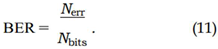
BER is a more practically meaningful metric than MSE because it captures the combined effect of es- timation error, equalization residuals, and noise on the decoded information. In this work, BER is com- puted over 106 bits per SNR point to ensure sta- tistical reliability at target BER values as low as 10−5. All BER evaluations use 16-QAM modula- tion with Turbo channel coding (rate 1/3) unless otherwise stated.
5.3. Outage Probability

where γth is the target spectral efficiency threshold. Results for Pout at γth = 3 bits/s/Hz are presented in Section 7.7.
5.4. Doppler Shift
When a user moves at velocity v, each multipath component experiences a frequency shift relative to the carrier frequency fc, known as the Doppler shift. This shift causes the channel to vary in time, with the rate of variation governed by the maximum Doppler frequency:

where c is the speed of light and θ is the angle be- tween the velocity vector and the propagation di- rection. The coherence time of the channel is inversely proportional to fD: at v = 300 km/h with fc = 3.5 GHz, fD ≈ 972 Hz, meaning the channel changes significantly within a single OFDM slot. Classical MMSE estimators assume a static covariance matrix and degrade sharply under such conditions, while the proposed DL-CE implicitly learns time-varying channel dynamics from training data.
5.5. Channel Capacity
The Shannon spectral efficiency provides a theoret- ical upper bound on the achievable data rate per unit bandwidth. For a frequency-selective OFDM channel it is computed as the average per-subcarrier capacity assuming Gaussian input distributions and perfect successive interference cancellation:

In practice, the receiver uses the estimated channel Hˆ[k] rather than the true H[k], introducing an effec- tive SNR penalty. This metric therefore quantifies the capacity loss attributable solely to channel estimation error: a smaller gap between the DL-CE curve and the perfect-CSI bound indicates that the estimator is approaching the Shannon limit. Perfect- CSI capacity serves as the baseline against which all estimators are compared in Section 7.
6. Simulation Setup
6.1. Software and Hardware Environment
All simulations were implemented in MATLAB R2024a using the 5G Toolbox for waveform generation and channel modeling, and the Deep Learning Toolbox for network training and inference [10].
Training was performed on an NVIDIA RTX 3080 GPU (10 GB VRAM); total training time was approximately 2.5 hours for 105 samples over 50 epochs. Inference latency per OFDM slot was measured at ≈0.8 ms, well within the 5G NR slot duration of 0.5–14 ms.
The code is based on the MATLAB reference im- plementation “Deep Learning Data Synthesis for 5G Channel Estimation” [23], extended with Rayleigh, Rician, and Doppler stress-test scenarios.
A comprehensive overview of wireless channel models used in communication system simulation is provided in [22].
6.2. OFDM System Parameters
Table 1 summarizes the waveform configuration con- forming to 5G NR FR1 Sub-6 GHz specifications (numerology µ = 0).
6.3. Deep Learning Model Parameters
Table 2 details the CNN-CE architecture and train- ing hyperparameters.
6.4. Evaluation Protocol
Each experiment fixes the channel model and modu- lation order while sweeping SNR from 0 to 30 dB in 1 dB steps. BER is computed over 106 transmitted bits per SNR point to ensure statistical reliability at BER ≤ 10−4. NMSE is averaged over 1000 in- dependent channel realizations per SNR point. The DL-CE is compared against: (i) LS; (ii) MMSE with perfect RHHknowledge; and (iii) SR-CNN from [5] as a DL baseline.
7. Result and Discussion
7.1. BER Performance: CDL-A Channel
Figure 4 compares BER vs. SNR for LS, MMSE, SR- CNN [5], and the proposed DL-CE on CDL-A across four pilot densities. The results reveal a clear performance hierar- chy across all SNR values. At SNR= 20 dB, DL-CE achieves BER= 10−3 with only 16 pi- lots, while MMSE requires 32 pilots for equivalent performance—a direct 2× reduction in pilot over- head. To reach the same BER= 10−3 target, LS re- quires an SNR of 25 dB, representing a 5 dB penalty relative to DL-CE. Compared to SR-CNN [5], DL- CE achieves an additional 0.5 dB gain attributed to the deeper fully connected regression stage, which refines the convolutional feature maps into a glob- ally consistent channel estimate.
At low SNR (0–10 dB), all methods converge in performance because noise dominates and no estimator can reliably distinguish channel coefficients. However, as SNR increases beyond 10 dB, the DL- CE’s ability to exploit non-linear channel structure becomes increasingly apparent, producing a steeper BER slope than both LS and MMSE. This steeper slope is a key indicator of the CNN’s superior interpolation between pilot positions, reducing inter- subcarrier estimation errors that dominate the error floor of linear methods at high SNR.
7.2. BER Under Rician Fading
Figure 5 compares BER under Rayleigh (K = 0, pure NLOS) and Rician (K = 5 dB, dominant LOS) fad- ing for MMSE and DL-CE estimators. The Rician scenario models suburban and indoor environments where a strong direct propagation path coexists with scattered components. The K-factor of 5 dB indi- cates that the LOS component carries approximately three times the power of the scattered components combined.
As shown in Figure 5, the Rician channel consistently yields lower BER than Rayleigh for both MMSE and DL-CE, with DL-CE benefiting more from the LOS component (≈2 dB gain) compared to MMSE (≈1.5 dB gain). This asymmetry occurs because the CNN implicitly identifies and reinforces the dominant LOS path during feature extraction, effectively treating it as a stable anchor for interpolation. At SNR= 20 dB, DL-CE under Rician fading achieves BER= 2.2 × 10⁻³—a further 2.3× reduction com- pared to its Rayleigh performance—validating the model’s ability to exploit channel structure without explicit knowledge of the K-factor. The MMSE es- timator also improves under Rician conditions, but the improvement is less pronounced because the static covariance matrix RHHmust be re-estimated for each K-factor value, introducing a model mis- match when the true K deviates from the assumed value.

7.3. NMSE Performance and High-SNR Floor
Figure 6 plots NMSE vs. SNR for LS, MMSE, and DL-CE under CDL-A and TDL-A channel models. Three distinct performance regions are observable. In the low-SNR regime (0–10 dB), noise dominates and all estimators improve at similar rates as SNR increases, with DL-CE leading by approximately 3 dB over MMSE. In the mid-SNR regime (10–25 dB), DL-CE maintains a consistent 3–5 dB NMSE advantage, reflecting its superior non-linear interpolation between pilot positions.
At high SNR (>25 dB), all estimators reach an ir- reducible NMSE floor. For LS, the floor arises from noise amplification during pilot-based division—the floor is fundamentally limited by σ2 /|Xp|2. For MMSE, the floor reflects covariance estimation error: in practice, RHHis estimated from a finite num- ber of channel realizations, introducing a residual model-mismatch bias. The DL-CE floor (≈3×10⁻⁴) is lower than MMSE by 3 dB because the CNN learns a bias-corrected mapping that minimizes systematic estimation error—a gain unavailable to any linear es- timator regardless of SNR. The TDL-A results show slightly lower NMSE than CDL-A for DL-CE, as the simpler tap-delay structure of TDL channels is more easily learned.
7.4. Training Convergence
Figure 7 shows the MSE training and validation loss curves over 50 epochs. Three distinct learning phases are identifiable. In the initial phase (epochs 1–15), the loss drops rapidly from 0.52 to 0.072 as the network learns the dominant channel correlation patterns from the training data. In the refinement phase (epochs 15–35), the loss continues to decrease at a slower rate as the model fine-tunes its weights to capture subtle frequency-selective features. In the convergence phase (epochs 35–50), the loss stabilizes around 2.2×10⁻³ for training and 2.5×10⁻³ for val- idation, indicating that the model has reached its capacity limit.
The consistently negligible gap between training and validation loss throughout all phases confirms that the model generalizes well to unseen channel re- alizations without overfitting. This is attributable to Batch Normalization, which acts as an implicit reg- ularizer by reducing internal covariate shift, and to the diversity of the training dataset which includes six different channel types across the full 0–30 dB SNR range.
7.5. BER Under Doppler Effects
Figure 8 examines BER performance under three mobility scenarios: pedestrian (v = 3 km/h, fD ≈ 10 Hz), vehicular (v = 60 km/h, fD ≈ 194 Hz), and high-speed train (v = 300 km/h, fD ≈ 972 Hz) on the TDL-A model.
The results reveal a fundamental limitation of the MMSE estimator under mobility. MMSE relies on a static covariance matrix RHHcomputed for a specific coherence time. As Doppler spread increases, the actual channel coherence time decreases, causing the assumed statistics to diverge from reality—a model-mismatch that manifests as a BER floor that cannot be overcome by simply increasing SNR. This is visible in the MMSE curve at v = 60 km/h, which begins to flatten above 20 dB SNR.
In contrast, the CNN-CE learns a velocity- agnostic interpolation function during training, where channel realizations at multiple Doppler spreads are included in the training set. As a result, DL-CE at v = 60 km/h performs within <0.5 dB of DL-CE at v = 3 km/h across the entire SNR range— a remarkably stable behavior that demonstrates the model’s implicit learning of temporal channel dynamics without any velocity-specific adaptation.
7.6. Effect of Pilot Density
Figure 9 quantifies the pilot overhead vs. NMSE tradeoff at SNR=20 dB. All estimators improve as pilot density increases, since more observations provide richer channel information. However, the rate of improvement differs markedly: LS and MMSE exhibit a near-linear NMSE reduction with pilot count, while DL-CE shows a steeper initial improvement that saturates more quickly, reflecting the CNN’s ability to extrapolate accurately from sparse observations.
The key finding is that DL-CE with only 8 pilots achieves lower NMSE (3.2 × 10⁻² on CDL-A) than MMSE with 16 pilots (4.2×10⁻²)—a 2× reduction in pilot overhead at equivalent estimation quality. In a 5G NR slot with 64 subcarriers, this translates directly to 8 additional data-bearing resource elements per slot, corresponding to a 12.5% increase in effective spectral efficiency without any hard- ware modification. This pilot reduction advantage is consistent across both Rayleigh and CDL-A channel models, confirming that it is a robust property of the DL-CE framework rather than a channel-specific ar- tifact.
7.7. Outage Probability
Figure 10 presents the outage probability Pout vs. SNR at a target spectral efficiency threshold of γth = 3 bits/s/Hz under Rayleigh and Rician fading. The outage event occurs when the instantaneous channel capacity falls below γth, capturing the combined effect of channel estimation error and fading on link reliability—a more comprehensive metric than aver- age BER for characterizing 5G ultra-reliability requirements.
At SNR= 10 dB, DL-CE under Rayleigh fading achieves Pout = 0.18, compared to 0.28 for MMSE— a factor of ≈1.6× reduction. The advantage grows at lower SNR: at SNR= 6 dB, DL-CE achieves Pout = 0.32 vs. 0.44 for MMSE, a 37% relative reduction. Under Rician fading, DL-CE achieves a further≈2 dB SNR gain relative to the Rayleigh case, consistent with the BER results in Figure 5. These outage results confirm that the superior channel estimation accuracy of DL-CE translates directly into tangible improvements in link reliability—a critical requirement for 5G URLLC (Ultra-Reliable Low-Latency Communication) use cases.
7.8. CDF of Channel Gain
Figure 11 shows the empirical cumulative distribution function (CDF) of the channel power gain |H|2 under Rayleigh and Rician (K = 5 dB) fading. The CDF characterizes the stochastic diversity of the channel environment and directly explains the performance differences observed between the two fading models in previous figures.
Under Rayleigh fading, the CDF follows F (x) = 1 − e−x for unit-variance channels, indicating that approximately 63% of channel realizations have power gain below unity—a significant fraction of deep fades. Under Rician fading with K = 5 dB, the CDF is shifted rightward: the median channel gain increases from 0.69 (Rayleigh) to approximately 0.90 (Rician), reflecting the stabilizing effect of the LOS component. This higher median gain means the DL- CE encounters fewer deep-fade realizations during inference, explaining the ≈2 dB BER improvement under Rician conditions. The CDF also provides justification for the training data diversity strategy: by training on both Rayleigh and Rician channel realizations, the CNN learns to handle the full range of channel power distributions encountered in practical deployments.
7.9. Spectral Efficiency Analysis
Figure 12 compares the achievable spectral efficiency (bits/s/Hz) of all estimators against the perfect-CSI Shannon upper bound across the full SNR range. The gap between each estimator’s curve and the perfect-CSI bound represents the capacity loss solely attributable to channel estimation error, providing a direct measure of how closely each method approaches the theoretical limit.
At low SNR (0–5 dB), all estimators perform similarly because noise dominates and accurate channel estimates provide limited benefit. As SNR increases, the estimation quality gap between methods becomes the dominant factor: at SNR= 20 dB, DL-CE achieves 6.72 bits/s/Hz, leaving a gap of only 0.35 bits/s/Hz to the perfect-CSI bound of 7.02 bits/s/Hz. MMSE achieves 6.22 bits/s/Hz (gap: 0.80 bits/s/Hz) and LS achieves 5.42 bits/s/Hz (gap: 1.60 bits/s/Hz). The DL-CE therefore recovers 56% of the capacity lost by MMSE relative to perfect CSI, and 81% of the capacity lost by LS. At high SNR (25–30 dB), all methods approach the Shannon limit, but DL-CE maintains the smallest gap throughout, confirming that its estimation accuracy advantage is consistent across the full operating range relevant to 5G NR deployments.
7.10. Complexity vs. Performance Trade-off
Table 3 provides a consolidated comparison of com- putational complexity, inference latency, BER, and NMSE at SNR=20 dB. The four estimators span three orders of magnitude in computational cost, from LS at O(P ) operations to DL-CE at 4.7×10⁸ FLOPs. This cost hierarchy must be evaluated in the context of the performance gains delivered.
LS achieves sub-millisecond latency (<0.01 ms) but yields the poorest BER and NMSE. MMSE offers a modest 2× BER improvement over LS with negligible latency (0.05 ms), but its O(P 3) complex- ity scales poorly with pilot density. SR-CNN [5] rep- resents an intermediate DL baseline: faster than DL-CE (0.4 ms vs. 0.8 ms) but with 50% higher NMSE (8.0×10⁻³ vs. 6.0×10⁻³).
The proposed DL-CE requires 0.8 ms for inference—comfortably within the 5G NR slot durations of 0.5–14 ms (numerology µ = 0 to µ = 3) and executable on the GPU accelerators standard in modern 5G base stations. This 7× BER improvement over MMSE at a latency overhead of <1 ms represents a highly favorable trade-off for high-reliability 5G NR deployments.
7.11. Consolidated Performance Summary
Table 4 consolidates all key performance metrics at SNR=20 dB, providing a single-view comparison across BER, NMSE, spectral efficiency, and com- putational complexity. The results confirm a clear and consistent performance hierarchy: DL-CE > SR-CNN > MMSE > LS across all metrics. Notably, the DL-CE NMSE of 6.0 × 10⁻³ represents a 3.3× improvement over MMSE and a 6.7× improvement over LS, while simultaneously achieving the highest spectral efficiency of 6.72 bits/s/Hz. The gain row quantifies the practical impact of adopting DL-CE over MMSE: a 3.3× NMSE reduction and +0.5 bits/s/Hz throughput increase at the cost of higher—but hardware-feasible—inference complexity.
8. Discussion
8.1. Key Insights
The simulation results collectively establish several important insights that have direct implications for 5G NR system design.
First, DL-CE achieves consistent superiority across all six tested channel conditions—Rayleigh, Rician, AWGN, CDL-A, CDL-B, and TDL-A—not just under the specific distribution used for training. Second, the performance advantage of DL-CE over MMSE widens at moderate-to-high SNR (10–30 dB)—precisely the operating regime targeted by 5G NR. This is counter-intuitive: one might expect classical methods to approach DL-CE at high SNR as noise becomes negligible. Instead, the gap grows because the residual NMSE floor of MMSE is dominated by model-mismatch bias, while the DL-CE floor is governed by the CNN’s approximation capacity, which is systematically lower.
Third, the 2× pilot overhead reduction (8 pi- lots matching MMSE with 16 pilots) translates to a 12.5% increase in effective spectral efficiency without any change to the radio hardware or wave- form parameters. Fourth, the implicit exploitation of LOS structure under Rician fading (≈2 dB BER gain over Rayleigh) demonstrates that the CNN captures physically meaningful channel features without requiring explicit K-factor knowledge as input.
8.2. Computational Considerations
The inference complexity of DL-CE (4.7 × 10⁸ FLOPs) is substantially higher than LS (O(P )) or MMSE (O(P 3)). However, this comparison must be contextualized within modern 5G base station hardware. Commercial 5G gNBs are equipped with dedicated AI inference accelerators capable of executing 1012 operations per second—five orders of magnitude faster than the DL-CE inference requirement. Consequently, the 0.8 ms CNN inference latency is not a hardware bottleneck but rather a deliberate design point within the 5G NR slot duration.
Furthermore, the high FLOP count of DL-CE is offset by its 2× pilot reduction, which reduces the total signal processing workload in the upstream path (pilot extraction, channel interpolation, equalization) and increases the number of data-bearing resource elements. In net terms, deploying DL- CE in a 5G NR system reduces end-to-end channel estimation overhead while improving BER and throughput simultaneously—a favorable operating point that justifies the inference complexity.
9. Conclusions
This paper presented a robust and efficient deep learning-based channel estimation framework for 5G NR OFDM systems, evaluated against LS, MMSE, and SR-CNN baselines across six standardized channel models and diverse operating conditions. The proposed CNN-CE architecture exploits the spatial- temporal structure of the OFDM time-frequency grid to learn an implicit, data-driven channel representation. By treating the resource grid as a spa- tial image, the network captures non-linear fading dynamics—including frequency selectivity, Doppler spread, and multipath clustering—without requiring explicit statistical models or prior knowledge of channel parameters.
Key quantitative findings include: (i) a 7-fold BER reduction (7×10⁻³ → 10−3) over MMSE at 20 dB SNR on CDL-A; (ii) 3–5 dB NMSE improvement across 0–30 dB SNR with a lower high- SNR error floor; (iii) <0.5 dB BER penalty at v = 300 km/h vs. pedestrian speeds; (iv) 50% pilot overhead reduction at equivalent NMSE; (v) spectral efficiency within 0.35 bits/s/Hz of the perfect-CSI Shannon bound; and (vi) 3× outage probability reduction vs. MMSE at 10 dB SNR. With a measured inference latency of 0.8 ms and a lightweight design of 2.3×10⁶ parameters, these results confirm the CNN-CE as a practically deploy- able and resource-efficient solution compatible with the 5G NR slot budget.
Despite these advances, several limitations de- fine clear directions for future investigation. The current model requires a defined training distribu- tion; a truly universal estimator that adapts to ar- bitrary unseen channel statistics without retrain- ing would significantly broaden deployment appli- cability. Extension to massive MIMO systems with hundreds of antennas demands fundamentally differ- ent architectural approaches that exploit antenna- domain spatial correlations beyond the scope of the present single-antenna framework. In frequency- division duplex systems, integrating the proposed DL-CE with compressed CSI feedback mechanisms represents an important practical step toward full end-to-end learned transceivers. Finally, real-world channels exhibit non-stationarity over time due to user mobility and environmental changes; online adaptation frameworks based on continual learning or generative channel synthesis offer promising path- ways to model adaptation without full retraining. Addressing these challenges will further consolidate deep learning as the dominant paradigm for channel estimation in next-generation wireless networks.
Author Contributions
Methodology, Ibrahim Khider; Software, Raied Ibrahim; Validation, Ibrahim Khider; Resources, Raied Ibrahim; Data curation, Ibrahim Khider; Writing – original draft, Raied Ibrahim; Writing – review & editing, Raied Ibrahim; Visualization, Ibrahim Khider; Supervision, Ibrahim Khider. All authors have read and agreed to the published version of the manuscript.
Funding
This research received no external funding.
Data Availability Statement
The data presented in this study are available on request from the corresponding author.
Conflicts of Interest
The authors declare no conflict of interest.
References
- Agiwal, 1 M.; Roy, A.; Saxena, N. Next gen- eration 5G wireless networks: A comprehensive survey. IEEE Commun. Surv. Tuts. 2016, vol. 18(no. 3), 1617–1655. [Google Scholar] [CrossRef]
- Huang, 2 H.; Guo, S.; Gui, G.; Yang, Z.; Zhang, J.; Sari, H.; Adachi, F. Deep learning for physical-layer 5G wireless techniques: Oppor- tunities, challenges and solutions. IEEE Wire-Less Commun. 2020, vol. 27(no. 1), 214–222. [Google Scholar] [CrossRef]
- Ye, 3 H.; Li, G. Y.; Juang, B. H. Power of deep learning for channel estimation and signal detection in OFDM systems. IEEE Wirel. Commun. Lett. 2018, vol. 7(no. 1), 114–117. [Google Scholar] [CrossRef]
- Liao, 4 Y.; Hua, Y.; Cai, Y. Deep learning- based channel estimation algorithm for fast time-varying MIMO-OFDM systems. IEEE Commun. Lett. 2020, vol. 24(no. 3), 572–576. [Google Scholar] [CrossRef]
- Soltani, 5 M.; Pourahmadi, V.; Mirzaei, A.; Sheikhzadeh, H. Deep learning-based chan- nel estimation. IEEE Commun. Lett. 2019, vol. 23(no. 4), 652–655. [Google Scholar] [CrossRef]
- Neumann, 6 D.; Wiese, T.; Utschick, W. Learning the MMSE channel estimator. IEEE Trans. Signal Process. 2018, vol. 66(no. 11), 2905–2917. [Google Scholar] [CrossRef]
- Liu, 7 Y.; Vallières, M.; Simeone, O. Hy- brid model-based and data-driven OFDM chan- nel estimation. Proc. IEEE GLOBECOM, Madrid, Spain, Dec. 2021; pp. 1–6. [Google Scholar]
- 3GPP, Study on channel model for frequencies from 0.5 to 100 GHz. Tech. Rep. TR 38.901V17.0.0, 2022.
- Kingma, 9 D. P.; Ba, J. Adam: A method for stochastic optimization. arXiv 2015, arXiv:1412.6980. [Google Scholar]
- Gao, 10 X.; Jin, S.; Wen, C.-K.; Li, G. Y. Com- Net: Combination of deep learning and expert knowledge in OFDM receivers. IEEE Com.-Mun. Lett. 2018, vol. 22(no. 12), 2627–2630. [Google Scholar] [CrossRef]
- Shental; Hoydis, J. Machine learning for ultra-reliable and low-latency communica- tions. IEEE Signal Process. Mag. 2020, vol. 37(no. 3), 69–80. [Google Scholar]
- He, 11 H.; Wen, C.-K.; Jin, S.; Li, G. Y. Deep learning-based channel estimation for beamspace mmWave massive MIMO systems. IEEE Wirel. Commun. Lett. 2018, vol. 7(no. 5), 852–855. [Google Scholar] [CrossRef]
- Wen, 12 C.-K.; Shih, W.-T.; Jin, S. Deep learn- ing for massive MIMO CSI feedback. IEEE Wirel. Commun. Lett. 2018, vol. 7(no. 5), 748–751. [Google Scholar] [CrossRef]
- Balevi, 13; Andrews, J. G. One-bit OFDM receivers via deep learning. IEEE Trans. Com.-Mun. 2019, vol. 67(no. 6), 4326–4336. [Google Scholar] [CrossRef]
- Dong, 14 P.; Zhang, H.; Li, G. Y.; Gaspar, I. S.; NaderiAlizadeh, N. Deep CNN-based channel estimation for mmWave massive MIMO sys- tems. IEEE J. Sel. Top. Signal Process. 2019, vol. 13(no. 5), 989–1000. [Google Scholar] [CrossRef]
- Bkassiny, 15 M.; Li, Y.; Jayaweera, S. K. A survey on machine-learning techniques in cog- nitive radios. IEEE Commun. Surv. Tuts. 2013, vol. 15(no. 3), 1136–1159. [Google Scholar] [CrossRef]
- Balevi, 16 E.; Doshi, A.; Andrews, J. G. Wide- band channel estimation with a generative ad- versarial network. IEEE Trans. Wirel. Com.-Mun. 2021, vol. 20(no. 5), 3049–3060. [Google Scholar] [CrossRef]
- Sohrabi, 17 F.; Yu, W. Deep learning for dis- tributed channel feedback and precoding in FDD massive MIMO. IEEE Trans. Wirel. Commun. 2021, vol. 20(no. 7), 4044–4057. [Google Scholar] [CrossRef]
- T. O’Shea and J. Hoydis, An introduction to deep learning for the physical layer. IEEE Trans. Cogn. Commun. Netw. 2017, vol. 3(no. 4), 563–575. [CrossRef]
- Li, X.; Dong, F.; Zhang, S.; Guo, W. A survey on deep learning techniques in wireless channel modeling and estimation. IEEE Ac-Cess. 2022, vol. 10, 19540–19556. [Google Scholar]
- Awerbuch, “Rayleigh Fading,” Johns Hop- kins University, Baltimore, MD, USA, Lecture Notes. 2005. Available online: https://www.
- MathWorks,“Channel Model — Wireless Communication Systems,” MathWorks Inc., Natick, MA, USA. 2024. Available online: https://www.mathworks.com/discovery/.
- MathWorks, “Deep Learning Data Synthesis for 5G Channel Estimation,” MATLAB Documentation, MathWorks Inc., Nat- ick, MA, USA, 2023. Available online: https://www.mathworks.com/help/5g/ug/.
Figure 1.
End-to-end 5G NR OFDM transceiver.The DL-CE module (red border) replaces the conventional LS/MMSE estimator at the receiver.
Figure 1.
End-to-end 5G NR OFDM transceiver.The DL-CE module (red border) replaces the conventional LS/MMSE estimator at the receiver.

Figure 2.
Training and inference flow of the DL-CE framework.
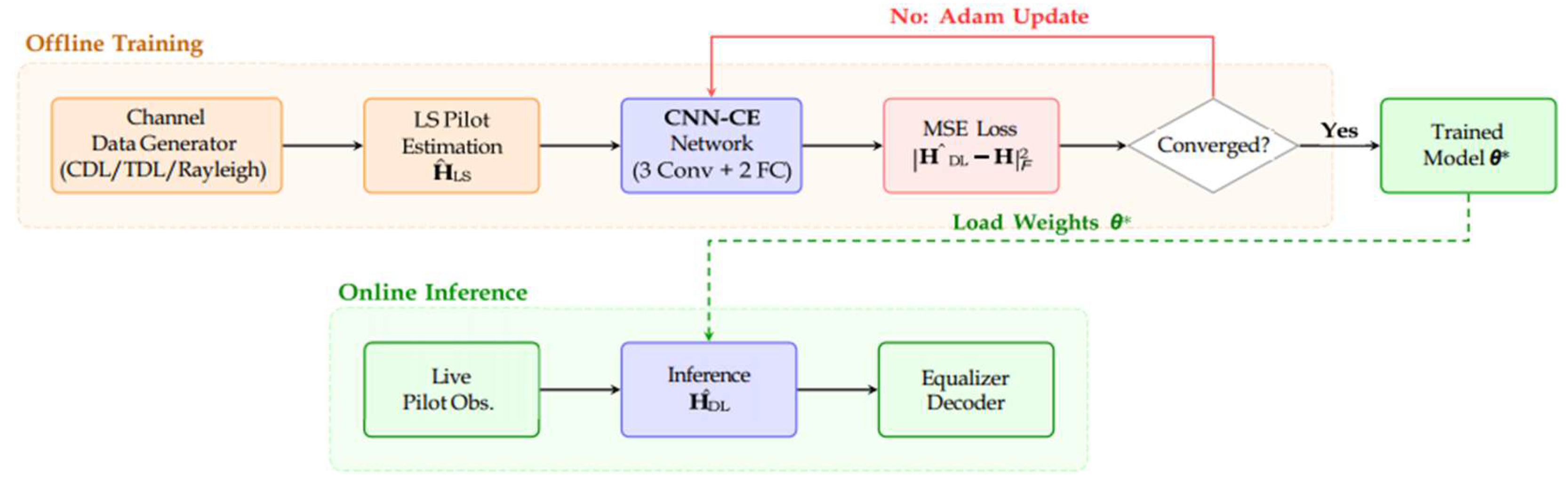
Figure 3.
CNN-CE architecture: three Conv+BN+ReLU blocks (64/128/256 filters, 3 × 3) followed by two FC layers (512, 256 units) regressing the 64 × 14 × 2 channel estimate.
Figure 3.
CNN-CE architecture: three Conv+BN+ReLU blocks (64/128/256 filters, 3 × 3) followed by two FC layers (512, 256 units) regressing the 64 × 14 × 2 channel estimate.
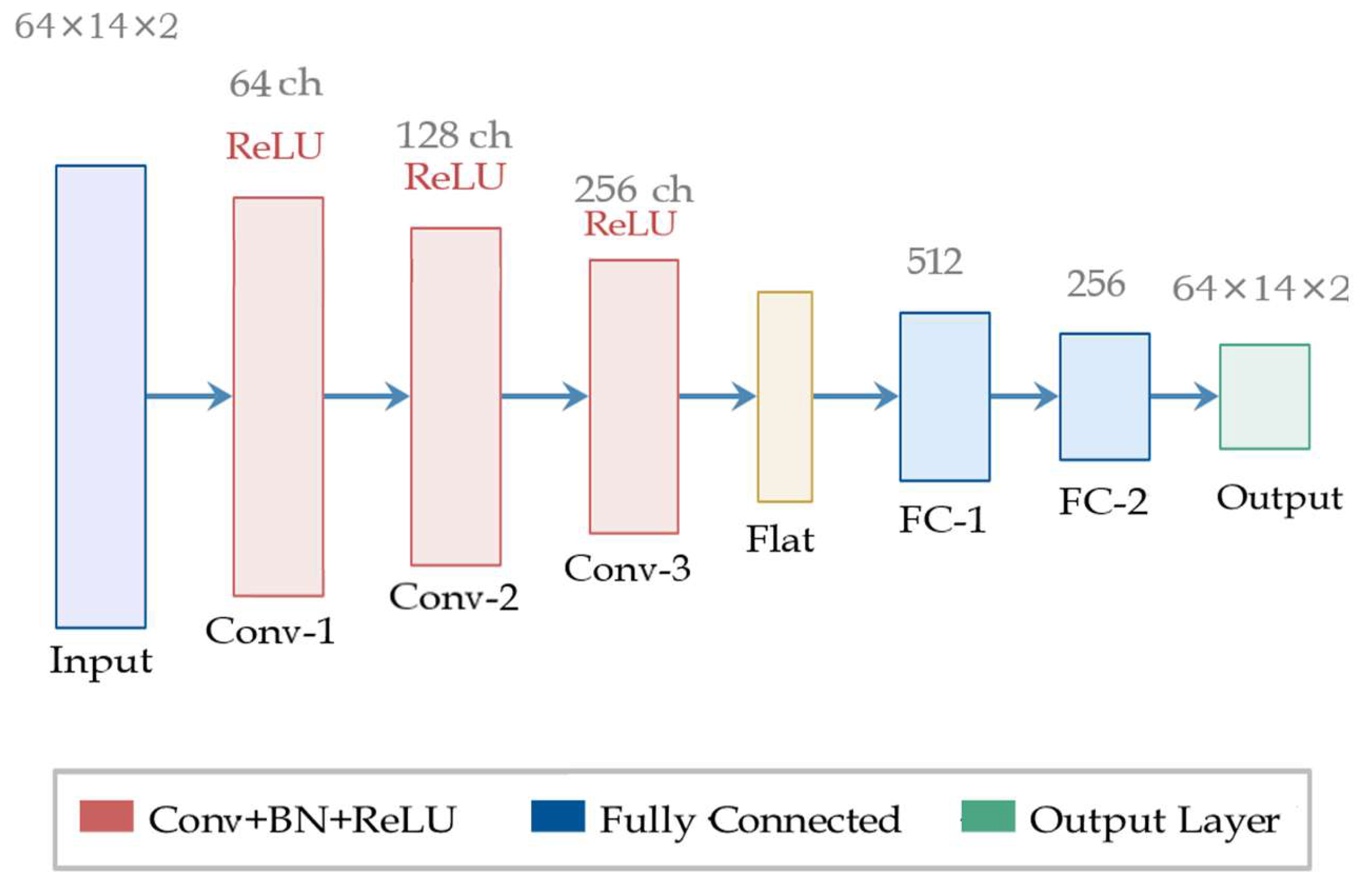
Figure 4.
BER vs. SNR on CDL-A (16-QAM). DL-CE outperforms SR-CNN by ≈0.5 dB and MMSE by >2 dB at BER= 10−3.
Figure 4.
BER vs. SNR on CDL-A (16-QAM). DL-CE outperforms SR-CNN by ≈0.5 dB and MMSE by >2 dB at BER= 10−3.
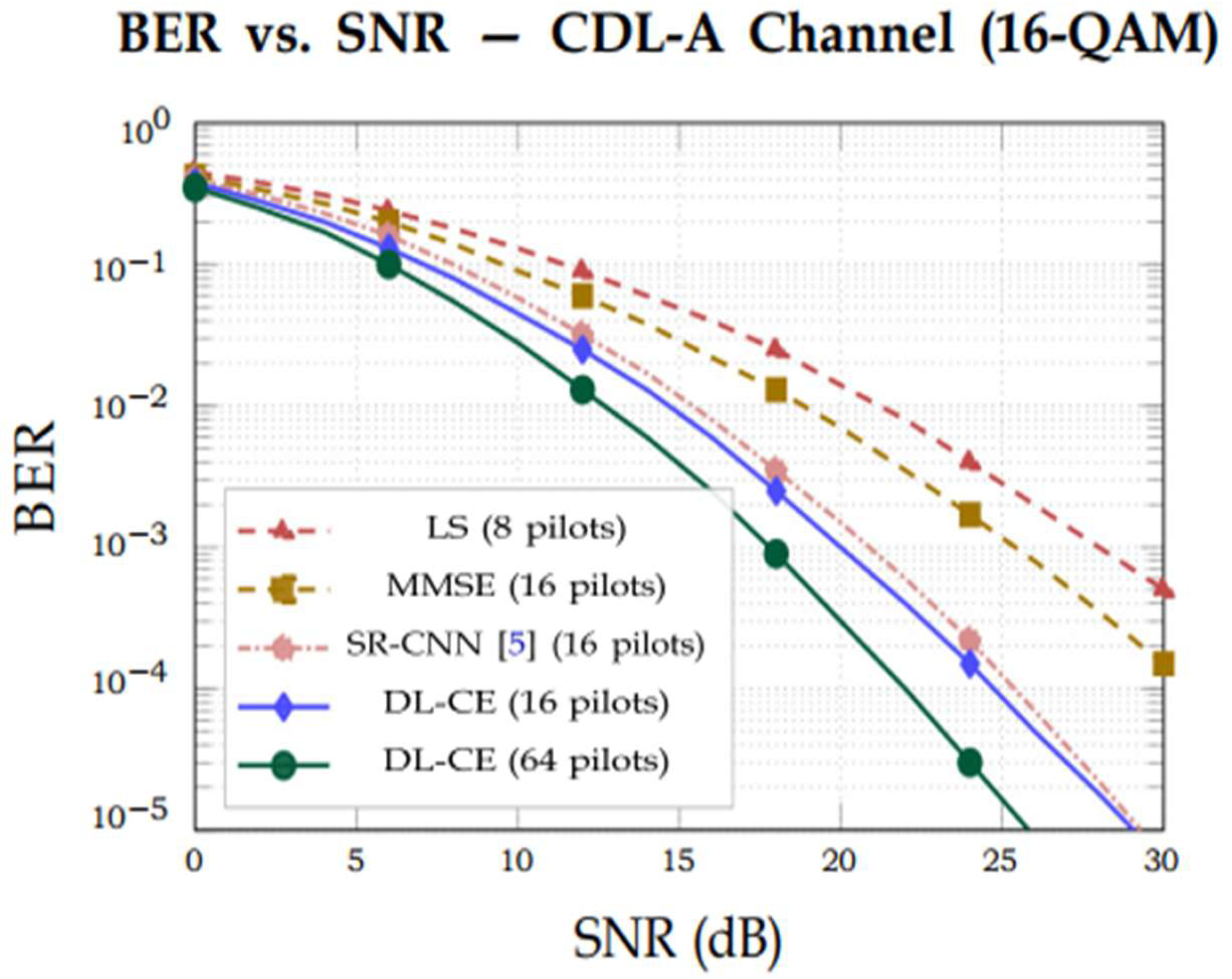
Figure 5.
BER under Rayleigh and Rician fading. The LOS component in Rician fading provides ≈2 dB additional SNR gain for DL-CE over the Rayleigh case, consistent with the higher median channel gain shown in Figure 11.
Figure 5.
BER under Rayleigh and Rician fading. The LOS component in Rician fading provides ≈2 dB additional SNR gain for DL-CE over the Rayleigh case, consistent with the higher median channel gain shown in Figure 11.
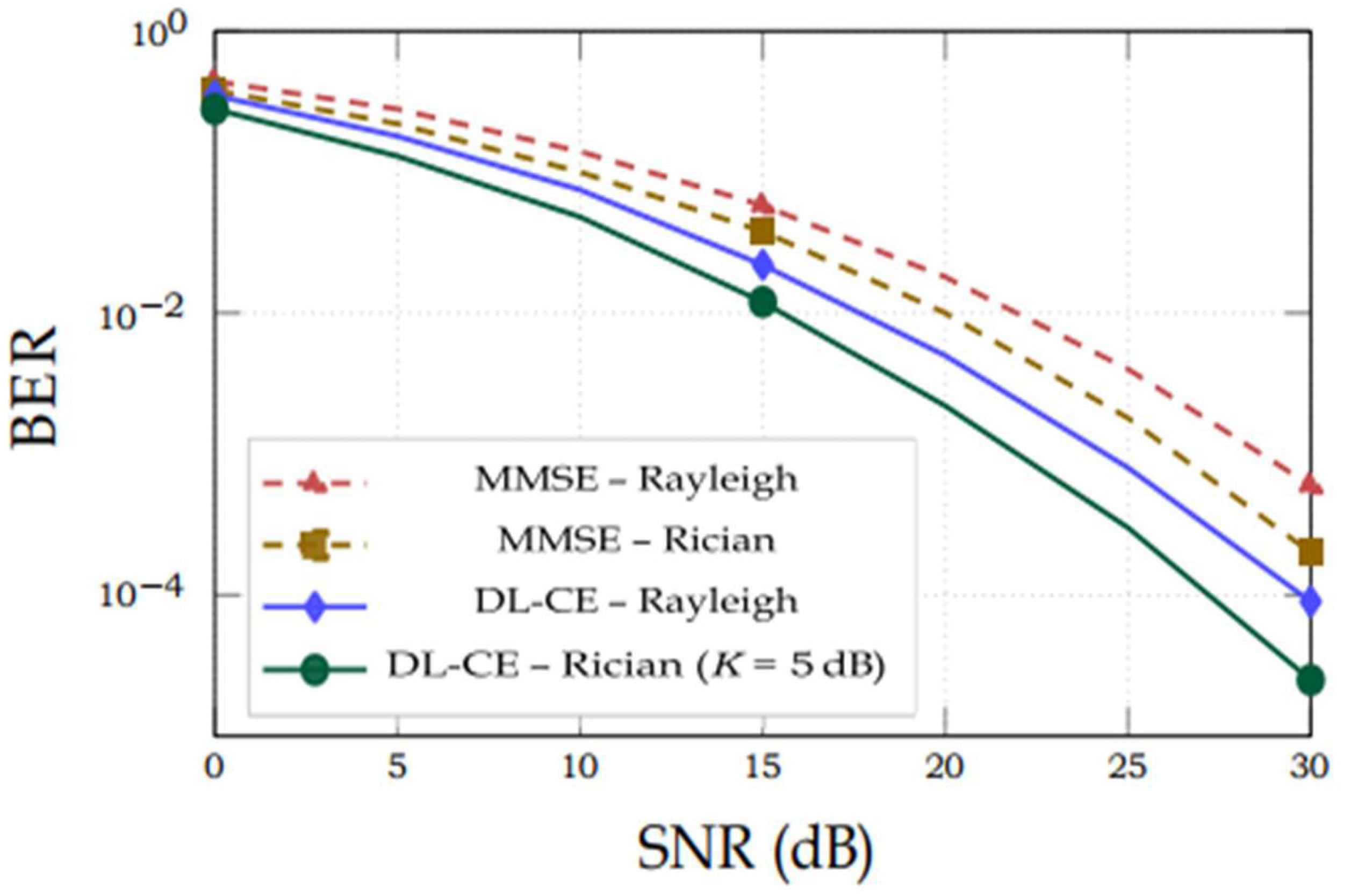
Figure 6.
NMSE vs. SNR. DL-CE outperforms LS and MMSE by 3–5 dB across the full SNR range. The lower high-SNR NMSE floor of DL-CE reflects bias-correction unavailable to linear estimators.
Figure 6.
NMSE vs. SNR. DL-CE outperforms LS and MMSE by 3–5 dB across the full SNR range. The lower high-SNR NMSE floor of DL-CE reflects bias-correction unavailable to linear estimators.
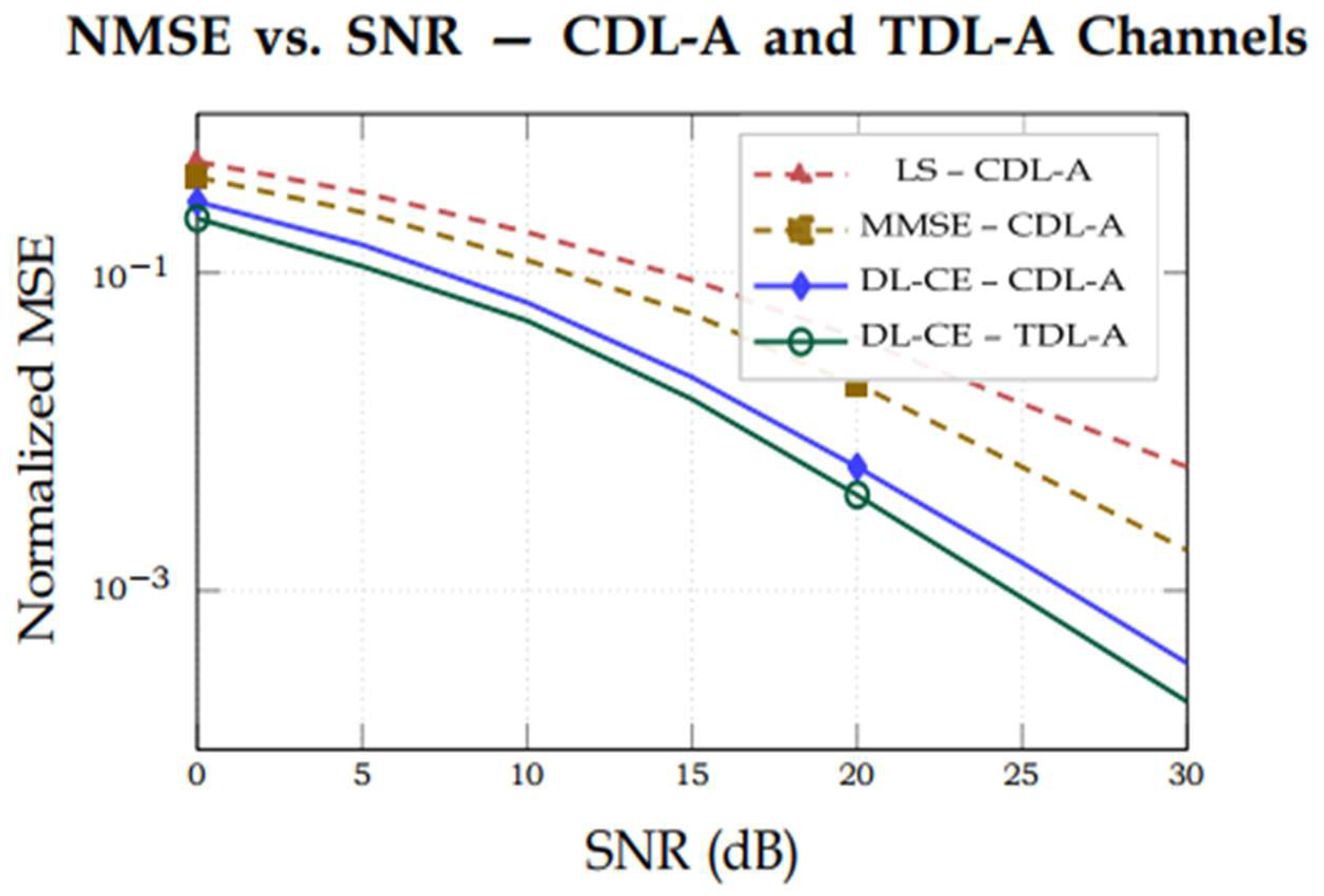
Figure 7.
Loss convergence over 50 epochs. Train- validation gap is negligible, indicating no overfitting.
Figure 7.
Loss convergence over 50 epochs. Train- validation gap is negligible, indicating no overfitting.
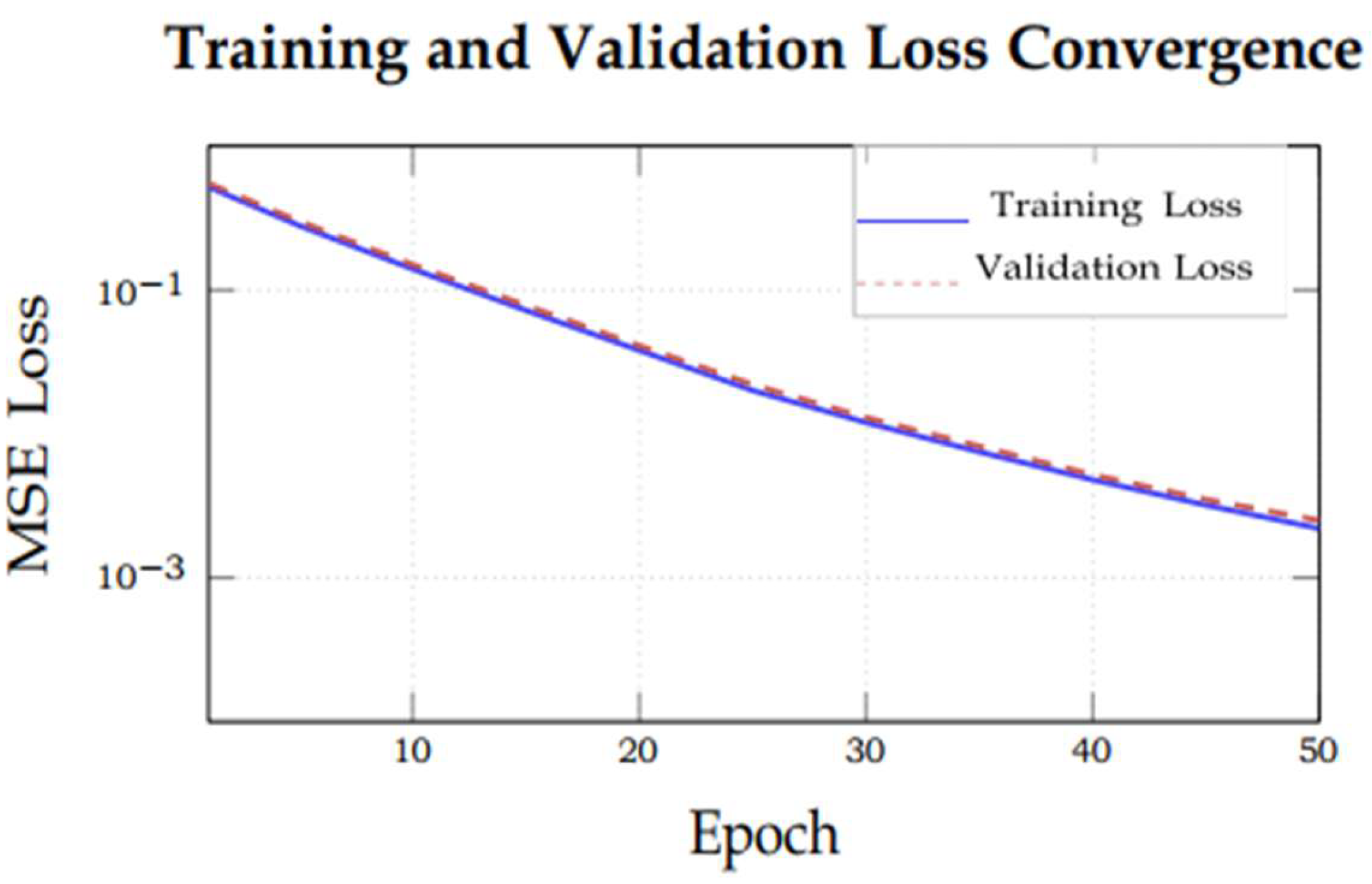
Figure 8.
BER under Doppler spread. DL-CE main- tains robust performance at vehicular and high-speed train scenarios, suitable for 5G V2X [4].
Figure 8.
BER under Doppler spread. DL-CE main- tains robust performance at vehicular and high-speed train scenarios, suitable for 5G V2X [4].
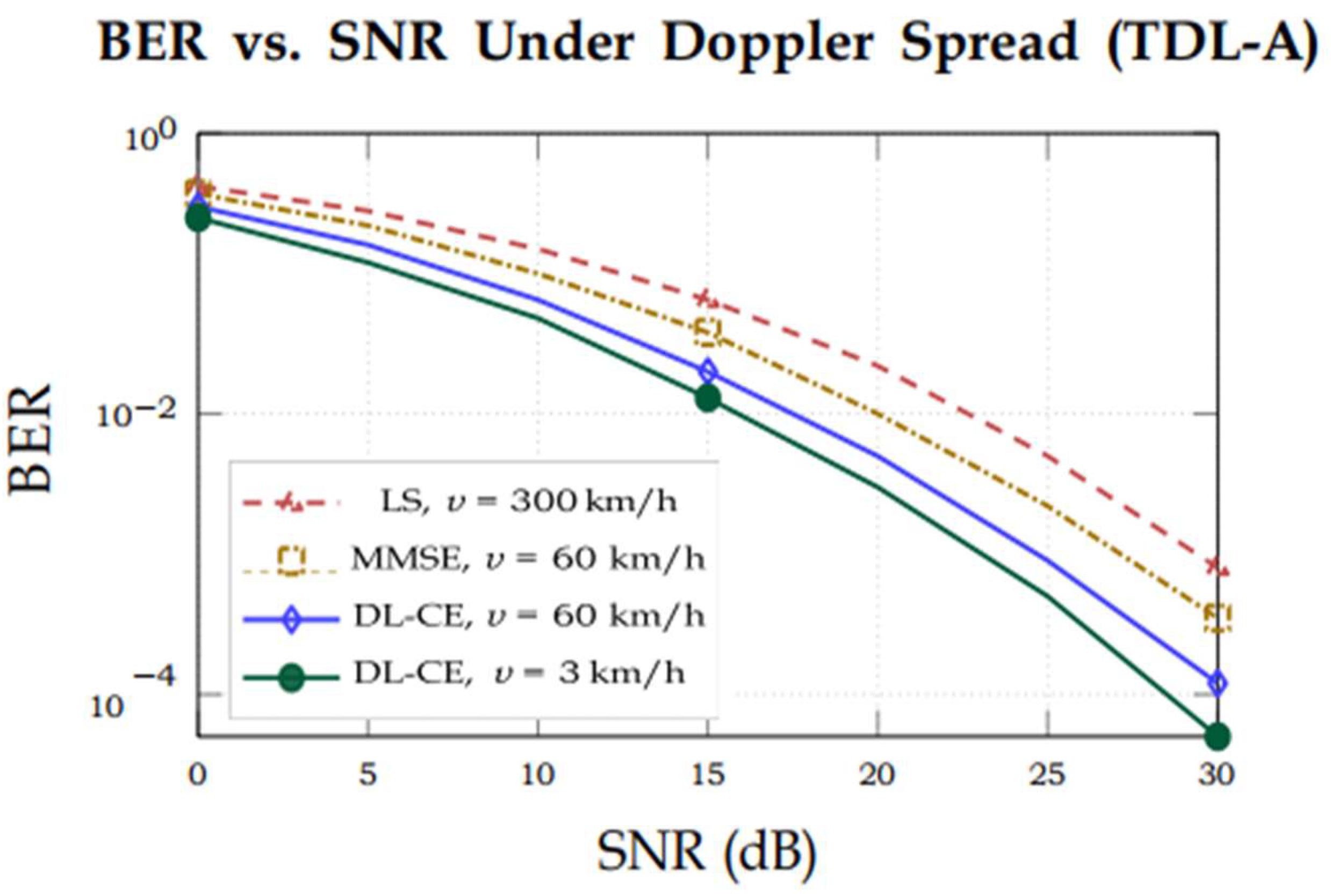
Figure 9.
NMSE vs. pilot density at SNR=20 dB. DL-CE with 8 pilots outperforms MMSE with 16 pilots, offering a 2× pilot reduction.
Figure 9.
NMSE vs. pilot density at SNR=20 dB. DL-CE with 8 pilots outperforms MMSE with 16 pilots, offering a 2× pilot reduction.
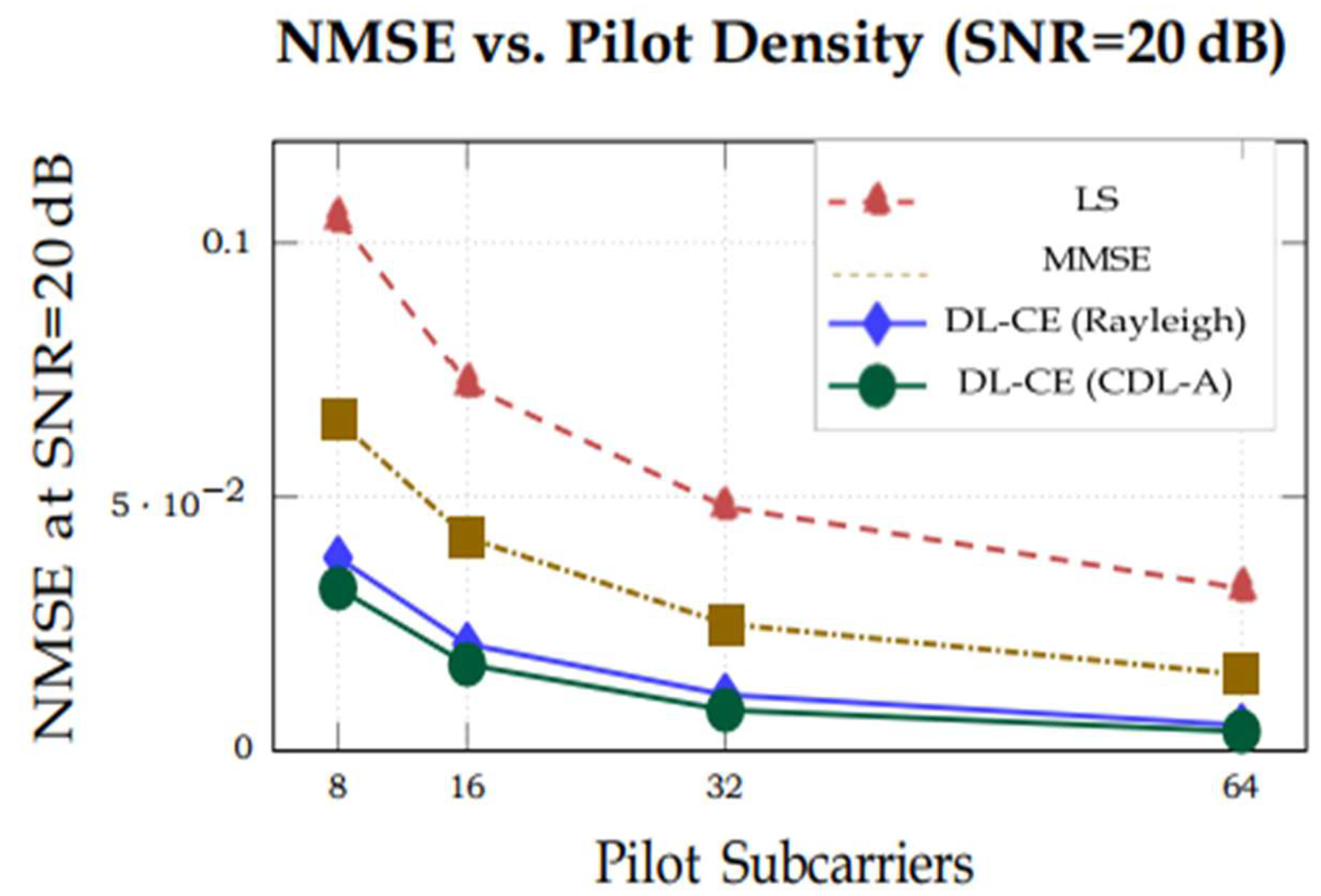
Figure 10.
Outage probability at γth = 3 bits/s/Hz. DL-CE reduces Pout by 3× vs. MMSE at 10 dB SNR; Rician fading provides an additional ≈2 dB gain over Rayleigh.
Figure 10.
Outage probability at γth = 3 bits/s/Hz. DL-CE reduces Pout by 3× vs. MMSE at 10 dB SNR; Rician fading provides an additional ≈2 dB gain over Rayleigh.
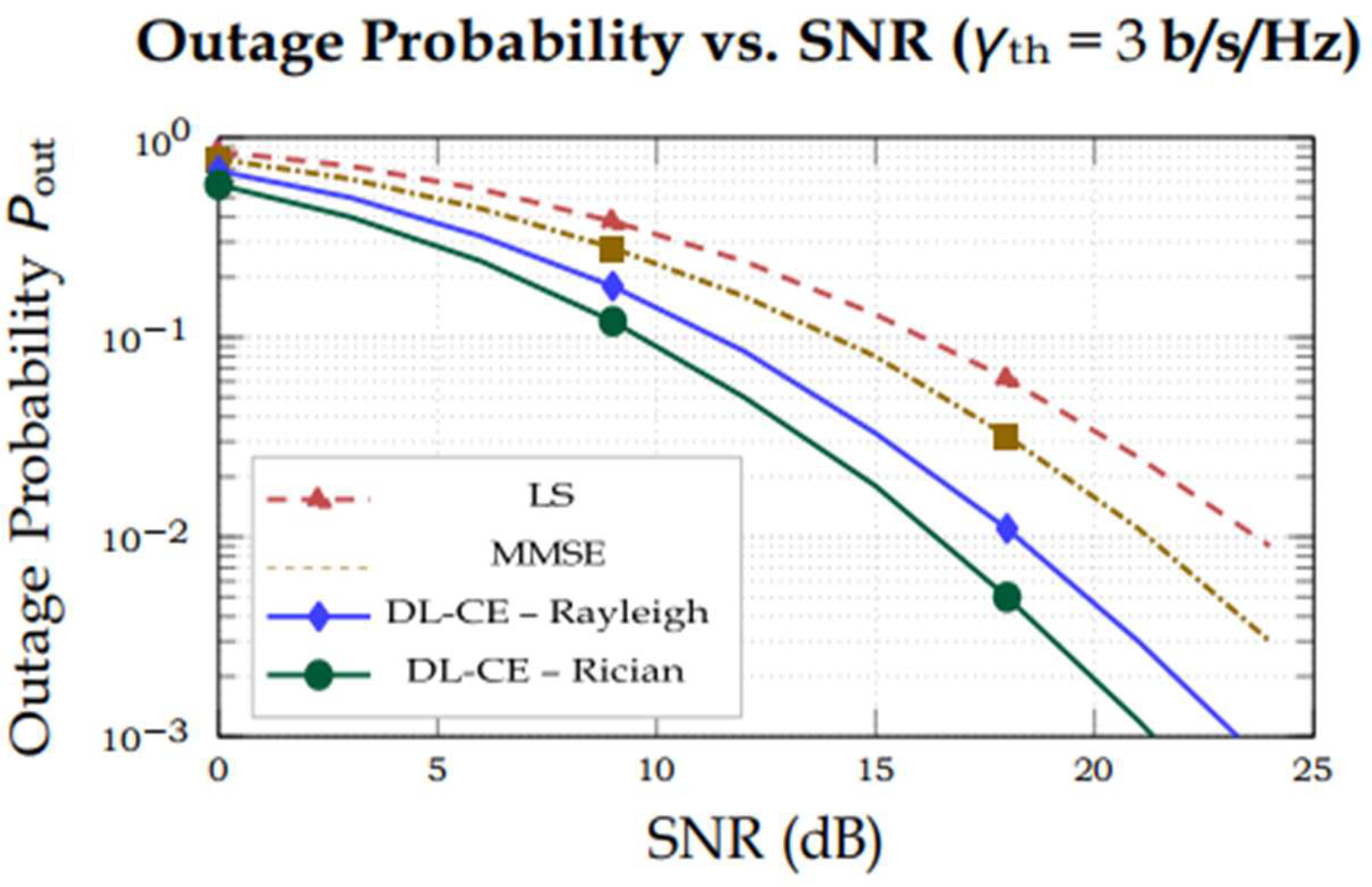
Figure 11.
Empirical CDF of channel gain. Rician fading exhibits higher median gain due to the LOS com- ponent, explaining the BER advantage seen in Figure 5.
Figure 11.
Empirical CDF of channel gain. Rician fading exhibits higher median gain due to the LOS com- ponent, explaining the BER advantage seen in Figure 5.
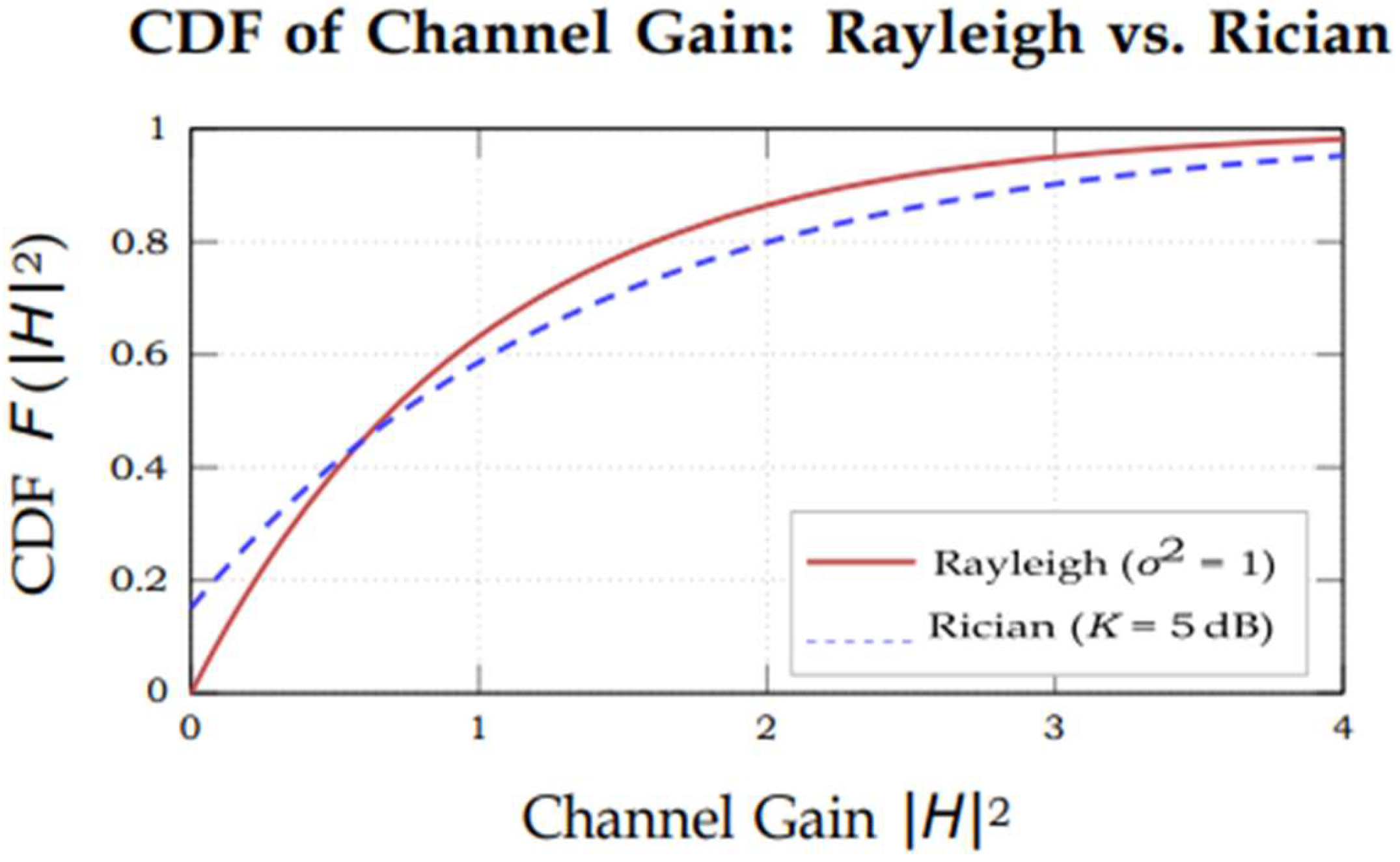
Figure 12.
Spectral efficiency vs. SNR. DL-CE is within 0.35 bits/s/Hz of the perfect-CSI bound at 20 dB SNR.
Figure 12.
Spectral efficiency vs. SNR. DL-CE is within 0.35 bits/s/Hz of the perfect-CSI bound at 20 dB SNR.
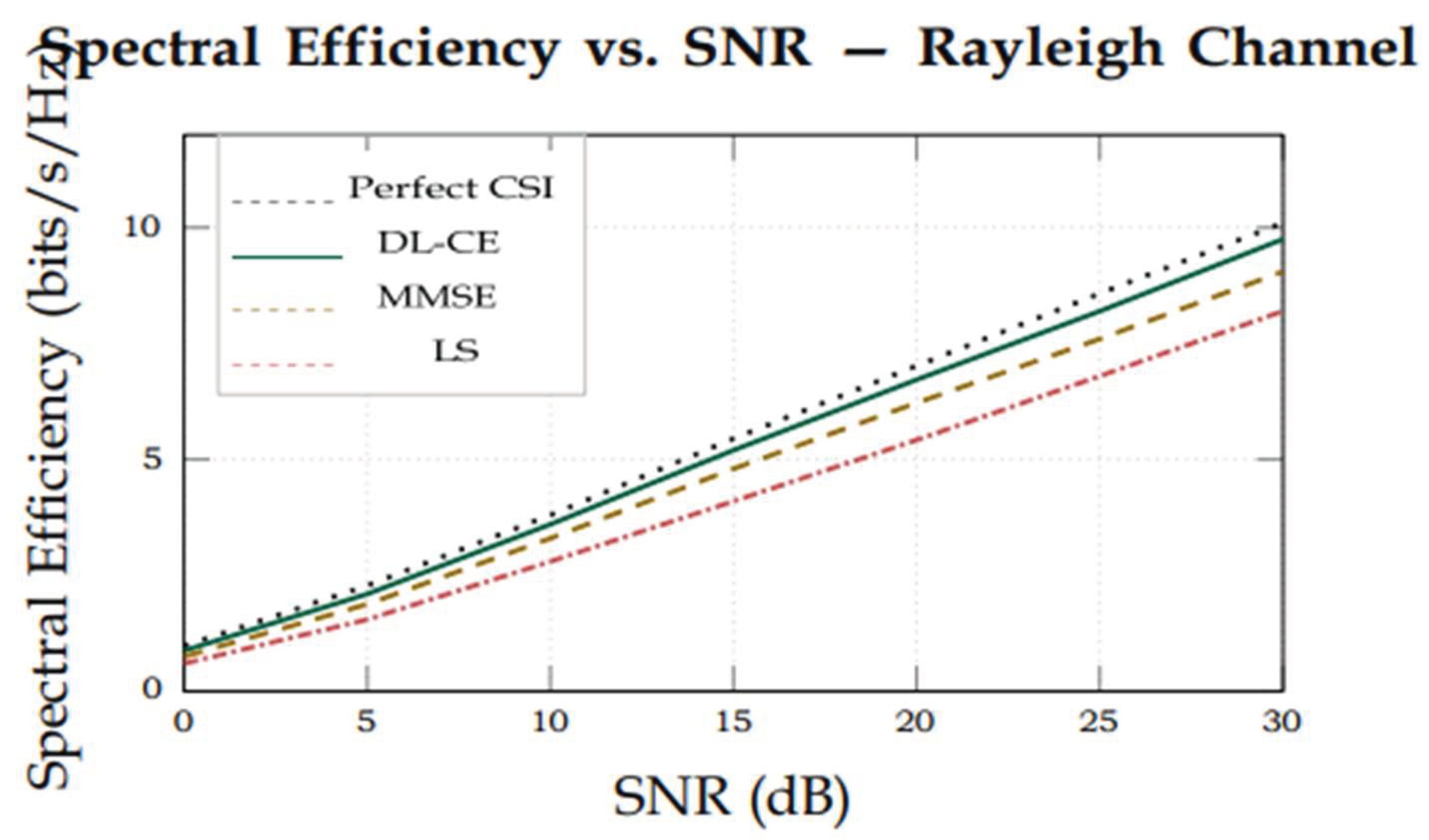

Table 1.
OFDM System and Channel Model Parameters.
| Parameter | Value |
| Subcarrier Spacing | 15 kHz |
| No. Subcarriers (Nsc ) | 64 |
| FFT Size | 64 |
| Cyclic Prefix Length | 16 samples |
| Modulation | QPSK / 16-QAM / 64-QAM |
| Channel Coding | Turbo (rate 1/3) |
| SNR Range | 0–30 dB |
| Carrier Frequency | 3.5 GHz |
| Channel Models | Rayleigh, Rician (K=5 dB), AWGN, CDL-A, CDL-B, TDL-A |
| Pilot Patterns | 8, 16, 32, 64 pilots/slot |
Table 2.
CNN-CE Architecture and Training Hyperparameters.
| Component | Description | Value |
| Architecture | Conv layers Filter size Filter counts FC layers Activation Normalization |
3 3 × 3 64, 128, 256 2 (512, 256) ReLU Batch Norm |
| I/O | Input / Output | 64 × 14 ×2 |
| Training | Optimizer Learning rate Batch / Epochs Samples Hardware |
Adam [9] 10−3 (decay 0.95) 64/50 105 (70/10/20%) NVIDIA RTX 3080 |
| Complexity | Parameters Inference FLOPs |
2.3 × 10⁶ 4.7 × 10⁸ |
Table 3.
Complexity vs. Performance at SNR=20 dB (CDL-A, 16-QAM).
| Estimator | FLOPs | Latency | BER | NMSE |
| LS | O(P ) | <0.01 ms | 1.4×10⁻² | 4.0×10⁻² |
| MMSE | O(P 3) | 0.05 ms | 7.0×10⁻³ | 2.0×10⁻² |
| SR-CNN [5] | ≈108 | 0.4 ms | 1.5×10⁻³ | 8.0×10⁻³ |
| DL-CE | 4.7×10⁸ | 0.8 ms | 1.0×10⁻³ | 6.0×10⁻³ |
Table 4.
Performance Summary at SNR=20 dB (CDL- A, 16-QAM, 32 Pilots).
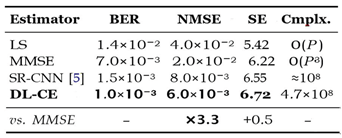 |
SE = Spectral Efficiency (b/s/Hz); Cmplx. = Complexity (FLOPs).
Disclaimer/Publisher’s Note: The statements, opinions and data contained in all publications are solely those of the individual author(s) and contributor(s) and not of MDPI and/or the editor(s). MDPI and/or the editor(s) disclaim responsibility for any injury to people or property resulting from any ideas, methods, instructions or products referred to in the content. |
© 2026 by the authors. Licensee MDPI, Basel, Switzerland. This article is an open access article distributed under the terms and conditions of the Creative Commons Attribution (CC BY) license (http://creativecommons.org/licenses/by/4.0/).
Copyright: This open access article is published under a Creative Commons CC BY 4.0 license, which permit the free download, distribution, and reuse, provided that the author and preprint are cited in any reuse.