

Submitted:
02 June 2026
Posted:
03 June 2026
You are already at the latest version
Abstract
Surgical resection remains a curative-intent treatment for hepatocellular carcinoma, but procedure-specific evidence for open minor hepatectomy using Takasaki’s Glissonean pedicle control remains limited. We retrospectively reviewed 74 consecutive patients with histologically confirmed hepatocellular carcinoma who underwent elective open minor hepatectomy, defined as resection of fewer than three Couinaud segments, using Takasaki-style Glissonean pedicle control at a Vietnamese hepatopancreatobiliary center between January 2021 and March 2024. Survival was estimated using the Kaplan–Meier method, and prognostic factors were explored using Cox regression. All patients had Child–Pugh class A liver function; 81.1% were hepatitis B surface antigen-positive and 87.8% had Barcelona Clinic Liver Cancer stage A disease. Median tumor diameter, operative time, and blood loss were 42 mm, 150 min, and 200 mL, respectively. R0 resection was achieved in 94.6%. Post-hepatectomy liver failure, major complications, and 90-day mortality occurred in 1.4%, 4.1%, and 1.4%, respectively. At a median follow-up of 39.6 months, 3-year overall and disease-free survival were 74.7% and 59.9%. This approach appears feasible and safe in selected Child–Pugh class A patients, with acceptable mid-term oncological outcomes.
Keywords:
hepatocellular carcinoma
; hepatectomy
; Glissonean pedicle
; Takasaki method
; treatment outcome
; survival analysis
1. Introduction
Hepatocellular carcinoma (HCC) caused an estimated 759,000 deaths globally in 2022, with the highest burden in East and Southeast Asia [1,2,3]. In Vietnam, liver cancer is the leading cause of cancer-related death in men, driven primarily by endemic chronic HBV infection [1,4]. Surgical resection remains the principal curative-intent treatment for patients with preserved liver function and resectable disease [2,5,6,7].
The oncological rationale for anatomical resection of HCC rests on the propensity of the tumor to disseminate through the portal venous system [8,9]. Takasaki’s Glissonean pedicle transection method translates this rationale into a reproducible operative strategy by selectively controlling the tumor-bearing secondary or tertiary Glissonean pedicle, thereby producing ischemic demarcation of the target portal territory while preserving perfusion of the future liver remnant [10,11]. Large institutional series have reported favorable perioperative and oncological outcomes after anatomical hepatectomy using Glissonean pedicle approaches and standardized hepatic resection in expert centers [12,13]. Although the Glissonean approach has been adopted in Vietnamese tertiary centers [14,15], evidence specific to open minor hepatectomy using Takasaki-style Glissonean pedicle control remains limited, particularly regarding recurrence and survival. We therefore evaluated perioperative outcomes, recurrence patterns, overall survival (OS), and disease-free survival (DFS) after this procedure in patients with HCC at a Vietnamese hepatopancreatobiliary center.
2. Materials and Methods
2.1. Study Design, Setting, and Patients
This was a retrospective, single-center cohort study of consecutive patients underwent open minor hepatectomy with Takasaki’s Glissonean pedicle control at the Hepato-Biliary and Pancreatic Surgery Department, 108 Military Central Hospital, Hanoi, Vietnam. The Institutional Review Board approved the study (protocol code: 3253/GCN-BV; approval date: 23 May 2025) and waived the requirement for written informed consent because of the retrospective design. The study was conducted in accordance with the Declaration of Helsinki [16] and reported with reference to the Strengthening the Reporting of Observational Studies in Epidemiology (STROBE) statement. Clinical, operative, laboratory, pathological, postoperative, and follow-up data were retrospectively extracted from institutional medical records, operative reports, pathology reports, laboratory records, and follow-up documentation.
All consecutive patients who underwent elective open liver resection with Takasaki’s Glissonean pedicle control between January 2021 and March 2024 were screened. Patients were eligible if they met the following criteria: (1) final histopathological diagnosis of HCC; (2) Child-Pugh class A liver function before surgery; (3) no radiological evidence of extrahepatic HCC spread before surgery; and (4) minor hepatectomy, defined as resection of fewer than 3 Couinaud liver segments. Patients with non-HCC final pathology or incomplete operative records were excluded. No emergency liver resections were included. Patient selection is summarized in Figure 1. Seventy-four patients constituted the analytic cohort.
2.2. Surgical Technique
Operations were performed by experienced hepatobiliary surgeons using a Takasaki-style Glissonean approach based on secondary or tertiary pedicle control [10,11,17]. After laparotomy, the target Glissonean pedicle was approached extrahepatically at the hepatic hilum when feasible, or intrahepatically during parenchymal transection for selected segmental or tertiary branches. Temporary clamping of the target pedicle was used to confirm the ischemic territory, and the demarcation line was marked with electrocautery. Parenchymal transection was performed using an ultrasonic surgical aspirator (CUSA Excel®, Integra LifeSciences, Princeton, NJ, USA) when appropriate. Depending on pedicle accessibility, the target pedicle was divided either before or, more commonly, after parenchymal transection. Selective Glissonean pedicle control was used as the primary inflow-control strategy.
2.3. Definitions and Outcomes
Preoperative liver function was assessed using the Child-Pugh classification and the Albumin-Bilirubin (ALBI) score [18,19]. Tumors were staged according to the Barcelona Clinic Liver Cancer (BCLC) 2022 system [7]. Resection extent was categorized according to the number of Couinaud liver segments removed. Minor hepatectomy was operationally defined as resection of fewer than 3 Couinaud liver segments. Procedure categories were defined by the anatomical territory resected and included segmentectomy, contiguous bisegmentectomy, right posterior sectionectomy (segments 6/7), right anterior sectionectomy (segments 5/8), and left lateral sectionectomy (segments 2/3). Post-hepatectomy liver failure (PHLF) was defined according to the International Study Group of Liver Surgery (ISGLS) concept of impaired coagulation and hyperbilirubinemia on or after postoperative day (POD) 5 [20]. Bile leak was defined by ISGLS criteria [21]; complications were graded using the Clavien-Dindo system [22], with major complications defined as grade III or higher. Margin-negative (R0) denoted the absence of tumor at the microscopic resection margin; microscopically positive (R1) margin denoted microscopic tumor involvement of the resection margin. Tumor differentiation was reported according to the Edmondson-Steiner system [23].
OS was measured from surgery to death from any cause. DFS was measured from surgery to first documented recurrence or death from any cause, whichever occurred first. Postoperative follow-up followed Vietnamese Ministry of Health guidance and institutional practice, with reassessment at 1 month, 3 mo, and every 3 mo thereafter using clinical examination, α-FP measurement, and imaging as indicated including ultrasonography, contrast-enhanced computed tomography, or magnetic resonance imaging when clinically indicated. Follow-up was censored on October 31, 2025. Median follow-up was estimated using the reverse Kaplan-Meier method [24].
2.4. Statistical Analysis
Continuous variables were summarized as mean ± SD or median (interquartile range [IQR]), and categorical variables as n (%). Group comparisons, when performed, used the Mann-Whitney U test or Fisher’s exact test. OS and DFS were estimated by the Kaplan-Meier method and compared using log-rank tests. Univariable Cox proportional hazards regression was used for exploratory prognostic analyses. An exploratory multivariable Cox model for DFS included R1 margin, BCLC stage B, and α-FP >400 ng/mL, corresponding to 9 events per variable. A multivariable model for OS was not constructed because of the limited number of deaths (n = 17). Two-sided P < 0.05 was considered statistically significant. All analyses were performed using IBM SPSS Statistics version 27.0 (IBM Corp., Armonk, NY, USA). Kaplan–Meier curves and postoperative laboratory trend plots were generated using jamovi version 2.7.30 for graphical presentation, based on the same analytic dataset.
3. Results
3.1. Baseline Characteristics
Baseline characteristics are summarized in Table 1. The cohort was predominantly male (65/74, 87.8%), with a median age of 59 years (IQR, 50–64). HBsAg was positive in 60 patients (81.1%). All patients had Child-Pugh class A liver function, and 58 (78.4%) were ALBI grade 1. The median preoperative α-FP level was 8.3 ng/mL (IQR, 2.8–55.6), with α-FP >400 ng/mL in 10 patients (13.5%). The median tumor diameter was 42 mm (IQR, 32–58); 24 patients (32.4%) had a solitary tumor >5 cm, and 9 (12.2%) had multifocal disease. Most patients were BCLC stage A (65/74, 87.8%).
3.2. Operative Findings and Immediate Outcomes
Operative characteristics and perioperative outcomes are summarized in Table 2. Right posterior sectionectomy was the most common procedure (31/74, 41.9%). Intraoperative cirrhotic morphology was observed in 44 patients (59.5%). Median operative time, parenchymal transection time, and blood loss were 150 minutes, 35 minutes, and 200 mL, respectively, and only 1 patient (1.4%) required intraoperative blood transfusion. Intraoperative complications occurred in 3 patients (4.1%): bile duct injury, hepatic vein injury, and diaphragmatic perforation. All were recognized and managed during the index operation, without apparent postoperative sequelae attributable to these events.
3.3. Postoperative Outcomes
Postoperative laboratory trends are shown in Figure 2. Aminotransferases peaked on postoperative day (POD) 1 and declined substantially by POD 5; total bilirubin peaked on POD 3, and prothrombin activity reached its nadir on POD 1 before improving by POD 5. PHLF occurred in 1 patient (1.4%) and was classified as grade C. This patient had undergone concomitant right nephroureterectomy, was discharged at family request on POD 10, and died after discharge on POD 12. Overall postoperative complications within 30 days occurred in 18 patients (24.3%), and major complications occurred in 3 patients (4.1%). Major complications included grade C PHLF, postoperative intra-abdominal hemorrhage requiring reoperation, and bile leak requiring percutaneous drainage. Pleural effusion managed conservatively was the most frequent individual complication (14/74, 18.9%). Other complications included ascites (3/74, 4.1%), surgical-site infection (2/74, 2.7%), and intra-abdominal abscess (3/74, 4.1%) (Table S1). There was no in-hospital mortality, and 90-day mortality was 1.4% (1/74). The median hospital stay was 8 days (IQR, 7–9; range, 4–19).
3.4. Pathology and Recurrence
Pathological findings, recurrence patterns, and follow-up are summarized in Table 3. R0 resection was achieved in 70 patients (94.6%), whereas 4 patients (5.4%) had microscopic R1 margins. Tumor differentiation was moderate in 62 patients (83.8%) and poor in 12 patients (16.2%). During follow-up, 26 patients (35.1%) developed documented recurrence. Recurrence was intrahepatic only in 19 patients (73.1% of recurrent cases), extrahepatic only in 6 patients (23.1%), and both intrahepatic and extrahepatic in 1 patient (3.8%). There were 27 DFS events, comprising 26 documented recurrences and 1 death from PHLF before recurrence could be assessed. Thirteen DFS events occurred within 12 months after surgery (48.1%). Patients with early DFS events had numerically higher preoperative α-FP than those with later events, but the difference was not statistically significant (110.8 ng/mL vs. 17.1 ng/mL; P = 0.198). Seventeen patients (23.0%) died from any cause, and 7 patients (9.5%) were lost to follow-up after discharge. Median follow-up estimated by the reverse Kaplan–Meier method was 39.6 months; median observation time among survivors was 38.3 months (range, 0.2–57.8).
3.5. Survival and Prognostic Analyses
Median follow-up estimated by the reverse Kaplan–Meier method was 39.6 months; median observation time among survivors was 38.3 months (range, 0.2–57.8). Seventeen patients (23.0%) died from any cause, including 1 postoperative death after grade C PHLF. The estimated 1-, 2-, and 3-year OS rates were 89.6%, 82.0%, and 74.7%, respectively (Figure 3a); corresponding DFS rates were 80.6%, 63.7%, and 59.9% (Figure 3b). Median OS and DFS were not reached. Exploratory margin-stratified Kaplan–Meier curves showed lower OS and DFS in patients with R1 margins than in those with R0 margins (Figure 4; log-rank P = 0.003 and P = 0.019, respectively). In the small BCLC stage B subgroup (n = 9), the 3-year OS rate was lower than that in BCLC stage A patients (46.9% vs. 78.6%; log-rank P = 0.005), whereas DFS did not differ significantly between BCLC stage B and A patients (3-year DFS, 50.0% vs. 61.4%; log-rank P = 0.168) (Figure 5). Exploratory Cox regression results are presented in Table 4, with Kaplan–Meier estimates for selected subgroups provided in Table S2.
4. Discussion
In this selected Vietnamese cohort with predominantly HBV-related HCC, open minor hepatectomy using Takasaki’s Glissonean pedicle control was feasible and associated with low major morbidity, no in-hospital mortality, and acceptable mid-term survival. These findings should not be interpreted as evidence of superiority over non-anatomical, laparoscopic, or robotic approaches, because the study was retrospective and had no comparator group. Rather, the study provides procedure-specific evidence that an anatomy-based, parenchymal-sparing open approach can be delivered safely in carefully selected Child-Pugh class A patients. This is clinically relevant in a HBV-endemic setting, where many patients have underlying chronic liver disease and where preservation of functional liver parenchyma remains central to safe hepatectomy.
The study adds to, rather than replaces, the existing Vietnamese literature on Glissonean-based hepatectomy. Previous Vietnamese reports have described combined extrahepatic Takasaki and intrahepatic Ton That Tung pedicle approaches, right anatomical hepatectomy using an extrahepatic Glissonean approach with liver hanging, and Glissonean pedicle approaches combined with different parenchymal transection techniques [14,15,25]. The narrower contribution of the present series is its focus on open minor hepatectomy using Takasaki-style extrafascial Glissonean pedicle control as the primary inflow-control strategy, with integrated reporting of perioperative outcomes, recurrence pattern, and Kaplan-Meier OS and DFS. This focus is important because minor anatomical resection is frequently required in patients with limited hepatic reserve, where oncological clearance and parenchymal preservation must be balanced within the same operation.
The technical value of Takasaki’s method lies in linking oncological anatomy to operative control. HCC may spread microscopically along portal venous branches, which provides the biological rationale for anatomical removal of the tumor-bearing portal territory [8,9,26]. Takasaki’s Glissonean approach translates this principle into a reproducible operative step: selective clamping of the corresponding secondary or tertiary Glissonean pedicle produces an ischemic demarcation that guides the intended transection plane [10,11]. In the present cohort, early postoperative biochemical changes were consistent with recovery after minor hepatectomy, and the low bile leak rate supports the technical safety of selective pedicle control when performed by experienced hepatobiliary surgeons.
A practical feature of this cohort was that right posterior sectionectomy was the most common procedure. Resection of segments 6/7 is technically demanding because of the deep location, limited exposure, and proximity to the right hepatic vein. The Morioka consensus recognized posterosuperior segments as among the most difficult locations for minimally invasive liver resection [27]. In this context, hilum-based Glissonean control may be useful because it defines the posterior sector by its inflow territory before or during parenchymal transection, rather than relying solely on surface anatomy. Our data do not argue against minimally invasive surgery; instead, they support the continuing role of a technically sound open anatomical approach for selected posterosuperior tumors, particularly in centers where minimally invasive posterior sectionectomy is not yet routine.
The perioperative outcomes were acceptable when interpreted in the context of a highly selected cohort. Large Glissonean series have reported favorable outcomes, but they include different mixtures of major and minor hepatectomies, tumor burden, and liver function [12,13]. In the present study, all patients were Child-Pugh class A and all resections were minor, which likely contributed to the low rates of PHLF and major complications. The only PHLF event occurred in a patient who underwent concomitant right nephroureterectomy and died after discharge on POD 12. This should be viewed as an important clinical detail rather than as evidence that combined surgery is generally unsafe; nevertheless, it highlights the additional physiological burden of synchronous extrahepatic surgery in patients undergoing hepatectomy.
The mid-term oncological outcomes were within an acceptable range for a cohort with predominantly HBV-related HCC. The 3-year OS and DFS rates were 74.7% and 59.9%, respectively. Recurrence remained predominantly intrahepatic, emphasizing that anatomical hepatectomy alone cannot eliminate the long-term risk created by tumor biology and the diseased liver remnant. In an HBV-endemic setting, this finding also reinforces that surgical clearance should be integrated with structured surveillance and antiviral management when indicated [2,5,28]. HBV DNA levels, antiviral adherence, and post-recurrence treatment were not recorded in a standardized manner and could not be analyzed in this study. The association between R1 margin and inferior survival is clinically important but should be interpreted cautiously. Only 4 patients had R1 margins, and exact margin width, microvascular invasion, and satellite nodules were not consistently available. Prior studies support the prognostic relevance of margin status and margin width after HCC resection [29,30,31], but in cirrhotic liver, a wider margin cannot be pursued indiscriminately. The practical implication is not simply to pursue wider resection in every patient, but to improve preoperative planning, use intraoperative ultrasonography when available, define the Glissonean territory and transection plane carefully, and standardize pathological reporting of margin width and microvascular invasion.
Two additional findings may guide postoperative management. First, nearly half of DFS events occurred within 12 months, and preoperative α-FP was numerically higher among patients with early events. Although this difference was not statistically significant, it is consistent with the concept that early recurrence is often driven by tumor factors present at the time of surgery, whereas late recurrence may reflect de novo carcinogenesis in the remnant liver [32].
The BCLC stage B finding should be interpreted in a regional and surgical context. In this cohort, BCLC stage B was associated with worse OS but not DFS, suggesting that intermediate-stage tumor burden may still influence survival after resection. BCLC-based algorithms have traditionally allocated intermediate-stage HCC primarily to transarterial therapy, whereas several Asian guideline systems place greater emphasis on technical resectability, liver reserve, and multidisciplinary selection [33]. The 2022 BCLC update also recognizes heterogeneity within BCLC stage B and permits treatment stage migration in selected patients [7], and recent expert recommendations emphasize individualized assessment for resectable disease with preserved liver function [6]. Vietnamese Ministry of Health guidance similarly allows hepatectomy to be considered according to resectability, liver function, and disease extent [34]. Because only 9 patients in this study were BCLC stage B, our findings should be viewed as descriptive: they support careful selection and structured postoperative surveillance, not broad expansion of surgical indications or evidence of superiority over transarterial therapy.
This study has limitations. Its retrospective single-center design introduces selection and information bias, and the inclusion of only Child-Pugh class A patients limits generalizability to patients with more advanced liver dysfunction. The sample size and number of survival events were small; therefore, the Cox analyses were exploratory. Exact margin width, microvascular invasion, and satellite nodules were not consistently recorded, limiting interpretation of the R1 association. Seven patients were lost to follow-up after discharge, and informative censoring cannot be excluded. Finally, because this study focused on open minor hepatectomy, the findings are best interpreted as procedure-specific outcomes for this selected setting rather than as comparative evidence against major hepatectomy, non-anatomical resection, minimally invasive approaches, or other inflow-control strategies.
5. Conclusions
In conclusion, open minor hepatectomy with Takasaki’s Glissonean pedicle control appeared feasible and was associated with low major morbidity and acceptable mid-term oncological outcomes in this selected Vietnamese Child-Pugh class A cohort. The main value of this study is to provide procedure-specific evidence for an open, anatomy-based minor hepatectomy approach in a HBV-endemic setting, including technically demanding right posterior sectionectomy. The observed association between R1 margin and survival is hypothesis-generating and supports prospective standardization of margin planning and pathological reporting. Future multicenter studies should determine which patients benefit most from Takasaki-style minor hepatectomy.
Supplementary Materials
The following supporting information can be downloaded at: Preprints.org, Table S1: Detailed intraoperative and postoperative complications (n = 74); Table S2: Kaplan-Meier survival estimates by overall cohort and selected subgroups; Table S3: Full exploratory Cox proportional hazards analyses for DFS and OS.
Author Contributions
All authors contributed to the conceptualization and methodology of the study. Investigation, H.N.A.N., V.L.H. and T.T.T.N.; resources, V.T.L., V.Q.V. and H.N.A.N.; data curation, T.T.T.N. and H.N.A.N.; formal analysis, T.T.T.N.; software, T.T.T.N.; validation, V.Q.V., H.N.A.N. and V.T.L.; visualization, T.T.T.N. and V.L.H.; writing—original draft preparation, V.Q.V., H.N.A.N. and T.T.T.N.; writing—review and editing, all authors; supervision, V.Q.V. and H.N.A.N.; project administration, V.Q.V. and H.N.A.N. All authors have read and agreed to the published version of the manuscript.
Funding
This research received no external funding.
Institutional Review Board Statement
The study was conducted in accordance with the Declaration of Helsinki and was approved by the Biomedical Research Ethics Committee of 108 Military Central Hospital (protocol code: 3253/GCN-BV; approval date: 23 May 2025).
Informed Consent Statement
Patient consent was waived due to the retrospective nature of the study and the use of anonymized clinical data.
Data Availability Statement
The data presented in this study are available from the corresponding author upon reasonable request and with permission from the relevant institutional authority. The data are not publicly available because they contain patient-level clinical information and are subject to privacy and ethical restrictions.
Acknowledgments
The authors thank the staff of the Hepato-Biliary and Pancreatic Surgery Department and the medical records team at 108 Military Central Hospital for their administrative and technical support during data retrieval. During the preparation of this manuscript, the authors used ChatGPT (OpenAI, GPT-5.5 Thinking) to assist with manuscript structuring, language editing, grammar, and formatting. The authors reviewed and edited the output and take full responsibility for the content of this publication.
Conflicts of Interest
The authors declare no conflicts of interest.
Abbreviations
The following abbreviations are used in this manuscript:
| AJCC | American Joint Committee on Cancer |
| ALBI | albumin–bilirubin |
| BCLC | Barcelona Clinic Liver Cancer |
| CI | confidence interval |
| CUSA | Cavitron Ultrasonic Surgical Aspirator |
| DFS | disease-free survival |
| HBV | hepatitis B virus |
| HBsAg | hepatitis B surface antigen |
| HCC | hepatocellular carcinoma |
| HR | hazard ratio |
| IQR | interquartile range |
| ISGLS | International Study Group of Liver Surgery |
| OS | overall survival |
| PHLF | post-hepatectomy liver failure |
| POD | postoperative day |
| R0 | microscopically negative resection margin |
| R1 | microscopically positive resection margin |
| STROBE | Strengthening the Reporting of Observational Studies in Epidemiology |
| TNM | tumor–node–metastasis |
| α-FP | alpha-fetoprotein |
References
- Bray, F.; Laversanne, M.; Sung, H.; Ferlay, J.; Siegel, R.L.; Soerjomataram, I.; Jemal, A. Global cancer statistics 2022: GLOBOCAN estimates of incidence and mortality worldwide for 36 cancers in 185 countries. CA Cancer J. Clin. 2024, 74, 229–263. [Google Scholar] [CrossRef] [PubMed]
- Singal, A.G.; Llovet, J.M.; Yarchoan, M.; Mehta, N.; Heimbach, J.K.; Dawson, L.A.; Jou, J.H.; Kulik, L.M.; Agopian, V.G.; Marrero, J.A.; et al. AASLD Practice Guidance on prevention, diagnosis, and treatment of hepatocellular carcinoma. Hepatology 2023, 78, 1922–1965. [Google Scholar] [CrossRef] [PubMed]
- Zhang, C.H.; Cheng, Y.; Zhang, S.; Fan, J.; Gao, Q. Changing epidemiology of hepatocellular carcinoma in Asia. Liver Int. 2022, 42, 2029–2041. [Google Scholar] [CrossRef]
- Nguyen-Dinh, S.H.; Do, A.; Pham, T.N.D.; Dao, D.Y.; Nguy, T.N.; Chen, M.S., Jr. High burden of hepatocellular carcinoma and viral hepatitis in Southern and Central Vietnam: Experience of a large tertiary referral center, 2010 to 2016. World J. Hepatol. 2018, 10, 116–123. [Google Scholar] [CrossRef]
- European Association for the Study of the Liver; Sangro, B.; Argemi, J.; Ronot, M.; Paradis, V.; Meyer, T.; Mazzaferro, V.; Jepsen, P.; Golfieri, R.; Galle, P.; et al. EASL Clinical Practice Guidelines on the management of hepatocellular carcinoma. J. Hepatol. 2025, 82, 315–374. [Google Scholar] [CrossRef]
- Park, M.S.; Cho, J.Y.; Kim, E.; Na, H.Y.; Choi, Y.; Ki, N.R.; Yoon, Y.I.; Lee, B.; Jang, E.S.; Jung, Y.K.; et al. Surgical treatment of hepatocellular carcinoma: an expert consensus-based practical recommendation from the Korean Liver Cancer Association. Ann. Surg. Treat. Res. 2025, 109, 123–143. [Google Scholar] [CrossRef]
- Reig, M.; Forner, A.; Rimola, J.; Ferrer-Fabrega, J.; Burrel, M.; Garcia-Criado, A.; Kelley, R.K.; Galle, P.R.; Mazzaferro, V.; Salem, R.; et al. BCLC strategy for prognosis prediction and treatment recommendation: The 2022 update. J. Hepatol. 2022, 76, 681–693. [Google Scholar] [CrossRef]
- Hasegawa, K.; Kokudo, N.; Imamura, H.; Matsuyama, Y.; Aoki, T.; Minagawa, M.; Sano, K.; Sugawara, Y.; Takayama, T.; Makuuchi, M. Prognostic impact of anatomic resection for hepatocellular carcinoma. Ann. Surg. 2005, 242, 252–259. [Google Scholar] [CrossRef]
- Llovet, J.M.; Kelley, R.K.; Villanueva, A.; Singal, A.G.; Pikarsky, E.; Roayaie, S.; Lencioni, R.; Koike, K.; Zucman-Rossi, J.; Finn, R.S. Hepatocellular carcinoma. Nat. Rev. Dis. Prim. 2021, 7, 6. [Google Scholar] [CrossRef]
- Takasaki, K. Glissonean pedicle transection method for hepatic resection: a new concept of liver segmentation. J. Hepatobiliary Pancreat. Surg. 1998, 5, 286–291. [Google Scholar] [CrossRef] [PubMed]
- Takasaki, K. Glissonean Pedicle Transection Method for Hepatic Resection; Springer Tokyo, 2007. [Google Scholar]
- Ariizumi, S.I.; Katagiri, S.; Kotera, Y.; Yamashita, S.; Omori, A.; Kato, T.; Shibuya, G.; Egawa, H.; Takasaki, K.; Yamamoto, M. Improved Mortality, Morbidity, and Long-Term Outcome After Anatomical Hepatectomy With the Glissonean Pedicle Approach in Patients With Hepatocellular Carcinoma: 30 Years’ Experience at a Single Institute. Ann. Surg. 2022, 275, 947–954. [Google Scholar] [CrossRef]
- Imamura, H.; Seyama, Y.; Kokudo, N.; Maema, A.; Sugawara, Y.; Sano, K.; Takayama, T.; Makuuchi, M. One thousand fifty-six hepatectomies without mortality in 8 years. Arch. Surg. 2003, 138, 1198–1206; discussion 1206. [Google Scholar] [CrossRef]
- Nguyen, T.H.; Ha, Q.V.; Nguyen, H.V.; Pham, D.V.; Pham, T.V.; Le, T.V.; Le, X.A.; Dang, A.Q. Survival outcomes of the combination of extrafascial extrahepatic and extrafascial intrahepatic pedicle approaches in hepatectomy for hepatocellular carcinoma. Clin. Exp. Hepatol. 2022, 8, 147–152. [Google Scholar] [CrossRef]
- Pham, A.T.; Truong, C.M.; Trinh, P.H.; Thi Nguyen, C.; Pham, M.H.; Dang, Q.H. Right anatomical hepatectomy using extrahepatic glissonean pedicle approach combined liver hanging for hepatocellular carcinoma: surgical approach in a developing country. Ann. Med. Surg. (Lond) 2024, 86, 3724–3729. [Google Scholar] [CrossRef]
- World Medical Association. World Medical Association Declaration of Helsinki: Ethical Principles for Medical Research Involving Human Participants. JAMA 2025, 333, 71–74. [Google Scholar] [CrossRef] [PubMed]
- Sugioka, A.; Kato, Y.; Tanahashi, Y. Systematic extrahepatic Glissonean pedicle isolation for anatomical liver resection based on Laennec’s capsule: proposal of a novel comprehensive surgical anatomy of the liver. J. Hepatobiliary Pancreat. Sci. 2017, 24, 17–23. [Google Scholar] [CrossRef] [PubMed]
- Johnson, P.J.; Berhane, S.; Kagebayashi, C.; Satomura, S.; Teng, M.; Reeves, H.L.; O’Beirne, J.; Fox, R.; Skowronska, A.; Palmer, D.; et al. Assessment of liver function in patients with hepatocellular carcinoma: a new evidence-based approach-the ALBI grade. J. Clin. Oncol. 2015, 33, 550–558. [Google Scholar] [CrossRef] [PubMed]
- Wang, Y.Y.; Zhong, J.H.; Su, Z.Y.; Huang, J.F.; Lu, S.D.; Xiang, B.D.; Ma, L.; Qi, L.N.; Ou, B.N.; Li, L.Q. Albumin-bilirubin versus Child-Pugh score as a predictor of outcome after liver resection for hepatocellular carcinoma. Br. J. Surg. 2016, 103, 725–734. [Google Scholar] [CrossRef]
- Rahbari, N.N.; Garden, O.J.; Padbury, R.; Brooke-Smith, M.; Crawford, M.; Adam, R.; Koch, M.; Makuuchi, M.; Dematteo, R.P.; Christophi, C.; et al. Posthepatectomy liver failure: a definition and grading by the International Study Group of Liver Surgery (ISGLS). Surgery 2011, 149, 713–724. [Google Scholar] [CrossRef]
- Koch, M.; Garden, O.J.; Padbury, R.; Rahbari, N.N.; Adam, R.; Capussotti, L.; Fan, S.T.; Yokoyama, Y.; Crawford, M.; Makuuchi, M.; et al. Bile leakage after hepatobiliary and pancreatic surgery: a definition and grading of severity by the International Study Group of Liver Surgery. Surgery 2011, 149, 680–688. [Google Scholar] [CrossRef] [PubMed]
- Dindo, D.; Demartines, N.; Clavien, P.A. Classification of surgical complications: a new proposal with evaluation in a cohort of 6336 patients and results of a survey. Ann. Surg. 2004, 240, 205–213. [Google Scholar] [CrossRef]
- Edmondson, H.A.; Steiner, P.E. Primary carcinoma of the liver: a study of 100 cases among 48,900 necropsies. Cancer 1954, 7, 462–503. [Google Scholar] [CrossRef] [PubMed]
- Schemper, M.; Smith, T.L. A note on quantifying follow-up in studies of failure time. Control Clin. Trials 1996, 17, 343–346. [Google Scholar] [CrossRef] [PubMed]
- Son, T.Q.; Hung, T.M.; Hoc, T.H.; Truong, T.V.; Thang, N.T.; Tuyen, P.V.; Thanh, N.T.; Dinh, N.Q.; Hue, B.T.M.; Minh, N.V.; et al. Survival outcomes of hepatectomy for hepatocellular carcinoma using LigaSure and Kelly forceps for parenchymal excision combined Glissonean pedicle approach: A retrospective single-centre study. Tạp Chí Nghiên Cứu Y Học 2023, 166, 92–102. [Google Scholar] [CrossRef]
- Shindoh, J.; Makuuchi, M.; Matsuyama, Y.; Mise, Y.; Arita, J.; Sakamoto, Y.; Hasegawa, K.; Kokudo, N. Complete removal of the tumor-bearing portal territory decreases local tumor recurrence and improves disease-specific survival of patients with hepatocellular carcinoma. J. Hepatol. 2016, 64, 594–600. [Google Scholar] [CrossRef] [PubMed]
- Wakabayashi, G.; Cherqui, D.; Geller, D.A.; Buell, J.F.; Kaneko, H.; Han, H.S.; Asbun, H.; O’Rourke, N.; Tanabe, M.; Koffron, A.J.; et al. Recommendations for laparoscopic liver resection: a report from the second international consensus conference held in Morioka. Ann. Surg. 2015, 261, 619–629. [Google Scholar] [CrossRef]
- Wong, J.S.; Wong, G.L.; Tsoi, K.K.; Wong, V.W.; Cheung, S.Y.; Chong, C.N.; Wong, J.; Lee, K.F.; Lai, P.B.; Chan, H.L. Meta-analysis: the efficacy of anti-viral therapy in prevention of recurrence after curative treatment of chronic hepatitis B-related hepatocellular carcinoma. Aliment Pharmacol. Ther. 2011, 33, 1104–1112. [Google Scholar] [CrossRef]
- Liu, L.; Shui, Y.; Yu, Q.; Guo, Y.; Zhang, L.; Zhou, X.; Yu, R.; Lou, J.; Wei, S.; Wei, Q. Narrow-Margin Hepatectomy Resulted in Higher Recurrence and Lower Overall Survival for R0 Resection Hepatocellular Carcinoma. Front Oncol. 2020, 10, 610636. [Google Scholar] [CrossRef]
- Shi, M.; Guo, R.P.; Lin, X.J.; Zhang, Y.Q.; Chen, M.S.; Zhang, C.Q.; Lau, W.Y.; Li, J.Q. Partial hepatectomy with wide versus narrow resection margin for solitary hepatocellular carcinoma: a prospective randomized trial. Ann. Surg. 2007, 245, 36–43. [Google Scholar] [CrossRef]
- Wang, H.; Liu, R.; Mo, H.; Li, R.; Lian, J.; Liu, Q.; Han, S. A novel nomogram predicting the early recurrence of hepatocellular carcinoma patients after R0 resection. Front Oncol. 2023, 13, 1133807. [Google Scholar] [CrossRef]
- Imamura, H.; Matsuyama, Y.; Tanaka, E.; Ohkubo, T.; Hasegawa, K.; Miyagawa, S.; Sugawara, Y.; Minagawa, M.; Takayama, T.; Kawasaki, S.; et al. Risk factors contributing to early and late phase intrahepatic recurrence of hepatocellular carcinoma after hepatectomy. J. Hepatol. 2003, 38, 200–207. [Google Scholar] [CrossRef] [PubMed]
- Omata, M.; Cheng, A.L.; Kokudo, N.; Kudo, M.; Lee, J.M.; Jia, J.; Tateishi, R.; Han, K.H.; Chawla, Y.K.; Shiina, S.; et al. Asia-Pacific clinical practice guidelines on the management of hepatocellular carcinoma: a 2017 update. Hepatol. Int. 2017, 11, 317–370. [Google Scholar] [CrossRef] [PubMed]
- Ministry of Health of Vietnam. Guidelines for diagnosis and treatment of hepatocellular carcinoma (Decision No. 3129/QD-BYT); 2020. [Google Scholar]
Figure 1.
Study flow diagram. Consecutive patients who underwent elective open minor hepatectomy with Takasaki’s Glissonean pedicle control for hepatocellular carcinoma at 108 Military Central Hospital between January 2021 and March 2024 were screened. Seventy-four patients met the eligibility criteria and constituted the analytic cohort. DFS, disease-free survival.
Figure 1.
Study flow diagram. Consecutive patients who underwent elective open minor hepatectomy with Takasaki’s Glissonean pedicle control for hepatocellular carcinoma at 108 Military Central Hospital between January 2021 and March 2024 were screened. Seventy-four patients met the eligibility criteria and constituted the analytic cohort. DFS, disease-free survival.
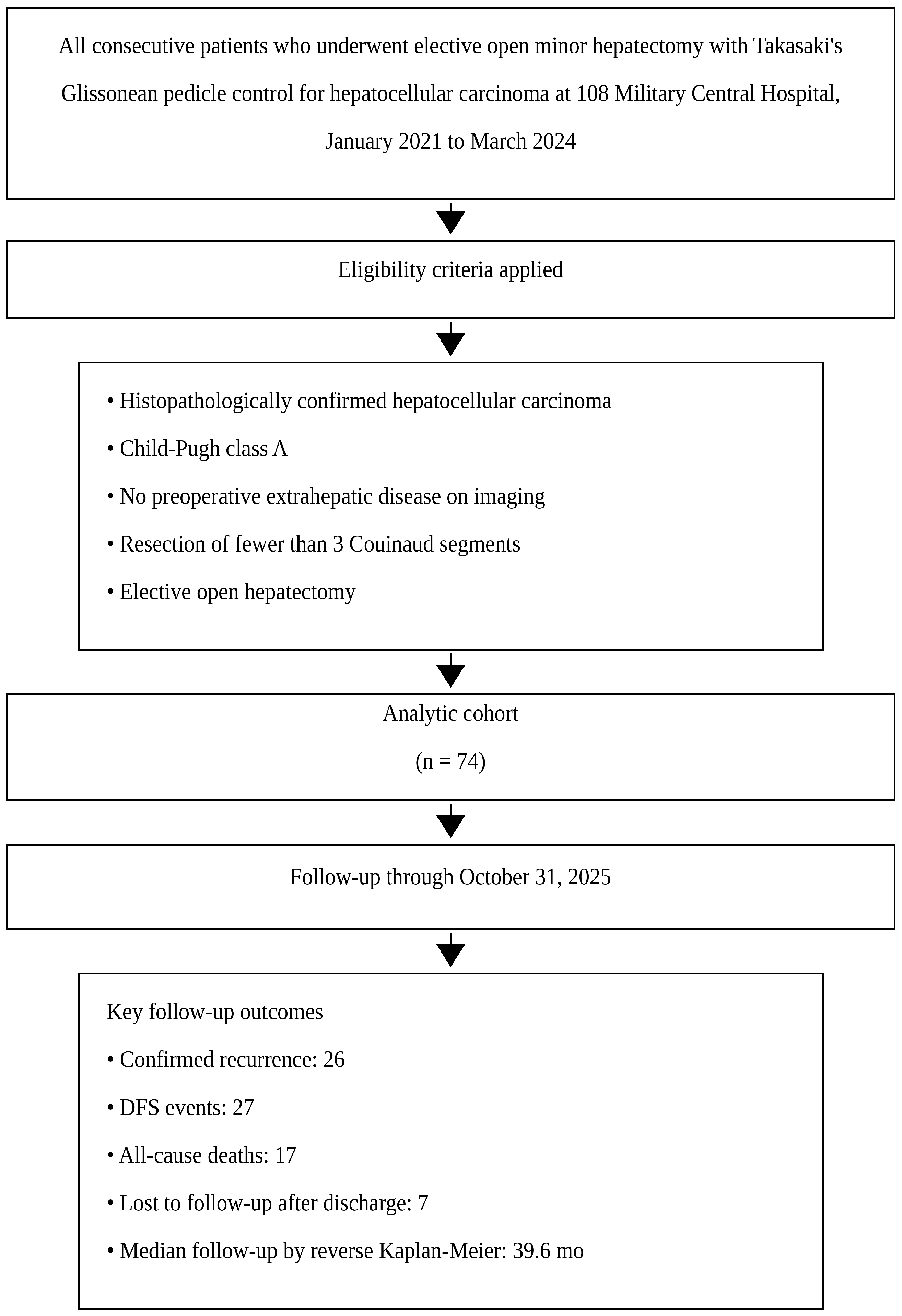
Figure 2.
Perioperative dynamics of liver function parameters after open minor hepatectomy. (a) Alanine aminotransferase. (b) Aspartate aminotransferase. (c) Total bilirubin. (d) Albumin. (e) Prothrombin activity. Data are presented as mean ± standard error. POD, postoperative day.
Figure 2.
Perioperative dynamics of liver function parameters after open minor hepatectomy. (a) Alanine aminotransferase. (b) Aspartate aminotransferase. (c) Total bilirubin. (d) Albumin. (e) Prothrombin activity. Data are presented as mean ± standard error. POD, postoperative day.
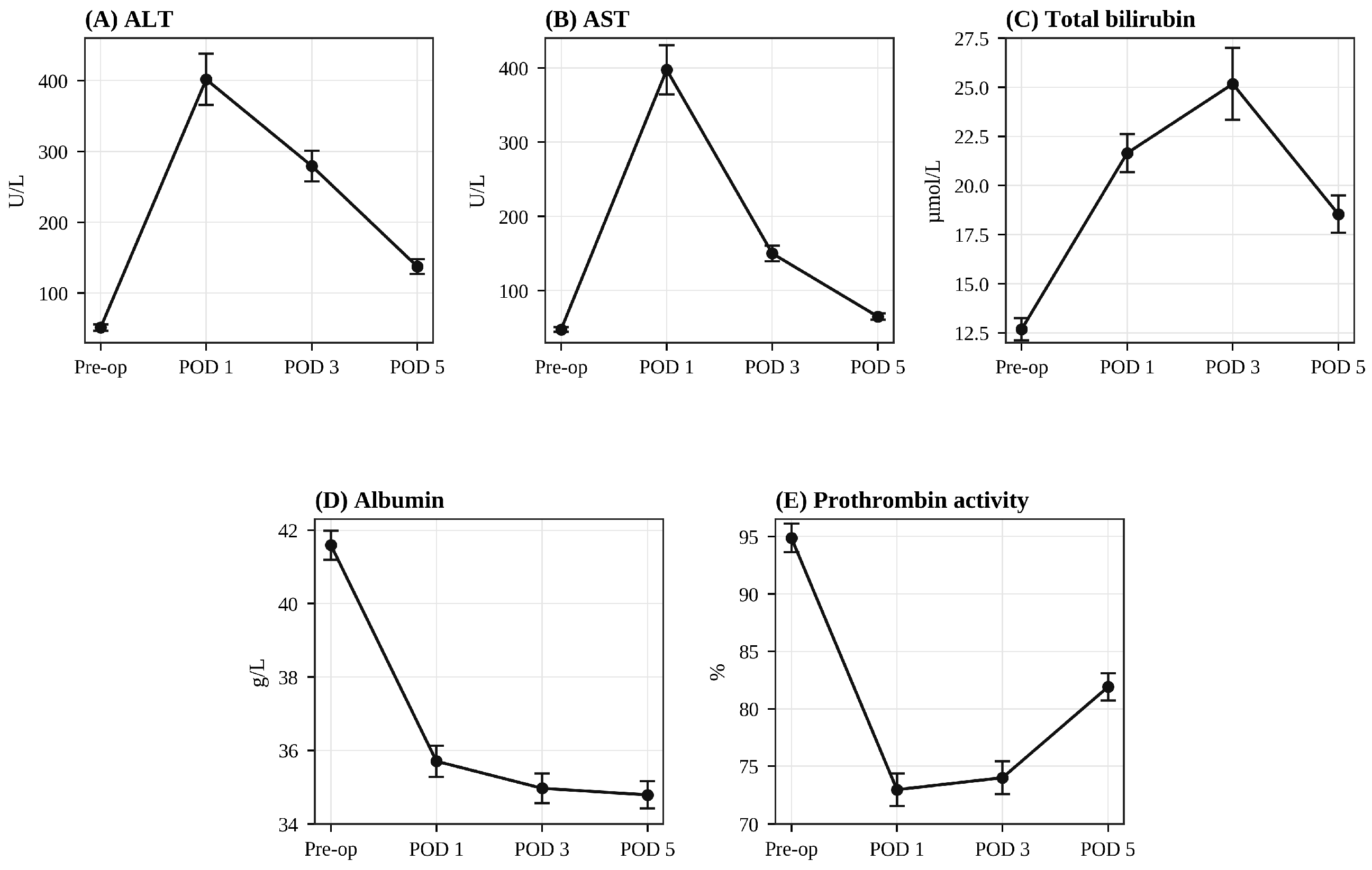
Figure 3.
Kaplan–Meier survival curves for the overall cohort. (a) Overall survival (OS). (b) Disease-free survival (DFS). Shaded areas indicate 95% confidence intervals. Numbers at risk, cumulative censored observations, and cumulative events are shown below each plot.
Figure 3.
Kaplan–Meier survival curves for the overall cohort. (a) Overall survival (OS). (b) Disease-free survival (DFS). Shaded areas indicate 95% confidence intervals. Numbers at risk, cumulative censored observations, and cumulative events are shown below each plot.
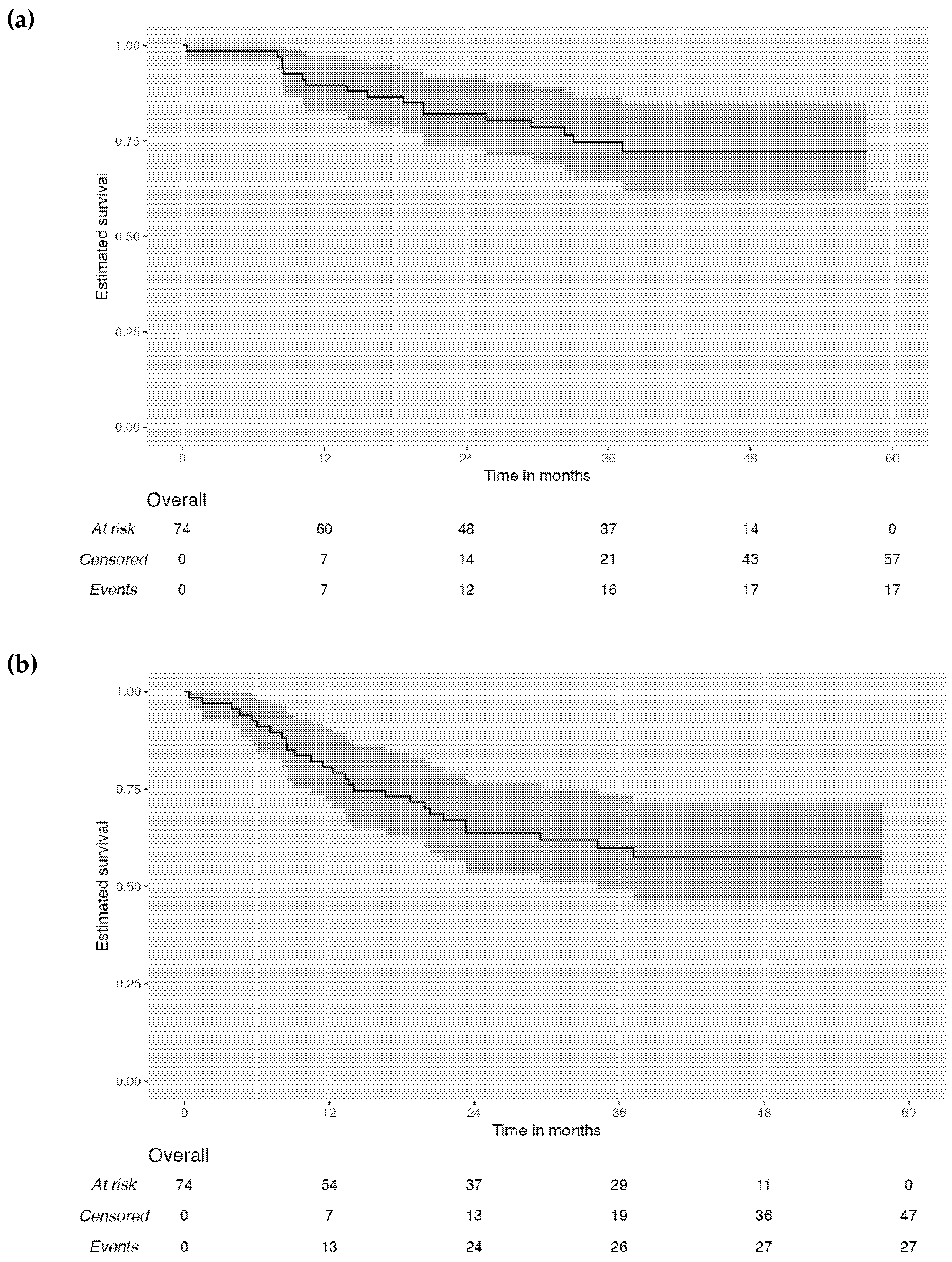
Figure 4.
Exploratory Kaplan–Meier survival curves stratified by resection margin status. (a) Overall survival. (b) Disease-free survival. Survival curves were compared between the R0 and R1 resection groups using the log-rank test.
Figure 4.
Exploratory Kaplan–Meier survival curves stratified by resection margin status. (a) Overall survival. (b) Disease-free survival. Survival curves were compared between the R0 and R1 resection groups using the log-rank test.
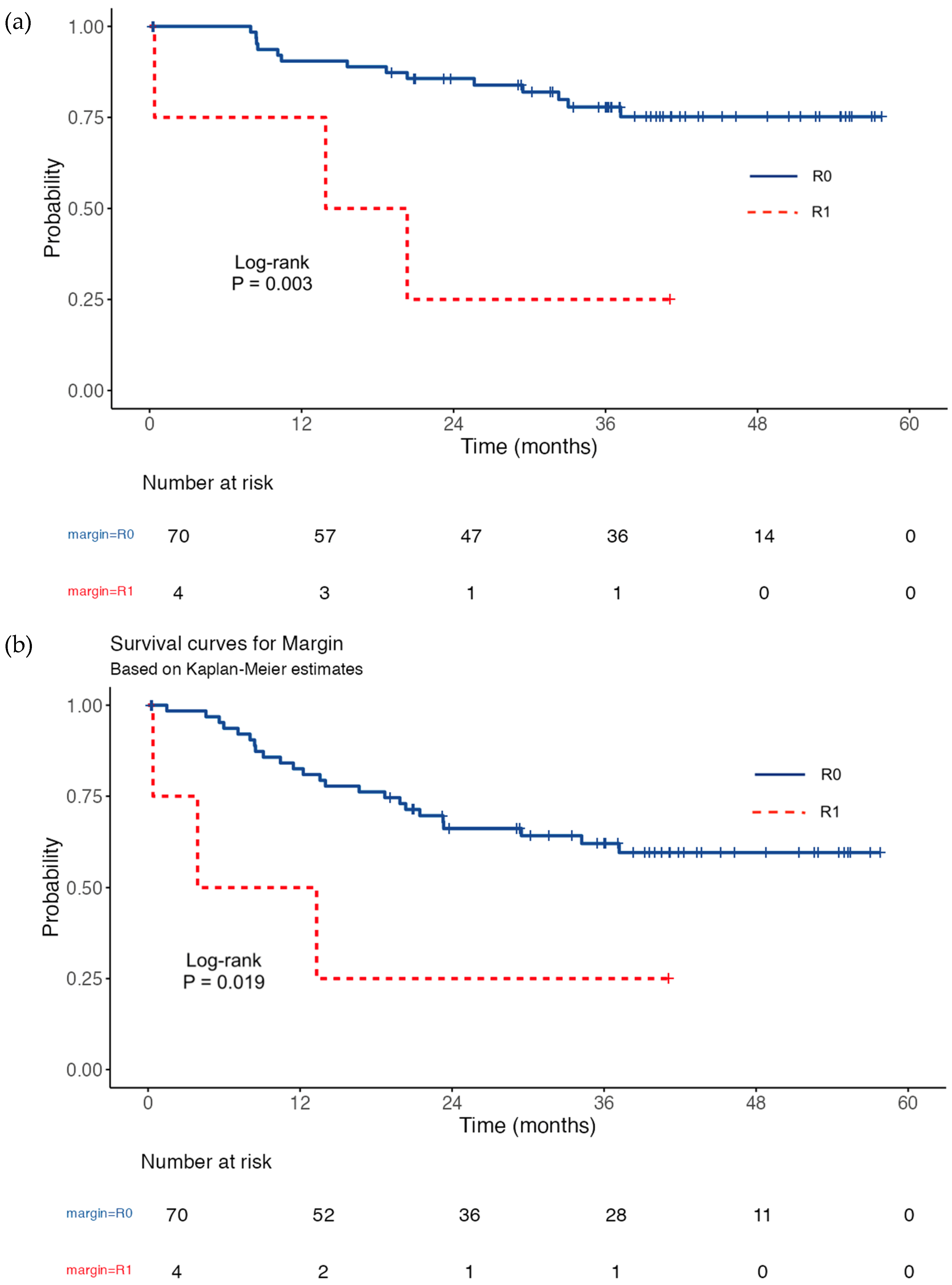
Figure 5.
Kaplan–Meier curves stratified by Barcelona Clinic Liver Cancer stage. (a) Overall survival according to BCLC stage A versus B. (b) Disease-free survival according to BCLC stage A versus B. Survival curves were compared using the log-rank test. BCLC, Barcelona Clinic Liver Cancer; OS, overall survival; DFS, disease-free survival.
Figure 5.
Kaplan–Meier curves stratified by Barcelona Clinic Liver Cancer stage. (a) Overall survival according to BCLC stage A versus B. (b) Disease-free survival according to BCLC stage A versus B. Survival curves were compared using the log-rank test. BCLC, Barcelona Clinic Liver Cancer; OS, overall survival; DFS, disease-free survival.
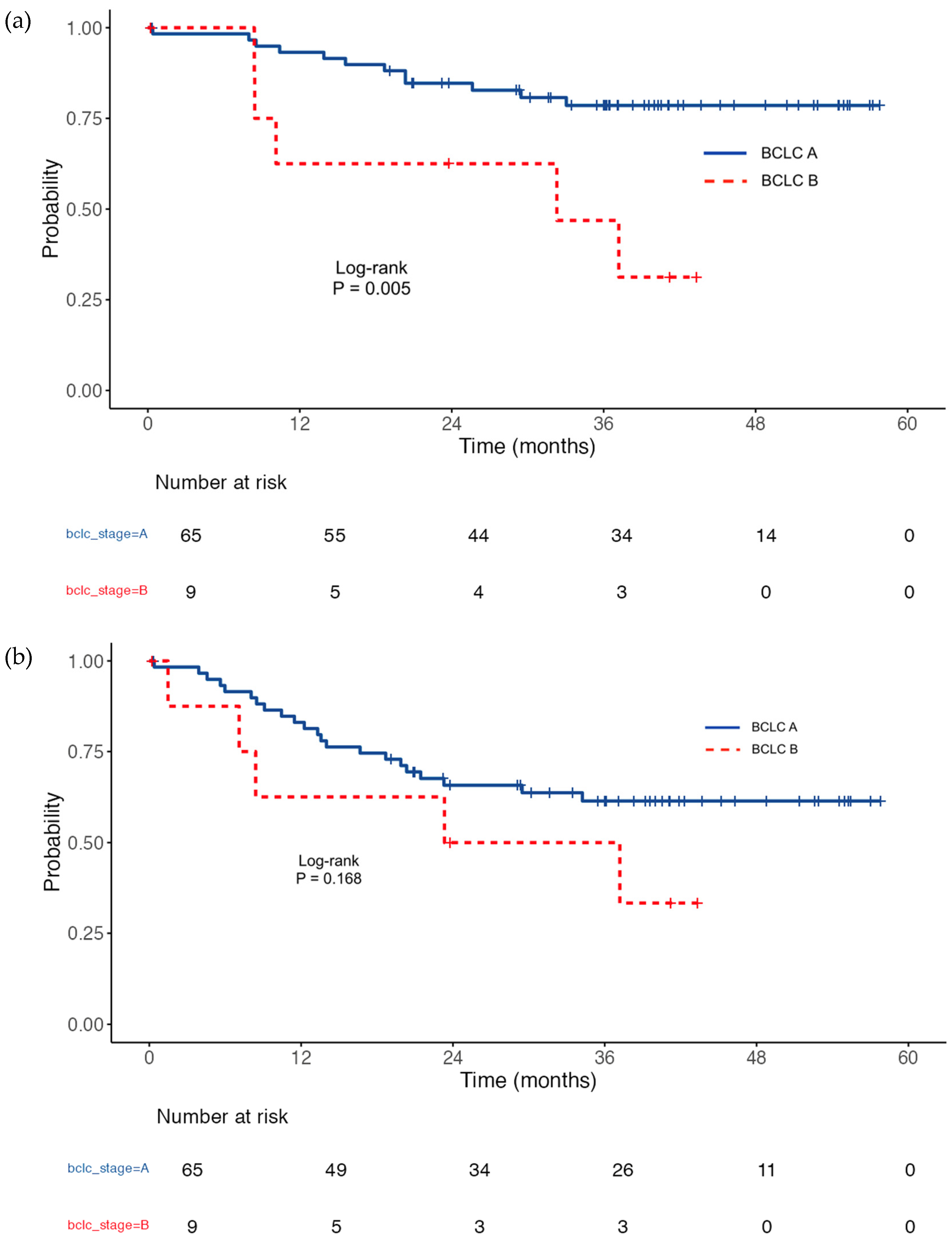

Table 1.
Baseline clinicopathological characteristics (n = 74).
| Characteristic | Value |
| Age (yr) | |
| Mean ± SD | 55.9 ± 11.5 |
| Median (IQR) | 59 (50–64) |
| Range | 18–75 |
| ≥60 yr | 34 (45.9) |
| Sex | |
| Male | 65 (87.8) |
| Female | 9 (12.2) |
| ECOG performance status 0 | 74 (100.0) |
| Incidental diagnosis | 37 (50.0) |
| Etiology and risk factors | |
| HBsAg-positive | 60 (81.1) |
| Anti-HCV positive | 2 (2.7) |
| Liver function | |
| Child-Pugh class A | 74 (100.0) |
| ALBI grade 1 | 58 (78.4) |
| ALBI grade 2 | 16 (21.6) |
| Preoperative α-FP (ng/mL) | |
| Median (IQR) | 8.3 (2.8–55.6) |
| ≤20 | 45 (60.8) |
| >20–400 | 19 (25.7) |
| >400 | 10 (13.5) |
| Tumor characteristics | |
| Median diameter (IQR), mm | 42 (32–58) |
| Range, mm | 21–133 |
| Solitary <30 mm | 12 (16.2) |
| Solitary 30–50 mm | 29 (39.2) |
| Solitary >50 mm | 24 (32.4) |
| Multifocal | 9 (12.2) |
Values are presented as number (%) unless otherwise indicated. SD, standard deviation; IQR, interquartile range; ECOG, Eastern Cooperative Oncology Group; HBsAg, hepatitis B surface antigen; anti-HCV, antibody to hepatitis C virus; ALBI, albumin–bilirubin; α-FP, alpha-fetoprotein; BCLC, Barcelona Clinic Liver Cancer.
Table 2.
Operative characteristics and perioperative outcomes (n = 74).
| Characteristic / Outcome | Value |
| Operative findings | |
| J-shaped subcostal incision | 72 (97.3) |
| Supraumbilical midline incision | 2 (2.7) |
| Intraoperative cirrhotic liver morphology | 44 (59.5) |
| Hepatectomy type | |
| Right posterior sectionectomy (segments 6/7) | 31 (41.9) |
| Right anterior sectionectomy (segments 5/8) | 4 (5.4) |
| Left lateral sectionectomy (segments 2/3) | 3 (4.1) |
| Segmentectomy | 25 (33.8) |
| Contiguous bisegmentectomy | 11 (14.9) |
| Surgical technique | |
| Pedicle divided after parenchymal transection | 70 (94.6) |
| Pedicle divided before parenchymal transection | 4 (5.4) |
| CUSA Excel as primary transection device | 61 (82.4) |
| Other or combined transection device | 13 (17.6) |
| Operative times | |
| Operative time, min, median (IQR) | 150 (125–175) |
| Operative time, range, min | 90–255 |
| Parenchymal transection time, min, median (IQR) | 35 (30–50) |
| Blood loss | |
| Intraoperative blood loss, mL, median (IQR) | 200 (100–300) |
| Intraoperative blood loss, range, mL | 50–1000 |
| Intraoperative blood transfusion | 1 (1.4) |
| Any intraoperative complication | 3 (4.1) |
| Postoperative outcomes | |
| PHLF | 1 (1.4) |
| Any 30-day complication | 18 (24.3) |
| Major complication (Clavien–Dindo ≥III) | 3 (4.1) |
| Bile leak | 1 (1.4) |
| Length of hospital stay, days, median (IQR) | 8 (7–9) |
| Length of hospital stay, range, days | 4–19 |
| In-hospital mortality, n (%) | 0 (0.0) |
| 90-day mortality, n (%) | 1 (1.4) |
Values are presented as number (%) unless otherwise indicated. CUSA Excel®, Integra LifeSciences, Princeton, NJ, USA. Other or combined transection devices included an ultrasonic dissector other than CUSA (n = 6), LigaSure (n = 1), and combined devices (n = 6). Segmentectomy denotes resection of one Couinaud segment; contiguous bisegmentectomy denotes resection of two adjacent Couinaud segments recorded separately from standard sectionectomies. PHLF was defined according to the ISGLS concept; bile leak was defined according to ISGLS criteria. USA, Cavitron Ultrasonic Surgical Aspirator; IQR, interquartile range; PHLF, post-hepatectomy liver failure; ISGLS, International Study Group of Liver Surgery.
Table 3.
Pathological findings, recurrence, and follow-up (n = 74).
| Variable | Value |
| Pathology | |
| R0 resection | 70 (94.6) |
| R1 resection (microscopic) | 4 (5.4) |
| Histological differentiation | |
| Well | 0 (0.0) |
| Moderate | 62 (83.8) |
| Poor | 12 (16.2) |
| Recurrence and follow-up | |
| Confirmed recurrence during follow-up | 26 (35.1) |
| Intrahepatic only, n/recurrences (%) | 19/26 (73.1) |
| Extrahepatic only, n/recurrences (%) | 6/26 (23.1) |
| Combined intra- and extrahepatic, n/recurrences (%) | 1/26 (3.8) |
| Total DFS events | 27 (36.5) |
| Early DFS event (≤12 mo), n/DFS events (%) | 13/27 (48.1) |
| Late DFS event (>12 mo), n/DFS events (%) | 14/27 (51.9) |
| Preoperative α-FP in early DFS events, ng/mL, median (IQR) | 110.8 (8.9–243.7) |
| Preoperative α-FP in late DFS events, ng/mL, median (IQR) | 17.1 (5.8–35.0) |
| All-cause deaths | 17 (23.0) |
| Lost to follow-up after discharge | 7 (9.5) |
| Median follow-up (reverse Kaplan–Meier), mo | 39.6 |
| Median observation time among survivors, mo (range) | 38.3 (0.2–57.8) |
Values are presented as number (%) unless otherwise indicated. DFS events included 26 documented recurrences and 1 patient who died from post-hepatectomy liver failure before recurrence could be assessed. Comparison of preoperative α-FP between early and late DFS events used the Mann–Whitney U test (P = 0.198). Resection margin width, microvascular invasion, and satellite nodules were not consistently recorded during the study period and were unavailable for analysis. R0, microscopically negative margin; R1, microscopically positive margin; DFS, disease-free survival; α-FP, alpha-fetoprotein; IQR, interquartile range.
Table 4.
Key exploratory Cox proportional hazards analyses of disease-free and overall survival.
| Variable | DFS HR (95% CI) |
P | OS HR (95% CI) |
P |
|---|---|---|---|---|
| Univariable Cox models | ||||
| R1 vs. R0 margin | 3.84 (1.15–12.82) | 0.029 | 5.38 (1.53–18.88) | 0.009 |
| BCLC stage B vs. A | 1.96 (0.74–5.18) | 0.176 | 3.96 (1.39–11.28) | 0.010 |
| α-FP >400 vs. ≤400 ng/mL | 1.61 (0.61–4.27) | 0.336 | 1.34 (0.38–4.69) | 0.644 |
| Multifocal disease | 1.27 (0.44–3.68) | 0.657 | 2.52 (0.82–7.73) | 0.107 |
| ALBI grade 2 vs. 1 | 1.09 (0.44–2.71) | 0.849 | 0.79 (0.23–2.77) | 0.717 |
| Major postoperative complication | 2.71 (0.64–11.51) | 0.178 | 2.32 (0.30–17.76) | 0.418 |
| Exploratory multivariable Cox model for DFS | ||||
| R1 vs. R0 margin | 4.23 (1.08–16.60) | 0.039 | — | — |
| BCLC stage B vs. A | 2.17 (0.80–5.91) | 0.129 | — | — |
| α-FP >400 vs. ≤400 ng/mL | 1.05 (0.35–3.12) | 0.936 | — | — |
Values are hazard ratios with 95% confidence intervals unless otherwise indicated. In the univariable Cox models, each variable was entered separately. The exploratory multivariable DFS model included R1 resection margin, BCLC stage B, and α-FP >400 ng/mL (27 DFS events; events per variable = 9); estimates in this section are adjusted hazard ratios. A multivariable Cox model for OS was not constructed because of the limited number of deaths (n = 17). Dashes indicate not applicable. HR, hazard ratio; CI, confidence interval; DFS, disease-free survival; OS, overall survival; R0/R1, microscopically margin-negative/margin-positive resection; BCLC, Barcelona Clinic Liver Cancer; α-FP, alpha-fetoprotein; ALBI, albumin–bilirubin.
Disclaimer/Publisher’s Note: The statements, opinions and data contained in all publications are solely those of the individual author(s) and contributor(s) and not of MDPI and/or the editor(s). MDPI and/or the editor(s) disclaim responsibility for any injury to people or property resulting from any ideas, methods, instructions or products referred to in the content. |
© 2026 by the authors. Licensee MDPI, Basel, Switzerland. This article is an open access article distributed under the terms and conditions of the Creative Commons Attribution (CC BY) license (http://creativecommons.org/licenses/by/4.0/).
Copyright: This open access article is published under a Creative Commons CC BY 4.0 license, which permit the free download, distribution, and reuse, provided that the author and preprint are cited in any reuse.


