

Submitted:
01 June 2026
Posted:
02 June 2026
You are already at the latest version
Abstract
The Aura Microwave Limb Sounder (Aura/MLS) measures temperature profiles with a horizontal spacing of about 170 km along its near polar orbit. We highpass-filtered the horizontal temperature fluctuations along the suborbital track in the middle atmosphere. The characteristics of inertia-gravity waves with horizontal wavelengths between 200 and 825 km are evaluated for the equatorial region (10°S to 10°N), northern polar region (70°N to 82°N), and southern polar region (70°S to 82°S) over the time interval from August 2004 to December 2021. The gravity wave activity over the southern polar region is stronger by a factor of up to 2 than over the northern polar region. The seasonal variation of the vertical structure of gravity wave activity shows strong interhemispheric differences. There are double layers of enhanced gravity wave activity in the upper mesosphere over Antarctica in summer and winter while the northern polar region does not show a double layer structure of gravity wave activity. In the northern polar region, the upper mesospheric gravity wave activity is decreased after the onset of major sudden stratospheric warmings.
Keywords:
gravity wave
; temperature fluctuation
; polar region
; middle atmosphere
; climatology
; interhemispheric difference
; microwave limb sounder
1. Introduction
Atmospheric gravity waves transfer energy and momentum through the atmosphere and contribute to the residual meridional circulation of the middle atmosphere [1]. The generation, propagation and dissipation of atmospheric gravity waves are complex processes and are still a challenge for theory and observation [2,3,4,5]. In the polar regions, gravity waves are mainly generated by storms and orography (wind flow over mountains) in the troposphere and by polar vortex perturbations in the stratosphere [6]. Gravity waves are divided into three classes: low-frequency gravity waves (or inertia-gravity waves), medium-frequency gravity waves, and high-frequency gravity waves [2]. The present study derives the characteristics of inertia-gravity waves with horizontal wavelengths between 200 and 825 km, periods between 2 and 12 hours, and vertical wavelengths between 6 and 30 km. Hocke et al. [7] showed that these inertia-gravity waves can be retrieved from level-2 temperature data of the satellite instrument Aura/MLS.
Interhemispheric differences are obvious in the global maps of gravity waves in the middle atmosphere [4,7]. There is a clear maximum of gravity wave activity above the Andean mountain ridge and the Antarctic Peninsula which can be regarded as wavemakers in southern hemispheric winter. This hot spot of gravity wave activity was also observed in the high-frequency gravity wave maps of [8,9] which were retrieved from level-1 brightness temperature data of Aura/MLS. In spite of these studies, the interhemispheric differences of gravity waves in the polar middle atmosphere were not investigated yet.
The seasonal and interannual variability of mesospheric gravity waves were analysed by means of horizontal wind measurements of a MF radar at Syowa station (S) in Antarctica [10]. It was found that the mesospheric gravity wave activity has a maximum in winter and a smaller local maximum in summer at 70-78 km height. The interannual variability of the gravity wave activity was related to the polar vortex breakdown and the strength of tropical precipitation and convection. Yoshida et al. [11] compared the absolute momentum flux of inertia-gravity waves in the troposphere and stratosphere above the Syowa station observed by the PANSY radar with those of ERA5 meteorological reanalysis. They found that ERA5 underestimated the momentum flux by a factor of 5 and more. This comparison shows the importance of observations of gravity waves in the polar regions which seem to be not well represented in ERA5 reanalysis.
Ern et al. [4] retrieved global maps of gravity waves from the satellite experiments Aura/HIRDLS and TIMED/SABER. They found a modulation of the gravity wave momentum flux with the quasi-biennial oscillation (QBO) in the tropical stratosphere. They showed that the gravity wave activity is increased in regions of strong zonal wind (e.g., polar vortex jet). The activity of high-frequency gravity waves in the Artic mesosphere was observed to depend on the strength of the Arctic Oscillation (AO) [6]. In January 2015 when high AO values represented the polar stratosphere, the mesospheric gravity wave activity was less than in other winters when small AO values occurred. Critical level filtering of gravity waves at stratospheric heights possibly explain the reduced amplitude of mesospheric gravity waves above. The relationship between mesospheric gravity wave activity and sudden stratospheric warmings (SSW) is a complex process of critical level filtering and wave-mean flow interaction. It has been simulated that the breakdown of the polar vortex at the onset of a major SSW leads to a reduction of mesospheric gravity wave flux in westward direction. This is associated with a reduction of the gravity wave-driven poleward and downward mesospheric wind circulation and the appearance of a mesospheric cooling during the SSW [12]. Several days after the SSW onset, mesospheric gravity waves (propagating in eastward direction) are supposed to be responsible for the elevated stratopause at about 80 km height [12,13,14].
Damping of gravity waves in the Arctic mesosphere was observed by lidar and airglow measurements [15]. The observations and modelling indicated that convective instabilities are most important for the gravity wave breaking process in the Arctic mesosphere. Qiu et al. [16] found a hemispheric asymmetry in the gravity wave impact on polar mesospheric clouds (PMCs). In the Arctic summer mesosphere, the PMCs appear within 23 days after the maximum of gravity wave energy, while in the Antarctic summer mesosphere the PMCs appear about 35 days before the maximum in gravity wave energy.
The present study is focused on inertia-gravity waves in the polar middle atmosphere. The observations of Aura/MLS are analysed for the time interval from August 2004 to December 2021. This dataset permits the retrieval of seasonal and interannual variation in mesospheric gravity wave activity. Section 2 describes the Aura/MLS dataset and the data analysis. Results are given in section 3, and the discussion is in section 4. Conclusions are given in section 5.
2. Aura/MLS Dataset and Data Analysis
The study is based on profiles of temperature and geopotential height in the middle atmosphere which have been observed by the Microwave Limb Sounder (MLS) on the NASA satellite Aura. The Aura satellite was launched in 2004, and an overview about the technical details of the instrument MLS was given by [17]. Aura has a Sun-synchronous orbit in 705 km height with two equator overpasses at 01:45 local solar time (LST) and 13:45 LST. The orbit revolution time of Aura is about 99 min. Aura is in a near-polar orbit with an inclination of about . The atmospheric profiles are sampled along the suborbital track with a distance of 1. in latitude or 165 km. The profiles are measured from S to N.
Level 2 data of Aura/MLS of the retrieval version 5 are analysed in the present study. The data analysis applies the data screening and quality check according to [18]. The Aura/MLS retrieval yields atmospheric profiles on 42 pressure levels for the parameters temperature and geopotential height. These parameters are retrieved from the Aura/MLS measurements of the thermal microwave limb emissions of the lines at 118GHz and 234GHz [19]. The geopotential height profiles are used to convert the profiles to profiles from z=13 to 92 km altitude.
The present study only uses the data from 2004 to the end of 2021, since in 2022 the number of the pressure levels of the retrieved Aura/MLS profiles was reduced from 42 to 37 because of a technical degradation of the MLS instrument. It is better to restrict the data analysis to the high quality profiles before 2022 and to omit the Aura/MLS observations from 2022 to 2025 in the present study. The precision of the temperature profiles is about 1K in the stratosphere and about 3K in the mesosphere [19]. Precision of geopotential height is 35m from 316hPa to 100hPa, 44m at 1hPa, and 110m at 0.001hPa [19]. The vertical resolution of the temperature profiles is about 3 km in the stratosphere and about 8 km in the lower mesosphere [19]. The along-track sounding volume is about 200 km. In the following, we highpass-filtered the temperature fluctuation along the suborbital track in a certain height. The digital filter was run in forward and reverse direction in order to avoid a filter-induced phase delay. The selected digital filter is a non-recursive, finite impulse response highpass filter with a Hamming window. The number of filter coefficients corresponds to a window of three times of the cutoff distance (825 km, the spatial distance of 5 consecutive temperature profiles). The highpass cut-off spatial frequencies are at 1/(825 km) and infinity. That means all spatial fluctuations with horizontal scales less than 825 km will pass the highpass filter. The highpass will select only the temperature fluctuations along the suborbital track with horizontal spatial scales less than 825 km. Figure 1 shows the filtered temperature fluctuation at 90 km height observed by Aura/MLS over the southern polar region (S to S) on 14 July 2009. The mean gravity wave amplitude is given by the standard deviation of these fluctuations which is 1.0 K in this example. For each day, we can calculate a standard deviation of the temperature fluctuations in the selected region: northern polar region (N to N), southern polar region (S to S), and equatorial region (S to N). The daily time series of the standard deviations for the time interval August 2004 to December 2021 are analysed for interhemispheric differences, seasonal variations, interannual variations of inertia-gravity waves, and influences of major sudden stratospheric warmings (SSWs) on inertia-gravity waves.
The angle between the gravity wave propagation direction and the suborbital track vector plays a big role for the sensitivity of Aura/MLS for gravity waves [7]. If the gravity wave propagates parallel to the suborbital track, then Aura/MLS can measure gravity waves with horizontal wavelengths between 200 km (length of sounding volume) and 825 km (cutoff of highpass filter). The temperature fluctuations due to tidal and planetary waves, propagating in zonal directions, are successfully suppressed by the filtering process.
The FFT amplitude spectrum is computed for the equatorial gravity wave amplitude (daily standard deviation of temperature fluctuation) from August 2004 to December 2021. A Hamming window was applied, and zero padding reduced the spacing of the frequency grid by a factor of 3. The amplitude was calibrated by means of a sine wave of a known amplitude.
Composite analysis or superposed epoch analysis was applied to the time series of standard deviation over the northern polar region (N to N). The central dates of the SSWs were taken from the U60 column of the table in [20]. U60 means the reversal of the eastward wind at 10hPa at N. The time point of this wind reversal is taken as the central date of the SSW which also stands for the onset of the SSW. Ten major SSWs occurred in the time period from 2004 to 2021 which are listed in Table 1.
For investigation of SSWs, the reversal of the eastward wind at 10hPa and N is used as a timing mark for the SSW onset (central date of SSW). This timing mark l corresponds to the epoch time 0, and all observed features which are associated with this event can be measured in days of epoch time before and after the SSW onset. The various SSW events as functions of epoch time can be averaged, and the result is a mean SSW impact on the gravity wave amplitude as function of epoch time.
3. Results
For comparison of the differences of the average inertia-gravity wave amplitude in the selected regions, we average the profiles of the standard deviations for winter, summer and all seasons during the time interval from January 2005 to December 2021. The winter or summer season includes either the months December, January, February or June, July, August. The averaged profiles of the mean gravity wave amplitudes is depicted in Figure 2. Generally, the amplitudes increase with height. The amplitudes in winter are larger than in summer in each hemisphere. Most evident is that the amplitudes in the southern polar region (red, magenta, dashed red lines) are larger by a factor of up to 2 than the correponding amplitudes in the northern polar region (blue, black, dashed blue lines).
As the next point, we like to investigate the modulations in the inertia-gravity wave amplitude in the equatorial region. Figure 3 shows the time series of the standard deviation from August 2004 to December 2021. Below the tropical tropopause (about 18 km height), the amplitudes are increased. In the mid-stratosphere, a QBO modulation is obvious in the amplitude. The gravity wave amplitude is increased at the end of the easterly phase of the QBO. The superposed magenta contour lines depict the easterly wind, while the black contour lines depict the westerly wind observed by radiosondes at Singapore. The zonal wind in the equatorial mid-stratosphere changes its direction with a period of about 28 months (QBO). This long-term oscillation of the zonal wind is driven by equatorial Kelvin waves and gravity waves [21].
In the upper stratosphere (40 to 50 km altitude), Figure 3 shows semiannual and annual oscillations (SAO and AO) of the gravity wave amplitude. The yellow wave crests of the QBO in the mid-stratosphere pass over to the wave crests of the SAO and AO in the upper stratosphere.
The FFT spectrum of the temporal variations of the gravity wave amplitude in the equatorial region is shown in Figure 4. The dominant oscillations are the QBO in the mid-stratosphere, and the SAO and AO in the upper stratosphere and mesosphere. The SAO and AO peaks also occur in the upper troposphere. It is a remarkable result, that the inertia-gravity waves in the mesosphere are not modulated by the QBO. There are many investigations about possible influences of the QBO on the upper atmosphere and ionosphere. Generally, the modulations of the gravity wave amplitude in the equatorial region are small.
Figure 5 shows the mean seasonal variation of the gravity wave amplitude in the equatorial region. It is obvious that the seasonal variation is quite small but signatures of the SAO and AO are present (maxima at solstices). In the mesosphere, there is layer structure with layers of enhanced amplitude with a vertical distance of about 5 km. It could be that this is a signature of interactions of gravity waves and tides.
Figure 6 shows the mean seasonal variation of the gravity wave amplitude in the northern polar region. The seasonal variation is stronger in the northern polar region than in the equatorial region in Figure 5. Maximal amplitudes are in the winter in the stratopause region and upper mesosphere. Smaller local maxima are present in summer (day of year 150-240) at 60 km and in the upper mesosphere at 88 km. In summer, there is a strong enhancement of the gravity wave amplitude at about 92 km height. Similar to the equatorial region, there are layers of enhanced amplitude in the mesosphere, vertically separated by about 5 km.
Figure 7 shows the mean seasonal variation of the gravity wave amplitude in the southern polar region. It is obvious that the mesospheric gravity wave amplitudes in the southern polar region are stronger than in the northern polar region. In the mesosphere, there are maximal in summer and winter. In difference to the northern polar region, there is a double layer of enhanced wave amplitudes in the mesosphere. For example, in summer (day of year 1 to 60) there are maxima at 77 km height and 84 km height. The double layer occurs below the cold summer mesopause which is observed at 88 km height by Aura/MLS. In winter, the double layer occurs again but at heights of 75 km and 90 km height. The stratospheric wave activity is clearly higher in the winter season (day of year 150 to 270, June to September) than in the summer season. Particularly in late summer, there are days of enhanced amplitudes, visible as yellow vertical lines from the lower stratosphere to the mesopause. This indicates the vertical coupling of the winter middle atmosphere by gravity waves. This process is more obvious in the southern polar region than in the northern polar region.
The double layer of enhanced gravity wave activity is a new finding, and thus we like to show that one can see it not only in the seasonal average but on an individual day. Figure 8 shows the southern polar maps of temperature fluctuations observed on 2 January 2009. The maps at 77 km height and 85 km height show larger fluctuations than the map at 81 km height. It is an open question why a damping occurs at 81 km (standard deviation is 076 K) height between the layers of enhanced amplitudes at 77 and 85 km height which have standard deviations of 1.27 K and 1.14 K respectively.
Finally, we performed a composite analysis of the influence of major sudden stratospheric warmings on gravity wave amplitudes. Figure 9 shows that upper mesospheric gravity waves in the northern polar region are enhanced before the SSW onset (dashed black line). There also seems to be a decrase of the amplitude of the gravity waves in the stratopause region (40 to 60 km height) after the SSW onset. The composite analyses for the equatorial and southern polar region showed that there are no influences of major SSWs (from Table 1) on the gravity wave amplitudes in these regions.
4. Discussion
As investigated in a previous study [7] in more detail, the level-2 temperature data of Aura/MLS are appropriate for the study of inertia-gravity waves. In difference to the previous study, we applied a highpass filter to the temperature variations along the suborbital track of Aura/MLS. Thus, the inertia-gravity waves have horizontal wavelengths between 200 and 825 km. Also in difference to [7], we derived long-term time series of the mean gravity wave amplitude in the 3 selected regions (equator, northern and southern polar region). These time series have a time resolution of 1 day, so that they are suitable for derivation of seasonal variations, interannual variations, and composite analysis of the impact of major SSWs on gravity wave amplitudes.
A key result is that inertia-gravity waves are generally stronger in the southern polar region than in the northern polar region (Figure 1). The previous studies by [4] did not discuss this important point. Possibly, the interaction of the strong zonal wind in the southern hemisphere with the Andean mountain ridge and the coastline of Antarcrtica could be stronger gravity wave generation sources than those in the northern polar region. It is also known that the southern polar vortex is stronger and more stable than the northern polar vortex. The latter is more disturbed by upward propagating and breaking planetary waves during winter which can even induce a reversal of the vortex from eastward to westward wind during major SSWs. During winter, gravity waves can propagate in westward direction against the vortex stream throughout the middle atmosphere. The seasonal variation of the gravity wave amplitudes above the southern polar region showed clear evidence for this vertical gravity wave coupling (vertical yellow lines in Figure 7 in winter) while the northern polar region did not show this signature. The equal sounding characteristics of Aura/MLS in the southern and northern polar region is valuable for the study of interhemispheric differences in the polar atmospheres. TIMED/SABER has a more complex sampling behaviour, measuring either the northern or the southern polar region with long separation in time. Ground-based instruments in Antarctica and Arctic are sparse and cannot be compared in such an easy, representative and objective manner as we did for the Aura/MLS measurements over both polar regions.
Our study confirmed the known result [4,21] that inertia-gravity waves are enhanced at the end of the easterly phase of the QBO in the mid-stratosphere (Figure 3). The amplitudes of the inertia-gravity waves at the equator are smaller than those of the equatorial Kelvin waves. Both wave classes contribute to the reversal of the easterly QBO phase. The FFT spectra of the modulations of the gravity wave amplitudes showed a QBO signal in the mid-stratosphere but no QBO signal in the mesosphere. Thus, a search for the terrestrial QBO signal in the upper atmosphere and ionosphere might be difficult though researchers found indications for a QBO signal in the ionosphere [22,23]. Here, we can say that inertia-gravity waves apparently do not transfer the QBO signal from the stratosphere to the thermosphere and ionosphere.
Generally the modulations and the seasonal variations of inertia-gravity waves in the equatorial region are smaller than those in the polar region which show larger annual and semiannual oscillations peaking at solstices. The vertical structure of the seasonal variations of gravity waves over the southern polar region is rather different to those over the northern polar region. We discovered a double layer oh enhanced gravity wave amplitudes over the southern polar region in winter and summer (Figure 7). According to literature on short period gravity waves, a wave duct layers is often observed at mesospheric heights due to vertical wind shears and vertical temperature gradients and inversion layers [6]. However, we are not aware about a study of a double layer of enhanced gravity wave amplitudes. It was observed that damping of gravity waves often occur in the polar mesosphere [15] but it is unclear how the gravity wave amplitude can recover after its damping at a certain height (e.g., 81 km). It remains an open question why the double layer structure is present over the southern polar region and why not over the northern polar region.
It is reasonable that major SSWs influence the upward propagating gravity wave flux due to the sudden reversal of the zonal wind in the stratosphere [12]. The prevailing westward propagating gravity waves cannot propagate into the polar mesosphere during the SSW. The composite analysis showed that indeed in the stratopause region and more clearly in the upper mesosphere, the gravity wave amplitude is decreased after the SSW onset (Figure 9). We are not aware of other composite analyses of observations which show this decrease in gravity wave amplitude. It was also a result that the gravity wave amplitudes over the equatorial and southern polar region are not affected by the SSWs in the northern hemisphere. Yasui et al. [10] also found no clear signal in the MF radar observations of horizontal wind above Syowa station (Antarctica) for northern hemispheric SSW onsets.
5. Conclusions
The level-2 temperature data of Aura/MLS are appropriate for finding characteristics of inertia-gravity waves. Of course one has to keep in mind that the Aura/MLS measurements are more sensitive for gravity waves propagating parallel to the suborbital track than for gravity waves propagating in perpendicular direction to the track. The equal sampling of temperature fluctuations over the southern and northern polar region permits the objective evaluation of interhemispheric differences. We find that the inertia-gravity waves above the southern polar region are stronger by a factor of up to 2 than those over the northern polar region. This is possibly due to stronger orographic waves in the Southern polar region and the more stable polar vortex in the southern hemisphere.
We confirmed that the inertia-gravity waves in the equatorial mid-stratosphere are stronger at the end of the QBO easterly phase so that they possibly contribute to the deceleration of the easterly wind. The QBO signal is not present for the mesospheric inertia-gravity waves so that inertia-gravity waves do not transfer the QBO signal to the thermosphere and ionosphere.
The seasonal variations of gravity waves are stronger over the polar regions than over the equator. The gravity wave amplitudes are maximal during winter and have local maxima in summer indicating the importance of AO and SAO at high latitudes. We discovered a double layer structure of enhanced gravity wave amplitudes in the mesosphere above the southern polar region. The double layer structure occurs in winter and summer but with a different vertical spacing,
A composite analysis of the influence of major sudden stratospheric warmings on gravity wave amplitudes was carried out. The upper mesospheric gravity waves of the northern polar region are enhanced before the SSW onset and decreased after the SSW onset. The gravity waves in the equatorial and southern polar region are not affected by the northern hemispheric SSWs.
Author Contributions
Conceptualization, K.H. and W.W.; methodology, K.H. and W.W.; software, K.H.; validation, K.H. and W.W.; formal analysis, K.H. and W.W.; writing—original draft preparation, K.H.; writing—review and editing, K.H. and W.W.. All authors have read and agreed to the published version of the manuscript.
Funding
Funding for open-access publication was provided by the University of Bern.
Institutional Review Board Statement
Not applicable.
Informed Consent Statement
Not applicable.
Data Availability Statement
The Aura/MLS data are available from the Aura Validation Data Center (AVDC) at https://avdc.gsfc.nasa.gov/ (accessed on 20 January 2026). The stratospheric zonal wind data over Singapore is provided by NOAA at https://www.cpc.ncep.noaa.gov/data/indices/ (accessed on 1 May 2025).
Acknowledgments
We thank the Aura/MLS team for the high quality data. We also thank the reviewers and the editor for their improvements and their work.
Conflicts of Interest
The authors declare no conflicts of interest.
References
- Holton, J.R. The Influence of Gravity Wave Breaking on the General Circulation of the Middle Atmosphere. J. Atmos. Sci. 1983, 40, 2497–2507. [Google Scholar] [CrossRef]
- Fritts, D.C.; Alexander, M.J. Gravity wave dynamics and effects in the middle atmosphere. Rev. Geophys. 2003, 41. [Google Scholar] [CrossRef]
- Vadas, S.L.; Becker, E.; Bossert, K.; Hozumi, Y.; Stober, G.; Harvey, V.L.; Baumgarten, G.; Hoffmann, L. The Role of the Polar Vortex Jet for Secondary and Higher-Order Gravity Waves in the Northern Mesosphere and Thermosphere During 11-14 January 2016. J. Geophys. Res. Space Phys. 2024, 129, e2024JA032521. [Google Scholar] [CrossRef]
- Ern, M.; Preusse, P.; Gille, J.C.; Hepplewhite, C.L.; Mlynczak, M.G.; Russell, J.M.; Riese, M. Implications for atmospheric dynamics derived from global observations of gravity wave momentum flux in stratosphere and mesosphere. J. Geophys. Res. Atmos. 2011, 116. [Google Scholar] [CrossRef]
- Richmond, A.D. Gravity wave generation, propagation, and dissipation in the thermosphere. J. Geophys. Res. Space Phys. 1978, 83, 4131–4145. [Google Scholar] [CrossRef]
- Mandal, S.; Moffat-Griffin, T.; Wright, C.J.; Pautet, P.D.; Taylor, M.J.; Nakamura, T. Gravity Wave Variability in the Arctic Winter Mesosphere in Relation With the Stratospheric Polar Vortex. J. Geophys. Res. Atmos. 2025, 130, e2024JD043037. [Google Scholar] [CrossRef]
- Hocke, K.; Lainer, M.; Moreira, L.; Hagen, J.; Fernandez Vidal, S.; Schranz, F. Atmospheric inertia-gravity waves retrieved from level-2 data of the satellite microwave limb sounder Aura/MLS. Ann. Geophys. 2016, 34, 781–788. [Google Scholar] [CrossRef]
- Jiang, J.H.; Eckermann, S.D.; Wu, D.L.; Ma, J. A search for mountain waves in MLS stratospheric limb radiances from the winter Northern Hemisphere: Data analysis and global mountain wave modeling. J. Geophys. Res. Atmos. 2004, 109. [Google Scholar] [CrossRef]
- Jiang, J.; Eckermann, S.; Wu, D.; Hocke, K.; Wang, B.; Ma, J.; Zhang, Y. Seasonal variation of gravity wave sources from satellite observation. Adv. Space Res. 2005, 35, 1925–1932. [Google Scholar] [CrossRef]
- Yasui, R.; Sato, K.; Tsutsumi, M. Seasonal and Interannual Variation of Mesospheric Gravity Waves Based on MF Radar Observations over 15 Years at Syowa Station in the Antarctic. SOLA 2016, 12, 46–50. [Google Scholar] [CrossRef]
- Yoshida, L.; Tomikawa, Y.; Ejiri, M.K.; Tsutsumi, M.; Kohma, M.; Sato, K. Large-Amplitude Inertia Gravity Waves Over Syowa Station: Comparison of PANSY Radar and ERA5 Reanalysis Data. J. Geophys. Res. Atmos. 2024, 129, e2023JD040490. [Google Scholar] [CrossRef]
- Zuelicke, C.; Becker, E.; Matthias, V.; Peters, D.H.W.; Schmidt, H.; Liu, H.L.; de la Torre Ramos, L.; Mitchell, D.M. Coupling of Stratospheric Warmings with Mesospheric Coolings in Observations and Simulations. J. Clim. 2018, 31, 1107–1133. [Google Scholar] [CrossRef]
- Stephan, C.C.; Schmidt, H.; Zülicke, C.; Matthias, V. Oblique Gravity Wave Propagation During Sudden Stratospheric Warmings. J. Geophys. Res. Atmos. 2020, 125, e2019JD031528. [Google Scholar] [CrossRef]
- Thurairajah, B.; Bailey, S.M.; Cullens, C.Y.; Hervig, M.E.; Russell, J.M., III. Gravity wave activity during recent stratospheric sudden warming events from SOFIE temperature measurements. J. Geophys. Res. Atmos. 2014, 119, 8091–8103. [Google Scholar] [CrossRef]
- Collins, R.L.; Smith, R.W. Evidence of damping and overturning of gravity waves in the Arctic mesosphere: Na lidar and OH temperature observations. J. Atmos. Sol.-Terr. Phys. 2004, 66, 867–879. [Google Scholar] [CrossRef]
- Qiu, S.; Wang, N.; Soon, W.; Herrera, V.M.V.; Yang, C.; Dou, X. The Hemispheric Asymmetry of Gravity Wave Impact on the Polar Mesospheric Cloud, Based on the Aeronomy of Ice in the Mesosphere Satellite. Atmosphere 2023, 14. [Google Scholar] [CrossRef]
- Waters, J.W.; Froidevaux, L.; Harwood, R.S.; Jarnot, R.F.; Pickett, H.M.; Read, W.G.; Siegel, P.H.; Cofield, R.E.; Filipiak, M.J.; Flower, D.A.; et al. The Earth Observing System Microwave Limb Sounder (EOS MLS) on the Aura satellite. IEEE Trans. Geosci. Remote Sens. 2006, 44, 1075–1092. [Google Scholar] [CrossRef]
- Livesey, N.J.; Read, W.G.; Wagner, P.A.; Froidevaux, L.; Santee, M.L.; Schwartz, M.J.; Lambert, A.; Valle, L.F.M.; Pumphrey, H.C.; Manney, G.L.; et al. Earth Observing System (EOS) Aura Microwave Limb Sounder (MLS) Version 5.0x Level 2 and 3 data quality and description document. Technical report, JPL D-105336 Rev. B. 2022. Available online: https://mls.jpl.nasa.gov/data/v5-0_data_quality_document.pdf.
- Schwartz, M.J.; Lambert, A.; Manney, G.L.; Read, W.G.; Livesey, N.J.; Froidevaux, L.; Ao, C.O.; Bernath, P.F.; Boone, C.D.; Cofield, R.E.; et al. Validation of the Aura Microwave Limb Sounder temperature and geopotential height measurements. J. Geophys. Res. Atmos. 2008, 113. [Google Scholar] [CrossRef]
- Palmeiro, F.M.; Garcia-Serrano, J.; Ruggieri, P.; Batte, L.; Gualdi, S. On the Influence of ENSO on Sudden Stratospheric Warmings. J. Geophys. Res. Atmos. 2023, 128, e2022JD037607. [Google Scholar] [CrossRef]
- Baldwin, M.P.; Gray, L.J.; Dunkerton, T.J.; Hamilton, K.; Haynes, P.H.; Randel, W.J.; Holton, J.R.; Alexander, M.J.; Hirota, I.; Horinouchi, T.; et al. The quasi-biennial oscillation. Rev. Geophys. 2001, 39, 179–229. [Google Scholar] [CrossRef]
- Tang, W.; Xue, X.H.; Lei, J.; Dou, X.K. Ionospheric quasi-biennial oscillation in global TEC observations. J. Atmos. Sol.-Terr. Phys. 2014, 107, 36–41. [Google Scholar] [CrossRef]
- Singh, D.; Goncharenko, L.P.; Zhang, S.R. Imprint of the Quasi-Biennial Oscillation on the Ionosphere and Thermosphere. J. Geophys. Res. Space Phys. 2026, 131, e2025JA034748. [Google Scholar] [CrossRef]
Figure 1.
Highpass-filtered temperature fluctuations at 90 km height observed by Aura/MLS over the southern polar region on 14 July 2009. The standard deviation of the temperature fluctuations is 1.0 K.
Figure 1.
Highpass-filtered temperature fluctuations at 90 km height observed by Aura/MLS over the southern polar region on 14 July 2009. The standard deviation of the temperature fluctuations is 1.0 K.
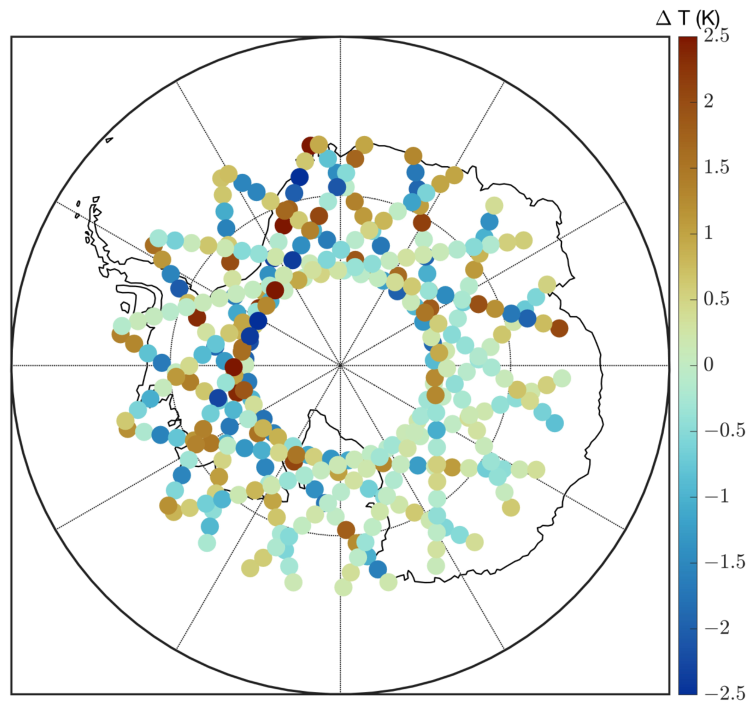
Figure 2.
Mean profiles of temperature standard deviation over the equator, northern polar region (NP: N - N), and southern polar region (SP: S - S). Winter and summer denotes to the months December, January, February or June, July, August. The averages are taken over the time interval January 2005 to December 2021.
Figure 2.
Mean profiles of temperature standard deviation over the equator, northern polar region (NP: N - N), and southern polar region (SP: S - S). Winter and summer denotes to the months December, January, February or June, July, August. The averages are taken over the time interval January 2005 to December 2021.
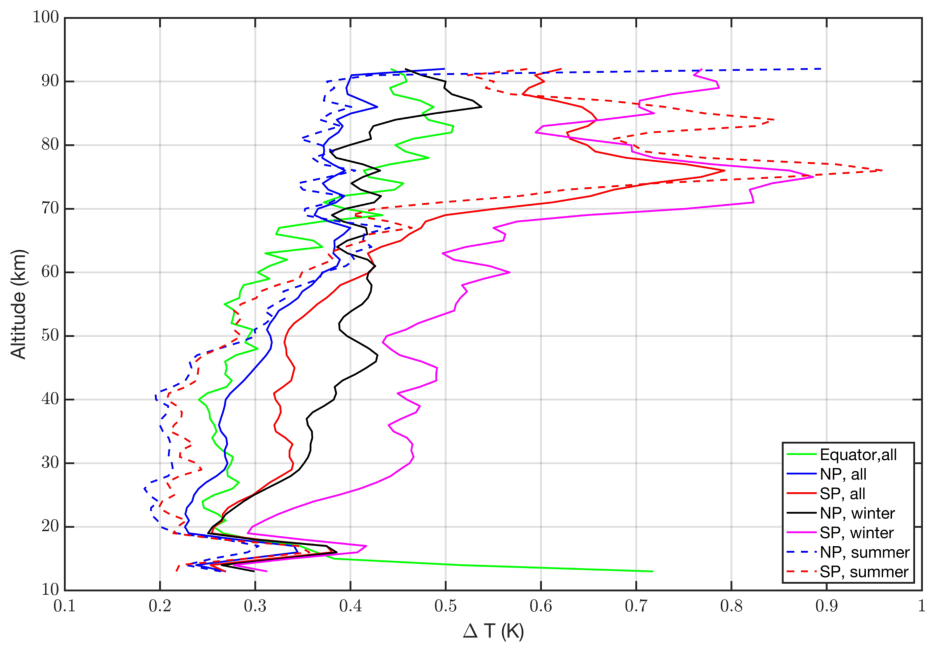
Figure 3.
Modulation of the gravity wave amplitude in the equatorial region (S to N) by the QBO (lower and middle stratosphere) and by the semiannual oscillation (SAO, upper stratosphere). The magenta and black contour lines denote easterly and westerly wind at Singapore respectively. Gravity waves are enhanced at the end of the easterly phase of the QBO at 25-30 km height.
Figure 3.
Modulation of the gravity wave amplitude in the equatorial region (S to N) by the QBO (lower and middle stratosphere) and by the semiannual oscillation (SAO, upper stratosphere). The magenta and black contour lines denote easterly and westerly wind at Singapore respectively. Gravity waves are enhanced at the end of the easterly phase of the QBO at 25-30 km height.
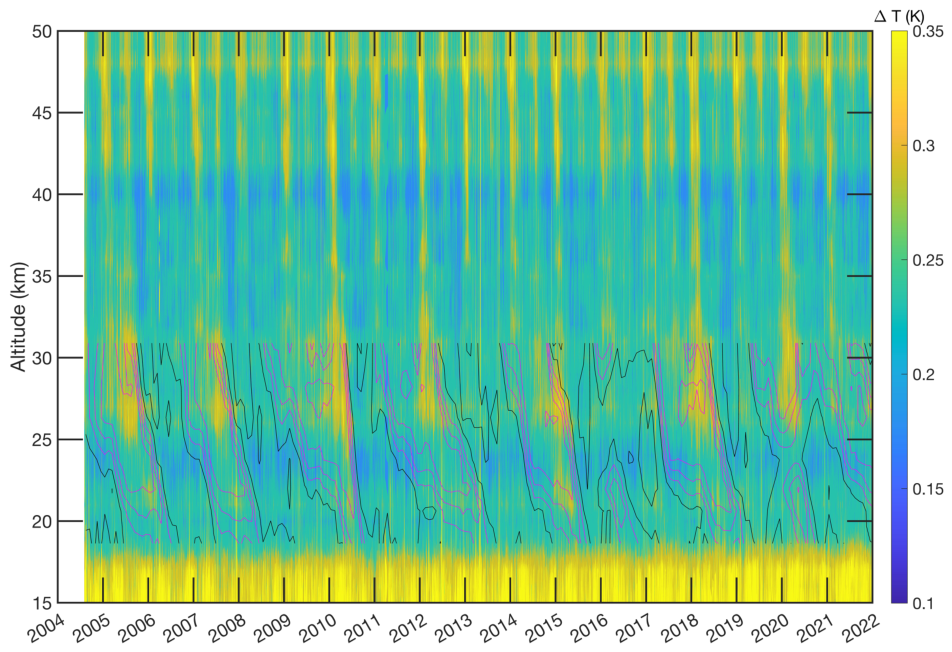
Figure 4.
FFT spectra showing the weak modulations of the gravity wave amplitudes in the equatorial region (S to N). The modulation periods are at 28 months (QBO, white dashed line), 1 year (AO) and 0.5 year (SAO). There is no QBO modulation of the gravity waves in the mesosphere.
Figure 4.
FFT spectra showing the weak modulations of the gravity wave amplitudes in the equatorial region (S to N). The modulation periods are at 28 months (QBO, white dashed line), 1 year (AO) and 0.5 year (SAO). There is no QBO modulation of the gravity waves in the mesosphere.
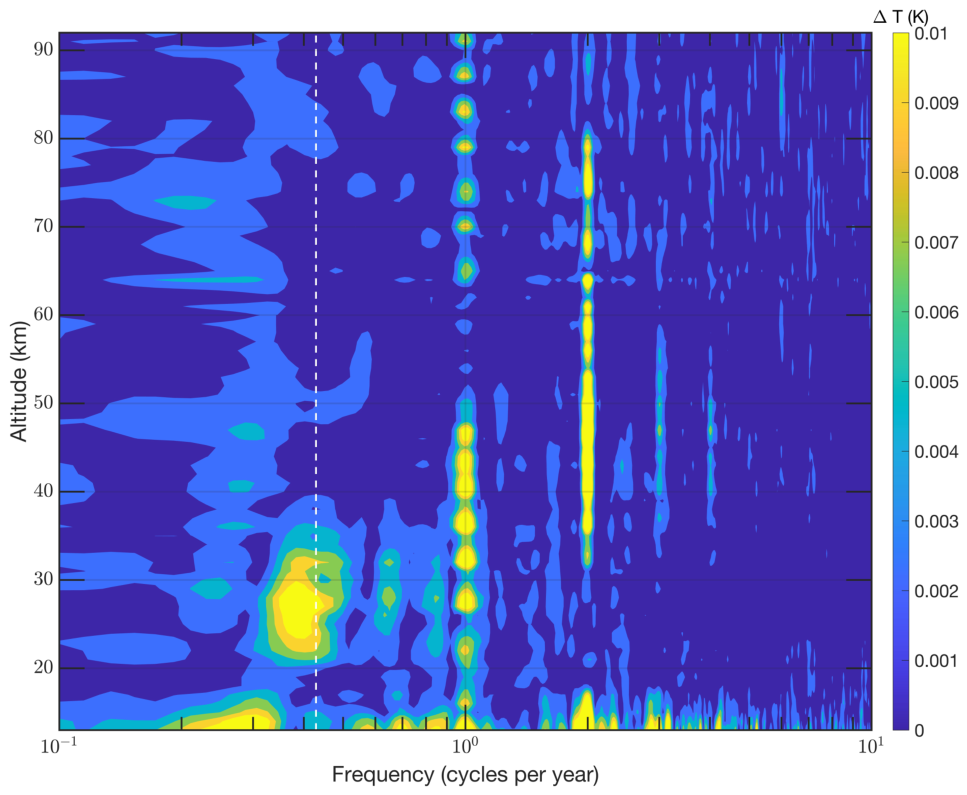
Figure 5.
Seasonal variation of the gravity wave amplitude in the equatorial region (S to N), averaged over the time interval from August 2004 to December 2021.
Figure 5.
Seasonal variation of the gravity wave amplitude in the equatorial region (S to N), averaged over the time interval from August 2004 to December 2021.
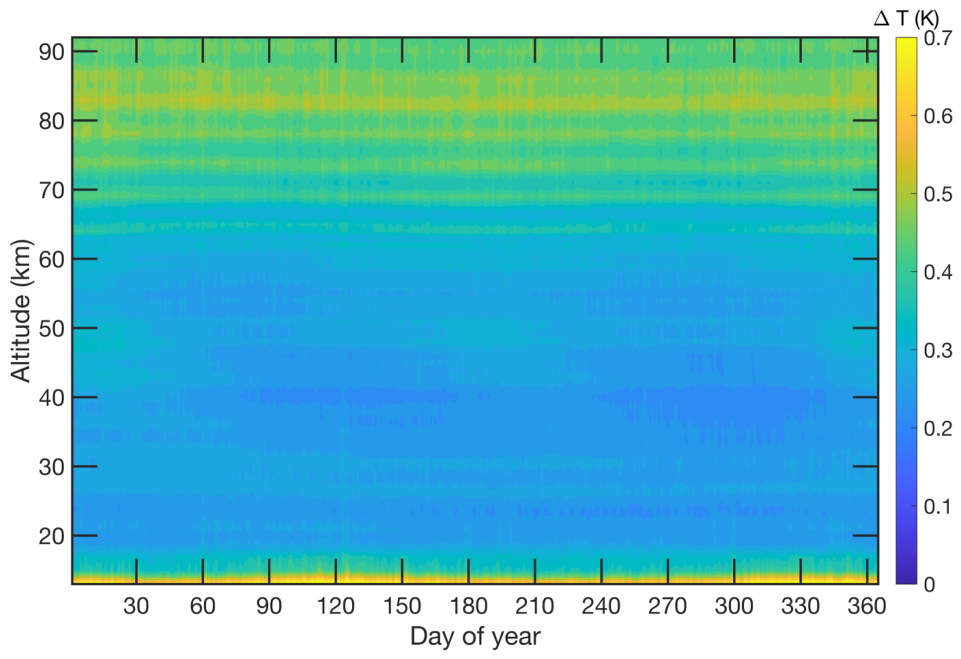
Figure 6.
Seasonal variation of the gravity wave amplitude in the northern polar region (N to N), averaged over the time interval from August 2004 to December 2021. Summer is from day of year 150 to 240.
Figure 6.
Seasonal variation of the gravity wave amplitude in the northern polar region (N to N), averaged over the time interval from August 2004 to December 2021. Summer is from day of year 150 to 240.
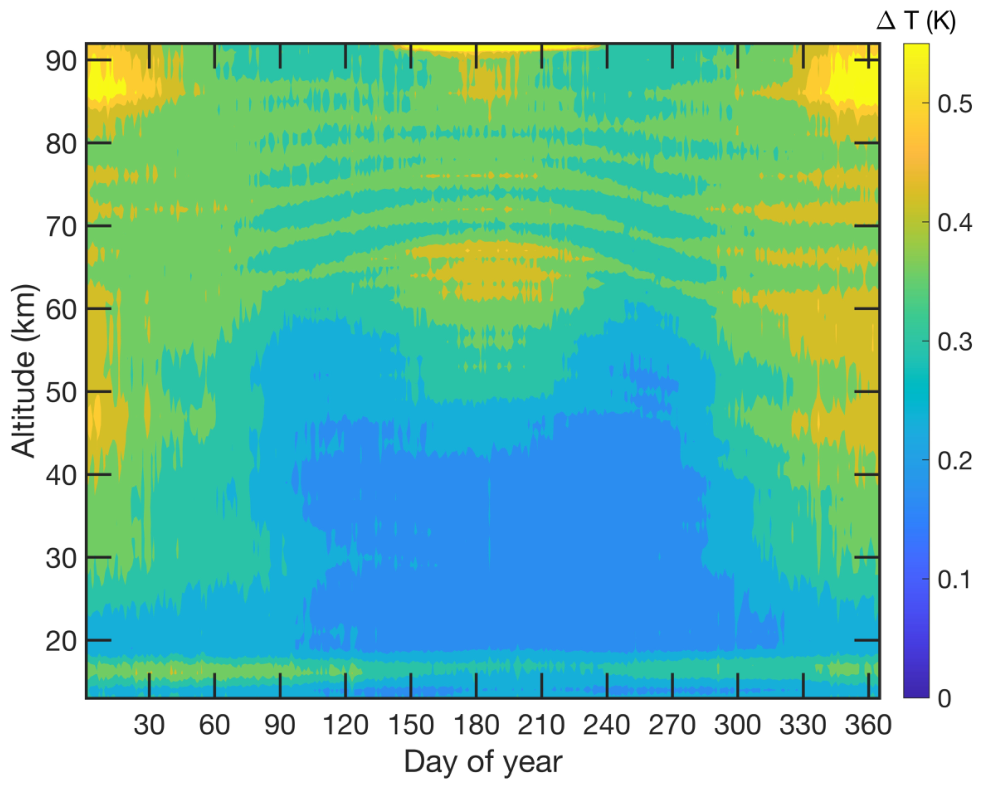
Figure 7.
Seasonal variation of the gravity wave amplitude in the southern polar region (S to S), averaged over the time interval from August 2004 to December 2021. Winter is from day of year 150 to 240.
Figure 7.
Seasonal variation of the gravity wave amplitude in the southern polar region (S to S), averaged over the time interval from August 2004 to December 2021. Winter is from day of year 150 to 240.
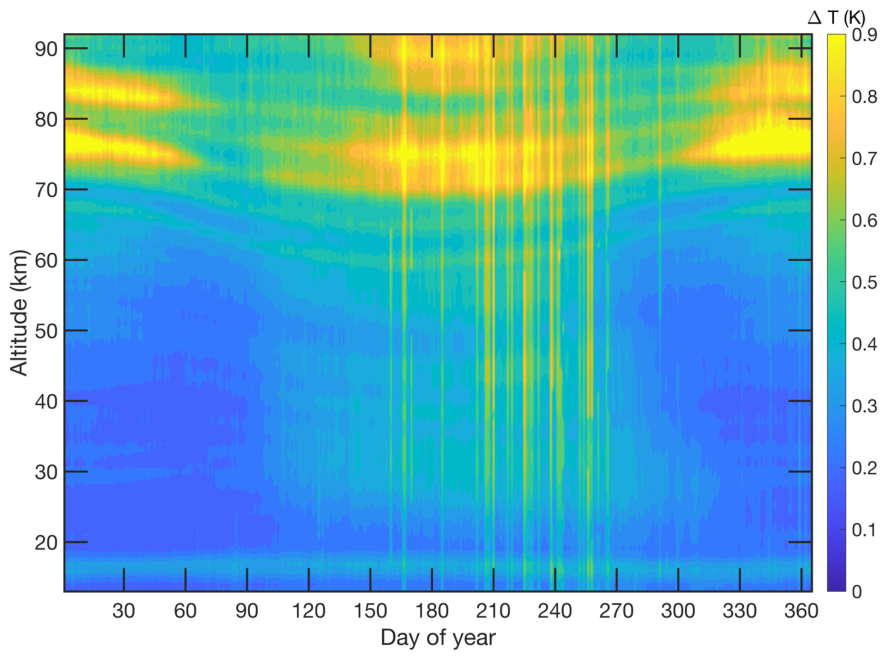
Figure 8.
Variation of the temperature fluctuation strength in the mesosphere over the southern polar region showing the double layer of enhanced gravity wave activity on 2 January 2009. The activity is strong at 77 km height (standard deviation is 1.27 K), then weak at 81km height and then strong again at 85 km height.
Figure 8.
Variation of the temperature fluctuation strength in the mesosphere over the southern polar region showing the double layer of enhanced gravity wave activity on 2 January 2009. The activity is strong at 77 km height (standard deviation is 1.27 K), then weak at 81km height and then strong again at 85 km height.
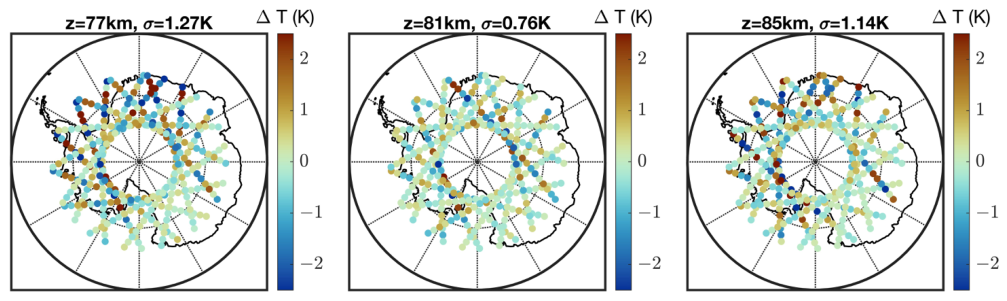
Figure 9.
Composite of gravity wave amplitudes in the northern polar region. The central date of the major stratospheric warming is at epoch time 0. In total, 10 SSW events are averaged.
Figure 9.
Composite of gravity wave amplitudes in the northern polar region. The central date of the major stratospheric warming is at epoch time 0. In total, 10 SSW events are averaged.
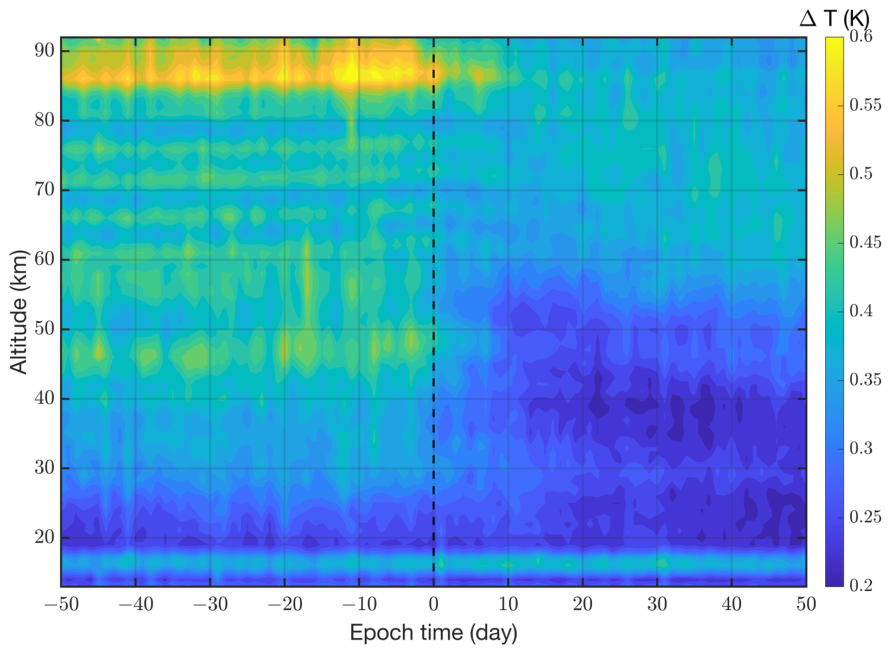

Table 1.
Central dates of the 10 major SSWs in the Northern Hemisphere from August 2004 to December 2021. The number in the bracket serves as identifier of the SSW event.
Table 1.
Central dates of the 10 major SSWs in the Northern Hemisphere from August 2004 to December 2021. The number in the bracket serves as identifier of the SSW event.
| 20060120 (1) | 20070224 (2) | 20080222 (3) | 20090124 (4) | 20100209 (5) |
| 20100323 (6) | 20130106 (7) | 20180211 (8) | 20190101 (9) | 20210104 (10) |
Disclaimer/Publisher’s Note: The statements, opinions and data contained in all publications are solely those of the individual author(s) and contributor(s) and not of MDPI and/or the editor(s). MDPI and/or the editor(s) disclaim responsibility for any injury to people or property resulting from any ideas, methods, instructions or products referred to in the content. |
© 2026 by the authors. Licensee MDPI, Basel, Switzerland. This article is an open access article distributed under the terms and conditions of the Creative Commons Attribution (CC BY) license (http://creativecommons.org/licenses/by/4.0/).
Copyright: This open access article is published under a Creative Commons CC BY 4.0 license, which permit the free download, distribution, and reuse, provided that the author and preprint are cited in any reuse.


